The purpose of history is less to explore the past than to illuminate the present. We value reading the Deuteronomic history – particularly 1st and 2nd Samuel, 1st and 2nd Kings for the way it casts a spotlight on issues of today.
The story so far. Having secretly anointed David as king, Samuel increasingly fades into the background as David emerges center stage. That David is now the real king remains a secret hiding in plain sight. Like most secrets hiding in plain sight, no one knows the secret while everyone recognizes that something has changed.
Last week’s OT lesson opened with David’s growing success on the battlefield. As David’s success grows – so Saul’s paranoia deepens. A moment of love at first sight threatens to complicate matters further.
Last week we heard that:
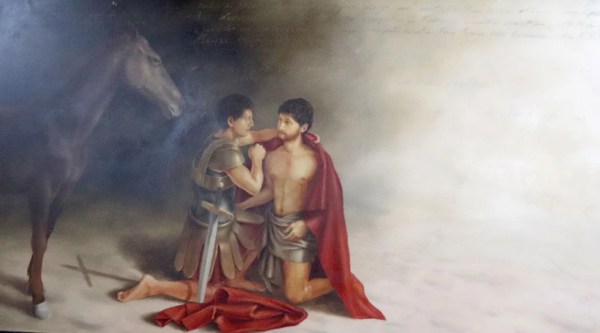
When David had finished speaking to Saul, the soul of Jonathan was bound to the soul of David, and Jonathan loved him as his own soul. Jonathan stripped himself of the robe he was wearing, and gave it to David, and his armor, and even his sword and his bow and his belt.
The process of intrapsychic resonance explains how two people become irresistibly drawn to one another across a crowded room before ever a word is spoken. This is a private moment of mutual intoxication – private that is until one of the parties walks up to the other and starts taking his clothes off. That’s the moment when others might notice something’s up.
Until death do us part is a phrase from the wedding service familiar to us. Even when used outside of the marriage ceremony it still implies a long-standing alliance or partnership between two people expected to last for their lifetime. The covenant between David and Jonathan is such a bond – forged between them until death will them part.
Today’s OT lesson opens with news of Jonathan and Saul’s deaths on Mt. Gilboa. As news reaches him, we witness the depths of David’s grief – as with the eloquence born only of grief’s devastation, David composes in the Song of the Bow – a love eulogy that he commands to be sung throughout Judah.
Your glory, O Israel, lies slain upon your high places! How the mighty have fallen. ….. Jonathan lies slain upon your high places. I am distressed for you, my brother Jonathan; greatly beloved were you to me; your love to me was wonderful, passing the love of women. How the mighty have fallen, and the weapons of war perished!
The synchronicity of reading the story of David and Jonathan as this year’s month-long international celebration of Pride winds down seems more than mere coincidence. For 21st-century ears, hearing the story of David and Jonathan spotlights two lines for contemporary inquiry.
The first line concerns issues of gender and sexual identity continuing to fuel our current culture wars raising the possibility of the question: was David and Jonathan’s love, homosexual?
In Pride month the temptation for some is to read the story of David and Jonathan in the vein of: ha, see, there were gay men in the Bible, after all. But being gay is not what this story is about. Homosexual identity – that is being homosexual is a modern concept that cannot be superimposed upon David and Jonathan who exist within their own psycho-cultural context. In other words, while there might have been a lot of sex between men in the ancient world – being gay was completely inconceivable.
By declaring that Jonathan’s love is a love beyond that of women – David is only acknowledging a cultural reality. While suitable as the bearers of children, women were inferior as persons because they were simply property. You don’t expect a piece of your property to be your soul companion. Consequently, in Israelite warrior culture, men sought one another to meet their emotional needs – whatever that may or may not have entailed in terms of sexual expression.
The second line of inquiry takes us in a different and more fruitful direction. Since the mid-20th century, anxiety about being homosexual has had a chilling effect on the dynamics of male friendship in Anglo-American culture. Before the 1950s we might be surprised to learn that despite the long history of anti-sodomy laws and periodic high-profile prosecutions, there was a wide latitude given for homosexual behavior because it remained simply an aberrant behavior largely hidden from the public eye.
From the late 1940s on – the older tolerance for homosexuality as a secretive and aberrant behavior among otherwise normal men is challenged by the promotion of homosexuality as a stable identity position along a continuum of human psycho-sexual development. The tragic paradox is that the growing recognition of a psychological theory of same-sex object choice – provoked a chilling effect on men’s capacity for emotional identification with one another within Anglo-American culture. It’s one thing to be a so-called normal person suspected of aberrant behavior. It’s quite another to be labeled as a homosexual.
The Church also jumped on the backlash bandwagon. In the new psychological explanation of homosexuality as a state of being, the Church found a new justification for the tradition’s ambivalence of being hostile to homosexual expression while at the same time remaining obsessed with it. What had always been regarded as aberrant (sinful) behavior subject to repentance, now becomes a state of disordered nature – giving rise to the invidious expression love the sinner but hate the sin.
The recent TV miniseries Fellow Travelers is a deeply moving serialization of the novel by Thomas Mallon – set at the height of the McCarthy witch-hunt for the practitioners of un-American activities. Alongside the rooting out of so-called communists in the Red Scare – in the Lavender Scare McCarthy aided by the infamous Roy Cohn – a closeted and repressed homosexual himself hunted persons who could be accused of being homosexual. Thousands of careers in government, academia, and entertainment were destroyed – driving many of the accused to suicide. In the spirit of the time being homosexual became an embodiment of the most un-American activity of all.
In men’s social formation just being emotionally sensitive became a source of considerable anxiety. Through injunctions such as boys don’t cry, don’t be a sissy, be a man – boys learned early on to equate emotional sensitivity with vulnerability. Who among men is the most vulnerable? The worst slur on the playground among boys became you’re a homo!
There’s a further paradox – that as societal acceptance of same-sexuality has greatly increased over the period from 1970 onwards – now resulting in the legal recognition and wider social acceptance of same-sex relations – men’s capacity for male friendship has continued to decline to the point today where many men report having few if any committed male friendships at all.
Equating male emotional sensitivity with signs of homosexuality has resulted not only in a chilling effect on men’s capacity to form male friendships but it’s also had knock-on effects on relations between the sexes.
By declaring that Jonathan’s love is a love beyond that of women – David is simply acknowledging that it is inconceivable that a woman could be an emotional partner equal to the degree that Jonathan was for him. This is in sharp contrast with the situation today – where the loss of men’s capacity to form male friendships has resulted in their wives becoming their primary and often exclusive source of emotional connection.
Avrum Weiss writing in the November 2021 Psychology Today notes the Saturday Night Live sketch titled “Man Park.” In the sketch, a young man waits anxiously for his partner to return from work. He has few if any friends and has had little social interaction all day. She listens, barely managing to feign interest in his data dump about the series of banal events of his day. As is often the case in heterosexual relationships, she reverts to the role of mommy, exhorting her partner to go outside and play with his friends. When he protests that he has no friends, she takes him by the hand as she would a little boy and walks him to the “Man Park” to play with the other men. The men approach each other awkwardly, unsure of how to make a friend, while the women patronizingly urge them on.
When I arrived in 2014, I observed the women of the parish easily creating experiences for mutual solidarity and support – enjoying the fruits of friendship with one another. Not so among the men. Except for a small selective group aptly named Band of Brothers, there was no wider-inclusive men’s group activity dedicated to the fostering of men’s friendship and emotional connection with one another.
This was a situation we have worked hard to change. With the aptly named Gander – as in the male goose – we have created an umbrella beneath which men’s lunch, writing, and reading-discussion groups now flourish – strengthening emotional solidarity between male group members. I recently noted with some satisfaction – that at a point of personal crisis, one man reached out for and received considerable emotional support from other group members. I see this as a fruit of men directly caring for one another – beyond the normal experience of men meeting only to talk about something other than the state of their emotional lives.
The story of David and Jonathan focuses a spotlight on contemporary men’s issues. Its message for us is not – ha, see, there were gay men in the Bible after all! The story of David and Jonathan highlights the contemporary problem of male isolation and loneliness – a problem with wider ramifications for the nature of relationships not only between men but between men and women in contemporary social life. It clarifies a need to create spaces for activities to facilitate men’s interests in one another. Spaces that facilitate men recognizing each other as emotional beings with emotional needs that can best be met in mutual friendship. At St Martin’s – among St Martin’s men, facing up to the tendency of men’s isolation is being thankfully, taken to heart.

 Relationalrealities