There is no time like the present

The only certainty in life is change. Opportunities arise, and challenges are confronted—some overcome, and others accommodated as we learn to live with what we cannot control. The other great certainty in life is the passing of time. Time passes, memories accrue, future expectations arise, while present-time successes are celebrated, and disappointments are weathered.

The future is unpredictable because however we imagine it, the sorry truth is we just don’t know what it will bring. Uncertainty leads us to hold two conflicting illusions at the same moment—that change can be resisted by turning back the clock and that time flows only in one direction, from past to future, and not the other way around. Advent is a season for the contemplation of change – signifying God’s intrusion, disrupting the smooth running of our broken world by playing fast and loose with the linear flow of time. Advent’s message speaks of new beginnings and ultimate endings in the same breath. Only in the depiction of the ending is the deeper meaning of the beginning revealed.

In a recent piece for Christian Century, Brian Bantum noted the difference between our experience of time and God’s—the feeling of being stretched between past, present, and future—akin to singing a song where the words we’ve just sung are still in our mind as we sing new words in the moment—anticipating the words still to come.

Bantum notes that we live in a current of time that flows like a great river of being within God’s life. For us, time is segmented and linear. For God, past, present, and future could be imagined as braided together, flowing like drops moving and twisting in a river.

Advent Sunday in 2024 coincides with the commemoration of Nicholas Ferrar, who, in 1625, in a place called Little Gidding – a tiny hamlet on his family estates in Huntingdonshire northeast of Cambridge – formed a small religious community centred on a disciplined life of prayer, work, and pastoral care modelled on the liturgical heart of the daily offices in the Book of Common Prayer. In 1941, the poet T.S. Eliot – in the depths of war-time winter, made a pilgrimage to the church at Little Gidding with the memory of Ferrar’s brave little community very much in mind.

In the final quartet, Eliot reflected on this visit, appropriately titled Little Gidding of his Four Quartets. Here, he articulates the multidirectional interplay of past, present, and future. He challenges the notion of time as only linear, with a single flow of direction flowing from the past to the future. For example, he wrote, We shall not cease from exploration/ And the end of all our exploring will be to arrive where we started/ And know the place for the first time.

If the past is memory and the future expectation, the present time is opportunity. Advent, if seen as only a future-oriented expectation, runs the risk of consigning the present to a period of passive waiting for the real action to begin. Advent becomes rather like sitting in the cinema, playing with our phones as the ads and previews play – distractedly anticipating the imminent arrival of the main feature. Seen like this, Advent becomes a period of marking time – a season marked by passivity – as the possibility and opportunity pass us by unnoticed. Future-oriented expectation has only one purpose – that is to guide and shape the actions we are called upon to take now.

There’s that time-honoured saying most recently placed in the mouth of Sonny, the manager of the Exotic Marigold Hotel – when seeking to offer reassurance, he says that everything will be OK in the end—if it’s not OK now, that means it’s not yet the end.

But Sonny’s advice is a false comfort. Today, things are not OK – in fact, things are very far from being OK in our world!  We wait passively – enduring the evils around us in the reassurance that things will all work out in the end? We look toward future expectations while missing the more important question of what do we need to be doing now? If we wait for our future expectations to come to realization we miss the point of them because the purpose of our vision of the future is to guide and energize our actions in the present. Our expectation of the future is realised in our actions in the present time.

Jeremiah predicts the fulfilment of God’s promises as future event. The past becomes realized only as future fulfilment. In projecting the past into the future like this, he seems to leapfrog the present. But perhaps this is understandable. The Babylonians are at the gates of Jerusalem. Destruction and exile seem the most likely outcomes, and maybe Jeremiah can be excused for skipping over the present – facing an impending catastrophe, there is nothing to be done. Yet, although not recorded in this passage, Jeremiah does have a sense of the importance of present-time action. Imprisoned in the palace guard room as the hostile army masses at the city gates – he instructs his scribe to exercise a purchase option on a piece of family land. Amidst the impotence of crisis – Jeremiah still believes in a future he will not live to see. The purchase of land he will not live to enjoy is still planting a marker of resistance to fate in the earth.

In Luke 21:25-36 Jesus shows us a vision of the ultimate fulfilment of the journey that must begin with his birth. Despite predictions of fear and woe – in the parable of the fig tree, he draws our attention away from future speculation to the necessity to act now. The fig tree’s leafing is not a future expectation of summer to be passively awaited but a recognition that summer has already arrived, demanding an action response now. The intrusion of God’s kingdom is already here. It’s now time to act.

Advent is a time for the expectation of things to come as an inspiration to plant in the present time the seeds that will one day mature into our future hope. Advent means consciously rejecting the self-protective foreboding and striking out with courage to boldly embody our future expectations because they are already effective within us.

In memory and imagination, time flows back and forth. Past mistakes are mitigated by present-time action. Future expectation – while still only potential becomes realized not in waiting but through action in the here and now shaped by the anticipation of its arrival.

The novelist Alice Walker wrote we are the ones we have been waiting for. My question to us this Advent is – are we not already the people we have been waiting to become?
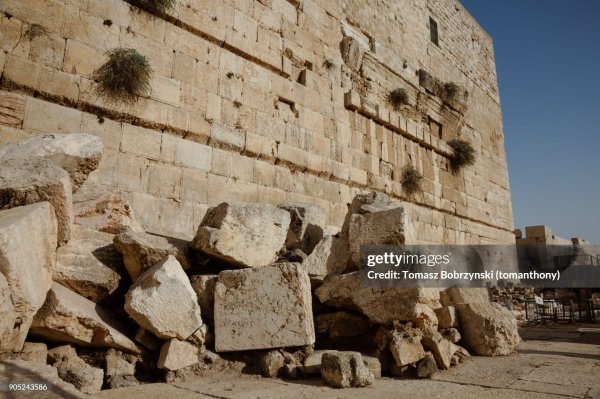
Temple Stones

The Photo shows stones from the Second Temple in Jerusalem thrown by the Romans who destroyed the city in the 1st century AD. Robinson’s Arch is visible above the Herodian street in the southwestern corner of the Temple Mount. It was named after scholar Edward Robinson who discovered it. The arch supported a large staircase which was buit by Herod the Great as part of the expansion of the Temple Mount. Ophel Archaeological Park. GPS: N31.77580°, E35.23594°.

Note on the recording: the recording from No one wants this that comes towards the end of this recording is garbled but you can hear the clear version below in the text.

It is not an exaggeration- though it may come as a surprise to some when I say that the Roman destruction of the Second Temple in 70AD was a seismic event – the shock waves from which continue to ricochet down the historical timeline. In the Jewish Revolt from 68-70AD, the Romans laid waste across the Jewish homeland in town and countryside – culminating in the catastrophe of the Temple’s destruction along with much of Jerusalem around it.

It’s interesting to speculate had the Temple continued as the national and religious center of Jewish life might the subsequent course of Jewish-Christian relations have followed a different trajectory? If the Jews had not been forced into diaspora by Roman devastation of town and countryside – becoming the perpetually resented other at the heart of Christian Europe – might the long and sorrowful history of antisemitism have been avoided?

Imagine, no antisemitism, no Holocaust, no need for the Zionist project and the creation of a Jewish state – no Nakba expulsion of Palestinians from their historic lands -no Jewish-Israeli Arab conflict – no Intifada – no Gaza or West Bank – no denial of Palestinian statehood through military occupation and illegal settlements. What if there had continued an evolution of Jewish life in the biblical homeland whatever the wider imperial superstructure of the region. What if no post-1914 British and French power grab – drawing impossible nation-state borderlines in the sand. Instead, imagine a collage of Jewish and Arab communities living side by side – enjoying the same rights and freedoms of religious and community expression in contrast with the drawing of sharp ethnic divisions between Jewish and Arab identities. As with all alternative visions of history, we can only dream.

For fledgling Christianity, the destruction of the Temple was also a seminal event reshaping early Christian memories of Jesus and redefining the subsequent development of post-Temple Jewish-Christian rivalries as the early Church and Rabbinic movements vied for supremacy in an increasingly hostile race for the heart and soul of post-Temple religious reconstruction.

For Mark, writing around 70AD, the destruction of the Temple is a contemporaneous event of such significance that surely Jesus must have prophetically predicted it 40 years before it came to pass. In service of the theological purpose of his narrative – Mark, therefore, puts words into Jesus’ mouth – establishing a long gospel tradition of projecting late 1st and 2nd-century Christian-Jewish tensions into Jesus’ relations with the Pharisees and other Jewish sects in the early 1st-century Jewish homeland.

In chapter 13, Mark presents Jesus after several days teaching his disciples in the Temple precincts. Mark records him leaving the Temple with his disciples – one of whom remarks on the massive stones in the Temple’s construction. Even with our contemporary engineering capabilities the construction of Herod’s great Second Temple is still awe-inspiring. Standing before the Wailing Wall we can still imagine the size of the original Temple Mount platform upon which the Muslim Dome of the Rock now stands. Jesus responds with a prophecy that not one stone shall remain upon another – for all will be thrown down. Mark makes no mention here of Jesus’ claim to rebuild the ruined Temple in three days. We need to wait for John to embellish his version of Mark’s story in 2:19 with this detail.

On the Mount of Olives facing the Temple Mount across the Kidron Valley, his disciples ask for clarification on when his prophecy of the Temple’s destruction will happen. Jesus avoids the direct question and begins to warn them about the dangers of mis and disinformation campaigns that will sow the seeds of confusion – seducing many and leading them astray by false claims of leadership in his name. He warns them not to be alarmed by news of conflict and rumors of wars – such will be necessary to herald a true vision capable of taking them into the future. But for the future to arrive it must begin in the painful stage of birthing that must first destroy the familiar patterns of life as they knew it.

Jesus in Mark 13 is presented as laying out his eschatological vision. Eschatology is theology of expectation that constructs a sweeping view of events that will mark the end of the present age in preparation for an end time. In chapter 13 Mark reminds the first Christians that Jesus’ conception of Messiahship begins not in a triumph in the present age but in a series of events of impending disaster culminating in his eventual triumphal coming again at the end of time as judge and savior of the whole world. But first, the kingdom of God must be born through a process marked by great convulsions and upheavals heralding the arrival of the end time.

When you hear of wars and rumors of wars, do not be alarmed; This must take place, but the end is still to come. For nation will rise against nation, and Kingdom against Kingdom; there will be earthquakes in various places; there will be famines. This is but the beginning of the birth pangs.

Christians throughout history have associated major convulsion and upheaval in the socio-political and economic fabric as heralding the imminence of the end time.  Yet for most of us whose lives have been lived in the peace and predictability of the post-1945 Pax Americana – an expectation of the end time has been confined to millenarian sects while the rest of us accepted that the world – as we experienced it – had now come of age  – marked by a time of social and scientific progress accompanied by the steady growth of economic prosperity.

Yet, we now awake to find ourselves in a world where war and rumor of wars disrupt our sleep. A world in which many are being led astray by the dark arts of dis and misinformation – perpetrated by foreign actors and aided and abetted by the charlatans of the political class who have no interest other than the accumulation of power beyond limit.

The last four years of the Biden Administration may well be seen in the rearview mirror of history as that last gasp of a world we grew up to expect. From now on things are going to be markedly different.

Last week Bishop Nicholas commented on the recent election results suggesting we don’t yet know what any of this means. Well, maybe?  What is clear is that a majority of voters voted for change. Motives for doing so seem mixed with no clear vision for what change will look like. It’s the time and tested response – of repeating failed choices in the hope of a different result.

As a scientist, Bishop Nicholas in essence reframed the gist of Jesus’ words in Mark 13 with the scientific observation of large systems transitioning from one stable phase to another. He commented that as it nears that point of change, fluctuations in a system become larger and more frequent. This is why water gets cloudy before it freezes or boils—the fluctuations signal that a significant change is coming. In our current political system, the jury’s still out on whether the direction of change is towards freezing or boiling.

Beyond endless analysis of what has now happened the more pressing question is – so how will we weather the convulsions and upheavals of the large socio-political paradigm change that is upon us?

Reading Mark 13 our attention is captured by the dire nature of Jesus predictions – because they mirror the instabilities we are now experiencing. Adding to the socio-political instabilities we should not fail to note instability in the largest system of all – the environment of the planet. Thus we are likely to miss the line where Jesus tells us not to be alarmed by the process that must take place – a process he identified as the beginning of the birth pangs. What are birth pangs other than the signal that new life is on the way?

In the Netflix romcom, Nobody Wants This – a sexy, youngish rabbi and his remarkably godless gentile girlfriend find themselves in a restaurant talking about the meaning of Shabbat. Listen

Buildings – and the systems they represent – may crumble – but that doesn’t matter – what matters is gathering with people we care about and who care for us. In the time that is upon us – solidarity, caring for one another in communities of solidarity and support – together sheltering within the protection of belonging – this has always been for Christians – and is now for us – the best survival strategy for enduring the birth pangs that will in the end result in the arrival of new birth.  This is Jesus’ message to us about the promises of God – and God is always faithful.

Today I will lick my wounds

A friend happened upon these words by Bob Martin. I don’t know who he is but his words captured my feelings on this dark day of the morning after.

Today, I Will Lick My Wounds
Bob Martin

Today, I will lick my wounds
and feel the deep ache of losing not just candidates,
but a way of life I thought I understood.
Everything feels distant, unfamiliar—
as though I’ve awoken in someone else’s country.
The urge to disappear presses down on me,
a heavy fog that whispers,
“Quit. Hibernate. Let the world move on without you.”

But I think of Frankl in the camps,
Mandela in his cell,
the Dalai Lama without a homeland,
Anne Frank dreaming of skies beyond her attic walls.
They refused to let the world steal their happiness,
refused to let suffering define their spirit.

I remind myself:
No decisions in this state of mind.
Just a breath,
then another.
Today, I rest and gather strength,
for tomorrow, I teach.

I have my practice—
a sanctuary built in the tolerance of discomfort,
and twelve bright souls,
who depend on me to rise.
For them, I will stand in front of the class,
share what I know,
and keep moving forward.

I will not let this darkness take more than it already has.
I will survive.
I will teach.
I will find, somehow, a way to be at peace
even when my country does not feel like my own.

The path is uncertain, but it is still mine to walk.

Blog at WordPress.com.

Up ↑