No Cheap Grace

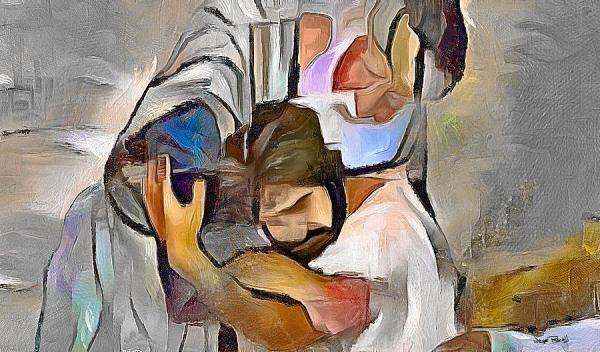
The parable of the Prodigal Son occurs only in Luke. Among all Jesus’ parables in Luke this one captures the singular tone of Luke’s humanistic presentation of Jesus.

In 2013, in a sermon on this text titled A Punch to the Gut, I drew out the parallels between Luke’s parable of the prodigal and Hogarth’s 18th century series of drawings in  A Rake’s Progress – chronicling a young man’s unravelling from fashionable young buck- about-London-town – newly come into his inheritance – to that of a broken man – destitute and driven mad with syphilis he’s incarcerated in the famous Bedlam hospital where along with the other inmates he becomes an object of curiosity for the fashionable of the day who loved to gape at the inmates as if they were animals in a zoo.

A fun fact is that the first hospice for the mad was dedicated in 1267 as the Priory of St Mary of Bethlehem at London’s Moorgate. During the reign of Henry VIII, the priory was dissolved and reestablished by royal charter as the Bethlem Royal Hospital – where I served as chaplain for 18 years. In the 17th century, the name Bedlam – a popular derivation of Bethlem became a synonym for chaos and madness and which today remains in common use.

In 2013 I focused on the destuctive narcissism of the young man as psychologically illustrative of the process Luke describes in his parable of the prodigal son. Then I wrote of the younger son seeing other people and situations as simply an extension of his own wants and desires. He cares little for his father, or brother, nor for the women he consorts with. They are simply the momentary extensions of his own wishes- needs, and to him have no life independent of what and who he needs them to fulfill his desires. At the lowest ebb of his life, is it the emergence of sorrow and repentance that reminds him of his father’s love, or is it his narcissistic expectation that his father will once again meet his needs regardless of his actions? Such a myopic psychological analysis seems a rather indulgent luxury when viewed from preaching demands in these more turbulant times.

Today I’m more conscious of the parable’s multilayered complexity. It’s a story as much about the elder son as the younger – as much about the father as either of the sons. Taking Luke’s parable as the parable of a loving father – provides a different starting point for my reflection on the text today.

Who among us does not know the experience of a wayward child? If that is too strong an expression at least many of us will know the pain and concern felt when our children begin to chart courses in life very different from the ones we had anticipated for them – making decisions we would have wished they made differently.

Luke sketches out the scene as Jesus leaves the synagogue where he’s been engaged in a long discussion with the Pharisees following the Shabbat service. As he comes out into the street, he’s mobbed by a crowd who had been loitering with intent to waylay the teacher outside the synagogue doors. In describing them as tax collectors and sinners, Luke is drawing our attention to the fact that these are the ritually unclean, those who would not have been allowed through the synagogue’s doors. Unable to listen to Jesus’ debate with the Pharisees inside, they are eager to hear him nevertheless. The Pharisees, following Jesus out into the street begin to grumble behind him about the shameful way Jesus is mixing with the ritually unclean. Clearly aware of their grumbling he begins to tell everyone this parable: There was a man who had two sons —. .

We can’t know with any certainty what ending the crowd outside the synagogue – both the virtuous pharisees and the ritually unclean expected from this parable. But we do know how subsequent interpretations have sought to reduce it to a rather simplistic morality tale about the wages of sin with strong patriarchal themes of judgment about sex with prostitutes, disobedience to fathers, and the wages of sin contrasted with the importance of duty. The younger son, in following his hedonistic desires, comes -predictably – to a sticky end. When hard times overwhelm him, he is forced to humiliate himself by going back home with his tail between his legs to beg his father’s forgiveness. You can hear the tut tutting down 2000 years of interpretation – be this a lesson for all you rebellious sons.

Both moralistic and psychological interpretations of the text focus on the motivation of the younger son, ignoring both the responses of his elder brother and his father.  What about the elder son’s reactions to his brother’s return? What about the father’s inexplicable pining for his profligate son’s return? Both challenge the traditional worldview of this parable as a morality tale.

This parable offends against the traditions that emphasize the virtues of obedience and duty to strict fatherly rule and the honoring of the firstborn over the younger. It challenges the virtues of blind filial duty. It skirts over being dutiful and hard working on the family estate seems to have bred in the elder son only a deep sense grievance – an envious resentment of his brother and a disparaging contempt for his father. In confronting his father, he refers to his brother not as my brother but as this son of yours – aptly articulating his anger towards both.

The traditional reading of this story is likewise conflicted on how to picture the father – whose indulgent generosity flies in the face of conventional inheritance custom. His willingness to take back his son – failing to hold him to account for his profligate ways smacks of more than a little moral weakness if not an indulgence dangerous to hierarchical moral order.

Reading this story through the filter of patriarchal relations has been one of the two main ways this parable is favoured by tradition.  The other has been to read it through the filter of antisemitism. The father is God. The elder son represents the Jews. and the younger son, the Christians. We can all see where this reading is headed.

But if Jesus were standing in this pulpit, orienting himself to our 21st century mindset he might ask so who do you identify with in this story? This is not simply a question for us as individuals – it has wider social-relation implications. As middle-class folk, dutiful, obedient, hardworking, and schooled in the virtues of delayed gratification, I imagine few of us identify with the headstrong younger son and his deeply narcissistic and self-destructive choices.

Reading the story through the lens of the prodigal son simply confirms our moral judgment of him as selfish and irresponsible – or a psychological interpretation of him as emotionally and psychologically immature. Both comfortably distance us from him and his choices. Reading the story through the lens of the elder son is likely to evoke more sympathy in us. We easily identify with his feelings and reactions – for who among us has not had an experience of being passed over in preference to another. However, it’s when we read this parable through the lens of the father – in other words, hearing the parable through the filter of his feelings and responses that we discover our disapproval of his indulgent, seemingly uncritical and nonjudgmental welcoming of his son’s return. He not only fails to call his son to account but throws caution and financial prudence to the winds – giving completely the wrong signal by appearing to reward bad behavior with a lavish party.

We can’t know how his 1st-century hearers, thronging the road outside the synagogue, expected this story to end. Yet for us today, the parable certainly carries a sting in its tail. We can be clear that Jesus is primarily painting a picture of God as a noncritical and non-judgmental father. God is recklessly generous, failing to discriminate between the worthy and unworthy as recipients of his love. God is a vigilant father whose is by his nature compelled to keep a watchful vigil in the hope of his wayward children’s return. Jesus paints a picture of God as a shockingly indulgent father who treats our return as the occasion for a wild celebration of new life – for his son who was as good as dead and has now come back to life – lost and now found..

The question remains, however, how does this picture of God leave us feeling? We may be happy to imagine ourselves as the recipients of such reckless generosity. But as a model for us to emulate towards anyone who has the power to hurt and disappoint us – we might feel some ambivalence.

Like all of Jesus’ parables, it operates at two levels. In the setting of its telling – the street outside the synagogue – the Pharisees can be depicted as the sincerely religious – men of real integrity and longing to know and love God more. Yet, their ability to be sincere in their spiritual quest is a product of their privileged social and economic status. In debate with Jesus, they are intrigued but remain cautious for being the privileged; they feel that they have much to lose. They want to know what the right path is before they commit to following it. Contrastingly, it’s those whose occupation or lack of one excludes them from among the company of the righteous – who have nothing to lose and who seem open to, and excited by, the invitation implicit in this parable.

We don’t know if the elder son did eventually swallow his hurt pride and join the feast – the parable leaves us with this possibility, for the father’s invitation is open-ended.

Although the parable does not have a clear concluding moral message, it nevertheless has a rub that chafes. The rub is – grace is never free. Oh, it’s offered freely by God and there is no pre-qualification required to receive its invitation. The offer is free, but the acceptance is costly. Identifying with the elder son – what would it cost us to relinquish our resentment and go into the feast? If we can identify with the younger son – what would it cost us to return home, humiliated?

The younger son knows that the grace of the father’s undying love is costly. Both the Pharisees and the tax collectors know that grace is costly. For the Pharisee, it’s costly to give up a presumption of righteousness. For the socially marginalized and religiously excluded, grace comes at the cost of lives of humiliation.

Like the father in this parable, who among us does not know the cost of unconditional, nonjudgmental love? Who among us has not suffered the pain of watching our children chart different life trajectories that either lead to painful and unsuccessful outcomes or hurt us in their rejection of our values and assumptions? We know that, like God’s grace, our love is not free; it exacts its own cost.
2025

Becoming open to the new – now there’s a counter-cultural proposition if ever there was one. Landscapes change, challenging us to take our values, principles, and beliefs with us as we find our bearings in a new and unfamiliar landscape.

The story of the call of Moses, as we receive it in Exodus 3, is the work of the Deuteronomist scribes of the Babylonian captivity following Jerusalem’s fall and the Temple’s sacking in 586 BC. The seven decades of the Babylonian captivity confronted the Jewish exiles with the challenge of rebuilding a sense of national and religious identity in a dramatically changed landscape. Soul searching for the meaning of events that had befallen them required them to confront the painful question- had God abandoned them in their captivity? In search of an answer, the scribes returned to their stories of national and religious origin. The fruit of this exploration emerged as the book of Exodus. Returning to the stories of national origin, the Jews of the captivity found meaning in present-time events and imagined a new future in restoring national identity.

As we find in Exodus 3, the story of the call of Moses is a reassembling from the fragments of oral folk memory. Many Bible stories – particularly origin stories follow this method. Remembering has less to do with reviving an old tale than with forging a new one.

As we receive the story of the call of Moses, we note the relationship between the time in which the story is set, around 1500 BC, and the circumstances at the later period of composition between 586 and 539 BC. As I’ve just noted, projecting present-time themes back into the past is a tried-and-true method biblical writers used when it was not always safe to be transparent. It’s not only biblical writers who employ this method. Shakespeare’s history plays covering the period from 1399 – 1485 purport to chronicle the rulers and events between these years. Yet, what we see portrayed in his history plays is a picture of Elizabethan and Jacobean society’s politics, entertainment, and social situations, safely projected into the medieval period. In this way, Shakespeare commented on current events without risking losing his head – literally. The purpose of remembering has less to do with reviving an old story than with forging a new one.

The call of Moses is a multilayered story about the struggle to hold onto cultural identity during a period of national catastrophe. There is an overarching narrative linking later issues of exile with an earlier period of captivity. However, within the narrative, events become powerfully instructional. Within the story, we discover the importance of curiosity, the importance of paying attention to peripheral vision, the oscillation between forgetting and remembering, the location of divine encounter as in the place where God meets us, and the struggle to find the courage to respond to God’s call.

Curiosity and the importance of peripheral vision. The story opens with Moses shepherding his father-in-law’s sheep for fresh pasture. Walking along a familiar track, he should have focused on what lay directly ahead of him. However, he becomes distracted when his curiosity is aroused by something he sees flickering in his peripheral vision – glimpsed, as we might say, out of the corner of his eye.

Isn’t this often the way of things. It’s not what appears to be most evident that we need to pay attention to but what we glimpse – caught out of the corner of our eye. Don’t we love those detective stories in which a witness being questioned about the details of the crime remembers something crucial in solving the case? At first, they claim not to have seen anything important. Yet, through painstaking detective prompting – bit by bit, their memory is unlocked, revealing something recorded by their peripheral vision.

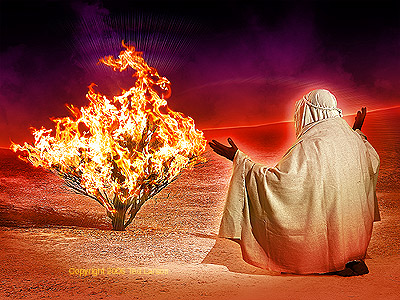
Moses detours from his beaten path to better view this fantastic sight of a bush burning without being consumed. As he approaches the burning bush, he hears a voice calling from the heart of the flames: Moses, remove your shoes, for you are about to enter holy ground. He does so and encounters that which will change the trajectory of his life – propelling him onto a new path toward his still-to-emerge life’s purpose.

Forgetting and remembering. Reading between the lines, we are surprised that Moses does not know the god who addressed him. In declaring that he is the God of his fathers, God jogs the collective memory fragments of Moses’ Hebrew identity. Remember, Moses was raised as an Egyptian. The reason he wanders around leading someone else’s sheep is because of the conflict between his Egyptian and Hebrew identities that eventually forces him into exile. Forgetting and remembering – the relationship of the past to the future – become the pivotal themes in the conversation between Moses and God.

God does not waste time after the introductions are over in declaring the purpose he has in mind for Moses. God is asking Moses to return to Egypt to remind the people that the god whom they have forgotten – has not forgotten them. For the hearers of the story in Babylon, this was a reminder that even as they were in danger of forgetting God, God would not forget them.

The place of encounter. Moses is leading his father-in-law’s flock through a landscape described as a place beyond the wilderness. The incurious among us might miss the significance of this description by simply picturing Moses walking through an arid desert landscape – in other words, a wilderness. But he’s not walking through a wilderness- he’s walking into a landscape beyond the wilderness – a description that implies entering a changed landscape – one beyond previous experience – devoid of recognizable signposts.

Moses is tasked with reintroducing God to the Hebrews and, in so doing, conveying a message of hope to them. As with all significant life-changing challenges – Moses is frightened and seeks to avoid the responsibility by playing down his fitness for the task. Even if I take your message to them, why should they believe me? I imagine many of us are similarly daunted by the task of reintroducing the God of the biblical record, the God revealed in the life, death, and resurrection of Jesus, to a culture held firmly in the grasp of a modern-day Pharaoh.

God’s new name. Up to this point in the story, God has identified as the God of memory – the God of your fathers. In answer to Moses’ understandable hesitancy, God instructs him to give the Hebrews his new name, symbolized by the Hebrew acronym YHWH – translated as I am who I am. God instructs Moses to tell the Hebrews that I am has sent me to you.

The Hebrew letters YHWH shimmer with ambiguity. The ambiguity of meaning is an outstanding characteristic of Hebrew, wholly lost in English translation. The Hebrew I am who I am, suggests a shimmering oscillation between I am who I have been, and I am who I will be.  A God identified with memory becomes a God of future possibility.  

The God of their fathers resurfaces into Hebrew consciousness – not as a God of distant memory but henceforth as Yahweh, a God of future hope and promise – a God whom they may have forgotten -but who has not forgotten them and who is inviting them into a changed landscape – into a place beyond the wilderness – a place of new beginning replacing the mourning for the past.

Today, rather like the Hebrews in Egypt and the Jews in Babylon, we find ourselves in a culture in which God, as revealed in the biblical record, has likewise become forgotten. Most Americans no longer share a common religious knowledge, allowing us to access a shared memory of God. The younger the generation, the worse it becomes. Outright rejection accompanies a general ignorance regarding the biblical stories through which God introduced God-self to former generations.

You might object that there is a vocal minority that loudly proclaims divinely mediated knowledge of God. However, this god is not recognizable as the God of Moses. The god of popular American Christian Nationalism is a god who no longer hears the cries of the poor and the oppressed, the voice of the stranger and the dispossessed, the plight of the victims of a cruel hatred for the LGBTQ+ community. This god is vociferously celebrated for his deafness, along with his whiteness and his maleness.

Today, we painfully awaken to the experience of finding ourselves in a changed landscape. Will we reach a place beyond the wilderness where new connections forge new possibilities to be grasped?

Receiving this story in 2025, we can’t avoid the question: are we willing to take our values, principles, and beliefs into a changed landscape – into an encounter with a God of future possibility? Or will we continue to mourn the loss of previous certainties – pretending that we don’t notice things have changed? In a changed landscape – a place beyond the wilderness God reintroduces God-self to us. No longer a God of fading or even of forgotten memory – but a God of vibrant present-time hope and future possibility – calling us to slough off the dead shell of yesterday and begin to live the life to which we are called. But this requires fortitude to resist being coopted into pharaoh’s camp. It will require finding the courage to confront a culture that seeks to make one man God so that all men become slaves. My goodness, if we do, then who might we become?

It’s the Coming Down that Matters

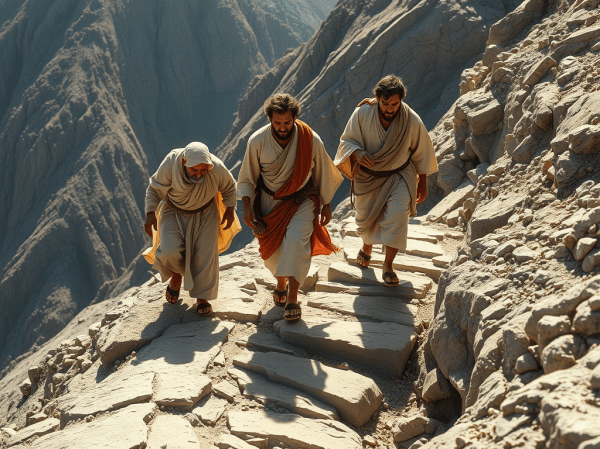
Looking at the gospel reading from Luke chapter 9, you will see that we are given two options. The first is to read only verses 28-36. Here, we hear the story of Jesus taking Peter and John on a mountain climb. On reaching the summit, Jesus becomes transfigured – his face shining with intense illumination and his clothes glowing with a dazzling whiteness. We note the echo of Moses’ experience on the mountaintop of Sinai reported in the OT lesson from Exodus 34.

Between verses 28- 36, we learn that the disciples gaze amazed yet fearfully at Jesus, speaking with Moses and Elijah – discussing Jesus’ journey to his death in Jerusalem.

The last Sunday after Epiphany is not the celebration of the feast of the Transfiguration – which takes place on August 6th. Today, we simply hear the story of Jesus and the disciples’ transfiguration experience as the transition story that marks the movement from Epiphany into Lent.

Epiphany means showing – a peeling away the layers of appearance to reveal the underlying true nature of things. Epiphany season begins on January 6th with the event known as The Epiphany – recalling the visit of the Magi to the infant Christ Child – signaling the non-Jewish world’s recognition of Jesus as the promised one foretold by Israel’s prophets. A second epiphany with a small e occurs a week later when we celebrate the Baptism of Jesus – during which the voice from heaven reveals Jesus as God’s openly acknowledged son. After his baptism, the clouds part as the heavens open to herald God’s proclamation of Jesus’ divine sonship. During Jesus’ transfiguration experience, once again, we hear the voice of God repeating the earlier proclamation of Jesus’ sonship – but in contrast to the clouds parting and the heavens opening, this time the voice sounds from within the density of a dark cloud descending to envelop the mountain summit.

The story of the Transfiguration functions as a final epiphany with a small e – in this case, a piercing of the layers of appearance exposing the underlying hidden truth of Jesus’ identity as a preparation for his fateful journey to Jerusalem. The story also functions as a literary device, marking the halfway point in the gospel narratives between Jesus’ ministry in Galilee and his journey to Jerusalem – his death and resurrection. We can picture the Galilee ministry progressing towards an epiphany on the mountaintop. Likewise, we can picture the trip to Jerusalem beginning with the descent from the mountain – setting out on the hard road through Lent to the destination of the cross before the final epiphany of his resurrection.

The story of the Transfiguration operates symbolically similarly to when Dr Martin Luther King Jr. proclaimed I have been to the mountain top, and I’ve seen the Promised Land. No one ever thought he was claiming to have climbed a mountain to describe the view on the other side. They understood his use of the mountaintop as a symbol with deep theological and biblical resonance. Likewise, for the synoptic gospel writers – Mark, Matthew, and Luke – the story of the Transfiguration is loaded with theological and biblical resonance, linking the beginning of the Jesus story with its ultimate ending – from birth through death to resurrection.  

So far, so good. But suppose we continue to read beyond verses 36 to 43. In that case, we enter into a bracketed section of text – bracketed to indicate that in the mind of the Lectionary compilers, these verses are optional. The bracketing might suggest a desire to keep the gospel reading short. But it also strikes me that the bracketing of verses 37-43 not only leaves the story incomplete but also might indicate how much more comfortable we are with experiences of transcendence than those of immanence.

Mountaintop experience symbolizes much hankered after peak experience – the spiritual high – the blissful experience. In contrast, the journey down shows Jesus reentering the noise and chaos – the tension, the messiness of the world. The arguing and recrimination in the scene that greets him at the bottom of the mountain is emblematic of our life experience when we come down from the highs of peak experience. Transitory bliss is soon dissipated amidst the more familiar feelings of anger, frustration, exasperation, and disappointment. Jesus does not hold back in expressing all these feelings in the face of human propensities and pretensions as he cries You faithless and perverse generation, how much longer must I be with you and bear with you?

Today’s gospel marks our transition from Epiphany to Lent. Figuratively, we descend from Epiphany’s heights to accompany Jesus on the rugged and stony road through Lent that will lead us to Jerusalem and beyond. This year, we hear the readings for the last Sunday before Lent sounding within the unique context of the present time in which we can’t ignore the fact that today, we revisit the story of the Transfiguration of Jesus on the mountain in the context of profound shock at the speed with which the world as we have come to know it seems to be coming apart at the seams.

We are sick at heart –aching with concern for the thousands of legal refugees now stranded across the globe at ports of debarkation for the US –  clutching their State Department permissions to enter the US now seemingly not worth the paper they were written on. Our concern encompasses the legal refugees newly arrived in the US whose resettlement programs have now been defunded. Our hearts are full of fear for the families of undocumented immigrants – families where parents and children at the beginning of each day wonder if they will still be together at day’s end. 

We seethe with rage at the callous indifference shown to thousands of faithful civil servants whose employment has been summarily terminated by the click of the send button.

We blanch with shame as America insidiously affirms Russian aggression before the General Assembly of the United Nations. We watch in fascinated horror as foreign leaders are welcomed, unaware that the Oval Office has now been transformed into the set of The Apprentice. Bravo to President Zelensky, who, unlike the ritual humiliation of Jordan’s King Abdullah two weeks ago, refused to play the game and pretend he didn’t recognize that the subtle art of diplomacy is now replaced by the crude art of the deal. 

Our faith in sound government is further corroded by a deepening cynicism as we witness once more a cowered Congress embarking on swinging budget cuts – not to put a dent in the national debt but to give wiggle room for a trillion dollars in tax giveaways to the 1%.

But lest I be accused of laying blame at others’ doors, as the blame game goes around and around, there is enough blame to crown all our heads with shame. Dietrich Bonhoeffer –our go-to prophet for our age – speaking to his fellow pastor-resisters during Christmas 1942 pulls us up short, reminding us of our failings. To paraphrase him:  we stand in grave danger lest we become even more the silent witnesses of evil deeds. We stand in peril of further perfecting our defense skills, relying on our learning in the arts of obfuscation and equivocal speech. If we fail to protest in the face of a deluge of unbearable events, we will become more worn down – become – as if it were possible – even more cynical – so that Bonhoeffer’s question – Are we still of any use, becomes the question for our age.

Kristopher Norris, Pastor of Calvary Baptist Church in Washington DC, in the Baptist Global News wrote: With family separations at the border, automatic detentions, dangerous dehumanizing rhetoric from our highest office and authoritarian misappropriations of scripture from our highest attorney, many churches and Christian leaders have remained silent witnesses. Three-fourths of white evangelicals continue to support these policies. Other churches and Christian leaders have responded with appropriate outrage. We’ve said this is not who we are — as Americans or as Christians. But Bonhoeffer’s words should compel us to take a deeper look at ourselves, at our history, and acknowledge that this is not true…. this is who we are as Americans ….. this is who we are as Christians ….. for this – citing the legacy of white Christian Nationalism is our collective history.

On Ash Wednesday, we will hear the Church’s invitation to the observance of a holy Lent. Among the traditional disciplines – the practices of discipleship – repentance is named as the chief way to make a right beginning. It is not only the best way to make a proper beginning, but it will remain the only way we will stay self-reflective and course for Jerusalem.

Repentance is the mark of our mortal nature, and repentance must become our byword as we accompany Jesus through the arid landscape of Lent, navigating the stony path to Jerusalem. In this life, it’s not what happens on the mountaintop that shapes us but how we conduct ourselves on the downward journey into the inevitable confrontation with the challenges of life in the world ruled by the demons of our age.

Blog at WordPress.com.

Up ↑