Advent Stillness in the Eye of the Hurricane

Picture: St John’s Church, Little Gidding

Advent begins with a strange invitation. It’s an invitation not to hurry, to pause, to savor the stillness of the moment at the point where time feels different – where the past and future seem to lean in on us at the same moment.

We have the prevailing idea that time flows in a linear, one-way direction – from the past into the future. This idea of time normally serves us well in everyday functioning, yet it’s nothing more than a convention of thought that enables us to organize our lives.

At points of crisis, however, we often find ourselves in moments of stillness akin to the eye of a hurricane. Here we have an uncanny sense of timelessness – not of the unidirectional linear flow of time, but of something more akin to convergence. We sense the past and future converging into the stillness of the present moment.

On a bleak, grey, winter’s afternoon, the poet T.S. Eliot arrived in the out-of-the-way hamlet of Little Gidding, deep in rural Huntingdonshire, northwest of Cambridge. That quiet visit became the seedbed for the fourth and final section of his Four Quartets, which he completed as London burned under the steady rain of German bombs.

The village of Little Gidding resonates in the English High Church imagination. In 1625, after the loss of much of their fortune with the collapse of the Virginia Company, the Ferrar family retreated to their estate at Little Gidding. In 1626, Nicholas Ferrar was ordained deacon by Archbishop Laud. As Archbishop of Canterbury, Laud led the extrajudicial suppression of the Puritans, and it was only by the skin of his teeth that one Roger Williams managed to embark for Massachusetts with Laud’s commissioners hot on his heels.

On Monday, we will commemorate Nicholas Ferrar. Under his leadership, the extended family forged a brave experiment in spiritual community centered on the disciplined life of prayer, work, and pastoral care grounded in the Daily Offices of the Book of Common Prayer.

Although Nicholas died in 1637, the community continued under the leadership of his brother, John, and their sister, Susana Collet, until their deaths in 1657.  

King Charles 1st visited the community three times. The king made his final visit to the community where he sought refuge following the defeat of the Royalist Army by the Parliamentary forces at the Battle of Naseby in 1645.

Chilled to the bone by that miserable dampness that is the unique characteristic of the English winter, after his long and taxing wartime journey from London, Eliot, stood in the little church dedicated to St John the Evangelist, and sensed a timeless moment.  Eliot opened the second stanza of his final quartet, aptly named Little Gidding, capturing his memory of that moment when wave met wave, past touched present, and present opened towards the future. He wrote:

If you came this way, taking any route, starting from anywhere, at any time or in any season, it would always be the same: you would have to put off sense and notion. You are not here to verify, instruct yourself, or inform curiosity or carry report. You are here to kneel where prayer has been valid – here, the intersection of the timeless moment is England and nowhere. Never and always.

Eliot here is speaking of the experience of a moment in timelessness – when the past and future converge in the real-time of the present moment.

Timelessness, interrupting the linear flow of predictability – past touching future in the present, is precisely the spiritual landscape to be explored in Advent.

Advent is where time bends to flow back on itself —
where memory and imagination meet,
where under the influence of the future, the past unsettles the present,
and God’s future leans toward us with urgency.

The voice of the prophet Isaiah conveys a sense of this divine urgency leaning into temporal time. In a vision of a future where swords will be beaten into plowshares, spears into pruning hooks, and where nation shall not lift up sword against nation, neither shall they learn war anymore.

Isaiah is not describing a dream to admire. He is describing a future that demands our present-time participation!

He beckons us with: “Come, let us walk in the light of the Lord.”

He does not say, let’s wait while we dream of a future better than the present. He commands us to walk now, conveying the divine urgency, leaning in to transform the future dream into something already shaping us in the present.

And here we are in 2025, a year when Isaiah’s vision feels both desperately needed and painfully elusive.

Wars continue to erupt and smolder. Political rhetoric grows sharper, more fearful, more chaotic. We face unprecedented technological acceleration with insufficient moral wisdom and the lack of a protective legislative and legal framework. We feel the low hum of climate anxiety amidst the quiet ache of rising social isolation and loneliness.

In such a world, Isaiah’s invitation is no abstraction. It’s invitation and instruction – it’s hope with boots on.

Come, let us walk in the light of the Lord.

Walk now before the world feels ready – before we have our act together – before we see the way ahead clearly enough to wrest its direction from God’s control.

Advent is a season of preparation. Yet, this is paradoxical. Jesus reminds us that there is nothing we can do to prepare ourselves to be ready. He invites us to simply remain awake, for we cannot know on what day the Lord is coming.

We wake up and stay awake, aware of the dangers of hardening our hearts against hope and allowing despair to shrink our imagination.

To be awake is to be alert to God’s urgency, leaning into the present time – in the moment we live in between Jesus’ birth and his return as the cosmic Christ in end-of-time glory. Here, past and future enfold in real-time punctuated repeatedly by acts of mercy and moments of courage, as the steady persistence of love is realized in the small actions of everyday life.

Traveling back to a drab and battered London, Eliot had felt the echo of Nicholas Farrar’s brave spiritual experiment. For him, the past leaned forward as the future leaned back. Right there, in that moment, something timeless broke through.

He wrote:

We shall not cease from exploration And the end of all our exploring
Will be to arrive where we started And know the place for the first time.

This is what it feels like when God’s future leans in upon the present and makes the ordinary shimmer with possibility.

At St. Martin’s, we catch glimpses of what it means to walk in hope before we fully see the way ahead. We are learning — slowly, steadily, faithfully — that hope is made real through service rooted in worship and prayer. Hope is something we make real, together.

We know what it is to rebuild community, deepening in worship and the renewal of ministries; to welcome newcomers with warmth, and to carry the flame of faith forward even when cultural winds blow cold.

Here, week after week, between font and altar, we open to the experience of that still place where the richness of tradition reconfigures to meet the challenges of the future. As we listen for God’s whisper we embrace hope as the antidote to the poison of despair.

Because even now, even here, in this community, with these people, in this moment, God’s dream, long promised, is already leaning in to take shape in us!
A King, But What Kind of King?

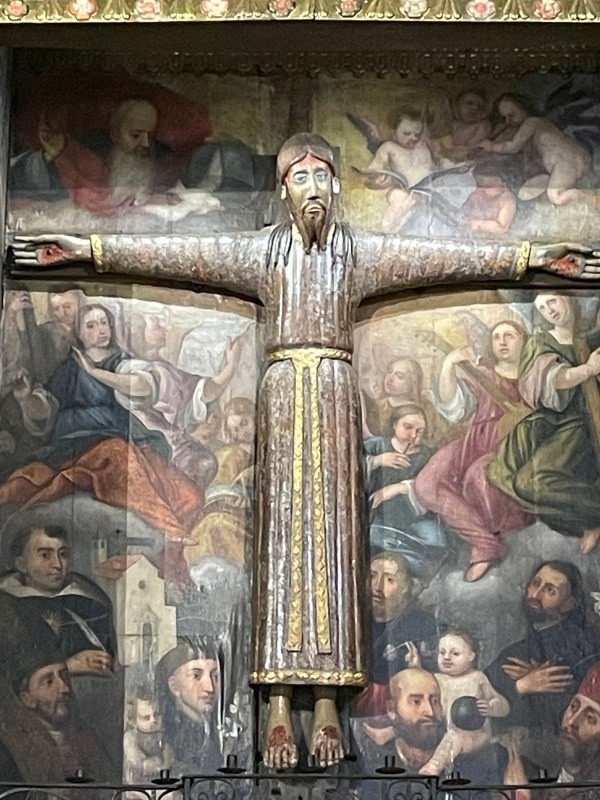
Image: 9th-century Christ figure, Esglesia de Sant Cristofol de Beget, Catalonia.

Note the sermon recording is a version of the text below streamlined for oral delivery.

This Sunday, the last in the season after Pentecost, brings us again to the Feast of Christ the King. It’s worth remembering that this is a relative newcomer to our Anglican–Episcopal calendar. Traditionally, the Sunday before Advent was known as Stir-Up Sunday—from that marvelous opening of the old Collect for Advent Sunday. We now find his Collect moved to Advent II.

“Stir up, we beseech thee, O Lord, the wills of thy faithful people…”

In England, of course, this also served as the annual cue for the vigorous stirring of the Christmas pudding. A lighthearted association, yes—but there is a deeper, more unsettling story beneath the surface of this day.

100 years ago in 1925, Pope Pius XI instituted the Feast of Christ the King as an explicit protest against the rise of fascism and the growing threat of communism. His instinct was to reassert the old Constantinian notion of the Church as the supreme earthly authority—the singular center of allegiance for Roman Catholics. At tremendous cost to freedom of thought and conscience within the Church, he marshaled his legions against those he perceived as rival authoritarian powers.

It is, as you’ve heard me say before, an old and familiar story: one form of authoritarian power confronting another. And for us, for our Anglican sensibilities and ecclesiology, this is problematic. We do not imagine ourselves as an authoritarian church, nor do we look to the state to wield sacred authority on our behalf. And so we are forced to ask:

What kind of king, and what kind of kingship, are we actually celebrating today?

The first chapter of Genesis tells us that humanity—male and female—is made in the image and likeness of God. But if God is unseen, then the only way we can learn anything about God is by taking a long, honest look at ourselves.

And this is where things immediately become complicated.

For which image of humanity is God reflected in?
The compassionate one?
The jealous one?
The collaborative one?
The violent one?
Perhaps, in some mysterious sense, all of them?

This double-edged mirroring cuts both ways. We deduce that God is loving, relational, and faithful because we find traces of these aspects within ourselves. But we also project onto God our fear, our rage, our desire for power and control—because these too are embedded so deeply within us.

This is why the Bible’s shifting, sometimes contradictory portraits of God may have more to do with the conflicting, constantly changing images of ourselves than with any actual change in God. And so today’s great question arises again:

Which of our many competing self-images do we want Christ the King to reflect?

The Church has never lacked for imagery.

Pantocrator—the omnipotent ruler of the universe—gazes down from Orthodox domes and even from our own great West Window at St. Martin’s, itself a war memorial. In this rendering, Christ is robed with imperial grandeur, presiding over the world with absolute command.

Christus Rex, the risen high priest, appears in the reredos of the St. Martin Chapel—Christ triumphant, the cross firmly behind him now, is decked in priestly attire; new life springing forth from resurrection’s victory.

But then there is that other image—stubborn, uncomfortable, and impossible to romanticize:
the one who reigns not from a throne but from a cross.
Not robed in splendor but stripped of all earthly power.
Not lifted above humanity but nailed into its deepest suffering.

This third image refuses the familiar pairing of strength over against vulnerability. It insists instead on a revolutionary pairing:

strength through vulnerability,
continuity reshaped by disruption,
life emerging from death.

This is the image Luke gives us today in Jesus’ Passion. Here, Christ’s kingship shines through the very moment when Rome, the Temple, and a frightened populace converge to crush him. He refuses to play the power game. He refuses to mount a defense that mirrors their tactics. His vulnerability becomes the very thing that reveals divine strength.

We are living, once again, in an interesting moment—interesting in that biblical sense where the tectonic plates shift beneath our feet. Authoritarian voices rise across the world; fear becomes a political currency; purity narratives—racial, religious, cultural—gain traction among anxious populations. Meanwhile, many feel that continuity is slipping away, that the old certainties no longer hold.

Newton’s Third Law quietly reminds us: for every action there is an equal and opposite reaction. And so the pendulum of history swings between order and chaos, continuity and disruption, stability and fracture.

Like Pope Pius XI a century ago, we, too, are tempted to imagine that the only adequate response to coercive power is counter-coercive power. Strength for strength. Force for force. A sort of theological arms race.

The danger here is subtle but real:
when God is remade in our image, it is only a matter of time before violence, domination, and exclusion become divinely sanctioned.

And so Christ the King asks us to choose carefully which image of ourselves we are willing to project onto God.

Left to our own devices, our imaginations merely recycle the familiar. We recognize only what we have already trained ourselves to see.

But the Gospel calls us into a more permeable imagination—one in which the rigid boundaries of our conventional selves give way, and something new breaks through. Jesus’ parables work in this way – as disruptive stories—stories that jump the track like a needle skipping on a vinyl record, suddenly placing us in an unanticipated part of the song.

Christ the King, as Luke gives him, is such a disruption.

Not Pantocrator high above us.
Not Christus Rex safely beyond us.
But Christ who stoops, who descends, who reigns from the cross itself.

This is not the familiar polarity of strength or vulnerability.
It is the holy paradox of strength through vulnerability.

Not disruption as the enemy of continuity,
but disruption as a necessity in the long-term reshaping and renewal of continuity.

Beneath the cross—Luke implies it, and the tradition expands it—are three great stones wedged into the earth:

divine love,
divine mercy,
divine justice.

From this place of what looks like utter defeat, Jesus exercises a kingship the world is not conditioned to recognize. A kingship that unsettles our desire for easy answers, half-truths, and superficial allegiances. A kingship that pushes us to live from hearts less governed by fear.

Christ’s kingship blesses us with righteous anger at injustice, oppression, and exploitation of the helpless. It calls us not to passive acceptance but to active labor for freedom, peace, and justice.

And Christ’s kingship blesses us with just enough holy foolishness to believe that we truly can make a difference—that the world’s wounds are not beyond healing, and that we are called to participate in that healing.

As Dietrich Bonhoeffer wrote in another moment of deep historical crisis:

“We have been silent witnesses of evil deeds; we have been drenched by many storms; we have learnt the arts of equivocation and pretence; experience has made us suspicious of others and kept us from being truthful and open; intolerable conflicts have worn us down and even made us cynical. Are we still of any use?

He continues:

What we shall need is not geniuses, or cynics, or misanthropes, or clever tacticians, but plain, honest, and straightforward men. Will our inward power of resistance be strong enough, and our honesty with ourselves remorseless enough, for us to find our way back to simplicity and straightforwardness?” we shall need is not geniuses, or cynics, or misanthropes, or clever tacticians, but plain, honest, straightforward men and women … with enough inward strength to find our way back to simplicity and straightforwardness.”

So today—this last Sunday of the Christian year—we stand again before the three competing images of Christ the King:

Pantocrator, the omnipotent ruler;
Christus Rex, the triumphant high priest;
and Jesus of Nazareth, reigning from the cross.

The first two are familiar.
The third is revolutionary.

For in that crucified face, we find not a projection of our own lust for control, but a revelation of God’s true nature:

a kingship that reconciles by resisting,
that resists by refusing to imitate violence,
that transforms by entering the world’s suffering rather than escaping it.

Perhaps this is the image of Christ the King we need now:
the one who reigns by setting aside every pretense of worldly strength,
and who invites us to do the same—so that God may enter our picture
and remake us in the divine image of love, justice, and mercy.

Amen.

Confrontation

Sermon on Luke 20:27–38 — “The God of the Living”

This story from Luke’s Gospel gives us one of Jesus’ clearest windows into what resurrection really means.

He isn’t just talking about life after death.
He’s talking about a whole new kind of life.

Resurrection doesn’t just keep the story going —
it transforms existence.
It isn’t the old life resumed,
it’s a new creation breaking in.

The Setting

To feel the power of what Jesus says, we have to picture the scene.

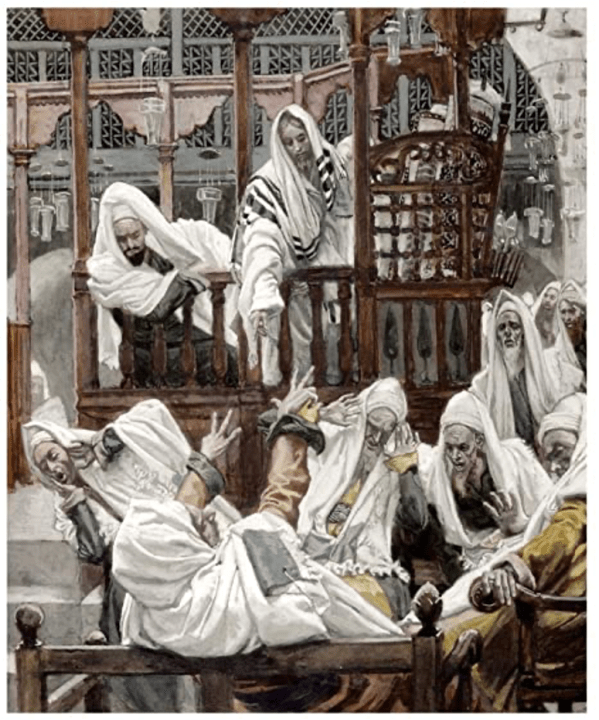
He’s standing in the Temple courtyard —
surrounded by religious authorities,
priests in their robes,
men who run the system.

The Sadducees.

They were the religious aristocrats —
a small priestly class who controlled the Temple in Jerusalem.
Wealthy, well-connected, aligned with Rome.
Religion and politics —
for them, it was all one system.
And it worked pretty well for them.

They only accepted the written Torah —
the first five books of Moses —
and since those books don’t mention resurrection or angels,
they didn’t believe in either.

For them, what you see is what you get.
God’s justice is whatever happens — if it happens — in this life.
So when Jesus preaches resurrection,
they hear danger.


Political danger.
Theological danger.
Because resurrection means
God still has surprises they can’t control.

So they come with their clever little riddle —
about a woman who marries seven brothers.
“In the resurrection,” they ask,
“whose wife will she be?”

It’s meant to make hope sound ridiculous.

But Jesus doesn’t take the bait.
He says, “as usual you’re asking the wrong kind of question.”

The resurrection, he says,
isn’t about rearranging the old furniture.
It’s not a continuation of this world’s arrangements —
it’s a transformation of life itself.

And then he quotes their own Torah —
the story of Moses at the burning bush.
God says, ‘I am the God of Abraham’ — not ‘I was.’

If God is their God,
then they are alive to God.
Because to belong to God
is to share God’s life.
And God’s life never ends.

A Theological Debate with Real Consequences

Jesus isn’t just winning an argument here.
He’s taking a stand in one of the great theological battles of his time.

The Pharisees — unlike the Sadducees —
believed that God’s justice must extend beyond the grave, – that wrongs in this life will be eventually put to rights –
that God’s faithfulness doesn’t stop at the cemetery gate.

And here, for once, there is no daylight between Jesus and the Pharisees.
He shares their conviction
that the covenant promise of God cannot be broken by death.

As Bishop Tom Wright says,
resurrection is not simply “life after death,”
but life after life after death
the full flowering of creation made new.

So this moment in the Temple
is not just a debate about heaven.
It’s a declaration that God’s future is already reaching into the present.
Resurrection is not something we wait for —
it’s something we can live into right now.

Then and Now

It’s easy to leave the Sadducees in the first century,
but their voice still echoes.

You can hear it today whenever people say:

  • “Be realistic — nothing ever really changes.”
  • “Power is power — take what you can.”
  • “Hope is naïve — better to be transactional.”

That voice fills our politics.
It shapes our economy.
It even creeps into our churches.

It whispers:
“The only world that matters is the one you can control.”
“The future belongs to the powerful.”
“Resurrection is just wishful thinking.”

But the God Jesus reveals
won’t fit inside that logic.
The God of Jesus
is the living God —
the One who keeps breaking in,
bringing life where death thought it had the last word.

The God of the Living

When Jesus calls God
“the God of Abraham, Isaac, and Jacob,”
he’s saying something profound about who God is.

If God is their God,
then they are alive to God.
Because God’s faithfulness can’t be interrupted by death.

Resurrection isn’t just about what happens after we die.
It’s what happens whenever God’s life breaks into our dead places:

— when forgiveness replaces bitterness,
— when courage rises to face down fear,
— when love crosses a boundary we thought was final.

That’s resurrection.
That’s the God of the living at work.

Resurrection as Resistance

To believe in resurrection
is to resist despair.
It’s to say that cruelty, injustice, and death
do not get the last word.

It’s to live as if God’s future
is already pressing in on this moment.

And yes —
it’s a dangerous belief.
Because resurrection threatens every order built on fear and violence used as a means of control.
That’s why the Sadducees — then and now —
want to silence it.

Fast Forward to 2025

You don’t have to look far to hear the same old logic being used today:

“People are bad and must be controlled.”
“The poor have only themselves to blame.”
“Immigrants are a threat and so must be expelled.”
“We’re not responsible for climate change, so drill, baby drill.”
“The Church is dying — why bother trying, it’s yesterday’s news?”

And into that weary chorus of constant outrage as distraction, Jesus still speaks:

“God is not God of the dead, but of the living.”

He calls us to live as citizens of that kingdom —
not someday, but today.

To practice resurrection
by daring to hope,
by forgiving, by standing with those the world forgets.

Conclusion — The God of the Living

So what does it mean to say
that God is not the God of the dead, but of the living?

It means that every time we meet despair with courage,
every time bitterness gives way to forgiveness,
every time indifference is replaced with compassion —
resurrection is already happening.

It means faith is not about survival.
Church is not about maintenance.
Resurrection is not escape — resurrection is transformation.
And that transformation begins with us.

That old Sadducean spirit still lingers —
in every system that defends the status quo,
in every voice that says nothing really changes,
in every theology that locks God in the past.

But the living God —
the God of Abraham, Isaac, and Jacob —
the God who raised Jesus from the dead —
will not be managed by fear or cynicism.

To proclaim resurrection
is not to deny death —
it’s to deny its finality.

It’s to trust that love is stronger.
That mercy endures.
That creation still pulses with divine possibility.

It’s to stand in the middle of an anxious, fractured world
and say with quiet defiance:

“The future belongs not to those who manipulate our fear of death,
but to the God who brings life out of death.”

So when you look around at our world —
its exhaustion, its cruelty, its despair —
do not lose heart.

Live as witnesses to the living God.
Practice resurrection
in the small, stubborn acts of love
that make God’s future visible in the present.

For the God of Abraham, Isaac, and Jacob,
the God and Father of our Lord Jesus Christ,
is still the God of the living.

And my friends —this means that however we may be feeling,
God is not done with us yet.

Blog at WordPress.com.

Up ↑