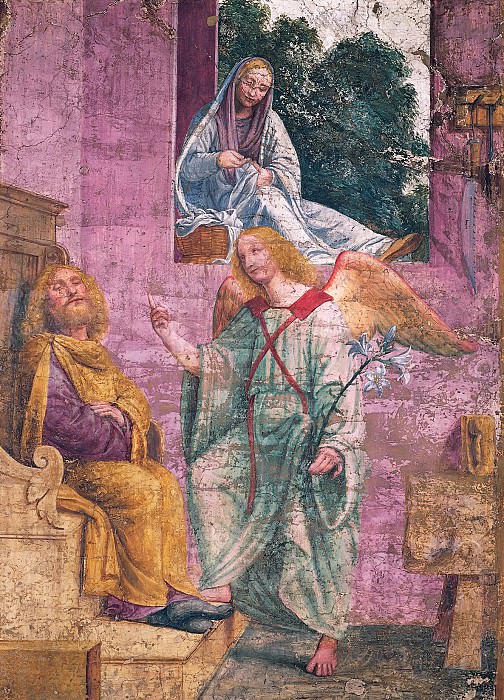
Dreaming Joseph

Image: The dream of St Joseph. Bernardino (Bernardino de Scapis) Luini (c.1480-1532)

This year, we return to Matthew as the gospel of choice in the three-year Lectionary cycle. Thus, Advent IV’s gospel opens with Matthew’s account of the events leading to the birth of Jesus. Matthew structures his birth narrative around themes specific to him. I want to offer a very personal take on Matthew’s understanding of the significance of Jesus’ birth.

For most of us, our sense of the nativity narrative emerges from an often unconscious compilation of Luke and Matthew, giving us the typical manger scene depicted in countless churches and nativity plays. In doing so, we miss the significance of each Evangelist’s distinctive portrayal of the events surrounding Jesus’ birth.

Luke’s focus is on Mary. His birth narrative is Mary’s story, depicting a birth in farmyard conditions surrounded by sheep and cattle and witnessed by ordinary shepherds – representative of those on the margins of society – and of course, let’s not forget the angels.

Matthew’s version of events gives us Joseph’s story – the story of Jesus’ birth told from Joseph’s perspective. Matthew does not mention the setting. Here, there are no shepherds, no cattle or sheep. This is a birth witnessed not by ordinary people but by foreign emissaries – the Magi – representatives of the wider world’s homage to the infant king of the Jews. Matthew also has an angel, but Matthew’s angel appears not to Mary, as in Luke’s account, but to a dreaming Joseph.

The first point to notice in the Matthew chronicle is the importance of establishing Jesus’ identity within the long genealogy that extends back through Jewish mythological time to Abraham. Matthew spends 17 verses of his 25-verse first chapter to do this. So we notice from the outset how intensely a Jewish story this is.

The second point to note is that Matthew’s story is highly political, situating the birth of Jesus within the turbulent political context of 1st-century Palestine. Here we have all the ingredients for a tense political drama – a brutal ruler in Herod the Great, the puppet of Roman occupation, whose murderous intent drives the Holy Family into exile as political asylum seekers. The Holy Family escapes, but every other-year-old male child born in the region of Bethlehem is slaughtered as Herod, alerted by the indiscretion of the Magi, endeavors to neutralize Isaiah’s prophecy of the birth of a rival king.

Matthew’s is a rich narrative, one that sets the birth of Jesus within a political context entirely familiar to us today in a world where literally millions of fathers and mothers with young children are daily forced to undertake the perils and dangers as refugees escaping in fear for their lives. And, Matthew’s birth narrative provides a contemporary flavor of the political and humanitarian themes embedded in his account. Matthew sets Jesus’ birth within the context of political oppression and of a ruler’s desire to seek out and punish anyone who poses a threat.

Matthew’s birth narrative also hints at the societal complexities of Joseph and Mary’s predicament. Matthew will go on to describe the holy family’s displacement and flight from political violence, but he must first skillfully navigate 1st-century Jewish societal reactions to surprise pregnancies out of wedlock.

Matthew’s approach to the Jesus story is told from within the Jewish patriarchal worldview of the men in charge. I have an intense personal unease with this feature of his approach. As a gay man, I learned early to fear the power of the patriarchy and to be deeply suspicious of the presentation of scripture through the exclusive lens of the men-in-change, in whose worldview there was no place for someone like me.

Richard Swanson is – at least to my way of thinking – a delightfully provocative biblical commentator who never misses an opportunity to take the patriarchal voice – that is, the traditional interpretation of scripture from the restrictive perspective of the men-in-charge – down a peg or two. Swanson coined the delicious phrase Holy Baritones to describe scripture’s patriarchal voice. My not infrequent uneasiness with Matthew’s voice is that, at times, he seems to me to epitomize the role of section leader in the Holy Baritone chorus.

It’s only in verse 18 that Matthew turns to the birth of Jesus. Having, as I’ve already noted, spent the first 17 verses of his 25-verse first chapter establishing Jesus’ identity at the heart of Jewish patriarchal transmission. Matthew writes:

When his mother Mary had been engaged to Joseph, but before they lived together, she was found to be with child.

In a society with a strict prohibition against sex before marriage, which by the way is a central convention in all patriarchal societies, including our own until relatively recently, Matthew chooses to introduce the birth of Jesus by telling us that Mary was found to be with child.

Was found to be is a grammatical structure known as the divine passive. It’s a way of telling us that so and so happened while obscuring causality. For the Hebrew writers, it was a way of indicating that something had occurred by the hand of God without invoking the name that could not be spoken. Matthew makes clear that Mary’s pregnancy is the result of God’s hidden hand. Still, unlike Luke’s portrayal of a direct encounter between Mary and the Archangel Gabriel, in which God addresses Mary directly and respects her primary decision-making agency, the thrust of Matthew’s narrative suggests that, once Mary’s pregnancy is discovered, she no longer has any agency, with all decision-making reserved to Joseph.

Matthew presents Joseph in a predicament. His reputation, through no fault of his own, is endangered by this turn of events. A kindly middle-aged widower with a teenage betrothed, he is resolved to end the engagement quietly. What a mensch! But here’s my problem with Matthew’s Joseph-focused version of events. In a religious society with draconian laws against sex before marriage, Joseph’s risk is one of public disgrace. Still, Mary risks honor killing by being stoned to death – in the first instance by her father – and if he could not bring himself to do the deed, then by another male relative – an uncle, or brother, or male cousin conveniently waiting in the wings. The reality of honor killing is a nasty detail that the Holy Baritone voice skips over in silence.

So how is Joseph to be extricated from his predicament of being betrothed to a girl who has now been found with child. Matthew rescues Joseph through the tried and trusted literary device of an angel appearing to him in a dream, telling him not to be afraid. Afraid of what we might ask? – if not a reputational disgrace. The angel instructs Joseph to proceed with the marriage because it is God who has caused Mary’s pregnancy. On waking, Joseph dares to do as the angel had commanded him. After all, what’s social opprobrium when compared with divine displeasure?

We might expect Matthew to end his chapter here. Joseph the mensch rescues his betrothed by marrying her. But as a cheerleader for the Holy Baritone voice, Matthew is not done yet. He rather tellingly – to my mind at least – mentions that while Joseph married Mary, he declined to consummate the marriage until after the child was born.

Why does Matthew feel the need to tell us this? Well, one of the pervading themes of the Holy Baritone voice is a preoccupation with genital penetration and sexual purity. As today’s conservative obsession with the restriction of women’s reproductive, queer, and transgender rights continues to demonstrate, this preoccupation continues a story older than time.

Let’s listen again to Matthew’s voice:

When Joseph awoke from sleep, he did as the angel of the Lord commanded him; he took her as his wife but had no marital relations with her until she had borne a son, and named him Jesus.

Although Joseph did as he was commanded, we will never know how he actually felt; however, we have a hint of how Matthew thought he might.

Hope is in the Waiting

On Advent Sunday, I explored the conundrum of time usually pictured as moving in a straight line, flowing only in one direction – from past to future. Drawing from a few lines of T.S.Eliot in his poem Little Gidding, I contended that our usual way of thinking about time, rather than describing reality, is simply a construction around which to organize our lives. What Eliot hints at is a notion of timelessness interrupting the linear flow of predictability: timelessness in which time bends back on itself—where memory and imagination meet, where, under the influence of the future, the past unsettles the present, and God’s future leans toward us with urgency.

Today on the 3rd Sunday in Advent I want to explore another conundrum – that of hope and hoping, with reference once again to a few lines of T.S. Eliot in his poem East Coker:

I said to my soul, be still, and wait without hope – for hope would be hope for the wrong thing.

Eliot is pointing us toward a distinction we rarely pause to notice between the action of hoping … and the object of our hope. That distinction lies at the heart of Advent, where, between the act of hoping and the object of our hope, we encounter the experience of waiting.

When hope disappoints us, is it because, as Eliot warns, we’ve placed our hope in the wrong thing?

So the question quietly pulsing beneath the themes in Advent is this:
How do we know whether our hope is rightly placed?

Act One and Act Two

Jesus’ fellow Jews in the first century lived with a deep, transgenerational expectation of the coming one—the messiah. A small group came to believe that this long-awaited hope had finally arrived in Jesus and that the messianic age had dawned.

But there was a problem. An enormous problem. How do you proclaim a messiah … who is dead? A dead messiah was not part of anyone’s expectations, prompting the first Christians to understand the dawning of the messianic age as a two-act process.

Act One: In Jesus—through death and resurrection—God had begun the messianic age. Act Two: What had begun would be completed when the Lord returned. Only then would God bring the long hope of Israel—and the hope of all creation—to its promised fulfillment. But it’s difficult to find ourselves living in the tension between the beginning of Act one and the still distant fulfilment of Act two. And so somewhere along the way, we Christians, especially in the Western mainline, quietly jettisoned a real expectation of a second act in the fulfillment of the messianic age.

We still say the words:

He will come again to judge the living and the dead. And Christ has died; Christ is risen; Christ will come again.

But is this still our actual expectation? Not so much.

We no longer live with any urgency around Christ’s return. Advent has become almost entirely about Act One—the Incarnation. A sweet baby. A quiet Bethlehem. A familiar story.

So when we jettison Act Two—what do we put in its place? We replace the early Christian hope of God renewing heaven and earth with a far more comfortable expectation: that when we die, we will be transported into eternal bliss. Instead of Christ coming to us, we will go to him.
Heaven is the end. Mission accomplished.

But note the subtle shift: Hope has moved from the renewal of creation to the escape from creation. A small shift with enormous consequences.

Competing Expectations—Then and Now

When John the Baptist began preaching his fiery message of repentance, many flocked to him because they thought he might be the coming one. Every Jew lived with urgent expectation. Yet, as with all expectations, there was a wide divergence about what the messiah was actually supposed to do.

Some clung to Isaiah’s great vision of cosmic renewal, which we listened to in the first reading from Isaiah 35. This is a vision of the desert blooming, the blind seeing, the lame leaping, the whole creation singing. A kind of divine re-terraforming of the earth.

Others, humiliated under Roman occupation, longed for a more political messiah.  A military leader. A racial champion. One who would restore the fortunes of Israel and make Israel great again.

Two expectations. Two hopes. Both fervent. Both biblical. Both alive in the hearts of first-century Jews.

And into this tangle of hope comes the moment in Matthew’s Gospel—with John the Baptist, now in prison, becoming afraid, unsure, increasingly doubting.

He sends messengers to ask Jesus:
Are you the one who is to come, or should we expect another?

We can imagine the roots of his doubt. John was a firebrand. He expected a messiah with a bit more muscle. A bit more judgment. A lot more nationalistic fervor.

And Jesus—wily as ever—refuses a direct answer.
He doesn’t debate. He doesn’t reassure. He doesn’t explain away the paradox. He simply says:

Go tell John what you see and hear. The blind see. The lame walk. The lepers are cleansed. The deaf hear. The poor receive good news.

In other words: remind John of Isaiah’s messianic expectation. The object of John’s hope is misplaced – his hope is hoping for the wrong thing.

Jesus aligns himself not with tribal ambition but with prophetic transformation. Not with national restoration but with justice, mercy, and renewal.

That same clash of expectations is alive today—very much alive—in the American church. Among large swaths of white evangelical Christianity, the hope is for a more muscular Jesus. A more tribal – a racially pure Jesus. A more nationalistic Jesus. A Jesus who will restore the fortunes of a particular nation, through political power at home and military strength abroad.

It is, as in the first century, hope for the wrong thing. And Jesus refuses to endorse it.

The Advent Question for Us

We who call ourselves mainstream Christians face the same choice John faced. The same choice the early Church faced. And the stakes today feel just as high.

Do we continue to ignore the New Testament’s two-act expectation, living with our eyes fixed solely on the reward of heavenly bliss? A single-act Christianity of personal salvation? A spirituality that floats above the world rather than being incarnated within it? Or do we recover Act Two—the expectation that Christ will return to this world, bringing justice to this society, healing to this creation?

Because the expectations we choose shape the lives we live.

If we believe the earth is simply the disposable staging ground before we depart for heaven, then why bother with justice? Why bother with creation? Why bother with anything beyond my personal ticket to ride the heaven-bound express?

But if we believe that God intends to redeem this material reality, then we understand our present responsibilities very differently – to become collaborators with God, agitators for peace with justice, stewards of the earth, and repairers of the breach. People who embody this hope – now—in real time.

So How Do We Know Whether Our Hope Is Right?

Let me return to the question that has been quietly humming underneath everything:

How do we know whether our hope is for the right or wrong thing?

Is our hope placed in some future escape from this world into heavenly bliss—while the world around us burns, and injustice deepens, and creation groans under the weight of greed and neglect?

Or is our hope placed in the renewal of all things— the healing of creation, the raising of what has fallen, the setting right of what has gone wrong?

Is our hope aligned with John’s early instinct for a tribal, forceful messiah? Or with Jesus’ prophetic vision of the messiah as the herald for the inbreaking of God’s justice, healing, and ecological restoration?

Enormous consequences flow from the hope we choose. Because hope is realized in the waiting, and in the spaciousness of waiting, future expectation folds back into present-time action.

Into the spaciousness of waiting time bends to flow back on itself — here memory and imagination meet, here under the influence of the future, the past unsettles the present, and God’s future leans toward us with urgency as we discover that the power of that for which we wait is already – I repeat, already effective within us.

Blog at WordPress.com.

Up ↑