
The Cost of Authenticity

Providence is experiencing a deep winter storm of snow and ice, and the resulting parking ban has simply confirmed the wisdom of cancelling church services. This sermon is by way of a reflection on the gospel for Epiphany 3 from Matthew chapter 4 on one of the key characteristics of discipleship – the cost of authenticity. The tone of the audio is more fireside chat than proclamation.

Sometimes discipleship is not hearing a new call
so much as realizing that a familiar and faithful way of life
is being gently loosened from our grasp.

Most of us live with the quiet assumption that if God is going to call us,
it will be obvious. Clear. Undeniable.

We imagine a clarion call.

And so, when we sense even the faintest possibility
that something might be shifting, we mutter—often without realizing it—
not yet.

Most of the time our antennae are finely tuned
to filter that possibility out. Familiarity comforts us.
Routine reassures us. They insulate us from disturbances
that might decenter us.

We are often listening for a call, but we are listening for it
to arrive on our terms.

And of course, it rarely does.

When a familiar and faithful life begins to leave us less satisfied,
when we sense—sometimes reluctantly— that something needs to change,
what often happens first is not clarity, but loosening.

Our accustomed ways of thinking about ourselves,
our settled sense of who we are,
begin—almost imperceptibly—
to slip from our grip.

Even when the light ahead feels real,
we often become alarmed
as the ground beneath us begins to shift.

We say to God:
If the light ahead is real,
then surely you can explain it to us.

We ask for a blueprint.
Presented for our pre-approval.

But even as the way forward remains unclear,
the ground beneath us continues to move—
heedless of our need for certainty.

Discipleship often asks us
to step away from what has been faithful,
fruitful, and trustworthy, before we can yet see
what will take its place.

Not all calls offer clarity at the outset.

For many of us,
facing a call only dimly perceived
fills us with anxiety.
With restlessness.
With agitation.

And that restlessness—
that refusal to let us remain where we are—
has a long spiritual pedigree.

St Augustine gave it words centuries ago:
“O Lord, our hearts are restless
until they find their rest in thee.”

That restlessness is not the enemy of faith.
It is often the sign that faith is being invited
to grow into a new form.

When we turn to Matthew’s Gospel,
this is not always easy to see.

I have often struggled with Matthew’s lofty, elevated portrayal of Jesus.
Matthew’s Jesus can feel remote—hovering above the human fray,
secure in his identity, untroubled by uncertainty.

Matthew gives us a Jesus shaped deliberately in the image of Moses:
authoritative, commanding, decisive.

And because of that, we can read Matthew’s account
of the call of the first disciples as a story from a different world—
a time when people were apparently capable of instant, unquestioning obedience
in a way that seems unavailable to us now.

But sometimes a familiar text changes because we have changed.

Sometimes scripture becomes newly audible
not because the words are different,
but because our lives are.

When Jesus hears that John the Baptist has been arrested,
Matthew tells us, he withdraws to Galilee,
leaving Nazareth, and making his home in Capernaum,
by the Sea of Galilee.

Matthew offers no commentary.
No emotional description.
No interior reflection.

And yet, for the first time, that single sentence stops me short.

Jesus leaves Nazareth.

He leaves his family networks.
He leaves the rhythms of village life.
He leaves behind the identity of the carpenter’s son—
a life that had made sense up until now.

And suddenly, I see this moment for what it is:
a threshold.

A quiet one.
But a costly one.

Before Jesus calls anyone else to leave their nets,
he himself leaves what has been home.

Matthew may not tell us how Jesus felt,
but he shows us the price that must be paid
before discipleship can even begin.

I find myself imagining the scene.

The packing of a few possessions.
The unspoken grief of departure.
The vulnerability of beginning again
in an unfamiliar place.

Capernaum was not a retreat.
It was a border town.
An ethnic and cultural crossroads.
An economic hub marked by opportunity
and deep precarity.

Matthew underscores this by reaching back to Isaiah:
“Land of Zebulun, land of Naphtali…
Galilee of the Gentiles… the people who sat in darkness
have seen a great light.”

Yes, this is mission geography.
But it is also inner geography.

Capernaum is the kind of place you go
when you are no longer who you were,
but are not yet who you will be.

Jesus’ move is not only strategic.
It is formative.

It is there—in that unsettled, liminal space—
that his authority takes shape.

And then, walking by the sea, Jesus sees two brothers fishing
and says simply: “Follow me.”

Matthew tells us they follow him immediately.

No deliberation.
No negotiation.
No farewell speeches.

For generations, this has sounded almost magical.

But perhaps it is not magic at all.

These fishermen already lived with risk.
They already knew instability.
They already sensed the limits
of their current lives.

They were poised.

And the power of Jesus’ invitation lies not only in his words,
but in the life he is already living.

Jesus does not appear as a settled authority figure
asking others to risk what he himself will not.

He appears as someone who has already crossed a line.

Discipleship recognizes authenticity instinctively.

Simon and Andrew follow him not because he is powerful,
but because he is already living the question they have not yet dared to ask.

In our Episcopal Church culture, discipleship is a word we use often
and understand poorly.

We tend to imagine discipleship as familiarity without transformation.
As membership.
As volunteerism.
As being good people doing what good people do.

But Matthew will not let us rest there.

The call to discipleship involves decentering.
Disruption.
Relocation—if not always geographic,
then interior.

It asks us to risk uncertainty in order to discover
a deeper, truer form of life.

And so we come back
to where we began.

Sometimes discipleship is not hearing a new call
so much as realizing that a familiar and faithful way of life—
the habitual way we think about ourselves
and experience the world— is being gently loosened from our grasp.

Discipleship is not adding Jesus to an otherwise stable life.

It is allowing our encounter with Jesus to unsettle us just enough
that the possibility of a new kind of life might begin to take shape within us.

The dawning of the light is a principal theme of Epiphany. Discipleship is how the light breaks through.
A Challenging Invitation

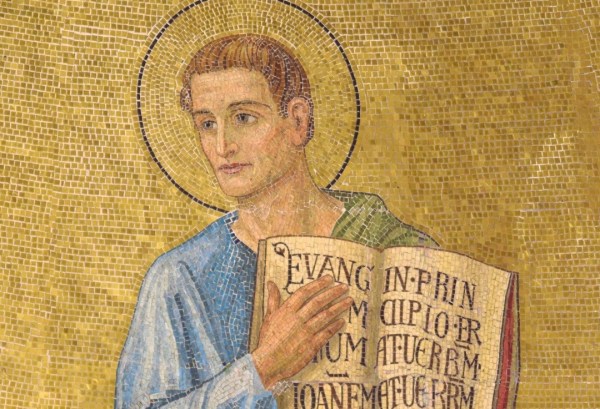
There is much that is confusing in John’s Gospel. In his opening chapter, John the Evangelist focuses on John, elsewhere known as the Baptist, as a witness to the messiah. But there’s also another John lurking in the background – John the Beloved Disciple of Jesus, whom Tradition has associated with John the Evangelist. Despite the Tradition, it’s clear that John the Evangelist is not John the Beloved Disciple. The Evangelist is writing in the 120’s, a period beyond the normal lifespan of the Beloved Disciple. So, John the Evangelist is someone who stands in the tradition of the Beloved Disciple, who, as a young man, probably knew him personally.

John’s gospel opens on the majestic panorama painted in the Prologue before plunging us into the opening moments in Jesus’ earthly ministry. The evangelist known as John fills this opening chapter and the whole of his gospel with word allusions and metaphors indicating the mysterious connections between Jesus and the fulfilment of Old Testament expectations of the Messiah.

We can tie ourselves in knots trying to decipher what these allusions and metaphors meant to the Evangelist John and his community. But so much of John remains mysterious.

For instance, John uses the metaphor of the Lamb of God. Taken in the context and period in which he is writing, this is a peculiar metaphor for Jesus. The practice of Temple animal sacrifice is, by this time, but a distant memory. Yet John’s metaphors are arresting, and in chapter one we have two on display – Lamb of God and God the Son – titles for Jesus that deeply resonated as they eventually entered the mainstream of orthodox Christology, i.e., the branch of theology that relates to the identity and nature of Jesus. Seeing as believing is the major theme in John’s gospel. First-hand seeing is not necessary, believing through hearsay, i.e., the words of another, is enough.

Chapter one is a story set over three days. On day one, the Jewish elders come to interrogate John (the Baptist), during which he identifies Jesus as the messiah because of what he has seen and can bear witness to. Day two, John’s out and about with two of his disciples – one of whom is Andrew, the brother of Simon Peter. When Jesus walks by, and John points him out as the Lamb of God, curiosity gets the better of Andrew and his unnamed companion, who follow Jesus, asking him where he is staying. Jesus replies come and see. 

Andrew then recruits his brother, Simon. In the section following this passage on the next day, day three, Jesus journeys to Galilee, where he encounters Philip, who then recruits his friend, Nathaniel (Bartholomew), and tells him he has seen the messiah.

John is showing his readers how discipleship happens and how it works. One person’s curiosity discovers Jesus. This discovery is then shared with a friend and they both begin to follow Jesus.

Jesus and his new disciples are now in position on day three for the first of John’s great signs – the wedding at Cana of Galilee, opening chapter two. John is not telling his readers about the call of the first disciples as much as he is showing them how discipleship works. First – we notice, then – we become curious, leading us to ask – then we have the opportunity to respond or not, to Jesus’ invitation to come and see. We then tell our friends what we’ve found and invite them to join us.

John’s Gospel is a gospel for our own age precisely because John the Evangelist addresses a mixed community in tension, a ragbag of different constituencies.

  1. There are the former disciples of John the Baptist, hence the Evangelist’s emphasis on the initial role of John (the Baptist) in the first chapter.
  2. There is a strong contingent of Samaritans, as evidenced by the story in chapter four, where the Samaritan woman he encounters at the well is the first to recognize Jesus’ true identity.
  3. There are gentile spiritual seekers. Later, in 12:21, we read that some Greeks come and ask Philip: please sir, we want to see Jesus.
  4. There are Jews who have openly split with the synagogue.
  5. There are Jews who still faithfully attend the synagogue but also secretly hang out with John’s ragbag Christian community on Sundays.

John’s task is to speak to the inner tensions in a community composed of factions, each with its own slightly different history and take on Jesus, all seeking to hold together amid the backdrop of unremitting hostility from the Jewish authorities, as represented by the emergence of rabbinic Judaism. This unremitting hostility from the newly emerging rabbinic movement is why John appears to us to project hostility back to those he continually refers to as the Jews.

John’s ragbag community manages to hold together during his lifetime. But after his death, another John, John of Patmos, writer of the epistles of John, bears witness to the internal tensions and eventual breakup of the Johannine Community in the middle decades of the 2nd century. Members of the Johannine community, known to us as the Gnostics, easily challenged the cohesion of a community with no recognized leader.  

The Johannie community had a flat hierarchy. It seems to have no recognized leaders apart from the guidance of the Evangelist, who lived on in his gospel. For instance, John never mentions the teaching authority of the apostles as the community leaders so evident elsewhere in the New Testament. Everyone is simply a disciple. All disciples are equal, sitting under the tutelage of the Holy Spirit. There are no sacraments, no doctrine, only the willingness to be led by the Holy Spirit on the way of love.

Jesus’ invitation is to come and see. But see what? Come and see a community characterized by the love its members have for one another. Now there’s a rare and seemingly unworkable thing!

A community known as the Beloved Community was a radical experiment based on Jesus’ Golden Rule in chapter 13:35, love one another, for by this the world will know them as his disciples. A radical and noble experiment in community, yet one predictably destined to fail.

Can we hear an echo of John’s beloved community in our Anglican, tolerant, and inclusive understanding of Christian community? Surely this is a difficult yet precious witness. Something unique to offer amidst the civic strife of 2026 in a nation torn asunder by so many bitterly held divisions.

The former Presiding Bishop, The Most Rev. Michael Curry, exhorted us with  John’s message to invite a renewal that flows from reframing ourselves as the contemporary Jesus Movement, a modern-day Johannine community embarked on the Way of Love involving seven practices that require us to turn, pause, listen, and make a choice to follow or not to follow Jesus.

  1. Learn – through reflecting on Scripture each day, esp. on Jesus life and teachings.
  2. Pray – dwell intentionally with God daily.
  3. Worship – gather in community weekly to thank, praise and dwell with God.
  4. Bless- share our faith unselfishly – one might suggest unselfconsciously- in order to give and serve.
  5. Go- cross boundaries, listen deeply and live like Jesus.
  6. Rest -receive the gift of God’s grace, peace, and restoration.

The Way of Love is a contemporary Johannine project that flows naturally from our Anglican love for John’s Gospel. For like John’s Beloved Community, we have some experience of holding together internal tensions within a framework that cherishes right relationship over right belief. Communities that stress the right belief are vulnerable to becoming oppressive. Communities where right relationship is stressed require no agreement, only tolerant acceptance of one another’s differences negotiated by love.

Our only obligation is to come and see! The question is, are we open and willing to see what the Spirit of Jesus longs to show us?

A Story Big Enough To Belong To

Our lives unfold inside stories.

Whether we are conscious of it or not, our experience of living in time and space is structured by the stories we tell—about ourselves, about one another, about the world, and about God. It is through story that the world takes on shape and meaning, that chaos becomes intelligible, that suffering is given context, and hope a horizon.

So the most important question we can ask about the stories we tell is not whether they are true or false, but whether they are big enough.

Are they thick stories—or thin ones?

Thin stories are easy to tell. They reduce complexity. They trade nuance for certainty. They divide the world neatly into winners and losers, insiders and outsiders, saved and lost. They are efficient. They are emotionally gripping. And for a while, they feel powerful.

But sooner or later, the threadbare nature of thin stories becomes increasingly difficult to hide. When reality refuses to fit their narrow frame, thin stories resort to fear, coercion, and eventually, violence to hold themselves together. Thin stories always need enemies.

Thick stories, by contrast, are harder to tell and slower to hear. They are woven from many strands—memory and hope, failure and grace, belonging and struggle. They leave room for contradiction and growth. They make space for human flourishing because they are large enough to hold real lives.

It is the thickness of our stories—their depth, complexity, and generosity—that determines whether we thrive.

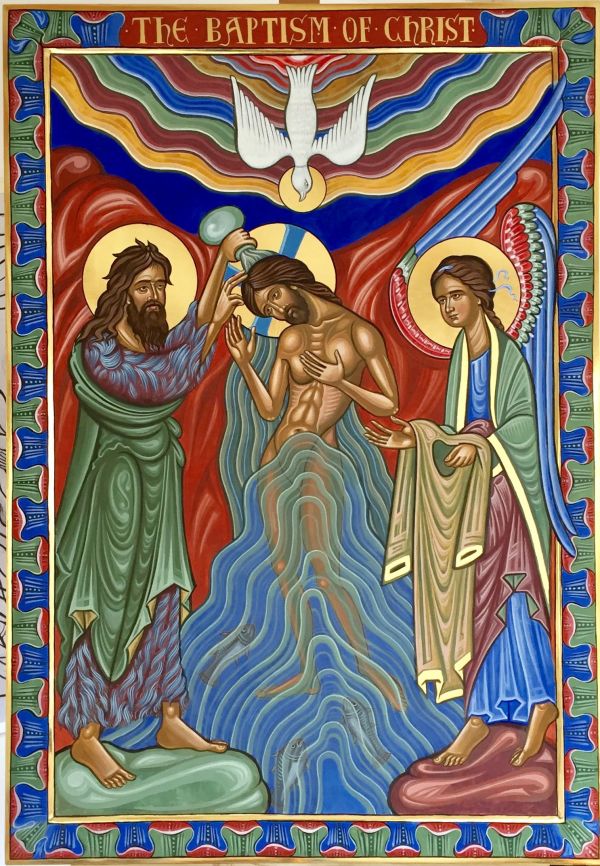
And today, we stand inside one of the thickest stories the Christian faith knows: the baptism of Jesus. And in 2026, we inhabit this rich story surrounded by the fraying of the thinnest of national thin stories.

All four Gospels tell a story about Jesus’ origins—but they do so in strikingly different ways.

Matthew and Luke begin with birth stories. Mark begins abruptly, with no mention of an infancy at all, Jesus emerges from the long silence of childhood and adolescence and steps onto the public stage as a grown man, ready to begin the work God has given him. John reaches back even further, telling a cosmic story of pre-existence: the Word who was with God and was God from the beginning has taken flesh and blood.

Each Gospel tells the same truth—but not in the same way. Each shapes a recognizable yet distinctive identity through story. This is the variety offered by a thick story – the truth -approached from a number of different angles.

And that matters, because identity is always a moving target. We discover and rediscover who we are through the stories that are told about us—and as these stories become our own, edited and reedited to become the stories we tell ourselves about ourselves and the world we inhabit.

Some identities are rooted primarily in birth. For a few—royalty, dynasties, elites—birth alone bestows belonging and meaning. But for most of us, identity is shaped less by birth than by adoption.

We become ourselves through a series of adoptions: into families, friendships, communities, vocations, causes, and commitments. Each adoption draws us more deeply into the persons we are becoming.

That is why baptism matters.

Matthew, Mark, and Luke recount Jesus’ baptism differently—and their differences reveal something essential. In Matthew’s and Luke’s birth narratives, the divine nature is conceived in human gestation. Matthew’s account is typically shorn of the human warmth of Luke, an event reserved only for the select few, whereas in Luke, Jesus’ baptism is witnessed by the crowds – a solidly communal experience. But it’s in Mark’s account that Jesus’ baptism becomes intensely personal. In Matthew and Luke, the heavens majestically part, but in Mark, they are violently torn open. In all three accounts, the Spirit descends, and the divine voice proclaims, but in Mark alone it is a voice heard only by Jesus. It’s personal, it’s particular, it’s the voice of divine adoption – still a secret only to be shared between Jesus and God.

These are not contradictions. They are complementary truths held together within a thick story. Within the complexity of this thick story, a key question remains unanswered. Is baptism a personal or a communal event? Is baptism the certificate of individual salvation —or is it the recognition of entry into the life of a community that is already saved?

The Christian tradition has never settled this question neatly, because it refuses thin answers to complex questions. What baptism does is tell us where and to whom we belong.

Jesus’ baptism echoes the first story of creation, when the Spirit of God swept over the waters and breathed life into the world. At the Jordan River, that same breath rests upon Jesus. God claims him. Names him. Delights in him.

And why the adoption strand in Mark’s account is crucial is that it shows that what God does for Jesus, God does for us.

As Jesus is baptized into a relationship of adoption, so are we.

In baptism, God adopts us—not because we have earned it, not because we understand it, but because God delights in us. Before we believe, before we choose, before we behave correctly, we are named and claimed.

Belonging precedes believing!

This is where the Christian story confronts the thin stories of our time.

Our nation is struggling—violently at times—to tell a story about who belongs. Immigration, race, power, identity, and fear have all been reduced to brittle slogans and hardened boundaries. Thin stories dominate because they promise certainty in an anxious world.

But many of us no longer recognize ourselves in these stories. We sense—often without knowing how to articulate it—that they are too small, too cruel, too narrow to hold the truth of our lives together.

What we are witnessing is not merely political conflict. It is a struggle over belonging.

Which story will tell us who we are and where we belong?

The Christian story is very thick, yet this does not mean the Church is immune to thin interpretations.

Different Christian communities tell very different stories about baptism, salvation, and belonging. Some see baptism as a personal declaration of faith—a transaction securing one’s place in heaven. Others see it as entry into a tightly bounded institution where salvation is carefully guarded.

The Anglican tradition tells yet a different story—an awkward, sometimes frustrating, but profoundly generous one.

William Temple, Archbishop of Canterbury, once said, “The Church is the only society that exists for those who are not its members.”

That sentence unsettles us because it resists thin boundaries. In the Episcopal Church, belonging often precedes believing. People find themselves woven into the life of the community—sometimes long before they know what they believe.

Our boundaries are intentionally fuzzy. Worship is open to all. The invitation to Communion is offered to the baptized—yet no one is turned away at the rail. To some, this seems inconsistent. But it reflects a thick story: the Church as a sign of God’s salvation already at work in the world.

Unlike other traditions, ours does not confine grace. We are content only to witness to it.

Baptism, then, is not a private spiritual insurance policy. It is entry into a community that lives for the sake of the world.

That is why the Episcopal Church places such weight on the Baptismal Covenant. Baptism is not something that happened once. It is something we relive every day.

We promise to persevere in the life of community.
To resist evil and return when we fall and to proclaim—not create but proclaim—the good news that God has already acted.
We promise to love and serve our neighbors. And to strive for justice, peace, and to fight to defend the dignity of every human being.

These promises are not abstract ideals. They are the practices of belonging.

They form us into people who can live inside thick stories—stories that do not require enemies, that do not depend on fear, that make room for difference and growth.

At Jesus’ baptism, God does not give him a task list. God gives him a name.

“You are my Son. With you I am well pleased.”

Before Jesus teaches. Before he heals. Before he suffers. Before he dies. He comes to belong.

Belonging comes first.

And that is the story we are called to live and tell—not only in church, but in a world desperate for stories big enough to hold the hope. And remember Advent’s key message about hope. That for which we hope is already present to us simply by virtue of our hoping. We are already those for whom we have been waiting. So let us stop waiting and proceed with the tasks at hand.

Amen.

Blog at WordPress.com.

Up ↑