Reflections on Quasimodo (Low) Sunday

Quasimodo derives from the Latin introit "Quasi modo geniti infantes, rationabile, sine dolo lac concupiscite",  by which words  the Church closed the octave of Easter with special reference to the newly baptized neophytes, as well as an allusion to the general transformation through the Resurrection.

Vibrant and healthy Christian communities have two key characteristics. Healthy Christian communities have a tolerance for doubt – and also prioritize human pastoral needs over doctrinal beliefs. These, like our own Anglican-Episcopal communities are communities where belonging comes before believing. To paraphrase Dietrich Bonhoeffer:

Being Christian adds nothing to being human, being Christian puts being human into practice.

John the Evangelist gives us the earliest account of Christian community in his description of events taking place over two consecutive Sunday evenings following the death of the man Jesus and his resurrection as the Messiah – the Christ. He begins:

When it was evening on that day, the first day of the week, and the doors of the house where the disciples had met were locked for fear of the Temple police, Jesus came and stood among them - he showed them his hand and side and said 'Peace be with you'. Then he puffed into them saying 'Receive the Holy Spirit".

It’s not doors with metal locks – but hearts barricaded by fear that Jesus penetrates. In showing them his wounds, Jesus demonstrates to them – look it’s me, Jesus, and I’m real – I’m not an apparition. Despite the obvious – that his post resurrection body seems not to be constrained by the normal material limitations – his wounded and scarred human flesh remains the primary identifier of his resurrection body. His wounds show the continuity between before and after – joining his crucified human body with his resurrected body. The post resurrection Jesus embodies a continuity between the divine and the human. From now on being human is to be most like God!

Jesus then breathes on them. John uses the Greek pneuma for which a better translation in this context is puff or inflate. Jesus puffs the Spirit into them. From pneuma we derive the English adjective pneumatic to describe the action of puffing up or inflating with breath. In Genesis, God puffed breath-wind-spirit into Adam’s nostrils. Jesus puffs the Holy Spirit – the breath-wind-spirit of God into his deflated disciples – inflating them into a pneumatic and dynamic community.

John goes on to depict Jesus’ return visit to the disciples one week later – a visit seemingly to encounter Thomas who had earlier announced his doubt – a need for physical proof before he could believe – earning him the epithet doubting Thomas. The epithet tells us something about the Tradition’s ambivalence towards doubt. But Thomas wasn’t the only one to doubt human hearsay. Remember the male disciples had only earlier in the day refused to take Mary and the women’s word that they had seen the risen Lord.

I think that curiosity is a prime requirement in the spiritual life. There can be no curiosity where there is no doubt. It seems that for Jesus, doubt is not the barrier. The barrier is anxious fear. We might conclude from John 20 that faith’s opposite is not doubt but fear – for the seeds of faith are sown in the fields of doubt.

John 20 relates how Jesus’ breathed into the disciples inflating them with his spirit and propelling them onto the pages of the New Testament as a dynamic community. In John, the inbreathing of the Spirit and the resurrection appear to be coterminous. It is Luke who translates this experience into an ordered chronology of sequential events: death-resurrection-ascension-spirit inflation.

The canonical arrangement of the N.T. books place the gospel of John between the gospel of Luke and Luke Acts. It makes some sense to keep all the gospels together. But it breaks the continuity of the Lukan narrative –for Luke’s is a story in two parts. The first part concerns the life and times of Jesus. The second concerns the life and times of the early community that emerges to continue Jesus’ the mission and purpose in the world.

In Luke’s Acts of the Apostles, we have his vivid firsthand portrait of the community of the first followers of Jesus. We are surprised to find that within a short space of time the community emerging from the ragbag band of followers displays the signs of an incredible pneumatic vitality. We are further surprised to note their shared heartbeat -a bold generosity and willingness to risk departing from conventional ways of living – a community where belonging is as important as believing. Matt Skinner notes:

Everyone participates. Everyone dares to show solidarity. Because everyone belongs. 

There is no reason to seriously doubt Luke’s overall depiction of a transformation in the followers of Jesus into a community imbued with Jesus’ sense of mission and purpose. They are not just motivated by the memory of the man they loved and have now lost. They are now empowered –pneumatically inflated with the breath of his spirit. The memory of love and loss becomes an-every-moment experience of radical transformation. For the first Christians – as Paul’s letters to his fledgling communities corroborate – because the power of the risen Christ has turned every normal expectation on its head, they’ve become charged with an energy to live in a radically new way. Everyone participates. Everyone dares to show solidarity. Because everyone belongs.

Matt Skinner further notes that something greater than charity and mission was operating in the community Luke depicts; believers are living out a commitment to belong to one another by addressing the impediments that get in the way of doing so. The key to their solidarity has something – though not everything – to do with their use of money and the reordering of resources.

We see money being used to destroy what money is usually used to create: [that is] distance and boundaries between people.

Willie James Jennings, the current professor of theology and Africana Studies at Yale

It’s worth noting Dietrich Bonhoeffer’s comment again- that being Christian adds nothing to being human, being Christian puts being human into practice.

At the heart of the early Christian transformation in shared consciousness lay the radical practice of putting being human at the heart of being Christian. In the Classical World this was a radically new approach to living – one that enabled small communities of relatively poor people to become magnets of attraction. Placing being human at the heart of being Christian triggered a second radical shift in the way these early communities organized themselves to achieve what they saw as their purpose in the world. Resources, i.e., money and access to commodities – were no longer the marks of division between the haves and have nots. They became instead, tools for the fostering of solidarity –of a shared investment in community. The early Christian communities emerge as centers where flourishing flows from mutual interdependence – where individual flourishing depended on everyone flourishing.

From each according to gifts – to each according to needs.

The early Christian picture Luke paints for us – amply corroborated by Paul’s letters to his missionary communities may not be exactly a translatable blueprint for us in 2022. But in the challenges facing us today we see how putting being human at the heart of being Christian – together with a more equitable distribution of resources becomes once more a radical manifesto for living.

In 2022, we face three mammoth challenges: pandemic recovery, ecological collapse, and the resurgence of sacred violence. Does the Easter story still empower our transformation? Are we capable of a transformation in consciousness like that experienced by the first Christian communities? Over the next weeks of the Easter Season – some 50-days in all – though seven have now passed – even if definitive answers continue to elude us – we will explore the implications that flow from asking such questions.

The Friday we call Good

Image: Isenheim Altarpiece- Niclaus Hagenau completed by Matthias Grunewald, 1515 commissioned for the infirmary of a local monastery, where patients could be comforted by message that they were not alone in their suffering

Today is the Friday we call good. Good does not mean good as we use the word but great as in significant. This day is a day of such significance for Christians that it warrants the name great. Alternatively, there is some evidence that good is a corruption of God as in God Friday. After all we say to one another good day, which can mean have a great day- as Americans now say or a more ancient form of greeting God be with you.

The liturgies of Holy Week and esp. the service simply known as the Solemn Liturgy of Good Friday provide a vehicle – transporting us into the heart of the drama of Jesus last week in Jerusalem. On Good Friday our music is sparse and hauntingly somber as befitting a communal expression of grief and sorrow. Ritual familiarity insulates us in a kind of vicarious dramatic experience. We perform certain rituals and take certain actions dictated by the liturgical protocols of the day as observing participants – watching the action so to speak from the other side of the metaphorical viewing screen – though with livestreaming the screen is often nowadays a literal one. Often the role taken by preachers on Good Friday is to help evoke for the congregation a sense of mood. To encourage those assembled to get into the feelings – to be moved by the pathos of the drama unfolding before us.

Did Jesus feel compelled to journey to his death on the cross? Crucifixion was a form of punishment reserved for political agitators who threatened the fragile stability of the imperial order. Therefore, death by crucifixion was a punishment for a particular kind of treason – thus turning Jesus’ death into a political act.

Did Jesus know how his last week in Jerusalem would end? The gospel narratives depict a degree of intention in Jesus’ decision to journey to Jerusalem. He seems to realize the likelihood of his death there. That he thought he would die by crucifixion is less clear. Nevertheless, his intention was firm because he believed himself to be acting within the drama of God’s dream for the world.

In 2022, Good Friday stands-out in stark contrast against the violence that Vladimir Putin has unleashed upon Ukraine. For me, the connection between the Ukrainian tragedy unfolding before us and Jesus’ death on the cross is so strong that I am impelled to go beyond the traditional pathos of Good Friday.

Tonight, I’m compelled to try to communicate the stark realities of courage in the face of a particular kind of imperial violence. Through the lens of Ukrainian courage we see the stark contours of God’s purpose through the death of Jesus on the cross. Imperial violence is always a form of sacred violence – that is the defense of political, cultural or religious values through violence. By the manner of Jesus’ death on the cross – with all its political significance – God demonstrates the nature of courage in the cosmic confrontation with human sacred violence.

There are two kinds of courage. The first is spontaneous courage – we simply react without time to think in the face of a threat either to ourselves or to others. The second kind of courage is deliberative – we have time to review the situation before deciding to act or not act – we have a choice. Jesus’ journey to the cross is the second kind of courage – deliberative courage. He always had a choice not to do so. Once in Jerusalem he had a choice to shape events towards a different outcome. He made the choices he did because through his deep rapport with God – he understood if not the manner – certainly the purpose of his death.

So, what was that purpose? In the example of Jesus, God demonstrates for all of humanity the ultimate victory in the cosmic confrontation with sacred violence. In the example of Jesus, God breaks sacred violence’s spiritual and psychological stranglehold over us.

Sacred violence is as old as humanity. It’s so instinctively programmed in us that we cannot imagine any alternative to its cycles of endless repetition. Violence becomes sacred when we come to believe that through it we are protecting God or some other supposed higher principle like national honor. Our propensity to remake God in our own image knows no bounds. Voltaire quipped that in the beginning God created man in God’s own image and ever since humanity has been returning the favor. Caught in sacred violence’s repetitive grip we are blind to the ironic paradox that it’s our sacred violence that killed Jesus – and continues to strike at the heart of God.

Our propensity to remake God in our own image means it is counter intuitive for us to believe in a God whose victory is through dying – even when the ultimate promise is resurrection.  To break the instinctive grip of sacred violence upon the human heart – Jesus knew that he – as God’s agent – must first demonstrate the victory that comes only through sacrificial death. 

O Jerusalem, Jerusalem, the city that kills the prophets and stones those who are sent to it. The Jerusalem Temple lay at the heart of an anxious and fragile Roman peace. It’s only by going to the heart of empire – that the roots of sacred violence as the ruthless projection of unrestrained power- that God, in Jesus, finally and for all time – breaks its power over us.

The nation of Ukraine – personified to an extraordinary degree in their President, Volodymyr Zelenski , is showing the world the nature of deliberative courage. We are transfixed in the headlights of the Ukraine crisis because for us – on Good Friday in 2022 – their refusal to be turned aside from their moral sense of destiny is showing us what sacrificial walking on the way of the cross looks like.

We all hope and pray that the courage of the Ukrainian people to confront the sacred violence being visited upon them will result in their victory – not despite of but because of the enormous material and human costs.  But there is a more important truth. Ukrainian courage and resolve – is a courage that courts a terrible vulnerability – a vulnerability through which they have already won a significant moral victory for humanity whatever the military outcome.

On the cross, God broke the power of sacred violence’s grip on the human heart. Jesus’ death on a cross demonstrates that the repeating cycles of sacred violence are no longer inevitable. The victory of God over death means the choice or refusal of sacred violence is now a matter of deliberative courage. Something to bear in mind as we stand in the shadow of the cross.

Holy Week Snapshots

In my address for Palm Sunday, I offered two metaphors – clashing storylines and snapshots – for thinking about the events of Holy Week and Easter.

Two themes have been running around in my head this Holy Week: the distinction between the holy and the sacred, and does Jesus know as tensions rise how his last week will end? 

The world is a holy place, and God’s holiness pervades every part of it. Human experience of God’s holiness is an enticing and infuriating experience of the numinous.  What is enticing about the numinous is that it can only be intuited or sensed. What’s infuriating about the numinous is that it can only be intuited or sensed – diffusing everything and yet remaining beyond out of our reach to grasp, capture, and control.

Our human response to the tease of the numinous is to create boundaries and name the space within them as sacred. Once created, boundaries need protecting and the sacred space within, policed. The very act of policing requires mechanisms of control and domination. In sacred spaces and places – there are two kinds of persons to be found:  those who police and those who are policed; those who control and those who are controlled.

Thus, the Jerusalem Temple was a sacred place, within which grace and violence formed the two sides of the same coin. In driving the sellers of cheap grace from the Temple, Jesus is clarifying the distinction between two distinct storylines – one sacred and one holy. Jesus must clarify the distinction between them because from the human perspective they are easily and often confused.

Throughout Holy Week, Jesus is teaching his disciples about the storyline of the holy -and in doing so – he presents himself as a danger to those who police and protect the sacred against contamination by the holy.

In the Holy Week snapshot we glimpse three clashing Messiah storylines.

  1. The disciples and those who gathered around Jesus to listen to him. They are still in the Palm Sunday storyline of hope in which Jesus is the Messiah – the long-promised figure of Jewish national liberation.  

2. The Temple authorities inhabit a variation of this storyline – but in this variation hope for the Messiah is replaced by fear of the Messiah. They fear Jesus. If he is the Messiah, then all is about to be lost.T

They fear the loss of their power to police the boundaries of the sacred space. They fear the loss of their political power as the quisling Jewish administration tasked with keeping the people compliant under the Roman occupation.They fear the loss of their economic privilege as a 1st century IRS and Wall Street rolled into one – the Temple, at the center of the complex web of taxation, insider trading, and profiteering.

3. Then there is the storyline of the Messiah as God’s agent.

The question about what did Jesus know or not know i.e., his omniscience, is sparked by a comment of Viktor Frankl’s: if you find a why, you can bear any how.

Does Jesus know how his last week amidst escalating tensions will end?  Of course, the gospel narratives portray him to varying degrees as omniscient – knowing ahead of time what was to happen and moving through events rather like the star actor in a well scripted play – the outcome of which is known by all in advance.

There is a theological rather than a literal purpose for the Evangelists in presenting Jesus this way. Yet, I feel this robs Jesus of his human limitation – for after all, isn’t the point that he is like us? The question is not – did Jesus at this point know the manner by which he would die? But how did Jesus understand his role in the storyline of the holy –i.e., God’s vision for the Messiah?

Jesus knows and has always known that his path is as principal agent in God’s unfolding storyline of a promise made to the whole of creation. This is the storyline that has been guiding and leading him to this week.

In other words, it’s not necessary for Jesus at this point to know the how of the future, only to know the importance of the why the future must flow from his deliberative courage – courage born of choices he has the power to make or not make. Viktor Frankl again: if you find a why, you can bear any how.

Jesus is in the Temple because it’s here and only here – where the final confrontation between the holiness of God and the violence of the sacred must begin!

Please remember in your prayers over the coming days:

The cause of peace – remembering the people of Ukraine. We pray for them as they undergo this terrible national and personal suffering. We remember and give thanks for the example of their courage and resolve in facing down Russian sacred violence. We pray for the peace of Jerusalem – still a symbol of conflict and division.

The plight of all forced to flee from their homes to become strangers in a strange land.

The oppressed peoples of the world. For Russians dreaming of freedom from tyranny – esp. remembering Alexei Navalny; for China’s persecuted minorities; for the peoples of Myanmar, Yemen and Palestine.

For those among us suffering from loneliness and isolation; for the distressed in body, mind, and spirit; for those nearing death, and others facing different kinds of loss.

I look forward to seeing you, preferably in person or otherwise online for the Great Three Days of Easter.

Mark+

Perils of Choosing The Wrong Story

History does not [exactly] repeat itself but it [certainly] rhymes. 
To paraphrase Mark Twain.

As human beings we construct stories to explain the world we experience to ourselves and to one another. This is the way we build meaning and purpose into our lives.

But there are always competing stories to tell – there are always -to use a current slogan -facts and then there are alternative facts.

To add complexity there is also more than one way to tell the same story – again there’s news and then there’s fake news. We construct meaning and purpose into our lives as we make choices between competing clashing and conflicting storylines – each vying for our attention and allegiance.

So, the question is: which stories will we choose? From among a bewildering choice of possibilities which stories matter most to us?

Palm Sunday offers a snapshot of a clash of storylines. Palm Sunday is the beginning of a series of snapshots from Jesus’ last week in Jerusalem before the Passover. On Good Friday we will arrive to stand before the image of a dying man on a cross.

Each Holy Week snapshot is like a prism refracting our associations into countless mirror images of our lives.  The snapshots of Jesus’s last week in Jerusalem before his death at a particular turning point of history are also timeless mirrors of the clash of history’s repetitive cycles of sacred violence – a storyline as old as human memory.

From Palm Sunday to Good Friday, we experience the repetitive cycles of human inhumanity.

Sacred violence is the violence inflicted to protect a storyline of empire. I’m defining empire as any unrestrained exercise of power in defense of a set of deeply held cultural, political, or religious beliefs. Usually, the motivation to sacred violence drinks from an intoxicating cocktail of all three.

From Rome to Rule Britannia and Europe’s legacy of colonial violence; from the revival of Putin’s dream of the Russian imperium or the legacy of American manifest destiny; history does not [exactly] repeat itself but it [certainly] rhymes.

Emotionally and spiritually bloodied by our passage before the snapshots of Holy Week’s violence we will eventually arrive at a different story – a new story – a bigger and better story – the unlikely story of Easter. Yet, we’ve some way to travel before arriving here.

In the snapshot of Palm Sunday we witness a clash and confusion of storylines.

The first is a Jewish storyline of national liberation. The waving of palms is a significant echo from the crowd’s Jewish collective memory – a particular echo to an episode in their ancient national story.

For some 160 years before, the triumphant Judas Maccabeus, the last leader of a successful Jewish rebellion against foreign domination, led his victorious partisans into the Temple – which the Syrian tyrant Antiochus Epiphanes had defiled by placing his statue in the Holy of Holies.

Using palm branches, the Maccabean partisans cleansed and rededicated the sanctuary after its defilement. On entering the sanctuary, they discovered miraculously the last light of the Menorah still burning – an event Jews, today, commemorate in the festival of Hanukkah.

This more recent Jewish story of national liberation found a powerful amplification in the more ancient story, Israel’s founding story of liberation – the Passover.

Inhabiting the story line of national liberation, the crowds ecstatically welcome Jesus into the city. But they are in the wrong story – as they will quickly discover – resulting in their disillusionment and anger. Jesus may be the Messiah – but his storyline is God’s not theirs.

At the same time as Jesus was entering from the East, another storyline was unfolding as a second triumphal entry procession wound its way into the city from the West. The Roman Procurator, Pontius Pilate, at the head of his Roman Legion had also come up to Jerusalem for the Passover.

Pilate much preferred the sea breezes and all mod-cons of Herod the Great’s former coastal capital of Caesarea Maritima – now the administrative center of the Roman occupation of Judea.

Pilate loathed and feared Jerusalem’s ancient rabbit warrens seething with civil and religious discontent. He most feared the pilgrim throng crowding into the city for the Passover swelling the city’s normal population of between 20-30,000 to over 150,000. The stability of Roman imperial rule required Pilate to come up to the city with a show of preemptive force to forestall any potential for insurrection.

Passover was Israel’s founding story of liberation from slavery. Pilate’s arrival was indeed a wise move, for the crowds hailing Jesus’ arrival saw him as the Messiah, but a Messiah from the wrong story. 

In the week leading to the celebration of Passover we see with hindsight the lethal intersection of competing storylines.

There’s the storyline of imperial domination and political violence intersecting with the storyline of populist resistance and longing for national liberation. Both are confronted by a third storyline concerning the next installment in the epic narrative of God’s love and vision for the world-through-Israel. This clash of storylines results in a chain of events that takes an unexpected turn – rapidly spiraling out of anyone’s control.

On Good Friday, we will revisit the twin themes of deliberative courage and the confrontation with sacred violence – the violence of empire. But on Palm Sunday, that is still several snapshots along.

History does not [exactly] repeat itself but it [certainly] rhymes.

Holy Week is the week during which we accompany Jesus on his journey to the cross. For some of us, this can be an intensely personal experience as our own experiences of loss and suffering – our passion – surface in identification with Jesus’. For most of us, however, the nature of our Holy Week experience is less personal and more communal.

As liturgical Christians we journey with Jesus as a community – each liturgical step along the way. Each snapshot is a prism refracting our own individual suffering and our identification with the overwhelming suffering of the wider world .

Liturgy is the transport – conveying us together through sacred time. In sacred time – where there is no past and no future only the eternal now – we move beyond memory, becoming in present time – participants in the events that engulf Jesus and echo across time into our current experience. We are well acquainted with of the world of sacred violence currently unleashed in Ukraine and countless other places.

History does not exactly repeat itself, but it certainly rhymes.

Choosing the right story to explain the world to ourselves is crucial. Choosing the wrong story leads to disillusionment and an impoverishment of hope.

Like the crowds praising Jesus as he entered the Holy City, we enthusiastically hail our next political savior until that is, – he or she no longer is.

Like the crowds praising Jesus as he entered the Holy City, we enthusiastically hail our next political savior until that is, – he or she no longer is.

We long to do the courageous thing – until that is, the moment when we don’t.

In sacred time we become participants with Jesus – as if we too are part of his band of disciples during this eventful last week.

With the disciples, we will share in the breaking of Jesus’ Passover bread and drink from his Passover cup.

With the disciples, we will accompany Jesus to the Garden of Gethsemane where we too, will fight sleep to keep watch with him through the night and early hours of Friday’s morning.

With the disciples we will follow Jesus on the way of his suffering, for like them – we will long do the courageous thing – until the moment when we we won’t.

History does not exactly repeat itself, but it certainly rhymes.

Fathers and Sons ( Lent IV)

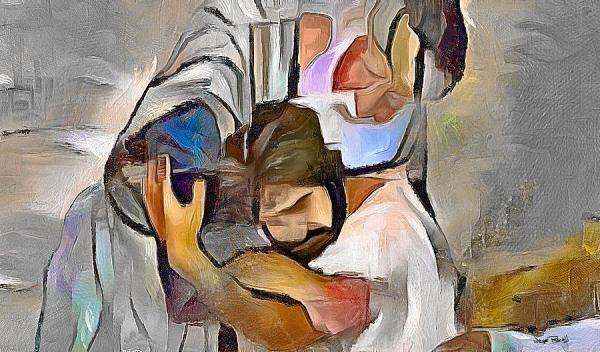
Image: Prodigal Son, Wayne Pascall

.

This week we have for the Gospel portion Luke’s parable of the Prodigal Son. Earlier in the week I was breathing a sigh of relief remembering that I had a sermon dating from 2013 on the Prodigal Son. But when I looked back I realized that I was hearing the text very differently from the way I heard it in 2013 when my focus had been more on the narcissism of the younger son. My starting point in 2020 was to reflect on the experience of parenting. Who among us does not know the experience of a wayward child? If that is too strong an expression at least we all know the pain and concerns felt when our children begin to chart courses in life very different from the ones we had anticipated for them – making decisions we would have wished they made differently.

Like all the parables of Jesus that only Luke records, this parable has always been a rich seedbed for profound mischaracterization. In the interests of full disclosure, I’m indebted to the Lutheran pastor and theologian Paul Neuchterlein – for his rich insights into this text.

We might begin with what to call this parable? Traditionally referred to as the Parable of The Prodigal Son, it’s as much about the elder son as the younger and is particularly rich in its portrayal of the father. Hence some refer to it as the Parable of the Loving Father, but it could equally be the Parable of the Envious Son.

Imagine, Jesus leaving the Synagogue after a lengthly discussion with the Pharisees following the Shabbat service. As he comes out into the street, he’s mobbed by a crowd who may have been loitering with intent to waylay the teacher outside the synagogue doors. In describing them as tax collectors and sinners, Luke is drawing our attention to the fact that these are the ritually unclean, those excluded from 1st-century Jewish worship. Unable to listen to Jesus debate with the Pharisees – they are eager to hear him, nevertheless. The Pharisees, following Jesus out of the synagogue begin to grumble behind him about the shameful way Jesus is comporting himself with the hoi poloi. Clearly aware of their grumbling Jesus begins to tell everyone a parable.

Parables were stories – the details of which were drawn from the ordinary everyday lives of the storyteller’s audience. They build a tension seemingly towards a familiar conclusion – only to at the last minute dramatically veer off into a completely unanticipated ending. This is the case in this parable. The father’s behavior towards is profligate – the meaning of prodigal – younger son is countercultural and not the conclusion anyone expected.

We can’t know with any certainty what ending the crowd outside the synagogue of Pharisees and sinners expected from this story. But we do know how subsequent interpretations have sought to reduce it to a rather simplistic morality tale about the wages of sin with strong patriarchal themes – namely, sex with prostitutes, disobedience to father and duty. The younger son in following his hedonistic desires comes -predictably – to a sticky end. He is forced to humiliate himself by going back home with his tail between his legs to beg his father’s forgiveness. You can hear the tut tutting down 2000 years of interpretation – be this a lesson for all you rebellious sons.

This rather traditional interpretation designed to support the patriarchal world view has largely remained silent on the elder son’s reactions to his brother’s return. It’s also conflicted on father’s response. The father – having daily pined for his son has kept a continual watch in the hope of his return. In this sense he seems to behave more like a mother than a father – an insight Neuchterlein suggests in one of his sermons on this text.

This parable offends against the patriarchal tradition which emphasizes the virtues of obedience and duty to strict fatherly rule and the honoring the first born over the younger. Thus it does not know what to do with Jesus’ portrayal of elder son – who is outwardly compliant but inwardly deeply contemptuous of his father’s response to his wayward brother’s return. Being dutiful and hard working on the family estate seems to have bred only envious resentment in him. In confronting his father, he refers to his brother, not as my brother but as this son of yours – aptly articulating his anger towards both.

The patriarchal reading of this story is likewise conflicted on how to picture the father – whose indulgent generosity flies in the face of conventional inheritance custom. This is bad enough, but his willingness to take his son back – holding him seemingly unaccountable for his profligate ways smacks of more than a little moral weakness on his part.

Reading this story through the filter of patriarchal relations is only one of the two main ways this parable has been misconstrued.  The other has been to read it through the filter of antisemitism. The father is God. The elder son is the Jews. The younger son the Christians. We can all see where this reading is headed.

If Jesus were standing in this pulpit, orienting himself to our 21st century mindset he might ask us:  so who do you identify with in this story? This is not simply an individual question it also has wider social-relations implication -as in – which identity do we inhabit within the social structures of 21st century American life? As middle-class white folk –dutiful, obedient, hardworking, and schooled in the virtues of delayed gratification, I imagine few of us identify with the headstrong younger son and his deeply countercultural choices – unless we do so secretly – which tells a story in itself.

It’s likely we believe that the prodigal’s decisions have been – to say the least – misguided, but how do we feel about the father’s non-judgmental and seemingly uncritical response to his son’s return? How do we account for his disinterest in holding him to account? He not only fails to call his son to account he throwing caution and financial prudence to the winds – giving completely the wrong signal he rewards him with a lavish party?

Of course, this parable is a story about God, whom Jesus portrays as an noncritical and non-judgmental father – recklessly generous; indiscriminate between worthy and unworthy recipients of his love – always keeping a watchful eye out for his wayward children’s return – and treating such return as the occasion for a celebration of new life.

Yet, I want to draw our attention to the parable’s conclusion. What do you conclude from hearing this story? Whatever you do conclude you will be wrong for this parable has no conclusion – a skillful teaching ploy on Jesus’ part.

The parable operates at two levels. In the setting of its telling – the street outside the synagogue – the Pharisees can be depicted as the sincerely religious; men of real integrity and longing to know and love God more. Yet, their ability to be sincere in their spiritual quest is a product of their privileged social and economic status. In debate with Jesus, they are intrigued but remain cautious for they feel that they have much to lose by the wrong decision. They want to know what the right path is before they commit to following it. Contrastingly, it’s those whose occupation or lack of one excludes them from the promise who have nothing to lose and who seem open to, and excited by, the invitation implicit in this parable.

In the context of our receiving this parable we need to sit with its open-endedness – its lack of firm conclusion.

We don’t know if the elder son did eventually swallow his hurt pride and join the feast – the parable leaves this both unclear and also a possibility for the father’s invitation remains open ended.

Although the parable does not have a clear concluding moral message, it nevertheless has a rub that chafes. The rub is – grace is never free. Oh, it’s offered freely by God and there is no pre qualification required to receive its invitation. The offer is free, the acceptance is costly. As elder son – what would it cost us to relinquish our resentment and go in to the feast? As the younger son – what has it cost us to return home, humiliated?

The younger son knows that the grace of the father’s undying love is costly. Like him, the crowds outside the synagogue know that grace is costly. As the socially marginalized and religiously excluded they’ve already paid its price.

Like the father in this parable, which among us does not know the cost of unconditional, nonjudgmental love? Which among us has not suffered the pain of watching our children chart different life trajectories that inevitably lead to painful and unsuccessful outcomes? We know that like grace, love is not free, it exacts its own cost.

The Death of Inevitability (Lent III)

There is a difference between memory – the impressions we are given and history – the connections that we work to make if we wish.

Timothy Snyder

Thinking of Snyder’s distinction between history as given impressions -what we might call collective memory fragments – and history as connections made (actions taken in the present) is helpful to us as we seek to unravel the complexities between collective memory and Biblical text – that is, between a story’s projected setting and the context of the written text that purports to remember back in time.  

originating among disparate and unrelated communities – later woven together into a written narrative to provide a coherent story of origins in support a later issue of national identity.

The O.T. lesson for Lent 3 2022 drops us into the scene of Moses minding his own shepherding business, leading his father-in-law’s flocks through a landscape – interestingly described as a place beyond the wilderness. It’s here, that Moses has his first encounter with God revealed through the phenomenon of a burning bush.

Moses’ curiosity is aroused, and he takes a detour from familiar route so that he can get a better view of this amazing sight he’s spotted in his peripheral vision. Moses, hearing  the sound of his name is immediately stopped in his tracks as God calls to him to come no further for first, he must remove his sandals, for he is about to tread on holy ground. This is the narrator’s way of alerting us to the fact that something really big is about to happen.

Reading between the lines we can note that Moses does not seem to know this God – requiring God to self-identify as the God of his fathers: Abraham, Jacob, and Joseph. Perhaps we can see here the skillful pen of 5th century writers reconnecting a break in the fragments of oral memory between Joseph and Moses to bridge a period during which because of their enslavement the Hebrews seem to have forgotten their God.

God asks Moses to reintroduce God to the Hebrews by carrying a message of hope to them. Moses tries to avoid God’s request. He anxiously asks God  – why will they believe me even if I take them your message?

God does something very interesting at this point. He gives Moses a new name to take to use – instructing him to tell the Hebrews that –I am who I am– has sent me to you. The God of their fathers resurfaces into Hebrew consciousness – not as a God of distant memories revived but  henceforth to be known as YHWHYahweh, a God of future hope and promise.

We often miss the distinction between the wilderness and a place beyond the wilderness. The wilderness is the place of lost dreams and broken hopes. The place beyond the wilderness is a new place of hope. This is where the work of history is done, not in the wilderness of memory, but beyond the wilderness where new connections are made – ones we wish for a different future.

Beyond the wilderness is a metaphor for a place that is no-longer-familiar to us – in which experience is no longer imprisoned within our familiar expectations. As we listen carefully, we can’t avoid the question: are we willing to enter a new landscape, one beyond the familiar, to encounter a God – no longer defined by fading memory – but a God of vibrant present-time hope and future possibility?

2019, the last time I preached on Exodus 3:1-15. 2019 was a very different world. It was a world in which we were still captive to what Timothy Snyder refers to as the belief in inevitability – which is the political propaganda promise of endless prosperity and well being.

After the fall of the Berlin Wall and the collapse of the Soviet Union we entered upon a set of assumptions that liberal democracy would inevitably spread prosperity well being. Through the engine of global capitalism the values of individualism and prosperity would advance through economic mutual self-interest.

Following upon the disruption of the pandemic, the Russian invasion of Ukraine has up ended this phase of history.

In a matter of weeks our long-cherished belief in the inevitability of democracy’s onward march fueled by economic progress has collapsed.

We are shocked to awaken to find that Vladimir Putin does not share our belief in inevitability. We now suspect him of having lost his marbles simply because it’s finally dawned on us that he actually sees the world quite differently from us. How is that even possible, we ask? He must be irrational, we respond.

Putting suggestions about his mental state to one side, the situation we waken to presents us with the uncomfortable question: was our belief in inevitability mistaken – blinding us to the reality of the world as it is rather than as we wanted to see it?

The answer to the question seems to be a resounding yes. We thought Putin shared his own version of our concepts of the importance of geopolitical advantage and the economic security as the basis for a stable society. It’s a shock to find he doesn’t care about either of these things. His invasion is not about pushing back against NATO no matter what he says. He doesn’t care about the economic pain of sanctions on ordinary Russians. Ordinary economic realities are distorted when your own net wealth is in excess of one hundred billion dollars, and you are surrounded by a small sycophantic kleptocracy who owe their survival to you.

Putin’s invasion of Ukraine is fueled by his mystical belief in an enduring Russian imperium. To this end he seems to believe that Russia cannot be Russia without the colonization of Ukraine. Like all mystical delusions – his belief is impervious to inconvenient facts. On this subject, Timothy Snyder’s analysis of Putin’s motivating beliefs in his conversation with Ezra Klein is well worth listening to.

All of this is by way of reflecting upon how differently we hear the story of the call of Moses in 2022 from how we heard it in 2019. The blinkers of inevitability falling from our eyes invites us away from spiritually individualistic interpretations of scripture in favor of Biblical commentary as a spiritual reflection on the nature of society -as in – what kind of society are we committed to building for the future?

The I am name God reveals to Moses pulsates with ambiguity. Ambiguity of meaning is a wonderful characteristic of Hebrew – one completely lost to us in translation. The Hebrew I am who I am, suggests two ambiguous readings shimmering and oscillating between I am who I have been, and I am who I will be.  Freed from inherited memories passing a history we are invited to forge connections that open us to who God might now become for us. More importantly, who might we become if we allow ourselves to be shaped by a God beckoning us into future hope and possibility?

God declares his new name to Moses as a promise of hope for a beleaguered people – hope for a future different from their past.

There is a difference between memory – the impressions we are given and history – the connections that we work to make if we wish.

Timothy Snyder

The resistance of the Ukrainian people in the face of the Russian onslaught is not a defense of their impressions from past memory. They seem remarkably unburdened by impressions of the past. They are forging history through connections they are choosing to make in the present – to take them into a new future. In this sense Ukraine has a future in a way that Russia does not. Would that such energy and imagination revitalize our own jaded sense of national identity – all to vulnerable to manipulation by impressions from our past that distract us from choosing the connections necessary that will build hope in the future.

The call of Moses in 2022 is heard as an encounter with God beyond the wilderness of the recently known. In this new place like Moses, we hear God’s new name. No longer a God of inevitability -as in- I am who I have always been, but as I am who I am now becoming, a God of promised hope.

Who might we become if we allow ourselves to be shaped by a God beckoning us into future possibility? To God’s new name he attaches an invitation: will you come with me?

Who might we become if we allow ourselves to be shaped by a God beckoning us into future possibility? To God’s new name he attaches an invitation: will you come with me?

Destiny’s Choice (Lent II)

Photo: Volodymyr Zelensky “I need ammunition not a ride”

In Courage and Vulnerability,  David Lose in 2016, reflecting on Luke 13:31-35, the gospel portion to be read this Sunday, highlighted two different kinds of courage.

The first kind is the unthinking spur of the moment reaction in the face of threat. This kind of courage says something about a person’s underlying character, their personal traits shaped by beliefs, training, and patterns of behavior developed over a lifetime.

The second kind of courage is also an expression of character formed by  

a lifetime of facing fears and shouldering burdens.

For me, there’s a significant element distinguishing the two kinds of courage, however. The second kind of courage involves an exercise of choice. In moments of spontaneous acts of courage – the first kind of courage – choice is absent, because choice is a matter of deliberation. When facing an immediate threat there is not time for deliberation.

The presence of choice means the second kind of courage is always an avoidable response. We know we could just walk away. After all who doesn’t want a quiet life. The choice is ours.

I know I can be courageous if I have no time to think about whether to get involved or not. But if given the opportunity for deliberation, I’m more than likely to shy away from the courageous gesture if the choice to do so is available to me. This kind of caution is a quality I least admire in myself – the reluctance to get involved when the option of walking away presents an alternative for action.

I suspect most of us are like this in that the second kind of courage is an exception to the rule. Therefore, we so admire it in others when we see it – and we know it when we see it. We see it in Alexei Navalny – someone taking a very costly stand and refusing to feel afraid – a quality for which Navalny earns our undying admiration.

In the last two weeks, the hitherto unlikely figure of Volodymyr Zelensky has become our number one poster boy for the second kind of courage. Like Navalny, Zelensky refuses to be cowered. When offered the chance to avoid leading Ukraine’s courageous defiance in the face of the other Vlad’s (Volodymyr and Vladimir are the Ukrainian and Russian equivalents of the same name) –vindictive blood lust, he responded to the US offer of evacuation with: The fight is here; I need ammunition, not a ride … I am staying in the government quarters together with others. The enemy has designated me as target number one, and my family as target number two.

He has subsequently safely evacuated his family, but Kyiv’s administrative center is where he remains – marshalling all his communication skills and savvy media knowhow to continue to inspire his nation and the rest of the free world with his brand of Churchillian courage.

Speaking of Churchillian, I can’t let the opportunity go by for a comparison between Zelensky and Boris J. The standing joke about Boris j is that he thinks he’s Churchill, but he’s really Steve Coogan (a well-known British comedian). Despite his aspirations to statesmanlike grandeur, a comparison with Zelensky exposes Boris J as a mere Churchillian wannabe. The contrast between the character of the two men is an instruction in the second kind of courage.

Zelensky’s sense of moral courage is displayed in his strong sense of purpose. He’s a man who knows he’s in the defining moment of his life. He grasps his sense of destiny. In this he emulates the Jesus kind of courage.

After coming down from the mount of Transfiguration in Chapter 9, Luke takes us on Jesus’ head spinning whirlwind tour as he moves rapidly throughout Galilee healing in some places, exorcising in others, and everywhere confronting his critics. In 13:31-35, Luke reports an exchange between Jesus and a group of Pharisees. They attempt to warn Jesus he’d better high tail it out of town to avoid Herod’s threats to silence him.

Luke doesn’t hint at the motive behind the Pharisees warning. It could be genuine concern – after all while Jesus is often in confrontation with Pharisee groups, he’s also continuing to accept dinner invitations from them – indicating the Jesus-Pharisee relationship is not black and white. Perhaps the warning is self-serving? After all, Herod’s probably not the only one who wants this agitator of the crowds gone from the local scene. We just don’t know – Luke provides no hint as to motive.

Like Zelensky, Jesus is no stranger to threats on his life. After having survived several attempts to kill him – the most notorious being his fellow Nazarethites attempt to throw him off a cliff – Jesus is not going to allow the machinations of Herod to alter his timeline. Describing Herod with a stunning image of that fox, Jesus asks the Pharisees to tell Herod that he’s casting out demons and performing cures today, tomorrow, and on the third day – and not before then will his work finish. Today, tomorrow, and the next day I must be on my way, because prophets don’t die in Galilee, they are killed in Jerusalem. Jesus already appears to have some sense of a timeline for events – probably dictated by the Passover dates – he’s not going to allow anyone, let alone that fox Herod to derail him from his destined confrontation with sacred violence.

Comparison between Jesus’ mission and Ukrainian resistance personified in Volodymyr Zelensky invites not only a reflection on the nature of courage but also on the nature of violence.

Violence takes several different forms depending on the situation and context. There is random as well as orchestrated violence – that is, ordinary violence whether spontaneous or personal. Then there is sacred violence – that is, communal – collective violence as an instinctive response in defense of a perceived higher cause – be it religious, ethnic, racial, or gender motivated in nature.

Jesus’ path to the cross is the journey to his courageous confrontation with sacred violence. Consistent with the second kind of courage for Jesus this confrontation with sacred violence was a deliberate choice. A choice it’s not hard to imagine he had numerous opportunities to avoid making or once made to still walk away from. In Luke 13 we see him refusing to walk away from his sense of destiny.

Sacred violence is as old as humanity. It’s so instinctively programmed in us that we cannot imagine any alternative to its cycles of endless repetition. Our propensity to remake God in our own image leads us to believe it’s our job to protect God with our sacred violence. Caught in its repetitive grip we are blind to the ironic paradox that it’s our sacred violence that killed Jesus – and each time continues to strike at the heart of God.

It’s counter intuitive for us to believe in a God whose protection of us is to die to our enemy’s violence – even when the ultimate promise is resurrection. The last thing we need is a God encapsulated by Jesus’ image of the mother hen protecting her chicks by offering her breast to the fox – giving her chicks time to scatter.

To break the instinctive grip of sacred violence upon the human psyche Jesus knew that he – as God’s agent – must first demonstrate that it could be done. O Jerusalem, Jerusalem, the city that kills the prophets and stones those who are sent to it. It’s only by going to the very source of sacred violence – that God, in Jesus, finally and for all time broke its power over us.

Zelensky is inspiring a Ukrainian resistance to Putin’s sacred violence being unleashed upon his nation. Kyiv is the birthplace of the Russian people. It has a higher claim to define the Russian soul than Moscow can muster.

This explains the ferocity of Putin’s unleashing of sacred violence. Putin’s invasion of Ukraine is nothing short of a struggle over the essential characteristics of the Russian soul.

One of the hallmarks of sacred violence is its brutality – a brutality more shocking to us because this time it’s unleashed on people recognizably like-us. Ukraine is not the first time Putin has unleashed his sacred violence as the tool of his imperial dreams, but Ukrainians are more like us that his previous victims – Muslim Chechens and Syrians. We identify with Ukrainian suffering because their suffering could – if Putin has his way -so easily , and may inevitably, become ours.

Volodymyr Zelensky is not Jesus – and here any comparison breaks down. But in thinking about the nature of his courageous leadership, his refusal to be turned aside from his moral sense of destiny, he is enacting the image Jesus offers of the mother hen and her chicks. While gathering them under the protection of her wings she distracts the predator by exposing the vulnerability of her breast – which in the larger sense is the very image of God’s actions on the cross.

We all hope and pray that the courage of the Ukrainian people to confront the sacred violence being visited upon them will result in their victory – yet the odds remain stacked against them.  But the more important truth here is that Zelensky’s embodiment of Ukrainian fierce courage – a courage that also courts a terrible vulnerability – has already won a significant moral victory for humanity whatever the military outcome.

On the cross, God broke the power of sacred violence’s grip on the human heart. Jesus demonstrated that the repetition in the cycle of sacred violence is no longer inevitable – being now a matter of human choice. Something to bear in mind as we journey with him on his way to Jerusalem.

Heart and Minds, Unveiled (Transfiguration)

Image: The transfiguration of Jesus – David Wojkowicz

There is text -an unchanging communication across time. Then there is context – the unpredictable – everchanging space in which the unchanging text with its timeless message is heard. Text and context. In Biblical interpretation, it’s context which carries the greater weight in fashioning meaning.

Our journey through the liturgical year brings us once again to the story of the Transfiguration of Jesus on the mountain. For Mark, Matthew, and Luke the Transfiguration is the narrative midpoint in the transition between Jesus’ Galilean ministry and taking the road to Jerusalem and the cross. It’s interesting that we are offered a glimpse – midway so to speak – of the end of the story. For the Transfiguration is a foretaste of the resurrection.

For most preachers, the trouble with events like the Transfiguration is that we’ve preached on it so many times before – can there be anything new to say about it? I often ask myself what’s wrong with repeating previous messages? Don’t we preachers do it all the time. In fact, some preachers will have their Transfiguration sermon. They will wheel it out year after year in the sure and certain knowledge that congregations hardly ever remember what they said last week, let alone a year ago. But we all know that things are different at St Martin’s.

The thing is though, even though the text is unchanging, it sounds differently in 2022 which is not 2021, or 2012, or 2002.

This year we hear the readings for the last Sunday before Lent sounding within the unique context of the present time – through which – if we are observant – new aspects – previously unnoticed -will speak to us.

We can’t ignore the fact that today we revisit the story of the Transfiguration of Jesus on the mountain in the context of profound shock. We are sick at heart – hearts aching in solidarity with the Ukrainian people.  We are all devastated by the actuality of a Russian invasion of Ukraine – the ultimate action of a megalomanic mind.

It’s not just the horror of the event but the terror in realizing that such a thing is possible in 21st-century Europe. Our distress is amplified by our seeming helplessness to do anything about it. Sanctions, esp. the ones with the greatest effect will also exact a price from us. Our willingness to make sacrifices in support of principles of peace and democracy – will be the true indication of our moral courage.

The significance of Russia’s invasion of Ukraine is huge and its game changing implications will reshape us all for years to come. It strikes at our shared assumptions forged from lessons learned amidst the ruins of two world wars.

As I wrote in E-News two weeks ago, the tensions between Russia and the North Atlantic Alliance resulting from Putin’s grievances over Ukraine evoke painful memories of 1938 and the Munich Conference.  Neville Chamberlain and Edouard Daladier, the respective prime ministers of Britain and France, aware that neither nation had any appetite for another conflict with Germany so soon after the last Great War, allowed the veil called peace at any price to fall across their minds and shroud their hearts. Longing for peace, but unwilling to defend it – they agreed to the dismemberment of Czechoslovakia in a hope of assuaging Hitler’s unassuageable sense of national historical grievance. We remember the chain of events that this appeasement of tyranny ultimately set in motion.

When faced with an autocrat’s ruthless narcissism- the lesson we keep having to relearn is that appeasement never works. We know this at the interpersonal level. As a nation we are daily reminded as sections of the most narcissistic generation (boomers) remain enthralled to a ruthless narcissistic former leader. So it is also at the level of relations between nations. Appeasement never works. You can only delay but not avoid the inevitability of conflict when faced with a ruthless narcissistic personality for whom enough is never enough.

Putin’s annexation of the Crimea and the Donbas amply demonstrate the point. Now, having failed to halt his advance at the gates of Kiev, we may yet find ourselves having to eventually do so at the gates of Vilnius, Riga, and Warsaw.

In 2022, the the Transfiguration of Jesus on the mountain sounds into a rapidly shifting context – for our future is reshaping as I write-speak.

Changing context opens us to hear different emphases in familiar stories. In previous years my attention in this story has always gravitated towards the mystical and psychological aspects of transcendent experience – that which Abraham Maslow referred to as peak experience in his hierarchy of needs. In the light of the Ukrainian Crisis the veil with which Moses hid the illumination of the divine energy from the people becomes the aspect of the story, that holds my attention.

Veils cloud vision!

It’s no surprise that the Transfiguration narrative draws a straight line to the Exodus story of Moses receiving the tablets of the law on the mountain top. We are intended to notice the similarity in the two stories. Luke is not alone in placing both Moses and Elijah on the mountain with Jesus, although it’s only in Luke that Jesus converses with them.

Within the story the veil functions at different levels.

  • There is the physical veil used by Moses to hide the glory of the Lord still present on his face from being seen by the people. After his face-to-face encounter infusing him with divine energy, Moses must place a veil over his face to dim its otherwise blinding brightness – until that is – the divine voltage dissipates in him.
  • But it’s Paul writing of the spiritual veil in his second letter to the Corinthians that speaks so loudly to me this year. Paul notes how the veil across Moses’ face continues to obscure direct human experience of the divine energy revealed in Christ. The spiritual veil allows us to use spirituality to hide from the reality of God’s reign of justice and peace – something I suggest influenced Chamberlain and Daladier at Munich in 1938.

In 2 Cor.  3:12-4:2 Paul is highly critical of the conventional Jewish reading of the Exodus story. He expresses the pain he feels – as a fellow Jew – at his nation’s rejection of Jesus as the fulfilment of God’s dream for Israel. He likens their rejection to their minds obscured by the same veil which Moses used to obscure the divine brightness from them. Paul is clearly also remembering how this same veil once clouded his mind leading him to persecute the Jewish followers of Jesus. This memory is intense and personal – remembering how on the Damascus Road, this veil was torn from his eyes leaving him temporarily blinded by his encounter with the divine energy.

At St Martin’s we omitted verses 14-16. Some might suggest my motive here is to protect Paul from the accusation of anti-semitism. Reading anti-semitism into N. T. texts remains something of a controversial issue among biblical commentators – but that debate is for another time. We are omitting these verses not because they imply Paul’s anti-semitism but because they risk validating ours. Whatever Paul’s intention, we can only hear him through the lens of our context – one shaped by the subsequent centuries of Christian antisemitism. Whether we are personally conscious of it or not – culturally, antisemitism remains a veil – concealing from us the very experience Paul longs for the followers of Jesus to have – which is he writes:

All of us, with unveiled faces, seeing the glory of the Lord as though reflected in a mirror, are being transformed into the same image from one degree of glory to another.

This is the freedom of those whose minds are no longer clouded by the veil that obscures from them the realization that our differences are not abolished but become reconciled in Christ.

The Archbishops of Canterbury and York, historically the two most venerable Primates in the Anglican Communion, have written a prayer for Ukraine which we will use as our Eucharistic intention. In the name of the Prince of Peace they ask us to pray for the people of Ukraine, for peace and the laying down of weapons, along with prayer for all whose lives will be changed or destroyed in this avoidable conflict.  But what their prayer does not address and maybe it cannot address is that while peace remains the hope of the holy, what are we to do when peace comes under attack?

On this Transfiguration Sunday, the Sunday before we begin Lent’s penitential season, it is the spiritual veil that insulates us from an encounter with the searing energy of the holy that should focus our attention as we reflect upon the meaning of Jesus’ transfiguration.

Jesus is the Prince of Peace, but the reign of peace – while a holy hope is not the default of this world. God’s peace comes only when we, as God’s agents in this world -with unveiled faces behold the glory of the Lord reflected in the world about us – are willing to stand firm in the cause of peace and when called upon -to pay the price of its defense.

Blog at WordPress.com.

Up ↑