'relationalrealities' is the recognition human beings are designed to be in relationships. Relationality is the meaning of being made in the image of God who is by divine nature, relational – Lover, Beloved, and Love-sharer..
Author: relationalrealities
Episcopal Priest currently Rector of St Martin's Providence, RI
We are always looking for the limit of our responsibility, the point beyond which we are no longer required to respond, the point at which we can rest easy acquitted from further claims being made on us. I remember as a first-year law student, my Legal Systems tutor telling us that the key quality of a well-drafted law lies not in the responsibilities it lays upon us but in the protection, it affords by delineating clearly the limits of its application. This makes the rule of law clear and predictable. But when applied to our spiritual life this approach encourages something called legalism. Legalism, sticking to the letter of the law impoverishes us in the spiritual life.
This goes to the heart of what Jesus is saying in the Gospel for this Sunday in Matthew 5:21-37 I hope you might follow this link to refresh your reading of this passage before going further. This passage is from Jesus’ teaching known as the Sermon on the Mount. Here he appears to extend the application of the commandments of old relating to murder, adultery, divorce, and swearing oaths. Extending the application of the commandments to judge not only our actions but our secret intentions as well, how will any of us reach the bar he appears to set?
Jesus confronts the legalistic approach to the commandments of old, which many in his time had confined to the strict letter interpretation according to which virtuous action was simply refraining from: killing, committing adultery, treating one’s wife as a chattel to dispose of at will, and appealing to an idol instead of to one’s personal honesty and integrity as the guarantor of one’s trustworthiness.
Jesus’ uses hyperbole –obvious intentional exaggeration, not to raise the bar to an unreachable level but to show us what living law looks like when compared with a legalistic approach. Legalism, i.e. dead letter interpretation turns the commandments into relational barriers, i.e. I am obligated to do only this much, or go this far in my dealings with others. Instead, Jesus is concerned with spiritual law as an agent for transformation and expands the notion of virtuous action to include our intentions. We are not transformed simply by refraining from doing harm. We are transformed only when we struggle with our rage, desire, greed, and our tendency to treat others as mere objects to be manipulated to fulfill our own needs.
It’s not whether we achieve the goal that matters. It’s whether we struggle with the baseline intentions that impoverish our relationships. Through the grace-filled transformation of our base intentions, we collaborate in God’s vision of what it means to live relationally and thus to experience life in all its fullness. Jesus’ approach to Scripture is to transform it from a noun to a verb. Scripture, something static becomes scripturing –something alive and dynamic and ever changing; capable of guiding us in the present context of the lives we live. Only in this way can the commandments of old continue to guide understanding and action in each new generation.
Stories shape identity. We come to know ourselves through the stories we build to explain our lives to others and ourselves. Each of our life stories comes in multiple versions, for as anyone who has attempted an autobiography will discover the way we currently construct our story is not the only way we can tell it. Each version depends on what is remembered and what is forgotten, what is included and what is left out.
Our identity is also shaped by the external stories of our ethnic, racial, and cultural identity histories. These lay claim to us. For instance, our culture has a powerful secular materialist story that has the most powerful claim over us. This is the story of the autonomous individual imbued by nature with gifts of intelligence and guile, who by the sweat of his or her own brow carves out a life of self-sufficiency and material success. Modern materialist culture assumes that to be successful all we need is the determination to be self-made people. Note how social capital (societal infrastructure) is normally left out of such a story.
All of this raises questions:
Who do we tell ourselves we are?
Given that each of has more than one way of telling our story, which is the principal story that lays claim to us?
A short chemistry lesson
Salt can’t lose its salinity unless the chemical bond between sodium and chlorine is broken. As one of the most stable of compounds, only an electric charge is able to loosen the NaCl molecule. Thus when salt is dissolved in water it enjoys a greater volume as it is released from crystal form, but it remains essentially salt in all its savory-ness.
In Matthew’s Sermon on the Mount Jesus’ tell his disciples: you are the salt of the earth. Describing someone as the salt of the earth creates an identity. This person is wholesome, true, and above all else effective and fruitful.
More troubling are Jesus’ words: but if salt loses its taste, how can its saltiness be restored? It is no longer good for anything and is thrown out and trampled under foot. Does Jesus not understand that salt can’t lose its savor?
Jesus would have observed how salt was collected from saltpans. When dried out the substance in which the salt was embedded still contains a lot of impurities. While salt as sodium chloride can’t be dissolved away it can be leached out. Heavy rain would leach the sodium chloride out of surface layers of the saltpans leaving the residue of impurities that are essentially tasteless. Like fine sand, it was good only as material to loosely gravel a pathway where it would be trampled underfoot.
Jesus has a habit of taking ordinary things to create stories of the spiritual life. So he takes salt – something crucially important in everyday life as a savory for food, a preservative of meat, a fixing for dying cloth, as a staple commodity in commercial transaction – Roman soldiers were often paid in salt in lieu of coin. The leaching of salt from the surface of the saltpan becomes an evocative metaphor for a loss of spiritual fruitfulness. While still looking like salt, without taste the residue is good for nothing. In terms of human behavior, it’s not difficult to see where Jesus is going with this.
Identity revisited
Through our stories, we identify ourselves. Jesus tells us we are the salt of the earth. Maybe we can’t lose our saltiness but like the saltpans after heavy rain, our saltiness can be leached out of us – diluted by the prevailing personal and cultural stories that claim us.
Many of us espouse storylines that promote independence and self-sufficiency as a primary value shaping our view of ourselves and of others. Most of us easily fall under the spell of storylines that shape our view of the world as a place of competitive scarcity. As a nation, we increasingly give allegiance to the storylines that make us fearful of the stranger and thereby more tolerant of simple, authoritarian solutions to complex multilayered problems. Many of us now seem to believe that the story of commercial business success and its competitive values of the unfettered self-interest are the primary attributes for good government. When we place ourselves at the center of our stories we easily forget that means justify ends not ends justify means, forgetting that justice cannot be achieved through oppressive measures.
Saltiness in action
If the gospel story has a claim on us what kind of transformation does it open us to? Isaiah 58 offers some guidance on what preserved saltiness in action looks like.Isaiah confronts the people of Israel’s collective image of themselves as faithful in worshiping God. They believe they are faithful. They complain that God does not see of their faithfulness, nor note their scrupulous observances. God retorts: Look, you can bow your head like a bulrush and lie in sackcloth and ashes all you want but you serve your own interest on the fast day, and oppress all your workers. Look, you fast only to quarrel and fight and to strike with a wicked fist. Such fasting as you do today will not make your voice heard on high. In other words, ritual observances without the saltiness of social action will not attract God’s attention. Israel’s true worship has become diluted by self-interest.
Further Reflections
Competing storylines, each laying claim over us, like the spring rains upon the saltpans dilute our saltiness, washing away the effectiveness of the gospel message, the good news story that opens us to a larger, deeper and clearer vision of our role in society.
Isaiah declares God’s call to fight injustice. Isaiah understands injustice to be a systemic evil that privileges:
the few over the many,
the rich over the poor,
the advantaged over the disadvantaged,
the insider over the outsider.
Religious observance without the saltiness of a social conscience is self-serving and connives with oppression.
Undoubtedly the gospel is a hard message to follow because it confronts us again and again with our own easy conformity to storylines that insulate us to the social evil in which our blindness makes us complicit. The gospel challenges us to understand that our own self-interests are best served when we are concerned for the interests of others.
In this highly complex world of ours, each of us feels powerless to effect change beyond traditional personal acts of charity. To use the biblical metaphor, individually we can feed the hungry, clothe the naked, and welcome the stranger. Yet until we ask why the hungry have no food and the naked are unclothed, why the stranger is forced to leave her home, we change little. Hélder Câmara, who as archbishop of Recefe from 1964 – 1985 opined: When I give food to the poor, they call me a saint. When I ask why they are poor, they call me a communist.
Note, it is to a whole people Isaiah speaks. Jesus speaks to the community of his disciples. The you addressed by both Isaiah and Jesus is the collective you. Worship is always communal. Worship bears fruit in communal action. In worship, God addresses us as a community so that community becomes the vehicle for saltiness in action. Communal action is always social in nature.
Jesus said you are the salt of the earth but beware of losing your savor. To preserve our saltiness from personal and cultural dilution we must first get our storylines straight and recognize that if we are followers of Jesus, the primary storyline that has a claim on us is the storyline of the gospel, the good news; this good news story calls us to
Go ahead and admit it: if you are of a certain age, when you hear the Beatitudes your mind automatically goes to one of two places. Perhaps you flash back to Sunday School; to memorizing the verses, or gazing at a picture of a blond-haired blue-eyed Jesus standing on a high hill above a huge crowd of people. Maybe, as your church school teacher read all the ‘blesseds’ to you and your classmates, you privately thought to yourself that being blessed might not be all it was cracked up to be.
Or. You remember the scene in Monty Python’s satire, Life of Brian, in which one of the crowd, straining to hear Jesus, says, “I think it was ‘blessed are the cheese makers.” To which his companion sagely responds, “Well, obviously it isn’t meant to be taken literally, it refers to any manufacturers of dairy products.” An argument ensues, degenerating into a knock-down/drag-out fight, and our hero decides he’d rather skip the rest of Jesus’ sermon and attend a stoning instead. And there you have it. A deft skewering of humans’ tendency to completely miss the point due to our sometimes comedic tendency to overthink and under-listen. Oh, the time we spend in the weeds while the forest towers above us.
It’s easy to lose our sense of perspective, to get lost in the weeds—and this applies to a lot of things besides Scripture. I confess that there have been days recently when a sense of existential fear for the future of this troubled world makes it difficult for me to read the paper or turn on the news. This is especially problematic when a guiding principle of preaching is to hold the Bible in one hand and the New York Times in the other. It is important to be a good citizen in these times of uncertainty and division, and even more crucial to be a courageous person of faith living into the Gospel and our Baptismal Covenant. But I confess that the temptation to withdraw from the reality of bitter civic division and anxiety is real. And based on my conversations with a number of folks, clergy and lay alike, I suspect I’m not alone–here in the weeds. So today’s readings are well timed. Because they invite us out of the weeds and into the majestic forest of Christian hope.
The Beatitudes as we hear them today in Matthew are also seen in Luke’s Gospel. Each of the two evangelists probably made use of a common source to create a longer discourse by Jesus, of which the Beatitudes are only a part. In Luke the discourse is known as the Sermon on the Plain, and it is configured differently according to his Gospel vision of social justice. This is why he writes of literal poverty and hunger, not the poor in spirit or a hunger for righteousness. On the other hand Matthew’s perspective was to portray Jesus as the New Moses. Hence we see Jesus go up on the mountain just as Moses did at Sinai. Jesus speaks to the people, offering important guidance, just as Moses did in delivering the Ten Commandments. The Sermon on the Mount is a crucial moment in Matthew’s Gospel, offering a large chunk of his teachings, of which we only hear the beginning today.
And that’s what the Beatitudes are; a beginning. They are the first several verses of three entire chapters of teachings on everything from family and social relationships to correct religious behavior. So there is plenty of time in the Sermon on the Mount for Jesus to get into the details, but this initial passage is different. If you’re a Greek scholar (and I am not), and understand verb tense and mood, you will see from the Greek translation that these are statements of fact, not commands to be followed. And this is important because if we just read the English and don’t know this distinction it would be easy (and common—as it was in our childhood) to read the Beatitudes as The Nine Very Discouraging Commandments that require you to aspire to be poor in spirit, meek, pure and persecuted in order to get into heaven. As theologian Charles James Cook notes, if the Beatitudes are truly meant for everybody, then it doesn’t make sense that they are standards for behavior that can only be attained by the likes of Dorothy Day and Desmond Tutu. If the children of God (that’s us) are to live into the Beatitudes we need to see them, not as individual behavioral guidelines, but as a unit—as a preamble to the larger discourse. The body of the Sermon on the Mount will give us the detailed teachings, but first the groundwork must be laid.
The Beatitudes, then, are the foundation of Jesus’ teachings– a statement of facts. And what are those facts? First, God says, you need to know this one thing: You are part of the Dream of God. That is what it means to be Blessed. The Beatitudes are the definitive statement of God’s abiding presence in a world writhing in the birth pangs of the incoming Kingdom. This is a statement, not that our only way into heaven is to aspire to become poor in spirit, mourning, meek and persecuted, but that God knows that we ARE these things. These are all forms of woundedness, and whether we know it or not, we are all wounded. We are all vulnerable. And God knows it, sees it, and Is. Not- Going-Anywhere. We- Are- Blessed. Blessed by God’s abiding and unfailing presence.
Jesus’ words were spoken into a world in pain; a world of division, corruption, imperial occupation and political turmoil. It was a world desperately in need of hope; a world where the temptation may well have been to crawl under a rock and pray it would all just go away. It was a world hungering for peace, mercy, righteousness– for hearts of such pure courage and compassion that they would see God in every person. It was a world in need of new prophets willing to take the risk of speaking the truth, to the hopeless and the powerful alike, of God’s love and healing presence—the truth of the incoming Reign of God.
The temptation today, in the face of political anxiety, is to shut down; either to close our eyes to a tumultuous world or to cocoon ourselves in an echo chamber of like-minded outrage and fear. Or, somehow, both. Neither is constructive or healthy. It is a lack of perspective that has lost the vision of the Kingdom—a vision that is ultimately more powerful than any ideology humans can concoct. Instead, God says LOOK. Look within you to where your hunger, your grief, and your fear reside. Look to your neighbor in need of healing, wholeness, and compassion.
The Beatitudes call us to remember our foundation: Blessed. You are Part of the Kingdom. This isn’t just words. God’s unfailing ability to work with human frailty can be seen if we look around us. Each person will have his or her own example, but for me, it was in last weekend’s marches. The thing that most resonated with me is that to paraphrase one of the organizers, it was not seen as a protest as much as it was an affirmation of human dignity—and that is echoed in our Baptismal Covenant. I attended the one in Providence, a number of folks from St. Martin’s were in D.C., and many of us know people who marched elsewhere—New York, Boston, Nashville, Charlotte, and even tiny Chelan in the state of Washington (population 4000). These were people who felt, for themselves or on behalf of others, the hunger and thirst for righteousness, the weight of persecution, and the pain of being silenced into meek acceptance of injustice. I looked at the pictures of the crowds—city after city and town after town—even a ship off of Antarctica, for God’s sake– and was moved to tears. These people–all over the world—raised their eyes from the weeds. And when they did they found their voices and they found each other. That is kingdom light breaking in right there when you can look into the eye of a neighbor, connect his or her pain with your own, and know that neither of you is alone.
Some say a march isn’t enough to bring about change. Maybe that’s true if it remains just a march. But it’s enough to offer hope. And to say that that isn’t significant is like saying that a little round wafer and a sip of wine aren’t a sufficient meal. It’s a beginning, a preamble. An invitation to participate in the Dream of God and to let it equip us, as Micah says, to do as the Lord requires: Do justice, love mercy, and walk humbly with the One who calls each of us, Blessed.
We human beings are storied creatures who construct and tell stories to identify who we are to ourselves and to the world around us. As citizens in a secular democracy, we have access to certain national stories that define us as a people. In contemporary culture secular humanism is the predominant story that defines us. This is a story rooted in the Enlightenment developments of autonomous individuals now not only in control of our own lives but free from superstition and the tyranny of religious controls. So freed we find ourselves now center stage, lonely and alone in an anonymous universe where God has departed leaving us to tinker and maintain the mechanisms of creation. The contemporary story that defines most of us is a story that focuses on material success and emotional fulfillment. This is a very limiting story.
But we are also people of religious faith and as such we have access to an ancient story that defines us as collaborators with and in relationship with God. The Biblical Epic defines us as those liberated by God’s engagement with the political, social, and economic structures of human history.
We gain access to our foundational religious stories through doing the text. Doing the text means to entertain, attend to, participate in, and to reenact the drama of the text. Our foundational Biblical texts are stories that contain three elements:
A promise made to our ancestors
Deliverance from enslavement
A gift of a place to settle-down in
Our task is to rediscover our connection to the definitional stories of faith, which authorize us to give up, abandon, and renounce other stories that continue to shape our lives in false and distorted ways.
But we come to an encounter with our faith stories already saturated with other stories to which we have given our allegiance and unwittingly placed our trust in. These are the stories of the prevailing ideology of our culture, which have become the stories we believe as a given.
The secular humanist story defines us as good people doing what good people do. While this is an example an area of overlap between faith and secular humanism, on its own its not a large enough story to provide us with that for which we yearn because it lacks the life-giving power of the holy – the larger perspective beyond ourselves, which we need to access if we are to live fully human lives.
We may wonder if a more public faith, a faith which takes a larger, critical view of culture is possible, and if with a larger public view buoyancy for discipleship as citizens is a possibility. (Brueggemann Biblical Perspectives on Evangelism)
In St Martin’s, 2016 was a year of steady progress. Having completed RenewalWorks in 2015 we began 2016 guided by three key priorities distilled from the data gathered during our participation in the RenewalWorks program. Because we don’t talk so much about RenwalWorks now, some may feel that it has simply become one more in the long line of new initiatives to disappear from our community life. This could not be further from the truth and I want to take some time to outline how RenewalWorks continues to guide our movement into the future.
Our distillation of three key priorities begins with Embedding the Bible in parish life. Under its impetus, we completed a full community reading of The Story –The Bible as one continuous story of God and God’s people.Our monthly discussion in three chapter sections took place at the adult forum on the 3rd Sunday of the month. The purpose of this program was to allow many of us to gain an overview of the broad sweep of God’s presence in human history. This is an epic, i.e. a story that unfolds through history. Our lives are shaped by the stories we tell, both to ourselves and the wider world. Our formational story of faith comes to fruition in our lives when we know how our formational epic story begins and develops throughout history, shaping our encounter with Scripture in the present moment.
With reference to the Bible, encountering is the verb I use in contrast to understanding or believing. We encounter Scripture as the key element in our spiritual deepening individually, and as a community through its power to shape us as we face into our lives in the here and now of the early decades of the 21st century. Our encounter with the ancient tradition of Scripture always has a quality of immediacy, for the Scriptures can only address us from within the contexts in which we actually live. In 2016 embedding the Bible as a spur to our spiritual deepening led to a number of developments:
As a community, we are growing in the practice of Lectio Divina, an ancient and yet amazingly novel way of letting a passage of Scripture speak into the intimacy of our everyday experience.
Over the summer to my invitation to form a virtual Daily Office prayer group. This continues as a practice for a number of parishioners who pray at least one of the daily options of Morning, Evening, or Night Prayer offices in the knowledge that others are similarly doing so each day. Praying the Daily Office links us to a global circuit of continuous prayer. Each month a prayer list is circulated for people to use to aid the sense of our local connection in the virtual reality of prayer.
On Thursday evenings we have started an essentially lay-led meditation practice. Four experienced meditators take turns to lead the weekly session. Our practice has an inclusive, interfaith approach to meditation as the cultivation of a deeper capacity for listening and mindful observation, anchoring us in an experience of ourselves that is more than our feelings, thoughts and bodily sensations. Meditation becomes a new portal through which outsiders may enter into the experience of what is offered within our community.
In 2017 embedding the Bible will spur a renewal of the healing ministry with the development of a regular healing service. Completing The Story forms a foundation for embarking in 2017 on a more focused exploration of the Bible together as a community. Watch this space.
The second key priorityEngaging our Passion – Getting People Going has resulted in the establishment of a more robust and effective greeting ministry on Sunday mornings with the creation of a welcome table, each week staffed by a member of the Vestry. Our welcome and new member incorporation now has a much higher profile in our community consciousness. Yet we still struggle to successfully impart that this is an every member responsibility. In 2017, the focus going forward needs to be on empowering people with the confidence and skills to know how to speak about the importance of their faith when the context makes this appropriate. We are not going to blanket convert our friends, neighbors, and colleagues. But we are going to learn how to be sensitive to those moments of inquiry when we sense another’s restlessness with life as it is. When we discover how our church membership helps us with our own longing for that mysterious more in life we are then able to share our experience with others who are similarly searching.
Our third priority – The Heart of the Leader has been amply demonstrated by a growing confidence and clarity of leadership purpose within the Vestry. This was amply demonstrated when all Vestry members stepped up to increase their pledge giving in preparation for our End of year Story at the end of July. Their example encouraged many others to also do likewise because when the leadership demonstrates confidence and resolve it encourages others to feel that St Martin’s is a community worth the investment of time, talent, and financial resources. Yet, strengthening the heart of leadership has also shown itself in all those instances when individual members have stepped up and taken initiative both within the congregation and in the wider world.
2016 has seen the following significant developments:
Settling into the new Sunday morning schedule where the 8 and 9:30 services continue to offer the contrast between quiet early morning worship and the vibrant worship involving choir and sermon. Moving from 10–9:30 a.m. makes space for the adult forum running alongside children’s formation allowing parents a new opportunity to gather with other adults to attend to their own formation. When children see that life-long formation involves their parents they are less likely to grow up with the mistaken idea that church is what you do only when you are growing up. It’s possible to worship and then attend the forum, or worship only or simply arrive in time for the forum hour, esp. when the complexities of family life might mean limiting the time commitment on Sunday mornings. The forum offers an easier portal of entry for spiritual seekers unfamiliar with our complex style of worship.
Retirement after 30 years of Jay MacCubbin as Music Director and the appointment of Nick Voemans as our new Minister of Music.
The new Temple-Church Conversation revives in a contemporary form the earlier Abrahamic Accord between the churches and temples on the East Side. The first in this new series of conversations happened in September. Our focus is on the relationship between our shared Jewish-Christian tradition and the issues facing us in our civic life together, notably issues of empowered citizenship, and protection of our democratic and civic institutions. How do we as people of the Abrahamic faiths (which now must include our Muslim Communities) learn the confidence to speak with authority into an increasingly pluralist civic arena, where often our voice is not at first recognized? For instance, the Temple-Church Conversation gave new impetus to the annual Interfaith Thanksgiving Service, which we hosted on the theme of refugee resettlement, bringing out the deep historical connections between migration, welcome, and gratitude. As we face into a revolution in our political life that will continue to create huge division and disruption in the civic space, we need our religious communities of Temple and Church to be places that empower and support us as we seek to go out to further the expectations of God’s Kingdom on earth.
A third significant development in 2016 has been the design, building, and dedication of a new nave altar and altar rails financed from the generosity of memorial gifts. With this, I feel we have completed a 30-year process of finding a suitable alternative to the primary focus of the high altar. The high altar dominates the architecture of our building. We remain committed to keeping this architectural integrity. Yet exquisitely beautiful though it remains, it no longer functions as the focus for our Eucharistic worship. Eucharistic worship now focuses on a theology of community gathering around the table. Our new nave altar and communion rails intentionally reflect the architecture of window tracery and woodworking evidenced in the sanctuary, creating a seamless stylistic and aesthetic movement from the east window down through the choir to the nave where the focus of our worship now takes place. I want to express our gratitude to Peter Lofgren for the design, Jim Eddy for the construction, and Luis Sosa who built the platform. I also wish to acknowledge the leadership of John Bracken who facilitated the request for memorial gifts from a number of members in the congregation.
The dictionary definition of flourishingis: to grow or develop in a healthy or vigorous way, especially as a result of a particularly favorable environment.As we look forward, because the future often appears uncertain, we don’t always notice or feel that our environment is particularly favorable to us. For me, a favorable environment is not the same as an easy one. A favorable environment is one that challenges us to create new and innovative opportunities for responding to issues we face.
All the challenges facing us can be rolled into one which in last year’s report I identified as the need for greater spiritual depth in our lives. One year further on we are clearer that part of our spiritual deepening requires us to be more convinced and adventurous with our faith and to move from welcoming to an active invitation. Active invitation requires us to live our faith more openly in the different contexts of our daily lives and not keep it a secret for Sundays and the St Martin community only. The fruitfulness of our lives results directly from the nature of the stories that inform and empower us. This comment takes us back to the importance of embedding the Biblical epic as the guiding story in our lives. Reaching-out must now be our number one priority!
Our ministry groups evidence our health with an explosion of energy across all our community ministries. The outreach ministry continues strong with commitments to feeding and clothing those in need as well as ongoing support for Amos House, and St Mary’s Home for Children, the only agency offering therapeutic support for children and families experiencing the trauma of many kinds of abuse, and DCYF’s Christmas gift appeal. The Women’s Spirituality Group has blossomed and now operates not only as a wonderful support for our women members but as a portal through which new members are being continually invited and incorporated. The Knitting Ministry continues to be a place for fellowship and active prayer expressed through the creation of prayer shawls for those who are sick and suffering. The Hospitality Committee continues to facilitate our community celebrations with flair and style. Altar and Flower Guilds, Vergers, Ushers, Acolytes, and Choir continue to form the backbone of our worship life.
Matthew records the call of the first two disciples, mirroring the version we read from John last Sunday. In John, Jesus simply extends the invitation to: come and see. Matthew’s version has Jesus say: follow me. These simple commands communicate that Jesus is not asking any of us to go where he is not prepared to go. Yet, life in the church is not a spectator sport. We don’t watch from afar, we come close and take responsibility for acting. Everyone has both the freedom and the responsibility to pursue his or her own spiritual growth. Yet, the nature of pursuing our own spiritual growth means more than an individualistic response to follow Jesus. It also means that we must become visible to one another as signs for others, pointing towards the path to follow.
In 2017 may we take the courage to embody in new and more dynamic ways the change we long to see in the world (Ghandi).
As a human being, King David was far from perfect. Yet, he embodied the principle that in Israel the king was to be a servant of the Lord and to rule in obedience to the Covenant that God made with Moses, which alone would bring peace and justice to the people. Beginning with his son Solomon, those who reigned after David’s death, more often than not came to embody the corrosive doctrine that the king was no longer under the rule of God, but above it. The age of the great Hebrew Prophets arose alongside the development of the institution of the Monarchy as a necessary antidote to the susceptibility of the monarch to rule as if he were above the Law and not subject to it. God anointed prophets as those called to speak truth to power; a message sometimes received and heeded but most times refused and ignored with disastrous results for the people. The 15th of January is the national commemoration of the birth of the Rev. Dr. Martin Luther King. Dr. King occupies a status of a modern day prophet in the lineage of the great Hebrew prophets. Like them he was one called to speak truth to power, one called to lead those in bondage into freedom. Like them, a man not universally accepted in his own time.
Both Christian and Jewish theology recognize that the age of Prophecy with a capital P is over. For Jews, the return of the exiles from Babylon signaled a seismic shift from prophet to scribe as the central conduit for God’s communication. Before the Exile, the prophet was a direct conduit for God to address the people, and particularly those in authority. Post-exilic Judaism became increasingly a text-based religion and the role of the scribe, embodied in the great figure of Ezra, indicates that it is now through the study and interpretation of the Law that God continues to address God’s people. For Christians, John the Baptist is the last of the Hebrew Prophets and with the coming of Jesus prophecy ceases. Although more than a prophet in the strict sense, nevertheless through Jesus the priorities of the great Hebrew Prophetic tradition continues to flow.
Martin Luther King is undoubtedly a prophet of our own time. The hallmark of this lies in the fact that his message brings hope to some yet in its speaking of truth to power, is hotly contended by others for no prophet is universally accepted in his own time and place. The prophet standing outside the center of power and influence calls for a response that often will be a response of violence – for the prophet speaks the words that the powerful refuse to hear. The prophetic message is always unsettling. If it is not, then it is not prophesy.
Martin Luther King became the catalyst for the movement we now call Civil Rights. On Thursday of last week, I and others from St Martin’s attended an interfaith celebration of Dr. King’s life during which his Six Principles of Nonviolence were addressed by six young men and women. Each spoke about one of Dr. King’s Six Principles of Nonviolence with the personal authority wrought from painful life experience. Students from the Rhode Island Philharmonic School and musicians from Grace Episcopal Church interspersed these reflections with beautiful and poignant musical offerings.
I believe we are once again entering a period of history when these Principles of Nonviolence will be seen to offer a universal message of hope and courage. Although there is but a confused picture of what will emerge with the Trump Presidency, what is clear is that liberal and progressive democracy’s championing of the ideals of inclusion, truth telling, and the connection between personal integrity and public policy is now being treated with open contempt. Therefore, many of us must now emerge from a period of shock and grief into a new civil rights struggle. We will need to atone for our conceit in thinking that virtue is our automatic right, something that should come to us without cost. Ideals naively assumed, must now be tenaciously defended. The arc of the moral universe, whatever the inevitability of its long-term trajectory towards justice, at particular times in history has required from human beings the loud voice of protest and the courage to resist in the face of forces that seek to impede its progress.
In Isaiah 41:1-16, we hear the voice of the Second Isaiah proclaim that God has roused a victor from the east (Nebuchadnezzar) to trample kings under foot. This is a message intended for the ears of Zedekiah King of Judah, whose foreign policy meddling has caused the crisis that would lead to the destruction of the nation. Yet, into the face of impending crisis Isaiah’s prophecy is one of hope and trust in God’s continued faithfulness to the covenant with his people.
Amidst the prediction of travail the prophet offers words that keep the dream alive amidst the uncertainties and regressions of the present time. However, prophets do more than predict doom and gloom, even if the doom and gloom is a necessary prerequisite for the renewal of vision and hopeful purpose. Prophets also offer practical words of advice about how to survive in such times. In chapter 29, the prophet Jeremiah offers this advice to those going into exile:
Build houses and settle down; plant gardens and eat what they produce. Marry and have sons and daughters; find wives for your sons and give your daughters in marriage, so that they too may have sons and daughters. Increase in number there; do not decrease. Also, seek the peace and prosperity of the city to which I have carried you into exile. Pray to the Lord for it, because if it prospers, you too will prosper.
In Dr. King’s Six Principles of Nonviolence, we have the practical advice from a prophet about the nature of protest and resistance in a time of struggle. In the face of forces that seek to dominate through fear, to rule through the creation of competitive division, nonviolence becomes a way of life for courageous people. It cultivates friendship and understanding, seeks to defeat injustice not people, sees suffering as educative and transformational, chooses love instead of giving in to hate and believes that the universe is on the side of justice.
The first line uttered by Jesus in John’s Gospel – the portion of which we read on the second Sunday after the Epiphany being with the words: What are you looking for?Andrew and John answer Jesus with another question: Where are you staying? Jesus simply says: Come and see.
Jesus asks us in this moment, this time, and in this place: what is it you seek- what is it you are looking for?What is our answer to be? Do we have the courage to ask: Lord show us where you are staying.For this will mean not only: Lord show us where we can endure and find stability in the face of uncertainty and disconcerting change, but:show us how we are to survive and pay the cost of keeping protest alive? As with Andrew and John, the first two whose curiosity led them to heed Jesus’ call to discipleship, where will our response to Lord’s inevitable invitation to: Come and see,- lead us?
We know where it led Andrew and John and the others who joined them in the band of disciples. Wherever Jesus’ words of invitation lead us, we will need to travel with Dr. King’s Six Principles of Nonviolence as lanterns for our feet. We will need the Six Principles of Nonviolence as lights to guide our way, ensuring that our resistance must become more than answering evil with more evil, violence with more violence, contempt with a double dose of contempt in return. We will need to remember that despite trying times, justice is never served through unworthy means. Dr. King reminds us that:
The ultimate measure of a man (sic) is not where he (sic) stands in moments of comfort and convenience, but where he stands at times of challenge and controversy.
Have you a favorite painting of the nativity? For painters of the Italian school of Renaissance painting, the nativity was a favorite subject. On the front of the Christmas bulletin, we see a reproduction of the central panel of St Martin’s altar reredos. The celebrated muralist of the Art Deco period, Hildreth Meiere has depicted the nativity in the style of an earlier artistic period. In nativity paintings, our attention is deliberately drawn to the action in the foreground.
Mary, Joseph, and the infant Jesus seem suspended in time against an imaginative depiction of a manger in a state of near disrepair. Surrounded by representatives of the animal kingdom, here we find shepherds, wise men, and in some instances the patrons of the particular artist who have had themselves inserted into the nativity scene among those who have come to pay homage to the infant Christ child.
Have you ever noticed the backdrop? Because our attention is always is drawn towards the figures in the foreground we fail to notice how the nativity event is set against the backdrop of ruins. The ruins of a pre-Christian antiquity; a symbolic expression of former things now superseded by the nativity event.
I particularly like those paintings where the backdrop is divided between two contrasting scenes. On one side we see depicted organized rural life, neatly tended vineyards, winding roads leading to a walled town in the far distance. The other side shows darker more turbulent skies beneath which we see the tumbledown ruins of antiquity, overrun by nature. As a backdrop to the birth of the Christ-child, human manicured countryside is contrasted with the collapse of civilization and wild revenge of nature’s reclamation.
**
Art depicts in a highly stylized form the figures of the Holy Family who seem unnaturally illuminated. Most of us are more than comfortable with this stylized depiction of enchantment. Our comfort lies in the way that the paintings speak to a part of us that longs for the return of a sense of long-lost enchantment; a hankering for a return of innocence.
The painters of the Renaissance period still lived within an enchanted mindset and worldview. I borrow the term enchantmentfrom Charles Taylor’s tracing of the rise of our present secular age. What characterizes an enchanted perspective is theinterpenetration of the divine within the material structures of our world. Here, the spiritual dimension is part of the material fabric experienced in places, through objects, and in persons. Yet, there was also a terror within the enchanted worldview for if the divine inhabited material existence so did it’s opposite, evil. The painters give voice to these fears in the almost hidden details of the backdrop scenery.
In contrast, we live in what Taylor calls as the age of disenchantment. Our disenchantment can be roughly traced back to the age of Enlightenment at the end of the 17thC. Enlightenment is an ironic term for a long social movement, which on the one hand freed us from the darkness of superstition and fear, yet ushered in a new kind of darkness, a darkness of despair. A despair born of the realization that human emancipation from enchantment has left us occupying center stage with God now banished to wings. As we celebrate our emancipation it also begins to dawn on us that we are now alone in a universe now largely of our own making and breaking. Today we find ourselves flat-lining in a world of profound disenchantment and increasing disillusionment.
***
In the infant Christ, God enters into a world that is turbulent and chaotic. In the conventions of Renaissance painting, this is the world of the ruinous backdrop where we wander around among the ruins, stumbling over the fallen stones of the forgotten and half- remembered.
Some will find this last statement shocking. Not because they deny its truth but because they abhor my timing. Christmas Eve, of all times, is a night for joy and celebration. Yet, I stand by my statement not because I have submitted to the darkness of despair but because our journey towards the illumination of the nativity event depicted in the foreground can only begin once we take an accurate compass bearing from our location among the fallen stones of the forgotten and half remembered. Our journey to the Christ-child progresses from among the ruins of our lives and the brokenness of our world on into the light.
God’s coming into the world is not a coming of strength into a world of light reflected from glossy surfaces. Jesus’ incarnation is not like the incarnation myth of Augustus Caesar – a divine prince of light coming gloriously and dazzlingly into a world made perfect by his arrival. God’s coming in the fragile form of a human infant, in insignificance and the hidden obscurity of the wrong part of the world is an entry of the divine into a world of instability and uncertainty.
Christians understand the nativity of Jesus as God’s final act of creation. Having created the world, bestowing stewardship responsibilities on humanity, God has watched over creation sometimes in anger, but mostly in sorrow. God has time and again called his chosen back to share the original vision for the creation. Now in the act of Incarnation, creation is made complete through God’s self-emptying entry into the experience of the created order from the inside out, as it were. Our God, Emmanuel –God is with us – comes not to visit, but to stay.
****
We cannot go back to an enchanted mindset. The Enlightenment has irrevocably reshaped our modern minds. Rather our contemporary task is to abandon the solitary hubris that is the root of our despair and encounter the transformative experience of the transcendent within the here and now remembering that for which we hope is already not far from us because of our daring to have hope.
As we journey from our wandering among the ruins of the backdrop towards the illumination of the scene in the foreground we become, as Bishop Nicholas Knisely puts it, charged with the light photons of the nativity scene. We begin to glow more brightly with every step of the way as we journey out of the backdrop and into the foreground where our transformation takes place.
What is the nature of this transformation, this glowing more brightly?
We celebrate the ordinary and everyday nature of our lives in which vulnerability and risk are foremost.
We become more relational for relationship is the medium the God of the universe chooses to be known through, ensuring that our relationships and communities become the places where grace is encountered.
We witness to the nativity, taking heart that it is our ordinariness, our unworthiness, our invisibility that makes us the objects of God’s love, and being so loved, we go and do likewise.
Luke in writing his account of the nativity of the Christ child is writing theology, not history, and certainly not science. In a recent article in the New York Times, Peter Wehner quotes the writer Garry Wills who describes Jesus as: undiscriminating and inclusive, not gradated and exclusive ... a man who honors women and considers sinners his friends. Here is the heart of Luke’s theology, a theology that we are called to make real in lives well lived.
On Christmas Day, our gospel reflection will move on into the Prologue of John’s Gospel. Here, John speaks of the coming of Christ, not in the language of nativity. He declares Jesus to be the Word present at the moment of creation. The Word of God– in Greek Logos – is the communicative element in God. The Word is God irradiating outwards from God’s self as en-lighten-ment.
In the beginning was the Word, and the Word was with God, and the Word was God. ….. What has come into being in him was life, and the life was the light of all people. The light shines in the darkness and the darkness did not overcome it.
As we approach 2017, for many of us it seems the world has taken a turn towards the embrace of darker hues. But we are those who know that the light has come into the world, and thus we are called through our baptism to be the bearers of that light. The responsibility is huge – to shine in the darkness and not be overcome; to be that light the world so urgently needs.
A sermon from John Reardon for Advent 4. John is an intern at St Martin’s, a former Roman Catholic Priest who is seeking recognition of his Holy Orders in the Episcopal Church.
I suspect I am not the only one here this morning who has Roman Catholic roots. If you do, perhaps you remember being at a middle or high school dance and having a chaperone—nuns were notorious for this—approach you and your date during a slow dance and remind you not to dance so close, and instead, to “make sure you leave room for the Holy Spirit.” It never happened to me personally, but I know the custom remained in the collective memory until at least the 1990s. At the time, I was teaching Religious Studies at a Catholic prep school in Ohio—that’s how Jesus punishes people who leave Roman Catholic seminaries—and we had an event to raise money for charity in which different teachers had to kiss a pig brought in from a local farm. The idea was that the pig would be not terribly appealing to look at and would squeal and create a fuss, so students could be amused by their teachers’ distress. But one year the farmer brought a very young piglet. The poor thing was very sweet and obviously overwhelmed by being stuck in a gymnasium full of yelling teenagers. I felt for it. I bonded with it. The yearbook from that year shows a photo of me cradling it tenderly to reassure it. The caption reads, “Mr. Reardon, religion teacher, forgets to leave room for the Holy Spirit while kissing a pig.” The point of leaving room for the Holy Spirit was of course that the Holy Spirit would make a preemptive strike on any possible shenanigans the young couple might get up to. The Holy Spirit was the ultimate chaperone.
How ironic then that in today’s Gospel we encounter the Virgin Mary as a “girl in trouble” who has conceived a child “from the Holy Spirit.” Orthodox Christianity has generally understood this to be a literal, biological claim that upholds the teaching that Jesus Christ is both truly and fully human and truly and fully divine. Others, like Scripture scholar Jon Dominic Crossan, have pointed out that many biographies at the time the Gospels were written claimed great men like Augustus Caesar to have been conceived by a human virgin and a god. For Crossan, the main point to take from the Gospel stories is the radical claim that it is not Augustus, but a nobody like Jesus who was so conceived. How to respond? As a scientifically minded 21st century American, my only honest answer is, “I don’t know. I wasn’t there. It’s not a part of my experience for virgins to conceive children. I know that parthenogenesis does happen in some species, such as komodo dragons, but when it does the offspring is always female.” But my faith tells me that, for the God in whom I believe, all things are possible, and that God can bring about the birth of a child from a virgin’s womb if God wishes to do so.
Joseph cannot have found it easy to believe the angel’s message he heard in a dream. And yet he did. He started out by making realistic calculations based on what he knew from human experience. He had been cuckolded. He had been wronged under the law. A mild and just man, he did not want to expose Mary to the brutal legal penalty prescribed under the Torah for adultery, namely stoning. He decided to make the situation fade away as quietly and discreetly as possible. But God had other plans and communicated to Joseph in a dream with a vision of an angel. Joseph could have written off the dream. But he did not. Joseph had left room for the Holy Spirit, not understood as the protector from temptation and chaos, but as the presence of the Living God constantly at work in human history, bringing about new life, healing, redemption, and renewal in ways that no human being calculating rationally would consider to be likely or even possible. By naming his son Jesus, which means, “God saves,” Joseph ratified his faith that the voice of the Holy Spirit was stronger and more creative than the fear-based calculations of human beings.
Joseph’s openness stands in stark contrast to the attitude of King Ahaz of Judah. Ahaz was a frightened man. The kings of Israel and Syria wanted him to join them in an alliance against the Assyrian Empire. He knew that was a bad bet and would not join them, so they plotted to overthrow him and replace him with a puppet who would do their bidding. Fearing them, Ahaz made an alliance with the powerful Assyrians in order to keep Judah safe. He compromised his mandate as a descendant of King David to keep the practice of the Torah pure and blended in pagan practices, including the sacrifice of children. He did not trust that God would keep God’s promises to protect the Kingdom and the Davidic line. He clung to his fears and his calculations of what was probable and did not trust in the God who can do anything. He did not even want to hear from God for fear that his plans might be disrupted and he might instead be asked to place his trust in something unbelievable. So when Isaiah tells him that God will allow him to ask for any sign he wishes, he affects a false piety and says he does not wish to tempt the Lord. God gives him the sign anyway—a young woman will be with child and will give birth to a son to be known as Emmanuel, which means “God is with us.”
God saves. God is with us. How easy is it for us to believe these things? Like Ahaz, we see a world filled with violence, horror, and fear. The suffering of the people of Aleppo. The ravages of poverty, abuse, and addiction. The surreal hardening and coarsening of our national life. The personal challenges and difficulties that beset our personal lives and those of our loved ones. The Reign of God does not appear very probable. The vision approaches at times, only to elude our grasp, apparently swallowed up in madness, chaos, and cruelty once more.
As Advent progresses towards the celebration of Christmas, we are invited to place our trust, not in our fear-based calculations of self-interest and survival, but in the child born of the Virgin from the Holy Spirit, the child whose name means “God saves” and whose title means “God is with us.” The advent of God’s Reign has never involved linear, incremental progress in human history. It has always been more hidden, more paradoxical. Times of apparent progress have given way to times of backsliding, violence, and hard hearts. But out of the very rubble of past hopes, the Holy Spirit has always been at work, operating deep down inside the workings of the world and the workings of human hearts, raising up new possibilities from the rubble created by human sin. This truth came home to me recently when I heard a lovely poem by the Irish writer Michael Coady, entitled “Though There Are Torturers.”
Though there are torturers in the world there are also musicians.
Though at this moment men are screaming in prisons, there are jazzmen raising storms
Of sensuous celebration, and orchestras releasing Glories of the Spirit.
Though the image of God is everywheredefiled a man in West Clare is playing the
concertina, the Sistine Choir is levitating under the dome of St. Peter’s,
and a drunk man on the road is singing, for no reason.
We are invited to imitate, not Ahaz, but Joseph. Angels speak in our dreams too. In
Aleppo a man puts on a clown show for children and another creates a sanctuary for cats. There are torturers but there are also musicians. Calculation based on the fear that we are alone and without help does not have the final word. The final word is for those who, like Joseph, leave room for the Holy Spirit, not just to protect us from temptation, but to stir us to faith, to risks, to daring, and to song. God saves. God is with us.
Among all of the words in the English language, the word, “expectation” has got to be one of the most freighted. It brings with it, on the one hand, the eager anticipation of, and preparation for, something wonderful in the future, or on the other hand, the stomach-churning realization that something we anticipated has disappointed somehow. No one wants to deal with something, in others or in ourselves, that has not lived up to expectations.
Listen to John’s words from prison: “Are you the one who is to come, or shall we wait for another?”
In earlier accounts, John the Baptist has greeted his cousin with awe and joy as the Anointed One who is to come and rescue Israel:“Behold, the Lamb of God!”, he has declared to his disciples, palpably excited that the hopes of his people are about to be fulfilled.
But now John has been jailed by Herod. He may not know it yet, but he will die in prison. And his hope is ebbing as he realizes that his joyful expectation of Jesus’ triumph over Roman occupation is in jeopardy. He is losing hope. You can almost hear the accusatory tone; the impatience, the doubt: “…should we look for another?”
And Jesus responds, as he often does, by turning to Israel’s roots. He alludes to the prophet Isaiah, some of which we heard today in the first lesson. Jesus says, look around. The things that the prophets told us of are actually happening; healing and justice are abounding—the Reign of God is breaking in, just like Isaiah said it would. Don’t lose hope, John, he says. All is going just as it should.
But of course, that is part of the tension here. Jesus says that the words of the prophets are being fulfilled, but evidently, John has different expectations of exactly what that should look like. John expects a heroic Messiah who will overthrow the Roman occupation—and he’s definitely not the only one who feels that way. But thus far Jesus is not meeting those expectations. There is a disconnect between differing visions of the Kingdom—the Reign of God—and this disconnect may well lie in how we read Isaiah, which is the foundational text that informs Jesus’ response.
Isaiah wasn’t a single person who wrote at a single point in time. A number of prophets wrote under that name between about 8th and 6th centuries BCE, and their writings are generally seen as being organized into three major sections, as we heard last week. The reading we heard today falls in First Isaiah, which emphasizes the importance of worshiping one God who will purify Jerusalem before inaugurating a vision of peace, healing and reconciliation. Of particular importance in this vision is the Davidic line of kings, of which, according to the Gospel accounts, Jesus is the culminating figure—the Anointed One that Isaiah prophesied over a half-millennium earlier.
Isaiah describes the coming Reign of God as a time of healing and justice, and Jesus alludes specifically to this in his response to John. But, as we just heard in the first lesson, that isn’t all Isaiah said. It’s not just about humanity:
The wilderness and the dry land shall be glad, the desert shall rejoice and blossom;
like the crocus it shall blossom abundantly, and rejoice with joy and singing.…
For waters shall break forth in the wilderness, and streams in the desert;
the burning sand shall become a pool, and the thirsty ground springs of water;
the haunt of jackals shall become a swamp, the grass shall become reeds and rushes.
Do you hear that? The prophet’s vision of the coming Kingdom encompasses all of Creation. This isn’t something we usually consider. But as we look at the water protectors at Standing Rock and what they have accomplished, and as we grieve the destruction and suffering being visited upon our Mother Earth due to pollution and climate change, we are invited to broaden our vision of the Reign of God beyond the anthropocentric—to remember that it’s not just about us.
Jesus turns to the crowd, and he begins by asking them about their expectations of John. “What did you go out to the wilderness to look at? A reed shaken by the wind?” Some scholars speculate that this was a reference to an image on royal coinage. Jesus continues to press the issue—what did you expect to see? Royalty in soft robes? Really? What kind of kingship do you think the prophets were talking about?
Or, did you expect a prophet? Well that’s what you got—and you may not know it yet, but you’ve gotten a lot more than you expected.The implicit question to the crowd in this interrogation has been, “What is YOUR vision of the Kingdom?” Because Jesus is implying that he’s about to turn it upside down. He says,
“Truly I tell you, among those born of women no one has arisen greater than John the Baptist; yet the least in the kingdom of heaven is greater than he.”
And it’s the last part of this statement that rocks the world. Yes, John is important—he’s the forerunner sent to prepare the way for Jesus. But what does it mean that he is the least in the Kingdom?
To answer that, I have another question:
What is our expectation of the Kingdom? If our expectations are in any way informed by the world as it is and not as we are called to help form it, then we are probably off the mark.
Let me introduce you to a living parable.
Steve Blackmer has been dubbed by Harper’s Magazine, ‘The Priest in the Trees.”* He’s an Episcopal priest, ordained just a couple of years ago and called from the beginning of his discernment to a ministry focused on conservation and healing in the natural world. During his time in seminary, he was struck in his study of Scripture by how much of the narrative is immersed in the land—mountaintops, valleys, lakes, gardens, deserts, rivers, wilderness. His Church of the Woods, now a year old, is comprised of just over 100 acres not far from Canterbury, New Hampshire. Liturgy in the Church of the Woods involves hiking, stargazing, storytelling, meditation walks, trail work, and open-air Eucharists. His vision is to help people understand, and repent of, what he calls ‘ecological sin.’
Steve tells this story of a major turning point in his ministry: He calls it the Chainsaw Eucharist. As he was clearing brush and saplings in the forest he came upon a stand of mature beech trees that were in the way of a new meditation trail. He cranked up his chainsaw and began chopping away. But as tree after tree fell, he became increasingly uneasy. He stopped. He realized that in cutting down those trees he had neither shown nor felt the slightest regard for the fact that he was taking lives that were worthy of reverence. Right then and there he set up an altar with his traveling Communion kit and turned to the Lectionary reading for the day. It was from Isaiah:
I have swept away your transgressions like a cloud, and your sins like mist. Return to me, for I have redeemed you. . . . Shout, O depths of the earth! Break forth into singing, O mountains, O forest, and every tree in it.
The author of the story writes: [Blackmer] prayed the prayer of confession, consecrated the bread and wine, and offered them to his fellow congregants — the trees — before partaking himself.
Set aside the complete lack of liturgical orthodoxy of Blackmer’s actions here, and see it, as I said, as a living parable: What is the Kingdom of God like? The Kingdom of God is where Jesus gave himself for ALL of Creation–for everything that God declared Very Good from the beginning of time. ALL of it.
None of Creation, not the natural world that we steward, nor the poor, nor the sick, nor the outsider are to be regarded as something that is in the way of our selfish desires. God’s Dream is to turn all of that on its head; in the words of the Magnificat, to cast down the mighty and lift up that which we would treat as lowly. It’s audacious, it’s what Isaiah envisioned, and that’s what Jesus wanted John the Baptist to understand.
Because, you see, John’s expectation was as imprisoned–as boxed-in–as he was. As he began to lose hope he thought he might have been expecting too much of Jesus, when in fact, he expected too little; as did the crowd that Jesus addressed. They expected to see the liberation of Israel—something they could imagine– not the unexpected–beyond imagination–, which was the healing and renewal of all Creation.
The prophetic imagination of Isaiah, and of the entire Gospel message, calls us to participate courageously in the Dream of God. It is a daunting message, and at the same time a hopeful and joyful one. Today we lit the pink candle on the Advent wreath to mark Gaudete Sunday, which means Rejoice. And we can rejoice today. We can rejoice in the audacious expectation and hope that the God who comes as a child is faithful to all of Creation, and calls each of us to be the ones that we’ve been waiting for.
After the death of Solomon, largely due to the tyranny of his reign, David’s united Kingdom of Israel split into its northern and southern constituencies. The name Israel continued to designate the northern kingdom with its capital at Samaria. The southern kingdom took the name of the predominant tribe in the south – Judah, with Jerusalem as its capital. In 721 BCE, the Assyrian army captured Samaria and deported the king, nobility, and priesthood of the northern kingdom into captivity. This left only the poorest of the peasantry, who over time intermarried with the foreign peoples around them producing the racially mixed Samaritans we know about from Jesus’ day.
The destruction of the northern kingdom of Israel left the southern kingdom of Judah to fend for itself within the whirlwind of Middle Eastern politics. As today, in the time of the First Isaiah Middle Eastern politics were marked by rapidly shifting alliances between small vassal and proxy states caught up in the global tension between the two superpowers of the time- Egypt and Assyria. How little things change.
At the time of Samaria’s fall, two kings in Judah — Ahaz and his son Hezekiah ruled as co-regents. Judah had survived as a vassal state in an uneasy relationship with Assyria, an arrangement that afforded some security paid for through an annual tribute to the powerful empire.
In 715 BCE, following the death of Ahaz, Hezekiah became the sole regent of Judah and initiated widespread religious reforms, including the breaking of religious idols. He re-captured Philistine occupied lands in the Negev dessert. In the belief that Judah’s fortunes would fare better in an alliance with Egypt, Hezekiah took a stand against Assyria by refusing to pay the annual tribute. In response, Sennacherib attacked Judah, laying siege to Jerusalem.
It’s in this political context of crisis that the prophet known to us as First Isaiah warns Hezekiah of the disastrous consequences of this reckless foreign policy. With the Assyrians at the gates, he counsels Hezekiah to hold firm and return the future of Judah to the covenant relationship with YaHWeH. In the midst of this dangerous political situation Isaiah proclaims an extraordinary vision, not of doom and gloom, but of a future time when out of the ruined and burned stump of the once mighty Davidic kingdom there will spring a new shoot. The new shoot is a metaphorical allusion to the Messiah, the promised one who will rise up to restore the fortunes of Israel. In the midst of impending crisis and destruction, Isaiah’s prophecy is a dream of improbable things:
the wolf will lie down with the lamb, the leopard with the kid, the calf and lion and the fatling together, and a little child shall lead them.
Isaiah’s vision constitutes a resurfacing of something I think of as the transgenerational vision. This vision is deeply counterintuitive. Isaiah sees the Messiah coming not as a mighty warrior, but as a little child. It is not surprising that the early Christians understood this prophecy as a direct reference to Jesus’ birth and therefore, a powerful corroboration of their claim that Jesus was the promised one.
In Matthew’ s gospel, John the Baptizer emerges as a crucial figure within the unfolding of the transgenerational vision that identifies Jesus with Second Isaiah’s Suffering Servant. In conscious time and space, John is most popularly identified as the cousin of Jesus. In the trans-generational vision John is Elijah returned and emerges as Isaiah’s:
voice of one crying in the wilderness: prepare the way of the lord, make his paths straight!
Of vision
The transgenerational vision is one of hope and expectation weaving in and out of history. It surfaces in prophetic utterance, beginning with the First Isaiah (chapters 1-39) prophesying into the Assyrian crisis of the 720s BCE. The vision submerges to reemerge two centuries later in the voice of Second Isaiah (chapters 40-55) prophesying into the Babylonian crisis of the 580’sBCE. The transgenerational vision submerges once again only to reemerge a generation later in the voice of the Third Isaiah (chapters 56-66) addressing the struggles of the exiles returning from Babylon to rebuild Judah and Jerusalem.
It next resurfaces in Christ during the crisis of the Roman occupation in the 1st century CE. The transgenerational vision connects us to a past stretching back through the prophecies of Isaiah and the other major prophets of Israel, into the primal Genesis narratives of creation. It constitutes a resurfacing of future hope, echoing the vision of earlier generations but now anchored and given shape by the Incarnation and Resurrection of Jesus the Christ.
Of hope
Today, it’s fair to say that our world is facing into a new period of instability. The Middle East is ablaze. The European Project stumbles as one Western Democracy after another lurches to the right. Huge population migrations are on the move escaping war and poverty. Russia’s return to its old imperial dreams of expansion is a cause for concern and this nation is gripped by a growing tide of rage and fear as we face into a future we no longer feel in control of. We are assailed by the hectoring of one false prophet after another, and we cover our ears or if we have sense switch off the 24-hour cycle of opinion regurgitation masquerading as news.
Isaiah’s message to Hezekiah was to stop politicking solutions that only lead to a deepening spiral of crisis. Isaiah reminds the king that the only security lay in faithfulness to God. He exhorts the king to have the courage to trust the God who hears the cries of the people to bring them out of bondage – bondage in this instance to one failed policy after another. He offers the king a vision of God’s faithfulness and promise.
Prophetic voices for our own time
Paul Tillich was among the top three formative theologians in the decades following the Second World War. He noted that:
If we wait in hope and patience, the power of that for which we wait is already effective within us. Those who wait in an ultimate sense are not that far from that for which they wait.
Alice Miller, to my mind, one of the great psychologists of the 20th-century echoes Tillich’s words when she proclaimed:
We are who we have been waiting for.
Tillich and Miller are prophets of the Kingdom. Kingdom shaped expectations are recognized because they are always counterintuitive – seeming at the time improbable, even impossible. Counterintuitivity is the hallmark of moving beyond the limitations of world views imprisoned within the distortions of the status quo.
Tillich’s words point us to a quality of the transgenerational vision, namely the way it collapses the temporal boundaries of time and action, as in becoming the hope we are yet still waiting for – the kingdom of God is both now and not yet. The quality of future hope shapes the nature of our action in the present. As we find ourselves in a world increasingly soothed by the malignant doctrine that the ends justify the means, we need more than ever to recognize that the means which inspire the peoples’ hope and expectation will dictate the quality of the ends towards which they are led. Means and ends are related in the same way as the quality of fruit is related to the health of the tree that bears it. Playing on people’s fears, exciting their rage and hate for the other is like planting a diseased tree and expecting it to bear good fruit.
Isaiah’s prophecy is of a time when under the leadership of the most vulnerable and fragile of all God’s creatures – a nursing human child; John the Baptist’s proclamation is that the Kingdom comes with a fierce urgency, with no time to waste; the prophetic words of Paul Tillich and Alice Miller shed light on the dynamic between seeming improbable hope and the task of the present time.
Of waiting
I add a third to my two aforementioned prophets of the 20th Century, the poet T.S. Eliot. In 1937 Elliot visited the village of East Coker and subsequently named the second of his four QuartetsEast Coker.The poem discusses time and disorder within nature that is the result of humanity following only it’s own wisdom and not God. Leaders are described as materialistic and unable to understand reality. The only way for humanity to find salvation is through pursuing the divine by looking inwards and there in the discovery of our interconnections the image of God. In the third stanza of the poem Elliot brings a novel twist to the idea that in the act of hoping we reshape our current experience. He writes:
I said to my soul, be still, and wait without hope – For hope would be hope for the wrong thing; wait without love – For love would be love of the wrong thing; there is yet faith – But the faith and the love and the hope are all in the waiting.
Advent reminds us that so much expectation is actually the patience born of waiting. But waiting is not idleness. That for which we wait compels us to turn away from our hard-hearted complicity with injustice,and forge new pathways for the kingdom’s coming, one step and one breath at a time.

 Salt can’t lose its salinity unless the chemical bond between sodium and chlorine is broken. As one of the most stable of compounds, only an electric charge is able to loosen the NaCl molecule. Thus when salt is dissolved in water it enjoys a greater volume as it is released from crystal form, but it remains essentially salt in all its savory-ness.


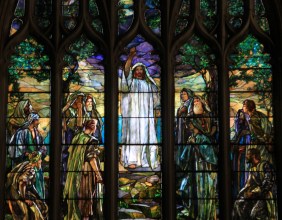 Blessed.
 Have you a favorite painting of the nativity? For painters of the Italian school of Renaissance painting, the nativity was a favorite subject. On the front of the Christmas bulletin, we see a reproduction of the central panel of St Martin’s altar reredos. The celebrated muralist of the Art Deco period, Hildreth Meiere has depicted the nativity in the style of an earlier artistic period. In nativity paintings, our attention is deliberately drawn to the action in the foreground.
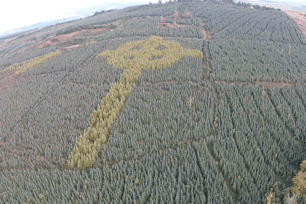 Steve Blackmer has been dubbed by Harper’s Magazine, ‘The Priest in the Trees.”* He’s an Episcopal priest, ordained just a couple of years ago and called from the beginning of his discernment to a ministry focused on conservation and healing in the natural world. During his time in seminary, he was struck in his study of Scripture by how much of the narrative is immersed in the land—mountaintops, valleys, lakes, gardens, deserts, rivers, wilderness. His Church of the Woods, now a year old, is comprised of just over 100 acres not far from Canterbury, New Hampshire. Liturgy in the Church of the Woods involves hiking, stargazing, storytelling, meditation walks, trail work, and open-air Eucharists. His vision is to help people understand, and repent of, what he calls ‘ecological sin.’
 Relationalrealities