We will Remember them!

A nation that forgets its past is vulnerable to becoming a victim of its future.

The events of Friday night in Paris are a reminder to all of us, if ever we needed it, of a changed and rapidly changing world. Our hearts reach out to the people of Paris as they awaken to loss and the recognition that lives have now been changed, not only for those who have been hurt or killed in the carnage of Friday night’s attacks but for the general population at large. Our lives have been changed along with theirs.

We have become inured on a daily basis to increasingly frequent reports of terrorist attacks in far-flung places with whom we feel only but a distant connection. Paris changes that. For we are rather frighteningly aware that Paris is also London, New York, or any of our major metropolitan cities. We are linked to the citizens of Paris as we are to those of London through ties of historical and cultural affinity. These form the basis for a human affection that links us to Parisians in ways that we can feel, for when human beings identify with one another, then fear and pain become shared.

Reports of terrorist attacks in the Middle East, or Africa, or South Asia affect us less because for most of us these affect people with whom our connections feel less intimate. We look on with horror. Yet, our response finds more of an echo with the words of the British Prime Minister, Neville Chamberlain who in 1938, shortly before flying to Munich to sign away the national sovereignty of Czechoslovakia in appeasement of Nazi aggression said:

How horrible, fantastic, incredible it is that we should be digging trenches and trying on gas-masks here because of a quarrel in a far-away country between people of whom we know nothing. 

We speak of terrorist violence as senseless. This is an expression of our inability to comprehend the motivation for such cruelty. Yet, we deceive ourselves when we hide from the reality that terrorist attacks upon unsuspecting civilian populations make perfect sense. Peter Neumann, Professor of Security Studies – what a title- at King’s College London, commenting on the events of Friday night:

This is the attack everybody has been dreading for at least a couple of years. This is really important because it is the essence of terrorism, it is not only about people being killed it is about creating a political effect. What worries me most is that we will see in France and other European counties a polarization, with different extremists egging each other on …. trying to take advantage. It’s about dividing societies. This was a big attack but even relatively small attacks are dangerous because of the political situation, because of the chain reactions they cause.

The shot that reverberated around the world

On June 28th 1914, in the Bosnian city of Sarayevo, a city situated along the fault-line dividing the Austro-Hungarian and Ottoman Empires. For the nations of Western Europe and America, Sarajevo was a place about which little was known. It was here along the ancient fault-line between the Christian and Islamic spheres of influence that a young Serb nationalist shot and killed Archduke Ferdinand Habsburg, heir to the Austro-Hungarian throne. This single, isolated event triggered a chain of events that ricocheted across Europe, catapulting it into the bloodiest war in its very bloody history. The First World War and the Armistice signed four years later, established the conditions that led into the Second World War and the Cold War, as well as just about every isolated hot war since then.

Most of us know from our history books that the event in Sarajevo on June 28th, 1914 led to the collapse of the Austro-Hungarian and German Empires. We may dimly remember that it also caused the collapse of the Ottoman Empire creating the genesis for events that today are playing themselves out, tearing apart the ancient societies of the Middle East.

As if we needed further reminding after weeks of viewing the plight of hundreds of thousands of Syrian and other refugees, in Paris on Friday night the consequences of the disintegration of Iraq and now Syria, broke through our mental levees and flooded into our consciousness.

History forgotten

With the vacuum left by the Ottoman collapse, as the victors of the Treaty of Versailles, the British and French were able to divide the Middle East into respective spheres of influence. Together, they drew meaningless lines on the map. Palestine, which included modern Israel as well as Jordan, and Iraq were created to be a British sphere of influence, together with the existing nations of Egypt and Iran. Syria and Lebanon were created to become an area for French influence. Both countries supported Ibin Saud to unify the desert tribes of the Arabian Peninsula into the Kingdom of Saudi Arabia.

However, it was the creation of Iraq and Syria, little more than arbitrary lines on the map that made so little sense. In the case of Iraq, Bedouin Sunni Arabs were lumped together with Kurds and Shi’ite Arabs. The Bedouin and Kurds shared the Sunni form of Islam but were divided by ethnic identity. The Arabs shared ethnicity but were divided by religious tradition. The Kurds sprawled across the artificial borders of the new Iraq, Syria, Turkey and Iran. The Shi’ite Arabs shared a common religious tradition with their Persian neighbor. In the case of Syria the rest of the Bedouin Sunni Arabs not included into Iraq were lumped together with the urbanized and cosmopolitan Levantine cultures of Damascus and the Mediterranean coast. In Lebanon, Sunni, Druse, Christian and Shi’ite populations were forced into a unitary state.

With the retreat of the colonial powers after 1945 and an increasing American influence in the region, the stability of Egypt, Iraq, Syria, and Iran was maintained through Western support for ruthless dictatorships that maintained stability through oppression. Iran was the first domino to fall.

We all know the rest of this history and how we come to the tragic events in Paris on Friday night. What we don’t know well enough is how responsible the several generations of Western political leadership is for what we see coming to pass. Violence only begets more violence. No one has clean hands.

Coming closer to home

Wednesday of last week was Veterans Day, which is always the 11th November because at the 11th hour, on the 11th day, of the 11th month in the year 1918, the guns on the Western Front fell silent, bringing to an end the First World War. The Allies celebrated November 11th as Armistice Day, keeping the minute of silence at the 11th hour. In the US Armistice Day was renamed Veterans Day in 1954 following the Korean War.

In the UK, the renamed Remembrance Day continues to be marked by the wearing of the red poppy, as it does also in France and Belgium. In these countries remembrance of the war dead grows in strength as a national commemoration with each passing year. The wearing of the poppy has fallen into disuse in the US and the link to remembrance seems to have weakened as the years have past. At St Martin’s we have marked Sunday 15th November as a day of remembrance, a time for the solemn commemoration of the war dead. To these we now must add the victims of terror, both cultural kin and foe.

Why keep this morning of solemn remembrance? Well, one answer is the rector is importing his British cultural observances. Yet, the deeper reason lies in a recognition that as our American culture loses the desire to remember, we need to be reminded that what we no longer remember, we are destined to repeat. If violence begets violence, then violence forgotten, repeats itself creating spirals of escalating horror.

On Veterans Day, we are quick to express our support for the men and women currently serving in our armed forces. The President pays an official visit to Arlington’s tomb of the Unknown Soldier. Yet, the rest of us seem to have loosened our remembrance of the war dead. We no longer wear the poppy, the symbol of the carnage of war. In the loss of that memory and the customs that keep it alive, we also lose the capacity to move beyond sentimental expressions of support our troops into a more somber contemplation of why we continue to put our young service men and women in harms way. Many of us are left scratching our heads, not daring to voice the question: and for what end? 

The separate commemoration of Memorial Day, instituted by President Lincoln as a solemn commemoration for all the dead of the Civil War, has now degenerated into just another of the proverbial three-day weekends. The national memory of the sacrifice of our sons and daughters falls lost somewhere between these two commemorations, both of which are now in need of a restoration if they are to fulfill our need for a satisfactory experience of national remembrance.

Coda

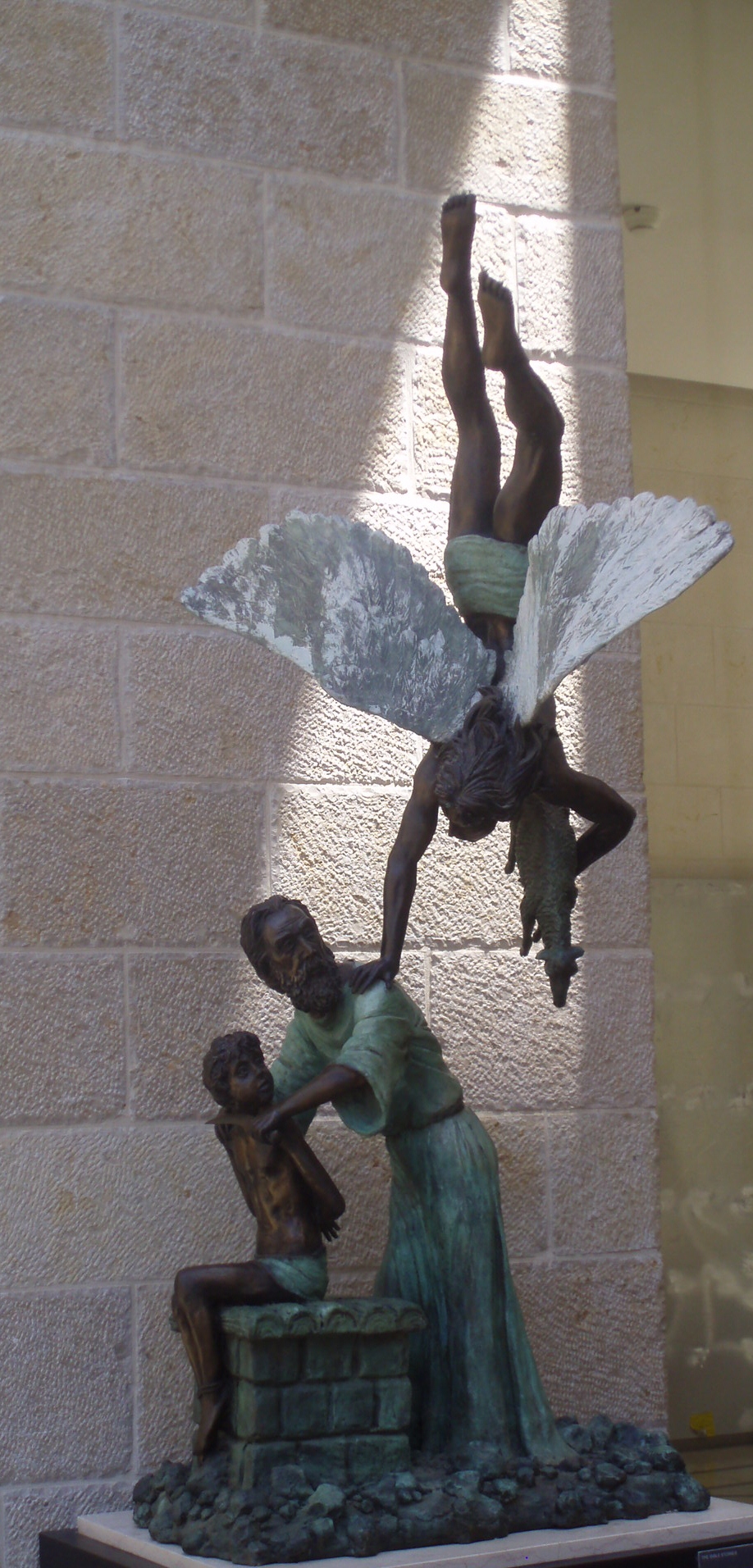
The Old Testament lesson recounts the story of the sacrifice of Isaac. This is a story that comes down to us out of the predawn of the Jewish religion. Recorded in its present form at a much later date and presented as a story about God rewarding complete trust, there are echoes of a more disquieting time when child sacrifice may well have been part of a more primitive Israelite deification of the violence of fear. As is the custom of all such wrathful deities, they require a scapegoat appeasement.

Among the flower of Britain’s youth being sacrificed to this same angry God in the trenches of the First World War, a number of poets, among them Siegfried Sassoon and Wilfred Owen sought to find a voice for protest. In The Parable of the Old Man and the Young, Wilfred Owen, a young poet of extraordinary giftedness, who died seven days before the eventful 11th of November in 1918, penned the grief of his generation and all generations whose misfortune is to be caught in the folly of war. He wrote:

So Abram rose, and clave the wood, and went, 
And took the fire with him, and a knife. 
And as they sojourned both of them together, 
Isaac the first-born spake and said,
My Father, Behold the preparations, fire and iron, 
But where the lamb for this burnt-offering?  
Then Abram bound the youth with belts and straps, 
and builded parapets and trenches there, 
And stretchèd forth the knife to slay his son. 
OLYMPUS DIGITAL CAMERA

When lo! an angel called him out of heaven, 
Saying, Lay not thy hand upon the lad, 
Neither do anything to him. 
Behold, A ram, caught in a thicket by its horns; 
Offer the Ram of Pride instead of him. 
But the old man would not so, but slew his son,
And half the seed of Europe, one by one.

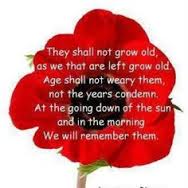
For the Fallen, is an ode from the pen of Lawrence Binyon, another young poet serving in the trenches. For the Fallen has become immortalized as the Ode of Remembrance, recited across the British Commonwealth at all Remembrance Day Services. 

They shall grow not old, as we that are left grow old:
Age shall not weary them, nor the years condemn.
At the going down of the sun and in the morning,
We will remember them.

I commend these words to all of us, not only in memory of our own fallen, but in memory of all the victims of terror. images
The Two Faces of Tradition

An interpretation of the fable of the widow’s mite il_214x170.684870014_kvo6

For some time, we have been following the events of Jesus’ road trip from Galilee to Jerusalem. In Mark’s narration of the events along the way Jesus has now reached his destination.

Mark 12:38-44 is one of the most remembered passages in the New Testament. It is a story that inspires and disturbs by turn. The actions of the widow who puts into the Temple treasury all the money she has appeals to a part of us where we would like to be more deeply motivated to trust, and through trusting to become more generous than we usually feel it is prudent to be.

I know that within myself the courage to trust to a sense of abundance is fought with on a daily and sometimes hourly basis. Within this pericope – from the Greek meaning an isolated selection of text – we have the appearance of generosity that costs everything pitted against the appearance of costless generosity. Jesus observes the wealthy giving large sums of money to the Temple treasury. In doing so, he notes tow things: their self-satisfaction and public pride and that their generosity costs them nothing.

Mark 12:38-44 has a fable-like – a short tale that packs a heavy moral punch – quality. He sets up a comparison between those who give only what they can afford to miss – and the widow who sacrifices all she has. This inspires and shames us to want to be more generous and self-sacrificial.

We should be more honest with ourselves and face-up to our struggles to live from trust in a spirit of God’s abundance. Yet, for the most part, we continue to choose to live under the weight of insecurities, fuelled by a fear that what we have, we have to hold onto. Few of us feel able to risk the widow’s generosity.

A new interpretation of the fable

But is generosity the point of the fable? If verses 38-44 are reconnected with the overarching thrust of Jesus’ teaching a very different interpretation confronts us.

On his first day in Jerusalem, Jesus sits observing the people dropping offerings into the Temple treasury. He watches the goings on and identifies a woman, whom he believes to be a widow. What escapes us is that Jesus also knows that she has no son or male heir, otherwise, it would be her son who would be making the offering.

In Jesus’ day, a woman without sons could not inherit or manage her deceased husband’s estate. Such estates were vested in trust to the Temple authorities to manage rather like a court-appointed trustee of our own day, appointed to manage the estates of minors or others who have less than a full legal status.

The Scribes and Levites in the absence of laws on financial regulation fraudulently devoured the property they administered in trust.

To add insult to injury, this woman, the likely victim of institutional embezzlement comes to the treasury and gives all of what little money she has left.

The traditional interpretation implies that Jesus praises the Widow’s action. Yet, nowhere in the text does Jesus praise her or imply any approval of her actions. Neither does he explicitly judge the rich in this passage. We are the ones who read in judgment and approval respectively, drawn from our awareness of Jesus’ wider message about the difficulties of wealth when it comes to the spiritual life.

Jesus, to say the least is an anti-establishment figure. His preaching of God’s Kingdom stands in opposition to a religious system based on the fraudulent exploitation of the poor. When seen within the larger context of his message, Jesus’ observations at the doors of the Temple treasury are less about generosity than they are a challenge to the way religious tradition has the potential to condition us to act against our own individual and group best interests.

Jesus observes a Widow acting against her own better interest because she is conditioned to do so by the religious system she lives within.

Addison G Wright in his paper on this text, Widow’s Mite: Praise or Lament? — A Matter of Context, says:

and finally there is no praise of the widow in the passage and no invitation to imitate her, precisely because she ought not to be imitated.

Setting the fable in a larger context

Organized religion always plays an ambivalent role in any society. On the one hand religion motivates and inspires people to transcend narrow self-interest in the service of a wider common good.  Yet, at the same time, organized religion easily becomes a pillar of the status quo, and as such, it blinds us to the need to question a system that privileges some and oppresses others. Whatever the merits of the widow’s actions she is a victim who cannot see beyound what her religion has conditioned her to see. She is thus blinded to her own best interests by her encounter with her religious traditions.

This last week I had to do some long-delayed work on the St Martin’s website. This was mostly a matter of updating content as we move towards a major experiment in the way we organize our Sunday mornings; making sure the changes are well signposted for visitors to our website. 

In the E-news this week, I wrote about our need to increase the number of portals through which the spiritually curious can enter into our community encounter with God. Our website has now replaced our red doors as the most important portal of entry into St Martin’s. 

The home or landing page is always a challenge. What do you put here that will grab the fleeting attention of a visitor to the site? The home page is where we communicate the essence of our message.

The difficult question for me is not so much what is our message, but how much of it to put in this crucial home page location?  The hard part is to say enough but not too much. Say too much and you overload the fleeting attention span of the casual site visitor. It seems today that every parish priest is required to be an expert in the subtleties of marketing and brand management.

If you visit stmartinsprov.org you will encounter in the first sentence the core of our message.

We are a Christian community exploring and interpreting the tensions when 2000 years of Christian Tradition is engaged by the opportunities and challenges of 21st-century life.

There are 10,000 words of meaning packed into this one sentence and I have spent an inordinate amount of time worrying over whether tradition engages the opportunities and challenges of modern life or is engaged by the opportunities and challenges of modern life? You might this is hair splitting, but it matters.

The rapidity of change in modern life is increasingly stressful and the core of our message as Episcopalian Christians is that we believe in the continuity of the Christian Tradition (scripture, tradition, and reason) with a capital T. For us it is a conduit through which God speaks. Yet, we recognize that the simplistic application of the Tradition to modern life, i.e Tradition engaging modern life, solves little beyond further straitjacketing people into lives that are too tight for them. Instead, we believe that when Tradition is engaged by the opportunities and challenges of contemporary life something powerful emerges from having to navigate through the resulting tensions.

The Temple in Jesus’ day was the place for powerful and life-changing encounter with the living God. At the same time, it also represented a systematic accommodation with the powers and principalities of this world. It was the thin place where God was encountered. It was also a system that ideologically blinded people to its operation as an instrument of their oppression.

Christian Tradition bears a legacy that has become largely discredited. For many in our society its failure to speak truth to power, preferring to align with the interests of this world has robbed it of authority and credibility. It is viewed as something that continues to thicken rather thin the blindfold across our eyes. Yet, Christian Tradition is first and foremost the transgenerational transmission of the Gospel – the good news- to each succeeding generation through which the collective human experience of being in relationship with God flows. Despite its capacity to become corrupted into an agent of oppression, Christian Tradition, as the good news of God is the chief means by which we free ourselves from the manipulation and oppression of the business as usual mentality of the world.

Crammed into the one sentence on our website is an attempt to articulate that our St Martin’s community is a place where Christian Tradition is engaged with from the perspective of the lives we actually live rather than something imposed that does violence to the integrity of our experience in our own time and place. When this engagement takes place, renewed by our encounter with it, Tradition becomes something with the potential to speak wisdom to the issues and conflicts that lie at the heart of our lives, awakening us to where our best interests really lie.

So Great a Cloud of Witnesses

Observing the fervent celebrations of Halloween, an anthropologist studying American culture might add a line in a learned paper:

The eve of All Saints and All Souls remains one of the great folk religious customs that unifies the otherwise fractious and quarrelsome North Americans. 

A little history

The weekend of November 1st  All Saints-All Souls marks a cultural event that has deep religious roots, the significance of which seems lost to most of the population who celebrate it. All Saints-All Souls is one of those thin places, a term from Celtic spirituality identifying a transitional space in time. Thin places can also be locations of place. Glastonbury and Stonehenge are two of many English examples. The commemoration of All Saints-All Souls constitutes a thin place in time opening a strange window into our popular culture, through which flow two great pagan religious traditions, one European, the other Mezzo-American, both with deep roots predating Christianity. All Saints- All Souls is the Christianization of the pagan Celtic Halloween. The great Latino celebration of  Día de los Muertos, similarly is the Christianization of the Aztec dia-de-muertosgoddess Mictecacihuatl, that center of a tradition of ancestor worship.

The significance of both these celebrations lies in the eruption of ancient pagan folk religion, which like all folk religion lies buried underneath the brittle carapace – the hard shell of Christianity. On the 1st and 2nd of November each year, the dead-hand of both Protestant and Catholic orthodoxy is shattered by the eruption of deep pagan currents running in the subterranean rivers of the collective unconscious of both Anglo and Latino cultures.

On Friday night, Al and I were FaceTiming with our 10-year-old granddaughter who was modeling for us her Cinderella costume including a long blond wig that completely transformed her appearance in preparation for her trick or treat escapades. Little does she know that the popular practice of trick or treating owes its origins to the great Celtic

Photo:Copyright JOE;CONLON;ATHBOY;;;

celebration of welcoming the transition of the seasons from autumn to winter. On Samhain, the door to the other world opened and feasts were prepared for the souls of the dead. Like our children today, our forebears protected themselves from harmful spirits by disguising themselves with weird and wonderful costumes and painting their faces into grotesque caricatures to hide their true identities from the evil spirits.

Following the English reformation, the celebration of Halloween was discouraged. For the English, the need for a lively celebration at this time of year was transferred to 5th November, the commemoration of Guy Fawkes. Guy Fawkes or bonfire night celebrates with bonfires and fireworks another cultural form of vanquishing of demons, this time the Papist demon Guy Fawkes and his Jesuit friends, who failed in their attempt to blow-up the Houses of Parliament during a visit of the King, James I. Incidentally, on that occasion of the King’s visit to Parliament, intended by the conspirators to be his last, one Roger Williams, secretary to the Lord Chief Justice of England, Lord Coke, accompanied his patron among the courtiers and officials in attendance on the King that day. In place of trick or treating, English children used to go from house to house carrying a straw effigy of Guy Fawkes. As householders opened their doors they were greeted with the cry not of trick or treat, but of penny for the guy.

Among the Puritans who settled in this part of America, the celebration of Halloween was strictly forbidden because of its demonic overtones. It seems the popularity of Halloween takes root in America among the millions of later Scots and Irish immigrants who, in their own part of the British Isles, had refused to abandon the old Celtic festival.

Our human nature

Human Nature expresses itself through culture. Our cultures are punctuated with small openings which allow expression of deeper psycho-spiritual needs.  We need these openings to illuminate what otherwise becomes the mind-numbing monotony of the here and now.

In the 1789 and 1928 editions of the Book of Common Prayer, the prayers of intercession bat309470were introduced with the words: Let us pray for the whole state of Christ’s Church, Militant here in earth.

That odd word militant refers not to aggression but to you and me. We are the Church Militant – the Church on the march in the world.Yet, we are not the whole Church. We are only the Church active in this world. The whole Church includes two other states, traditionally referred to as the Church Expectant, and the Church Triumphant. This is the vision of the three-tiered universe, an inspiration that draws from the imagery of the Book of Revelation, from which the epistle reading for All Saints is taken.

The endurance of the pagan roots of Halloween and Dia de los Muertos, as vibrant contemporary expressions of popular culture, give testament to the human need, from time immemorial, to hope for more than the idea that life is this world is all there is.

In abandoning the medieval imagery of the Book of Revelation, let us not throw the baby out with the bathwater. The division between All Saints and All Souls expresses our deep human psycho-spiritual need to build meaning in the face of the reality of death. All Saints is a celebration.

Through remembering the great exemplars of Christian living, we celebrate a joyful expectation of our continued life in God. Yet, in the face of death we experience sorrow, loss, bewilderment and pain as those we have loved are no longer physically present to us. All Souls expresses this element of human need. Our hearts still reach out for those we have lost. Our hearts open in the urgency of prayer for those who are still achingly loved and yet no longer present to us.

Love and a sense of continued relationship compels us to pray for our loved ones, who comprising the visions of a Church Expectant wait in the hopeful expectation of their fulfillment. A sense of need likewise compels us to seek the prayers of the saints and Saints, whose love and support we implore having already attained the joy of paradise in the Church Triumphant. For we are all united in one Church through the timelessness of relationship now lived out through prayer – uniting militant, expectant and triumphant states of being.

What of Scripture?

imagesThe gospel for All Saints is the story of the Raising of Lazarus from John’s Gospel. This is a powerful story in which the themes of faith and grief are linked together. Jesus confronts Mary and Martha with the need to trust, to risk a leap of faith. He asks them to trust and believe in something greater than surface appearances. It seemed to them their brother was dead. In the face of the human grief that accompanies death, we see the deep humanity of a Jesus disturbed by grief and sorrow. It seems that grief and faith are not incompatible, but complementary.

In the Gospel story of the Raising of Lazarus, God shows us that death is only a biological event, not a human event! Biology ends because it is a condition of life in the Church Militant. Contrastingly, being human is a continuous event that transcends the event of biological death, spanning between the dimensions of militant and expectant life.

Human life is a process of journeying into the fulfillment of God’s Covenant made with us in Christ. This is a promise that our humanity is more than an accident of biology. It is nothing short of the promise of incorporation into the life of the divine community that is God. In the words of the Burial Service of the Book of Common Prayer

For to your faithful people, O Lord, life is changed, not ended; and when our mortal body lies in death, there is prepared for us a dwelling place eternal in the heavens.

Investment of the Heart

In the culture in which I was raised, making a fuss was considered as something that could only invite personal embarrassment. If you made a fuss, in effect you were drawing attention to yourself, and drawing attention was tantamount to inviting social judgment. Consequently, I am someone who hardly ever makes a fuss, at least, not in public. The one exception, are high-end restaurants. Here I have learned to overcome my conditioning when I am encountered by an attitude of condescension, the kind of attitude that with concealed subtlety communicates that it’s a privilege for me to be eating in this elegant and glamorous restaurant while paying through the nose for the privilege of being condescended to. This being the exception, I often find myself hotly ruminating in my mind – going over and over again what I should have said to this or that person, in this or that situation, had I been less inhibited by my fear of embarrassing myself by making a fuss.

As we travel through the enveloping cool of autumn, a season that always conjures up for me the opening lines of Keats’ Ode to Autumn:

SEASON of mists and mellow fruitfulness!
Close bosom-friend of the maturing sun;
Conspiring with him how to load and bless                                                                                                             With fruit the vines that round the thatch-eaves run;

I am mindful of another season that I secretly dread; that of the parish’s Annual Renewal Campaign or ARC, when as rector I run the risk of making a fuss, or at least provoking the opprobrium of my more conservative parishioners who consider it bad taste for the rector to talk about money, in church. This year at St Martin’s I have enjoyed the relief of being able to soft peddle the usual message about financial stewardship because this year, the ARC occurs within a larger process of our adoption of the RenewalWorks spiritual inventory.

Like many parishes, at least in the Episcopal Church, we struggle with financial stewardship. Often this is presented as a budgetary issue, and meeting proverbial budgetary deficits is an element for careful, and dare I say – prayerful consideration. Yet, for us at St Martin’s, a community where the financial generosity of its members is regularly expressed when it comes to paying for large ticket items such as our recent restoration of the St Martin window, we discern that the challenge of financial stewardship facing us is to deepen our response to the call of discipleship. By this, I don’t mean to suggest the proverbial report card comment – must try harder. I am talking about our need to find a satisfaction for the unnamed yearning of our hearts.

Several years ago, when I served at Trinity Cathedral in Phoenix, I coined the sound bite – opening our wallets as widely as we long to open our hearts. Glibness aside, in my own life of discipleship, financial stewardship takes me to the heart of an internal struggle to overcome an ingrained attitude of scarcity and to experience life- abundance. To live with gratitude and generosity from a belief that there is always enough, because in my life the experience of enough is more than anything else, an attitude of mind and an orientation of heart. An attitude of scarcity often goes hand in hand with an anxiety about making a fuss. Both are the products of certain kinds of cultural experience.

Invitation to conversation through the gospel reading

The story of Bartimaeus son of Timaeus takes place on the outskirts of the Biblically rich city of Jericho. This is a multilayered story in a sequence of multilayered stories that Mark offers us concerning Jesus’ road trip to Jerusalem. This road trip recalling Jesus’ journey to Jerusalem is for those who travel with him the road trip to discipleship. Mark recounts a number of incidents along the way that are all linked by a call to discipleship. Mark chronicles events of blindness and clear-sightedness. The healing of the physically blind becomes the metaphor for another kind of blindness, that of the mind and heart; a blindness repeatedly displayed by the Disciples.

Bartimaeus is a poor man, not simply poor materially, but according to the prevailing religious attitudes of his time, poor spiritually as well. For the religious of his day, his blindness was an indication of his being out of favour with God. Bartimaeus has placed himself by the roadside so as not to be missed by Jesus as he passes. When he hears Jesus approaching he begins to make a fuss, and as others try with some severity to silence him, the crescendo of his fuss-making only increases.

Bartimaeus sits by the roadside on the outskirts of Jericho, which in the 6th chapter of the Book of Joshua we are told was the first town to fall to the Israelites who leveled its walls by making a huge commotion of feet tramping, trumpets blaring, and voices shouting. On the roadside, on the outskirts of Jericho, Bartimaeus sits making a commotion as he calls repeatedly: Son of David, have mercy on me!

Towards cathexis

Bartimaeus’ use of this historic phrase Son of David is a code phrase for his recognition of Jesus as the Messiah. Jesus, moving amidst the throng of people is halted in his tracks and turning around he tells the crowd to bring him to me. Mark then shows us a man, not a blind man who haltingly rises and moves with caution towards Jesus, but a man who throws off his cloak and springs up and rushes toward Jesus. Jesus asks him the proverbial discipleship question: What do you want me to do for you? Compare Bartimaeus’ response to that of James and John to the same question, reported by Mark in last week’s incident along the road. Bartimaeus with simplicity says: My rabbi, let me see again! 

Whenever we respond to the call of discipleship, Jesus simply asks us: what do you want me to do for you? Unlike Bartimaeus, we will often not know how to answer. For me, the point of this story lies in my recognition that Bartimaeus receives his sight through an experience of cathexis.

Cathexis is a term that refers to the investment of emotional significance in an activity, object, or idea. Bartimaeus becomes deeply invested in the one his heart has been yearning for because the intensity of his yearning heart creates a moment in which he experiences a profound realignment with Jesus.

Sometimes to obtain that which our hearts yearn for requires such a realignment. Realignment, results when we risk to step outside of our sense of social conformity and make a fuss, weathering the storm of public rebuke for doing so. Bartimaeus’ heart moves from yearning via commotion-making to investment in the one for whom he has been longing. Through becoming invested in Jesus, he now moves into the relationship of discipleship.

Today over lunch at St Martin of Tours in Providence, our RenwalWorks leadership team meets to begin to review the data from our recent RenewalWorks online survey. At this point in time, it’s not for me to speak too much about my impression of the data from our responses. What I can say, because it relates directly to my exploration of Mark’s story of Bartimaeus son of Timaeus, is that our survey results provide breathtaking evidence of the strength of the yearning of our hearts for God. The possibility of cathexis is in the air!

Missing The Point: Mark 10 35-45

Mark 10: 35-45 sits within the unfolding of a series of events on the road trip Jesus takes towards Jerusalem. Like all road trips, for some time we remember the isolated events that happen along the road. Over time however, our memory of isolated events along the way, which at the time occur within their own discrete context, become reshaped by the larger meaning and purpose of the road trip itself. So each week we note the happenings along the way, but also need to keep them in the larger perspective of what this road trip is about for Jesus.

The incident concerning James and John’s request to Jesus for the ultimate places of honor strikes me as a difficult reminder of our human propensity for over-valuing ourselves. Within Mark’s larger road trip narrative this is the third time the disciples have not heard Jesus correctly, or so it seems. Along the road, Jesus takes time to explain to his disciples his larger purpose for making this journey. He speaks of his expectations of humiliation, failure, death, and resurrection that lie ahead.

How did he know this? Is Jesus omniscient? Does Jesus share God’s bird’s eye panorama of the events unfolding? Maybe? However, I prefer to think of Jesus not as omniscient but as simply bringing to bear a very human awareness, unclouded by wishful thinking. Jesus knows all too well the consequences of confronting systems of power and oppression. He seems amazingly free of any fantasy expectation that he is going to win in this confrontation.

Along the road, Jesus speaks of the inevitability of his impending death three times. After the first time, Peter is so incensed he rebukes Jesus. A second time Jesus tries and while he’s speaking the disciples argue out of his earshot, or so they think, about who is going to be the most important among them when they reach the road trip’s destination. For them, the road trip is a political campaign tour on the way to winning the election. They are the Jesus campaign activists seeing him as the candidate of choice for the position of Messiah. They expect that when he wins power, there will be goodies for everyone who has supported him. Jesus tries one more time to tell them what to expect, and again his words fall on deaf ears.

The other disciples when they find out what James and John have asked Jesus become indignant, and maybe this is our response to them as well. Isn’t indignation our response in the face of another’s blatant attempts to curry favor?

Now maybe James and John, a story coming out of the mists of time has lost any real power to affect us beyond being mildly amused at their audacity. Yet, this story needs to be connected up with our own experience. When we relate to James and John’s grab for power, ditching their friends along the way, this story is a story that uncomfortably resonates with our ordinary everyday lives and becomes a conduit for our feelings of outrage at the unashamed grab for power and influence by others. Yet, the more complicated truth is, aren’t we also James and John?

Mark presents the disciples as stupid and slow to understand, in the grip of a fantasy of having their own day basking in the sunlight of freedom and prosperity. Yet, they are only doing what Christians have done ever since – view Jesus through the prism of our own worldview and self-interests.

It seems to me there are two ways of seeing James and John and all the James’ and John’s we daily encounter in our everyday lives. We can see them as main-chancers. Coming from near the bottom of society the promise of social advancement as followers of the man who was about to take Jerusalem by storm, must have been too much to resist. We can also see them as a kind of everyone. We all live in tension with our unfulfilled needs and longings to be more than we are, to be better than we are, and maybe more pressingly, to have more than we already have. 

Missing the point

What is remarkable is not the motives behind their request. These seem all too understandable enough. What is remarkable is Jesus’ response. What is remarkable is that the disciples missed the point, and so do we, but for different reasons.

The ironing out of a confusion

We live at the end of a line of political and social development that has given us social democracy, sometimes also referred to as liberal democracy. Social democracy is characterized by the possibility for social mobility alongside the idea that the governed should determine who governs them. The old hierarchies of power and influence still pertain – after all human nature is still in a process of perfection, yet social mobility has until comparatively recently been a striking characteristic of our democratic society. Fuelled by a national system of education coming on the back of secularization, that grand post-Enlightenment momentum of social perfectibility, hitherto undreamed of possibilities for social and economic mobility opened up for many ordinary folk in our grandparents and parents generations.

Sadly, we now seem to be at the end of this line of social and political momentum and our 21st-century society seems to be coming to more closely resemble some of the gross inequalities more characteristic of Jesus’ time.

Another characteristic of social/liberal democracy that blinds us to the radical nature of Jesus response is our familiarity with the development of an ethic of public service. The age-old pattern of governmental appointments as tools for personal self-aggrandizement and financial enrichment through public theft was in the 20th century replaced by the concept of a civil service, the members of which were paid out of the public purse in order to serve the interests of the public good. All of this would have been quite alien in the society of first-century Palestine, as well as much of the following 2000 years of European social history. As with social mobility, as the 21st century progresses, notions of public service (servanthood) seem increasingly to be the mark of a previous age.

To our ears, Jesus teaching on servanthood, the first to be last and the last first is not so revolutionary, though it remains difficult to put into consistent practice. However, to the ears of his followers, it was incomprehensible – literally speaking. As human beings, we can only comprehend that which is already imaginable. Jesus suggests a radical vision for social relations beyond the social imaginary of his first-century hearers, and so – they literally miss the point. Each time he reiterates his vision of servanthood as the way his followers should relate to one another, the response is startling. It is as if a cone of silence comes down between him and them, preventing the words he speaks from being heard by them.

****

The disciples do eventually come to belatedly understand. Because Jesus with self-sacrificial consistency models the way he wants them to behave, they eventually do come to understand. Their still patriarchal and hierarchical worldview notwithstanding, the followers of Jesus come more and more to be able to not only comprehend his message but to begin to live it out in practical, everyday ways.

Here, is where the confusion needs to cleared up. It’s important to note that the development of a culture of servanthood is not the fruit of an early kind of project of self-improvement, which secularization and social democracy have shaped us to value. The followers of Jesus are radically changed not by their own growing social sophistication, but by what his death allows God to do. God raises Jesus to life, after life after death.

For the Son of Man came not to be served but to serve, and to give his life a ransom for many.

In the Tradition we have often come to see Jesus’ death as the price God paid to liberate us from the death of sin. There is a strong tendency to see Jesus as a heroic figure, freely and nobly offering up his life for the world. However, the efficacy of Jesus’ death lies not in its nobility, nor in it being the blood price demanded. The efficacy of Jesus’ death lies in what it allows God to do. Jesus’ death leads to the possibility of resurrection. This is the new thing that God does. And one of the most immediate fruits of this new thing, this fundamental change, is the development of a real culture of servanthood as the unique mark of community among the followers of Jesus.

Arriving at the point

The disciples do not achieve the servanthood Jesus called them to through the expansion of their own individual and social imaginations. The did not achieve anything. Instead, they became transformed as the spirit of Jesus was given back to them in the form of the Holy Spirit. It’s the Holy Spirit, not their self-improvement, that empowered them to emulate Jesus’ example of servanthood.

Bringing the point home

This last point is for us, the crucial one. The question of servanthood lies at the heart of our journey of spiritual renewal at St Martin’s. The danger is that we will be content to simply exemplify the best of our secular society’s notions of mutual respect and in the broader world, the ethic of community service motivated and empowered by our acceptance of the best traditions of social democracy. If our aim is to only do what good people do then we will miss our mark. Because, if this is all that happens we will as individuals and as a community remain unchanged. Remaining essentially unchanged means remaining unsatisfied.

I believe that our spiritual deepening has important implications for how we treat one another, how we serve and allow ourselves to be served by one another. This is not just a matter of becoming better than we are, doing better than we’ve done. It is a matter of becoming transformed by the power of God’s Holy Spirit moving among us. Like the first followers of Jesus, for us following Jesus is not a matter of self-assertion, not a matter of finally getting it. Following Jesus is a matter of allowing ourselves to become transformed by the power of the Spirit working among us. Like the first disciples before us, only radical transformation can bring about the change that our hearts are yearning for.

Gripping Tightly or Holding Lightly (Mark 10:17-31)

For audio go to

The Rev. Linda Mackie Griggs, Deacon and Director for Spiritual Formation, St. Martin’s Church.

Two wrenching images stand out in today’s Gospel lesson. The first is of a young man grieving; trudging away as if weighted down by everything he owns—realizing for the first time the what the high cost is of following Jesus. The second image is that of Peter—aghast, perplexed, standing with his empty palms outstretched to Jesus, complaining, “Look, we have left everything and followed you”! Imagine all the disciples clustered together behind him, no money, bag or possessions between them—Breathlessly asking, “Then who can be saved?” They must feel, even if only for a millisecond, like twelve victims of a massive theological bait-and-switch.

But as is typical with Jesus, what seems at first blush to be an overwhelming challenge is really an invitation. He has taken the original question, about how to inherit eternal life, and transformed it instead into a description of the Kingdom—the Reign of God. But Jesus hasn’t so much evaded the man’s question as he has tried to shift his perspective.

We have a clue to Jesus’ objective at the very beginning of this encounter. The man kneels, paying homage, and calls him, “Good Teacher”. Jesus gently rebukes him, pointing the man’s attention away from himself and toward God: “No one is good but God alone.” It is this statement that sums up everything that follows.

Jesus asks the man about his knowledge of the Law, by reciting the Commandments. Note, however, that he names only six of them, not all ten.The ones he cites are the LAST six—the ones that have to do with relationships of people with each other. The four Commandments that Jesus has left out of his list are the ones that focus on peoples’ relationship with God:

You shall have no other gods;

            You shall not worship idols;

            You shall not take God’s name in vain;

            You shall keep the Sabbath holy.

These four are the ones that should align our priorities. When that alignment happens, the other six Commandments fall into place. It’s like Jesus said in Matthew’s Gospel, “You shall love the lord your God, and your neighbor as yourself.” God first, neighbor next; everything that comes from this is like a tree which grows from a single fundamental nourishing root; God alone.

And Jesus’ questioner thought he was doing everything right—He had kept Jesus’ list of Commandments all of his life. He was a good man. But Jesus needed him to internalize the fact that unless he had God as his focus, his good intentions would ultimately fall to shreds.

There was One Thing lacking—one thing that was the thread weaving through it all; a realignment of his priorities. And so Jesus tells the man to rectify his focus—to shift it back to God: “…go, sell what you own, and give the money to the poor, and you will have treasure in heaven; then come, follow me.” And the man leaves, grief-stricken, because he has many possessions.

The common perception is that the man is devastated because he has decided that he won’t be able to follow Jesus. But what if it is because he’s decided he WILL follow Jesus, only now he knows what it will cost him?

He realizes he’s got to let go. Letting go of our idols, by definition, requires loss. It also requires Trust. Trust that, though we are leaving something cherished behind—money, status, pride, resentment, anger (and yes, it IS possible to cherish and idolize our anger and resentment)–that it will be okay. That somehow, the loss will be worth it. Somehow.

But it’s hard. And Jesus knows that. Which is why, “looking at him, Jesus loved him”. He knew that what he was asking for was a leap of faith into the arms of God. He knew that, human frailty being what it is, God’s children tend to hold tightly to things. Prying those fingers loose is some kind of spiritual heavy lifting.

Jesus said, ‘…how hard it is for those who have wealth to enter the kingdom of God!” He uses the ludicrous image of camels in tiny spaces to illustrate the difficulty—Scholars have tried to explain it away and make it somehow more palatable. But the message is clear: Letting go is a tight squeeze. But it’s vitally necessary for our wholeness as human beings and as beloved children of God.

We know from the first months of life the importance of holding on to something. Babies have a grip reflex—where you can gently press your finger into a baby’s hand and he will automatically grab on tight– That reflex is so strong that babies can sometimes hold their own body weight. We need to know how to pick things up and move them from place to place. We need to know how to hold a spoon, or a pencil, or take someone’s hand. But the reflex itself only lasts three or four months into a baby’s development, until she begins to close and open her hands voluntarily. So even our developmental DNA knows that proper motor skills involve not just holding tightly, but letting go. It’s the only way to make progress. You can’t just keep carrying along everything you pick up without leaving some stuff behind as you discern what you need and what you don’t. And if you’re loaded down with a lot of junk, how can you grasp what is really important when you find it?

Our spiritual and emotional selves can learn a lot from our physical selves. God’s Kingdom isn’t about staying stuck and weighed down. And that is what happens if we continually hold tightly to an ideal of perfection and achievement and acquisition that we can never attain because the bar of worldly expectations will always be set higher than we can reach.

You may have heard of what John D. Rockefeller said to someone who asked how much money is enough. He responded, “Just a little bit more.”

But it’s not just about money that Jesus was speaking. The idea of letting go also pertains to the misconception that life should be perfect and painless and effortless, if only we do it right. Whatever ‘it’ is.

We do our best. We work, we save, we exercise, we eat our fruits and vegetables, we follow the rules. And still jobs are lost, health fails, loved ones die, tragedies and natural disasters wreak havoc.

Jesus offers the rewards of the Kingdom in this age, but it is not what contemporary culture—our own or that of the first century—would expect. Jesus warns us to expect that things won’t be perfect—that the Kingdom entails “persecutions”. There are battles to be fought and suffering to be encountered. This is the counterintuitive Kingdom that Jesus describes. It asks us to give up so that we can gain even more.

But what is it that we gain? This is not some prosperity Gospel, which falsely promises that giving your money away is going to yield a bountiful financial return. This is wrongheaded and dangerous teaching.

No; when Jesus says that we will gain a hundredfold brothers, sisters, and fields, he speaks of the brothers and sisters in Christ that we are called to serve, in fields of generosity, justice, and compassion. And the joy that it brings is not the same as superficial happiness. Joy is God-rooted—deeper, richer, more eternal, and most often seasoned with deep knowledge of pain and struggle.

One of my earliest memories is of my own baptism. It may have been only a dream, but I remember myself as an indignantly squalling freshly-splashed infant. Mostly , though, I remembered love: The love of my new church family as I was paraded up the aisle of my little church. I remember being held; held in strong arms. Safe, secure. I myself held nothing; instead, I was held, and I trusted those arms.

This morning we will baptize Ryn Mulholland. We will vow that by our prayers and witness we will help her to grow into the full stature of Christ. What will that look like? What will we teach Ryn about the Kingdom of God?

We will teach her that being a Christian is countercultural. Being a Christian invites her to hold lightly, not tightly, to the superficial criteria of success that our culture offers. Being a Christian asks that she move through this world, not fearful of scarcity but reveling joyously in the abundance and wholeness of a life lived securely in God’s embrace. We will teach her that the Kingdom is an enormous family—hundredfold brothers and sisters who love her. We will teach her that the Kingdom doesn’t mean that life is easy.

The world is a scary place sometimes. Pets die, friends move away, knees are skinned and bones get broken, but we, the whole Christian family, are with her all the way, through seasons of despair as well as joy, holding her in prayer and love.

We will teach her that seeing the world through the eyes of the Kingdom means seeing how she can hold others through Christlike compassion and service. Most of all we will teach her the countercultural lesson that there is freedom in letting go, freedom in trusting God, and in living faithfully into the knowledge that, for God, all things are possible.

For the softening of the heart

imagesLast week I took the easy way out. I preached from the Letter of James instead of tackling the thorny text from Mark, in which Jesus talks about cutting off hands and feet and plucking out eyes in order to enter the kingdom of heaven. James chapter 5 is a significant text for any Christian community with its vision of healing as flowing from the dynamo of the community’s prayer, channeled through the elders of the Church and other individuals who have been called by God to this particular ministry. Nevertheless, avoiding the gospel because the text is too challenging is something I don’t feel I can pull off two weeks in a row.

Mark Chapter 10, contains a series of events, all of which are interconnected by Mark’s use of the word and, implying linkage. The chapter opens with today’s reading in which Jesus delivers what on the face of it appears to be a clear teaching on the indissolubility of marriage. For most of the last 2000 years, the Church has understood this text as a prohibition on divorce.  Christian’s who still hold to a literal interpretation of the Bible continue to read Mark 10: 2-16 this way. For different reasons, the Roman Church also interprets this text similarly.

In the Episcopal Church the remarriage of divorced persons is at the discretion of the bishop, who on the recommendation of the priest concerned gives or withholds his or her permission for the marriage to be solemnized in church. When I am approached by two persons seeking marriage, one or both of whom have been previously married, I am required to ask the person or persons to share with me their perception of the issues that led to the failure of the previous marriage. The quality of this conversation will determine whether I feel able to advise the bishop to grant their request to marry again in the Episcopal Church.

What is the scriptural authority for this practice? Many continue to see the Church’s stance as simply an accommodation with the declining moral standards of the secular world. Maybe, so, it certainly can be read this way. Yet, the recognition of divorce is not the first time that the humanist-inspired championing of civil rights in a secular society has led the Church to review its previous stance on the interpretation of Scripture.

Mark 10: 2-16: a softening of the heart

There are two distinct scenes in this passage The first scene opens with a conversation between Jesus and some Pharisees, in which they seek to force Jesus to come down on one side or the other of a dispute between them. Judaism held two competing views on the interpretation of the writ of divorce. The strict party allowed divorce only in cases of (the wife’s) sexual infidelity. The more tolerant party allowed a number of justifications for divorce. The question the Pharisees put to Jesus in effect is teacher, which interpretation do you favor? Jesus shocks them with his answer the effect of which is to sayI do not favor divorce under any circumstances. 

What is in Jesus’ mind becomes clearer when we recall that he reminds the Pharisees that Moses’ allowance of a writ of divorce was an accommodation with the hardness of the human heart. He compares this accommodation with God’s intention at creation. God intended the marriage relationship between two persons to be a sign of the covenant between God and humanity. When Jesus says: what God has joined together let no one separatehe is saying that God’s intention takes precedence over the Mosaic writ of divorce. The Pharisees go away muttering to themselves.

A second scene now opens with Jesus talking privately with his disciples, who ask him to explain himself again. Jesus then utters these words: Whoever divorces his wife and marries another commits adultery against her. So far, no surprises here. But then he says: and if she divorces her husband and marries another, she commits adultery. The disciples must have been shocked by this. What on earth is he talking about? Surely, they think, Jesus must know that a woman cannot divorce her husband?

Jesus is making clear that God’s intention at creation is for marriage to be a relationship between equals and not simply a legal property arrangement that can be put aside by the man whenever he chooses because the patriarchal law accommodates his superior status as a male.

Now, there are two ways of reading Moses’ allowance for a writ of divorce. Although the writ became a weapon in the hands of men, perhaps its original intention was for the protection of women. The writ of divorce ensured that what little legal protections marriage gave a woman, could not be lightly put aside by her husband without his having to go to court to do so, thus preventing a cruel and capricious husband simply casting his wife out of the house. Jesus is saying that Moses allowed a writ of divorce as a necessary protection for the woman against the hardness of the male heart.

A curious echo of this continues in England. In the marriage services of the Church of England the couple sign the register in front of the congregation because the marriage register of the Establish Church is the legal register of marriages. After signing the register, the couple sign the certificate of marriage, which the priest then gives to the bride.

As I handed over the certificate I would explain this ancient practice to the couple telling the bride that the certificate legally belongs to her and not to her husband. Now, an anachronism, in the past the certificate was her proof for the protections accorded her by marriage in an otherwise patriarchal society, in which property law accorded her few rights.

A relationship between equals

Jesus endorses our modern acceptance of human beings as relational beings. God is relational and the very act of creation is a desire for relationship with human beings. Through forming relationships with one another, we come to be reflections of God.

We are relationship seeking beings. Yet, as with every other aspect of being human our relationships are also fallible. Some succeed while others fail. The quality of our relationships is an expression of our emotional maturity. The failure of our relationships is often, sadly, an expression of our emotional immaturity.

In marriage preparation, I invite a divorced person seeking remarriage to share with me their perception of the reasons why their marriage ended in divorce. In their story, I listen for the echoes of sorrow. I am hoping that I can hear in their story a sense of loss – a  loss of innocence. I listen for signs of the pain and disillusionment at finding failure where they hoped for fulfilment in relationship. My question is: how has this experience of loss of innocence deepened their self-awareness so as to better equip them to have a more mature expectation of themselves and their new marriage partner? It seems to me that no-one who had been through a divorce has remained unscathed by the loss of their once innocent belief that when you make sacred promises everything should work out, and people should live happily thereafter.

Because the loss of our innocence leaves a deep and often ugly scar in us, it is all the more important that we have an opportunity to learn from experience by making a new and fulfilling marriage with another person. In this way, a second marriage holds the promise of reparation. In God’s relationship with us there are always second chances. Why should this not also be so in our relationships with one another?

The Mosaic writ of divorce had become by Jesus’ time an expression of the hardness of the human heart. Jesus moves the goal posts away from the legalistic debate among men concerning the justifiable grounds for divorcing one’s wife, into a new conversation that recalls God’s intention for marriage as a covenant reflecting God’s love for us in creation. There is more than a hint here, at our own contemporary approach to seeing the relational failure resulting in divorce as an expression for the softening of the human heart.

As Anglican Christians in the Episcopal Church we live in the tension between our parental generation’s interpretation of Scripture and Tradition and the reality of the lives we actually live; lives also illuminated by a fresh encounter with the written Word of God. This place of tension is where we expect to encounter God, not only in our successes but also in our failures. It is in this tension that God comes looking for us.

Healing: Miracle or Cure?

A little background on the Letter of James

Over recent weeks, the epistle or second lesson has been taken from the Letter of James. Traditionally the letter was ascribed to James the Just, the brother of Jesus, and first Bishop of Jerusalem. This James is different from James the Great, one of the sons of Zebedee, mentioned in the gospels. Some modern scholars dispute James the Just as author, noting that the quality of the Greek is indicative of a higher level of education than might be expected from a brother of Jesus, preferring to see the letter’s authorship as anonymous. Written in Jerusalem, the letter addresses Christians in the diaspora. The date of the writing is uncertain.

What is distinctive about the letter is its very pastoral style and content. It focuses on behavior, calling believers to live according to a higher standard of behavior than normally expected in the world. To a modern reader, the judgments meted out to those who fall short seem rather exacting.

In chapters 3 and 4 James explores the themes of self-control and personal restraint, identifying the tongue for particular comment. How great a forest is set ablaze by a small fire. And the tongue is a fire. He notes that the greatest damage  to relationships and communities is done by the unbridled tongue. Today, we often say of such a person, she or he has no filter, for whatever comes into the mind pours out of the mouth. James notes that real wisdom and understanding are expressed only through the gentleness of our actions. He strikes a somewhat modern psychological tone when he notes in chapter 4 that when envy, ambition, and selfish cravings are at war within us, then disorder in relationships and disharmony in community, will be the result.

The power of prayer

The letter of James contains one of the most eloquent passages on prayer to be found anywhere in the New Testament. In Chapter 5:13 we come upon this beautiful passage:

Are any among you suffering? They should pray. Are any cheerful? They should sing songs of praise. Are any among you sick? They should call for the elders of the church and have them pray over them, anointing them with oil in the name of the Lord. The prayer of faith will save the sick, and the Lord will raise them up, and anyone who has committed sins will be forgiven. Therefore confess you sins to one another and prayer for one another, so that you may be healed. The prayer of the righteous is powerful and effective. 

This passage is often read as an invitation at services for healing. Normally in our Episcopal context, healing services are led by a priest, who stands in the stead of those James refers to as the elders of the church. Yet, James also invites us to pray for one another. He notes that this prayer for each other’s healing provides another powerful conduit for God’s healing.

Clearing up one confusion

images-1In our somewhat hierarchical structure, it is easy to see the prayers for healing from a priest in the sacrament of anointing and the laying on of hands as more efficacious than our prayers for one another’s healing. It’s true that while we can all lay hands on one another in prayer, only a priest has the authority to administer an anointing. This tension often translates into the expectation that the sacrament of healing is dependent on the presence of a priest.

This attitude is tantamount to what I call a belief in strong and weak medicine as in: he-im strong medicine – as Native Americans are given to say in Hollywood Westerns. It’s an understanding of prayer as somewhat magical. The miracle of healing is a conjuring up of a powerful magical medicine. Our hierarchical view of ministry leads us to view the priest as possessing strong healing, whereas baptized laypersons possess healing in a more diluted form.

But according to James the power for healing that resides in the elders of the church is not a product of their stronger magic. It is an expression of the prayer of the whole church –everyone’s prayers, concentrated and channeled through the conduit of the priest as a representative of the whole body. In this sense, the priest needs no special temperament for healing, for he or she is simply the conduit for the healing power of a community of prayer. In addition to the priest as the embodiment of the community of prayer, God also calls particular laywomen and men, who by virtue of their baptism are given a special temperament for healing. This is a personal charism or gift, to be used for the strengthening and healing of one another within the whole body of the faithful.

Clarification of a second confusion

images-1Healing for those who still maintain a pre-modern mindset, is (mis)understood through the language of miracles. A miracle is defined as: an event not explicable by natural or scientific laws. Such an event may be attributed to a supernatural being (God or gods), a miracle worker, a saint or a religious leader. In contrast for those who hold a modern mindset, healing is often (mis)understood as curative. Used as a verb, cure means to: relieve the symptoms of a disease or condition. When used as a noun cure refers to: a substance or treatment that cures a disease or condition, i.e. a medicine.

Note the bracketed prefix – mis – above. For, from a spiritual or theological perspective healing is neither miracle, nor cure. Healing is an action of God, usually mediated through the prayerful orientation of the community, which brings about for the recipient a strengthening in confidence, an alteration of perception, and a shift in perspective. Healing restores us to both wholeness and holiness, and the process by which it occurs is complex and various.

In a sermon, I cannot wander into the complexities of the process of healing as it affects our physical, emotional and spiritual health. As we look forward to having more time for Christian Formation at St Martin’s, healing is an area I hope we can with some urgency, begin to explore in seminar and workshop format. A key area for further exploration is the complex nature of the psyche-soma connections and cross-overs. We are so conditioned by a rationalistic scientific point of view that understands soma – physical matter, to be foundational. This view relegates mind and soul to secondary positions as merely registers, places for the reverberation for the primacy of the physical.

A short example: heart issues are understood to be rooted in biological somatic causes, located in the malfunction of the heart muscle. This obscures the connection between stress and the heart’s response. Could not heart failure also be a registering of the emotional condition of unresolved stress, originating in the mind. It might equally be a somatic registering of the spiritual state often poetically referred to as a broken heart.

Yet, if we accept that human beings are psychosomatic creatures, then we have to accept that healing is a complex interplay of factors affecting all three domains. The sermon is a medium severely limited by time restriction and mode of presentation and is not conducive to the exploration of the interplay between psyche, here used in both the sense of mind and soul, and soma. It is enough to say here that healing operates as a dynamic process with divine origins, bringing soma, psyche, and soul into realignment.

Jesus in his ministry, as recorded in the Gospels performs what are usually referred to as miraculous, spontaneous healings. Why does he do this? Is he intent on wooing the crowds with feats of miracle working? Is he setting up a first-century version of medicins sans frontiers? The answer to these questions is a resounding no. Jesus is revealing the power and glory of God, and his healings are intended to bring about a realignment and reorientation in his hearers relationship to God.

The revival and strengthening of the church’s healing ministry is for me a central plank as our community at St Martin’s moves forward on a path of spiritual renewal. Although healing led by a lay person has been available on the third Sunday of the month, it is my hope that as we can gather a larger team of those who discover a call from God to participate in this ministry, we can offer healing prayer routinely on Sundays. The formal sacrament of anointing and laying on of hands is always available on request as is the sacrament of the reconciliation of the penitent.

To come for healing runs somewhat counter to the reserved New England temperament, which shuns public demonstrations of spirituality. Nevertheless, pray that through God’s blessing our renewal will begin to gather momentum. One fruit of this might be that many more of us within our community might feel emboldened to bring ourselves, our suffering, our anxiety, and our struggles for healing. Pray God to also raise up some amongst us who discern a calling to this ministry of prayer and human solidarity.

Three Themes in Mark 9:30-37

There are three distinct sections to this passage from Mark, chapter 9.

  1. Passing through Galilee.
  2. The question about the disciples conversation along the way.
  3. Jesus’ admonition on what it means to be welcoming.

imagesTracing Mark’s chronology

Remember two weeks ago we heard about Jesus’ encounter with the Syrophonecian woman? This was a consciousness expanding experience, for Jesus. The challenge presented by this gentile woman, who seems to be the first to openly recognize who Jesus really is, dislocates him from his hitherto understanding of his mission to the Children of Israel. Jesus now opens to the wider implication of a mission to everyone who recognizes the message he brings. God’s open armed inclusion of all within the grace of God’s love and acceptance. For Mark, this is the pivotal point in Jesus’ ministry, because it is from here-on that he turns his face towards the journey to Jerusalem.

Then last week, we were invited into a rather tense encounter between Jesus and his disciples, and in particular, their spokesman, Simon Peter. Having been recognized by the gentile woman Jesus now challenges those who are closest to him with the question – who do you say I am? Jesus then begins to share with them the implications of what his mission really means, for him, and for them. 

Tracing Mark’s theology

Mark begins his gospel with God’s open declaration – this is my son, my beloved, and I am very pleased in him. It’s unclear as to who among those present at his baptism get to hear God’s voice, but the point is that we the readers, hear God’s declaration as to who Jesus is. Mark then treats Jesus’s identity as the Christ as an open secret. The Syrophonecian woman – a gentile seems to understand. It is significant for Mark that after the theophany (God event) at his baptism, Jesus is next recognized by someone outside of the dispensation of Israel. Then it’s a case of the disciples, those inside the dispensation playing catch-up.

Contexting

The question continues to hang over us – who do we say Jesus is, or put another way- who is Jesus for us? The difficulty for many of us is that we think we know the answer, because we know Mark’s story and how it ends. It’s not a secret for us. Yet, let’s not dismiss Mark’s notion of the open secret too soon. We know who Jesus is because at one level we know the story. Yet, knowing the story means we know about Jesus. It does not mean that we experience who Jesus is.

Jesus’ question to the disciples has two parts: who do people say I am, and who do you say I am? As part of the generic people, we know who he is because we know the story. Yet, in our heart of hearts can each of us answer – yes, I know who Jesus is for me? 

In Mark 9: 30-37 we come to realize just how hard it is to truly know who Jesus is, because the consequences of knowing are rather unsettling. With the three-fold outline of this passage in mind, we see Jesus talking to the disciples about what it means to be who he is as they pass through the region of Galilee. He talks to them about the ultimate implications of who he is and what God is asking him to accomplish. The details are so dire, so frightening that the disciples hear, and yet do not hear him.

Selective cognizance

This is what we human beings do all the time, we select what we want to hear and ignore the rest. Most of the time this is a semi-conscious process. By semiconscious, I mean that if someone were to bring it to our attention we would readily recognize the process. Yet, there are some things so terrible, so frightening for us in their implication that we simply can’t take them in without something blowing up. The hippy phrase – wow that really blows my mind, man – comes to mind here.

Now, the reason we can’t take in the message is because unconsciously we do hear it. It is just that confronted by an imagined sense of utter helplessness, the message is too much for us. This is exactly what we see the disciples doing as they follow along at a distance they think is safely out of Jesus’ earshot. We see them distracting themselves with a pointless conversation. Unconsciously, they feel terrified and helpless in the face of what Jesus is telling them. No, no, no, they psychically scream!

So much of our lives together in parish community involve distracting ourselves with endless chatter about things that don’t matter because we are afraid to really recognize the full implications of why we are here. Do we not chatter on endlessly about our desire to make a difference in the world while keeping our commitment to building Christian communities with the energy and power to really make a difference rather low, in the list of our priorities? Do we not feel a need to protect ourselves from being dislocated by the demands of the kind of discipleship Jesus is talking about in Mark 8 and 9?

Similarly, as a society we are distracted by the spectacle of the massive corruption of our political election process, presented to us as entertainment by an equally corrupted news media. In truth, we are all disgusted by the waste and the wasted opportunities to confront the issues that really matter. While being somewhat entertained we stand helpless before the escalating crises bearing down upon us like the headlight of a locomotive soon to roar upon us from its tunnel.

Jesus response

Jesus takes a child in his arms. For us this seems a tender and caring gesture that resonates with our view of the world where we hold our own children dear and at least in principle, we hold all children dear. Contrastingly, Jesus’ society predates the development of a concept of childhood. Here, children were simply smaller and weaker adults, to be overlooked and disregarded. To be a child was one step down from being a woman. So to represent a little child as the model for the receptivity and welcome of the Kingdom of God was a startling thing. This is an invitation for all of us to embrace vulnerability. In our vulnerability, we are compelled to welcome God.

Welcome and change

To welcome, costs us something. There is an important link between our process of welcome and what we welcome others to. We long to be like little children with their open and trusting view of the world. Yet, as adults we know disappointment and disillusionment. We are caught between our child-like desire to be open and our adult need to protect ourselves.

Resolving this tension is a matter of deepening our experience with the living God, an experience always mediated through the way we negotiate our day-to-day lives. To this end at St Martin’s our key priority areas: inspiring one another to greater levels of engagement in all aspects of our community life, strengthening the message of financial stewardship, and attracting and retaining new members, merge into a single priority:

to facilitate our personal transformation through the renewal of our individual spiritual lives.

Key to addressing our new priority is offering a practical approach to the enrichment of our day-to-day lives through spiritual practice. Spiritual practice – is for me a catch-all phrase covering the application of age-old spiritual wisdom and experience to help anchor ourselves more securely in the face of the escalating demands and stresses of modern life.

In the particular

At St Martin’s on the Eastside of Providence we long to become a more magnetic community – the fruit of transformation in our individual spiritual lives. In my mind, that requires us to become more magnet shaped. This has implications too terrible to contemplate, i.e. changing the way we do Sunday morning.

In our Anglican- Episcopal tradition worship is the focus of who we are. The primacy of worship gathers us, transforming us into a community that celebrates the long relationship between God and the people of God. In Eucharist, we make present here and now this great story, collapsing past and future into this present moment.

To become more welcoming, we think it’s a matter of tinkering with the liturgy, in some cases simplifying it, in others making it even grander and more complex. We think if we offer more services then we will attract more people. All of this smacks of a response of those of us already here, desiring and designing a welcome for those who are already like us.

In Advent, we will launch an experiment that flows partly out of our recent experience of the simplified summer schedule of services. During the four Sundays of Advent we will move from two Eucharist’s on Sunday morning to one, timed to be followed by an hour of Christian formation time, for adults as well as young people, ending around 11.30am. A second, contemplative and instructive Eucharist will be added to the late afternoon – early evening. Our recent experience of this pattern confirmed for us a new and strengthened experience of a more magnetic community as we husbanded our human resources into one place and time.

This is bound to inconvenience some of us who are used to the existing pattern. The chief reason for this change is to offer a richer diet for a world where many are so spiritually hungry.

Jesus called his disciples to mission. It took them a while to be able to face the fearful implications of what this would mean for them. But embrace mission they did, breaking out of the fear shaped prison of their selective cognizance, and in nearly every case, like that of their master, at the cost of their lives.

The question of welcome, that so exercises most church communities boils down to the question Jesus asks us: who am I for you? Am I the comfortable Jesus – distanced by the gospel narrative as a once-upon-a-time story? Or, am I the anchor that holds you firm in the face of the escalating demands of life?

Echoing Archbishop William Temple’s statement that the church is the only organization which exists for those who are not yet its members, let’s work to renew our community as a magnetic – mission-shaped community of disciples, – a community where personal transformation through daily encounter with God us, its members to with energy and joy have an open and welcoming heart for those who have yet to show up.

Homecoming; Mark 8:27-38

Episcopalian preachers are images-4constrained in the choice of preaching texts by the Lectionary’s three-year cycle of readings. We preach on one of the four texts –OT, Psalm, NT, or Gospel appointed for a particular Sunday. I often lament not having the authority to choose my own favorites. I think that’s probably a good thing? The congregation is spared my hobbyhorses and can be directly addressed by the Wisdom of God. Through the Lectionary cycle, the Wisdom of God invites us as a community into a particular conversation, one that God desires to have with us rather than the one we tend to have with ourselves. Through the sermon, the preacher’s task is to respond to God’s invitation, taking the broader transgenerational conversation of Scripture and contextualizing it within the here-and-now experience of this particular community.

This little summary of the theory of preaching is a way for me to segway into an admission that on Homecoming Sunday, a Sunday when the emphasis is on celebrating the start of a new program year and welcoming everyone back after the recreations of the summer, having been given the choice I would not have selected Mark 8 with its language of getting Satan behind us, self-denial, taking up our cross, and the terror of winning or losing one’s life – but hey? Before I get into the knotty task of contextualizing these challenging comments of Jesus reported by Mark, let me say welcome back! It’s good to see you. Let me tell you I am excited looking forward to where our new program year might take us!

Invitation

Over the coming months – September – November, the transgenerational conversation that the Wisdom of God will be drawing us into, will be channeled through the Gospel of Mark. The good and bad thing about Mark is that he is a straight talker. The economy of his words, the direct immediacy of his syntax – note he has a preference for the continuous present form, communicating an immediacy that can often disquiet those of us who prefer a more polite distance from Jesus’ call to discipleship.

Recently in Mark’s Gospel, Jesus has returned from a visit to the borderlands with a visit to the Gentile city of Tyre. Here, outside his exclusively Jewish context, Jesus is jolted into a larger vision for his mission, a graphic experience for Jesus of learning from experience,250px-Palestine_after_Herod the upshot of which is that the message of grace and inclusion is no longer confined to the Children of Israel, but now startlingly open to the entire canine[1] world. He then returns via a healing tour of the Decapolis, an autonomous cosmopolitan region where Jews and Gentiles live side-by-side, before arriving at Caesarea Philippi, where he addresses his disciples with the question: who do people say I am, and more specifically who do you say I am?

A question: do we know who Jesus is?

Homecoming Sunday and the call to discipleship

Each of us is on a spiritual journey. To an extent our spiritual journey and our life journey are parallel strands of experience not always well synced, yet designed to be coterminous, each arriving in the fullness of time, at the same destination. For most of us these parallel strands are in tension. At each turn of the way, the pressures of the life journey seek to overwhelm our awareness of being on a spiritual journey. The nature of our parish community is a communal reflection of our individual negotiation of the tension between the demands of life and our desire to anchor where the restlessness of our hearts find rest in the Wisdom of God. Synchronizing the life and spiritual journeys is a process of learning through consecutive stages of maturing. Thus, Christian communities comprise a series of concentric circles.

In the first concentric circle, we experience little of the tension between the life and spiritual journeys. As individuals we try to be good people in our lives and so association with church is simply, us as good people doing what good people do, connecting with an organization we see as fulfilling a good purpose in the world. Being Christian presents as another version of a desire for self-improvement, we want to be better than we are. For instance, as parents we want our children to have a Christian formation because we want them to grow as fully rounded people. Yet, at this stage of our spiritual awareness Sunday School and Sunday morning soccer are roughly equivalent, and we want our kids to have a bit of both.

The second concentric circle represents a heightening of spiritual awareness. Paradoxically, we experience a sharp increase in the tensions between the demands of life and our spiritual calling. The tension increases here because we’ve caught the whiff of relationship with Jesus, and this becomes something important to us. We seek something ineffable, something too big for us to be able to adequately express it in words. We know that no amount of self-improvement will bring us closer to that which we are compelled to seek. We become increasingly dependent on grace. Negotiating this tension requires of us some difficult choices. We continually revisit our priorities as we realize we can’t make all the choices open to us, equally – we have to choose. Choice opens some doors while closing others and this is often a difficult negotiation. As parents, we want to model to our children our growing sense of the importance of God in our own lives. Because we don’t always feel confident in doing this we seek the support of the Christian community to help us shape them in that experience. However, for our children to have more than a cursory experience of ‘church’ as part of their well-rounded education, they need to catch the spark of our own curiosity and excitement about God. Otherwise, church becomes like school, something they do when young.

The inner-most circle is where the tensions between our life and spiritual journeys settle out a little. The choices we make in the face of the demands in daily life are in greater alignment and harmony with our desire to know and experience being known by God. I am not suggesting there are no conflicts to negotiate and that such negotiation does not come without cost. It’s simply that our sense of spiritual priorities is more established and this becomes a real support in guiding us to the choices we now intentionally make. We have learned a little more about the nature of the difference between the life we seek to win and the life we can afford to let go of. Here, we don’t feel we are good people, associating with an organization for good. We feel inadequate to the central task, no longer one of asserting our own goodness, but of opening ourselves to God.

In this inner circle Jesus’ words about self-denial and cross-carrying, about winning and losing life take on special significance. Often this is the stage of the spiritual journey we reach only after our children have launched upon their own lives in the world. Experiencing a certain amount of new and often terrifying freedom from the constant demands of family life with children at home, we begin to look towards the next phase of our lives, which of necessity moves us closer to a sense that we don’t have a lot of time left. Nearer to death, the earlier urgency of love gives way to a broader perspective and greater clarity.

In a world where all the emphasis is on individual choice and our own ability to progress along a continuum of self-improvement, however defined, we are likely to hear Jesus’ invitation to self-denial and cross-bearing as a heavy and rather irksome personal demand. We mutter to ourselves: I am under enough pressure in life, I don’t need my religion increasing the level of impossible demands. Many of us remain in the outer circle of faith community life because we just simply don’t feel able to meet what we experience as God asking more than we can risk.

To be in the first concentric circle is perfectly acceptable to God because this stage in negotiating the tensions between the life and spiritual journeys is a fine place to begin. My concern is that many of us stay longer in this stage because we misunderstand what God is asking of us. Because we hear God’s call only in purely individualistic terms, we can’t move forward, and there is a danger that after a while this unsatisfying experience causes us to leave the church altogether.

From individuality to community

The call to self-denial and taking up our cross to follow Jesus is not primarily, a call to prove ourselves worthy of the task of achieving personal salvation. It’s an invitation to participate in the life of a community that is a self-denying and cross-carrying community, in other words, a community of the baptized. The most ancient strand of soteriology, i.e. the doctrine of salvation, emphasizes that it is as the people of God that we are saved. It is as a company of disciples that we follow Jesus.

I believe the conversation that the Wisdom of God is calling us into on this Homecoming Sunday is a conversation of welcome. God is saying come, be present, all I require is that you conscientiously seek to participate in the building up of my body in the world. The purpose of the church is not to be a haven for the good, but to witness to the saving actions of the death and resurrection of Jesus Christ. All are welcome at all stages within a community that supports us as we struggle with negotiating the tensions between the demands of life and our spiritual calling.

SAM_0011

As we journey … into the new beginnings of post-Labor Day autumn, what will it mean to deny ourselves, take up our crosses, and follow Jesus? More, certainly, than giving up a few things; more than suffering as part of the human condition; more than moving forward on new paths—peering into autumn’s transitions, we belong to one another. Matthew Skinner

 Welcome back!!

[1] My pun on Jesus’ initial disparagement of the Syrophonician-gentile woman as ‘little bitch’, hence reiterating the Jewish disparagement of gentiles as dogs.

Blog at WordPress.com.

Up ↑