Love Bade Me Welcome – Part I

Love bade me welcome: yet my soul drew back,02
Guilty of dust and sin.
But quick-ey’d Love, observing me grow slack
From my first entrance in,
Drew nearer to me, sweetly questioning
If I lack’d anything.

A guest, I answer’d, worthy to be here:
Love said, you shall be he.
I the unkind, ungrateful: Ah, my dear,
I cannot look on thee.
Love took my hand, and smiling did reply,
Who made the eyes but I?

Truth Lord, but I have marr’d them: let my shame
Go where it doth deserve.
And know you not, says Love, who bore the blame?
My dear, then I will serve.

You must sit down, says Love, and taste my meat.
So I did sit and eat.                                                                                                                                                  George Herbert 1593-1633

In a Far-off Country A Long Time Ago      

The poem Love, by George Herbert comes to us from the 17th Century. Herbert, a highly educated man, spent his ministry in the depths of the Wiltshire countryside ministering to the members of his parish. Herbert is acknowledged to be one of the significant articulators of that literary and spiritual flowering we refer to as the period of the Caroline (from the Latin for Charles) Divines. The Caroline period, extending from the end of the reign of James I into the reign of his son Charles I, is a period later recognized as the flowering of Classical Anglican devotion. It is paradoxical that such a period of deep spiritual awakening should emerge within the religious tensions forced underground by the Elizabethan Settlement; tension that contributed to a period of increasing political crisis leading up to the English Civil War.

The Elizabethan Settlement resulted in the use of the law to force the English to attend divine service morning and evening each Sunday, in their parish church. A consequence of this was that people of very different religious and political views found themselves side by side in the same pew, under the same church roof. Over several generations the religious and political differences did not disappear. They finally erupt in the English Civil War. Yet, something amazing happened in this period. Despite their differences, a common Anglican identity emerged from the experience of a community in the process of being molded by the overarching language and deeply devotional liturgy of the 1559 Book of Common Prayer.

This may all sound like events of an era, long ago. Yet, those very tensions that the Elizabethan Settlement sought to contain remain today as the embedded sources of tension between increasingly irreconcilable world-views currently afflicting the fabric of American political life in our own day.

Inheritance

The Episcopal Church comes to life after the Revolutionary War as the heir to the Anglican Tradition in these United States, and consequently is a community of Christians that identifies itself by a notion of right relationship in place of common agreement on belief and world-view. Being in right relationship with one another finds its principle expression in the beauty and dignity of worship.

In the absence of a shared world-view common to all members, which is the usual way Christian Communities organize themselves, Anglican-Episcopalians hold together because we live-out the experience that when two or three gather to pray in Christ’s name, we encounter God in our midst, speaking to us as a community, through the in-spirited conversation between Holy Scripture and present context.

It is not that Episcopalians don’t have a body of belief. The Book of Common Prayer in the section titled Historical Documents identifies what Episcopalians believe. This is nothing more or less than a faith founded upon the orthodox consensus of the Early Christian Church articulated by the first seven Ecumenical Councils, beginning with the First Council of Nicaea in 325 and ending with the Second Council of Nicaea in 787.  Episcopalians are Catholic Christians who interpret the catholic faith of the first seven centuries through the lens of Anglican Tradition. Anglican Tradition emerges from 1000 years of the English experience of Christianity.

In this Tradition we speak of the deep formative influences of Augustine’s (Hippo) theology, of Benedict’s spirituality, and the events of the English Reformation that shaped the emergence of a spirituality of the via media, or the middle way.

This is an experience, which while holding firm to the ancient roots of historic Christianity allows a wide room for the tolerance of tension. Our emphasis on the equality between Scripture, Tradition, and Reason, referred to as the three-legged stool, encourages us to stay within the arising tension when Tradition interprets Scripture, and Reason questions Tradition.

This is not only the tension which inevitably results from the differences between individual world-views present in our communities, but in the fundamental tension arising out of each generation’s interpretation of the tradition we receive in the light of the challenges of the age in which we live.

Tradition and Experience

Herbert, and the Anglican devotional spirit he compellingly gives voice to, opens-up for us a way to comprehend what the Evangelist John is seeking to express in the way he constructs Jesus’ farewell conversation with his disciples as they linger round the table following that Passover meal in the upper room. In this conversation Jesus is preparing his disciples for what is to come.

In constructing the farewell conversation between Jesus and his disciples, John is not transcribing a literal recording of events. He is passing-on the tradition, in this case that of the Last Supper, in a way that allows him to speak to the crisis in his own Christian Community at the end of the 1st Century. As with Mark, Matthew, and Luke before him, we can see how the tension between received tradition and current context is in play for John. This is the tension, which Episcopalians because of the accidents of our spiritual history, have come to value so highly.

In the face of the potential fragmentation over internal differences, John calls his community to hold together through the active practice of purposeful love (agape). Not only will the practice of purposeful love (agape) bind the community from within, but it will also commend the community to a hostile, external world.  Purposeful Love operates at both community and individual levels:

Love one another; as I have loved you, by this shall the world know, that you are my disciples,                                                                                   if you love one another. (John 14:15-16) 

You must sit down, says Love, and taste my meat.
 So I did sit and eat.                                                                                                             (closing stanza to Love by George Herbert 1593-1633)

In Love Bade Me Welcome – Part II, I plan to further explore the dynamic of John’s purposeful love (agape) in the face of the challenges to Christian Community in our own time.

Love – caught not taught

Previously (as they say on TV)

Through the Lectionary for the Sundays after Easter, God has been initiating a conversation with us through the medium of John’s Gospel. From this conversation we have drawn the following insights into living the new life in Christ.

Despite John’s story of doubting Thomas, the enemy of faith is not doubt, but fear. John’s picture of the disciples hiding away behind locked doors on the evening of the resurrection day is a metaphor for the way we hide from fear by erecting walls and locked doors in our minds. You can refer back to my posting for Easter 2- Behind Locked Doors: A Sermon for Low Sunday

My posting for Easter 3 Lakeside Breakfast and Life Changing Conversation

explored the experience of Peter with Jesus at the lake shore revealing that along with grief, guilt and shame are also powerful fears that come between us and living the new life in Christ.

On reaching Easter 5, God’s evolving conversation with us moves back from the post resurrection appearance, to the events of the Last Supper in John 13.  John is not so concerned with depicting the sequence of events, as he is concerned to paint the theological picture known as the Farewell Discourses. During this extended conversation, Jesus reveals the nature of his relationship with the Father, and uses this as the model for how the disciples are to live in community. In the Farewell Discourses, Jesus begins to speak exclusively to the community of his disciples, preparing them for what is coming.

What’s new about the New Commandment?

Jesus gives his disciples a new commandment:

– love one another; as I have loved you, so you are to love one another. By this all will know that you are my disciples.

 Have you ever wondered why John has Jesus call this a new commandment? The commandment to love God and love your neighbor, as yourself appears also Mark, Matthew, and Luke, each presenting it as the Great Commandment summarizing the Law of Moses. The new element in John is that Jesus offers more than a repetition summary of the Law. John shows Jesus modeling for his disciples a vision of love arising from the experience of being loved.

John, alone offers us a vision of love as an experience conditioned by being loved. There is a logical progression at work here. As Jesus is loved by God, so he shares this love with his disciples. As the disciples are loved by Jesus, so they are to share that love with one another. The point here is that despite John’s use of the word commandment, love is caught, not taught. We are enabled to love, because we first have the experience of being loved.

Shared contexts across time

John’s community struggled with internal, probably irresolvable disputes and tensions. Therefore, the only way for John’s community to hold together was on the basis of relationships forged through love, not through common agreement. This makes John’s community rather like the Episcopal Church where, historically, our unity rested on a notion of right relationship experienced through our willingness to worship together in spite of the lack of political or theological agreement between us.

What does John mean by love? He uses the word agape. The best translation I know for agape is purposeful love. Purposeful love does not require attraction. Neither does it rest on mutual likeability. It does not demand similarity and for that reason is able to bridge across differences. Purposeful love simply recognizes that we must love one another because God has first loved us.

John’s emphasis is upon the internal stability and unity of the Jerusalem Church. Yet, the lectionary places the gospel from John alongside a reading from Luke’s Acts of the Apostles. The implication of Peter’s dream, directs us to God’s desire to extend purposeful love beyond the gathered communities of the like minded to embrace a widening of diversities present in the wider world. Of course this wider inclusiveness is the whole purpose of Luke’s writing.

The Episcopal Church rejects the false certainties that paint a world in hues only of blacks and whites. From the 19th Century struggles over slavery, throughout the 20th Century struggles for racial and gender equality, into the 21st Century battle to accept differences in sexual identity as God given, Episcopalians remain where Anglican has always stood. We stand in that place of tension between respect for the Tradition we receive and living with integrity lives that confront the challenges presented by contemporary society.

The Anglican Tradition of the Episcopal Church, shaped by dynamics similar to those faced in John’s Jerusalem Community equips us well for the task of being the community of love in the world of the 21st Century. Acts 11 shows us that God’s intention is wide and inclusive. Our experience as a tradition equips our Trinity Community as Christ’s disciples shaped and formed in particular by a vision of inclusive and purposeful love.

The nature of God’s conversation with us on Easter 5 points us to the need to read John 13:31-35 through the lens of Acts 11:1-8. I am grateful to the Rev. Amy Allen, an ordained minister in the Evangelical Lutheran Church in America and a fellow in theology and practice at Vanderbilt University in the area of New Testament and early Christianity for referencing in her blog the following quotation of the great Martin Luther King.

Agape does not begin by discriminating between worthy and unworthy people…It begins by loving others for their sakes” and “makes no distinction between a friend and enemy; it is directed toward both…Agape is love seeking to preserve and create community.”(http://www.thekingcenter.org/king-philosophy Accessed 04-15-13)


Lakeside Breakfast and Life Changing Conversation

Jesus breaks through the walls and doors that the disciples have set up to hide behind.  Through the post resurrection appearances of Jesus John paints a theological picture revealing of the fear that the disciples experienced following the events of Good Friday and Easter Day, neither of which events, they seemed to have understood.  From our 21st century perspective we can see that the walls and doors that the disciples hide behind are the mental walls and doors erected within their minds to protect them from emotions of grief and loss. Like all human beings, the disciples  are afraid that their grief and loss if not repressed, would overwhelm them.  This is why fear, not doubt is the enemy of faith, and I refer those interested to know more about what I mean by this to relationalrelaities.com/ Behind Locked Doors or the Trinity Face Book site  https://www.facebook.com/azcathedral?ref=hl  for the full published text of last week’s sermon.

There are four post resurrection appearances in John’s Gospel. So we can assume he thought them to be important. The first, is to Mary in the Garden with the second, and third, to the disciples in the upper room. John is painting a theological picture through the way he constructs these narratives. What does John wish us to understand through these stories? Perhaps more to the point, what is God drawing our attention to as we receive these Gospel texts gathered for worship at the Table of Our Lord?

Limited Expectation and Perception

John seems to imply that the disciples experienced Jesus continuing to come and go in their lives following his death and resurrection. It is only three weeks later and the disciples are back to life as usual. They are out fishing – picking-up the threads of their lives prior to their adventure with Jesus. So the boundaries of normal awareness with all the limitations of their conventionally conditioned imaginations have closed around their minds once again preventing them from expecting to see Jesus. It is well attested that human beings only recognize what they expect to see. They see the man standing by the fire on the shore and yet they don’t recognize him. It is not until the disciple Jesus loved –John’s code for himself, identifies him to the others. Perhaps we see here a little self congratulation going on here.

Commentators on this text all note that it resembles Luke’s Jesus calling his disciples to follow him as he observed them fishing from the shore of the Sea of Galilee. In Luke’s theological picture the call of the disciples comes at the outset of Jesus’ ministry. Yet, John places it at the very end following his resurrection. Luke’s positioning makes more logical sense, but John conveys a deeper theological truth through which God addresses us as the Christ following community sitting at the intersection of Roosevelt and Central.

Post Resurrection Discipleship

In John’s theological picture, Jesus’ call  to discipleship is made by one who bears the scars of his wounds. Whatever, seemingly magical qualities, Jesus’ post resurrection body possesses, it’s a body that still bears the scars of  the wounds inflicted by the Cross. Fear limits the disciples expectations and so they can’t see through the veil of illusion built up to protect them from their fears. They don’t see what is in front of them. In each post resurrection appearance, Jesus comes and breaks through the veil of illusion in order to reconnect the disciples with what they once knew, but have forgotten because of grief, and repressed because of guilt.

The second scene in John’s story concerns Simon Peter. While in the boat when the beloved disciple points out that it is Jesus, Peter recognizes his nakedness, hurriedly dresses and then jumps into the lake.  Of course we are left wondering – so why get dressed first? At first I interpreted Peter’s actions as another example of how he needs to be first and the center of attention. On reflection, I have come to see Peter’s clothing and jumping into the lake not as an attempt to get to Jesus first, but as an attempt to hide his shame. For it is his shame that Jesus seems to have come to address.

What follows is Peter’s rehabilitation from the failure and betrayal when last he sat warming himself before a fire in the court of the High Priest. For me, a rather interesting question arrises here. Is Jesus saying to him: Peter, regardless of the scars of your failure and fear I still call you?  Or is he saying: Peter, because of your wounds I call you?

Reparation

Jesus offers Peter to an opportunity to  repair the damage of betrayal. For any of us the events of shame and guilt from the past can never be undone. We, and those we have hurt will always bear the scars of memory.  We cannot undo the past, but we can alter the damage flowing from the past through actions we take in the present. Reparation is the most far reaching of all the psychological mechanisms available to us. Reparation allows a different future to unfold from the one made inevitable by the flow of unresolved guilt and shame from our past,into our present and on into our future. When acts of reparation are not enacted in the present our futures end up being only ever a repetition of that which remains unresolved in our past. Here, Peter is offered the possibility of reparation.

Yet, reparation depends  upon our acceptance of a responsibility to change and become different. Jesus is not content to receive Peter’s three-fold protests of love. Each time he lays upon him the charge – feed my sheep. Healing finds expression only through accepting responsibility for action and service in the here and now.

As with Peter, when we accept Jesus’ call to discipleship, we accept responsibility to act and serve in the world around us. We also relinguish being in control of the ultimate direction of our lives. Where once we buckled our own belt and walked where we wanted to walk, once we accept the call to discipleship, God buckles our belt and we walk where God needs us to go. In this lies our healing and salvation.

They know the Lord when Jesus breaks bread with them as he does in Luke’s Road to Emmaus story, or here in John when he offers them breakfast. So it is for us as we gather to make Eucharist.  Here we come to know the Lord Jesus who time and again breaks through the limitations of our expectations in the intimacy of the breaking of the bread.

Behind Locked Doors: A Sermon for Low Sunday


Random Thoughts

What a strange name – Low Sunday? The origin of the name is shrouded in the mists of time. Yet, for me at least, it resonates with my mood. I took a couple of days out of the office this week. This was not really time-off, although no self-respecting priest in the Church of England is anywhere to be seen in Easter Week. However, the workaholism of American life, frowning on the need for time-off as a sign of personal weakness, exacts its toll. So I took two days out, which I hasten to add, were not exactly time off. I continued to work, but at least at a different pace thus providing me with some mental space for profound thoughts as I approach the task of preaching on Low Sunday.

In an email response to me this last week, Canon Dombek wished me a blessed 50 days of Easter. That’s nice, I thought to myself. I was about to move-on when the notion of celebrating the 50 days of Easter caught me like a catch in the back of the throat.

Whether we do much about it or not we mentally and emotionally resonate with the 40 days of Lent. But come Easter Day, the feeling is, thank goodness all that is now over for another year! Each year, I am pleased to note that a few more of our community take Lent and especially Holy Week to heart and discover the empowerment of a liturgical journey that orients us to the experience of Easter in new ways. You can’t parachute into Easter Day unless you have trodden the path of the Passion expressed through our community liturgy. Many of us have yet to grasp the essential point of being Episcopalian – which is to be a community of Christians to whom God primarily speaks through our celebration of the liturgy.

During this Easter Season, which runs until Pentecost Sunday, we will be hearing John’s Gospel proclaimed in the Sunday liturgy. I wonder what kind of conversation God will be seeking to have with us as we journey with John. As I have noted before the sermon is the community’s conversational response to God speaking through the lectionary. The preacher leads this conversational response by virtue of his or her Godly learning, as the Prayer Book of 1789 phrased it. In my case, this is supported by the fact that I am rarely thinking about anything other than our Trinity Community.

From time to time I need to stand back and take a breather in order to refocus upon what I am intuiting and sensing. Community is like a pond of water, fed by a strong underground spring. Turbulence gushes from the mouth of the spring rising to cause ripples and sometimes rather turbulent waves breaking the surface. As pastor and dean, my role is to gaze and reflect upon these ripples and waves. I am looking for the sense of where God is moving upon the face of our waters which are the reflection of our struggles to be faithful in our life as a community of Christ’s Body.

Conversing with the Text

When it was evening on that day, the first day of the week, and the doors of the house where the disciples had met were locked for fear of the Temple authorities and their henchmen, Jesus came and stood among them and said ‘Peace be with you’.

It has been a long, bewildering, exhausting day. Amidst the devastation caused to the their hopes and dreams by the events of Good Friday, the disciples begin this day discovering the body of their slain teacher removed, by whom they do not know. Harrowed and blinkered by grief, they have forgotten what Jesus had spent three years trying to show them and so his death on the cross is a loss to them, the implications of which are literally mind splintering.

They do what human beings do in such circumstances – they lock themselves away. Secluded behind doors of wood and walls of plaster they seek that feeling of safety amidst a hostile world. Yet, the doors of wood and walls of plaster are emblematic of the impenetrable walls and doors within their minds. These, they have erected to shield themselves from their suffering. Profound suffering and loss is like a feared tsunami threatening to burst upon them and obliterate them in a torrent of fearful rage and grief.

I am perplexed by the way John depicts the first two of Jesus’ post resurrection appearances. Next week I will explore the wider meaning of the post resurrection experiences.  The central theme for John seems to be the need to have faith. Faith is complicated by fear and doubt. Yet, while in my view fear is the more serious antithesis to faith, John emphasizes doubt.

What are we to make of doubting Thomas? We need, I think, to see Thomas not as the doubting disciple, but as the personification of all their doubts.doubting-thomas

I like this more contemporary version of the famous scene in John, published by Zondervan Press.

The epithet Doubting Thomas has become a name heaped on those who cannot rise to the demands of being true believers. In the story of Thomas, doubt is posed as the opposite of faith. This unfortunately has come to obscure for us the curious relationship of doubt to faith.  The story about doubting Thomas completely distracts us from recognizing the corrosive relationship of fear to faith, which is so strongly portrayed between verse 19-23. Thus the majority of Christians in this country are taught from an early age that doubt is the enemy of faith. To be a true believing Christian is to banish doubt, while encapsulating our fear, locking it away behind  blast proof doors deep in our minds. The denial and locking away of our fear so that we are no longer in touch with it is, for me, the principle explanation for the continued persecuting style of so much contemporary Christian rhetoric. A wonderful example is currently being played out before us as strident anti gay Christian voices now on the defensive, seamlessly move from victimizing others in the name of freedom of conscience, to seeing themselves as the victims of others who seek also to exercise freedom of conscience. However, John seems less interested in fear and more in doubt. He has his reasons, which I will explain later.

The popular attitude among many Christians concerning doubt evokes for me the conversation between Alice in Wonderland and the Mad Hatter. Alice proudly tells the Mad Hatter that: Sometimes I believe as many as six impossible things before breakfast.  The Hatter replies: That is an excellent practice.

Thomas, it seems would strongly disagree with both Alice and the Mad Hatter. He defiantly declares that unless he sees the proof he will not believe.

So John reports Jesus coming back the same time the following week seemingly to put Thomas right (note the cheers from the true believers in the background).  Yet, despite what Jesus tells Thomas- do not doubt but believe and blessed are those who have not seen and yet believe, the process in play here is one in which Thomas comes to faith because he has the courage to voice his doubt!

John has a purpose in focusing on doubt rather than fear. He reveals his purpose in the last verses of Chapter 20. He writes here that his recording of these events is but a snapshot of many events not recorded. He records these events so that successive generations may believe in Jesus Christ as the Son of God and so have the life that comes from faith. So his emphasis is on his Gospel as the living proof taken on faith for generations yet to come. He has a reason for the story about Thomas. It is to denigrate doubt as a desire for immediate here and now proof, in favour of received faith. Yet, to doubt is to be human. I think it is to misread John as a denial of this natural propensity for human beings to doubt what they are told. Paradoxically, Thomas comes to embody this human dilemma in a way that endears him to many.

The Anglican Tradition encourages us to give voice to doubt in matters of faith. It recognizes that deep human truth – to be human is to have doubt. For Anglicans doubt is not the enemy of faith. On the contrary, as we see with Thomas, doubting is very often the road to faith. No belief is possible unless we have arrived via the road of doubt. Therefore, Episcopalians understand doubt more as the process of doubting. To doubt is not to deny what is true, it is to go in search of what is true in order that you may find it. Doubting is a necessary process that enables us to finally accept truth. What upsets other Christians is that faith is not a packet to be lifted from the spiritual shelf. Coming to faith is a process. That process leads via the road of doubting. Coming to faith will take as long as it needs to take. What matters is not arriving at faith as if like a destination. What matters is being on the road that leads to faith. The seeds of faith are always sown in the rich soil of doubt.

For me, the only effective enemy of faith is fear. It is the disciples fear that has enclosed them not only behind locked doors made of wood and walls of plaster. Jesus moves through the locked doors and walls erected to protect them from being overwhelmed by their grief. He stands among them and says peace be with you. He then shows them his wounds. It’s interesting that Jesus’ post resurrection body still displays the marks of his suffering.  Jesus is coming to as one wounded, yet not vanquished, by grief and death.

As we journey in intentional conversation with God through the 50 days of Easter, our first task is to become aware of those places deep within where we have locked away out fear. Fear, out of sight- out of mind, is a dangerous thing. While, walled away in unconsciousness fear continues to drive our actions.  The message of the Resurrection is that through Jesus God promises us new life and new life casts our fear. Yet, in our new life we will still bare the scars of the wounds caused by our fear. Scarred and wounded we might remain, but we will be no longer afraid.

Jesus is saying to us Peace be with you! My peace I give you!

Vicissitude of Watching for the Kingdom

Waiting for the kingdom is an experience of keeping the Watch with Jesus through out the lonely hours of the night as Maundsly Thursday transitions into Good Friday.

It’s 1pm on Good Friday and I am awakening after four hours of fitful and intense sleep following the long night’s Watch with Jesus in the Garden of Gethsemane. In our Anglican Liturgical Tradition watching is enacted symbolically before Jesus’ sacramental presence placed in the symbolic Gethsemane, a corner of the Church which remains decorated with flower, silks and linens, lit with lamps and lights in the midst of an otherwise interior stripped bear of its usual ornament.

What is Jesus watching – waiting for? What is he inviting us to watch and wait with him for? The answer is: Jesus is watching for the emerging contours of the Kingdom of God. Contours, emerging into reality, anxious minute by anxious minute, long hour by long hour.

The Watch, is a confrontation for each of us with our individual experience.  I observed some coming for their hour and then leave, a tinge of regret that the relentlessness of life demands takes them away. Others arrived for their allotted time and stayed on, unable to leave. Although, appearing not always clear about what continued to hold them, they communicated the look of those who know they can be no where else for that moment. Still, others came for their allotted time, leave, and then returned, some times more than once throughout the long watch of the night.

That this experience is spiritually purposeful to those companioning me through the long transition from Maundy Thursday to Good Friday is, for me, beyond any doubt! I expect over the coming days some will confide their experience to me, while others will treasure the experience in varying mindsets of palpable incomprehension of the sense of connection, in a moment there and then gone, but never absent.

Yet, what is my sense-making of my own experience of waiting with Jesus, watching for the Kingdom?  My spiritual memory locks me into repeating this event each year. Yet, this year, as priest in sole charge, without other priestly colleagues to share the load, I am there because I feel a responsibility for the safety of those who will come and go. This functional explanation helps and hinders me throughout this night. It helps to have a rational explanation for doing something apparently absurd. It hinders me, because it distracts and insulates me from experiencing the pain of my deeper spiritual need to wait, watching without knowing exactly what I wait and watch for.

There are moments when I am able to surrender to that which is just beyond the boundary of my conscious awareness. These are moments of calm. There are many more moments of frustrated agitation, in which to stay is to know that Jesus also is beside himself, agitated by the dawning enormity of what is unfolding for him. The dawning, a double entendre, of the Kingdom makes me desperate. I sit, like some 3rd leg relay runner, gripping the baton at times in the hope of colleagues who will come and take it from me, letting me leave this long and exhausting race. Knowing they will arrive for Morning Prayer at 9am, I hang on only long enough to meet them arriving in the car park as I take flight under the pretext of fatigue. Like the first disciples, eventually I cannot bear any longer the waiting and the watching with Jesus for the coming of the Kingdom.

And yet, as I awaken from the imagined respite of four hours of sleep to repare for the coming Liturgy of Good Friday, even though I taste the bitter ego failure of having taken flight, I know I have seen the Kingdom of God coming through the agency of my Jesus who, sometimes in agitation, other times in calm certainty endures the violence of the kingdom of this world, a violence that implicates me, in order for another kingdom, God’s Kingdom to invite me-in.

A Punch to the Gut

Associations to Jesus’ Parable of the Prodigal Son in Luke: 15:11b-32

For 18 years I was the Presiding Chaplain of the South London and Maudsley  NHS Trust. The Trust included the Bethlem Royal Hospital, known simply as the Bethlem.  Bethlem  has given to the English language a corruption of its name – Bedlam- now used as a synonym for unruly chaos. The famous artist, Hogarth in The Rakes Progress, immortalized Bedlam, in an 18th century series of prints http://en.wikipedia.org/wiki/A_Rake’s_Progress

Hogarth chronicles the life of one Tom Rakewell, the spendthrift son and heir of a rich merchant who comes to London and wastes all his money in a life of depravity and debauchery, living the life of a high society gentleman. His dissolution finally leads him to the ultimate degradation – incarceration in Bedlam. The eighth of Hogarth’s paintings shows Tom in the state most feared by any human being, that of being abandoned to madness.

William_Hogarth_021

In the first painting in the series immediately on the left, we see Tom, surrounded by servants mourning the death of his father, being        measured for a fine suit of clothes. He is rejecting the hand of his pregnant fiancée Sarah, whom he now pays off. However, Sarah, will not give up. Hogarth depicts her in successive prints with babe in arms following Tom through the events of his rise and fall.

In the final eighth painting Tom is depicted semi-naked, in a state of madness. He is surrounded by others similarly no longer clothed in their right minds. One man seems dressed as the Pope. Another , is a king, naked but for a crown on his head and scepter in his hand. Tom and his fellow patients are the objects of mockery by a group of fashionable ladies who following the custom of 18th Century ladies who lunch would visit the Bedlam for an afternoon’s entertainment of viewing the mad folks.

William_Hogarth_019Behind Tom, kneeling on the floor is a woman who among the throng seems to be the only person attending to him with a look of compassion and a caress of tenderness. This is, of course, Sarah, who, even in his madness Tom continues to reject. We know the sad ending of the meteoric rise and fall of Tom Rakewell. Tom is a man who spurns the only person who really loves him. There cannot be a tragedy greater for any of us than to spurn the ones who love us in preference to the ones who attract us?
Morality Tales contrasted with Parables

In contrast, Jesus’ telling of the parable of the Prodigal Son leaves the story open ended. Jesus taught in a very specific literary medium known as the parable. The parable is a form of teaching specific to the Middle Eastern context of first century Palestine. It continued in rabbinical teaching within Judaism, but was soon lost in the developing life of the Early Church. Early on, the parable medium used by Jesus comes to be misunderstood as allegory. Allegory is a classical Greek medium where one set of images comes to represent a second set of images in a story. Allegorically, the father in Jesus’ parable represents the unconditional love of God, and the sons represent two kinds of human response to unconditional love. It’s a short step from allegory to morality story, where the parable is given a specific moral meaning, e.g. we need to beware of abandoning ourselves to our libertine instincts.

The parable operates as a literary device by contrasting the familiar themes and images drawn from everyday life and presenting them with a twist at the end. This twist is a kind of sting in the tail of the tale. The hearer of a parable identifies with the familiar images in the story only to be left at the end in a state of shocked dilemma. The dilemma results from a sudden clash of images at the end of the parable. This clash presents us with a choice. Will we allow our worldview to be challenged and turned upside down by new insight or will we reject the challenge and obstinately cling to the familiar.

The Shock of the New

So what is shocking to us about this parable? Many commentators like to draw attention to the cultural anomalies in the parable. The fact that the son asks for his inheritance prior to his father’s death, which in patriarchal culture is tantamount to saying to his father you are already dead to me, has no impact to shock me out of my familiar world view. Likewise, the father running to greet his son, an action of humiliation for a patriarchal father, passes over my head.

Interesting, though these first century cultural anomalies might be to some, for me, the punch to the gut in this parable is not the way Jesus presents conflicting images for first century Palestinian hearers. As a 21st century Christian these are of only minor and obscure interest to me. They don’t translate as shocking in the world of my  familial relationships.

I find this parable shocking because unlike Hogarth’s morality story of Tom Rakewell’s, aka. the Rake’s, progress we don’t have the satisfaction of knowing the end of the story. Instead, the parable leaves us only with our responses to it. We are the end of the story. The ending of this parable is written in our personalities and lived experience.

A Psychological Profile of the Characters

The Prodigal Son

For me, the question is with whom do I most identify in this story? As a preacher and pastor, I extol the virtues of risk taking. Without risk we never experience anything new. Last week I explored the call of Moses as an example of the spiritual journey as always a journey into the new – https://relationalrealities.com/2013/03/02/a-place-beyond-the-wilderness/ .Yet, there is a fine line between calculated or even impulsive risk taking and recklessness. The son in this story is reckless. Having also practiced as a psychotherapist, I know about recklessness not only in the lives of my patients, but in my own, at times, barely controlled, impulses towards narcissism.

My diagnostic profile of the Prodigal Son is that he suffers from a narcissistic personality disorder. His recklessness is the result of his seeing other people and situations as simply an extension of his own wants and desires. He cares little for his father, or brother, nor for the women he consorts with. They are simply the momentary extensions of his own wishes- needs, and to him have no life independent of what and who he needs them to be to fulfill his desires. At the lowest ebb of his life, is it the emergence of sorrow and repentance that reminds him of his father’s love, or is it his narcissistic expectation that his father will once again meet his needs regardless of his actions?

Well, we don’t know! Yet, isn’t this a punch in the gut to have to consider ourselves caught in the endless tension between true repentance for which heart rending sorrow is the appropriate emotion, and narcissistic expectations of being forgiven, because that is simply what we desire because things have not worked out for us.

The Older Son

So much Christianity is risk adverse. So many Christians become trapped within the imagined safety of notions of obedience and duty. The spiritual life becomes reduced to playing it safe and following the rules. I see this tendency in those who come to me for spiritual counsel. I also know conformity’s stifling, life denying grip upon my own life. I note my resentments and harbor my grievances born out of my fear of embracing my liveliness.

Psychologically and spiritually speaking, liveliness has two components. The first is Eros. The older son, sacrifices his erotic engagement with life. The energy of Eros is not about sex. The Prodigal and Hogarth’s Tom Rakewell both discovered, mindless sex is the short-circuiting of Eros. The erotic is the energy for connection and engagement with our internal capacities for excitement and connection to the world.

The second component of liveliness is potency or healthy aggression. The older son stifles his aggression. Whereas his brother acts out his aggression in his narcissistic using of others, the older son stifles his aggression. In doing so he is robbed of his potent engagement with life. He is consigned to the futility of a life lived in calculated obedience to the norms of his culture. His, is not true obedience. True obedience is the deep listening of the heart to the responsibilities of relationship. His sibling resentment tells us that his, is an obedience calculated to keep him safe within the norms of rule following. In return he expects his justified reward.

The proof of my analysis rests on the older son’s reaction rage at his father’s generosity. He is consumed with envy, which has a murderous qaulity.  His denial of his potency, i.e. his healthy aggression, threatens to overwhelm him with murderous rage. My guess is that if you are like me, you are not strangers to this experience.

The Father

What of the father in this story? Can we identify with him? I suppose we all would like to see ourselves in the image of the father’s generosity. Yet, in positions of authority or power can we really forego the privilege and respect that social norms tell us is owed to us? Are we able to risk being taken advantage of and to still act with generosity?

The test of our likeness to the father in the parable is to be confronted by a choice. Are we drawn to right believing or to right relationship? When tested by others whose difference from us poses a real challenge to what we stand for and hold dear, are we able to forsake ourselves enough to choose between being right and being in relationship?

A Punch to the Gut

If we can be honest with ourselves, we might feel this parable as a punch felt deep in our gut. Jesus challenges us with an image of God as unrestrained generosity. It is as if like the father in the parable, God never stops being on the lookout for us. God waits always watching for our approach. When we are spied from a distance, this God of ours, runs-out to embrace us.

We are made in the image of God. So our images of God matter https://relationalrealities.com/2013/02/23/images-of-god/. It’s a punch in the gut to accept the challenge from Jesus in this parable – that the possession of truth expressed as rightness of belief is not enough. Only the abandoned unrestrained generosity of love, expressed as a need to preserve relationship with one another, will do!

A Place Beyond the Wilderness

The Call

The passage from Exodus 3:1-15 set as the Old Testament Lesson for the 3rd Sunday in Lent opens with Moses encountering God in the burning bush at the foot of the mountain of God. So what possible conversation might God be seeking to have with us, within the context of our 21st century lives?

One feature of 21st century life is that we live in an age when we sup on an endless diet of celebrity. Our celebrities and superheroes seemingly live in a universe that is magnified to epic – larger than life- proportions. Against these images our lives seems small and insignificant. Exodus 3:1-15 seems but an Old Testament version of today’s celeb-superhero images. When we read this passage the images that are indelibly engrained upon our imaginations are of Charlton Heston as a rugged superhero Moses.

For us Moses is forever shaped by Charlton Heston in Cecil B  deMille’s epic The Ten Commandments http://www.youtube.com/watch?v=615Wfm6iEf8

The danger of viewing Moses as some kind of superhero in an epic movie is that it distracts us from the possibility of hearing God calling our own names. We experience our insignificance in comparison to the images of the superhero Moses, whose every action has such significance. By viewing Moses’ encounter with the call of God at the burning bush as a larger than life tale, we deepen the disconnect between the lives we live, and our longing to experience a deeper purpose for our lives. 

The passage opens with Moses, the Hebrew adopted son of Pharaoh’s daughter, now a fugitive from Pharaoh’s Law, shunned and rejected by his own Hebrew people. He has fled to the wilderness of Sinai. In pursuit of a new life he has become a shepherd for Jethro, the priest of Midian, whom we also learn is Moses’ father-in-law.  We are told: that Moses was leading his flock beyond the wilderness, and came to Horeb, the mountain of God.

To A Place Beyond the Wilderness

My attention is tweaked by this image of Moses wandering not just in the wilderness, but, beyond the wilderness where he stumbles upon the Mountain of God. For me this is a symbol of a place beyond the normal limits of our known, familiar world. The implication here, is that we stumble upon God when we become open to and able to tolerate the unfamiliar. We either don’t recognize or fear the unfamiliar because it does not trigger the familiarity of memory. The importance of the unfamiliar is that it is yet to become fully and consciously known by us. The unfamiliar offers us space to grow.

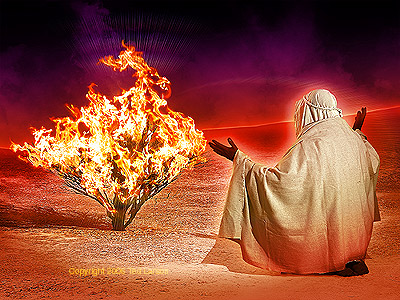
In Exodus 3 the place beyond the wilderness seems to us to be a rationally improbable place of enchanted pre-modern imagination. Here, God’s voice booms from within flaming bushes that never burn-up. However, it is important not to become distracted by the literary images of the pre-modern imagination. The burning bush serves as a metaphor for the presence of God. We are being shown that the significance of the place beyond the wilderness is as a place of unfamiliarity lying at the heart of what otherwise is our everyday experience.

moses-and-the-burning-bush-the-bible-27076046-400-300  I used the phrase stumble upon a moment ago to communicate that sense of being surprised by the unexpected. Actually, Moses does not   so much stumble upon the Mountain of God. He spies the burning bush some distance off. So he departs from the path, taking a detour in order to investigate this strange sight. As 21st century Christians the place beyond the wilderness is a place of internal, psycho-spiritual insight, requiring us to take an unexpected detour around the road blocks of normal and familiar expectations.

Trusting the Past

God introduces God-self to Moses using a familiar name – I am the God of your father, the God of Abraham, Isaac and Jacob. What interests me is that God self-identifies firstly, in terms of the familiar past, i.e. that already known to Moses. This is the God of Moses’ past, the God of Hebrew Tradition, with whom he is well acquainted. There is nothing unfamiliar for Moses here.

Likewise, God self-identifies to us through the Tradition that is familiar to us. We need God to self- identify in terms that trigger our memory. The collective memory of our Christian Community conditions our individual ability to recognize, or fail to recognize, God in our own lives. Yet, it’s not enough for us to know God only in terms of the familiar images of the past. To do just this traps us within the possibilities of only what we already recognize.

Curiosity and the Courage To Be

God expressly needs Moses. The prospect of this terrifies Moses whose first line of defense is the old Episcopalian ruse of humility – but God, who am I? The ruse of humility is saying, but God I am not important enough for you to even notice me let alone task me with the impossible. God counters – don’t worry about that, I will be with you all the way. Then Moses regroups in order to come at God from a different angle. But God, if I say the God of our ancestors has sent me, they will ask me your name, and what shall I tell them? God replies, tell them I AM WHO I AM sent me to you.

God, who has up to this point identified in terms of Hebrew collective memory, now offers a new and mysterious name. God declares, I AM WHO I AM. The Hebrew words are ambiguous and can also be translated as, I WILL BE WHO I WILL BE. The God of our fathers, the God of tradition and the familiar past becomes the, I AM of the present moment. Yet, the meaning of I AM is unstable and oscillates between I AM, i.e. God in the present moment, and I WILL BE, God in the future. The flow of time from past to present to future is only a human mental construct. For God, the present moment encompasses past, present, and future as a continuous interchange of ebb and flow.

God is beckoning Moses forward out of the familiar past where his expectation is of an omnipotent God performing might acts all on his own. God is inviting Moses into a new and unfamiliar experience, a God who is seeking his co-operation, his partnership.

The perpetual dilemma for human beings is that our minds only recognizes that which we are already looking for. This accounts for the difficulty we encounter in making truly new choices. Moses in wandering along leading his flock of sheep. Without realizing it he finds himself in a place beyond the wilderness. What we need to take note of is that before Moses becomes scared he first becomes curious. In the place beyond the wilderness a sense of familiarity is replaced by a growing sense of curiosity. Moses becomes more alert and his attention is attracted to something happening in his peripheral vision. He might just as well have continued on his way, but his curiosity diverts him from his path.

Curiosity is an important element in the spiritual life. It leads us off the beaten path where we wander through a landscape of familiar landmarks. Curiosity leads us to take what at first may only seem a detour. Yet, the detour leads us onto a new path where because the landscape is unfamiliar to us, God has more of a chance to surprise us with something new.

Listening to God’s Conversation

The Church’s Lectionary binds us to the conversation that God is seeking to have with us, the people of God in a particular place, in this instance at the people of God at Trinity Cathedral at the intersection of Roosevelt and Central. This prevents us from being confined by the familiar conversation, which is the only conversation we can have with ourselves.

Through Exodus3:1-15 God beckons us into the necessity of journeying beyond those familiar landmarks that populate our settled, imaginations into the place beyond the wilderness. Paradoxically, for us the place beyond the wilderness this not the place of epic mountain top experience. The place beyond the wilderness is a place of intersection between known and yet to become known, lying at the heart of our everyday lives. God’s call issues out of the familiar images of the Tradition, images of majesty, awe, and holiness. Yet, the call only becomes personal to us when we allow our curiosity and our courage to win over our fear and need for familiarity.

Daniel Deffenbaugh in his blog http://www.seedsofshalom.com/2008/08/ever-on-holy-ground.html  puts it rather neatly when he says while, theophany surely issues from heaven, it’s holiness can be found only on the lowly ground where it becomes known, in the dust beneath our feet. Our longing to find meaning and purpose for our lives can only be satisfied when we accept God’s call for partnership to journey to a place beyond the wilderness. This is found not on the mountain of God but at the center of where our daily lives, live themselves out.


Images of God

What is your image of God? Yet, more significantly, how does your image of God assist you or impede you in realizing the purpose of your life? These are the questions that God is inviting us to address as our response to the conversation he is seeking to have with us through the proclamation and reception of the Gospel passage from Luke 13:31-35.

The Gospel narrative in Mark, Matthew, and Luke follows the same pattern even though the telling of the story is not identical.  For each Evangelist and the community for which they are writing has its own story to inhabit, just as we have our own story to inhabit as the Body of Christ at the intersection of Roosevelt and Central. The pattern unfolding has a beginning, middle, and an ending. And this Lent the Lectionary has us journeying with Luke as he tells the story of Jesus’ journey to Jerusalem.

Luke sets the scene as Jesus is leaving the Galilee on the road that will take him to Jerusalem. He encounters a group from the Pharisee religious party, who in this instance warn him about their common enemy, Herod, Tetrarch of Galilee. Herod was called Tetrarch, because he ruled only a quarter of what had been his father, Herod the Great’s kingdom. Jesus calls Herod the Tetrarch a Fox and this alone conjures a delightful image of cunning and shiftiness.

Jesus’ response to the Pharisees is to assert in the clearest terms his sense of purpose in the face of their warning. He tells them: Listen, I am casting out the demons and performing cures today and tomorrow…. He hints at the implication of his purpose: …. And on the third day I finish my work. This is clearly an allusion to the Resurrection further strengthened by his reference to Jerusalem as the city where Prophets meet their death.

Jesus then offers a startling image of God as a mother hen gathering her brood under her wings. The image of the mother hen is not only a powerful and unexpected image of God. It leads me to ask: What is my image of God? Does my image of God assist or impede me in realizing my life purpose?

Our Images of God

I question my image of God. I am uncomfortably aware that my default image of God includes the attributes of a solitary, majestic, kingly, male figure, omnipotent, all- powerful, and omniscient,  all-seeing. In short my default image is of God, self-contained within his own potency and invulnerability. When I allow myself to examine this default image of God, I become distressingly aware of how poorly this image serves me. How can I be made in this image? It is impossible for me to project those very same attributes as my self-image into the world?

Each of us carries a dominant or default image of God that we rarely examine. Such images of God are given to us. We imbibe them along with our mother’s milk, as it were. Except that in this instance our mother’s milk is the socially conformist message of conventional, hierarchical, patriarchal, Christianity. Our image of God is communicated to us through a dominant interpretation of the Tradition we receive. This dominant interpretation serves patriarchal interests because the impossibility of attaining to the potency of such images of God casts us as docile children who must remain obedient under the protection of our heavenly Father.

It comes as a surprise to many that the Episcopal Church still has something called a Catechism. It can be found on page 845 of the Book of Common Prayer. I invite you this Lent to make a study of it. The opening question in our Catechism is: What are we by nature? The answer given is: We are part of God’s creation, made in the image of God.

We find or fail to find our sense of purpose in the images of God we harbor deep within us. There is a profound link between our sense of purpose and these often unexamined default images of God. If we are to examine the purpose of our lives we need images of God that encourage and enable us to realize the purpose of our lives both as individuals and as community. Are our images of God up to this task, I wonder?

Does our image of God lead us to assume the Universe is fixed, unfolding according to a distant God’s omnipotent plan?  When people tell me with such confidence that God has a plan for them I want to ask – so how is that working out for you? Or does our image of God enable us to realize that life is not fixed and unfolding according to plan, but fluid and dynamic? Do we have a sense of God inviting us to be more than obedient children and to play a meaningful part in the unfolding of creation?

The second question in the Catechism asks – What does it mean to be created in the image of God? It answers – It means we are free to make choices: to love, to create, to reason, and to live in harmony with creation and with God. 

Realizing our Life Purpose

Within each one of us are a number of competing voices. We usually don’t realize this because we are so used to listening only to the most dominant one. This is the default image. When I become aware of my default image of the omnipotent heavenly Father who has already worked out the plan, I consciously search within myself for the echo of another voice which directs me to my actual experience. It also directs me to look within the Tradition for the signs of another image of God. When I do I discover an image of God who is dreaming me into becoming myself. This image sounds lovely. However, it can be frightening to make a stand against the inner and outer voices that offer me an image of God as all-powerful and invulnerable. In some ways this image suits me and letting it go causes me a sense of loss. It’s comforting to know I have a God who is so much stronger than I am.

By contrast, for me the image of a dreaming God is a limited God. The dreaming God has chosen self-limitation to make room for my participation in the dreaming. God’s dreaming is a mutual and social activity. Unlike the image of the omnipotent God, majestic in masculine splendor and power, in the image of a dreaming God, who self limits to make room for my participation in the dreaming, I can see myself projected upon my world.

The image of a dreaming God is an image of a social God who delights in the loving interplay of relationship within the community of the Trinity.  The image of a dreaming God gives me the courage to step out and to risk moving beyond the confines of my own narrow and fearful imagination. Being true to the deeper sense of purpose for my live, beyond my desire for material protection and success, requires the courage to risk, or as Paul Tillich called it, the courage to be.

Responsiveness

Here is how I think the relationship between us and God works. Embracing the central purpose of our lives triggers a reciprocal responsiveness in God. We live in a Universe that is responsive to us; yet, we need an image of God that connects us with this reality.

We come to understand that our purpose is so much more than a realization of our own potential through self-fulfillment.  Our response to God this Lent is more than a program for self-improvement.  Risk, which is stepping beyond our own limited imaginations opens us to becoming the persons God is dreaming us into being. I need to issue a product warning here. The process of our becoming, may also involve pain and suffering as well as joy and fulfillment.

Jesus’ Purpose and His Image of God

In Luke 13: 31-35 we see Jesus refusing to be distracted by the warning of the Pharisees from pursuing his life purpose. His life purpose is to take the road to Jerusalem. Jerusalem here is a place on a map. It is also a symbol for all the centers of power and vested interest, which following Jesus’ example we are likewise called to challenge. Jesus further reveals how his image of God – as a mother hen gathering her brood – is instrumental in supporting the realization of his life purpose. Could he do what he must do if he imagines God any other way?

In this passage from Luke’s Gospel we see clearly the essential connection between Jesus’ God image and his determination to fulfill the purpose of his life. Let us pray that the same may be so for each of us both in our individual lives and as the Body of Christ at the intersection of Roosevelt and Central.

Moments in Time

Commentary on the Transfiguration

The event we know as the Transfiguration – recalls Jesus’ ascent of Mount Tabor to commune with Moses and Elijah, with Peter, James, and John in tow. This event concludes the season of Epiphany – a season of making manifest, things otherwise hidden.

On the 6th January, the feast of the Epiphany itself, I likened Epiphany to that internal ah hah moment we have when at least for a spilt second we glimpse the larger meaning, or the larger picture forming  the deep background against which our lives, are lived out https://relationalrealities.com/2013/01/05/significance-glimpsed/ .

Today it is quite common to refer to the term mountain-top experiences. In psychology we refer to these as peak experiences. As a society we are somewhat addicted to them and this addiction finds no more potent a focus than in the area of our spiritual lives. We read the story of the Transfiguration with a conscious nostalgia for that Biblical world of enchantment, when such things happened. In contrast, the world we live in is one in which we feel profoundly disenchanted, alienated from, yet longing for those moments in which we are transported beyond the narrow confines of our limited imaginations.

The season of Epiphany begins with a glimpsing into the truth that this infant Jesus is none other than the Messiah, the Christ. It ends with another glimpsing of Jesus’ divine identity as he is transfigured in the presence of Moses, Elijah, and three of the disciples. In this experience of Jesus’ transfiguration the significance of Tradition buts hard up against the experience of contemporary life.

At Trinity Cathedral, another version of our tag line where traditional worship encounters contemporary ideas, is, where tradition encounters contemporary life. This is often a hard place to sit, yet it is the place where Anglican Christians insist on sitting. Our Celtic ancestors referred to this hard place also as a thin place. Thin places are those points of experience where the boundaries between tradition as an expression of that which is greater than, and experience become very permeable allowing a deeper insight into the true nature of things to emerge.

A conventional reading of the Transfiguration tends to focus on Jesus, brilliantly illuminated and God’s voice, shrouded in cloud declaring you are my Son. This is usually seen as the central focus of the event, and in one sense it is. However, here I want to emphasize two points.

  1. It’s the way the Tradition, embodied in Moses and Elijah, and contemporary human experience embodied in the Disciples, encounter one another, that draws my attention. It seems necessary that Tradition and contemporary human experience both witness the glory of God in Christ.
  2. Jesus leads his disciples down the mountain into the hard reality of every day events. Not only are the disciples disappointed by this, but can we not also hear a tinge of disenchantment when Jesus himself despairs of having to endure life at the level of human experience limited by the imaginative poverty of what he calls perverse and faithless generation?

While we long for an enchanted glimpse of God on the mountain-top, I invite us to realize that the descent from the mountain is more significant for us, living as we are -within the confines of our human experience of the here and now! While the mountain top experience is never quite forgotten, its meaning only becomes clear through the lens of a convergence of the Tradition with the issues faced in life, as we are actually living it!

Exploration of a Point of Convergence

Some weeks ago Rob Smith who is the coordinator for Trinity Outreach Ministries asked if I would address the theme of environmental degradation on February 10th to coincide with the release by the Arizona Interfaith Power & Light of a statement by religious leaders on global climate change. My first response to his request was to want to say no. My intention was to preach a sermon on the psychodynamics of the Transfiguration. Fortunately, one of the things I have learned in those moments such as the one that followed Rob’s request is to allow the no to sound in my head but not come out of my mouth. I smiled and looked meaningfully at Rob as I said – ‘an interesting idea Rob let me think about it.’

The more I thought about it the more intrigued I became with the idea of exploring a possible link between transfiguration and global climate change. For it has become clear to me that there cannot be any more urgent need for convergence between tradition and contemporary life than that presented by the task Rob inadvertently set me. Convergence takes me into a hard place where I am uncomfortable sitting. As a preacher, I would be devastated if any of you thought I was being political from the pulpit.

Exploring my discomfort a little more deeply I came upon my desire to avoid thinking about environmental degradation, which is a probable cause of global climate change. My unease is not because I’m a global warming naysayer. For me the discomfort is that the link between environmental degradation and climate change is such a frightening prospect, over which I feel I have no control. I don’t like being confronted by my helplessness in the face of such a terror.

I am not alone in feeling this way and the question is what are we to do? Alone we feel impotent, yet joining our voices to the chorus that increasingly comes to be heard on issues of crucial importance to the future of the human race, confronts our sense of impotency.

At the Heart of Convergence

Oikos is the Greek word for house. In English, we have a number of words that share the root meaning of oikos. Ecumenism is the obvious one – meaning all under one roof. I was somewhat surprised to also realize that economics –good management of the house, and ecology – study of the health of the environment provided by the house, are all related. Environmental degradation is an ecumenical, an economic, as well as an ecological issue.

Ecumenism confronts us with the urgency that we are all on this planet together.  The human race lives under one roof in a more profound state of interdependency than we like to admit. As other parts of humanity are affected by environmental degradation and climate instability we in the US are not immune to the devastating effects caused by climate change. Trinity Cathedral, through our Millennium Development Goals Group (MDG), is deeply committed to addressing global inequalities. Yet, our energy and financial resources expended in furtherance of the MDG’s will be jeopardized by climate change. We can love and praise God as much as we like, but God will not take us seriously if this is decoupled from Jesus’ second commandment to love our neighbor as our selves.

Ecologically, we are impacted in numerous ways as climate change puts the environment under stress and restricts the range of the human habitat, not to mention the habitat of other species with whom we share, in the words of the Book of Common Prayer, this fragile earth our island home  (Eucharistic Prayer C). You don’t need me to point out the obvious signs for concern about climate volatility in our own back yard let alone in other parts of the world.

Economically, we note the debates about sharing resources more equitably through a more just global economic system. We automatically fear such developments for our fear is that what we enjoy will be taken from us. Yet, for the first time, Americans are being given a taste of the inequalities inbuilt into the global economic order as whole industrial and manufacturing sectors disappear with the outsourcing of jobs and skills.

There is an even more profound discussion to be had concerning philosophies of growth and sustainability. We can all go a little wonky in this area, with some of us advocating more and more growth through business as usual while others seem to preach the only alternative being a back-to-the-future regression to a pre-industrial economy. Sustainability does not mean no to any development.

A Theology of  Right Action

It’s fashionable to decry Western Civilization because of its legacy of industrialized exploitation of the earth. This exploitation has been and continues to be justified by misinterpreting God’s command to subdue the Earth in Genesis 1:28. Yet, the more profound character of Western Civilization is its mastery of technology to provide solutions to the problems of environmental limitation. I refer readers to Langdon Winner’s (1992) Autonomous Technology esp. chapter 3 for an in-depth discussion of this theme which lends itself to the view that sustainability and technological progress go hand in hand.

Ecumenical, ecological and economic solutions to the current issue of environmental degradation and global climate change as one of its inevitable consequences, require two complementary actions:

  1. We must recommit ourselves to a robust theology of stewardship first enjoined upon us by God in Genesis 1:28. Here, God commands us not only to subdue, but also to replenish the Earth. God commands us to exercise dominion over the Earth, but dominion means to take responsibility for the resources of the Earth entrusted to our care – in short exercise good stewardship defined as tender care.

Stewardship is further defined within the Biblical Tradition in the theology of Jubilee, first set out in Leviticus 25. Here is a recognition that injustice and inequality inevitably come to mark human social and economic relations. The function of the Hebrew Prophets was to provide the social critique that articulated God’s view of how human society should operate.

2.We urgently need to adopt in all our social and economic planning a philosophy of sustainability. A contemporary definition of sustainability is set out in the Brundtland Report as:

… development that meets the needs of the present without compromising the ability of future generations to meet their own needs. (Micah Challenge page 10 http://www.micahchallenge.org.au/assets/pdf/Theology-of-climate-change.pdf )

A Moment in Time

The encounter between the lives we are living and the Tradition we receive, although a place of tension is necessarily a place of convergence, a moment in time that gives birth to something new. It is now imperative that we glimpse and  grasp this moment in time to displace the theology of subjugation and exploitation with a renewed theology of stewardship supported in the secular world by a philosophy of sustainability.

It seems to me that we have reached a tipping point, that moment in time, where future development and prosperity is no longer supportable through the practice of subjugation of the Earth. Our future as a species and as a planet now requires that we replenish the Earth, and where we encounter limitation of supply we resist further plundering the Earth and rely on the ingenuity of our technological cunning to provide sustainable solutions.

All of this relies on a serious changing of our hearts. The Christian Tradition informs us about who we now are through showing us who we have always been.  Convergence is a moment in time when who we have been and who we now are mutually inform each another in order that we might discover who we need to become.

Are We Not All Corinthians?

I want to talk about the various ways God’s Spirit gets worked into our lives. It’s complex and often bewilderingly difficult to understand. One of the things people say about coming into the Episcopal Church is that it is an experience of not having to leave your mind at the door. This assumes that understanding is one of the ways God’s Spirit gets worked into our lives.

Yet, understanding, the application of our rational minds to the mystery that is God is like sailing in shoal, infested waters. It is easy to come to grief on the shoals of over-inflation and self-importance in our individual thinking. We can come to grief on the shoal of rational analysis itself, which runs the risk of reducing mystery to the point where there is no longer anything left to understand, let alone to trust.

The Limitations of our Mental Process

Our minds are pattern-mapping machines. New experience is pattern mapped onto earlier memories. Therefore, our minds usually only recognize what we already know. Our thinking often is simply a confirmation of the limitations of our own impoverished inability to glimpse beyond the boundaries of imaginations corralled within memory. I have commented before on a dominant theme of memory, which is the need to stay within the safety afforded by the familiar.

An Enigmatic Question

This last Thursday evening those of us who arrived for our weekly adult formation evening were sitting in the subdued lighting of the Auditorium. This is a space not normally available to us on a Thursday night and so we make do with Atwood Hall, which though suited to our eating together, is particularly inflexible and uncomfortable for the class that follows. For those who have ears to hear – yes I am complaining!

Invariably the conversations I instigate rarely follow the pattern I envision at the outset. Thursday evening was no exception. I set out to invite a conversation picking up on last Sunday’s sermon in which I used Brad Kallenberg’s exploration of precritical, analytical, and postcritical approaches to story. You can read more of that on last week’s sermon blog Inhabiting our Story either on the Trinity Facebook site or at relationalrealities.com or listen again to the podcast at azcathedral.org

On Thursday evening I posed the question:  what would inhabiting our story as the Body of Christ at the intersection of Roosevelt and Central, look like?

As we wrestled to find a response to this somewhat enigmatic question, we found ourselves sailing in those shoal, infested waters I referred to earlier. We kept coming to grief on the particular shoal represented by the tension between perceiving God’s Spirit through our own individual experience (God’s Spirit as a source for personal self-fulfillment) and a perception of God’s Spirit acting in us as the Body of Christ (God’s Spirit as a communal experience).

Everyday we wrestle with how to live our lives in a world that, forces upon us difficult and conflicting choices with regard to self-interest and reaching-out in relationship with others.

Understanding how God’s Spirit gets worked into our lives is fraught with tension. This tension goes to the heart of Paul’s letter to those notorious Christians at Corinth. 2000 years does not, it seem, appreciably alter some aspects of human experience. Like the Corinthians Paul is addressing the way we orchestrate our lives in the midst of often difficult and conflicting choices, choices that polarize between following self-interest and acting in ways that build up our shared lives of relationship.

Paul’s First Letter to the Church at Corinth

Over the last two weeks the Lectionary Epistle has come from the 12th chapter of Paul’s first letter to the Corinthians. The essence of Paul’s message here is that God’s various gifts can be seen everywhere and in everyone. Each person is given a gift capable of revealing God to others. All gifts originate in God’s intention that they be used for the building up of community life. The image he employs to communicate this is that of the human body.

In our human society we value different parts of the body with greater or lesser significance. There are parts we like to show in public and other parts we conceal with clothing. We tend to focus on the parts that are perceived as beautiful. We rank different body parts and functions in importance, with those most visible being given most value. Yet although we can live without an eye, or a full head of hair we can’t live without a bowel or without a heart.

Following this analogy, we value ourselves, and others by the degree of physical beauty or intelligence, or other attributes that ensure success. When we regard the personal attributes of our bodies, our intelligences or our personalities we are defining our significance. Yet, Paul reminds us that our significance, our success, our honor, is given to us only because of what we are part of, i.e. part of The Body of Christ.

Hyperbole, Soliloquy, Idealization and Reality

Inhabiting our story of being The Body of Christ at the intersection of Roosevelt and Central means two things. Firstly, that it is within community as a whole that each person receives the gift of a calling. Secondly, it is only through the lens of community viewed as a whole that our individual calling reveals who God is to one another and to the world.

At the very end of Chapter 12 with the words: but now I want to lay out for you a still more excellent way, Paul takes us from his analogy between the Body of Christ and our human bodies into the greatest soliloquy in all of human literature, his soliloquy on love in chapter 13.

The word Paul uses for excellent is huperbolen, which gives us our English word hyperbole. Chapter 13 is hyperbole – exaggerated statements or claims not intended to be taken literally. Perhaps this explains why I Corinthians 13 is the most powerful love soliloquy ever recorded. It also explains why this passage finds its way to the wedding section of the Hallmark gift card range. At countless weddings this passage is chosen and I often wonder why as two people embark on the most difficult and complex emotional negotiation of their lives, joining two lives together as one, they want to be burdened by such an impossible idealization of love, such as Paul offers here.

As poetry, which relies on hyperbole, Paul’s definition of the attributes of love in Chapter 13 moves me deeply. Yet, as a prescription for loving amidst the day to day choices and tensions that comprise my life, these words only convince me of impossibility of my ever successfully loving.

Psychologically, I am familiar with the way idealization inhibits living. When we idealize we measure ourselves against an unobtainable standard, and this leads to disillusionment as we continue to fail to obtain that for which we long.

So is Paul intending to set an impossible standard? The overall theme of Paul’s writing to the Corinthians is one of encouragement rather than criticism. To invite them to understand love by measuring themselves against an impossible ideal would not make much sense.

Paul’s intention in this section becomes clearer when he begins to describe the impermanence of all spiritual gifts. He eloquently articulates the task of moving from childish ways of thinking, feeling, and acting to embrace more mature ways of living.  In the process we become only more and more aware that our own perception of things is only ever partial and incomplete.

Paul is not telling the Corinthians that no matter how hard they try they will never succeed in becoming a community of love. His purpose is to point out to those who think they had already achieved perfection, how short of the mark they really are falling. Here, his point is not just to bring them down a peg or two, although he can’t resist doing this. He is saying that it is all right to be a human being and to acknowledge that we all have a long way to go.

For me, being human is an experience that despite my often, inflated sense of my own success, I always still have a long way to go. Yet, God manifests God’s Self through that very imperfect human vulnerability. Vulnerability is not weakness or inadequacy. Being vulnerable requires a capacity to put away childish ways, and for childish ways read omnipotence and self-importance.

Inhabiting our Story

My Thursday night question: what would inhabiting our story as the Body of Christ at the intersection of Roosevelt and Central, look like, now takes on a deeper relevance.  Firstly, what always remains incomplete and partial in each one of us is made more complete and more comprehensive through our participation together in a community we call The Body of Christ.

Secondly, the gifts that God gives to each of us only find their fuller expression within the experience of interdependency within the Body.

Thirdly, to inhabit our story as The Body of Christ is to be at ease with love as vulnerability, not successful achievement. Vulnerability opens us to receive a deeper power of love, originating in God’s Spirit, flowing into us from within the life of God. Flowing from the life of God through us into the life of the world.

Paul’s concluding words in chapter 13 invite us to trust steadily, to hope unswervingly, and love extravagantly. I rather hope that this is what it means for us to inhabit our story as Christ’s mystical Body at the intersection of Roosevelt and Central.

Blog at WordPress.com.

Up ↑