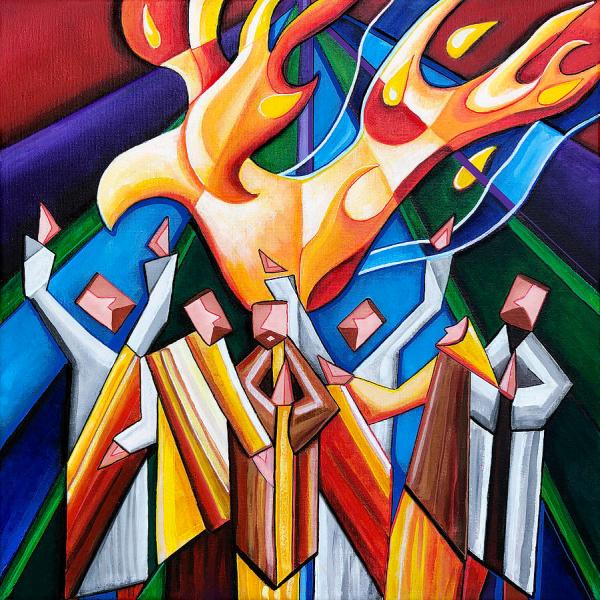
The Gateway

On the fourth Sunday after Easter – traditionally referred to as Good Shepherd Sunday – it is customary for the preacher to explore the protective and nurturing metaphor of shepherding.  As many of you know I’ve explored in previous years how the metaphor of the shepherd and the dynamics of shepherding offer a sharp contrast between modern and 1st-century methods of sheep farming. Good Shepherd Sunday also has a habit of falling on Mother’s Day and I’m somewhat relieved that this year we’re still two weeks ahead of that sermon challenge.

Coming from a country such as New Zealand – a nation of five million humans and over 40 million sheep – the life of sheep and that of the shepherds who manage them is somewhat familiar. In previous sermons on Good Shepherd Sunday, I’ve spoken of my nephew Hamish, who farms a hill country station – sheep farms are known as stations in the rugged hill country of NZ’s South Island – a topography familiar to many of us as the mountainous and foreboding terrain that formed the scenic backdrop for the Lord of the Rings Trilogy.

In the 19th-century, Scottish farmers – familiar with the harsh topography of the Scottish Highlands – settled easily in the rugged high-altitude foothills of the imposing mountain range of the Southern Alps – running like a great spinal column down the center of the South Island (S I). For them this was as close to the homeland they had left as anywhere on the globe. Their sheep farming heritage easily transplanted into this new setting.

Like the Scottish Highlands, the S I’s high-country land is poor – expansive high-altitude grassland. With the granite bedrock only a couple of inches below the surface the land is completely unsuitable for arable farming. This landscape is only suitable to the particular Marino breed of sheep – a scrawny bread – bred not for the succulence of its meat but for the fineness of its wool – wool today much coveted by the Italian textile and designer fashion houses. The Italian fashion industry is the end destination for my nephew’s wool.

Easter IV draws its Good Shepherd theme from John’s presentation of Jesus as the good shepherd in chapter 10 of his gospel. Here we are given two contrasting images of Jesus. One is as the personification of the good shepherd- I am the good shepherd – hearing my voice my sheep know me and follow me. This image resonates with intimations of intimacy and loving care. The other image – which is the one presented to us on Easter IV in year 1 of the Common Lectionary – is the more striking image of Jesus as the gateway to the sheepfold.

Facing the blank looks of incomprehension on the faces of his disciples as he speaks about himself as the gatekeeper who guards against the illicit entry of thieves and rustlers seeking to mislead and steal the sheep, Jesus offers what I would have thought was an even less comprehensible metaphor – of him as the literal gate to the fold –I am the gate for the sheep.

On a baptism Sunday, the shepherd and sheepfold metaphors present us with fundamental questions about the nature of the church and the dynamics of belonging.  What is the Church; how do we get into the Church, and what are the hallmarks of belonging???

The Episcopal Church has this quaint phrase to identify one of its three main membership criteria. Following John 10 you might think the Episcopal Church would say that one of the core attributes of membership is to know and be known by Jesus. It is very telling that the Episcopal Church prefers to define membership as those who know and are known to the treasurer.  Easter IV being a baptism Sunday here at St Martin’s – lends an added poignancy to questions of belonging.

The Church is the Christian community – which may seem an obvious statement. But we have a very impoverished understanding of Christian community because we imagine that we are the Christian community – that without us there is no Church. IN this sense we think of the Christian community as a voluntary association much like being members of the tennis club. Accordingly the answer to the question what is the Church – is – we are the Church – the fruit of our organization.

However, the Christian community is God’s creation not ours. The Christian community is not a manifestation of our social organizing. It is the creation of God-in-Christ active within the dimension of time and space. Following this view, we don’t create Christian community – we simply participate in it. As the sheep entering the sheepfold – so we come into a divine community that is already awaiting our arrival and in which we are invited to participate.

That the Christian community emerges from our self-organization is only the first of two major mistaken ideas. The other widespread mistaken view is that being Christian is an individual thing – as in – you don’t need to go to church to be a Christian – or I’m spiritual but not religious. We each can be as autonomously spiritual as we like, but being spiritual does not make us Christian. The Early Church father, Tertullian summed it up when he said one Christian is no Christian. The only way to be a Christian is to participate in the life of the Christian community – which is the divine community of God-in-Christ or the Body of Christ – made visible in the dimension of time and space.

John 10 speaks of both sheep and sheepfold. The sheep don’t form the sheepfold – they enter the sheepfold when they pass through the gate. Likewise, we don’t form the Christian community, we enter the Christian community – the Body of Christ in the world – through the gate of baptism. If baptism is the gate, the rich pasture is the Eucharist. Through baptism we come to belong to a community that nurtures us with the rich pasture of the Eucharist – Christ’s mystical body – upon which we feed.

If John 10 is the metaphor for our entry and belonging within the Christian community then the first reading from Luke-Acts chapter 2 clarifies the nature of belonging. We don’t simply belong by virtue of becoming members – the hallmark of belonging is participation – active engagement in the covenanted relationship with God – and – more challengingly, a covenanted relationship with one another.

By covenanted relationship I mean a relationship in which we become responsible for one another. We read in Acts 2:42 that the first Christians devoted themselves to the apostles teaching and when they gathered to worship God, they broke bread with one another – praying unceasingly for one another, and for the world around them that often viewed them with considerable hostility. In addition, they practiced common fellowship which meant they shared their material resources – holding all things in common for the benefit of all. It’s this characteristic of early Christianity that not only facilitated the Church’s astonishing growth in a short span of time – and day by day the Lord added to their number – but has continued to inspire a vision of a society where each gives according to their ability, and each receives according to their need.

Through baptism we enter into belonging. By participation our belonging fosters believing – both signs of our taking responsibility for one another.

That we seem even further away from being able to embody this ideal as the hallmark of our participation together within the Christian community – is a continued matter for our profound repentance.

Re-Membering

Image: Road to Emmaus by Ivanka Demchuck

Following the Great Three Days of Easter, we find ourselves among the various accounts of Jesus’ post-resurrection appearances. These come mostly from John but also include today’s gospel portion which is Luke’s account of the experience of two of Jesus’ disciples on the road to Emmaus – a village not far from Jerusalem.

Luke 24:13-35 is one of the iconic gospel passages – shaping Christian spiritual imagination down the ages. Emmaus is a name deeply associated with places of spiritual seeking and retreat – a name that Christians automatically associate with spiritual journeying.

The post-resurrection accounts from John that pose a direct challenge to our received Newtonian understanding of the laws of the physical universe – accounts where Jesus walks through locked doors and solid walls, one moment appearing, the next disappearing – and all that. Luke’s account relates an experience that offers no such challenge to our Newtonian rationality. Luke’s post resurrection appearance is immediately relatable because at its center is the all too familiar experience of minds clouded and hearts set on fire.

Jenna Smith in her article A Blaze of Glory published in The Christian Century, alerts us to the Ukrainian artist Ivanka Demchuk’s painting Road to Emmaus. Demchuk’s work is influenced by the techniques and aesthetics of iconography and in the painting, we see Christ, in white, facing the two disciples on the road. She layers gold filament in a way that draws the eye immediately to the disciples’ torso region – portraying that most significant phrase in the passage: Were our hearts not burning in us as he spoke to us? Smith comments that Demchuk’s use of gold, against the back layers of white, effectively lights up the scene, as if there is a ball of embers in the disciples’ chests. I love the image, both in the text and in this artwork, of hearts burning within us. It is, in this story, so good, such an indicator of trueness and of life. I’ve posted the painting to accompany this sermon online at relationalralties.com and stmartinprov.org.

We relate to Luke’s story on the road to Emmaus because, whether we know it or not – we are all on the road to Emmaus – journeying with minds clouded by grief and hearts enkindled by the fires of our yearning.

For the two disciples traveling to Emmaus, it had been a long and bewildering day. The Lord’s death – yes – can it only have been on Friday? – somehow time for them has stood still – the Lord’s death and now first thing today some of the women reported the disappearance of Jesus’ body from the now mysteriously empty tomb. The succession of these events is too great for them to bear. Faced with experience too huge and overwhelming to process – their minds shut down like a computer hard drive crashing. Numbed into mindlessness by grief – all they can think of to do is to physically react and get as far away from Jerusalem as a day’s travel can take them.

Viewing this story from the sidelines of history – from our 21st-century psychologically informed perspective– we’re curious about the dynamics of the experience these two disciples are having as they walk away from the city as fast as their legs can carry them. Along the road they encounter a mysterious stranger who asks to walk with them. He’s been following, perhaps, at a distance and having caught up with them he asks: What are you discussing while you walk along?

Oh, it’s bad enough this stranger intrudes on their grief, but he further burdens them with his dumb-assed question as well. Cleopas, one of the two, turns on the stranger and in a voice dripping with incredulity demands: Are you the only one in Jerusalem who doesn’t know what been going on there these past days?

As if to rub salt into their wounds the stranger simply asks: what things? The disciples commence to pour out their hearts – the first stage of articulating their grief by talking it out to someone else. They relate their grief and bewilderment, the devastation of their lost expectation: we had hoped that he was the one to redeem Israel. And now the worrying disappearance of Jesus body – with only the witness of the women – unreliable in itself – as you know what women are like imagining all sorts of fancies. I mean women – being addressed by angles – really?

We can picture them standing dumbfounded when the stranger rebukes them: what fools you are – not only fools but faithless fools! He then begins a process of reconstructing the broken chains of memory – relinking associations which like broken links on a website no longer connect to the source of meaning. Today, we would recognize that the disciples were suffering from post-traumatic depression – a state of mental shutdown resulting from an overwhelming experience of trauma, grief, and loss.

Luke relates that Jesus beginning with Moses interpreted the things about himself in all the scriptures. In the guise of the stranger, he helps the disciples to begin to process their grief through a process of re-membering. When hyphenated the word remember takes on its original meaning. To Re-member is to put back together – to reconnect broken memory fragments weaving them once again, into a meaningful picture of the world.

There is a fundamental law of psychological life – that the mind only recognizes what it already knows. They could not see what their minds had no stored memory template for – offering a clue into the mindset afflicting the disciples’ on the road to Emmaus.

All forms of trauma – of which acute grief is but one form – interfere with the pattern mapping of memories onto real time experience that enables recognition – that is – the act of re-membering. We know how depression – depresses certain chains of memory capable of restructuring pain and loss – preferring instead memory chains associated with hopelessness and helplessness that simply confirm our current experience of suffering.

The disciples had seen Jesus’ death and burial. With his death all their hope died. They could no longer access the stored memories of him to map onto their real time experience. Cut off by grief from their memories of his teaching, they couldn’t see Jesus because their minds had no way of recognizing him.

As the three men journey on the road to Emmaus something deeply therapeutic is taking place. Grief has traumatized them – preventing remembering. They don’t recognize Jesus because they’ve lost access to the memories of him that could reconnect them to his resurrected body. Gradually with each step along the road – as the stranger beginning with Moses, interprets the things about Jesus in all the scriptures – they begin to re-member – a process beginning in their bodies ennkindling their hearts. By the time the stranger leaves them they can turn to one another exclaiming: Were our hearts not burning in us while he was talking to us on the road, while he was opening the scriptures to us?

There’s one more thing to notice in this story. When the disciples reach Emmaus and invite the stranger to stay and eat with them: Stay with us for it’s almost evening and the day is now nearly over. – it’s not only the day that is nearly over but the therapeutic process of reconnecting the broken links – allowing them to map memory onto real time experience is also complete. In response to their invitation – the stranger takes bread, blesses, and breaks it before sharing it with them. Luke tells us that then were their eyes opened and they now correctly recognized the stranger as Jesus. Process complete –memory pattern mapping onto real time experience has been rebooted – and Jesus vanishes from them.

Every therapist working with serious trauma knows that it’s action –as in controlled reenactment rather than words that matter. Over the sharing of the bread Jesus reenacts – reconnecting the last broken link in the disciples’ fuller recovery of memory in real time.

The road to Emmaus is the symbol for our spiritual journey. Like the disciples’ – we make this journey travelling in one another’s company. Like the disciples’, we walk the road to Emmaus with minds clouded by distraction and forgetfulness. Memory templates of doubt and fear rather than hope and courage map onto real time experience. Consequently, like the disciples’ on the road to Emmaus we fail to notice the ball of embers – our hearts burning with yearning for something more.

If we don’t see Jesus – maybe it’s because he’s not who we are looking for – until like the disciples’ we recognize him as he blesses, brakes, and shares with us his bread of life. Only then are our eyes opened in recognition of his abiding presence with us.

Living in the Time In-Between

Ayana Mathis, in her New York Times first installment in a series on American literature and faith titled The Prophetic, is recalling her childhood memories of growing up in a Black revivalist Christian tradition. She writes that:

the God of her revival childhood was all-powerful and relatively benevolent, but had a great many rules about what we should do  (go to church 3x a week, live by the Word of God, literally interpreted) and what we shouldn’t do (listen to secular music, play cards, watch movies, drink). These commitments and privations would be rewarded with God’s love, palpable, like a bird alighting on a shoulder.

She describes leaving this world behind with the memorable image of plunging into the world on the other side of the stained-glass window. Mathis views the beginnings of her adult journey as one of growing beyond her conservative Christian origins to become an artist. Her’s was a journey of learning how to disbelieve but be imprinted by belief.

How to disbelieve while remaining imprinted by belief struck a deep chord in me. Mathis asserts that American literature –and by extension mainstream American culture – remains imprinted by belief, freighted by ideas about morality, justice, and standards for living. Her assertion is that whatever the condition of our belief at the personal level – as in do we, or don’t we? – the cultural impact of belief remains imprinted on us. That despite many manifold wrongs and derelictions, the literary and cultural landscape of America remains deeply imprinted by the nation’s historically Christian heritage.     

She notes that this Christian imprint has both good and not so beneficial consequences –in her phrase it trucks in paradox. The Christian imprint on American society has often been used to justify great evil and at best inspire decency and generosity, acting as a hedge against oversimplistic notions of society and the individual. Her assertion is that our Christian legacy asks us to tolerate a degree of paradox – requiring us to wrangle with contradictory realities in mind and heart with sustenance and insight to be gained in that wrangling.

Omitting her more personal references to a fundamentalist upbringing, Mathis is speaking to many of us – I suspect- here in this church on this Easter morning. Few of us good middle-class, over-educated, professionally-successful, and predominantly White worshippers remain Christian if measured by orthodox belief and devotional piety and practice. Yet here we are on Easter Day. Some among us may be a little surprised to find ourselves sitting in these pews. Yet nevertheless we’re here – despite being unable to give a full account for why we have been drawn here.

Perhaps we’re being drawn by memories of an earlier phase of family life as children or as parents of young children? Perhaps it’s the influence of friends drawing us here? Perhaps – and this is the best reason of all – we’re drawn here by cultural tradition – tradition as the imprint of belief upon our personal struggle with disbelief? Deep-down being here reflects a questioning of certainties -once – easily taken at face value but alas no longer so. Many of us have lost confidence in a belief that Jesus was raised from the dead, and all is right in our lives and our world.

We are they who are seeking to find a fingerhold – to say a foothold here would be to overstate our confidence – to find a fingerhold on what it means to live well with a hope which at times aspires to the level of real courage – and love demonstrated through generous concern for everyone affected by our action or non-action – in short – a generous concern for our neighbor. We are they who are seeking a fingerhold on something ineffable. We wrangle with disbelief while remaining mysteriously imprinted by belief.

Many today think Christian belief is too hard. Belief has been reduced to yes or no answers. Such belief seems to us irrational – an artifact of a former time long passed. We think in terms of making the leap of faith – wondering can we leap that far or not. Edward Weber in a recent edition of the Anglican Digest recalls an Associated Press interview with John Updike not long before his death in 2009 in which he said that he was aware of the explanations for the creation of the universe, which did not require God, but that personally he just could not quite make the leap of unbelief.

So perhaps the leap of unbelief is as hard and irrational as any leap in the other direction? It’s not so hard to believe in a higher power. It’s not even so hard to believe in resurrection as an internal spiritual experience in the minds of the disciples. It’s quite another level of difficulty to actually believe in resurrection as a bodily experience for Jesus.

In his poem, Seven Stanzas at Easter, Updike unashamedly speaks of his belief in the literal, corporeal resurrection of Jesus. Despite his controversial lifestyle, and regardless of whether he practiced a conventional piety or not – John Updike remained firmly imprinted by Christian belief.

Make no mistake: if He rose at all It was as His body; If the cell’s dissolution did not reverse, The molecules reknit, The amino acids rekindle, The Church will fall.

It was not as flowers, Each soft Spring recurrent; It was not as His Spirit in the mouths and fuddled eyes of the Eleven apostles; It was as His flesh; ours.

I’m convinced – whatever the condition of our personal Christian belief – we remain imprinted by the Christian social and cultural legacy. For me, belief is no longer an either or proposition. Belief is neither something I can possess, nor is it something I can lose. Belief is like the tide – it ebbs only to return in the flow. For me, as I am today, belief is the expression not so much of objective faith in a collection of doctrinal propositions but a heartfelt experience of being deeply imprinted by belief as a narrative – a narrative of belief that creates meaning and purpose in my life – continually correcting my orientation to the world around me in all its evil as well as its glory. Mathis echoes Updyke – faith as the practice of wrangling contradictory realities in mind and on heart and finding sustenance and insight in the wrangling.

I agree with Updike that if Jesus was not bodily raised to a new and transformed life – yet a life so continuous with his pre-death human life that he remained recognizable to the disciples – – the Church will fall.

By the church’s fall I’m not imagining the church as the respectable middle-class institution – of which St. Martin’s is one of the finer examples. I’m thinking the Christian legacy which remains imprinted on our culture. Despite the process of relentless secularization – Christianity’s cultural imprint is of a generous orthodoxy which gives our culture its distinctive shape.

There is at the heart of Christianity a curious paradox – Jesus died on the cross – but Christ was born in an empty grave. Wrangling with this paradox is worth it- for it leads us to the realization that resurrection is both a present time experience as well as a future hope.

For me this is the paradox of living in the season of the resurrection – a period of time I think of as the-time-in-between – that is – the time between the resurrection of Jesus and the divine restoration of the whole of the creation at a point we can only poetically refer to as at the end of time. To live in the-time-in-between is to live bookended between the resurrection of Jesus and the eventual restoration of all of creation. If we can forget our narcissistic worries about belief – what is it and do we possess it or have we lost it?, – we become free to embrace living in the time-in-between as a narrative opening us to an immense enrichment of meaning and purpose that continually refocuses our attention on the day and its task of building a future better than our past.

The onetime legendary 19th-century bishop of Massachusetts, Phillips Brooks, wrote: The great Easter truth is not that we are to live newly after death, but that we are to be new here and now by the power of the resurrection.

Living in the-time-in-between means the promise of being reunited in the Resurrection with all who we have loved and yet see no longer. It also means new beginnings after a failed relationship, healing after a messy divorce or a parent-child estrangement; it means new life on the other side of addiction recovery and the healing of old hurt; it means new life for a nation like Ukraine rebirthing in the fire of war.

The new life of resurrection in the-time-in-between can be found in the struggle for peace – not peace at any price but peace with justice; in the making real our hopes and dreams for a future better than our past – a future arriving step by step through our commitment to put right that which currently, is so very wrong in our world. In the-time-in-between we are called to strive for and to witness and to collaborate in the divine plan for restoration and renewal – challenging the world to see and know that things which were cast down are being raised up, and things which had grown old are being made new!

For us living in-the-time in-between the resurrection of Jesus and the resurrection of the whole of creation – poetically referred to as at the end of time – means to wrangle with paradox – holding contradictory realities in mind and heart, and thereby drawing sustenance and insight in that wrangling (Mathis). To disbelieve while being imprinted by belief is the best description I can find for living in the-time-in-between. All well and good you might say but what of the bodily resurrection of Jesus? All I can say is that living in the-time-in-between – we should rule nothing out.

Fickleness of Crowds

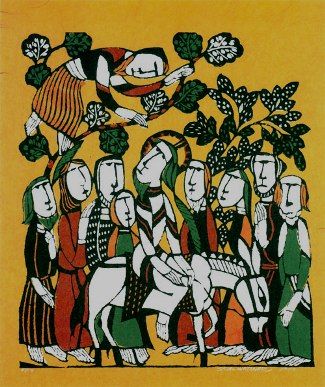
Featured Image: Entry to Jerusalem, Sadao Watanabe

There is something mysterious about crowds. Being part of a crowd can be an exhilarating escape from our individual sense of isolation and helplessness. In crowds we find an experience of shared solidarity. An experience of mass protest builds networks to support ongoing action when we return to the sphere individual life. Crowd experiences can become an in-the-moment expression of the more expansive currents of aspiration and longing for change.

But there is also something menacing about crowds. Being caught up in a mass mind-meld can be frightening. Crowds morph in the blink of an eye from peaceful protest to violent action. The journey from exuberant celebration to mass hysteria can be a very short one. We are right to fear being caught up in the experience of mass manipulation when an unscrupulous and skillful orator stokes our fears. Fear-stoked messages become conduits for the surfacing of repressed collective memories and imagined grievances – an experience that we in America are all too familiar with.  

Crowds become the conduits for the resurfacing of shared cultural and historical storylines. It matters greatly which storylines echo through a particular crowd’s collective awareness.  In short crowds can be fickle.

He had come to celebrate the Passover. Having traveled from Bethany, Jesus entered Jerusalem through the East Gate to the wild acclaim from the crowds that greeted him. They stripped the fronds from the palm trees to lay them as a carpet before him as he entered the city gates.

The surfacing of collective memory – acted out in real time – is often the best interpreter of a crowd’s mind-meld . The waving of palms was a gesture that tells us everything about the mind of the crowd welcoming Jesus.

Jerusalem with its estimated population of 40,000 had swelled to well over 250,000 for the Passover festival. Accommodation in the city was at a premium, hence Jesus, during the two weeks prior to the festival had been commuting the two miles from the Bethany home of his friends Lazarus, Martha, and Mary to the city. During this time his reputation had gone viral. Jesus was the name whispered on every breath. Who is he? they whispered to one another. A question couched within the question – the only question that really mattered to the crowds – is he the one?

It’s the palm branches that tell us everything we need to know about the crowd’s expectations. Like the MAGA – Make America Great Again – slogan – the waving of palm branches was a political gesture echoing and earlier storyline. Some 160 years before, the triumphant Judas Maccabeus, the last leader of a successful Jewish rebellion against foreign domination, had led his victorious partisans into the Temple. One of their first acts of victory was to cleanse and rededicate the Temple – the memory of which is celebrated by the Jewish community in the festival of Hanukkah. For us, the important point is that the partisans used palm branches to cleanse and prepare the sanctuary for rededication after its defilement by the Syrian tyrant, Antiochus Epiphanes, whose erection of a larger-than-life sized statue of himself placed in the Holy of Holies was the initial trigger for the rebellion.

The waving of palm branches speaks of the crowd’s expectations for Jesus as a new national liberator in the mold of Judas Maccabeus – come to free them – this time – from the hated Roman occupation.

Of interest here is to what extent was Jesus the hapless victim of a mistaken historical identity – and to what extent was he deliberately playing into the MIGA Make Israel Great Again storyline – colluding with the crowd’s frenzy of jubilation? Again we don’t need to search far for the answer. Riding into the city on the back of an ass proclaimed another historical storyline – that of the prophet Zechariah:  

Rejoice greatly, O daughter of Zion!
    Shout aloud, O daughter of Jerusalem!
Lo, your king comes to you;
    triumphant and victorious is he,
humble and riding on an ass,
    on a colt the foal of an ass.
Zechariah 9:9

Of course, as events played out, we know that Jesus had a very different interpretation of what kingship in this context meant. However, we should not miss the implication here that he seems not to be averse to playing on popular messianic expectation of an earthly liberator king.

At the same time as Jesus entered through the East Gate, another triumphal entry procession wound its way into the city through the West Gate. The Roman Procurator, Pontius Pilate at the head of his Roman Legion had also come up to Jerusalem for the Passover.

Pilate did not live in Jerusalem. He chose to avoid the city’s ancient warrens seething with civil and religious discontent. Pilate and his Roman administration preferred the sea breezes and mod-cons of Herod the Great’s former capital at Caesarea Maritima – 60 miles to the west on the coast and now the administrative center of the Roman occupation of Judea.

Pilate hated and feared the crowds of Jerusalem. He feared them most during the Passover which required him to come up to the city with a show of preemptive force to forestall the potential for insurrection. For Passover celebrated Jewish collective memory of liberation from an earlier period of slavery. Pilate’s arrival was indeed a wise move, for the crowds that hailed Jesus, were in insurrection mood.

Holy Week commemorates the events beginning on Palm Sunday of Jesus’ last week in Jerusalem before the Passover. The echoes of three historical storylines merge from Jewish collective memory to intersect and clash with an alarming result as Pilate, the crowds, and Jesus all become caught up in an escalation of events – which in the end – none could control.

The storyline of worldly oppression and political violence intersects with a storyline of populist resistance and nationalist longing for liberation at whatever cost. Both confront the third storyline which concerns the next installment in the epic narrative of God’s love and vision for the world.

I have spoken over recent weeks and days concerning Holy Week and the Triduum – the Great Three Days of Easter – as our liturgical enactment of a drama in three acts. Palm Sunday is the overture – setting up the major themes that will play out from Act I on Maundy Thursday through to Act III on Easter Day.

Of course, we know how the drama ends. But like a Shakespeare play – our knowing the ending does not deprive us of experiencing its spiritual impact in new and unexpected ways. Remember, it’s one thing to read the play in the comfort of an armchair, but it’s always a more meaningful experience to attend its enactment.

Crowds can communicate the exhilarating experience and act as conduits for a people’s collective memory. In American collective memory we find both a storyline of revolution and liberation alongside a darker storyline of civil war. Both storylines vie and clash in our collective memory – and in the present time we remain uncertain which storyline will find a conduit in the action of crowds.

Crowds are fickle because they evoke competing storylines.

Richard Lischer in his 2014 article in Christian Century notes his South African friend Peter Storey who once remarked that “America is the only country where more Christians go to church on Mother’s Day than Good Friday.” It is a sobering thought. Those who skip Maundy Thursday and Good Friday only to show up on Easter Sunday are missing the essential truth of Easter – which is that the Messiah was born in a grave (Paul Tillich).

We too are the victims of competing storylines. For like the crowds praising Jesus as he entered the Holy City, we enthusiastically hail our next political savior until that is, he or she no longer is. We long to do the brave thing, until that is, the moment when we don’t.

Lazarus Unbound

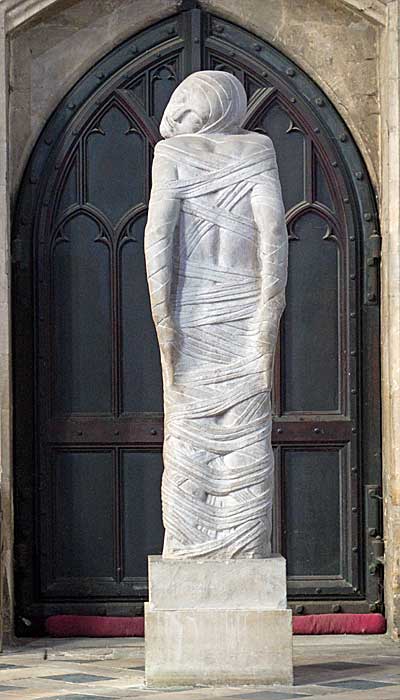
Featured image: Jacob Epstein’s Lazarus Unbound, New College, Oxford

On Passion Sunday – Lent V – we hear the story of the Raising of Lazarus as the seventh in the series of John’s Seven Signs of the Kingdom. John has an overarching-transpersonal message he wants us to hear. This overarching message is that Jesus is the Son of God, the Light that has come into the world as the Word of God – who was with God before the beginning of creation; that we come into relationship with God through hearing and accepting this message. John weaves his overarching-transpersonal message into a rich fabric of arresting personal human-interest stories.

John places his seventh sign story at the Bethany home of his friend Lazarus and his sisters Martha and Mary. Bethany is two miles from Jerusalem, conveniently placing Jesus within commuting distance for the start of his final week in Jerusalem.

We’re attracted to the narrative richness of John’s storytelling. But we’re also put off by their complexity for John is always weaving two parallel storylines at the same time. We’re jolted as the narrative wanders back and forth between his overarching-transpersonal and personal human-interest storylines – between the storyline about Jesus’ relationship to the glory of God and the intimate personal storyline of love, loss, and friendship.

In the personal human-interest storyline, the disciples and Jesus are just across the Jordan in the region of Perea having fled Judea after the Judean officials threatened Jesus’ life. Bethany is also in Perea, so they are not too far away when they receive news that Jesus’ friend Lazarus – has fallen gravely ill. His sisters’ request Jesus to come immediately. The disciples are puzzled by Jesus’ response to this urgent request for help. Instead of rushing off to Bethany Jesus simply says that Lazarus’ plight is not one that will lead to his death but is an opportunity for the glory of God.

So here is an example of the John moving rapidly between storylines. In response to the disciples’ human question Jesus gives a transpersonal answer – which at the level of the personal human-interest storyline must have struck them as a callous response. John then moves equally abruptly back to the personal storyline – showing Jesus responding to the disciples’ anxiety by explaining that Lazarus merely sleeps, so no need to be alarmed.

There are other examples of abrupt transitions between storylines as when he answers the disciples’ anxiety about his going back to Judea having only just escaped being stoned there with a transpersonal explanation about walking in the light and stumbling in the dark. I imagine the disciples exchange of puzzled looks – thinking to themselves – now what’s he on about?

We see the interesting contrast between transpersonal and personal storylines in Jesus’ encounters first with Martha, and then her sister, Mary. Incidentally, we know both these women independently of John’s account here. Both Martha and Mary appear in Luke 10:38-42, from which we learn that Martha is the hyperactive one, while Mary is the contemplative. It’s no surprise that while Mary is being comforted indoors, Martha is out pacing the road on the lookout for Jesus’ approach.

Both sisters greet Jesus with identical words: Lord, if you had been here my brother Lazarus would not have died. Martha encounters Jesus within the personal human-interest storyline of friendship and loss but in his response to her, we are jolted back into the overarching-transpersonal storyline. In response to what is in effect Martha’s rebuke – really Jesus, how could you not have come immediately for now Lazarus is dead! – he subjects her to an examination of her belief in the resurrection – hardly evidence of a skilled pastoral manner here. He then identifies the resurrection with himself leading Martha to proclaim: Yes Lord, I believe that you are the Messiah, the Son of God, the one who is coming into the world. 

Jesus’ response to Martha focuses on the transpersonal -theological significance of Lazarus’ death as an opportunity, not for sorrow, but so that God might be glorified in the presence of the bystanders who will come to believe in him. In the overarching-transpersonal storyline the outcome is already preordained, so there’s no need for Martha to worry.

In contrast, his response to Mary who greets him with the same words as her sister has used, reveals Jesus now responding to Mary from within the personal-human interest story. John describes Jesus being greatly disturbed in spirit and deeply moved. The result is that Jesus too begins to weep with Mary as John presents Lazarus’ death within the parallel storyline of human love and loss. Nowhere else, does Jesus appear more vulnerable – more human – than in his response to Mary. Together, both now weeping, they go to the tomb of friend and brother.

It is at the tomb we see how the overarching-transpersonal and personal human-interest storylines merge. Both storylines are about relationship. In the transpersonal storyline its Jesus awareness of his relationship with God. In the personal storyline it’s his experience of friendship with Martha, Mary, and Lazarus. Trust the lofty and theological John to offer us the most moving vignette of the importance of human friendship for Jesus. While unashamedly weeping over the death of his friend we see a moving picture of his compassion for this family of friends. In his command Lazarus come forth, Jesus articulates his human sorrow within the narrative of his transpersonal relationship with God.

Despite continued widespread views to the contrary, the raising of Lazarus is not a premonition of the resurrection, a kind of trial demonstration. Lazarus’ emergence from his tomb is simply resuscitation. Lazarus is returned to life for the somewhat specific purpose of glorifying God in the presence of some -note only some of the bystanders. It is not to set up a happily ever after ending. For in the act of glorifying God, Jesus drives others of those who witness his action into the arms of the Judean religious authorities – setting in motion the very resolve that will end in his arrest and death.

Lazarus’ restoration to life is a limited one-time offer only. Nothing is surer that at some future date he will die again. The theological point for John is that what begins in resuscitation will end in resurrection. If you want to know more about the difference between the two – you will need to tune in on Easter Day.

On Passion Sunday we are 14 days from the Great Three Days of Easter and I want to now to make some general comments about the significance of worship – particularly liturgical worship – that is – worship shaped by the traditions of ancient, catholic, and apostolic Christianity – which the Anglican Tradition of the Episcopal Church preserves.

We can commemorate the events of Jesus’ passion, death, and resurrection at a personal level – attaching importance to them to the degree to which they break through the cacophony of noise and distraction at the level of our every-day preoccupations. At the level of personal association, we will treat the events of Jesus passion, death, and resurrection – as either spiritually meaningful to us in the here and now or as merely of historical significance.

In contrast, Liturgical Christianity commemorates these events not so much as a sequence of personal associations, but as collective memory reenacted in present time through participation in a great drama in distinct acts. Act 1 concerns Jesus preparation for his death – on the night before he died Jesus took bread. Act 2 is his death. Act 3 concerns God doing a new thing by raising Jesus to a new and transformed life.

In liturgy we are not commemorating historical events – that is looking back in time. We are bringing history to life in present-time – as if these events are happening for the first time.

Of course, we know how the drama ends. But like a Shakespeare play – our knowing how the play ends does not deprive us of experiencing the impact of the drama in new and unexpected ways. After all it’s one thing to read the play in the comfort of an armchair, but it’s always a more meaningful experience to attend its performance.

A few of us will he here on Maundy Thursday evening, though not enough of us. Many more of us may be here on Good Friday evening, though again never enough of us. A few of us will be here on Easter Eve for the retelling of our faith family story around the new fire of Easter concluding with the renewal of our baptismal covenant. Nearly all of us able to be here will no doubt be here on Easter Day. So let me leave you with this thought. None of us would be seriously content to arrive for the final act of a play having missed the preceding acts. It makes little sense to us to attend the conclusion of the play without having been present at its beginning – hint, hint!!

Mud in Your Eye

Last week in the archeology of a story I noted that John’s approach to story is different from that of Mark, Matthew and Luke where stories flow out of events. In John it’s the other way around. The event emerges out of the story.

A good example of this is the first of John’s Seven Signs of the Kingdom – the much-loved story about the wedding at Cana in Galilee. Is this a real event or is it an event created by the story John tells to make a point about Jesus? John’s stories are created to reveal Jesus’ identity rather than as accounts of what did or did not happen.

Today we are two weeks away from the start of Holy Week – a week ending in the Great Three Days of Jesus’ death and resurrection. On the Fourth Sunday in Lent the scene opens onto John’s sixth Sign of the Kingdom – the healing of the man born blind. There’s only one Sign left after this – the raising of Lazarus and as its title suggests this is a time sensitive story that prepares us for the journey through Holy Week to the Great Three Days of Easter.

On the face of it – the healing of the man born blind is a story about two kinds of blindness. John wants us to see – ha – see, note the play on words – that this is not only a story about how Jesus cured a man’s physical blindness, but how he struggled with the community’s spiritual blindness – that is their refusal to see. It seems Jesus can restore physical sight but is powerless to remove a community’s blindness – which continues as a barrier preventing the dawning of deeper sight – that is – the discovery of insight.

I’m struck by the way John constructs this story. It’s not a story about any old blind man, it’s a story about a man born blind. It’s not a story about a man who loses his sight as the result of a misfortune. It’s a story about a man born into a state of blindness.

There are two groups of by-standers in this story. There is the man’s family and neighbors. Then there’s the godly -Jesus’ disciples and the serious religious types. The man’s neighbors are overjoyed when he gains his sight. The godly types are perplexed if not downright disconcerted.  They ask: Rabbi, who sinned, this man or his parents, that he was born blind? Jesus will have none of this. In answer to the question, he tells them, neither!

Jesus spits on the ground to make a poultice of mud and spreads it over the man’s eyes. There’s another whole sermon in this simple act. For here we again see the homeopathic principle in operation. The Hebrew for ground is adamah and the word for the first human being is Adam. Genesis tells us that Adam was made from adamah – the ground. We are formed out of the dust of the earth and it’s this same dust that holds the key to our healing. But I digress.

Having spread the mud poultice over the man’s eyes, Jesus tells him to go wash in the pool of Siloam. He does so and returns able to see for the first time in his life – an outcome that amazes his family and neighbors. Yet for the godly among the by-standers, this is a deeply concerning outcome. Their question to Jesus is not how was this man born blind but who sinned that this man was born blind? Blindness is not the issue here, but sin – more particularly – punishment for sin.

Today we understand that in premodern societies illness and sin were closely aligned. Sin explained the arbitrariness of illness – why him and not me, why me and not her? We don’t think this way today because in the wake of advances in medicine we know better. Or maybe it’s just that we think we do.

Today, medical science offers us an explanation for illness. Medical science may explain how and even why someone develops an illness, but in the face of incurable illness knowing the how and why still leaves us with the unanswered question – why them and not me?  Medical science has no answer for the sheer arbitrariness of the way illness strikes some and not others. We’re quick to disavow sinful behavior as a cause for illness. Yet beneath the surface – accusations of carelessness and negligence in lifestyle often persist and are not a million miles away from a notion of sin and blame.

The why him and not me question lies at the heart of the who sinned question of the godly by-standers in John’s story. Medical science may explain the causes of illness, but it remains silent before the question of suffering and punishment. Sin as a cause of illness address the question of suffering and punishment head on.

No amount of medical knowledge can reassure us against the arbitrary and indiscriminate injustice of suffering. Nevertheless, we still seek reassurance in the way we try to distance those who suffer from those who don’t.

We’re not that different from the godly in John’s story. We have many ways of assigning blame to reassure ourselves that we are different from the ill who suffer. She’s only got herself to blame – we say if we’re brave enough or just think if we’re not. Afterall he should have worn a mask – or they should have been vaccinated – or even more far-fetched – it’s because they were vaccinated that they became vulnerable to infection. She should have smoked less, he should have drunk less, you should have not eaten so much.  Our need to pronounce judgement is endless. What matters is that we find an explanation for reassuring ourselves by denying our own vulnerability.

We draw distinctions between conditions we can reasonably catch and those we feel safe from catching. Allowing for the hypothetical that we all may develop cancer – we feel safe around cancer patients because after all they have it and we don’t. We comfort ourselves with the knowledge that we are not a member of a vulnerable population that is genetically predisposed to diabetes or heart disease. We congratulate ourselves on controlling our food intake, drink in moderation, and exercise regularly. Protected by the illusion of reassurance we are too ready to sit in judgment of the afflicted.

As we continue to recover from the Corona Virus plague – as a society we’ve been shocked by how hard it is to maintain the fiction of a protective barrier between us and them. How easily we reverted to ancient fears of contamination from conditions transmittable on the air, through touch, or proximity. How quickly those in authority stoked public fear as we reverted to the ancient remedy of quarantine with all its attendant moral judgements. We’ve been painfully reminded of what it feels like to be treated as a plague carrier. We’ve quickly rediscovered that quarantine is as much a moral as it is a physical segregation.

Having worked for 18 years in acute mental health ministry, I’ve long pondered public fear of those who experience mental illness. Who says the practice of shunning is dead?

Following one of my first patient groups one man who seemed struck by my rapport with the group asked me if I’d ever had mental illness – to which I replied – so far I’ve escaped being diagnosed. Mental and emotional disturbance- whether it ascends to the degree of psychiatric diagnosis is a matter of there but for the grace of God go we.

John’s story of the man born blind is the sixth in his Seven Signs of the Kingdom – which are all theological stories constructed to reveal Jesus’ divine identity to those capable of moving from blindness to sight, and from sight to insight.  For John, Jesus and God are indivisible – a feature that distinguishes his Christology from that of the other Evangelists. Yet, the story of the man born blind is also a story about our denial of human vulnerability and our conflation of illness and suffering as punishment. In John’s story of the healing of the man born blind Jesus challenges us to open our eyes to a new world view – and turn away from judgement and embrace our common solidarity.

If we can what will we discover in moving from blindness to sight and from sight to insight?

In his 1947 novel The Plague Albert Camus echoes John’s portrayal of the tension between Jesus and the godly-bystanders – his disciples and the Pharisees – when he contrasts the responses of Oran’s doctor and the parish priest. The priest condemns the suffering he sees explaining it away as God’s punishment for sin. Who has sinned – Jesus disciples ask him? This man has sinned by healing on the sabbath – the Pharisees complain. Both seek to distance themselves from the arbitrary, indiscriminate nature of illness and suffering.

Camus’ doctor knows that suffering is a cosmic tragedy -and if accepted as such leads to a softening of the heart. Camus’ doctor says that the only way to fight the plague is with decency. When asked what decency means, the doctor responds that decency: is doing my job.

What is that?

Decency and doing our job means committing to living lives of courage -trust fueled by hope. Not the fairytale hope in faith as some magical protection, some divine insurance policy, a denial of vulnerability, but the hope rooted in a refusal to be defeated by fear in response to the seeming random unpredictability of illness and suffering.

The man born blind moved from blindness to sight, and from sight to insight. When we do likewise, we find a surprising rediscovery. In the face of fear, we just need to be decent enough to do the job God called us here to do.

At the Last Supper, having washed his disciples’ feet John has Jesus give them a new commandment to love one another so that the world may know them by their shared solidarity. Accepting we’re all equally vulnerable to the misfortunes of illness and suffering – that we are all in this predicament together – is the greatest sign of Christian – of human solidarity with one another.

The Archeology of a Story

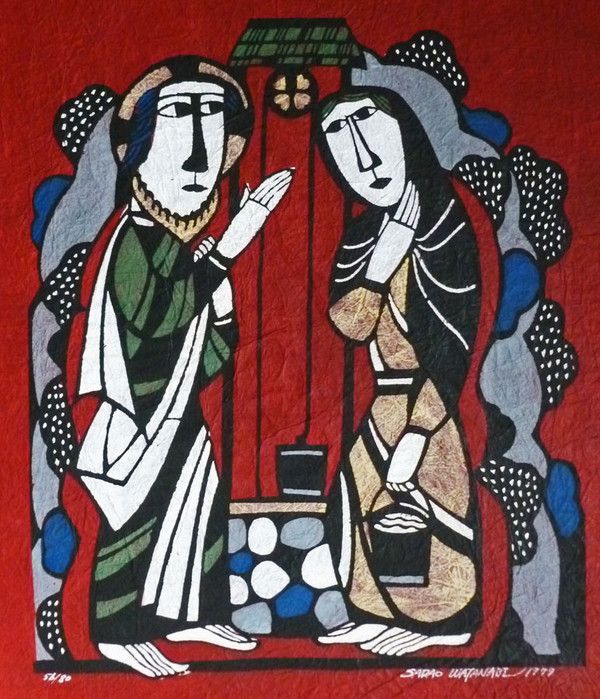
Image by Sadao Watanabe

Here’s a little Bible trivia to get us started. In year 1 of the 3-year lectionary cycle we read from Matthew’s gospel biography of Jesus’ life and ministry – except on the Sundays in Lent when after Lent 1 we switch over to John’s account. Except for a return to Matthew on Palm Sunday, it will be John who will also accompany us through the Easter Season.

Among the Evangelists, John’s approach to story stands out from the rest. For Mark, Matthew and Luke, stories flow out of events. They’re called synoptic gospels because they follow a synopsis of events. Stories emerge out of events often arranged chronologically within a broad theological framework. Nevertheless, story arises out of and explains the meaning of a particular event.

In John it’s the other way around. Events are created from stories. There is no event until the story creates one. So instead of following a broad chronology of Jesus life and ministry, John constructs seven stories around which he builds his very distinctive theology of Jesus. We refer to these stories as John’s Seven Signs of the Kingdom. Linking the seven sign stories we also find in John many other stories that do not appear anywhere else. Last week we had the story of Nicodemus, the high-ranking member of the Jewish council who comes to Jesus under cover of night. Today we are given the story of Jesus’ encounter with the Samaritan woman at Jacob’s Well.

Like all John’s stories Jesus and the Samaritan woman at the well is multilayered.  My title for today’s sermon is the Archeology of a Story because if we dig down through the multiple story layers, we come to understand how John shapes the story to become a narrative for building of a new and radical type of community.

John’s is a community made up from disparate groupings – coming together in a multi-ethnic melting pot of Jews, Greeks, and others among whom were a significant number of Samaritan converts attracted to this new kind of Christian community. In the story of Jesus’ encounter with the Samaritan woman at Jacob’s Well – John seems to have in mind this constituency in his community. Yet the story has an overriding message that would not have been missed by the other sections in the Johannine community in Jerusalem around the end of the 1st-century CE.

In Jesus’ encounter with the Samaritan woman at Jacob’s Well John is weaving a new story from the fragments of older storylines – some close to the surface of current memory – others more deeply buried and encountered only in places where they poke through from below – with the potential to pose serious trip hazards for some in his complex community.

For example, there’s the storyline of contested origins. As Samaritan and Jewish converts come together in John’s radical style Christian community- they brought with them contested origin stories that come into focus around Jacob’s Well. Both Jew and Samaritan each regarded Jacob as the father of their nation – and hence had contested claims to the Well’s ownership.

We see the protruding tip of another more deeply buried story of dispute over the true site for God’s worship. Was it – as the Samaritans claimed on Mt. Gerizim – the ancient holy site of the Northern Kingdom of Israel before its destruction in 721 BCE or as the Jews claimed – at Jerusalem – a more recent development and a claim particular to Judah?  

The story follows a conversation between Jesus and a Samaritan woman he encounters at Jacob’s Well. As noted, in Jesus’ time, this was a place of contested historical and religious tension between Jews and Samaritans. The Samaritans were the biracial descendants of intermarriage between Assyrian forced foreign migrations (five in total) and the remnants of the Jewish peasantry left following the destruction of the Northern Kingdom of Israel after 721 BCE. Nevertheless, the Samaritans – the descendants of Samaria – another name for the ancient Northern Kingdom continued to protest their historic and religious claims against a Judahite Jewish population who regarded them as racially and religiously impure.

John intends his story to shock. You might ask, what is so shocking in a man asking a woman for a drink of water? To appreciate how this encounter challenges social taboos of the time let’s group them under the headings of race, religion, and gender.

Firstly, racial prejudice. Imagine a white man in the Jim Crow south asking a black woman for a drink from the colored water fountain. Or imagine today, an Israeli Settler asking a Palestinian woman to draw water for him from Jacob’s Well – which today sits in contested territory within the city of Nablus in Israeli occupied and annex-threatened Palestine.

Secondly, religious bigotry. A Samaritan woman drawing water for a Jew would have rendered the water undrinkable by virtue of ritual contamination. A religiously observant Jew could not have even entered conversation with a Samaritan woman – let alone drunk water from her hand.

Thirdly, gender conventions. As an adult man, like Mike Pence who reputedly will not dine alone with another woman who is not his wife, Jesus could not have looked at – let alone spoken -unchaperoned- to a woman who was neither his wife nor a close female relation. Yet he does – and this shocks the Samaritan woman into asking: How is it, you a Jew, ask a drink from me, a woman of Samaria? In her one question she encompasses all three taboos – racial, religious, and gender.

But she’s not the only one shocked. The disciples on returning were astonished that he was alone and speaking with a woman – but no one asked [her] what do you want or [ Jesus] why are you speaking with her? We can imagine what they were thinking though. Honestly Jesus, we leave you alone for five minutes and this is what you get up to!

Beyond its shock value – that where Jesus is concerned always adds value to any story -John is building a crescendo of storyline around the theological theme of recognition – that is – who sees the truth about who Jesus really is – and who doesn’t.

The water from the well is not any old water but living water. It’s not our physical thirst but our spiritual thirst that we seek slaked. Only Jesus alone has the gift of living water. The woman gets this right away and says Sir, give me this water so I may never thirst again.

Jesus then somewhat perplexingly tells her to fetch her husband. She must admit she doesn’t have one to which Jesus says you are right – for you have had five husbands and the one you have now is not your husband. This is the point in John’s story when we might ask one another: sorry, but have I missed something here?

It might appear so until we see how John is slowly ratcheting up his theme of recognition. And here is another trip hazard where an ancient story pokes up for the unwary in John’s community. Jesus’ reference to her five husbands is a historical metaphor for the five forced foreign migrations with whom the Samaritans had intermarried. The man she is currently with, and who by-the-way is not her husband, extends the metaphor to include a sixth forced migration into Samaritan territory under Herod the Great in 37 BCE. That this man is not her husband is an allusion to the later Roman prohibition of intermarriage between this last group and the Samaritan population.

The theme of recognition now builds towards the peak of its crescendo. Following Jesus’ comments about worshiping the Father neither here on Mt Gerizim, nor in Jerusalem, but in spirit and in truth – the woman speaks about her messianic hope. She now recognizes Jesus as the One. John wants us to note it’s the despised outsider – and a woman to boot – who comes to recognize the truth about Jesus long before it dawns on anyone in his intimate in-crowd of followers.

The rest of the story focuses on the blindness of the disciples. Unlike the Samaritans who now flock to Jesus in response to the woman’s invitation to come and see- a particularly resonant phrase for John because Jesus’ disciples continue to miss the point of his messianic identity and the nature of his mission for which John offers the metaphor of gathering in the harvest.

Through excavating the buried layers within this story, we can see that for John this is not about the past as much as it is about the future.  It’s a story about the building of a new and radical type of community from among the jumble of racial and religious constituencies sharing contested histories. John’s is a community of disparate groupings coming together in a multi-ethnic melting pot of Jews, Greeks, and others – among them a significant number of Samaritan converts attracted to this new way of living.

The upshot of the encounter between Jesus and the woman at the well is that many Samaritans sought out Jesus and asked to stay with him and many more believed in his word. They believed not because someone else convinced them but because they heard and saw for themselves.  The disparate constituencies that made up John’s community could not have missed the point of a story about the building a new way of being in community. Through the reconciling of historic grievances – required a confrontation with ingrained and divisive social and religious prejudice.

Was there ever a story more pertinent for our time?

The Incident of the Woman, the Snake, and the Apple in the Garden

All fairy stories need a villain – and the snake is as good a villain as any. I remember a memorable dinner party at a former colleague’s house in which a series of terrariums populated by large snakes stood against the walls of the dining room. For someone who grew up in a country where there are no snakes – being surrounded by them contributed to a particularly disconcerting dinner party.

It’s worth noting – before we dismiss the serpent as the all-time villain in our seminal religious history – an incident recorded in the 21st chapter of the book of Numbers. After a serious serpent infestation of the Israelite camp resulting in many deaths from snake venom, Moses instructed the Levites to cast a bronze image of the serpent and raise it up over the camp so that whoever looked upon it was cured.

We can puzzle over how this incident escaped the Second Commandment’s prohibition against the fashioning of graven idols? It seems that bronze serpents are a curious exception to the Golden Calf rule. Yet, what’s interesting about the story in Numbers is that it’s the first depiction of the homeopathic principle – that the toxin is also the antidote.

Some ideas have a universal resonance in human consciousness and it seems the serpents or snakes are a case in point. The Rod of Asclepius – a stave with a single serpent coiled around it became the symbol of healing among the Ancient Greeks. Do you think they had read Numbers 21? The Rod of Asclepius became the symbol of healing in modern medicine and in the United States where two is always better than one – the Caduceus – the double headed serpent stave – was officially adopted as the symbol of the Army Medical Core in 1902.

The OT reading on the first Sunday in Lent records the fateful incident of the woman, the snake, and the apple in the garden. Just as God’s plan for creation seemed to be right on course the incident of the woman, the snake, and the apple in the garden seriously derailed things. This unfortunate incident subsequently came to be known as The Fall.

The reasoning goes that through the gross disobedience of eating the fruit from the only tree God had forbidden them to eat of – Eve and her hapless husband Adam, fell from a state of original grace into the state of original sin.

The Apostle Paul was at pains to map out the history of sin from Adam to Christ in his epistle to the Romans – our second reading for Lent 1. He maps out the notion of felix culpa – felicitous or happy sin. Happy in the sense that universal salvation through Christ became its ultimate consequence. Following Paul, Augustine chose to place the emphasis on the sin side of the sin-redemption equation – thus creating a doctrine of original sin – transgenerational sin from which no human being could ever escape being born into.

It’s curious that upon receiving the knowledge of good and evil, Adam and Eve’s first discovery was shame at their realization of nakedness. For Augustine, this was proof enough of sex as the means of intergenerational transmission of an unalterable genetic fault.

As Anglicans, Episcopalians don’t pay much mind to the doctrine of Original Sin – good news to those of you raised in either Roman Catholic or Calvinist traditions. Although Archbishop Cranmer included the doctrine in article 9 in the 39 Articles of Religion – given the times how could he have not done so – the direction of Anglican theology has been to place the emphasis on redemption through grace and not on the sin of Eve and by extension, her hapless husband. Anglican Tradition recognizes the necessary tension between the influences of sin, and freedom of choice. That we are subjected from birth (and not before) to sin’s influence is a matter of environmental nurture not intrinsic nature. Our human vulnerability to self-centeredness restricts and distorts our exercise free will – requiring us to look to God for our ultimate hope and salvation.

Matthew picks up this theme in his depiction of Jesus’ temptation in the wilderness. Following Jesus’ baptism by John in the Jordan, Matthew tells us that- Jesus was led up by the Spirit into the wilderness – there to be tempted by Satan.

Satan – that ancient Serpent appears again – taking us back to the incident of the woman, the snake, and the apple – but this time, note not in the garden, but in the wilderness. Since the fall the gates to the Garden have been firmly shut – consigning humanity to an exile of toil and suffering in the wilderness.

Satan tempts Jesus with a series of metaphorical apples – everyone the promise of omnipotent power that flows from possessing the knowledge of good and evil. However, unlike the spiritually adolescent Eve, Jesus has the spiritual maturity to see through the Serpent’s ruse.

An important re-reading of the incident of the woman, the snake, and the apple in the garden reveals God’s prohibition against eating from the tree of the knowledge of good and evil – is not as some have conjectured – a divine desire to keep Adam and Eve in a state of infantile immaturity but the safeguard of parental protection. In the process of their creation, God imbued Adam and Eve with freedom of choice. To understand this seeming paradox, we need to view the incident through the lens of parental guidance.

The skillful and loving parent leads the child to an eventual state of full independence by protecting the child from being exposed to making certain choices – before they are fully mature enough to understand them. One of the signs of that maturity is to understand the consequences of the decisions we make.

Today, multiple, and shocking survey evidence is revealing to us the damaging consequences for our adolescent and young adults of being exposed to choices – the consequences of which they have neither the full cognitive development nor emotional maturity to understand. We are beginning to wake up to the pernicious effects of social networking in prematurely exposing our young to a knowledge of good and evil which they are not yet ready to handle. The result is an epidemic of youth depression, social bullying, and suicide.

Jesus enters the wilderness to face the temptation of being presented with the illusion of omnipotent freedom of choice. Unlike Eve and her hapless husband, Adam, both still at the stage of adolescent omnipotence – Jesus is a fully mature human being with wisdom and foresight beyond his chronological years. He sees through Satan’s allurements to affirm his rootedness in the wisdom of God.

Last week I ended my reflection with coming down from the mountain of transfiguration into the rocky and barren terrain of the lent of our lives. The wilderness not a place – it’s a metaphor for a particular lens that reveals sinfulness at the heart of everyday life. Through the wilderness lens we come to see more clearly how sin – when not openly acknowledged -restricts and distorts the actual freedom of our moral choices. Sin, like the serpent’s venomous bite acts like a toxin at the center of our daily lives. If sin is the toxin, then repentance is the antidote.

The Prayer Book invites us to contemplate keeping a Holy Lent through practices that trigger self-awareness – bringing us to a fuller appreciation of how sin distorts the quality of our choices.

  • Self-examination and repentance reconnect us with our sadness and sorrow, our hatred and anger, our refusal to acknowledge our selfishness and greed. Self-examination and repentance- makes us more sensitive to, and mindful of, the way we speak to and about others. Self-examination and repentance remodulate our internal voices of judgement and criticism – esp. the pernicious self-criticisms which feed the hardening of our hearts.
  • Fasting and self-denial introduce elements of physical and emotional discomfort that trigger a more conscious sense of the food we eat and how we eat it. Food here can be a metaphor for all our cravings. We deny ourselves something and the experience of frustration – the mildest deprivation – makes us mindful of our normal patterns of over consumption and waste – our collusion with social inequalities of access and distribution and our despoiling of the natural world. Through self-denial we are reconnected to an experience of a bountiful God who requires us to preserve and not just consume.
  • Through worship, prayer, and study – through the cultivation of habitual recollection (every moment mindfulness) – we retune to the presence and goodness of our Creator in the human and natural world around us. In so doing we rediscover the sources of gratitude that bring us the pleasure and fulfilment only found in generous living.

In the temptation in the wilderness Jesus shows us what humanity – mindful of our relationship with God, is capable of. Let’s keep this realization front of mind as we embark on the journey through the lent of our lives – only to arrive prepared and ready for the great celebration of Easter.

I’ve been to the Mountaintop (MLK Jr)

Last week I noted that in the wide sweep of history between Moses and Jesus – we see a clear evolution in the picture of God – a development always moving in the direction of greater complexity.

The Hebrew God of Moses is experienced as a god inhabiting the natural world of mountain tops and sacred places. This god who through control of the elements – reigns down fire, deluge, and drought; famine and earthquake – on hapless humanity. The Hebrew god is a god of transcendent encounter in the external world. But by the 1st-century the Jewish experience was of a god increasingly encountered within human consciousness – a god of internal space.  No-longer a god encountered on mountain tops but a god encountered in the mind and heart. It is within this religious evolution that Jesus of Nazareth emerges onto the world stage.

The Canadian philosopher Charles Taylor in his massive opus A Secular Age explores the historical, religious, and political developments in the evolution from an age of belief to our current secular one. He contrasts the year 1500 when it was impossible not to believe in God with the impossibility of such belief for many today.

The Bible communicates the broad sweep of evolution in human perceptions from the Hebrew mountaintop god of Moses to the 1st-century Jewish god of heart, and mind – the god of Jesus. Likewise, Taylor charts the broad sweep of development – tracing in some detail the route of travel as the culture of the West moved from the impossibility of unbelief to the impossibility of belief.

Another way of speaking about the evolution in religious consciousness of God – both in the biblical record as well as the subsequent evolution of Western culture – is to note a movement from transcendence to immanence. In the long 400-year emergence of our current secular Western mindset, Taylor notes the gradual transition from the age of enchantment to the age of disenchantment. By disenchantment Taylor is commenting on our loss of a connection to the transcendent.

God, who in human experience was once transcendent over the vastness of external space became God, now discerned within the immanence of spiritual awareness, and emotional experience.

Taylor notes that when our connection to the transcendent is lost, all we have left is ourselves alone occupying center stage. The opposite of transcendence is immanence. With the loss of belief in spiritual transcendence the Western mind eagerly embraced the experience of immanence – weighing the costs of disenchantment off against a hubris of omnipotence. Afterall, we may find ourselves alone on center stage, but in our hubris we consoled ourselves that it’s now we – and no longer God – who from center stage commands the world.

To find ourselves center stage is a lonely and at times alienating experience. Thus, the Western spirit continued to frantically seek to recapture through entertainment and fiction the experience of enchantment in a world of lost transcendence. In fact we’ve coined a new term for this recapture of enchantment – we call it magical realism. And today we find magical realism everywhere.

We have two stories of mountaintop experience in the readings for the last Sunday before Lent – that of Moses and that of Jesus. Both are stories of transcendence – or to use Maslow’s term, peak experience. But as the disciples with Jesus were to discover, peak experience is always problematic. The spatial image of the mountain summit works in some ways for us, yet, it feeds an assumption that it’s only there that self-transcendent experiences such as joy, awe, and wonder can be found, captured, and forever held onto. With minds clouded by this illusion we will miss the more ordinary and everyday places where true joy is – by chance – encountered.

It’s not altitude that separates us from a life-enhancing encounter with the living God, but a dogged refusal to let go of our preoccupation with seeking transcendence somewhere other than where we happen to be.


The image of the mountain top is an image of an encounter with God that ordinarily feels so out of our reach – driving us crazy with a promise of bliss. However, it’s not altitude that separates us from a life-enhancing encounter with the living God, but a dogged refusal to let go of our preoccupation with seeking transcendence somewhere other than where we happen to be. Transcendent experiences are not found by climbing mountains but in experiences like joy and sadness – ordinary everyday experience. Experiences of transcendence await us – not elsewhere – but in the here and now.

When Dr. Martin Luther King Jr. said he’d been to the mountaintop, no one assumed he had actually climbed a mountain. The mountaintop now becomes the metaphor for the possibility of a different order of experience, one that challenges our acceptance of our disenchantment – our blind acceptance of lives that have no space for the possibility of belief.

Our struggle is not how to attain transcendent experience – how to seek and capture (Lord it is good to be here, -I will make three dwelling places) experiences of peak bliss. Our struggle today is the struggle to rise above our own individualized preoccupation. In our secular age, spiritual transcendence is found within the immanence of our everyday emotional lives – when we are able to move beyond our immediate self concerns and embrace an encounter with God through everyday relationships with others. For this is where the god who inhabits the heart and the mind is to be found.

So here is the clue. For us today, transcendence is found in the web of interconnectedness with one another. God inhabits the relational spaces between us as well as the internal spaces of the heart -mind within us. We escape our arid experience of immanence – lonely life centerstage – not into the emptiness of bliss – but into the fullness joy.

The great 19th-century Bengali poet and spiritual teacher, Rabindranath Tagore noted:

I slept and dreamt that life was joy. I awoke and saw that life was service. I acted and behold, service was joy.

Joy is an experience of connection, communion, and presence – of divine grace reconnecting us to experiences of transcendence within the immanence of our daily lives. Yet, paradoxically, joy is also found in moments of great suffering. Meg Wheatley, a spiritual writer and change consultant with an acute eye to the paradoxical nature of our contemporary experience notes that it is in pursuit of happiness that we estrange ourselves from joy.

She speaks of joy being the same as sadness for both states embrace us with an energy that is beyond the physical. Laughing or crying – it doesn’t matter. This strikes us as paradoxical. We might doubt the truth of the statement until we realize that joy and sadness are both states of self-transcendence. Both open us to a level of experience that takes us beyond the tyranny of the preoccupied self – the isolated self, confined within the hubris of disenchanted omnipotence.

Faced with a birth, a wedding, an anniversary – we are captivated by joy. In the face of sickness, a death, a disaster, a tragedy of personal or epic proportions, sorrow and sadness capture us as we suffer with, console, and love one another.

The Transfiguration story is a halfway point in Matthew’s account of the life and times of Jesus. It marks the transition point from his preaching and teaching in the Galilean countryside to his final and eventful journey to Jerusalem.

The Visit of the Magi and the Transfiguration bookend the Epiphany season. From here on, we move into a different section of the spiritual journey. The landscape becomes rocky and desert-like as we journey down the mountain into the Lent of our lives.

Intention Means – Paying Attention!

In the wide sweep of history between Moses and Jesus – we see a clear character development in the picture of God – a development always moving in the direction of greater complexity. In his book God: A Biography, Jack Miles recounts the evolution of God’s character through the eyes of Israel’s religious story.  By thoroughly analyzing scriptural text, Miles contends that the broad sweep of Israel’s relationship with God reveals a god who is a learning god. His book won the 1996 Pulitzer Prize for Biography or Autobiography.

Miles presents God evolving – learning as he goes along from the events of a long and tumultuous relationship with humanity as represented by Israel. The capacity to seemingly learn from experience, esp. mistakes – is the key quality that jumps out from Miles’ somewhat startling portrayal of God.

The capacity to learn from our experience, esp. our mistakes, is the primary way that we humans continue to evolve in the direction of greater psycho-socio-spiritual complexity. In short, learning is fundamental to our survival.

It’s a startling notion – hypothetically speaking of course – that God is also capable of learning from experience.  Put another way, maybe that’s why humanity is imbued with this capacity of learning from experience because we are made in the image of God – a god who also learns from experience.

The Biblical story of God’s relationship with humanity is full of instances where God changes god’s mind. God seems open to argument – able to be convinced by human beings like Moses into a change of mind. God acts, often precipitously, only to on reflection, regret impulsive action. God can be convinced to moderate genocidal impulses, which alarmingly in the earlier sections of the story, seem to be God’s default response in the face of human disobedience.

How does this notion square with the theological assertion that God is unchanging – omnipotent, as in can do whatever God likes – as well as omniscient – knowing all outcomes in advance?  One way of getting around this theological conundrum is simply to say it’s not God who changes but human understanding of God that is deepening over historical time. The god of Moses and the god of Jesus – although recognizably the same god – nevertheless are dramatically different. My point is not so much to challenge the traditional theological assertion of divine unchangeability, but to recognise in the broad sweep of history separating Moses and Jesus, Jewish evolving understanding of God’s character in the direction of complexity and sophistication.

In Deuteronomy 30:15-20 we hear Moses’ dramatic ultimatum: I call upon heaven and earth to witness against you today that I have set before you life and death, blessings and curses. Choose life so that you and your descendants may live, loving the Lord your God.

This is a call to make choices, which can be either life enhancing or death dealing. The Deuteronomists conceived of the choice for life as one of fidelity and obedience to God’s commandments given through Moses. Obedience not only demonstrated being faithful to God, but also ensured justice in community life. For contemporary Judaism, Torah observance remains the way of contributing to the building up of society through performing the actions that support the evolution of the world in line the dream God has for it -as revealed in the teaching of the Law and the Prophets.

The Hebrew God of Moses is experienced as a god inhabiting the natural world of mountain tops and sacred places. This god controlled the elements – reigning down both blessing and punishment. This is a god of external spaces.

By the 1st-century the Jewish experience was of God increasingly encountered within human consciousness – a god of internal space.  No-longer a god of mountain tops but a god of the mind and heart. It is within this religious evolution that Jesus of Nazareth emerges onto the world stage.

In Matthew chapter 5 – in his Sermon on the Mount Jesus refers his listeners back to the ancient Hebrew understanding of God’s commandments. He begins and then repeats the phrase: You have heard that it was said to those of ancient times – as his springboard into a developing Jewish inner consciousness of God.

But of course, Jesus takes things to a new level by thrusting Jewish ethical teaching into the deepest recesses of his hearers’ minds and hearts.

Many of us would probably prefer to remain ancient Hebrews in our orientation to the requirements of the religious life. This accounts for the appeal of Christian Fundamentalism. Give us a good external commandment we can choose to follow or not as the case may be, and we at least will know where we are.

In contrast, Jesus’ teaching is frightening in its seeming impossible confrontation with human nature. For whom among us exercises the degree of self-control over our thoughts and intentions, our impulses, and motivations, let alone our fantasies that Jesus seems to require of us? It is no longer a matter of refraining from unethical actions, we now must harbor only virtuous intentions. This is impossible.  

Despite leading outwardly upright and ethical lives – if we are to take Jesus literally – we all remain serial murderers and adulterers in our hearts. And the penalty for non-virtuous thoughts and impulses, even if firmly under our self-control, is astonishingly severe indeed! Eyes are to be plucked out, hands to be lopped off and hearts and minds exposed to the most searing condemnation. Moses’ cry: today choose life or choose death makes death the only obvious proposition.

We are not fundamentalists and so to interpret this passage as Jesus setting impossible standards – so as to continually reaffirm through failure our broken and sinful nature – contradicts his primary message of God’s love and forgiveness. Another way that is consistent with our understanding of Jesus primary message – is for us to understand Jesus’ teaching in the Sermon on the Mount, and esp. this section, as the next step within the evolution from ancient Hebrew to 1st-century Jewish understandings of God.

Through his frequent use of hyperbole Jesus invites us to pay attention to the hardness of the unruly passions lurking in the darker recesses of the human heart. I imagine his disciples found this invitation as unnerving as we do. But one thing is clear, Jesus has our attention!

In this difficult teaching Jesus is reminding us that ethical and spiritual health are not simply a matter of the actions we refrain from taking but also concerns intentions we entertain. To get a better sense of what Jesus means we note in Matthew 15 his further development of his theme here in chapter 5 – when he tells his disciples that we are not defiled by what goes into the body but by that which flows from the human heart.

Jesus ushers in the dawning of a new religious age with the in-breaking of God’s Kingdom. No longer camouflaged by an externalized morality of rules and obligations – religious observance now requires a subjective examination of conscience – esp. with regard to the disordered projections of fear, rage, and desire that if ignored harden our hearts.

Moral and ethical action is good, but right intention is better. Right belief is one thing, but right relationship is even better.

This is the focus of Jesus’ teaching, and it represents the big leap for humanity into a new kind of relationship with God and with one another.

Psychologically speaking, none of us is without a rich inner fantasy life in which we can detect thoughts and feelings that we have absolutely no intention of acting upon. But our best protection against acting out is to know such thoughts and feelings are there and to see them clearly. For most of us to act on our darker fantasies of rage, hurt, and desire would create an intense conflict with our higher self-aspirations.

Our refusal to act upon our darker urges motivated by rage, pain, and desire is not enough, however. We also need to be able to recognize them and look them in the eye. The ability to recognize and to know our darker impulses and to reign them in – is what makes us fully human as reflections of the divine nature – imperfect though this reflection may be.

Returning to the theme of learning from experience leads me to conclude with three questions of the moment that remind us of the importance of calling out our darker urges and looking them in the eye.

  • What can learn from the gradual erosion of restraint of darker motives now afflicting our current political culture – unrestrained urges that were on full display in Tuesday evening’s State of the Union address?
  • What stirs us as we witness the brutality of Putin’s war in Ukraine – a situation that challenges us to learn from the mistakes of the past?
  • Will we learn something vital about ourselves as we confront potentially irreversible environmental changes – so as to ensure a brighter future for generations to come?

The process of learning must first begin with looking into the darkness of our human hearts.

Good intention means paying attention!

Blog at WordPress.com.

Up ↑