Perils of Choosing The Wrong Story

History does not [exactly] repeat itself but it [certainly] rhymes. 
To paraphrase Mark Twain.

As human beings we construct stories to explain the world we experience to ourselves and to one another. This is the way we build meaning and purpose into our lives.

But there are always competing stories to tell – there are always -to use a current slogan -facts and then there are alternative facts.

To add complexity there is also more than one way to tell the same story – again there’s news and then there’s fake news. We construct meaning and purpose into our lives as we make choices between competing clashing and conflicting storylines – each vying for our attention and allegiance.

So, the question is: which stories will we choose? From among a bewildering choice of possibilities which stories matter most to us?

Palm Sunday offers a snapshot of a clash of storylines. Palm Sunday is the beginning of a series of snapshots from Jesus’ last week in Jerusalem before the Passover. On Good Friday we will arrive to stand before the image of a dying man on a cross.

Each Holy Week snapshot is like a prism refracting our associations into countless mirror images of our lives.  The snapshots of Jesus’s last week in Jerusalem before his death at a particular turning point of history are also timeless mirrors of the clash of history’s repetitive cycles of sacred violence – a storyline as old as human memory.

From Palm Sunday to Good Friday, we experience the repetitive cycles of human inhumanity.

Sacred violence is the violence inflicted to protect a storyline of empire. I’m defining empire as any unrestrained exercise of power in defense of a set of deeply held cultural, political, or religious beliefs. Usually, the motivation to sacred violence drinks from an intoxicating cocktail of all three.

From Rome to Rule Britannia and Europe’s legacy of colonial violence; from the revival of Putin’s dream of the Russian imperium or the legacy of American manifest destiny; history does not [exactly] repeat itself but it [certainly] rhymes.

Emotionally and spiritually bloodied by our passage before the snapshots of Holy Week’s violence we will eventually arrive at a different story – a new story – a bigger and better story – the unlikely story of Easter. Yet, we’ve some way to travel before arriving here.

In the snapshot of Palm Sunday we witness a clash and confusion of storylines.

The first is a Jewish storyline of national liberation. The waving of palms is a significant echo from the crowd’s Jewish collective memory – a particular echo to an episode in their ancient national story.

For some 160 years before, the triumphant Judas Maccabeus, the last leader of a successful Jewish rebellion against foreign domination, led his victorious partisans into the Temple – which the Syrian tyrant Antiochus Epiphanes had defiled by placing his statue in the Holy of Holies.

Using palm branches, the Maccabean partisans cleansed and rededicated the sanctuary after its defilement. On entering the sanctuary, they discovered miraculously the last light of the Menorah still burning – an event Jews, today, commemorate in the festival of Hanukkah.

This more recent Jewish story of national liberation found a powerful amplification in the more ancient story, Israel’s founding story of liberation – the Passover.

Inhabiting the story line of national liberation, the crowds ecstatically welcome Jesus into the city. But they are in the wrong story – as they will quickly discover – resulting in their disillusionment and anger. Jesus may be the Messiah – but his storyline is God’s not theirs.

At the same time as Jesus was entering from the East, another storyline was unfolding as a second triumphal entry procession wound its way into the city from the West. The Roman Procurator, Pontius Pilate, at the head of his Roman Legion had also come up to Jerusalem for the Passover.

Pilate much preferred the sea breezes and all mod-cons of Herod the Great’s former coastal capital of Caesarea Maritima – now the administrative center of the Roman occupation of Judea.

Pilate loathed and feared Jerusalem’s ancient rabbit warrens seething with civil and religious discontent. He most feared the pilgrim throng crowding into the city for the Passover swelling the city’s normal population of between 20-30,000 to over 150,000. The stability of Roman imperial rule required Pilate to come up to the city with a show of preemptive force to forestall any potential for insurrection.

Passover was Israel’s founding story of liberation from slavery. Pilate’s arrival was indeed a wise move, for the crowds hailing Jesus’ arrival saw him as the Messiah, but a Messiah from the wrong story. 

In the week leading to the celebration of Passover we see with hindsight the lethal intersection of competing storylines.

There’s the storyline of imperial domination and political violence intersecting with the storyline of populist resistance and longing for national liberation. Both are confronted by a third storyline concerning the next installment in the epic narrative of God’s love and vision for the world-through-Israel. This clash of storylines results in a chain of events that takes an unexpected turn – rapidly spiraling out of anyone’s control.

On Good Friday, we will revisit the twin themes of deliberative courage and the confrontation with sacred violence – the violence of empire. But on Palm Sunday, that is still several snapshots along.

History does not [exactly] repeat itself but it [certainly] rhymes.

Holy Week is the week during which we accompany Jesus on his journey to the cross. For some of us, this can be an intensely personal experience as our own experiences of loss and suffering – our passion – surface in identification with Jesus’. For most of us, however, the nature of our Holy Week experience is less personal and more communal.

As liturgical Christians we journey with Jesus as a community – each liturgical step along the way. Each snapshot is a prism refracting our own individual suffering and our identification with the overwhelming suffering of the wider world .

Liturgy is the transport – conveying us together through sacred time. In sacred time – where there is no past and no future only the eternal now – we move beyond memory, becoming in present time – participants in the events that engulf Jesus and echo across time into our current experience. We are well acquainted with of the world of sacred violence currently unleashed in Ukraine and countless other places.

History does not exactly repeat itself, but it certainly rhymes.

Choosing the right story to explain the world to ourselves is crucial. Choosing the wrong story leads to disillusionment and an impoverishment of hope.

Like the crowds praising Jesus as he entered the Holy City, we enthusiastically hail our next political savior until that is, – he or she no longer is.

Like the crowds praising Jesus as he entered the Holy City, we enthusiastically hail our next political savior until that is, – he or she no longer is.

We long to do the courageous thing – until that is, the moment when we don’t.

In sacred time we become participants with Jesus – as if we too are part of his band of disciples during this eventful last week.

With the disciples, we will share in the breaking of Jesus’ Passover bread and drink from his Passover cup.

With the disciples, we will accompany Jesus to the Garden of Gethsemane where we too, will fight sleep to keep watch with him through the night and early hours of Friday’s morning.

With the disciples we will follow Jesus on the way of his suffering, for like them – we will long do the courageous thing – until the moment when we we won’t.

History does not exactly repeat itself, but it certainly rhymes.

Fathers and Sons ( Lent IV)

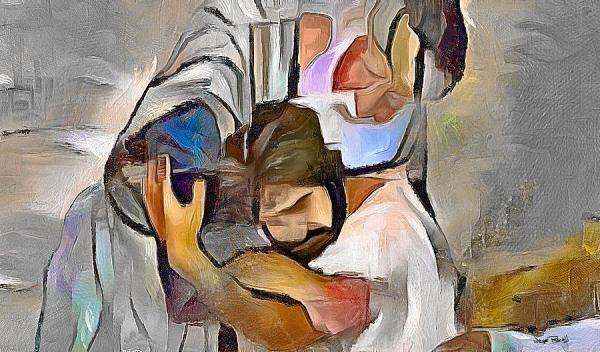
Image: Prodigal Son, Wayne Pascall

.

This week we have for the Gospel portion Luke’s parable of the Prodigal Son. Earlier in the week I was breathing a sigh of relief remembering that I had a sermon dating from 2013 on the Prodigal Son. But when I looked back I realized that I was hearing the text very differently from the way I heard it in 2013 when my focus had been more on the narcissism of the younger son. My starting point in 2020 was to reflect on the experience of parenting. Who among us does not know the experience of a wayward child? If that is too strong an expression at least we all know the pain and concerns felt when our children begin to chart courses in life very different from the ones we had anticipated for them – making decisions we would have wished they made differently.

Like all the parables of Jesus that only Luke records, this parable has always been a rich seedbed for profound mischaracterization. In the interests of full disclosure, I’m indebted to the Lutheran pastor and theologian Paul Neuchterlein – for his rich insights into this text.

We might begin with what to call this parable? Traditionally referred to as the Parable of The Prodigal Son, it’s as much about the elder son as the younger and is particularly rich in its portrayal of the father. Hence some refer to it as the Parable of the Loving Father, but it could equally be the Parable of the Envious Son.

Imagine, Jesus leaving the Synagogue after a lengthly discussion with the Pharisees following the Shabbat service. As he comes out into the street, he’s mobbed by a crowd who may have been loitering with intent to waylay the teacher outside the synagogue doors. In describing them as tax collectors and sinners, Luke is drawing our attention to the fact that these are the ritually unclean, those excluded from 1st-century Jewish worship. Unable to listen to Jesus debate with the Pharisees – they are eager to hear him, nevertheless. The Pharisees, following Jesus out of the synagogue begin to grumble behind him about the shameful way Jesus is comporting himself with the hoi poloi. Clearly aware of their grumbling Jesus begins to tell everyone a parable.

Parables were stories – the details of which were drawn from the ordinary everyday lives of the storyteller’s audience. They build a tension seemingly towards a familiar conclusion – only to at the last minute dramatically veer off into a completely unanticipated ending. This is the case in this parable. The father’s behavior towards is profligate – the meaning of prodigal – younger son is countercultural and not the conclusion anyone expected.

We can’t know with any certainty what ending the crowd outside the synagogue of Pharisees and sinners expected from this story. But we do know how subsequent interpretations have sought to reduce it to a rather simplistic morality tale about the wages of sin with strong patriarchal themes – namely, sex with prostitutes, disobedience to father and duty. The younger son in following his hedonistic desires comes -predictably – to a sticky end. He is forced to humiliate himself by going back home with his tail between his legs to beg his father’s forgiveness. You can hear the tut tutting down 2000 years of interpretation – be this a lesson for all you rebellious sons.

This rather traditional interpretation designed to support the patriarchal world view has largely remained silent on the elder son’s reactions to his brother’s return. It’s also conflicted on father’s response. The father – having daily pined for his son has kept a continual watch in the hope of his return. In this sense he seems to behave more like a mother than a father – an insight Neuchterlein suggests in one of his sermons on this text.

This parable offends against the patriarchal tradition which emphasizes the virtues of obedience and duty to strict fatherly rule and the honoring the first born over the younger. Thus it does not know what to do with Jesus’ portrayal of elder son – who is outwardly compliant but inwardly deeply contemptuous of his father’s response to his wayward brother’s return. Being dutiful and hard working on the family estate seems to have bred only envious resentment in him. In confronting his father, he refers to his brother, not as my brother but as this son of yours – aptly articulating his anger towards both.

The patriarchal reading of this story is likewise conflicted on how to picture the father – whose indulgent generosity flies in the face of conventional inheritance custom. This is bad enough, but his willingness to take his son back – holding him seemingly unaccountable for his profligate ways smacks of more than a little moral weakness on his part.

Reading this story through the filter of patriarchal relations is only one of the two main ways this parable has been misconstrued.  The other has been to read it through the filter of antisemitism. The father is God. The elder son is the Jews. The younger son the Christians. We can all see where this reading is headed.

If Jesus were standing in this pulpit, orienting himself to our 21st century mindset he might ask us:  so who do you identify with in this story? This is not simply an individual question it also has wider social-relations implication -as in – which identity do we inhabit within the social structures of 21st century American life? As middle-class white folk –dutiful, obedient, hardworking, and schooled in the virtues of delayed gratification, I imagine few of us identify with the headstrong younger son and his deeply countercultural choices – unless we do so secretly – which tells a story in itself.

It’s likely we believe that the prodigal’s decisions have been – to say the least – misguided, but how do we feel about the father’s non-judgmental and seemingly uncritical response to his son’s return? How do we account for his disinterest in holding him to account? He not only fails to call his son to account he throwing caution and financial prudence to the winds – giving completely the wrong signal he rewards him with a lavish party?

Of course, this parable is a story about God, whom Jesus portrays as an noncritical and non-judgmental father – recklessly generous; indiscriminate between worthy and unworthy recipients of his love – always keeping a watchful eye out for his wayward children’s return – and treating such return as the occasion for a celebration of new life.

Yet, I want to draw our attention to the parable’s conclusion. What do you conclude from hearing this story? Whatever you do conclude you will be wrong for this parable has no conclusion – a skillful teaching ploy on Jesus’ part.

The parable operates at two levels. In the setting of its telling – the street outside the synagogue – the Pharisees can be depicted as the sincerely religious; men of real integrity and longing to know and love God more. Yet, their ability to be sincere in their spiritual quest is a product of their privileged social and economic status. In debate with Jesus, they are intrigued but remain cautious for they feel that they have much to lose by the wrong decision. They want to know what the right path is before they commit to following it. Contrastingly, it’s those whose occupation or lack of one excludes them from the promise who have nothing to lose and who seem open to, and excited by, the invitation implicit in this parable.

In the context of our receiving this parable we need to sit with its open-endedness – its lack of firm conclusion.

We don’t know if the elder son did eventually swallow his hurt pride and join the feast – the parable leaves this both unclear and also a possibility for the father’s invitation remains open ended.

Although the parable does not have a clear concluding moral message, it nevertheless has a rub that chafes. The rub is – grace is never free. Oh, it’s offered freely by God and there is no pre qualification required to receive its invitation. The offer is free, the acceptance is costly. As elder son – what would it cost us to relinquish our resentment and go in to the feast? As the younger son – what has it cost us to return home, humiliated?

The younger son knows that the grace of the father’s undying love is costly. Like him, the crowds outside the synagogue know that grace is costly. As the socially marginalized and religiously excluded they’ve already paid its price.

Like the father in this parable, which among us does not know the cost of unconditional, nonjudgmental love? Which among us has not suffered the pain of watching our children chart different life trajectories that inevitably lead to painful and unsuccessful outcomes? We know that like grace, love is not free, it exacts its own cost.

The Death of Inevitability (Lent III)

There is a difference between memory – the impressions we are given and history – the connections that we work to make if we wish.

Timothy Snyder

Thinking of Snyder’s distinction between history as given impressions -what we might call collective memory fragments – and history as connections made (actions taken in the present) is helpful to us as we seek to unravel the complexities between collective memory and Biblical text – that is, between a story’s projected setting and the context of the written text that purports to remember back in time.  

originating among disparate and unrelated communities – later woven together into a written narrative to provide a coherent story of origins in support a later issue of national identity.

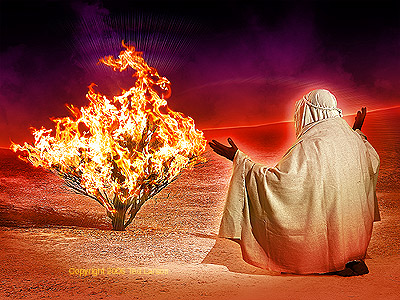
The O.T. lesson for Lent 3 2022 drops us into the scene of Moses minding his own shepherding business, leading his father-in-law’s flocks through a landscape – interestingly described as a place beyond the wilderness. It’s here, that Moses has his first encounter with God revealed through the phenomenon of a burning bush.

Moses’ curiosity is aroused, and he takes a detour from familiar route so that he can get a better view of this amazing sight he’s spotted in his peripheral vision. Moses, hearing  the sound of his name is immediately stopped in his tracks as God calls to him to come no further for first, he must remove his sandals, for he is about to tread on holy ground. This is the narrator’s way of alerting us to the fact that something really big is about to happen.

Reading between the lines we can note that Moses does not seem to know this God – requiring God to self-identify as the God of his fathers: Abraham, Jacob, and Joseph. Perhaps we can see here the skillful pen of 5th century writers reconnecting a break in the fragments of oral memory between Joseph and Moses to bridge a period during which because of their enslavement the Hebrews seem to have forgotten their God.

God asks Moses to reintroduce God to the Hebrews by carrying a message of hope to them. Moses tries to avoid God’s request. He anxiously asks God  – why will they believe me even if I take them your message?

God does something very interesting at this point. He gives Moses a new name to take to use – instructing him to tell the Hebrews that –I am who I am– has sent me to you. The God of their fathers resurfaces into Hebrew consciousness – not as a God of distant memories revived but  henceforth to be known as YHWHYahweh, a God of future hope and promise.

We often miss the distinction between the wilderness and a place beyond the wilderness. The wilderness is the place of lost dreams and broken hopes. The place beyond the wilderness is a new place of hope. This is where the work of history is done, not in the wilderness of memory, but beyond the wilderness where new connections are made – ones we wish for a different future.

Beyond the wilderness is a metaphor for a place that is no-longer-familiar to us – in which experience is no longer imprisoned within our familiar expectations. As we listen carefully, we can’t avoid the question: are we willing to enter a new landscape, one beyond the familiar, to encounter a God – no longer defined by fading memory – but a God of vibrant present-time hope and future possibility?

2019, the last time I preached on Exodus 3:1-15. 2019 was a very different world. It was a world in which we were still captive to what Timothy Snyder refers to as the belief in inevitability – which is the political propaganda promise of endless prosperity and well being.

After the fall of the Berlin Wall and the collapse of the Soviet Union we entered upon a set of assumptions that liberal democracy would inevitably spread prosperity well being. Through the engine of global capitalism the values of individualism and prosperity would advance through economic mutual self-interest.

Following upon the disruption of the pandemic, the Russian invasion of Ukraine has up ended this phase of history.

In a matter of weeks our long-cherished belief in the inevitability of democracy’s onward march fueled by economic progress has collapsed.

We are shocked to awaken to find that Vladimir Putin does not share our belief in inevitability. We now suspect him of having lost his marbles simply because it’s finally dawned on us that he actually sees the world quite differently from us. How is that even possible, we ask? He must be irrational, we respond.

Putting suggestions about his mental state to one side, the situation we waken to presents us with the uncomfortable question: was our belief in inevitability mistaken – blinding us to the reality of the world as it is rather than as we wanted to see it?

The answer to the question seems to be a resounding yes. We thought Putin shared his own version of our concepts of the importance of geopolitical advantage and the economic security as the basis for a stable society. It’s a shock to find he doesn’t care about either of these things. His invasion is not about pushing back against NATO no matter what he says. He doesn’t care about the economic pain of sanctions on ordinary Russians. Ordinary economic realities are distorted when your own net wealth is in excess of one hundred billion dollars, and you are surrounded by a small sycophantic kleptocracy who owe their survival to you.

Putin’s invasion of Ukraine is fueled by his mystical belief in an enduring Russian imperium. To this end he seems to believe that Russia cannot be Russia without the colonization of Ukraine. Like all mystical delusions – his belief is impervious to inconvenient facts. On this subject, Timothy Snyder’s analysis of Putin’s motivating beliefs in his conversation with Ezra Klein is well worth listening to.

All of this is by way of reflecting upon how differently we hear the story of the call of Moses in 2022 from how we heard it in 2019. The blinkers of inevitability falling from our eyes invites us away from spiritually individualistic interpretations of scripture in favor of Biblical commentary as a spiritual reflection on the nature of society -as in – what kind of society are we committed to building for the future?

The I am name God reveals to Moses pulsates with ambiguity. Ambiguity of meaning is a wonderful characteristic of Hebrew – one completely lost to us in translation. The Hebrew I am who I am, suggests two ambiguous readings shimmering and oscillating between I am who I have been, and I am who I will be.  Freed from inherited memories passing a history we are invited to forge connections that open us to who God might now become for us. More importantly, who might we become if we allow ourselves to be shaped by a God beckoning us into future hope and possibility?

God declares his new name to Moses as a promise of hope for a beleaguered people – hope for a future different from their past.

There is a difference between memory – the impressions we are given and history – the connections that we work to make if we wish.

Timothy Snyder

The resistance of the Ukrainian people in the face of the Russian onslaught is not a defense of their impressions from past memory. They seem remarkably unburdened by impressions of the past. They are forging history through connections they are choosing to make in the present – to take them into a new future. In this sense Ukraine has a future in a way that Russia does not. Would that such energy and imagination revitalize our own jaded sense of national identity – all to vulnerable to manipulation by impressions from our past that distract us from choosing the connections necessary that will build hope in the future.

The call of Moses in 2022 is heard as an encounter with God beyond the wilderness of the recently known. In this new place like Moses, we hear God’s new name. No longer a God of inevitability -as in- I am who I have always been, but as I am who I am now becoming, a God of promised hope.

Who might we become if we allow ourselves to be shaped by a God beckoning us into future possibility? To God’s new name he attaches an invitation: will you come with me?

Who might we become if we allow ourselves to be shaped by a God beckoning us into future possibility? To God’s new name he attaches an invitation: will you come with me?

Destiny’s Choice (Lent II)

Photo: Volodymyr Zelensky “I need ammunition not a ride”

In Courage and Vulnerability,  David Lose in 2016, reflecting on Luke 13:31-35, the gospel portion to be read this Sunday, highlighted two different kinds of courage.

The first kind is the unthinking spur of the moment reaction in the face of threat. This kind of courage says something about a person’s underlying character, their personal traits shaped by beliefs, training, and patterns of behavior developed over a lifetime.

The second kind of courage is also an expression of character formed by  

a lifetime of facing fears and shouldering burdens.

For me, there’s a significant element distinguishing the two kinds of courage, however. The second kind of courage involves an exercise of choice. In moments of spontaneous acts of courage – the first kind of courage – choice is absent, because choice is a matter of deliberation. When facing an immediate threat there is not time for deliberation.

The presence of choice means the second kind of courage is always an avoidable response. We know we could just walk away. After all who doesn’t want a quiet life. The choice is ours.

I know I can be courageous if I have no time to think about whether to get involved or not. But if given the opportunity for deliberation, I’m more than likely to shy away from the courageous gesture if the choice to do so is available to me. This kind of caution is a quality I least admire in myself – the reluctance to get involved when the option of walking away presents an alternative for action.

I suspect most of us are like this in that the second kind of courage is an exception to the rule. Therefore, we so admire it in others when we see it – and we know it when we see it. We see it in Alexei Navalny – someone taking a very costly stand and refusing to feel afraid – a quality for which Navalny earns our undying admiration.

In the last two weeks, the hitherto unlikely figure of Volodymyr Zelensky has become our number one poster boy for the second kind of courage. Like Navalny, Zelensky refuses to be cowered. When offered the chance to avoid leading Ukraine’s courageous defiance in the face of the other Vlad’s (Volodymyr and Vladimir are the Ukrainian and Russian equivalents of the same name) –vindictive blood lust, he responded to the US offer of evacuation with: The fight is here; I need ammunition, not a ride … I am staying in the government quarters together with others. The enemy has designated me as target number one, and my family as target number two.

He has subsequently safely evacuated his family, but Kyiv’s administrative center is where he remains – marshalling all his communication skills and savvy media knowhow to continue to inspire his nation and the rest of the free world with his brand of Churchillian courage.

Speaking of Churchillian, I can’t let the opportunity go by for a comparison between Zelensky and Boris J. The standing joke about Boris j is that he thinks he’s Churchill, but he’s really Steve Coogan (a well-known British comedian). Despite his aspirations to statesmanlike grandeur, a comparison with Zelensky exposes Boris J as a mere Churchillian wannabe. The contrast between the character of the two men is an instruction in the second kind of courage.

Zelensky’s sense of moral courage is displayed in his strong sense of purpose. He’s a man who knows he’s in the defining moment of his life. He grasps his sense of destiny. In this he emulates the Jesus kind of courage.

After coming down from the mount of Transfiguration in Chapter 9, Luke takes us on Jesus’ head spinning whirlwind tour as he moves rapidly throughout Galilee healing in some places, exorcising in others, and everywhere confronting his critics. In 13:31-35, Luke reports an exchange between Jesus and a group of Pharisees. They attempt to warn Jesus he’d better high tail it out of town to avoid Herod’s threats to silence him.

Luke doesn’t hint at the motive behind the Pharisees warning. It could be genuine concern – after all while Jesus is often in confrontation with Pharisee groups, he’s also continuing to accept dinner invitations from them – indicating the Jesus-Pharisee relationship is not black and white. Perhaps the warning is self-serving? After all, Herod’s probably not the only one who wants this agitator of the crowds gone from the local scene. We just don’t know – Luke provides no hint as to motive.

Like Zelensky, Jesus is no stranger to threats on his life. After having survived several attempts to kill him – the most notorious being his fellow Nazarethites attempt to throw him off a cliff – Jesus is not going to allow the machinations of Herod to alter his timeline. Describing Herod with a stunning image of that fox, Jesus asks the Pharisees to tell Herod that he’s casting out demons and performing cures today, tomorrow, and on the third day – and not before then will his work finish. Today, tomorrow, and the next day I must be on my way, because prophets don’t die in Galilee, they are killed in Jerusalem. Jesus already appears to have some sense of a timeline for events – probably dictated by the Passover dates – he’s not going to allow anyone, let alone that fox Herod to derail him from his destined confrontation with sacred violence.

Comparison between Jesus’ mission and Ukrainian resistance personified in Volodymyr Zelensky invites not only a reflection on the nature of courage but also on the nature of violence.

Violence takes several different forms depending on the situation and context. There is random as well as orchestrated violence – that is, ordinary violence whether spontaneous or personal. Then there is sacred violence – that is, communal – collective violence as an instinctive response in defense of a perceived higher cause – be it religious, ethnic, racial, or gender motivated in nature.

Jesus’ path to the cross is the journey to his courageous confrontation with sacred violence. Consistent with the second kind of courage for Jesus this confrontation with sacred violence was a deliberate choice. A choice it’s not hard to imagine he had numerous opportunities to avoid making or once made to still walk away from. In Luke 13 we see him refusing to walk away from his sense of destiny.

Sacred violence is as old as humanity. It’s so instinctively programmed in us that we cannot imagine any alternative to its cycles of endless repetition. Our propensity to remake God in our own image leads us to believe it’s our job to protect God with our sacred violence. Caught in its repetitive grip we are blind to the ironic paradox that it’s our sacred violence that killed Jesus – and each time continues to strike at the heart of God.

It’s counter intuitive for us to believe in a God whose protection of us is to die to our enemy’s violence – even when the ultimate promise is resurrection. The last thing we need is a God encapsulated by Jesus’ image of the mother hen protecting her chicks by offering her breast to the fox – giving her chicks time to scatter.

To break the instinctive grip of sacred violence upon the human psyche Jesus knew that he – as God’s agent – must first demonstrate that it could be done. O Jerusalem, Jerusalem, the city that kills the prophets and stones those who are sent to it. It’s only by going to the very source of sacred violence – that God, in Jesus, finally and for all time broke its power over us.

Zelensky is inspiring a Ukrainian resistance to Putin’s sacred violence being unleashed upon his nation. Kyiv is the birthplace of the Russian people. It has a higher claim to define the Russian soul than Moscow can muster.

This explains the ferocity of Putin’s unleashing of sacred violence. Putin’s invasion of Ukraine is nothing short of a struggle over the essential characteristics of the Russian soul.

One of the hallmarks of sacred violence is its brutality – a brutality more shocking to us because this time it’s unleashed on people recognizably like-us. Ukraine is not the first time Putin has unleashed his sacred violence as the tool of his imperial dreams, but Ukrainians are more like us that his previous victims – Muslim Chechens and Syrians. We identify with Ukrainian suffering because their suffering could – if Putin has his way -so easily , and may inevitably, become ours.

Volodymyr Zelensky is not Jesus – and here any comparison breaks down. But in thinking about the nature of his courageous leadership, his refusal to be turned aside from his moral sense of destiny, he is enacting the image Jesus offers of the mother hen and her chicks. While gathering them under the protection of her wings she distracts the predator by exposing the vulnerability of her breast – which in the larger sense is the very image of God’s actions on the cross.

We all hope and pray that the courage of the Ukrainian people to confront the sacred violence being visited upon them will result in their victory – yet the odds remain stacked against them.  But the more important truth here is that Zelensky’s embodiment of Ukrainian fierce courage – a courage that also courts a terrible vulnerability – has already won a significant moral victory for humanity whatever the military outcome.

On the cross, God broke the power of sacred violence’s grip on the human heart. Jesus demonstrated that the repetition in the cycle of sacred violence is no longer inevitable – being now a matter of human choice. Something to bear in mind as we journey with him on his way to Jerusalem.

Heart and Minds, Unveiled (Transfiguration)

Image: The transfiguration of Jesus – David Wojkowicz

There is text -an unchanging communication across time. Then there is context – the unpredictable – everchanging space in which the unchanging text with its timeless message is heard. Text and context. In Biblical interpretation, it’s context which carries the greater weight in fashioning meaning.

Our journey through the liturgical year brings us once again to the story of the Transfiguration of Jesus on the mountain. For Mark, Matthew, and Luke the Transfiguration is the narrative midpoint in the transition between Jesus’ Galilean ministry and taking the road to Jerusalem and the cross. It’s interesting that we are offered a glimpse – midway so to speak – of the end of the story. For the Transfiguration is a foretaste of the resurrection.

For most preachers, the trouble with events like the Transfiguration is that we’ve preached on it so many times before – can there be anything new to say about it? I often ask myself what’s wrong with repeating previous messages? Don’t we preachers do it all the time. In fact, some preachers will have their Transfiguration sermon. They will wheel it out year after year in the sure and certain knowledge that congregations hardly ever remember what they said last week, let alone a year ago. But we all know that things are different at St Martin’s.

The thing is though, even though the text is unchanging, it sounds differently in 2022 which is not 2021, or 2012, or 2002.

This year we hear the readings for the last Sunday before Lent sounding within the unique context of the present time – through which – if we are observant – new aspects – previously unnoticed -will speak to us.

We can’t ignore the fact that today we revisit the story of the Transfiguration of Jesus on the mountain in the context of profound shock. We are sick at heart – hearts aching in solidarity with the Ukrainian people.  We are all devastated by the actuality of a Russian invasion of Ukraine – the ultimate action of a megalomanic mind.

It’s not just the horror of the event but the terror in realizing that such a thing is possible in 21st-century Europe. Our distress is amplified by our seeming helplessness to do anything about it. Sanctions, esp. the ones with the greatest effect will also exact a price from us. Our willingness to make sacrifices in support of principles of peace and democracy – will be the true indication of our moral courage.

The significance of Russia’s invasion of Ukraine is huge and its game changing implications will reshape us all for years to come. It strikes at our shared assumptions forged from lessons learned amidst the ruins of two world wars.

As I wrote in E-News two weeks ago, the tensions between Russia and the North Atlantic Alliance resulting from Putin’s grievances over Ukraine evoke painful memories of 1938 and the Munich Conference.  Neville Chamberlain and Edouard Daladier, the respective prime ministers of Britain and France, aware that neither nation had any appetite for another conflict with Germany so soon after the last Great War, allowed the veil called peace at any price to fall across their minds and shroud their hearts. Longing for peace, but unwilling to defend it – they agreed to the dismemberment of Czechoslovakia in a hope of assuaging Hitler’s unassuageable sense of national historical grievance. We remember the chain of events that this appeasement of tyranny ultimately set in motion.

When faced with an autocrat’s ruthless narcissism- the lesson we keep having to relearn is that appeasement never works. We know this at the interpersonal level. As a nation we are daily reminded as sections of the most narcissistic generation (boomers) remain enthralled to a ruthless narcissistic former leader. So it is also at the level of relations between nations. Appeasement never works. You can only delay but not avoid the inevitability of conflict when faced with a ruthless narcissistic personality for whom enough is never enough.

Putin’s annexation of the Crimea and the Donbas amply demonstrate the point. Now, having failed to halt his advance at the gates of Kiev, we may yet find ourselves having to eventually do so at the gates of Vilnius, Riga, and Warsaw.

In 2022, the the Transfiguration of Jesus on the mountain sounds into a rapidly shifting context – for our future is reshaping as I write-speak.

Changing context opens us to hear different emphases in familiar stories. In previous years my attention in this story has always gravitated towards the mystical and psychological aspects of transcendent experience – that which Abraham Maslow referred to as peak experience in his hierarchy of needs. In the light of the Ukrainian Crisis the veil with which Moses hid the illumination of the divine energy from the people becomes the aspect of the story, that holds my attention.

Veils cloud vision!

It’s no surprise that the Transfiguration narrative draws a straight line to the Exodus story of Moses receiving the tablets of the law on the mountain top. We are intended to notice the similarity in the two stories. Luke is not alone in placing both Moses and Elijah on the mountain with Jesus, although it’s only in Luke that Jesus converses with them.

Within the story the veil functions at different levels.

  • There is the physical veil used by Moses to hide the glory of the Lord still present on his face from being seen by the people. After his face-to-face encounter infusing him with divine energy, Moses must place a veil over his face to dim its otherwise blinding brightness – until that is – the divine voltage dissipates in him.
  • But it’s Paul writing of the spiritual veil in his second letter to the Corinthians that speaks so loudly to me this year. Paul notes how the veil across Moses’ face continues to obscure direct human experience of the divine energy revealed in Christ. The spiritual veil allows us to use spirituality to hide from the reality of God’s reign of justice and peace – something I suggest influenced Chamberlain and Daladier at Munich in 1938.

In 2 Cor.  3:12-4:2 Paul is highly critical of the conventional Jewish reading of the Exodus story. He expresses the pain he feels – as a fellow Jew – at his nation’s rejection of Jesus as the fulfilment of God’s dream for Israel. He likens their rejection to their minds obscured by the same veil which Moses used to obscure the divine brightness from them. Paul is clearly also remembering how this same veil once clouded his mind leading him to persecute the Jewish followers of Jesus. This memory is intense and personal – remembering how on the Damascus Road, this veil was torn from his eyes leaving him temporarily blinded by his encounter with the divine energy.

At St Martin’s we omitted verses 14-16. Some might suggest my motive here is to protect Paul from the accusation of anti-semitism. Reading anti-semitism into N. T. texts remains something of a controversial issue among biblical commentators – but that debate is for another time. We are omitting these verses not because they imply Paul’s anti-semitism but because they risk validating ours. Whatever Paul’s intention, we can only hear him through the lens of our context – one shaped by the subsequent centuries of Christian antisemitism. Whether we are personally conscious of it or not – culturally, antisemitism remains a veil – concealing from us the very experience Paul longs for the followers of Jesus to have – which is he writes:

All of us, with unveiled faces, seeing the glory of the Lord as though reflected in a mirror, are being transformed into the same image from one degree of glory to another.

This is the freedom of those whose minds are no longer clouded by the veil that obscures from them the realization that our differences are not abolished but become reconciled in Christ.

The Archbishops of Canterbury and York, historically the two most venerable Primates in the Anglican Communion, have written a prayer for Ukraine which we will use as our Eucharistic intention. In the name of the Prince of Peace they ask us to pray for the people of Ukraine, for peace and the laying down of weapons, along with prayer for all whose lives will be changed or destroyed in this avoidable conflict.  But what their prayer does not address and maybe it cannot address is that while peace remains the hope of the holy, what are we to do when peace comes under attack?

On this Transfiguration Sunday, the Sunday before we begin Lent’s penitential season, it is the spiritual veil that insulates us from an encounter with the searing energy of the holy that should focus our attention as we reflect upon the meaning of Jesus’ transfiguration.

Jesus is the Prince of Peace, but the reign of peace – while a holy hope is not the default of this world. God’s peace comes only when we, as God’s agents in this world -with unveiled faces behold the glory of the Lord reflected in the world about us – are willing to stand firm in the cause of peace and when called upon -to pay the price of its defense.

Nothing to Fear but Fear Itself

Image courtesy of Daniel W. Erlander, http://www.danielerlander.com

Quite often, at least for me, the way the Lectionary compiles the Sunday selection of biblical readings seem so arbitrary. Not always, but quite often. It’s like each week being presented with a conundrum made from the fragments of a larger puzzle, which as the preacher I’m tasked to try to piece together – in order for our community to hear the conversation that God is inviting us to consider.

It seems to me that in the arrangement of texts, it’s the relationship between the O.T and the Gospel readings that alerts us to the nature of God’s timely invitation. The psalm and the N.T. readings appear, at least to me, as side commentaries – often angling outwards at a tangent.

At first sight the Lectionary’s O.T. choice of the story of Joseph’s reunification with his brothers seems to wing into our awareness towards the end of the story cycle. Of course, we know the story of Joseph – you know the possessor of the coat of many colors sold by his jealous brothers into slavery in Egypt where he rises to become Pharaoh’s prime minister. Why does the Lectionary choose this point in the story?

The book of Genesis is a book about origins. The Patriarch story cycles that form the last part of the book construct a history from Abraham, through Jacob, in preparation for the Exodus event and Moses. The story of Isaac is a link story providing the continuity through the fiction of father, son, and grandson, that links Abraham and Jacob. The Joseph cycle does the same between Jacob and the Exodus- Moses cycles.

These are independent memory fragments of older Hebrew oral traditions, woven together by later authors into a discourse that speaks much more about the issues facing the authors some 500 years after the time in which the stories are dramatically positioned. These stories are set in around the 13-12th centuries BCE. But the Bible’s purpose for telling them in this way – relates more to the politics and ideologies of the 6-5th centuries during which these ancient independent memories and traditions from different communities of Hebrews are woven together into a contiguous story of a multigenerational family to speak about race and community.

Genesis ends with the death of Joseph.  But before he dies, he compels his brothers under oath to promise to return with his bones to the land God promised to Abraham and his descendants. The book of Exodus opens with establishing Joseph’s brothers, the sons of Jacob as the ancestors of the 12 tribes of Israel.

But it seems Joseph’s brothers don’t leave Egypt. They stay and prosper rather too well causing the Egyptians to begin to fear them. Exodus 1:8 opens with the ominous sentence: Now a new king arose over Egypt who did not know Joseph. The scene is now set for the enslavement of Joseph’s descendants as the preface for the rise of Moses and the Exodus event.

Today we drop in – as it were – on Joseph revealing his true identity to his brothers – leading to a tearful reunion and reconciliation. Why this piece of a bigger story? Why now?

It’s clearly chosen to fit with Luke’s portrayal of Jesus’ teaching love your enemies – opening up the complex dynamics of the Golden Rule – do unto others not as they have done to you, but as you would have them do to you. Joseph becomes an exemplar of the power of love to triumph over fear and resentment – paving the way for reconciliation of those who might more easily have remained estranged. As the truth comes out -Joseph has every reason to hate his brothers for what they did to him. His brothers have every reason to fear the revenge of their kid brother whom they had so grievously wronged. But this is not what happens.

The choice of this fragment from the Joseph cycle illustrates Luke’s Jesus’ teaching. It is only love your enemies that offers a cure capable of breaking the age-old cycles of repetitive violence.

A timely message for us living in a society where personal relationships have become poisoned by fear of one another. Once upon a time our fear of otherness focused on external actors – others not-like-us. Today we fear our neighbors next door as the ones who are now not-like-us. Even family members have now come to fear one another -estrangements inflamed by conspiracy theories peddled by social media influencers. We are becoming a society in which the members increasingly no longer recognize each other. Contested truth – contested realities –poison our perceptions – paving the way for new cycles of repetitive violence.

Gil Bailie in commenting on the gospel passage says:

In other words, don’t do to others as they do to you, but as you would have them do to you. Doing unto others as they do to you is the old world of reciprocity. Jesus asks us to do as you would have them do. Love your enemies. Why? Because they’re really nice people after all? Not necessarily. This is the most radical thing in the gospel.

There is nothing sentimental in the teaching of Jesus.

His is a hard teaching – hard in the sense that it’s difficult to put into practice and hard in its stark lack of sentimental warm fuzziness.

James Breech in The Silence of Jesus, says:

Jesus is the most loving and least sentimental man one could imagine. ‘Love your enemies’ is not sentimentality. This is something that goes right to the heart of it. Jesus says, ‘…do good to those who hate you, bless those who curse you, pray for those who abuse you.’ And watch what happens. This is a recipe for destroying the little bundle of lies about myself and my society that came into existence the moment my tribe and I found somebody to hate. Following this injunction is not just a nice thing to do. It’s a matter of destroying the whole system of mystification which has been the womb in which [we’ve] lived and moved and had [our] social existence. It’s the recipe for deconstructing the whole business. We have to recognize the profundity of that.

Do unto others as you would have them do to you is the only antidote for combatting the lies fueled by fear – the lies our fear tells us about ourselves and our neighbors.

Following Jesus teaching is not just a nice thing to do. It’s the only way to expose the fear hiding in plain sight. The cycles of repetitive violence stem from the way we mask and mystify the extent of the fear that lurks at the center of our hearts.

Love you enemies, do good to those who hate you is not the nice – ‘Christian’ thing to do. It’s the only thing to do. This is a hard teaching – hard as in difficult to practice and hard as in the opposite of the pious masochism that sentimentizes turn the other cheek and enjoy being beaten up. The first step has nothing to do with love as we normally understand the word. The first step is to simply to refuse any longer to be afraid – to waste our hearts on fear no more (John O’Donoghue).

In the practice of loving our enemies – treating others as we would wish to be treated by them – the 20th century Benedictine monk and poet Sebastian Moore says something like, Jesus …. lures us, arouses our desire for him. We are caught up in being fascinated by each other, and he steps in to catch our fascination. He came in; he can get out. And we can follow him out. Out – that is – from entrapment within repetitive cycles of reciprocal violence.

In the Year of the Lord’s Favor

We continue in Luke’s 4th chapter with an accounting of the beginnings of Jesus’ active ministry. Two weeks ago, in the dramatic scenes Luke described Jesus attending sabbath worship in the Nazareth synagogue. Having taken his place, Jesus indicated his desire to read, and Luke tells us he was handed the scroll of the prophet Isaiah. Taking the scroll, Jesus unrolled it to a specific place and began to read:

The Spirit of the Lord GOD is upon Me,

Because the LORD has anointed Me

To preach good tidings to the poor;

He has sent Me to heal the brokenhearted,

To proclaim liberty to the captives,

And the opening of the prison to those who are bound …

To proclaim the year of the LORD’s favor.

NKJB

Handing back the scroll to the attendant Jesus sits down to begin his further interpretation of the text. Luke reports that all eyes in the synagogue were fixed on him as Jesus began with a momentous statement:

today, these words are fulfilled in your hearing.

Now we know that Nazareth was Jesus’ hometown – the place where he had grown up. Luke reports that at first the congregation were amazed – awestruck at Jesus eloquence.

All spoke well of him, and asked is not this Joseph’s son?

Of course, everyone knew him. They knew his mother Mary and his father Joseph, the village carpenter. They knew his brothers and sisters – they were his friends and neighbors. Because of this they were all the more amazed and perhaps stirred with pride in their hometown boy.

Luke hints that report of Jesus teaching at Capernaum had already preceded his arrival in Nazareth, so the congregation may well have greeted him with already raised expectations. They begged him:

Do here also in your hometown the things that we have head you did at Capernaum.

But Jesus replies:

Truly I tell you, no prophet is accepted in the prophet’s own hometown.

Oh! You can feel the bewildered deflation.

Luke tells us that at this point the mood in the synagogue dramatically shifts from universal praise to sheer rage – a rage so powerful that in a few minutes it transforms a congregation hanging on his every word into a lynch mob intent on throwing him off the brow of the village cliff face. How come?

We sense Jesus’ unease in response to their acclamation. So he quotes to them the saying that no prophet was ever accepted in his hometown. Often interpreted as an explanation for the crowd’s turning on him, if we focus only on these words we miss the point of what’s really going on here. In effect, Jesus is saying a prophet is accepted only if he privileges his hearers relationship to his message in some way – confirming their expectations and affirming their prejudices.

Isaiah’s words were regarded by Jesus’ Jewish hearers as a manifesto for their liberation as God’s chosen people. They are roused to murderous rage at his suggestion that others also – even members of other despised and hated communities – are included in the dispensation of God’s favor.

There’s a whole lot of historical baggage of hatred and animosity between these northern Jews of the Galilee and their Phoenician and Syrian neighbors. Therefore, it’s intolerable for them to hear Jesus including them within Isaiah’s prophecy of liberation. Jesus is referencing God’s favor extending to those who are not like us. It’s one thing to quote with approval from Isaiah – it’s quite another to tell his Jewish hearers that God of Israel’s favor is not exclusive to them. 

Here is Jesus’ first practical teaching on love your enemies – because it’s not up to us to confine the boundaries of God’s favor – which he is at pains to point out – is given without discrimination.

Last week’s weather cancelled both in person and livestream worship. In the sermon I had prepared for then I drew a line of connection between the response of Jesus’ Nazareth friends and neighbors and our current experience of the resurgence of white supremacist nationalism. You can read the text and hear the audio podcast as usual on the worship webpage for last week. The connection I drew out then is this. To be told that God’s favor extends indiscriminately to not only those we consider not like us but to those we historically and culturally consider not only outside the dispensation of God’s favor but the recipients of God’s disfavor -is a terrifying prospect. For Jesus’ Galilean hearers as well as today’s white supremacists, their restriction of the boundaries of God’s favor exclusively to themselves must now be defended and enforced with violence.

Today’s gospel passage from Luke moves us into the next phase at the start of Jesus ministry – the call of his first disciples. The Old & New Testament lessons for today both take up the theme of vocatio – vocation rendered variously as calling, invitation, even summons. Unlike Jesus’ Nazareth family, friends, and neighbors; unlike white nationalists and evangelical white supremacists – we are the recipients of God’s favor not through birth or membership of an exclusive group of racial privilege – not through simply being Jewish or being white skinned.  We enter the dispensation of God’s favor through conscious response. We choose to be among those who receive God’s favor when we respond to the invitation – maybe even for some of us, the urgent summons of the call to follow Jesus.

Isaiah and Paul were both persons who experienced their personal identities collapse, their view of self and world transform in the face of the forceful and mystical urgency of God’s summons to serve. For Peter the response to being called by Jesus began with the experience of being shamed and humbled in the face of an overwhelming experience of God’s generous abundance (the huge haul of fish). All three heard God’s summons – a call to serve in realizing God’s dream for the world. All three accepted God’s invitation. For each the circumstances differed – yet something of a common blueprint for acceptance of God’s call was established in each instance – namely a process that begins with a reordering of self and worldview through a spontaneous act of repentance.

Where’s our experience of repentance without which we will remain blind to the urgency of God’s call to become more fit for the purposes we’re being summoned to? It’s this lack of repentance -the necessary precondition for the reordering of our comfortable lives and our easy and complacent relationship to the world as those who believe themselves to be included within God’s favor without any effort on our part. For aren’t we also good people just doing what good people do?

Today, these words are fulfilled in your hearing.

What is our relationship to the year of the Lord’s favor – are we within or without? Our readiness for an attitude of repentance might be our best guide to the answer.

God’s Favor – a Precarious Thing

Last week, in Luke 4: 1-21, rising to his feet in the synagogue at Nazareth Jesus reads from the scroll of the prophet Isaiah. This, he proclaims is his messianic manifesto – fulfilled in the here and now. He’s greeted with rapturous applause as his hearers – hearing in his words – a message of nationalist liberation. Today, Luke continues in versus 21-30 to show how quickly moods can change as Jesus seemingly goes out of his way to confront the congregation’s jubilation with two well-aimed inconvenient truths.

To get behind this gospel passage we first need to know a little Jewish history. Jesus lived at the tail end of a period that began around 140 BCE. This was a period that marked an astonishing, if final flourishing of an independent Jewish state, that is, until the the founding, of the modern state of Israel.

In 140 BCE, the Maccabean revolts having liberated Jerusalem and Judea from Hellenic-Syrian control established the Hasmonaean dynasty – initiating a period of Jewish reunification of the territories of the former United Kingdom of Israel and Judah prior to the fall of the Northern kingdom of Israel in 721 BCE. Yet, despite the successful reunification of former Hebrew territories stretching from the coast to beyond the Jordan, Jewish independence remained a precarious thing. Sandwiched between Hellenic mini-empires –the Seleucids in Syria and the Ptolemys in Egypt, the Hasmonean kingdom maintained itself as a political entity through alliances of convenience with the Roman Republic to the West and the Parthian Empire to the East.

But in 37 BC the last Hasmonaean king was supplanted by Herod the Great – the Herod of Biblical fame. Herod was not a Jew but an Ituraen – or using the earlier name, and Edomite. His accession marked not only the end of the Hasmonaean dynasty but Israel’s fragile independence. For Herod, despite some appearance of autonomy – was really a proxy for indirect Roman power. On his death the Romans interfered directly, dividing his kingdom into three Jewish protectorates under each of Herod’s three sons – Archelaus, Antipas, and Fillippus as titular rulers of the now Roman provinces of Judea, Galilee, and Iturea-Trachonitus, respectively. In response to the psychopathic Archelaus’ routine massacres of his own people, the Romans deposed him and took over direct rule in Judea placing it under a Roman procurator.

Jesus’ home province of Galilee remained under the titular control of Herod Antipas – again of biblical fame. Despite the success of the Hasmonean period, the Jews of the Galilee had suffered periodic brutal incursions at the hands of the Phoenicians of Tyre and Sidon – the non-Jewish regions along the coastal strip of what is now Lebanon. By Jesus’ time a legacy of considerable racial animosity had built up among the Galileans towards the Phoenicians.

So, returning to events in the Nazareth synagogue, how are we to understand why the congregation was so quickly roused to rage against the man who a moment ago they had been extolling with jubilation?

Not for the last time will Jesus respond to the acclamation of the crowd with a word designed to burst the bubble of misguided enthusiasm. We sense his unease in response to their acclamation as he tells them tells that no prophet was ever accepted in his hometown.

This has often been interpreted as an explanation for the crowd’s turning on him. But this doesn’t make sense given that only a moment ago he had them eating out of his hand. Something more is going on here. In effect, Jesus is saying a prophet is accepted only if he tells his hearers what they want to hear.

Isaiah’s words were regarded by Jesus’ Galilean hearers as a manifesto for their liberation as God’s chosen people. They were roused to rage when they heard Jesus referencing from a story about and encounter between Elijah and a widow of Zarephath – a hated Phoenician. They were further incensed at the mention of the encounter between Elisha and Naaman, the general of the Syrian army that had vanquished the Kings of Israel and Judah. It’s one thing to quote with approval from Isaiah. It’s another to tell his audience that they are not the only recipients of God’s favor. 

Here is Jesus’ first practical teaching on love your enemies – because it’s not up to his audience to confine the boundaries of God’s favor – which Jesus is at pains to point out – is given without favor.

In 2021 there are sections of our society which continue to experience historic and systematized discrimination. Discrimination results from historic definitions of who is excluded from God’s favor. Those outside of God’s favor – become the objects of God’s disfavor.

In our society, the favored feel free to assume God’s disfavor with such groups through random forms of violence against them. Serious violence becomes systematized – expressed through economic and environmental discrimination – that continues to disadvantage very specific communities. More serious still, the systemic violence against communities not included in the definition of those worthy of God’s favor – becomes embedded in the DNA of the criminal justice system’s courts, prisons, and police.

Only this week we heard of a current instance of this. Under the First Step Act, an algorithm identifies a low-risk category of incarcerated offenders in deciding who is eligible for early release. It’s been noted that the algorithm currently identifies only 7% of Black and Latino offenders compared with 31% of white offenders as eligible for early release. In our society even the computer algorithms operate racial bias.

There are sections of our society who rather like the congregation at Nazareth have historically assumed automatic inclusion within God’s favor. Like the Nazarites – any challenge to this set of assumptions provokes real fear and rage. Much of the current resurgence of white supremacy is a reaction similar to the way the Nazareth congregation pivoted on the head of a pin from jubilation to rage.

America is growing less white and becoming more polychrome. The problem for groups at the top of the racial pecking order is the fear of falling from preeminence. Such groups become highly vulnerable to political and social media manipulation into believing a culture war is about to displace them with a loss – largely imagined – of privileges and prestige. Therefore, the boundaries of God’s favor must now be defended-enforced with violence.

White nationalist evangelicalism equates a failure – despite some frightening successes – of imposing in God’s name their own cultural norms on the whole of society – as a widespread conspiracy to take away their religious and civil rights. The stark choice presented by the zero-sum thinking is if you’re not on top then you must be at the bottom.

Peter Marty writing in Christian Century identifies behind white supremacy a more aggressive resentment:

a fear-based panic that typically involves some form of rage. Most White grievance is built on a perceived sense of being under siege. The aggrieved think of themselves as a persecuted people, wronged and under attack. In order to cultivate White victimhood, purported enemies must be fashioned or imagined enemies who can then be targeted and attacked.

How quickly the persecutors imagine themselves the persecuted. In psychology we speak of a mechanism called projective identification. This is where our own unacknowledged fears and resentments are projected into others. The unacknowledged violence in our own hearts becomes the fear of violence at the hands of a largely fictional other.

Sections of the white community now fear being on the receiving end of the violence they have historically meted out to nonwhite groups. Thus, historic white-rage-driven-violence is projected outwards and exploited for political advantage – now by one of the two major political parties – to the point of now threatening the very foundations of our democracy. How lethal is the need to preserve the illusion of being the sole recipients of God’s favor.

We cannot completely get inside the mindset of the 1st-century community of Galilean Jews who heard Jesus’ prophetic and political proclamation in the synagogue at Nazareth. Yet we can surmise that their sudden raging reaction towards Jesus had something to do with the sudden realization that they were not the exclusive recipients of Isaiah’s words of God’s favor.  Jesus tells them that God shows favor without regard, even to those they deemed unworthy of divine inclusion. Put into today’s context of White rage – God shows favor even to those you fear – a fear based simply on your own record of persecution of them.

As we have persecuted others so now we fear they will persecute us. After all, everyone is just like us, aren’t they?

Seeing is Believing

Image: Water into Wine, Sadao Watanabe.

The gospel according to John proceeds through its first chapter at a breathless pace. The writer whom we know as John the Evangelist – who while not John the Beloved Disciple is someone who may have known John personally. He is the one who records and passes-on the unique teaching tradition of the Beloved Disciple – a teaching tradition that had remained distinct from the mainstream apostolic tradition recorded in the synoptic gospels of Mark, Matthew, and Luke.

Feel the pace of the narrative. Chapter 1: 29 we read: The next day Jesus appears before John for baptism. Then again at verse 35: The next day – Andrew, one of men who witnessed the baptism followed Jesus and introduced his brother Simon to Jesus. Verse 43 opens with again: The next day –Philip enters the picture and follows Jesus. Philip finds Nathaniel and announces the joy of his discovery – we have found him about whom Moses wrote, Jesus, from Nazareth – to which Nathaniel, ever the whit replies: can anything good come out of Nazareth?

Day one, day two, day three – a symbolic sequence for John who from the outset wants us to be aware of how the story ends – Jesus’ final three days. John’s  schema is captured by T.S Eliot: The end is where we start from. Every phrase and every sentence is an end and a beginning. Chapter 2 opens with: On the third day there was a wedding in Cana of Galilee, and the mother of Jesus was there. Jesus and his disciples had also been invited.

We catch our breath as we’ve been propelled through the first chapter – having moved from the majestic opening of the prologue – words conjuring up images worthy of any Star Trek movie – to finding ourselves on the planet’s surface -so to speak – watching God’s only son coming and going among the local inhabitants – calling this one and then these ones, before arriving at the most domestic of all scenes – a local small town wedding where there seems to be a problem about the wine.

The first part of John’s Gospel is also known as the Book of Signs. Rather than following the chronological narrative of Jesus birth and life followed by Matthew and Luke according to the blueprint established by Mark, after locating Jesus ‘ identity as the pre-existing Word – the logos – the communicative element of the divine nature – John proceeds to build his Jesus narrative around seven signs – each designed to demonstrate and confirm Jesus’ divine origin and purpose.

There are seven signs in all beginning with:

  1. Changing water into wine at the wedding at Cana (Jn 2:1-11)
  2. Healing the royal official’s son (Jn 4:46-54)
  3. Healing the paralyzed man at the pool of Bethesda in Jerusalem (Jn 5:1-15)
  4. Feeding the 5,000 (Jn 6:5-14)
  5. Walking on water (Jn 6:16-21)
  6. Healing the man born blind (Jn 9:1-7); and
  7. Raising Lazarus from the dead (Jn 11:1-45)

John’s sign stories certainly contain inexplicable-miraculous happenings. But to get into a debate about whether miracles as supernatural events happen or not is to miss John’s purpose. Signs always have the function of pointing beyond themselves to something greater. We are in the season after the Epiphany and John intends to draw our attention to a rolling sequence of epiphanies – a Greek word meaning showings that reveal to the disciples an inner truth about Jesus’ divine identity and purpose – truth accessible only through the medium of faith.

The Wedding at Cana is a favorite text at weddings. It’s noted in the Preamble to the wedding service in the Book of Common Prayer that Jesus was present at this wedding event – seemingly an indication of God’s valuing of lifelong marriage as a reflection of relational love shared within the divine community.

The story has some other interesting features.

  1. We are told that Mary, who in John is never referred to other than as the mother of Jesus seems one of the principal guests – named first with Jesus lumped in with his disciples in second place.
  2. We are left to wonder why the bride and groom appear nowhere in the story. Their wedding is simply the convenient backdrop for the focus of action between Jesus and his mother and then between Jesus and the minor servants.
  3. When Mary tells Jesus the wine has run out he responds: Woman, what concern is that to you or me? Addressing his mother as Woman seems abrupt and dismissive to our ears. Yet, we need to note however, that his use of the address woman – sounding to us like the all too familiar patriarchal putdown of women – is also the way he addresses Mary when standing at the foot of the cross he entrusts her to the care of John the beloved disciple: Woman, behold your son. Here, woman communicates respect and the agonies of love and loss.
  4. Having seemingly dismissed his mother’s concern, her response is in the vein of whatever son.  She dismisses his tone of rather priggish self-importance and remaining confident he will do the right thing instructs the servants to do as he tells them.
  5. Having appeared to dismiss his mother’s implicit request, Jesus does as she obviously intended him to do.

Christian commentators have seen in the transformation of the contents in the huge stone jars of water reserved for ritual purification into wine as a sign of Jesus abrogating the old law of the Mosaic Covenant. A better interpretation of this is that water used to delineate the boundaries of ritual purity – a form of exclusion –now becomes the wine of welcome and inclusion.

Who is the audience witnessing this first sign? Only Mary and the disciples witness and understand what Jesus has done. No one else at the wedding has any inkling – which causes the steward of the celebration to exclaim wonderment at why the groom has broken with common sense and custom and served the best wine last after everyone is well on the way to being drunk.

Down the centuries, the more Puritan in the Christian community have felt perplexed that John should report a wedding event as the first sign of the kingdom. After all, a wedding where the main thrust of the narrative revolves around the quantity and quality of the wine- seems a somewhat trivial if not unworthy image for the coming of the kingdom.

Others, however, have welcomed and been affirmed by John presenting Jesus at a wedding as the setting for the first of his signs that the kingdom has come. It’s reassuring that Jesus seems to have enjoyed parties – and that occasions of joy and merriment involving eating and drinking reveal a great deal about the nature of God’s kingdom – as a place of abundance in the form of the good things of life – wine and food, celebration of love, drunken bonhomie – symbolizing the goodness of creation.

This story of the Wedding at Cana is unique to John. There is no overlap here with the synoptic tradition. Nevertheless, my question this morning is how do we hear the first of John’s signs of the kingdom as a 21st-century audience?

In the short term, receiving this story finds us in a place of need. Into the third year of a global pandemic amidst the heedless head-long rush towards an ecological cliff, we have a need to see God’s invitation to faith as an invitation to celebrate social joys. This is more important now after three years of on-and-off quarantine that has left us not simply yearning for a return to our previous enjoyment of social life, but more worryingly, has now instilled in us a reticence – a wariness of social situations that may not so easily dissipate with the end to the COVID emergency. The Wedding at Cana reminds us of the essential nature of social celebration – something not only essential for human wellbeing but also a central manifestation of God’s intention for the world.

Over the longer view we hear the first of John’s signs of the kingdom as a 21st-century audience by being reminded of the importance of seeing the world through an active faith lens. For many of us this is a tall even risky ask. Whether Andrew, Simon, Philip, and Nathaniel had a greater imaginative acceptance of the miraculous that we have – or not – we are not privileged to their 1st-century mindset – they were changed as they witnessed in Jesus the quiet and unseen way divine action in the world comes about.

Like them, we are hungry to be changed and yet remain fearful of change. This is a balancing act and so what is needed to tip the balance on this scale? The disciples hunger led them to begin to trust Jesus enough to follow him. Now he rewards them with this first in a series of signs. They will go on the experience seven signs yet one sign is enough to completely rewire their whole world view.

What we call reality is never real – reality is only the way we see things. Our current worldview lens equips us to see somethings – usually the bad things – and remain blind to others – usually the good things – chief among them the quiet and unseen ways divine action in the world comes about to break open the dead shell of yesterdays to equip us to do what we came here for and waste our hearts on fear no more (John O’Donohue). Food for thought – no?

The Starkness of Choice

Our current struggle in the information age – is on a daily basis to decide between multiple stories. These stories no longer present different interpretations of commonly accepted facts, but now present us with different sets facts. There are facts and there are now alternative facts. There is truth, it seems, and there is alternative truth. There are stories, it seems, and then there are other stories.

Yet, this has always been true – if expressed in less extreme and less incendiary ways. Each one of us creates or constructs individual stories to explain our experience of the world. Together, as cultures, faith traditions, communities, and nations, we construct our collective stories- stories that tell us about our origins. Who are we? Why we are here? How do things come to be the way we experience them? Both as individuals and as communities our stories mold and shape our perceptions of self and the world. Our stories once brought to life, make claims upon us. And herein- lies our current dilemma as a culture and as a nation. We no longer share agreed upon interpretations of events -events that shape our perceptions of who we are, why we are here, and how we came to be this way?

Christmas is a story about how God becomes known to us – not through timeless mystery – but within the flow of events that forms our shared human history. Even so – there have always been differing interpretations of how God entered into the flow of events in human history.

You see, there is, and has always been, more than one way to tell a story. I can tell my own life story as a story of a glass half full. Or I can reframe this story to take account of my actual experience of abundant grace and generosity – a story of a glass overflowing. This second way of telling makes the quality of my experience ever more fruitful. Between these two stories designed to explain my experience to myself, lies the area of personal choice. Which will I choose?

As we all have multiple stories from among which to make choices, so we discover that Christmas is not one story, but multiple stories.

Matthew’s birth of Jesus story is story about Jesus and Joseph and the fulfillment of Israel’s long dream of a new Moses. In Matthew it’s the kings of the earth who come to pay homage to Israel’s infant king. Like Moses, Matthew has Jesus taken down into Egypt, but not as prince but infant refugee in the company of his parents, who are in flight to protect the young boy-king’s life. In 2021, we easily identify with Matthew’s story of forced migration and flight to safety as the world is rocked by the largest global movement of peoples, now on course to exceed that in the aftermath of the Second World War. Choosing to believe in response to Matthew’s version of the story might help us to clarify what are the priorities for us in the current conflicting immigration debate. In Jesus, God enters into the experience of homelessness – in order to call our homelessness – home.

Luke’s birth story is about Jesus and Mary. In Mary, an adolescent girl, pregnant out of wedlock and scared out of her wits by the dangerous predicament she finds herself in becomes an image of courage born of vulnerability. On Advent 4, I wrote about how in 2021, Mary’s story evokes powerful resonances to the vulnerability of women – in the face of a ruthless patriarchy – that even today continues to control women and their reproductive bodies. Luke’s story is about the role we human beings play as the essential agents who collaborate with God’s dream of putting the world to rights. Luke’s Jesus is a universal savior, born in utter obscurity, witnessed not by kings but by illiterate peasant shepherds and field hands. Luke’s Jesus is born among the outcast and excluded, those of us who are of little account in this world.

John’s story offers a completely different take on how God the creator enters within the experience of the creation. In John there are no birth facts – no Joseph, no Mary, no wise men, or shepherds, or angels. In contrast, John constructs a narrative in which Jesus’ entry into human experience is reframed as a new Genesis event  – harkening back to the very origins of the creation, itself.

John’s begins with: In the beginning —–. In the beginning, when God created the heaven and earth, the Word already was. Logos, translated in English as Word, points to the action of God in creation. Jesus is the Word -that is, God in the communicative action – radiating outwards through the energies of light and love. In Jesus, God as the Word self-reveals in the contours of a human face and in the unfolding events of a human life.

From his opening words, John quickly sketches out his plot line. God’s self-giving as the Word, has come into the world, but the world is not ready for this and fails to recognize what God is doing. Because the world remains mired in the self-interests of the status quo. John’s story of how the Creator pours into and becomes one within the creation presents us with the stark outlines of choice. Will we, do we make the choice to believe – inspired by John’s story to become allied with God’s purposes in the Incarnation?

Each Evangelist constructs a story that makes sense of Jesus birth in the context of their own time and place. Each of these stories poses for us a challenge of particular choices, accepted or refused.

We modern Westerners are preoccupied with the question of truth. Is this version of event true or not? We tend to treat the birth narratives in the Gospels as fairy stories, which for many of us places them in the not true category and consequently of not true for us. But the question – is this story true or not true is the wrong question because it doesn’t get us to where we need to be in relation to story. The real question is: what implications flow from believing or not believing in the incarnation story? We choose whether to find value or not in our large faith stories.

The choice of story is always ours. The enchanted magical-realism of the Matthew and Luke stories of Jesus’ birth among angels, shepherds, and wise men may no longer speak to us as it once did in previous generations. Yet, buried in these stories lie a set of tensions that do – tensions between safety and risk; between invulnerability and vulnerability; between collaboration and resistance; insiders or outsiders.

In its cosmic expansiveness, John’s narrative might better speak to those of us with science-fiction rich, post-modern imaginations in the way that Matthew and Luke’s enchanted birth stories once functioned for the pre-modern mindset. For me, John’s more cosmic and expansive reframing of the Creator’s entry into the heart of the creation fits better with my sci-fi – Quantum field influenced imagination. Picture

in the beginning, was the Word, the Word was with God  ….. the light shining in the darkness and the darkness has not overcome it  ….. and Word became flesh and lived among us  …..and we have seen his glory …..God’s only son full of grace and truth.

scrolling across the wide screen of a new Star Wars postquel epic.

I believe in the power of these gospel stories to change lives – because they change my life. I believe in these stories, not because I mistake them for literal descriptions of events, but because to not believe in them is to reject their implications for human living – to prefer lesser and more self-serving stories that impoverish and limit my imagination, cramping the space for creative living. I choose these stories to live by because they are large expansive stories that challenge the forces – both in me and in the world around me that resist and work against God’s healing of a broken human world.

Good stories break the power of the illusion that we have no choice – as if there are no other stories to draw from – or no other ways to reframe the stories we have. Viewed in this way, the Christmas story might be worthy of our closer consideration?

A Christmas Blessing

May the stories we choose to live by – enliven us to the invisible geography that invites us to new frontiers, breaking the dead shell of yesterdays, risking being disturbed and changed, giving us courage to live the lives we long to love, and to postpone no longer the life we came here to live and waste our hearts on fear no more.

My paraphrasing from John O’donohue A Morning Offering

Blog at WordPress.com.

Up ↑