'relationalrealities' is the recognition human beings are designed to be in relationships. Relationality is the meaning of being made in the image of God who is by divine nature, relational – Lover, Beloved, and Love-sharer..
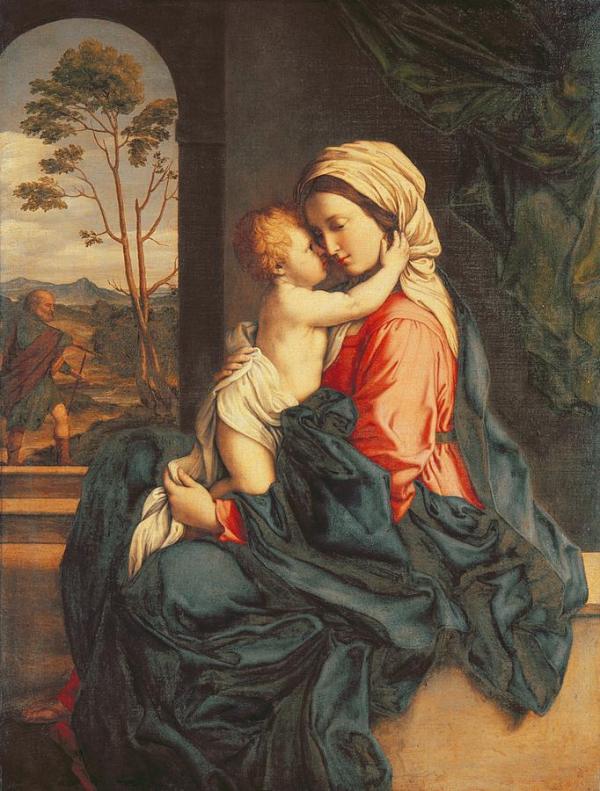
Virgin and Child Embracing by Giovanni Batista Salvi
A sermon from the Rev. Linda Mackie Griggs – Christmas Eve, 4:00 pm, 24 December 2018
And so, all Creation waits for the birth of the Christ Child.
Someone once
told me that, for God, Resurrection is easy. It’s Incarnation that’s hard.
Imagine being God, and squeezing yourself down into this fleshy unpredictable
body, filled with emotions and plans and aspirations, faced with the highs and
lows of making it from one day to another, weighed down by the past, uncertain
about the future, and unable to rest in the present. Imagine choosing to be this fallible, and
vulnerable, and finite.
It does give one pause. Emmanuel. God With Us – God With Us.
A few months
ago I read an article called, “Becoming Human.” Only it wasn’t about God
becoming human; it was a thought-provoking observation that we are not born
human; that actually we become human
by a process that involves negation– separating ourselves from different
aspects of existence, specifically from God, from Nature, and from Society. The
author says that we choose to become human when we establish our distinctness
as individual creatures with unique capacities to think and reason within
ourselves, without reliance upon an exterior Divine presence, or upon social
pressures and demands. He says that when we choose to be part of this process
we thus avoid the risk of falling prey to the echo chambers and groupthink that
currently threaten to destroy us. And he has a point, especially in the current
environment—we do have a responsibility to think independently and creatively
as part of our social and civic communities. But here is what saddens me about
his argument:
The author
writes, “To be human is to preserve, inside oneself, against all forms
of social pressure, a place of intimacy and secrecy into which the greater
whole cannot set foot.”
Not even God.
How lonely that must be!
The author, Bernard-Henri Levy, is not a theologian. His
perspective is more a view of what is,
than it is a view of what we are called to be. I think he is looking at our
world today and fears for it, and sees a remedy in a form of self-protection;
nothing out there will protect us, so we need to protect ourselves. I wonder if
he has actually shed light on something crucial; that we have, in fact,
preserved those secret places he talks about too well, and as a result we are, as a society, more and more
alienated from one another, from creation, and from the call of God to live
lives of reconciliation and healing. So the question here is: Is negation and
self-protection the ultimate goal of becoming human?
Nope. Negation is not
the Good News!
We are here tonight because God says Yes.
Yes to Creation.
Yes to us.
Crazy mixed-up not-always-very-loveable Us.
So what does it
mean to be human? It is the opposite of negation and self-protection. It is to seek relationship. We seek to love and
to be loved; to return the gaze of love that we first knew as babies, gazing
into the eyes of our parents. We seek it because we are made in God’s image,
and God’s nature is love. Love is transitive—it needs an object in order to be
complete. It needs a Yes—the relationship of one to another, mutually giving
and receiving.
So the question tonight is not what is it for us to become human,
it’s what does it mean that God
became human?
A mother of a five-year-old settled her son into bed—story
read, last cup of water, last trip to the bathroom, prayers, night-nights and
I-love-yous said, door gently closed:
“Mo—om?” Sigh. “Yes sweetie.” “I’m scared.” “There’s nothing to be scared of—you’re safe in bed and I’m right in the next room.”“But. It’s DARK in here, and I’m all alone!” “You’re not alone, precious; God loves you and is right there with you.” “I know God loves me! But I need somebody with skin on!”
Yes. That’s it. Jesus is God’s yes. With skin on.
God has declared God’s enduring, abundant and undying love
for us by entering into history. Entering the darkness that threatens to
overwhelm us—that tempts us into giving up on a world wrapped in fear. God
counters our no’s of anxiety, self-doubt and negation by calling us to bloom
outward from our hearts; to risk embracing Creation and our neighbor—even the
ones who drive us nuts.
And how better to do that than to be born among the creatures
of God, on a night filled with stars, visited by smelly shepherds and Eastern
sages, sung to sleep by the tired loving voices of his parents, as the angels’
music fades gently into memory?
Emmanuel. God, with us. Creation waits, holding her breath. And God whispers, “Yes!”
This looks a long recording as the recorder ran over. The actual sermon time is around 14 minutes only
How old is she, I wonder? 12-13-14 years-old? We don’t know. What we do know is that she’s just a girl. Maybe a girl already betrothed, but a girl nevertheless. A girl betrothed as was the custom of her people. But a girl according to the betrothal custom of her people should not have yet come to know the man to whom she is betrothed in the intimacy of sexual intercourse. She hasn’t, – well as far as she knows. Yet, how to explain the strange stirrings in her belly? Whatever – however – these things are happening. Mary is very, very scared.
She’s scared, and yet, somewhere deep inside her she feels something else, a consolation, a rightness that defies all rationality. At night her mind flits to-and-fro, back and forth. One moment calm, she feels the assurance of a consolation. In the next moment – the grip of terror takes hold once again.
Two questions vie within her. What is happening to me? A question that stirs her curiosity. Only to be followed by another question: what will Papa do to me when he finds out?
St
Martin’s, Providence, is one of the finest examples of both English domestic Gothic
form and ecclesiastical Arts and Crafts in New England, if not wider afield. It
has both nave and clerestory levels of stained-glass windows telling the story
of faith and life. Although put in over a 40-50-year period, all the windows stylistically
conform to a master schematic – presenting a holistic integrity in style and an
orderly progression of themes. Like the Medieval cathedrals and churches, St Martin’s
windows are more than decoration, they tell the story of Christian faith and Western
culture.
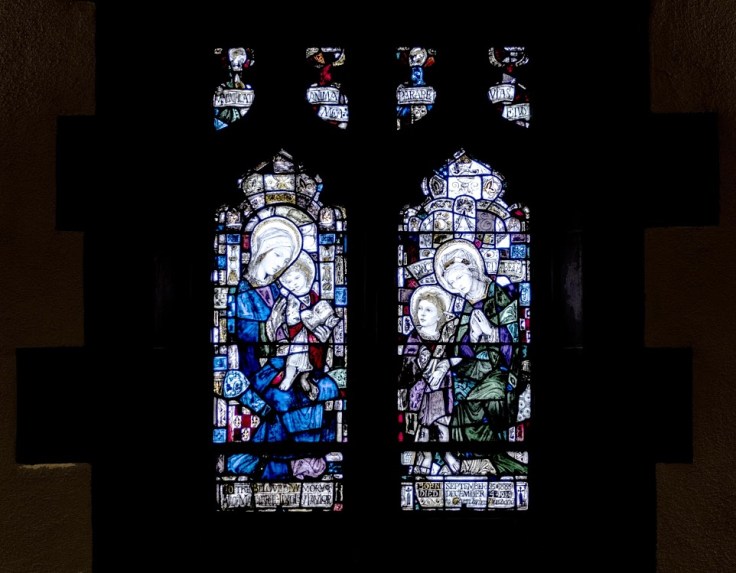
The nave windows form a progression in which the story of Jesus’ life unfolds in sequential chapters. The first window begins with the chapter occurring before the one we hear about in Luke’s Gospel on Advent IV – the announcement from the archangel Gabriel to this 12-13-14?, year-old girl. The next window depicts the events of Luke 1:39-55. In this window we see two adult women, one clearly middle-aged while the other in the full bloom of early womanhood. Both sit appearing to be in conversation; each depicted with a boy toddler – two maybe there year old, sitting in their lap.
St Martin’s Visitation Window
This is the window that depicts the event we call the Visitation, when Mary journeys some distance to visit with her older cousin, Elizabeth. Elizabeth is also pregnant. Again, her pregnancy, like Mary’s is unexpected. But in her case, the surprise is one that defies biological rather than social convention, because Elizabeth is decidedly post-menopausal.
There
are deeper strands of significance weaving through this story of Luke’s. Elizabeth
and Mary are cousins. Luke tells us that Elizabeth is married to Zechariah, and
that Zechariah is of the priestly clan. Luke, here, clearly wants us to know
that Mary too is of a priestly family, thus telling us how Jesus is connected into
the institutions of his Hebrew people. For his readers, this is a matter of
some importance in supporting their claim that Jesus is the one promised to
Israel. Elizabeth’s son is John the Baptist, who is not simply the cousin to
Jesus, son of Mary, but the prophetic Elijah, who later the wilderness will announce
the arrival of the promised one.
One final comment about the Visitation window. This window is clearly a euphemized depiction, a pleasant cover for the unpleasant or embarrassing truth of the actual event.
At the time of their meeting, neither woman has yet given birth. Yet, here they are with two toddlers in their laps. Perhaps the explanation for this lies in the year the window was made – 1924, a period when WASPy social convention was clearly uneasy with the depiction of pregnancy in the sacred precincts of the church. This is how we dress-up, gloss over in order to distance ourselves from the rawness of the biblical story.
Back to Luke’s actual story – In those days, Mary went with haste to a Judean town in the hill country. Because of the discrepancy in their ages, it seems probable to assume Mary’s and Elizabeth’s relationship is one more typical of niece and aunt. Maybe this is the reason Mary has come to Elizabeth. Uncertain of her own mother’s reception of her news – she comes to the woman who has always looked out for her and whom she knows will protect her. Mary rises early, and with haste, flees to the bosom of her aunt.
Mary leaves in haste, because she is very, very scared. She lives in a society that practiced honor killing for girls made pregnant outside wedlock. Though betrothed to Joseph, Mary is not yet locked into the social convention of weddedness that would explain and approve her pregnancy.
The Law of Moses dictated that a girl in Mary’s predicament was to be stoned to death. But Mary is from a priestly family and a special method of honor killing was prescribed for her. In priestly families, the daughter in Mary’s predicament was to be strangled by her father at the door of their house.
So, Mary sets out with haste – in flight – to the protection of her aunt – in the distant hill country of Judea. It’s speculation, but maybe she continued in the seclusion of Elizabeth and the kindly Zechariah’s protection until the middle-aged Joseph agreed to marry her. But that is part of Matthew’s telling of this story, not Luke’s.
Luke’s story is about two women the elder protecting the younger from the harshness of the patriarchal heart. Between Elizabeth and Mary lies a recognition and a solidarity that is the ancient echo of a very modern #me too moment, because the vulnerability of women to the hardness of the patriarchal heart is a story older than time.
Luke take an earlier song of a woman’s jubilation – Hannah’s song from the second chapter of the first book of Samuel – and transposes it into Mary’s key. Mary sings out in jubilation the story of God’s generosity towards her, and through her, to generations yet to come.
What
is the essence of Mary’s jubilation? It is that at a deeply intuitive level she
perceives the significance of her acceptance; of the exercise of her individual
responsibility to participate in God’s dream for the world. She sings out:
It extols, my life does, haShem.[1] It rejoices, my breath does, at Elohim[2] my deliverer. Because Elohim looked on the humility of his female slave.
Mary
sings out that this is a dream for justice, of putting to rights those things that
are currently so very wrong:
His mercy extends into birthings and birthings of those reverencing him.
He made strength with his arm, he scattered those visibly superior by the intentions of their wills. He put down the capable from thrones and exalted the humble ones. Hungry ones he filled full of worthy things, rich ones, out and away he sent them, empty. [
Richard Swanson’s evocative translation
How
will the Messiah – the promised one – come? He will come in obscurity, through
the courageous cooperation of human agents like Mary and Joseph, Elizabeth and
Zechariah.
In
the womb of an adolescent girl, untimely pregnant, who has had to run for her
life, the next chapter in Israel’s long story of God’s dream for the world
awaits fulfilment. How many other countless young mothers are running for their
lives, shielding their unborn and shepherding their born children from danger
in the hope of finding the equivalent of an Elizabeth and Zechariah – that’s
code for you and me, for all us together, we who have the power and resources to
provide a place of safety? Let the
President and his hawks have ears to hear and eyes to see.
God comes into the world, not as the head of a multinational conglomerate, not as a political figure of power and influence, not as a successful culture icon, but as a babe, protected for a time within the womb of an adolescent girl who finds shelter in a world of patriarchal danger. God comes through the collaboration of a frightened and courageous girl-woman. Pray God that like Mary we may not be found wanting when the time for our decision making comes.
Mary’s story is our story too. The nature of truth is stranger than fiction because you couldn’t make it up even if you tried!
[1]HaShem. noun. Judaism a periphrastic way of referring to God in contexts other than prayer, scriptural reading, etc because the name itself is considered too holy for such use. [2] The true God
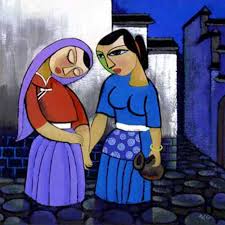
Featured Image ‘The Visitation’ by Dr. He Qi, China/USA
Cranach the younger The Sermon of John the Baptist*oil on panel 1549
The power of that for which we hope is already effective within us
a Paraphrasing of Alice miller
The Prophet Zephaniah is the 9th of the minor prophets, minor referring to the shortness of their writings not to the importance of their message. In 721 B.C. the Northern Kingdom of Israel, comprising 10 of the 12 tribes, is utterly destroyed by the Assyrians. In 586, the remaining Kingdom of Judah will fall to the Babylonians. Zephaniah is writing roughly between 639 and 626 B.C. – a time of great foreboding and danger. The remaining two tribes of Judah and Benjamin stand alone, threatened by bands of Scythian invaders sweeping down from the North. Into this politically and militarily unstable situation in 639 B.C. the 8-year boy, Josiah ascends to the throne.
Zephaniah’s prophecies are heavy with the expectation of God’s judgment upon Judah. So, it’s somewhat surprising that he ends his writing with the joyful expectations we find in verses 14-20 of his final chapter; the whole book only numbers three chapters. Zephaniah makes no mention of a personal messiah. Nevertheless, he articulates a vision of hope and redemption –
The King of Israel, the Lord, is in your midst, you shall fear disaster no more. … I shall save the lame and gather the outcast, and I will change their shame into praise and renown in all the earth. At that time I will bring you home ….gather you….make you renowned and praised among all the peoples of the earth.
This is the nature of hope, that the power of that for which we hope is already active within us.
Without hope we have no compass to direct our actions
****
Mark, Matthew, and Luke, each paint a portrait of John the Baptist as the last in the line of the great Hebrew prophets whose purpose is to announce the arrival of the messiah. However, it’s Luke, in particular, who gives us the most relatable picture of John. Mark makes no mention of the people who come to hear John, and Matthew, refers to them exclusively as Pharisees and Sadducees – always the Jewish bad guys for Matthew. In Luke those who come to hear John are described as the kind of people one might find at any modern crowdsourced event. Among the general populace of the hungry -some physically hungry, others spiritually ravenous – coming out to the wilderness to hear John, Luke includes some rather dubious groups as well.
Luke’s depiction of John the Baptist in the wilderness emphasizes the inclusivity of his view of Jesus’s message- a message not for the few but for the many, not for the special or religious but for those whose daily lives are hard and often complicated by being forced into or trapped within compromising and dubious choices. In particular, Luke includes tax collectors and soldiers among those who come to hear John.
Our official translations often avoid communicating the wild and fluid nature of the Biblical conversations. ‘Listen’ to how Richard Swanson of the Provoking the gospel project renders the encounter between John and the crowds.
They kept asking him, the crowds did, they said: What should we do? He answered, he kept saying to them: ‘the one having two coats, give one to the one who has none. The one having goods: do likewise’. They came, even tax gatherers, to be purified. They said to him: ‘Teacher what should we do’? He said to them: ‘nothing beyond what is set to you. Beyond that do nothing’. They asked him, soldiers, they said: ‘what should we do, even we’? He said to them: ‘rob no one, neither be an informer, and let your wages be enough’.
Richard Swanson’s Provoking the gospel: methods to embody Biblical storytelling through drama
The first thing to notice is that the members of dubious groups like tax collectors and soldiers ask John, not what should we believe, but what should we do? Tax collectors were Jewish traitors because they collaborated with the Roman occupation,not only collecting the Roman taxes but top slicing their profit from what they collected, and so collecting a little more than they needed to. John’s view of them seems to accept that everyone needs to earn a living, even if sometimes by dubious means. Even so, he tells them: collect the tax but oppress your neighbors no more than you need to, to satisfy Roman demands.
If they don’t tell you to bring the tribute in money boxes or cash bags,” says John, “Don’t. Turn in heaps of pennies. If people pay you in chickens or goats, turn in the livestock. Let the Romans figure out how to feed their tribute.
Swanson
Soldiers were notorious street thugs who like modern day vigilantes terrorized local communities through extortion with menaces and violence – in effect setting up and administering their own protection rackets. John says to them: if you want to do know what you should do to be right with God, don’t be mindless proxies for a violent system of oppression; be satisfied with your wages and stop exploiting your own community.
John seems to recognize that life at times can be a morally ambiguous affair. In other words, you may not be able to control the whole of your situation, but nevertheless quietly resist sacrificing your sense of right and wrong to a cynical transactional approach to living.
And to those of us who live ordinary, noncontroversial lives, those of us who enjoy some abundance but an abundance that is finite and limited; to us John says: it’s fine to have two coats, but if having two coats means that someone else has no coat, then share what is actually your surplus.
****
In what or where lies our hope? An even more fundamental question: Is it even worth it to risk hoping at all? Beneath both questions sounds the solid drumbeat of the crows question to John: Teacher, tell us, what should we do? So think about it this way. Without the prophetic dream of God’s putting to rights all that currently seems so wrong we have little inspiration to act similarly in the present. Without a strong hopeful vision setting the needle of our moral compass to guide our actions we will fall into the temptation of being guided only by the concept of what we can get away with.
John the Baptist is popularly presented as the most uncompromising of characters, whose very strictness gives us an excuse for backsliding, because how can we ever match up to his moral and spiritual demands? Yet, in Luke’s picture of him he seems to understand that life choices are made in the grey ambiguity of circumstances where mixed motivations vie with each other, self-interest competes with our genuine concern for others.
Prophetic hope, the greater vision of God’s restoration of Israel should not be misunderstood as a reflection of good times following bad times. In fact, the prophetic vision of God’s restoration of Israel occurs often in the darkest of moments,either just before national catastrophe as in the case of the first Isaiah or after such a catastrophe as in the case of both Jeremiah and Ezekiel.
Teacher, tell us, what should we do? The answer is: struggle to keep hope alive. Advent’s hope is simply this:
If we wait in hope and patience, the power of that for which we wait is already effective within us. Those who wait in an ultimate sense are not that far from that for which they wait.
Abstract: The theme of Advent’s second Sunday is the coming of the messenger. The concept of a messenger whom God will send firmly links the O.T. reading from Malachi with Luke’s account of the arrival of John the Baptist upon the scene. There is a striking resemblance between Malachi’s messenger and Luke’s John the Baptist. The unexpected nature of the message poses a challenge to the hearer.
Malachi writes: See I am sending my messenger to prepare the way before me, and the Lord whom you seek will suddenly (unexpectedly) come to his temple. The messenger of the covenant in whom you delight.
Luke writes: Hear the voice of one crying out in the wilderness (wilderness is an unexpected place): Prepare the way of the Lord, make his paths straight.
Both are messengers of hope. We long for the coming of the messenger, yet as Malachi poses the question: will we be able to endure the day of his coming? Who among us will be able to stand when God’s messenger appears? The unexpected nature of the message lies in its power to surprize and disturb the hearer.
John the Baptist’s message promises the longed-for salvation. Yet, its arrival disturbs everything – as we know it. To borrow an image from science fiction channels, the prophet Isaiah’s vision of a massive terra-forming of the planet; a reshaping of the world as we know it. Paths that presently are crooked are to be made straight. Valleys are to be filled in with the material of hills that are to be leveled flat. And the rough terrain is to be smoothed out. It’s an uncomfortable realisation that human beings have been despoiling the earth by terraforming the planet for centuries, the prophetic imagery here functions as a metaphor for the remaking of human society at the hand of the Creator.
Malachi is among a slew of prophets known as the minor prophets, or alternatively, as the Twelve. The term minor refers not to the importance of their message but to the shortness of their books. We don’t know much about the prophet Malachi, and in fact the name Malachi simply means messenger, which is clearly a reference to God’s messenger in chapter three.
All twelve of the minor prophets speak into the historical period in the decades following the return of the Babylonian exiles in the middle of the fifth-century BC. The rebuilding of Jerusalem and the temple expressed a powerful hope for a return to the glory days of King David. The hope in this period could be summed up in the soundbite -let’s make Israel great again!
As Malachi looked around him he saw a period of reconstruction that had failed to recreate the nostalgic dream for a new Davidic age. The renewed institutions of national life centered on the temple were corrupt and demoralized. Worship had degenerated into a listless perpetuation of form. The study of the Law – neglected. Taxes – unpaid. The Sabbath routinely broken. Intermarriage with pagans seemed the order of the day. The priesthood – corrupt, and the political leadership – self-serving. Malachi proclaims God’s impending judgement upon this situation.
A tension permeated the Post-Exilic period between a nostalgic longing to recreate a vanished past and a stalled hope for an as yet – unrealized future. The result was a present-time – marked by disillusionment and moral malaise. Doesn’t this all sound rather familiar?
Advent 2018 arrives at the end of another year of turmoil, rancor, and fear; a world caught in transition between the relative stability of a recent past and the hope and fear for an as yet – unrealized future. The past is gone. The future has yet to arrive. Like post-exilic Jewish society we also sit in a similar place of tension. The tension between a desire to recreate an imaginary golden past and the fear of an unknown future paralyses us, rendering us incapable of making the fruitful choices and decisions that could shape our renewal in the present.
Hope is greater than an attitude of optimism. The unexpectedness of Advent’s message lies in the counter intuitiveness of hope. Last week on Advent Sunday, in a few short, pithy sentences Linda reminded us that Advent’s message comes to us in the midst of social and political uncertainty and the devastation of ecological disasters all around us. Yet it’s not a message of defeat but one that unexpectedly exhorts us to:
stand up and raise our heads. Look up, look around, pay attention. Wait. Hope. Live faithfully. Don’t hide. Don’t panic. God is God. We are not.
In a piece printed in the Guardian newspaper, Ibram X Kendi, the director of the AntiracistResearch and Policy Center at American University, expresses for me the unexpectedness of Advent’s message:
The times when all seem lost are the times when we most need to see the people and ideas trailblazing the way out of the muck.
We live in an age when there are no more messengers, in the sense of someone coming to show us what we as yet need to know. Godself became the ultimate messenger in the human experience of Jesus. There remains one more act in the drama of salvation which will involve God’s final restoration of the creation. However, the function of the vision of the end time is to refocus our attention on what we need to be getting on with in the present time.
We live in an age when there is now only the message, and we hold the power of choice to heed the message or not. We have no need for another prophet to show us the way. What is needed is a greater commitment to sparking in one another the energy for new ideas, and most crucially of all – the energy to risk bold actions capable of trailblazing a way forward out of the muck and mire in which we currently find ourselves.
Hope, the prophetic tradition reminds us, also disturbs our self-protections; the false certainties that provide the illusion of safety. The world of the first quarter of the 21st-century is in transition as the 20th-century’s social and political tectonic plates break apart and begin to realign. The rampant creed of individualism – unchecked, of globalized, unrestricted venture capitalism -unleashed, of wholesale destruction of the environment have brought us to a sticky end. As the tectonic plates of former certainties shatter, it will be the kind of stories we embrace that will really matter.
There will always be those who are easily manipulated into embracing the small and pernicious stories of our culture, which whenever previously embraced, have led to moral bankruptcy. I speak here of traditions of racism, of gender oppression, of military adventurism, of planetary exploitation for personal profit, of both laisse faire economics and nationalist protectionism.
The Advent hope is the greater story of the reign of God’s justice which is a vision:
+ where racism is no longer intersecting with other bigotries to manipulate people away from their self-interest.
+ Where native and immigrant are united by common interest.
+ Where we honestly share our racial history.
+ Where free high-quality healthcare is a universal right.
+ Where guns are as controlled as much as motor vehicles.
+ Where voting is easy and accessible.
+Where human activity is no longer the principle cause of environmental catastrophe.
Where we all can be fully human through embracing humanity fully?
Luke 21:25-36 A sermon from the Rev. Linda Mackie Griggs
“There will be signs in the sun, the moon, and the stars, and on the earth distress among nations confused by the roaring of the sea and the waves. “
There’s a sign in a bookstore window: “Post-apocalypticLiterature has been moved to the nonfiction section.”
Yeah. If you don’t laugh, you’ll cry, right?
Sometimes it does feel like everything’s coming
apart—like the proverbial End of Days—wars and rumors of wars; a baking planet,
bad news upon bad news. Fear begetting more fear. Joking aside, the genre of
apocalyptic and post-apocalyptic fiction does tend to stoke peoples’ anxiety as
they try to match the plot up with the news cycle—because that’s what sells.
And for creators and purveyors of doom-related scenarios, that’s the point:
Fear equals ratings. But a better understanding of Apocalyptic literature, of
which today’s Gospel is a sample, tells us that the panic (or resignation, or
eagerness, take your pick) about how current events presage the world’s doom is
misplaced. Apocalyptic literature isn’t a crystal ball predicting the future.
Attempts to use it that way have resulted in many calendar dates circled in
red—THE END IS HERE—and then the sun comes up the next day anyway. You would
think people would learn that this isn’t a great strategy for how to plan the
program year, or for that matter, how to enact environmental policy. The fact
remains that the timing of the end of days is, frankly, none of our earthly
business. God is God, and we are not.
Stand up and raise your heads!
Stand up and raise your heads for your redemption is drawing near
The original purpose of apocalyptic writings was to respond to times of turmoil, violence, persecution and fear. They go back at least as far as the 2nd century BC, when the Book of Daniel was written, and it is this scripture that Jesus evokes in today’s passage—the vivid image of the Son of Man coming in the clouds. The point of apocalyptic asa genre was to offer people who lived in fear signs of hope amid the chaos of their time. They saw the turmoil in the sky, the earth and in the nations as reflections of a larger battle of good and evil taking place on another plane of existence—a hidden place that the writers could only imagine. And when they imagined, they imagined big. They didn’t know what the end times would look like anymore than we do, but the vivid stories they wrote provided hope to people living in fear of earthly events.“
Writers of Apocalyptic texts had rock solid faith
in the ultimate triumph of good over evil, on earth and in the heavens. They
had faith in their redemption– that God would act—indeed was acting to bring
God’s Dream of justice, healing and reconciliation ultimately to fruition.
When will all this happen? We don’t know. What do
we do in the meantime? We wait. We wait within the reality of the challenges of
the present, by virtue of our faith in the future; our faith that God is
faithful to us.
We wait, and watch. And hope.
In today’s Gospel, Luke’s Jesus, having entered
Jerusalem in triumph, teaches in the Temple, his own fate looming as all of
Palestine buzzes with whether or not he is The One; the Messiah that they have
awaited for so long.
In the verses before the ones we’ve just heard,
Jesus tells of the coming fall of Jerusalem: “When you see Jerusalem surrounded
by armies, then know that its desolation has come near.” Luke’s Gospel was
actually written after the destruction of Jerusalem by the Romans in the year
70, so Jesus didn’t actually predict the future; what Luke did was a literary
setup to Jesus’ sweeping declaration about the Son of Man from Daniel’s
Apocalypse. The images are
disturbing—they reflect what people fear—the violent, the unknown. “People will
faint with fear and foreboding.” There is a risk of focusing exclusively on
these images—breath held, expecting only the worst. But a little advice
here: If we ever come away from
scripture in a state of fear, we need to go back and read again. (Are we
disturbed? Maybe. Challenged, absolutely. Fearful? Nope, go back.) The God who loved Creation into being does
not call us to fear.
So how to press on? Know that Luke’s Jesus speaks
of the difficult reality in which he lives in a language and style that people
would recognize—in this case the apocalyptic texts of Daniel. He uses the
language of the past to address the difficulties of the present and to point
toward the future. It’s not about becoming fearful—it’s about facing those
fears with courage.
Every era has its crises and insanity—some more than others. So today we observe distress among nations and within nations. These as roar, the wildfires rage. Some crises, like war, are familiar. Some, like climate change, are unique to our time. Welcome to a broken and sinful world.
But what does Jesus say? Buy a survival bunker and
head for the hills? No. He says to stand up and raise our heads. Look up, look
around, pay attention. Wait. Hope. Live faithfully—don’t hide, and don’t panic.
God is God, and we are not.
Look at the fig tree. Look at any tree. Every time
a leaf falls it leaves a bud behind—new life ready to spring out before the old
growth hits the ground. Look up! Look around! Yes, the world is going nuts. It
has done it before and it will do it again. But Jesus knew, and Daniel before
him knew, that even when the world goes bananas buds of life abound. Look for them—look for the joy. For people
falling in love, and getting married and having babies. Look for roses to
smell, music to make, exploring to do. Look for laughing until our sides hurt.
For planting trees. For caring for each other. The buds are everywhere. Hope is built into Creation.
Advent begins today. We wait. How?
We remember what God has called us to from the
very beginning: Love. Generosity. Compassion. Justice. Hope.
Stand up and raise your
heads! Look around you—see the buds of new life, perhaps hidden, but there if
you look closely.
In the second chapter of
Luke’s book of Acts he describes what the earliest Christians did as they
awaited what they thought was Christ’s imminent return. They didn’t hide, they
didn’t hoard; they didn’t scheme and turn on one another. They prayed. They
shared. They sang. They loved. They lived with courage, not fear, in face of
persecution and a world going bananas.
We are called to carry on with their waiting, because only God knows God’s time.
The infant will soon be in his cradle, and begin his journey to the Cross. The Christ Child will show us the way, through everything the world can throw at us–through our fear, our despair, and anxiety; the Christ will show us the way of love, right up until Kingdom Come.
Pilate: Are you a king? Jesus: My kingdom is not from this world. Pilate: So you are a king?Jesus: if you say so.
JOHN:18:33-37
The question Pilate and Jesus dance around is if Jesus is a king, what kind of king is he?
There are two kinds of religion; religion as the assertion of power, and religion as the profound recognition of vulnerability. The difference between these two manifestations is the distinction between kingship and kingdom.
Kingship I
In 1925 Pius XI proclaimed the feast of Christ the King as the Catholic Church’s assertion of power against the rival totalitarian movements of Fascism and Communism. This is an old, old story. In 313, when on Hadrian’s Wall at the most northern reaches of the Empire, the Emperor Constantine adopted Christianity as the official religion of the Roman Empire, he forever changed the developmental course of Christianity.
In the Eastern half of the Roman Empire centered at Constantinople, the Church became incorporated as the spiritual aspect of imperial power. In the Western half centered on Rome, as the political center of imperial power collapsed before the waves of Barbarian invasion, the Church became the only center for both political and spiritual power. In the East, the Church becomes established, the spiritual arm of the State. In the West, the Church becomes the State. Either way, the images and attributes of political and economic power became projected onto the image of Christ. Christ, the Good Shepherd became Christ Pantocrator -ruler of the world. The dying man on the cross shape-shifts into Christus Rex, Christ reigning in glory.
It’s understandable why in 1925, facing the menacing growth of fascism and communism, Pius XI marshals his Catholic legions in an assertion of the old Constantinian power of the Church as the only center of allegiance. Religion as power girds for battle.
Pius’ proclamation also needs to be understood within the Italian context. In 1861, the newly unified Kingdom of Italy proclaimed Rome as its capital. This was greeted by the Vatican as a hostile act amounting to the annexation of Rome and the Papal States by the newly formed Kingdom of Italy – leaving only a small enclave surrounding the Vatican itself as the remnant of the once mighty Papal States. Between 1861 and 1929 the Popes considered themselves prisoners of the Italian State and thus refused to leave the Vatican City. This standoff came to an end when in 1929 the Italian Government and the Papacy concluded the Lateran Agreements, ending Papal self confinement and inaugurating the Vatican City as a sovereign entity independent of the Italian State.
Completing the historical development of the commemoration of Christ the King, in 1994, with the revision of the Common Lectionary, the Anglican Communion along with the mainline Protestant traditions adopted Christ the King as the celebration for the final Sunday of the Church Year.
The question Pilate and Jesus dance around is if Jesus is a king, what kind of king is he?
Kingship II
Robert Capon, in Hunting the Divine Fox confronts us with our typical American notions of divine kingship.
. . . The true paradigm of the ordinary American view of Jesus is Superman: “Faster than a speeding bullet, more powerful than a locomotive, able to leap tall buildings in a single bound. It’s Superman! Strange visitor from another planet, who came to earth with powers and abilities far beyond those of mortal men, and who, disguised as Clark Kent, mild-mannered reporter for a great metropolitan newspaper, fights a never-ending battle for truth, justice and the American Way.”
If that isn’t popular christology, I’ll eat my hat. Jesus gentle, meek, and mild, but with secret, souped-up, more-than‑human insides bumbles around for thirty-three years, nearly gets himself done in for good by the Kryptonite Kross, but at the last minute, struggles into the phone booth of the Empty Tomb, changes into his Easter suit and, with a single bound, leaps back up to the planet Heaven. It’s got it all — including, just so you shouldn’t miss the lesson, kiddies: He never once touches Lois Lane.
Capon notes [pp. 90-91; reprinted, along with two other books under the title The Romance of the Word: One Man’s Love Affair with Theology] that the human race has: alwaysbeen deeply unwilling to accept a human messiah. He notes that: we don’t want to be saved in our humanity; we want to be fished out of it. We crucified Jesus, because: he claimed to be God and then failed to come up to our standards for assessing the claim. It’s not that we weren’t looking for the Messiah; it’s just that he wasn’t what we were looking for. Our kind of Messiah would come down from a cross. He would carry a folding phone booth in his back pocket. He wouldn’t do a stupid thing like rising from the dead. He would do a smart thing like never dying.”
Whether as Pius’s Christ the King, or America’s Jesus Christ -Superman, both picture Christ reigning in triumph and glory, avoiding the shame and humiliation of Jesus’ death on the cross. As we struggle in 2019 to clarify the meaning of Christ the King in a religious tradition that long ago forsook religion as power, we have little use for projections of either Christ Pantocrator -omnipotent ruler of the universe, or Jesus Christ Superman -contemporary folk superhero.
Kingdom
Christ the King is the celebration of Jesus as Messiah or liberator. The theology of Jesus’ kingship is the Jewish theology of the Messiah as God’s promised one, who, in his coming confronts the business-as-usual mentality of human political, social, and economic structures. My kingdom is not of this world, does not mean Jesus is a secret king who rejects the pain and mess of the real world in preference to the world of privatized faith accessible only in the inner world of the believer.
Jesus as Messiah and liberator confronts popular notions of a charismatic leader coming to fight fire with fire. Christ as King is not a celebration of king-ship but an announcement of king-dom. The religion of kingdom is made real in those attributes Jesus reveals on the cross; courage, servant-hood, forgiveness, generosity, and inclusion.
The notion of Kingdom makes us very uneasy because it challenges our complicit accommodation with the status quo; a status quo drawing on the privileging of power and its unequal distribution from which flow all the forms of oppression and injustice that characterizes our contemporary society.
As we celebrate the ending of a wonderful year and prepare with anticipation and excitement of what Advent and the new Becoming more and more fit for the God’s purposes can be a blessing or a curse – depending on how we want to look at it.
It’s not that we are not looking for a king. It’s just, is Jesus the kind of king we are looking for?
Living with uncertainty is very hard to do. It was certainly hard to do for the Christians in Rome during the decades following Jesus’ death and resurrection, for whom Mark was constructing his gospel. In chapter 13, Mark records Jesus and his disciples on their fateful final visit to the Temple in Jerusalem. Chapter 13 is known as the Little Apocalypse[1]– a curious intrusion of dire warnings about a dystopian future into the overall flow of the Passion Narrative.
It’s a universal human experience that living with future uncertainty cultivates an attitude of fear and foreboding in us. Predictions of a dystopian future currently constitute a staple diet for Hollywood movie script writers and producers. It seems we have an unending appetite for frightening ourselves. It was no different in the 1st-century in which Mark was writing.
It’s not that there is nothing to worry about. The future viewed from our current lens looks increasingly bleak. Last week I noted the increasing dangers to international order posed by the rise of nationalistic, authoritarian government that seems only interested in alliances of convenience that shift and change from moment to moment. Later last Sunday, in his St Martin’s Day address, RabbiHoward Voss-Altman warned against our subtle desensitization to re-suregent racist and fascist tendencies. The now continual news of catastrophic climate events is really beginning to focus all our attention, the current Administration excepted, on the realization that as we endeavor to ensure the future prosperity of our children in material terms, we are actively bequeathing them an escalating process of environmental degradation.
There
are real worries for the future posed by problems that can, however, be
tackled, if we but find the collective political will to do so. However, at a
deeper level, the inherent uncertainty of the future continues to pose an
existential anxiety for which the most effective solution is living lives nurtured
by faith, hope, and the daily practice of love. In short, the antidote to
existential anxiety is spiritual in nature.
Our
Christian faith offers us what I continually refer to as a really big story within
which to construct our lives. When we fail to acknowledge that this is the
central story with a claim upon our allegiance, we risk becoming enslaved to lesser
stories, that like all idolatries promise more than the can deliver. Perhaps it’s
the desire for wealth, the drive for security or competence, the craving for
satisfaction – food, alcohol, sex, drugs, and let’s not forget shopping – all
delivering only temporary satiation of our longed-for desire to feel full and
complete. Perhaps it’s the adulation of success – beautiful bodies, glossy
lifestyles, professional and personal adulation that promise insulation from
the slings and arrows of life’s outrageous fortune. Let’s not forget the naive allegiance
to the charismatic leader, the latest slick politician promising to solve all
our economic woes and appease our social-racial-gender anxieties by playing on
our fears. I could go on.
All
of the lesser story claimants on our lives are not in and of themselves inherently
bad, it’s that they are simply unable to bear the weight of the expectations
for meaning and purpose we project onto them.
In short, the antidote to existential anxiety is spiritual in nature
The only antidote to fear and anxiety generated by uncertainty is to let the large story of faith, hope and love shape us. This is important for us individually, but more significantly our religious story is lived out only in community. For it’s in community we catch from and reinforce in each other our common spiritual heritage. Last Sunday’s wonderful celebration of St Martin’s Day is such an example of what I mean, an event that is the fruiting of new energies of commitment and collaboration within our parish community, which in turn strengthens our overall commitment.
**
Like
the disciples ogling in wonder at the great stones of the Second Temple, we place
our confidence in the wrong things. Mark’s Jesus, not for the first time shows
he has no truck with such naivete. He slaps his dreaming deciples down hard! Do you see these great buildings? Not one
stone will be left here upon another; all will be thrown down. You can
imagine the disciples – to use the current vernacular – thinking: Hang on Jesus, keep your hair, on I was only
just saying —–
If
you are like me, you will often look around in admiration of the stones of this
very beautiful church of ours. I remember my first visit to St Martin’s. By
that point I had become used to the Colonial-Spanish styles of Arizona Episcopal
churches, so that on entering St Martin’s for the first time you might have
heard me exclaim: Look Jesus, a proper
church!
We
love the stones of this church, it’s glass and its grace in decoration – St Martin’s
is indeed among the finest examples of an Arts and Crafts church interior in
New England. But look a little closer, see the buckling plaster, the severe
water damage to the walls in the chapel. Look closer and you will see beautiful
stones come at a price; the price being that of continually very expensive
maintenance and repair.
NowI believe that we must shoulder our responsibility to maintain with diligence and effort the stones of this church – bequeathed to us by former generations – of whose sacrifices this building remains a living testimony. Fortunately, the task is not yet beyond our capacities. Yet, there may come a time when it will be. One of the future’s uncertainties is what will happen to churches like ours in the face of demographic and generational changes that are already resulting in drastically reduced commitments to church and church going among the post-boomer generations?
My purpose is not to depress us all. It is simply to affirm Jesus’s teaching as presented by Mark, that we live always in the face of the future’s uncertainties. We cannot know the future but we must trust ourselves to it, nonetheless. Jesus reminds us that many will come in his name. Their ability to lead us astray rests upon our craving for clear and certain answers to uncertainty cannot be met other than that uncertainty must work itself out over a longer time frame than the one we are most comfortable with.
***
We cannot allow ourselves to be distracted from making our commitment to living life in the here and now by the uncertainties of the yet to become known future.
This is why each year the Annual Renewal Campaign carries such importance. Today, the 2019 campaign comes to a close with the in-gathering of our commitment promises for the next 12 months. We cannot allow ourselves to be distracted from making our commitment to living life in the here and now by the un certainties of the yet to become known future.
Onin-gathering Sunday, our practice is to return – if we have not already done so-our estimate of giving cards for 2019 as we come to eat and drink Christ intoour lives. Doing it like this emphasizes that the gifts of life are to beenjoyed and given thanks for as God-given and not worshiped as gods, in themselves.The gifts God gives us are for the enjoyment of our lives, and the means throughwhich to fulfill our responsibilities.
When we worship the gifts of God rather than the God who gives them, we fall away from the support of the large story of faith, hope and the practice of love into the clutches of the smaller stories of our anxiety-ridden human condition.
For no amount of hard work, no degree of piety, no level of personal achievement, no desire to make ourselves acceptable by the sweat of our own brow can insulate us from the uncertainties of the future. When we worship the gifts of God rather than the God who gives them, we fall away from the support of the large story of faith, hope and the practice of love into the clutches of the smaller stories of our anxiety-ridden human condition.
Christian faith is not a protection against future uncertainty. It is not an insurance policy against things going wrong. Rather, it promises that we can discover “who we are” only when we firmly know “whose we are”(David Lose). We entrust ourselves to a future that is for us yet to become known because we are God’s beloved children, love by God unconditionally. The opposite to uncertainty it turns out is not certainty, but courage – faith, hope, and the practice of love.
[1]
Apocalyptic writing in a genre of Biblical writing that predicts catastrophic
events that will herald the end times.
The first edition of the celebrated WWI poet Wilfred Owen’s war poems was edited and published by Sigfried Sassoon and Edith Sitwell in 1920. Dominic Hibberd’s 1973 republication includes Owen’s poems together with extracts from his letters to his mother, written from the trenches of the Western Front, and other materials including Owen’s own preface to a collection he was clearly planning to publish before his untimely death in 1918.
Owen writes in his preface:
This book is not about heroes, English poetry is not yet fit to speak of them. Nor is it about deeds, or lands, nor anything about glory, honour, might, dominion, or power, except war.
Above all, I am not concerned with Poetry. My subject is War, and the pity of war. The Poetry is in the pity.Yet these elegies are to this generation in no sense consolatory. They may be to the next. All a poet can do today is warn. That is why the true Poets must be truthful.
If I thought the letter of this book would last, I might have used proper names; but if the spirit of it survives – survives Prussia – my ambition and those names will have achieved themselves fresher fields than Flanders.
Wilfred Owen was awarded the Military Cross for conspicuous gallantry and devotion to duty. He freely chose to be part of the worst brutalities of a war in which a young subaltern’s life expectancy in the trenches was a matter of weeks. Having made it through some truly horrendous experiences, Owen was killed seven days before the cessation of hostilities. With tragic poignancy, the telegram informing his mother of his death reached her about an hour after the Armistice was signed.
The record of his war poetry makes Owen’s death noteworthy. Yet, I believe he would be among the first to protest that his was but one death amidst the annihilation of a whole generation – the flower of European youth.
It has been estimated that between 15 – 21 million men died among all combatants in the First World War, with another 21 million seriously wounded. The death totals are staggering: Russia 1,700,000; France 1,357,000; The British Empire, 908,000; The United States, 116,000; Germany, 1,800,000; Austria-Hungary, 1,200,000; Turkey, 325,000.
In my family, we lost two of three brothers. At the time, New Zealand with a population of 1 million, fielded a Division of 100,000 men, of whom 16,000 were killed and a further 41,000 injured; a 58% casualty rate, the highest death toll per head of population for any single combatant army.
Of a grand total of 65 Million men mobilized in the First World War, an estimated 9 million men died, with a further 21 million men wounded.
The most monstrous war in human history was followed by a punitive peace treaty – the infamous Treaty of Versailles, which succeeded only in sowing the seeds of bitterness and ensuring the national humiliation of Germany and the rise of Hitler. You can draw a straight line from the Treaty of Versailles to the outbreak of the Second World War, 21 years later.
On the 19th January 1917 Wilfred Owen wrote to his mother:
They want to call No Man’s land ‘England’ because we keep supremacy there. It is like the eternal place of gnashing teeth; the Sough of Despond could be contained in one of its crater holes; the fires of Sodom and Gomorrah could not light a candle to it – to find the way to Babylon the Fallen….The people of England needn’t hope. They must agitate. But they are not yet agitated even. Let them imagine 50 strong men trembling as with ague (a fever of shivering) for 50 hours!
February 4th, 1917, after describing his experience of leading his platoon into the frozen wastes of no man’s land where without even the cover of dug-outs, under the constant gaze of German periscopes and machine gun positions his platoon lay frozen for several days, plagued by thirst because their Tommycookers (Tommy being the nickname for a British infantryman) could not even melt the snow to fill their canteens, Owen writes to his mother:
I suppose I can endure cold, and fatigue, and face-to-face death, as well as another; but extra for me there is the universal pervasion of Ugliness. Hideous landscapes, vile noises, foul language and nothing but foul, even from one’s own mouth, everything unnatural, broken, blasted; the distortion of the dead, whose unburiable bodies sit outside the dug-outs all day, all night, the most execrable sights on earth. In poetry we call them glorious. But to sit with them all day, all night, …and a week later to come back and find them still sitting there, in motionless groups, THAT is what saps the ‘soldierly spirit’ …
16th May 1917:
Already I have comprehended a light which will never filter into the dogma of any national church: namely that one of Christ’s essential commands was: Passivity at any price! Suffer dishonour and disgrace; but never resort to arms. Be bullied, be outraged, be killed; but do not kill. It may be a chimerical and an ignominious principle, but there it is. It can only be ignored: and I think the pulpit professionals are ignoring it very skillfully and successfully indeed. … Christ is literally in no man’s land. There, men often hear his voice – Greater love hath no man than this, that a man lay down his life – for a friend. Is it spoken in English, only in French? I do not believe so. Thus you see how pure Christianity will not fit in with pure patriotism.
Remembrance
On the 11th day of November in 2018, we commemorate the 100th anniversary of the signing of the Armistice that finally brought the carnage to an end. Throughout the English speaking world and in France and Belgium each year on November 11th a day of remembrance is observed in memory of this global tragedy that shaped the world as we now know it.
Over the war-ravaged landscape Owen describes in his poetry and in his letters home; across the churned up, shell-cratered moonscape of Flander’s fields, a carpet vista of red poppies blossomed. The Canadian poet, John McCrae memorialized this in his poem In Flanders Fields. The red poppy quickly became the universal symbol of what Owen in his preface called the pity of war.
Following World War II and the subsequent wars of the 20th and 21st centuries, November 11th is no longer exclusively focused on the 1918 Armistice. What is now called Remembrance Day elsewhere, is in the US known as Veterans Day, with an emphasis on the honoring of those who have and who currently serve in the armed services.
Nevertheless, the wearing of the red poppy remains the enduring symbol that reminds us of the pity of war. Throughout the nations of the British Commonwealth, the near-universal wearing of the poppy for several weeks preceding Remembrance Day is one of the most moving experiences of what is now sadly an increasingly rare experience of national unity and demonstration of a civic common mind. The wearing of the poppy was once also a common sight in the US, and the American Legion still does its best to make poppies available and to promote a revival of its wearing.
Speaking of the generation killed in the trenches of the First World War, Lawrence Binyon composed a rather jingoistic poem For the Fallen. Only one of the stanzas bears repeating. In the fourth stanza, Binyon penned this memorial verse – now recited at all Remembrance commemorations:
They shall grow not old, as we that are left grow old: Age shall not weary them, nor the years condemn. At the going down of the sun and in the morning, We will remember them.
Remembrance is a somewhat anomalous word in a society that increasingly has no collective memory extending further back than the last 24-hour news cycle. In a time, such as the one we are living through, Sigmund Freud’s axiom: that which we can no longer remember we are destined to repeat – signals the danger we are in.
All a poet can do today is warn.
I believe the international order is fragmenting under the assault of reckless leadership that echoes the world of 1914. This may seem an unduly alarmist observation, but if we can only remember the lessons of history, we will quickly see that at no time since 1945 have international relations most mimicked the situation in 1914 that led to the outbreak of the First World War. I highlight five observations.
After the collapse of communism, the relative stability of a bipolar world of two major powers has now fragmented into an international complexity of multiple and competing power centers that signals a frightening return to the 1914 picture of the world.
The stable alliance groups of the post-World War II decades are now being actively undermined in preference for alliances of convenience that come and go at the whim of perceived national interests; interests that are often driven directly by leaders who promote a culture of grievance.
The rise of nationalistic, totalitarian, saber rattling leadership styles in Russia, Eastern Europe, China, the Middle East, and now in the US should ring history’s warning bells for us. Such styles of leadership pose inherent dangers to world peace.
A new tripartite arms race between the three preeminent military powers of Russia, China, and the US seems to echoes a prescient return to a 1914 world. As then, so now, governments seem to favor only one international relations philosophy; that in the zero-sum game, we will always win.
Totalitarian, nationalistic, and jingoistic regimes often view war as the primary tool for distracting their populations from more pressing domestic tensions.
An uncomfortable Christian truth
I return to Wilfred Owen’s most challenging words: pure Christianity will not fit with pure patriotism.
At the 11th hour of the 11th day in the 11th month, 1918, the guns on the Western Front fell silent. Yet, although his life was cut short by a matter of days from celebrating this event, in his poem The Parable of the Old Man and the Young, Wilfred Owen, drawing on the Biblical story of Abraham and the sacrifice of Isaac offered a deeper and unfortunately more enduring truth about the nature of human political leadership.
So Abram rose, and clave the wood, and went, And took the fire with him, and a knife. And as they sojourned both of them together, Isaac the first-born spake and said, My Father, Behold the preparations, fire and iron, But where the lamb for this burnt-offering? Then Abram bound the youth with belts and straps, And builded parapets and trenches there, And stretched forth the knife to slay his son. When lo! an Angel called him out of heaven, Saying, Lay not thy hand upon the lad, Neither do anything to him, thy son. Behold! Caught in a thicket by its horns, A Ram. Offer the Ram of Pride instead.
But the old man would not so, but slew his son, And half the seed of Europe, one by one.
A couple of years ago a group of children and teachers sat in a circle in the Memorial Garden as I explained a few of the major points about the celebration of All Saints. I told them that Halloween is the night when people used to say spirits walked the earth and so they faced their fear by disguising themselves with masks and costumes so they wouldn’t be recognized by ghosties and ghoulies. I told the kids that the word Halloween is short for All Hallow’s Eve—the Eve of the Feast of All Saints, when we celebrate the greats of the Church—people of special devotion and courage, many of whom died for their faith in Jesus. And following All Saints is All Souls’ Day when we commemorate the lives of all of those people who have gone before us—people who have died but who we miss, and remember with love. In our church today we tend to celebrate All Saints and All Souls together—remembering the famous (big S) Saints—like our St. Martin, and St. Theresa and newest Saint Oscar Romero, as well as the little ‘s’ saints, like grandma or Uncle Harry, all on the same day.
So that was the basic spiel as we sat together, surrounded by the memories of many of the loved ones of St. Martin’s. A little hand went up. I paused. A quiet voice said, “My mommy says she’s going to die, but not for a long, long time.”
You could have heard a pin drop.
The other children in the group took it calmly. The grownups, however, rushed into the gap with words of reassurance for the little speaker and the rest of the children, desperately hoping we could handle any of the difficult questions that might follow. There weren’t any. The kids were fine—but the teachers were sweating.
Such a simple statement of truth and hope. But out of the mouth of a child, these words called to mind some of the most difficult conversations of our lives.
I don’t want clinical trials. I want to enjoy my family and say goodbye on my own terms. You need to know where the important files are and that you’ll be okay when I’m gone. I want to die at home. I want to be buried next to my spouse. I’m ready to die. I’m afraid to die. All difficult conversations!
And in the event of sudden and untimely death, the conversations are even more painful, usually beginning with shock and tears. And then, Why? Or, If only… If only she hadn’t gone there. If only I had been there.
Jesus wept
We are afraid of death. Our society spends a lot of time, energy and money trying to fend it off and to deny its hold over us. But if we have to be honest, for most of us it’s not death that scares us; it’s dying. Fear of pain and frailty. Fear of lingering and being a burden. And even when it is death that we fear, it’s not so much our own as that of those we love—we’re terrified of facing the gaping hole in the universe that will be left when a loved one dies.
Death frightens us. But if we are serious about our Christian faith, death isn’t, in itself, scary. For, to us, death is not an end, it’s a change. A pretty radical change, yes, but it is a transformation from one kind of life to another. That is what our faith teaches.
But it’s hard to hold onto that. Because we are creatures that don’t, as a rule, like change. And if we don’t like the small changes in life, we’re sure not going to have an easy time embracing The Big One; for ourselves, or for anyone we care about.
And so we grieve. And thus this morning we can connect with Mary and Martha and Jesus on a fundamental level as they confront the death of Lazarus, their brother, and friend. Lord, if you had been here, my brother would not have died.
Our Gospel today is one usually reserved for late in Lent; considered in the context of Jesus’ journey to the Cross, rich in parallel imagery of tomb, stone and burial wrapping—a microcosm of the great drama of Salvation, foreshadowing Jesus’ death and resurrection. Yes, it is all of that. But for right now it is a portrait of grief.
Of weeping.
Of accusation.
Of “if only”.
This is a scene that tugs at the heart. Many can identify with the sense of loss, confusion, and even anger felt by those crowded around the tomb; some glad of Jesus’ presence, others wondering what took him so long… His emotional response is unexpected—no divinely stoic reaction here—this is a man expressing grief—whether for his friend or for his own impending death doesn’t really matter. Note that John doesn’t just mention Jesus’ reaction in passing—he points to it three times: …He began to weep …greatly disturbed in spirit… deeply moved… Different translations phrase it different ways, but the significant point is that Jesus’ grief mirrors our own when we face death: We weep, we are moved, we are troubled, we are disturbed. This repetition indicates that it is as important that we know Jesus feels the pain of grief as it is that we know Jesus raises his friend from the dead. We see his human vulnerability and his divine nature in equal measure.
And it is this combination that is crucial to how we understand this passage today. New Testament Professor Brian Peterson notes that, while we can easily see the raising of Lazarus as a sign of God’s promise to raise us on the last day, as Martha confesses to Jesus, we also need to see the Jesus who reaches out to his friend and calls him by name: Lazarus, come out!… Unbind him, and let him go.
This isn’t just about Lazarus. It’s not just about something that happened then. And it isn’t just about the future; a foreshadowing of the coming of Christ at the end of time. It’s about Jesus now; the Jesus who embodies life and hope for us in the present moment because his power to defeat death lies most profoundly in his compassion for those who suffer.
Jesus weeps with us
The life of Jesus calls out to us now in all of our tombs of grief and despair; in all of the myriad kinds of death, disillusionment and cynicism that threaten to bind us in knots and bury us in fear and anxiety. The love of Jesus grieves with us; it does not save us from suffering and difficulty, but it does sustain us through it.
This is what the Saints knew. This is the Jesus that they loved and followed, that they served every time they fed the hungry or cared for the sick. The Jesus that they often died for.
Often we think of Saints as people of the past, whose exemplary and faithful lives we read about in biography and see in our stained glass windows. But our faith teaches us that they are not just figures of the past, or of an eschatological future. The Saints inspire us and are present with us now, which is why we celebrate them—as people who toiled and fought and lived and died because they loved Jesus, and whose faithful lives give us the courage to meet the challenges that confront us today and in the days to come. We are knit together, as this morning’s Collect says—knit together in communion and fellowship.
Retired Bishop Steven Charleston, first Native American Bishop of the Episcopal Church offers this beautiful description:
They are watching over us, all those who have gone before. They are our ancestors and they have seen enough in their own lives to know what we are going through. They have survived economic collapse, social unrest, political struggle, even great wars that raged for years. Now from their place of peace they seek to send their wisdom into our hearts, to guide us to reconciliation, to show us the mistakes before we make them. Their love for us is strong. Their faith in us is certain. When times get hard sit quietly and open your spirit to the eternal grandparents who are still a part of your spiritual world. Receive their blessing for their light will lead you home.
An address from Malcolm Griggs to start St Martin’s Annual Renewal Campaign for 2018-19
Thanks Giving
Good morning . Usually, it’s another member of my family standing here, not me, but it’s traditional during the stewardship and in-gathering time of year for lay people to convey theirpersonal perspective on what church and community mean to them and how we have concluded that it is important to give back. That’s the part of this that is frankly unsettling . I have no problem making people’s eyes glaze over with boredom when discussing abstract concepts, ….it’s one of my core competencies….but when it gets personal? …well, it’s personal.
So maybe let’s approach it this way: If any one of us were standing here today to discuss the level of importance that the church occupies in their life and why they give of their talents; I suspect we’d hear something a bit different from each of us . Some things would resonate, others would not, but perhaps a thought might be kindled , or a motivation encouraged. There is no one path to engagement with our church community . As Mark often says , we are a congregation on a journey , and I think that can apply to our spiritual journey as well as how we interact with the Church and with our broader community.
For me , there are intersecting factors in how I view my role in the church and the community and how I choose to spend my time and how I choose to make contributions of my time and resources. For the sake of ease , and because this is supposed to be personal, I’m using terms like “I” and “my” , but for the record , …decisions on resource contributions and so many other things in my life are actually “our “ decisions , made by me and Linda together , as we have always done.
So the disclaimers dispensed with, let’s now get back to these intersecting factors that I mentioned. These factors include Stewardship,Citizenship, and Gratitude. And each of these factors is somehow tied up in Love. Love for community, love for God and the love of God for God’s creation , including us.
So that brings me back to the first of these intersecting factors that inform why and how I choose to contribute .
Stewardship
the concept to me has to do with the present and the future ; in particular the need to preserve things that matter for generations that will come after us. I’ll give two examples of what I mean…one global…the other closer to home.
First, there is no conceivable positive outcome for the future resulting from the destruction of coral reefs, the rainforests or an increase in Carbon Dioxide content in our atmosphere. In my view if we allow this to happen we are failing in our role as Stewards of God’s creation . We are not the “owners” of God’s creation . It was given to our temporary , responsible use, not for us to destroy through our negligence or willful greed , without regard for future generations. That was not our job. Our job was to act as steward of God’s creation so that others may know God through it .
The other example , quite close to home here at St. Martins, is this wonderful place where we are able to meet with each other and affirm together what we believe and what we seek to understand . St. Martins has been around a long time and has been in this location , in this building , for 100 years. I believe we are stewards of this building and of the spiritual life that is facilitated by gathering in this place. We cannot, through action or inaction , fail future generations who may benefit from a congregation here . This includes worshipers, seekers of spiritual knowledge and solace, and the community at large who may benefit from our outreach programs . I believe our faith informs how we deal with each other and with the world around us. So Stewardship of God’s creation and stewardship of God’s vision for our relationship with God and with each other is a prime factor for me in how to spend time and resources and this intersects with the next factor.
Citizenship
To be a good citizen in a democracy requires, in my view, the discipline to be civil with those with whom we disagree . A lack of disagreement among members of society is a hallmark of a totalitarian state ( not to mention just plain boring) ; and so, while many of us could use a good dose of “boring” in our political discourse lately , it is critically important that we listen to each other respectfully without abdicating our right to advocate our own point of view.
It is also essential that we are educated on the critical policy positions that affect us all , ….and that we vote . The reason I think Citizenship intersects with stewardship is that Citizenship , and our participation in our community through civic engagement is often the means by which we can ensure that we are good stewards of the resources needed to enableour community and people from other communities who wish to join ours, to be fed and sheltered and educated and given a chance to be safe and to be loved . Citizenship is not just activism on policy issues. It is , or should be , the secular version of what we Christians promise in our baptismal covenant when we say that we will “Respect the Dignity of Every Human Being”. That’s a powerful promise that we make as followers of Christ , and when we respect the dignity of every human being it’s hard not to be a good steward.
And when these things happen I am grateful, which brings me to my last intersecting factor .
Gratitude
I am grateful for many things, but I’ll name a few that top the list, and then end by describing how I think all of this fits together:
I am grateful for this Church , which has welcomed and supported us through Linda’s ordinations, my Daughter’s wedding ( two years ago this month) and day to day life . I’m sure everyone here can think of why you might be grateful for St. Martins…life events like baptisms, confirmations, weddings or funerals, or day to day spiritual sustenance
I am grateful for the opportunities that were afforded to me to obtain a good education and a meaningful career
I am grateful that I don’t have to worry about shelter or where my next meal will be coming from
I am grateful for friends who make life interesting
I am grateful for my family . I’m especially grateful that 40 years ago this month I decided to take a study break and go downstairs to a common area in my dorm , where I met my future wife.
I am grateful for the outdoors and New England in the Autumn ( and actually New England any time of year)
I am grateful for the gift of music , especially the richness of the music environment that we have in Rhode Island, including our excellent choir here at St. Martins, and also the Rhode Island Philharmonic Orchestra and Music School , which has an extraordinary group of musicians and teachers, including our own Cheryl Bishkoff.
I know we are charged with being Stewards of God’s creation and God’s expectations of us as a community ; Iknow that Civic engagement , small or large, is important in fulfilling our mission as Stewards , but for me theMotivation for civic engagement and Stewardship is gratitude. That laundry list of things for which I am grateful was not random. I support , with my time and resources , St. Martin’s Church , The Rhode Island Philharmonic , Nature Conservancies, and organizations that alleviate hunger, enhance education, and provide shelter to God’s children. I do this not out of a sense of duty, but out of a sense of gratitude for things that matter ; …and I am thankful that in some small way , through my time, or whatever I might be able to afford, that I can contribute in the present and FOR the future.
Next month we will celebrate Thanksgiving . Most of us have visions of turkey and stuffing and great food and giving thanks for our blessings. And that’s fine . But I wonder if this year Thanks Giving might mean something a bit different ? In addition to giving thanks , perhaps we should think about giving because we are thankful.