Tyranny: one short memory loss away

Old Testament Lessons

For the last month, we have listened to a broad historical outline sketched out in the first book of Samuel. I and II Samuel are the first two books of a larger corpus of Old Testament histories covering the period that charts the rise and fall of monarchical tyranny in ancient Israel.  More particularly, I & II Samuel, I & II Kings, cover the same period but from different editorial sources. The books of Samuel and the Kings are the product of the D or Deuteronomy source as are the books of Deuteronomy, Joshua, Judges, Ruth, and Jeremiah.

D source

The Deuteronomic narrative emphasizes the themes of obedience and disobedience to the covenant between Yahweh and Israel. Although drawing from older oral traditions brought south after the fall of the Northern kingdom in 721 BC, the books as written documents emerge between the 7th and 6th-centuries BC and are particularly associated with the discovery of the long-forgotten Book of the Law, uncovered in the wall of the temple during renovations, which launched the Josiah Reform in 622 BC.

The Deuteronomic history was further edited and re-cast by the scribes of the P or priestly source after 582 BC during the period of the Babylonian Exile in search of an answer to why God had abandoned Judah in 581.

Period of transition

I Samuel covers the period of political transition during which the Hebrew tribes emerge from a loose confederation ruled by charismatic judges, into the beginnings of a unified state that reaches its zenith under the kingship of David in the 10th-century BC.

With the advent of monarchy, the tension is set up between two competing theologies of government. Although Israel’s kings start out as agents of Yahweh, they are increasingly influenced by concepts of divine kingship that prevailed in the Middle East at that time. In resistance to this trend, the prophetic movement arose as a very necessary check on the notions of divine kingship, calling the nation back to its obedience to the Covenant with God.

Samuel

The person Samuel is the last of the great Judges in the line stretching back to Joshua son of Nun, the successor to Moses. Samuel now in his twilight years, is presented with the increasing demand of the people to give them a king so that they could be like the other nations. It’s clear that the loose tribal confederation is not efficient enough to marshal the necessary resources to resist the military incursions of the Canaanite kingdoms. Tired of being defeated in battle by their neighbors, the Israelites too, now want a king who would lead them to victory.

Samuel dislikes the people’s demand. He explains to the people that having a king will mean giving up their tribal independence and submitting to authoritarian, centralized rule, in which the king would have the first claim on their land, their labor, and their wealth. Samuel experiences the people’s demand as a personal rejection, about which he complains to God. God tells him not to get above himself, reminding Samuel that the people’s demand is not a rejection of Samuel, but a rejection of God.  God effectively tells Samuel to give the people what they want in the spirit of the proviso – be careful what you ask for.

Saul
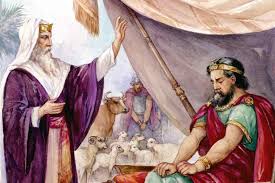
images-1Samuel’s choice was very predictable. Swayed by Saul’s appearances – tall, dark and handsome, Samuel anoints him king. Like many seemingly strong leaders, Saul’s narcissism is on the surface at least, attractive and impressive. He cuts a large swagger, is a big presence, and the people mistake this for real strength. Yet, like all narcissists, he’s a big man with a fragile ego. He is quick to take offense, has poor anger management control, and increasingly becomes more paranoid and vindictive. Despite initial successes, it works out badly for Israel under Saul, and it works out very badly for Saul himself.

Nepotism, ambition, and theology

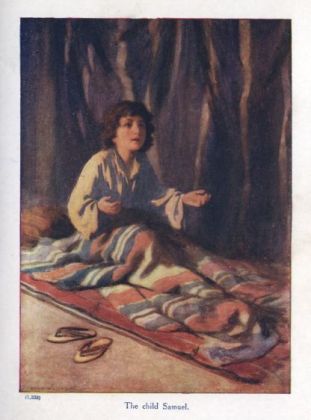
There is an interesting subtheme in the book of Samuel. Four weeks ago, we listened to the call of the boy Samuel. In calling Samuel, God repudiates the priestly succession of Eli because Eli’s sons were corrupt grifters who exploited their position of power and privilege to the detriment of the people. We next jump ahead in the story to where after many years of wise leadership the people complain that they need a king because Samuel is now old, and they fear being left at the mercy of his own sons, who they complain do not walk in the ways of their father but have turned aside and taken bribes.

Rulers are one thing, but ruling families where the members exploit the privileges of power for their own interests, are quite another.

Samuel’s dislike of the demand for a king is both theological and personal. Samuel had already appointed his sons as Judges to succeed him. As God thwarted Eli’s dynasty, so God seems to now thwart Samuel’s dynastic pretensions. What goes around come around.

However, the more important point is Samuel’s theological objection to kingship. The focus of the Deuteronomic history is faithfulness to the covenant between God and Israel. Yahweh is Israel’s only king. If Israel has a king like the other nations, Samuel rightly foresees that the prevailing regional models of divine kingship will cause Israel to reject Yahweh as their only king.

Samuel’s fears are well-founded. For the rest of the Deuteronomic history is the sorry tale of how Israel’s kings, again and again, placed themselves above obedience to the Covenant Law under which they ruled as God’s agent, not as God’s replacement.

Last week, we listened in the Samuel narrative to the anointing of the shepherd boy David to be king in Saul’s place. This time, God is leaving nothing to Samuel’s weakness for narcissistically handsome, warrior-like men with good legs. To Samuel’s imagesurprise, God passes over all the virile sons of Jesse until it seems he has run out of options. But there is one son remaining and when he is summoned he appears to be a boy with ruddy cheeks and bright eyes.

Samuel pours the oil of anointing over David in secret. No one tells Saul he is no longer king. But as David notches up military victory one after another, in today’s installment it seems something is beginning to dawn on Saul. Despite David’s successes and his ability to charm the increasingly paranoid king, Saul suspects something is up:

So Saul eyed David from that day on. The next day an evil spirit from God rushed upon Saul, and he raved within his house, while David was playing the lyre, as he did day by day. Saul had his spear in his hand; and Saul threw the spear, for he thought, “I will pin David to the wall.” But David eluded him twice.

David

David goes on to become the exception to the rule concerning kingship in Israel. Though hardly a paragon according to contemporary evangelical ideals of virtue, he nevertheless ruled over a golden age never to be repeated. David ruled 7 years in Hebron before conquering Jerusalem and making it his capital from where he ruled a further 33 years.

By the standard of the times, his was a long reign during which Israel morphs into a unified and powerful kingdom, rivaling those of the states around it. But David’s monarchy is a blip in the long trajectory of good governance in Ancient Israel. Although David faced the pervasive tendencies to concentrate power absolutely, what saved him and the nation time and again was his love of God and his willingness to be faithful to the covenant ideal that Israel had only one king, and Yahweh was his name.

When the prophet Nathan accuses David of engineering the death of Uriah so he could take the man’s wife, David presented with his crime, repents. David’s greatness lay in his ability to recognize the limitations of his power when it came to obedience to Israel’s covenant with God. A man of his time, nevertheless David is rare among the Israelite kings in his desire to love and honor Yahweh.

When the king ruled as God’s agent and not in God’s place, the nation prospered because this covenant form of government offered a more effective set of checks and balances capable of successfully negotiating competing interests.

After David, monarchy brought disastrous consequences for Isreal, beginning with his son, Solomon, whose taxes and dalliances with foreign religions oppressed the people and set the scene for the division of the unified kingdom following his death.

The Deuteronomist’s repeated judgment on each reign was whether this king did or did not walk in the ways of David, whether this king was faithful or unfaithful to the covenant with Lord.

Lessons from history

The Covenant between Yahweh and Israel was intended to function as a constitution, setting out the system of checks and balances in the interests of good government. Like Samuel, the framers images-1of the American Constitution feared the people’s demand – give us a king, for there were many who at the time thought General Washington would make a fine king.

And so the Framers wrote into the Constitution the complex system of checks and balances to ensure governance capable of negotiating different interests, which when taken together represented effective governance, serving the interests of the people while not pandering to the rabble cries of the crowd.

Their vision was not of popularism – governance at the mercy of the crowd, but republicanism – government reliant upon a system of checks and balances in which power and the limits to the exercise of power are clearly set out.

I guess we are all wondering what the future holds, but one thing is clear, we are now in the midst of a constitutional crisis. What the Founding Fathers most feared, is the very thing that results when Congress, craven before the demands of the rabble, abdicates power to an increasingly authoritarian Executive.

What alarms me is the historical amnesia. Let the Deuteronomic history of the Biblical record of Israel’s struggles with itself and its God be a lesson for us.

As the prophets in Ancient Israel knew only too well, tyranny is but one short collective memory loss away.


A Holy Trinity: Bible, Kingdom, and Politics

St Martin’s first strategic priority is called embedding the Bible in community life. In addition to recently completing the year-long Bible Challenge, many of our ministry groups now routinely take some time for Bible reflection during their meetings. At the recent men’s beer and pizza evening, actually, it’s more pizza than beer, we devoted time in our two hours together to have a Biblical conversation.

Taking the gospel for Pentecost 4, I invited the men into a subjective encounter with the depiction of the farmer scattering his seed. I asked them to note the word or phrase that caught their attention. We then proceeded to explore each man’s free associations evoked by encountering the text. This is an ancient process, known as divine reading, and in its contemporary form raises the question: how might God be using my associations to this text to speak to me about what needs attention in the next 5-7 days?

***

download.jpgIn the E-News Epistle which came out on Thursday, I made a very bold statement indeed. I said:

Despite our current immigration debate’s political and social complexities, the Bible allows Christians to hold only one view on immigration – we are to welcome the stranger. 

Now I am aware that it’s always tricky, as Jeff Sessions is discovering, to appeal to the Bible’s text as literal evidence for any proposition we might wish to advance. For on almost any matter to do with how to act, what to believe, what is binding, what is not, the Bible is a collection of contradictory texts. You can use the Bible to argue for or against slavery, for or against the equality of women with men. It’s more difficult to use the Bible as evidence for God’s dislike of LGBTQ people because Biblical societies had no concept of an inherently natural and stable developmental state we recognize as homosexuality. However, the one matter on which the Bible is fairly consistent is the obligation to welcome the stranger. Hence my statement in the E-news is quite difficult to contradict.

If we ask who and what kind of God do we serve? Welcoming the stranger emerges at the heart of Biblical obligation because God’s word to Moses when he asked this very question; when they ask me who shall I say sent me? – was:I am the Lord your God who has heard your cry and brought you out of bondage in the land of Egypt.

The reason we are to welcome the stranger, God tells us, is because we were all strangers, once.

***

When it comes to engaging with the Bible, there is no such thing as a plain meaning for the words on the page. There is the text, with its own history and context. Then there is us, and the context in which we encounter the text. Meaning emerges in the tension of the space between text as written and text as received by the reader.

***

imagesMark offers us a rather uneventful story of the farmer who sows his seed by a rather careless method of scattering it, willy-nilly. He then forgets about it, getting on with his life, trusting in God’s goodness in creation to do the rest. The seeds sprout and fruit, though he knows not how. Unlike many of us, he seems OK with not needing to control the process. He knows well enough his real work will come when the harvest is ready.

Jesus’ gospel message is open your eyes and ears and see how the kingdom is in-breaking all around you. Its coming is not within our control, yet neither are we passive bystanders in its arrival.

***

We cannot hasten the coming of the kingdom. Neither can anyone frustrate its coming. We have work to do, work of scattering the seeds of faith, hope, and love – scattering ourselves and our energies in the world.

We have further work as harvesters of the kingdom’s fruits. Faith ripens into courage, hope into persistence, and love into justice.

The kingdom’s coming is always counterintuitive. Its inbreaking is not another version of the myth of progress; advancing step by step and evidenced by things getting better and better, over time.  Will the coming of the kingdom be further advanced ten years from now? Experience shows it does not work like this.

We scatter, and the kingdom comes, though we know not how. Yet, are not the kingdom’s expectations advanced in a world where slavery is abolished, where women are emancipated, where LGBTQ men and women are accepted, and where the vulnerable stranger is welcomed? The answer is, of course. Nevertheless, the scourge of racism persists and in periods like the present seems even to grow stronger. Sexist discrimination, sexual exploitation of women, and the often-invisible limitations imposed by the glass ceiling, still remain firmly in place. Homophobia is still nurtured in the bosom of evangelical and patriarchal religion, and despite the divine requirement to welcome the stranger we tolerate the inhumanity of this Administration’s approach to immigration enforcement.

***

This coming week is World Refugee Week when Christians are asked to address the difficult issues of migration and population displacement in the light of the coming of God’s kingdom. What is our response when children, even infants still nursing at the breast are separated from parents at the border; when unaccompanied children and adolescents are detained in Walmart megastores converted into prisons? How must we respond to the latest extrajudicial decree denying asylum claims to women escaping from domestic abuse, and women and children escaping from communities ravaged by drug and gang violence; violence fed and sustained by our epidemic addictions. And when we have the temerity to object to these inhumanities, the Attorney General manipulates Scripture in support of a policy that by any standards is as draconian as it is arbitrary. The primary purpose of our rule of law lies in it being a remedy against capricious and arbitrary exercise of executive government.

In the light of the inbreaking of God’s kingdom, what should our response to immigration be?

Experience rather than prejudice and phobia should be the driver of policy. It is worth noting that communities across the country are benefiting from organized refugee resettlement programs, such as the one Dorcas International manages in RI. Economics dictate that if our economy is to grow to meet our national needs then migration is a principal source of the workforce growth necessary. For those escaping political and social chaos, compassion should temper suspicion.

***

Neither a fearful nor a soppy handwringing response is acceptable.

The kingdom demands from us a hard-headed commitment to hold our legislators accountable for the fashioning of sound policy grounded in principles of justice that protect the vulnerable from the arbitrary and capricious exercise of power.

In authoritarian forms of government ruling through the mechanisms of scapegoating, the vulnerable today will eventually become you and me, tomorrow.

[T]he reign of God does not carve out a separate sacred space; it claims all aspects of human existence. There is no such thing, not in Christianity at least, as an apolitical gospel. There is no economically neutral gospel. There is no gospel that dismisses the importance of embodied existence and interpersonal relationships. …however your church conducts its ministry, if it doesn’t provide sanctuary, hospitality, sustenance, and renewal to those who need it, …. then it isn’t the gospel. In short, there is no gospel in which Jesus remains buried in the ground like a dormant seed. Matthew Skinner

Gaslighting Jesus

This is my family- Mark 3-20-25


A sermon from the Red. Linda Mackie Griggs

people were saying, “He has gone out of his mind.” And the scribes who came down from Jerusalem said, “He has Beelzebul…”

In the past few weeks, the Episcopal Church seems to be having something of a moment.  Fourteen minutes in the pulpit at the latest royal wedding thrust Presiding Bishop Michael Curry into the spotlight. His energy alternately delighted and dismayed those present, and his message about the power of love actually became, briefly, a topic of discussion that shunted other matters to one side. You could actually hear people talking over coffee and on the radio about the Presiding Bishop’s message that the love he is talking about is not just the stuff of fairytale romance, but of justice, compassion, healing and wholeness. And to have us, the Episcopal Church, at the center of this Gospel message has been admittedly a breath of fresh air.

There are those who see all of this as a flash in the pan, noting that a few weeks later the country is back to business as usual; painfully divided and agonizing over the steady drumbeat of stressful news. But there is a heartbeat that is just as steady as the drumbeat—we just need to listen for it–for the persistent voices proclaiming the Good News, and to attend to the tradition in which they are rooted.

What are those voices? Bishop Curry came off of his star turn at St. George’s Chapel, and on the following morning’s talk shows, and went straight to Washington, where he preached again and led a march and vigil outside the White House as part of the Reclaiming Jesus Initiative; a prophetic movement led by a broad coalition of church leaders who feel that, in this time of moral and political crisis, Christians must remember that they are followers of Jesus first—before party, race, gender, ethnicity, or geography.

The Reclaiming Jesus Initiative isn’t alone. The Rev. William Barber’s revival of Martin Luther King’s Poor Peoples’ Campaign and the evangelical-led Red Letter Christians are two other broadly based prophetic movements that are finding their voice in a difficult time. They are also calling those in power to account, as prophets have always done. They are calling those who benefit from and are complicit with unjust systems to rethink their values and priorities.

These modern-day prophets have come by it honestly. They are following the Old Testament prophetic tradition, and they are following in the footsteps of Jesus—footsteps that are firm, steadfast, uncompromising and even a bit disturbing, as we heard in today’s Gospel.

An overarching theme of Mark’s Gospel is the pure urgency of Jesus’ message—his call to the people to wake up, to repent, and to believe the good news of the inbreaking Kingdom of God. One of the ways that Mark does this is by layering his stories within each other in a sort of crosswise chiastic pattern, more endearingly known as a “Markan Sandwich.” He does this at least nine times, in each instance interrupting one story with another, and then returning to the original. And rather than distracting the reader, Mark has actually maximized the effect by intensifying his major points, sort of coming at them from more than one direction at once. Like any good sandwich, the idea is that the whole is more than the sum of its parts.

Today’s story begins claustrophobically, with the hometown crowd pressing in on Jesus and the disciples, squeezing up so close that they can barely move their hands to bring food to their mouths. They are effectively entrapped by the crowd and its collective hunger for healing. And through the crush, Jesus gets word that his family thinks he has flown off the deep end. “He has gone out of his mind,“ they say. He’s crazy. Nuts. Bonkers. Come on Jesus, let’s get you home and put you to bed. And keep you quiet.

And then a shift, as the second layer is placed in the Markan Sandwich.  Our attention pivots to the scribes from Jerusalem who wish to pass judgment on Jesus because he is becoming a disruption—stirring up the people, supposedly casting out demons, performing healings (on the Sabbath!) and criticizing the Temple authorities. This man must be stopped. He’s–I know! He’s possessed by a demon—that’s it! Come on Jesus, let’s get you—quiet. Let’s get you–out of the way.

We have an undercurrent of worry in both layers. Jesus’ family is worried that he is about to make them the target of condemnation of the religious authorities. The religious authorities are worried a) that he will bring down the wrath of the Roman authorities, and b) that he is attacking their own authority and credibility. This is a tight spot for everyone.

Jesus first responds to the Scribes with pure logic. Of course, it makes no sense that, having cast out demons himself, he would be a demon.  A demon would not cast out demons—a house divided is doomed.  Then he intensifies his argument. He offers a parable comparing Satan with a strong man who thinks he is secure in his home. But in this parable Satan’s days are numbered because it is Jesus who is intent upon tying up the powers of evil; it is Jesus who is scoping out the property, aware that it will not fall without a fight. But he is ready to rumble.

These are powerful words and images. The vividness and even the darkness of them are disturbing. But the urgency is undeniable, and that is Mark’s intention; to communicate Jesus’ message that the Reign of God is near and that this is serious business. And those who would deny the evidence—the healings, the exorcisms—right in front of their eyes by declaring them to be the work of Satan are denying the Kingdom; denying its imminence and its potential—this is the blasphemy against the Holy Spirit to which Jesus refers. This is refusing God’s invitation, God’s yearning for his children to be part of the dream. And this refusal grieves God deeply.

The final layer of the Markan Sandwich returns us to Jesus’ mother and brothers, standing outside of the crowd, begging him to come away from this place—this situation that threatens to become dangerous, not only for Jesus but for those associated with him. They feel the eyes of the Temple and Roman authorities upon them. They need to tame him. This is why they say he has lost his mind. It is a narrative similar to that of the Scribes. If they say he’s insane he can be restrained. He can be controlled. So they pass the word through the pressing crowd: “Jesus, come back home. Forget this crazy talk. Remember us. Remember your family.”

Here is when we begin to see the cumulative effect of this Markan sandwich. It is driving home what Jesus is up against: a classic strategy. It is a strategy of renaming what cannot otherwise be controlled. Renaming or labeling can be an act of uncreation—of dismantling someone’s core identity by distorting it. It is a strategy of sowing doubt in the community. The strategy of Jesus’ family and the Scribes is that if they label Jesus, he becomes that label in the eyes of others. He becomes LunaticPossessed. And when, in the eyes of others, he becomes Lunatic—when he becomes Possessed, he becomes less than human. And thus easier to marginalize and control.

But what Jesus’ family and the Scribes fail to understand is that, while they may be able to distort Jesus’ identity in the eyes of some, they cannot sow doubt about Jesus in his own mind. They cannot, no matter how hard they try, gaslight Jesus.

And he makes that crystal clear; first with his parable about tying up the strong man, and then in response to his family’s pleas to remember them; he says, “ ‘Who are my mother and brothers?’ and looking at those who sat around him, he said, ‘Here are my mother and my brothers! Whoever does the will of God is my brother and sister and mother.’”

Jesus’ blunt words have turned the strategy of uncreating on its head. He has taken aim at a fundamental Jewish institution—the nuclear and extended family—and he renames it and extends it even further–drawing the circle wider, not more tightly. In response to others’ efforts to uncreate him, he refuses to be gaslighted, instead opening his arms in an embrace of the crowd and declaring the presence of the Kingdom; Here, THIS is my family. God’s family. The family created by the power of Love.

And here is what we need to understand about this family—what is so radical about this urgent passage: It’s something that necessarily follows from Jesus’ gesture of broadly redefining family. Think about that day on Golgotha, when he opened his arms wide on the Cross—what did he do? He included everyone in his loving and forgiving embrace. This family that he declares today includes everyone. Even those who want to marginalize and stigmatize him. Everyone who chooses to respond yes to God’s invitation is included, because that’s what God’s will is–an invitation to be part of the Family. The wonderful and challenging truth here is that, though anyone may refuse, everyone is invited. And that is the power of it—the power of love. Because if God welcomes both the marginalized and those who seek to tear them down, then that is what we must set as our goal as well. This is our work. The family is that big. To paraphrase the Presiding Bishop, Here is my family: conservative, liberal, anglo, black, white, latino, LGBTQ, heterosexual, citizen, immigrant, refugee,  parent, child—all are family. People we like and people we don’t—all are family. People we agree with and people we don’t—all are sisters and brothers. Family.

This is the urgent message, from the prophets, from the Gospels, and proclaimed even at a royal wedding. It has withstood the test of time, and it’s strong enough to withstand the vagaries of current events as long as we have ears to hear and eyes to see it. We cannot waste a second of our precious lives in fear, or in thrall to those who would divide us one from another. Rather, God challenges and invites us to follow the One who boldly declared himself ready to take on the strong one in his own house, and who wields his weapon of choice: the courageous, confounding and audacious power of love.

A Clear Litmus Test for the Church

There is a tension in organized religion between prophecy and culture.  In the playing out of this tension, organized religion runs the risk of accommodating itself to cultural expectations, bestowing a spiritual imprimatur upon them. When it resists this tendency and is faithful to its prophetic responsibility, organized religion poses a challenge to prevailing cultural assumptions that conflict with the gospel message of love and inclusion.

Prophetic religion can be likened to the unimpeded free-flowing movement of the Spirit, which like a natural spring of water gushes and spills out everywhere. Organized religion creates a walled reservoir collecting the gushing spiritual spring water of the Spirit, channeling it to become a flow of spiritual energy to irrigate civic and cultural life.

However, the fundamental weakness of organized religion lies in its tendency to reject its prophetic mission in order to compromise with the values of its surrounding culture, thus blurring the distinction between spiritual and cultural values. When this occurs, organized religion becomes cultural religion. Cultural religion not only suppresses prophecy but becomes its greatest opposition.

When religion puts on cultural blinkers, the journey from organized religion to cultural religion becomes a very short detour.

In the pages of the Old Testament, we witness this age-old struggle between the divine vision for Israel expressed in its covenant with God and its own vision shaped by an adoption of the cultural values of the world around it. The history of ancient Israel is a rollercoaster ride, a record of the ups and downs in a struggle that finds no simple solution.

***

samuel-hearing-the-lordThe first lesson for this Sunday, the call of Samuel, is set in an age when: the word of the Lord was rare, and visions were not widespread.  This is a description of a society in which God’s voice is no longer heard or even expected to be heard. In Samuel’s call, we witness Hebrew society’s final attempt to form a true theocracy in which God would be the sole leader.

Samuel was that last of the great charismatic Judges who ruled in Israel before the age of monarchy. In his call, we see God repudiating the religion corrupted by cultural values; that turned a blind eye to the misuse of power identified with Ely, then priest at the hill shrine of Shiloh, and his corrupt sons.

The period of Samuel’s judgeship is a watershed between tribal confederacy led by a charismatic leader and the emergence of monarchy in Israel. Under pressure, Samuel will finally gives way to the people’s demand: give us a king like all the other nations around us  -and anoints first Saul and then David to be kings of Israel.

The advent of kingship in Israel ushered in a new phase in the struggle between culture and religion. With the advent of the monarchy, Hebrew religion becomes corrupted by the cult of divine kingship. As a result, the office of the prophet now arises to speak out against the cultural corruption of Israel’s covenant with God. Israel’s new cultural religion gave its blessing not to God, but to kings who acted as if they were God.

In the politics of ancient Israel, prophecy becomes the counterpoint to the royal prerogative.

***

The eternal truth is that political structures shift and change, nevertheless the need for prophecy remains. By the 1st-century, Israel’s period of monarchy is but a dim memory. In Jesus time an imperial Roman occupation worked uneasily hand in glove with Jewish cultural religion represented by the Jerusalem Temple establishment. Jerusalem and the Temple embodied a 1st-century equivalent to life within the Beltway. In his teaching about the kingdom of God. Jesus – the heir to the prophets -confronts the cultural religion of his day.

field-of-dreams-e1486999847754_1_orig

Mark tells us of an incident between Jesus and the Pharisees that took place on the Sabbath. In his confrontation with the Pharisees, Jesus shines the spotlight on the central issue of the cultural corruption of religion.

Chapters 2:1 – 3:6 record five clashes between Jesus and the Jewish religious authorities. In this incident in the cornfield on the Sabbath Day, Jesus insists that God made the Sabbath for the benefit of human beings, not human beings for the benefit of the Sabbath.

The Sabbath observance harkens back to the Genesis story of God resting on the 7th day after 6 days of creation. Without regular rest and respite, our human capacity for the enjoyment of life is degraded. Thus God intends the Sabbath as an instrument of nurture and care. But the Pharisees had turned it into a religious instrument in the culture wars of the 1st-century; an instrument of social control enforced by punishment.

***

As in Jesus’ day, so also today. Organized religion when it turns it back on its prophetic responsibilities to speak the good news of the kingdom to society -degenerates, becoming a bulwark in defense of the hardness of the human heart. Every day, we are witnesses to the most strident defense of cultural values and political expediencies loudly trumpeted by religious groups that have become so identified with a particular version of American culture that they no longer bear any resemblance to the radical and revolutionary expectations of God’s kingdom articulated in the teaching of Jesus.

When confronted by prophetic witness, cultural religion becomes something lethal in its defense of cultural norms. In its practice of an extreme form of identity politics, culturally co-opted religion lashes out against everything that threatens its hold on power.

***

The Pharisees become so outraged by Jesus’ prophetic challenge that Marks tells us: they went out and immediately conspired with the Herodians against him, how to destroy him. Between the pious Pharisees and the worldly Herodians – between the so-called religious faction and those who cared for nothing but privilege and power, -can we imagine a more unholy and self-serving alliance? Regrettably, I think we can!

In a New York Times Op-Ed this week, Ross Douthat speaking about recent ructions in the white, male-dominated and politically power hungry hierarchy of the Southern Baptist Convention, poses our wider dilemma:

So the question posed by this age of revelation is simple: Now that you know something new and troubling and even terrible about your leaders or your institutions, what will you do with this knowledge?

Douthat concludes that:

For ….. all of us, the direction of history …… will be determined not just by Providence’s challenge, but by our freely chosen answer.

For organized religion in today’s America, there is a clear litmus test to determine the vibrancy of its prophetic health. This litmus test is simple, it is clear, and it is uncompromising:

Justice is what love looks like in public; tenderness is what love feels like in private. Cornel West.

“You will have to do better than that Patrick!”


Perhaps we can begin a more serious reflection on the Trinity with a little Irish humor from Donal and Conal.

Every Sunday we say together the words of the Nicene Creed, which distill down to four concise statements:

We believe in God, maker of heaven and earth. We believe in Jesus Christ, eternally begotten of the Father. We believe in the Holy Spirit, the giver of life. We believe in one holy catholic and apostolic Church.

The doctrine of the Trinity as we have inherited it today is the result of a need in the Early Church, not so much to explain the nature of God as to protect the nature of Christ from being reduced to one of two simple assertions – divine or human. For the key question arises, if God is God, who and what is Christ?

Is Jesus a man, a great man, an avatar like Moses or the Buddha, or Mohammed showing us a fuller revelation of God or the cosmic order in the case of the Buddha? Or is Jesus a divine being who like the God’s of Olympus dons the trappings of human appearance.

The Christian experience is that Jesus was both divine and human, both natures existing simultaneously, yet independently. But this seems to assert something that to all the world seemed and still seems absurd? Yet, the assertion of both human and divine goes to the heart of the experience of the Early Christians and Christians ever since.

The Christian experience makes sense in that to be human is to be most like God. But this requires God to have first experienced being really human. The doctrine of the Trinity emerges from the early Christian struggle to articulate an experience of God who is the God of creation, the intimate participant within creation, and the ongoing transformer of our experience within the creation.


Perspective from the 21st Century

The Holy Trinity forms a central plank in my own spiritual life. I have some sympathy for St Patrick when under the withering barrage from Donal and Conal he retreats into the impenetrable incomprehensibility of the Athanasian Creed. In his creed, St Athanasius puts it like this:

The Catholic faith is this: That we worship one God in Trinity, and Trinity in Unity, neither confounding the persons nor dividing the Substance.

Another way to approach this is to recognize that God is both unknowable and also knowable; mysterious and yet intimate; far off and yet close by. The Trinity echoes the first chapter of Genesis where God exclaims: Let us make humanity in our own image, male and female let us create them. Who is the us here?

The us is God who self-identifies as communal, not solitary. The Trinity reveals God as a divine community within which God manifests in three distinct ways. These have been traditionally referred to as Father, Son, and Holy Spirit. Today, we can get caught up in rejecting the gendered nature of these terms and miss that the main point lies not in their gendered but in their relational nature.  When I become sensitive to the exclusive impression male-gendered terms communicate I  translate them as God the lover, the beloved, and the love sharer. Gendered terms can be avoided if the essence of the relationship between equals is maintained.

Relational theology

Relationships require more than one person. Within the context of relationships, you cant speak of one member without reference to the others. Husband as no meaning with the concept of a wife, mother without daughter,  father without son,  sister without brother and so forth. Each term implies the existence of the other. Each identity is inseparable from its existence within a relationship.

Psychologically, we are object seeking. Our identity is most fully discovered and named in relationship with others. One Christian is no Christian because to be Christian is by definition to be a member of a community that bears this name. In the relational separations between persons on the divine community, we find our true identity as persons fulfilled and made complete through our seeking connection with others in relationship.

Being human is a reflection of the relational nature of the divine image, thus as the reflection is relational so must be the image it reflects.

From doctrine to worship

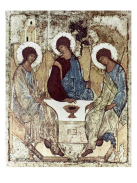
andrei--rublev-russian-icons--the-trinity_i-S-61-6179-4K11100ZDespite the popularity among Episcopalians to name our churches after the Holy Trinity, the Trinity in the Catholic and Protestant West has been largely reduced to a theological doctrine. The Orthodox East provides an interesting counterpoint. In orthodox Christianity, the Trinity is a devotional focus. This can be most graphically demonstrated by Andrei Rublev’s archetypal depiction of the Trinity, written (icons are written not painted) in 1410. The Trinity is shown as three identical persons lovingly gazing upon one another. Rublev clearly has in his mind’s eye the visit to Abraham of the three angels at the Oak of Mamre. Yet, in the striking aspect of Rublev’s depiction of God the Holy Trinity, we catch the echo of the conversation we hear God having in Genesis, let us make humanity in our own image. God is not a singular entity, but a relational community.

When we put together the ancient echo in the Genesis record of God’s internal conversation with our current psychologically shaped experience of the fluidity of identity, we arrive at the theological realization that for us, in our period of history, God’s nature takes on a poignantly, relational quality.

Identity

I don’t only believe in the Trinity as a doctrine, but I worship God through the Trinity. When I gaze at each identical figure seated around the three sides of a table, I notice how they gaze upon one another with expressions of intimate love.

Sitting before the icon of the Trinity I am reminded that my identity as a person is not constructed by me in isolation. I experience my identity as the result of the way I see others looking back at me. My identity is constructed through the interplay of my relationships. As I gaze upon the three figures of the Trinity, I am invited into a reaffirmation that I am a child of God because I belong to a community that reflects a relational God. I am a relational being and my health lies in my desire to seek my identity within relational connections with others. Only when we are fully in community together can we become an image of the unseen God, whom in the visibility of the Trinity we discover is not a solitary entity, but a relational community of love.

I began with Irish humor, let me end with Irish wisdom.

Three folds of the cloth yet only one napkin is there. Three joints in the finger, but still only one finger fair. Three leaves of the shamrock, yet no more than one shamrock to wear. Frost, snowflakes, and ice, all in water their origin share. Three Persons in God: to one God alone we make our prayer.                                                                       

An Irish Celtic prayer to the Trinity.

The Wind Blows Where it Wishes


A sermon from the Rev. Linda Mackie Griggs

There once was a bishop: Gregory of Nazianzus, Bishop of Constantinople. It was his mission in life to defend the Doctrine of the Trinity as stated in the Nicene Creed against those who would, in effect, strip it of its mystery. And one of the biggest mysteries of the Trinity (and there are plenty of them—more on that next week) was how, or even if, the Holy Spirit fits into the Trinity as its Third Person, of the same substance as, and co-eternal and co-equal with, the Father and the Son. To those who would minimize or eliminate the Holy Spirit in their theology, Gregory had this to say:

Look at these facts: Christ is born, the Holy Spirit is His Forerunner. Christ is baptized, the Spirit bears witness to this … Christ works miracles, the Spirit accompanies them. Christ ascends, the Spirit takes His place. … I tremble when I think of such an abundance of titles, and how many Names they blaspheme, those who revolt against the Spirit! 

Gregory was my kind of guy. The Spirit transformed how he saw the world.

Gregory wrote and preached copiously about this in the fourth century, and his work was tremendously respected—one of the titles given him by the Church was Gregory the Theologian. This simply goes to show that when people (like me) talk freely and admittedly enthusiastically about the movement of the Spirit—this isn’t a touchy-feely New Age-y thing: This tradition is ancient and powerful.

But be honest. Doesn’t the Holy Spirit make you just a wee bit nervous?  Because it should.

We wear red. We put out balloons, we’ll have red goodies at coffee hour and some churches even sing Happy Birthday to the Church. And that’s great—I love to see people engaged in a joyous celebration in the life of our faith. But if we’re not just a little trepidatious at the power of what we are celebrating, we’re missing the point.

The Spirit is hard to pin down. Unlike the other two Persons of the Trinity, commonly referred to as Father and Son, most of the words used to describe the Spirit are conceptual, like Truth and Wisdom, or functional, like Advocate, Guide, Teacher and Comforter, or material but kinetic, like fire, water, wind. The Dove is the only image that we can really get our hands on, but even then, just try to catch one.

And when it comes to gender, the Spirit is absolutely fluid. I know today’s lessons and the Creed, due at least in part to patriarchal influence, refer to the Spirit as male, but this is an incomplete picture. The ancient tradition was to equate the Spirit with Wisdom, or the Greek feminine, Sophia. The word for Spirit that Jesus would originally have used is the Aramaic, ruach, which is a feminine noun. And the Greek, pneuma, is neuter. So there you have it, the Spirit’s gender is definitely—indefinite. Genderless. Or all-gendered, whichever—isn’t theology fun?

Pentecost was a Jewish celebration before it was a Christian one. The Jewish Pentecost, or Shavuot, is the commemoration of the giving of Torah to Israel. So this is why Jews were gathered all in one place from all around the area, bringing with them their own languages, traditions and ethnic identities. Parthians and Medes, Elamites, etc… Imagine the cacophony of voices and languages, the rich mosaic of faces, the scent of different kinds of food…the tension of people encountering the unfamiliar.

And suddenly. The “sound like the rush of a violent wind.” Not simply enough to mess up your hair—think more like helicopter rotors, sending everything flying. And then tongues of flame, followed by a total linguistic paradigm shift, as everything they thought they knew about how they spoke or related to one another—was thrown out the window in one great Tower of Babel reversal. Imagine how disorienting this would be, for those who experienced or witnessed it.

This Holy Spirit is powerful. No wonder she makes people nervous.

There are those who see it/him/her as mostly the territory of evangelical and Pentecostal households of the Christian faith, looking askance at the surrender of the rational

in favor of the less quantifiable and predictable, and perhaps even more unnerved by the idea of speaking in tongues. For people who like things orderly, the Spirit can be overly mischievous, taking its own time about things we need to get settled now, and nudging us in directions we don’t understand, or even like.

We have learned to be skeptical of things we can’t control. We are products of a New England, Anglican, disenchanted Enlightenment point of view that has a difficult time accepting guidance from a flexibly-gendered immaterial out-of-the-box and generally stubborn Spirit. And yet, on that first Pentecost, lives were changed. The Church was born. All at once on that windswept and fiery day, people began to speak the language of the Good News of Jesus Christ, and the Dream of God began to take hold.

How do we know if it’s the Spirit that is urging us on? How do we know, in this era when people claim to be guided by the Spirit, but are actually indulging their own wishful thinking about a world that reflects their fears and a conception of God that conveniently matches the face they see in the mirror? How do we know? It’s a good question, and it gets to the heart of what it is to discern—to weigh, through listening in community and with the Spirit’s guidance—what we are called to do.

In our church ,we have a template that helps us with discernment– our Baptismal Covenant. (Book of Common Prayer, pp. 304-305)

Listen to the questions that it asks, and how it directly confronts us with our vocation and identity as followers of Jesus:

Will you continue in the apostles’ teaching and fellowship, in the breaking of the bread, and in the prayers?

Will you persevere in resisting evil, and, whenever you fall into sin, repent and return to the Lord?

Will you proclaim by word and example the Good News of God in Christ?

Will you seek and serve Christ in all persons, loving your neighbor as yourself?

Will you strive for justice and peace among all people, and respect the dignity of every human being?

Worship, prayer, reconciliation, community, justice, compassion, evangelism, humility. This is our Christian identity. With God’s help.

No pressure, right?

This Covenant is where the Spirit nudges (or sometimes shoves) us as we discern our path. No wonder it makes us nervous. It requires measures of courage, perseverance, and steadfastness that we fear we don’t have. It requires us to make the living out of our faith the centerpiece of our lives; every minute of every day.

And in these days when we are bearing worried witness to the groans of a Creation in painful transition on so many fronts, discerning the Spirit’s movement and letting it/her/him set us aflame with Gospel energy is an invitation we are being called to answer in the affirmative. With God’s help.

Today is one of my favorite days in the life of the church—the celebration of Holy Baptism and the welcoming of a new member of the Household of God, Madeleine Mae McCloskey. When I first saw her and heard her name, I instantly thought of the words of children’s author Ludwig Bemelmans—his description of the main character in his beloved Madeline series: “She was not afraid of mice; she loved winter, snow and ice. And to the tiger in the zoo, Madeline just said, ‘Pooh, pooh!’”

The qualities that endear Madeline to us—courage, joy wonder, spunk—these are qualities of the Spirit that we pray our Madeleine—and in a few minutes we will, as a community, claim her as ours—these are the gifts that we pray Madeleine will offer to a world in great need of Gospel courage, joy, wonder and spunk.

Today we will, as we always do at baptism and Pentecost, call upon the Holy Spirit, eagerly waiting to welcome her/him/it into our midst. But given what we know about her power, and her persistence, perhaps we should consider that, rather than waiting for the Holy Spirit, the Holy Spirit is waiting for us.


In but not of: that’s the question.


So it truly is a miracle to experience the sudden bursting into new life that occurs as the weeks of May give way to the sudden warmth of a New England spring – so long delayed that it seems no sooner here than it’s gone and suddenly, summer is upon us.

My thoughts of awaiting the miracle of spring coming to my garden provide a suitable analogy to where we are at present in the yearly cycle of the Church’s calendar. As in the days of late April and early May transitioning between the seasons of winter to spring to summer, we now wait in the time-in-between, between Ascension and Whitsun, expectant of a new cycle of fruitfulness in the spiritual life of the community we know as the Church.

***

Concepts of ascending and descending provide powerful metaphors for the movement of spiritual time from one cycle to the next. The Evangelist Luke used them to particular effect. Ascending and descending as metaphors already existed in the Jewish spiritual imaginary for Luke to draw upon. As the prophet Elijah had ascended into heaven, born in a chariot of fire, as he rose, his mantle fell to rest upon the shoulders of his servant Elisha; anointing him to continue the vital work of prophecy in Israel. In Luke’s theological schema, Jesus bodily ascends in order that his Spirit can descend upon his followers; anointing them to continue the vital working for the kingdom’s in-breaking- your kingdom come; your will be done on earth as it is in heaven.

With the appointment of Matthias to replace Judas Iscariot, who having betrayed Jesus, now lay dead, his entrails polluting the field he had purchased with the ill-gotten gains of his treachery, we see a picture of getting on with the work during a period of waiting in an in-between time – waiting for further instructions, as it were.

The Evangelist John gives us a more nuanced picture of the tensions involved in the work ahead. Being a disciple of Jesus will require living in the world but not being of the world. This is a place of necessary tension. In the First Letter of John, written by someone we know as John the Elder who was a disciple of John the Evangelist, the author makes explicit the tensions involved in living in the world, while not being of the world.

John the Elder addresses the tensions leading to the breakup of the Beloved Community formed around the teachings of John the Evangelist. Some in the community had come to believe that they could be in relationship with God without believing in Jesus as Son of God. Freed from believing in Jesus as the way to the Father, having confined the concept of neighbor to those like themselves, they no longer felt bound by Jesus’ commandment to live with love as the mark of their discipleship.

John the Elder protests that belief in Jesus as the Son of God and obedience to his commandment to love everyone is what marks-out those who continue to live in the world but are not of the world.

Those who believe in the Son of God have the testimony in their hearts. Those who do not believe in God have made him a liar by not believing in the testimony that God has given concerning his Son.

If he were to put it in more contemporary language John the Elder might have said that it’s all a matter of values; the values of the kingdom or the values of the world.

***

Contexts change, but the tension between being in the world but not of the world remains the same. For the community of John the Evangelist, the theology of living in the world but not being of the world was born out of an experience of dispossession and exclusion. Johannine Christians were Jews no longer welcome in the synagogues. They were excluded from the cultural settings in which late 1st and early 2nd-century Jewish life reconstructed itself after the fall of the Temple. In the time of John the Elder, the Johannine community was fractured by the actions of those who had come to understand the intimacy with God promised by Jesus in his farewell instructions to the disciples as a matter of their entitlement to claim equality with God.

It’s a short journey from claiming equality with God to no longer needing God.

***

As 21st-century Christians, we remain in the tension between living in the world but not being of the world. Like the members of the Beloved Community, we also hold conflicting understandings of what being in the world but not of the world looks like. We are struggling to navigate our way through a period when the perennial tension of living in the world but not being of the world is a focus of particular conflict. Contexts change but the tension between being in but not of the world remains the same.

***

Being in but not of the world is the central theological tension running through the entire history of the Judeo-Christian epic. On the one hand, there is a theology of the chosen people in possession of the promised land by virtue of their being the chosen. On the other, there is the theology of liberation from bondage, a different kind of experience of chosen-ness in which the promised land is not a possession but exactly what its name describes – a promise – still in the process of being fulfilled. Both are theologies rooted in the Exodus experience of our Hebrew ancestors in faith. They conflict with each other, mightly.

In the particular American context, this ancient theological tension manifests in our conflicting vision of ourselves as a nation. One vision is that we are the chosen people inhabiting a shining city set on a hill, looking out over the promised land, ripe for our taking. The other is of a people chosen by virtue of being freed from the bondage of multiple oppressions. Set in the context of our New England history, is the tension between the Massachusetts Bay and the Rhode Island experiments.

Today, it’s the tension between those who define their chosen-ness through assumptions of white-male privilege and those whose sense of being chosen is the direct result of their experience of oppression at the hands of white-male privilege.

Judeo-Christian history is the story of a people chosen through being liberated into the hope of the promised land. But it’s also a story of a people who kept forgetting that their chosen status was not based on their power and privilege, but on their having once been slaves before their liberation. Whenever the people forgot this and claimed the promised land on the basis of assumptions of entitlement, they lost it. They kept forgetting that being chosen carries responsibilities, and the promised land is only ever a gift, not a birthright.

***

For me, it’s mostly my vulnerability, not my sense of entitlement that defines me as one who is living in the world but not of the world. Being connected to my vulnerability connects me to the vulnerability in others. Here are some simple ways to work out whether you are living in the world but not being of the world.

  • How do you feel when judges interpret the law and politicians pass legislation that favors corporate interests over those of communities?
  • Do you notice when the operation of the law and the criminal justice system oppresses the poor and denies them justice?
  • Are you turning a blind eye so that you fail to recognize let alone challenge the entrenched institutions and attitudes of racism in America?
  • How do you feel when your elected officials are in the pockets of those who would continue to exploit and pollute our air, land, and water in the interests of private profit?
  • Do you believe that the concern for the threat to women from the male use of power to sexually and professionally exploit them is overblown?
  • Do you agree that whiteness and white maleness, in particular, deserve special minority protections; that when a black woman is given a job over the choice of a white man that she’s been given his job?
  • Do you think the freedom of religious conscience should be able to deny LGBT people equal rights before the law?
  • Do you believe that universal access to affordable public education and healthcare – esp. for women is not a civil right?
  • Do you believe that Second Amendment rights should be protected from any regulation in the interests of public safety?

imagesIn seven days, we will commemorate the birth of the community we know as the Church. In seven days we will receive the empowerment of the Holy Spirit so that we might continue the work of agitation for the inbreaking of the kingdom. Are we living inspired by the expectations of the kingdom; expectations of justice for all; as those who depend on God to liberate us from our bondage, not once but over and again? Or are we those whose lives are guided by a complicity with the values of the world; values shaped by the exercise of the powerful over the powerless; the values and politics of entitlement? The answer will tell us whether we are in or of the world.

“Never forget that justice is what love looks like in public.”
― Cornel West

I’ve Been Thinking About Friendship

images-2I’ve been thinking about friendship. One of my weaknesses has always been an ability to move-through.

I‘m struck by a paradox of moving-through. Emotional attachment to places and people is a necessary skill for a priest to have, yet so is the ability to detach and move on. As a priest, one enters a community ready-made to receive you. New faces, new relationship possibilities, new situations and contexts rapidly fill the void left by previous leavings. Parishioners often like to remind me when I do something they don’t agree with that I am only passing through and they were here before me and will be here after I have gone.

I have to confess that being a priest enables me to connect more deeply with others, but at the same time, it has encouraged in me a kind of laziness when it has come to the maintenance of previous friendships, left behind after moving-through. I am increasing saddened by this awareness.

I’ve been thinking about friendship. Perhaps it’s a wisdom that comes with aging – the realization dawning more clearly that when it comes to friendship, there is little time for squandering and taking love for granted.

***

I’ve been thinking about friendship. Men and women seem to have different approaches to friendship. Friendships, their making and sustaining seem to have now become the social responsibility of women, who maintain friendships not only with one another, but facilitate the social worlds of their families, and especially their husbands and partners. While this is a situation that is particular to heterosexual marriage, the dynamic of one partner taking social responsibility for making and sustaining friendships is also something that characterizes relationships between gay men. In my long 40-year relationship, it’s largely been Al’s responsibility to nurture our mutual relationships with others.

I was born in 1955. In the world of my childhood and adolescence in the late 1960’s & early 70’s I remember my mother and father existing in separate social worlds. As the social world of women has greatly expanded beyond the traditional areas of home and children, changing expectations of marriage have also resulted in a shrinking of traditional spheres of male camaraderie leaving men more and more the passive participants in the social worlds their wives now create, organize, and sustain. In the NPR March 19th podcast Hidden Brain episode titled The Lonely American Man, a number of men reflect on the slow deterioration of their capacity for friendship. One man reports that when his wife is home, there are never enough hours in the day for all their social activities, but when she is away for more than three days, he rapidly becomes a hermit.

A new sense of the deficit of moving-through, and a growing concern about wider societal trends leaving many men emotionally isolated from one another gives impetus to my desire to revive some kind of men’s community at St Martin’s. It comes as little surprise that the Women’s Spirituality Group (WSG) flourishes while attempts to bring men into community together, continue to flounder. I am reassured to discover that this is not only the rector’s concern but is a concern more widely shared among the men of the parish.

On April 7th, 30 men came together to talk about hopes and expectations for a revival of a men’s community. On April 24th a similar number attended the first beer and pizza evening. On May 8th we plan a second of these dinners. At these events, men are recognizing and articulating their need to enjoy the company of other men; to eat together, to share experience, to grow together, and eventually, together to forge a vision of being of greater service in the wider community. To this end, St Martin’s Men’s Community (SMMC) is establishing itself as an umbrella under which men can self-organize according to different needs and interests.

Within the SMMC we have the level of the large group community. Here the process of being in a large group (30) encourages individual encounters.  The SMMC also fosters an energy for more intimate encounters in smaller groups. One example is the revival of something remembered with affection – the priest facilitated small lunch discussion group. Alongside this, flowing from the traditional concept of a book group, new possibilities for multiple reading (smaller than a book like an Op-Ed article) discussion groups are emerging. A third level of activity is service. This will take longer to emerge but will be the direct fruit of both the large social and small group learning encounters. As the community solidifies there is the future hope of SMMC sponsored service projects in the wider community.

As is the case with the WSG, the SMMC is one of our portals or gateway ministries because it is open to all men from far and wide, Episcopalian or not, who wish to participate in building Christian men’s community together.

***

I slipped in that qualifier Christian before the word community above. It feels controversial to have done so, for in the St Martin’s Community the use of Christian as a qualifier is often heard as an expression of an unwanted and undesirable exclusivity associated with Evangelical groups. Yet, what we are about is building Christian community among men. The thorny question is what is it that makes a community Christian amidst a raft of other social and service group possibilities?

In John 15, Jesus, building on his commandment that his disciples love one another continues to explain to them that there is no greater love than to lay down one’s life for one’s friends. For Jesus, this is not a generalized statement that in principle there’s no greater love than to lay down one’s life in the cause of friendship. Jesus is being very personal. He is teaching his disciples about his own willingness to give his life for them, as it turns out on the cross. He contemplates his own self-sacrificial death not simply as an expression of some lofty and high principle known only between the heavenly Father and his earthly Son, but as an intimate relational commitment to his friends. He startles them when he tells them:

You are my friends, he tells them. I do not call you servants any longer, because a servant does not know what the master is doing; but I have called you friends because I have shared with you everything I have learned from God. 

This kind of friendship is a revolutionary political action in a world of strict hierarchies of master and servant relations characterized by the use and misuse of differentials of power that characterize the normal tendencies or status quo in human societies. 

***

The life of faith is lived at the intersection of two axis lines – one horizontal and the other vertical. At the human level, we easily recognize that friends are accountable to, and for one another. On the horizontal axis, there’s mutuality in the responsibilities for one another shared among friends. Is this also true along the vertical axis?

Jesus teaches that the world will recognize us as his friends by the manner of our love for one another. He also teaches, that his friendship with his disciples flows directly from his friendship with God. This is how love flows up and down along a vertical axis revealing friendship-love as a core quality of the divine nature. In a few weeks, we will celebrate the deeper implications of this mystery on Holy Trinity Sunday.

It’s easy to get the relationship between the two axes back-to-front in the sense that many have and still believe that you must love God first then others second. After all, this is how the ancient Jewish commandment – love God as the first commandment and then love neighbor. Even Jesus restates this in the summary of the Law. But from a human perspective living into the reflection of divine friendship first requires viable blueprints and templates for friendship with one another. Developmentally, do we not learn to love God through the love of self and then love of neighbor?

Human beings, left to their own impulses tend towards developing friendships that usually bear the marks of self-interest. It’s easy to be friends with those we are attracted to. It’s easy to be friends with the like-minded, those who are like us. Human friendship tends to degenerate into exclusionary practices.

The connection between human friendship and Christian friendship lies in adding the dimension of the vertical axis an allowing it to inform and shape our expression of friendship with one another. Our belief that friendship is an essential quality of God reflected back to us confronts our tendencies towards the exclusivities that preserve so many evils in human society.

***

I’ve been thinking about friendship informed by the vertical axis which further transforms us into resurrection-story-shaped communities – where friendship empowers us to be no less than God’s future-arrived-in-the- present.

May [we] have the courage to listen to the voice of desire that disturbs [us] when [we] have settled for something safe and may the forms of [our] belonging – in love, creativity, and friendship be equal to the grandeur and the call of [our] soul[s].

My paraphrasing of lines from: For Longing [1]– a poem by John O’ Donohue

[1]

blessed be the longing that brought you here
and quickens your soul with wonder.

may you have the courage to listen to the voice of desire
that disturbs you when you have settled for something safe.

may you have the wisdom to enter generously into your own unease
to discover the new direction your longing wants you to take.

may the forms of your belonging – in love, creativity, and friendship –
be equal to the grandeur and the call of your soul.

may the one you long for long for you.
may your dreams gradually reveal the destination of your desire.

may a secret providence guide your thought and nurture your feeling.

may your mind inhabit your life with the sureness
with which your body inhabits the world.

may your heart never be haunted by ghost-structures of old damage.

may you come to accept your longing as divine urgency.
may you know the urgency with which God longs for you.


Bearing Resurrection Fruit

A sermon from Linda Mackie Griggs for Easter 5The Vine


Abide in me as I abide in you. Just as the branch cannot bear fruit by itself unless it abides in the vine, neither can you unless you abide in me.

Every year during this liturgical season I go on a mission to remind people that they can say “Happy Easter!” for fifty days, not just for one. For those of you counting along, today is Day 29, so that makes 21 “Happy Easter” days to go.

This isn’t just a liturgy-geeky fun fact. Easter as a season, not just a day, is important to the Christian life, if only because at seven weeks—that’s longer than Advent, longer than Lent—its length reinforces the impact of what has happened in the Resurrection. Easter isn’t just a holiday on our calendar—there and then gone—any more than the Big Bang was just a random cosmic pop in space. Like the Big Bang, Easter has transformational consequences. It transforms how we see the world, our neighbors and ourselves. The impact of Easter on our lives is a challenge and an invitation—asking a recurring question: What does it really mean to be People of Resurrection?

Today’s Gospel passage is from Jesus’ Farewell Discourse, which he shared with his disciples in the hours following the Last Supper and before his arrest. These are Jesus’ final words of peace, challenge, and reassurance to his friends. Reading the discourse you get the palpable feeling of urgency—like a parent’s final instructions to a child heading out the door, or a teacher trying to cram vital information into the last lecture. Even before the Discourse, at the Last Supper, Jesus urgently needed to communicate his love and legacy in a way that the disciples would never forget; taking bread and wine, blessing them and offering them as himself with words that resound through the ages, This is my Body…This is my Blood.

And the Discourse is similarly vivid as Jesus tries in his last few hours to impress his wisdom on the hearts of his friends.

Today we hear him speak of abiding, of vines, and of fruit. What does it mean to abide in Jesus? In the Gospel and the three Letters of John, all of which were written by the same late first-century community, the word abide appears nearly 70 times. Seventy. Somebody is trying to tell us something.

“To abide” in the Johannine context is distinctive from other references in the New Testament—here it means to stay, remain, dwell, endure, await. It connotes the Benedictine idea of stability—sticking it out no matter what. To abide in Jesus and in God is to be in a consistent, steady, solid, but not always easy relationship. Abiding is both comforting and challenging at the same time.

Seventy times. Obviously, this is a core concept for John. But I don’t think it is necessarily a new idea that randomly popped up in his head. As I was reading this passage and seeing this word repeated…abide…abide…abide…it started reminding me of another phrase that I see over and over when reading the Psalms: Steadfast love. “Help me O Lord! Save me according to your steadfast love….His steadfast love endures forever…Let your steadfast love come to me…” The list of references in the Bible Gateway website goes on for pages.

There is a foundational Jewish ethical/theological concept called chesed. It is articulated in the Hebrew Scriptures as, yes, ‘steadfast love’, mercy or loving-kindness. It refers to the special relationship between God and God’s people, and it informs the relationship of God’s people to one another. Fundamental to chesed is what are called acts of mercy and compassion. In other words, God’s compassionate care for us is reflected in and expressed by our commitment and compassionate behavior toward others.

God’s compassionate care and steadfast love. Abiding love.

Related to chesed is the broader concept of tikkun olam, or ‘repairing the world’; a phrase that dates back to the first century, or about the time of Jesus and John. It encompasses those actions that serve to establish God’s Kingdom by bringing healing and wholeness to the world.

Bearing Fruit

Jesus and John the Evangelist were rooted in the Jewish faith. They were plenty knowledgeable of the Scriptures and of the fundamental tenets of Judaism, including the concept of chesed. So it isn’t too much of a stretch to see how it might influence Jesus’ teachings.

The steadfast love of God invites and challenges us to reflect that love to the world in concrete ways; to contribute actively and intentionally to the healing and reconciliation of God’s people with God, Creation and each other.

To live in the steadfast love of God is to abide in the Vine. A thriving, glorious and prodigiously fruitful vine.

John uses the metaphor of being cut off for the isolation, alienation and emptiness that result from seeking to fill the God-shaped hole within us in exclusively self-gratifying and fruitless ways. We’re called to resist that. We’re called to be woven, entwined, even entangled sometimes, in relationship with God.

To be People of Resurrection is to understand in our minds and hearts that Jesus, the embodied Word of God, is the root and vine of all we do for the healing of the world. We are called to fruitfulness through acts of mercy and steadfast love; acts that are not just good because good people should do good things, but as part of a larger dream—God’s Dream– of a just and peaceful world. A Dream that exploded into Creation in the Risen Christ, and that still ripples through our lives if we have eyes to see it and ears to hear it.

The beauty of the image of the Vine is that the branches share the nourishment together—no one branch must bear the burden of producing all the fruit. The Dream of God is a big picture and we each choose how to respond to God’s call to fruitful living. The key is to begin somewhere and trust in the dream.

There’s a meme that I saw a few months ago that illustrates it: One character says to another: “Why so optimistic about 2018? What do you think it will bring?” Response: “I think it will bring flowers.” “Yeah? How come?” “Because I’m planting flowers.”

To be People of Resurrection is to plant flowers–to live a life of discipleship, connection and community, seeking to thrive and to help others thrive and live abundantly. It is to abide in the Risen Christ—to stay, remain, dwell, endure, await–plant—nourished with faith and hope through the Vine that empowers us to bear fruit that carries the DNA of the Kingdom of God.

Happy Easter!


Of Lambs and Elephants


In the 12th-century, St Bernard of Clairvaux, founder of the great Cistercian reform of Benedictine life described Holy Scripture as: 

a vast sea in which a lamb can paddle and an elephant can swim.

When it comes to our encounter with the Bible through a regular practice of reading Holy Scripture, most of us will be lambs paddling. Yet maybe some of us if not already elephants swimming the depths will be encouraged to grow in that direction.

In a few weeks, we will finish our reading of the Bible Challenge, a programmatic reading of the Bible begun after Easter last year. We began the year-long reading of the Bible as a way of dispelling the fruits of 150 years of  Biblical Criticism that has left us feeling that the Bible is for experts, scholars, and clergy trained to be able to unpack the sitz im leben, the historical, cultural, and theological settings in which a text was originally written. This has led to a propensity among Episcopalians to encounter the Bible through the lens of commentary. Thus learning about rather than engaging with the text keeps us in our detached comfort zone.

Yet our Anglican Tradition speaks in the imagery of the three-legged stool in which Scripture, Tradition, and Reason are held in a mutual tension of equal relationship. We still honor Scripture, but we now only hear it within the context of worship. Outside of the formality of liturgy, we attempt to sit on a two-legged stool of Tradition and Reason. Straddling a two-legged stool requires considerable acrobatic dexterity.

St Martin’s is a community where few of us find it possible to accept faith as a matter of unquestioning obedience to the literal interpretation of words on a page. We are a community where faith is increasingly seen as a major life-shaping story. Many of us enjoy the way meaning is conveyed through language that is complex, and nuanced. We are beginning to understand the way story shapes us individually and communally. We believe that metaphor more effectively conveys truth-plus, and that truth is poorly conveyed when limited to the face value of the words on the page.

****

The language of the Bible is such that meaning is conveyed imaginatively. Meaning is fluid and open-ended able to speak to the challenges encountered in our lived experience. Stimulated by the power of curiosity we are encouraged to explore beyond the simple meaning of words on the page. A rich appreciation of metaphor allows us to echo the words of the prophet Jeremiah[1]:

When your words came, I ate them; they were my joy and my heart’s delight, for I bear your name, Lord God Almighty.

Approaching the text for Easter 4 can we discover our experience revealed as truth-plus through the way text uses of metaphor and poetic figures of speech?

****

The Fourth Sunday after Easter conveys the arresting metaphor of The Good Shepherd conveyed through the powerful imagery of the 23rd Psalm and John 10. In 2015 I preached on the Good Shepherd text, drawing upon what for preachers can become a clichéd contrast between biblical and contemporary images of shepherding. However, coming from a country where sheep outnumber people by 40-1, I am very familiar with the contemporary experience of shepherding sheep.

imgresYou may recall that I have spoken about my nephew Hamish who on his sheep station in The Lord of the Rings high country of N.Z’s. South Island, shepherds his Marino sheep either from the seat of an ATV or the saddle of a horse, depending on the terrain. In response to a complex set of whistles and verbal commands from Hamish, he drives his sheep before him in the direction he wants them to go.

Sheep have been gifted by the Creator with a double dose of stupidity. Nevertheless, the image for our relationship with God is often depicted as a version of modern New Zealand sheep herding; God in the rear driving us on with his dogs of guilt barking in our ears and fear nipping at our heals. Yet, contrast the words of Psalm 23 in which God is the shepherd and we the sheep. God as the Good Shepherd does not drive us before him, setting his dogs upon us, whose bark frightens us, and whose teeth nip us into line. Instead, he leads us beside still waters so that we may lie down in green pastures. Even through the valley of death, he accompanies us so that we need not fear any harm befalling us. His rod and staff are not symbols of discipline and control, but of protection and comfort. The Biblical image of sheep is one of cherished objects with which the shepherd feels an intimacy of love and concern.

Again, a contrast between sheep and people reveals that it is not only sheep who are created with a double dose of stupidity. Jesus, teaching in poetic metaphors discovers again and again that it’s the human beings that fail to hear his voice. The biblical image draws a distinction between the sheep who hear his voice and the people who are deaf to his voice. Hearing in this sense is a metaphor for knowing and being known by.

In John 10 Jesus speaks about the unreliability of the hired hand who at the first sign of the wolf runs away. He speaks of robbers, identified as those who do not enter the sheepfold by the gate. His metaphor for the entrance shimmers between images of gate and gatekeeper before finally identifying himself as the gate. Jesus is not some arbitrary gatekeeper but with his body becomes the gate across the entrance of the sheepfold, so that those who seek to enter to do us harm must first encounter him.

In response to hearing his voice, the sheep come and go, responsive to the shepherd’s voice, in pursuit of the green pasture. The mention of green pasture is a metaphor for life lived to the full takes us full circle back to the imagery of Psalm 23.

****


Despite the great distances of time, place, and mindset separating us from Bernard of Clairvaux, John the Evangelist, and the psalmist of the 23 Psalm, we share the experience of being shaped by the power of a poetic imagination whose rich language of allegory and metaphor opening our ears to recognize the distinctiveness of God’s voice among the cacophony of competing, false voices in the world. Whether as lambs paddling on the edge of a vast scriptural sea, or as elephants venturing beyond the safety of the shore, we face the prospect of no longer living in a place of security, but still hearing God’s voice echoing through the creative imagination –we swim with increasing confidence and trust. Hearing the Good Shepherd’s voice we navigate through a difficult and at times dangerous world.


Blog at WordPress.com.

Up ↑