To Resist Being Loved

christinthewilderness


Verse 9 of Mark’s first chapter opens with these words:

In those days, Jesus came from Nazareth in Galilee and was baptized by John in the Jordan. And just as he was coming up out of the water, he saw the heavens torn apart and the Spirit descending like a dove on him. And a voice came from heaven, “ You are my beloved Son, with you, I am well pleased.”

It ‘s so good to get back to Mark’s gospel in the Lectionary’s three-year cycle of gospel readings. Mark’s narrative is spare and uncluttered with extraneous detail. As we can see in the passage above, Mark does not describe events from the safety of the past tense. He writes in the continuous present. Using the ing verb ending, Mark ushers us into the action as it happens, e.g. and just as he was coming up out of the water he saw the Spirit descending like a dove on him.

Mark’s language is also personal and direct. God speaks directly to Jesus: “You are my son, the Beloved, with you, I am well pleased”. It’s interesting to compare Mark with Matthew’s version of this same story where God says: “This is my son, the Beloved, with whom I am well pleased”.

So who does Matthew think God is addressing? Certainly not Jesus! Perhaps the reason for the difference is that Matthew has already identified who Jesus is in his birth narrative. In Matthew and Luke Jesus is born as God’s son. Jesus already knows who he is and so God’s speaking at his baptism seems to be for someone other than Jesus’ benefit. But in Mark, there is no doubt that God is speaking directly to Jesus.

The question that intrigues me is this: is Mark suggesting that God is telling Jesus something he does not already know? Does Jesus know he is the Son of God before God identifies him as such at this moment of baptism?

Because Mark gives us no backstory on Jesus birth or origin, his appearing before John to be baptized is his first arrival on the scene. What really excites me is that in Mark, God does not talk about Jesus in the third person as reported in Matthew and Luke, but names Jesus, to his face, as the Beloved with a capital B. This is not a beloved, but THE BELOVED. And it appears from Mark’s construction of the story that the process by which Jesus comes to be the Beloved is not by birth, but adoption. We are also children of God, not by birth, but through adoption. And our adoption, like that of Jesus’, is through baptism, a baptism at which God names us also as beloved – although with a small b.

****

This leads me to ask what is our experience of being be-loved by God?

We are coming to the end of the first week of our participation in the Lent Program from SSJE and The Virginia Seminary – Meeting Jesus in the Gospel of John. The theme of this week has been the love of God. Each day we have been invited to respond to a short Scriptural passage and journal our responses and associations as the text as it works it’s way into us. I have found that what really works well for me is not to journal at a single sitting, but to carry the journal around with me throughout the day. In those moments of trying to remember to pause by creating a space between the ending of one activity and the beginning of the next, I read the text again and jot down some more associations and responses.

The real challenge for me has been to take seriously John’s message that God loves me. I am beloved, not because of anything in myself that is particularly lovable. I am God’s beloved, because God has first and foremost, loved me.

I have been curious to note my emotional response to being addressed as beloved. Theologically and intellectually I understand myself to be the recipient of God’s love. Yet, emotionally, I shy away from this for I feel and know myself to be both unworthy and ungrateful.

George Herbert’ poem Love Bade Me Welcome exactly describes my shying away. When God tells me I am beloved my natural reaction perfectly echoes Herbert’s words:

….I, the unkind the ungrateful? Ah, my dear, I cannot look on thee. 

It’s as if I want to tell God: thank you, but no thank you! To be beloved of God is too intrusive and potentially demanding, too intimate a suggestion. It’s too much for me to accept because the reality of God’s love for me takes me way out of my comfort zone.

The human existential reality is that it’s hard to be loved. It is so much easier to the lover. The lover has all the control. Between us, and God, there is a continual negotiation going on around this issue of loving and being loved. As the lover, God pursues us and has no intention of respecting our intimacy comfort zones.

The Rev. Mr. Herbert says it best when he puts God’s negotiation and pursuit of us in this way:

….I, the unkind the ungrateful? Ah, my dear, I cannot look on thee.

Love took my hand and smiling did reply, ‘Who made the eyes but I?’

Truth Lord, but I have marred them, let my shame go where it doth deserve. 

Because Herbert lived and wrote in a time when Anglican theology was strongly influenced by a Calvinist emphasis on Jesus’ sacrifice, he naturally continues: 

And know you not, says Love, who bore the blame? 

Ah, My dear, then I will serve.

You must sit down, says Love, and taste my meat,

So I did sit and eat. 

Finally, comes the human capitulation in the face of God’s relentless pursuit. 

If I was more spiritual I might say that my experience of God’s love for me is humbling. In reality, I shy away from it because I find it humiliating. I know that heaven is not about earning and deserving, but believing and receiving, yet, so much of my identity is predicated on being worthy as one deserving of God’s love only to the extent of having somehow, earned it – a ridiculous notion I know, but it’s buried deep in me and seems impervious to theological reason.

The truth is I am loved. We are all beloved because God’s love is gifted to us. Our response should be to open and receive this gift; letting our humiliation – our shame go where it doth deserve.

****

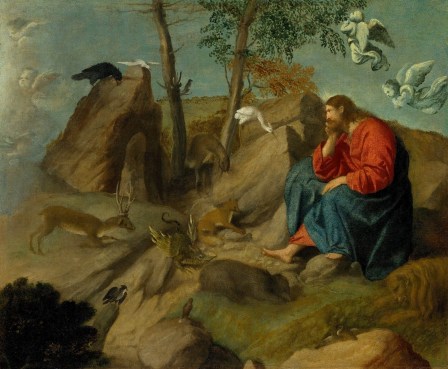
Notice how Mark simply tells us that the Spirit drove Jesus out, in effect expelling him into the 40-day wilderness experience, being tempted by Satan? Again, note Mark’s preference for strong and active verbs; compare: immediately drove out – with Matthew’s more passive: was led out. 

Also, note how Mark provides no details as to the nature of the confrontation between Jesus and Satan. The detailed series of temptations come from Matthew and Luke, not th-1from Mark.

I like Mark’s version better, not only for the stark beauty of its sparseness but because it allows us to populate Jesus’ time in the wilderness with our own imaginings.

Might Mark’s lack of prescriptive detail provide space to populate Jesus’ experience in the wilderness from within our own imaginations so that the 40-days become a more intimate struggle with our own demons?

As we move into Lent, let us look more deeply into our own experience of temptation and struggle. In particular, let us look head-on at the greatest temptation of all – to shy away from receiving our true identity as beloved of God

Mark ends this section with Jesus returning from his time of preparation in the wilderness to find John has been arrested. The time he says has come, the Kingdom of God has come near, repent and believe the good news! For us also, there’s no time to lose!

Listen here to Ralph Vaughan Williams setting of Herbert’s poem.


Ash Wednesday Message

There is no text to accompany this extemporaneous message. In the message, beginning with the Tagore quote linking service with joy  I suggest that keeping Lent focuses on our service to God. Using Benedict’s approach to the regulation of the day, I translate his approach into the contemporary concepts of mindfulness and intentionality. Being mindful and intentional guided by Benedict’s injunction that all activity has a beginning and an end and between the ending of one activity and the beginning of another lies a period for prayerful pausing, taking stock, quietly breathing. The Book of Common Prayer invites us to practice traditional disciplines of fasting, prayer, repentance, self-denial, and almsgiving. I offer interpretations of what these traditional practices of service to God and others might look like in our contemporary context. I end with a warning about expectations.

On The Loss of Transcendence


Margaret Wheatley writes about joy as an experience of connection, communion, presence, and grace within the ordinariness of our daily experience. She notes how it’s possible to have joy in moments of great suffering. Noting that it is in pursuit of happiness that we estrange ourselves from joy, she speaks of joy being the same as sadness for both states embrace us with an energy that is beyond physical – laughing or crying – it doesn’t matter.

Perhaps this seems so paradoxical as to not be true until we realize that joy and sadness are both states of self-transcendence. When we lose connection to the transcendent we are left to the tyranny of self – a state of profound disenchantment.

Faced with a birth, a wedding, an anniversary – we are captivated by joy. In the face of a death, a disaster, a tragedy of personal or epic proportions, sorrow and sadness capture us as we suffer with, console, and love one another.

The joy we so long for may not be found on mountaintops but it must be found somewhere. It’s not distance that separates us from a life-enhancing encounter with the living God, but a preoccupation with self that makes self-transcendence impossible.

+++

The Canadian philosopher Charles Taylor is to my mind one of the towering figures in contemporary philosophy. Joshua Rothman in an op-ed in the New York Times last year wrote that Taylor:

has explored the secret histories of our individual, religious, and political ideals, and mapped the inner tensions that cause those ideals to blossom or to break apart.

images-1Taylor’s massive opus A Secular Age explores the historical, religious, and political developments leading to our arrival in the current secular age. He contrasts the year 1500 when it was impossible not to believe in God with the impossibility of such belief for many today. He charts the route of travel as the culture of the West moved from the impossibility of unbelief to the impossibility of belief.

In the long 400-year emergence of our current secular Western mindset, Taylor notes the gradual transition from the age of enchantment to the age of disenchantment, Disenchantment denotes our loss of a connection to the transcendent.

When our connection to the transcendent is lost, all we are left with is ourselves – now occupying center stage. This is a place of great loneliness and disenchantment.

+++

Drawing on Taylor’s distinction between enchantment and disenchantment helps us to view the Biblical narratives as the product of an enchantment mindset. To the enchantment imagination, God is often frighteningly present in the physical structures of the material world. Divine power not only inhabits objects and places, it fills and disturbs the relational spaces that separate one person from another. God is made uncomfortably known in the sweep of great events through the unfolding epic that is the story of history.

The enchanted mindset understands God’s presence in spatial terms of up and down, in imgresand out. Thus God inhabits sacred mountaintops, sacred spaces. The encounter between the divine and human takes place only after a laborious journey up to the mountaintop where God dwells in a self-revelation in blinding light.

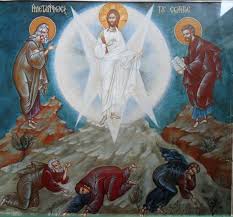
Yet at the same time, the mountaintop is a place concealed in thick cloud. What comes to be known there cannot be spoken about. On the mountaintop Peter, James, and John experience an epiphany of Jesus clothed in his divinity as the Christ. This is a fleeting experience, no sooner glimpsed than it is gone – forever eluding their desire to capture and contain it. Then the disciples must negotiate the even more perilous path down the mountain carrying the experience. They must carry the remembrance of what they have seen and yet, at the same time, practice a kind of forgetting.

Events on the mount of the Transfiguration are only at a midpoint in a long process towards the dénouement or the final act in Jesus’ ministry. It seems that in the spiritual life peak experience is only a means to, and not an end in itself.

As they were coming down the mountain Jesus ordered them, “tell no one about the vision until after the Son of Man has been raised from the dead”.

+++

Today we do not look for God in material space-time. The acceptance by past generations, whose enchantment shaped expectations of encountering God in material objects and places is now firmly rejected by most of us as superstition. Nevertheless, the question is not does a separate spiritual dimension still exist for the modern imagination, but where and how does it exist for the modern disenchantment mind?

Spatial references to up and down don’t work in the same way for us. For us, God no longer inhabits the mountaintop. Heaven is no longer imagined as up there, or hell being down there. Yet, the metaphors of in and out still work for us. For a modern imagination, the spiritual realm is best conceived of as a parallel dimension that interpenetrates with space-time.

When Dr. Martin Luther King Jr. said he’d been to the mountaintop, no one assumed he had actually climbed a mountain.

The mountaintop now becomes the metaphor for the possibility of a different order of experience, one that challenges our acceptance of the absence of the spiritual in lives given over to a preoccupation with our small self. We may no longer find God in the through the material world in quite the same way as our Biblical and generational ancestors did, yet, despite this God remains emotionally and experientially available to us.

The paradox is that while we reject enchantment as superstition, no generations crave with a greater intensity a desire of self-transcendence than we do. Magical realism, heroic superhuman sagas abound in Hollywood’s works. Opioids, marketed as a solution for physical pain establish a hold on society as a solution to the increasing levels of our spiritual pain.

+++

Margaret Wheatley speaks of joy as an example of a transcendent experience because joy is able to encompass both delight and sadness. Joy is not happiness, which is a very one-sided experience. Happiness is easily destroyed because it is the product of self-preoccupation. Joy radiates outwards, opening new pathways for interconnection and relief from self-preoccupation.

So here is the clue. For us today, transcendence is found in the web of interconnectedness with one another. We transcend the limited confines of self not into the emptiness of bliss, but into the joy of being fully present for one another. Wheatley quotes from the great 19th-century Bengali poet and spiritual teacher, Rabindranath Tagore:

I slept and dreamt that life was joy. I awoke and saw that life was service. I acted and behold, service was joy.

+++

The Transfiguration story is a halfway point in Mark’s account of the life and times of Jesus. It marks the transition point from preaching and teaching in the Galilean countryside to his final and eventful journey to Jerusalem.

The Visit of the Magi and the Transfiguration bookend the Christmas-Epiphany season. From here on, we move into a different section of the spiritual journey. The landscape becomes rocky and desert-like as we journey down the mountain into the season of Lent.

Is there no better time than in Lent than for us to renew our engagement with the debilitating experience of our preoccupied and disenchantment self?

It’s About Time

A sermon from the Rev Linda Mackie Griggs for Epiphany 5

He came and took her by the hand and lifted her up. Then the fever left her, and she began to serve them.”

It has been said that a preacher should preach about two things: About the Gospel, and about 10-15 minutes. That old quip came to mind because I’ve been thinking a lot lately about time. Maybe it’s the turning of the new year. Maybe it’s the imminence of Lent so quickly on the heels of Christmas, leaving us with no breathing space. Maybe it’s the fact that Malcolm and I updated our wills this past week. Regardless, time has been a thing lately.

Salvador Dali Melting ClocksIt’s not a major revelation that time’s passage is puzzling. It purports to be steady and measured; marked in precise intervals by atomic clocks—and on our cell phones. But anyone who has lain awake at 3:39 in the morning and contemplated the endless sleepless and usually worry-filled hours ahead, and then compared that to the fleeting seconds of cozy sleep that pass so quickly after you hit the snooze button— anyone who has had that experience knows that time is fickle. It even varies from person to person; I read recently that the past year has gone by either painfully slowly or relatively quickly depending upon how we respond to current events.
As Einstein demonstrated, and as we all know, time has subjective qualities that render it at once measured, steady and relentless, yet also ebbing, flowing, and mysterious.

I wonder if that’s because time is so tightly entangled with mortality. How much time do we have left? How much time for our friends and loved ones? And not just on a personal level—a few weeks ago the entire state of Hawaii thought it had twenty minutes left on earth. Monday’s Providence Journal had a front page article

about preparedness for nuclear attack. The Bulletin of Atomic Scientists clock,

that measures how close the world is coming to nuclear war, moved thirty seconds closer to midnight. Things haven’t been this tense in decades. And it’s bound to affect our outlook on the future. How do we look toward tomorrow if we don’t know if there will be tomorrow?

Well, that’s depressing.

I know, but it’s a serious conversation that I was having just a few days ago.

There’s a country song that’s called “Live Like You Were Dying” that posits what we would do if we knew we had just a little time left, and the idea would be to cram all the fun and excitement and love into a short span, and not waste a minute on ‘the small stuff’. But to live like you’re dying also risks a mentality of the heck with responsibility, do what you want because it just doesn’t matter anymore.

So what’s the alternative?

Perhaps rather than living as though there’s no tomorrow, it would be better to live—and plan—in hope and faith that there will be tomorrow because really, even if everything were calm and perfect in the world we still don’t know how much time we have on earth. We have as much as we have; that’s the case now, just as it has always been. The question is not how much time we have left, but what will we do with what we have?

And that is what gently weaves its way through our scripture lessons today, including Isaiah. “Have you not known? Have you not heard?” This gorgeous passage from Second Isaiah is a reassurance and reminder to the people not to despair;

that their time will come, and that the unsearchable God of Creation who has numbered and named the stars has every creature in God’s hand, and they are called to wait faithfully for deliverance that will come.

Eventually. In time.

For Israel it was seventy years.

And during that time they would establish themselves and become a community in exile—living in faith and hope for a tomorrow that they might not see, but the generation after them would. Isaiah was calling them to wait, not in despair of time running out for themselves, but in anticipation of—and preparation for—the future for the next generations.

In Paul’s letter to the people of Corinth you see him encouraging the Corinthians to come out of their identity silos and walk a bit in the shoes of others, which indicates that the concept of empathy was apparently a challenge for the young developing church. But what does this have to do with time?

When Paul wrote this letter, late in the first century, he felt the pressure of time in a different way from the people of Israel in Isaiah’s time; rather than feeling that time was stretching endlessly ahead, Paul felt that time was coming to a close—that the Second Coming was imminent, and that the community—a diverse, cosmopolitan and fractious bunch, needed to get it together quickly. The example that he was setting was of a person who so deeply felt God’s call that he was willing to make a free gift of his ministry, not asking for reward.

“To the Jews I became as a Jew, in order to win Jews…to the weak I became weak, so that I might win the weak…” The way to preach the Gospel, in other words,

is to live the Gospel; to respond with empathy, truly listening to one another from a place of vulnerability and humility. Don’t waste precious time quarreling.

Paul’s mission was to form a beloved community in preparation for the Reign of God—a time that was at once quickly approaching and yet already here. Time was short; who knew if there would be a tomorrow? The call to the people of God was to live in whatever time they had with a Kingdom mindset, not in fear but in fulfillment of, and anticipation of, abundant life.

So to Paul time was at once precious and meaningless—something to be savored and used well, and not dwelt upon as a commodity for its own sake;

In a way this helps to express the concept of God’s time—Kairos. God is in all of time

and therefore not ruled by it. To be mindful of God’s time is to be open to its fluidity and mystery; to understand the Incarnation of Christ as God entering into time

in the person of Jesus, who embodies the intersection of time and eternity.

In the Gospel today we see time moving quickly, and distinctively. More than in the other Gospels Mark expresses urgency. Like Paul, he was writing very early after the Resurrection and felt the pressure of time—the awareness that Christ’s return was imminent. And his narrative shows this urgency. Things move quickly—the word, ‘immediately’ is used over 40 times in this Gospel. And today we see Jesus moving from pillar to post, dogged by Simon Peter as though he was some kind of a handler with a clipboard and an itinerary—“…after the synagogue, Jesus, you have a healing appointment at my house, followed by teaching, healing and deeds of power in the evening, and we have an early start tomorrow for spreading the Good News, so you’ll want to rest up…” When Jesus escapes long enough to pray—he has to wait until everyone is asleep to manage it—the disciples hunt him down. It’s exhausting.

So Mark has squeezed a lot into a relatively short amount of time, but what does this tell us? What is the invitation of this story in our pondering of time’s mystery?

It lies in resurrection.

In returning to time—getting it back. Jesus came to Peter’s mother-in-law, sick with a fever, took her by the hand and lifted her—in other translations, raised her up. “Then the fever left her, and she began to serve them.” For years I saw this passage as an excuse for getting snarky about patriarchy, or mothers-in-law, but no; this is actually a pivotal expression of Christian identity by Mark, who had an almost Pauline understanding of what a kingdom life should look like for someone living in the now-and-not-yet.

The Greek term for “lifted up” or “raised” is the same one Mark uses for Jesus’ resurrection. And he uses it in six healing stories in his Gospel—six instances of people being restored to their families, to wholeness, and in a way to time itself—

lifted up from the suspension of time that can mark pain or illness and returned to the flow of daily life. From Mark’s perspective the healing grace of Jesus is a form of resurrection.

And the response of the healed is what?

To serve.

“…and she began to serve them.”

The word he uses is a form of the Greek for deacon—one who serves. So this story is not one of patriarchy as usual. Rather, it’s telling us that in response to Christ’s healing grace and renewal we are called to serve. That is how God calls us to spend our time—no matter how much or how little we have.

What would you do if time were offered back to you?

Sandy Buffy knows the answer to that question. In 1997 she was diagnosed with a life-threatening pancreatic tumor. Faced with the decision of whether to undergo extremely risky surgery to remove it, she was given a two percent—Two. Percent.—

chance of surviving the surgery. As a mother to three small children, twin boys and a girl, she wanted to see them grow up, so she chose the surgery. Her husband and family were advised to say their goodbyes, which they did. Can you imagine how wrenching that must have been?

And she survived.

Two Percent.

And since then she has lived a life of daily gratitude. Sandy is an artistic person, and after her recovery her creativity went into overdrive. Beginning working from her home in Charlotte, she now has a studio and gallery in downtown Cleveland, creating and teaching and having a wonderful time. And she has given 100% of her profits to charity.

One Hundred Percent.

“And she began to serve them.”

Sandy embraced her resurrection by throwing herself into a life of gratitude, beautifully symbolized by the fact that she works with materials that have been used before—bottle caps, dryer lint, random bits of chain, roofing copper, what have you. She serves by giving things new life, and then gives again of the rewards from her creations.

More than anyone I know Sandy has taught me about the precious meaningless of time—how to live joyfully and compassionately in each moment while holding very lightly the fact that the number of moments allotted to us is a mystery, and there is no point in fretting about our inability to control it.

Chances are we won’t experience such a dramatic moment as Sandy’s in our own lives, so how can we participate in the precious meaningless of time?

Jesus experienced it when he withdrew in the dark hours of the morning to pray. Like Jesus himself, prayer is the intersection of time and eternity; a way of allowing ourselves, within the framework of our lives, to rest in the timelessness—the eternal present/past/future –of God. Or consider the Eucharist: When we partake in Christ’s mysterious and real presence, we participate in a sacrament in which the events of the past and the promise of the future meet in the present moment. That is God’s time.

(And that is why some priests take off their watches before every service.)

In prayer and sacrament we are offered sacred time; precious time rendered mysterious and meaningless in the presence of God. We are offered healing grace and are lifted up in renewed wholeness every time, and every time called to get up, to go out, serve the Lord, and be the Good News.


Giving Ourselves Up To God

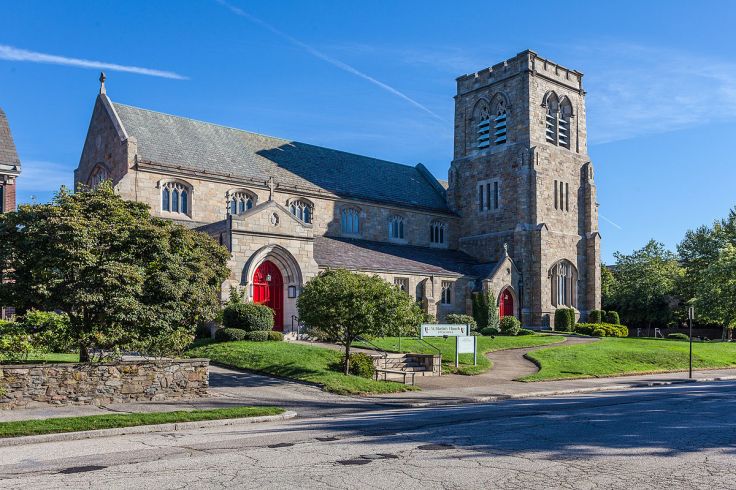
St._Martins_Church_Providence2017 Rector’s Report


Taken together the reports from the various ministry groups in this Annual Report provide in detail a record of achievements in 2017. I have no wish to duplicate this information here. For the purposes of this annual state of the parish reflection, I want to review 2017 through the lenses of spiritual practice, engagement, and overall health, a slightly different take on our three strategic priorities.

Christian communities often get bogged down in issues of belief and miss the point that what we believe is often much less impactful that how we live and act. The prayer of General Thanksgiving recited every day at the end of Morning and Evening Prayer puts it succinctly:

And, we pray, give us such as awareness of your mercies, that with truly thankful hearts we may show forth your praise, not only with our lips, but in our lives, by giving up ourselves to your service, and walking before you in holiness and righteousness all our days. 

We express our discipleship not through the words we speak but in the manner of our living. Hence spiritual practice is a first lens through which to review these past 12 months.

Spiritual Practice

Worship is the first element of spiritual practice. At the Bishop’s visitation in January 2017 he consecrated the new nave altar and communion rails. The care and attention given to the design and manufacture together with the financial generosity of members in the congregation symbolize our commitment to the importance of worship as a community of practice.

In 2017, the average Sunday (ASA) attendance danced around the 120-140 mark. ASA is gradually falling as a stable measurement as older patterns of weekly attendance change. In addition to our traditional schedule of services, we added a new worship opportunity in the form of a monthly, Tuesday evening Eucharist during which the sacrament of anointing and laying on of hands with prayers for healing is the special focus. So far numbers are slowly climbing at this service as word of mouth promotes this as an opportunity to connect spiritual practice with the emotional and spiritual yearnings in 21st-century life.

In 2017, the offering of prayers for healing in the chapel during communion has drawn increased numbers of folk for whom this is an important support in bearing the burdens of the heart. Attendance at the weekly Meditation Hour on Thursdays continues to hold steady with the introduction of a more body focused meditation practice. On the Thursday before Christmas, we held our second Blue Christmas service, with a focus on the experience of sorrow in a season of joy. This year we drew 70 folk, roughly double the numbers on the same event in 2016.

It’s clear to me that a traditional Anglican emphasis on worship continues to not only define our community identity but is leading us to encounter a deeper spiritual connection with God as a community as we peer into the mists of an uncertain 2018.

The second element of spiritual practice in 2017 has been in the area of embedding the Bible through the ambitious program of the Bible Challenge – reading the Bible over the course of a year. An unthinking and unreflective approach of – it must be true because the Bible tells us so, as well as a cynical rejection of the Bible as a source for anything applicable for life in today’s world, are both attitudes that are equally challenged when we are exposed to the unfolding epic of God’s relationship with the Judao-Christian community over the span of some 4000 years of social and theological development. Scripture is a poor and tyrannical rulebook. However, it is a powerful source of wisdom for how human beings and communities can find strength and purpose as they contend with the sorrows and joys of living with God at the center of their lives.

I don’t have an accurate sense of how many people are actually participating in the Bible Challenge program but in 2017, yet, we have had more conversation about the Bible than before, and Bible Study has flourished in surprising settings.

For instance, Vestry meetings no longer start with a ritualistic pause and a prayer as Vestry members have each taken responsibility to begin meetings with a personal reflection on a Biblical passage, inviting wider discussion. A good third of our Vestry meetings is now given over to spiritual practice in the form of Bible reflection at the beginning and Compline or night prayer at the end. The Vestry, long the bastion of the practically minded has in 2017 continued its evolution into a leadership team of spiritually inspired vision crafters.

Yet in 2017 the Bible Challenge has deepened our scriptural fluency and tolerance for complexity. Whether you are participating actively or passively in the Bible Challenge, it continues into 2018 as a central element of spiritual practice with knock-on effects that are as yet, hard to measure. 

Member Engagement

If we were a retail organization we would report a sharp increase in foot traffic in 2017. As a lens, engagement offers us a very positive story to tell in 2017. We had a staggering 120 visitors in 2017. The definition of a visitor is a new face we’ve not seen before. Of the 120 visitors, 40 have become members.

The website has played an increasing role in showcasing the parish to enquirers. While usage by members remains disappointing considering the amount of time spent on maintaining the website, it is a key factor for enquirers in finding their way to our doors. At the end of the year, e began to revamp the website in the direction of greater simplicity and pictorial appeal. The new design will be launched within a month or so into 2018.

The fact that I can tell you how many visitors we have had in 2017 indicates an enhancement in our ability to capture this information thanks to the tireless efforts of those involved in the welcome ministry. I commend their report to you. It’s also clear to me that, in 2017, increased energy for engagement has resulted in us taking greater strides towards being an every member ministry community where everyone takes responsibility for engagement with newcomers. Over and over again, newcomers report that this is the most friendly and welcoming church they have come into. One young man who attended on a baptism Sunday said: I felt like I had stumbled into a family gathering. He stayed and was formally received into membership of the Episcopal Church by the bishop last Sunday.

In addition to increased visitors on Sunday morning, we are seeing participation from non-members for weekday offerings, for example 10 women attended the Women’s Spirituality Group who are not part of Sunday congregational attendance. This is a sign of how we have opened another doorway for people to participate in the life of St Martin’s.

An important challenge in 2018 will be able to offer men an experience of solidarity that functions to open a door to men in our wider community, beyond the boundaries of the Sunday congregation.

Any increase in numbers is an amazing achievement of swimming upstream against the flow of traditional New England indifference to the serious practice of Christian faith and the demographic challenge of a still sluggish Rhode Island economy.

A picture of Health

Financial support is not the only indicator of levels of engagement and health in our community, but it is a crucially informative metric. As with average Sunday attendance, there continues a decline in the number of pledging members. This is a global phenomenon, again reflecting changing generational demographic priorities. I commend the Treasurer’s Report where you can gain a sense of the underlying trends, which are resulting in a smaller number of pledging units contributing a higher level of income – to produce in 2017 the first surplus in some years.

At the beginning of 2017, the draw from the endowment was budgeted at 5.5%. We will end the year with a draw of slightly less than 5%. I note that this is a real achievement, for when I arrived in 2014, the endowment draw was 7 +%. The autumn annual renewal campaign netted 22 new pledges going into 2018.

Health as a lens revealing a steady progress. In my first two years at St Martin’s my focus was on reenergizing the parish system. 2017, my third year, shows a parish system fully re-energized.

This is thanks to all of you believing that St Martin’s is a community that is not only worth your continued support, but a community worth your enhanced investment of time, talent, and treasure.

Of the three elements of personal investment -time, talent, and treasure, time remains at the highest premium as the pressures of modern life take their toll on us. In 2018, the danger will be that despite an increase in membership numbers and a healthy balance sheet we remain in danger of overheating as we all run at capacity to keep the size and complexity of our program going.

A phrase we will hear again in the coming year is – less is more, i.e. we must invest more energy in fewer programs In 2018, our priority remains one of becoming more and more a magnetic community of attraction, giving testament to Archbishop William Temple’s comment that:

The Church is the only institution that exists primarily for the benefit of those who are not its members.

2017, has been a phenomenal year for St Martin’s during which we have shown forth God’s praise, not only with our lips but in our lives.

In conclusion, I want to return to the notion I mentioned earlier that an overemphasis on believing is less impactful than focusing on how we live our lives.

It’s a false distinction in some senses because belief and practice are intertwined so that we can’t live and act well if our primary belief in the centrality of God in our lives is absent.

Let us continue into 2018 along the path we have chartered, a path of spiritual deepening characterized by the manner in which we {give} up ourselves to God’s service, walking in holiness and righteousness -all our days.

Will You?


jonah-and-the-whaleWhat do you know about the book of Jonah? Put up your hands (metaphorically if you are reading this) if you know the name of the city to which God asks Jonah to go? Do likewise if you know the name of the city to which he escapes in order to take a ship going in the opposite direction from the one God asks him to take? Raise your hands if you know what happens to Jonah after he is thrown overboard from the ship in the midst of the storm? I imagine if you can’t answer the first two questions you will get the third right. Because what we all know about the story of Jonah is that he is swallowed by a whale and spends three days cooling his heels in its fishy belly before being vomited up onto the seashore.

In the Bible Challenge, we will arrive at day 246 on Monday having recently read through the entirety of the Book of Isaiah and are now 13 chapters into Jeremiah. Judged by worldly standards of success none of the Major Prophets –Isaiah, Jeremiah, Ezekiel, Micah, Amos, Hosea, etc -seem to have been successful. They cry out about backsliding ways and the people refuse to repent. They draw attention to impending crises and the disasters predicted happen anyway. Now, in contrast, the prophet Jonah, a minor prophet if there ever was one, is a rip-roaring success. After some shilly-shallying about, he preaches for only a day to the citizenry of great Nineveh, calling them to turn from their evil ways. Low and behold, they do! At first sight, we might conclude that no one is more surprised than Jonah. But when we look deeper, we notice that Jonah is really pissed off because he knew beforehand what the outcome would be.

He tells God plainly that it was because he knew God would change his mind that he tried to avoid the task in the first place:

That is why I made haste to flee to Tarshish; for I knew that you are a gracious God and merciful, slow to anger and abounding in steadfast love, and relenting from disaster. Therefore now, O Lord, take my life from me, for it is better for me to die than to live. 

And God asks Jonah – Do you do well to be angry? meaning, Jonah, how does it serve you to be so angry?

This seems a very contradictory way for a prophet to behave and goes to the heart of the conundrum of this book of only four short chapters. When face with conundrum we all experience a strong impulse to cut through the uncertainty and confusion and make it simple anyway, regardless of the consequences.

So the simple interpretation is that the book of Jonah is about racial and religious intolerance and the desire to exclude those who are not members of our tribe from being the recipients of God’s grace. Despite his rip-roaring success with the folk in Nineveh by getting them to repent and thus enabling God to change his mind about wiping them from the face of the earth, Jonah, a good Hebrew, does not like God being merciful to a bunch of heathens. He likes even less being made to be God’s instrument in what appears to him to be a sorry affair.

How’s Jonah’s complaint ringing for you?

Jonah is a short book written sometime between the 5th and 4th- centuries BC during the period of the returning exiles from Babylon to Jerusalem. However, its setting is in an earlier 8th-century time, probably around the 750’s when Nineveh, the capital of the Assyrian Empire was at its peak. Recall that it was in 721 that the Assyrians swept down from the North and destroyed the Northern Kingdom of Israel completely. The book’s plot of sending a Hebrew prophet to win the Assyrians over to God’s favor has some loaded undercurrents.

In reading any scriptural text the first question to ask is what is the purpose of the writer (s)? The book of Jonah, the son of Amitai, meaning son of truth, seems to be an appeal to the returning exilic community, busily rebuilding Jerusalem, warning them against the dangers of retreating into a racial and cultural exclusivism that places limits on God’s mercy and compassion.

Jonah is a warning to our human propensity to limit God’s abounding mercy so as to bolster our own fear and anxiety.

Did you know that Jews read the book of Jonah in the afternoon on the Day of Atonement? Picture this, the drama of the morning liturgy with its solemn chant of the Kol Nidre, the prayer of atonement is now past and the expanse of the afternoon opens before the fasting penitents whose hunger and thirst only increase as the day draws on. Reading Jonah reminds them of the fruitlessness of any attempt to evade the relentless task of examining the unpalatable truths of one’s life – at least in the last 12 months.

Jonah, despite his knowing better, is a model for the fruitlessness of attempting to evade God. Jonah rejects God’s purpose, i.e. God’s desire to pardon and save. Jonah sits in judgment on God by seeking to distance himself from God’s generosity.

How perverse it is that the thing we desire most for ourselves is also the very thing we work so hard to deny to others.

In a recently published book entitled, Jonah: The Reluctant Prophet, Erica Brown, of George Washington University:

Jonah is, in many ways, every man and woman who struggles with inadequacy, who confronts the darkness within and without…. Jonah is every person who has wrestled with insecurity, celebrates second chances and then realizes the path out is never linear. Jonah is the only Biblical Book that ends with a question, because his life became a question: is life worth it? Can we find meaning? Can we find Peace? 

My answer for now is that we cannot find meaning or peace without an honest examination of how we, individually and communally have participated in attitudes and actions that have sought to limit the extent of God’s mercy, compassion, and generosity to my/our tribe, my/our community, only to those like me/those like us.

The Lectionary in placing a reading from Jonah alongside Mark’s depiction of Jesus calling his first disciples presents us with an uncomfortable challenge. God is not only more generous and loving towards others who are different from ourselves than we might care for God to be, but God expects us to be her agents, his voice, her hands, his feet in mirroring God’s concern.

God calls us to be prophets, or in the more intimate language of the gospels, Jesus calls us to be his disciples. So what is our response? What kind of prophet, what sort of disciple are we prepared to be?

Jesus echoes God’s call for Jonah to go to Nineveh when he proclaims:

The time is fulfilled, and the kingdom of God has come near; [but first, you must] repent and believe in the good news.

The Kingdom is good news in the midst of a world that continues to conform itself to the bad news of business as usual. By contrast, the Kingdom’s expectations of greater inclusion, deeper compassion, and more abundant mercy are realized when repentance as an honest confrontation with the truth of the past enables for a genuine state of reconciliation.

Are we like Jonah, or are we like Andrew and his brother Simon, James and his brother John? To be like Jonah is to sit in judgment on God through second-guessing and seeking to run away from the Kingdom’s expectations? Andrew, Simon, James, and John have little idea of what they are getting themselves into, all they know is it seems worth taking a risk by saying yes.

The time is now, the Kingdom of God is near. Which way will you follow?

Action Words

A sermon for the Epiphany/Baptism of the Lord from The Rev. Linda Mackie Griggs

“And just as he was coming up out of the water,  he saw the heavens torn apart and the Spirit descending like a dove on him.”

If you had to choose a grammatical theme for today’s liturgy it would be verbs. The verbs are everywhere, even before we arrived this morning. Yesterday was the Feast of the Epiphany, remembering the Wise Ones’ star-led journey to Bethlehem to see the Christ Child. This wasn’t just the noun, “journey”. These Magi from the East walked, rode, lumbered, followed, struggled, wondered, climbed, descended, sought and wandered until they arrived, some two years after Jesus’ birth, at the home of the Holy Family, where they knelt, and worshiped. Worshiped the manifestation of God with us, Emanuel. That’s what Epiphany means—to make manifest—to show.

But that was yesterday. Even as the rest of the world has taken down the tree, gone back to work, (or stayed home from work and shoveled snow) and prepared to enter the post-holiday doldrums, the Church has barreled full speed ahead through the Christmastide of twelve days straight into the season of Epiphany, stopping along the way to observe the feast days of Thomas Becket, St. Stephen and St. John the Evangelist; also the Commemoration of the Holy Innocents and the Feast of the Holy Name of Jesus. And today, the first Sunday after the Epiphany, we celebrate the Baptism of Our Lord. (And oh, Lent is just five weeks away. Whew.)

So like the Magi, the Church is on the move. The calendar symbolizes the dynamic nature of the faith journey; a path marked variously by joy, mystery, wonder, and challenge. Say what you will about the life of faith, it is not static—it is never still. Even stillness isn’t still. Within the most solid rock subatomic particles move in relationship with one another. Every relationship in creation, from atoms to our relationship with God, is dynamic because it involves engagement of one with another. Otherwise, it’s not relationship. Creation moves. It’s all about the verbs.

In the beginning, God. We never see God as still. In the beginning, God created. God as Spirit swept, over the waters, bringing something new from nothing, from chaos. God spoke, ‘Let there be…’ And it was. Creation was the first Incarnation—the first joining of matter and Spirit to create everything that exists. And everything that is now, is descended from—and connected to–what was from the moment God loved it into being. The very water we will use to baptize Grayson Savastano this morning is materially connected to those first milliseconds of Creation.

The water we use today is connected to the Red Sea through which God led the Israelites from Egypt. It is connected to the River Jordan in which John baptized Jesus. It is connected to the water that was transformed into wine at the Wedding at Cana. That’s a pretty amazing genealogy. And yet there it is, flowing through the great Story of our creation, liberation and salvation by a dynamic and loving God.

In Mark’s Gospel we see the dramatic and transformative movement of the Spirit as Jesus emerges from the water of the Jordan: the heavens are ‘torn apart’ and the Spirit descends upon him like a dove. And again, God speaks: “You are my Son, the Beloved…” In a reflection of those first moments of Creation, something new has emerged from the water with God’s creating word—Jesus’ ministry of healing, teaching and challenging authority as he begins his journey to the Cross.

It is this journey that is reflected in the baptismal liturgy. Grayson will be symbolically immersed and then raised from the water into new life as a member of the household of God, mirroring Jesus’ dying and then rising again. The Holy Spirit is present, blowing and flowing in and through this community, as Grayson becomes a new creation—a Christian.

What does that mean? What does it mean to be reborn by the Holy Spirit? Look at the verbs.

The first verb in the Baptismal Covenant is “believe.” A common way of looking at belief is to see it as adherence to a set of tenets or articles of faith, but a more dynamic translation of the term “credo” (from which we get the word, ‘creed’) in this context is to give one’s heart to something. “I believe in God the Father…’’—I give my heart to God…to Jesus Christ…to the Holy Spirit. I give my heart to the God who is three in one and whose very nature is to create, to love, to give.

And flowing from believing are the most important verbs in the life of a Christian: to continue in the apostles’ teaching and fellowship, in breaking bread, and in praying; to persevere in resisting evil, to repent and return to God; to proclaim the Good News; to seek and serve Christ in all persons; to strive for justice and peace, and respect the dignity of every human being.

These are vitally important verbs. They are the words that should mark us as a community throughout a world that is in many ways in chaos. They are words that we are called to live into every day as Jesus’ hands, feet and voice in the world, helping God to bring God’s dream of reconciliation, healing and wholeness to fruition.

To be a Christian is not simply to be a Christian; it is to Live as a Christian. It is to journey like the Wise Ones journeyed to the Christ Child: to seek, follow, wonder, struggle, wander, love, and give. And, like the three Magi, it is to do it in company with one another, because no Christian journeys alone.

What baptism does is to bring us into a dynamic relationship with the community that vows to support us, thus expanding family in the way that Jesus redefined it

when he looked around at his followers and friends and declared, “THIS is my family—these are my mother and brothers and sisters.” Christianity is relationship—not just with God but with each other.

As Grayson’s new extended family we will pray that God will sustain him in the Holy Spirit and that God will equip him with the gifts of curiosity and discernment, courage and perseverance, joy and wonder. It is these gifts that we are called to help Grayson develop as he grows into the full stature of Christ.

We promise to support Grayson’s family as he faces the challenges and the joys of living a life of faith. He will learn, through God’s grace and in the embrace of his community, that God’s blessing at baptism is irrevocable—that there is nothing he can do that will separate him from God’s love and presence. He will learn a lot of verbs: like give, thank, love, and grieve. Like take, eat, drink, and forgive. And as he learns these verbs and lives into them in his journey of faith he will himself become a kind of epiphany—a showing of God’s light to the world.

May that light –the same light that shone upon the beginning of time; the Light of Christ that came into the world marked by a star over Bethlehem—may that light illuminate, sparkle, radiate, reflect and shine through Grayson and all of us now and always, Amen.


Worth Considering?

*

Increasingly, I have come to understand that stories are all we have and that human beings create meaning from the stories they construct. Contrary to popular perception, meaning is not something lying around waiting to be discovered. It’s only through the construction of stories, that we bring meaning and purpose to life.

Each one of us creates or constructs individual stories to explain our experience of the world. Together, as cultures, faith traditions, communities, and nations, we construct our collective stories- stories that tell us about our origins, who we presently are, and why we are here. Both as individuals and as communities our stories mold and shape our perceptions of self and the world. Our stories once brought to life, make claims upon us.

The demands of daily life distract us from an awareness of being shaped by the stories we tell. Gaining a little perspective on our stories allows the swirling snowstorm of ideas and feelings that like in a shaken snow globe, to settle. Gaining perspective allows us to perceive our lives viewed through the rearview mirror, revealing the hidden dissonances between the life actually lived and the stories we continue to tell ourselves about that life.

For instance, I am temperamentally a half glass full kind of guy -that all I can expect in life is that my glass will be half full is a story I have constructed to protect myself against the experience of disappointment. But when I look at my life in rearview mirror sight, I spot the variance between the pessimistic story I tell myself and actual life experience. I note that my actual experience has invariably been one of a glass filled and at times overflowing with the abundance of grace; an experience of life, filtered through my predominant half glass full story, obscures from me.

This is a reflection on the Christmas event and I guess many of you may be asking where is he going with all of this? Where I want to go with this is in the direction of identifying the Christmas event in terms of being a story that opens us to the invisible geography that invites new frontiers;[1] a story through which to glimpse the possibility of a deeper and richer experience in life.

Christmas is a historical story. God becomes known not through timeless mystery but in time and space – through the events of our communal and personal histories –  events remembered and recorded as story. There is always more than one way to tell a story. I can live my life under the influence of a story of life as a glass half full, or I can reframe this story to take account of my actual experience of abundant grace and gratuitous gift. This results in the emergence of a new story that redirects me towards beckoning new meaning into my life. We all have multiple stories from among which to make choices. Christmas is a story. Actually, Christmas is multiple stories.

**

Matthew places the birth of Jesus within the transgenerational epic of Israel’s history. Matthew’s Jesus is a new Moses – the long-awaited fulfillment of Israel’s longing. It’s to Joseph, as the direct descendant of David that the angel brings the good news. It is to the child messiah that the wise kings of the earth come to worship as an expansion of Israel’s story to now enfold them. It’s to Egypt that the Holy family must flee – an allusion to Israel’s flight into Egypt.

Luke’s story differently locates the birth of Jesus, placing it against the backdrop of a Roman-dominated world and specifically within the context of the imperial census. In Luke’s story, it is to a young woman Mary, an image of courage born of vulnerability, to whom the angel speaks. Luke’s Jesus is a universal savior, born in utter obscurity, witnessed not by kings but by illiterate peasant shepherds and field hands. Luke’s Jesus is born among the outcast and excluded of this world.

John’s story offers a further take on the birth of Jesus. There is no Joseph, no Mary, no wise men, and no shepherds or angels. In contrast, John constructs a narrative in which Jesus’ birth is reframed as a new Genesis event  – that harkens back to the very origins of the creation, itself.

John’s opening words are: In the beginning —–. In the beginning, when God created the heaven and earth, the Word already was. Logos, translated in English as Word, points to the action of God in creation. The Word is God in action – communicating outwards through the energies of light and love. This active aspect of the divine has now acted again and entered the heart of the creation in a human form. In the birth of Jesus, God self-reveals in the contours of a human face and in the unfolding events of a human life.

From his opening words, John quickly sketches out his plot line. God’s self-giving as the Word, has come into the world, but the world is not ready for this and fails to recognize what God is doing. The world may remain blind, yet for those who believe new and unforeseen possibilities open up for them.

Each Evangelist constructs a story that makes sense of Jesus birth in the context of their time and place. Each story encompasses the particular choices that can be made or refused – and the consequences for lives lived that flow from the exercise of positive or negative choices.

We choose our stories. The modern and post-modern mindset likes to know if something is true or not. We tend to treat the birth narratives in the Gospels as fairy stories, which for many of us places them in the not true category and consequently of no value to us. But the question – is this true or not true is the wrong question because it doesn’t get us to where we need to be in relation to such stories. The real questions are – what implications flow from believing or not believing? What happens to our experience in life if we either live as if these stories convey something meaningful to us, or reject them? Essentially, these are questions about choice. It’s a choice whether to find value or not these large faith stories.

The choice of story is always ours. The enchanted magical-realism of the Matthew and Luke stories of Jesus’ birth among angels, shepherds, and wise men may no longer speak to us as it once did in previous generations. Yet, buried in these stories lie the balance between safety verses risk in the way we live; courage and strength found in the tension between invulnerability or vulnerability; who do we consider in or out and are we insiders or outsiders?

In its cosmic expansiveness, John’s narrative might better speak to us in an age when science fiction functions for the post-modern imagination as once Matthew and Luke’s enchanted birth stories functioned for the pre-modern mindset. For me, John’s more cosmic and expansive reframing of the Creator’s entry into the heart of the creation fits better with my sci-fi – Quantum field influenced imagination. I could easily imagine the words of Johns prologue projected across an opening scene in a new Star Wars epic –

in the beginning, was the Word, the Word was with God  ….. the light shining in the darkness and the darkness has not overcome it  ….. and Word became flesh and lived among us  …..and we have seen his glory …..God’s only son full of grace and truth.

***

We are not only victims of our own self-limiting life stories we are also vulnerable to some very pernicious cultural-collective stories that claim us in ways we may not always be comfortable with. Materialism is one of our pervasive cultural stories of our time and it makes us more and more anxious. We live out personal and social stories that promote the illusion that our pursuit of more and more things or a better more glossy experience will plug the emptiness inside us. Our drive for more and more success, more and more power, and more and more attractiveness delivers less and less of that for which our hearts yearn. Satiation is often the illusion we mistake for satisfaction.

I believe in the power of these gospel stories to change lives. I believe in these stories, not because I mistake them for literal descriptions of true events, but because to not believe in their message impoverishes and limits me. The question is how is my life enriched through allowing the priorities of these stories to shape my sense of self and the world around me?  Larger stories reframe our own self-limiting life story. Faith-based stories challenge our awareness of pernicious cultural stories that lay claim on us, competing for our primary allegiance. Good stories break the power of the illusion that we have no choice – as if there are no other stories to draw from or no other ways to reframe the stories we have -maybe such stories are worthy of our closer consideration?

May the stories we choose to live by – enlivening us to the invisible geography that invites us to new frontiers, breaking the dead shell of yesterdays, risking being disturbed and changed, giving us courage to live the lives we long to love, and to postpone no longer the life we came here to live and waste our hearts on fear no more.

(My paraphrasing of O’Donohue’s last stanzas from A Morning Offering.)


[1] Words taken from John O’Donohue’s poem A Morning Offering.

The World Is About to Turn

A sermon from the Rev. Linda Mackie Griggs for Advent III

Isaiah 61:1-4, 8-11, John 1:6-8, 19-28

The first Christmas card Malcolm and I sent as parents was in the infancy of the now-common practice of sending custom photo cards pre-printed with greetings that you could choose from a menu of options: Merry Christmas! Happy Holidays! Greetings of the Season! etc. Our card displayed a snapshot of our first child, four months old and dressed in a pale green Winnie-the-Pooh onesie, grinning from ear to ear; that toothless smile just melting your heart. Nobody, but nobody could resist that face.

And from the menu of greetings, we chose a single word: Joy!

Of course, we did. The photo expressed a child’s joy as well as the great happiness she brought to all who had eagerly awaited her arrival.

But as I look back on that Christmas card and its jaunty scripted caption almost exactly 29 years later, I realize that the joy we felt at that time was just the beginning. The joy of new parenthood wasn’t just the delight our daughter (and five years later, her younger brother) brought us each day as she grew and developed. This joy was more–a sign of the inexorable movement of our identity as a couple transforming into something new. This creature from God was not just a happy short-term event accompanied by our adjustment to sleepless nights, diapers and projectile vomiting. This was a paradigm shift that turned our world around; affecting how we saw the future. We had become parents—a permanent identity change. The decisions we would make and the actions that we would take would now ripple forward in a way that they hadn’t before—into a new generation. This joy was much deeper than the moment, and it enfolded us (and still does) throughout the journey of raising first one, and then two, children.

This, then, is the kind of joy that rocks the world in ways we only understand dimly at first but, as we move with it into the future, we realize it is a joy that is inextricably woven with challenge, and with hope.

This is the joy symbolized by the pink candle on the Advent wreath, marking what the church calls Gaudete Sunday. We always think of Advent as a season of anticipation, but actually, Advent is also a season of penitence, and we observe it as a ‘little Lent’. And like Lent, whose fourth Sunday, Laetare Sunday, is a kind of joyful respite from the austere season in anticipation of the Resurrection, Gaudete Sunday with its pink candle, expectant lessons, and in some churches rose-colored vestments and hangings, serves to spike our awareness of the approaching Incarnation as we enter the final stretch of the season. Traditionally the liturgy includes an introit that begins with words from Philippians: “Gaudete” “Rejoice in the Lord always; again I say rejoice.” The Gospel lesson for this day in the past has included Mary’s stirring Magnificat: “My soul magnifies the Lord and my spirit rejoices in God my Savior…he has put down the mighty from their seats and exalted the humble and meek…” This is powerful joy. There is a beautiful musical adaptation of this in which Mary exultantly declares, “My heart cries out with a joyful shout…the world is about to turn.”* That phrase perfectly expresses the deep foundational joy that goes beyond platitude and enters the realm of the existential. This is joy that reaches the core of our identity.

And though today’s lessons are different from what the church has offered in other years, we still hear in them the overarching theme of a world about to turn.

Our passage from Isaiah may sound familiar: “The spirit of the Lord God is upon me…he has sent me to bring good news to the oppressed… to proclaim liberty to the captives and release to the prisoners…” These are the verses that Jesus will read in Luke’s Gospel when he opens the scroll in the synagogue in Nazareth; an act that nearly gets him killed when he’s barely begun his ministry. Written early in the 6th century BCE as the exiles were returning from Babylon, Third Isaiah’s words reflect the optimism of those who recognize that they are in a whole new post-exile world; that God has done great things for them by bringing them home. Israel will be renewed and she will be a light to the nations. As in Mary’s Magnificat, this is an expression of renewed identity and purpose.

This is Joy springing from the ruins of the Temple: joy seeping through the broken places and watering the seeds of hope.

Isaiah makes a lot of Gospel appearances. It is most cited by the evangelists as foretelling the life and significance of Jesus as Messiah. John’s Gospel refers to the earlier, Second, Isaiah this time—very early in the narrative, as we just heard. A man named John says that he is “the voice of one crying out in the wilderness, ‘make straight the way of the Lord’”

Who is this man?

The interesting thing is that John is identified as who he is not. “He was not the Light.” He says, “I am not the Messiah.” Elijah? Nope. The prophet? Unh-uh. Even as compared to the other Gospel writers, who identify him as the Baptist or The Baptizer, the Evangelist here simply tells us that this is a man named John. That is all we really need to know.

He is who he is not and, as shadow brings out highlights in a picture, his function—his vocation—is to illumine the one who comes after him. He testifies—he is witness to the Light coming into the world; witness to hope; witness to the world about to turn.

So while at first blush this may not seem like an overtly joyous passage, it really is. This is whispered joy; the joy of a candle in the darkness; the light of healing in a wilderness of anxiety and pain.

And John’s news of the one whose sandals he was not fit to untie caused people to rethink the decisions they would make; the actions they would take. “Make straight the way of the Lord, ” he says. How would the baptism of this man John, and the one who came after, affect their identity as children of God? What would the world look like now that the promised Light was now among them? What would the future hold?

Whispered joy. Powerful joy. They didn’t know it at that time, but they were embarking on an unknown road into a new world— following the Light that was now somewhere among them. It did not mean that their troubles were over. The road ahead was rutted with challenge and difficulty. But hope beckoned them on—a joyful expectation of God’s promised Messiah.

As in first century Palestine, Emmanuel comes to us in a world in the wilderness. And accessing this thing called Joy is not always easy. For those who suffer; for the vulnerable, anxious, and fearful, to speak of joy without also speaking of hope is a mere platitude. Offering platitudes to someone in pain is like blowing dandelion fluff at them. You can’t offer joy effectively without also offering hope—the two are conjoined. And as Christians, we are all about hope: the seed that sprouts when it is buried in the darkness.

On Thursday evening at 5:30 we will have a service here that seeks to offer comfort to those who struggle to find hopeful joy in this season. Our third annual Blue Christmas liturgy is a quiet prayer service that is held each year on December 21, the winter solstice and the darkest day of the year. The important thing about the timing of this service is that this shortest day and longest night means that on the very next day the light will begin to return—the days will lengthen into summer, just as they always have, and will continue to do—and there’s not a thing we can do for good or ill that will stop it. Blue Christmas is a service perfectly timed to celebrate, quietly and contemplatively, the joy of a world always about to turn. Of a world into which God comes steadily, constantly, faithfully and inexorably; present with us in all of our suffering and brokenness.

I hope you will try and join us on Thursday. Even if you are at a place in your life where you are able to connect with the Joy of Gaudete, I’ll wager that has not always been the case. I’ll wager that you have learned something about hope and how you can walk with someone who suffers. Because I deeply, deeply believe, and I cannot say it enough—God does not give us suffering. God gives us each other. And that’s not dandelion fluff—it’s what we are called to as the Body of Christ.

On a cold morning a while ago a priest entered a church early, turned on the lights and went about the business of unlocking and getting ready for the day. He entered the sacristy and found a person sleeping there on the floor, peacefully bundled up in robes from the closet. Upon waking him, the priest found the young man groggy and disoriented—a lost soul carrying a load of God only knew what kind of troubles. When asked how he got in, he simply said, “I came to the door, and the light came on.”

In the cold light of day, this is a story about motion sensors and building security—I get that. But in the world of metaphor, this is eloquent. A troubled world is out there looking for a place to rest its head—a place to be enfolded and comforted and healed. It is a world seeking light— the light of joy conjoined with hope in a way that transforms all of us—those who struggle and those who walk the road with them. We are called to be that light, and in that may we Rejoice…again I say, Rejoice! Amen.

* Canticle of the Turning: https://www.youtube.com/watch?v=TXyGh1MW2OM


Blog at WordPress.com.

Up ↑