Re-membering Memory

*

The book of Isaiah falls into three sections, each with a different author who between them span some 230 years from the 720’s to the 5teens BCE. In the O.T. lesson for Advent Sunday we encountered the voice we now recognize as Trito or Third Isaiah, who in the around 515 BCE addresses the Jewish exiles recently returned from Babylon to rebuild Jerusalem and the Temple. The O.T. lesson for the second Sunday in Advent moves further back in time to the period immediately preceding the fall of Babylon to the Persian armies around 550 BCE. In chapters 40-55 of the book of Isaiah, we hear the voice of Deutero of Second Isaiah, who prophesies new political shifts that will result in the ending of the period of Jewish captivity in Babylon. Whereas Third Isaiah addresses the returnees, Second Isaiah is still looking forward to their release and eventual return.

The words of Second Isaiah are known to many today who either reject or are in ignorance of the Christian faith because his words are memorialized in Charles Jennens’ libretto, which Frederick Handel set to music in his oratorio The Messiah. We cannot hear the words: 

Comfort ye, comfort ye my people, saith your God. Speak ye comfortably to Jerusalem, and cry unto her, that her warfare is accomplished, that her iniquity is pardoned: for she hath received of the Lord’s hand double for all her sins.

without Mr. Handel’s music resounding in our heads.

**

One of the aspects I sorely miss from 30 +years living in London is the ability to catch a thought-provoking play at the National Theatre at the South Bank, that wonderful complex of theatres, concert halls, museums and restaurants along the Thames at Waterloo – only a 20-minute tube ride away from where we lived in North Greenwich.

I was reminded of how much I miss the National when on Wednesday evening I experienced the Gamm Theatre’s very fine production of Nick Payne’s play, Incognito. Incognito means to conceal one’s identity. Payne explores the fragility of our sense of self and the way it fluctuates according to retention and loss of memory.Before the play begins a number of quotations are projected onto the blank backdrop of the stage, all of which highlight the fluid and somewhat fragile nature of something we take for granted as automatic, namely a continuous sense of self.

Identity is that sense of self that flows across time from one moment to the next. Am I at this moment the same person as I was yesterday and will be tomorrow? It’s an important question, which is obscured by our tendency to assume memory and identity as fixed givens. Like the division of time into past, present, and future, some would claim that this continuity of self is a necessary illusion, but an illusion nevertheless.

Our brains operate rather like pattern-mapping and matching machines. The machine analogy has it limits because human brains are like and yet, not like pattern matching computers. However, the ability to recognize experience in the present moment rests on the brain’s rapid matching of the current experience with a template of experience stored in memory. Occasionally, but less often than you might think, we are stumped by a truly new experience, completely unfamiliar. What we experience as unfamiliar results when a current experience can’t be quickly matched to memory.  Sometimes it takes a little longer to locate the right stack, section, and volume in the library that is the memory. Sometimes it’s not possible because a memory template is not there. The indigenous peoples of America first saw Europen ships by not seeing them because what their optic nerves recorded had no corresponding memory template.

Memory plays fast and loose with our linear conception of time. In one way, memory is the past. Yet, the past appears incognito as it were. Unseen- unknown, memory filters our perceptions of the present and shapes our expectations for the future. When memory fragments, what happens to our sense of self and with it, our linear conception of identity flowing across time? This is the subject of Payne’s play, Incognito.

As we live longer with an accompanying increase in the incidence of dementia, the fear that any one of us might find ourselves slipping into incognito or the pain of seeing a loved one increasingly lost to the experience of incognito, increases.

***

If all new experience is filtered through the templates stored in the memory, can anything really new ever happen? The answer is yes. Because the brain’s pattern-matching is not an exact computer-like repetitive process. In the human brain, the new is dawning all the time as a process fragmentation and recombination or re-membering. This process of fragmentation and recombination is what I mean by the hyphenated word re-membering – a rearranging of old memory elements into new configurations dictated by the needs of the present.

This fluidity in re-membering underpins human adaptability and our ability to successfully align with our environment. Memory fragmenting and recombining in the act of re-membering -into new configurations is happening imperceptibly – that is until that moment when we realize that something has shifted, that times have changed, that a new perspective opens up before us.

***

This is not only true for individuals it is also true for communities. Like individuals, communities form stable identities through the operation of the collective memory.

Mark opens his gospel with a skillful collective re-membering of collective memory. He begins his story of the good news of Jesus Christ with the figure of Elijah represented by John the Baptist. In the new figure of John the Baptist, collective memory is re-membered to evoke a familiarity with the image of Elijah as popular imagination pictured the forerunner of the Messiah.

Mark then draws from the words of Second Isaiah, though regrettably for him, without the internal accompaniment of Mr. Handel’s music.

The voice of him that crieth in the wilderness, prepare ye the way of the Lord, make straight in the desert a highway for our God. 

In associating this collective memory with Jesus, Mark creates the opening scene for something new in a re-membering of elements in Israel’s collective memory, which takes Israel’s story in a new direction.

Re-membering is not confined to the Judaeo-Christian practice of reworking tradition in new directions to meet the needs of the present time. Re-membering operates  at all levels of social-civic life. Both as individuals and as communities such as a nation, we are always in the process of re-membering- recombining-reworking elements in our individual and collective memory. The question to ask is for what purpose and what is the result?

I am sure that for those with ears to hear the process of fragmentation and re-membering offers us new ways to interpret collective forces at loose in our current political life.

*****

Advent is a time of waiting. Advent’s waiting is not simply a literal waiting for a date on the calendar – December 25th. Advent’s waiting is a deep universal experience of tolerating frustration and weathering uncertainty. Advent’s waiting is also an invitation to risk having hope and  I refer you back to last weeks exploration of hope here. For waiting is underpinned by a process of fragmentation and re-membering so as to create the new.

But for this moment in time let me end with words from the Irish poet and mystic John O’ Donohue from his poem A Morning Offering:

May my mind come alive this day

to the invisible geography

that invites me to new frontiers,

to break the dead shell of yesterdays,

to risk being disturbed and changed.

May I have the courage today

to live the life that I would love.

To postpone my dream no longer,

but do at last what I came here for

and waste my heart on fear no more.

The object of hope, that is longing for a future better than what we already have. Hope is underpinned not so much by what we remember from past memory, but how we re-member the past in the present.

Is re-membering a slipping backward- into the dead shell of yesterdays? Or is our re-membering the opening of a way forward?- Let’s re-member so as to postpone the dream no longer and waste our heart on fear no more.


Hope Is A Seed

Advent hope

The Old Testament lesson for Advent Sunday comes from the voice we know as the Third Isaiah,[1] writing in the 6th-century BCE during the return of the Exiles from Babylon to Jerusalem.

Like all Biblical texts, the writer has a context, writing for a specific audience facing real challenges as they live out their lives along the horizontal axis of time. Despite recognizing the contextual origins of Biblical texts, the reason they have been preserved and why we still refer to them is because they are regarded as sacred. In the Episcopal Church, we understand this to mean that they have a capacity to speak truth across time, beyond their context of origin. The sacred quality of Biblical texts lies in the way they form part of a transgenerational story.

Third Isaiah writes in a context of tension between national and global-transnational perspectives. Themes of immigration and border control; anxieties about racial and religious purity; questions concerning land ownership and community identity are among the deep currents that run through the period addressed by Third Isaiah. The particularity of this undercurrent of tension makes the voice of Third Isaiah particularly relevant for our hearing this Advent season.

The future, more pointedly a hope for the future, runs to the core of what the Advent Season of a new Church year is all about.

Historical context 

When Nebuchadnezzar destroyed Jerusalem and the Temple in 586 BCE he transplanted only the upper echelons of Judah’s society to Babylon, leaving the bulk of the peasantry to eek out lives amidst the ruins. With the destruction of Judah, other people migrated in to fill the vacuum left. Cyrus the Great, the Persian conqueror of the Babylonian Empire, in 539 decreed that the Exiles in Babylon could return to Judah. The Exiles, returning in several waves of migration came face to face with the Jewish-mixed race remnant who at first welcomed but eventually came to resent and oppose their return.

In the books of Ezra and Nehemiah, we get a clearer picture of the multiple tensions between the Jewish remnant, the neighboring peoples with vested interests, and the returning Exiles. For 70 years, the remnant and neighboring peoples had comprised the Persian province of Beyond the River – the river referring to the Euphrates. From the provincial capital at Damascus, they claimed control of Jerusalem and the land that had once comprised the kingdom of Judah. They represented a powerful political force that continually lobbied Cyrus against the returnees.

The voice of the prophet known as Third Isaiah is characterized by what on the surface seems to be a more global -universalist vision. The return of the Exiles would usher in a new age in which all nations would stream to worship God on his holy hill of Zion at Jerusalem. Yet, he also speaks with the voice of the Exiles who beneath the universalist vision harbored ruthless nationalist intentions of exclusion in the interests of religious and racial purity.

The paradox is that the returnees were the beneficiaries of the global multinational vision of the empire and at the same time were the ones insisting on a purist nationalist identity for themselves. We learn in Nehemiah of their rejection of the help offered by the remnant peoples in rebuilding Jerusalem and the Temple; only the exilic community was to be allowed to perform this task. We learn in the book of Ezra of the extent to which the exilic community feared and despised the remnant because of their globalist-transnational outlook and their inter-racial accommodations.

The Scribes had spent the period of captivity editing old and writing new sacred texts to hone an exclusive monotheism. Now back in Jerusalem, Ezra and the Scribes around him demanded the divorce and expulsion of all foreign wives taken by Jewish men along with the children born to these interracial marriages; an action even from this distance resonates for with ethnic cleansing.

In Chapter 64, Third Isaiah struggles to make sense of his world. He notes how the Jews needed to remember the great things that in the past God had performed among their ancestors. He also notes their need to remember that it was through unfaithfulness that God had abandoned them. He thus arrives at a significant realization. He writes that we all have become unclean. All our deeds like a filthy cloth. We all fade like a leaf, and like a wind, our iniquities take all of us away. Kristen Wendland commenting on this text observes that:

When one reads this passage in Hebrew, one is struck by the repeated phrase “all of us” (kulanu). In the NRSV the phrase appears as “we all” (vs. 6a, 6b, 8, 9) but is less obvious than in Hebrew where the word hangs on somewhat awkwardly at the ends of the phrases. We are like one unclean — all of us (vs. 6a). We drooped like a leaf — all of us (vs. 6b). We are the work of your hand — all of us (vs.8). Consider, we are your people — all of us (vs. 9). 

We don’t know who Third Isaiah had in mind as included in the phrase all of us, but contrary to events of the time it presents the possibility for inclusion rather than exclusion.

Contemporary context

So far, I have outlined what we know of the context into which the prophet Third Isaiah’s voice sounded. It’s a voice in which we detect the struggle between national and multinational interests, a tension between racial and religious purity, and a universal message of inclusion.  Yet, in interpreting sacred text we need to pay perhaps more attention to the way we hear this voice speaking into our own context. How do we hear the prophet’s words today?

Among the nations of the global West, we find ourselves facing an unprecedented rise in the tensions similar to those faced by Third Isaiah and the returning exilic community in the 530’s BCE. We appear to be coming to a crucial point in the post-war period’s vision of an increasingly global society of blurred national and ethnic interests in the service of economic realignment and multicultural assimilation. Of course in the US, this post-war trajectory emerges seamlessly out of a national culture built upon the vision of the nation defined as a melting pot of hitherto national, racial, and religious differences.

This period of post-war global-internationalist expansion has triggered a nationalist, and protectionist backlash. Within the US, we witness the alarming resurgence of older tribal and racial identities. We are uncomfortable recognizing that these have always persisted beneath the surface of the melting pot vision. Are we at the end of the post-war liberalism and in transition to something else? No one can really know as the future is yet to become clearly defined.

As with Third Isaiah, all we can do is, with as much honesty and repentance as we can muster, face up to our helplessness in the search for quick solutions to the deep and complex issues of our time.  This is not a counsel of despair. Third Isaiah precedes us to this place. He proclaims an image of humanity as clay with God as potter, molding and shaping us into our future:

Yet, O Lord you are our God: we are the clay, and you are our potter, we are the work of you hand … consider that we are your people.

Advent hope

The future, more pointedly a hope for the future, runs to the core of what the Advent Season of a new Church year is all about.

Advent is the season during which we focus with special intensity on hope. Hope is a quality of the eternal. Hope is hope because it’s the focus on something that is not yet arrived.

Hope is the capacity to project into the future an expectation of something better than what we already have. Yet we have no direct control over how to make our hopes real. But without hope, we will lack the necessary compass settings, without which we will remain lost, having no predetermined direction of travel.

In Advent, our immediate object for our hope is the birth of Jesus. The nativity of Jesus opens upon a deeper truth of God revealed as the Incarnation – the reason for all our hope- the point of intersection between the dimensions of time and eternity.

Hope’s contours

  • The first is that compared or optimism hope appears to be audacious and unrealistic. Optimism is a reading of the evidence as fortuitous. There is always evidence for optimism. Whereas there is no evidence for that, which is hoped for. Yet hope persists.
  • The second is that hope is life-giving because it is sustained by our experience of loss. The pain and suffering of loss become the energy and engine for the projection of hope. Hope is the capacity to project into the future an expectation of something better than what we already have. Hoping is not just wishful thinking, a wouldn’t it be nice, kind of sentiment. Hope requires grit and courage. Arising in the face of confusion and adversity, hope is the determination to not settle for that, which is less than life-giving. Therefore, hope costs.
  • That for which we hope is already present to us through the action of hoping. Therefore hope realizes itself.

Adversity seeks to bury hope little realizing that hope is a seed.


[1] The book of Isaiah comprises three different voices writing amidst three periods of crisis spanning a period of 250-300 years

Service, Reconciliation, and Resistance

First motif

Last Sunday afternoon I sat around the table in the Stearns Room in the first of this year’s confirmation preparation classes with five people, three adults, and two teens, asking the question -who or what is God? Our discussion evolved over the course of our time together towards the hypothesis that the deepest insight of the Judaeo-Christian Tradition is that humanity is made in the image of God.

If we are made in the image of an unseen God, then we can come to learn something about God through taking a good hard look at ourselves. The tricky question then is, which image of humanity is God reflected in?

Like a double-edged sword, the mirroring of divine and human images cuts both ways. We can hypothesize that God is loving, relational, and collaborative because we also possess these qualities. Yet, we can equally propose that God is jealous, angry with a propensity for violence in pursuit of the ends of power and control because these are very typical human characteristics. The Bible records an image of God, shifting and changing as the projections like a pendulum swing back and forth between our conflicting images of ourselves.

Christ the King Sunday presents us with two images, likewise in tension. The more usual image is of Christ the King robed in the trappings of political culture, the paramount operative in the zero-sum-equation of dominion with domination. The other image is of Christ reigning not from a throne but nailed to a tree. One is an image of power, the other an image of vulnerability. One of our human propensities is to too easily equate displays of power with images of strength, while we mistake displays of vulnerability with helplessness and weakness.

I will return to the equation of power with strength and vulnerability with weakness because it takes us to the heart of the meaning of Christ as King.

Second motif

What an interesting moment in history we are currently living through. Our culture rocks and reels as the tectonic plates shift unpredictably. Newton’s Third Law of Motion states that counteracting forces always come in pairs. You have to be blind not to see in the #Me Too a response of resistance to the trends in our current political culture.

The flaunting of a shameless culture of male power and domination has paradoxically shone a spotlight on sexual predation as a mechanism for the abuse of power.  The shuttered doors kept locked by the threat of legal and personal retaliation have burst open to reveal the astonishing pervasiveness of men’s sexual predation of young women and in fewer instances younger men.

On the film set, in the boardroom, and especially in the corridors of political power, where sexual predation has been deliberately concealed, hidden at taxpayer expense, women’s vulnerability is finding a new voice of protest in the #Me Too.

The brazen displays of male dominance now begin to trigger a reaction principally among women and men who have experienced sexual and other forms of victimization. But more widely, we are experiencing first hand the phenomenon called a tipping point.  We are witnessing a rising protest from among the silent majority of folk who have simply had enough of the debasement of our political and civic culture.

There are instances of the gross abuses of power for which the criminal law is the appropriate forum for redress. What we are witnessing is a deep resistance to the pervasive culture of male narcissism that sees women as objects. Groping is not the same as rape, distinctions need to be made, but both are expressions for the enacting upon women of men’s unresolved adolescent desires.

Empowered by one of the more positive effects of social media, the intensity of female-led resistance finds a potent channel for a protest that has the power to bridge across the fractured texture of our civic life, bringing disparate individuals together in a wave movement for change.

That, men in powerful positions sexually prey upon women made vulnerable within a system of entrenched power imbalance, is nothing new. What seems to have catalyzed a new potency for protest is that it had come to seem that there was no longer a sense of shame in getting caught. This shift in our values reflects a new callousness in sections of public opinion. In the pursuance of political aims and objectives, the attitude of many has come to be- who cares, so what? As a section of the electorate revels in the displays of phallic showmanship, the evangelical right abandons traditional moral principles, making the cynical calculation that this is a price worth paying in pursuit of the creation of a Supreme Court through which to impose their vision of the theocratic state upon the fabric of the Republic.

Is this not a moment in time when we might hear again Dietrich Bonhoeffer’s call to resistance?

We have been silent witnesses of evil deeds: we have been drenched by many storms; we have learned the arts of equivocation and pretense; experience has made us suspicious of others and kept us from being truthful and open; intolerable conflicts have worn us down and even made us cynical. ……. Are we still of any use? What we shall need is not geniuses, or cynics, or misanthropes, or clever tacticians, but plain, honest, straightforward men [and women]. Will our inward power of resistance be strong enough, and our honesty with ourselves remorseless enough, for us to find our way back to simplicity and straightforwardness?  

Motifs blended

In 1925 Pius XI proclaimed the feast of Christ the King as an assertion of the Catholic Church’s protest against the rise of authoritarianism, asserting the equally authoritarian power of the Church as the only center of allegiance for Roman Catholics. At a considerable cost to liberty and freedom of thought within the Church, he marshaled the Catholic legions against those he perceived as the enemy.

The historical context for the origins of the commemoration of Christ the King sounds a tone today that is both timely yet also problematic. As an old story of one authoritarian system asserting itself against competing, equally authoritarian rivals, for those of us who do not subscribe to the notion of an authoritarian church or even an authoritarian state, Christ the King is a very necessary reminder of the dangers in mistaking power for strength and vulnerability for weakness. 

Matthew in his parable of the sheep and the goats challenges us to break the all too easy equation of power with strength and vulnerability with weakness. In Jesus’ parable of the sheep and the goats, Matthew presents a picture of what social empathy looks like in the context of community life. For some weeks we have all puzzled at the way Matthew in particular, concludes each of Jesus’ parables of the kingdom with a proclamation of serious punishment for those who will be cast into outer darkness where there will be much wailing and gnashing of teeth. My suggestion is that putting hyperbole aside, like the drumbeat of the heart pulsing through Matthew’s gospel, we hear Jesus’ mantra: there is no charity without justice. – there is no charity without justice.

We embrace the image of Christ the King because at the heart of the gospels stands the iconic image of Jesus, not robed in kingly power, but nailed to a tree. It is not to Christ arrayed in worldly displays of sumptuous, designer splendor reeking of privilege and power, but to the crucified one that we must look. At its base, three huge stones wedge the cross in place: service, reconciliation, and resistance. 

An anonymous Franciscan blessing goes:

God bless us with discomfort at easy answers, half-truths, and superficial relationships so that we may live deep within our hearts. May God bless us with anger at injustice, oppression, and exploitation of people, so that we may work for justice, freedom, and peace. May God bless us with tears to shed for those who suffer from pain, rejection, starvation, and war so that we may reach out our hand to comfort them and to turn their pain into joy. May God bless us with enough foolishness to believe that we can make a difference in this world so that we can do what others claim cannot be done. Amen

The Long and Winding Road

imagesThe long and winding road 

How to begin? Well, maybe the best way to begin a reflection on the parable of the talents in Matthew 25 is to confess that I haven’t a very clear understanding of what this parable means, other than to note that it has some rather odd and disturbing messages buried within its narrative. Most disturbing is that it begins with the words: the kingdom of heaven is like.

To begin with, what’s a talent? Take note, we use this word in English to indicate either innate (naturally occurring without effort or design) or carefully cultivated (developed with intention through effort) abilities and qualities. Matthew uses the term to denote a monetary value. Apparently, it’s a huge value somewhere in the region of a million dollars. The parable envisages amounts of 6, 3, and 1 million dollars respectively.

This parable concerns a man preparing to set out on a long journey, where and for how long we don’t know. We will refer to him as the man. Who is the man? Is he God? If so, this parable presents a pretty problematic image of God. The first two slaves are commended for their financial acumen and their trustworthiness. They have clearly done what the man considers a good thing. But his response to the third slave is a little troubling. The third slave fears the man, believing him to be a harsh man who exploits the power his wealth accords him. The man does not argue with this slave’s assessment of him. In fact, he demonstrates why his slave has good reason to fear him.

I’ve seen that road before

Traditionally, this parable has been interpreted as a parable of commendation for trustworthiness. This interpretation hinges on understanding the talents entrusted to the slaves as referring to personal qualities rather than monetary amounts. The message lies in seeing the slaves as stand-ins for you and me. Here, the man is God who commends us when we develop our skills and abilities and put them to good use – good use defined as producing an increasing benefit to God.

As a story of commendation, the traditional interpretation plays on the Star Trek blessing Live long and prosper, paraphrasing it as Work hard and prosper.

The Protestant work ethic seems to be a value of the kingdom. Consequently, when we live in conformity with the Protestant work ethic we are to be commended by God for the fruitful increase that the effective development and employment of our talents produce. It’s very easy for us to see ourselves being commended for measuring up well against the standards of good, persevering, trustworthy producers. Well done good and faithful servants, we hear! The third slave in this parable represents a cautionary counterpoint, showing us what laziness and untrustworthiness look like.

Another time-honored interpretation understands this to be a parable about timeliness and the need to be ever watchful for the Lord’s return. In this way, it follows on from last week’s parable about the wise and foolish virgins. The man’s going away is probably a Matthean detail, referring to the early Christians’ experience of the interim time between the ascension and Jesus’ imminent return in the glory of his second coming. So the message is, be ready! And in the meantime, make hay while the sun shines. Are we not also those who through thoughtful prudence and careful preparation with an eye to the future will be found ready when the Lord returns?

Why leave me standing here?

Despite the traditional interpretations, aspects of this story remain troubling.

  1. If we look more deeply at the third slave, viewing his function in Jesus’ story as more than the counterpoint to the qualities of trustworthiness and hard work, what can we discern? He has a jaundiced view of the man but it’s made clear that even the man himself shares his slave’s assessment of himself as the very worst example of a first-century robber baron, who shamelessly confesses: I reap where I did not sow and gather where I did not scatter.
  2. What are we to make of the parable’s apparent endorsement of usury – the practice of lending at interest? Charging interest on a loan was strictly condemned in Jewish law. The Torah allowed the practice only when the loan was made to non-Jews. The Prophets prohibited the practice outright no matter the circumstance. Therefore it seems unlikely that Jesus, himself standing in the strict line of the Prophets would have endorsed the practice. The Church continued the thrust of prophetic teaching about usury, prohibiting it outright. This together with the Torah allowance of charging interest on loans to non-Jews paved the way for the Jews to become the lenders of choice in medieval Europe.
  3. What is the purpose of the line: For to all who have, more will be given, and they will have abundance; but from those who have nothing, even what they have will be taken away? This line describes a very common experience for the poor in Jesus’ time. Needing to take loans for basic necessities, they incurring an exponential ballooning of debt, leaving them in the end with less than they began with. This practice led to the widespread indenturing of whole communities, something Jesus would have been intimately familiar with. The practice continues unmodified today throughout the Two-Thirds World, and a variation of this age-old practice of unscrupulous lending also describes the experience of many living on the economic margins in First World societies. Driven by necessity and hampered by poor creditworthiness the poor are forced to take payday loans only to find themselves in the same predicament of ballooning debt. Are we to take it that God commends such things?

Let me know the way

We hear this parable from within our culture where banking and financial investment are pillars of our economic system.

Lending at interest is normal and valued by most of us because we benefit hugely when we have enough financial resource to participate in the investment economy. We see nothing wrong when enterprises borrow the necessary capital to manufacture goods and services and in return guarantee a dividend to the lenders. So for us, the actions of the first two slaves are absolutely prudent. I wonder if they received a warning that because markets go up they also can come down?

If we read modern intentions into the attitude and action of the third slave, we note a very risk averse approach to investment. His fear of and loathing for the man causes him to take the safest route to ensure no loss of capital. It’s the equivalent to keeping it under the mattress or in a current savings account.

At one level it’s complex to read into Matthew and other pre-modern texts our modern and post-modern norms and assumptions. Yet, this is the very task that scholars call the hermeneutical (interpretive) process and which Judaism refers to as Midrash. We read our own contextual values into Matthew’s account of Jesus’s parable, how can we do otherwise?

We live in troubling times. Whether we fear the consequences of unrestricted global capitalism or we fear society’s regression to more tribal and insular nationalism, the fact remains that we are all living daily with unprecedented levels of fear heightened by the information chaos of social media created echo chambers.

The traditional interpretations of the parable of the talents as a story of divine commendation for hard work and prudent risk-taking no longer seem convincing to many today. More and more, contemporary interpretations view this parable with the interpretation of suspicion. The interpretation of suspicion interrogates the text. Can Jesus really be endorsing the practice of usury as the modus operandi in the kingdom of heaven? Is he really suggesting that the man is a suitable representation of God? It notes how elsewhere Jesus is very strong on the need to see the world as it is. Nearly all his parables that touch on money and economics, which are the majority, stress the importance of seeing the world as it is. A picture emerges of Jesus asking his hearers to open their eyes and confront in themselves their unwitting collusion in the maintenance of an unjust status quo.

The third slave recognizes with whom he is dealing. He recognizes how the man enriches himself, enjoying not simply reasonable wealth but an obscene level of wealth that can only result through his power to exploit others.

Now, a new interpretation is emerging in which the kingdom of heaven is likened to the third slave’s resistance to participating in a system that promotes inequalities in the balance of wealth and power in this world.

The tension between faith and culture shapes our engagement with Biblical texts. We regard Biblical texts as sacred, by which I mean that we approach these texts believing them to be vehicles through which God continues to speak to us. We also engage Biblical text as people shaped by living in a particular culture at a certain time and place.

It’s no help to us to stick with ways of interpreting texts that made sense to our fathers and grandmothers.

They lived in very different worlds from us. Each generation must come afresh to its own engagement with Tradition. We come to our engagement shaped by the lives we actually live.

And still, they lead me back

In our Anglican Tradition, although individuals are free to interpret a text from Scripture, authoritative interpretation – the generally accepted meaning of the text as currently understood – emerges only from the common mind of the community of believers listening together. So let me pose two questions:

  1. Who do we identify with in this parable? We easily see ourselves in the responses of the first two slaves whose actions of prudent risk-taking strike us as familiar, playing the equivalent of the ancient world’s stock market. Yet, can we see ourselves in relation to the third slave who challenges the socio-economic assumptions that result when one person – to use the agrarian images of the text itself – can reap where he did not sow and gather where he has not scattered with impunity – simply because they occupy a place of privilege as a member of what today we refer to as the 1%?
  2. If we believe this is a sacred text capable of speaking directly to us as a community, do we hear it commending or disturbing us?

So take your pick. As individuals while we hear different voices and messages in our engagement with a religious text the danger we all need to be aware of is hearing only that which suits us. When our engagement with a gospel text leaves us unchallenged, undisturbed, it’s an indication that we have only heard what fits within our set of prior assumptions.

God is a god of surprises, not a figure of predictability. We miss this quality of the divine when we find in sacred scripture only what we are already looking for. The parable of the talents is both a confirming and troubling text and as with all the parables of Jesus, it is carefully constructed to ambush us.

My takeaway on the parable of the talents is that the kingdom of heaven is a paradoxical place. At one level the kingdom’s values commend trustworthiness and hard work. At the same time, the kingdom’s values challenge us to see things as they are but seeing things as they are is not the same as naïvely accepting things as they are. In the parable of the talents, the kingdom of heaven commends trustworthiness while simultaneously challenging our collusion with the status quo of economic injustice.

So you see, it’s complicated!

Martin of Tour: a man for our time?

Here is the audio track from a reflection on Martin of Tour I gave at Choral Evensong on the occasion of their Patronal Festival at St Martin’s, Providence. The reflections are organized around the suggestion of an internal tension between love and duty that shaped the whole of Martin’s life. In a time of massive change, marked by population migrations, economic pressures, and decay of civic institutions, are all pressures that mark the similarity between 21st-century and 4th-century pressures.

A Different Kind of Other: Joshua 24: 1-3a, 14-25


A sermon from The Rev. Linda Mackie Griggs for Pentecost  25

“…but as for me and my household, we will serve the Lord.”

In last week’s lesson from the Hebrew Scriptures Joshua son of Nun, then a young man, led the Israelites miraculously across the Jordan—on dry land between two walls of water– a mirror image of Moses’ crossing of the Red Sea. God’s charge to Joshua was to enter the Land of Canaan and rid it of everyone who lived there, thus fulfilling God’s promise to Abraham, Isaac and Jacob. The list of targeted groups comes tumbling off the page; Canaanites, Hittites, Hivites, Perizzites, Girgashites, Amorites, and Jebusites—It was Joshua’s responsibility to clear them all out.

All of them.

If you’ve read the book of Joshua all the way through, you’ve seen that Joshua was not completely successful. As he gathered the people at Shechem at the end of his life, everyone knew that there were any number of Canaanites, Hittites, Hivites, Perizzites, Girgashites, Amorites, and Jebusites still living in the land. For example, the entire Canaanite family of Rahab was spared because she helped two Israelite spies. And the sneaky Canaanites of the city of Gibeon, terrified of being obliterated by Joshua’s army, managed to outsmart Joshua by disguising themselves as travelers from a faraway country seeking a peace treaty. And Joshua had to honor it once he realized their deception. So the Gibeonites stayed. And these weren’t the only ones.

So Joshua’s record as a total conqueror is, let us say, not so total. Why?

The only way to read Scripture really fruitfully is, as I have often said, to look deeper; to interrogate the text. In Joshua, we already struggle with episodes of apparently divinely sanctioned violence that are woven throughout the book. Now add to that the fact that this violence, even with God’s supposed blessing and aid, still hasn’t accomplished what it was supposed to do. The writer wants us to take a closer look.

So today’s story takes place at the end of Joshua’s life, with a farewell address. He begins by reminding the people of their story, going all the way back to Abraham. And right there, in his first words, is the key: “Terah and his sons Abraham and Nahor lived beyond the Euphrates and served other gods.” Let that sink in. In other words, the origins of the Israelites are outside of the land. The entire history of the people of God is peppered with the concept of Outsiders and Otherness: Jacob’s family lived—where? — in Canaan before going to Egypt to be with Joseph. So the Israelites—all twelve tribes— had their origins in the very land that Joshua was charged with cleansing. So you see, Otherness—who is insider and who is outsider, who is alien and who is native, this is the confusion that has been built into the very DNA of the people of God.

And the fact that Joshua had failed to eradicate the Other in the land is the writer’s way of telling us that Otherness is built inescapably into all of us. We are always in some kind of relationship—healthy, unhealthy, or somewhere in between—with Otherness. Culturally and socially we must co-exist with those who are different from us and who see things differently. Psychologically we must learn to identify and live with our shadow—the parts of us that we would rather hide from the outside world. And as much as we may wish to wall ourselves off, internally or externally, we just can’t. We’re stuck with each other and ourselves. This is a fundamental truth of our identity as the people of God. 

The issue was never really the Canaanites, Hittites, Hivites, Perizzites, Girgashites, Amorites, and Jebusites themselves. It was what they worshiped. God desired the people to worship only the one God who created them, and who liberated them from Egypt. God called the people to turn away from other gods and idols. And in doing so God was calling them to become a different kind of Other: the kind who didn’t fit in with the prevailing social norms of idol worship.

The kind of Other that was countercultural.

The beguiling thing about idols was that they were so…tactile. So comfortable. Made of wood and stone, they were created by human hands. And if they could be created and molded, then, whether people admitted it or not, the gods that they represented could be created and molded as well. The God of Israel couldn’t be molded or manipulated. The God of Israel could not be controlled.

To follow a God like that requires more than the motor skills to carve or sculpt. It requires trust. Trust in the love, provision, and presence of that which is unseeable, unknowable and uncontrollable. It requires the courage to go against the cultural grain; to be willing to face and endure the discomfort of others’ skepticism, disdain, or even anger. But mostly it involves letting go of something that has become an idol in itself: Fear.

To release fear and to embrace trust, that is to become Other.

“…Therefore we also will serve the Lord, for he is our God.”

Joshua knew from previous experience with the people during Moses’ leadership that their newfound zeal for his call to forsake idols would ebb and flow, so he tested them by saying, in effect, “Are you SURE you want to do this? God is not amenable to domestication.” And with good intentions their response was enthusiastic as they declared their renunciation of idols and their desire to worship the one God.

They chose the way of Otherness.

I wonder. Could we do that? Could the Church really do that? Be Other?

In a way we are already. On a Sunday morning, when we can choose to be anywhere else, we choose to be here, and that in itself is a countercultural act these days. The fact that on this Ingathering Sunday we choose to offer back to God a portion of our treasure is an act of faith and gratitude that no one takes for granted.

Perhaps there is an even broader invitation for us, though; broader than Sunday and broader than pledging in order to keep the lights on. Can we also hear an invitation to ponder the competing idols that hold us back from fully embracing our Otherness?

In the Bishop’s address to Convention last weekend—the day before the latest gun violence in Texas—he expressed his concern for the spirit of division, anger and fear that has taken hold in our world. He worries that people have become so estranged from one another that our basic institutions can barely function. Even family relationships are suffering. And violence—violent words and violent actions—is claiming more victims by the day.

The god (little g god) of fear—of scarcity, change, difference; of failure, death, or loneliness; the fear of our corporate and individual shadow selves—this fear has caused us to mold and sculpt numerous idols; idols that we think we can control but that end up controlling us. I don’t need to make a list. You can find that in the headlines.

It seems to be the norm now. But isn’t the church called to a different normal? Doesn’t God (big G God) call us to be Other, and to show a world that fears Otherness a better way—a Gospel way of compassion and justice, a way of listening rather than walling ourselves off in (literally or figuratively) armed echo chambers? Can we let God transform the idols born of fear into a spirit of faith and trust in a God who loves us and nourishes us for the challenges of a wounded world?

The Church is Other. The Church keeps its lights on because it is called to be a beacon—a lighthouse in the darkness where the waves threaten to overwhelm and the rocks lurk beneath the surface. The Church—that’s us—can signal sanctuary for a world in fear. The church is not a luxury. We are a vital necessity, and we’re called, each and every one of us, to live into that, through trust and faith.

Walter Brueggemann says it best: “The prophetic tasks of the church are to tell the truth in a society that lives in illusion, grieve in a society that practices denial, and express hope in a society that lives in despair.”

Last week we baptized two babies and welcomed them into the Household of God. That’s one of my favorite descriptions of the Church because it expresses the bonds and the messiness of the family relationship that is the Body of Christ. Can we embrace that fully? Can this loving, chaotic, ridiculously hopeful bunch of God’s people show the world that being Other is the way of healing and wholeness for creation? Can we? Can we declare, “As for us, and our household, we will serve the Lord. Please join us.”?

With God’s help, may it be so.


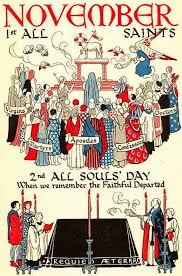
Saints, Souls and Dark Matter

images-2


Everything in the universe is inter-connected and inter-dependent. Everything impacts upon everything else. The Medieval Church understood this only too well in the grand panorama of a three-tiered universe comprised of the Church Militant here in time and space, the Church Expectant – those having passed through death into a state of preparation for eventual entry into the third tier of the Church Triumphant – the Saints (with a capital S) who in the imagery of the Book of Revelation worship before the throne of the Lamb of God, night and day. This vision is a glorious medieval metaphor, a product of the enchanted mind. In this vision, prayer functions as communication flowing up and down along a two-lane highway connecting the tiers of the threefold universe. As in life, so in death, prayer forged a sense of relationship.

In an age shaped by the digital communication revolution, although we might imagine things differently, the central idea of prayer as a two-lane super-communication highway, connecting the living and dead takes on a new and vivid appropriateness.

Good theology always mirrors sound psychology. In the olden days of my youth, I remember how we celebrated All Saints – the Saints with a capital S – and All Souls – those whom we still love yet see no longer – as two separate events. Today, the utility of time and more rationed patterns of Church attendance have led us to merge Saints and Souls together as one celebration of the resurrection.

Good Theology always mirrors sound psychology. The division between saints and souls hints at the emotional complexity of our human experience of death. Although Christian funerals are celebrations of the resurrection with hopeful language, and white vestments, they are also rituals for the expression of personal and communal grief. Thus in the commemoration of the saints, we rejoice in the celebration of hope in eternal life while the commemoration of souls reminds us that our experience of death involves painful feelings of loss for those for whom our hearts still ache.

For many today, myself included, the medieval imaginary gives way to a quantum imaginary. As then, so now, our knowledge still fails us and it’s to the imagination that each generation must turn in the face of death as the ultimate mystery of life.

For none of us can know ahead of time what everlasting life is like. Contemporary metaphors of web and network, communication flow, particle and wave with the hypothesis of parallel dimensions alongside time and space now provide culturally compatible metaphors for interconnection and communication between the living and the dead.

I was recently reading about how physicists came to believe in the existence of dark matter. Belief is a kind of hypothesis and astrophysicists have since observed faintly detectable gravitational waves rippling across the seeming emptiness of space. Although it can’t easily be seen, physicists posited dark matter’s existence as the only explanation that accounts for the way light matter, i.e. the universe that’s visible to us, actually behaves. It’s interesting to speculate that the prior hypothesis of belief pointed them to look in the right place for the evidence.

The point I want to make here is that we comprehend dark matter indirectly through its effects. Likewise, no one can prove everlasting life in the communion of saints to you. It’s a hypothesis of faith. Like the hypothesis of dark matter, I believe in the communion of saints hypothesis because of its effects, its influence on my making sense of the bewildering and often nonsensible experiences of living.

The communion of saints conceives of the union of the living and departed within the love of God opens me to experience a wider purpose and deeper meaning in my life.

It shows me that life may be changed by the biological event of death but not ended with death.

This belief provides me with a compass setting, a direction of travel in life, and the support of an enduring set of values to guide the journey. Without these, so much of my life would otherwise seem limited to a trivial, yet overwhelming self-preoccupation.

The writer of the letter to the Hebrews speaks of the communion of saints thus: 

Therefore, since we are surrounded by such a great cloud of witnesses, let us throw off every encumbrance and the sin that so easily entangles, and let us run with endurance the race set out for us. Hebrews 12:1

Belief in the communion of saints is a practical choice. It either makes sense to you, or it doesn’t and if it doesn’t then maybe this is only a matter of finding the right metaphor or image through which it can speak to you. Whether working through an enchanted medieval mindset or a contemporary quantum imaginary it’s imagination that provides us with what we need. Remember, that without physicists imagining dark matter as an explanatory hypothesis for what they already knew, they would not have begun to look for its detection.

The question is not: do you find the theology of the communion of saints credible? The question is: do the actions that flow from believing in the communion of saints support you in living your life more fruitfully?

The language of the letter to the Hebrews is helpful here – for living fruitfully requires an ability to throw off every encumbrance, and here I single out cynicism that compromises our capacity to live hope-filled lives. The great exemplars of Christian living, those whom the Church honors as Saints provide us with sources of encouragement, strengthening our resolve in the face of adversity. Belief in an ongoing relationship between the living and the dead opens us beyond the limits of our material self-preoccupation – clearing a pathway through the mire of easy entanglements that perpetually seek to ensnare us into settling for something less than the grandeur of our soul calling. Encouraged by a sense of continued relationship with those whose love in life has nurtured and shaped us – we run with endurance the race that is set before us.

It’s for all these reasons that on All Saints-All Souls Sunday, in Churches up and down the land we will baptize new human beings into the membership of the Christian people of God, wildly cheered on by the company of so great a crowd of witnesses.


Unfinished Business

A sermon from The Rev. Linda Mackie Griggs 

“This is the land of which I swore to Abraham, to Isaac, and to Jacob, saying, ‘I will give it to your descendants’; I have let you see it with your eyes, but you shall not cross over there.” –Deuteronomy 34:4 

“We have some unfinished business.” The thought leaves you anxious, doesn’t it? Right up there with, “We need to talk.” Nobody likes unfinished business—that breath-holding sense of incompleteness that begs for closure. In music, it’s like an unresolved dissonance or a chord that just leaves you hanging. The nature of an incomplete past is to make us gazes anxiously upon a murky future.

At the end of Deuteronomy, we have a classic case of unfinished business. Moses, after shepherding his stubborn, stiffnecked, whining people out of Egypt, across the Red Sea and through the wilderness, is brought to the tantalizing border of the Promised Land and told, this is as far as you go, friend. Thank you for your service, but you’re done now.

After all Moses did. And put up with. It just doesn’t seem fair.

Actually, we were warned that this would be the end of the line for him. We read in Exodus and in Numbers of Moses being confronted by his people, yet again, at a place that would later be called Meribah (which means, appropriately, “quarreling.”) This time it was because they were thirsty, demanding that Moses fix it. So God told Moses that if he would take his staff in hand and speak to a nearby rock, water would issue forth. So Moses picked up the staff, struck the rock twice, and water flowed. All ended well, right? Nope. Barely before anyone had gotten so much as a sip God expressed extreme displeasure at Moses for his lack of obedience, declaring that as a result, he would not see the Promised Land.

Huh? What in the world did Moses do wrong to earn such a harsh sentence?

It actually took an alert and more careful fellow reader just a few weeks ago to point out that God told Moses to speak to the rock, not strike it. When he struck it instead he was showing a lack of faith in God. And if we have learned nothing else from our reading in the Hebrew Scriptures, we have learned that God requires above all that God’s people be faithful to God.

And so, Moses, this is as far as you go.

The Israelites were not left leaderless. Joshua son of Nun had been made the successor to Moses and they would enter the Promised Land and take possession, often in ways that grieve us today and leave us wrestling with how these accounts speak to us about issues of violence and how we treat the Other in our midst. But that is looking from hindsight. From the point of view of the Israelites in the story, they faced a future filled with question marks. Where are we going? What will we find when we get there?

And this is why this story is so important just as it is, unfinished business and all. Because for those with ears to hear it speaks to our own questioning about the road ahead of us on any given day. Who am I? Where am I going? Who am I going with? What am I called to do? The future is our unfinished business and we, like the Israelites after the death of Moses, are holding our breath to know what will happen next.

So this story invites us to ponder, as individuals and as a community, both the nature of our Wilderness and the possibly mixed blessings of the journey ahead.

The most famous public reference to today’s story occurred on the evening of April 3, 1968. Martin Luther King, Jr. was speaking to sanitation workers in Memphis, his words hopeful, though introspective. You should google the video of the speech and listen to that unmistakable voice:

“I just want to do God’s will. And He’s allowed me to go up to the mountain. And I’ve looked over. And I’ve seen the Promised Land. I may not get there with you. But I want you to know tonight, that we, as a people, will get to the promised land!” 

Dr. King was assassinated the next morning.

But his words still resonate amid the heartbreak. As he preached that night his vision of Moses gazing upon the Promised Land took on a new dimension; a Gospel dimension of Christian hope and a vision of the Beloved Community nurtured out of the wilderness. It was a vision of the Promised Land transformed into the Kingdom of God.

Matthew’s Gospel portrays Jesus as the New Moses, leading his people to the Kingdom. God’s call to the people to be faithful above all else had remained unchanged over centuries, but the landscape of the Wilderness was different—now it was a wilderness of Roman occupation and quarreling among factions of the Jewish community, as we heard last week; Sadducees, Pharisees, etc. And their quarreling has again found its focus in Jesus when a lawyer tests him: Which commandment is the greatest? Jesus’ response does two things: first, it continues to seal his reputation as one who knows his Torah inside and out—he has passed test after test from the Temple authorities, leaving them speechless every time. And this time and this is the second point, the way in which he combines the commandments, two of the most significant passages in Torah, transforms them into a whole that is more than the sum of its parts. You shall love the Lord your God,

(found in Deuteronomy) and You shall love your neighbor as yourself (found in Leviticus); these two commandments, up to this point have evolved separately into ways in which the people of Israel have distinguished themselves as a community. And by extension, they have created narrow definitions of who is Neighbor and broad categories of those who were Other.

But Jesus has combined the two commandments in such a way that they become new marching orders for the people of God. Here is what you must do: Love what God loves, (that is, everything and everyone, including taxpayers and sinners), and love how God loves it (that is, prodigiously, abundantly, and with no exceptions.) There is no room for equivocation or qualification.

Zing.

And he’s not done yet. He adds, “On these two laws hang all the Law and the Prophets.”

The role of the prophets from the beginning was to critique the system; to call it to account and to repentance whenever it strayed. And Jesus’ words here point out that the interpretation of the Law is rightly challenged to refocus from time to time. As Jesus said earlier in Matthew’s Gospel, he did not come to abolish the Law, but to fulfill it. Prophets are part of an ecosystem of faith that includes, God, God’s creation, and God’s call to the people to faithful obedience through the Law.

It’s an ecosystem that endures now. God calls us to faithfulness and to a faithful response to those whom God loves, in the way that God loves them. That’s our unfinished business. Like Moses, like modern prophet Dr. King, we are called to be faithful, even as we may not always be successful. But just because it’s unfinished and we can’t see the end doesn’t mean we shouldn’t make the journey. Attending to the unfinished business of the Kingdom means that we keep our focus on God’s promise to what God loves, and how God loves it.

If you look in the Book of Common Prayer, on page 855 you will find the part of the Catechism that pertains to the Church. It says:

  1. What is the mission of the Church?
  2. The mission of the Church is to restore all people to unity with God and each other in Christ.
  3. How does the Church pursue its mission? 
    A. The Church pursues its mission as it prays and worships, proclaims the Gospel, and promotes justice, peace, and love.
  4. Through whom does the Church carry out its mission? 
    A. The church carries out its mission through the ministry of all its members.

Marching orders, right there.

You know, when it comes to the unfinished business of God’s Kingdom, one of the most powerful metaphors is birth. It is a process that is profoundly uncomfortable, and yet immensely hopeful. The future is all tied up in the pain, the anxiety, the anticipation, the promise. But like Moses looking down from the mountain, we need to understand that the nature of the birthing process is that the future it holds doesn’t really belong to us. It belongs to that which is being birthed. Ultimately it will leave us behind, perhaps gazing longingly toward what is beyond our ability to see or know. What is being born belongs to its own future. Our role right now is to keep breathing, and pushing, and working and hoping. And loving. Loving what God loves, and how God loves it.

We have some unfinished business. But unlike Moses, our journey isn’t over yet. The saying goes that the God’s Dream for Creation is both already and not yet. May God give us grace to see the Kingdom where it is already among us and to let that excite and empower us for the journey ahead.


Caesar or God, the question is: can you feel the love?

The context

While it’s not absolutely essential for the understanding of Jesus’ encounter in Matthew in 22:15-22, it’s kind of interesting to engage in a little historical contextual exploration.

If you think America’s political body is fractious and fragmented then picture the state of Roman Palestine in the time of Jesus. Jewish body politic in the 1st-century shows us a nation suffering under the enormous pressures of conquest and occupation.

Five major Jewish factions contented with one another. Between them lay acute differences regarding the status and interpretation of the religious tradition. However, the main point of sharp conflict between them concerned the appropriate response to the Roman occupation. Two choices presented – collaborate or resist. Resistance involved another question: how violently?

The Sadducees, the religiously conservative, hereditary priestly caste, collaborated with the Romans in order to preserve their power base in the Temple. A functioning Temple was important for the Romans who used it as the Inland Revenue Service for their Palestinian provinces. The Sadducees lived in terror of any social unrest that might jeopardize their privilege and bring the Romans down on their priestly heads. Thus, Jesus’ power over the crowds made him a target for Sadducee enmity.

The Herodians, the aristocracy of the Hasmonean Dynasty of Herod the Great and his depraved sons provided another focus for collaboration. Herod had been the last ruler of an independent Jewish State. The Romans subdivided Israel into provinces, appointing three of Herod’s sons as puppet rulers. The Herodians were more than collaborators. Unlike the Sadducees, they were also assimilationists. They constituted a Greek-speaking, culturally cosmopolitan, designer wearing, fast living, pleasure-seeking 1st-century elite. If the Herodians had such a thing as an economic philosophy it would have resembled trickledown economics. They didn’t care about fidelity to God. As people living at the apex of the pyramid, insulated from the concerns of lesser mortals, God was simply a primitive artifact of a superstitious past. Religion could be useful but not in a way that mattered to the Herodians personally, but only as a tool for the political manipulation of the masses.

The Pharisees were the religiously progressive party, careful to oppose the occupation through keeping themselves apart from any involvement in governing. They formed the main party of political moderation. Their influence lay outside Jerusalem in the synagogues of the countryside. They promoted their progressive religious interpretation through widespread sponsorship of education. It’s interesting to speculate that a Pharisee school probably provided Jesus with his education. Staunchly opposed to the occupation, they nevertheless, firmly rejected violence as a tool of resistance.

The Zealots or Sicario were a first century equivalent to the Taliban. They engaged in widespread campaigns of assassination against Roman officials and Jewish collaborators. Committed to the violent overthrow of Rome they also violently intimidated local Jewish populations as it suited their interests.

The Essenes, the fifth faction, are known to us principally through the excavation of one of their settlements at Qumran. It’s here that archeologists unearthed the treasure trove known as the Dead Sea Scrolls. The Essenes were separatist survivalists who refused to have anything to do with both the Romans as well as their fellow Jews. Hold-up in communities in isolated parts of the country – they waited for the day of God’s liberation of Israel with the coming of the Messiah.

The text

Matthew 22:15-22 paints a startling picture of Pharisees and Herodians consorting together to entrap Jesus. Matthew’s account is startling because no Pharisee would have let a Herodian’s shadow fall across his path, let alone be seen in public together. We are familiar with political necessity at times making for strange bedfellows. When Jesus asked for a coin, it would have been a Herodian who produced it. It was blasphemy for a Pharisee to possess a coin with the head of a foreign God (Caesar) imprinted on it.

The Pharisees get a bad press in the Gospels, esp. in Matthew. This is less a reflection of Jesus’ conflict with them, for in most ways Jesus’ teaching and politics were strikingly similar to that of the Pharisees. Matthew singles-out the Pharisees because in his own day the principal contention lay between his second-generation Christian Community and the emergent Rabbinic Movement of a reconstructed Judaism. Matthew projects much of his conflict with the rabbis back into the time of Jesus where he depicts a relationship of conflict between Jesus and the Pharisees, who were the rabbis’ religious forebears.

The gist of this encounter between Jesus and his interlocutors relates to the thorny problem of taxation. In this context, the question concerned the dispute between Jews about whether it was breaking the Covenant with God to pay taxes to Caesar, who claimed the divine status of a god.

The Pharisees and Herodians seemed to have found common cause together in mounting a two-pronged assault on Jesus, attempting to box him in. If Jesus answered in the affirmative that it was lawful to pay taxes to Caesar, he committed blasphemy. If he rejected paying taxes, he committed treason. So the strategy was to flatter him with the title of teacher and watch which way he jumped.

Jesus jumps out of the trap, startlingly suggesting a separation between church and state. His answer offends both groups while depriving them of the satisfaction of hearing the jaws of their trap snap closed. Jesus’ answer thus angered the Herodians, while offending the Pharisees.

Render to Caesar the things belonging to Caesar and to God the things belonging to God seems a simple solution, but as we know all too well, one that requires a complex negotiation of dual and competing allegiances? How much is owed to Caesar and how much to God?

Applying the text in a new context

For preachers in communities where the fall pledge drive is a challenging, reoccurring, yearly tradition, Matthew’s text is a gift offered by the compilers of the lectionary. The crude interpretation of this text would lead me to say, hey folks, you pay your taxes so pay-up on your church pledge! In more authoritarian traditions some preachers even suggest that there is a rough parity between the amount of tax you pay to the government and the quota of your hard earned wealth the church has a claim on. To my mind, this is a dangerous approach because it invites people to infect their attitude towards God with the same level of resentment and cynicism they feel towards the IRS.

It’s human nature not to want to pay taxes or at least to not want to pay too much in tax. But in the US, the resentment about paying tax is unique in the Western World. Everyone assumes that current proposals for tax reform mean lower, not higher taxes, irrespective of which group becomes the main beneficiary of the reductions.

The quality of our lives is seriously impacted by the chronic underfunding of public services in the forms of roads, bridges, railways, and the national grid. Yet, at the same time, we believe we should be paying less tax. Isn’t there an inconsistency in our thinking here?

I have come to the conclusion that the deep resentment Americans feel about paying taxes is rooted in two related factors. In this last week’s E-news epistle I wrote about the discrepancy between a year-on-year rising GDP and a plummeting sense of national wellbeing. Actually, 1979 was the last year that the GDP and our sense of national wellbeing mirrored each other.

The other problem is that we feel we don’t experience any benefit from the taxes we pay. We all know that taxes pay for infrastructure, but when you live in Providence, which is a typical example in the NE Corridor, we see our taxes disappearing while the infrastructure continues to crumble around us.

I was listening to an NPR reporter asking a group of Danes why they didn’t mind paying a tax rate that seems to Americans an abuse of government. They replied, No, we don’t mind at all because look at what we get for our taxes: free healthcare, free maternity support, free childcare, free education from preschool to university graduation. I believe that if Americans experienced such benefits, they might consider a higher tax rate an acceptable price to pay for such benefits. Imagine, no childcare, no healthcare, no children’s education or college expenses. How rich would you feel then?

Ideally, our taxes should be an expression of our gratitude for living in this wonderful country. We face many real problems as we transition from the Pax Americana of the post-1945 period during which the US enjoyed the lion’s share of global prosperity. we now face a future in which we too, are subject to the whims and capriciousness of trans-global capitalism. However, the insecurity of an unpredictable future is something not to be feared but welcomed as a catalyst for unleashing new national resourcefulness and energy.

It’s important, however, that our energies are guided by sound and unchanging values and principles. Whether it be income tax or church pledge, Jesus’ words render under Caesar that which belongs to Caesar and to God the things which belong to God would suggest we start out from a place of gratitude for the good things we enjoy. Our lives remain incomparably rich by any measuring.

We’re all in this together. Bonds of affection tie us to one another. Be it at the level of personal, family or community relationships, together we share a common life. We’ve been reminded in this last week by George W. Bush, Barak Obama, and John McCain that our concept of nationhood and good government lie in the enduring values and ideals that have made America such a bright beacon for the world. That we fail to live up to these ideals is to be expected, but we must never retreat from them just because the going gets rocky. We have a great deal to be thankful for.

The Pharisees rightly understood that all things belong to God. Jesus was not challenging this, but asking what does it mean for all things to belong to God? God is not a tyrant busily collecting and banking our dues, muttering mine, mine, all mine. That all things to belong to God – is to recognize our debt of gratitude for life, and to express that gratitude in our own generous living.

Gratitude for life imposes the responsibilities of generous living upon us. Whether it’s in the form of taxes in our civic life or working to realize kingdom expectations in the world through our participation in the life of the Church, through both we render to God our debt of personal gratitude for the love we share in our relationships together.

Popular culture poses the question: can you feel the love? When you consider your membership of this community, can you feel the love? Underneath the fears that threaten to divide us from one another, can you sense the love? This fall, as you conduct your spiritual inventory in order to reconnect with the values that matter to you, can you feel the love? You don’t, I hear you say. Then there’s only one remedy. Act generously today, and I promise you, you’ll begin to feel love’s burn.

Idols: Exodus 32

Evolution

imagesSpiritual understanding emerges over time on humanity’s long march in a relationship with God.  Judaism, and to a lesser degree Christianity both understand humanity’s relationship with God to be an evolutionary one, rooted in the events of history.

This historical understanding of God can be contrasted with the understanding of the great Eastern religions, which hold a view of God as cosmic, outside historical time and place. In this view, God is universal and unchanging.

The point here is not the complex theological question of whether God changes or is unchanging. The story keeps moving onwards. God appears to grow within an evolving relationship with humanity. With the evolution of culture our image of God, hopefully, deepens.

Loneliness and fear

The people have become frightened by Moses’ long stay on the mountain. They feel lost and bewildered without Moses and the God who accompanies him. Lost and afraid, deprived of Moses they turn to Aaron, Moses’ brother for comfort and leadership. They ask him to restore their lost sense of God’s presence.

Aaron is the priest. Priests are usually more down-to-earth than prophets. It’s not so much that they confuse the Golden Calf for the unseen God of Moses, but that the Golden Calf represents the Hebrews longing for a God who is accessible and available.  In the Golden Calf, they can see God, and they can touch God. This image is an image of God with them, a God to whom they are able to pour out their concerns, to whom they can express their fears, a God before whom they can dance and celebrate with ecstatic joy.

Exodus:32 seems to be one of those powerful cathartic moments in the history of the relationship between God and the Hebrews – a small section of humanity.

Two startling discoveries

The God of the Torah reacts when things don’t go according to plan. Exodus:32 reveals a God who, when crossed can rise to the heights of rage and threaten to obliterate Israel. This God is a passionate lover, who brooks no infidelity.  In the story of the Golden

In the story of the Golden Calf, we make two startling discoveries. The first is that God can be reasoned with. Secondly, God seems capable of learning from experience and changing his mind. Here lies a deep insight into the psychology of relationship. No real relationship can exist where either party to the relationship lacks the power to make an impact upon the other!

God’s learning?

Rabbi Arthur Waskow commenting on this aspect of the encounter on Mount Sinai says:

The ancient rabbis thought there was a relationship between the Golden Mishkan (the portable Shrine known to us as the Tent of Meeting) and the Golden Calf. The way they understand the relationship was that from watching how the people dance for the calf, God ruefully accepts that the people need a physical focus for their experience of God. So God gives them the Mishkan in place of a calf. In this approach, the story as we have it in the Torah is “out of order” — chronologically reversed. For it is the experience of the calf that convinces God to design a Mishkan. 

Rabbi Waskow ruefully notes the similarity between the golden calf and the golden altar to be placed at the center of the Tent of Meeting; both made of gold, both with horns. He says:

And the people? Dimly from the foot of the mountain, they hear the overtones, a blur: “Plenty of gold? Uh-huh. And — something about horns? — Un-huh. Must be a golden bull-calf!!” So they build it. For God as well as us, the truth is firm: What you sow, that you shall reap. Or to put it in another way: certainly earth is spirit, there needs to be a physical context for the spiritual path. (A “path” is very earthy.) https://theshalomcenter.org/content/golden-calf-golden-mishka

 Human loneliness

We also live in a time when idols abound. Since the Enlightenment, God has been in retreat from the center stage of the universe. It’s as if God, having set up the mechanism to run itself, packs a bag and goes on vacation, leaving humanity alone to strut with increasing self-importance center stage.

We are now like the Israelites at the foot of Mt Sinai, bereft of a lively sense of being in relationship with God, trying to get on with things the best way we can. Finding substitutes to fill the chasm of our loss we construct and worship our own golden calves in:

  1. The idol of scientific progress.
  2. The idol of materialism and material prosperity.
  3. The celebration of celebrity.

It’s this third idol I want to explore a little. For we have become a culture where we no longer celebrate achievement, i.e. what people do. We celebrate success, popularity, i.e. how people appear. We increasingly live into a reality that is virtual, and not real. A reality of shiny surfaces and ever-shifting perspectives, based on appearance and not substance.

Celebrity culture is always changing. As a result, our culture feeds our uncertainty and exacerbates our feelings of vulnerability. We may be popular one minute and cast down the next. Beneath the surface, our anxiety and stress keep growing. Social media only feeds our underlying anxiety captured in the title of a song- Will you still love me tomorrow?

Idols promise more than they deliver

Like the Golden Calf, our idols increasingly fail to fill the gap created by our loss of tangible relationship with God, and with one another. This causes us to plunge into even deeper despair!

The lessons of discipleship

The parables of Jesus are not morality stories but exhortations to discipleship. Through the juxtaposing of images that are at once familiar and at the same time hyperbolic, Jesus challenges us to move beyond the limits of our idols, the product of only what we are able to imagine for ourselves. The expectations of the Kingdom of God (thy will be done on earth as it is in heaven) break into our safe but lonely experience, forcing us to draw uncomfortable comparisons between what we are prepared to settle for, and what God desires for us.

The God of Moses demanded obedience. Where the God of Moses is passionate and jealous, the God of Jesus is compassionate and extravagant. The God of Jesus calls us into a relationship of discipleship in which we find the courage to live and work for more than we imagine being possible. Only discipleship leads us to the discovery that in the midst of feeling alone and lost, we are already found. As David Ewart in his weekly sermon blog Holy Textures puts it:

There may indeed be joy in heaven over one sinner who repents, but the parables are more about the joy to be had on earth from hearing the good news of the extravagant God who risks all to search for each one of us personally, individually – joyfully. Our God isn’t sitting passively off somewhere in heaven waiting for someone to bring news that a sinner has repented today. Our God is actively searching for us.

My question is will we allow ourselves to be found?

Blog at WordPress.com.

Up ↑