Hidden Realities

Thin Places

Our Celtic forebears in the faith understood the importance of thin places. These were more often than not physical places of intersection between the temporal and spiritual dimensions. The Hebrew Bible identifies mountaintops as thin places, locations where a dimensional interpenetration resulted in a revelation that changed the course of development.

Moses’ encounter with God on Mt. Sinai was a transfiguration experience after which his face continued to shine so brightly with the divine energy that he had to veil himself in the presence of the people. The encounter between Moses and God resulted in the birth of a new and different kind of relationship with profound results echoing down the millennia. On Mt. Tabor, in the presence of the disciples Jesus’s appearance shone with a radiant illumination. Illumination is a metaphor for direct and unmediated human- divine encounter.

On Mt. Tabor, the disciples were witness to Jesus’ encounter images-2with Moses and Elijah. Theologically, this is an encounter that reveals the continuity of authority from the Covenant God made with Moses and the Israelites flowing into the New Covenant God makes with  Jesus and humanity. The presence of Elijah identifies Jesus as the Messiah. Through the enchanted images of the mountaintop experience, the theological identity of Jesus as the Messiah is confirmed in the presence of key human witnesses.

From a literary perspective, the Transfiguration marks the midpoint in all three synoptic Gospels. Up to this point, Jesus has been establishing his ministry in Galilee among the mixed gentile-Jewish populations of the north. The descent from Mt. Tabor marks a turning point in tone and action. Jesus now sets his face towards Jerusalem and his inevitable confrontation with institutional religion and the forces of empire.

Peak experience

The 20th-century psychologist Abraham Maslow coined the term peak experience to refer to experiences of transfiguration. We no longer live in a society that takes the idea of thin places very seriously. A world of enchantment in which supernatural events are encountered in the here and now is no longer part of our mindset. Instead, we have traded belief in the super natural for the certainty and predictability of the mundane. We find ourselves living in a rational world of disenchantment.

Enchantment and disenchantment are the terms that Charles Taylor uses to show the steady historical movement from a religious worldview of the Bible to that of our own secular and cynical age. The avenues leading back into an enchanted universe are now blocked off for us. No matter how hard we may wish it was not so, a pre-Enlightenment mindset of enchantment is no longer available to us.

Our modern dilemma

Unfortunately, the loss of enchantment has not rendered redundant our longing for transcendent experience. Consequently, in desperation, we cast about for experiences of transcendence that for a brief moment release us from within the prison walls of our disenchanted mindset. We have arrived in a world that Ken Wilber calls the flatland, a disenchanted world of arid rationality in which we become increasingly focused on finding ways to break out from the mind-numbing reality of post-post modernity.

Our modern quest takes on the quality of increasing desperation to find transcendence within the confines of the mundane. Our desperation makes us vulnerable to the addictions that promise us peak experience.

Our longing for the release of heightened sensory experience snares us in the addictions of modern-day life, which are many and varied. But they all share one characteristic – they compel us to misplace our hopes and dreams in substances, processes, behaviors, and technologies that promise more than they can deliver. It can take us a lifetime to discover that momentary escape is not a solution to the experience of living in flatland. Yet, increasingly we resort to the technologies of virtual or fantasy reality, substances that offer mind-altering or pain-numbing escape, and the all-pervasive patterns and behaviors of materialist self-medication.

Peter said, Lord it’s good to be here, let’s make three dwellings, one for you, one for Moses, and one for Elijah – not knowing what he said. Peter’s unknowingness reveals the human longing to chase and capture peak experience. This is a failure to understand.  Peter wanted to make the experience permanent. He no sooner expressed his desire than puff it all evaporated. If we are unlucky enough to have religious peak experiences it makes living in this world even more unsatisfactory as we become consumed by the search to repeat what always remains an elusive experience.

Properly understood, the nature of peak experience opens our eyes to the bigger picture. It offers an ah-hah moment glimpsed and then gone. But a glimpse is enough to bring about realignment in the direction of finding not escapism, but satisfaction.

Descending the mountain – life on the flat(land)

The disciples and Jesus did not ascend the mountain in order to spend the rest of their days there. They ascended to encounter God and then descend down the other side. As they descended Jesus advised them to keep schtum, a popular British expression derived from the German word for silent. In effect, Jesus was telling them that it’s enough to have glimpsed the intersection of the temporal and divine dimensions lying within the secret heart of all reality. But glimpsing is the only possibility for transfiguration moments are elusive and unrepeatable.

As they came down Jesus, Peter, James, and John became instantly embroiled in heated encounter as the disciples who had remained at the bottom of the mountain had unsuccessfully tried to cast out a demon from a boy who we recognize as probably suffering from epilepsy. They must have wondered had their experience on the mountain changed anything? Apparently not, at least at the surface level of reality.

It didn’t last, it could not be repeated, and yet for Peter, John, and James, their experience at the mountaintop changed something. They now knew beyond a shadow of a doubt who Jesus really was. This knowledge became the central organizing principle for the rest of their lives.

Confronting disenchantment

Disenchantment in the flatland must be confronted and not escaped from. within a lived encounter with a story that was expansive enough to enable them to experience the interpenetration of the spiritual and temporal dimensions. Despite the magical imagery of the enchanted world our mothers and fathers in faith experienced the divine within the heart of human reality much the same as we can. God is at the center of the future through an endless succession of present moments. In other words, God is active through history and the only moment is now.

Today, the best antidote to our profound sense of disenchantment is not to crave escape into pseudo states of re-enchantment, but to live lives motivated by curiosity, creativity, and wonder.

The words of W.B Yates seems to capture so much of our present predicament. In The Second Coming, he penned:

The ceremony of innocence is drowned; the best lack all conviction, while the worst are full of passionate intensity. 

The mount of Transfiguration offers no magic solution to the unfolding events that would lead Jesus, Peter, James, and John into the future. Yet, we can only believe that the experience on Mt. Tabor changed something that enabled them to come through the tumult of their future into the birth of a new way of experiencing the world.

We are powerless to dramatically change the way the world is. Yet there are moments of transfiguration in individual lives. When taken together these contribute to those moments of transfiguration in our common life together. For me, transfiguration is not defined so much as a peak experience, though sometimes it may be. Transfiguration lies in those moments when weimages-3 experience the ah-hah-ness of glimpsing a more expansive backdrop against which our daily lives are lived out. We come to a new appreciation of the otherwise ordinariness of life. We become encouraged or inspired to renew allegiance to that expansive story that leads us to rediscover that decency, faithfulness, and courage remain available to us.

We don’t have to wait for some grand utopian future. The future is an infinite succession of presents, and to live now as we think human beings should live, in defiance of all that is bad around us, is itself a marvelous victory.

Howard Zinn, historian

I might say that to live now as we think human beings should live, in defiance of all that is bad around us, is to participate in the reshaping of transfiguring experience.



A God of Surprises

A sermon for Pentecost 8 Proper 12 Year A from The Rev. Linda Mackie Griggs                     Genesis 29:15-28 & Matthew 13:31-33, 44-52


“When morning came, it was Leah!”

Surpri-i-i-se! Perhaps we should have seen it coming. Jacob the Trickster, so richly and delightfully (to us, anyway) himself a victim of his uncle’s trickery. It’s perfect.

And yet, in spite of our amusement, there is tension here. Think of how extravagantly Jacob loved Leah’s younger sister Rachel; to agree at the outset to serve Laban seven years for her, and then another seven years due to Laban’s deceit—Jacob obviously saw Rachel as a pearl of great price.

Seven years. “…and they seemed to him but a few days because of the love he had for her.”

Outside of the Song of Songs, this type of evocative description of devotion is rare in scripture. So to see this great love cheated in such a way, even if there is a measure of justice in it, is unsettling.

And what of Leah, poor Leah. Humiliated at being foisted off on a man who doesn’t love her as part of her father’s game. Neither she nor Rachel has a lot of agency here, unlike the previous stories with Rebekah and Sarah. They made things happen. But here things happen to these young women, not because of them. So there’s tension here too.

So again, as we have done so often in this cycle of stories these past several weeks, we ask, where is God in all of this? What, amid all the drama and the levity and the perplexity, does this tell us about God, and about God’s word in Scripture?

For one thing, as we look back on the Patriarch/Matriarch stories in Genesis, we see a thread of inversion running through them; Isaac gets precedence over the older Ishmael, Jacob over Esau, Leah over Rachel. We are kept off balance all the time, wondering what these characters will do or say next. And then, as with Hagar in the wilderness, Abraham and Isaac on the mountain, and Jacob’s dream near Haran, God appears at the lowest and most critical moment. Surprise.

This is not a God who colors between the lines. This is a God who can be found in the depths, in the tension and the gray areas. This is a God who invites us to interrogate what we read–a God who turns things upside down.

Think again of Leah, the unloved first wife. Biblical tradition sees her as a usurper. She will have the honor of becoming the mother of many of the Twelve Tribes of Israel. We can’t help but ask, what kind of God would show such preference for the unloved? Oh, right—when you put it that way Surprise.

When we ask these kinds of questions, we learn something we might not have expected.

As we see in Jesus’ parables today, it is the nature of God and God’s kingdom to be in places of paradox, because that is where we grow. We see the kingdom in tiny, seemingly insignificant things like yeast and mustard seeds, which pack enormous strength in tiny packages. We see the paradox of treasure, found where? Buried in dirt. We see a pearl of great price, which has grown from what? A speck of sand; an irritant in the oyster. We learn, from engaging with the paradoxical God of Scripture, that we are called to the perplexing and rewarding work of seeking wisdom through interrogating what we read and listening for God’s often surprising response. Which is not the same as reading for the purpose of confirming our expectations.

This penchant that God has for calling us into places of questioning and tension—of insisting that we think more deeply and at the same time more out of the box—this tends to fly in the face of the way many of us engage the world on a day-to-day basis.

We live in a dualistic, binary world of yes/no, black/white, for us/against us, red states/blue states. Even the technology that permeates our lives is premised on binary code that is a combination of zeros and ones symbolizing electronic switches that are on or off. One or the other. This dualistic structure can be helpful initially when forming societies and institutions. We need basic foundational framework or structures as we learn to engage with the world. The Israelites had the initial structure of the Ten Commandments. The earliest church had a basic structure of communal sacramental living. Our government has a basic structure in the Constitution. A fundamental framework is a good way to set things up, just as human social development begins by first learning the rules of behavior in order to get along in the world.

But as we, and our institutions, discover, structures and frameworks always meet with complexity and complications. It’s inevitable. Because stuff happens. And when stuff happens our basic framework is thrown into question and disruption. Then we have a choice, to be formed, or deformed, by it.

Deforming is what happens when we act out of fear. We hold rigidly to our positions on one side or another—yes/no, black/white, for/against—so that we are Right and the Other is Wrong. This is the tyranny of the binary, and it is why we struggle with some of these scripture passages that go against our expectations of how Matriarchs/Patriarchs/God should behave.

And as frustrating as unpredictability can be, we infinitely prefer to fight to be right rather than face the more challenging prospect of engaging with the tension formatively, of acknowledging the existence of gray areas and the potential for wisdom that comes from letting go of the fear of the unknown and unfamiliar. This requires humility and the ability to hold lightly to one’s own ego. When this happens we can find ourselves at a new level of maturity; of being able to interrogate and critique structures and institutions creatively and constructively.

By seeking the wisdom that resides, sometimes deeply embedded, within the stories of Scripture, we find that we are not just reading about God’s actions in history, we are attending to God’s call into where God is most likely to be found; in the gray areas, the uncomfortable places of tension and question.

How why in the world would we want to do that?

Look around. Look what happens to a world in which it is more important to be right than to seek wisdom. Finding God in the grey areas of Scripture helps us to do the vital work of facing the grey areas in our hearts and in our communities.

How we engage with Scripture can either mirror or change how we engage with the world around us. Listen:

“Again, the kingdom of heaven is like a net that was thrown into the sea and caught fish of every kind; when it was full, they drew it ashore, sat down, and put the good into baskets but threw out the bad. So it will be at the end of the age. The angels will come out and separate the evil from the righteous and throw them into the furnace of fire, where there will be weeping and gnashing of teeth.”

I had a friend years ago who, when confronted with a passage like this, commented, “I like the idea that the bad guys are going to be punished in the end.” And of course, the assumption in this declaration is that we are the good guys and they are the bad guys. Whoever they are. This kind of uncritical reading leads to the tyranny of the binary. Us vs. Them. Us Normal People vs. those Different People.

Now, hat if we apply the lessons we’ve learned from questioning Scripture as we’ve been doing these past few weeks. Instead of an uncritical reading of this parable, leaving it as it is in its binary glory let’s seek the wisdom that resides outside the box– in the unexpected, the uncomfortable, and the surprising.

Ponder this: The kingdom of God, like a great net of fish, is filled with a diverse gathering of creatures. God’s dream is not that those in the net will fight and judge among themselves. The sorting isn’t up to them—that is up to God. And the nature of the sorting isn’t even up to those in the net; consider the possibility that separating righteous from unrighteous is something that happens within individuals, not between them—that the struggle between good and evil in the final reconciliation with God is an internal, not an external one. Whoa—now that’s thinking outside the box. Honestly, I’m not sure what that last judgment will look like, but I do know that Jesus says in the parable that it’s not my call to make. And the Second Commandment tells us to love our neighbors in the net, not shove them out of it. As much as we might want to do so sometimes.

Listen to the words of Steven Charleston, Native American elder and retired Bishop of Alaska:

“My life is not my own… In my tradition none of us are autonomous free agents making our own destiny as we go. We do not think in the singular, but the plural…I am forever connected to the welfare of others, born into a network of hope. I do not live for myself, but for our-self, for the well-being of all. This vision of life is where rugged individualism gives way to love: we leave no one behind.”

From Bishop Charleston’s perspective, the net in the parable could be seen as a network. Surprise.

So you see, when we speak of inspiration and Scripture—the inspiration isn’t just in the writing, it’s in the reading—and that’s a crucial point. Engagement in the paradoxes and grey areas, the willingness to question and to listen, these are vital to the flourishing of our communities and society, especially now. God’s call to us through Scripture to be part of God’s dream of reconciliation is an urgent one. And God’s promise to us, as to Jacob, is to be with us throughout the journey.


Finding Bethel

A Sermon for Pentecost 7 Proper 11 Year A  from The Rev. Linda Mackie Griggs

Genesis 28: 10-19a & Psalm 139:1-11, 22-23


So Jacob rose early in the morning, and he took the stone that he had put under his head and set it up for a pillar and poured oil on the top of it. He called that place Bethel.

Two passages this morning have become woven together in my head, and as a result , have been pondering thresholds—those in-between places of transition and transformation that can be filled with both anticipation and anxiety. Though we only read half of it today, Psalm 139 is one of my favorite psalms for threshold times; unique in its lyrical style, authenticity and vivid imagery. At the end of seminary, in a transitional point between school and ministry, I prayed the entire psalm every day during the General Ordination Exams. It reassured me of God’s presence and care, and helped me keep the ordeal in perspective. It helped to be reminded that four days of brutal testing are nothing when compared to the vastness of God’s creative and abiding love.

“You have searched me out and known me…”

This is why psalm 139 is often used as part of youth formation programs like Journey to Adulthood. Talk about a threshold time of life. While it is a time of exuberance, fun and adventure (some of which parents would rather never hear about…), it’s not the completely carefree time our selective memories would have us think. We elders have forgotten the pressures, the insecurities, and the emotional rollercoaster that teens deal with daily, compounded by the fact that they have yet to develop the coping mechanisms and sense of perspective that come with maturity. The teen years can be a joy, but face it; it can also be a jungle out there.

“…surely the darkness will cover me, and the light around me turn to night…”

There is so much going on with young people that puts them at risk. The usual social, family and academic pressures are difficult enough. But consider also the kids dealing with major existential issues; LGBT youth, teens of color, kids living in poverty or dysfunctional family situations. Many teens deal with depression. Many resort to risky behaviors as a way of testing boundaries, finding acceptance with peers, and numbing the pain of overwhelming life pressures. Adolescence is a wilderness even in ideal circumstances, and traveling that road can be hard and lonely. 

“You know my sitting down and my rising up; you know my thoughts from afar…”

Genesis doesn’t tell us how old Jacob was in our story today—in last week’s episode the writer tells us that he and Esau had grown up, but that can mean anything in this context. Regardless, I’d argue that many young folks could identify with what Jacob is feeling in this story.

But first a little background, since the Lectionary has skipped over an important piece of the story. Why is Jacob on the road toward Haran? Because, as I hinted last week, when Jacob cheated Esau out of his birthright, Jacob and mother Rebekah had more trickery up their sleeves. They hatched a plan to fool Isaac into giving Jacob the all-important paternal blessing that should have gone to his older twin. Esau, heartbroken and furious, vowed revenge, and Rebekah arranged to have Jacob flee.

“Where then can I go from your Spirit? Where can I flee from your presence?”

And so now Jacob is on the road. Imagine his mental and emotional turmoil. He is alone; without family or community. He is fearful for his life, his trickster ways having caught up with him. He has treated his brother and his father horribly. Regardless of the fact that Rebekah shares the blame, he can’t take back what he’s done. The past is the past, and now he has to live with the consequences of his actions. How many young people do we know who have had this realization? (Or how many experienced it ourselves?)

Night falls, and Jacob is exhausted. A pillow of stone is an appropriate bed for this troubled young man.

Surely the darkness will cover me…Search me out, O God…”

Jacob dreams of angels; a glorious dance in the sky above him, up and down a great celestial ladder linking heaven and earth. The Lord stands beside him and renews the promise made to Abraham; a promise of family, community, land, and a legacy. A promise of God’s abiding presence: “for I will not leave you until I have done what I have promised you.”

Notice that this is the first time God has ever spoken to Jacob. Neither he nor his brother is portrayed as having a close relationship to God; and yet here God is, at the lowest ebb of Jacob’s life, reassuring him that his future is bright and his legacy firm. This is a God of the unexpected. A God present in the darkest times.

“Such knowledge is too wonderful for me; it is so high that I cannot attain to it.”

A God of renewal. This threshold of Jacob’s life is about renewal on many levels: Renewal of God’s Promise. Renewal of God’s relationship with Jacob. Renewal of Jacob himself as he is invited into transformation; to quote a colleague, transformation from Trickster to Mensch; the Yiddish word for a person of integrity and honor. At this threshold Jacob begins the long and difficult process of maturing in his relationship with God and with others. He will discover what it is to be a mensch. Eventually.

“Search me out, O God… Look well whether there be any wickedness in me…” 

Jacob, at his lowest moment, has found God present with him in the depths, and by the grace of God he grasps the significance of what has happened: “This is none other than the house of God, and this is the gate of heaven.”

This kind of reassurance of God’s presence, this kind of renewal of relationship and self-hood, this kind of promise of a brighter future; all of these are what both Jacob and the psalmist experienced. And it is what we desire for our children, on any day, yes, but especially on their worst days, when anxiety and insecurity threaten to overwhelm them. I worry sometimes that the world we have created for our children is not really the blessing that it should be. Many young people look around them at climate change, political strife, nuclear proliferation, and they would be right to accuse us of wasting their inheritance; of leaving them a world that threatens to be dirtier, meaner and more dangerous than we found it. Have we added to the pressure on the next generations by squandering our own inheritance and our children’s as well?

“Surely the darkness will cover me…” but  “Darkness is not dark to you; the night is as bright as the day…” 

Both the Genesis passage and the psalm, woven together, invite us to resist the temptation to despair. They invite us to envision a world that is hopeful, not bleak. We owe it to our young people, not only to try to get our own generations’ acts together, but to create a framework of hope—a holy place, a Beth-el– for the Jacobs of this world; the ones wandering in a wilderness of uncertainty and insecurity, who struggle with their own failures and seek their place in a world that can feel pretty inhospitable.

There’s an elephant in the room here. I’m standing in this pulpit talking about ministering to young people and there are very few present in this congregation. I understand that. As I have said before, there are many, many reasons for this, but those reasons are NOT that teens don’t care about being loved, being trusted and having someone to trust in, and being given credit for inquiring and discerning hearts and minds. If the kids won’t come to us, then we must, at every opportunity make holy space—Beth-el– for them where they are.

Each one of us can be a place of refuge for a young person in our lives. Each one of us can mirror the psalmist’s image of God by truly listening and being present to youth as they struggle and when they triumph. We can proclaim to them a God who sides with the lonely and the marginalized; a God who knows the secrets of the heart and forgives us so much faster than we forgive ourselves.

The journey of a mensch-in-training can be formidable, but worthwhile, and this is what we need to reflect for the youth in our families and community. In Jacob’s ladder of angels we can see a dance of hope that reflects the ups and downs of life, and the constant reassurance that God’s promise is firm and God’s presence irrevocable. God calls us to walk compassionately and courageously with those who journey in the wilderness of youth and adolescence, perhaps remembering our own cringe-worthy moments to keep us from judging too harshly. And remember, when the going gets tough you can always remind them not to make fun of you for having trouble with the computer. Because after all you taught them how to use a spoon.

Let us pray.

Loving God, you see your children growing up in an
unsteady and confusing world: Show them that your ways
give more life than the ways of the world, and that following
you is better than chasing after selfish goals. Help them to
take failure, not as a measure of their worth, but as a chance
for a new start. Give them strength to hold their faith in you,
and to keep alive their joy in your creation; through Jesus
Christ our Lord. Amen.


Sibling Rivalry

A sermon for Pentecost 6, Proper 10, Year A  from     The Rev. Linda Mackie Griggs                Genesis 25:19-34 &  Matthew 13:1-9, 18-23


Then Jacob gave Esau bread and lentil stew, and he ate and drank, and rose and went his way. Thus Esau despised his birthright.

Jacob roughly measures a handful of cumin seed and toasts it until fragrant. Then he grinds the seeds while garlic and onion turn golden in a little oil. As he adds and stirs in the orange-red lentils he is reminded of the color of his twin’s unruly hair. Last, he adds water and sets it all to simmer. I wonder what he was thinking about as he worked. I wonder if he was plotting against his brother as he made sure the seasonings were just as Esau liked them—enough to make him drool in anticipation. Oh Esau—what an easy mark.: See food, want food, get food. A man driven by his appetites more than by his brain. Unlike Jacob. His appetites are a little more, well, sophisticated. His sights are higher than the next meal.

The storyteller has left fertile space between the lines of this tale. It is as rich and flavorful as Jacob’s stew—each bite revealing different nuances and textures. This is another chapter in the saga of the Patriarchs–and Matriarchs–of the faith, and it incorporates a familiar archetype—the Trickster, known throughout cultures to sow mischief and create conflict. Though in Jacob’s case his role as Trickster actually eventually serves to cement his role as Patriarch of the People of God. Leaving us, not for the first or the last time, to question God’s choices in patriarchs.

This story also serves as etiology. It’s related to Myth—it’s a way of speculating as to why things happen in a certain way. For example, the writers of Genesis knew that there was longstanding enmity between the peoples of Edom and Israel. What might the source of that conflict be? Well, it’s because of God’s prophecy to Rebekah that two nations were at war in her womb and the elder would serve the younger. Jacob was later known as Israel, and Esau as Edom, which is Hebrew for red, hence the repeated reference to that color as connected to Esau.

Etiology is a major function of Hebrew Scriptures. It often engages the big existential questions of who we are as people of God and why we are the way we are—why we do some of the things we do as human beings. That’s not to say that the explanations provided are definitive, but they can at least shed light on the attitudes and perceptions of the people who wrote these stories. The storytellers of Genesis don’t shy away from the hard truths of human nature—the tribalism, the violence– not only are these things revealed in the actions of the people, but also in images of God that often tell us a great deal more about the nature of the writers—and us–than they do about the nature of God.

But the true beauty of these stories is how they resonate—how they find us wondering about Jacob and Esau, in spite of what we may know (or not) about myth and etiology. We wonder about them as individuals, not as archetypes. We find ourselves identifying, to some extent or another, with these brothers who evidently had, well, issues.

Each was favored of a different parent. Isaac especially loved the hairy older twin—a man’s man, a hunter. Jacob, born literally on the heel of Esau, was favored by his mother Rebekah. Like her mother-in-law Sarah before her, Rebekah will help God’s plans along by concocting a plot for Jacob to receive Isaac’s blessing. But that’s another story. (See Chapter 27.) At this point, we don’t know if Rebekah has encouraged Jacob to bilk Esau out of his birthright, or if Jacob just wants to goof on his brother for the heck of it.

It is no small thing, a birthright—to inherit the greatest share of the father’s flocks, herds and land. For Esau to ‘despise’ it as he does, for the sake of a bowl of stew (as tasty as it might be,) is an indicator that he isn’t too bright.

Listen to some of the language about Esau: The first came out red, all his body like a hairy mantle… and later, “Let me eat some of that red stuff, for I am famished!…I am about to die; of what use is a birthright to me?” 

The storyteller invites us to see Esau in a particular way: Unconventional in his appearance; as driven by basic appetites, and as a result prone to making life-altering decisions without considering consequences. He is an object of pity, at best.

He is, in the eyes of the storyteller, of Jacob, and of us, The Other in this tale.

Yet somehow he resonates, at least a little. We wonder about him, how he doesn’t fit the family mold. Perhaps our thoughts are drawn to those we know who are likewise unconventional, impulsive, possibly snakebit by their own questionable decisions. How often do we see Esau around us, or within us?

Esau is a man of appetites. How can we not see ourselves in this man who sees, wants and gets? We are a culture who has raised “see, want, get” to an art form. Did you catch the buzz about Amazon Prime Day? Last Tuesday, 30 hours of great deals for all Prime members—irresistible items that we can’t do without—I’ll bet you didn’t even know you needed an extra air compressor in your garage, did you? See, want, get: Esau is a man for our time.

And Jacob. His appetite was ambition, nurtured and encouraged by Rebekah as he sat at her knee day after day in the tent. Did she groom him to feel privileged, entitled to a birthright that didn’t actually belong to him, if only because he was born a few minutes too late? Was his appetite to fulfill God’s dream for him and for God’s people, or to be Number One for Jacob? See, want, get: another man for our time.

Jacob’s fate at this point in the saga remains to be seen. It will remain for us to read on.

Because Esau and Jacob’s story is just beginning with this passage. Jacob’s trickster ways will continue, but not without consequence. He will come face to face with his own deceptions, and even face to face (in a matter of speaking) with God. Esau, too, will find transformation, just as many of us do, by way of a bumpy road.

The saga of the Patriarchs and Matriarchs is disturbing because we keep coming face to face with our own flawed selves through the mirror of people, like Jacob, who we’ve been taught to admire, but on closer examination they fall way short. And the ones we pity—the Others, the Esaus—they may yet surprise us. But we continue to discover God’s grace through it all– that God chooses whom God chooses; the weak, the flawed, the unwise, the ambitious and the messed-up. And thanks be to God for that! Because none of us is the person we idealize ourselves to be. We’re all more Jacob and Esau than Jesus.

Jesus today draws our attention to soil, and it’s a helpful image here because the Hebrew Scriptures often help us, to examine our own interior landscape. It includes the rocky shallow ground of appetites and whims—see, want, get. There is thorny ground of willfulness and ambition, maybe even cruelty. But if we keep digging and tilling there is also the fertile soil of generosity, compassion, and holy listening. And God never stops sowing it with the seeds of forgiveness, challenge, vocation, and grace. With God’s help may it yield a hundredfold.

Loosening the Yoke

A sermon from the Rev. Linda Mackie-Griggs.


Matthew 11:16-19, 25-30                                       5 Pentecost, Year A (9 July 2017)

We have this dog. Bartlett. A rescue who came to us last November. He’s sweet and smart, and he’s very well behaved. Most of the time. Not long ago he and I were wrapping up our afternoon walk; he’d been pretty good and followed my directions well, which wasn’t a real surprise—he’s well trained and he knows the routine—we go the same route every day.

But this time something distracted him, and he totally lost it—took off running like a greyhound in another direction—he’s fast and he’s strong. I didn’t want him to go that way. I wanted him to go MY way. But he would have none of it. He ran, I pulled. I shouted. He kept running. I kept resisting. And I resisted face first into a tree.

Lying dazed on the ground, I heard a still, small voice speak to me:

Why didn’t you drop the stupid leash???”

That would have been the smart thing to do. But it was more important that I remain in control.Sometimes it’s like that with institutions. They go along a single path for a long time until something changes. The change is inexorable and powerful, and no matter how hard they yell and pull and resist, the change comes anyway. And if they don’t find a way to deal with it, they run face first into misery, or irrelevance, or extinction.

I’ve been hearing since seminary that the church is dying. Attendance is down; the culture is shifting, priorities are changing. It’s a huge topic in diocesan workshops and conversations, church publications, vestry meetings, staff meetings. Where are the packed Sunday school rooms? The overflowing offering plates? How are we going to keep the roof on? The changes we are seeing are pulling hard, and the mainline church—not just the Episcopal Church– is struggling to know how to respond. And one of the easiest responses is to just keep pulling on the leash; to keep things on the same track it has always been on. If we could just do things the way we used to back in the day, then everything would be okay. That way lies the tree.

The major generational and cultural shifts pulling on us are not going to stop shifting just because we resist them. Each generation has a set of core values and formative experiences that affect how they engage with the world and more specifically the church. The generations that built Mainline Protestantism in the 20th century have birthed wonderful and creative and different generations who have been formed by certain shared experiences–for example 9/11, Katrina, and I would argue the 2016 election–who see church differently. It’s simply not the central spiritual, formative, social focus for them that it has been for their parents and grandparents. That is not to say that they are not spiritual, or that they have not been formed ethically or morally or socially because I will argue ferociously that they have been—just not necessarily by the church.

The generations that built mainline Protestantism need to come to terms with the fact that the generations that followed them are not going to keep that edifice standing in the same form that we have known.

But that doesn’t mean the church is dying. We just need to consider dropping the leash. Theologian Phyllis Tickle, in her 2007 book, The Great Emergence argues that the Church goes through a period of major transformation about every 500 years. She called it a 500-year Rummage Sale. the most recent being the Protestant Reformation, which just celebrated its 500th birthday.

And sure enough, the ground is shifting beneath us. One sign of this shift came a number of years ago with the rise of the group describing themselves as ‘spiritual but not religious’. Almost immediately lines were drawn between those who felt that that was a cop-out and those who heard it instead as a wake-up call, or better still, an opportunity for growth and transformation. Those who heard the wake-up call wanted to understand what has brought the SBNR’s to the point of rejecting something that had been a mainstay of personal, family, and community life in this country for a very long time. And for many it still is. I’m not saying that the church as a worshiping, healing, serving community is not vitally important—God is still very busy calling people into ministry, both lay and ordained. God perseveres in finding a way to realize God’s Dream for Creation. But it is up to us to discern what new path God is trying to show us—not to throw the baby out with the bathwater, but to remember the roots and foundation of our call to be God’s People in the world.

What does discipleship look like to a church experiencing a 500-year rummage sale?

Jesus said to the crowd, “To what will I compare this generation? It is like children sitting in the marketplaces and calling to one another, ‘We played the flute for you, and you did not dance; we wailed, and you did not mourn.’ 

I always thought Jesus sounds like a classic grumpy old dude in this passage. But this is a serious critique of the blindness of the religious and cultural authorities of the time. The picturesque cries of the children are references to Jesus and to John the Baptist: “We played the flute for you…” refers to Jesus’ works of healing, his call to abundant life and the coming of the Reign of God. “We wailed…” refers to John’s call to repentance; to the necessary inner work of discipleship.

Jesus is saying that between himself and John, they can’t seem to catch a break. Jesus’ practice of dining with sinners has people calling him a drunkard, while John’s fasting has people saying he’s crazy. The blindness of the skeptics is such that the coming of the Kingdom meets with disapproval no matter what John and Jesus do.

But disapproval aside, this juxtaposition of Jesus and John is valuable because it shows us a two-layered model for discipleship, with each being crucial to the other. The inner work of repentance (both personal and institutional) is needed to ground us in humility and holy listening (The Benedictines call it obedience). This was the urgent call of John. The outer works that Jesus did, of mercy, compassion, and healing are vital to the inbreaking of the Kingdom of God. And these two; contemplation and action, are meant to be woven together in relationship. Spiritual practice grounds acts of caring. Effective discipleship requires both. Spiritual practice alone is hollow, and the acts of charity alone are simply, as Fr. Mark puts it, “good people doing what good people do.” Without prayerful grounding our acts of charity carry the risk of seeing ourselves as being in control; as the powerful bestowing bounty upon the powerless– as being in God’s place rather than in God’s service.

It’s a seductive thing. We feel good when we do nice things for others. There’s nothing wrong with that—with knowing the joy of servanthood. But the point of servant discipleship is not to feel good about ourselves. It’s not about us. Spiritually grounded service may actually put us in a place where we encounter our own vulnerability and woundedness. But our own vulnerability brought to our actions is the very best way to truly see others as siblings in Christ who have something to offer us in mutual lifegiving relationship.

To surrender to this concept is to find ourselves being led into unfamiliar territory, and it’s natural to resist that tugging of the Spirit. But what can happen if we follow that tugging—if we let the Spirit take the lead?

There is some wonderful creative ministry happening in this Diocese. There is a trend toward making church walls more porous—toward a clearer-eyed vision of our neighbors as coworkers in realizing God’s dream of abundance, justice and mercy. The Center for Reconciliation comes quickly to mind, taking on the delicate and difficult ministry of fostering understanding around issues of race. The Church Beyond the Walls is another unique initiative—a community of faith that turns upside-down the dynamics of feeding ministry and worship. Members of the community include those who are struggling and homeless who gather to worship and to offer hospitality to visitors and each other. Church Beyond the Walls is not just another feeding program. The model where people come from outside to make and pass out sandwiches is turned on its head—rather, those who wish to serve must first be served.

A third initiative is a little younger than these first two, but it is also the result of prayerful discernment and willingness to see through God’s eyes in new ways. Rhythms of Grace at Church of the Advent in Coventry is a special weekly Eucharist geared toward people with autism. Can you imagine an offertory of playing with a parachute? Rhythms of Grace is meeting an important need of families for whom conventional worship is a challenge, and it shows them in a visceral way that God’s love is creative and all-encompassing.

The Spirit is tugging St. Martin’s too. Our new initiative of incorporating a monthly fast on the 21st of each month is intended to focus on a spiritual practice that can undergird new and renewed ministries of advocacy and service around issues of hunger. It is through fasting that we can regularly renew our understanding that God, not we ourselves, is Source of all that we have.

And our pastoral ministry is feeling tugged in a new direction as well. We are currently pondering becoming part of Communities of Hope International; a Benedictine-inspired program for training lay chaplains. This is in response to an upsurge in energy on the Pastoral Care Team—a desire to do more to reach out to those in our community and neighborhood who are in need of healing and listening presence. Our monthly Healing Eucharist, beginning in September, will be part of that effort as well.

So the Spirit is tugging away and new things are germinating. Which is why I don’t believe for a minute that the Church is dying. Transformation? Yes. Death Spiral? Nope.

But we need to be ready to heed the Spirit’s tugging; to hear the cries of the children in the marketplace who call us to joyful compassionate action, firmly undergirded by the sometimes uncomfortable inner work that comes with regular spiritual practice—prayer, meditation, fasting, Bible reading.

“For my yoke is easy and my burden is light.” Jesus’ most important teachings are the ones that invert our expectations. The Church’s yoke, it could be argued, has become burdensome; weighed down by changing circumstances and a fierce desire to stay a course that is becoming unsustainable. New opportunities invite us that are found down paths that are at the same time both new and yet eternal. The Spirit calls us to live into our true vulnerable selves, to follow our passions, and to loosen the yoke of “but this is how we’ve always done it.”  Go ahead, let loose of the leash.


Unlikely Mirrors


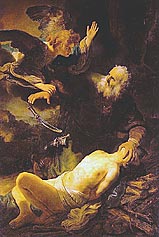
God tested Abraham. He said to him “Abraham!” And he said, “Here I am’. He (GOD) said.   “ Take your son, your only son Isaac, whom you love, and go to the land of Moriah, andagr_01-01 offer him there as a burnt-offering on one of the mountains that I shall show you”.

So two questions arise. Why would God ask this of Abraham, and why would Abraham agree to such a request? After all, we have ample evidence from the story of Sodom and Gomorrah in Genesis 19 that when Abraham encountered a seemingly brutish and retaliatory streak in God by threatening retribution on all who had displeased him (thank goodness God didn’t have a cell phone), he was more than capable of reasoning God back into divine senses. So why didn’t Abraham, in this instance, reason with God?

He could easily have pointed out to God that this was an ill-judged idea. Why kill the next link in fulfillment of the promise that Abraham’s descendants will be as numerous as the stars in the sky? God’s request seems both short sighted and unbelievably cruel. As if to rub salt into the wound, God emphasizes that Isaac is Abraham’s only son and not only that, but God goes out of his way to remind Abraham if he needed any reminder that is, that Isaac is the son he loves.

We are given a clue as to God’s intention in the first line: God tested Abraham. Ah, so something becomes clearer. This was a test to see if Abraham loved God more than he loved Isaac. Can God be so insecure, so needy, so desperate to receive exclusive adulation and affirmation?

Last week Linda+ invited us into the Jewish practice of Midrash. Midrash is a process for interrogating the ancient Torah texts. The earliest Midrash commentaries seem to date from the 2nd Century AD, and this tells us that Midrash represents a development in Rabbinic Judaism’s attempt to humanize these ancient and sparse Torah texts, to mitigate their harshness in order to fit them to the experience of a contemporary time.

In the St Martin community, on this coming Monday, we arrive 43-days into The Bible Challenge – a 365-day program for reading the entire Bible. But this only begs the question: Why read the Bible in 21st Century America? Especially these sparse and harsh Torah texts that strike us as so alien to our understanding of God? This is an important question for Episcopalians who over the last 100 years have steadily jettisoned any personal discipline of Bible study. So let me offer responses to this crucial question. I want to identify two responses here.

Story shapes personal identity

Alasdair Macintyre in After Virtue notes:

I can only answer the question what am I to do?if I can answer the prior question, of what story or stories do I find myself a part?

Macintyre suggests here that identity is story shaped. We come to know ourselves through the stories we tell about ourselves as well as the stories that claim our ultimate allegiance. Such stories are responsible for shaping us. Small and mean selfish stories constrict our development beyond meeting our own self-interests. Large stories give us room to grow and change, they invite us into a more expansive vision of interpersonal and civic relationships and responsibilities.

The Biblical epic has always fundamentally shaped Jews and Christians. Judaism seems better at recognizing that stories are multifaceted in that they can be reframed and retold to bring out different emphases. Stories are continually being told and reheard in different ways. We are not shaped by the literal reading of these stories according to a strict dichotomy between true or false. We are shaped more through how we come to interpret their meaning. As Midrash reveals, meaning is a continually evolving process.

Story shapes community identity

The communitarian response to the question why read the Bible today is given greater clarity by Paul D Hanson in A Political History of the Bible in America comments:

To gain a solid footing for understanding the mixed legacy of American political history, it is necessary to turn to the more ancient epic from which the leaders of our nation, from colonial times to the present, and for better or for worse, derived justification for their actions. That epic is the Bible.

So on the weekend when we celebrate the founding of the nation, we are reminded that for Americans the Bible has occupied a more central role in our political process than might be true in other Western democracies. Our leaders and sections of society repeatedly appeal to the Bible in the civic space, and as Hanson notes for better or for worse. In that conversation it’s crucial for Episcopalians to stop ceding the high ground to those who would apply an anti-Midrash spin on interpretation, i.e. take the stories we encounter, especially in these very ancient and harsh Torah texts as literally true and able to speak uninterrupted to our modern context.

Scholars now believe that the Genesis stories were only written down, or at least, re-edited during the very late period of the captivity in Babylon some 1500 year after the time in which the stories are set. We might ask why is this?

Part of the answer lies in how nations respond at points of crisis. At a time of crisis when the very existence of the Jewish people was imperiled they revisited and recast their ancient stories of national manifest destiny. This is a process that we in contemporary America have a feeling for as we face into a crisis of national identity articulated through competing interpretations of our formational stories. The sacrifice of Isaac was a story that spoke about God’s deliverance for those who keep faith, those who in the face of adversity pass the test of trusting in the beneficence of God’s ultimate purpose.

In Bible Challenge group discussions, St. Martin’s folk, especially women among them seem to take great exception to these primitive stories that depict a nomadic society’s very tribal and patriarchal view of God. I encourage us to note our response of repugnance as our first visceral reaction in our engagement with these ancient texts. A visceral reaction, not intellectual insight is where textual engagement begins. But after this what next? Do we simply reject these texts as holding no potential for any meaning? Are we to retreat into our lofty 21st-century judgmentalism that proclaims loudly this is not our God or the God of Jesus?

This attitude blinds us to the contemporary relevance of many of these ancient myths, and so we too, need to develop our own Midrash for textual questioning. We must read these stories because they are where our God shaping story begins. It’s clear from our post-Jesus perspectives that both we and God have come a long way over the millennia. To know our place in the world through the story of which we are a part, we need to begin at the beginning of the relational epic that continues to evolve within historical time through the events of human history.

Genesis 22:1-14

What can we discover through a Midrash-style questioning of this text?

  1. Anthropologically, is this story an echo of a primitive pre-Israelite time when child sacrifice was practiced, which later becomes conflated and given an Israelite spiritual meaning as an event in the life of Abraham? Perhaps.
  2. Did God really command the sacrifice of Isaac, or did Abraham believe that was what God asked of him? Even if we exonerate God the point still remains that Abraham trusted in his experience of a God who had over and over again proved trustworthy. Why should he second-guess God now?
  3. Is this a story about the blindness of human devotion? Religious devotion has proved throughout history an effective instrument for practices and attitudes that flow from the hardness of the human heart. Did not Jesus confront and expose the way religious devotion became a mask, a facade concealing the cruelty of the human spirit?
  4. What’s the ultimate point of this story? At one level the story shocks us. But on closer reading, this story demonstrates that God is not the capricious tyrant we fear, for it is God who stays Abraham’s hand. The dénouement of the story reveals a God who will provide as long as we have the courage to trust.

As we sit in lofty judgment on Abraham and what seems to us to be a grotesque caricature of a narcissistically insecure God, we miss the point that this story shines a powerful searchlight upon us and our motivations. Whatever else this story might be about it reveals our collective collusion in systems that readily sacrifice the weak and the vulnerable while rewarding the strong and contemptuous.

Among that group of young men we refer to as the World War I poets, Wilfred Owen (1893-1918) chronicled through his poetry his experience alongside his brother soldiers fighting in the trenches. In The Parable of the Old Man and the Young, Owen uses the Genesis imagery of the sacrifice of Isaac as the basis for his ode of lamentation on the willingness of those who represent authority to sacrifice the flower of youth in pursuit of idols, i.e. ideologies and stories that displace our trust in God with something less than worthy of ultimate allegiance.

So Abram rose, and clave the wood, and went,
And took the fire with him, and a knife.
And as they sojourned both of them together,
Isaac the first-born spake and said,
My Father, Behold the preparations, fire and iron,
But where the lamb for this burnt-offering?
Then Abram bound the youth with belts and straps,
and builded parapets and trenches there,
And stretchèd forth the knife to slay his son.
When lo! an angel called him out of heaven,
Saying, Lay not thy hand upon the lad,
Neither do anything to him. Behold,
A ram, caught in a thicket by its horns;
Offer the Ram of Pride instead of him.
But the old man would not so, but slew his son,
And half the seed of Europe, one by one.

Our 21st-century vantage point is fundamentally shaped by the image of God refracted through the face, words, and actions of Jesus Christ. This lulls us into a false sense of superiority when we encounter the Genesis images of God, refracted as they are through the lens of a tribal, nomadic people subsisting on the precipitous knife-edge of survivability. And yet, these Israelites are our spiritual ancestors. We are among the children of the blessing God brought about through his covenant with Abraham. Thus on closer inspection, I believe the sacrifice of Isaac disturbs us because as Wilfred Owen found a voice to express – it is not God who is barbarous, it is we who continually affirm what is barbarous in the human spirit.

When lo! an angel called him out of heaven,
Saying, Lay not thy hand upon the lad,
Neither do anything to him. Behold,
A ram, caught in a thicket by its horns;
Offer the Ram of Pride instead of him.
But the old man would not so, but slew his son,
And half the seed of Europe, one by one.

Abraham was shaped by his encounter with a God to whom he gave the allegiance of complete trust. We may quibble over whether this was a good thing or not especially when it leads him to be prepared to follow through on an act of self-laceration. In the end, it was God who stayed his hand and delivered Isaac. Why God needed to test Abraham in this way, we cannot know. But what we can know is the contrast between God’s actions and ours in a society where trust in the beneficence of God has been displaced by lesser and more pernicious creeds that call for the sacrifice of many for the good of a few. The idolatry of ideology reveals itself in the promise of more and the delivery of less.

Wilfred Owen was killed on the day the Armistice was signed at the 11th hour, of the 11th day, of the 11th month, in 1918; a different sacrifice of sorts.

Families are Complicated

A sermon from the Rev. Linda Mackie Griggs for Pentecost 3, Proper 7 Year A                

Genesis 21: 8-21; Matthew 10:24-39

Families. Are. Complicated. I have yet to meet anyone who wouldn’t agree on this, and honestly , f someone told me that they had a perfect family I would wonder what they’d been smoking. The other day (on the way home from a visit to my family in Virginia), I heard someone on the radio comment that she couldn’t understand why some businesses advertise by saying, “We treat you like family.” Given the nature of most family dynamics, that should send most potential customers running in the other direction. But it doesn’t. Because the idea of family draws us even as it drives us nuts. But there you have it. It’s complicated.

And so it is with Hagar. Our first lesson this morning is a continuation of last week’s text from the Hebrew Bible, in which Sarah and Abraham become the proud parents of Isaac. But the Lectionary left out a chunk of the story. You see, after God promised that Sarah and Abraham would have a child, even at their advanced age,images-1 some time passed with no child, and Sarah began to panic–she ran out of patience. So she took matters into her own hands and said that Abraham should father a child with her Egyptian slave, Hagar.

And immediately things got, complicated. To make a long story short, Hagar, who as a slave had no choice in the matter, became pregnant by Abraham. Her relationship with Sarah soured (not surprising)—she became contemptuous of her mistress. Sarah in return became abusive of Hagar, and Hagar ran away. While in the wilderness God saw her, and told her to return to Sarah, but first announced to her that she would bear a son, Ishmael, and that he would be the progenitor of a great multitude of descendants. And in response, Hagar does something that no one else in the Bible does: She has the audacity to name God to God’s face; El-roi; “God who sees.”

Yet she is generally known only as the mother of Ishmael and then forgotten. She only appears two times in the Bible. (If you don’t count a reference to her in Paul’s letter to the Galatians.) Her story of slavery, abuse, rejection, and expulsion is a painful one. It is listed by theologian Phylis Trible as a “text of terror”. There is no way to whitewash it and still be a responsible reader of Scripture. There is always the temptation to avert our gaze from difficult episodes such as this. But if we did that we would be ignoring a substantial chunk of the Hebrew Scriptures. And we can’t do that, any more than we can avoid dealing with our own family dramas. This is the story of God’s family—the human family. And just as we need to find healthy ways of handling difficult relatives and dynamics, we can benefit from finding healthy ways of reading some pretty troublesome and disturbing stories in Scripture.

Which is one of the reasons the Jewish Bible study practice of Midrash is so helpful. This is an ancient tradition; a method of viewing scripture through the lens of questioning; of a conversational encounter, with God, with the writings of learned rabbis, and with each other. Midrash is a liberating tool that encourages wondering. We are encouraged to ask a crucial question: Where is God in this? The answers may be difficult, but with God’s help they can be fruitful and transforming.

So where to start a midrash exploration of Hagar’s story today? We see a woman who is doubly cursed: exiled from bondage, with no more than a little bread, water, and her child. In other words, she’s been cast out from frying pan into the fire. The story notes that Abraham is only distressed on his firstborn son’s behalf: As for any concern for the mother of Ishmael, he is simply following his wife’s instructions, “Cast out this slave woman with her son; for the son of this slave woman shall not inherit along with my son.” You see, Ishmael jeopardizes God’s Promise to Abraham: “Look toward heaven and count the stars, if you are able to count them…So shall your descendants be.”* That’s the promise. But Sarah, in her impatience with God, had waited long enough. She had taken matters into her own hands, but now, confronted with the mistake of her lack of trust in God’s promise, she has sought to rectify it by effectively declaring a death sentence for the child and his mother. Where is God in this???

And this is where the midrash comes in. Let’s wonder. Abram sent Hagar away. “And she wandered about in the wilderness of Beer-sheba.” I wonder what Hagar encountered in the wilderness? Since midrash actually encourages inter-scriptural exploration, we can look at other stories of wilderness wandering in the Bible. Certainly the Israelites wandered, and there is a wealth of stories of their journey and their attempts (not always successful) to be faithful to God. Jesus wandered for 40 days after his baptism, tempted by Satan. Both the Israelites and Jesus faced challenges and emerged equipped for the future. John the Baptist emerged from the wilderness as a prophet. What about Hagar? Was she changed somehow? Did she and Ishmael talk with each other? By all calculations Ishmael was actually an adolescent, not an infant, but Midrash texts speculate that he was quite ill, which was why she had to carry him. Was he even conscious, or could Ishmael sense Abraham’s and Sarah’s rejection of him? I wonder–what demons haunted Hagar in the wilderness? Powerlessness? Resentment? Guilt? Fear? Grief? Did she rage at the God she had so courageously named to God’s face? Did she shake her fist at “God Who Sees”, now apparently blind to her plight? Midrash bids us ask, Where does it hurt, Hagar?

We can continue to wonder and wander the scriptural wilderness: What if she and Ishmael weren’t totally alone? Perhaps they were shadowed by the angel that later called out to her. Perhaps the angel heard every word of fury, recrimination and second-guessing and absorbed it, comprehending her pain. Perhaps, just maybe, God’s silence wasn’t divine rejection after all, but divine listening. I asked a minute ago if Hagar was changed. Maybe not, but what if God was changed? What if God was moved as Hagar wandered and struggled and fed the last crumb and drop of water to her son? Imagine God watching and listening as Hagar, spent and out of resources, did the only thing she could do; lament. As testimony to her pain and rejection and in grief for the child she was certain would die, she lifted up her voice and wept. There is no truer, more authentic prayer than lament; it is the dark night of the soul. And the silent, listening God heard her cries and took pity on her. “What troubles you, Hagar?” Where does it hurt?

A midrash exploration of Hagar’s time in the Wilderness is a fruitful way to engage the text and to discover God’s presence between the lines. When we can do this with Scripture we can perhaps learn to do this in our own lives; to ask, “Where is God in this?” But it should by no means minimize or marginalize suffering—ours or anyone else’s. There is always a risk that assurance of God’s abiding presence becomes mere platitude or Facebook meme, which does a huge disservice to those who suffer. We are meant to gaze upon Hagar’s story and to grieve for and with her; to witness to her abuse, rejection and exile. We are even within our rights to question God. Midrash encourages it.

For example, the fact remains that as Hagar was sent packing God was silent. This is, after all, a story about the Promise, and as such it speaks a hard truth. God promised Abraham and Sarah a legacy of countless heirs, and their rejection and exile of Hagar assured that legacy. But I still struggle with any general assumption that what happened to Hagar was God’s will. I simply don’t believe that God wills human suffering, Promise or no Promise. God didn’t tell Sarah to violate God’s trust and take matters into her own hands; Sarah chose to do that. God didn’t exile Hagar and Ishmael; Abraham did. The fact is that people do stupid, mean, cruel and thoughtless things to each other, but that doesn’t mean that God wills it, then or now. Like it or not, this story reflects the very real frailty of the complicated human family, and our family story is all-too-guilty of projecting our own baggage and selfish motives on God rather than looking in the mirror.

I read something the other day that sums it up: “I screamed at God for the starving child until I saw the starving child was God screaming at me.”**

The good news is that God perseveres. We can trust that. God continues to work within the framework of the gift of free will and the resulting complications and chaos that accompany it. In our Gospel today Jesus alludes to the same idea when he says that he will set a man against his father, daughter against mother; that one’s foes will be part of one’s household. God’s call entails the risk that relationships will be disrupted. But that stress on relationships is because of humans’ choices about how they will respond to God’s invitation to new, transformed and abundant life. Jesus’ entire life and ministry was about reminding everyone, from Temple authorities to lepers, that God is the God of the outsider, the rejected. The Hagars. Jesus knew that what he proposed was not the status quo, and that can be difficult for those who are afraid to risk change and for those who, like Sarah and Abraham, struggled to trust that God’s promise would be steadfast; that God will not give up on God’s dream, no matter how many times and ways we are tempted to screw it up.

So we must be clear-eyed about the suffering and trials of Hagar. We can’t soften their impact, though we can witness to her lament and, through closer and imaginative reading, ask her where it hurts. In doing that, we gain a window on our own lives and the lives of our neighbors. Hagar’s suffering is redeemed through us; it calls us to see and hear her lament in the abused, rejected and marginalized of our time, and it further calls us to offer them God’s healing wherever we can, like a well of cool water in the harsh wilderness. And by God’s grace and with God’s help, that’s not really complicated at all.

*Genesis 5:15   images-1** –unknown

From Members to Disciples

In the E-news, I commented on the phrase every member ministry community. It requires the investment of each and every person to ensure our community continues to be fit for the purpose God calls us to be.

The New Testament has a simple word that encompasses every aspect of being fit for purpose. The word is disciple. I increasingly draw a distinction between two terms often used interchangeably – member and disciple. 

Members are concerned with supporting the organization to which they belong:

  • Members see themselves as supporting the clergy and others to whom they look to perform ministry.
  • The demands of membership are intentionally kept low so as not to discourage people from joining, and to encourage people to remain.
  • Members notoriously vote with their pocket books and ultimately with their feet, when they don’t get what they want or feel their specific needs are not being met.

Disciples see themselves as active participants in the Church’s ministry and not just supporters of the organization:

  • Disciples are invested in their relationship with God.
  • For them building a strong church is the most effective way of making a difference in the wider world with which they feel deeply involved.
  • Disciples practice lives of prayer, study, and reflection.
  • They experience deep gratitude for the good things they enjoy, seeing them not as things to own, but hold in trust.
  • Disciples express their sense of gratitude in generous lives of service.

The contours of discipleship vary from person to person because God not only calls us as we are as we are in the process of becoming. Our temperament, our gifts, our passions, and concerns are the lenses that illuminate God calls each of us to service in the world. We respond to our call through loving God and loving the people in whose company we live out our lives, moment-by-moment, day-by-day, one breath at a time.

When he saw the crowds, he had compassion for them, because they were harassed and helpless, like sheep without a shepherd.

Jesus could well have been addressing the current plight of our own experience. Most of us feel harassed by the pace of life and it’s increasing level of demands. Our ability to respond to the rapid pace of change and the level of demand is decreased by the seemingly unstoppable rise in our levels of anxiety. We are now sorely afraid in the world in which we find ourselves, and Americans, who enjoy higher levels of prosperity than any other nation, seem to be the most afraid of all.

Spiritual community offers release from both fear and a sense of futility because it provides a way for us to work together to become the change we long to experience in the world around us. Our community, however, is currently operating at the outer limits of our capacity, continuing to run a program that is too large for the pool of disciples on hand. We find ourselves in the situation Jesus describes in: the harvest is plentiful but the laborers are few.

Our continued high-level priority is to grow. I have outlined the ways in which the need for growth is currently being supported as together we become a more magnetic community; a community shaped to attract others who long to grow more in love with God and thus be equipped to make a greater difference in the world.

We have a job to do and I believe that at St Martin’s we have done it well in 2016-17. I firmly believe that only when we do our part is God enabled to do God’s part. So with all that we’re currently doing, and with the new directions that will undoubtedly open up in 2017-18, we must not neglect the second have of Jesus statement:

Then he [Jesus] said to his disciples: The harvest is plentiful, but the laborers are few; therefore ask the Lord of the harvest to send out laborers into his harvest. 

Jesus then called his disciples and sent them out. He sent them out in teams, two-by-two. It’s together that we become equipped for ministry in the world. There’s no such thing as a ministry of one.


Every Member Ministry


We arrive at our end of year story Sunday when we celebrate the achievements of our last program year. The success of our financial appeal this time last year has freed us this year to focus on a theme of giving thanks for the enlivened passions of the members of our various ministry teams. During the coffee hour, Laura Bartsch will present a slide show in which we will also recognize ministries and ministry leaders by name. In my overview here, I have not included the music or education ministries because I will speak more directly about these in the coffee hour presentation.

An organizational vision of ministry

In speaking of our achievements over the last program year I want to make the point that all our ministry activities align with the fruits of the RenewalWorks Program out of which three key priorities have emerged to guide our future direction of travel. These are:

  1. Embedding the Bible in community life,
  2. Getting people going,
  3. Developing the heart of the leader.

As part of our first core priority of embedding the Bible in community life, we completed the yearlong reading of The Story. This was at best, a mixed experience but it achieved its purpose of placing engagement with the Biblical narrative at the heart of our spiritual growth. Following Easter, we began to deepen this process as we embarked on The Bible Challenge – a 365-day program for reading the entire Bible. I view this initiative as a multi-year program because reading the Bible is a tough sell among Episcopalians. Thus it will take time for a commitment to daily Bible reading to become a priority for us.

The Bible Challenge will continue over the summer months and as we move into a new program year in September we will give particular emphasis to the formation of small discussion groups to provide venues for sharing our experience as a major element in strengthening our identity as disciples.

Embedding the Bible contributes to a deepening of our lives of spiritual practice. In addition to public morning prayer said in the Church, we have an active virtual Daily Office group whose members commit to saying the Daily Office at home in the knowledge that others are doing likewise. The Thursday Meditation Hour is a gateway for the spiritual but not religious folk. The big discovery for me is how the Meditation Hour seems to be offering a valuable space for traditional religious but not spiritual members who seem to relish exploring the hitherto mysteries of meditation.

Our second priority getting people moving covers the greater number of our ministries.

  • An example is the arrival of the Welcome Table at the back of the Church. Working with the greeters and ushers, and increasingly by ordinary members of the congregation without greeter portfolio, we are seeing a steady stream of new arrivals being welcomed and successfully incorporated into our community journey.
  • The Women’s Spirituality Group has continued from strength to strength and is a model for passion-led engagement that is building a robust experience of discipleship. This ministry has a wider ‘neighborhood’ aspect as another non-Sunday church gateway for involvement in the St Martin style of community life.
  • The Knitting Ministry has blossomed into a major nexus where fellowship interfaces with the crucial ministry of praying for healing. The Knitting Ministry neatly dovetails with the commitment of the members of the Pastoral Care Team who on a weekly basis serve in the liturgy as well as visit on average as many as 10 folk, either housebound or in supported living. The team also supports Linda+ in her monthly visits to Wingate and Bethany care facilities, and regular visits are also made to Laurelmead. Those who offer healing prayers on Sunday during Communion have also become more linked to the wider Pastoral Care Team Ministry.
  • The Hospitality Team continues its well-established ministry of food as a core aspect of our communal life. Hospitality Team members work tirelessly around the high points of celebration throughout the liturgical year. No other parish throws a party like our Hospitality Team and as one diocesan official commented, St Martin’s events are a style act!
  • The Thrifty Goose Ministry teams – Wednesday and Saturday – devote a great deal of time to their passion. The thrift shop and Cloak ministries represent important aspects of community outreach. However, the Thrifty Goose has the additional distinction of being a crucial revenue-generating ministry. Revenue generation has not traditionally been embraced as a ministry. We will need to change this attitude as our future will rely increasingly on our ability to use our resources in revenue-generating ways. As a consequence, a new Additional Revenue Think-tank has formed to address this particular area of increasing importance.
  • Outreach is an umbrella term that covers a variety of ministry initiatives. We have a grant-making group that distributes our outreach budget among applicants from the wider community. The Rector’s Discretionary account makes grants to a number of community organizations as well as responding to parishioners and others at points of crisis need. Each year folk work tirelessly to support the DCYF, St Mary’s Children Home, and Amos House appeals. Episcopal Charities, May Breakfast and Thanksgiving Lunch are key elements of our outreach as is the Epiphany Soup Kitchen as is the annual Good Friday Walk. As in the recent past, the men of the parish took responsibility for Shrove Tuesday, which this year morphed into a highly successful and outreach focused Mardi Gras celebration.
  • Worship infrastructure ministries cover Ushers, Greeters, Readers, Eucharist Ministers, Acolytes, and Altar and Flower Guilds. Most of these ministries are well supported, however, this program year we have struggled to maintain three acolyte teams, and going forward we will increasingly need to rely on adult acolyte support. The Altar Guild remains a ministry most in need of new volunteers. The Flower Guild continues under strong leadership.
  • The Memorial Garden Group continues its good work. This year we had a change in leadership in this ministry and Laura will refer to this in her presentation.
  • The Buildings and Property Committee has been greatly strengthened this past year. Working closely with our buildings supervisor, Gordon Partington, the committee has developed a rolling prioritized buildings maintenance program.

To many developing the heart of the leader may seem the most mysterious key priority. The word leader and leadership are interchangeable and this last year this priority has focused largely on developing leadership vision within the Vestry, and its all-important Finance subcommittee. Traditionally, the Vestry is charged with clear responsibilities for finance and buildings. Yet, today much more is needed from our lay leaders, and we have streamlined review and discussion of routine monthly matters and earmarked more time for spiritual reflection and leadership visioning. Currently, under the leadership of the Church Wardens, the Vestry is becoming a more inspirational leadership forum. Laura’s very competent meetings management has meant that I no longer feel the need to chair the Vestry, releasing me the spiritual leader to become more of a participant-observer.

Going forward, a key initiative, which I invite the Vestry to give more serious consideration and commitment to is the development of small group leadership skills as part of any plan to seed new small group structures in the parish.

More individuals are now stepping forward and showing a desire to take leadership on specific initiatives. An example of this was the Carol Sing before Christmas and the Mardi Gras party, both new initiatives resulting from individuals stepping forward to take leadership responsibility.

A theology of ministry

In the E-news, I commented on the phrase every member ministry community. It requires the investment of each and every person to ensure our community continues to be fit for the purpose God calls us to be.

The New Testament has a simple word that encompasses every aspect of being fit for purpose. The word is disciple. I increasingly draw a distinction between two terms often used interchangeably – member and disciple. 

Members are concerned with supporting the organization to which they belong:

  • Members see themselves as supporting the clergy and others to whom they look to perform ministry.
  • The demands of membership are intentionally kept low so as not to discourage people from joining, and to encourage people to remain.
  • Members notoriously vote with their pocket books and ultimately with their feet, when they don’t get what they want or feel their specific needs are not being met.

Disciples see themselves as active participants in the Church’s ministry and not just supporters of the organization:

  • Disciples are invested in their relationship with God.
  • For them building a strong church is the most effective way of making a difference in the wider world with which they feel deeply involved.
  • Disciples practice lives of prayer, study, and reflection.
  • They experience deep gratitude for the good things they enjoy, seeing them not as things to own, but hold in trust.
  • Disciples express their sense of gratitude in generous lives of service.

The contours of discipleship vary from person to person because God not only calls us as we are as we are in the process of becoming. Our temperament, our gifts, our passions, and concerns are the lenses that illuminate God calls each of us to service in the world. We respond to our call through loving God and loving the people in whose company we live out our lives, moment-by-moment, day-by-day, one breath at a time.

When he saw the crowds, he had compassion for them, because they were harassed and helpless, like sheep without a shepherd.

Jesus could well have been addressing the current plight of our own experience. Most of us feel harassed by the pace of life and it’s increasing level of demands. Our ability to respond to the rapid pace of change and the level of demand is decreased by the seeming unstoppable rise in our levels of anxiety. We are now sorely afraid in the world in which we find ourselves, and Americans, who enjoy higher levels of prosperity than any other nation, seem to be the most afraid of all.

Spiritual community offers release from both fear and a sense of futility, because it provides a way for us to work together to become the change we long to experience in the world around us. Our community however, is currently operating at the outer limits of our capacity, continuing to run a program that is too large for the pool of disciples on hand. We find ourselves in the situation Jesus describes in: the harvest is plentiful but the laborers are few.

Our continued high-level priority is to grow. I have outlined the ways in which the need for growth is currently being supported as together we become a more magnetic community; a community shaped to attract others who long to grow more in love with God and thus be equipped to make a greater difference in the world.

We have a job to do and we have done it well in 2016-17. I firmly believe that only when we do our part is God enabled to do God’s part. So with all that we’re currently doing, and with the new directions that will undoubtedly open up in 2017-18, we must not neglect the second have of Jesus statement:

Then he [Jesus] said to his disciples: The harvest is plentiful, but the laborers are few; therefore ask the Lord of the harvest to send out laborers into his harvest. 

Jesus then called his disciples and sent them out. He sent them out in teams, two-by-two. It’s together that we become equipped for ministry in the world. There’s no such thing as a ministry of one.


Three into One Does Go

 images.jpg

Three folds of the cloth yet only one napkin is there,
Three joints in the finger, but still only one finger fair,
Three leaves of the shamrock, 
yet no more than one shamrock to wear. Frost, snowflakes, and ice, all in water their origin share. Three Persons in God: to one God alone we make our prayer.

Ancient Irish poem to the Trinity                                                            

The Trinity emerging in historical experience.

For the first generation of Christians, their radical transformation on the Day of Pentecost was a confusing, yet exhilarating experience. They had an experience of God as the God of Abraham, Isaac, and Jacob – the Eternal One, creator of heaven and earth, whose dwelling place was far away. The Law had been given by God as a gift of his presence, yet in another way, it also emphasized God’s distance.

For the first Christians, their experience of Jesus posed something of a conundrum in relation to the God of their Fathers. As they had lived through the roller coaster of events and emotions of Holy Week, and Easter, they could not shake off their undeniable gut sense that in the life of Jesus, they had had an experience of God, no longer remote, but God as part of their everyday lives in the world.  Their hearts had been set ablaze by an experience of God face to face: living, breathing, walking, in whose gaze they discovered new selves and a new sense of God.

Then on the Day of Pentecost, a new and unexpected experience crashed in upon them as they encountered the living Spirit of Jesus. No longer Jesus the human person whom they had known as a part of their lives, but the dynamic power of Jesus now fully experienced from within. What really confronted all their hitherto expectations was their direct experience of God, no longer solitary, but dynamic, relational and communal.

The first generations of Christians lived out their new experience of God, it seems without too much controversy. As Luke in Acts reveals, they lived the life of dynamic, energetic, and empowered transformation. Yet, the New Testament nowhere describes God in the language of the Trinity. The first Christians didn’t need to think about the nature of their experience of God because they were too busy living it.

The Trinity solidified in doctrine

The doctrine of the Trinity as we have inherited it today is the result of a need that arose with the passing of time. In the early days of any movement, people just live out their experience of inspiration. But as movements grow up, they morph into institutions. Between the third and fifth centuries, the Church grew from a charismatic movement into a powerful institution, second only to the institution of the Empire, itself.

Institutions need to develop official policies to ensure consistency and conformity. For later generations, the conundrum at the heart of the Christian revelation of God became something less to be reconciled through living and more to be explained, protected, and defended. The Church of the first five centuries needed not so much to explain the nature of God as to protect the nature of Christ from being reduced to one of two simple assertions. Was he divine or human?

This question provoked two competing assertions. The first was that Jesus was God masquerading in human form. Being divine, Jesus was not genuinely human in any meaningful way that you and I are human. The second assertion was that Jesus was only a man, although a great man, nevertheless just a human being uniquely attuned with God in the sense of an avatar like Moses, or the Buddha, or the prophet Mohammed.

Yet the conundrum at the heart of the Christian experience was that Jesus was both divine and human, both natures existing simultaneously, yet independently. As an experience that you don’t think about but just live, the notion of Jesus as human and divine is not such a problem. When you begin to need to understand it, to protect and defend it from attack, you need a way to explain what on the face of it, seems absurd.

The doctrine of the Trinity evolves to protect the core mystery of God as experienced by Christians. In Jesus, the divine and the human might lie at polar ends of a continuum, but it is the same continuum. If to be human is to be most like God, then God must first have experienced being fully human.

I don’t think we can imagine the heat of controversy and accompanying violence out of which the doctrine of the Trinity was forged. As the bishops hotly debated the issues in council, their followers roaming the streets in armed bands settled the issues in rivers of blood.

The bishops, steeped in the philosophy of Aristotle applied the best thinking of the day to address the conundrum at the heart of the Christian experience. How can God who is one be also experienced in three distinct ways? The purpose of the Great Councils was never to explain the mystery of God, but to protect the Christian experience of the mystery of God’s divine nature from being reduced to only that which made sense viewed from the perspective of human logic. Good doctrine gives us enough certainty to be going on with while preserving the ultimate unknownness of God from domestication within the limitations of the collective human imagination. 

The Trinity reinterpreted within a contemporary experience

Each generation must interpret the Christian Tradition in ways that maintain continuity with what has gone before while, at the same time, speaks with the particular voice needed in the here and now.  Theology says less about God and more about our current state of awareness of God. Whereas once Aristotelian logic offered a vehicle for theological articulation, today, a psychologically informed understanding of human nature becomes one of our key vehicles for theologically expressing ourselves.

A psychologically informed view of being human reveals how our individual identities emerge through the processes of being in relationship with others. Identity is constructed relationally because who I think I am is to a very great degree shaped by my perception of the ways others experience me.

Being able to contemplate others as separate from our own thoughts is a crucial milestone in human development. As we behold another, we catch a glimpse of ourselves in the face of the other looking back at us. All of this is rooted in our earliest experience as infants. Increasing brain development during infancy allows us to gradually build up a sense of separate selfhood as we discover ourselves in our mother’s face. We catch from our mother her sense of us, communicated through her touch, the sound of her voice, and principally through her gazing back at us.

il_570xN.1058233088_2e9sAndrei Rublev’s archetypal depiction of the Trinity, from 1410, shows the Trinity as three identical persons sharing the same loving gaze.  His depiction shows God not as a singular entity but as a relational community. The figures are identical, reflecting the oneness of God, yet at the same time, each figure represents the separate and distinct ways in which Christian’s experience God.

Rublev shows God the creator on the left gazing at God the Son in the center and at God the Holy Spirit on the right. Son and Spirit each encounter themselves in the reflection of the Creator’s face as they mirror God’s gaze. For the identity of the Son and the Spirit are inseparable from the identity of the Creator. What the Councils of the early Church referred to as three persons being of one substance, we might rephrase as three expressions sharing one identity. 

Today, any serious exploration of the Trinity cannot be separated from the debate about gender. The Tradition of the Trinity ascribed masculine identities to the relational elements as Father, Son, and Holy Spirit. Despite the feminine noun for spirit in both Hebrew and Greek, even the Holy Spirit has been referred to as he. As 21st century Christians, we hear God’s voice more clearly in nongendered ways. The traditional ascription of Father, Son, and Holy Spirit is simply a by-product of patriarchal language and culture. Today we need to be sensitive to the fact that although Tradition has spoken in male terminology, the theological emphasis lies not in the gendered but in the relational nature of the names.

Understanding the relational nature of the patriarchal names, it then becomes possible to avoid the gendered terms and still retain the relational emphasis that binds the members of the Trinity into a unity. It’s common to hear Father, Son, and Holy Spirit referred to as creator, redeemer, and sanctifier. However, creator, redeemer, and sanctifier denote economy of function, not unity in relationship. I prefer to refer to God as Lover, Beloved, and Love-Sharer, thus emphasizing the relational quality within the community of God that commends itself so powerfully to us in a world where the presence or absence of being in relationship is the significant measure of meaning and a key indicator of our quality of life.

The Trinity as devotion

Can we recapture in our own time and place a devotional approach to the Trinity?History turns full circle. As it was for the first followers of Jesus living in a pre-Christendom world, so for us living in a post-post Christendom world. Like them, our faith is less and less about conforming to right belief and more and more about living lives of right practice.

At the center of my daily devotional practice sits an icon of the Trinity written in the style of Rublev by Laura Smith, an accomplished icon writer, living and working in Phoenix, Arizona. This icon was a farewell gift to me from Laura and the congregation of Trinity Cathedral. When I gaze at each identical figure seated around the three sides of a table, I observe their mutual gaze of intimate love. This intimation of loving intimacy evokes in me my yearning for God. I too, long to catch a glimpse of my greater-truer self as I  gaze upon and sit before the gaze of the members of the divine community.

Sitting before the icon of the Trinity I am reminded that my identity is constructed within me through the interplay of my relationships around me. I experience myself shaped and reshaped continually through the way I experience others looking back at me.

Participating in the mutual gaze of Rublev’s representation of the Holy Trinity invites me to reaffirm my personhood as the image of God. I am reminded that I belong to a community that is, albeit and imperfect one, nevertheless a reflection of the Divine Community. Fashioned to be a relational being, I discover my individual identity as a fruit of being in divine community.

Three folds of the cloth yet only one napkin is there,
Three joints in the finger, but still only one finger fair,
Three leaves of the shamrock, yet no more than one shamrock to wear,
Frost, snowflakes, and ice, all in water their origin share,
Three Persons in God: to one God alone we make our prayer.                                                                  

Blog at WordPress.com.

Up ↑