Healing: Miracle or Cure?

A little background on the Letter of James

Over recent weeks, the epistle or second lesson has been taken from the Letter of James. Traditionally the letter was ascribed to James the Just, the brother of Jesus, and first Bishop of Jerusalem. This James is different from James the Great, one of the sons of Zebedee, mentioned in the gospels. Some modern scholars dispute James the Just as author, noting that the quality of the Greek is indicative of a higher level of education than might be expected from a brother of Jesus, preferring to see the letter’s authorship as anonymous. Written in Jerusalem, the letter addresses Christians in the diaspora. The date of the writing is uncertain.

What is distinctive about the letter is its very pastoral style and content. It focuses on behavior, calling believers to live according to a higher standard of behavior than normally expected in the world. To a modern reader, the judgments meted out to those who fall short seem rather exacting.

In chapters 3 and 4 James explores the themes of self-control and personal restraint, identifying the tongue for particular comment. How great a forest is set ablaze by a small fire. And the tongue is a fire. He notes that the greatest damage  to relationships and communities is done by the unbridled tongue. Today, we often say of such a person, she or he has no filter, for whatever comes into the mind pours out of the mouth. James notes that real wisdom and understanding are expressed only through the gentleness of our actions. He strikes a somewhat modern psychological tone when he notes in chapter 4 that when envy, ambition, and selfish cravings are at war within us, then disorder in relationships and disharmony in community, will be the result.

The power of prayer

The letter of James contains one of the most eloquent passages on prayer to be found anywhere in the New Testament. In Chapter 5:13 we come upon this beautiful passage:

Are any among you suffering? They should pray. Are any cheerful? They should sing songs of praise. Are any among you sick? They should call for the elders of the church and have them pray over them, anointing them with oil in the name of the Lord. The prayer of faith will save the sick, and the Lord will raise them up, and anyone who has committed sins will be forgiven. Therefore confess you sins to one another and prayer for one another, so that you may be healed. The prayer of the righteous is powerful and effective. 

This passage is often read as an invitation at services for healing. Normally in our Episcopal context, healing services are led by a priest, who stands in the stead of those James refers to as the elders of the church. Yet, James also invites us to pray for one another. He notes that this prayer for each other’s healing provides another powerful conduit for God’s healing.

Clearing up one confusion

images-1In our somewhat hierarchical structure, it is easy to see the prayers for healing from a priest in the sacrament of anointing and the laying on of hands as more efficacious than our prayers for one another’s healing. It’s true that while we can all lay hands on one another in prayer, only a priest has the authority to administer an anointing. This tension often translates into the expectation that the sacrament of healing is dependent on the presence of a priest.

This attitude is tantamount to what I call a belief in strong and weak medicine as in: he-im strong medicine – as Native Americans are given to say in Hollywood Westerns. It’s an understanding of prayer as somewhat magical. The miracle of healing is a conjuring up of a powerful magical medicine. Our hierarchical view of ministry leads us to view the priest as possessing strong healing, whereas baptized laypersons possess healing in a more diluted form.

But according to James the power for healing that resides in the elders of the church is not a product of their stronger magic. It is an expression of the prayer of the whole church –everyone’s prayers, concentrated and channeled through the conduit of the priest as a representative of the whole body. In this sense, the priest needs no special temperament for healing, for he or she is simply the conduit for the healing power of a community of prayer. In addition to the priest as the embodiment of the community of prayer, God also calls particular laywomen and men, who by virtue of their baptism are given a special temperament for healing. This is a personal charism or gift, to be used for the strengthening and healing of one another within the whole body of the faithful.

Clarification of a second confusion

images-1Healing for those who still maintain a pre-modern mindset, is (mis)understood through the language of miracles. A miracle is defined as: an event not explicable by natural or scientific laws. Such an event may be attributed to a supernatural being (God or gods), a miracle worker, a saint or a religious leader. In contrast for those who hold a modern mindset, healing is often (mis)understood as curative. Used as a verb, cure means to: relieve the symptoms of a disease or condition. When used as a noun cure refers to: a substance or treatment that cures a disease or condition, i.e. a medicine.

Note the bracketed prefix – mis – above. For, from a spiritual or theological perspective healing is neither miracle, nor cure. Healing is an action of God, usually mediated through the prayerful orientation of the community, which brings about for the recipient a strengthening in confidence, an alteration of perception, and a shift in perspective. Healing restores us to both wholeness and holiness, and the process by which it occurs is complex and various.

In a sermon, I cannot wander into the complexities of the process of healing as it affects our physical, emotional and spiritual health. As we look forward to having more time for Christian Formation at St Martin’s, healing is an area I hope we can with some urgency, begin to explore in seminar and workshop format. A key area for further exploration is the complex nature of the psyche-soma connections and cross-overs. We are so conditioned by a rationalistic scientific point of view that understands soma – physical matter, to be foundational. This view relegates mind and soul to secondary positions as merely registers, places for the reverberation for the primacy of the physical.

A short example: heart issues are understood to be rooted in biological somatic causes, located in the malfunction of the heart muscle. This obscures the connection between stress and the heart’s response. Could not heart failure also be a registering of the emotional condition of unresolved stress, originating in the mind. It might equally be a somatic registering of the spiritual state often poetically referred to as a broken heart.

Yet, if we accept that human beings are psychosomatic creatures, then we have to accept that healing is a complex interplay of factors affecting all three domains. The sermon is a medium severely limited by time restriction and mode of presentation and is not conducive to the exploration of the interplay between psyche, here used in both the sense of mind and soul, and soma. It is enough to say here that healing operates as a dynamic process with divine origins, bringing soma, psyche, and soul into realignment.

Jesus in his ministry, as recorded in the Gospels performs what are usually referred to as miraculous, spontaneous healings. Why does he do this? Is he intent on wooing the crowds with feats of miracle working? Is he setting up a first-century version of medicins sans frontiers? The answer to these questions is a resounding no. Jesus is revealing the power and glory of God, and his healings are intended to bring about a realignment and reorientation in his hearers relationship to God.

The revival and strengthening of the church’s healing ministry is for me a central plank as our community at St Martin’s moves forward on a path of spiritual renewal. Although healing led by a lay person has been available on the third Sunday of the month, it is my hope that as we can gather a larger team of those who discover a call from God to participate in this ministry, we can offer healing prayer routinely on Sundays. The formal sacrament of anointing and laying on of hands is always available on request as is the sacrament of the reconciliation of the penitent.

To come for healing runs somewhat counter to the reserved New England temperament, which shuns public demonstrations of spirituality. Nevertheless, pray that through God’s blessing our renewal will begin to gather momentum. One fruit of this might be that many more of us within our community might feel emboldened to bring ourselves, our suffering, our anxiety, and our struggles for healing. Pray God to also raise up some amongst us who discern a calling to this ministry of prayer and human solidarity.

Three Themes in Mark 9:30-37

There are three distinct sections to this passage from Mark, chapter 9.

  1. Passing through Galilee.
  2. The question about the disciples conversation along the way.
  3. Jesus’ admonition on what it means to be welcoming.

imagesTracing Mark’s chronology

Remember two weeks ago we heard about Jesus’ encounter with the Syrophonecian woman? This was a consciousness expanding experience, for Jesus. The challenge presented by this gentile woman, who seems to be the first to openly recognize who Jesus really is, dislocates him from his hitherto understanding of his mission to the Children of Israel. Jesus now opens to the wider implication of a mission to everyone who recognizes the message he brings. God’s open armed inclusion of all within the grace of God’s love and acceptance. For Mark, this is the pivotal point in Jesus’ ministry, because it is from here-on that he turns his face towards the journey to Jerusalem.

Then last week, we were invited into a rather tense encounter between Jesus and his disciples, and in particular, their spokesman, Simon Peter. Having been recognized by the gentile woman Jesus now challenges those who are closest to him with the question – who do you say I am? Jesus then begins to share with them the implications of what his mission really means, for him, and for them. 

Tracing Mark’s theology

Mark begins his gospel with God’s open declaration – this is my son, my beloved, and I am very pleased in him. It’s unclear as to who among those present at his baptism get to hear God’s voice, but the point is that we the readers, hear God’s declaration as to who Jesus is. Mark then treats Jesus’s identity as the Christ as an open secret. The Syrophonecian woman – a gentile seems to understand. It is significant for Mark that after the theophany (God event) at his baptism, Jesus is next recognized by someone outside of the dispensation of Israel. Then it’s a case of the disciples, those inside the dispensation playing catch-up.

Contexting

The question continues to hang over us – who do we say Jesus is, or put another way- who is Jesus for us? The difficulty for many of us is that we think we know the answer, because we know Mark’s story and how it ends. It’s not a secret for us. Yet, let’s not dismiss Mark’s notion of the open secret too soon. We know who Jesus is because at one level we know the story. Yet, knowing the story means we know about Jesus. It does not mean that we experience who Jesus is.

Jesus’ question to the disciples has two parts: who do people say I am, and who do you say I am? As part of the generic people, we know who he is because we know the story. Yet, in our heart of hearts can each of us answer – yes, I know who Jesus is for me? 

In Mark 9: 30-37 we come to realize just how hard it is to truly know who Jesus is, because the consequences of knowing are rather unsettling. With the three-fold outline of this passage in mind, we see Jesus talking to the disciples about what it means to be who he is as they pass through the region of Galilee. He talks to them about the ultimate implications of who he is and what God is asking him to accomplish. The details are so dire, so frightening that the disciples hear, and yet do not hear him.

Selective cognizance

This is what we human beings do all the time, we select what we want to hear and ignore the rest. Most of the time this is a semi-conscious process. By semiconscious, I mean that if someone were to bring it to our attention we would readily recognize the process. Yet, there are some things so terrible, so frightening for us in their implication that we simply can’t take them in without something blowing up. The hippy phrase – wow that really blows my mind, man – comes to mind here.

Now, the reason we can’t take in the message is because unconsciously we do hear it. It is just that confronted by an imagined sense of utter helplessness, the message is too much for us. This is exactly what we see the disciples doing as they follow along at a distance they think is safely out of Jesus’ earshot. We see them distracting themselves with a pointless conversation. Unconsciously, they feel terrified and helpless in the face of what Jesus is telling them. No, no, no, they psychically scream!

So much of our lives together in parish community involve distracting ourselves with endless chatter about things that don’t matter because we are afraid to really recognize the full implications of why we are here. Do we not chatter on endlessly about our desire to make a difference in the world while keeping our commitment to building Christian communities with the energy and power to really make a difference rather low, in the list of our priorities? Do we not feel a need to protect ourselves from being dislocated by the demands of the kind of discipleship Jesus is talking about in Mark 8 and 9?

Similarly, as a society we are distracted by the spectacle of the massive corruption of our political election process, presented to us as entertainment by an equally corrupted news media. In truth, we are all disgusted by the waste and the wasted opportunities to confront the issues that really matter. While being somewhat entertained we stand helpless before the escalating crises bearing down upon us like the headlight of a locomotive soon to roar upon us from its tunnel.

Jesus response

Jesus takes a child in his arms. For us this seems a tender and caring gesture that resonates with our view of the world where we hold our own children dear and at least in principle, we hold all children dear. Contrastingly, Jesus’ society predates the development of a concept of childhood. Here, children were simply smaller and weaker adults, to be overlooked and disregarded. To be a child was one step down from being a woman. So to represent a little child as the model for the receptivity and welcome of the Kingdom of God was a startling thing. This is an invitation for all of us to embrace vulnerability. In our vulnerability, we are compelled to welcome God.

Welcome and change

To welcome, costs us something. There is an important link between our process of welcome and what we welcome others to. We long to be like little children with their open and trusting view of the world. Yet, as adults we know disappointment and disillusionment. We are caught between our child-like desire to be open and our adult need to protect ourselves.

Resolving this tension is a matter of deepening our experience with the living God, an experience always mediated through the way we negotiate our day-to-day lives. To this end at St Martin’s our key priority areas: inspiring one another to greater levels of engagement in all aspects of our community life, strengthening the message of financial stewardship, and attracting and retaining new members, merge into a single priority:

to facilitate our personal transformation through the renewal of our individual spiritual lives.

Key to addressing our new priority is offering a practical approach to the enrichment of our day-to-day lives through spiritual practice. Spiritual practice – is for me a catch-all phrase covering the application of age-old spiritual wisdom and experience to help anchor ourselves more securely in the face of the escalating demands and stresses of modern life.

In the particular

At St Martin’s on the Eastside of Providence we long to become a more magnetic community – the fruit of transformation in our individual spiritual lives. In my mind, that requires us to become more magnet shaped. This has implications too terrible to contemplate, i.e. changing the way we do Sunday morning.

In our Anglican- Episcopal tradition worship is the focus of who we are. The primacy of worship gathers us, transforming us into a community that celebrates the long relationship between God and the people of God. In Eucharist, we make present here and now this great story, collapsing past and future into this present moment.

To become more welcoming, we think it’s a matter of tinkering with the liturgy, in some cases simplifying it, in others making it even grander and more complex. We think if we offer more services then we will attract more people. All of this smacks of a response of those of us already here, desiring and designing a welcome for those who are already like us.

In Advent, we will launch an experiment that flows partly out of our recent experience of the simplified summer schedule of services. During the four Sundays of Advent we will move from two Eucharist’s on Sunday morning to one, timed to be followed by an hour of Christian formation time, for adults as well as young people, ending around 11.30am. A second, contemplative and instructive Eucharist will be added to the late afternoon – early evening. Our recent experience of this pattern confirmed for us a new and strengthened experience of a more magnetic community as we husbanded our human resources into one place and time.

This is bound to inconvenience some of us who are used to the existing pattern. The chief reason for this change is to offer a richer diet for a world where many are so spiritually hungry.

Jesus called his disciples to mission. It took them a while to be able to face the fearful implications of what this would mean for them. But embrace mission they did, breaking out of the fear shaped prison of their selective cognizance, and in nearly every case, like that of their master, at the cost of their lives.

The question of welcome, that so exercises most church communities boils down to the question Jesus asks us: who am I for you? Am I the comfortable Jesus – distanced by the gospel narrative as a once-upon-a-time story? Or, am I the anchor that holds you firm in the face of the escalating demands of life?

Echoing Archbishop William Temple’s statement that the church is the only organization which exists for those who are not yet its members, let’s work to renew our community as a magnetic – mission-shaped community of disciples, – a community where personal transformation through daily encounter with God us, its members to with energy and joy have an open and welcoming heart for those who have yet to show up.

Homecoming; Mark 8:27-38

Episcopalian preachers are images-4constrained in the choice of preaching texts by the Lectionary’s three-year cycle of readings. We preach on one of the four texts –OT, Psalm, NT, or Gospel appointed for a particular Sunday. I often lament not having the authority to choose my own favorites. I think that’s probably a good thing? The congregation is spared my hobbyhorses and can be directly addressed by the Wisdom of God. Through the Lectionary cycle, the Wisdom of God invites us as a community into a particular conversation, one that God desires to have with us rather than the one we tend to have with ourselves. Through the sermon, the preacher’s task is to respond to God’s invitation, taking the broader transgenerational conversation of Scripture and contextualizing it within the here-and-now experience of this particular community.

This little summary of the theory of preaching is a way for me to segway into an admission that on Homecoming Sunday, a Sunday when the emphasis is on celebrating the start of a new program year and welcoming everyone back after the recreations of the summer, having been given the choice I would not have selected Mark 8 with its language of getting Satan behind us, self-denial, taking up our cross, and the terror of winning or losing one’s life – but hey? Before I get into the knotty task of contextualizing these challenging comments of Jesus reported by Mark, let me say welcome back! It’s good to see you. Let me tell you I am excited looking forward to where our new program year might take us!

Invitation

Over the coming months – September – November, the transgenerational conversation that the Wisdom of God will be drawing us into, will be channeled through the Gospel of Mark. The good and bad thing about Mark is that he is a straight talker. The economy of his words, the direct immediacy of his syntax – note he has a preference for the continuous present form, communicating an immediacy that can often disquiet those of us who prefer a more polite distance from Jesus’ call to discipleship.

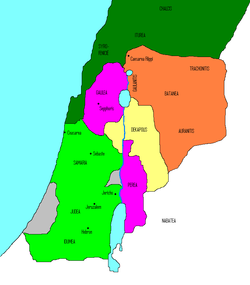
Recently in Mark’s Gospel, Jesus has returned from a visit to the borderlands with a visit to the Gentile city of Tyre. Here, outside his exclusively Jewish context, Jesus is jolted into a larger vision for his mission, a graphic experience for Jesus of learning from experience,250px-Palestine_after_Herod the upshot of which is that the message of grace and inclusion is no longer confined to the Children of Israel, but now startlingly open to the entire canine[1] world. He then returns via a healing tour of the Decapolis, an autonomous cosmopolitan region where Jews and Gentiles live side-by-side, before arriving at Caesarea Philippi, where he addresses his disciples with the question: who do people say I am, and more specifically who do you say I am?

A question: do we know who Jesus is?

Homecoming Sunday and the call to discipleship

Each of us is on a spiritual journey. To an extent our spiritual journey and our life journey are parallel strands of experience not always well synced, yet designed to be coterminous, each arriving in the fullness of time, at the same destination. For most of us these parallel strands are in tension. At each turn of the way, the pressures of the life journey seek to overwhelm our awareness of being on a spiritual journey. The nature of our parish community is a communal reflection of our individual negotiation of the tension between the demands of life and our desire to anchor where the restlessness of our hearts find rest in the Wisdom of God. Synchronizing the life and spiritual journeys is a process of learning through consecutive stages of maturing. Thus, Christian communities comprise a series of concentric circles.

In the first concentric circle, we experience little of the tension between the life and spiritual journeys. As individuals we try to be good people in our lives and so association with church is simply, us as good people doing what good people do, connecting with an organization we see as fulfilling a good purpose in the world. Being Christian presents as another version of a desire for self-improvement, we want to be better than we are. For instance, as parents we want our children to have a Christian formation because we want them to grow as fully rounded people. Yet, at this stage of our spiritual awareness Sunday School and Sunday morning soccer are roughly equivalent, and we want our kids to have a bit of both.

The second concentric circle represents a heightening of spiritual awareness. Paradoxically, we experience a sharp increase in the tensions between the demands of life and our spiritual calling. The tension increases here because we’ve caught the whiff of relationship with Jesus, and this becomes something important to us. We seek something ineffable, something too big for us to be able to adequately express it in words. We know that no amount of self-improvement will bring us closer to that which we are compelled to seek. We become increasingly dependent on grace. Negotiating this tension requires of us some difficult choices. We continually revisit our priorities as we realize we can’t make all the choices open to us, equally – we have to choose. Choice opens some doors while closing others and this is often a difficult negotiation. As parents, we want to model to our children our growing sense of the importance of God in our own lives. Because we don’t always feel confident in doing this we seek the support of the Christian community to help us shape them in that experience. However, for our children to have more than a cursory experience of ‘church’ as part of their well-rounded education, they need to catch the spark of our own curiosity and excitement about God. Otherwise, church becomes like school, something they do when young.

The inner-most circle is where the tensions between our life and spiritual journeys settle out a little. The choices we make in the face of the demands in daily life are in greater alignment and harmony with our desire to know and experience being known by God. I am not suggesting there are no conflicts to negotiate and that such negotiation does not come without cost. It’s simply that our sense of spiritual priorities is more established and this becomes a real support in guiding us to the choices we now intentionally make. We have learned a little more about the nature of the difference between the life we seek to win and the life we can afford to let go of. Here, we don’t feel we are good people, associating with an organization for good. We feel inadequate to the central task, no longer one of asserting our own goodness, but of opening ourselves to God.

In this inner circle Jesus’ words about self-denial and cross-carrying, about winning and losing life take on special significance. Often this is the stage of the spiritual journey we reach only after our children have launched upon their own lives in the world. Experiencing a certain amount of new and often terrifying freedom from the constant demands of family life with children at home, we begin to look towards the next phase of our lives, which of necessity moves us closer to a sense that we don’t have a lot of time left. Nearer to death, the earlier urgency of love gives way to a broader perspective and greater clarity.

In a world where all the emphasis is on individual choice and our own ability to progress along a continuum of self-improvement, however defined, we are likely to hear Jesus’ invitation to self-denial and cross-bearing as a heavy and rather irksome personal demand. We mutter to ourselves: I am under enough pressure in life, I don’t need my religion increasing the level of impossible demands. Many of us remain in the outer circle of faith community life because we just simply don’t feel able to meet what we experience as God asking more than we can risk.

To be in the first concentric circle is perfectly acceptable to God because this stage in negotiating the tensions between the life and spiritual journeys is a fine place to begin. My concern is that many of us stay longer in this stage because we misunderstand what God is asking of us. Because we hear God’s call only in purely individualistic terms, we can’t move forward, and there is a danger that after a while this unsatisfying experience causes us to leave the church altogether.

From individuality to community

The call to self-denial and taking up our cross to follow Jesus is not primarily, a call to prove ourselves worthy of the task of achieving personal salvation. It’s an invitation to participate in the life of a community that is a self-denying and cross-carrying community, in other words, a community of the baptized. The most ancient strand of soteriology, i.e. the doctrine of salvation, emphasizes that it is as the people of God that we are saved. It is as a company of disciples that we follow Jesus.

I believe the conversation that the Wisdom of God is calling us into on this Homecoming Sunday is a conversation of welcome. God is saying come, be present, all I require is that you conscientiously seek to participate in the building up of my body in the world. The purpose of the church is not to be a haven for the good, but to witness to the saving actions of the death and resurrection of Jesus Christ. All are welcome at all stages within a community that supports us as we struggle with negotiating the tensions between the demands of life and our spiritual calling.

SAM_0011

As we journey … into the new beginnings of post-Labor Day autumn, what will it mean to deny ourselves, take up our crosses, and follow Jesus? More, certainly, than giving up a few things; more than suffering as part of the human condition; more than moving forward on new paths—peering into autumn’s transitions, we belong to one another. Matthew Skinner

 Welcome back!!

[1] My pun on Jesus’ initial disparagement of the Syrophonician-gentile woman as ‘little bitch’, hence reiterating the Jewish disparagement of gentiles as dogs.

Learning our way towards the Kingdom

The Evangelist Mark, tells of a period in Jesus’ ministry when he appears to be off-line or off the radar, to use an older expression. Mark relates Jesus turning up in the region of Tyre. Tyre was historically the capital of the Phoenicians, an area we would recognize today as Lebanon. By Jesus’ time, this region had become a melting pot of Phoenicians, Canaanite-Syrians and Greeks. Jesus has wandered into and area where Jews were not always welcome. The Middle East was always, as it remains today, a hotchpotch of diverse ethnicities and faith communities living cheek by jowl, not always in amicable terms with one another. Mark does not explain why Jesus journeys into foreign territory. Furthermore, it appears that Jesus is alone. Mark offers no explanation for this, either.

Jesus roams beyond his Jewish homeland into a borderland. I am interested in the term borderland not merely as a geographical reference, but as a psychological designation. The borderland is the place where our psychological references shift.

Within our habitual environment – our habitudewe become programmed to expect only certain things, and to interpret them in familiar ways. Our habitude, an old French word once frequently used in English is from a psychological viewpoint a construction, a mental space inhabited by familiar expectations. Our habitude is by its very nature designed to minimize the possibility of being surprised by the unexpected. Even when we are, there’s no guarantee we will even recognize it.

Mark relays an encounter in the borderland with the unexpected that surprises Jesus. What’s more, being surprised by the unexpected seems to bring about a huge shift in Jesus personal perspective on the world presaging a huge shift in the nature of his mission.

An encounter that changed the world

We all know Mark’s story (Mk 7:24-37) about Jesus’ encounter with the gentile woman who request healing for her daughter. Distance in time and culture insulates us from the tensions running through this encounter. We miss the fact that Jesus’ response to her is from his place of habitude. He rejects her request because as he puts it, it’s not right to give the food reserved for the children of Israel and feed it to the likes of her a gentile dog. Micah Kiel in his commentary on this text comments:

Mark’s Jesus here uses the Greek word for “dog” in the diminutive, but this does not mean Jesus is calling her a “cute little puppy.” A colloquial translation today might be: “little bitch.” Jesus seems unsure of the relationship between the Gentiles and the Kingdom of God. 

The reason Mark gives us this vignette is because it presents Jesus as a man, confronted by the unexpected, being jolted into a new understanding of his mission. The woman receives her request and her daughter is healed not because she has skillfully bested Jesus in argument, though this is clearly so, but because Jesus is confronted with a new understanding that expands his mission beyond the confines of his Jewish-shaped -habitual expectation.

What kind of Jesus do we want?

What I mean by this question is, is Jesus a prisoner of our habitude, or is he a figure that surprises us and jolts us into the hitherto unimaginable? So much of our traditional way of viewing Jesus pictures him as omniscient – knowing all things, seeing all possibilities ahead of their happening. This presents a curious picture of Jesus who knows his end and simply journeys towards its fulfillment. It is as if we see Jesus as the key protagonist in a play, who going through the motions knows, as we also know, the end of the story ahead of time.

Speaking plainly, I do not find this Jesus of much help to me. I see this traditional image as an expression of our human desire to put a wide blue distance between Jesus and ourselves. In raising him to a higher plain of consciousness – an omniscient being, Jesus earns our admiration, someone to look up to. Yet, we seldom notice that such an elevation also conveniently excuses us from the now so-called higher – as in beyond our reach -elements of his mission. Our elevation of Jesus gives us an excuse from following Jesus because it’s now a futile exercise in comparing apples with oranges.

The phrase Mark most often uses to refer to Jesus is Son of Man. Most of us seem to prefer Matthew’s more elevated reference Son of God. In Jewish etymology, their meanings are technically interchangeable, yet for us they nuance this question of what kind of Jesus do we want? Do we want a Jesus who unlike us, is omniscient, knowing all things ahead of time? Or do we yearn for a Jesus who like us, can be surprised? Mark presents Jesus as very much like us, a man who was confronted by surprise; a man who could be jolted out of his habitude of familiar expectations and learn. 

Learn is the key word here, for learning can be pleasurable, but is most often painful, arising out of a conflict between the familiar and the challengingly novel. The idea that Jesus learns comforts me because I too learn – usually painfully, and I can only imagine that it was as painful and initially disorienting for Jesus as it usually is for me.

A local implication of Mark’s story

images-2At St Martin’s in Providence the Labor Day Weekend signals our entry into the new program year. We do so this year supported by the spiritual inventory program, RenewalWorks. Like many Christian communities we are powerfully confronted by the challenge to grow- growth measured across the board: in numbers, income, levels of engagement, but most significantly, measured in terms of our spiritual deepening. It’s clear to many of us that the key to drawing others, to attaining better financial sustainability, and levels of community engagement is completely reliant on the members of our community learning; learning more about our spiritual needs and the discrepancies between what we spiritually long for and our spiritual practice.

Key to this learning transition is our willingness to close the safety gap mind the gap – keeping Jesus and his call to mission, at a comfortable distance. 

A global implication of Mark’s story

As we watch the agony of the flood of refugees fleeing the carnage of Syria and adjacent regions, as a citizen of the European Union I am appalled at the failure not simply of human charity, but of the amnesia that blinds the more xenophobic countries of the Union to the echo between the historical images of the holocaust and what we all see unfolding across our TV screens. The current crisis is a European crisis, and one that is challenging the EU at its core to learn from its own painful history. Yet, in America the lesson should not be lost on us either, for we are more than willing to look the other way in the face of increasing pressure on our own borders.

The mission of Jesus is not his mission, it is our mission also. Mark’s story is a pivotal point that shows Jesus being (uncomfortably) confronted to expand the boundaries of his mission to reveal the power and urgency of God’s love and acceptance for the entire human race. Let’s stop hiding in our habitude, safely insulated from the demands of too much accountability for one another and allow ourselves to be confronted by the message of Jesus’ encounter with the Syro-Phoenician woman.

The problems of our world are huge, and the solutions always partial and incomplete. This does not excuse us from our need for a change of heart!

‘Little I’ Incarnation

Sermon delivered on August 31st Pentecost 14, by Linda Mackie Griggs, St Martin’s Director of Christian Formation

While it may be tempting to think that we have left behind the Gospel lessons about Jesus as Living Bread, perhaps I should warn you not to get too comfortable. While our text today does seem to have moved on to a new setting, and even a new Gospel writer, we have not left behind the difficult images of incarnation. Only this time we aren’t exploring Jesus’ Incarnation so much as we are exploring our own.

Our story today actually begins much earlier; at the beginning—when God loved Creation into being, clothing countless sparks of life with myriad creaturely bodies—wings, fins and tails; fur, scales and skin; mouths, eyes and ears. The story begins, according to the first creation story in Genesis, as God seeks his first children while walking in the Garden in the cool of the evening, asking, “Where are you?”—three words that embody God’s yearning for relationship.

How do we respond to the ineffable—to that which is beyond physical knowledge or description? There is a spark, essence, a something that God first clothed in physicality—what I like to call “little ‘i’” incarnated. Perhaps James describes it well as “implanted word.” When God first sought out this essence, this little homing device in His children they responded the only way they knew how—through their bodies, their senses, their incarnated selves. They established ritual and worship, marking the men through circumcision, eating certain foods and preparing them in certain ways. Ritual washing of bodies and cooking vessels wasn’t just a matter of hygiene. It was a matter of holiness—of valuing the sacred, and making offerings to God as acts of love and worship. All in response to God’s, “Where are you?”—God’s invitation to relationship. The bodies that humans had been given were used to connect the hearts of the people to the heart of God. This was the gift of their incarnation—heart and body as one.

And this served not only to build relationship with God but with one another. The “statutes and ordinances” that we hear about in Deuteronomy connected God’s people to God and bound the people of God into community—into family. Their physical practices kept them mindful, day by day, of who they were and whose they were. And arguably they would not have survived without it. They wanted to be seen as “wise and discerning people”, distinct from others, as Chosen.

But something happened, and it happened pretty much immediately, as is the nature of fallible humanity. Our beautiful God-given gift of incarnation has a difficult time remaining properly connected to its Source. It’s almost as though there’s a short in the system. Once the idea of sacred is introduced, humans tend very quickly to gravitate toward dualism—to want to pit sacred against that which is perceived to be profane.

So now it’s not just a matter of holiness and relationship, it’s a matter of who is holy, and who is not. Who deserves to be in connection with the sacred, and who does not. I’m worthy, but I’m not so sure about you.

“Hey Jesus, why don’t your disciples wash their hands?” This isn’t an issue of washing up for dinner. It’s a matter of who is worthy of being a member of the family.

And Jesus recognizes this. He knows the stakes are higher than hygiene and conformity. As a matter of fact he has a better idea than the Pharisees of the significance of their simple question. He pegs it as symptomatic of a totally skewed worldview—a misuse of their gift of incarnation and, as a result, of a total disconnection of the heart of the people from the heart of God. “You hypocrites,” he calls them. You have lost touch with the heart of the Law, and you are using rituals to circumvent relationship, not to build it.

And the language Jesus uses shows once again that he is, in fact, probably more comfortable with the concept of embodiedness/physicality than anyone present. It’s amusing that the Lectionary actually leaves out several verses in this passage—perhaps just for brevity in the summer heat, but I’m a wee bit skeptical. These lines, in particular stood out when I curiously went to see what was missing:

“Do you not see that whatever goes into a person from outside cannot defile, 19 since it enters, not the heart but the stomach, and goes out into the sewer?” (Thus he declared all foods clean.) 20 And he said, “It is what comes out of a person that defiles.”

Jesus responded to the Pharisees’ indignation about impurity by getting down and dirty about human bodily functions. Jesus had no trouble at all with physicality. He used spit to heal a blind man. He used spit, stuck his fingers in ears AND touched a man’s tongue to heal his deafness. He called a woman with a 12-year hemorrhage, “daughter.” And, as we have heard for the past few weeks, he invited his hearers to eat his body and drink his blood.

Jesus, fully God and fully human, was totally at ease with incarnation, while the rest of us generally squirm.

This discomfort, this uber-focus on bodies as simply bodies, and not as incarnated creatures of God, has resulted in the tendency to devalue others based on various aspects of embodiedness, whether it is practices or physical characteristics. Jesus cited a plethora of sins that issue forth from a heart disconnected from its divine Source: “fornication, theft, murder, adultery, avarice, wickedness, deceit, licentiousness, envy, slander, pride, folly”, and he was probably just getting warmed up.

All from a simple question about washing hands.

Jesus wanted to open the eyes of his audience. He wanted them to understand that if they refused to truly see all people as incarnated creatures in the hearts of which burn a God-created spark, they risked devaluing them; they risked Othering them.

How might Jesus respond to our 21st century world? Would he see any change from first-century Palestine? I’m afraid He would see that humans persist with a heart-breaking tendency to discriminate, neglect, subjugate, abuse, and disregard the brothers and sisters whom we deem unworthy because they don’t look or act like us.

And God said, “Where are you?”

Thank God that God is so patient!

One of my favorite Eucharistic prayers is Prayer C. It recounts the history of our relationship with God from the very, very beginning. One of the most distinctive lines is this: “Again and again, you called us to return.” Again, and again. God will never stop waiting for us to remember that we are bound heart-to-heart with God and each other.

How will our hearts respond?

Credibility

Now is my way clear, now the meaning plain; Temptation shall not come in this kind again. The last temptation is the greatest treason: to do the right deed for the wrong reason. T.S. Eliot Murder in the Cathedral

The readings for the 13th Sunday in the season after Pentecost are particularly rich. In the second track O.T. reading from the book of Joshua, Joshua now an elderly man presents the option for the people; they can either follow the God their ancestors worshipped before they entered the Land of Canaan or they can adopt the Gods of their Amorite neighbors. But, they must choose according to what they are willing to do. He tells them that: as for me and my household, we will serve the Lord. The people respond: therefore we also will serve the Lord for he is our God. 

The Gospel continues with working it’s way through John 6. Jesus has been speaking about himself as the bread from heaven before moving onto more graphic imagery in which he exhorts his listeners to accept that unless they eat his flesh and drink his blood they cannot have eternal life. In my last two posts, Bread and The Seed of an Idea I explored both of these metaphors in the context of Eucharistic worship.

To choose or not to choose, that is the question

Relationship with God seems always to involve a choice. To be in relationship with God is hard. Despite their affirmations, the Israelites discover over and over again that serving the Lord requires more from them than they are prepared to give. Jesus is not about to win followers through tailoring a seductive and inspiring message. Consequently, in 6:66 John tells us that: because of [his message] many of his disciples turned back and no longer went about with him. 

This seems to cost Jesus something. He seems resolute in his message but not exactly unperturbed, left unshaken by its consequences. We can sense him taking a deep breath as taking his courage in his hands he asks the twelve – his core group: Do you also wish to go away? Peter speaking on behalf of the twelve says Lord, to whom can we go? You have the words of eternal life. Phew!

Picture this scene. Place yourself in it. Do you not hear the catch in Jesus’ throat as he puts himself on the line with those who mean most to him. We can see the tears in Peter’s and the other disciples eyes as they acknowledge that for them there is simply, nowhere else to go, no one else to go to, for this is where their hearts have led them. They make a choice.

Although subsequent events reveal that neither the Israelites nor the twelve are ready to accept all the consequences of their choice, their choice places a marker in the ground, a place from which to at least struggle to stand firm. Standing firm is what Paul or a writer steeped in Paul’s thought exhorts the Ephesians to do through the imagery of donning the armor of God.

Choosing and then standing firm is less of a once-and-for-all resolute stand and more of a repetitive cycle of wandering and returning. From time to time, we will be knocked off our marker by what The Book of Common Prayer refers to as changes and chances of transitory life. Sometimes, we will willingly, though misguidedly wander from our marker – the imprint of our choice on the ground. Yet, having made the choice, we have a marker in the ground to which we are able to repetitively return.

Jesus, like his great forerunner Joshua, remains resolutely on-message. He recognises that the consequence will likely be that people will turn away because the message isn’t to their liking, or because it’s too costly for them to bear.  I, on the other hand, want to present a convincing image of Christian faith in a world where to choose to be a disciple of Jesus is increasingly countercultural and seemingly non-credible for the majority. The pressure to make the message credible is great.

For me, the treason to do the right deed for the wrong reason is all too real a temptation. Unlike Jesus, who refuses, I am tempted to do the right deed, i.e. win new adherents and attract new people to the parish, but for the wrong reason, i.e. a desire to be successful in my work of building strong Christian community. I want to ease the anxiety of choosing by presenting the choice as credible. The question which present itself every week in sermon preparation is this: does being credible require tailoring the message for the ears of the listeners? Most of the time I think it does. Yet, a closer reading of Jesus ministry shows that this is a temptation he resolutely resists.

This exploration is making me uncomfortably aware that I have a strong need to make the Christian faith a credible choice within the context of a highly educated and intellectually sophisticated community. After all, is this not why they called me to be their rector? Yet, I am also aware that credibility is not the standard Jesus used in constructing his message. Paradoxically, the power of Jesus’ message lies in its challenge to what in any given society is regarded as credible.

What faced the Israelites over and over again was that the pagan religions who’s Gods represented every aspect of human domestic-agrarian-warrior culture were more credible than the overarching and emotionally remote deity Yahweh. The crowds flocked to Jesus because they wanted to hear a credible message that proclaimed liberation from hunger, poverty, and oppression. They fell away because the message they heard was not a credible vehicle for realizing their aspirations.

In Eliot’s play Murder in the Cathedral, Thomas A Becket, Henry II’s hand picked man in the end refuses to tailor the gospel to fit the King’s needs. Four barons take it upon themselves to rid the King of his troublesome priest, murdering the archbishop on the altar steps in Canterbury Cathedral.

Down the generations little changes, it seems. What is the message we choose to hear, I wonder?  The disciples of Jesus found themselves in what often struck them as a non-credible place. It was a place of the heart, that made little sense to the mind. Having chosen, they arrived at a place where they became acutely aware that they could choose to be nowhere other and to be with not one else. If you take the courage to choose the gospel, then you find you have little choice. In a society captive to the illusion of power through choice, the option of faith seems non-credible.

Today, so many exhibit the signs of spiritual hunger. The food we are in search of is the food of faith, faith lived through community. The dilemma remains that faith only comes after we take the courage to believe. This might seem to many, incredible.

A Really Big Caricature

The seed of an idea

Scott Hoezee in his weekly blog The Lectionary Gospel refers to an incident in The River by the Southern Gothic author Flannery O’Connor in which a child drowns while trying to baptize himself in a river. O’Connor was heavily criticized for this depiction that seems to many grotesque. She responded by reminding us that within the symbolism of baptism is the notion of dying to the old self and being reborn in Christ. She noted that:

In the land of the nearly blind, you need to draw really big caricatures.

The text

Last week in a piece entitled Bread  I asked the question: do we at St Martin’s come Sunday by Sunday with a real expectation of eating the bread from heaven?

The bread from heaven is the a phrase Jesus uses in his conversation with the crowd following the feeding of the 5000 in John 6. We’ve spent the last two weeks making our way in bite-sized chunks through this chapter.

This week’s gospel section opens at verse 51 where Jesus, again likens himself to the living bread that came down from heaven. We see that the debate with the crowds is now heating up, initially sparked by Jesus’ question: are you coming to see the signs of God or for a free meal? They don’t like his referring to himself as the bread from heaven. They know this man and because they know his family background the crowd objects when Jesus attributes to himself a phrase they associate with Moses and the feeding of their ancestors in the wilderness of Sinai. Such attribution amounts to a human confiscation of God’s qualities – in other words, blasphemy.

Not being a man to over explain himself in an attempt to avoid an argument, Jesus now ratchets up the level of tension by abandoning the historically significant and metaphorically rich bread from heaven image, an image that is already getting him into trouble with the crowd. Instead, he offers them a really big caricature: his very flesh and blood:

Very truly I tell you. Unless you eat the flesh of the Son of Man and drink his blood, you have no life in you … for my flesh is true food and my blood is true drink. 

The power of big caricature

As with our instinctive reaction to Flannery O’Connor’s story of the boy drowning himself in a baptism seemingly gone tragically wrong, Jesus offers an image to his hearers, which for them, is truly grotesque.

It’s grotesque on two levels. Firstly, it’s cannibalistic, and secondly, it’s blasphemous. The first reaction is the instinctive repulsion human beings feel when confronted by cannibalism. The second reaction is the equally strong and socially programmed reaction of human beings to an assault upon cherished religious images and beliefs.

In the land of the nearly blind, you need to draw really big caricatures!

Intuitively, I draw back from really big caricatures. They offend my need for reasonableness. We live in a political world where reasonable debate has been replaced by grotesque caricature and incendiary sound-bite.

If you are Episcopalian, chances are you have come to the Episcopal Church attracted to the reasonableness and moderation of its Anglican ethos. Anglican ethos has a tendency to smooth over the bumpy caricatures of more extreme and less reasonable forms of Christianity with a spirit of balanced and gentle moderation. Yet, it has to be noted that our great strength at the same time is always in danger of degenerating into a kind of nothingness that is so vanilla that no one can take offense at it. If you never make any demand of people then no one ever has to say no, and we can all happily jog along in the land of the nearly blind. 

Revelation is never reasonable

The fact is that the message of Jesus is not reasonable – it is revelatory. Jesus is not trying to convince his hearers of rightness based on the reasonableness of his worldview. In that sense, he’s not very Episcopalian. Jesus’s priority is to shock us out of our cultural and religious insularities in order to catch a glimpse of things from the perspective of a self-giving God. Jesus reveals God giving [his] life to the life of the world. How better to do this than to present an image of religious participation as the ingestion of his flesh and blood, with no apology for the inevitable cannibalistic overtones.

So what do we at St Martin’s think we are doing Sunday by Sunday? Do we really come expecting to eat the bread of heaven? Possibly, when understood as tasteful metaphor. Do we come with and intention of consuming the flesh and blood of Christ? Unlikely, not even if understood as a less attractive metaphor.

I believe that most of us attend compelled by an inarticulate desire for what Anglicanism traditionally has referred to as the awe and wonder of worship, or the beauty of holiness. What does this mean, and what might it look like?

In the land of the blind

In 1979, The Rev. Bruce Reed published his book The Dynamics of Religion. Reed was an example of that great English tradition of a priest deeply involved with a sociological and psychological engagement with wider society. An American focus might be: how does church serve an individual? The English focus finds expression more in the question: how is society served by the existence and practice of the Church?

Drawing from Durkheim as well as Freud, Reed described the process of worship in terms of oscillation. Psychologically, oscillation describes a movement between rational and non-rational states of awareness. Reed understood the non-rational not as irrational, but akin to dream or even psychospiritual states where the boundaries of time and space and individual identity, are in constant flux. Sociologically, oscillation describes the process of movement between individual and collective aspects of experience. Reed noted that a primary function of worship is to focus and then manage the process of oscillation in both senses.

Put most succinctly oscillation is the process of energetic renewal. Psychologically, we arrive at worship clothed in our right minds in order to experience without interruption to rational functioning the irrigation of deeper currents of energy. Interestingly, charismatic worship most clearly exemplifies a process, which for non-charismatic Christians operates mostly at an unconscious level. Charismatic worship allows for a more dramatic oscillation where the influx of the deeper currents of energy for a time, overwhelm the rational state of the worshiper. Charismatic forms of worship meet the needs of communities where the day-to-day experience of suffering rooted in the experience of poverty, racism, and other forms of discrimination, is more intense.

Similarly, in our relationship between our individual and our collective identities, we are empowered individually through our participation in communal or collective rites of passage, in order for our lives to become better shaped by a deeper and more energetic connection with the common good.

Eating the body and drinking the blood of Christ is a psychotic idea. What I mean by this is that to eat human flesh and drink human blood requires a serious alteration of rational consciousness. For example, the Maori of New Zealand practiced ritualistic cannibalism prior to European arrival. They consumed human flesh within a context of religious ritual. The Maori ate the flesh of their enemies only in the highly ritualized context of warfare where cannibalism expressed spiritual domination over one’s mortal enemies through ingesting their flesh.

The interplay within and between – getting to the nub

Jesus did not literally offer his flesh and blood. No one ate Jesus and he did not intend for anyone to do so. He was employing psychotic- non-rational imagery – a really big caricature – as a revelatory device to show that through him, God is doing a new thing. God, through Jesus, is entering into the very heart of created life as an expression of love for the world. Jesus embodies this love through the events of the cross and resurrection. The really big caricature of eating his flesh and drinking his blood is his way of driving home the message that nothing short of complete incorporation of God in the form of physical ingestion will satisfy our spiritual hunger.

I cannot overemphasize two points here:

  1. Communion, i.e. participation in God’s self-giving is not an individualized, esoteric, spiritualized phenomenon according to Jesus. Communion with God requires ingesting real food – bread and wine transformed by collective memory and future hope into the flesh and blood of the Savior. This is the psycho-spiritual event of Eucharist.
  2. Eucharist is also a community event, properly understood when we realize that no one individual can celebrate Eucharist alone. Through the ritual of Eucharist we are incorporated into a communal meal at which it is as a community we take God into ourselves, thus satisfying our need to recharge our individual batteries from the our communal charging station. This is the socio-spiritual event of Eucharist.

Psychospritually, the ritual of Eucharist weaves a complex interplay between the ideas of physical and spiritual hunger, spiritual and physical food. In both cases, ingesting is the way to satisfying our need of God. Sociospiritually, the ritual of Eucharist draws us as individuals into an experience of the communal, an entity greater than the sum total of its parts, also referred to a the Body of Christ. Eating and drinking is the most powerful expression of social solidarity. Consuming the bread of heaven is the most effective way of ensuring that there is enough bread of the world to feed the hungry.  

In the land of the nearly blind, this requires drawing a really big caricature!

Bread

 Individual Remembering

As a child, I remember buying bread at the grocery. I remember it came as whole loaves, either white or brown. That’s all I remember about bread until at some point imagesa third option became available – sliced. The arrival of a slicing machine in the grocery meant that in our house bread now came presliced in a plastic wrapper.

A common saying in both New Zealand and the UK is: it’s the best thing since sliced bread! Maybe it’s a saying used by Americans as well. Being a denizen of all three cultures, it’s increasingly difficult for me to keep straight in which of the three cultures a certain aphorism originates. The saying means: wow, this [thing, situation] is a wonderful invention. I remember sliced bread as the staple of my childhood, for bread was not the specialty item to be savored and delighted over that those of us living in Providence find at Seven Stars Bakery. images-1Bread was bread, white or brown, sliced or not, used as toast or to make a sandwich or a bread pudding –a great favorite of visits to my maternal grandmother.

I also remember a time when the eating of bread had little down side. The purity of the grain and the metabolism of youth allowed me to consume bread without regard to quantity or consequence. This is alas, is no longer so. The processed nature of much wheat used in making bread is making bread toxic and I now strictly monitor my wheat intake. The slowing of my body’s metabolism also means that bread is now a source of unwanted carbs, and unwanted carbs are the enemy of my aging male waste line.

Bread is the staple food in all cultures where wheat is the staple grain. Bread is the staple food, the fruit of nature’s bounty. Wheat growing societies dependence on bread as the staple food has led such societies to view Bread is also a symbol of divine generosity – an embodiment of God’s care and concern for human beings. Our own religious memory contains countless instances and references to bread as a sign of God’s presence, God’s communication with and involvement in human affairs.

Collective remembering

We read of the prophet Elijah (1Kings:19) at a point of despair retiring under a solitary broom tree to await the welcomed release of death only to be awoken to find God’s gift of bread, baked on stones heated by the merciless sun as a both a means not only of physical sustenance but also as a sign of God’s promise of a future. The feeding of the Israelites (Exodus 16) with manna (a form of flaky bread) in the wilderness has become the archetypal bread story. It’s ecimages-6ho sounds throughout the scriptural record where bread becomes a sign of divine deliverance at times of crisis and a promise for the future. This story finds a strong resonance in ministry of Jesus, who feeds 5000 with two loaves; again bread used not only as a real material expression of God’s care and concern but an action that has a huge symbolic significance, the meaning of which Jesus begins to unfold.

We continue in the 6th chapter of John’s gospel with Jesus following his feeding of the 5000, expanding on his theology of bread. The crowds flock in increasing numbers to hear Jesus, drawn as he suggests not simply by the signs and wonders he performs but by the promise of a full stomach; the satisfying their physical hunger. We recall that hunger was the commonplace experience for the masses of displaced peasantry that flocked to hear Jesus. 1st Century Palestine was undergoing a commercialization of agricultural production with land being increasingly vested in powerful landowners who like the powerful in our own time were intent on the monopolizing of resources. Independent peasant farmers were being displaced and turned into itinerant day laborers, a story as old as time, and one alarmingly familiar to us as we view with a sense of increasing helplessness the trajectory of economic developments in our own day.

Jesus challenges the crowds to consider what it is they have come expecting. If it’s to be fed then that’s important but only a temporary fix. He pushes them beyond the familiarity of their boundaried imaginations and they don’t like it. They begin to challenge his presenting himself as the bread come down from heaven. Jesus is telling them he is the manna of God, which is much more than physical bread that temporarily satiates hunger. As God’s living bread, Jesus offers them the spiritual nourishment of transformation. If Jesus had read Maslow he would have realized that it is a tall order telling people about spiritual nourishment, whose bellies need filling.

I don’t imagine that Jesus as unsympathetic to the crowds drawn to him by the promise of a free meal. Yet, his purpose seems to be to lay out a much larger perspective, within which satisfying physical needs has a place, but cannot be the ultimate end goal. As human beings, we need spiritual nourishment that enables transformation, as well.

Bread the life of heaven and the life of the world

Bread is the fundamental element in Christian community. Christian community, to be Christian must be concerned with the need for real bread to feed the hungry. Give us this day our daily breadextends bread as a metaphor for all of life’s basic needs: something to eat, somewhere to live, and someone to love and be loved by. Christian community is also concerned with the bread from heaven that feeds our spiritual hunger.

Every Sunday and in some communities more frequently than that, Jesus’ gift of the bread from heaven that feeds the life of the world is renewed in time and space in the celebration of the Eucharist. The Eucharist is the central aspect of Christian worship. At the Eucharist real bread, the staple of life becomes the bread from heaven that feeds our spiritual hunger.

The celebration of the Eucharist must bear certain characteristics according to one of America’s greatest lay theologians of the 20th Century, William Stringfellow.images-5

In an essay entitled Liturgy as Political Action1 Stringfellow outlines three basic characteristics for liturgy that roots it in the integrity of the gospel. Let me apply some of Stringfellow’s thinking about liturgy more specifically to my task in hand.

Transcending categories of time

The Eucharist is where the Biblical story of creation is recalled and rehearsed in the full knowledge of the world’s redemption by Christ. In a modern world enthralled by the concepts of time travel and parallel multidimensional connections across time, the Eucharist, as action forges a conduit between past and future allowing the energies of the past and the promises of the future to flow into the present, i.e. into present time and the particularity of place.

This drama – dramatic action requires the full participation of all the people to prevent it becoming simply a spectacle to be observed. As Stringfellow puts it:

As a transcendent event, the [Eucharist] collects all that has already happened in this world from the beginning of time and prophesies all that is to come until the end of time. But the [Eucharist] is also a contemporary event, involving these particular persons gathered in this specific place and in this peculiar way.

In other words, the Eucharist is here and now and its effects are real in the here and now. It becomes for us a way of focusing our attention on our connections within the community – past and present, and between the community and rest of the world around it. [It] is the normative and conclusive ethical commitment of the Christian people to the world2

The Eucharist celebrates not only God’s gift of Godself in Christ as the bread from heaven given for the life of the world, it also expresses the involvement of the Christian community in the life of the everyday world through the acts of service and witness, i.e. real bread, necessary for real people as staple of life.

Eucharist is the central act of worship in the historicl3 tradition of Christianity of which the Episcopal Church as a Church of the Anglican Tradition is a part. This summer at St Martin’s we are deepening our understanding of Eucharist, which for many of us becomes rather routine and devoid of impact, cocooned within the familiar recitations on Sunday mornings. Eucharist becomes merely a matter of doing what we do without any real connection to the why. For the months of July and August, we are exploring Eucharist in instructional format at the different time of  5.30pm on Sunday evenings. In this format, the familiar cadences of the Prayer Book give way to reveal the skeleton of actions that undergirds Eucharist as one whole action.

Returning to an expansive vision

Since the 1979 revision of the Book of Common Prayer, we have sought to overcome the legacy of the arid argument as to whether at the Eucharist the bread becomes Christ’s real body or remains just bread. Today we transcend the controversy particular and peculiar to the 16th century by reconnecting to a larger and more encompassing vision of sacramental action and sacramental authority.

Our current science fiction fascination with time and anomalies of time fuelled by the real physics of Quantum observation opens a way to revisit the historic concepts of anamnesis, i.e. the remembrance of things past made effective again through action in the present. Like the crowds that came to hear Jesus, what are our expectations as members of a community whose central action in the world is the celebration of Eucharist?

St Paul offered two tests for measuring our spiritual vitality. Can we allow ourselves to be part of community -something greater than ourselves, and can we engage with our individual calling through which we can make our distinctive contribution, bringing our skills, passion, and resources to the building up of the community?

For so many of us our membership of the community of faith has become perfunctory and at times can mean little more to us than belonging by habit to a club or association. This is not always our fault. It can be just the way life is at times. Yet, no matter how exuberant or lackluster we feel about church, I have yet to meet a person who is not spiritually hungry for something more.

Bread, the bread from heaven, which satisfies our spiritual hunger (John 6:35, 41-51) in the celebration of the Eucharist brings the nature of Christian community into sharper focus. Is our community a place where we can expect to eat the bread of heaven? Is St Martin’s a place where we can begin to distinguish between our emotional wants and moods and our spiritual needs? It can be only if we invest ourselves in its life.

Much of what we long for is not more happiness, but a more vital sense of purpose and connection beyond ourselves. We find that what we need as a community of seekers journeying together is to become a community where transformation is an expectation in everyday experience. We long not only for personal transformation; we also long to become transformed as a community, fit to carry out the mission of the being Christ’s body in the world.

The Book of Common Prayer tells us that the mission of the Church is to pray, worship, proclaim the Gospel, and promote justice, peace, and love (Pg 854BCP). Through whom does the Church carry out its mission? The Church carries out its mission through the ministry of all its members, i.e. you and me gathered to celebrate and receive the bread from heaven.

William Stringfellow again: Eucharist is not any ritual such as the rituals of the Masons or any other secret society. It uses ordinary things that are the staples of life in the world –

bread, wine, water, cloth, money, color, music, words, or whatever else is readily at hand.

Using the ordinary things at hand to celebrate and make present the extraordinary gifts of God is a political event. By political event Stringfellow clearly has an event in mind that challenges and changes things.

The very example of salvation, it is the festival of life that foretells the fulfillment and maturity of all of life for all of time and in this time. The liturgy is social action because it is the characteristic style of life for human beings in this world. 4

quote-the-practice-of-the-christian-life-consists-of-the-discernment-of-the-seeing-and-hearing-william-stringfellow-70-51-64

[1] A Keeper of the Word: Selected Writings of William Stringfellow (1994) Ed by Bill Wylie Kellermann. Eerdmans Publishing, Grand Rapids, Michigan.

[2] The History of the Liturgy Pp 124-5

[3] Catholic and Apostolic

[4] Pp 125-6

Spiritual Maturity

Reverie

Cork is a wonderful material, a natural product of the Quercus suba or cork oak tree. I remember in the house I grew up in, there was a cook floor in the Wtree-360dining and sitting rooms made from large squares of cork arranged in an alternating pattern of honey and coffee coloured tiles. Because the ultraviolet rays of the sun are so intense in New Zealand, after a while the contrasts faded and every so often the floors needed sanding to restore them to the colours of the original pattern. It was a very 1960’s look. Cork tile floors are ubiquitous with the great movement in design called Mid-century Modern, a style common around the Pacific Rim but which seems not to have made much inroad into New England; a style I note, that is once again the rage in design magazines like CB2.

You don’t see cork as much as you once did. Even its last great bastion, the wine cork, seems to be on its way out. More often than not wine bottles are now sealed with the easy to open screw-top, or something, which interestingly we still refer to as a plastic cork. It’s ironic how cork now refers to a function, i.e. sealing or stopping, rather than the material of the seal or stopper itself.

Cork was for centuries prized for its buoyancy making it an essential material in the traditional fishing industries. Even here, or maybe especially here, cork has now largely been replaced. Fishing buoys made from cork are now hard to find. Universally, buoys are now made from a material I call polystyrene, which translate for Americans as Styrofoam.

My cork reverie was evoked by the passage in Ephesians 4:14-16 that speaks of being tossed to and fro, an image for me of the action of swimming in the surf, of being helplessly carried upward and downward, forward and backward, propelled by the action of the waves. 

We must no longer be children, tossed to and fro and blown about by every wind of doctrine, by people’s trickery, by their craftiness in deceitful scheming. But speaking the truth in love, we must grow up in every way into him who is the head, into Christ, from whom the whole body, joined and knit together by every ligament with which it is equipped, as each part is working properly, promotes the body’s growth in building itself up in love. 

This passage offers two intriguing contrasts.

1. Being anchored

The first contrast is between corks and buoys, whether the latter are made from the material cork or not. In the image of being tossed to and fro, in my mind’s eye I picture the contrast between the image of a cork bobbing up and down on the surface of the water, at the mercy of the ebb and flow of the currents, and that of the buoy rising and falling with the action of the waves but firmly anchored in one place.

Am I a cork or a buoy? Do I feel like a cork or a buoy? Are these even different questions? As I explored last week in the Illusoriness of Reality, these are different questions to the extent that feelings are not always an accurate indication of what is real. Yet, feeling states are what we have ready, conscious access to, so I guess there are times when I feel more or less cork-like. Yet, feelings are no indication of spiritual maturity.

There is an important distinction between spiritual and emotional states. Optimism, or pessimism, happy or sad, these are emotional states. They are not accurate indicators of spiritual vitality, because each is a reflection of circumstances in the external world. Things go well and we feel happy and optimistic. Things are tough and we feel sad and pessimistic.

Spiritual discernment has traditionally made a distinction between consolation and desolation. These are spiritual states that contradict, rather than reflect feeling states tied to external perception. For instance, things appear to going well for us. We seem to have all we could desire, and in the midst of our optimism we feel hollow and empty. This is the spiritual state of desolation and it alerts us to the illusory mistake of identifying spiritual vitality with material or emotional happiness. Correspondingly, consolation galvanizes us during tough times. When we face up against the large uncertainties of life, the seeming impossibilities that loom large before us, we experience a certainty of purpose and direction anchored by a palpable – felt but not seen – trust in God.

Spiritual states have an objective quality, i.e. an expression of something in us that is greater than we are, whereas emotional states are highly subjective, i.e. resulting only from inside ourselves. Yet, it seems both spiritual and emotional states involve maturing.Returning to my metaphor of the cork and buoy, the key spiritual question is: am I a cork cast adrift and vulnerable to the unpredictability of tide and wind, or am I a buoy, firmly anchored to the ocean floor with a cord strong and elastic enough to ride the turbulent current and hold-fast into the prevailing wind?

2.Growing up

In exploring this question I note the second contrast that Paul –whether it is actually the historical Paul or a later disciple imbued with his spirituality makes in the Ephesians passage between spiritual immaturity, the state associated with being a child and maturity.

We must no longer be children, tossed to and fro …. [But] we must grow up in every way into him who is the head, into Christ …

Here’s a nice theological question: does the soul grow up, i.e. does it grow and mature with the passage of life? Theologically, the soul has been seen as immutable or unchanging. This is somewhat the position held by transpersonal psychologies such as Psychosynthesis, which see the soul as a higher center of supraconsciousness, independent from, but contributing to our emotional development. The soul may be unchanging, but spiritual maturity, rather like emotional maturity is constantly forming.

Different languages

The theologian James Fowler, while not the only one to do so, has developed a schematic of spiritual maturity across psycho-spiritual formational stages, which he links with those of increasing emotional development. This is not the place to go into an analysis of his six stages of spiritual formation so visit https://en.wikipedia.org/wiki/James_W._Fowler to explore further.

Without access to a modern psychology of psycho-spiritual formation, Paul and those speaking Paul’s message to a later generation had two core measures for individual spiritual maturity.

The first is a measure of a healthy capacity to participate in community and to strengthen the sinews that link individuals into a whole, i.e. a maturity that supports unity. The second is a measure of participation in one’s individual call. Spiritual maturity manifests differently in each of us according our discernment and acceptance of our calling, our vocation.

If the first measure of spiritual maturity is the capacity to participate in something greater than one’s self, the second measure is of a capacity to contribute our difference, something very individual to one’s self, to the building up of the greater whole. Paul often uses the metaphor of the human body to speak of this; one body, yet different organs. Ephesians takes up this metaphor and presents a process for building up the body through the promise of spiritual maturity.

Ephesians speaks of spiritual maturity, of growing up, in the language of:

The gifts he gave were that some would be apostles, some prophets, some evangelists, some pastors and teachers, to equip the saints for the work of ministry, for building up the body of Christ, until all of us come to the unity of the faith and of the knowledge of the Son of God, to maturity, to the measure of the full stature of Christ.

Fowler’s sixth stage of formation offers us a modern language for the spiritual maturation Ephesians speaks of. Spiritual maturity, while exhibiting a number of different characteristics is the capacity to treat any person with compassion, accepting them as a part of the same universal community, according to the Christ-centered principles of love, tolerance, and inclusive justice.

One image I easily have for myself is that like a cork tossed about, I feel vulnerable, at times child-like and ill equipped in the face of shifting opinions and conflicting worldviews. In the face of this turbulence, my overriding anxiety is to please, to fit in, to be included by making myself acceptable. This is an image of being adrift in a sea of fearful feelings. It’s an image for spiritual immaturity.

An alternative image is that like a buoy I ride the turbulent surface of living in the world with courage knowing that I ride the surface tempest anchored by a cord that is strong and elastic enough to hold me fast to God’s promise for me to grow into the full stature of Christ. Here, I am not afraid to express my difference and to tolerate if not embrace other’s difference as we grow together. This is an image of spiritual maturity in action. This is Christ’s promise and God’s gift.

There is one body and one Spirit, just as you were called to the one hope of your calling, one Lord, one faith, one baptism, one God and Father of all, who is above all and through all and in all. But each of us was given grace according to the measure of Christ’s gift. 

Spiritual maturity is demonstrated in our ability to discern and take up our calling, and to realize that we do not do so not in isolation, but in the company of one another. Together we use our individual gifts to built the body, helping rather than hindering one another as together we mature into the full statue of Christ.

The Illusoriness of Reality

Like others I suspect, the reoccurring tension for me lies in my confusing what I can see with what really exists. I have two prayers that form the bedrock of my daily devotion that seem to help me with this.

The first is: Please God, show me what I have yet to be able to see. The field of my awareness takes shape from what I think I see in front of me. Yet, I know that what I see is actually the product of the interplay between an objective reality and my imagination that interprets what I see according to the available templates of my memory. I know this. Yet I live as if what I see and the way I perceive it is an accurate reflection of something objective, i.e. independent of my perception.

My second prayer comes from my adaptation of a line in the ancient Christian prayer known as the Salve Regina. This is a prayer of heartfelt intercession to Mary. It is a prayer I learned a long time ago and within my current spiritual practice it remains an artifact from the fervor of my Anglo-Catholic youth. It survives when many other aspects of this earlier spiritual phase have fallen away simply because one day I found myself unthinkingly changing the line that runs:

to you do we sigh, mouring and weeping passing through this vale of tears, to:         to you do we sigh, mouring and weeping passing through this veil of illusion. 

My adaptation reflects a shift in my spirituality away from a medieval notion of the plight of human suffering to a notion that suffering is a perception that is rooted in the tension between subjectivity and objectivity. Sometimes this tension reflects our imprisonment within the way memory confines imagination or put another way a reflection of being shackled by the familiar. However, this tension can also be a place of imaginative creativity when imagination breaks free an opens to new shifts in awareness.

*

There is a scholarly controversy over whether Ephesians is actually from the hand of Paul or from that of a later disciple writing in the style of Paul. The controversy over Ephesians is a modern concern and not one that would have made any sense to Paul, himself. Ephesians strikes a different tone with its focus on the qualities of an ordered spiritual life that indicates a less turbulent and more settled time than the one Paul lived through. Nevertheless in so many places it approaches the intensity of Paul’s vision. In the portion appointed for the epistle (Ephesians 3:14-21) on the 9th Sunday after Pentecost, the author, whether Paul or not, articulates a powerful Pauline vision:

I pray that you may have the power to comprehend, with all the saints, what is the breadth and length and height and depth, and to know the love of Christ that surpasses knowledge, so that you may be filled with all the fullness of God. 

My heartfelt response to this passage is –if only. What I mean is, if only this expectation would resonate through my whole and undivided being. I long to expand my perception beyond the limitations placed by my need to stay within the security of what I already know. I so desire to comprehend beyond the limitations of what I think I see.  I long for this Pauline expectation to become my reality. I live in the tension between such a hope and my encapsulation within a small, limited, and overly self-referenced perspective; a perspective resulting from still being firmly on this side of the veil of illusion.

**

In John 6:1-21, the gospel appointed for Pentecost 9 we receive the miracles of the feeding of the 5000 and Jesus walking on the water. The feeding of the 5000 is one of those rare events recorded in all four Gospels.

John does not record many of the events that form the bedrock of the synoptic writers. Unlike Mark, Matthew and Luke, John is not writing a synopsis – general theological and chronological overview of Jesus life and ministry. John is constructing a theology of theophany i.e. God’s visible manifestation to humankind. He reconstructs the ministry of Jesus around seven signs, all of which focus attention on the nature of Jesus’ and God’s identity as intertwined. At the heart of John’s gospel lies his theology that in Jesus we see God; a God who reveals through signs or miracles.

Misapprehension, misunderstanding, rejection, are themes that run through John’s narrative of theophany because our ability to see reality is distorted by the veil of illusion constructed from our self-referenced and imaginatively encapsulated hopes and expectations. The crowds are firmly rooted on this side the of the veil of illusion, with Jesus on the other side. Interestingly, reality and illusion are often so close together, and can be likened to the opposite sides of the same coin.

The crowd is attracted to Jesus because of the signs he works, signs that make him a powerful target for the projections of their unrequited longing.  For the crowd, Jesus is Moses or Elijah come again. The prophet of old who will lead them from their current state of subjection into a new promised land. Ecstatic with expectation, they try to make Jesus a king – the Messiah who will deliver Israel from its bondage. These expectations are close to the truth but perceived from the illusory side of the coin.

On the other side of the coin, John tells the story of the feeding of the 5000 to create an echo between Jesus and Moses. In John’s version Jesus echoes God through Moses feeding the people with manna – limitless bread in the wilderness. After feeding the people John has Jesus go up onto a mountain beside the lake – a probable reference to the Golan Heights, but an echo of Moses ascending Mt Sinai to witness theophany.

It’s as if God’s self revelation is designed to actively trigger the people’s collective religious memory, creating an association between Jesus and Moses. God desires that the people see that in Jesus something radically new is coming to pass. Yet, then as well as now, humankind tends to limit itself to perceptions shaped by what it already knows. The need is for humankind to see something new. John sees in Jesus something new and he never seems to come to terms with the fact that most people around him don’t. Today, the danger is that we continue to construct God as a manifestation of our own self image – a kind of anthophany.

The feeding of the 5000 followed by the walking on the water are the fourth and fifth of John’s miracle signs. But, what is a miracle? Put most simply a miracle seems to be an event that on the face of it has no rational or logical explanation according to our expectations of how things work in the universe.

On one side we have the externalists, those who see miracles as events in time and space that are miraculous because they mysteriously and inexplicably suspend the Newtonian laws of physics. The miraculous becomes its own explanation. On the other side we have the internalists, those who believe the seemingly miraculous is a psychospiritual event – something occurring within the inner consciousness of individuals. Between these two positions is a profound theological disagreement. The externalists affirm miracles because God can do what God likes, that’s the function of being omnipotent. The internalists counter with, having set up the laws along which the universe seems to operate, God becomes confined by a self-imposed restriction to only operate as a good Newtonian.

***

For me, the question do miracles happen is the wrong question. Miracles are defined not by how they happen but by their consequences. Miracles change perceptions and the course of events. I am happy to be agnostic about whether they are external or internal events because I find this distinction to be an illusion. I have only my internal perception of any objective event in external reality.

I prefer to see miracles as those experiences that show us the more than what we are conditioned by memory-shaped imagination to expect. It’s not do they, or how do they, happen? It’s how is our sense of the possible reshaped by such events so that we make the imaginative leap into expecting more than we have dared to hope for?

The hypothesis that I have been at pains to articulate here is that the expectations of God’s KINGDOM are never limited to the possible or even to the probable. The expectations of the KINGDOM come to us in the form of a discovery that we are not limited by the boundaries of only what we can imagine.

The veil of illusion is permeable! Through courageous expectation and hope-filled action we are called to comprehend the breath and length and height and depth, and to know the love of Christ that surpasses all knowledge so that we may not only be filled with the fullness of God, but be those through whom God is able to accomplish abundantly far more than we can ask or imagine.

Blog at WordPress.com.

Up ↑