Of Neighbors and Eternal Life

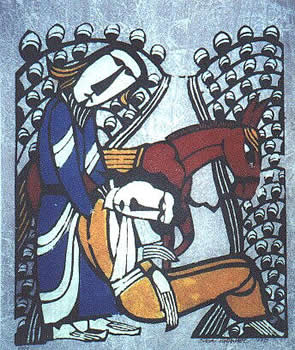
Sadao_Watanabe_The_Good_Samaritan_smWith the Zimmerman trial being reported in the news this last week the Good Samaritan parable strikes me as a timely commentary on the question of who is my neighbor? Of course this was at the heart of the lawyer’s questioning of Jesus. Jesus, side steps the question and elicits an answer from the lawyer to a slightly different question: which of the three, the Priest, Scribe and Samaritan acted as a neighbor? The lawyer now does some side stepping of his own and simply replies: the one who showed mercy. In telling the lawyer to go and do likewise, Jesus is answering the lawyer’s original question: what must I do to inherit eternal life?

So there are two questions here. The first is who is my neighbor? The second is what is what is my responsibility to my neighbor? The simple answer to the first question is everyone is my neighbor. You may question this as an impossibility? A simple definition of the word neighbor is the one who comes near. Therefore, for me it’s the second question that is the more significant. If everyone is my neighbor, the real rub is, so what do I owe them; what do they owe to me?

Understanding neighbor in this way, George Zimmerman became Trayvon Martin’s neighbor the moment he came near to him. Such a reading is dramatically at odds with the assumptions that underpin social relations in contemporary America. In our society, a working definition of neighbor might be, not the one who comes near to me, but the one who fears me or of whom I am afraid.

Why is this so? Do we really pose such a threat to one another? Is this a hangover from frontier culture in which the stranger was automatically experienced as a threat until discovered to be otherwise? Perhaps. Having lived in the UK for 30 years and now in the US, I notice how quick Americans are to enthusiastically shake hands with broad smiles. In England such behavior might imply particular interest being shown between people, otherwise the English tend to ignore one another. I have learned not to assume this in the American context. The person vigorously shaking my hand and broadly smiling at me with perfect teeth is not expressing any particular interest in me. He, for usually it’s men who behave like this is simply signaling to me that he poses no threat to me and is hoping I am likewise, nonthreatening.

Yet, the pioneer roots of American culture can’t explain the degree to which we now fear one another in modern America. Listening to the Gospel reading of The Good Samaritan, one sympathizes with Jesus as the lawyer attempts to cross-examine him. The overly litigious nature of American society both reflects and stimulates an environment of mutual fear and suspicion between us.

It seems to me that a better explanation of the situation we find ourselves in as neighbors to one another lies in the nature of modern society viewed from the helpful perspective of a theory called Spiral Dynamics http://spiraldynamics.org/ . Spiral Dynamics is a tool that I found very useful in my former life as a priest within a large secular organizational setting. Here, my task was to be the pastor to organizational structures and relationships.

Spiral Dynamics helps to analyze organizations, and by extension social structures in terms of types of cultural development it calls Memes. A meme is a particular location on an evolutionary continuum that helps to explain the dynamics of social relations and worldview. Spiral Dynamics assigns a color to each meme, which greatly aids comprehension. Each meme represents an organized shared system of values around which a culture structures itself. For instance, purple, tribal cultures based on blood or extended kinship ties, blue, hierarchical-authoritarian cultures, relying on complex stratified bureaucracies, where knowing one’s place in the order is a primary concern.  Orange, scientific- entrepreneurial cultures structure social relations around an ethos of progress, and wealth-creation. Whereas, green, communitarian- egalitarian culture bases its value system on shared notions of equality, consensus, and the common good. There are two rather interesting evolutionary stages identified as the yellow, systemic-integrative, and turquoise, holistic-interdependent memes.

Historically, it has been possible to identify a culture by reference to its monochrome memetic identity: purple, red, or blue, green, etc. It’s also possible to show how a society evolves through the hierarchy of memes; from purple or red to blue, from blue to orange, or from blue to orange to green.

In each memetic location, the concept of neighbor is given a dominant meaning. In a purple, tribal culture my neighbor is my kin or others similarly connected by virtue of belonging within the tribe. Those outside the tribe are not my neighbors, and in fact they are usually seen as my enemies. In blue, authoritarian- hierarchical culture my neighbor is someone of the same class, group, or occupational identity as me. In orange, scientific-entrepreneurial culture there exists a shared yet, individualistic concept of neighbor. Anyone who is not able to embody a strongly individualistic, progress or wealth-driven self-sufficiency is not my neighbor. In green, communitarian culture my neighbor is an extensive concept that includes everyone who agrees to be governed by a shared construction of the common good. Anyone who does not agree to this construction of the common good is not a neighbor, as those who resist the contemporary liberal social agenda, usually blue or orange meme individuals, come to quickly find out. No modern society has yet to achieve a secure hold on yellow or torquoise memes, although small groups among the elites do reflect these memetic locations.

Spiral Dynamics tells us a lot about our competing political and religious cultures. The Army and the Church are classic blue cultures. Republicans tend towards being blue- orange in culture. Democrats are heavily green with sometimes an orange, and sometimes a yellow tinge. Evangelical Christians sometimes are purple, sometimes blue. Roman Catholics tend toward the blue, with purple enclaves and with green on the liberal fringes. Episcopalians are almost uniformly green.

When a society displays a primary memetic location, there exists a consensus within that society concerning both the identity of, and obligations owed, between neighbors. In contemporary American culture there no longer is any consensus on neighborliness. Fear is generated between us as we struggle with competing purple, blue, orange and green notions of who is my neighbor. I suspect competing concepts of neighbor lie at the heart of the violent altercation between George Zimmerman and Trayvon Martin leading to the tragic death of young Martin. Amidst the overwhelming confusions between who is neighbor and who is foe in our global, pluralistic society, Zimmerman seems to have relied upon a more primitive, purple, tribal classification. Zimmerman decided that Martin was not his neighbor, but his enemy; a conclusion reached through a complex process of classifying the identifiers (age, race, on foot rather than in a car, etc) of like and non-like.

Jesus lived in a society structured around two memetic locations. The dominant location was the blue culture of the Roman Empire, which imposed an authoritarian, bureaucratic enforcement of hierarchy and stratification. Along side this, and in reaction against it, there co-exited the earlier purple culture centered on tribal loyalties. Jesus exploits his listener’s purple, tribal construction of neighbor through his parable of the Good Samaritan. For them good and Samaritan couldn’t share the same mental space. In connecting good and Samaritan, Jesus was creating an identity conflict that threatened to burst open his hearers tribal construction of neighbor, or push them into cognitive shut-down.

Jesus conversation with the lawyer had a larger group of people eavesdropping-in on their conversation in a manner similar to our eavesdropping-in on the Zimmerman trial. Jesus invites the lawyer and the eavsdroppers into the turquoise, meme of the Kingdom of God. Here, there are no tribes, nations, or empires, only neighbors. In the Kingdom of God we are not concerned to discriminate between neighbor and non-neighbor on the basis of the costs to us of neighborliness. In the Kingdom of God we are invited to consider as our neighbors all who come near. Our only consideration should be the cost to them if we refuse to be a neighbor to them.

Jesus asked the lawyer: which of the three do you think was a neighbor to the injured man lying in the ditch? The lawyer replied, the one who showed mercy. Jesus said to him- go and do likewise!

The print appearing above is Sado Watanabe’s: The Good Samaritan

For Episcopalian Eyes Only!

The Church of England is a complex animal because it does not share the possibility for consensus more easily arrived at in the Episcopal Church(TEC). TEC has its voices of minority, yet it draws from a narrower and more homogenous range within the wider social spectrum than does the Church of England, which often strikes us from this side of the pond to be bedeviled by the breadth of its constituency and therefore, the strength of different voices competing with that of the predominant voice of progressive liberalism. Here you can see in the Archbishop’s opening address to the General Synod his attempt to address the complexities of difference within his audience while at the same time sounding an unequivocal call to move beyond the confines of our limited imaginings to embrace the winds of change the Spirit is breathing into and through the Church.

Mark+

Pressmail from St Matthew’s Westminster
View this email in your browser

Archbishop’s call for church revolution
Justin Welby, addressing General Synod in York, 5th July 2013

The Archbishop of Canterbury, Justin Welby

Before I begin I would like to thank all the staff at Lambeth and around the NCIs, and at Bishopthorpe and the Anglican Communion Office, who have been so effective and kind in dealing with the frightening and unsettling impact of a new Archbishop. Transitions are always very complex, and taking on a new Archbishop is as demanding as it gets. But there’s invariably been a warm welcome and extremely hard work, for which I am extremely grateful. Chief amongst those who have led the way through the process is Chris Smith, the Chief of Staff at Lambeth. After more than ten years of faithful service, working night and day and every weekend – he’s the biggest menace to my capacity to have a quiet evening in on a Saturday night because I get an email from him – after more than ten years of never stopping he is moving on to other things later this year. His contribution has been largely behind the scenes, but he has served the Church of England and the Anglican Communion – not only for a long time but with huge effect – and our debt to him is more than we can imagine. So on your behalf I would like to thank him.

As you know too from public announcements, Bishop Nigel Stock, Bishop of St Edmundsbury and Ipswich, has with great generosity and considerable sacrifice, I’d imagine, agreed to become the Bishop at Lambeth, in a new configuration for the role, working alongside the new Chief of Staff. I could not be more grateful to have such a wise and experienced person, who will enable my many weaknesses to be compensated for more than adequately.

One of the things about this job is you tend to carry a lot of baggage – physical, metaphorical; probably more than I know. We arrived yesterday, the car having broken down en route – there’s a nasty metaphor there. But we did arrive – and we found ourselves with a ton of baggage to carry from one end of what seemed to be a much bigger campus than last year, to the other. And it reminded me – as I was staggering along with what seemed to be enough robes to rival Wippell’s – that we come to this session of Synod with a certain amount of baggage; and it’s good to find ways of getting rid of it. A friend of ours – of my wife and mine, from our days when we lived in Paris – worked for many years for an American company but living in Paris. We went to stay with them about six of seven years ago – he’s now ordained; there’s no connection – and he was still laughing about an experience at Kennedy airport the day before. It was a February and the weather in New York had been very bad, and he’d arrived and everyone was in a grump and the flights were late. And when he got one from the front of the check-in, the person in front of him was incredibly rude to the poor check-in operator. And John, our friend, is always gracious and polite, and when he got to the front he said, ‘I’m embarrassed to be a passenger when people treat you like that. I don’t know how you were so patient.’ And she said, ‘Well, sir. I shouldn’t really tell you this. There’s sort of bad news and good news. The bad news is he’s sitting next to you on the flight to New York. But the good news is I’ve sent his luggage to Tokyo.’

There are a number of obvious applications to that, one of which is we could do with some people like that at the beginning of a Synod session – for the baggage to go somewhere else.

You don’t want a lot of baggage in a revolution. And we live in a time of revolutions. And the trouble with revolutions is once they start no-one knows where they will go. Of the most serious type, the physical type, the practical type… Bishop Angaelos, Head of the Coptic Church in the UK, whom I met in Egypt last week, and who is sitting with us today, knows exactly about revolutions. While we were in Egypt, we heard much talk of what would happen this week – and we’ve seen. And the grace and leadership of Christians in that country is something to behold.

But we live also in a time of many revolutions in this country. And as the Synod meets today, we are custodians of the gospel that transforms individuals, nations and societies. We are called by God to respond radically and imaginatively to new contexts – contexts that are set up by revolutions. I want to thank you, and to say what a privilege it is to share with you, in the ministry of shouldering the heavy burden of facing these changing contexts, and grappling with them in this Synod, now and over the years to come, and to thank you for your commitment in your work here you show to Jesus Christ and to His church. It is genuinely a privilege to be among you.

The revolutions are huge. The economic context and position of our country has changed, dramatically. With all parties committed to austerity for the foreseeable future, we have to recognise that the profound challenges of social need, food banks, credit injustice, gross differentiation of income – even in many areas of opportunity – pressure on all forms of state provision and spending: all these are here to stay. In and through the church we have the call and potentially the means to be the answer that God provides. As Pope Francis recalled so memorably, we are to be a poor church for the poor, however and wherever poverty is seen, materially or spiritually. That is a revolution. Being a poor church for the poor means both provision and also prophetic challenge in a country that is still able and has the resources to reduce inequality – especially inequality of opportunity and life expectancy. If you travel north from parts of Liverpool to Southport, you gain almost a year in life expectancy for every mile you travel. We are debating these questions in this Synod. But prophetic challenge needs reality as its foundation, or it is mere wishful thinking; and it needs provision as its companion, or it is merely shifting responsibility.

The social context is changing radically. There is a revolution. It may be, it was, that 59% of the population called themselves Christian at the last census, with 25% saying they had no faith. But the YouGov poll a couple of weeks back was the reverse, almost exactly, for those under 25. If we are not shaken by that, we are not listening.

The cultural and political ground is changing. There is a revolution. Anyone who listened, as I did, to much of the Same Sex Marriage Bill Second Reading Debate in the House of Lords could not fail to be struck by the overwhelming change of cultural hinterland. Predictable attitudes were no longer there. The opposition to the Bill, which included me and many other bishops, was utterly overwhelmed, with amongst the largest attendance in the House and participation in the debate, and majority, since 1945. There was noticeable hostility to the view of the churches. I am not proposing new policy, but what I felt then and feel now is that some of what was said by those supporting the bill was uncomfortably close to the bone. Lord Alli said that 97% of gay teenagers in this country report homophobic bullying. In the USA suicide as a result of such bullying is the principle cause of death of gay adolescents. One cannot sit and listen to that sort of reality without being appalled. We may or may not like it, but we must accept that there is a revolution in the area of sexuality, and we have not fully heard it.

The majority of the population rightly detests homophobic behaviour or anything that looks like it. And sometimes they look at us and see what they don’t like. I don’t like saying that. I’ve resisted that thought. But in that debate I heard it, and I could not walk away from it. We all know that it is utterly horrifying. to hear, as we did this week, of gay people executed in Iran for being gay, or equivalents elsewhere. With nearly a million children educated in our schools we not only must demonstrate a profound commitment to stamp out such stereotyping and bullying; but we must also take action. We are therefore developing a programme for use in our schools, taking the best advice we can find anywhere, that specifically targets such bullying. More than that, we need also to ensure that what we do and say in this Synod, as we debate these issues, demonstrates above all the lavish love of God to all of us, who are all without exception sinners. Again this requires radical and prophetic words which lavish gracious truth.

The three Quinquennial Goals of growing the church, contributing to the common good and reimagining ministry, are utterly suited to a time of revolution. They express confidence in the gospel. They force us to look afresh at all our structures, to reimagine ministry, whether it be the ministry of General Synod, or the parish church, or a great cathedral, or anything between all of those three. For that reimagination to be more than surface deep, we need a renewal of prayer and the Religious Life. That is the most essential emphasis in what I am hoping to do in my time in this role. And if you forget everything else I say, which you may well do – probably will do – please remember that. There has never been a renewal of church life in western Christianity without a renewal of prayer and Religious Communities, in some form or another, often different. It has been said that we can only imagine what is already in our minds as a possibility; and it is in prayer, individually and
together, that God puts into our minds new possibilities of what the Church can be.

The Quinquennial Goals challenge our natural tendency to be inward looking, calling on us to serve the common good. That covers many areas, and between us all, not singly, we are able to face the challenge. May Synod rise to that. But the second of my personal emphases, within that goal, is reconciliation, within the church but most of all fulfilling our particular Anglican charism to be reconcilers in the world, in our communities, in families, even, dare I say it, amongst ourselves. Even if we do sometimes conduct our arguments at high volume and in public, to be reconcilers means enabling diversity to be lived out in love, resisting hatred of the other, demonisation of our opponents.

The common good goes much further than that. Our unique presence across the country enables us to speak with authority both in parliament and here, and in every church and cathedral and synod and gathering place across the country. Our extraordinary presence across the world as Anglicans enables us to speak with intelligence from around the world. As Anglicans we are called to reconcile incredible differences of culture in over 150 countries. What an extraordinary heritage we have under God. So we seek to be renewed here and across the Communion, and to find the reconciling presence of God. This Synod meets in an era of revolution, but we have together the means and the courage to seize the opportunities that revolution brings.

The Quinquennial goals aim at spiritual and numerical growth in the church. That includes evangelism, the third of my emphases. The lead has been set by the Archbishop of York. Here again we need new imagination in evangelism through prayer, and a fierce determination not to let evangelism be squeezed off our agendas. At times I feel it’s rather like me when I have to write a difficult letter, or make an awkward phone call: even things like ironing my socks become more attractive. We treat evangelism too often in the same way. We will talk about anything, especially miscellaneous provisions measures after lunch on Sunday; and we struggle to fit in the call to be the good news in our times through Jesus Christ. The gospel of Jesus Christ is indeed THE good news for our times. God is always good news; we are the ones who make ourselves irrelevant when we are not good news. And when we are good news, God’s people see growing churches.

Attitudes to hierarchy and authority have changed, and continue to change; there’s nothing new in that. And the more they do, the more we are perceived, often wrongly – but genuinely – to say one thing, about grace, community and inclusion, and do another.

And yet with all these revolutions, which raise such huge challenges to us in our lives as the Church, we see clearly that God is working a wonderful and marvelous revolution through the Church in the wind of the Spirit, blowing through our structures and ideas and imagination.There is a new energy in ecumenism, not least shown by Pope Francis. There is a hunger for visible unity. Many churches across England are growing in depth and numbers. People are looking for answers in a time of hardship and when we show holy hospitality and the outflow of grace, we are full of people seeking us. There is every cause for hope. This Synod had a shock, depending on your view, good or bad, last November; but there is here assembled, in weakness or confidence, in all sorts of fear and lack of trust, people with the faith and wisdom who in grace will seek the way to the greater glory of God.

In some things we change course and recognise the new context. Revolutions change culture. In others we stand firm because truth is not set by culture, nor morals by fashion. But let us be clear, pretending that nothing has changed is absurd and impossible. In times of revolution we too in the church, in the Church of England, must have a revolution which enables us to live for the greater glory of God in the freedom which is the gift of Christ. We need not fear. The eternal God is our refuge and underneath are the everlasting arms.

There have been many times where the Church of England felt that change was in the air or this was a moment of crisis. Because we are not an organisation, let alone a business, or even an institution, but in reality the people of God gathered by the Holy Spirit to walk together in a way that leads to the greater glory of God, there are bound to be many crises and turning points.

So let us not imagine for one moment that because we are in revolutionary times what we are going through currently is either more dangerous, more difficult or more complicated than anything faced by the generations before us. We are in the hands of God; the eternal God is our refuge and underneath are the everlasting arms. We need not worry, but we must give all that we have and we are, for the uniquely great cause of the service of Jesus Christ.

So how we journey here is essential, and that is why during these next few days, certain things are being reimagined: not least what we do tomorrow. What is clear to all of us is that there exists, as we gather – and let’s be honest about it – a very significant absence of trust between different groups; and, it must be said – and the evidence of this is clear, though sad – an absence of trust towards the Bishops collectively.

One thing I am sure of is that trust is rebuilt and reconciliation happens when whatever we say, we do. For example, if, while doing what we believe is right for the full inclusion of women in the life of the church, we say that all are welcome whatever their views on that, all must be welcome in deed as well as in word. If we don’t mean it, please let us not say it. On the one hand there are horrendous accounts from women priests whose very humanity has sometimes seemed to be challenged. On the other side I recently heard a well-attested account of a meeting between a Diocesan Director of Ordinands and a candidate, who was told that if the DDO had known of the candidate’s views against the ordination of women earlier in the process he would never have been allowed to get as far as he did.

Both attitudes contradict the stated policy of the Church of England, of what we say, and are completely unacceptable. If the General Synod, if we decide, that we are not to be hospitable to some diversity of views, we need to say so bluntly and not mislead. If we say we will ordain women as priests and Bishops we must do so in exactly the same way as we ordain men. If we say that all are welcome even when they disagree, they must be welcome in spirit, in deed, as well as in word.

Lack of integrity and transparency poisons any hope of rebuilding trust, and rebuilding trust in the best of circumstances is going to be the work of years and even decades. There are no magic bullets.

So how we travel, and our capacity to differ without hating each other and to debate without dividing from each other, is crucial to the progress we make.

Integrity and transparency depend utterly on a corporate integrity and transparency before God, above all in our prayer and liturgy. I sometimes wonder if one of the drivers of our lack of trust is that we have lost from our experience and our expectation two of the great moods of liturgy: of lament and of celebration. The ability truly to lament, to rage at circumstances, at loss, at decline, at injustice, at our own sin or the problems we face, is one that enables us to find afresh the mercy and grace of God. Lament is a liturgical mood that builds our capacity to trust God in the face of change, and then we trust each other. Encountering the face of Jesus Christ in pain, grief or anger transforms us.

Equally the capacity to celebrate, to lift our hearts and voices in true and passionate praise and thanksgiving because the presence of God is known among, restores our perspective. Not only does it renew our faith and strengthen weary limbs in the long journey we are undertaking, but also the act of celebrating that which we share together cuts across our great barriers and difficulties. We celebrate because who can not be overwhelmed by the love of God?

Take for example the two Anglican Dioceses I saw a week ago in the Middle East, in Jerusalem and in Egypt. In the midst of terrible and confused situations, with unspeakable human suffering, tension and fear, they shine with brilliant light. And they are part of us. In each of them there is a profound commitment to the common good of the populations in which they live as a minority – populations of whatever faith and ethnicity. In each of them there are more schools, hospitals and clinics than there are churches. In each of them the Bishops have established confident and effective relationships with other churches, with Muslim leaders and with governments that enable them to speak frankly and truly and with great courage. And we need to remember that as what they do there affects us, lifts our hearts, shows us the grace and glory and power of God, even more so what we do here affects them and every other church in the Anglican Communion. We have great responsibilities.

We should do no less, be no less effective, no less bold than our brothers and sisters in Christ in those Dioceses; in Nigeria, in Pakistan, in places of persecution and suffering, of revolution, change and disruption. The eternal God is our refuge, and underneath are the everlasting arms.

Come Holy Spirit, fill the hearts of your people and kindle in them the fire of your love. AMEN.

© Justin Welby 2013

An Amazing Journey – From Galatians to DOMA

Struggling with Paul

I struggle with Paul’s linguistic image of a distinction between the spirit and the flesh. In my living memory our everyday thinking has been dramatically reshaped by the acceptance of psychological models of human development. Paul uses the only language he has on hand. It’s a language shaped by the notion that there is a struggle going on both within us and all around us. This struggle he conceives in terms of a war between spirit and flesh. Why do I struggle with this language?

My struggle is not with Paul. It is with the way Paul’s words have been interpreted. I need to translate this sharp division between spirit and flesh into an understanding that works for me.

That phrase works for me is an immediate warning flag to many who would accuse me of trying to domesticate Paul’s teaching, confining it only to that which I and the modern world that shapes me is able to feel comfortable with. However, what I mean by works for me is more than a demand that Paul’s words have to make sense to my modern understanding and feel comfortable to me within the limitations of my own disenchanted (Charles Taylor) imagination.

Works for me means that I need more not less from Paul’s words. For me, Paul has been too long the prisoner of patriarchy. For Paul to speak to me in the way he clearly intends his words to speak to the Galatian Christians, I need to hear his distinction between spirit and flesh as having the potential to usher me into the freedom which is the major theme of his letter to the Galatians. Chapter 5:1 opens with:

For freedom Christ has set us free. Stand firm, therefore, and do not submit again to a yoke of slavery. 

Freedom from things that had a hold over me

I have just described Paul as having for too long been the prisoner of patriarchy. This needs a little amplification. Patriarchy and patriarchal are terms of abuse now much bandied about by feminists and liberals of all shades and hues. Of course, I have been guilty using the terms in this way many times! So here, I am attempting to be more objective.  

By patriarchy I am referring to a way of looking at the world that seeks to maintain order through contrasting flesh as impure and spirit as pure. A way of looking at the world that fears the unfettered expression of freedom, because freedom challenges stable order. Patriarchy’s view of stable order rests upon not only the ranking of men over women, but upon a complex system of power based ranking between males. 

St Paul, like most human beings, oscillates between speaking from within his culture and moving beyond the limitations of his culture and its thought. If I accept less from Paul, I will read him as a supporter of patriarchal order and end up either accepting or rejecting his teaching about what it means to be a Christian. If I want more from Paul, I open my ears to hear his radical call to move beyond the cultural status quo of any social system of ordering human relationships. For Paul, the Cross and Resurrection of Jesus Christ changes everything concerning the vision of relationships between human beings in society. 

Paul and the Galatians

In his letter to the Galatians, we hear Paul’s radical call to be changed by the Cross and Resurrection of Christ. In this letter he is confronting the Galatian Christians who have moved away from the challenges of his teaching. He has taught them that life in Christ is about a freedom that transforms the person from within. This freedom is relational and so it also leads to a transformation of society. The Galatians seem to be in favor of the patriarchal Christianity of some conservative Jewish Christians. These Jewish Christians are telling the Galatians that being Christian means submitting to the Law of Moses. The symbol of submission to the law is of course, circumcision. 

A way now opens for me to listen differently to Paul’s language contrasting spirit and flesh. For Paul, circumcision has become the ultimate expression of the perversion of the law of the spirit by the law of the flesh. Circumcision is the ultimate religious symbol of a patriarchal form of control and privileging of the male on the basis that what males have and females don’t have is a penis. Paul is so outraged that this practice should be used as the mark of being a follower of Christ that he rails why then don’t these agitators go the whole hog and make eunuchs of themselves? For Paul, circumcision has become tantamount to the mutilation of castration. 

The freedom Christ offers is the freedom of faith counted as love. Paul sums up love as loving one’s neighbor as one’s self. So, freedom is not unfettered abandon to do as one pleases. It is love disciplined by the privileging of relationship. In contrast the patriarchal regulation of power rests upon the psychological principle of phallic potency. Men rank over women and men rank each other, by among other things, what a man does with penis and with whom he does it. 

The freedom Paul speaks of leads to a new set of social relations defined not by circumcision but by baptism. In chapter 3 Paul proclaims that for those who belong to Christ There is no longer Jew or Greek, …slave or free, …male and female. Building on Paul’s reasoning it seems reasonable to me to add heterosexual or homosexual, to the list.

From Galatians to the Supreme Court 

I don’t suppose that the Justices of the Supreme Court had Paul’s letter to the Galatians in mind when they wrote and delivered their landmark decision to strike down the Defense of Marriage Act. If some of them might have made a connection, they probably felt that Paul would be against their decision rather than in favor. To the extent that DOMA was an expression of the kind of inequalities that lie at the heart of patriarchy, I believe Paul would most definitely have applauded the justices.

Patriarchy is not a psychologically driven conspiracy by men to oppress women. It is more complex than that. Patriarchy harms men as much as it does women. The experience of being a man in the patriarchal world is usually very unsatisfying. The male world is a complex web of ranking according to power. Power can be expressed in a multitude of ways, yet is always traceable back to the psychological principle of the phallus.

In the world of phallic power, homosexual men are at the bottom.  We are seen to have a compromised expression of masculinity, which not only makes us as worthless as women, but makes us dangerous. Women are always identifiable. Gay men can pass and consequently, evoke the paranoia of the enemy within.

In talking about gay men I am not ignoring gay women. It’s just that being a gay woman is not a challenge to patriarchy beyond the challenge already posed by being a woman. Within the patriarchal world view marriage between women can be tolerated as simply another domestic arrangement among women. It is marriage between men that evokes the patriarchal fear of the destruction of marriage.

There is some validity to this fear. If marriage is seen as an expression of love between two people enabling them to create a stable environment for human flourishing, then gay marriage greatly strengthens the ailing social institution. Gays believe in marriage with an intensity no longer characteristic of many heterosexual people. However, if marriage is understood as the ordering of power relations between men and women, and men and children under the law of the father, then gay marriage strikes a blow to the heart.

In Summation

My desire for the teaching of Paul to work for me leads me to challenge the patriarchal interpretive bias that his teaching and all of Christianity has been imprisoned within. Challenging this bias is good for society. In response to this challenge we hear the strident voices proclaiming that what God intends for humanity is patriarchy. Yet, what does God intend for humanity? I can find no better advocate in answer to this question than the Apostle Paul who preaches that God’s intention for humanity is freedom disciplined by mutual love.

When we challenge the assumption of inequality that lies at the heart of all systems of social relations, the Scriptures, as well as the Constitution of these United States, become free to speak of what God is continually dreaming for us to become. In the words of St Paul:

For freedom Christ has set us free. Stand firm, therefore, and do not submit again to the yoke of slavery. For you were call to freedom, brothers and sisters; only do not use your freedom as an opportunity for self-indulgence, but through love become slaves to one another. Galatians 5

With Ah! Bright Wings

God’s Grandeur  Gerard Manley Hopkins                                                                                                                                                                                                                    

http://www.youtube.com/watch?v=ZhLCSh4VLmA

THE WORLD is charged with the grandeur of God.
  It will flame out, like shining from shook foil;
  It gathers to a greatness, like the ooze of oil
Crushed. Why do men then now not reck his rod?
Generations have trod, have trod, have trod;        
  And all is seared with trade; bleared, smeared with toil;
  And wears man’s smudge and shares man’s smell: the soil
Is bare now, nor can foot feel, being shod.
 
And for all this, nature is never spent;
  There lives the dearest freshness deep down things;        
And though the last lights off the black West went
  Oh, morning, at the brown brink eastward, springs—
Because the Holy Ghost over the bent
  World broods with warm breast and with ah! bright wings.

.                                                                                                                                                                                   


Creation Window, Trinity Cathedral, Phoenix

Rose WindowAt long last the day has arrived, Pentecost, literally meaning the 50th day of the great 50 days of Easter. Several weeks ago, our Trinity  preacher, Canon Bill Rhodes, employing all the skills and timing of a comedy club veteran, commented on the interminable sense that comes as we near the end of 50 days of Easter. Yes, sometimes we really can have too much of a good thing! His was a humorous lament for the loss of an Anglican tradition of Rogation Sunday. Rogation days represent an older, more primal sensibility recognizing that human beings exist within a network of relationships with the natural world around us, – a web of intertwined, dependencies.

God’s Nature

Christians celebrate the mysterious nature of God as we understand it. For us, Jesus alone is not God, yet, God includes and cannot be spoken about without reference to Jesus. The Holy Spirit alone is not God and yet God cannot be experienced without reference to the Holy Spirit.

For Christians the nature of God is not solitary, but communal. The concept of a trinity offers us a vision of God as a community of interdependencies. God is a playful interpenetration of three identities, which never-the-less share the same nature. Traditionally God is referred to by the gendered names of Father, Son, both masculine, and Holy Spirit, which while feminine in English is still usually referred to as he? Go figure.

We sometimes avoid these gendered terms by referring to God as having three modes or functions. In the name of the Creator, the Redeemer and the Sanctifier we often say. Yet these modes, as Cathedral graduates of Episcopal 101 will know denote functions and not relationships, and lead us to an ancient heresy called Modalism or Sebellianism.  For non 101 grads you can look this up at http://en.wikipedia.org/wiki/Sabellianism.

The most important insight we have into God is that God is fundamentally relational. One way to avoid the gendered terms and still retain relationality is to see God as Lover, God as also Beloved, and God as Love-Sharer. If Easter is the celebration of love redeemed. Pentecost is the celebration of love shared.  The lections for Pentecost provide us with three differing, yet complimentary perspectives on God as love sharer, or as we traditionally refer to this aspect of God, the Holy Spirit.

Visions of Pentecost

The Apostle Paul, through the metaphor of adoption perceives God as Love-Sharer . Human beings are no longer living enslaved to fear.  God as Love- Sharer adopts us as children. Paul is not content to see the Holy Spirit as adopting us only as privileged children. For him, being children of God is not a state of minority – as in prior to the age of consent.  The Holy Spirit adopts us as nothing less than heirs. Not simply heirs through Christ, but joint heirs with Christ able to participate fully in the promise of new life.

John’s understanding of God as Love-Sharer is as advocate and teacher. Jesus’ ministry comes to an end. In John, the Father is God as Lover and Jesus is God as Beloved in whom God redeems creation. The Holy Spirit, God as Love Sharer becomes the energy empowering us to live more and more deeply so that day by day we grow into the realization of God’s love for us.

The picture of Pentecost as a distinct event within a chronological unfolding of events beginning with the Incarnation, and flowing through the Crucifixion, Resurrection, Ascension, and descent of the Holy Spirit today at Pentecost, is Luke’s invention. For Luke the coming of the Holy Spirit marks the transition from the ministry of Jesus to the life of the Church, which contains his spirit.

In Luke’s account of the birth of the Church in Acts:2, the descent of the Holy Spirit is depicted through powerful and elemental forces of nature – wind and fire.  Addicted as we are to special effects, we wonder, some with amazement, others with incredulity, at how this could be.

Yet, Luke’s purpose here is to draw our attention to the effects upon human beings of the descent of God as Love-Sharer. He uses the metaphor of an ecstatic eruption into a profusion of different languages among those present, to do so. Hopkins echoes such:

THE WORLD is charged with the grandeur of God.
It will flame out, like shining from shook foil;
It gathers to a greatness, like the ooze of oil crushed.

Luke’s theological message is that for human society – born anew as the Church, it is no longer business as usual.

Pentecost Signals An End To The Denial Of Difference

Why do men then now not reck his rod? 
Generations have trod, have trod, have trod;
And all is seared with trade; bleared, smeared with toil;
And wears man’s smudge and shares man’s smell: the soil
Is bare now, nor can foot feel, being shod.

Hopkins, questions why humanity so reckless of God’s gift of creation, soiling it with its smudge and smell?   Extending Hopkins’ enquiry I would ask why are we as human beings so fearful of the differences between us?  Deacon Myra Kingsley, our last week’s Trinity preacher, lamented the corruption of Mother’s Day. Once an expression of protest against the futility of war and the injustices of oppression which generations have trod, have trod, have trod- so that we have become insensible to the feel of the earth, now made barren beneath our feetMother’s Day, a movement of protest against human recklessness has, like so much else, become seared with trade, bleared, smeared, with toil sharing man’s smudge. 

Luke’s vision of the Holy Spirit, God as Love-Sharer empowers us to embrace the sheer diversity of expression that lies at the heart of being human. No longer is it impossible for women and men to understand each other because of their differences. At the roots of discrimination, exploitation, and unjust systems  – is the fear of difference. God as Love-Sharer, calms our fears, empowering us to embrace our sheer diversity.

At one level of perception we see that we are not all the same. We notice the obvious differences between us expressed by skin color with its inevitable associations of race, culture, language, and education. These are real differences that evoke fear because they are emblematic of a more profound experience of the differentials of power, privilege, and access to the protections that these differences afford to some and deny to others.

Here in Arizona, as a foreign worker with a work permit, I was allowed a driver’s license from the moment of my arrival. Yet, the children of foreign parents, brought illegally into the country now possessing the same federally extended legal right to remain and work as I enjoyed, are in this, great state of Arizona still denied access to something so fundamental as a drivers license.

There are yet more, fundamental differences between us. We differ in gender and sexual identity. These are the attributes of being human, through which we are profoundly formed and in many instances deformed by our experience of a patriarchal world that deeply fears and is suspicious of the power of the anima –the feminine principle.

God as Love-Sharer calms our fears of the differences between us, inviting us to embrace the incredible richness that difference brings to our human sense of community. God as Love-Sharer is the ever-present energy that permeates our experience. The Holy Spirit – that which I am naming God as Love-Sharer  -is creative, interrelational, dynamic and open to the future. God as Love-Sharer is present in every moment of our lives and in every aspect of the created order within which our living forms only a part. A world that is interconnected to form a giant web of complex interconnections. The complexity of interconnection is the deeper truth that lies beyond all appearances of difference because it is our experience that what harms or blesses one, harms or blesses all.

God as Love-sharer, is powerfully present in this community. Each week as spiritually searching people, we find our way through the cathedral’s Great Doors. Initially, we are somewhat bewildered to find ourselves sitting in the pew of this church, – a church for God’s sake – whose liturgy and welcome seem both strange and wonderful at the same time. This mysterious turn in our lives brings us to return through these doors a second and a third time because those of us who are seeking God as a source of meaning in our lives know that we can be nowhere else.

Luke’s vision of God embracing all kinds of diversity is continually coming true at Trinity Cathedral. As individuals, and as a community, God as Love Sharer guides us beyond the limitations of only that which we can imagine for ourselves. Each time I face the profound disappointment of failing to achieve what I have so longed for, I have discovered that the Holy Spirit, with barely concealed sense of humor, has had something else in mind for me amazingly different from any dream of mine.

And for all this, nature is never spent;
There lives the dearest freshness deep down things;
And though the last lights off the black West went
Oh, morning, at the brown brink eastward, springs—
Because the Holy Ghost over the bent
World broods with warm breast and with ah! bright wings.

cropped-72.png


Love Bade me Welcome – Part II

Short Recap from Part I

In the face of the potential fragmentation over internal differences, the Evangelist John calls his community to hold together through the active practice of purposeful love (agape). Not only will the practice of purposeful love (agape) bind the community from within, but it will also commend the community to a hostile external world.  Purposeful Love operates at both community and individual levels:

Love one another; as I have loved you, by this shall the world know, that you are my disciples, if you love one another. (John 13:34-35)

You must sit down, says Love, and taste my meat.
So I did sit and eat. (closing stanza to Love, George Herbert)

Purposeful Love as Right Relationship

What are the qualities of purposeful love (agape)? How does purposeful love define the nature of the community where the members are bound together by a notion of right relationship?

For the Episcopal Church, the historical absence of a centralized teaching authority capable of declaring, and perhaps more to the point, enforcing an authorized interpretation of belief requires us to find some other basis for our holding together in community. We find this is the concept of right relationship. Right relationship is rooted in John’s understanding of purposeful love (agape) both binding a community together from within, as well as providing the means for projecting a discipleship presence into the wider world.

Agape, or purposeful love, has certain key characteristics that distinguish it from other forms of experience covered by the English word love.

  • Purposeful love is not dependent on emotions of attraction or admiration or liking. It does not rest upon the experience of a felt emotional bond between people.
  • Purposeful love honors the other, values mutuality, refrains from judging others simply on the basis of their difference from us.
  • Purposeful love for others does not emerge from our sense of abundance as in a kind of largess that tends to patronize others. It arises from our own prior experience of being loved. We love others in this agape way because of our own experience of being loved by God, often communicated to us through the experience of being loved by other people. In this sense purposeful love is caught, not taught.

Purposeful Love as Worship Centered

The historical absence of a centralized teaching authority capable of declaring and enforcing an authorized interpretation of belief has had a profound effect on the way the Episcopal Church interprets received tradition as we seek to be true to Christ’s teaching amidst the challenges of the world  in which we find ourselves living.  For us right relationship finds its highest expression not simply in that sense of shared common purpose, though this is important, but in the experience of common prayer and worship.

For Episcopalians that ancient Benedictine emphasis on the community defined as the community at prayer or in worship has shaped our Anglican character. Worship becomes for us our unique expression as a community. Our emphasis on worship, where all are welcome, contrasts us from the majority of Christian communities on the American religious landscape who define themselves through enforcement of fixed content and definition of belief, usually referred to as a confessional statement.

As we worship, so we believe. In worship we encounter God’s conversation with us as a community. This conversation comes to us through the liturgical use of Holy Scripture as the sacramental basis of an inspirited encounter with God. For us, it is not only the inspirited encounter that leads to the writing of Scripture in the distant past. Our encounter with the text is equally inspirited in the present. The sermon becomes for us our response to the conversation God seeks to have with us. Both the liturgical reading of Scripture and the reflective homiletic response is guided by the presence of John’s Advocate – the Holy Spirit , whom in chapter 14:15 Jesus declares God gives to us to continue to remind us of all that he has taught us.

Purposeful Love as Justice

The Holy Spirit teaches us as a community through the in-spiritedness of our engagement with Holy Scripture within sacramental setting of worship. Worship thus empowers us as a community to carry that in-spirited engagement out into the world where as disciples we seek to witness to the presence and action on God who is already in the world all around us.

For Episcopalians, extending right relationship into the world requires us to enter into a creative engagement with the issues of the time. This creative engagement leads us to an appreciation of our understanding of all that Jesus has taught us, deepening over time. For we, as a Church, hold that it is possible for the Church to change its mind about the particular meaning of Scripture. Interpretation of Scripture is what constitutes Tradition. Tradition is continually questioned by Reason in the light of current experience. Examples of this process in action is the 19th Century repudiation of  slavery. In the 20th Century the struggle for civil rights in the areas of racial, and gender equality, led us to change our understanding of certain scriptural texts because we came to see in them a contradiction with the Jesus emphasis on inclusion. We continue to engage in a similar way with the issue of sexual identity in the opening years of this 21st Century, along with an ever deepening of our commitment to global justice.

So within the community purposeful love is expressed as mutuality of interdependency. Yet, Christian community has a mission beyond its own internal world. The mission of  Christian community is to provide a base for going out and speaking to the issues of the world around us. William Temple was perhaps the greatest  Archbishop of Canterbury of the 2oth Century. He presided over the Anglican Communion during the dark years of the Second World War and its immediate aftermath. He reminded us that the purpose of the Church is to exist for those who are not yet its members. When we extend right relationship based on purposeful love into the world beyond our immediate communities, purposeful love takes on the expression of justice. For the Holy Spirit is not only a comforter, but also an advocate. An advocate is  one who speaks on behalf of God’s desire for ever greater justice to govern our relationships with one another in the world.

The Enigma of Love

Returning to George Herbert’s poem cited in my previous post . Love has been further immortalized for music lovers by the English composer Ralph Vaughn Williams’ who scored five of Herbert’s poems in his Five Mystical Songs

http://www.youtube.com/watch?v=mNMnGNL0-uw                                                                                                        http://www.youtube.com/watch?v=q5JvpL6nyTc

Herbert highlights the common human experience that it is our shame that misguides us into hiding from, maybe even protecting ourselves from, the experience of love. We cannot take seriously the promise that God makes to love us, no matter what.

Herbert is talking of that love which we experience when we discover that we are beloved by God. We discover God’s love, not merely, despite our human weaknesses, but particularly because of our human vulnerabilities. Being human is to be a glorious creation much beloved by God. We hear in George Herbert that tender Christian humanism, which is an essential aspect of Anglican devotion, deeply rooted in the theology of Creation and the Incarnation.

Love one another; as I have loved you, by this shall the world know, that you are my disciples, if you love one another. (John 13:34-35)

You must sit down, says Love, and taste my meat.
So I did sit and eat. (closing stanza to Love, George Herbert)


Love Bade Me Welcome – Part I

Love bade me welcome: yet my soul drew back,02
Guilty of dust and sin.
But quick-ey’d Love, observing me grow slack
From my first entrance in,
Drew nearer to me, sweetly questioning
If I lack’d anything.

A guest, I answer’d, worthy to be here:
Love said, you shall be he.
I the unkind, ungrateful: Ah, my dear,
I cannot look on thee.
Love took my hand, and smiling did reply,
Who made the eyes but I?

Truth Lord, but I have marr’d them: let my shame
Go where it doth deserve.
And know you not, says Love, who bore the blame?
My dear, then I will serve.

You must sit down, says Love, and taste my meat.
So I did sit and eat.                                                                                                                                                  George Herbert 1593-1633

In a Far-off Country A Long Time Ago      

The poem Love, by George Herbert comes to us from the 17th Century. Herbert, a highly educated man, spent his ministry in the depths of the Wiltshire countryside ministering to the members of his parish. Herbert is acknowledged to be one of the significant articulators of that literary and spiritual flowering we refer to as the period of the Caroline (from the Latin for Charles) Divines. The Caroline period, extending from the end of the reign of James I into the reign of his son Charles I, is a period later recognized as the flowering of Classical Anglican devotion. It is paradoxical that such a period of deep spiritual awakening should emerge within the religious tensions forced underground by the Elizabethan Settlement; tension that contributed to a period of increasing political crisis leading up to the English Civil War.

The Elizabethan Settlement resulted in the use of the law to force the English to attend divine service morning and evening each Sunday, in their parish church. A consequence of this was that people of very different religious and political views found themselves side by side in the same pew, under the same church roof. Over several generations the religious and political differences did not disappear. They finally erupt in the English Civil War. Yet, something amazing happened in this period. Despite their differences, a common Anglican identity emerged from the experience of a community in the process of being molded by the overarching language and deeply devotional liturgy of the 1559 Book of Common Prayer.

This may all sound like events of an era, long ago. Yet, those very tensions that the Elizabethan Settlement sought to contain remain today as the embedded sources of tension between increasingly irreconcilable world-views currently afflicting the fabric of American political life in our own day.

Inheritance

The Episcopal Church comes to life after the Revolutionary War as the heir to the Anglican Tradition in these United States, and consequently is a community of Christians that identifies itself by a notion of right relationship in place of common agreement on belief and world-view. Being in right relationship with one another finds its principle expression in the beauty and dignity of worship.

In the absence of a shared world-view common to all members, which is the usual way Christian Communities organize themselves, Anglican-Episcopalians hold together because we live-out the experience that when two or three gather to pray in Christ’s name, we encounter God in our midst, speaking to us as a community, through the in-spirited conversation between Holy Scripture and present context.

It is not that Episcopalians don’t have a body of belief. The Book of Common Prayer in the section titled Historical Documents identifies what Episcopalians believe. This is nothing more or less than a faith founded upon the orthodox consensus of the Early Christian Church articulated by the first seven Ecumenical Councils, beginning with the First Council of Nicaea in 325 and ending with the Second Council of Nicaea in 787.  Episcopalians are Catholic Christians who interpret the catholic faith of the first seven centuries through the lens of Anglican Tradition. Anglican Tradition emerges from 1000 years of the English experience of Christianity.

In this Tradition we speak of the deep formative influences of Augustine’s (Hippo) theology, of Benedict’s spirituality, and the events of the English Reformation that shaped the emergence of a spirituality of the via media, or the middle way.

This is an experience, which while holding firm to the ancient roots of historic Christianity allows a wide room for the tolerance of tension. Our emphasis on the equality between Scripture, Tradition, and Reason, referred to as the three-legged stool, encourages us to stay within the arising tension when Tradition interprets Scripture, and Reason questions Tradition.

This is not only the tension which inevitably results from the differences between individual world-views present in our communities, but in the fundamental tension arising out of each generation’s interpretation of the tradition we receive in the light of the challenges of the age in which we live.

Tradition and Experience

Herbert, and the Anglican devotional spirit he compellingly gives voice to, opens-up for us a way to comprehend what the Evangelist John is seeking to express in the way he constructs Jesus’ farewell conversation with his disciples as they linger round the table following that Passover meal in the upper room. In this conversation Jesus is preparing his disciples for what is to come.

In constructing the farewell conversation between Jesus and his disciples, John is not transcribing a literal recording of events. He is passing-on the tradition, in this case that of the Last Supper, in a way that allows him to speak to the crisis in his own Christian Community at the end of the 1st Century. As with Mark, Matthew, and Luke before him, we can see how the tension between received tradition and current context is in play for John. This is the tension, which Episcopalians because of the accidents of our spiritual history, have come to value so highly.

In the face of the potential fragmentation over internal differences, John calls his community to hold together through the active practice of purposeful love (agape). Not only will the practice of purposeful love (agape) bind the community from within, but it will also commend the community to a hostile, external world.  Purposeful Love operates at both community and individual levels:

Love one another; as I have loved you, by this shall the world know, that you are my disciples,                                                                                   if you love one another. (John 14:15-16) 

You must sit down, says Love, and taste my meat.
 So I did sit and eat.                                                                                                             (closing stanza to Love by George Herbert 1593-1633)

In Love Bade Me Welcome – Part II, I plan to further explore the dynamic of John’s purposeful love (agape) in the face of the challenges to Christian Community in our own time.

Love – caught not taught

Previously (as they say on TV)

Through the Lectionary for the Sundays after Easter, God has been initiating a conversation with us through the medium of John’s Gospel. From this conversation we have drawn the following insights into living the new life in Christ.

Despite John’s story of doubting Thomas, the enemy of faith is not doubt, but fear. John’s picture of the disciples hiding away behind locked doors on the evening of the resurrection day is a metaphor for the way we hide from fear by erecting walls and locked doors in our minds. You can refer back to my posting for Easter 2- Behind Locked Doors: A Sermon for Low Sunday

My posting for Easter 3 Lakeside Breakfast and Life Changing Conversation

explored the experience of Peter with Jesus at the lake shore revealing that along with grief, guilt and shame are also powerful fears that come between us and living the new life in Christ.

On reaching Easter 5, God’s evolving conversation with us moves back from the post resurrection appearance, to the events of the Last Supper in John 13.  John is not so concerned with depicting the sequence of events, as he is concerned to paint the theological picture known as the Farewell Discourses. During this extended conversation, Jesus reveals the nature of his relationship with the Father, and uses this as the model for how the disciples are to live in community. In the Farewell Discourses, Jesus begins to speak exclusively to the community of his disciples, preparing them for what is coming.

What’s new about the New Commandment?

Jesus gives his disciples a new commandment:

– love one another; as I have loved you, so you are to love one another. By this all will know that you are my disciples.

 Have you ever wondered why John has Jesus call this a new commandment? The commandment to love God and love your neighbor, as yourself appears also Mark, Matthew, and Luke, each presenting it as the Great Commandment summarizing the Law of Moses. The new element in John is that Jesus offers more than a repetition summary of the Law. John shows Jesus modeling for his disciples a vision of love arising from the experience of being loved.

John, alone offers us a vision of love as an experience conditioned by being loved. There is a logical progression at work here. As Jesus is loved by God, so he shares this love with his disciples. As the disciples are loved by Jesus, so they are to share that love with one another. The point here is that despite John’s use of the word commandment, love is caught, not taught. We are enabled to love, because we first have the experience of being loved.

Shared contexts across time

John’s community struggled with internal, probably irresolvable disputes and tensions. Therefore, the only way for John’s community to hold together was on the basis of relationships forged through love, not through common agreement. This makes John’s community rather like the Episcopal Church where, historically, our unity rested on a notion of right relationship experienced through our willingness to worship together in spite of the lack of political or theological agreement between us.

What does John mean by love? He uses the word agape. The best translation I know for agape is purposeful love. Purposeful love does not require attraction. Neither does it rest on mutual likeability. It does not demand similarity and for that reason is able to bridge across differences. Purposeful love simply recognizes that we must love one another because God has first loved us.

John’s emphasis is upon the internal stability and unity of the Jerusalem Church. Yet, the lectionary places the gospel from John alongside a reading from Luke’s Acts of the Apostles. The implication of Peter’s dream, directs us to God’s desire to extend purposeful love beyond the gathered communities of the like minded to embrace a widening of diversities present in the wider world. Of course this wider inclusiveness is the whole purpose of Luke’s writing.

The Episcopal Church rejects the false certainties that paint a world in hues only of blacks and whites. From the 19th Century struggles over slavery, throughout the 20th Century struggles for racial and gender equality, into the 21st Century battle to accept differences in sexual identity as God given, Episcopalians remain where Anglican has always stood. We stand in that place of tension between respect for the Tradition we receive and living with integrity lives that confront the challenges presented by contemporary society.

The Anglican Tradition of the Episcopal Church, shaped by dynamics similar to those faced in John’s Jerusalem Community equips us well for the task of being the community of love in the world of the 21st Century. Acts 11 shows us that God’s intention is wide and inclusive. Our experience as a tradition equips our Trinity Community as Christ’s disciples shaped and formed in particular by a vision of inclusive and purposeful love.

The nature of God’s conversation with us on Easter 5 points us to the need to read John 13:31-35 through the lens of Acts 11:1-8. I am grateful to the Rev. Amy Allen, an ordained minister in the Evangelical Lutheran Church in America and a fellow in theology and practice at Vanderbilt University in the area of New Testament and early Christianity for referencing in her blog the following quotation of the great Martin Luther King.

Agape does not begin by discriminating between worthy and unworthy people…It begins by loving others for their sakes” and “makes no distinction between a friend and enemy; it is directed toward both…Agape is love seeking to preserve and create community.”(http://www.thekingcenter.org/king-philosophy Accessed 04-15-13)


Lakeside Breakfast and Life Changing Conversation

Jesus breaks through the walls and doors that the disciples have set up to hide behind.  Through the post resurrection appearances of Jesus John paints a theological picture revealing of the fear that the disciples experienced following the events of Good Friday and Easter Day, neither of which events, they seemed to have understood.  From our 21st century perspective we can see that the walls and doors that the disciples hide behind are the mental walls and doors erected within their minds to protect them from emotions of grief and loss. Like all human beings, the disciples  are afraid that their grief and loss if not repressed, would overwhelm them.  This is why fear, not doubt is the enemy of faith, and I refer those interested to know more about what I mean by this to relationalrelaities.com/ Behind Locked Doors or the Trinity Face Book site  https://www.facebook.com/azcathedral?ref=hl  for the full published text of last week’s sermon.

There are four post resurrection appearances in John’s Gospel. So we can assume he thought them to be important. The first, is to Mary in the Garden with the second, and third, to the disciples in the upper room. John is painting a theological picture through the way he constructs these narratives. What does John wish us to understand through these stories? Perhaps more to the point, what is God drawing our attention to as we receive these Gospel texts gathered for worship at the Table of Our Lord?

Limited Expectation and Perception

John seems to imply that the disciples experienced Jesus continuing to come and go in their lives following his death and resurrection. It is only three weeks later and the disciples are back to life as usual. They are out fishing – picking-up the threads of their lives prior to their adventure with Jesus. So the boundaries of normal awareness with all the limitations of their conventionally conditioned imaginations have closed around their minds once again preventing them from expecting to see Jesus. It is well attested that human beings only recognize what they expect to see. They see the man standing by the fire on the shore and yet they don’t recognize him. It is not until the disciple Jesus loved –John’s code for himself, identifies him to the others. Perhaps we see here a little self congratulation going on here.

Commentators on this text all note that it resembles Luke’s Jesus calling his disciples to follow him as he observed them fishing from the shore of the Sea of Galilee. In Luke’s theological picture the call of the disciples comes at the outset of Jesus’ ministry. Yet, John places it at the very end following his resurrection. Luke’s positioning makes more logical sense, but John conveys a deeper theological truth through which God addresses us as the Christ following community sitting at the intersection of Roosevelt and Central.

Post Resurrection Discipleship

In John’s theological picture, Jesus’ call  to discipleship is made by one who bears the scars of his wounds. Whatever, seemingly magical qualities, Jesus’ post resurrection body possesses, it’s a body that still bears the scars of  the wounds inflicted by the Cross. Fear limits the disciples expectations and so they can’t see through the veil of illusion built up to protect them from their fears. They don’t see what is in front of them. In each post resurrection appearance, Jesus comes and breaks through the veil of illusion in order to reconnect the disciples with what they once knew, but have forgotten because of grief, and repressed because of guilt.

The second scene in John’s story concerns Simon Peter. While in the boat when the beloved disciple points out that it is Jesus, Peter recognizes his nakedness, hurriedly dresses and then jumps into the lake.  Of course we are left wondering – so why get dressed first? At first I interpreted Peter’s actions as another example of how he needs to be first and the center of attention. On reflection, I have come to see Peter’s clothing and jumping into the lake not as an attempt to get to Jesus first, but as an attempt to hide his shame. For it is his shame that Jesus seems to have come to address.

What follows is Peter’s rehabilitation from the failure and betrayal when last he sat warming himself before a fire in the court of the High Priest. For me, a rather interesting question arrises here. Is Jesus saying to him: Peter, regardless of the scars of your failure and fear I still call you?  Or is he saying: Peter, because of your wounds I call you?

Reparation

Jesus offers Peter to an opportunity to  repair the damage of betrayal. For any of us the events of shame and guilt from the past can never be undone. We, and those we have hurt will always bear the scars of memory.  We cannot undo the past, but we can alter the damage flowing from the past through actions we take in the present. Reparation is the most far reaching of all the psychological mechanisms available to us. Reparation allows a different future to unfold from the one made inevitable by the flow of unresolved guilt and shame from our past,into our present and on into our future. When acts of reparation are not enacted in the present our futures end up being only ever a repetition of that which remains unresolved in our past. Here, Peter is offered the possibility of reparation.

Yet, reparation depends  upon our acceptance of a responsibility to change and become different. Jesus is not content to receive Peter’s three-fold protests of love. Each time he lays upon him the charge – feed my sheep. Healing finds expression only through accepting responsibility for action and service in the here and now.

As with Peter, when we accept Jesus’ call to discipleship, we accept responsibility to act and serve in the world around us. We also relinguish being in control of the ultimate direction of our lives. Where once we buckled our own belt and walked where we wanted to walk, once we accept the call to discipleship, God buckles our belt and we walk where God needs us to go. In this lies our healing and salvation.

They know the Lord when Jesus breaks bread with them as he does in Luke’s Road to Emmaus story, or here in John when he offers them breakfast. So it is for us as we gather to make Eucharist.  Here we come to know the Lord Jesus who time and again breaks through the limitations of our expectations in the intimacy of the breaking of the bread.

Behind Locked Doors: A Sermon for Low Sunday


Random Thoughts

What a strange name – Low Sunday? The origin of the name is shrouded in the mists of time. Yet, for me at least, it resonates with my mood. I took a couple of days out of the office this week. This was not really time-off, although no self-respecting priest in the Church of England is anywhere to be seen in Easter Week. However, the workaholism of American life, frowning on the need for time-off as a sign of personal weakness, exacts its toll. So I took two days out, which I hasten to add, were not exactly time off. I continued to work, but at least at a different pace thus providing me with some mental space for profound thoughts as I approach the task of preaching on Low Sunday.

In an email response to me this last week, Canon Dombek wished me a blessed 50 days of Easter. That’s nice, I thought to myself. I was about to move-on when the notion of celebrating the 50 days of Easter caught me like a catch in the back of the throat.

Whether we do much about it or not we mentally and emotionally resonate with the 40 days of Lent. But come Easter Day, the feeling is, thank goodness all that is now over for another year! Each year, I am pleased to note that a few more of our community take Lent and especially Holy Week to heart and discover the empowerment of a liturgical journey that orients us to the experience of Easter in new ways. You can’t parachute into Easter Day unless you have trodden the path of the Passion expressed through our community liturgy. Many of us have yet to grasp the essential point of being Episcopalian – which is to be a community of Christians to whom God primarily speaks through our celebration of the liturgy.

During this Easter Season, which runs until Pentecost Sunday, we will be hearing John’s Gospel proclaimed in the Sunday liturgy. I wonder what kind of conversation God will be seeking to have with us as we journey with John. As I have noted before the sermon is the community’s conversational response to God speaking through the lectionary. The preacher leads this conversational response by virtue of his or her Godly learning, as the Prayer Book of 1789 phrased it. In my case, this is supported by the fact that I am rarely thinking about anything other than our Trinity Community.

From time to time I need to stand back and take a breather in order to refocus upon what I am intuiting and sensing. Community is like a pond of water, fed by a strong underground spring. Turbulence gushes from the mouth of the spring rising to cause ripples and sometimes rather turbulent waves breaking the surface. As pastor and dean, my role is to gaze and reflect upon these ripples and waves. I am looking for the sense of where God is moving upon the face of our waters which are the reflection of our struggles to be faithful in our life as a community of Christ’s Body.

Conversing with the Text

When it was evening on that day, the first day of the week, and the doors of the house where the disciples had met were locked for fear of the Temple authorities and their henchmen, Jesus came and stood among them and said ‘Peace be with you’.

It has been a long, bewildering, exhausting day. Amidst the devastation caused to the their hopes and dreams by the events of Good Friday, the disciples begin this day discovering the body of their slain teacher removed, by whom they do not know. Harrowed and blinkered by grief, they have forgotten what Jesus had spent three years trying to show them and so his death on the cross is a loss to them, the implications of which are literally mind splintering.

They do what human beings do in such circumstances – they lock themselves away. Secluded behind doors of wood and walls of plaster they seek that feeling of safety amidst a hostile world. Yet, the doors of wood and walls of plaster are emblematic of the impenetrable walls and doors within their minds. These, they have erected to shield themselves from their suffering. Profound suffering and loss is like a feared tsunami threatening to burst upon them and obliterate them in a torrent of fearful rage and grief.

I am perplexed by the way John depicts the first two of Jesus’ post resurrection appearances. Next week I will explore the wider meaning of the post resurrection experiences.  The central theme for John seems to be the need to have faith. Faith is complicated by fear and doubt. Yet, while in my view fear is the more serious antithesis to faith, John emphasizes doubt.

What are we to make of doubting Thomas? We need, I think, to see Thomas not as the doubting disciple, but as the personification of all their doubts.doubting-thomas

I like this more contemporary version of the famous scene in John, published by Zondervan Press.

The epithet Doubting Thomas has become a name heaped on those who cannot rise to the demands of being true believers. In the story of Thomas, doubt is posed as the opposite of faith. This unfortunately has come to obscure for us the curious relationship of doubt to faith.  The story about doubting Thomas completely distracts us from recognizing the corrosive relationship of fear to faith, which is so strongly portrayed between verse 19-23. Thus the majority of Christians in this country are taught from an early age that doubt is the enemy of faith. To be a true believing Christian is to banish doubt, while encapsulating our fear, locking it away behind  blast proof doors deep in our minds. The denial and locking away of our fear so that we are no longer in touch with it is, for me, the principle explanation for the continued persecuting style of so much contemporary Christian rhetoric. A wonderful example is currently being played out before us as strident anti gay Christian voices now on the defensive, seamlessly move from victimizing others in the name of freedom of conscience, to seeing themselves as the victims of others who seek also to exercise freedom of conscience. However, John seems less interested in fear and more in doubt. He has his reasons, which I will explain later.

The popular attitude among many Christians concerning doubt evokes for me the conversation between Alice in Wonderland and the Mad Hatter. Alice proudly tells the Mad Hatter that: Sometimes I believe as many as six impossible things before breakfast.  The Hatter replies: That is an excellent practice.

Thomas, it seems would strongly disagree with both Alice and the Mad Hatter. He defiantly declares that unless he sees the proof he will not believe.

So John reports Jesus coming back the same time the following week seemingly to put Thomas right (note the cheers from the true believers in the background).  Yet, despite what Jesus tells Thomas- do not doubt but believe and blessed are those who have not seen and yet believe, the process in play here is one in which Thomas comes to faith because he has the courage to voice his doubt!

John has a purpose in focusing on doubt rather than fear. He reveals his purpose in the last verses of Chapter 20. He writes here that his recording of these events is but a snapshot of many events not recorded. He records these events so that successive generations may believe in Jesus Christ as the Son of God and so have the life that comes from faith. So his emphasis is on his Gospel as the living proof taken on faith for generations yet to come. He has a reason for the story about Thomas. It is to denigrate doubt as a desire for immediate here and now proof, in favour of received faith. Yet, to doubt is to be human. I think it is to misread John as a denial of this natural propensity for human beings to doubt what they are told. Paradoxically, Thomas comes to embody this human dilemma in a way that endears him to many.

The Anglican Tradition encourages us to give voice to doubt in matters of faith. It recognizes that deep human truth – to be human is to have doubt. For Anglicans doubt is not the enemy of faith. On the contrary, as we see with Thomas, doubting is very often the road to faith. No belief is possible unless we have arrived via the road of doubt. Therefore, Episcopalians understand doubt more as the process of doubting. To doubt is not to deny what is true, it is to go in search of what is true in order that you may find it. Doubting is a necessary process that enables us to finally accept truth. What upsets other Christians is that faith is not a packet to be lifted from the spiritual shelf. Coming to faith is a process. That process leads via the road of doubting. Coming to faith will take as long as it needs to take. What matters is not arriving at faith as if like a destination. What matters is being on the road that leads to faith. The seeds of faith are always sown in the rich soil of doubt.

For me, the only effective enemy of faith is fear. It is the disciples fear that has enclosed them not only behind locked doors made of wood and walls of plaster. Jesus moves through the locked doors and walls erected to protect them from being overwhelmed by their grief. He stands among them and says peace be with you. He then shows them his wounds. It’s interesting that Jesus’ post resurrection body still displays the marks of his suffering.  Jesus is coming to as one wounded, yet not vanquished, by grief and death.

As we journey in intentional conversation with God through the 50 days of Easter, our first task is to become aware of those places deep within where we have locked away out fear. Fear, out of sight- out of mind, is a dangerous thing. While, walled away in unconsciousness fear continues to drive our actions.  The message of the Resurrection is that through Jesus God promises us new life and new life casts our fear. Yet, in our new life we will still bare the scars of the wounds caused by our fear. Scarred and wounded we might remain, but we will be no longer afraid.

Jesus is saying to us Peace be with you! My peace I give you!

Vicissitude of Watching for the Kingdom

Waiting for the kingdom is an experience of keeping the Watch with Jesus through out the lonely hours of the night as Maundsly Thursday transitions into Good Friday.

It’s 1pm on Good Friday and I am awakening after four hours of fitful and intense sleep following the long night’s Watch with Jesus in the Garden of Gethsemane. In our Anglican Liturgical Tradition watching is enacted symbolically before Jesus’ sacramental presence placed in the symbolic Gethsemane, a corner of the Church which remains decorated with flower, silks and linens, lit with lamps and lights in the midst of an otherwise interior stripped bear of its usual ornament.

What is Jesus watching – waiting for? What is he inviting us to watch and wait with him for? The answer is: Jesus is watching for the emerging contours of the Kingdom of God. Contours, emerging into reality, anxious minute by anxious minute, long hour by long hour.

The Watch, is a confrontation for each of us with our individual experience.  I observed some coming for their hour and then leave, a tinge of regret that the relentlessness of life demands takes them away. Others arrived for their allotted time and stayed on, unable to leave. Although, appearing not always clear about what continued to hold them, they communicated the look of those who know they can be no where else for that moment. Still, others came for their allotted time, leave, and then returned, some times more than once throughout the long watch of the night.

That this experience is spiritually purposeful to those companioning me through the long transition from Maundy Thursday to Good Friday is, for me, beyond any doubt! I expect over the coming days some will confide their experience to me, while others will treasure the experience in varying mindsets of palpable incomprehension of the sense of connection, in a moment there and then gone, but never absent.

Yet, what is my sense-making of my own experience of waiting with Jesus, watching for the Kingdom?  My spiritual memory locks me into repeating this event each year. Yet, this year, as priest in sole charge, without other priestly colleagues to share the load, I am there because I feel a responsibility for the safety of those who will come and go. This functional explanation helps and hinders me throughout this night. It helps to have a rational explanation for doing something apparently absurd. It hinders me, because it distracts and insulates me from experiencing the pain of my deeper spiritual need to wait, watching without knowing exactly what I wait and watch for.

There are moments when I am able to surrender to that which is just beyond the boundary of my conscious awareness. These are moments of calm. There are many more moments of frustrated agitation, in which to stay is to know that Jesus also is beside himself, agitated by the dawning enormity of what is unfolding for him. The dawning, a double entendre, of the Kingdom makes me desperate. I sit, like some 3rd leg relay runner, gripping the baton at times in the hope of colleagues who will come and take it from me, letting me leave this long and exhausting race. Knowing they will arrive for Morning Prayer at 9am, I hang on only long enough to meet them arriving in the car park as I take flight under the pretext of fatigue. Like the first disciples, eventually I cannot bear any longer the waiting and the watching with Jesus for the coming of the Kingdom.

And yet, as I awaken from the imagined respite of four hours of sleep to repare for the coming Liturgy of Good Friday, even though I taste the bitter ego failure of having taken flight, I know I have seen the Kingdom of God coming through the agency of my Jesus who, sometimes in agitation, other times in calm certainty endures the violence of the kingdom of this world, a violence that implicates me, in order for another kingdom, God’s Kingdom to invite me-in.

Blog at WordPress.com.

Up ↑