A Punch to the Gut

Associations to Jesus’ Parable of the Prodigal Son in Luke: 15:11b-32

For 18 years I was the Presiding Chaplain of the South London and Maudsley  NHS Trust. The Trust included the Bethlem Royal Hospital, known simply as the Bethlem.  Bethlem  has given to the English language a corruption of its name – Bedlam- now used as a synonym for unruly chaos. The famous artist, Hogarth in The Rakes Progress, immortalized Bedlam, in an 18th century series of prints http://en.wikipedia.org/wiki/A_Rake’s_Progress

Hogarth chronicles the life of one Tom Rakewell, the spendthrift son and heir of a rich merchant who comes to London and wastes all his money in a life of depravity and debauchery, living the life of a high society gentleman. His dissolution finally leads him to the ultimate degradation – incarceration in Bedlam. The eighth of Hogarth’s paintings shows Tom in the state most feared by any human being, that of being abandoned to madness.

William_Hogarth_021

In the first painting in the series immediately on the left, we see Tom, surrounded by servants mourning the death of his father, being        measured for a fine suit of clothes. He is rejecting the hand of his pregnant fiancée Sarah, whom he now pays off. However, Sarah, will not give up. Hogarth depicts her in successive prints with babe in arms following Tom through the events of his rise and fall.

In the final eighth painting Tom is depicted semi-naked, in a state of madness. He is surrounded by others similarly no longer clothed in their right minds. One man seems dressed as the Pope. Another , is a king, naked but for a crown on his head and scepter in his hand. Tom and his fellow patients are the objects of mockery by a group of fashionable ladies who following the custom of 18th Century ladies who lunch would visit the Bedlam for an afternoon’s entertainment of viewing the mad folks.

William_Hogarth_019Behind Tom, kneeling on the floor is a woman who among the throng seems to be the only person attending to him with a look of compassion and a caress of tenderness. This is, of course, Sarah, who, even in his madness Tom continues to reject. We know the sad ending of the meteoric rise and fall of Tom Rakewell. Tom is a man who spurns the only person who really loves him. There cannot be a tragedy greater for any of us than to spurn the ones who love us in preference to the ones who attract us?
Morality Tales contrasted with Parables

In contrast, Jesus’ telling of the parable of the Prodigal Son leaves the story open ended. Jesus taught in a very specific literary medium known as the parable. The parable is a form of teaching specific to the Middle Eastern context of first century Palestine. It continued in rabbinical teaching within Judaism, but was soon lost in the developing life of the Early Church. Early on, the parable medium used by Jesus comes to be misunderstood as allegory. Allegory is a classical Greek medium where one set of images comes to represent a second set of images in a story. Allegorically, the father in Jesus’ parable represents the unconditional love of God, and the sons represent two kinds of human response to unconditional love. It’s a short step from allegory to morality story, where the parable is given a specific moral meaning, e.g. we need to beware of abandoning ourselves to our libertine instincts.

The parable operates as a literary device by contrasting the familiar themes and images drawn from everyday life and presenting them with a twist at the end. This twist is a kind of sting in the tail of the tale. The hearer of a parable identifies with the familiar images in the story only to be left at the end in a state of shocked dilemma. The dilemma results from a sudden clash of images at the end of the parable. This clash presents us with a choice. Will we allow our worldview to be challenged and turned upside down by new insight or will we reject the challenge and obstinately cling to the familiar.

The Shock of the New

So what is shocking to us about this parable? Many commentators like to draw attention to the cultural anomalies in the parable. The fact that the son asks for his inheritance prior to his father’s death, which in patriarchal culture is tantamount to saying to his father you are already dead to me, has no impact to shock me out of my familiar world view. Likewise, the father running to greet his son, an action of humiliation for a patriarchal father, passes over my head.

Interesting, though these first century cultural anomalies might be to some, for me, the punch to the gut in this parable is not the way Jesus presents conflicting images for first century Palestinian hearers. As a 21st century Christian these are of only minor and obscure interest to me. They don’t translate as shocking in the world of my  familial relationships.

I find this parable shocking because unlike Hogarth’s morality story of Tom Rakewell’s, aka. the Rake’s, progress we don’t have the satisfaction of knowing the end of the story. Instead, the parable leaves us only with our responses to it. We are the end of the story. The ending of this parable is written in our personalities and lived experience.

A Psychological Profile of the Characters

The Prodigal Son

For me, the question is with whom do I most identify in this story? As a preacher and pastor, I extol the virtues of risk taking. Without risk we never experience anything new. Last week I explored the call of Moses as an example of the spiritual journey as always a journey into the new – https://relationalrealities.com/2013/03/02/a-place-beyond-the-wilderness/ .Yet, there is a fine line between calculated or even impulsive risk taking and recklessness. The son in this story is reckless. Having also practiced as a psychotherapist, I know about recklessness not only in the lives of my patients, but in my own, at times, barely controlled, impulses towards narcissism.

My diagnostic profile of the Prodigal Son is that he suffers from a narcissistic personality disorder. His recklessness is the result of his seeing other people and situations as simply an extension of his own wants and desires. He cares little for his father, or brother, nor for the women he consorts with. They are simply the momentary extensions of his own wishes- needs, and to him have no life independent of what and who he needs them to be to fulfill his desires. At the lowest ebb of his life, is it the emergence of sorrow and repentance that reminds him of his father’s love, or is it his narcissistic expectation that his father will once again meet his needs regardless of his actions?

Well, we don’t know! Yet, isn’t this a punch in the gut to have to consider ourselves caught in the endless tension between true repentance for which heart rending sorrow is the appropriate emotion, and narcissistic expectations of being forgiven, because that is simply what we desire because things have not worked out for us.

The Older Son

So much Christianity is risk adverse. So many Christians become trapped within the imagined safety of notions of obedience and duty. The spiritual life becomes reduced to playing it safe and following the rules. I see this tendency in those who come to me for spiritual counsel. I also know conformity’s stifling, life denying grip upon my own life. I note my resentments and harbor my grievances born out of my fear of embracing my liveliness.

Psychologically and spiritually speaking, liveliness has two components. The first is Eros. The older son, sacrifices his erotic engagement with life. The energy of Eros is not about sex. The Prodigal and Hogarth’s Tom Rakewell both discovered, mindless sex is the short-circuiting of Eros. The erotic is the energy for connection and engagement with our internal capacities for excitement and connection to the world.

The second component of liveliness is potency or healthy aggression. The older son stifles his aggression. Whereas his brother acts out his aggression in his narcissistic using of others, the older son stifles his aggression. In doing so he is robbed of his potent engagement with life. He is consigned to the futility of a life lived in calculated obedience to the norms of his culture. His, is not true obedience. True obedience is the deep listening of the heart to the responsibilities of relationship. His sibling resentment tells us that his, is an obedience calculated to keep him safe within the norms of rule following. In return he expects his justified reward.

The proof of my analysis rests on the older son’s reaction rage at his father’s generosity. He is consumed with envy, which has a murderous qaulity.  His denial of his potency, i.e. his healthy aggression, threatens to overwhelm him with murderous rage. My guess is that if you are like me, you are not strangers to this experience.

The Father

What of the father in this story? Can we identify with him? I suppose we all would like to see ourselves in the image of the father’s generosity. Yet, in positions of authority or power can we really forego the privilege and respect that social norms tell us is owed to us? Are we able to risk being taken advantage of and to still act with generosity?

The test of our likeness to the father in the parable is to be confronted by a choice. Are we drawn to right believing or to right relationship? When tested by others whose difference from us poses a real challenge to what we stand for and hold dear, are we able to forsake ourselves enough to choose between being right and being in relationship?

A Punch to the Gut

If we can be honest with ourselves, we might feel this parable as a punch felt deep in our gut. Jesus challenges us with an image of God as unrestrained generosity. It is as if like the father in the parable, God never stops being on the lookout for us. God waits always watching for our approach. When we are spied from a distance, this God of ours, runs-out to embrace us.

We are made in the image of God. So our images of God matter https://relationalrealities.com/2013/02/23/images-of-god/. It’s a punch in the gut to accept the challenge from Jesus in this parable – that the possession of truth expressed as rightness of belief is not enough. Only the abandoned unrestrained generosity of love, expressed as a need to preserve relationship with one another, will do!

A Place Beyond the Wilderness

The Call

The passage from Exodus 3:1-15 set as the Old Testament Lesson for the 3rd Sunday in Lent opens with Moses encountering God in the burning bush at the foot of the mountain of God. So what possible conversation might God be seeking to have with us, within the context of our 21st century lives?

One feature of 21st century life is that we live in an age when we sup on an endless diet of celebrity. Our celebrities and superheroes seemingly live in a universe that is magnified to epic – larger than life- proportions. Against these images our lives seems small and insignificant. Exodus 3:1-15 seems but an Old Testament version of today’s celeb-superhero images. When we read this passage the images that are indelibly engrained upon our imaginations are of Charlton Heston as a rugged superhero Moses.

For us Moses is forever shaped by Charlton Heston in Cecil B  deMille’s epic The Ten Commandments http://www.youtube.com/watch?v=615Wfm6iEf8

The danger of viewing Moses as some kind of superhero in an epic movie is that it distracts us from the possibility of hearing God calling our own names. We experience our insignificance in comparison to the images of the superhero Moses, whose every action has such significance. By viewing Moses’ encounter with the call of God at the burning bush as a larger than life tale, we deepen the disconnect between the lives we live, and our longing to experience a deeper purpose for our lives. 

The passage opens with Moses, the Hebrew adopted son of Pharaoh’s daughter, now a fugitive from Pharaoh’s Law, shunned and rejected by his own Hebrew people. He has fled to the wilderness of Sinai. In pursuit of a new life he has become a shepherd for Jethro, the priest of Midian, whom we also learn is Moses’ father-in-law.  We are told: that Moses was leading his flock beyond the wilderness, and came to Horeb, the mountain of God.

To A Place Beyond the Wilderness

My attention is tweaked by this image of Moses wandering not just in the wilderness, but, beyond the wilderness where he stumbles upon the Mountain of God. For me this is a symbol of a place beyond the normal limits of our known, familiar world. The implication here, is that we stumble upon God when we become open to and able to tolerate the unfamiliar. We either don’t recognize or fear the unfamiliar because it does not trigger the familiarity of memory. The importance of the unfamiliar is that it is yet to become fully and consciously known by us. The unfamiliar offers us space to grow.

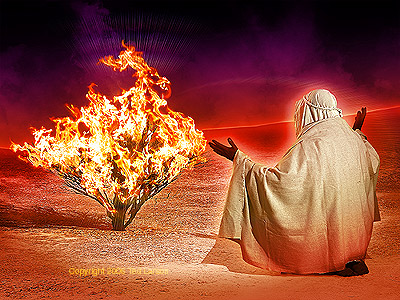
In Exodus 3 the place beyond the wilderness seems to us to be a rationally improbable place of enchanted pre-modern imagination. Here, God’s voice booms from within flaming bushes that never burn-up. However, it is important not to become distracted by the literary images of the pre-modern imagination. The burning bush serves as a metaphor for the presence of God. We are being shown that the significance of the place beyond the wilderness is as a place of unfamiliarity lying at the heart of what otherwise is our everyday experience.

moses-and-the-burning-bush-the-bible-27076046-400-300  I used the phrase stumble upon a moment ago to communicate that sense of being surprised by the unexpected. Actually, Moses does not   so much stumble upon the Mountain of God. He spies the burning bush some distance off. So he departs from the path, taking a detour in order to investigate this strange sight. As 21st century Christians the place beyond the wilderness is a place of internal, psycho-spiritual insight, requiring us to take an unexpected detour around the road blocks of normal and familiar expectations.

Trusting the Past

God introduces God-self to Moses using a familiar name – I am the God of your father, the God of Abraham, Isaac and Jacob. What interests me is that God self-identifies firstly, in terms of the familiar past, i.e. that already known to Moses. This is the God of Moses’ past, the God of Hebrew Tradition, with whom he is well acquainted. There is nothing unfamiliar for Moses here.

Likewise, God self-identifies to us through the Tradition that is familiar to us. We need God to self- identify in terms that trigger our memory. The collective memory of our Christian Community conditions our individual ability to recognize, or fail to recognize, God in our own lives. Yet, it’s not enough for us to know God only in terms of the familiar images of the past. To do just this traps us within the possibilities of only what we already recognize.

Curiosity and the Courage To Be

God expressly needs Moses. The prospect of this terrifies Moses whose first line of defense is the old Episcopalian ruse of humility – but God, who am I? The ruse of humility is saying, but God I am not important enough for you to even notice me let alone task me with the impossible. God counters – don’t worry about that, I will be with you all the way. Then Moses regroups in order to come at God from a different angle. But God, if I say the God of our ancestors has sent me, they will ask me your name, and what shall I tell them? God replies, tell them I AM WHO I AM sent me to you.

God, who has up to this point identified in terms of Hebrew collective memory, now offers a new and mysterious name. God declares, I AM WHO I AM. The Hebrew words are ambiguous and can also be translated as, I WILL BE WHO I WILL BE. The God of our fathers, the God of tradition and the familiar past becomes the, I AM of the present moment. Yet, the meaning of I AM is unstable and oscillates between I AM, i.e. God in the present moment, and I WILL BE, God in the future. The flow of time from past to present to future is only a human mental construct. For God, the present moment encompasses past, present, and future as a continuous interchange of ebb and flow.

God is beckoning Moses forward out of the familiar past where his expectation is of an omnipotent God performing might acts all on his own. God is inviting Moses into a new and unfamiliar experience, a God who is seeking his co-operation, his partnership.

The perpetual dilemma for human beings is that our minds only recognizes that which we are already looking for. This accounts for the difficulty we encounter in making truly new choices. Moses in wandering along leading his flock of sheep. Without realizing it he finds himself in a place beyond the wilderness. What we need to take note of is that before Moses becomes scared he first becomes curious. In the place beyond the wilderness a sense of familiarity is replaced by a growing sense of curiosity. Moses becomes more alert and his attention is attracted to something happening in his peripheral vision. He might just as well have continued on his way, but his curiosity diverts him from his path.

Curiosity is an important element in the spiritual life. It leads us off the beaten path where we wander through a landscape of familiar landmarks. Curiosity leads us to take what at first may only seem a detour. Yet, the detour leads us onto a new path where because the landscape is unfamiliar to us, God has more of a chance to surprise us with something new.

Listening to God’s Conversation

The Church’s Lectionary binds us to the conversation that God is seeking to have with us, the people of God in a particular place, in this instance at the people of God at Trinity Cathedral at the intersection of Roosevelt and Central. This prevents us from being confined by the familiar conversation, which is the only conversation we can have with ourselves.

Through Exodus3:1-15 God beckons us into the necessity of journeying beyond those familiar landmarks that populate our settled, imaginations into the place beyond the wilderness. Paradoxically, for us the place beyond the wilderness this not the place of epic mountain top experience. The place beyond the wilderness is a place of intersection between known and yet to become known, lying at the heart of our everyday lives. God’s call issues out of the familiar images of the Tradition, images of majesty, awe, and holiness. Yet, the call only becomes personal to us when we allow our curiosity and our courage to win over our fear and need for familiarity.

Daniel Deffenbaugh in his blog http://www.seedsofshalom.com/2008/08/ever-on-holy-ground.html  puts it rather neatly when he says while, theophany surely issues from heaven, it’s holiness can be found only on the lowly ground where it becomes known, in the dust beneath our feet. Our longing to find meaning and purpose for our lives can only be satisfied when we accept God’s call for partnership to journey to a place beyond the wilderness. This is found not on the mountain of God but at the center of where our daily lives, live themselves out.


Images of God

What is your image of God? Yet, more significantly, how does your image of God assist you or impede you in realizing the purpose of your life? These are the questions that God is inviting us to address as our response to the conversation he is seeking to have with us through the proclamation and reception of the Gospel passage from Luke 13:31-35.

The Gospel narrative in Mark, Matthew, and Luke follows the same pattern even though the telling of the story is not identical.  For each Evangelist and the community for which they are writing has its own story to inhabit, just as we have our own story to inhabit as the Body of Christ at the intersection of Roosevelt and Central. The pattern unfolding has a beginning, middle, and an ending. And this Lent the Lectionary has us journeying with Luke as he tells the story of Jesus’ journey to Jerusalem.

Luke sets the scene as Jesus is leaving the Galilee on the road that will take him to Jerusalem. He encounters a group from the Pharisee religious party, who in this instance warn him about their common enemy, Herod, Tetrarch of Galilee. Herod was called Tetrarch, because he ruled only a quarter of what had been his father, Herod the Great’s kingdom. Jesus calls Herod the Tetrarch a Fox and this alone conjures a delightful image of cunning and shiftiness.

Jesus’ response to the Pharisees is to assert in the clearest terms his sense of purpose in the face of their warning. He tells them: Listen, I am casting out the demons and performing cures today and tomorrow…. He hints at the implication of his purpose: …. And on the third day I finish my work. This is clearly an allusion to the Resurrection further strengthened by his reference to Jerusalem as the city where Prophets meet their death.

Jesus then offers a startling image of God as a mother hen gathering her brood under her wings. The image of the mother hen is not only a powerful and unexpected image of God. It leads me to ask: What is my image of God? Does my image of God assist or impede me in realizing my life purpose?

Our Images of God

I question my image of God. I am uncomfortably aware that my default image of God includes the attributes of a solitary, majestic, kingly, male figure, omnipotent, all- powerful, and omniscient,  all-seeing. In short my default image is of God, self-contained within his own potency and invulnerability. When I allow myself to examine this default image of God, I become distressingly aware of how poorly this image serves me. How can I be made in this image? It is impossible for me to project those very same attributes as my self-image into the world?

Each of us carries a dominant or default image of God that we rarely examine. Such images of God are given to us. We imbibe them along with our mother’s milk, as it were. Except that in this instance our mother’s milk is the socially conformist message of conventional, hierarchical, patriarchal, Christianity. Our image of God is communicated to us through a dominant interpretation of the Tradition we receive. This dominant interpretation serves patriarchal interests because the impossibility of attaining to the potency of such images of God casts us as docile children who must remain obedient under the protection of our heavenly Father.

It comes as a surprise to many that the Episcopal Church still has something called a Catechism. It can be found on page 845 of the Book of Common Prayer. I invite you this Lent to make a study of it. The opening question in our Catechism is: What are we by nature? The answer given is: We are part of God’s creation, made in the image of God.

We find or fail to find our sense of purpose in the images of God we harbor deep within us. There is a profound link between our sense of purpose and these often unexamined default images of God. If we are to examine the purpose of our lives we need images of God that encourage and enable us to realize the purpose of our lives both as individuals and as community. Are our images of God up to this task, I wonder?

Does our image of God lead us to assume the Universe is fixed, unfolding according to a distant God’s omnipotent plan?  When people tell me with such confidence that God has a plan for them I want to ask – so how is that working out for you? Or does our image of God enable us to realize that life is not fixed and unfolding according to plan, but fluid and dynamic? Do we have a sense of God inviting us to be more than obedient children and to play a meaningful part in the unfolding of creation?

The second question in the Catechism asks – What does it mean to be created in the image of God? It answers – It means we are free to make choices: to love, to create, to reason, and to live in harmony with creation and with God. 

Realizing our Life Purpose

Within each one of us are a number of competing voices. We usually don’t realize this because we are so used to listening only to the most dominant one. This is the default image. When I become aware of my default image of the omnipotent heavenly Father who has already worked out the plan, I consciously search within myself for the echo of another voice which directs me to my actual experience. It also directs me to look within the Tradition for the signs of another image of God. When I do I discover an image of God who is dreaming me into becoming myself. This image sounds lovely. However, it can be frightening to make a stand against the inner and outer voices that offer me an image of God as all-powerful and invulnerable. In some ways this image suits me and letting it go causes me a sense of loss. It’s comforting to know I have a God who is so much stronger than I am.

By contrast, for me the image of a dreaming God is a limited God. The dreaming God has chosen self-limitation to make room for my participation in the dreaming. God’s dreaming is a mutual and social activity. Unlike the image of the omnipotent God, majestic in masculine splendor and power, in the image of a dreaming God, who self limits to make room for my participation in the dreaming, I can see myself projected upon my world.

The image of a dreaming God is an image of a social God who delights in the loving interplay of relationship within the community of the Trinity.  The image of a dreaming God gives me the courage to step out and to risk moving beyond the confines of my own narrow and fearful imagination. Being true to the deeper sense of purpose for my live, beyond my desire for material protection and success, requires the courage to risk, or as Paul Tillich called it, the courage to be.

Responsiveness

Here is how I think the relationship between us and God works. Embracing the central purpose of our lives triggers a reciprocal responsiveness in God. We live in a Universe that is responsive to us; yet, we need an image of God that connects us with this reality.

We come to understand that our purpose is so much more than a realization of our own potential through self-fulfillment.  Our response to God this Lent is more than a program for self-improvement.  Risk, which is stepping beyond our own limited imaginations opens us to becoming the persons God is dreaming us into being. I need to issue a product warning here. The process of our becoming, may also involve pain and suffering as well as joy and fulfillment.

Jesus’ Purpose and His Image of God

In Luke 13: 31-35 we see Jesus refusing to be distracted by the warning of the Pharisees from pursuing his life purpose. His life purpose is to take the road to Jerusalem. Jerusalem here is a place on a map. It is also a symbol for all the centers of power and vested interest, which following Jesus’ example we are likewise called to challenge. Jesus further reveals how his image of God – as a mother hen gathering her brood – is instrumental in supporting the realization of his life purpose. Could he do what he must do if he imagines God any other way?

In this passage from Luke’s Gospel we see clearly the essential connection between Jesus’ God image and his determination to fulfill the purpose of his life. Let us pray that the same may be so for each of us both in our individual lives and as the Body of Christ at the intersection of Roosevelt and Central.

Moments in Time

Commentary on the Transfiguration

The event we know as the Transfiguration – recalls Jesus’ ascent of Mount Tabor to commune with Moses and Elijah, with Peter, James, and John in tow. This event concludes the season of Epiphany – a season of making manifest, things otherwise hidden.

On the 6th January, the feast of the Epiphany itself, I likened Epiphany to that internal ah hah moment we have when at least for a spilt second we glimpse the larger meaning, or the larger picture forming  the deep background against which our lives, are lived out https://relationalrealities.com/2013/01/05/significance-glimpsed/ .

Today it is quite common to refer to the term mountain-top experiences. In psychology we refer to these as peak experiences. As a society we are somewhat addicted to them and this addiction finds no more potent a focus than in the area of our spiritual lives. We read the story of the Transfiguration with a conscious nostalgia for that Biblical world of enchantment, when such things happened. In contrast, the world we live in is one in which we feel profoundly disenchanted, alienated from, yet longing for those moments in which we are transported beyond the narrow confines of our limited imaginations.

The season of Epiphany begins with a glimpsing into the truth that this infant Jesus is none other than the Messiah, the Christ. It ends with another glimpsing of Jesus’ divine identity as he is transfigured in the presence of Moses, Elijah, and three of the disciples. In this experience of Jesus’ transfiguration the significance of Tradition buts hard up against the experience of contemporary life.

At Trinity Cathedral, another version of our tag line where traditional worship encounters contemporary ideas, is, where tradition encounters contemporary life. This is often a hard place to sit, yet it is the place where Anglican Christians insist on sitting. Our Celtic ancestors referred to this hard place also as a thin place. Thin places are those points of experience where the boundaries between tradition as an expression of that which is greater than, and experience become very permeable allowing a deeper insight into the true nature of things to emerge.

A conventional reading of the Transfiguration tends to focus on Jesus, brilliantly illuminated and God’s voice, shrouded in cloud declaring you are my Son. This is usually seen as the central focus of the event, and in one sense it is. However, here I want to emphasize two points.

  1. It’s the way the Tradition, embodied in Moses and Elijah, and contemporary human experience embodied in the Disciples, encounter one another, that draws my attention. It seems necessary that Tradition and contemporary human experience both witness the glory of God in Christ.
  2. Jesus leads his disciples down the mountain into the hard reality of every day events. Not only are the disciples disappointed by this, but can we not also hear a tinge of disenchantment when Jesus himself despairs of having to endure life at the level of human experience limited by the imaginative poverty of what he calls perverse and faithless generation?

While we long for an enchanted glimpse of God on the mountain-top, I invite us to realize that the descent from the mountain is more significant for us, living as we are -within the confines of our human experience of the here and now! While the mountain top experience is never quite forgotten, its meaning only becomes clear through the lens of a convergence of the Tradition with the issues faced in life, as we are actually living it!

Exploration of a Point of Convergence

Some weeks ago Rob Smith who is the coordinator for Trinity Outreach Ministries asked if I would address the theme of environmental degradation on February 10th to coincide with the release by the Arizona Interfaith Power & Light of a statement by religious leaders on global climate change. My first response to his request was to want to say no. My intention was to preach a sermon on the psychodynamics of the Transfiguration. Fortunately, one of the things I have learned in those moments such as the one that followed Rob’s request is to allow the no to sound in my head but not come out of my mouth. I smiled and looked meaningfully at Rob as I said – ‘an interesting idea Rob let me think about it.’

The more I thought about it the more intrigued I became with the idea of exploring a possible link between transfiguration and global climate change. For it has become clear to me that there cannot be any more urgent need for convergence between tradition and contemporary life than that presented by the task Rob inadvertently set me. Convergence takes me into a hard place where I am uncomfortable sitting. As a preacher, I would be devastated if any of you thought I was being political from the pulpit.

Exploring my discomfort a little more deeply I came upon my desire to avoid thinking about environmental degradation, which is a probable cause of global climate change. My unease is not because I’m a global warming naysayer. For me the discomfort is that the link between environmental degradation and climate change is such a frightening prospect, over which I feel I have no control. I don’t like being confronted by my helplessness in the face of such a terror.

I am not alone in feeling this way and the question is what are we to do? Alone we feel impotent, yet joining our voices to the chorus that increasingly comes to be heard on issues of crucial importance to the future of the human race, confronts our sense of impotency.

At the Heart of Convergence

Oikos is the Greek word for house. In English, we have a number of words that share the root meaning of oikos. Ecumenism is the obvious one – meaning all under one roof. I was somewhat surprised to also realize that economics –good management of the house, and ecology – study of the health of the environment provided by the house, are all related. Environmental degradation is an ecumenical, an economic, as well as an ecological issue.

Ecumenism confronts us with the urgency that we are all on this planet together.  The human race lives under one roof in a more profound state of interdependency than we like to admit. As other parts of humanity are affected by environmental degradation and climate instability we in the US are not immune to the devastating effects caused by climate change. Trinity Cathedral, through our Millennium Development Goals Group (MDG), is deeply committed to addressing global inequalities. Yet, our energy and financial resources expended in furtherance of the MDG’s will be jeopardized by climate change. We can love and praise God as much as we like, but God will not take us seriously if this is decoupled from Jesus’ second commandment to love our neighbor as our selves.

Ecologically, we are impacted in numerous ways as climate change puts the environment under stress and restricts the range of the human habitat, not to mention the habitat of other species with whom we share, in the words of the Book of Common Prayer, this fragile earth our island home  (Eucharistic Prayer C). You don’t need me to point out the obvious signs for concern about climate volatility in our own back yard let alone in other parts of the world.

Economically, we note the debates about sharing resources more equitably through a more just global economic system. We automatically fear such developments for our fear is that what we enjoy will be taken from us. Yet, for the first time, Americans are being given a taste of the inequalities inbuilt into the global economic order as whole industrial and manufacturing sectors disappear with the outsourcing of jobs and skills.

There is an even more profound discussion to be had concerning philosophies of growth and sustainability. We can all go a little wonky in this area, with some of us advocating more and more growth through business as usual while others seem to preach the only alternative being a back-to-the-future regression to a pre-industrial economy. Sustainability does not mean no to any development.

A Theology of  Right Action

It’s fashionable to decry Western Civilization because of its legacy of industrialized exploitation of the earth. This exploitation has been and continues to be justified by misinterpreting God’s command to subdue the Earth in Genesis 1:28. Yet, the more profound character of Western Civilization is its mastery of technology to provide solutions to the problems of environmental limitation. I refer readers to Langdon Winner’s (1992) Autonomous Technology esp. chapter 3 for an in-depth discussion of this theme which lends itself to the view that sustainability and technological progress go hand in hand.

Ecumenical, ecological and economic solutions to the current issue of environmental degradation and global climate change as one of its inevitable consequences, require two complementary actions:

  1. We must recommit ourselves to a robust theology of stewardship first enjoined upon us by God in Genesis 1:28. Here, God commands us not only to subdue, but also to replenish the Earth. God commands us to exercise dominion over the Earth, but dominion means to take responsibility for the resources of the Earth entrusted to our care – in short exercise good stewardship defined as tender care.

Stewardship is further defined within the Biblical Tradition in the theology of Jubilee, first set out in Leviticus 25. Here is a recognition that injustice and inequality inevitably come to mark human social and economic relations. The function of the Hebrew Prophets was to provide the social critique that articulated God’s view of how human society should operate.

2.We urgently need to adopt in all our social and economic planning a philosophy of sustainability. A contemporary definition of sustainability is set out in the Brundtland Report as:

… development that meets the needs of the present without compromising the ability of future generations to meet their own needs. (Micah Challenge page 10 http://www.micahchallenge.org.au/assets/pdf/Theology-of-climate-change.pdf )

A Moment in Time

The encounter between the lives we are living and the Tradition we receive, although a place of tension is necessarily a place of convergence, a moment in time that gives birth to something new. It is now imperative that we glimpse and  grasp this moment in time to displace the theology of subjugation and exploitation with a renewed theology of stewardship supported in the secular world by a philosophy of sustainability.

It seems to me that we have reached a tipping point, that moment in time, where future development and prosperity is no longer supportable through the practice of subjugation of the Earth. Our future as a species and as a planet now requires that we replenish the Earth, and where we encounter limitation of supply we resist further plundering the Earth and rely on the ingenuity of our technological cunning to provide sustainable solutions.

All of this relies on a serious changing of our hearts. The Christian Tradition informs us about who we now are through showing us who we have always been.  Convergence is a moment in time when who we have been and who we now are mutually inform each another in order that we might discover who we need to become.

Are We Not All Corinthians?

I want to talk about the various ways God’s Spirit gets worked into our lives. It’s complex and often bewilderingly difficult to understand. One of the things people say about coming into the Episcopal Church is that it is an experience of not having to leave your mind at the door. This assumes that understanding is one of the ways God’s Spirit gets worked into our lives.

Yet, understanding, the application of our rational minds to the mystery that is God is like sailing in shoal, infested waters. It is easy to come to grief on the shoals of over-inflation and self-importance in our individual thinking. We can come to grief on the shoal of rational analysis itself, which runs the risk of reducing mystery to the point where there is no longer anything left to understand, let alone to trust.

The Limitations of our Mental Process

Our minds are pattern-mapping machines. New experience is pattern mapped onto earlier memories. Therefore, our minds usually only recognize what we already know. Our thinking often is simply a confirmation of the limitations of our own impoverished inability to glimpse beyond the boundaries of imaginations corralled within memory. I have commented before on a dominant theme of memory, which is the need to stay within the safety afforded by the familiar.

An Enigmatic Question

This last Thursday evening those of us who arrived for our weekly adult formation evening were sitting in the subdued lighting of the Auditorium. This is a space not normally available to us on a Thursday night and so we make do with Atwood Hall, which though suited to our eating together, is particularly inflexible and uncomfortable for the class that follows. For those who have ears to hear – yes I am complaining!

Invariably the conversations I instigate rarely follow the pattern I envision at the outset. Thursday evening was no exception. I set out to invite a conversation picking up on last Sunday’s sermon in which I used Brad Kallenberg’s exploration of precritical, analytical, and postcritical approaches to story. You can read more of that on last week’s sermon blog Inhabiting our Story either on the Trinity Facebook site or at relationalrealities.com or listen again to the podcast at azcathedral.org

On Thursday evening I posed the question:  what would inhabiting our story as the Body of Christ at the intersection of Roosevelt and Central, look like?

As we wrestled to find a response to this somewhat enigmatic question, we found ourselves sailing in those shoal, infested waters I referred to earlier. We kept coming to grief on the particular shoal represented by the tension between perceiving God’s Spirit through our own individual experience (God’s Spirit as a source for personal self-fulfillment) and a perception of God’s Spirit acting in us as the Body of Christ (God’s Spirit as a communal experience).

Everyday we wrestle with how to live our lives in a world that, forces upon us difficult and conflicting choices with regard to self-interest and reaching-out in relationship with others.

Understanding how God’s Spirit gets worked into our lives is fraught with tension. This tension goes to the heart of Paul’s letter to those notorious Christians at Corinth. 2000 years does not, it seem, appreciably alter some aspects of human experience. Like the Corinthians Paul is addressing the way we orchestrate our lives in the midst of often difficult and conflicting choices, choices that polarize between following self-interest and acting in ways that build up our shared lives of relationship.

Paul’s First Letter to the Church at Corinth

Over the last two weeks the Lectionary Epistle has come from the 12th chapter of Paul’s first letter to the Corinthians. The essence of Paul’s message here is that God’s various gifts can be seen everywhere and in everyone. Each person is given a gift capable of revealing God to others. All gifts originate in God’s intention that they be used for the building up of community life. The image he employs to communicate this is that of the human body.

In our human society we value different parts of the body with greater or lesser significance. There are parts we like to show in public and other parts we conceal with clothing. We tend to focus on the parts that are perceived as beautiful. We rank different body parts and functions in importance, with those most visible being given most value. Yet although we can live without an eye, or a full head of hair we can’t live without a bowel or without a heart.

Following this analogy, we value ourselves, and others by the degree of physical beauty or intelligence, or other attributes that ensure success. When we regard the personal attributes of our bodies, our intelligences or our personalities we are defining our significance. Yet, Paul reminds us that our significance, our success, our honor, is given to us only because of what we are part of, i.e. part of The Body of Christ.

Hyperbole, Soliloquy, Idealization and Reality

Inhabiting our story of being The Body of Christ at the intersection of Roosevelt and Central means two things. Firstly, that it is within community as a whole that each person receives the gift of a calling. Secondly, it is only through the lens of community viewed as a whole that our individual calling reveals who God is to one another and to the world.

At the very end of Chapter 12 with the words: but now I want to lay out for you a still more excellent way, Paul takes us from his analogy between the Body of Christ and our human bodies into the greatest soliloquy in all of human literature, his soliloquy on love in chapter 13.

The word Paul uses for excellent is huperbolen, which gives us our English word hyperbole. Chapter 13 is hyperbole – exaggerated statements or claims not intended to be taken literally. Perhaps this explains why I Corinthians 13 is the most powerful love soliloquy ever recorded. It also explains why this passage finds its way to the wedding section of the Hallmark gift card range. At countless weddings this passage is chosen and I often wonder why as two people embark on the most difficult and complex emotional negotiation of their lives, joining two lives together as one, they want to be burdened by such an impossible idealization of love, such as Paul offers here.

As poetry, which relies on hyperbole, Paul’s definition of the attributes of love in Chapter 13 moves me deeply. Yet, as a prescription for loving amidst the day to day choices and tensions that comprise my life, these words only convince me of impossibility of my ever successfully loving.

Psychologically, I am familiar with the way idealization inhibits living. When we idealize we measure ourselves against an unobtainable standard, and this leads to disillusionment as we continue to fail to obtain that for which we long.

So is Paul intending to set an impossible standard? The overall theme of Paul’s writing to the Corinthians is one of encouragement rather than criticism. To invite them to understand love by measuring themselves against an impossible ideal would not make much sense.

Paul’s intention in this section becomes clearer when he begins to describe the impermanence of all spiritual gifts. He eloquently articulates the task of moving from childish ways of thinking, feeling, and acting to embrace more mature ways of living.  In the process we become only more and more aware that our own perception of things is only ever partial and incomplete.

Paul is not telling the Corinthians that no matter how hard they try they will never succeed in becoming a community of love. His purpose is to point out to those who think they had already achieved perfection, how short of the mark they really are falling. Here, his point is not just to bring them down a peg or two, although he can’t resist doing this. He is saying that it is all right to be a human being and to acknowledge that we all have a long way to go.

For me, being human is an experience that despite my often, inflated sense of my own success, I always still have a long way to go. Yet, God manifests God’s Self through that very imperfect human vulnerability. Vulnerability is not weakness or inadequacy. Being vulnerable requires a capacity to put away childish ways, and for childish ways read omnipotence and self-importance.

Inhabiting our Story

My Thursday night question: what would inhabiting our story as the Body of Christ at the intersection of Roosevelt and Central, look like, now takes on a deeper relevance.  Firstly, what always remains incomplete and partial in each one of us is made more complete and more comprehensive through our participation together in a community we call The Body of Christ.

Secondly, the gifts that God gives to each of us only find their fuller expression within the experience of interdependency within the Body.

Thirdly, to inhabit our story as The Body of Christ is to be at ease with love as vulnerability, not successful achievement. Vulnerability opens us to receive a deeper power of love, originating in God’s Spirit, flowing into us from within the life of God. Flowing from the life of God through us into the life of the world.

Paul’s concluding words in chapter 13 invite us to trust steadily, to hope unswervingly, and love extravagantly. I rather hope that this is what it means for us to inhabit our story as Christ’s mystical Body at the intersection of Roosevelt and Central.

Inhabiting our Story

On Friday of this last week, Canon Jeff Bullock, Canon Theologian for the Diocese of Arizona and our last Sunday’s preacher at Trinity Cathedral convened a small group of clergy for a book study. (Canon is Anglican-Episcopal speak for a priest or leading lay person appointed by the Bishop for the good order of the Church) The book chosen is Brad Kallenberg’s http://academic.udayton.edu/bradkallenberg/Home/Bio.html  Live to Tell: Evangelism for a Postmodern Age.

Kallenberg’s maps three phases in Western thought which he describes as precritical, modern, and postcritical. The Bible belongs to that period he identifies as precritical thinking. Precritical is a way of looking at the world akin to Charles Taylor’s http://en.wikipedia.org/wiki/Charles_Taylor_(philosopher) term enchantment. Modern describes the way of thinking and looking at the world originating with the Enlightenment at the end of the 17th Century and reaching a peak in the mid to late 20th Century. A modern worldview is informed by the analytical method of scientific observation. In the precritical accounts of the Bible, the emphasis is on story and the picture of a world created by the details of the story. That many details in Biblical stories seem to us improbable does not worry the precritical reader. The details of a story take on a meaning by their context within the overarching theme of a story. Kallenberg uses the example of Jesus walking on the water. To the precritical mind this is not improbable. It is the kind of thing one would expect within the overarching context of Jesus as Son of God. Contrast this with the way a modern reader approaches the same Biblical story. Details are separated from overall contextual meaning and analyzed through asking questions like, could this really have happened or is there any historical proof for this claim? This is the world view Taylor calls disenchantment. 

We are now passing through a period when the modern worldview is breaking down in favor of what appears to be a return to a holistic, in contrast to an atomistic, approach to experiencing the world. The modern approach of constructing reality only from what can be externally observed and verified has left us in a universe that seems flat and drab and in which we feel deeply lonely. We are left with the question: is this all there is to life? Increasingly, our experience is that the modern worldview is inadequate and leaves us wanting more. Our current dissatisfaction with the limited world of factual certainties expresses itself in film and book through an increasing longing and appetite for mystery, and magical-realism. Consequently, the modern is giving way to an emerging world of thought Kallenberg sometimes calls postmodern, a somewhat confusing term because of its association with the deconstructionists, or postcritical, to my mind a better descriptive. In the modern world view stories are to be analyzed and verified. In the postcritical world view stories are to be inhabited and lived out.

The 27th January is the day when Trinity Cathedral holds its Annual General Meeting. In preparation for the meeting it has been customary for the Dean to offer a review of the past year. I suspect that previous Deans have tended to approach this task in a modern frame of mind. Cathedral Deans, like the rest of us, strongly influenced by our modern approach to thinking will have tended to break the past year down into events, facts and figures – the past year broken down into its atomistic parts and viewed from a perspective of achievement or failure, pride or disappointment.

A modern view of 2012

In this vein I can confirm that in 2012 Trinity Cathedral began the year with three full time priests, one nonstipendary priest missioner and three deacons. We ended the year with one full time priest, one nonstipendary priest missioner, and two deacons. Nevertheless, we have continued to flourish. We said goodbye to Canon Deborah Noonan at the end of July as she prepared to go off to become the Vicar of Dibley. With sad and somewhat anxious hearts we bade farewell to Dean Nicholas Knisely and his wife Karen at the end of August, wishing them well as Nicholas became the next Bishop of Rhode Island. This resulted in the Canon Pastor, at the Bishop’s invitation, stepping into the role of Dean in-between. At the end of December Bishop Kirk accepted Deacon John Mather’s request for a sabbatical year.

I can confirm that we experienced other personnel changes, in particular Sarah Gennett’s resignation as Youth Minister, Joan Howell’s stepping down as Children’s Education Director and Colin Gennett’s appointment as Children’s Education Co-ordinator. At the change-over of the year, Carol Lamont Walker, after many years of ministry in the Cathedral Shoppe has made a decision to step down as Shoppe Manager. For Carol and for the Trinity Community this is a decision that really does signify the passing of an era. For as the Cathedral grows in size it also is moving from a culture which rests heavily on the work of volunteers to a culture which needs a more centralized organization led by paid staff. To the paid staff, I express my deepest gratitude for the way they have accomplished more by using less.

I can confirm that our numbers have continued to swell as we have welcomed new spiritual seekers, along with Episcopalians from elsewhere together with others with established spiritual lives in other Christian Traditions. Our La Trinidad Community has continued to flourish in response to the welcome of the Episcopal Church, embodied by Canon Carmen Guerreo, priest missioner and Canon for Hispanic Ministry. The Trinity Community’s embrace of diversity welcomes members of the Latino Community excluded or discriminated against within an increasingly conservative Roman Catholic Church and wider Arizona Society. The growth of La Trinidad is reminiscent of Luke’s description of the first days of the Church in the Acts of the Apostles – as each day more and more were added to their number.

I can confirm that we had a most successful Annual Renewal Program. So many of you have responded with gratitude to God and generosity in support of the ministry of Trinity Cathedral. As a community, as well as individually, we continue to deepen our response to Jesus’ call to accompany him on the road of discipleship. We began 2012 with 170 pledging units and a $50,000 deficit and we ended the year with a balanced budget, thanks in large part to the spending discipline of the staff. As all the statistics are harmonized we start 2013 with and net increase of 44 new pledging units. Our current total stands at 195 pledging units and as the phone calls go out to those yet to respond, we anticipate this number continuing to rise.

Passing from a modern to a postcritical view of 2012

All of these events, facts and figures are true. Yet, this modern worldview, in breaking down the past year into atomistic parts leaves out something crucial. A precritical reading of the last year would have emphasized the story of how the Holy Spirit is active within Trinity Cathedral’s Community. A modern reading analyses the past year, dividing it up into a series of events, achievements and failures seen primarily, as the results of human agency. Yet, I want to address 2012 through a postcritical lens which emphasizes our experience as participants within a story. The past year is a story about who we are as a community. Through inhabiting our story in 2012 we encounter our identity. Who are we? We are the Body of Christ in the world.

Ours is a story of being Church through our participation in the life of the cross-bearing and saving community at the intersection of Roosevelt and Central. Ours is a story of a Spirit filled community inwardly strengthening its identity as a community of love. Ours is a story of a missional community reaching out beyond itself through prayer and active service, bearing witness to the presence of God in the world. As we inhabit the story of being the Church we discover our identity, not as a society of individual Christians but as the mystical Body of Christ bearing witness to God’s generous and abundant love for the world.

The Gospel for this morning from Luke 4:14-21 articulates what it means to be the Church bearing witness to the abundant love of God for the world. In worship our postcritical community story encounters our precritical Biblical story, transmitted to us across 2000 years as part of the collective memory of the Church. As we inhabit the postcritical story of being Trinity Cathedral facing-up to the challenges posed by life in 21st century America, we we encounter with the precritical Biblical story of salvation history. As we seek to inhabit both stories we become more and more those whom God is dreaming us into becoming.

Within this process of becoming, we emerge to find that the Spirit of the Lord is upon us. God has anointed us to bring good news to the poor. God has sent us to proclaim release to the captive and recovery of sight to the blind, to let the oppressed go free, to proclaim the year of the Lord’s favor.

The postcritical invitation to inhabit our story

2012 has been but another year when through worship, prayer and action we have endeavored to rediscover over and over again our identity through inhabiting this story. As we enter into another year of change and challenge we don’t necessarily, need to know, let alone be able to agree among ourselves about what bringing good news to the poor, release to the captives, recovery of sight to the blind, challenging oppression and proclaiming the year of the Lord’s favor will, or even should, look like in 2013.

There are different possible interpretations ranging from a powerful focus on the fight for a just society to deepening our psychospiritual understanding in order to challenge our own spiritual and relational poverty.  While challenging the blindness to inequality in our society we also look more deeply into our own spiritual lives, challenging our own blindness, our sense of captivity and societal and self oppression. Some will be called more to engage in the external struggle, while others will be drawn more deeply into the internal exploration. Our identity as the Church means that we will be engaging across both outer world, and inner-world, fronts.

Luke 4:14-21 echoing the words of the Prophet Isaiah, goes to the heart of the story that is Jesus’s ministry. This precritical story takes us to the heart of our own postcritical story as the Christian Community in this place. We inhabit that story thereby encountering the source of our identity as those who can say the Spirit of the Lord is upon us. My invitation for all of us is to continue to live out the implications of this as we move into 2013.

What’s in a Baptism?

Boundaries 

William Temple, perhaps the most influential  of the Archbishops of Canterbury in the 20th Century commented that the Church is the only society that exists for those who are not its members. Perhaps this helps explain the Anglican Tradition’s rather odd view of boundaries. For nothing seems easier than to become a member of the Episcopal Church. In fact, just showing up on a regular basis might easily result in your slipping seamlessly into membership.

Given the prevailing truth based, salvation, preoccupied culture of large swathes of American Christianity this might appear to be a very odd way to carry on. The open boundary practice of the Episcopal Church regarding everyone who shows up for worship expresses the point behind Archbishop Temple’s comment – the Church is the only society that exists for those who are not its members. Consequently, the Episcopal Church struggles to define the boundary between the Church and the World. Yet, that does not mean there is not a portal of entry into the Church. In worship all are welcome, yet the portal of entry into the practice of the Christian faith is still baptism.

Baptism

Our Gospel this morning is Luke’s account of the baptism of Jesus. Luke’s account has some interesting departures from the original account recorded in Mark.  John the Baptist is absent. In Luke’s chronology, at the time of Jesus’ baptism John languishes in Herod’s prison.  Luke does not give us the mechanics of who is doing the baptizing and the implication is that the Holy Spirit is the chief actor. Luke makes it clear that the Spirit takes bodily, physical form. The Holy Dove descends upon Jesus for everyone to see. The heavenly voice publicly proclaims Jesus’ identity as Son of God for everyone to hear.

In Mark, Jesus’ baptism seems intensely personal. His identity seems to be a secret that only he and John the Baptist really know about. In Luke, Jesus’ baptism has become everyone’s baptism. This last week, while wondering about the difference in emphasis between Luke and Mark I noticed that the difference in emphasis reflects something of the continual dispute among Christians as to whether we are saved through baptism or whether baptism is the sign that we are already saved.

Evangelical Christians tend to believe that we become individually saved through baptism. Baptism first requires a personal sign of faith, and so Evangelicals emphasize baptism as the conscious decision of the individual believer, i.e. a believer’s baptism. Baptism is the individual believer’s purchase of a ticket to salvation.

Anglicans tend to believe that baptism is a sign that we are already saved by God. For us, baptism is not like purchasing a ticket to individual salvation. Baptism is entry into the faith of the community that is already saved. We are saved through our participation in the life of the Church. God has already saved the world through the birth, death and Resurrection of Christ.

Through entry into and participation in the life of the Church we actively witness to this truth.

Church

I began with noting Archbishop Temple’s statement – the Church is the only society that exists for those who are not its members. We are all painfully aware that the sad truth is that the Church often behaves as if it exists only for the sole benefit of its members.

Different Christian traditions all use the same word Church for the gathering of Christians. Yet, Protestants, Anglicans, and Roman Catholics have differing understandings of Church. Generally speaking, for Protestants the Church is simply the voluntary gathering of Christians who are all individually saved through their personal acceptance of Jesus Christ as Lord. For Anglicans and Roman Catholics the Church has a collective identity greater than the sum total of its individual members. Salvation comes from our participation in the life of the saving community.

Current Roman Catholic emphasis tends not to agree with Archbishop Temple’s statement. For Roman Catholics, salvation is confined within the boundaries of the Church itself, which is why those boundaries have to be so rigorously policed. Using an analogy form baking bread for a moment, Roman Catholicism sees the Church as the loaf. Anglican Tradition understands the Church as the leaven in the loaf. For Episcopalians, the purpose of the Church as the saving community is to bear witness that God’s saving action extends to the whole world.

Implications

Does any of this matter? For me it does. In a society dominated by a  Calvinist reoccupation with whether each and every person is saved or dammed, I reject the notion that as an individual, through my choice of Jesus as Lord, I can be saved while the person next to me is dammed. My salvation has nothing to do with my self-assertion of belief. I am saved, and you are saved, because God loves us both without distinction. In a society where Christians easily become preoccupied by a notion of the Church as the Ark of Salvation, I accept that salvation comes to me through my participation in the saving community of the Church. Yet, the point of Temple’s statement is that God’s gift of salvation is not limited only to those within the Church.

The Baptismal Covenant of the Book of Common Prayer

Baptism is not a once upon a time event. It’s a daily process of living out our commitment to God’s world. We articulate our common purpose as the baptized in what’s known as the Baptismal Covenant. Every time a person is baptized we all participate in the Holy Spirit’s action by affirming five promises that commit us to action.

  1. We promise to be faithful in our participation in the life of the Church. In other words we not only show up on Sunday morning but we try to practice being Christians seven days a week.
  2. We promise to fight evil and when we fail, to return to the struggle through the path of repentance.
  3. We promise to share with everyone the good news that in Christ, God has already saved the whole world.
  4. We promise to serve Christ, by having a regard for our neighbor as much as we love ourselves.
  5. Finally, we promise to strive for justice and peace in the world and to respect the dignity of all human being. In every generation that last promise is a real challenge. For it requires us to go beyond our easy accommodation to the values of culture that glosses over patterns of privilege and discrimination.

As Episcopalians, our apparent fuzziness about the boundaries, is by design. We trust the truth behind Archbishop Temple’s statement that the Church is the only society that exists for those who are not its members. Our boundaries may be fuzzy, but our identity is clear!

Through baptism we participate in the life of the saving community. This community commonly called the Church is a witness to the fact that in Christ salvation is God’s freely offered gift to all, with no strings attached. Because of our baptism, our lives are lived in a tension. On the one hand we can be tempted to live with an uncritical accommodation to the values of our culture. Or we can view the events of our daily lives, and life of the communities around us, through the lens of those five promises in our Baptismal Covenant.

So to live, is to live as a Christian in the world.

Significance Glimpsed

The Church’s Calendar mark’s two kinds of celebrations. It marks celebrations that always occur on the same date each year, and celebrations that always occur on the same day each year.   Each year we celebrate the feast of the Epiphany on the 6th of January. This is an example of a fixed date celebration. Each year we also celebrate the Baptism of Jesus on the second Sunday in the Christmas Season. This is an example of a fixed day celebration. Today is both the 6th of January as well as being the second Sunday after Christmas and so both the Epiphany and the Baptism of Jesus occur on the same day. According to the complex formula used for rating celebrations, the Epiphany takes precedence.

The arcane workings of the Calendar may seem tedious information, better suited to an Episcopal 101 class than a Sunday Sermon.  Actually, I never discuss anything as tedious as the  organization of the Church’s Calendar in EP 101. My point in raising it in the context of a Sunday Sermon is because the clash of Epiphany and Baptism of Christ, occurring on the same day, offers an opportunity to explore the inner and outer dimensions of our experience of God.

Epiphany is a Greek word that translates into English as showing.  In everyday speech we sometimes report: “I have had an epiphany” to communicate that we have had something of an ah-hah moment.

I prefer the word glimpsing as a better expression of the meaning of epiphany. When we catch a glimpse of something we suddenly see through, or see behind, or see around, the usual way our experience of the world appears to us. In the event that Matthew records as the Epiphany, for only Matthew’s Gospel records this detail in the narrative of the birth of Jesus, God is giving us a glimpse of the bigger picture within which a fuller understanding of the identity of this infant is revealed. 

In the Birth Narrative both Matthew and Luke report the details that set the birth of Jesus in its first century Palestinian context. Matthew’s addition of the arrival of the Magi, variously referred to as wise men or three kings, moves us beyond the everyday details of Jesus’ birth which is firmly located in a time and a place, into the bigger picture. In the bigger picture the muling and sucking infant we know as Jesus is none other than God’s anointed Christ. The arrival of the Magi bearing their gifts of gold for a king, frankincense for a priest, and myrrh for a death, offers us a glimpse into the larger world – a world that reveals to us the significance of the infant Jesus’s birth.

So the Epiphany is a point of intersection between the outer and inner dimensions of experience. Our burden as 21st century Christians is to struggle with a rationalist inheritance that since the Enlightenment has convinced us that what we see is all there is. This leaves most of us with feelings that echo the words memorialized by the singer Peggy Lee:  

Is that all there is? Is that all there is? If that’s all there is my friends, then let’s keep dancing. Let’s break out the booze and have a ball – if that’s all there is?

Our experience of living in a world where the appearance of things is all we think there is, is profoundly unsatisfying! We need to know that what we see is not all there is. What we often fail to notice is the way our lives unfold within a frame that encompasses more than the appearance of the external dimension of our day-to-day experience. This more than – we catch a glimpse of from time to time, when we connect with a sense of significance in our living. From time to time we catch a glimpse of a significance that lies beyond the mere appearance of events that unfold around us in the world. We catch it – and then the glimpse fades. 

What can be done about this? In attempting to answer this question I turn to the Baptism of Christ. It’s interesting, that Mark who tells us nothing of the birth of Jesus begins his gospel with the account of his baptism. It too, is an epiphany experience. As John performs the act of baptizing Jesus the heavens open and the voice of God confirms that Jesus is the Christ.

To escape the burden of the way 300 years of scientific rationalism has reduced our ability to see the bigger picture by confining our vision only to that which is externally observable, we have to seek help. That help comes to us through our spiritual development. Spiritual formation opens us to those repeated glimpses of significance, of our lives unfolding within the frame of a bigger picture. Our spiritual formation chiefly results from our participation in the life of religious community.

Human beings are not meant to live alone. We need to gather and organize into communities. Communities provide the resources necessary for our individual flourishing. Tertullian, one of the Early Church Fathers said, one Christian is no Christian. Being Christian is the result of belonging to the community of Christ’s Followers. The Christian Community is much greater than the sum total of its individual parts because it is expanded by the inflowing of the Grace of God. In this moment of time we are more than a gathering of individuals, we are the very Body of Christ in the world at the corner of Central and Roosevelt, in down-town Phoenix, Arizona. 

This morning we are welcoming seven persons into membership of the Body of Christ. We will promise before God to be the community within which they will be formed and sustained on their spiritual journey. Baptism is entry into participation in the community of faith. Participation shapes us so that we become more and more open to those moments of glimpsing the greater significance to our lives. For these six children and one adult, their baptism is their entry into the spiritual journey that we as the Body of Christ in the world are making together.

As individuals we catch glimpses from time to time of the divine significance that underpins our existence. These moments of epiphany offer snap shots of lives unfolding within a larger picture. These snap shots, these glimpsings, redirect and re-enliven us as we travel along the way. However, these are only glimpses. Epiphany is not for individuals, a continuous experience. 

Through baptism we come to participate in the life of Christ’s earthly body – the Church. Here we join others and together become greater than the sum total of our individual selves. It is only from within the experience of being part of the Body of Christ that we become more open to the profound glimpses of the significance of our lives within the continual action of God’s dreaming us all into becoming. 

Incarnation of Dreams

As I gaze out from the height of my perch – 7 feet above contradiction – I spy many familiar faces. Yet, what draws me are the faces of those I have not met, you who are visitors and our guests. Maybe you are drawn to wanting to come to a place of worship where you know you will get a good show. I don’t mean to be flippant about the need for a good show on Christmas eve, a time loaded with memories and associations from the past, where your hearts are lifted by the beauty of the music, your spirits resonate to the dignified rhythms of the liturgy, perhaps even where your  minds are engaged by the quality of the preaching – although you may want to reserve judgment on that for a moment. I want to say to you all, visitors, annually returning old friends, spiritual seekers, the Episcopal Church welcomes you!  Whoever you are, what- ever you think you believe or don’t believe, know that you are in good company here. SO welcome all, to Downton Abbey a world of bewildering, yet magnetic traditions.

For the Episcopal Church and in particular this Cathedral of the Holy Trinity, is the closest we shall come in the Phoenix of the 21st Century, to the spirit of Downton Abbey. If you have watched  Downton Abbey, now entering its third season you will have been drawn into a great drama. Downton Abbey, is an intersection in time and place where the ancient traditions moulded over centuries of English life are brought into a tension-filled engagement with the pressures and demands of a changing world.

In this place of tension between traditions handed-on and the demands of life as it is actually being lived, the inhabitants of Downton struggle to find a way of living that gives  new impetus and new energy to the traditions that have shaped them and from which it is impossible to escape.

The Episcopal Church,  the American expression of Anglican Tradition,  a transmission of the ancient catholic faith shaped by exposure to 1000 years of English culture, like Downton Abbey sits in the tension between the traditions we receive, which appear to have been crafted for another age, and the demands of life as we are actually living it in 21st century America.

America as a nation sits in the tension between the tradition known as the American Dream and the challenges of a rapidly changing world. The Episcopal Church, America’s best kept secret, welcomes you to life in the tension where the gritty struggle between faith and doubt, hope and fear, nostalgia for the past and terror of the future, continues producing the pearl that is God’s love for us.

Luke is the great historian of the New Testament. His Gospel places the birth of Jesus in historical time and place, yet it also comes to us across 2000 years of transmission. It depicts an enchanted world where God communicates through angels to shepherds, those who are on the margins of social acceptability. This is an enchanted world where the Creator of the Universe can be born as a baby, in a stable, in the most marginal of circumstances, and not only survive but be visited by wise men from the east.

For much of Christian history this story resonated so closely with the precarious vulnerability of the lives people actually lived, most in a similar rural poverty. It also resonated with the enchanted mindset in which God was experienced to be magically and mysteriously present in every aspect of the material world that surrounded human life. In this world of enchantment, God was never absent and people were never alone.

So how does this story resonate with us whose lives are lived amidst the urban and technological complexities of 21st century America? How does this story communicate to a people whose disenchanted mindset no-longer has room for the magical and mysterious presence of God at the level of material reality? In this disenchanted world, God seems to us largely absent. 300 years of Scientific progress has left us feeling alone, in a lonely, and potentially hostile universe.

It’s impossible for us to return to that enchanted mindset, no-matter how much we might wish to do so. Ours is not a world filled with the magical presence of God – 300 years of scientific rationalism has unalterably changed the way we think. Yet, human beings are still capable of imagination, we still dream.

The birth of Jesus is significant, not in the biographical details of Luke’s narrative, but because it still resonates with the deeper, imaginative dreaming parts of our lives.  The birth of Jesus is God’s dream coming to rest through its incarnation into the limitations of the world of human reality. It’s significance poses us with the question:- so what do we dream  that will not rest until it becomes incarnated in us?

We feel presently, that it is difficult to allow ourselves the luxury to hope and dream the answer to that question. All around us we see the signs of the world we once trusted and relied upon – disintegrating before our eyes.

We pull back in fear, no longer born on by the optimism that technological and economic progress will take us into a better world.  We live increasingly in fear that the Environment, which for so long has been seen by us as something to be tamed and mastered. Yet, as hurricane Sandy has just shown us the environment, now increasingly delivers what seems to us, a revengeful punishment as Sandy, struck at the heart of the country’s most urban and technologically sophisticated region. We seem newly vulnerability in the face of the power of nature.

It’s a striking coincidence that the name Sandy features also in the place Sandyhook. Here, we could be anywhere in America  and so recent events have plunged not only those intimately affected, but the whole nation into a deep collective suffering, the like of which has not been known in several generations.

We all live in this uncomfortable tension between the world that we came to trust and a newly uncertain future. Yet, the message of the Incarnation is that Dreams are nevertheless made real within the context of limitation and uncertainty.

God calls us to embrace the dream that is seeking to incarnate in us. Like God’s dream incarnated in the birth of Jesus, incarnation of our dreams happens within the limitations of our imperfect human lives. Propitious circumstances are not required for the incarnation of dreams.

Dreams are incarnated in us when we connect with our passions and dedicate ourselves to living passionately, with a compassion born from the realization we are interconnected and interdependent within the ebb and flow of a universe that is responsive to our dreams.

Our dreams are the most accurate reflection of the way the divine universe really functions. Life is not a plan – fixed and finished. Life is more like a dream, always evolving and in the process of becoming. Life is fluid ebbing and flowing around and in response to events and experience.

This is how it works. When we make all the resources of our dreams, our loving, our relating, our hoping and longing, our determination and our courage and especially our suffering and our fearfulness available for living, –  the resources of life flow to meet us. At points of suffering and disillusionment the tide ebbs only to gather and return with flowing fullness towards us.

The message of the Incarnation is that God operates within the limitations of human nature and human society. So then must we. When we allow ourselves to dream and give ourselves over to the pursuit of our dream then abundance is the gift of life to us who pursue the courage to live abundantly.

Tell us, what then should we do?

It’s been several weeks since my last sermon blog. I have been enjoying a rest after a solid three-month period of weekly preaching on the theme of discipleship. As I return to writing today, its early Saturday morning and as I settle to reflect on the thoughts concerning the Gospel reading for Advent III what is uppermost in my mind is yesterday’s tragic events in Sandy Hook elementary School.

The airways and internet buzz with analysis and comment. We feel sick to our stomachs as we identify with the grief of the parents, teachers, first responders, and of course, the children all caught up in this whirlwind of suffering. If past events are an accurate guide to the unfolding of analysis and comment over the days, weeks and months to come, the central question will be what can we as a society learn from yet another tragic mass shooting?

Opinion will polarize around two positions. Many will seek to build meaning out of meaninglessness by distinguishing this event to the deranged psyche of one individual. Still many others will seek to understand this event as a generalized symptom of an increasingly distressed society.

Polarizations stereotype real life. Between stereotypes there can never be agreement. Human beings stereotype real experience because this process offers the illusion of explanation and maybe even the more illusive illusion of  understanding. As rational beings, we need both explanations and understandings. These enable us to feel the universe can still be predicted in ways that leave us feeling safe. Our desperate need to feel safe leads us to passionately defend our stereotypes as if they actually provide us with the potential to learn from our experience.

Stereotypes posse a semblance of the real truth of a situation. This is their danger. They seem on the face of things to be the truth. However, they are encapsulations that distort the reality they claim to represent through simplification and generalization. Both the shooter and the shooting have been described as evil – by no less a personage than the Prime Minister of the Commonwealth of Australia. The stereotype of evil is simply a way of saying the motivation and the act challenge understanding. To describe an act as evil closes-off any possibility of comprehending the meaning and restricts the potential for there to be any learning from experience!

To paraphrase Freud, experience that we cannot learn from is experience we are destined to repeat. My own background in Psychoanalysis confirms for me a truth that seems to be hard to learn. The only way we can begin to set ourselves free from the dark forces of our individual and collective unconscious is to allow that which can’t be thought about, and so, continues to be acted out, to become thinkable.

Our current difficulty as a society remains to allow the unthinkable to become thought. We can only allow this process to emerge if we resist our need to stereotype. The result is that we sit with complexity without the comfort of simple explanations. Only then might we begin to really learn from our collective experience.

**

The Gospel reading from Luke appointed for Advent III comes to us across 2000 years of transmission. We receive it as a stereotype. For us we have a mental picture of John the Baptist, dressed in a coat of camel-hair cursing and  cussing-out the sheep-like crowds who flock to him. We have an image of hordes running out through city gates and traversing the rocky desert terrain to arrive at a place in the wilderness. Here, they yearn to hear what they hope will be John’s simple and uncompromising answers to the complex anxieties that fill their daily lives. Wilderness is not only the location of meeting John, it is also symbolic of where their lives are lived.  The crowds revel, taking masochistic comfort from John’s firebrand style of collective verbal flagellation.

Although the crowds attending John are a mixed lot, Luke offers us an interesting profile of them. Once we get beneath our stereotype of the scene, we note Luke’s profile of the crowd. We see tax collectors and soldiers among the throng representing the powerful amidst the powerless, the exploiters among the exploited.  Within the collective of the crowd, all come together to seek answers to the challenges of their lives.

The crowds who throng to John represent a conquered society disintegrating under the pressures unleashed by the destruction of the traditional checks and balances through which Jewish society has traditionally governed itself. For us this would be the equivalent of an invader abolishing our form of government, straining our society to the point where the mechanisms of  civil society begin to unravel, i.e. the law, organized religion, education, economic regulation, the social contract.

The tax collectors are private entrepreneurs who buy the right to collect the tax owed to Rome. This is a lucrative franchise which allows several layers of middle men to add their inflated commission to the baseline tax. Not only do the people resent paying the tax to their Roman oppressors, but they also resent being additionally exploited by the tax collectors who, after-all are their fellow Jews. Occupation pits Jew against Jew. Likewise, the soldiers are the local thugs working security detail. They are the hired muscle used to intimidate the ordinary people. They practice free-lance intimidation and extortion of their own. Occupation pits citizen against citizen.

Luke identifies John as an Essene-like character. The Essenes, are known to us as a radical sect who sought out an alternative lifestyle in the back-blocks of the Idaho of Judea. We think they are the authors of the scrolls found at Qumran. Whether John was an Essene or not, we can’t really know. However, for Luke and for us, John represents the last of the great Hebrew Prophets. In times of crisis people rush to embrace the prophet’s uncomfortable message only to later disregard it when times improve.

John employs the ritual vocabulary (brood of vipers etc) of the prophetic genre and we can assume this would have been understood as the convention of prophetic speech, by his hears. However, the focus of his preaching is upon announcing the coming of Jesus as Messiah. He calls his hearers to prepare for the Messiah’s arrival. In answer to their question: what then should we do?, John abandons his ritualized prophetic language and addresses each category of questioner before him with surprising intimacy.

To the ordinary people he exhorts them to relationships of mutual support. To the tax collectors he exhorts them to ethical practice. To the soldiers he exhorts them to cease extorting their fellow citizens through force and to be satisfied with what they honestly earn. As we penetrate beneath the stereotype of our image of a first century Judean scene we find the question asked by the crowd becomes our question also – what then should we do?

**

Earlier this week I had an email from someone who has been attending the Cathedral fairly frequently over the last couple of months. In the email this person, with some sadness, reported that with the exception of the Greeters and the Clergy not one person from the congregation had spoken to them. We need to take this person’s experience to heart and I would like to invite us to wonder together about what this tells us about our community.

Episcopal Churches have an appalling record of welcoming strangers. I have shared with you some common jokes about Episcopalians and money – like: we give till it hurts- pity we have such a low threshold to pain. There are also jokes about the quality of our welcome. All our churches have a sign outside that says: The Episcopal Church Welcomes You!- and the joke is: as long as you are like us. Another rather shocking aphorism runs: Everyone who needs to be an Episcopalian, already is. I don’t believe these witticisms in anyway reflect our actual attitudes at Trinity. In actuality we are a community of spiritual refugees. We are a warm community that welcomes diversity and intends to be a place of welcome for new people. However, it seems that our intention and our practice are out of sync.

So what then should we – the people of Trinity Cathedral- be doing?  The answer this morning is to be a source for God’s expression of welcome to everyone whose path directs them to come through our doors. Through the warmth of our smiles, our readiness to speak to the visitor, our sensitivity that gently allows the newcomer to find their own level of comfort while leaving them in no doubt of our delight they have found their way to worship with us – we provide the human connection. While the visitor to our worship battles with the unfamiliarity and complexity of our liturgical expression, it’s the human connection of welcome that supports them as they explore the experience of being drawn to our Anglican transmission of historic Christianity.

Blog at WordPress.com.

Up ↑