Contending Images of Kingship

The first chapter of Genesis God states – Let us make humanity, male and female in our own image.  All well and good. But if we are made in the image of an unseen God, then we can only come to learn something about God through taking a good hard look at ourselves. The tricky question then is, which image of humanity is God reflected in? Maybe all of them?

Like a double-edged sword, the mirroring of divine and human images cuts both ways. We can deduce that God is loving, relational, and collaborative because we also possess these qualities. Yet, we can equally imagine God as jealous, angry with a propensity for violence in pursuit of the ends of power and control because these are also very typical human characteristics. The Bible’s presentation of shifting and changing images of God -may in the end simply be the projections of our own conflicting images of ourselves.

The final Sunday before the start of a liturgical year on Advent Sunday is dedicated to Christ as King – begging the question – what kind of king, what kind of kingship is being imaged here?

Pantocrator is one popular image of Christ as King – omnipotent ruler of all of creation – often pictured on the concave half dome typical of many Orthodox churches. We see Christ as Pantocrator in St Martin’s great West window which is by no mistake a war memorial window. As Pantocrator, Christ is robed in the trappings of political power, the paramount operative in the zero-sum-equation of dominion through domination.

Christus Rex is another traditional image of Christ – an image depicted in the St Martin Chapel reredos. Here Christ is robed not as king but as high priest whose resurrection life springs forward from the cross – which is now firmly behind him in the background.  Both Pantocrator and Christus Rex images sit in uneasy tension with the other enduring image of Christ reigning not from a throne or a gilded cross but dying, nailed to a tree.

The final Sunday of the year is a celebration of the end time as depicted in 1 Corinthians 15 – when the Father will place all things in subjection under his Son who as dutiful Son will complete the Father’s restoration of the divine dream for all of creation.

Our images of power vie with the our images of vulnerability. We project humanity’s competing characteristics into the blank space that is the unseen God. If we are fashioned in the image of an unseen creator, then we can only come to learn something about God through taking a good hard look at ourselves. Thus the tricky question remains, which of our many conflicting self-images do we want Christ as king to reflect?

Interesting is an interesting word! What an interesting historical moment we are living through. Our culture rocks and reels as the tectonic plates shift unpredictably. Newton’s Third Law of Motion states that counteracting forces always come in pairs – as the pendulum of history swings between the order and chaos – between continuity and disruption – each vying for dominance. The theological thrust for designating the final Sunday in the liturgical year to the kingship of Christ crystalizes the waring tensions within us – counteracting forces finding expression in competing images of God.

In 1925 Pope Pius XI proclaimed the feast of Christ the King as an assertion of the Catholic Church’s protest to the rise of fascist and communist authoritarianism. He chose the images of strength in asserting the equally authoritarian power of the Church as the only center of allegiance for Roman Catholics. At a considerable cost to liberty and freedom of thought within the Church, he marshaled the Catholic legions for battle against forces in direct competition with the power of the Church.

The historical context for the origins of the commemoration of Christ the King today sounds a tone that is both timely yet also problematic as once again we are being called to face down a new resurgence of authoritarian forces. Pius XI drew on an old story of one authoritarian system asserting itself against competing, equally authoritarian rivals – strength against strength. For those of us who do not subscribe to the notion of an authoritarian church or even an authoritarian state, Christ the King is a very necessary reminder of the dangers in mistaking power for strength and vulnerability for weakness.

Human beings have rich imaginations – but left to our own devices – as it were- our imaginations tend to recycle familiar image patterns. Consequently, we only tend to recognise what we are already preconditioned to look for.  In the pursuit of the deeper search for the spiritual or soul-filled connection we so long for – the challenge is to allow the boundaries of our imaginations to become more permeable – less strictly policed by our conventional selves – allowing something new to break-in.

An example of the in-breaking of new insight might be that instead of the all too familiar counteracting pairing of strength with vulnerability, continuity with disruption as polar alternatives- we imagine new possibilities in a collaborative pairing of strength through vulnerability – with the forces of disruption seen not as destructive of continuity but as the timely reshaping and revitalizing of continuity over the long term.

We are storied beings – meaning we are only ever the stories we tell about ourselves. Stories are one of the most effective ways through which the unfamiliar breaks-in to disrupt the familiar patterns of recycled imagination. New spiritual insight breaks-in through the medium of stories that change through shock or surprise. Parables are disruptive stories – which like the needle on an old vinyl record jumps tracks as it hits a scratch in the record’s surface – disrupting the familiar melody and jolting us suddenly into a new one.

Matthew’s Jesus parable of the Sheep and the Goats allows new spiritual insight to break-in – disrupting our usual imaginings of Jesus’ kingship. In this parable Jesus presents kingship as service, strength through the embrace of vulnerability – the in-breaking of compassion disrupting the more familiar continuity of hardness of heart.

Matthew presents a picture of the end time when the Son of Man will come in his glory to sit upon his throne. But this is not Jesus clothed in worldly power. What breaks-into our imaginations through this story are the responsibilities of kingship being those of service, empathy, and a concern for the least important, the least powerful, the least able among us. Justice is the hallmark of this image of kingship in which Jesus echoes the prophet Ezekiel in our first lesson who speaks of God as shepherd of the flock seeking out the lost, bringing back the strayed, binding up the injured, strengthening the weak, and feeding them with justice.

We embrace the image of Christ the King because at the heart of the gospels stands the iconic image of Jesus’ royalty, not as one lifted high above us decked in robes of kingly power, but as one who stoops to reach down to join us in the one nailed to a tree. Christ’s kingship – breaks open the strength, or vulnerability, continuity, or disruption polarities with a new and revolutionary image of strength displayed in vulnerability, of disruption as necessary for long term continuity.

At its base the cross was wedged into place by three huge stones hammered into the ground. These are the stones of strength through service, strength in vulnerability, and strength as the fruit of justice. 

Christ’s kingship extends over us to discomfort our search for easy answers, half-truths, and superficial relationships – so that we may live more deeply from less fearful hearts. Christ’s kingship extends over us to bless us with anger at injustice, oppression, and exploitation of the helpless – so that we may work tirelessly in the cause for freedom and peace with justice. Christ’s kingship extends over us to bless us with tears shed for those who suffer from pain, rejection, starvation, and war – so that we may reach out our hand to comfort them by standing together in their pain. Christ’s kingship extends over us to bless us with enough foolishness to believe that we can make a difference in this world – so that we can do what others claim cannot be done. Amen (My paraphrasing of an anonymous Franciscan blessing)

The Kingdom of Heaven will be as if —

Taken at face value the Parable of the Talents raises several interesting lines of inquiry. Interpretations of the parable’s meaning over time have varied. On the face of it the message seems to commend and reward trustworthiness and punish laziness, with the subtheme of productiveness or lack of running underneath. Jesus makes a somewhat surprising statement at the end of the parable.

Like many of his statements the meaning is enigmatic – it could be this or it might be that. Is Jesus commending the dynamics of the market economy where investment fuels new development with a healthy profit return for the investor? Yet, his final statement for to those who have, more will be given, and they will have an abundance; but from those who have noting, even what they have will be taken away could simply be read as a statement of fact that this seems to be the way things are – leaving us to draw our own moral value conclusions.

Whatever conclusion we draw from this parable it presents us with a baffling question concerning Jesus’ apparent endorsement of lending with interest. I’ll return to this in due course.

For a community of people whose financial security is closely linked to the performance of the stock market – in a parish which in addition to the normal finance committee has a very specialized investment committee whose only task is to manage our stock portfolio – how do we hear this parable and who among the stewards do we identify with? Where do our sympathies lie?

Most of us struggle to hold a fiscal conservatism – at least when it comes to the management of our own money – in an uneasy tension within a more broadly socially liberal worldview. The fiscal conservative in us hears Jesus commending wise investment in the capital markets. For us this is not only a social good in that it sponsors innovation and development but also returns a healthy dividend on our investment. In this respect we fall very much in the camp of the master’s first two stewards. But what do we make of the third steward’s resistance to participating in this system? This parable captures our dilemma – it reassures our fiscal conservative values while challenging us to examine our blind subservience to an economic status quo that promotes inequality – as in- those who have, are given even more.

Taking a deeper dive into this story we find the Parable of the Talents is much more than a story about two stewards who in the successful management of their master’s affairs are amply rewarded for the virtues of trustworthiness and the skills of their financial acumen. The third steward in this story introduces a critical element in his view of his master as a harsh and unjust man. This disturbs the otherwise congratulatory tone pointing up the injustice of one who reaps where he has not sown and gathers where he has not scattered seed. Why, thinks this steward should I collude with this system that bears abundant fruit to a very few at the expense of the many.

We might be tempted to dismiss the third steward as a man with a grievance until we find the master himself, concurring with his steward’s assessment. The master says to this steward, if you knew that I am a man who reaps where I did not sow and gathers where I did not scatter, then you should have been even more diligent with my property for fear of the consequences of my wrath.

The master then takes the talent from the third steward and gives it to the steward who’s shown the greatest financial acumen. Of course, this being a Matthew kingdom story – a feature of which is punishment for those who don’t match up – we aren’t surprised to find the third steward punished by being thrown into outer darkness, where there is much weeping and gnashing of teeth. Let’s think of the first two stewards as fiscally conservative and the third steward a social liberal – challenging the system of inequality. But here’s the kicker. Jesus’ final judgment says for to those who have, more will be given, and they will have an abundance; but from those who have noting, even what they have will be taken away. Is this Jesus justifying the master’s actions? Or is he implying something else here?

The central paradox in this parable centers around Jesus appearing to put aside the prohibition against usury by commending interest bearing investments.

Charging interest on a loan was strictly condemned in Jewish law. The Torah allowed the practice only when the loan was made to non-Jews. The Prophets prohibited the practice outright no matter the circumstance. Therefore, it seems unlikely that Jesus, himself standing in the strict line of the Prophets would have so openly endorsed the practice.

The Church continued the prohibition against usury, prohibiting it outright. Yet, that the Torah allowed Jews to lend to foreigners at interest provided the Church with a very convenient workaround. Neither Christians nor Jews could lend at interest within their communities, but Jews could lend to Christians to meet the growing need for Christian princes and merchants to access additional sources of finance above and beyond what could be raised by taxation. Thus, everyone arrived at a workaround of the usury prohibition – everyone a winner. Deprived of the legal rights of land ownership lending at interest was for the Jews their primary means of wealth generation. A situation that paved the way for the Jews to become the lenders of choice in Medieval Europe – a development with unintended consequences.

The prohibition against usury is an ancient example of social liberalism. Social liberalism believes in the necessity for regulation of economic activity in the interest of preserving social stability. As we know from our own time when for the last 50 years a deregulation of economic activity has resulted in profound loss of trust in traditional civic institutions and the democratic system. The paradox is that those most propelled by grievances against a system that has eroded prosperity and entrenched inequality prefer politicians who fan the heat of their grievances while doing nothing to tackle the underlying root causes of grievance.

For to all who have, more will be given, and they will have abundance; but from those who have nothing, even what they have will be taken seems to be Jesus’ recognition of the facts on the ground in the 1st-century. He would have witnessed the growing number of small landowners and tenant farmers forced off the land by agricultural reforms. Exposed to ballooning debt, left them in the end with less than they began with leading to indentured service -effectively slavery- as their only course of action.

Indentured service is today a practice widespread in countries with poor or no social regulation of market capitalism. As in Jesus day, from those who have nothing, even what they have will be taken away is the regrettable reality for many.  In the poorer districts of our own cities those living on the economic margins – driven by necessity and hampered by poor creditworthiness to take out payday loans at astonishingly high rates of compound interest lead many into ballooning debt. From those who have nothing, even what they have is taken away – becomes a reality of everyday life for so many in our society.

The circumventions of the prohibition against usury whereby the Jews became the lenders of choice to Christian princes and merchants had unforeseen consequences that only fed the flames of antisemitism – the misdirected expression of populist resentment in search of a scapegoat. Lying just beneath the surface of collective consciousness lies the primal fear of the other in our midst. Contemporary economic resentment and social grievance once again finds expression in breathing new life into old antisemitic tropes – reviving an old scapegoat to magic away our problems. The situation in Israel-Palestine is only throwing gasoline onto homegrown antisemitic embers already smoldering into flame.

At such a time it is our Christian responsibility to express our solidarity with our Jewish friends and neighbors – and we’ll have an opportunity to do so this coming Tuesday at the annual interfaith Thanksgiving Service at Temple-Beth-EL.

Who do we identify with in the parable of the talents? Do we easily see ourselves in the responses of the first two stewards whose actions of prudent risk-taking strike us as familiar, playing the equivalent of the ancient world’s stock market? Can we also see ourselves in relation to the third steward who challenges the socio-economic assumptions that result in one person – to use the agrarian images of the text itself – reaping where they have not sown and gathering where they have not scattered with impunity – afforded by their power of economic privilege but enabled by our systemic collusion? I suspect few of us have the courage to follow the example of the third steward, as much as we might applaud his stand.

If we believe this is a sacred text capable of speaking directly to us as a community, what do we hear in it that either commends or disturbs us? For the kingdom of heaven will be a paradoxical place where seeing things as they really are means not accepting that this is the way things have to be.

Being Prepared- Question Mark?

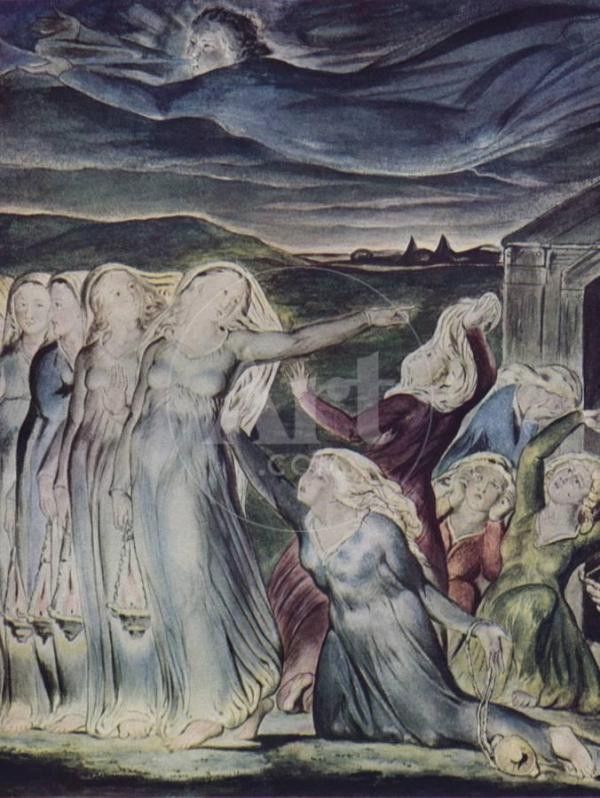
Picture: William Blake, The Parable of the Wise and Foolish Virgins 1800

Of the three synoptic gospels – so called because they follow a broad outline or synopsis of Jesus life – Matthew’s is the most Old Testament in feel with its frequent dichotomies of inclusion and exclusion, praise and judgement. Matthew’s depiction of Jesus lacks the urgent and accessible humanity of Mark’s presentation and comes nowhere near to the pastoral and social sensitivity of Luke’s portrayal. Matthew’s Jesus is modelled on the image of a new Moses. Jesus is more elevated and detached – more guru like – a figure above the fray at whose feet the disciples gather to be inaugurated into the Kingdom of God.

Today we are presented by the Lectionary with the parable of the wise and foolish virgins. Already the English translation of the female wedding attendants as virgins sets a particular patriarchal tone – as in virgins are better than non-virgins because they are virginal – meaning unsullied. A better rendering might be bridesmaids – which immediately carries a more neutral – less morally colored inference. The other thing to note is that this parable is unique to Matthew and is one of his Parables of the Kingdom.

Matthew is fond of using the wedding as the metaphor for the kingdom of God. At first sight we can see what he’s getting at. Like a wedding – the kingdom is a place of celebration and merriment. But Matthew’s wedding metaphor carries a starker inclusion -exclusion message. Weddings are celebrations only for those who are invited – or those who accept the invitation. Matthew’s parables of the kingdom all end with a warning – usually of severe punishment for those who are excluded or exclude themselves from the kingdom. Images of outer darkness with much wailing and gnashing of teeth abound. Thus themes of inclusion and exclusion lie close to the heart of Matthew’s kingdom parables.  Reading back into the historical context in which he’s writing, themes of inclusion and exclusion attest to a central struggle between two new movements in Jewish religious life. From the destruction of the Second Temple in 70 AD – Rabbinic Judaism and the Early Church – both fresh and vital shoots – struggled to emerge from under the ashes of temple-centered Jewish religious life.

Matthew’s tones of harsh punishment for those excluded – echo the struggle to define tribal identity. In tribal societies – like that of ancient Israel – and Matthew’s contested context in the final decades of the 1st-century AD – everyone inside the tribe are friends and those outside it are foe. We should not be surprised to find today similar themes afflicting much of contemporary white, rightwing, evangelical messaging – which has regressed to a tribal identity. For this reason alone, Matthew’s message of judgement often jars upon those of us with a more contemporary, progressive, Christian ear.

At the end of the parable of the wise and foolish bridesmaids Matthew sternly warns: Keep awake, for you know neither the day nor the hour”.

Of course, no one knows what the future will hold. We develop a tendency to anticipate events based on what we already know about life. Sometimes experience is an accurate guide, yet more often it’s misleading. Facing the uncertainties of the future armed only with a partial – often misremembered recollection of the past – only makes us even more anxious.

We alleviate our anxiety with the illusion of being prepared, and consequently we live a good portion of our lives caught up in a process of attempting to anticipate all eventualities – inducing in us a perpetual and neurotic wakefulness.  No wonder many of us no longer sleep well. The problem with anticipation of an assumed dangerous future is that it encourages risk aversion in life. Life lived circumscribed by past experience may ofer the illusion of a predictable future but it’s a very, very unsatisfying experience!

In our society we reserve our harshest judgments for those who fail the Boy Scout test to be prepared!  How easily the phrases: well, it’s his own fault, or, she has no one to blame but herself, or, its time they really took responsibility for themselves trip lightly off our tongues. To such persons regardless of gender do we not think: oh, what a foolish virgin you’ve been! You see being found unprepared is an American sin.

Matthew’s parable of the wise and foolish bridesmaids has three themes worth closer inspection.

The first is the stereotypical treatment of women. There would have been quite a number of invited wedding guests – men as well as women – so why does Matthew focus his treatment on a group of women? He seems to be playing upon the stereotyping of women into two groups – to put into modern parlance the sensible housewife or foolish, if not downright dangerous, women driver.

Motifs of virtue and shame are woven throughout this parable. We are not strangers to this denigration of women – today a prevalent theme underpinning conservative (mostly male) hostility to women owning control of their own bodies as compared with so called virtuous women who accept male expectations for both the control as well as the exploitation of their bodies.

Secondly, Matthew presents a group of people who have no sense of solidarity or a commitment to support and aid one another. Instead, the wise bridesmaids, gloat over their sisters’ foolish lack of preparedness. Likewise motivated by our fears of scarcity we exclaim – of course I want to share my surplus with you, but I can’t because – who knows what the future may bring – I might need all of it.

The lamp oil is a symbol for scarcity –reinforcing our prevalent scarcity worldview in which there is only so much to go around.  In a culture of scarcity, you keep what you have by not sharing it with others. Within a worldview that sees resources as limited, the pie is only so big – people of necessity are divided into the haves and the have-nots. At St. Martin’s like the wise bridesmaids there is no mistaking that we are among the haves when the world is viewed from the perspective of scarcity.

This past year we’ve put the resources of our successful capital campaign to good use – by which I mean uses over and beyond the perpetual drain on resources that maintaining this historic church requires of us. This past year we’ve been especially mindful of our responsibility to share what we have with others who can benefit from our support. I happen to believe that through being generous we become the net beneficiaries of our own generosity. Generous action reminds us of our ultimate dependency upon divine providence. Unlike the wise bridesmaids we discover again and again that only when our giving flows generously from our commitment to one another do we encounter the depths of our gratitude for God’s gracious providential love towards us.

In a season of stewardship renewal, we are well reminded that money is like water. Water sustains life only when it is allowed to flow freely. When dammed up it becomes stagnant – poisoning the ground around it.

Weddings are one metaphor of the kingdom. Baptism is another. In a moment we will welcome a new member through baptism into the fellowship of the kingdom of God as embodied in our St. Martin’s community. Baptism reminds us that preparedness and self-sufficiency do not qualify us for entry to the kingdom. Willingness to respond to the invitation of grace is all that is required. Will not Christ welcome us his church and bride – regardless of our state of un-preparedness? For whom can be prepared for such a life changing encounter.

Matthew’s injunction to stay awake is an odd conclusion. This isn’t a parable about staying awake – after all, all the bridesmaids fell asleep. Matthew’s gripe is that half of them were found unprepared for the grooms return. In this there is an aspersion of something shameful. What is their shame? It’s the shame of failing to be self-sufficient. We all know that failure to be self-sufficient is the real American sin. A sin to us – but not to Jesus.

Martin: Man for Our Time

Imagine we’ve come to the movies to watch the latest new Marvel epic suitably named AD 406. The curtain rises on the year 406 when in an unusually severe winter in which the Rhine has frozen solid, we watch in that peculiar ecstasy of pure horror the battle-hardened barbarian hordes stream across the frozen river into the civilized world of Roman Gaul.

The Rhine River forming a natural barrier dividing Latin and Germanic cultures has a long history that stretches down well into the 20th-century. The Rhine, winding in many places through its steep-sided valley formed a natural barrier – a boundary between civilization and the wilderness of the barbarian lands. Barbarian – a name the Graeco-Romans gave to all who lived beyond the geographic and cultural reach of their civilization. The barbarians represented the epitome of the psychological other. We need no further evidence today of how the psychological other functions to embody the terror of difference within individual and collective consciousness.

Vandal is a word that has made its way into the English language as the very symbol of destructive otherness. In his book on Martin of Tours, Christopher Donaldson describes how the Vandals, Alans, and Suevi, swarmed into Roman Gaul in complete disregard for their own loss of life. It was estimated that at least 20,000 Vandals alone lost their lives in the river crossing. Yet they still pressed on – forced by the relentless pressure of mouths to be fed and need for land. The great horde swept on into Roman Europe and North Africa leaving behind them a trail of devastation and confusion. In what had been the civilized and fertile countryside of Roman Gaul the only vestiges that remained were the giant buildings, aqueducts, and monuments of Roman civilization – things that a wattle and daub society had neither use nor imagination for.

On the South Bank of the River Loire, at a place called Marmoutier about 3 miles downstream from the city of Tours, there was a large grassy plain lying between the river and a line of forbidding grey cliffs rising for 100 feet or so. With trees clinging precariously to their face, the cliffs were honeycombed with caves, for all the world giving much the same appearance as the holes of sand-martin nests in the side of a disused quarry. And in the year AD 393 all the caves were inhabited and the grassy plain below was covered with the rough wooden shacks of a great camp of spiritual refugees, numbering in all some 2,000 men – a smaller group of women having formed their own community within the walls of the neighboring city of Tours. Working from  contemporary eye witness sources, Donaldson tells us that the whole concourse was wrapped in a deep silence from morning until evening, punctuated only by the occasional singing of psalms or hymns, and the low voices of those who were reading the scriptures aloud.

The reason for this great gathering of men, many of them the sons of the Roman Gaul nobility, lay not only in the general urge to withdraw from the responsibilities of public service in a time of civic institutional breakdown, but also in the attraction of the unconventional personality of Martin, the holy man and Bishop of Tours. His appearance at the age of 77 belied the extraordinary depth and range of his character. For underneath the deliberately unkempt hair, the pallid emaciated features, and the rough surge slave’s robe in which he was dressed, lay a personality that at one moment recalls for us the image of a Mahatma Gandhi, quickly morphing into that of a visionary William Blake, before yet again emerging into a man forged by his years of discipline in the Roman Army – a military man of commanding presence.

Martin was born in AD 316 into a high-ranking, but non aristocratic Roman military family in what is now modern-day Hungary. His father was a military tribune in the Imperial Guard – then stationed on that other great river frontier separating the civilized and barbarian worlds – the river Danube. His parents were staunch pagans opposed to the growing influence of Christianity – and so they named their son Martin after Mars the god of farm and battle, in the hope he would grow up to become a champion for the restoration of the old order.

In AD 312, with the proclamation of Constantine as the new emperor, the last great period of intense persecution of Christians under the emperor Diocletian ended. Following Constantine’s conversion to Christ – a mere four years before Martin’s birth in 316 – the Church had begun its rapid expansion. Although already an extensive and growing influence, the most significant result of Constantine’s conversion was the incorporation of the bishops into the Roman Civil Service with the rank and more importantly for many, the stipend of a magistrate.

Yet, despite the new imperial patronage, a deeper and simpler reason lay behind Christianity’s rapid growth. Christianity offered to ordinary men and women fed up with the status quo an explanation and philosophy for living that was satisfying. Unlike enforced imperial obligation the Church offered a supportive and voluntary style of community life with an educational system based on the scriptures that met people’s intellectual and emotional needs. Despite strong parental hostility, Martin could not avoid being attracted from around the age of ten to this magnetic vision of a new way of being human with its practice of a more satisfying way of life.

To cut a long story short, by the time Martin reached the age of 15, his father – increasingly fearful for his son’s development into Roman manhood, arranged for him to be press-ganged (kidnapped) into the army. Martin was to spend the next 25 years of his life in conscripted military service. Army service did succeed in making a man of Martin – but not in the way his father may have envisioned.

Martin was far from being just another plebeian conscript. He enjoyed the privileges of being a Tribunes’ son. Interestingly, Martin found his way into the Army medical corp. As a medical officer, he would have been responsible not only for the surgical treatment of soldiers in the field but for their social and emotional welfare within garrison life. Thus, Martin found a strong synchronicity between this care for his men and his developing sense of what it meant to live as a Christian. For he showed an unusual compassion for the poor whom he would have encountered hanging around the edges of his garrison town of Amiens. This sensitivity – in another military officer decried as weakness – would have found acceptance or at least toleration among his peers as an attitude characteristic of a healer.

Martin’s concern for the poor is captured in the famous incident of his encounter with a beggar at the city gates – poetically depicted in our great St Martin window. In the window we see Martin cutting his cloak in half and placing one half around the beggar’s shoulders. Incidentally a soldier’s cloak was a garment of joint ownership. The half he gave to the beggar would have been the half he owned. The half he retained was army property – and not his to give away. That night he had a vision of Christ, clothed in half his cloak saying for as you have done unto the least – you have done unto me.

Martin died in AD 397 – a mere 9 years before the catastrophic collapse of the Roman Legions along the Rhine wall in 406. While he didn’t live to see this catastrophe, he nevertheless lived in the preceding decades during which anyone with any foresight might have foreseen this eventuality. For during the preceding decades leading to the curtain rise on the 5th-century, sensitive and intelligent people had known that the end of the centuries of stable government and cultural achievement was fast approaching. The signs were all around them.

Inflation had been steadily mounting for a century or more and had become so out of control that many were beginning to return once more to the simpler system of barter. Ordinary people knew that the wealthy were seeking every possible way of avoiding taxes and turning their backs on the virtues and responsibilities of public service which had become an increasingly unsavory and dangerous occupation. From time to time the army would attempt to raise up a new emperor – someone whose value had been proved in the field – to take control of the empire and make Rome great again. But things had gone too far for such simple solutions. In the Western half of the Empire the problems lay deeper than a return to the efficient management of the economy and the revival of a spirit of public service. Rather it was a complex exhaustion of morale in the inner minds and spirits of men and women throughout the West – where many increasingly feared that the civilization of Rome had run its course.

Donaldson notes that if there was any hope for the future of Western Civilization, it was hard to see it lying in the hands of the governing classes. Rather the future had come to rest in a group of men and women who had completely withdrawn from the civilized world – men and women who were quite careless of whether it sank or swam.

Martin is a transitional figure spanning the inflection point at the turn of the 4th & 5th-centuries. He remained hugely influential across the whole of Western Europe as far north as Scotland. When Augustine arrived at Canterbury 200 years late he found the ruins of a Roman Christian church dedicated to St Martin. St Martin’s Canterbury still stand today dwarfed alongside the great Cathedral. A mystic revered by the Druids for his love of nature in preference for the highly urban life of most Christian bishops. A pastor and a healer of souls who attracted the brightest and the best of a generation disillusioned by the degeneration of civic society. A reluctant and yet more than able administrator bishop – under whose leadership a disciplined structure of administration developed relatively free of the growing corruption afflicting the more worldly among his fellow bishops – increasingly corrupted by their magistrate’s privileges and state stipend.

Martin as a transitional figure is an avatar for us today. For we also are living at a similar inflection point to that of the late 4th and early 5th centuries – a time when the post-Enlightenment spirit of progress, order and the global peace – the product of Pax Americana -seems increasingly spent. Like the men and women of the age into which Martin was born, disillusionment and loss of hope mark the pervading zeitgeist of our age.

Yet there’s a key distinction between the inflection point of the 4th-5th centuries from that of the 20th-21st. As the 5th-century unfolded – despite the devastations brought about by the first wave of barbarian incursions and the collapse of the Pax Romana – invasion also brought an infusion of energy and vitality – forging a new spirit in Western Civilization – a spirit now channeled and guided by the growing institutions of a vital and energetic Christian Church. For Martin and his church stood at the beginning of something new – whereas we and our Church today feel increasingly as if we stand at the end of something old.

I believe that the jury’s still out on the accuracy of such a premonition, real though the experience maybe. As we navigate our way forward in a time of civic challenge at home and challenges to peace and democracy abroad, we might pay closer attention to the movement of the Spirit of the God of unchangeable and yet also everchanging power. God who empowers the work of restoring the world through the raising up of things which have been cast down and inviting us to collaborate in the renewal of things that have grown old.

Embroiled in this process as we are – of finding the confidence as Christians to entrust ourselves to the hope that is within us as we navigate our way forward in challenging times – we could ask for no better guide than Martin, our patron – whose spirit is infusing those who bear his name to become increasingly molded into his likeness.

What is that likeness we might ask? It’s the likeness of a man of courageous hope, deep humility before the divine mystery, a man of resolute faith infused with the gentleness of gratitude. We can only pray and work hard to ensure that gratitude is our well spring – gushing forth through lives marked by Martin’s spirit of compassionate generosity.

What’s on the Coin?

What’s on the coin? We’ve all played the game of spinning a coin in the air and calling out heads or tails before it lands. The coin eventually lands with one side or the other facing up and depending on who called correctly – heads or tails – they get first choice. This is a tried-and-true method of deciding between two possibilities by entrusting the decision to fate’s choice.

Ancient coins were – as modern British ones still are – stamped with image of the reigning monarch along with an inscription – just in case there’s any identity confusion.  Jesus was presented with such a coin by his opponents – increasingly disturbed by the challenge of his message and its appeal to the ordinary folk who flocked to the Temple to listen to him. Keep at the back of your mind the question what’s on the coin.

As we watch the playing out of the internecine struggle within the House Republican caucus – confirming the current fractious and fragmented state of America’s body politic – picture the state of Roman Palestine in the time of Jesus. Like the Palestinians of today, occupation led 1st-century Jews to sometimes unite in common cause but more typically – fracture around different responses to occupation and how to bring about its end.

In 1st-century Palestine, five major Jewish factions faced the central choice presented to all occupied people – collaborate or resist. Those on the resistance side of the tension further divided over the use of violence as a tool of resistance.

The Sadducees, the religiously conservative priesthood – jealous for their hereditary privileges along with the Herodians, the aristocratic oligarchs of the Hasmonean Dynasty of Herod the Great – the last ruler of an independent Israel before the Roman occupation – chose to collaborate with the Roman occupation. In fact the Herodians went one step further as the Greek-speaking, culturally cosmopolitan globalists – the designer clothes wearing, fast living, pleasure-seeking 1st-century .1%. The Sadducees clinging to unchanging tradition. The Herodians for whom God was simply a primitive artifact from a superstitious past.

The parties of resistance were the Pharisees, the Zealots, and the Essenes. The Pharisees, religiously progressive – the party of moderation resisting the occupation through keeping themselves apart from any involvement in Roman administration – while firmly rejecting violence as a tool of resistance. While the Zealots – also known as the Sicario were a 1st-century Hamas or Hezbollah – engaged in violent resistance through assassination of Roman officials and Jewish collaborators alongside widespread intimidation of the Jewish population. The Essenes, on the other hand, are known to us principally through the excavation of one of their settlements at Qumran where archeologists unearthed the treasure trove known as the Dead Sea Scrolls – were separatist-survivalists who refused to have anything to do with both the Romans as well as their fellow Jews. Hold-up in communities in isolated parts of the Negev – they waited for the coming of the Messiah whom they pictured as God’s warrior king who would free them from the occupation. John the Baptist presented a very Essene image and preached an Essene message.

Matthew 22:15-22 therefore paints the startling picture of Pharisees, Herodians, and Sadducees consorting together to entrap Jesus. Adversity makes for strange bedfellows. It’s a testament to the power of Jesus’ message that factions who normally would have had nothing to do with one another were forced to come together to try to take him down by tricking him into convicting himself of blasphemy and or treason.

So, what’s on the coin? For the Pharisees, Roman coinage was a source of spiritual contamination because the inscription on the head proclaimed Caesar not simply as emperor but as Kyrios or Lord – a title only Yahweh could claim. The gist of this encounter between Jesus and his interlocutors centers around the legitimacy of taxation. In this context, the question concerned the dispute among Jews as to whether it was breaking the Covenant with God to pay taxes to a false god – that is Caesar – or simply a civic duty forced upon them.

In a somewhat surprising alliance of convenience, the Pharisees and Herodians pose the taxation question to Jesus. If he answers that it is lawful to pay taxes to Caesar – he will be acknowledging the emperor as a god, and thus convict himself of blasphemy. To advise not paying taxes, he commits treason against the Romans. So, the strategy was to flatter him with the title of teacher and watch which way he jumped.

We know how clever a debater Jesus was and so we are not surprised when Jesus avoids the trap by stating the obvious. Asking for a coin – most likely from one of the Herodians as no Pharisee would ever carry such a thing – Jesus is suggesting there is no conflict between a civil duty to pay taxes and a religious duty to honor God as an ultimate responsibility. The beauty of his answer is that he offends both groups while depriving them of the satisfaction of hearing the jaws of their trap snap closed. 

Render to Caesar the things belonging to Caesar and to God the things belonging to God seems a simple solution. But as we know all too well, it’s one that requires an examination of and balancing between competing allegiances. What and how much is owed to Caesar? What and how much is owed to God?

The reading of Matthew 22:15-22 in parishes up and down the land, marks the launch of the fall pledge drive. Eschewing gimmicky stewardship campaigns much loved by Episcopal Church Central, this year’s annual stewardship letter will soon be dropping into your letter boxes. The focus of this year’s letter is to thank everyone for their support last year by highlighting the vibrancy and extent of our outreach ministries in 2023 – the wonderful fruit of your support. In the mailing you will also find a supporting budget narrative with a pie chart of expenditure along with the all important estimate of giving card for 2024. After prayerful contemplation please complete the estimate of giving card and return it to us asap – please.

However, having noted the connection between Matt 22:15-22 and stewardship themes I want to take Matthew’s text in a different direction by returning to the question what’s on the coin? More explicitly– what coin design can tell us about ourselves.

US coin design is traditional and for the most part unchanging. It tells us that original designs never need to change. By contrast with the accession of Charles to the British throne, the Royal Mint has issued a whole new set of coin designs. Each coin’s head features Charles in profile -facing left as his mother faced right. His image bears no crown– a nod to less deferential times. On the tail the coins depict examples of endangered species of British flora or fauna – reflecting the King’s conservation and ecological concerns.

The coin images – head and tail – of his mother’s reign projected images of national greatness and political unity. As did the humble coin in Matthew’s story – a symbol not only of economic value but also a representation of worldly power and political values.

As representations of economic value and national pride the design of our coins and banknotes has tended to project pride in national achievement. Such pride – the celebration of power also lies at the root of our plunder of the earth’s resources as a celebration of human achievement. Too much deference to Caesar and not enough honor to God.

Therefore, it’s curious to see on a nation’s money images expressing a godly concern for the protection of the environment against the human instinct to plunder and despoil the natural world. Alongside being tokens of economic value, the new British coin designs project the spiritual values of our growing desire for economic power to be better harnessed to the project of environmental restoration – heralding a more equal balance between the interests of Caesar and those of God.

A rereading of Jesus’ statement Render to Caesar that which belongs to Caesar and to God the things which belong to God – might lead us to see that he’s not making a sharp distinction between civic and spiritual obligations so much as offering a picture of balance between the expression of earthly power and our spiritual aspirations. Facing up to the serious challenges ahead still requires of us some hard choices as we bring our material and spiritual aspirations into closer alignment. What better way to do this than in the redesign of the humble coin – reminding us of a need for greater alignment between political and spiritual values as hinted at in the new British coin designs. Render to Caesar what belongs to Caesar and to God what belongs to God – of earthly power harnessed to the fulfilment of God’s work of restoring the face of creation. What better project to meet the challenges ahead.

In Defense of a Moral Principle

We stand appalled and helpless before the enormity of the rapid escalation of unspeakable violence in the Holy Land. We’ve been shocked to witness the biblical barbarism of the Hamas slaughter of Israeli civilians in the settlements of southern Israel. Hamas’ actions display a deliberate barbarism born of a religious fanaticism that despises life – any life – in this world in preference to the promise of paradise in the next. Of course there is a political calculation in Hamas’ actions – to scupper any path forward for peace between Israel and its Arab neighbors in the region.

In slow motion we now watch the 21st century revenge of a traumatized Israel – reeling after the revival of Jewish collective memories of helplessness in the face of genocidal attack. That such a thing could happen within the borders of Israel is particularly painful. Israel, the one country where Jews hoped to be safe.

The victims of Hamas’ fighters were not the ultra-militant residents of the illegal settlements on the West Bank that everyday devour more and more Palestinian land and vital water resources. Thomas Friedman in his NY Times opinion piece Israel Has Never needed to be smarter than in this moment –quotes the Israeli writer Ari Shavit: “These were the homes of the people of pre-1967 Israel, democratic Israel, liberal Israel — living in peaceful kibbutzim or going to a life-loving disco party,” For Hamas, “Israel’s mere existence is a provocation”.

Amidst the deluge of commentary and opinion on the current crisis I found  Yossi Klein Halevi’s The Reckoning in The Atlantic to be most insightful. He notes that Israel must grapple first with its enemies, and then with the failures of its own government. He writes:  Israel faces two very different reckonings. The first is with our enemies. Until now, Netanyahu and his right-wing allies viewed Hamas as a kind of strategic asset: so long as it was in power in Gaza, a two-state solution to the Israeli-Palestinian conflict was impossible. For that reason, in addition to effectively bribing Hamas to refrain from attacking Israel, Netanyahu allowed massive infusions of cash from Qatar to prop up the Hamas government.

Thomas Friedman articulates the challenge facing Israel now – which is to act in its own best long-term interests and not fall into the trap of doing what Hamas and Iran dearly want it to do. As Americans now recognize in the decades after 9/11, revenge is a path that leads only to a cycle of ever diminishing return.

In grappling with its enemies, we now must bear witness to the execution of Israel’s rage upon Hamas resulting in the collateral deaths of thousands in Gaza. History attests that in Israel after the current war emergency is over there will be a terrible reckoning for the politicians who have exploited intercommunal (Israeli-Palestinian) and intracultural (Israeli culture war) tensions that gravely endangered the cohesion and security of the nation. For the citizens of Gaza, no such future reckoning awaits. At best the leaders of Hamas will either be killed or escape into exile – never having to answer for their crimes against their own people. The Gaza Palestinians – 60% children – continue to die under a hail of Israeli bombs, while the Hamas terrorist organization hides within a shadow underground city of tunnels and caverns more extensive than London’s Underground Tube system.

So, what are we to do? This is not an inconsequential question as many today look to the latest tweet or social media post for their moral compass settings – no longer able to hold mutually contesting thoughts at the same time. Reducing a spectrum of nuanced grays into blacks and whites offers a kind of solution – and feed the dangerous yearning to take a stand for one side or the other.

Our culture of false moral equivalency has obscured for many a clear-sighted understanding of the fundamental moral question which Ben Wittes Co-Director of the Harvard Law School–Brookings Project on Law and Security has recently articulated so clearly. Wittes tweeted: There are no problems the solutions to which are the intentional murder of civilians. The response of many to his tweet was a yes, but – a continuation of the what about-ism response. No matter the context of oppression – the genuine grievances of the oppressed and the genuine fears of the oppressors – the solution never justifies the political murder of civilians. That as a culture we can no longer agree on this basic moral premise – is cause for great concern.

What can we do? Ultimately, what we can do is to categorically affirm – that is – without qualification or exception – the fundamental moral principle that There are no problems the solutions to which are the intentional murder of civilians. Agreement on this principle provides us with a road map for action.

In this week’s E-News I encouraged us to support the American Friends of the Episcopal Diocese of Jerusalem AFEDJ appeal for the a-Ahli Arab Hospital in Gaza. A-Ahli is a health care institution within the wider Episcopal-Anglican Diocese of Jerusalem’s healthcare ministry to the Palestinians. Like all under resourced medical providers in Gaza, a-Ahli is now completely overwhelmed. The numbers of injured increase exponentially as essential medical supplies, along with the availability of food, water, diesel and electricity alarmingly decrease. Alongside the AFEDJ appeal I also mentioned the American Friends of Magen David Adom AFMDA Israel’s Red Cross organization. As part of the International Red Cross network MDA is prevented from receiving government funding of emergency services. It relies on donor support for the provision of ambulance and emergency response services across Israel.

Alongside finding practical ways to support humanitarian relief we must not overlook the crucial importance of giving spiritual support. Spiritually, our task is to bear witness to the facts of violence and atrocity – facing humanity’s seemingly bottomless capacity for inhumanity without flinching or seeking to explain it away. Our spiritual task is to bear witness to the suffering of the innocent – refusing to justify the causes of their suffering. As Christians, we bear testament to a mystery that might is never right – a mystery concealed in plain sight – from those whose vision is wholly conformed by the power driven zero sum narratives of this world. Facing unflinchingly into the face of violence and refusing to turn our faces away from the suffering of the innocent – is I believe – our most important Christian witness.

Philippi had been a Greek city founded by Alexander’s father, Philip of Macedon. Under the Romans, Philippi had mushroomed into a regional commercial hub through the Roman army’s policy of resettling veterans far away from the incendiary politics of the capital.

Paul had found in Philippi a rich field for sowing his Jesus message. We should not miss in today’s reading reference to the importance and influence that Paul acknowledges of the women working alongside him in his mission work.

Philippians is a Paul love letter. Writing to his friends in Philippi we find him during a period of some personal anxiety, having journeyed to Rome after appealing the case the Judean authorities had tried to bring against him to the imperial courts. In Rome he waits under house arrest – not knowing if his appeal will lead to his release or a sentence of death. Having already encouraged the Philippians to adopt humility as the model for Christ-centered living, in today’s portion he exhorts his friends with: Finally, beloved, whatever is true, whatever is honorable, whatever is just, whatever is pure, whatever is pleasing, whatever is commendable; if there is excellence and if there is anything worthy of praise, think about these things – then God’s peace – peace that passes all understanding – will be with you.

What can we do? We can practice the cultivation of truth in the face of lies and misinformation – holding in tension conflicting viewpoints. We can choose honorable action when tempted to take the road of expediency. We can value excellence in a culture where the mediocre will suffice. And in our encounter with anything worthy of praise we can fix our minds there – cultivating a deep attitude of gratitude flowing into generous action. We can cherish love and commend justice – and in so doing open ourselves to the counsel of our better angels. We can fervently pray for peace to come and work for justice to be done.

How easily our prayers for peace and justice trip off our tongues. We pray earnestly for peace as a cessation of conflict while ignoring the denial of justice. As we are forced to currently bear witness to – peace without justice is merely the temporary suspension of hostilities.

Peace is the fruit of hard love and justice is the hard doing of love. Peace and justice are indivisible and their causes inseparable. As 70 years of turbulence in the Holy Land bear witness – justice denied frustrates the desire for peace! The world continues to burn and the need for us is to base our attitudes, decisions, and action upon a fundamental moral principle – only grows more urgent.

The Virtues of Umbleness

"I suppose you are quite a great lawyer?" I said, after looking at him for some time.
"Me, Master Copperfield?" said Uriah. "Oh, no! I'm a very umble person."
. . .
"I am well aware that I am the umblest person going," said Uriah Heep modestly, "let the other be where he may. My mother is likewise a very umble person. We live in an umble abode, Master Copperfield, but have much to be thankful for. My father's former calling was umble; he was a sexton."
"I suppose you are quite a great lawyer?" I said, after looking at him for some time.
"Me, Master Copperfield?" said Uriah. "Oh, no! I'm a very umble person."
. . .
"I am well aware that I am the umblest person going," said Uriah Heep modestly, "let the other be where he may. My mother is likewise a very umble person. We live in an umble abode, Master Copperfield, but have much to be thankful for. My father's former calling was umble; he was a sexton."

I’m indebted to Doug Bratt, who in his reflection on today’s epistle reading from Paul’s letter to the Philippians notes an interview between Adam Bryant of The Times and Laszo Bock, senior vice president of Operations at Google, reported by Thomas Friedman in the NYTs on February 22, 2014. Bryant and Bock’s subject concerned the nature of emergent leadership – and this is what caught my attention. In contrast with more traditional hierarchical models of leadership, Emergent leadership is not a fixed status command and control role, its more a flexible function [my words]. It’s situational – arising and receding according to the demands of the situation. Bock explains that emergent leaders face problems as members of a team. At the appropriate time they may step forward to lead – but just as critically step back and let another team member take the lead:

Because what’s critical to be an effective leader in this environment is you have to be willing to relinquish power (Bock).

Humility seemed to be a key component in Bock’s description of emergent leadership. Explaining how humility and leadership go hand in hand:

It’s feeling the sense of responsibility, the sense of ownership, to step in to try to solve any problem — and the humility to step back and embrace the better ideas of others. Your end goal is what can we do together to problem-solve. I’ve contributed my piece, and then I step back.

It is why research shows that many graduates from hotshot business schools’ plateau. Successful bright people rarely experience failure, and so they don’t learn how to learn from that failure [Bock].

Bock stresses that without humility no learning can take place. Every institution of higher education should have his words emblazoned over their gate posts.

Emergent leaders don’t take the personal credit for success, neither do they blame others or conditions for failure. Emergent leaders argue fiercely for their point of view but have the ability to accept how the introduction by someone else of new facts changes the situation. Bock notes: You need a big ego and small ego in the same person at the same time.

It is interesting to note how much Google’s concept of emergent leadership is so contrary to the thrust of American academic, business – and might I add -political culture – where talent and leadership is about being the brightest, the highest paid, or when it comes to politics, the most shameless star in the firmament – all the while like Uriah Heep protesting umbleness. The problem with encouraging a prima donna culture – particularly in business and politics – is that it’s the antithesis of collaboration. An individualistic culture will celebrate narcissistic models of leadership – and we wonder why things don’t work out as intended.

The Philippians had sent Paul a gift delivered by the hand of Epaphroditus who subsequently had fallen ill. Paul is writing from imprisonment – most probably house arrest in Rome to reassure the Philippians that Epaphroditus had made a full recovery and that Paul is returning him to them in good health. This letter allows Paul to express his deep gratitude. Thanking the Philippians for their love and concern he addresses the current tensions in Philippi – news of which has reached him from Epaphroditus’ mouth to his ear.

Philippians is just one of his Paul’s more personal letters written during this period of house arrest. It’s during this period that he pens his opus magnum – his letter to the Romans – in which for the first time he seeks to collate a systematic theology – responding to some very thorny issues around inclusion and exclusion, righteousness and judgement, human intransigence and the faithfulness of God.

This is an anxious time for Paul. Will the result of his impending trial lead to an acquittal or his death? Facing into the uncertainties of the future, Paul is at pains to encourage the Philippians to take the humility of Christ as the blueprint for holding together in the face threats to their faithfulness to Christ.

Paul draws on the language of a familiar hymn extolling as the model for Christian community relations Jesus’ humility in his relationship with God. Paul asks that the Philippians practice having the same mind as Christ Jesus, who though he was in the form of God, did not regard equality with God as something to be exploited. Instead, he emptied himself, taking the form of a slave. Being born in human likeness – he humbled himself and became obedient to the point of death – and not just any kind of death – but the most shameful of deaths – death on a cross. In this manner Paul encourages the Philippians to work out their salvation with fear and trembling – recognizing that it is God who is at work in them.

By fear and trembling Paul is not advocating some kind of fearful submissive Uriah Heep like groveling. Paul is showing the Philippians that only humility enables the Holy Spirit to work in and through them to achieve God’s good purpose. Our context and cultural issues may differ from those of the Philippians, but the underlying truth of the message remains the same because human nature does not change much over time.

The Classical World of the 1st Century in which Paul is living and working was a world in which success and power were celebrated and in the ultimate case of the Emperor, worshipped. For the Roman man – to have power and social prestige was literally to have unquestioned power over – the right to dominate others with few societal or personal moral restraints. Might was right and humility was the ultimate sign of weakness!

Although we live in a society that in many ways apes Roman norms – where might is right continues unchallenged in many instances, yet unlike the Romans, a lack of humility is for those of us with normal levels of narcissism a guilty secret we try to hide. For we know that might is not necessarily right in the moral sense. What changes with the death and resurrection of Christ is that powerlessness and humility become the ultimate expressions of power. After Christ – as we see in Paul’s teaching – the exercise of crude power is – regarded from a moral and ethical perspective – subject to judgment by a higher set of values embodied by Jesus on the cross and vindicated by God in his resurrection.

Because Judao-Christian legacy has fundamentally shaped the secularism of the democratic West – humility stills echoes in our society even though for many it’s no longer tied to the practice of Christianity as a religion. Nevertheless, humility is still admired – we can say nothing better of a person than to ascribe to them the virtue of humility. We value humility as a cardinal virtue – despite or maybe even because for many of us – our struggle with humility is a guilty secret we try to hide from others.

Our greatest contribution when any of us might find ourselves in leadership roles is to know when and why to relinquish power. In leadership as well as in ordinary life – in Google speak – each of us needs both a big and small ego in order to be able to live collaboratively and work effectively or as Paul puts it to work out our salvation with fear and trembling – to come together to find collaborative solutions to shared problems.

The only adequate response in the face of the overwhelming mystery of God is one of humility – allowing power to flow in and through us – in pursuit of God’s good purpose.

I wonder if Google recognizes in their model of emergent leadership a contemporary reworking of Paul’s encouragement to the Philippians?

Who’s talking Fairness?

The Thomas Avenue Home Depot car park in Phoenix AZ around 5am. Men squat in ones or twos or small groups seeking whatever shade the sparse Acacia trees of Phoenix’s ubiquitous car park desert plantings can provide against the merciless sun – which even at this hour of the day grows hot. A pickup truck drives slowly by – stopping at a group of men. After a brief exchange of words – the men climb onto the back and the pickup drives off. Maybe the driver of the pickup is in construction. Maybe he’s a farm foreman. Either way – he’s on the lookout for day laborers who abound at any number of pickup points in the carparks that dot not only the Phoenix landscape but towns and cities across the Southwest.

At whatever time of day, you can find scatterings of such men –seeking the only work easily available to them as below minimum wage undocumented day laborers. Numbers throughout the day fluctuate, yet, even towards the end of the working day some still patiently wait for the ever-decreasing possibility of finding a day’s hire. What of those who are not hired as the sun sets?

Manual work – now there’s an expression! It means to work with one’s hands. Unskilled day laborers who have nothing but their labor to trade have always been and remain vulnerable to the dehumanizing conditions we impose on those who have no power, no voice, no country, no other marketable skills.

Even skilled workers who like the members of the United Autoworkers Union – or the Writers Guild of America – workers whose manual labor takes the form of an application of necessary knowledge and skill are forced to strike for an equitable share of the huge profits generated from their labor. It’s odd how even today capital refuses to recognize that the most valuable commodity in the creation of profit are the workers whose labor produces it.

And so it was ever thus as we plainly see from Jesus’ parable in Matthew 20 – in which he addresses the economic plight for a class of Jewish tenant farmers and small landowners who had become the losers in the 1st-century global economy. In the 1st-century – Galilee was a cosmopolitan mishmash where Syro-Phoenicians, Greeks, Roman incomers, and Jews mixed freely. It was the most fertile and productive agricultural region in the Middle East. Therefore, Galilee was also at the heart of the socio-economic upheavals that accompanied an agrarian revolution in which Jewish tenant farmers and small landowners were being displaced by the influx of Roman new money.

The Roman new money wanted to amalgamate land holdings to create larger farms to form more economic units to maximize profit for the landowners through scaling-up agricultural production to feed the Empire’s rapidly increasing population. As a story this one is not an unfamiliar one from the pages of history – where page after page evidences the eviction of tenant farmers and small landholders reducing them to the status of day laborers. Jesus would have encountered men standing idle in the marketplace – an ancient Home Depot carpark – awaiting hire to work the land they had once farmed.

This story opens with Jesus describing it to his listeners as a parable of the kingdom of heaven. In other words, he’s telling them that this is a story about God. Jesus’ stories about God take the form of parables – that is- stories that draw on the familiarity of the hearers’ everyday experience to expose them to an unexpected and somewhat disturbing conclusion – a kind of sting in the tail ending.

Read from our 21st-century perspective this parable about a landowner presents him as a man with a strong social conscience. He acts to do what he can to stem the tsunami of injustice afflicting his society. He not only pays his laborers above the daily minimum wage but is concerned for the plight of those who as the day progresses have still not been hired. He goes out at intervals through the day and hires them in batches – promising them the same daily rate as those he had engaged in the early morning. So far, so good.

But the surprise comes when at the end of the day, he pays everyone the same amount regardless of the hours worked. I mean, who does that? How can this be fair – we cry?

Both Jesus’ 1st and 21st-century hearers are confronted – if not affronted by this man’s behavior. How can it be fair to pay those taken on late in the day – working only and hour or so – the same amount as those who have been toiling since 7am? But remember, this is a story about God. The employer – standing in for God counters – why accuse me of being unfair when I am actually being generous. Those who have worked since sunrise receive exactly the wage I’d promised. In effect, my generosity is my own business and not your concern.

Wow, can God really be like this? Where’s then – the incentive to work hard and do the right thing if God is so indiscriminate in the distribution of their generosity? This story assails our cherished distinctions between the deserving and undeserving – those entitled and those with no claim whatsoever.

Jesus’ parables – his stories about God – are at their heart stories about justice. If aliens from outer space were to observe how we Christians talk about God, they might conclude that the thrust of God’s concern as evidenced in Jesus’ teaching is about personal sexual morality. They would be correct because that’s what most Christians and non-Christians believe.

Closer reading of the gospels reveals that Jesus never speaks about personal sexual morality in social life. The closest he comes is in his parable about the woman taken in adultery and we know upon whose heads his judgment is heaped here. The other example is his teaching on the indissolubility of marriage – but this is a teaching honored mostly in the breach. 99.8% of Jesus teaching directly addresses the societal and religious issues of his day reframed through the lens the kingdom’s justice revolution.

What is justice? Jesus shows us that justice is love in action. Justice has little to do with fairness and everything to do with generosity. Thus the right to earn our daily bread through the dignity of human labor is an aspect of justice viewed through the lens of the kingdom revolution – where Justice requires the dignity of human labor honored by the equitable distribution of both risk and profit.

On a baptism Sunday, we hear Jesus opening words The kingdom of God is like. He sets the expectations of the kingdom within this parable about an employer’s seemingly – to us – unfair remuneration of his laborers. Through it we learn that God is not interested in fairness at all. God is only interested in generosity. Like all stories of the kingdom revolution our conventional expectations of the way things should work – are upended.

We live in a world in which so much is governed by the principle – first come first served. In the workplace it’s enshrined in notions of reward for seniority – protections for length of service– and corresponding vulnerability of the last in to being the first out the door when downturn strikes.

The task of the Christian community is to reflect less the values and arrangements of the world and more the expectations of the kingdom’s justice revolution. In the kingdom there is no such thing as seniority nor greater reward based on length of service. In the Christian community there should be no discrimination according to status. Among us, there is only the status of the baptized. Baptism is the common denominator that elevates us all to the same level of significance in God’s eyes. Whatever distinctions we enjoy in the world – whatever lack of privilege and disrespect we suffer in the world – all inequality is leveled through baptism.

When Lucca is baptized in a moment – he will be admitted to a community of equals – taking his place with the rest of us who sit in the front row in the House of God. For my generosity is my own business and not your concern – says the Lord.

Sealed in Blood

Image: Arthur Hacker (English Pre-Raphaelite painter, 1858-1919), “And There Was a Great Cry in Egypt” (1897)

With the story of the Passover in Exodus 12 we leapfrog forwards from the lifechanging encounter between Moses and Yahweh in Exodus 3 which takes place beyond the wilderness. Last week I explored the dynamic of finding our way beyond the wilderness – wilderness being a metaphor for life’s status quo. To reach beyond the wilderness is to risk following our curiosity – curiosity that is triggered by the glimpse of something  in peripheral vision – out of the corner of our eye. The encounter between God and Moses beyond the wilderness was life changing both for Moses -obviously – but also for God. Life changing, how exactly?

For Moses it was an experience of being called; of finding his identity radically reshaped. But called from what and called to what?

The place beyond the wilderness is a metaphor for an experience bereft of the signposts that keep us corralled within the familiar. It is a place empty of the signs and markers that normally keep the unfamiliar at bay – for in the unfamiliar thar be dragons. Beyond the wilderness Moses is called from his uncalled life – his life amidst the familiar routines and expectations shaped by life as business-as-usual. By turns – Moses is terrified and yet curious, he’s stripped and exposed and yet empowered – he’s shaken not stirred into a new identity – an emerging new sense of self and purpose.

But the encounter with Moses is also life changing for God. Moses is not the only one whose identity is shaken not stirred. God – I AM WHO I AM – a God of memory of the past becomes God -I WILL BE WHO I WILL BE – God now defined by future actions that refashion God’s identity to become the God of liberation, the warrior God, who gets their[1] hands bloody in the messy affairs of human history.

In today’s reading from Exodus 12 we catch a glimpse of just how messy things had become.

Between Chapter 3 and 12, Exodus chronicles a series of skirmishes in the war Yahweh – to use God’s Hebrew name – has provoked with the Pharoah over his refusal to let the Hebrews go. In pursuit of his new role as liberator – God has donned the identity of the warrior. One interpretation characterizes this conflict as a trial of strength between Yahweh and the Gods of Egypt. Whether this is a cosmic struggle or simply a struggle between the divine will and recalcitrant human resistance, need not overly concern us, here. Save to remind ourselves that the Pharaoh’s opening salvo – his command that all Hebrew male infants be killed at birth has now found its echo in Yahweh’s ultimate response – that is to strike all firstborn – human and animal – in the land of Egypt as a judgement not only against the Pharaoh but upon all the gods of Egypt. Yahweh asserts his right to do this terrible thing – for he proclaims I am the Lord – that is -I AM WHO I WILL BE.

Yahweh instructs Moses on how the Hebrews are to prepare for and commemorate the angel of death’s passing over the land shrouded in the darkness of night. This is to be a unique event- an event like none other – therefore it is to be remembered as a perpetual anniversary – a commemoration of Yahweh’s involvement in the liberation of his people from bondage.

On the night of the angel’s passing over the land – the Hebrews encounter their God in a lifechanging event that will henceforth forge them into a people. On this night the Hebrews will be changed from a community of slaves into an Israelite nation – identified and protected by the blood of the sacrificial lamb smeared on the doorposts and lintels of their houses..

Down the centuries the Jewish people have continued to commemorate the night of the angel’s passing over. Passover or Pesach is not only a yearly commemoration but also a weekly family meal of remembrance on the eve of Shabbat – the Sabbath day. At the Shabbat meal a question is posed by the eldest to the youngest person present: why is this night different from all other nights? This question triggers collective memory enshrined in the unique customs of this commemoration where food is the focus. A meal of unleavened bread – for there was no time for the dough to rise. A meal seasoned with the bitter herbs of adversity, eaten in haste – eaten in a state of readiness for flight.

The Passover and flight from Egypt mark a reset in the measurement of chronological time – it becomes the beginning of months. It’s on the 10th day of the first month that the festival of Passover is to be commemorated.

How we measure the passing of time is interesting. As a Church community, we measure our year according to three different cycles. Some aspects of Church life follow the dictates of the chronological calendar year – January to December. The Lectionary and calendar of greater and lesser festivals of the Christian year run from December to November – beginning with Advent Sunday and concluding with the celebration of the kingship of Christ. Yet we have a third way of measuring the passing of months in the Program year from September to July. The Program year is a particular – and in my experience – a unique feature of American Church life.

The first covenant between Yahweh and Israel was inaugurated on the night of the Passover and sealed in the sign of sacrificial blood. The second covenant between God and the second Israel – that is – an Israel now extending beyond the blood boundaries of the Israelite nation – has also been sealed in sacrificial blood – this time not the blood of a sacrificial lamb but the blood of Jesus the Christ – the Lamb of God.

I need to say here that in using the language of first and second covenants and racial and extended Israel – I am not in any way suggesting that the second covenant has replaced the first. God does not abrogate their promises – nor abandon their faithfulness. Therefore, both covenants remain in force and are conduits for God’s continued presence with God’s people -Jew and Gentile. Neither am I suggesting that the extended Israel – the nonracial Israel – has supplanted the Israel of blood and circumcision. Extended Israel – usually referred to as the New Israel is an extension of God’s promises to Abraham – which through Christ – now encompass – potentially – the entire human race.

The parallel continues. As with the yearly commemoration of Passover and its weekly echoes on the eve of Shabbat, the New Israel of the second covenant – the Christian people of God – likewise commemorate Jesus’ with the symbolism of the Passover meal. We read On the eve of Passover Jesus took bread and gave thanks; he took the cup  giving thanks and saying …..

The yearly celebration of Easter therefore coincides in the same Luna calendar cycle as the Exodus Passover. So as with the weekly celebration of Pesach on the Shabbat eve – Christ’s Passover – the passage from life to death to new life – is celebrated by Christians on the first day of the week.

On that fearful night when Yahweh’s angel of death passed over the land of Egypt – the identity of a new people was forged through the experience of deliverance at the hand of Yahweh now the warrior God – sallying forth in defense of a chosen people. The promise made to Abraham becomes renewed as God cherishes once again an exclusive human relationship with Moses. The Jews rightly remember this night as the lynchpin of their identity as a community liberated to become instrumental in God’s plan for the liberation of a world – a world still ensnared in Egypt’s bondage.

Egypt represents in any age our entrapment in the uncalled life in which we continue to connive with the forces of oppression – be they political, social, or environmental. The promise made to Abraham became renewed in the sacrifice of Christ as Passover lamb. The blood of Christ – no longer a sign smeared upon our door posts, is now seared into our hearts.

On the night before he died, Jesus celebrated the Passover with his disciples. Over the following three days the angel of death passed over him. In his passage from life to death to new life – those who follow in his name were forged into a new community liberated to become instruments in God’s plan for the liberation of a world still ensnared in Egypt’s bondage.

On the 10th day of the first month of the Program year – Homecoming Sunday we celebrate Christ our Passover as the lynchpin of our identity as a community liberated to become the willing instrument in God’s plan for the liberation of a world still ensnared in Egypt’s bondage.

Deliverance is the lynchpin in identity. We can only pray that as Episcopalians – we might take our identity as seriously as our Jewish friends and neighbors across the street from us on the corner of Orchard place and Orchard Avenue – do. That together as Jew and Gentile we might work tirelessly in the divine dream for the healing of the world. Amen!


[1] My use of the collective pronoun for what the Tradition often views as a singular God reflects an affirmation that God’s nature  is communal not singular, and also beyond the immediate associations with human gender.

Encounter

Robert J Warren, the Vicar of All Saints, the Anglican Church in Rome, has a witty turn of phrase. He writes:

Moses was doing his best to lose the Egyptian accent that people had remarked on when he first landed in Midian (Exodus 2:18-19). It was an accent worth losing.  First, it was a lie: he wasn’t Egyptian.  He’d been a Hebrew child raised like a dirty secret in the heart of the Egyptian court.  Second, it provided a clue to his past misdeeds.  The child became a man back in Egypt.  His identity crisis sharpened and caused him to snap.  He’d killed an Egyptian overseer who was beating a Hebrew slave and thus became a fugitive from Egyptian justice.

Warren somewhat amusingly, yet concisely, summaries Moses’ story so far.  Exodus chapter 3 opens on Moses’ day-to-day life after having fled across the Gulf of Aqaba to Midian – an area that took its name from Midian who had been one of Abraham’s many illegitimate sons. Time has elapsed since his flight – time enough for the ever-resourceful Moses to have not simply found sanctuary but to have married the daughter of Jethro, the priest of Midian.

One day while absent-mindedly leading Jethro’s flocks Moses wanders into a region described as beyond the wilderness. It’s not an incidental detail that beyond the wilderness lies at the foot of Mt. Horeb – sometimes referred to as Mt. Sinai – or the holy mountain of God. It seems that the later Deuteronomist scribes who compiled Exodus sometime in the 6th-century BCE seem to have had a hazy grasp of geography. Midian is situated on the eastern shores of the Gulf of Aqaba – modern Saudi Arabia – yet Mt. Horeb sits at the southern tip of the Sinai Peninsula – so Moses has indeed been wandering far from home.

It’s helpful to picture Moses as daydreaming as he walks along – because his attention is alerted by a mysterious phenomenon which he spies in his peripheral vision – out of the corner of his eye so-to-speak. Focused concentration narrows the range of our peripheral vision. It’s only when we are not concentrating on anything closer to hand that our peripheral vision expands to take in a wider panorama. Out of the corner of his eye Moses spies something that arouses his intense curiosity. Driven by curiosity Moses leaves the beaten track and sets off across country.

In his peripheral vision Moses had caught sight of a mysterious phenomenon. Driven by curiosity – Moses arrives at his first encounter with the living God – a momentous encounter that will upend his life as he knows it.  

This encounter is not only life changing for Moses but from the perspective of God’s biography it’s also direction changing for God as well. In this encounter with Moses – we hear God speaking again for the first time since his relationship with Abraham.

Throughout Genesis’ long epics of the Patriarchs after Abraham, God has remained silent. The Patriarchal cycles are stories that focus on human action in which God is assumed as background but plays no direct role. In warning Moses to take off his sandals for he is about to tread on holy ground – we hear God speaking directly to a human being again. God speaking – is the prelude to a personal relationship with Moses who for God becomes a new Abraham – that is- a human being with whom God can form and intense and personal relationship. Through his relationship with Moses –as in the days of Abraham – God once again emerges as the primary actor in the unfolding story.

Moses’ encounter with God before the burning bush is an extended metaphor which illuminates the nature of own spiritual journey. Hidden within the rich theological-biographical detail – is a story of rediscovery, of remembering, and of reset.                                                                                                             

As Exodus chapter 2 winds to a close we witness a startling recovery of memory for God. We read:

After a long time, God heard the Israelites groaning and remembered his covenant with Abraham. God looked upon them and God took notice of them. 

We might ask why has God taken so long to act? Is there a suggestion here that the enslavement is the result of God having forgotten his people? Their servitude comes to and end only when God notices their plight as he recovers his memory of Abraham. We shall never know but it is interesting to speculate.

In remembering Abraham God seems to become aware again of a need for relationship – something he last enjoyed with Abraham.  This is also a story of rediscovery, remembering, leading to a reset now with Moses as God’s chosen partner.

At the heart of this story is the surprising revelation of God’s name. God has until this point been the God of ancestors – for the Israelites a God of distant memory. In response to God’s request – Moses pressures God for something more personal in the form of a name rather than a description.  God replies: tell them I AM WHO I AM has sent you.

The English is incapable of conveying the pulsating quality of the Hebrew letters YHWH -which shimmer with ambiguity of meaning. I AM WHO I AM – can be read as a statement about who God is and has always been – a God associated with the past. But it also can be read as a statement about who God will now become – I WILL BE WHO I WILL BE. The nature of who God will be – becomes revealed in future action where God is to become known as Liberator.  This is material enough for a whole sermon series yet to come.

However, today I want to focus on the element of the story captured in the phrase beyond the wilderness. I interpret this to mean – a place beyond conscious recognition – outside of the boundaries of familiar imagination.

The process of noticing what’s hidden in our peripheral vision is often best demonstrated in crime fiction where the chief witness is subjected to some kind of hypnotic process taking them back to the scene of the crime – during which they recover details of the crime lodged in peripheral vision – details that had remained hidden – inaccessible to their conscious memory.

Through the cultivation of curiosity, we begin to consciously register elements otherwise unrecognized in the peripheral vision of our daydreaming.

To venture beyond the wilderness is to leave the beaten path – the constrictions of the familiar. Matthew Syrdal – is the pastor of The Church of Lost Walls – a wild theology church in Denver, synthesizing theology and ecology. He has referred to the beaten path as the uncalled life. He bemoans that as pastors and spiritual leaders we spend too much time tending the uncalled life of the flock – by which he means:

The business-as-usual, relatively autonomous existence we often lead. In the uncalled life, Syrdal notes that: Most of us typically experience no major intrusion to speak of, nothing disrupting or redefining our identity and role in our communities, yet also no appearance or message — no larger conversation with the Holy.

He likens our uncalled life to the Israelites slavery in Egypt. In the uncalled life we are silently crying out – unknown and uncalled. In other words – being unable to notice the call of the Holy within us and around us – we remain unconsciously encapsulated in our distress – a distress emanating from the fixed and closed pattern of our lives.

Syrdal further suggests that our unconscious distress finds collective expression of the storm surges of racism, fear, and terror – forces currently in play – powerfully disrupting our civic life todayHe writes:

At times, it might seem as if the whole of western culture is enslaved in a cultural pathology — the City that Egypt represents in the Exodus narrative. The City, egocentric civilization, is almost by definition structured as a defense mechanism against the natural world and the threat it represents. In our times, Egypt is that which slashes and burns the old growth of a forgotten World, that which consumes the Earth’s resources with an insatiable appetite. We are largely, and mostly unconsciously, enculturated from early childhood with the incipient imperialism of Egypt. Moses, as a type, represents for us an awakening from the imperial dream to something like the dreaming of the Deep World.

The story of Moses and the burning bush is a story of theophany – to use the technical term. Theophany is a story or experience of divine revelation – and from the perspective of God’s biography – that is – God’s personal story -a self-revelation – a new learning for God about being God.

Theophany occurs – never in plain sight, nor along the familiar path – but always beyond the wilderness – meaning – off the beaten track hidden in peripheral vision. The trick for us is to catch its glimpse out of the corner of our eye.

Like Moses, we become changed by an encounter with the Holy – only when our lives become decentered enough – disturbed enough – to reshape our expectations, stimulate our curiosity, and pay attention to what’s happening out of the corner of our eye.

Blog at WordPress.com.

Up ↑