From Final Chapter to Epilogue

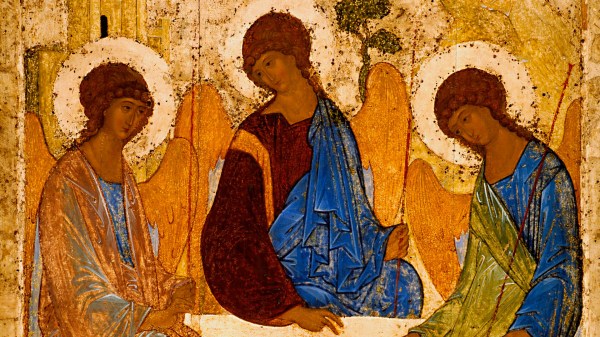
Image: Andrei Rublev’s 15th-century icon of the Holy Trinity

Last week on Pentecost Sunday, I likened the Bible to what my granddaughter Claire, at an important stage in her learning to read, used to refer to as her chapter books. When children are learning to read, a critical stage is reached when they graduate from simple, single-storyline books to complex stories that unfold in stages, or chapters.  In the last two weeks, we have celebrated two significant chapters in the Christian biblical chapter book- namely the Ascension of Jesus and the descent of his Spirit – a two-way process which Tom Wright describes as the moment when the personal presence of Jesus with his disciples is translated into the personal power of Jesus in his disciples.

Pentecost is the final chapter in the Christian chapter book. But in all good chapter books, the final chapter is often capped off with an epilogue – a short addition or concluding section at the end of a literary work, usually dealing with the future of its characters.  Trinity Sunday is the Christian chapter book’s epilogue, hinting at a foretaste in volume two, so to speak, of the continuing Christian storyline with the action now centering on the life of the Church.

How do you recognize an Episcopal Church at first sight? Well, the red doors are usually a giveaway. But when you see Holy Trinity as the dedication of the church, you know this is an Episcopal Church. The Trinity is deeply revered in the Anglican tradition with by far, a greater number of Episcopal churches dedicated to the Holy Trinity than to any other single dedication. Why is this so? I think it must have something to do with the naturally speculative cast of the Anglican mind. Unlike more literalist traditions, we appreciate mysteries to puzzle over. We’re not interested in simple answers to complex questions. We appreciate mystery as something that hints at but never fully explains truth.

There is a spoof report of a supposed conversation between Jesus and his disciples. In answer to Jesus’ question Who am I? Peter, – yes, it’s always Peter who pipes up first – launches into: “Thou art the Logos, existing in the Father as His rationality and then, by an act of His will, being generated, in consideration of the various functions by which God is related to his creation, but only on the fact that Scripture speaks of a Father, and a Son, and a Holy Spirit, each member of the Trinity being coequal with every other member, and each acting inseparably with and interpenetrating every other member, with only an economic subordination within God, but causing no division which would make the substance no longer simple”. And Jesus answering, said, “What?”

Some people are, by temperament, Jesus-people. Others by temperament are God-people, while others, often many others, are Holy Spirit-people – no, I’m not looking at Linda+ when I say this. I have to say I appreciate the role both Jesus and God play in my spiritual imagination. I’m also good on the Holy Spirit as long as we don’t get too enthusiastic about her. But my temperament really hums in the contemplation of the Trinity. Why is this? Part of my answer would be to affirm the elegant simplicity of the Trinity as the fullest expression of God. And I want you all to know how simple and enticing the Trinity really is.

The distinctively Christian understanding of God, as Trinity, emerges from the Pentecost event, as an everyday experience long before it became a doctrine. This unthought experience of God as Trinity is captured in a venerable Celtic prayer:

Three folds of the cloth, yet only one napkin is there,                                                                                           Three joints in the finger, but still only one finger fair,                                                                                               Three leaves of the shamrock, yet no more than one shamrock to wear,
Frost, snowflakes and ice, all in water their origin share,
Three Persons in God: to one God alone we make our prayer.      

Like most experiences, it’s only when we turn our backs on the poetic and try to rationally capture the intuitive that things get complicated.

God as Trinity – that is, as divine community – arose out of the everyday experience of the first Christians. They knew of God, the creator, from their Jewish inheritance. Yet, this inheritance of faith had been augmented through a collective memory of Jesus as a human personification of God. Following the Ascension event, when they had so keenly felt the loss of a personal connection with Jesus, at Pentecost they became overpowered by– literally inflated with his Spirit as the personal presence of Jesus with them was translated into the personal power of Jesus in them. It’s only later, when Christianity takes root among the Greeks – ah those Greeks being of a more philosophical frame of mind, loved codified statements – like the one we repeat every Sunday in the Nicene Creed. It’s here that the Trinity begins to get complicated.   

While human beings have always cherished relationships, it’s only with the advent of a psychosocial understanding of relationship that we have grasped the importance of relationality as the engine of emotional development. Following on from our being created in the image of an unseen God, we can deduce that the dynamics at play in human relationships reflect something essential about God. If we are made for relationships in community then might this be true of God as well. The image of God as a solitary being falls away before the image of God as divine community.

I’m now coming closer to answering the earlier question of why I am at heart a Trinity-person.  In 2025, the celebration of the Holy Trinity coincides with both Father’s Day and the baptism of a child in the fourth generation of one of our church families. Both Father’s Day and baptism provide rich material for reflecting on the relational nature of God as divine community.

Fatherhood, often thought of as a male characteristic – the possession of individual men, is really a concept dependent on and expressive of relationship. All fathers are men, but not all men are fathers. Men become fathers only through the procreation or adoption of children. Relationally speaking, you cannot be a father without a child.

Traditionally, despite acknowledging that God is genderless, God the creator nevertheless has been referred to as Father, rendering Jesus his Son. Yes, these are now unfashionably gendered nouns. But its not the gendering, but the relationality of these nouns that captures the essence of the divine nature. Other nouns for God can be used so long as they speak of relationship – as in Lover, Beloved, and Love-sharerer. As with us, so it seems with God. Fatherhood is an identity created through a relationship. Likewise, baptism speaks the language of relationship.

Here, a contemporary psychological understanding of relationality is pertinent. Human beings come into existence through relationships. I’m not referring here to biology but to the development of self-consciousness as the core foundation for identity.

The psychology of Object Relation Theory, the psychoanalytic school in which I was trained as a therapist after my ordination to the priesthood, perceives the infant as object-seeking from birth. This means the infant is instinctively drawn to the mother, initially to her breast, but soon her face as well. Every mother of a newborn knows this unfolding experience. The infant and mother are held in the embrace of a mutual gaze. It’s the experience of coming to self-consciousness through the gaze of the mother that is as vital to infant flourishing as the physical sustenance the mother provides.

My point in all of this is to say that our sense of self is caught – a process of self-discovery through catching a glimpse of ourselves in the gaze of another. Self-consciousness and identity are the fruit of being in relationship. While the initial mutual gaze is between mother and infant, it eventually broadens to include the gaze between mother, father, and infant as the child develops a consciousness of the father’s presence.

I want to make a necessary disclaimer here. Although I’ve been speaking of the more usual context of female mother, with male father, I want to stress that mothering or motherhood, fathering or fatherhood are potentially gender fluid roles. However, this takes us into a more contested area and should be the subject of a separate sermon.

I’ve been suggesting that the Trinity is first an experience and only thereafter a concept of God as relational within divine community. This seems a somewhat modern development in reinterpreting traditional metaphors for God, yet, the early 15th-century Russian iconographer Andrei Rublev seems to have had a premonition of God as a divine community that uncannily echoes a contemporary, psychologically informed image of God.

His icon of the Holy Trinity depicts three angel-like figures seated around a table – an allegory of the visitation of the three angels to Abraham at the oaks of Mamre as recorded in Genesis 13. But it’s the facial expressions I want to draw your attention to. Although dressed differently, and presented essentially as men – although angels are actually genderless, they share the same face and gaze through the same eyes. Their mutual gaze of love is evocative of the gaze shared between mother and infant. It’s as if each is held in being through the exchange of mutual gaze with the other. The optical illusion is created so that while the members of the divine community sustain each other through a shared loving gaze, we are also drawn into the experience of that gaze. Before Rublev’s icon of the Holy Trinity – we experience something so familiar to us – an echo from our earliest unthought memory.

Today, on Trinity Sunday, little Evie Tulungen will become a Christian. This is a shorthand way of speaking. But exactly in what sense will Evie become a Christian? Most of us will imagine that Evie becomes a Christian through the flowing of water and the anointing of the Holy Spirit. Both are true. But what we may miss is an equally important point. It will be through her baptism that Evie becomes a part of the mutual gaze shared between participants in the Christian community. The Early Church Father, Tertullian is reputed to have said that one Christian is no Christian. What he meant was that being Christian, like fatherhood and motherhood, like sonship and daughterhood, is a relational experience. There are no individual Christians, only persons who through baptism are born into a shared life of relationship within a community called Christian. Though an imperfect reflection it may be, the community of the Church is none other than the reservoir for a love no longer exclusive to the Divine Community but now shared through the overflowing of the Spirit into the life of the world.

Pentecostal Reflections

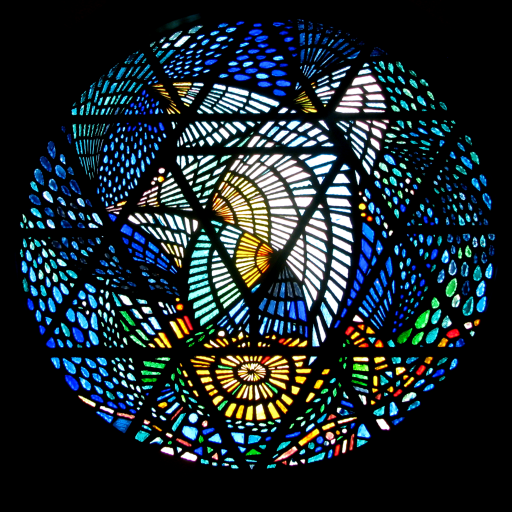
Image, Veda Rosenbury’s Great East Window at Trinity Cathedral, Phoenix

I remember the amused joy of watching our granddaughter Claire learn to read. As a 3-year-old, she would mimic her parents reading in bed. Lying on their bed, she wanted to show us that she, too, could read a book. She would gabble away to herself in her 3-year-old language, clearly delighting in some gripping yarn, all the while completely oblivious to the fact that she was reading the book upside-down.

When Claire first started reading whole books, I would ask her what she was reading. I’m reading a chapter book, she would reply. I was struck by her response, which described the type of book she was reading rather than its content. By referring to her book as a chapter book, she got me thinking about the nature of a story. Chapters organize the development and progression of more complex stories. That was the point she had grasped; she was no longer reading books with a single, simple story but was now reading books where the story progressed in stages or chapters.

As I continually assert, narratives are the building blocks of meaning. We make sense of the world around us, including making sense of ourselves to ourselves as well as to others through the construction and endless telling of stories.

Constructing a story to make sense of her 3-year-old world was what Claire was doing when she lay on her parents’ bed mimicking their reading. It was irrelevant to her construction of a story that she was holding her book upside down. At 3-years of age, the problem for the rest of us was that only she could understand the story she was making.

The Bible is, in a sense, like one of Claire’s chapter books. It builds the story of God chapter by chapter. Many authors writing from different historical and cultural contexts over an extended timeline make the Bible a rich, complex, and often confusing read. Yet the overarching narrative it tells is the story of our experience of God’s presence within the flow of history.

For Christians, the story of Jesus forms the penultimate section of this long biblical story. The story of Jesus unfolds through the chapters chronicling his birth, life, and ministry, his death and resurrection, culminating in his ascension and the descent of the Holy Spirit, and the birth of the Church as the continuation of Jesus’ ministry in the world.

Continuing with my analogy of the Bible as a chapter book, Pentecost is the final chapter in the Jesus story. In the previous chapter of the story called the Ascension, Jesus, in the fullness of his humanity now perfected through suffering, death, and resurrection, passes through the membrane separating the parallel worlds of Our-Space and God-Space. As parallel dimensions, Our-Space and God-Space occupy the same location in time, although separated by a permeable membrane that allows energy to flow from one to the other. Last week, I used a different analogy: an interdimensional two-way conduit or superhighway to express the same idea of movement between dimensions.

At the Ascension, Jesus passes through the membrane from the dimension of Our-Space to that of God-Space. In doing so, he does not jettison his humanity like a worn-out suit of clothes to don a new divine suit on the other side. In the Ascension, it’s his very humanity now perfected through suffering, death, and resurrection that is embraced and incorporated into the nature of the divine self.

In the present chapter, called Pentecost, energy passes in the opposite direction, i.e., from God-Space to Our-Space. Having received Jesus’ full humanity into the divine nature, the divine spirit is now released back through the membrane, where in Our-Space it empowers us to continue the work begun by Jesus.

There are at least three different ways to talk about the Pentecost event. The first is Pentecost as a highly mystical pyrotechnic event – the 50th day after Easter -focusing on the pyrotechnics of the day: wind, fire, and an experience of instantaneous translation between the speakers of myriad languages as a proclamation of God’s vision of inclusion. The second is as I’ve been doing in this sermon up to now – a story of energy flows between related dimensions, both occupying the exact location in timespace –  a Sci-Fi influenced use of imagination alongside the medieval images of the triple-decker universe. The third is a focus on the human fruits of the day itself.

Tom Wright describes Pentecost as:

The moment when the personal presence of Jesus with the disciples is translated into the personal power of Jesus in the disciples.

In Acts, chapter 2, Luke tells the story of the fruits of Pentecost.

Awe came upon everyone, ….All who belonged were together and had all things in common; they would sell their possessions and goods and distribute the proceeds to all, as any had need. Day by day, as they spent much time together in the temple, they broke bread at home and ate their food with glad and generous hearts praising God and having the goodwill of all the people.

His description of the early Christian community is a description of what Our-Space infused with the energies of God-Space might look like – if we allowed it to. Equality and magnetic inclusion become the hallmarks of such a community where the phrase: from all according to ability -to all according to need – is lived out in real time. This produced among the first Christians the most magnetic community, which drew increasing numbers of people into a new way of being human within a new kind of community: one that invested itself in those who had yet to become members.

This image of Christian community frightens us – and so it should! For it stands as a perpetual indictment upon the values and practices that we live by in our own society and which in our present moment are being frighteningly exposed in the corruption of money, privilege, and power now openly celebrated in plain sight.

Luke’s story in Acts 2 raises a serious question for us. Could this vision of transformation and risky living, shaping the first Christian communities, ever become a story we can tell ourselves about our society?

As Episcopalians, we pride ourselves on espousing a tolerant, inclusive Christian vision for a society with greater inclusion and distribution of wealth, but not enough to truly disrupt our societal expectations. While heavy on tolerance and inclusion, we run light on accountability. We like faith as a comfort as long as we can remain undisturbed by its imperatives.

Some of us understand faith as personally life-changing. Some, though perhaps fewer in number, understand that there is a connection between personal transformation and the process of societal change. Nevertheless, most of us expect our faith to let us off lightly by making few demands on us. We do not wish to be made accountable to the imperatives of our faith.

The presence of God’s Spirit in the world of Our-Space demands of us transformation along the lines experienced by the first Christians. They experienced personal change as the catalyst for societal change. To reference Tom Wright again: Pentecost was the moment when the personal presence of Jesus with the disciples is translated into the personal power of Jesus in the disciples.

This Pentecost, the presence in us of the power of the Spirit of Jesus – AKA Holy Spirit – defines our mission. Should we choose to accept it:

  • We cannot engage in acts of charity towards the less fortunate individuals while failing to confront the systems that deprive them and whole communities of access to the fruits we expect as of right to enjoy.
  • We cannot reject calls for personal accountability in our communities. Leaving when we feel challenged or uncomfortable might be an option for members of a non-profit, but not for disciples of Christ.
  • The story we live by tells us we need to feel troubled if the fruits of our own material success blind us to the inequalities in wider society.
  • We need to stop expecting our faith to insulate us and allow it, instead, to disturb us.

Conclusion

In his poem God’s Grandeur, Gerard Manley Hopkins captures the message of Pentecost – a timeless message which is for us, oh so very timely.

The World is charged with the grandeur of God. 

It will flame out, like shining from shook foil; 

It gathers to a greatness, like the ooze of oil – crushed.

Why do men then now not reck his rod? 

Generations have trod, have trod, have trod; 

And all is seared with trade; bleared, smeared with toil and wears man’s smudge and shares man’s smell:

The soil is bare now, nor can foot feel, being shod.

And for all this, nature is never spent;

There lives the dearest freshness deep down things;

And though the last lights off the black West went -

Oh, morning, at the brown brink eastward, springs –

Because the Holy Ghost over the bent

World broods with warm breast and with ah! bright wings.

What Next?

Image from the Chapel of the Ascension at Walsingham, England.

Next door to the Shrine Church the Chapel of the Ascension, built in the dispiriting modern style of the 1960’s, the style that festooned the US with hideous A-Frame churches, nevertheless has one most astonishing feature. On entering the chapel one’s attention is immediately drawn to the ceiling where two feet dangle at the center of a rosette of gilded clouds punctuated by lightening forks representing the only remaining part of Jesus’ body still visible after one imagines him squeezing through the gilded rosette into heaven on the other side of the ceiling. Those of you participating via the livestream will be privileged to this truly baroque sight – all the more astonishing because of the chapel’s otherwise plain sheetrock walls and ceiling.

The Ascension, which today is treated as a rather non-event. Always occurring on the 40th Thursday after the Resurrection – to accommodate the reality that most Episcopalians rarely venture to church except on Sundays – the current custom is to celebrate the Ascension of the Lord on the Sunday following. It’s Luke who gives us the most vivid narration of the Ascension scene.

If constructing stories and weaving narratives are the ways we make sense of our experiences in the world, what is the nature of the relationship between story and material experience? In other words, do narratives – our human need for stories simply interpret and explain our material experience, or do narratives construct our material experience through the power of language to bring to awareness the objects and meanings of which it speaks.

This tension surrounding the function and power of language is especially pertinent when it comes to religious-spiritual stories. Narrative Theology asserts that spiritual meaning lies not in the literal veracity of the events depicted – did they happen or not – but in the function of story to construct and convey purposeful meaning and truth- and here it’s helpful to paraphrase the late biblical scholar, Marcus Borg who used to say that the Bible contained many true stories – and some of them actually, happened.

Does a story construct meaning and purpose that we can trust as a source of understanding of the divine which enriches and empowers us to live our best lives?

Spiritual stories recycle elements from human imaginative memory. Clearly, Luke’s graphic account of Jesus’ ascension borrows extensively from Elijah’s ascension in a chariot of fire buoyed upwards by heavenly steeds amidst billowing clouds that obscure heaven from earthly sight. In like manner – as the mantle of Elijah fell upon the shoulders of Elisha – giving him a double portion of his master’s spirit, the double portion of Jesus’ spirit falls upon his disciples -clothing them in preparation to take up the work Jesus had begun.

The resonance between the two ascension stories is unmistakable.  Now skeptics will say – ah-hah, so you admit that Luke copied an earlier story that is a feat of imagination to start with. Well yes, I’m happy to admit this, because both stories function not as eyewitness accounts of actual events but as ways of making sense of a meaning and truth capable of changing lives and altering the trajectory of history. By the way – even eyewitness accounts of actual events are never photographic but interpretations – colored by the contents of individual memory. The problem in crime solving is that no two people will recall the same event in the same way.

In Luke’s chronology of events from Calvary to Pentecost, his story of the Ascension of Jesus forms a transition point bringing the earthly ministry of Jesus to a close to prepare his followers for what was to come next. The question underlying the Ascension event is not how, when, or if it happened, but what light does it shed on the question of what next?

Can we trust the meaning inherent in the story of the Ascension of Jesus, even though most of us accept it to be, as all stories are, a construction of imagination? By focusing the stories meaning on the question what next – this becomes a story sharply focusing the choices to be made, the actions to be taken, and the directions to be followed that transform our perceptions of the world and our role in living our best lives by furthering the work Jesus began.

By substituting the traditional heaven and earth spatial metaphor of up and down for one more suited to contemporary imagination – that of heaven and earth as side by side – the Ascension becomes a story of a conduit event linking our space and divine space.

The two essential points in the Ascension story now come into focus.

In his return to the divine space, Jesus does not jettison his humanity like a suit of worn-out clothes – but carries the fullness of his humanity – perfected through suffering, death, and resurrection – to be received by God – incorporating the essence of humanity into the divine nature. The first collect for the Ascension captures this: that as we believe your only begotten Son our Lord Jesus Christ to have ascended into heaven, so we may also in heart and mind there ascend, and with him continually dwell. The we here is not us individually, but the essence of our humanity which now constitutes an element within the divine nature.

In receiving the gift of Jesus humanity perfected through suffering, death, and resurrection the gift of the divine spirit of Jesus is released to make the return journey back into our space – or as the second collect for the Ascension captures it:  our Savior Jesus Christ ascended far above all heavens that he might fill all things and to abide in his church until the end of time.

As Jesus ascends, we become  Christ’s mystical body on earth  – now prepared and empowered as the Church for the continuance of the work Jesus began.

The Ascended Christ bearing our perfected humanity is received into the heart of God so that henceforth, in the imagery of the book of Revelation, the home of God is to be found not above in the clouds but here on the earth among mortals. Now we come to the most extraordinary assertion of Christian faith – that from henceforth to be most fully human is to be most like God.

As the disciples gawk stupefied after the Lord’s disappearing feet, they are told to stop looking upwards. In other words, there is nothing to be found up there. Instead, we need to look around us for signs of God’s continued presence in our world through the power of the Holy Spirit.

Building Heaven on Earth

I am struck by the fugue-like nature of the themes in the readings for the fifth Sunday after Easter. The Encyclopedia Britannica defines a fugue as a musical composition characterized by systematically imitating a main theme, called the subject, across multiple voices or parts. It typically includes an exposition where the subject is introduced, followed by development sections that explore variations and interactions of the theme.

Working with the fugue metaphor, we hear the central melody in Luke’s account of Peter’s dream—a rich melody introducing a new vision for human community based on radical inclusion. The central theme is further developed in the second reading from the book of Revelation, where it is expanded into the cosmic key of God’s announcement that heaven is to be found on earth. The gospel reading then restates the central melody in the tone of Jesus’ teaching on love as action.

Staying with the musical metaphor, there is a brilliant summation of the melodic interplay I’ve just described in Belinda Carlisle’s legendary 1987 hit single Heaven on Earth:

Ooo, baby, do you know what that’s worth? Heaven is a place on Earth.
They say in heaven, love comes first. We’ll make heaven a place on earth. Ooo, heaven is a place on earth. 
Lyrics by Rick Nowells and Ellen Shipley

In Surprised by Hope, N.T. (Tom) Wright describes Jesus’ resurrection as the beginning of God’s new project—not to snatch people away from earth into heaven but to colonize earth with the life of heaven. It’s somewhat amusing to find the great Tom Wright channeling Belinda Carlisle.

Christians today, in the main, think that resurrection means spiritual life after death, as in we all will go to heaven to live with God when we die. While liberal Christians have a straightforward inclusive notion of who gets into heaven, basically everyone, conservative Christians still cling to the idea that entry to heaven is conditional on right believing and ritual formulas such as Jesus died for my sins – Jesus as my savior, etc. But both agree on the point of Jesus’ resurrection as a promise of life after death – an announcement of future life with God somewhere else after biological death.

The notion that we leave our bodies behind to ascend as souls to some other place is a deeply anti-Christian idea firmly rooted in Classical Greek thought. The NT does not talk of the separation of body and soul; it speaks of the integration of body and spirit as dual aspects of human experience in the material dimension of time, space, and matter. Belinda croons, “Ooo, baby, do you know what that’s worth?” Heaven is a place on Earth. They say in heaven love comes first. We’ll make heaven a place on earth. Ooo, heaven is a place on earth.

Christians need to understand Jesus’ resurrection, not as an individual event, something that happened only to him, but as the first fruits, the inauguration of a project of changing the world, redirecting our attention away from pie in the sky when we die back to the current state of life on earth.

The concept of our souls’ future fulfilment requiring the jettisoning of our bodies invites us to care more about the life to come than the life to be lived now. Christians who are most focused on their destination in heaven are likely to neglect the duty to leave the world in a better state than the one they came into.

Resurrection as an internal, individualized, spiritual experience of future fulfilment breaks the continuity linking the resurrection of Jesus to the ultimate resurrection of the whole of creation.

Through the Hebrew prophets, God continually affirmed the goal of the resurrection project, as nothing short of the remaking of heaven on earth. It’s only within the continuity of this promise for the whole creation that the resurrection of Jesus on Easter Day makes any sense.

Revelation’s melodic expansion – See! the home of God is among mortals … see I am making all things new – is a further development of Luke’s central theme of radical inclusion before the gospel’s final restatement in Jesus’ teaching on love as the engine for transformation.

Tom Wright speaks of Jesus’ resurrection as a foretaste of the future brought into real time, God’s promise of the kind of future we should anticipate in the present. Anticipating the future—now, there’s a challenge. Because the shape of the future does not arrive preformed of its own accord. Our anticipation today shapes the kind of future that will arrive through the actions we take or fail to take now.

The radical vision of an inclusive community is where the home of God is to be found. The struggle within human communities to translate love into justice is where the power of remaking a new heaven on earth can be seen. As Christians, we do not look forward to a future heaven for the righting of all wrongs and the wiping away of every tear. We grasp the challenges of working towards these goals today by

  • loving as we are loved
  • behaving towards others as we expect to be treated
  • agitating for human dignity as a foundational right for everyone, and not something to be dictated or denied by the exercise of power.

The radical vision of the home of God at the heart of the human community is centered on the cherishing and protection of human dignity. In Dignitas Infinita, the late Pope Francis laid out the four aspects of human dignity.

  1. Ontological dignity – the dignity of being made in the image of God, loved and cherished by God as a reflection of the divine nature.
  2. Moral dignity – the exercise of freedom and fidelity to the dictate of conscience – not only a requirement for right action but also for right motivation and intention
  3. Social dignity—the means to prosper in a society that affords the social, economic, and environmental protections necessary for sustainable living with dignity.
  4. Existential dignity involves combating serious illnesses, domestic violence, gender and racial scapegoating, pathological addictions and their social causes, and other hardships that debase a person’s ontological dignity. Existential dignity also affects those who may enjoy the material prosperity considered essential for a dignified life, yet struggle to live with hope and the experience of joy in their hearts.

What God has made clean, who are we to call profane? Who are we to reject and exclude those whom God has included through the Holy Spirit’s outpouring? For see the home of God is to be found not in heaven but here among us, where through loving action we support God’s reign of justice. When love is realized through action, justice becomes its name.

Or as Belinda Carlisle croons: Ooo, baby, do you know what that’s worth? Ooo, heaven is a place on earth. They say in heaven, love comes first. We’ll make heaven a place on earth, Ooo, heaven is a place on earth..

Of Shepherds and Other Things

In John 10, we encounter Jesus’ riff on an extended metaphor of sheep and shepherds. I am the Good Shepherd. My sheep hear my voice. I know them, and they follow me. I give them eternal life – that is, life no longer subject to the restriction of temporal time.

Here are two seemingly contrasting shepherding images.

My nephew, Hamish, is a sheep farmer in the South Canterbury high country in the foothills of the Southern Alps – the mountain backbone of New Zealand’s South Island. This is Lord of the Rings country. Not the idyllic landscapes of the Shire but the astonishingly majestic terrain framed by the dark mountains of Mordor. Across 60,000 acres of tussock grassland, amid rocky crags and sharp ravines, Hamish runs around 12000 Marino sheep bred for the fineness of their wool, much prized by Italy’s fashion houses.

One day, during a visit some years ago, with Murray, Hamish’s father, we suddenly stopped as Murray leapt out of the cab of the truck and bounded down a steep-sided gully to where a ewe had been caught by its dense wool in a thorn tree, known locally as a Lawyer Bush because the saying goes, once caught you’ll never get free. Cutting the ewe free, he hoisted it in one smooth movement onto his shoulders, and with the ewe draped around his neck, he climbed back up, depositing it on the truck bed before we drove off.

B.W. Johnson in The People’s New Testament, his 1891 bible commentary, recalls the following.

As we ate and looked, almost spellbound, the silent hillsides around us were in a moment filled with sounds and life. The shepherds led their flocks forth from the gates of the city. They were in full view and we watched and listened to them with no little interest. Thousands of sheep and goats were there in dense, confused masses. The shepherds stood together until all came out. Then they separated, each shepherd taking a different path, and uttering, as he advanced, a shrill, peculiar call. The sheep heard them. At first the masses swayed and moved as if shaken with some internal convulsion; then points struck out in the direction taken by the shepherds; these became longer and longer, until the confused masses were resolved into long, living streams, flowing after their leaders. Such a sight was not new to me, still it had lost none of its interest. It was, perhaps, one of the most vivid illustrations which human eyes could witness of that beautiful discourse of our Savior recorded by John.

Johnson’s almost biblical depiction of shepherds leading their sheep over rocky hillsides is not an image that translates well to modern NZ shepherding. The NZ sheep farmer is more herder than shepherd as he stands to the side, he commands his sheepdogs with piercingly high whistles produced by use of a flat plastic device held between the teeth. With much barking and nipping of sheep heels the dogs gather and drive the herd on.

Unlike Johnson’s scene, which is so strongly reminiscent of Jesus’ Good Shepherd imagery, there is little sense of this kind of intimacy between Kiwi shepherd and sheep. Yet, in the moment when Murray bounded off to retrieve his solitary ewe, the power of the biblical image of the Good Shepherd who leaves the 99 to go in search of the one lost sheep communicated an unexpected intimacy.

I am the Good Shepherd. My sheep hear my voice. I know them, and they follow me. I give them eternal life – that is, timeless life as in life unrestricted by the limitations of temporal time.

In 2025, the good shepherd imagery of Jesus in John’s Gospel occurs on the second Sunday in May, otherwise known as Mother’s Day. Whether by design or not, it’s an interesting coincidence that emboldens me to reframe Jesus’ good shepherd metaphor as: I am the good mother. My children hear my voice. I know them, and they trust me. I give them eternal life—a life of relationship with me that cannot be measured or restricted by the limitations imposed by temporal time.

We hear Jesus’ voice -to quote from TS Eliot in Little Gidding:

a voice … not known, because not looked for -but heard, half-heard, in the stillness between two waves of the sea.

The voice of the good mother is the voice heard, and yet not heard, remembered, and yet not looked for, but viscerally felt; a voice we trust because it resonates through the finely tuned strings of our memory.

This half-remembered yet forgotten voice enters our lives through the earliest experience at our mother’s breast—if not while we are still in utero. Nurture echoes nature. The human bond of mother and child echoes the bond between God and humanity. Jesus says, I am the good mother. My children hear my voice, I know them, and they trust me.

In John’s Christology, there is no distinction between Jesus the Logos and God the Creator; in each, the other finds its reflection. God, the good shepherd, enters our human experience at first as God the good mother. We learn to trust God, the good mother, who calls us each by name and protects us from danger, because like a mother, God has first loved us with a quality of unconditionality that is breathtaking to contemplate.

Imagine being loved because you are already good enough. The problem for many of us is that it requires courage and faith to see ourselves as God, the good mother, sees us.

Jesus’ voice is heard and yet half heard, remembered, and yet not looked for, but viscerally felt; a voice we trust because it resonates through the finely tuned strings of early memory. Jesus, the good shepherd, enters our lives through our experience of the divine good mother.

Donald Winnicott, the renowned 20th-century British pediatrician and psychoanalyst, coined the phrase “good-enough mother.” Winnicott’s legacy has been a formative influence on my evolution as a psychotherapist and priest.

By good enough, Winnicott meant that mothers did not need to be perfect. The mother-infant relationship, though vulnerable to mishap, is also robust and able to withstand imperfect conditions. The reminder that mothers need to be good enough and not perfect is a reminder that the quest for the perfect in this arena of life is certainly the enemy of the good. The essence of a good-enough experience of mothering lies in our experience of love that is simply consistent and unconditional.

Many feel as a lifelong absence the early lack of the unconditional love of the good-enough mother. Maternal failure is often due to a perfect storm of emotional and environmental failures that interrupt or prevent the formation of a good-enough mother-infant bond. Yet, if we didn’t find the memory of good-enoughness in our early experience with our mothers, maybe we found it through good-enoughness in the love of a grandmother or grandfather, in the compensating love of an aunt or uncle, or even later, a devoted teacher or mentor. Good-enough mothering, though more usually exercised by women, is nevertheless a universal human quality found in the rich variety of human relationships.

Yet an early experience of a disinterested or unavailable mother will leave its mark.  An early experience of the promise of love being restricted by conditions – I will love you only if — is not an uncommon experience. Yet, there are very few people who cannot locate an experience of unconditional love somewhere in their early formation.

Jesus says I am the good-enough mother. I have no choice; for I cannot -not – love my children and give them eternal life, that is, life that cannot be restricted by the limitation of temporal time.

Our lives are bounded between the bookends of Jesus’s resurrection as the first fruits of the hope for new life and the promise of the resurrection of the entire creation at the end of time. Jesus said, “I am the Good Shepherd. My sheep hear my voice. I know them, and they follow me. I give them eternal life. Eternal life is realizing the promise of good-enough love extended to all.”

America stands out among developed Western nations as a society that continually fails those entrusted with the sacred responsibility for mothering. In a country that eulogizes motherhood and apple pie, the US ranks very low on the scale of nations where public policy concretely supports family life and child development. A society configured by the divine mothering template will ensure maternal and paternal paid leave, supported childcare, public pre-school and kindergarten education free at the point of use. The paradox at the heart of American society concerns the disproportion between our passion for the unborn and our social neglect of the born.

Human mothering only needs to be good enough, not perfect.  For some of us, Mother’s Day will be an opportunity to reaffirm the heart-felt forgiveness that soothes the discordant strings of early memory. For most of us, Mother’s Day will be an opportunity to express feelings of gratitude for the love our mothers gave us. Whichever may be the case, for each one of us, the divine good mother encourages us to be good-enough mothers to those who trust us to love and care for them.

I am the good shepherd. My sheep hear my voice – a voice … not known, because not looked for -but heard, half-heard, in the stillness between two waves of the sea; – a voice not heard but remembered; a voice not looked for but viscerally felt; a voice we trust because it resonates through the finely tuned strings of our memory.

My sheep know my voice, they follow me, and I give them eternal life – a life that is not restricted by the limitations imposed by temporal time.

On The Damascus Road

In the early weeks of the Easter Season, the Lectionary focuses on a series of appearances in which the post-resurrection Christ – still recognizable as the pre-resurrection Jesus – drops in on the ongoing lives of his disciples. The gospels contain 13 post-resurrection appearance stories. The gospel for the third Sunday after Easter from John 21 offers us a classic example of Jesus appearing to the fisherman disciples – wearily returning to the shore after a fruitless night’s fishing.

Jesus’ post-resurrection appearances often spark an arid debate about whether he physically appeared to his followers or whether they simply imagined him doing so. We have a ridiculous modern preoccupation with dividing human experience between what might be called external, verifiable, objective experience, and internal psychological-imaginative, subjective experience. Put simply, the argument is over whether they happened or were the product of imagination.

This debate rests on some big materialist assumptions about what is real and what is not. This is an arid dispute, argument, debate, or however you want to describe it, because it misses the essential point of the reports of Jesus’ post-resurrection appearances. Jesus’ post-resurrection appearances are real if real is defined as having an impact to change lives.

Alongside John 21, on the third Sunday after Easter, we have an epistle reading from Luke-Acts chapter 9, describing Jesus’ post-resurrection appearance to one Saul on the road to Damascus. There is no debate to be had here. This is a psychological-spiritual event that registers in Saul’s imagination. Only he sees the blinding light and hears Jesus’ voice. Nevertheless, this is a real event if real is defined by discernible and verifiable impact, i.e., the power to change the direction of Saul’s life.

We know Paul through his letters to his fledgling house church communities. We also know Paul through Luke’s account of his missionary journeys. Luke begins his missionary biography of Paul with the famous incident on the Damascus Road – a devastating spiritual confrontation that was to change everything for Paul. Thanks to Luke, we come to know Paul, less as the writer of letters but as a protagonist in a grand historical drama chronicling the spread in antiquity of what will come to be known as Christianity. Yet, Luke is not only interested in recording the grand epic of the Church’ rise but also has an ear for the personal. In Luke-Acts we meet Paul as a man struggling with an internal identity conflict. For Paul was once Saul and it’s with Saul that Luke begins his biography of Paul.

Saul was a product of the amazingly cosmopolitan world of antiquity. Born into a family of the Jewish diaspora living in the Greek-speaking city of Tarsus in the Roman province of Cilicia, and thus a Roman citizen, Saul was educated in Jerusalem – a student of the famous teacher Gamaliel. Educated in the strictest observance of the Pharisee tradition, Saul became zealous for the God of Israel.

While traveling on a commission from the Sanhedrin to root out the followers of Jesus in Damascus, Saul is blinded by a blazing light – a moment of complete sensory overload. Blinded, he falls from his horse and hears a voice saying, Saul, Saul, why do you persecute me? Left in a state of physical blindness and bodily paralysis, the voice tells him, I am Jesus, whom you are persecuting. Picked up from the ground by his startled companions, Saul – now blind – is led into the city.

Saul is sequestered for three days. Luke does not want us to miss the symbolism of Jesus’ three days in the tomb. Saul, neither eating, drinking, nor sleeping, remains in this state of extreme sensory deprivation as he undergoes a death of self involving a dramatic spiritual and psychological reconstruction. With the return of his sight, a new worldview greets him. Symbolic of this dramatic change, the zealous Saul has been reborn as Paul, transformed by his encounter with the post-resurrection Christ.

The expression a Damascus Road experience has become an idiom for a 180-degree change in a person’s view of self and the world. After his encounter on the road to Damascus, Saul has a kind of death, resurrection, and Pentecost experience rolled into one – after which he too can claim to have seen the risen Lord. Like Peter and the other disciples – who by their encounters with the risen Christ are transformed from disciples – followers, into apostles – messengers, Paul is similarly transformed – but for him the transformation is from persecutor to apostle. Paul leaves behind his national-ethnic God of rage and fear, a God of them and us, a God whose followers must find an endless supply of scapegoats to carry away their unacknowledged projections of guilt and fear – and encounters a God of love, mercy, and inclusion.

Paul, Apostle to the Gentiles, through his letters to the various churches that sprang up in the wake of his missionary journeying, continued to articulate his experience of living in the painful tension between divine judgment and acceptance. Thus, at numerous points his letters make difficult and confusing reading as he flip-flops between being a truly ground-breaking visionary and remaining a man of his own time and place.

Our experience of the world is articulated through the stories we tell, both to ourselves and to one another. We are shaped and our world is given meaning by their telling. This is a good and a bad thing because if the story is poor, which I mean does not offer enough room for growth, we become constrained in our sense of identity and worldview. On the other hand, if the story is expansive, allowing us space to grow, then our sense of self and view of the world expands to include more and more of what is needed.

The resurrection is an expansive story that changes lives. It’s not a story to be believed or explained but to be lived. In living it, the resurrection story shapes the way we understand the nature of the world around us. The question I ask myself is one I also put to you – how do we live the resurrection story?

For some of us like Saul, being changed by an encounter with the risen Christ is a dramatic and devastating indictment on our former lives. Yet, for most of us, we encounter the risen Christ in the subtle opportunities for change amidst the routines of everyday life. We encounter the power of the resurrection story:

  • when we chose to be more courageous and less risk adverse
  • when we become more accepting and less judgmental of difference
  • when we face down our fears and cease being driven by them to seek others to blame
  • when we come to experience mercy as the first attribute of God
  • when the God of Mercy becomes also the God of Justice, that is love in action.

Today as we look at our world, among those who claim to speak for God it’s not hard to distinguish Saul’s voice from Paul’s. So many politicians and church people speak with the voice of Saul. This is the paranoid voice that demands the protection of religious liberty as the fig leaf for the denial of difference. It’s the voice that celebrates the limitations of culture as a rejection of God’s open-ended invitation to enter the new.

For Saul, persecution, imprisonment, and murder were all necessary tools to protect an angry God not able to withstand the imagined trauma of human questioning. For Paul, all that was needed was the law of love manifesting in vulnerability. After his experience on the Damascus Road, Paul knew that because of his vulnerability and weakness, God chose him to be the greatest apostle of inclusion, which is simply a way of describing the divine call to love in action.

Imprinted by Faith

Image: Icon of the Resurrection by the Ukrainian icon writer Ivanka Demchuk. Unlike Western iconography of the resurrection, which portrays it as a Jesus-alone event, Orthodox iconography of the resurrection portrays Jesus raising Adam and Eve, symbolizing the general resurrection of the dead.

In her New York Times essay, The Prophetic, subtitled What American Literature’s Prophetic Voices Tell Us About Ourselves, the renowned writer Ayana Mathis in her first installment, titled Imprinted by Faith, recalls her childhood memories of growing up in a Black revivalist Christian tradition. She writes that:

the God of my revival childhood was all-powerful and relatively benevolent, but had a great many rules about what we should do  (go to church 3x a week, live by the Word of God, literally interpreted) and what we shouldn’t do (listen to secular music, play cards, watch movies, drink). These commitments and privations would be rewarded with God’s love, palpable, like a bird alighting on a shoulder.

She describes leaving this world behind with the memorable image of plunging into the world on the other side of the stained-glass window. Mathis views the beginnings of her adult journey as one of growing beyond her conservative Christian origins to become an artist. Her journey was a learning how to disbelieve while still being imprinted by belief.

How to disbelieve while remaining imprinted by belief struck a deep chord in me. Mathis asserts that American literature –and by extension mainstream American culture – remains imprinted by belief, freighted by ideas about morality, justice, and standards for living. Her assertion is that whatever the condition of our belief at the personal level – as in do we, or don’t we? – the cultural impact of belief remains imprinted on us. That, despite many manifold wrongs and derelictions, the literary and cultural landscape of America remains deeply imprinted by the nation’s historically Christian heritage.     

She notes that this Christian imprint has both good and not-so-beneficial consequences –in her phrase, it strikes a paradox. The Christian imprint on American society has often been used to perpetrate great evil. Christian Nationalism’s distortion of the Christian tradition is today still being used to justify racism’s doctrine of white supremacy, oppression of women and a multiplicity of other phobic responses to people of difference. Yet, at best, the Christian imprint continues to inspire decency and generosity, acting as a hedge against oversimplistic notions of society and the individual. Mathis’ assertion is that our Christian legacy asks us to truck in paradox, requiring us to wrangle with contradictory realities in mind and heart, discovering the sustenance and insight to be gained in the wrangling.

Bracketing her personal references to a revivalist upbringing, Mathis nevertheless speaks for many of us – I suspect- here in this church on this Easter morning. As good-aspiring, middle-class, over-educated, professionally successful, and predominantly white Episcopalians, few of us would pass the orthodox belief and devotional piety smell test. Yet here we are on Easter Day. Some among us may be a little surprised to find ourselves sitting in these pews. Yet, nevertheless, we’re here, despite being unable to give a full account for why we have been drawn here.

Perhaps we’re being drawn by memories of an earlier phase of family life as children or as parents of young children? Maybe it’s the influence of friends drawing us here? Perhaps – and this is the best reason of all – we’re drawn here by cultural tradition – tradition as the imprint of belief upon our personal struggle with disbelief? Deep down, being here reflects a questioning of certainties -once easily taken or rejected at face value, but alas no longer so. Many of us have lost confidence in the belief that Jesus being raised from the dead means all is right in our lives and our world.

We wrangle with disbelief while remaining mysteriously imprinted by belief as we reach for a fingerhold—to say a foothold here would be to overstate our confidence – on what it means to live well with a hope that, at times, aspires to the level of real courage – a tentative purchase on what it means to live well with a love demonstrated through generous concern for others. In short, we long for lives of generous toleration and concern for our neighbor while seeking to grasp after something ineffable.

If faith is an imprint we absorb from the shape of the culture around us, then belief is neither something we can possess nor something we can lose. It’s like ebb tide in the morning, only to return with evening’s flow. Belief is the expression not so much of objective faith in a collection of doctrinal propositions but a heartfelt experience of being deeply imprinted by a story capable of fostering meaning and purpose in our lives. A large and expansive narrative capable of adjusting our orientation to the world in all its evil as well as its glory. Faith is the practice of wrangling contradictory realities in mind and on heart and finding in the wrangling sustenance and insight for living well.

As an example of wrangling paradox, many today reject institutional Christianity for deeply Christian reasons. They reject the institutional Church for failing to live up to the expectations set out in Jesus’ teaching and the Christian culture it has spawned. Often citing the teachings of Jesus, secular humanism rightly judges the Church for its hypocrisy, its love of earthly power, and its manifold human abuses.

Wrangling with paradox is further illustrated in the debate between Tom Holland, a British historian of classical antiquity and author of Dominion: How the Crucifixion Shaped the Values of the Modern World, and AC Grayling, Master of the New College of Humanities in London and a well-known humanist philosopher.

The central contention between them relates to the origin of our contemporary definition of human dignity and personhood. AC Grayling, in his militant rejection of Christianity, contends that the values of modern humanism – ideas about human dignity, social justice and inclusive standards for living – emerge from the Enlightenment’s rejection of religion. There is a wonderful exchange where Holland challenges him, saying that the humanist values we cherish today are not simply remnants of pre-Christian classical antiquity, lying around neglected until rediscovered in the Enlightenment at the end of the 17th century. Our contemporary humanist values – aspiring to do good; valuing ethical action; protection of the individual especially the weak against the strong; the cherishing of vulnerability as a strength and not simply a weakness to be crushed by the powerful; the belief that might is not right – are all the direct product of the Christian revolution in the first centuries of the current era.  Holland – with the historical evidence to support him – asserts our contemporary definition of what it means to be a human being flows directly from the crucifixion and resurrection of Jesus. He contends that modern humanist values are nowhere to be found in classical antiquity – a world where might was always right, where the weak were fair game for the strong, and where the only individuals with any rights were freeborn men – everyone else existing within various degrees of servitude and enslavement – in societies imprinted by not by faith but the crude transactional practice of calculated cruelty.

On Palm Sunday at the beginning of Holy Week while exploring the clash of competing storylines intersecting with dire consequences for Jesus’ during his last week in Jerusalem, I predicted that we would eventually arrive at a new and more expansive storyline – that of God’s dream for the renewal of creation. As Christian believers, we celebrate the resurrection of Jesus as the Christ, the longed-for promised one who came to change everything. But whether we pass the belief smell test or not, at the very least we celebrate a story that revolutionized the ancient world and ushered in a new and vastly more compassionate understanding of what it means to be human.

This morning, I’m not interested in forensically deconstructing the evidence for or against the resurrection to ascertain in an arid attempt to prove it did or did not happen. All human meaning and purpose are narrative in origin—in other words, we only ever have the stories we construct to make sense of our experience in the world. The crucifixion and resurrection of Jesus is a story that fundamentally changed our understanding of what being human looks like.

The crucifixion and resurrection of Jesus introduced a new storyline in the collective consciousness of the West and among all who have come to the Christian faith—a more expansive story that continues to imprint itself upon our cultural experience regardless of whether we believe in its literal truth or not. In this sense, secular humanism is not the antidote to Christianity but its natural heir.

Despite many manifold wrongs and derelictions, the literary and cultural landscape of America remains deeply imprinted by the nation’s historically Christian heritage. This heritage struggles with a view of humanity shaped by Jesus’ crucifixion and resurrection – forcing us, in Mathis’ words, to truck in paradox – requiring us to wrangle with contradictory realities in mind and heart, discovering the sustenance and insight to be gained in the wrangling.

The imprint of Christian faith shapes a cultural landscape where human dignity and Christian love, expressed as justice, are enshrined in the protections of the rule of law. The imprint of Christian faith, whether as cultural legacy or principled belief, empowers us to call out and resist the cyclic embrace of calculated cruelty as a transactional means to political ends – whether as remembered history or experienced within the flow of present-time current events.

But on Easter Day in 2025, you might want to ask, what about Jesus’s bodily resurrection? Well, there you have it—a curious paradox: Jesus died on the cross, but Christ was born in an empty tomb. To disbelieve while being imprinted by belief is the best description I can find for living with the paradox at the heart of our cultural landscape. Wrangling to disbelieve while still imprinted by faith, we should be careful not to rule anything out.

Good Friday Meditation inspired by The Rose

The Rose, a song and lyrics by Bette Midler

Love hurts, and our hearts have an all too familiar affinity with suffering. Yet, if we dwell on our suffering, we are in danger of being little more than mere spectators of Jesus’ suffering on his way to the Cross.

It’s so easy to stand and watch from a safe distance, comforted by an image of Jesus as the noble hero valiantly traveling the route God has set for him, seemingly heedless of the costs because, after all, he knows ahead of time how things will end.

But we must go deeper than this if we are to move from spectators to participants in Jesus’ Passion. You see, if we are to be participants, then Jesus must be more like us than not. We are not noble heroes passing through the drama of our lives unscathed with complete foreknowledge. And so, if he is to be more like us, then neither is Jesus.

He treads his path, a path he chooses to accept – and like us, he knows little more than what is revealed as he takes each step, putting one foot in front of the other, one breath at a time. Jesus is no noble victim sacrificing his life for the sins of the world. If we just stop there, no matter how thankful we might feel, we fail to see that the way of the Cross is God’s invitation to become transformed not by suffering, but by the power of love. For Jesus’ chooses the way of love.

Some say love it is a river that drowns the tender reed, some say love it is a razor that leaves your soul to bleed, some say love it is a hunger an endless aching need. I say love, it is a flower, and you its only seed. ….

The Rose Verse 2

The Way of the Cross requires us nothing short of a transformation in our whole (moral, emotional, and spiritual) way of being. In Jesus, God’s hands get dirty as Jesus takes the initiative and leads us through example. Our acceptance, our entry into the way of love, involves risking as Jesus risked. Risk is the raw material for transformation for

It’s the heart afraid of breaking, that never learns to dance
It’s the dream afraid of waking, that never takes the chance
It’s the one who won’t be taking, who cannot seem to give
And the soul afraid of dying, that never learns to live …

Entering into the way of love leads us to challenge the status quo – taking risks and stepping out in faith rather than holding back in fear. As a community, it means uncovering and challenging the cosmic forces of dehumanization woven into the very DNA of our culture and its collective memory. In our confrontation with the forces of power and privilege that stand in opposition to the expectations of the Kingdom of God, we may often fail, but we cannot be defeated. Failure is a temporary setback, not an ultimate defeat of God’s purposes for us in the unfolding repair of the world.

Entering upon the way of love – above all else means accepting an invitation to become transformed into a new way of being, one step at a time – a transformation from timid and grateful children into collaborators with God in the vision of putting the world to rights.

From mere spectators to active participants with Jesus on the way to the cross is a movement through belonging into believing, a risking that moves us from fear into loving and trusting being loved.

This is not a hero’s path. Jesus shows us that it is a very human path. On Good Friday, God shows us the way of love, motivated not by an abhorrence of sin but by what is for God—the impossibility for God of not loving enough.

When the night has been too lonely and the road has been too long
And you think that love is only for the lucky and the strong
Just remember in the winter, far beneath the bitter snows
Lies the seed, that with the sun’s love in the spring becomes the rose.

Choosing the Right Storyline

All we have are the stories we construct to explain the world both to ourselves and to one another. The creation of narrative is the essential building block for discovering meaning and developing purpose. Any cursory Google or web search will reveal the considerable neuroscientific evidence in support of this assertion. For example – neuroscience researchers have repeatedly found that reader attitudes shift to become more congruent with the ideas expressed in a narrative after exposure to fiction (Green & Brock, 2000; Prentice, Gerrig, & Bailis, 1997; Strange & Leung, 1999; Wheeler, Green, & Brock, 1999).

The current profusion of online disinformation and conspiracy theories proves that there is always more than one way to tell a story, and the way you tell it influences beliefs and behaviors. Our awareness of competing stories increases the accuracy of our experience—to use a current slogan—there are facts, and then there are alternative facts. It’s vital to be able to distinguish between restrictive and toxic stories that restrict our capacity for creative responses and expansive stories that encourage creativity in our encounters with the world around us. We develop accuracy of perception, clarity of meaning, and purpose as we select between competing narrative storylines because it’s vital to know which storyline we are participating in.

The power of a storyline rests on its capacity to attract our attention and command our allegiance. We may construct a storyline to make sense of the world as we experience it, but once we do so, that storyline has the power to own us. The question of the current moment is, among competing storylines available to us, which storyline will we choose to believe? From among a bewildering choice of possibilities, which stories will command our allegiance?

With the spread of online information, the question of which stories we allow to shape our perceptions of reality is the question of the moment. We might be surprised to learn that this is not only a modern problem.

Palm Sunday offers a snapshot of competing storylines from Jesus’ last week in Jerusalem before the Passover and his crucifixion. On Palm Sunday, we witness a clash of competing storylines that are particular to Jesus’ 1st-century setting yet are also universal – timeless.

There is the storyline of sacred violence as the storyline of empire – that is – the unrestrained exercise of power to dominate and subjugate. From Rome to Rule Britannia, from the European legacy of colonial violence to the revival of Putin’s dream of the Russian imperium – not to forget to mention here the legacy and current ugly resurgence of American manifest destiny – the storyline of empire repeats endlessly across time.

Then there is the storyline of populist nationalism with its blood-socked dreams of liberation. On Palm Sunday the waving of palms was a significant echo from Jewish-nationalist collective memory. For some 160 years before, the triumphant Judas Maccabeus, the last leader of a successful Jewish revolt against foreign domination, led his victorious partisans into the Temple – which the Hellenist tyrant Antiochus Epiphanes had defiled by placing his statue in the Holy of Holies. Using palm branches, the Maccabean partisans cleansed and rededicated the sanctuary after its defilement. On entering the sanctuary, they discovered miraculously the last light of the Menorah still burning – an event Jews, today, celebrate in the festival of Hanukkah.

On Palm Sunday, this more recent Jewish storyline of national liberation found a powerful amplification in Israel’s more ancient founding story of liberation—commemorated in the festival of the Passover.

Inhabiting the amplified storyline of national liberation, the crowds ecstatically welcome Jesus into the city. They have yet to discover that they have chosen the wrong storyline. But they will do so – and rather quickly, with the result that they will pivot from exuberance to disillusionment and anger over the course of days. Jesus may be the Messiah, but his messiahship is part of a third storyline—that of the dream of God’s salvation, not of Jewish national liberation.

Casting our mind’s eye over the competing storylines converging on Palm Sunday, we observe that at the same time as Jesus was entering the city from the east, a second triumphal entry procession wound its way into the city from the west. The Roman Prefect, Pontius Pilate, at the head of a militia made up mostly of Samaritan mercenaries, had also come up to Jerusalem for the Passover.

As Prefect, Pilate was a vicious yet relatively low-level regional administrator who reported directly to Vitellius, governor of the Province of Syria. Each year at the Passover, Pilate came up to Jerusalem – forsaking the sea breezes of Caesarea Maritima— Herod the Great’s former capital and now the administrative center of the Roman occupation of Judea.

Pilate loathed and feared Jerusalem’s ancient rabbit warrens seething with civil and religious discontent. He most feared the pilgrim throngs crowding into the city for the Passover, swelling the city’s normal population of between 20-30,000 to over 150,000. The stability of Roman imperial rule required Pilate to come up to the city with a show of preemptive force to forestall any potential for insurrection.

Passover was Israel’s founding story of liberation from slavery. Pilate’s arrival was indeed a wise move, for the crowds hailing Jesus’ arrival were in insurrection mood. Being caught, as they would soon discover, in the wrong Messiah storyline—would have dire consequences for Jesus.

In the week leading to the celebration of Passover, we see with hindsight the lethal intersection of these three competing storylines – of imperial domination and political violence intersecting with populist resistance and longing for national liberation – both confronted by the next installment in the epic storyline of God’s love and vision for the world-through-Israel. This clash of storylines results in a chain of events that takes an unexpected turn – rapidly spiraling out of everyone’s control.

Emotionally and spiritually bloodied by our passage through the snapshots of Holy Week violence, we will eventually arrive at a different story – a new story – a bigger and better story – the unlikely story of Easter. Yet, on Palm Sunday, we’ve some way to travel before arriving there.

Holy Week is when we accompany Jesus on his journey to the cross. For some of us, this can be an intensely personal experience as our own experiences of loss and suffering – our passion – surface in identification with Jesus. For most of us, however, the nature of our Holy Week experience is less personal and more communal.

As liturgical Christians, we journey with Jesus as a community – each liturgical step along the way. Each snapshot is a prism refracting our own individual suffering and our identification with the overwhelming suffering of the wider world – an experience amplified by events in 2025.

Liturgy transports us together through sacred time. In sacred time, there is no past and no future, only the eternal now. Here, our individuality dissolves as we become participants in the events that engulf Jesus, erasing separation across time and then becoming now. As I’ve mentioned, we are no strangers to the storylines of sacred violence and national populist yearning for a messiah.

Choosing the right story to explain the world to ourselves is crucial. Choosing the wrong story leads only to disillusionment and rage.

Like the crowds praising Jesus as he entered the Holy City, we enthusiastically hail our next political savior until that is, – he or she no longer is.

We long to do the courageous thing – until that is, the moment when we don’t.

In sacred time, we become participants with Jesus—as if we were part of his band of disciples during this eventful last week. With them, we will share in the breaking of Jesus’ Passover bread and drink from his Passover cup. With them, we will accompany Jesus to the Garden of Gethsemane, where we, too, will fight sleep to keep watch with him through the night and early hours of Friday morning. With them, we will follow Jesus on the way of his suffering to the cross. For like them – we will long do the courageous thing – until the moment when we we won’t.

History does not exactly repeat itself, but it certainly rhymes.

No Cheap Grace

The parable of the Prodigal Son occurs only in Luke. Among all Jesus’ parables in Luke this one captures the singular tone of Luke’s humanistic presentation of Jesus.

In 2013, in a sermon on this text titled A Punch to the Gut, I drew out the parallels between Luke’s parable of the prodigal and Hogarth’s 18th century series of drawings in  A Rake’s Progress – chronicling a young man’s unravelling from fashionable young buck- about-London-town – newly come into his inheritance – to that of a broken man – destitute and driven mad with syphilis he’s incarcerated in the famous Bedlam hospital where along with the other inmates he becomes an object of curiosity for the fashionable of the day who loved to gape at the inmates as if they were animals in a zoo.

A fun fact is that the first hospice for the mad was dedicated in 1267 as the Priory of St Mary of Bethlehem at London’s Moorgate. During the reign of Henry VIII, the priory was dissolved and reestablished by royal charter as the Bethlem Royal Hospital – where I served as chaplain for 18 years. In the 17th century, the name Bedlam – a popular derivation of Bethlem became a synonym for chaos and madness and which today remains in common use.

In 2013 I focused on the destuctive narcissism of the young man as psychologically illustrative of the process Luke describes in his parable of the prodigal son. Then I wrote of the younger son seeing other people and situations as simply an extension of his own wants and desires. He cares little for his father, or brother, nor for the women he consorts with. They are simply the momentary extensions of his own wishes- needs, and to him have no life independent of what and who he needs them to fulfill his desires. At the lowest ebb of his life, is it the emergence of sorrow and repentance that reminds him of his father’s love, or is it his narcissistic expectation that his father will once again meet his needs regardless of his actions? Such a myopic psychological analysis seems a rather indulgent luxury when viewed from preaching demands in these more turbulant times.

Today I’m more conscious of the parable’s multilayered complexity. It’s a story as much about the elder son as the younger – as much about the father as either of the sons. Taking Luke’s parable as the parable of a loving father – provides a different starting point for my reflection on the text today.

Who among us does not know the experience of a wayward child? If that is too strong an expression at least many of us will know the pain and concern felt when our children begin to chart courses in life very different from the ones we had anticipated for them – making decisions we would have wished they made differently.

Luke sketches out the scene as Jesus leaves the synagogue where he’s been engaged in a long discussion with the Pharisees following the Shabbat service. As he comes out into the street, he’s mobbed by a crowd who had been loitering with intent to waylay the teacher outside the synagogue doors. In describing them as tax collectors and sinners, Luke is drawing our attention to the fact that these are the ritually unclean, those who would not have been allowed through the synagogue’s doors. Unable to listen to Jesus’ debate with the Pharisees inside, they are eager to hear him nevertheless. The Pharisees, following Jesus out into the street begin to grumble behind him about the shameful way Jesus is mixing with the ritually unclean. Clearly aware of their grumbling he begins to tell everyone this parable: There was a man who had two sons —. .

We can’t know with any certainty what ending the crowd outside the synagogue – both the virtuous pharisees and the ritually unclean expected from this parable. But we do know how subsequent interpretations have sought to reduce it to a rather simplistic morality tale about the wages of sin with strong patriarchal themes of judgment about sex with prostitutes, disobedience to fathers, and the wages of sin contrasted with the importance of duty. The younger son, in following his hedonistic desires, comes -predictably – to a sticky end. When hard times overwhelm him, he is forced to humiliate himself by going back home with his tail between his legs to beg his father’s forgiveness. You can hear the tut tutting down 2000 years of interpretation – be this a lesson for all you rebellious sons.

Both moralistic and psychological interpretations of the text focus on the motivation of the younger son, ignoring both the responses of his elder brother and his father.  What about the elder son’s reactions to his brother’s return? What about the father’s inexplicable pining for his profligate son’s return? Both challenge the traditional worldview of this parable as a morality tale.

This parable offends against the traditions that emphasize the virtues of obedience and duty to strict fatherly rule and the honoring of the firstborn over the younger. It challenges the virtues of blind filial duty. It skirts over being dutiful and hard working on the family estate seems to have bred in the elder son only a deep sense grievance – an envious resentment of his brother and a disparaging contempt for his father. In confronting his father, he refers to his brother not as my brother but as this son of yours – aptly articulating his anger towards both.

The traditional reading of this story is likewise conflicted on how to picture the father – whose indulgent generosity flies in the face of conventional inheritance custom. His willingness to take back his son – failing to hold him to account for his profligate ways smacks of more than a little moral weakness if not an indulgence dangerous to hierarchical moral order.

Reading this story through the filter of patriarchal relations has been one of the two main ways this parable is favoured by tradition.  The other has been to read it through the filter of antisemitism. The father is God. The elder son represents the Jews. and the younger son, the Christians. We can all see where this reading is headed.

But if Jesus were standing in this pulpit, orienting himself to our 21st century mindset he might ask so who do you identify with in this story? This is not simply a question for us as individuals – it has wider social-relation implications. As middle-class folk, dutiful, obedient, hardworking, and schooled in the virtues of delayed gratification, I imagine few of us identify with the headstrong younger son and his deeply narcissistic and self-destructive choices.

Reading the story through the lens of the prodigal son simply confirms our moral judgment of him as selfish and irresponsible – or a psychological interpretation of him as emotionally and psychologically immature. Both comfortably distance us from him and his choices. Reading the story through the lens of the elder son is likely to evoke more sympathy in us. We easily identify with his feelings and reactions – for who among us has not had an experience of being passed over in preference to another. However, it’s when we read this parable through the lens of the father – in other words, hearing the parable through the filter of his feelings and responses that we discover our disapproval of his indulgent, seemingly uncritical and nonjudgmental welcoming of his son’s return. He not only fails to call his son to account but throws caution and financial prudence to the winds – giving completely the wrong signal by appearing to reward bad behavior with a lavish party.

We can’t know how his 1st-century hearers, thronging the road outside the synagogue, expected this story to end. Yet for us today, the parable certainly carries a sting in its tail. We can be clear that Jesus is primarily painting a picture of God as a noncritical and non-judgmental father. God is recklessly generous, failing to discriminate between the worthy and unworthy as recipients of his love. God is a vigilant father whose is by his nature compelled to keep a watchful vigil in the hope of his wayward children’s return. Jesus paints a picture of God as a shockingly indulgent father who treats our return as the occasion for a wild celebration of new life – for his son who was as good as dead and has now come back to life – lost and now found..

The question remains, however, how does this picture of God leave us feeling? We may be happy to imagine ourselves as the recipients of such reckless generosity. But as a model for us to emulate towards anyone who has the power to hurt and disappoint us – we might feel some ambivalence.

Like all of Jesus’ parables, it operates at two levels. In the setting of its telling – the street outside the synagogue – the Pharisees can be depicted as the sincerely religious – men of real integrity and longing to know and love God more. Yet, their ability to be sincere in their spiritual quest is a product of their privileged social and economic status. In debate with Jesus, they are intrigued but remain cautious for being the privileged; they feel that they have much to lose. They want to know what the right path is before they commit to following it. Contrastingly, it’s those whose occupation or lack of one excludes them from among the company of the righteous – who have nothing to lose and who seem open to, and excited by, the invitation implicit in this parable.

We don’t know if the elder son did eventually swallow his hurt pride and join the feast – the parable leaves us with this possibility, for the father’s invitation is open-ended.

Although the parable does not have a clear concluding moral message, it nevertheless has a rub that chafes. The rub is – grace is never free. Oh, it’s offered freely by God and there is no pre-qualification required to receive its invitation. The offer is free, but the acceptance is costly. Identifying with the elder son – what would it cost us to relinquish our resentment and go into the feast? If we can identify with the younger son – what would it cost us to return home, humiliated?

The younger son knows that the grace of the father’s undying love is costly. Both the Pharisees and the tax collectors know that grace is costly. For the Pharisee, it’s costly to give up a presumption of righteousness. For the socially marginalized and religiously excluded, grace comes at the cost of lives of humiliation.

Like the father in this parable, who among us does not know the cost of unconditional, nonjudgmental love? Who among us has not suffered the pain of watching our children chart different life trajectories that either lead to painful and unsuccessful outcomes or hurt us in their rejection of our values and assumptions? We know that, like God’s grace, our love is not free; it exacts its own cost.

Blog at WordPress.com.

Up ↑