With Warm Breast and Ah! Bright Wings

Images

I. The first chapter of Genesis opens upon a huge panorama: In the beginning God created the heaven and the earth. And the earth was without form, and void; and darkness was upon the face of the deep. And the Spirit of God moved upon the face of the waters.

The Hebrew word used for Spirit is the feminine noun Ruach. The Spirit of God carries the pronoun – she.

II. In the 22nd verse in the 8th chapter of his letter to the Romans, Paul offer us the intensely intimate image of the Creation in the travail of giving birth: for we know that the whole creation has been groaning in labor pains until now. 

Paul hones this image down even further as he tells us that as we too, continue in labor’s grip, we groan, we pant, and we push, driven by the hope of imminent new birth. In this state of travail, the Holy Spirit, like a midwife comes to our aid, supplying the strength we need to give birth to a new world.

III. For the Evangelist John, as Jesus bids farewell to those he has loved he tells them that: it is to your advantage that I go away, for if I do not go away, the Advocate will not come to you. The Advocate provides the energy of truth by which John means the empowerment to live more and more deeply, to grow day-by-day into the profound realization of God’s love for us.

IV. The most popular image for the Day of Pentecost, the 50th day after the Resurrection is given by the Evangelist Luke. Luke constructs a chronology of unfolding events. Incarnation, ministry, death, resurrection, and ascension, all leading to the climactic moment in history when the Holy Spirit descends upon the world. For Luke, the coming of the Holy Spirit marks the point of transition between the ministry of Jesus and its continuance in the life of the Church now impregnated with God’s Holy Spirit.

The 2nd chapter of Luke-Acts opens upon another panorama, this time of Ruach the Spirit of God descending rather than brooding. As in Genesis, the action of the Holy Spirit is depicted through powerful elemental forces of nature, this time of wind and fire.  As modern moviegoers, addicted as we are to special effects, we wonder, some with amazement, others with incredulity, at how this could be?

Luke’s purpose is not to awe us with the pyrotechnics of the latest blockbuster special effects. He wants to draw our attention to the effect upon humanity of the descent of the Spirit. The heat of fire and the noise and rush of wind are metaphors for a new birth, one marked by something very significant – difference no longer a source of division but enrichment.

There is an echo here to the 11th chapter of Genesis that records an example of humanity’s hubris. The people of that day thought they could build a tower tall enough to reach heaven. God frustrated the builders through destroying their ability to communicate in a common language. God says: Come, let us go down and confuse their language so they will not understand each other. On the day of Pentecost, the disciples praise God and all who witness the descent of the Holy Spirit upon them hears them speaking in their own language. The curse of Babel is lifted -difference no longer a source of division but enrichment.

Luke’s theological message is that for human society – born anew as the Church, it is no longer the business as usual of the old order.

Hope and Hopkins

In his poem God’s Grandeur the 19th century English Jesuit and poet Gerard Manley Hopkins proclaims that:

The World is charged with the grandeur of God. It will flame out, like shining from shook foil; It gathers to a greatness, like the ooze of oil – Crushed.

Yet, against the background of this optimistic proclamation Hopkins questions why humanity is so reckless of God’s gift of creation: 

Why do men then now not reck his rod? Generations have trod, have trod, have trod;  And all is seared with trade; bleared, smeared with toil and wears man’s smudge and shares man’s smell: The soil is bare now, nor can foot feel, being shod.

Extending Hopkins’ inquiry I would ask why are we as human beings so fearful of the differences the lie between us?  Our labor pains are marked by the futility of war and the injustice of oppression in which generations have trod, have trod, have trod. We have become insensible to the feel of the earth, increasingly  made barren beneath our shod feetOur social relations are mired: seared with trade, bleared, smeared, with toil sharing man’s smudge. 

We notice that we are not all the same. We notice the obvious differences between us expressed through gender, sexuality, race, culture, and class difference. Such difference becomes emblematic of the differentials of power, privilege, and access to the protection that difference affords to some and denies to others.

The birth of the new Spirit-filled order comes as a challenge to the human propensity to distribute power, unequally. Luke’s vision of the Holy Spirit is of the anima – the feminine energy of new birth, embracing and celebrating the rich diversity of being human. Difference, no longer the source of division becomes the celebration of diversity as the Holy Spirit calms our fear.

God as Holy Spirit is powerfully present in our various communities, but particularly so in the community of the baptized. Each week as spiritually searching people, we negotiate the complexities and pressures of our daily lives. This experience reminds us of something intangible that seems to be lacking in our lives. Our search leads us through a Church door. Initially, we may be somewhat bewildered to find ourselves sitting in the pew of this church; a church for God’s sake, and an Episcopal Church at that, whose liturgy and welcome seem both unfamiliar and wonderful at the same time. This mysterious turn in our lives brings us to return through those doors a second, and a third time. We don’t have to know why we return. Those of us who are seeking God as a source of meaning in our lives intuit that we can be nowhere else.

Luke’s vision of God embracing all kinds of diversity is continually coming true in Church communities of bewildering variety. Genesis presents us with an image of God as Spirit brooding over the abyss of the world calling forth order from chaos, out of which creation is born. Pentecost presents us with an image of God as Spirit now impregnated deep within the human DNA as that longed for God shaped space, or as Hopkins more poignantly says it:

And for all this, nature is never spent; There lives the dearest freshness deep down things;        Rose Window

St Paul phrases it like this: in hope we are saved, but the trick of hope is to have the courage to hope for that as yet unseen. Into the space of the yet to become known, the Holy Spirit pours her power and spreads her balm.

And though the last lights off the black West went   Oh, morning, at the brown brink eastward, springs –
Because the Holy Ghost over the bent
World broods with warm breast and with ah! bright wings.

God’s Grandeur  Gerard Manley Hopkins S.J.

Vada Roseberry’s Creation Window, Trinity Cathedral, Phoenix

Worlds Apart?

I am very interested in the relationship between worlds. What do I mean by worlds? The imageslanguage of Christian faith traditionally talks about this world and the next. I do believe there is a next world, although the mental picture of a world to come that is in every way a perfect solution to the ills of the present world in which I am confined until the happy event of my death, is not the way I tend to think about this. My imagination is more energized by the notion of parallel dimensions. I don’t know how many there are, and quantum physicists suggest there may be many, but I know there are at least two dimensions, one spiritual and the other temporal.

Temporal is an interesting word. The dictionary basically defines temporal as referring to everything that is not spiritual. This strikes me as being the opposite way round to popular thinking that views the spiritual as everything that can’t be explained within the parameters of the temporal, which suggests to me that our conventional stressing of the temporal as if this is all there is, is to place the proverbial cart before the horse.

My background as a psychotherapist increases my curiosity about the complex relationship between the worlds of inner and outer experience. I think my fascination for the notion of parallel dimensions is deeply rooted in years of exploring the interface between inner and outer experience, firstly in myself, and then through my relations with others.

What this has shown me is that the interface is hardly a solid line, a neat line of demarcation between separate spheres. The problem I have encountered is that the inner and outer worlds are bewilderingly intertwined. They interpenetrate each other so as to make it difficult at times to distinguish between them. They mirror each other.

Imagine the experience of looking in a mirror and not knowing which image of you is doing the looking and which is being the reflection? Further, imagine how much more complicated it all becomes when we consider how my inner world is projected upon or through your outer world and vice versa. Trying to clarify the complex dynamic of such distortions is the central work of psychotherapy.

To the Text

The Hardest Question is a weekly commentary blog that I like to follow. Writing about John 17:6-19, the gospel for the Sunday after Ascension, Danielle Shroyer [1] in What in the World? says: John’s gospel is what nowadays we’d call “New Age-y” because it’s always talking about “the world” as if it’s this thing outside of us, as if we could decide whether to be t/here or not. 

So, much of the way we have been conditioned to see the world leads us to separate things into this or that. This is what philosophers and theologians refer to as dualism. So we have heaven or hell, this world or the next, inner or outer experience, up or down, or as Jesus says in John 17: in the world but not of the world.

A little background

John 17 is a section that spans several chapters and is known as the Farewell Discourses. These are those passages in John’s gospel where Jesus talks endlessly, or so it seems, about his relationship with the father as a mirror for his relationship with the disciples. Now, this idea that Christians are in the world but not of the world has throughout history created enormous problems. It caused huge problems for the Johannine community, which after the death of John fragments into orthodox and gnostic factions. John’s view of Jesus becomes, on the one hand, the high Christology of the growing Church, and on the other, fuels the secret-otherworldly-conspiracy-laden-esoteric preoccupations of the Gnostics. For a flavor of Gnosticism read Dan Brown’s The De Vinci Code and other works in this genre.

Conformity or paranoia, take your pick

Too much emphasis on being in the world and the result is 1950’s conformist Christianity when the churches were full because at the height of a post-war boom of Pax Americana there was no discernable distinction between the Church and World. At St Martin’s in Providence where I work, this period is remembered as when St Martin’s was the Agawam Hunt Club at prayer. This time period, is one of many throughout history when Christianity became confined to the outer world as a reflection of the values and norms of human society.

This strong trajectory towards Christians as citizens of this world has only fuelled a counter-desire to create an Iron Curtain separating this world and the next. Here, Christian attention becomes firmly focused on being separate from the world. There is a strong element of paranoia – the dark feature of the American psyche, in the response of Christians to retreat into the inner world with the result that Christians absent themselves from the outer world by turning a blind eye to what I call business as usual. It’s not good for Christians to retreat from active engagement with the values and norms of human society for fear of becoming contaminated. This kind of ascensionism robs the gospel of its power to critique the World.

This coming Sunday is known as the Sunday after the Ascension. Rather like in a play one actor leaves the stage to make way for the next to enter, the Ascension – 40 days after Easter, is Luke’s way of removing the earthly Jesus from the stage to make way for the entry of the Holy Spirit. Note the symmetry, Jesus (the second member of the Trinity) ascends so that the Holy Spirit (the third member of the Trinity) can descend at the Day of Pentecost, – 50 days after Easter.

The theme of being in and yet not of the world is reflected in the fact that there are two collects for the Ascension. It’s as if the Episcopal Church wants to hedge its bets and present both sides of life in the tension between outer-temporal and inner spiritual experience.  In the first the emphasis is on the presence of Christ who abides in his Church on earth. In the second the emphasis reminds us that Jesus has ascended into heaven so we may also in heart and mind there ascend and with him continually dwell. Can you spot the difference in emphasis between Christians being fully engaged in the world and Christians absenting themselves from the world?

The hardest question

Being in the world and not being of the world is the way Jesus speaks of life in the tension of interpenetrating worlds. This world and the world to come are not chronologically sequential but interpenetrating spirals, each mirroring the other. For example, the Kingdom of God – the age-old hope for justice and peace is not a future hope but an expectation of the now. The joy of relationships that characterize what is essential in our temporal lives is a foretaste of a future communion with God.

So my version of the Hardest Question is this: living in the tension, which side do you tend towards? Two areas for fruitful reflection on this question might be:

  • how do you feel when politics and money are talked about in church?
  • does your Christian faith lead you to join with others in speaking truth to power in issues of human dignity, equality and economics, and the protection of the environment?

The tension for me is not how do I keep my faith free from being contaminated by the values of the world or from what I call business as usual? It’s how do I use my faith to protect me from facing an uncomfortable confrontation with the values of the world – the world of business as usual?

[1] http://thq.wearesparkhouse.org/featured/easter7gospel-2/

Radical Inclusion

Samantha: “isn’t religion just a set of man-made rules?” Me: “Yes”, at one level that’s true.” Samantha: “So God is a man-made creation then?” Me: “No. Religion is the man-made pointer to the divine. I wonder if you think religion and God are the same?” Samantha: “Aren’t they?”  Me: “Is the Geiger counter the same as radiation”?

What I wanted to help Samantha to see was a more complex and nuanced picture. Religion is quite literally man-made. I normally try to avoid the traditional use of the male pronoun in matters of religion. But in my talk with Samantha I was happy to stay with using the male pronoun man, because religion is indeed an expression of that which Freud would have referred to as the law of the father or the patriarchal order. It’s also more complex than this simple anthropological analysis reveals.

Religion is a system for organizing the human encounter with the divine dimension – or the numinous, or the sense of greater otherness. This process of organising the experience of the divine is shaped by the particularity of culture and philosophy. This goes some way to accounting for the differences between the great religions, ie. they are the fruit of the way very different cultures, with differing philosophical systems organise the human encounter with the divine.

The great religions as we know them today have deep roots in that phase of human social development anthropologists characterise as the transition from matriarchal to patriarchal forms of social organisation. We see this process so clearly in the transition from the matriarchy of Mycenean culture as represented in Minoan Crete to the patriarchy of Classical Greece.

Patriarchy is a system of values for ordering society that privileges the male experience of the world. Anthropologists date this transition to around 3000BCE. The epics that recount the complex history of the Trojan Wars echo this period of transition to leadership models exclusively embodied in male kingship. Because, patriarchy emerges as a system based upon the male experience of the world, it is male attitudes and more importantly, male anxieties that come to characterise the construction of both gender and gendered relations. 

Gender relations construct and police the relations between men and women. While gendered relations construct and police relations within the genders, ie.most significantly between men. Relations between women are also constructed and policed, but these are of lesser concern in the patriarchal order.

The two key concerns in patriarchy are to ensure control over procreation and to regulate competition. Procreation is controlled through the subordination of women to men ensuring clearly defined blood lines of inheritance. Competition between men is regulated through hierarchies of power and privilege.

As our conversation proceeded, Samantha began to identify more clearly the sources of her difficult relationship with organized religion, much of which lay in her experience of religion as man-made. As such religion was for her an expression of the patriarchal order, which in her experience she wanted to challenge. It’s easy to throw the baby out with the bathwater. So the temptation for Samantha was to see the rejection of patriarchal religion with its view of God through the lens of male attributes, attitudes and especially male anxieties, as a rejection of the divine dimension.

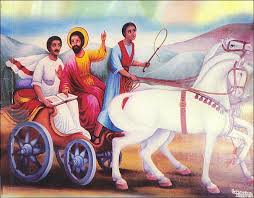
images-2Memories of my conversation with Samantha are triggered by the story about that remarkable encounter between Philip and the Ethiopian eunuch recorded by Luke in Acts 8. For me, the eunuch has three key characteristics: he is black, he’s a foreigner, and he’s a eunuch. We are told he is a high official of the Queen of Sheba and is on his way back to Ethiopia from visiting the Temple in Jerusalem.

It’s not clear why he would have been visiting the center of a religion that would have denied him any possibility of being anything other than an observer, an outsider.

In our society where race is such a volatile issue, we note his blackness. Yet, it’s not his race that denies him the right to participate in the rituals of the Temple. Skin colour was not the issue in the 1st-century world that is now is in ours. We see racial tensions exploding throughout America, Baltimore being only the latest outburst.  These racial tensions have the particular characteristic of being tensions between communities defined by race and the patriarchal forces of law and order. It’s important to note that it is not only white police officers who come into sharp confrontation with black men, and the communities they live in. The police ranks are filled with many black officers who are caught-up alongside their white colleagues in the increasingly violent confrontation. Law and order and especially the police increasingly find themselves as agents for our patriarchal system’s entrenched institutional racism.

The eunuch is a foreigner. This might have been a greater impediment to his participation in the rituals of a religion that was intensely xenophobic. Yet, Judaism had a place for foreigners who were interested in Jewish teaching and practice. By the 1st-century, many gentiles regularly attended the synagogues and kept many of the ritual customs, while not being technically regarded as Jews. In the New Testament, it is this group who form the audience for much of the apostles, especially Paul’s teaching.

The eunuch was a eunuch. Eunuchs were castrated males appointed to administrative roles within ancient societies. Because they no longer qualified as male within the culture of patriarchy, they posed no threat to patriarchal versions of masculinity. In fact, patriarchy needed eunuchs to occupy the sensitive positions of trust, such as the management and protection of communities of women in the harem. They occupied powerful administrative posts because unlike intact men, they could not supplant the alpha male. Castration removed them as a source for the two principle patriarchal anxieties: the need to control procreation through the subordination of women, and the management of intermale rivalry through strict hierarchies of power. A slight twist in this story is that Ethiopia at this time is still a society ruled by a queen. Having a eunuch as her chief minister is an interesting way for a queen to control the ever-present threat of male power.

Consequently, being a eunuch was the fundamental impediment to this man’s participation in the Temple rituals. Yet, despite this, he was powerfully attracted to the prophetic teaching of the Jewish religion. Within all systems of organised religion, the encounter with the divine is something that despite attempts to domesticate it, remains always beyond control and operates as a prophetic voice continually challenging the structures of patriarchal religion. For while the Temple rituals excluded him on the basis of his sexual orientation, the prophetic call of the divine included him as when Isaiah speaks in 56:3-5:

 Neither let the son of the stranger, that hath joined himself to the Lord, speak, saying, The Lord hath utterly separated me from his people: neither let the eunuch say, Behold, I am a dry tree.  For thus saith the Lord unto the eunuchs that keep my sabbaths, and choose the things that please me, and take hold of my covenant;  Even unto them will I give in mine house and within my walls a place and a name better than of sons and of daughters: I will give them an everlasting name, that shall not be cut off.

In the story of the Ethiopian eunuch, we see the hidden subversion of the patriarchal systems of organised religion by the energy of the divine. This divine energy operates to undermine and challenge attempts to organise religion as an instrument the control of anxiety through policing the dynamics of inclusion and exclususion. In Acts 8  we see the Holy Spirit operating as an instrument of inclusion. Philip willingly baptises this man and having accomplished this major act of inclusion of one hitherto excluded makes clear that the expectations of God’s kingdom contrast to the tyranny of man-made religion.

Today, many believe that the age of patriarchy has, or is passing away. Patriarchy is not necessarily the evil system of oppression as portrayed in much feminist critique. It hurts men as much as it hurts women. I believe we need to see patriarchy and its expression in organised religion as a historical phase in attempting to manage the universal tensions and anxieties around difference. These remain tensions that still distort our world through systemic entrenchment of racism, xenophoia, and homophobia. Today gay men stand in the place of exclusion represented by the eunuch in the ancient world because being gay and male offers a varient on bieng male that confronts the violence of the patriarchal order.

Firstly, women challendged their position of subordination in the male perspective of the world. Then gay men amd women challenged the patriarchal defintion of gendered relationships. A new confrontation looms as transgendered men and women challeneg the patriarchal notion of the very immutability (unchanging nature) of gender.

Isn’t the message  of Acts 8 clear, at least for those of us who have ears to hear?

Of Shepherds, Love, and other things

Herders and Shepherds

My nephew is a high country sheep farmer and has recently taken over the family business from his father. In the high country of the South Island of New Zealand, a land where sheep outnumber people by 20 to 1, my nephew Hamish runs around 12000 sheep over 60,000 acres. This is Lord of the Rings country. Not the idyllic landscapes of the Shire. This is the harsh and majestic landscape on the way to Mordor. The holdings are so large because the high country land is poor, suitable only for the Marino breed of sheep farmed not for their meat, but the fineness of their wool. Farms of this size are known as Stations or High Country Runs.

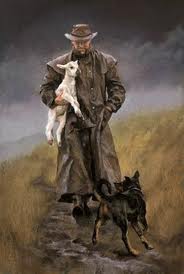
One day, during a visit some years ago, while travelling around the rugged hills with Murray, Hamish’s father, we suddenly stopped and Murray leapt out of the cab of the truck and bounded down a steep-sided gully to where a ewe had been caught by its dense wool in a thorn tree, known locally as a lawyer bush because the saying goes, once caught you’ll never get free. He cut the sheep free and hoisted it in
one smooth movement onto his shoulders and then arranged the ewe around his neck and proceeded to climb back to the truck. He then deposited the sheep on the bed of the truck, climbed in, and we drove off.

Now to say I was impressed by his agility and strength is something of an understatement. In that moment, he resembled the poster add for Speights, a local beer which advertised itself as the drink of the Southern Man, take a look  a kind of N.Z. equivalent of the Malboro Man. 

The Old Testament image of the shepherd leading his sheep over the rocky hillsides is not an image that translates to modern N.Z. shepherding, where the term herder is used more commonly than shepherd. The herder stands to the side and through piercingly high whistles, produced through a tightening of the lips or by use of a flat plastic device held between the lips, he directs the sheep-dogs in their task of rounding up the sheep and driving them to where the herder is directing.

In N.Z. because sheep are driven not led, there is normally little simgresense of the intimacy between shepherd and sheep conveyed by Jesus’ image of the Good Shepherd. Yet, in the moment when my brother-in-law bounded off to retrieve his solitary ewe, all the power of the Biblical image of the Good Shepherd who leaves the 99 to go in search of the one lost sheep communicated itself to me with a powerful and intense immediacy. I witnessed in that moment my brother-in-law’s concern for his ewe, a concern that went far beyond the animal’s economic value for him.
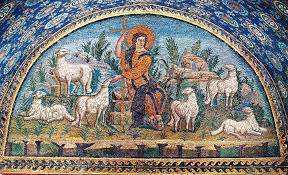
 As we ate and looked, almost spellbound, the silent hillsides around us were in a moment filled with sounds and life. The shepherds led their flocks forth from the gates of the city. They were in full view and we watched and listened to them with no little interest. Thousands of sheep and goats were there in dense, confused masses. The shepherds stood together until all came out. Then they separated, each shepherd taking a different path, and uttering, as he advanced, a shrill, peculiar call. The sheep heard them. At first the masses swayed and moved as if shaken with some internal convulsion; then points struck out in the direction taken by the shepherds; these became longer and longer, until the confused masses were resolved into long, living streams, flowing after their leaders. Such a sight was not new to me, still it had lost none of its interest. It was, perhaps, one of the most vivid illustrations which human eyes could witness of that beautiful discourse of our Savior recorded by John. Cited by B.W. Johnson in his commentary The People’s New Testament, 1891)

images-2

Love

Jesus refers earlier in John 10 to the sheep knowing his voice and being able to distinguish his voice from the voices of the imposter. This communicates the intimacy of the connection between shepherd and sheep that Jesus clearly has in mind. It’s the inherent quality of recognition that makes the image of the good shepherd stand out among the many powerfully evocative images that Jesus takes from everyday 1st-century life.

I am the good shepherd. I know my own and my own know me, just as the Father knows me and I know the Father.

It’s easy to miss the potency of connection in these two sentences. If I am not careful I find myself mishearing these lines as:

I am like the good shepherd. I know about my own and my own know about me, just as the Father knows about me and I know about the Father.

There is a world of difference between knowing and knowing-about. Jesus’ image of the good shepherd is an image that reflects the intensity of his experience of knowing, and being known by, God.  I am drawn by my desire to know and be known-by. But there is something more comfortable and less demanding; a good deal more self-protective in knowing-about and being-known-about.

Herein, lies another example of the ambivalence of my all too human heart. That which I long for most is the very thing I need also to distance myself from. It’s one thing to be moved by the poetic intensity of the Jesus’ image of the good shepherd and quite another to open to the costly experience of knowing and being known-by. In the intimacy of knowing and being known-by there is no place to hide.

George Herbert captures the essence of the struggle in Love bade me Welcome   and you might like to listen to Ralph Vaughan Williams musical setting of this powerful poem in his series of Five Mystical Songs.

To love is a risky business. To allow ourselves to be loved, now that is the trick!

Axis Revolutions

The struggle

I find myself preoccupied with a particular struggle that takes place along the axis between the spiritual and temporal dimensions of experience. My struggle concerns how do I apprehend the spiritual in my experience? The answer is I am never sure. At times, I seriously question if, as a thoroughly brainwashed child of the post-Enlightenment, I even can. This disturbs me and hence my rotation along the axis that divides spiritual and temporal domains of experience.

My friend Jane langmuir sent me Friday’s blog from Richard Rohr. Rohr, speaking of St Paul puts it like this:

It seems to me that Christianity in the West suffers from two very foundational problems, which were not problems for Paul. First, we do not seem to believe in the active, dynamic reality of the spiritual world. For most of us, the “real world” is this physical, material world. So when I use a word like consciousness or the collective unconscious, many Christians are afraid I must be some kind of New Ager.  

Christians should be the first ones to understand that the first and final state of reality is spiritual, or the unmanifest, as some have called it. But we have been so caught up in the world of forms, or the manifest, that it becomes all we take seriously. If religion is to be reborn at any dynamic level that is really going to change society or change the world, we must understand that spiritual reality, consciousness, or Spirit, if you will, is the true reality; all the rest, including the material world, emerges from it. That’s a switch even for people who think of themselves as religious. True spiritual cognition does not come naturally to us.

A prisoner of disenchanted immanence

My experience, even as a so-called religious person is as Rohr describes – true spiritual cognition or more aptly recognition does not come naturally to me – or at least in any form my psycho-cultural filters allow me to easily recognize. Thus, as a result of a combination of psychological predispositions and my cultural and educational formation in the age of disenchantment of a world shaped by the Newtonian scientific paradigm, the transcendent is filtered out.

Finding the transcendent within the immanent

The Newtonian paradigm of time, space, and matter, operatings according to seemingly immutable laws of cause and effect, past, present, and future has no way to allow the possibility of Christ’s resurrection. The most resurrection can be thought of is – as an interior psychological experience of the disciples. They believed Christ was raised from the dead because they experienced him returning to them as reported in Luke’s 24th chapter and the other Gospel narratives of post-resurrection appearances, particularly John’s.

On Easter Day, I explored an exciting idea: what if our Newtonian paradigm is not simply a reflection of observation, but a construction of our expectations? Instead of the laws of physics being an articulation of our observation of the way the material universe works, what if they are also the result of the way we expect the material universe to behave? Thus my excitement over recent infant observations in a research program at Johns Hopkins which has evidenced infant amazement at balls rolling through walls and toy cars floating through the air. You can read more in my post Seeing is believing – or is it? click 

imagesBeneath Newtonian reality there lies a domain physicists call the Quantum paradigm. Here, we glimpse the energetic underpinning of the material universe we experience. The only point I want to stress here is that in the Quantum paradigm energy and matter behave differently from our Newtonian conditioned expectations. In the Quantum realm we can observe nothing as it happens, we can only speculate as to what has happened after the fact, as it were. We see the traces – the vapor trails, and we hear the echoes of energetic processes and structures only after something has happened, not as it is happening.

Even in out attempts to directly observe the processes and structures of the Quantum realm, one key difference from the Newtonian realm is that our position as the observer generates what we see, e.g. particle or wave, but never both.  This all seems very unscientifically contradictory. Its downright mysteriousness reminds me that our observations and perceptions of the Quantum and spiritual domains share a common difficulty. We speculate as to their existence through our experience of their effects. Our speculations are hampered and constricted in both accounts by the limitation of language to fully articulate a non-dualistic world. I mean that language is shaped by our experience of a world in which things are always this or that, but never both! Yet, that is what we grasp after in any articulation of the Quantum and spiritual realms. All we have are metaphors, similes and analogies. In his book Quirks of the Quantum (22-23), my friend Sam Coale speaks of language being designed to describe a world where although perspectives of what is seen may differ from person to person, there is no dispute that we are all interacting with an object that exists independently of our interaction with or observation of it.

The language of Quantum theory and spirituality are both languages of speculation and imprecision as we chase after that which can’t be directly apprehended and described. In the quantum and spiritual realms there is not direct encounter, only speculation about encounter through our experience of its after effect.

The Transcendent’s inbreaking

Luke’s chapter 24 is an account of the disciples very long traumatic and exhausting Easter Day. At the break of day the women discover the empty tomb and encounter the angels asking why are they looking for the living among the dead? When they report their experience to the male disciples, they are dismissed as rambling and hallucinatory women. So Simon Peter goes to see it for himself while another couple of the male disciples set out for Emmaus, a village about five miles outside Jerusalem.

On the road to Emmaus, they are joined by a stranger. It’s Jesus but despite their hearts burning unaccountably within their chests they don’t recognize him until he breaks bread imageswith them. Their minds can only recognize what is familiar to them. In his action of breaking bread, Jesus triggers a memory of him at which point they recognize the man in front of them as their familiar Lord.

They rush back to town and on arriving find the rest of the band in the upper room. As they are telling the others of their experience Jesus comes and stands in the room with them and says: Peace be with you. To describe them as being startled and terrified must be a considerable understatement. People of the 1st Century no more expected the dead to come back to life than we do, and so their only explanation was that they were experiencing an intrusion from the spirit world into their experience of the here and now.

Through the trauma of this day and the events that have led up to it, the disciples come to recognize, not just the Lord they thought had died. They come to recognize the Lord who died and is now alive again as familiar and yet radically different at the same time. At the risk of torturing a Quantum analogy, it’s as if having only ever having seen him in particle matter form – they can now see him as energetic wave.

Recognition of effect

In life, in the face of defeat and confusion, pain and suffering, we come to self-recognition and redemption as new understandings of the world around us emerge. This leads to actions that reveal a completely new picture of ourselves. As Paul Tillich put it, suffering introduces you to yourself and reminds you that you are not the person you thought you were.

Proof of Tillich’s point lies in the contrast between Peter in Acts 3 and the man portrayed in Luke 24. Peter has become the man he never imagined he could be. Peter’s journey from Luke 24 to Acts 3 is a journey of self-recognition and the transformative power of images-1redemption. Through confusion and disillusionment, and the necessity of letting go cherished hopes and expectations, Peter is conformed by the new life of the resurrected Christ. It’s not that he necessarily understands what has happened, only that he knows the truth of it because he experiences the effects of it.

In the Newtonian paradigm, the dead do not come back to life. There seems no mechanism to enable this to happen. In the Quantum paradigm matter and energy seem interchangeable. No one knows how the Quantum realm really interfaces with Newtonian reality, whether how or even if one domain or dimension affects the other. What matters for me is that Jesus’ resurrection, which remember is God’s action and not his, can no longer be ruled out purely on the basis of our Newtonian expectations of how the universe should behave.

At the end of the day, there is more to the universe than meets our eyes. Our expectations are after all, only the products of what we already expect to see. None of the disciples saw the resurrection. Yet, the good news is we are somehow called beyond expectations. The disciples simply became transformed through the experience of the effects of  the resurrection of Jesus upon them. As they come to recognise the reality of the post-resurrection experience of Jesus, they become open to becoming the persons they never dreamed they were.

Who might it be that we have yet to recognize ourselves becoming? Let’s begin to pay more attention to that possibility in this Easter Season.

Seeing is Believing – or Is It?

A startling discovery

I found a report on NPR about a study conducted by psychological researchers at Johns Hopkins in multiple infant observations startled me this last week. The researchers seem to have discovered that the laws of Newtonian physics are hardwired into human perception from the earliest stages of human development.

In one experiment, they explored the infant’s relationship with objects, a ball in one case, and a toy car in the other. They rolled the ball along the floor in order to attract the infant’s attention. The baby hardly paid any attention to the ball beyond an initial observation. They tried to interest the infant in the fact that the ball squeaked. When, later they presented the ball the infant showed no indication that it remembered the ball squeaked when pressed.

Then through clever photographic manipulation of images, they engineered it to appear to the infants that the ball rolled straight through a solid wall. Watching the ball roll through a solid wall attracted the avid attention of infants. While sitting in their high chairs, they were presented with the new ball to play with. The infants then repeatedly bashed the ball against the surface of their food tray, seemingly in an attempt to test-out its solidity. It seemed no difficulty for the babies to now remember that this new, much more interesting ball, also squeaked.

In a second experiment, they projected the image of a toy car sailing through the air. As with the ball, the car floating through the air immediately attracted the infant’s attention. When given the toy to play with teach baby repeatedly dropped it on the floor, seemingly to test- out whether it would float or not.

The startling discovery from these experiments is that our human Metal Wall Artperceptions and expectations based upon the Newtonian Laws of the way the physical universe behaves are not only learned but seems to some degree to be innate. It seems that this is probably an evolutionary adaptation that enables human beings from birth to survive in a physical universe that can be predicted to behave in certain ways rather than others. Survival required this adaptation, which now seems to have become hardwired into even the most anatomically unformed of human brains.

A second startling discovery 

The different Gospel accounts of the resurrection, though they differ widely in their details, all seem to be accounts struggling to make sense of what they thought impossible.  Now, remembering that the pre-scientific mind had a much richer range of explanations for the seemingly impossible than we possess today, it seems even allowing for a high degree of what Charles Taylor calls enchantment, the disciples knew without any reference to Newtonian physics that the dead do not, as a rule, come back to lifeThe Gospel records struggle to make sense of experience which is not only improbable, but unaccountable.

The response of Mary Magdalene outside the tomb in supposing Jesus to be the gardener is but the first of a whole series of experiences of the risen Christ where the disciples simply fail to recognize Jesus. Now this could be because he was unrecognizable. Though seemingly, their lack of recognition had more to do with the way their natural expectations blinded them to the reality in front of them, than to any radically changed images-2appearance of the post-resurrection Jesus.

Psychologically, we know that most of us only recognize what our brain is already looking for. That our perception of reality is colored strongly by what we already have experienced. For me this is the most obvious explanation for Mary, who is but the first in a series of encounters where those who knew Jesus intimately fail to recognize him because their brains are not looking for him. In a twist on the words of the angelic visitors in the tomb, the disciples are not looking for the living among the dead.

Like the Johns Hopkins babies, the disciples seem to experience a conflict between expectation and experience. Resurrection is the concept that reconciles their psychological conflict.

Resurrection – what it is not

The conventional view is that Newtonian theory didn’t invent the physics of the material universe. It simply observed and articulated that which human beings instinctively know to be true. Yet, a new realization seems to emerge from the Johns Hopkins infant observations. Newtonianism is not the result of our observation of the way the universe works, it is a creation of our perceptions. The evidence of infant observation is that Newtonian expectations are hardwired knowledge. It seems that even young infants don’t expect balls to roll through solid walls, or toy cars to float through the air. We don’t expect people we have seen die – return to physical life after death. From the inconclusiveness of the Gospel narratives of the resurrection event, neither it seems, did the followers of Jesus. Yet, resurrection is the account they settled on to explain their experience.

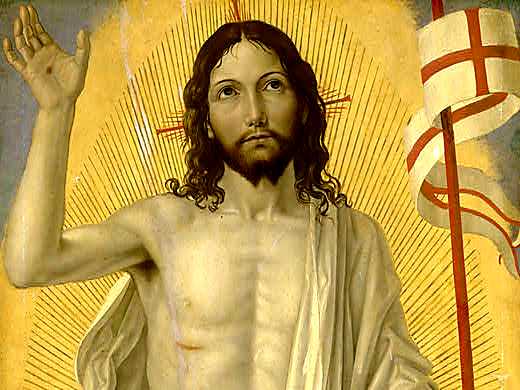
It’s been fashionable among progressive and theologically liberal Christians to understand1490Bergognonedetailb the first Christians experience of Jesus’ resurrection as a spiritual (internal) experience. In earlier phases of my ministry, I trumpeted the spiritual interpretation of the resurrection. According to this way of looking at the event, what did or didn’t actually happen to Jesus was and remains, irrelevant. The point being, that the disciples had a spiritual experience of the risen Jesus. I am a firm believer in the transformative power of  psychological and spiritual experiences to transform our experience of reality.

The irrefutable

What is irrefutable is that the experience of the empty tomb, and the disciples subsequent encounter with a risen Jesus, whether considered spiritual, i.e. internal or not, changed  lives and birthed a powerful world transforming religious movement. The big question is not what did or didn’t happen in the tomb? Maybe that will always be just beyond our grasp to explain, i.e. a genuine mystery. The big question is why did the first Christians settle on the concept of resurrection to explain their experience?

The Anglican bishop and biblical scholar N.T. Wright makes the telling point when he asks why would the first Christians adopt the concept of resurrection to explain a spiritual experience of the risen Lord? After all, they had concepts for such a spiritual experience. They had a theology of the souls of the righteous, who because of their virtuous living after death, ascended to dwell with God. So why choose resurrection, because in Jewish theology resurrection referred specifically to the return to physical life after physical death, or as Wright coins it: life, after life after death.

The simple answer

The simple answer to this is that the disciples became convinced by their post resurrection experiences of Jesus that he was, in truth the Messiah. A key characteristic of being the Messiah involves resurrection, or coming back to life after death. The Jews had lots of pretend messiahs, and the key thing that identified them as pretenders was that they died and did not come back to life. The first Christians’ claim that Jesus was the Messiah required the authentication of a resurrection. So did they simply convince themselves that their experience was the result not of a spiritual awareness, but and event in external reality?

A more complex answer

There is a more complex answer to the question and it takes me back to the Johns Hopkins infant observation. The discovery of a Quantum reality where a different set of physical laws operate shows that the Newtonian view of the physical universe is at one level, simply an observation of how we experience the laws of physics to actually operate. Therefore, our actual experience is that when a human being dies, they do not come back to physical life. What excites me about the Johns Hopkins research is the way Newtonian-type expectations are not simply our adult brain’s observation of the way the universe works. They are evolutionary expectations constructed by our brains from the start of life.

The experience of New Life this Easter

The promise of New Life is to be open to experiencing at the very least the improbable. This is not simply magical thinking. Like the infants in the Johns Hopkins observation, I want to become excitedly curious about the effects of God’s interpenetration of Newtonian reality with something much more enlivening.

Each Easter the message seems to reveal something new in God’s invitation to me to experience new life. This Easter, God’s raising Jesus to new life in the Resurrection conveys to me that God’s action is not limited by the boundaries of Newtonian physics and its definition of probability. That God can, and has interpenetrated our Newtonian defined dimension with

images-1something more akin to a quantum-like reality of the spiritual dimension. Here, what is real is continually shifting and changing according to the experience of the observer.

The infants, when presented with an ordinary ball or toy car, behaving ordinarily in time and space, showed little interest in the objects. They were neither curious about them, nor did they remember much about them. Once the object defied their brain’s Newtonian construction of how objects should behave, the infants became excited about them. Their excitement stimulated their curiosity for exploration and testing out. Is there a lesson here for us as we contemplate the promise of New Life through the resurrection of Jesus Christ this Easter?

In my experience that which is supposed to be improbable is one of the key characteristics of God’s presence within the flow of my life and in the divine action I see all around me in the wider world. Like the infants in the observation, to be filled with excited and curious amazement at suddenly imagining a whole new range of possibilities, now wouldn’t that be something?

Ambivalence is a Good Place to Hide

Ambivalence scares me, especially my own.  In the area of most ambivalence, amidst the shallow, shoal infested waters that lie between hope and fear, there are moments when I find everything within me rising in hope and I cry out: save us, we pray -hosanna! Then in the next moment the impossibility of my hopeful exultation crashes under the weight of a defensive cynical realism, and because I am an INTJ, http://www.16personalities.com/intj-personality I quietly give voice to my fears and whisper: crucify him.

Palm Sunday is my least favorite stop on the Easter liturgical Express https://relationalrealities.com/2015/03/21/all-abord-the-easter-bound-liturgical-express/. I find the contradiction of blessing palms and singing Ride on, ride on in imagesmajesty before minutes later hearing an enactment of the Passion, with its crescendo cry of crucify him, crucify him, deeply disturbing.The juxtaposition between hosanna and crucify him administers a shock to the system. For this is an expression of the human capacity for shocking contradiction. We retreat into our paranoia saying: see there really is something out there to be afraid of.

In 160BC after seven years of guerilla resistance, Judas Maccabeus led the triumphant Jewish Resistance back into a Jerusalem newly liberated from the yoke of the Seleucid Emperor, Antiochus Epiphanies. The Jewish forces carried blessed palm branches with which to begin the cleansing of the Temple, a Temple that  had been defiled by the image that Antiochus had placed of himself in the Holy of Holies. The Maccabean Revolt was the last time the Jew’s could point to a successful assertion of their independence from foreign domination.

I find drawing a connection between the Maccabean cleansing of the Temple and Jesus being welcomed by the crowds bearing branches they had cut from the trees gives an insight into the hopes and aspirations of the crowds that welcomed Jesus into the city. They were welcoming in the name of the great King David a new liberator, who like Judas Maccabeus would liberate them both from the foreign Roman domination and the Jewish Temple authorities, the domestic collaborators with Roman oppression.

We know the end of the story. We know that as the events of Holy Week unfold, things don’t go in the direction of fulfilling public hopes and expectations. These increasingly turn to disappointment and in disillusionment the crowds turn on the one in whom they felt their deepest longing had been betrayed.

This is what happens when our impossible expectations fail to materialize. We turn on those who have hitherto evoked our hopes and crush them. It seems the only thing we can do to express the rage and despair that feed our fear that nothing has, nor will ever, change.

How does the profound disillusionment of the crowds at large, and of Jesus’ own inner circle in particular play into our current experience of the world? We live in a world in which the political, judicial and law enforcement, the educational, economic, and religious institutions that articulated our highest aspirations and hopes as a society are either in rapid collapse or changed beyond recognition. We seem to be returning to an age when the levers of power are firmly controlled by those with unaccountable privilege while the rest of us are gripped by a growing sense that we are helpless in the face of a new world in which there is a great deal to be afraid of.

The danger is that our liturgical journey through the events of Holy Week and the Great Three Days of Easter communicate only esthetically and sentimentally. We are moved, maybe even caught up in the drama of this week. Yet, when the gruesome ordeal of poor Jesus is vindicated in his glorious and shining resurrection, we breathe a sigh of relief. Easter is now over for another year and we are reassured by having witnessed the archetypal triumph of good over evil.

The danger I fear most is that we travel through the events of Holy Week and Easter as if we are only attending consecutive performances of Shakespeare’s history plays or the demanding three days of Wagner’s Ring Cycle. We emerge from the experience moved, disturbed, elated, saying to one another: gee that was powerful!  Like drama and opera, liturgy has the power to transport us from one spiritual state of awareness to another. Liturgy is the vehicle that moves us into and through what I have been referring to as sacred time. Yet, the question will remain, for what purpose? Is the drama of Holy Week and Easter just another form of entertainment? Or is Holy Week and Easter fundamentally important to our ability to live out our hopes and longings?

What scares me about my ambivalence is that in the events of Holy Week and Easter as they are particularly magnified on Palm Sunday, I see myself in the crowds crying both hosanna, and crucify him. I am full of hope and longing for a world transformed beyond the maintenance of the status quo, the endless repetition of business as usual. Yet, my very hopes and longings also terrify me, and so I resist the change I most long for. If I really believe that self-sacrificial love can change the world, challenAmbivalence_artge the tyrannies of power and privilege, where then would I find myself? What might an allegiance to self-sacrificial love cost me? What will following Jesus to the Cross and beyond demand of me? Now that really scares me! Ambivalence is a good place to hide.

All Aboard the Easter-Bound Liturgical Express

This Lent, I’ve been exploring the traditional spiritual disciplines of fasting and self-denial; meditation on God’s holy Word; and self-examination and repentance. My central theme has been that spirituality flows through practices that discipline the human heart. Spirituality needs a vehicle or instrument for expression.

Today I turn my attention to the spiritual practice of worship. The Episcopal Church is a liturgical church. We are not the only one, yet what distinguishes us even among other liturgical churches is the beauty of our worship and the importance we place on its form. But what does this really this mean?

I don’t know about you, but I love trains. Given a choice I would always go by train. Let me explain. We board a train in order to be taken on a journey. Along the way, we make numerous stops, but each stop is simply a station we pass through along the route to our intended destination. There is something about being transported at speed, through an ever changing landscape, free of the anxiety of watching the road or the traffic.

Applying this metaphor image to our worship, liturgy like a train transports us through the landscape of sacred time. On Ash Wednesday, we boarded the Easter-bound liturgical Express. It has taken us on a journey through the Lenten countryside; making stops at a different station each Sunday. Along the route, we notice that terrain changes.A train approaches Ribblehead ViaductWith each change, our awareness deepens, or maybe heightens is a better spatial term, in preparation for arriving at our ultimate destination.

The final stage of our liturgical train journey will take us through some very dramatic scenery. I am talking about the scenic contours of Holy Week. Our itinerary has us reaching the Palm Sunday station on April 3rd. Here, we notice a change in the air quality, laden with a heightening of expectation as well as apprehension. Compared to our long journey through the Lent countryside, with long expanses between stations, the last leg of our journey is short in terms of distance, the stations increasingly close together. Between Palm Sunday and Maundy Thursday we will stop at the stations of Monday, Tuesday, and Wednesday in Holy Week. Each station is a metaphor for a liturgical experience of the events in Jesus’ last week.

On April 7th, we arrive at the major junction of Maundy Thursday. From here we travel overnight and through the following day’s descent into rocky terrain, reaching the station of the Good Friday Liturgy. From here the liturgical train takes us through a barren plainimages of Holy Saturday. By evening, we will begin to pass through the last canyon before emerging into a lush valley, the location of our final destination, the golden city of Easter. We might decide to leave the train at the first station in the Easter City, called the Easter Vigil. However, many of us will want to continue through to the main terminus of Easter Day.

Liturgy moves us through sacred time, or put another way the eternal now of God. Psychologically as well as spiritually, liturgy transports us into and through the spiritual landscape of the Christian Calendar. The journey from Ash Wednesday prepares us for joy-filled arrival at Easter. The promise of New Life offers enrichment for our everyday living. Mentally, emotionally, as well as spiritually, we need to prepare for our arrival. Easter is not something you can just parachute into at the last minute – if you want, that is, to be ready for the fullest experience possible.

Worship brings us into the company of others and together we journey into the encounter not only with God, but we also find ourselves reflected in our encounter with one another. worship11Worship brings us to the cross, in the sense of an intersection between the vertical and the horizontal dimensions of life. Invite your friends and board the Easter

Why not invite your friends and board the Easter liturgical Express, stopping at stations in Holy Week and the Triduum or Great Three Days of Easter. You won’t arrive if you don’t get aboard.

The Homeopathy of Repentance

Opening reflection

I have been thinking about a recent experience. Late last year, I asked my bishop about the study resources he draws on in his preaching. Now, I should have known better. My bishop is quite a scholarly guy and so he recommended a biblical software package called Logos. I dutifully signed up and purchased Logos 6 (Anglican version of course) software, on monthly installments. I felt that this was quite an investment and that I needed to get the most out of it. However, I could not make it work for me. I mean, it’s a complex software and it takes time to know how to get into all it has to offer, which is truly exhaustive. That was one challenge. More significantly, I just didn’t find its resources useful for my sermon prep. I have come to the conclusion, not for the first time, that I am not a scholarly preacher.

I found all the background information on text a little tangential to my main interests. I am interested in text as it relates to exploring the chasm into which the biblical author’s intended meaning falls, as the result of translation of a word from Hebrew or Greek into English. Languages have equivalent words, but equivalent words often do not convey equivalent emphasis or meaning. But overall, when it comes to interpreting Scripture, I am a broad brush-stroke kind of preacher. It’s the intuitive impression of the text, filtered through the prism of my own, and my community’s preoccupations and experiences that seems to be the grist for my preaching mill.

So I finally had to admit that Logos 6 was not for me. Relinquishing my scholarly presumptions to struggle with my pride, I have come, not for the first time, to a realistic acceptance of who I am. My Parish Administrator came to my rescue. She offered to wrangle with Logos 6 customer services to extricate me from the installment plan. She’s good at that sort of thing!

The text

I am putting aside for a moment that fascinating vignette, giving us access into the struggles of the Israelites in the wilderness, that comes to us from Numbers 21:4-9. Turning first to the readings from Paul’s letter to the Ephesians and John’s Gospel, both appointed for Lent 4, I find myself struggling with my own knee-jerk reactions to the text.

From my broad brush-stroke vantage point, the Scriptures often communicate a worldview that fails to translate well into my own 21st century way of looking at things. The tone of both Paul and John in these readings evokes negative feelings in me, feelings of being lectured by the voice of authority, telling me that because of my miserable worm-likeness God has deigned to throw me the carrot of salvation, but only as long as I tow the line and stay within the fold of the elect, or as John puts it among: those who believe in him are not condemned, but those who do not believe are condemned already. 

Biblical worldviews, for there are many, to my 21st century mind can communicate the feel of a predominantly, hierarchical, patriarchal- which kind of goes with hierarchical, and exclusionary perspective. I mean that so often it’s childlike (unquestioning) obedience that’s required to make sure we find ourselves among those who are included and not among those excluded. This worldview contrasts with my broad bush-stroke encounter with the spirit of Jesus’s teaching. Jesus’ emphasis is less on obedience and more on metanoia – turning of the heart. It is less about exclusion and more about God’s invitation, for all are included.

The scholar and the pastor

As a preacher,  I feel I am knowledgeable, but the purpose of my knowledge is always pastoral in application. The scholar has a primary interest in the text. Logos 6 was not of great use to me because my interest is less in the text itself, and more in the impressions the text gives, and the reactions it evokes in us, its hearers. My passion lies in taking the impressions and intuitions that emerge from my 21st century shaped encounter with the Tradition, something I deeply cherish, in order to render it accessible to my community’s 21st century mindset so that our lives too, may be enriched by its timeless wisdom.

Getting to the point

My opening section has taken the form of a kind of self-examination, and it enables me to neatly segway into an examination of the next spiritual practice, which the Prayer Book mentions as necessary for keeping a holy Lent – self-examination and repentance.

Self-examination

It was Socrates who said: the unexamined life is not worth living! The Christian spiritual tradition is certainly in agreement with Socrates on this score. Yet, it is also part of our human nature to shield ourselves from too much self-examination, because it’s often painful.

Self-examination and repentance

The Prayer Book invites us to keep a holy Lent through self-examination and repentance. Oftentimes self-examination is the path to repentance. Repentance is the doorway to our liberation from the pain and shame of the past.

Most Episcopalians think of confession either as the General Confession in the liturgy, which is communal not individual confession or as the Roman Catholic practice of going to confession. In the Book of Common Prayer, we have a rite called the Reconciliation of the Penitent. Contrary to common knowledge the practice of going to confession has always had an important place in Anglican spiritual practice. Cranmer talks about the need to seek ghostly counsel from the priest. The difference between Anglican and Roman practice is that the Prayer Book understands going to confession or Reconciliation, as a images-1spiritual and pastoral practice. This is in sharp contrast to the Roman view of confession as being reinstated to a necessary (juridical) state of grace in order to receive the sacraments.
At certain points in life, we are led to a reflection on the deeper currents that flow beneath the surface of our lives. These currents are fed from deep wellsprings of spiritual and emotional energy that hold the potential to enrich our sense of connection with God, with ourselves, and with other people. A paradox of life is that our strengths and weaknesses, joys and sorrows often flow from the same source. Beneath the surface of our living we also find feelings of shame, guilt, and the pain of relationship loss and failure.images

The Sacrament of Reconciliation is designed to aid us when we feel stuck; when we sense that something is blocking the reworking of pain into gain. Unlike modern counseling which brings a psychological framework to bear on self-examination, Reconciliation brings a forgiveness framework to bear on our internal reflections. The real problem is not whether God forgives us. The real stumbling block is our inability to forgive ourselves!

Human beings are at heart relational, and so there is a limit to how far we can get by simply talking to ourselves or even talking to God within the privacy of our own minds. When we can’t make progress on our own, what is needed is to be able to talk to another person. The Sacrament of Reconciliation provides the confidential space for opening ourselves to the healing grace of God, mediated through the ministry of a priest representing the living Body of Christ.

Painting with a broad brush

My attention is riveted by the implications of the story about the infestation of the Israelite camp by venomous serpents in Numbers 21:4-9. It seems that in response to their endless grumbling, God’s patience comes to an end. He punishes the Israelites by sending an infestation of poisonous snakes among them, with the result that many of them die.

God instructs Moses to cast in bronze an (graven) image of the snake and raise it up at the heart of the camp. Anyone with snakebite has only to look up at the image, in order to be healed. The real snake kills. The image of the snake of bronze heals. The connection between the two lies in the source of death also being the source of life. This is what I mean by a spiritually, homeopathic images-4solution. The image works like a psycho-spiritual vaccine, healing through exploiting its associations with the source of the poison.

Our potential to be healed and to experience joy flow from the same place as the source for much of our pain and suffering. This is the paradox of human emotional life and is not dissimilar to the realization that our main strengths are not different from our fundamental weaknesses.  For us, Jesus is raised upon the cross, not as an allopathic (combative) condemnation of sin, but as a homeopathic source for our healing. As we explore self-examination in preparation for repentance, we encounter a loving Christ who feels with us in our weakness because he too, knows first-hand, the vicissitudes of the heart.

When we bring our self-examination and our earnest desire to be liberated from the pains and shames of our past into the shadow cast by Jesus of the cross, we are not submitting to an experience of condemnation, a kind of spiritual snakebite. We are opening ourselves to being healed by the one who not only knows of our suffering, but is well acquainted with the sources of our grief. For as the prophet Isaiah says: by his stripes we are healed.

The theology of Reconciliation of the Penitent in the Episcopal Church can best be summed up as: all may, none must, but some should, make their individual confession. Some people find the Reconciliation of the Penitent to be a valuable and regular part of their spiritual formation. For others, it is a remedial and healing action taken at particular times in pursuance of a healthy pastoral care. Either way, this Lent why not consult with a priest near you?

Covenant

The God of the Covenant

The old Testament lections for the previous two Sundays have recounted the evolution of a  crucial element in the historic relationship between God and humanity. This crucial element we call, covenant. On Lent I, we received a reminder of the second covenant. God makes the first covenant with Adam and Eve.  The flood symbolizes a God who despairing of the evil that had come to distort the goodness of creation wipes the slate clean. In this second covenant that God makes with Noah, we glimpse a sign of God’s regret, having destroyed the creation, he now vows to never do this again. God seems to have learned rainbowthat destroying things is not the way to reform them.  As an enduring sign of his faithfulness to his promise to Noah and all of those who are, symbolically, his descendants, God makes the rainbow in the sky.

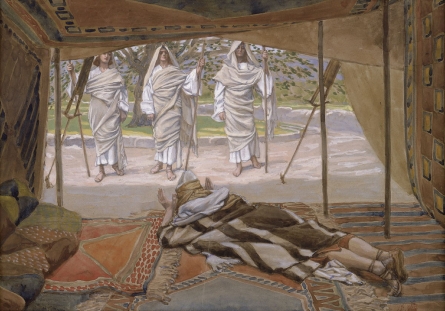
Tissot_Abraham_and_the_Three_AngelsOn Lent II we read of the call of Abram and Sarai, whom God now renames Abraham and Sarah as a sign of the covenant God makes with them. The promise is to Abraham and Sarah, a promise to make their descendants as numerous as the grains of sand on the seashore and the stars in the sky. In return, God simply asks for Abraham and Sarah to keep faith with God and to trust God in a relationship of collaboration.

Covenant evolves as God renews the covenant he made with Abraham, with each of the Patriarchs, the son, grandson, and great-grandson of Abraham, Isaac, Jacob, and Joseph. Then today we hear of a new covenant between God and Moses on Mt Sinai. The covenant with Moses takes a new form. This time the human side of the obligations are spelled out and written down.

The New Covenant

In many of our Anglican-Episcopal churches dating from the late 17th and 18th Centuries, Trinity Newport being a fine example, one often sees the tablets of the Ten Commandments on either side of the altar. What many don’t fully appreciate is that this is Rembrandt_-_Moses_with_the_Ten_Commandments_-_Google_Art_Projecta particular theological statement of the period. It’s somewhat anomalous to have the Ten Commandments depicted in tablet form adorning Christian Churches because they have been supplanted by Christ in his teaching of the two great commandments: love God and love one another. For Christians these two great commandments take the place of Moses’ ten. 

The presence of the Ten Commandments in some of our colonial churches represents a shift in religious consciousness during the period known as the Enlightenment. This shift was characterized by a movement away from a relational experience of God, mediated through image, ritual and mystery, towards an experience of a more impersonal universe, where God having set up the mechanism goes on vacation. Now, the goal of the spiritual life is not the pursuit of a felt relationship with God, but to live an ethically-moral life.

The basis of an ethical and moral life is to live according to the codes, hence the importance of having the mother of all codes in plain sight. Codes, stipulate what is, and what is not to be done. Like all codes, the Ten Commandments  tend to emphasise the negative – thou shalt not. The ideal may be that following the code leads to an appreciation of all that it noble and true, but the danger is that code driven faith degenerates into a stultifying legalism. At its best, pursuit of the moral-ethical life decoupled from relationship with God becomes an allegiance to the grand project of ethical and moral self-improvement, both at the level of the individual and at the level of society.

This has produced our modern secular age in which it is now possible to live morally and ethically without any reference to God. This is no small achievement and I don’t mean to disparage it. I mean only to refute the widespread misapprehension that to be a follower of Jesus amounts to simply being a good person, dedicated to a life of ethical and moral self-improvement. Christians are not good people merely doing what society dictates that good people should do!

Paul, in the opening of his first letter to the Corinthians, speaks of this tension. On the one hand, there is the high ethical philosophy of the Greeks that places the self-assertion of the noble individual as the source of wisdom. To the Greeks, allegiance to Christ seemed folly, flying in the face of reason. On the other hand, he speaks of the slavish adherence to every letter and jot of the written code. He characterises this kind of legalism as the struggle within the Judaism of his day. Ethics on one hand and legalism on the other, neither of which are the way of Christian discipleship.

In John’s Gospel, we are shown a picture of Jesus, raging. What has made him act in a manner that most of us consider to be out of character with our conception of Jesus, meek BA-106330-2and mild? Jesus rails against a religious institution, i.e. the Temple, that has placed money as the determinant of access to God. No money equals no pigeon, or no sheep, which equals no sacrifice and thus no access to God. He rails against a system of exchange – the money changers- who defraud the people. To buy what was necessary to make sacrifice, you couldn’t use ordinary money. You had to change your heathen denarii for Temple currency at an extortionate rate of exchange. Jesus cries out against an attitude that says that doing business as usual is the price for purchasing a relationship with God.

Much more significantly, we see Jesus engineering a shift. This is a shift from a spirituality which locates God in the externals of a building or a code, or in behavior. He alludes to his body as the Temple, signaling a shift in emphasis from true religion as allegiance to institutions and codes, to true religion as an allegiance to personal relationship.

Living in the New Covenant

This last week we celebrated the lives of John and Charles Wesley. These great Anglican priests, were part of a reaction against the Enlightenment’s impersonal view of God, a view which goes by the name, Deism. They led a return to a spiritual emphasis on the primacy of relational love as the way to live the New Covenant, inaugurated by God through Jesus.

For the Wesley’s relationship with God was more than being ethical, or moral. It had little to do with being wise and reasonable. Relationship with God was a manifestation of devotion, devotion rooted in the worship and common prayer of the Book of Common Prayer. For them and those who joined them, relationship with God emerged from a heartfelt encounter with God through the Scriptures, a heartfelt encounter that compelled them into lives of generous service. They were branded as Methodists, because of their methodical commitment to loving God from the heart, marked by a life of devotion.

In my two previous postings, I explored fasting and self-denial in an attempt to make these ancient practices comprehensible to our 21st Century mindset. Prayer and meditating on God’s holy Word are further practices commended to us. Many of us get stuck on prayer as intercession. Much intercession seems to function as our initiative, seemingly designed to raise God’s consciousness about the concerns we think important, or to present God with our shopping list of desires. In reality, intercession works in reverse. Intercession attunes our consciousness to the concerns that God continually bears for the plight of the creation. Thanksgiving is prayer opening us to experience gratitude, paving the way for converting gratitude into actions of generous living. These forms of prayer take root only when we begin to listen more and speak less. So what are we listening for?

In answer to this question, I would like to commend two ways of living prayer-filled lives guided by meditation on God’s holy Word. I’m more intuitive than sensory. Therefore, I try to follow a pattern of sitting and listening for the presence of the Spirit speaking through my intuition, which is my gut-level awareness, or through my insight, which is more of an intellectual awareness. If you are more sensory in orientation, you might listen for God communicating through images, and, or feeling states – often triggered by the world around you. Very often, the most I can manage is simply to try to sit in one place and watch myself breath, repeating under my breath the Aramaic phrase: Maranatha, or come Lord! I am hardly ever conscious of how this prayer makes a difference other than at some dim level of awareness I know that in the silence, which is paradoxically still filled with the clamor of my thoughts, I am opening a little chink in the protective walls of my defenses, my preoccupation with myself, through which I am slowly being transformed by the trickle of Grace into my life.

To meditate on God’s holy Word is an ancient practice known as Lectio Divina or divine reading. Taking a small section – no more than a sentence or two, particularly from the Gospels or Psalms, we slowly read the passage several times. We note the word or phrase that attracts our attention. This word or phrase creates associations in our imagination. This is not so much a study of scripture as it is an encounter with the text brought to life so that we might discover God’s invitation to pay attention to something in the next 5-7 days. Norvene Vest describes this process in a very user-friendly manner in her little book, Gathered in the Word http://www.amazon.com/Gathered-Word-Scripture-Pathways-Spiritual/dp/0835808068

A startling discovery

The invitation to keep a holy Lent speaks of the spiritual practices that help us to translate into action and behavior our spiritual longing for relationship with God. Oftentimes we live out of touch with this longing because it does not always register consciously. Spiritual practices are simply methods for bringing unconscious soul longing and soul pain into conscious awareness. In this sense, are we not all methodists?

Blog at WordPress.com.

Up ↑