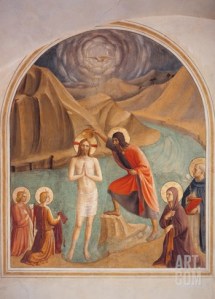
Covenant

The God of the Covenant

The old Testament lections for the previous two Sundays have recounted the evolution of a  crucial element in the historic relationship between God and humanity. This crucial element we call, covenant. On Lent I, we received a reminder of the second covenant. God makes the first covenant with Adam and Eve.  The flood symbolizes a God who despairing of the evil that had come to distort the goodness of creation wipes the slate clean. In this second covenant that God makes with Noah, we glimpse a sign of God’s regret, having destroyed the creation, he now vows to never do this again. God seems to have learned rainbowthat destroying things is not the way to reform them.  As an enduring sign of his faithfulness to his promise to Noah and all of those who are, symbolically, his descendants, God makes the rainbow in the sky.
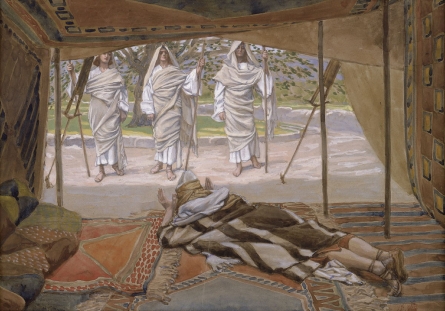
Tissot_Abraham_and_the_Three_AngelsOn Lent II we read of the call of Abram and Sarai, whom God now renames Abraham and Sarah as a sign of the covenant God makes with them. The promise is to Abraham and Sarah, a promise to make their descendants as numerous as the grains of sand on the seashore and the stars in the sky. In return, God simply asks for Abraham and Sarah to keep faith with God and to trust God in a relationship of collaboration.

Covenant evolves as God renews the covenant he made with Abraham, with each of the Patriarchs, the son, grandson, and great-grandson of Abraham, Isaac, Jacob, and Joseph. Then today we hear of a new covenant between God and Moses on Mt Sinai. The covenant with Moses takes a new form. This time the human side of the obligations are spelled out and written down.

The New Covenant

In many of our Anglican-Episcopal churches dating from the late 17th and 18th Centuries, Trinity Newport being a fine example, one often sees the tablets of the Ten Commandments on either side of the altar. What many don’t fully appreciate is that this is Rembrandt_-_Moses_with_the_Ten_Commandments_-_Google_Art_Projecta particular theological statement of the period. It’s somewhat anomalous to have the Ten Commandments depicted in tablet form adorning Christian Churches because they have been supplanted by Christ in his teaching of the two great commandments: love God and love one another. For Christians these two great commandments take the place of Moses’ ten. 

The presence of the Ten Commandments in some of our colonial churches represents a shift in religious consciousness during the period known as the Enlightenment. This shift was characterized by a movement away from a relational experience of God, mediated through image, ritual and mystery, towards an experience of a more impersonal universe, where God having set up the mechanism goes on vacation. Now, the goal of the spiritual life is not the pursuit of a felt relationship with God, but to live an ethically-moral life.

The basis of an ethical and moral life is to live according to the codes, hence the importance of having the mother of all codes in plain sight. Codes, stipulate what is, and what is not to be done. Like all codes, the Ten Commandments  tend to emphasise the negative – thou shalt not. The ideal may be that following the code leads to an appreciation of all that it noble and true, but the danger is that code driven faith degenerates into a stultifying legalism. At its best, pursuit of the moral-ethical life decoupled from relationship with God becomes an allegiance to the grand project of ethical and moral self-improvement, both at the level of the individual and at the level of society.

This has produced our modern secular age in which it is now possible to live morally and ethically without any reference to God. This is no small achievement and I don’t mean to disparage it. I mean only to refute the widespread misapprehension that to be a follower of Jesus amounts to simply being a good person, dedicated to a life of ethical and moral self-improvement. Christians are not good people merely doing what society dictates that good people should do!

Paul, in the opening of his first letter to the Corinthians, speaks of this tension. On the one hand, there is the high ethical philosophy of the Greeks that places the self-assertion of the noble individual as the source of wisdom. To the Greeks, allegiance to Christ seemed folly, flying in the face of reason. On the other hand, he speaks of the slavish adherence to every letter and jot of the written code. He characterises this kind of legalism as the struggle within the Judaism of his day. Ethics on one hand and legalism on the other, neither of which are the way of Christian discipleship.

In John’s Gospel, we are shown a picture of Jesus, raging. What has made him act in a manner that most of us consider to be out of character with our conception of Jesus, meek BA-106330-2and mild? Jesus rails against a religious institution, i.e. the Temple, that has placed money as the determinant of access to God. No money equals no pigeon, or no sheep, which equals no sacrifice and thus no access to God. He rails against a system of exchange – the money changers- who defraud the people. To buy what was necessary to make sacrifice, you couldn’t use ordinary money. You had to change your heathen denarii for Temple currency at an extortionate rate of exchange. Jesus cries out against an attitude that says that doing business as usual is the price for purchasing a relationship with God.

Much more significantly, we see Jesus engineering a shift. This is a shift from a spirituality which locates God in the externals of a building or a code, or in behavior. He alludes to his body as the Temple, signaling a shift in emphasis from true religion as allegiance to institutions and codes, to true religion as an allegiance to personal relationship.

Living in the New Covenant

This last week we celebrated the lives of John and Charles Wesley. These great Anglican priests, were part of a reaction against the Enlightenment’s impersonal view of God, a view which goes by the name, Deism. They led a return to a spiritual emphasis on the primacy of relational love as the way to live the New Covenant, inaugurated by God through Jesus.

For the Wesley’s relationship with God was more than being ethical, or moral. It had little to do with being wise and reasonable. Relationship with God was a manifestation of devotion, devotion rooted in the worship and common prayer of the Book of Common Prayer. For them and those who joined them, relationship with God emerged from a heartfelt encounter with God through the Scriptures, a heartfelt encounter that compelled them into lives of generous service. They were branded as Methodists, because of their methodical commitment to loving God from the heart, marked by a life of devotion.

In my two previous postings, I explored fasting and self-denial in an attempt to make these ancient practices comprehensible to our 21st Century mindset. Prayer and meditating on God’s holy Word are further practices commended to us. Many of us get stuck on prayer as intercession. Much intercession seems to function as our initiative, seemingly designed to raise God’s consciousness about the concerns we think important, or to present God with our shopping list of desires. In reality, intercession works in reverse. Intercession attunes our consciousness to the concerns that God continually bears for the plight of the creation. Thanksgiving is prayer opening us to experience gratitude, paving the way for converting gratitude into actions of generous living. These forms of prayer take root only when we begin to listen more and speak less. So what are we listening for?

In answer to this question, I would like to commend two ways of living prayer-filled lives guided by meditation on God’s holy Word. I’m more intuitive than sensory. Therefore, I try to follow a pattern of sitting and listening for the presence of the Spirit speaking through my intuition, which is my gut-level awareness, or through my insight, which is more of an intellectual awareness. If you are more sensory in orientation, you might listen for God communicating through images, and, or feeling states – often triggered by the world around you. Very often, the most I can manage is simply to try to sit in one place and watch myself breath, repeating under my breath the Aramaic phrase: Maranatha, or come Lord! I am hardly ever conscious of how this prayer makes a difference other than at some dim level of awareness I know that in the silence, which is paradoxically still filled with the clamor of my thoughts, I am opening a little chink in the protective walls of my defenses, my preoccupation with myself, through which I am slowly being transformed by the trickle of Grace into my life.

To meditate on God’s holy Word is an ancient practice known as Lectio Divina or divine reading. Taking a small section – no more than a sentence or two, particularly from the Gospels or Psalms, we slowly read the passage several times. We note the word or phrase that attracts our attention. This word or phrase creates associations in our imagination. This is not so much a study of scripture as it is an encounter with the text brought to life so that we might discover God’s invitation to pay attention to something in the next 5-7 days. Norvene Vest describes this process in a very user-friendly manner in her little book, Gathered in the Word http://www.amazon.com/Gathered-Word-Scripture-Pathways-Spiritual/dp/0835808068

A startling discovery

The invitation to keep a holy Lent speaks of the spiritual practices that help us to translate into action and behavior our spiritual longing for relationship with God. Oftentimes we live out of touch with this longing because it does not always register consciously. Spiritual practices are simply methods for bringing unconscious soul longing and soul pain into conscious awareness. In this sense, are we not all methodists?

On Winning and Losing Life: a reinterpreation

Initial ramblings

My response to the lectionary’s text is an individual response within a communal setting. Preaching is always an activity of speaking from within a shared context. The context for me is my life within a community of relationships and the way this experience influences the trajectory of my response to text. Text does not, for me at least, exist in a vacuum. It originates in community, it is transmitted through community, and it is received within the context of a community. Community colors everything.

The trajectory of my response to the reading of Mark, the gospel text appointed for Lent this year, leads me to explore the aspects of spiritual practice enjoined on us by the Book of Common Prayer’s invitation to keep a holy Lent[1]. I feel an urgency to view this invitation in a new way; a way familiar to me from past responses, and yet also completely different.

I feel compelled to speak intelligibly to my community about spiritual practice. Historic Christian spiritual practices are couched in language, and project collective images that are not only now obscure to us, but carry the echo of a Victorian spirituality that saw the function of spiritual practice to be in making life unpleasant, rather than creative. Today we urgently need to be able to reclaim the creativity of our traditional spiritual practices.

This led me last week to translate, to make intelligible for 21st century ears, the practice of fasting https://relationalrealities.com/2015/02/21/to-keep-a-holy-lent-re-imagined/ . A not unsurprising silent response echoed back to me. Providence is a very foodie city. East Siders are very foodie people. Dieting, yes, but fasting? You’ve got to be kidding!

The Lenten invitation links self-denial as a spiritual practice with fasting. I see the connection, fasting is a form of self-denial. Yet, self-denial also stands alone because it proposes an approach to living that needs careful unpacking for contemporary ears.

Getting to the point

Mark’s chapter 8 is a pivotal point at which Jesus’ identity as the Christ, something hitherto only hinted at with the injunction to secrecy is now openly proclaimed. As Jesus begins to speak of his own trajectory towards increasing conflict and ultimately, death, he invites his hearers into the life of discipleship. He defines this as a life of self-denial, cross-bearing, and loss of life. What can he mean when he says that those who want to save their lives will lose them, and those who lose their life for his sake, and that of the good news, will save them?

The word Mark uses for life is psyche. In most languages, psyche carries a wider connotation than in English. For instance, a huge distortion in English speakers understanding of Freud flows from the translation of his use of psyche as mind. As in the Greek, so in the German, psyche carries a larger meaning for which the English word soul is more appropriate. To the Anglo-Saxon pragmatic mind, soul is very unscientific, unpsychological, and way too spiritual!

Mark uses psyche to tell us that Jesus is talking about more than physical life. Although, certainly in Mark’s, as well as Jesus’ world there were profound implications of life and death for those who followed Jesus, he wants us to understand that Jesus is referring to our total inner and outer disposition towards life, we might say, a soul approach to life. Soul lies at the core of our identity of selfhood. This core of identity is rooted in the reality of being made in the image of God. We find fulfillment only in living life from this perspective.

A traditional theological perspective

Christianity views the soul as the imprint of our divine origin – our imago dei in this phase of biological life. Soul energy impacts upon us to two significant ways. We unconsciously experience the pain of separation from God. This is the source of sinful action through patterns of life that place our own self-assertion at the heart of our living. The positive aspect of soul is that it offers to us ever new and fulfilling perspectives for living because through soul we are aligned with the life conferring energy of the Holy Spirit.

A contemporary psychospiritual perspective

Transpersonal or psychospiritual psychology makes a distinction between self and personality. Embracing our self-hood means living from the soul. It is through the soul that the connection with a higher source of energy leads to an enlargement of our experience of life. Personality is constructed from our experience of life. It is controlled by memory. Because memory is mostly unconscious, much of our behavior is beyond our conscious control. Hence, the truth of Freud’s dictum: that which we can’t remember we are destined to repeat. 

Memory transmits our sense of identity, or what we normally think of as me-ness. We recognize present experience as confirming a sense of me-ness through its familiarity. Familiarity is inherited from the past and bequeathed to the future. Living exclusively from personality leads to a degrading of the experience of self. How?

We live from personality because for most of us our attachment to soul is insecure. To make-up for the loss of the expansiveness of soul quality, the mind substitutes personality, which remembers only our own individual, biographical experience. Central to personality is the need to maintain a balance between what is new and what is familiar. Too much novelty disrupts our sense of the familiar, upon which we rely to tell us who we are. Too much familiarity robs us of the freshness of novelty and consigns us to an wearied experience of endless repetition, sapping away our vitality. This leads to a growing sense of futility and heightened anxiety. Our lives become dominated by fear and a need to protect ourselves against the unpredictability of life. We become imprisoned as a result and our longing for change is continually thwarted because nothing changes if we keep making the same choices, no matter how much we might wish for different results. 

Jesus’ invitation

In speaking of winning and losing life Jesus is addressing our estrangement from soul energy. He tells us that it makes little difference, even if we were to win mastery over the whole world, if to do so results in a loss of soul connection. Jesus offers us a new experience of life through following him. We follow him when we decouple our sense of self from the preoccupations of our personality, and open ourselves to the invitation to become who God dreams us to be. Decoupling from the exclusive dominance of personality feels like a loss. Yet, only through denial of personality and the experience of loss can we open to the inflow of the greater and more, expansive richness that God offers us through living from our soulful self-center.

Jesus own mission to be rejected, killed, and raised again demonstrates God’s faithfulness, a faithfulness he promises to Abraham in the first reading from Genesis.

Self-denial means to risk losing the life that flows from the self-assertion of personality only. Paradoxically, it’s the decoupling from the control of personality that opens us to fulfilled spiritual living. Self-denial means giving up trying to control things through the strength of our personality. The objective of self-denial is not to become good, better, or even moral. I heard on NPR this week that we no longer need a notion of God to live good moral lives. I could not agree with that more! The objective of self-denial reframed as loss of living self-preoccupied lives centered on our personalities, is to become transformed not to become good! Jesus invites us to follow him and thereby enter upon the route of transformation.

Jesus shows us that to find life requires us to lose life. To truly live is nothing if not a risky business. Seeking liberation from lives of self-preoccupation is the fruit of the spiritual practices enjoined upon us this Lent.

[1] I invite you, therefore, in the name of the Church, to the
observance of a holy Lent, by self-examination and repentance;
by prayer, fasting, and self-denial; and by reading and
meditating on God’s holy Word. And, to make a right beginning
of repentance, and as a mark of our mortal nature, let us now
kneel before the Lord, our maker and redeemer.

Liturgy for Ash Wednesday in the Book of Common Prayer

To Keep a Holy Lent: Re-imagined

Mark

In those days, which is the equivalent to the modern TV phrase recently in the Gospel of Mark, Jesus appears at the Jordan and is baptized by John and the heavens are ripped apart and the Holy Spirit as a dove descends on him and God booms out in an amazingly loud voice this is my Son and in whom I am well pleased,  then the Holy Spirit drives-out Jesus into the desert to spend 40 days tempted by Satan, then he comes back because his friend John the Baptist has been arrested and begins his ministry with the words: the time is fulfilled, and the kingdom of God has come near, repent, and believe in the good news. 

There is such urgency in the first chapter of Mark’s incredibly spare and sparse narrative. His urgency is magnified by his use of the Greek word ekballo – to expell as the verb for the Holy Spirit’s immediate expulsion of Jesus into the wilderness.  desert1

Why the urgency? Well, Mark’s context is one of a community undergoing sharp Roman persecution. Suffering focuses the members of Mark’s community to the huge and urgent cost of being faithful to the Gospel, for whom this is a daily matter of life and death – what can be more urgent than that? Mark ends his opening chapter with Jesus proclaiming the kingdom of God is nigh, no time to lose, repent and believe the Good News.

Re-imagining

Mark does not detail the confrontation between Jesus and Satan. Our knowledge of the actual series of temptations comes from Matthew and Luke, not from Mark. I like Mark’s version better, not only for the stark beauty of its sparseness, but because it allows us to populate Jesus’ time in the wilderness with our own imagination.

The first Christians did just this. For them, the season of Lent – a time for intentionally remembering Jesus’ temptation in the wilderness became the season during which new Christians were prepared to enter the life of the community through baptism at the Great Vigil on the eve of Easter Day. Lent was also a time to focus on the restoration of those lost to the life of the community, those whose relationship to the community had been damaged by that which the Prayer Book calls notorious (public) sin. Lent was the season when through self-examination the non-baptized entered upon the path to fellowship, and for the estranged baptized, repentance provided for a way back into fellowship.

A new wilderness

In my community of St Martin of Tour, Providence, many were prevented by bad weather from attending the Ash Wednesday service marking the beginning of Lent. Many this year, did not hear the solemn exhoration in the Book of Common Prayer inviting us: in the name of the Church, to the observance of a holy Lent, by self-examination and repentance; prayer, fasting, and self-denial; and by the reading and meditating on God’s holy Word. 

Nevertheless, for those of us who were able to hear the Ash Wednesday Exhortation, like many in our society we have become inured by our culture’s pursuit of comfort and the anodyne experience. Therefore, the words of solemn exhortation to observe a holy Lent flow off us like water off a duck’s back. Over the years, I have heard this proclamation many times, some years with a shudder and revulsion at the prospect of being invited into medieval images of gloom, doom, and privation. At other times, the proclamation’s sheer out-of-synch-ness with our modern mindset has tweaked my curiosity, briefly, before returning to business as usual.

Vital questions

Is it so hard for middle-class Episcopalians to take the Prayer Book’s invitation seriously? I wonder? I believe that for most of us who fit into this category, our failure to take to heart the Prayer Book’s invitation to keep a holy Lent is the result, not of indifference, but of our experience of wilderness – a wilderness of meaninglessness.

We reject the cultural baggage of sin and suffering emphasized by our Victorian forebears. We also reject the post-war period of shallow hypocrisy, when liberal Christianity and popular American culture seemed so alarmingly, interchangeable. Today we find ourselves in a kind of wilderness where we seem bereft because so many of our historic spiritual practices fail now to sync with our imaginations. Consequently, the words of the invitation to Lent and the spiritual practices they enjoin upon us, leave us not exactly unmoved – they are after all rather majestic in their gravity, the problem is they leave us uninspired. They fail to ignite our spiritual lethargy into life-giving flame.

Is there a way out of our communal and individual experience of spiritual wilderness? The question really is can we re-imagine the spiritual practices contained in the invitation to keep a holy Lent, re-invigorating them for our lives in 21st Century America?

The modern imaginary

Our relatively modern discovery of the mind has opened up a view where body and mind form one interconnected and interdependent system. Yet, we live largely oblivious of this fact. We notice when we suffer headaches, backaches, digestive distress, or skin conditions. We worry when we develop heart problems. Yet, we seldom make the connection between mind and body as the cause. The mind’s job is to process emotion. Anxiety or stress is a form of emotion. When the mind experiences anxiety overload, the overflow of unprocessed emotion lodges in the tissues and organs of the body as psychosomatic distress. When we make the psychosomatic connection and take steps to address our high levels of stress, our physical symptoms often clear up.

Reclaiming the spiritual within the modern imaginary

Today, we are more aware of the interconnections between mind and body. However, our recognition of the power of the mind has eclipsed a third element, an element our ancestors knew better – the presence of the soul within the human system. It is vital for us to now recognize the presence of soul, which together with mind and body completes the human psycho-somatic-spiritual system.

Soul is the imprint of our God-nature. The full glory of the human being derives from our being made in the image of God.  Our God-image imago dei is our spiritual likeness. In this life, the soul registers not only our connection to God, but it also registers the pain of the physical separation from God. The difficulty lies in the unconscious nature of much of our soul-pain. As unconscious emotional pain can lead to physical illness, unconscious soul-pain powerfully drives our addictions of all kinds. Addiction, even if it’s only to shopping, is the symptom of our attempt to fill the emptiness left by our physical separation from our divine origin. Spiritual practices seek to address disruptions in our psycho-somatic-spiritual balance.

Re-imagining spiritual practice

The invitation to a holy Lent, among other things encourages us to practice fasting and a form of de-centering traditionally referred to as self-denial. Fasting is unfashionable in religious circles these days, which is ironic in a society obsessed with food and dieting. Fasting causes us to feel hungry. Feeling hungry is not pleasant. Yet, countless numbers of us endure dieting in the service of our body-image! Now here is where the re-imagining comes in. Extrapolating from the common experience of dieting in the service of our body-image, might our somatic experience of hunger as a result of fasting function in the service of our God or soul-image?

Fasting re-imagined as a reinvigorated spiritual practice

Fasting is not extreme privation or starvation. Fasting is mindfully altering the pattern of our consumption of food while taking care to maintain good hydration. Abstention from alcohol is a form of fasting. In both cases, we experience a somatic sense of loss that offers us a way to consciously register our profound, if largely unconscious, longing for God – this is the source of our soul-distress – a distress that contributes towards our wilderness experience.

Fasting simply alters our pattern of food consumption. It might mean after a light breakfast not eating, though continuing to hydrate for the remaining 7-8 hours of a day such as Wednesday or Friday before enjoying a light meal in the evening. We return the next day to a normal pattern of eating, but having fasted the day before we are more aware of our way of using food to assuage spiritual hunger. Fasting hunger becomes the physical symptom for our spiritual hunger. It’s the unconscious nature of spiritual hunger that drives much of our addictive, obsessive, highly anxious and other generally unhelpful behaviors.  Fasting brings into conscious, physical awareness our unconscious, spiritual hunger.

Longing for something we are not conscious of longing for fuels as sense of the unrequited. Fasting and other forms of spiritual practice make us conscious of our unrequited longing. Instead of our unrequited spiritual longing driving us into dysfunctional behavior in the hope of filling the wilderness space within us, conscious awareness allows us to choose to draw on the energy of that longing to reinvigorate our sense of wilderness. The great Indian spiritual poet Kabir puts it eloquently when he says: There are seasons in the mind, great currents and winds move there, the true yogi ties a rein to them; a power plant he becomes.

Fasting might also result in taking something like meat or alcohol out of our normal pattern of consumption and translating our experience of loss into concern for the world through financial or practical support for a worthy project or good cause. In this way, fasting begins to work on our sense of connection to the world beyond us, fuelling a sense of compassion for others.

Re-imagined and revitalized spiritual practice is what we have to look forward to when we accept the invitation to keep a holy Lent as prescribed by the Book of Common Prayer Exhortation for Ash Wednesday. During Lent, we also consciously reconnect with the wilderness experience that Mark shows Jesus modeling. A wilderness experience that desrt 2becomes transformed from one of spiritual futility into a source for spiritual vitality.

During the journey of Lent, in these blog reflections I hope to continue to explore the possibilities for re-imaging the other elements of spiritual practice mentioned in the Ash Wednesday Exhortation. Stay tuned.

The Call

images-1It’s 4.15 on a Sunday morning and I wake early with thoughts about Paul’s letter to the Corinthians in my head. One friend is fond of saying to me: you need to get out more!

The snow is gently falling again in Providence, coating the sand and salt encrusted mountainous brown and soiled snow banks, that have reduced the roads on Providence’s East Side into narrow goat tracks, with a fresh coat of feathery white, sound absorbing, snow. It’s amazingly beautiful!

I spent most of Saturday in a meeting of the Bishop’s Commission on Ministry (COMM). This was only my second meeting on coming to Rhode Island, but I bring four years of experience from my time on the very dynamic COMM in the Diocese of Arizona. I hate Saturday meetings because Saturday is the only day I have for the kind of reflective writing I do each week in this blog. Hence, finding myself at 4.15am, sitting at my laptop trying to get some thoughts down before the busy round of Sunday morning services and adult formation commence.

Vocation is on my mind. It’s what Paul is talking about in the Epistle from 1 Cor 9:16 appointed for Epiphany 5. Vocation is the issue I and my COMM colleagues spent most of Saturday grappling with as we interviewed three aspirants for postulancy. Postulancy is the name we give to the first stage of the public recognition of being called to ordained life as a priest or deacon in the Episcopal Church.

What is a vocation, often referred to as a call? How is a call being manifested in a particular person’s life? What seems to be the purpose for the individual of this new awareness of being called? In our catholic understanding of ministry within the Episcopal Church, the call begins as an individual experience but requires recognition and affirmation by the mind of the Church. In this process, the question is how does this stirring within the life of an individual connect or not with the wider needs of the Church? There are huge tensions within these wider questions that I and my COMM colleagues hold as we seek to encourage those who come before us to invite us into seeing what they see of God moving in their lives. For me this is the question. Is the aspirant able to let me – a representative of the wider mind of the community – into seeing what they claim to be seeing?

Paul speaks of his sense of being called in these terms:

If I proclaim the gospel, this gives me no ground for boasting, for an obligation is laid on me, and woe to me if I do not proclaim the gospel! For if I do this of my own will, I have a reward; but if not of my own will, I am entrusted with a commission. What then is my reward? Just this: that in my proclamation I may make the gospel free of charge, so as not to make full use of my rights in the gospel. 1Cor 9:16-18 

I get the sense that Paul feels that the liberation he has experienced through Christ lays a claim on him, which he has no choice about. For most of us this is a rather alarming image that makes us fearful about going anywhere near the exploration of having a call. Being called is a burden, a kind of compulsion that robs us of our own free agency for choice and self-determination. We hear Paul’s words from a place of fear within us. Our lives are full of experiences of obligation and duty. Yet, in Paul’s feeling that he has no other choice we can also see the possibility of freedom – of the liberation from our all-consuming, anxiety-provoking preoccupations with self.

There is much in our self-preoccupied, individualistic lives that makes us fearful of being called, of having a vocation because we hear being called as another layer of burden – in Paul’s words – a claim upon us. In our over stimulated and impossibly pressured lives, we shrink from involvement, fearing the claims that others or the community might make upon us. Yet, our fearfulness only further abandons us to a sense of dislocation, and isolation – of alienation, no matter how social and full of other people our lives might appear to be. For most of us are profoundly lonely within the pressure cooker of modern social life.

When I was a seminarian I remember a particular supermarket checkout person in the little market friends and I used to frequent. In response to her indefatigable joyful service we used to joke: she’s not got a job, but a vocation! Making allowance for the smug self-importance of the seminarian mindset, that phrase comes back to me over and over again whenever I meet someone who impresses me with their quality of being, often in what otherwise appears to me to be rather mind-numbing situations.

Being called, responding to a sense of vocation is the experience of liberation not
obligation. Our joy comes not from having our needs met, but from serving another’s needs. In our modern alienation, an alienation as much from self as others let alone, what is for most of us the utterly remote concept of God, we have become consigned to relationships, occupations, social connections that are functional, yet, not fulfilling. In our work lives we lack that strong feeling of suitability, being cut-out for a purpose that transcends mere functionality. We long for a deeper, wider, higher – any number of special metaphors will do – sense of purpose for living.

In short, do we not all long for that sense of vocation – now sadly lost to many of us, that infuses the ordinary aspects of daily life lived within a finite set of limitations and boundaries? Liberation is not escape from ordinariness, which is a realization so contrary to the relentless messages of advertising that insulate us in a fog of unattainable illusions. Liberation comes only when we are able to connect with a sense of being called, so that our endeavors come to offer us that particularly strong sense of suitability that makes all that we do, and all that we are, meaningful and fulfilling.

In his sense of being called Paul speaks of being all things to all people? This is not the imagesrather grandiose impossible boast it appears. In his sense of being compelled to serve he encounters freedom to reach out and across the spaces that divide him from others; that fracture that fragments of community into factions. Paul is talking about here,

what we moderns recognize as empathy. Maybe empathy is the first and essential step on the path to accepting one’s calling.

Am I My Brother/Sister’s Keeper?

In the Episcopal Church has anyone ever questioned, or, even enquired after what you believe? Maybe they have, or even if no one has you may have had an occasion to volunteer the contents of your beliefs. If that is the case can you ever remember a member of the clergy or anyone else for that matter contradicting you? Maybe someone has said, Oh, I have a different take on that!

In the Episcopal Church has anyone ever told you that you believe the wrong things. It’s possible I imagine that someone may have questioned the veracity of your beliefs. Yet, I seriously doubt if anyone, especially among the clergy, has ever said to you ‘don’t believe that’ or, ‘you shouldn’t believe’, or, ‘that’s just plain wrong’ or, what you believe is not the truth, or, unless you correct your views and accept the truth then there’s no place for someone with your beliefs here!’

I don’t imagine any of these scenarios have ever befallen you in the Episcopal Church. Haven’t you ever wondered why no one, even among the clergy seems concerned about whether you believe the truth or not? This could be an indication that the Episcopal Church doesn’t care what its members believe. Maybe this is a further indication of what other Christians often say about us – that we don’t believe anything, much.

After all we don’t seem very worried about the issues of sexual morality or even issues concerning the right to life that seem to drive many Roman Catholics and especially their clergy to distraction. We don’t seem to be much concerned about how many times you have been remarried. We certainly seem rather lax on letting women do things that in other churches only men can do. I don’t just mean the obvious – like becoming ordained and celebrating the Eucharist, but other things that the Bible clearly says are wrong – such as women exercising authority, speaking- out in church of all places while not even wearing a hat when they do so.

To cap things off, we now seem to be prepared to risk God’s wrath by letting Gay, Lesbian, and Transgendered people be themselves and extend to them the same level of rights and privileges the heterosexual community takes for granted as their birthright. We seem to have departed from the age-old tradition just reaffirmed by the Mormon hierarchy in their recent call for tolerance towards the GLBT community of: love the sinner but hate the sinwhich is nothing more that old smoke screen for the maintenance of systemic discrimination.

Maybe this is because it’s true what many Evangelicals say. Many say that the Episcopal Church doesn’t believe in the Bible anymore, and maybe never did. Two popular descriptions of the Episcopal Church as catholic-lite, and all of the pageantry with none of the guilt are stereotypes assailing the Episcopal Church from conservative expressions of Christianity.

Stereotypes are easy to draw. Stereotypes function as caricatures because they have enough accuracy to be believable. The Anglican Tradition doesn’t seem to mind being sent up. We even send ourselves up- as in the joke about the Episcopal priest on discovering his salad fork still in his hand as he started on his main course was horrified at the realization he had committed a mortal sin. The irony here, as Cousin Violet, the Dowager Duchess of Grantham would be quick to point out, is that Anglicans don’t catalogue sins into those that are venial -forgivable sin, and mortal – death-dealing to salvation sin.

Maybe it’s that Anglican DNA thing again. Aren’t we such awful Anglophiles panting over Downton Abbey. Sunday PBS viewing has become a feast of double chocolate as Downton is now followed by The Grantchester Mysteries, another romantic parody of English life with ever such a nice-looking young vicar, to boot.

There is that Episcopalian sense that it’s rather bad form and just the tiniest bit embarrassing to take one’s religion too seriously. Yet, history shows, there is good reason not to take one’s religion too seriously.

The easy parodies of Anglicanism and the Episcopal Church point-up the fact that the origins of the present form of Anglican Tradition lie in a 16th-Century solution to religious tensions – the National Church.

The National Church of England brought together the post-Reformation religious divisions in England that elsewhere in Europe led to a hundred years of inter-communal strife, every bit reminiscent of the violence raging across the Islamic World in our own day. In England, conservative adherents of the old religion of pre-Reformation Catholicism met the radical proponents of Lutheran and Calvinist reform at the Church door. Compelled by the law of the land, representatives of opposing factions were forced to sit alongside one another in the same pew where in the course of several generations their spiritual imaginations were shaped by the soaring poetry of Cranmer’s Book of Common Prayer.

This produced a context in which Truth, characterized as right belief had of necessity to give way to Love, characterized not so much as warm feelings but as right relationship. Shared doctrine was replaced by common worship as the means of defining community. The differences, both theological and political remained under the surface, erupting into violence finally in the English Civil War a century later. Yet, the Civil War only underscored the importance of a Church structured, not around right belief, i.e. truth, but around common worship, i.e. right relationship. Over a period of some three hundred years the Book of Common Prayer incubated an Anglican religious identity rooted in worship. It is this rich legacy that we in the Episcopal Church, are the present-day heirs.

Human experience shows us that there is never a single truth, only multiple truths. Attempts to enforce a single truth lead only to intractable and insoluble conflict. This is a lesson the occupants of Capitol Hill seem in need of learning all over again. For contemporary America is a society where a sense of the common good is continually fractured by the seeming unfettered exercise of individual rights and competing experiences of truth. There are always contesting truths and this is part of what energizes a society – the vibrancy of its public debate. Yet, public debate results from a holding together of tensions around some sense of the common, the shared.

The Episcopal Church is living proof of how this works. It’s not that we don’t have a body of doctrine. We do and it’s very clear! The interesting thing is that the place where you can find this doctrine is in the same place as you find our patterns of worship – in The Book of Common Prayer. Go to the Historical Documents and the Outline of Faith sections of the BCP and you will find clear statements of what the Episcopal Church believes.

Our beliefs are rooted in the ancient Catholic Christianity of the first five hundred years of the Church. The way we believe this ancient Catholic faith has been strongly influenced by Reformation theology. More distinctively, our spirituality molded by a thousand years of Benedictine Spirituality seeps into us through the practice of worship. We say to others, as we worship so we believe i.e. if you want to know what we believe come and worship with us. For us, worship is the centrally defining element of what it means to be God’s people. Our individual identities, with our own experiences of truth give way to a common identity shaped by the experience of God addressing us as a community, in worship. When you jettison an addiction to truth, then multiple truths can be contained only within the practice of worship.

In the Epistle for Epiphany IV from 1 Corinthians, we listen to Paul’s development of his argument with the rich and proud Corinthian Church. This is a Church that would fit well into contemporary American life, where the rights of the rich and the powerful are exercised with a careless disregard if not disdain for the poorer and less powerful members of the community. The behavior of the Corinthians forces Paul to assert that as a follower of the truth he is entitled to exercise in full, the rights that his conscience as a follower of Christ allows. In this

The behavior of the Corinthians forces Paul to assert that as a follower of the truth he is entitled to exercise in full, the rights that his conscience as a follower of Christ allows. In this case, he has the right to eat meat sacrificed to idols since because idols don’t exist eating such meat can have no spiritually injurious effect upon him. This is the truth; in this Paul is exhibiting right belief. Yet, he gives up such rights in the interests of affirming his right relationship with other members of the community.

Being theologically correct, a disciple of truth is not enough. Giving-up one’s right in order to foster right relationship with others in the community who may not yet be ready to exercise the full entitlement of liberty of conscience is more important, says Paul.

In the Episcopal Church we don’t enquire after whether our members hold the correct belief because we understand that we are individually, members of a community of right belief. As I like to say, the seeds of faith are sown in the fields of doubt. Some days I hold impeccably to orthodox truth. Other days I feel adrift in a see of doubt and uncertainty. None of this matters, because every day, my participation in the worship life of the Christian Community of the Episcopal Church places me in right relationship to others on the same spiritual journey.

I would go so far as to say that none of us individually are saved. What I mean is that because all knowledge is as Paul asserts only ever partial, our grasp of so-called truth is always incomplete. Individually we are saved not by our right belief but by our participation in the life of the community that is saved. The richest form that such participation takes, is found in the worship life of the community of faith.

Participation in that rich communal life owes less to holding a rightimagesbelief than it does to our life-long pursuit of right relationship! Or maybe put another way, am I my brother/sister’s keeper on the road to salvation? 

State of Parish Address

I arrived at St Martin’s on the Feast of the Most Glorious and Most Holy Trinity -in secular time the 15th June 2014. At the outset, I felt it was important to set a few immediate priorities, ones that would enable me to begin to structure my relationship with the parish. I wanted to respond with confidence to the very strong signal given me in my interview process – that the parish was ready for change. The experience of change is always ambivalent. Change is yearned for while simultaneously resisted. That which we most long for is also the thing we often most fear.

The quandary for any incoming rector is how quickly to make changes. One argument suggests making change quickly so as to make good use of the honeymoon period when the community is at its most generous, excited about new possibilities, and open to change. The counter argument counsels that important change needs buy-in from the community experiencing the change. The level of buy-in needed to tackle difficult issues comes only with time and the discovery that the new rector is someone who can be trusted.

My initial assessment was that I was coming into a parish experiencing the ebb dynamic in its growth cycle. Like the tide, organizations flow towards fullness only to find after a period of time their energy begins to ebb. I felt I had arrived in a parish, which despite being a community of undreamed-of strength in terms of its human potential was experiencing life at low tide. In the State of Rhode Island, it’s low tide time more generally. There seems to be a fearfulness among many who wonder how much further the tide might continue to ebb before needed change can be embraced.

St Martin’s is a church that for many years has hovered around the transition point that marks the movement from the pastoral, to what I will call, the participative rather than the usual term program culture of parish organization. The pastoral church is focused on the priest at its center. The Rector is looked to for not only strategic leadership but is expected to have a hand in nearly everything that happens. The Vestry tends in this culture to micromanage community life. The problem is that at the upper end of the pastoral organization’s size, and this is where St Martin’s is, being priest centered and Vestry managed, inhibits growth. The expectation of priestly involvement in everything means that the parish cannot move beyond the limitations of one person’s capacity. The preoccupation of the Vestry with day-to-day management prevents it developing a higher level strategic vision.

In the participative parish leadership and initiative are more shared between Rector, Vestry, and membership. This is a community that possesses a higher and more dynamic level of spiritual capacity. The Rector does not have a hand in everything; he or she supported by assistant clergy is thus freed to attend to the strategic direction. Lay-led ministry teams are more active and autonomous. The Vestry relinquishes the day-to-day running of the parish to the paid Staff and is thereby freed to assist the Rector in mapping strategic direction of travel.

St Martin’s has been hovering at this transition point for a good many years. Recent history shows how difficult it is to secure this transition from pastoral to participative organizational culture. In some years, the parish has crossed the line. This has been marked by confidence and growth usually reflected in the appointment of assistant clergy, the strengthening of the paid staff, and by a surge in the vibrancy of lay ministries. Yet the experience of increased flow has repeatedly been followed by ebb. Energy ebbs back from participative to pastoral cultural modes, as confidence and resources to continue forward, falter.

What is it that flows only to then ebb? At one level, it can be tracked in terms of the crude measurements of money and bums on seats. More significantly, it is the flowing and ebbing of what truly makes a Christian community viable – its spiritual capacity.

In response to my assessment, over the last six months I have been signaling and where possible, implementing changes designed to stimulate the parish’s spiritual capacity. Where have these changes been?

Where have these changes been?

  1. The empowerment of the paid Staff through signaling my confidence in them. I have invited them as a team as well as individually, into my confidence. I believe members of Staff understand that I have confidence in them as a team, as well as in them individually. I have seen my task as one of empowering them to function at their optimal levels of skill, enthusiasm, and creativity. I have invited them into my thinking with the aim of engendering a style of a collaborative culture signaled by my valuing of their advice, wisdom, and support. An empowered, highly functional paid Staff, responsible for the day-to-day running of the organization is a hallmark of the participative parish culture.

There are budgetary implications to this empowerment. We will communicate about these in the presentation of the budget at the Annual Meeting. However, I want to emphasize that an increase in paid Staff capacity is the most effective way to lay the foundations for securing and sustaining our transition back t0 being a participative parish. By comparison the appointment of assistant clergy, while being infinitely more expensive, bears more limited fruit in supporting this transition, as this parish’s experience bears out.

  1. We engaged professional help to design and launch a new website. I was able over the summer to devote the time needed to write the content for this new website. At the same time, I began stimulating the use by our members of our parish FaceBook page. In the digital age, our web profile is our main communication with the wider world. Hardly anyone will visit us on a Sunday morning without first looking us up on the web. An active FaceBook page is one of the key indicators of energy among the membership. The website is where we profile who we are, and sound our theological and community tone to the wider world around us.

We are not where I want us to be digitally speaking. Yet, we have made a good start. In addition to now posting sermons in blog form on our website the next step is for them to appear as video and audio podcasts. The next phase of development is to move towards greater video, and less text dominated web format.

The missing demographic at St Martin’s is the late 20’s-40 age groups. A more vital web presence, radical Biblically based preaching, traditional worship, and accessible teaching on daily spiritual practice as a support in stress filled lives, are the key elements of spiritual capacity that in my experience, attracts the spiritual seekers in this age demographic.

  1. Empowerment of worship and education ministries has been and will continue to be a key priority for me. As Episcopalians, we define ourselves not through statements of belief, but through the central quality of our worship, which is the key defining characteristic of our Anglican Tradition.

Ministries of welcome and new member incorporation are part of our worship life. Our welcome ministry has had a good restart, but we need fuller membership buy-in and participation. Our growth will be limited by the speed at which everyone comes to embrace a model of every member ministry. 

Our Christian Formation ministries are where we attract and nurture our members in the active phases of family life. The nurturance of Christian family life is a complex process today. Once, families defined their spiritual lives through participation in Church Communities. Today, many other demands draw families away from Church involvement and we continue to live in this place of cultural tension.

  1. In the fall, the Staff, and I, supported by the Wardens worked very hard to implement a structured, and theologically led, Annual Renewal Campaign. The theology of financial giving seemed to many to be something they had not considered before. Placing gratitude at the heart of our financial thinking is a long-term sell in many Episcopal Churches. Yet, I am encouraged by the start that we have made together. There is very good news to report and more about this will be shared by our Junior Warden Sean Mulholland and our Treasurer Dennis Stark at the Annual Meeting. However, let me note that both the good and bad news is that we now generate an equivalent dollar value with half the number of pledging units we had in 2005. Sean will talk us through that story and its longer-term trend implications at the Annual Meeting.

The Lections today offer us two images of discipleship. In our Old Testament reading from the prophet Jonah we have an image of reluctance and outright refusal in response to God’s call. Jonah shows a very pissed-off attitude towards God. First he refuses to accept God’s call for him to preach to Nineveh, instead sailing away on a ship in the opposite direction. After being punished by being thrown overboard in a storm and swallowed by a whale, Jonah after the symbolic three days is eventually spewed up on the beach near Nineveh. He reluctantly enters the city and after traveling through the metropolis for a day calls the Ninevites to repent or else face the wrath of God. To his surprise, they heed his call, from highest to lowest. When God sees this he relents. In the next chapter, we read that Jonah is mightily pissed-off about this. He angrily tells God, see I could have told you back home that you would act like this. So why have you caused me all this grief only to go soft on Nineveh?

We can contrast Jonah’s call and response with the call by Jesus of his first disciples – Simon, his brother Andrew, and James and John the sons of Zebedee. They immediately drop everything they are doing and follow Jesus. Mark’s depiction of the call of the disciples is cryptic in the extreme. He presents a rather idealized image of a response to God’s call, unquestioning, completely trusting, and willing to give up everything else for the cause of following Jesus.

Jonah is a man who counts the cost of heeding God’s call and he seems to think the price is way too high. Simon, Andrew, James, and John seem heedless of the cost of the call to follow Jesus. Yet as we move through Mark’s Gospel we learn of the more mixed and ambivalent response of his disciples to God’s call.

Paul’s advice to the Corinthians tells us that we should live as if there is no time to loose. It’s just not possible to put off the call of God, thinking there is plenty of time tomorrow to think about this. Paul hints at the possibility of what if there is no tomorrow. How would this affect our decision-making process today?

So my question to all of us is what kind of disciples are we? How much time do we think we have to make up our minds? These are great questions on the Sunday of the Annual Parochial Meeting at St Martin’s, Providence. It’s the answers to these questions that will, or will not, catalyze us towards an increase in the spiritual capacity as the St Martin’s Community becomes more truly magnetic, thereby pulling more and more of those on the search for meaning and purpose beyond mere worldly satisfactions, into its heart.

Identity and Global Tensions and Other Good Stuff

Identity- a moving target

Last week in my entry titled Adoption https://relationalrealities.com/2015/01/10/adoption/ I touched on the nature of identity. Identity remains a source of continual tension for the contemporary Western person because we have multiple, competing and overlapping sources of identity.

A simple example. Who is Mark Sutherland?  Mark Sutherland is an overly educated, white male, a New Zealander by birth, but British by adoption, living in New England. My identity shifts when I consider, as I recently had to, which passport do I travel on. Returning to New Zealand I left the US on my NZ passport but returned to the US on my British European Union passport containing my American Green Card. Each passport differently identifies me and my Green Card adds a further twist to identity. I am not speaking about legality here, but emotions. Each passport represents crucial emotional elements within an overlapping sense of identities.

My identity also shifts when considering other competing or overlapping elements of identity. Consider the attributes of middle class, overly educated, racially white, gendered male. Each signifies an aspect of identity which taken together construct an identity of someone well placed on the social pecking order – the only thing lacking is the possession of either a noble title or inordinate wealth to shoot me right to the top. However, my identity radically shifts when I add into the mix the element of being gay. In my identity as a gay man my experience of discrimination gives me an affinity not with overly educated white males, but with persons in society who are discriminated against because they are not male, or not white, or not educated.

Identity and global tensions

Differing notions of identity also go to the root of a growing tension between the West and Islamic societies. Although religion seems to be involved this is not a tension between Christianity and Islam. It’s rather a tension between differing notions of how identity is constructed. The capacity of Post Modern Secular societies and Traditional Religious societies to understand one another, never that great, seems to be deteriorating alarmingly. Religion- from the Latin religare, meaning to bind or the lack of it plays a part in this process.

In the world of Late Modern Western Culture, identity has become decoupled from family, clan, and religion because it is now firmly rooted in individual self-awareness.  While in Traditional Religious Culture identity is rooted not in an individual self awareness, but in a set of relationships that are structured by, and mediated through family, clan, and or religion.

The process of moving from relationally based identities fostered by the glue of religare, to secular individualist identity, decoupled from any notion of the existence of the divine has been chronicled by the philosopher Charles Taylor in his major opus A Secular Age. In the long progress of Western Society towards arriving at the first example of a secular society in human history, Taylor refers to the emergence of the buffered self.

Taylor defines secular to mean a social arrangement in which individual identity has not only become decoupled from family and clan with identity now residing in the unique and autonomous individual – the buffered self, but, and this is his main point, that the buffered self is a particular characteristic of the secular society, a society where identity is defined without any reference to the divine or God.

The notions of unencumbered right

Once upon a time, the framers of the Second Amendment to the US Constitution imagesunderstood the right to bear arms as the right of the community in the form of the militia to possess the means to defend itself against the encroachment of tyrannical government, acting unlawfully. The right the bear arms has now become the right of the buffered self to use or abuse guns in the pursuit of self defense against other members of the same community.

Once upon a time the right to free speech was the right of individual self expression free from the coercion of, and encroachment from, social and political authority.  Today, the right of free speech has become the right of the buffered self to say whatever is considered lawful to say, without regard to the consequences for others. Freedom of speech is now significantly decoupled from any sense of a duty to preserve social and political harmony. Free speech is controlled to some extend by legal duties that prevent speech that results in actual harm to another. Yet, there is no duty to refrain from intentionally giving offense through the unfettered exercise of free speech.

As we move further into the 21st Century, the world is increasingly characterized by a growing divide between societies in the Post Modern Western secular mode and societies that still adhere to traditional modes in which individual identity is defined by relationship to an extended community. In traditional societies social identity is still coupled to a sense of the presence of God and the social support afforded by religion.

In the growing acrimony and increasing violence that characterizes communication across the divide between Post Modern Western and Pre Modern Traditional societies, freedom of speech has become a litmus test, the core defining value for Western Society. We see this in the way freedom of speech has become a recent rallying cry following the terrorist attacks on Charlie Hebdo. We rally to the cause in collectively identifying with the cry – je suis Charlie! 

Living in the tension

I am a product of the secular West. For me the right to individual free speech is inalienable. I believe the achievement of the right to individual freedom of speech to be one of the crowning achievements of our Western social development. Consequently, I too feel the surge of passion in the proclamation je suis Charlie as a protest against the forces of mindless and brutal terrorism. This form of terrorism is so called, Islamic. Yet, under any sane analysis this kind of violent response is anything but Islamic. Terrorism in the name of Islam is the distorted and perverted response from the authoritarian mindset to the challenges presented by the Western value of freedom of speech. Yet, a question continues to haunt me.

Islam has not undergone a process of secularization. It still posits a worldview in which society and religion are not separable. In this worldview disrespect shown for the Prophet is not severable from an experience of being disrespected as a Muslim. The question that haunts me is: given that we know the offense felt by Muslims in the visual characterization of the Prophet, how is our freedom of speech commended or defended by gratuitously publishing images of the Prophet justified on the grounds that we are only treating Islam with the same degree of disrespect and mockery we accord to our own Christian and Jewish faith traditions? It is only within our worldview where religion is separate from society that ridiculing of its more ridiculous antics is fair game. This right does not extend, in my view, beyond our own worldview context.

Individual isolation the reification of individual rights

I value the development of the buffered self in the way it has enabled individual identity for the first time in history to stand out against collective definitions of personal identity. Yet, I agree with Taylor that an unintended consequence of secularization has been our increasing sense of personal isolation from one another. Reification is where something essentially abstract is made into something concrete. Is the exercise of our individual rights immutable, i.e. fixed and unchanging regardless of circumstances, or relative and contextual?

I believe that our total emphasis on individualistic rights decoupled from corresponding duties beyond the minimum stipulation of the law, is damaging for our society. Rights become distorted when we exercise them without any regard for a corresponding duty towards others. This is not only a somewhat remote duty towards societies that see the world differently from us, but when we increasingly exercise our rights without basic regard for one another’s wellbeing within our own society, something is un-balanced. I do not want to exercise my right to free speech as a weapon that causes gratuitous offense and hurt to my neighbor. My right to free speech is a right only to defend myself from social and political forces of coercion.

Religion and personal identity in a secular society

Another level of identity complexity resides in my notion of the baptized buffered self. Even if I am guilty of a certain selectivity among the various claims urged upon me of my baptism, as a baptized buffered self I recognize a higher duty towards others enjoined upon me by my Christian faith These claims impact my exercise of my legal rights.

A Christian voice

It is somewhat timely, that as the terrorist alert ratchets upwards and Western voices are raised in somewhat belligerent defense of our freedom of speech values we find ourselves being addressed by St Paul in his first letter to the Corinthians. There is a context and a specific content to this exchange between Paul and the Corinthians that relates to sexual behavior. It seems that the Corinthians are still acting like Greeks in terms of a freedom to consort with prostitutes that Paul sees this as inconsistent with being Christian. It’s easy to read Paul as advocating a Jewish, puritanical attitude towards the sexual freedom, otherwise considered normal in Corinthian society. However it’s not the context or the content of Paul’s conversation with the Corinthians that interests me here.

What grabs my attention in this reading is Paul’s assertion that because he has a legal –here read moral as well as narrowly legal – right to a certain action or behavior, it does not automatically follow that it is beneficial for him or others that he insist on exercising his right. Paul is advocating a degree of self-restraint in the interests of promoting social harmony. This seems obvious in societies where identity is relational, i.e. a sense of identity being conferred through networks of extended social relationships like a family, clan, or tribe, supported by the adhesive function of religion. It seems less obvious when identity resides in individual self awareness.

Secular Western societies are comprised of buffered selves, individuals who compete and conflict with one another in the exercise of the rights they enjoy under the law. The law is the ultimate guarantor of our rights and is also the minimal referee between competing rights in the interests of a minimum of social order. However the law is selective. For instance, racial or gender abuse is no longer protected under the right to freedom of speech, but abuse of gays and religious believers still is. Beyond the minimal constraint imposed by law we are left to exercise our rights as if we lived in isolation from one another. There is little sense of duty owed towards one another. Yet, Paul reminds us that for those of us who recognize God’s claim upon us through our allegiance to the Christian faith, we must consider our duty towards others as a primary factor influencing the way we do or don’t exercise our rights.

In this way our religious identity becomes another significant element in our experience of multiple identities. Christian faith moves from the purely private sphere to influence our behavior in the public sphere. Paul goes on to develop his argument in 1 Corinthians. He says that although the gospel frees him to do all that his conscience allows, if the free exercise of his rights causes another to stumble, then the duty he owes to those not able to exercise the full degree of freedom is to restrain himself in his otherwise lawful exercise of his rights.

The giving of grave offense to Muslims cannot ever be a justification for acts of terrorism in the name of the Prophet – peace be upon him. Yet, the Apostle Paul reminds us of the danger in exercising rights unfettered by a sense of duty to others. Translating this into our current global context, freedom of speech is not an absolute right exercised as if in a moral vacuum, mindless of consequences. It is limited by our duty not to give gratuitous offense to another. It is doubly so when we very well know that grave offense will be the consequence of our insistence on our legal rights.

Adoption

Initial Reflections

I am so glad to get back to Mark’s Gospel. There is a radical immediacy in the Marcan presentation of Jesus that leaves the reader in little doubt that God is breathlessly at work in the world. There is the drama of urgency in Mark’s language and so he begins: in those days whenthis and that were happening, God did this really amazing thing.

What amazing thing is this? Well, we are so used to the storyline of Jesus’ baptism, which both Matthew and Luke follow, that we miss the drama of Mark’s image of God ripping apart (schizomai) an opening in the heavens. In Matthew and Luke, the heavens merely open (anoigo) like the curtain parting to reveal the opening scenes of a play – except that in both these gospels, Jesus’ baptism is not the opening scene.crop

Only in Mark, do we first meet Jesus at his baptism. Mark presents Jesus’ baptism within the messianic transgenerational vision, here instanced by the presence of John the Baptist. However, the most dramatic aspect ofMark’s presentation is the way God rips the heavens asunder and declares in a booming voicethis is my son and I am just ripped, i.e. ecstatic about him. When something is ripped it remains tattered, leaving a gaping hole in that which was previously whole.

Mark’s gospel begins and ends with images of something being ripped or torn open. Through the resulting rend a new set of possibilities flood in. Mark begins with the heavens being ripped open leaving a rend in the heaven-earth continuum that cannot be sown up again. Through this tear the Holy Spirit pours down upon Jesus, and through him deluging the world in a completely new way.

wpd062c01b_05_06Mark ends his gospel with the veil in the Temple, separating the sacred from the profane being ripped in two. The holy is let loose from the confines of sacred space into the open space of the world.

Continued Reflections

I’ve literally just returned from two weeks visiting with family and friends in New Zealand, the land of my birth. With this in mind, the contrast between Mark’s introduction of Jesus and the way Matthew and Luke introduce him is striking me very powerfully. The Jesus of Matthew and Luke is born-into his identity as God’s son. We might say his identity is a matter of birth. In Mark, Jesus’ identity as God’s son seems to be a matter not of birth, but of adoption. The coincidence of my visit home? with Mark’s Gospel being set for the Baptism of Christ has led me to reflect on my experience of the contrasting interplay between the significance of being born into, and adoption. Home – where I wonder is home? Is home birthplace or place of adoption?

For each one of us, the interplay between the significance of being born-into and adoption of identity will vary. I have known a number of persons for whom this interplay is a painful one resulting from the experience of being adopted by parents other than those who gave birth to them. The experience of infant or child adoption for some can raise excruciating questions of identity because for most of us identity is primarily shaped by that which we were born-into. For others, and I count myself among this group, identity is a process of shaping within contexts of adoption.

I am aware that the distinction between being born-into and adoption, even if drawn differently in each of us, is also an artificial one. Identity for each one of us is a multilayered complex comprising awareness of both the experiences of being born-into and of adoption-by. Within each of us, the boundaries between our identifications with the significances of birth and adoption continually ebb and flow. Yet, each of us will tend toward a conscious valuing of one over the other.

The recent experience of traveling to the land of my birth, to my family of origin, and the friends that were part of my growing-up within that context, and Mark’s opening presentation of Jesus at his baptism is causing me to reflect anew on my experience of the interplay between the significances I attach to birth and adoption. It also leads me to pose a more general question: to what extent is our identity consciously shaped by either something we are born-into or by a process of adoption and being adopted?

For the first 22 years of my life, I lived in the land of my birth. While I have no wish to underestimate the significance of the formative influences of time and place, my subsequent 37 years are years in which my adult identity has been shaped by contexts not of birth, but adoption. One result of this is that for me, family is less a matter of blood than it is a matter of choice. Most of the time, for peace of mind sake, I want to say this matter is settled. Yet after my recent visit, I am reminded that identity is never quite so neatly settled, or so it would seem.

Renewed Reflections

I. All of this leads me to a renewed reflection on what is given and what is chosen. This is not simply a reflection on Mark’s depiction of Jesus’ baptism and the interplay between the significances of what is given (birth) and what is chosen (adoption). I am led to a renewed realization of the significance for each Christian of our baptism as an expression of the interplay between birth and adoption, between what is given and what is chosen.

II. Mark’s message is that even for Jesus, identity is a matter of choice and not simply a given of his birth. Jesus chooses to come to John and to receive the baptism of water at the hands of one who freely admits he is not worthy to untie his (Jesus’) sandals. Can we see in Mark’s depiction of the Baptism of Jesus, God choosing to use this event as the opportunity to affirm that the nature of the relationship between them is less a matter of birth than adoption? This seems a bold assertion coming so soon after the celebration of the Nativity. Yet, I do think that this is what Mark, who is deeply influenced by Paul, intends.

III. If Jesus’ baptism is the moment when God tears open a rend in the heavens through which the Holy Spirit deluges the world, what then is the meaning and purpose of our own baptism? Following Augustine it has often been difficult for Christians, fearful of their place in the scheme of things, not to erroneously connect baptism with personal salvation. Yet, isn’t the gift of life, in and of itself a gift from God that is complete according to the beauty and order of Creation. All human beings by birth are made as an expression of God’s love for the world. Being loved by God is a gift we enjoy because through biological birth it is given to us. This realization leads me again and again to want to assert that: To be human is to be most like God.

IV. Yet, the natural, material order is only one strand in an experience that contributes to our sense of possessing multilayered identity (ies). There is the identity as child of God through the natural processes of birth. Yet, Christians understand that there is a second birth that takes identity to a new level. This is not a material birth but a spiritual birth. The characteristic of spiritual birth is choice. We are not born into the spiritual life, we adopt and are adopted into it. Unlike our physical life, it is not a given, but a choice!

V. Baptism is entry into participation in the active life of Christ. It is an entry into a set of community relationships through which we come to the spiritual life not as a journey undertaken alone, but as one undertaken in the company of one another. Together, through our baptism into the Body of Christ in the world, we become conduits for the outpouring of the Holy Spirit’s deluge of the world through the tears in a universe where before Heaven was separated from earth and the sacred walled off from the profane. Baptism is the choice to become adopted sons and daughters and God is ripped, i.e. well pleased with us!

If being born human is to be most like God then being baptized is to be adopted into a new level of identity as those who know that to be human is to be most like God. Such knowledge is not only an immense responsibility, but also a humbling privilege!

Finding Enchantment In A Disenchanted Age

Reredos Center Panel Cropped color corrected 064I

I want to say to you all, visitors, annually returning old friends, spiritual seekers, and regular members the Episcopal Church welcomes you! Whoever you are, what- ever you think you believe or don’t believe, know that you are in good company here. So I say, welcome all to Downton Abbey, a world of bewildering, yet magnetic rituals and tradition.

In my mind, there is a strong link between the Episcopal Church and Downton Abbey, beyond our mere sharing of things English. Like Downton Abbey, Episcopalians sit in the tension between the rituals of a Tradition that often appears to have been crafted for another age, and the demands of life as we try to live it, in 21st century America. We are not alone in this, but we are unusual in our failure to resolve this tension by either saying:

tradition trumps modern life – as appears in current expressions of conservative Christianity whether Catholic and Evangelical, or modern life trumps tradition – as appears in much of the response from Liberal Protestantism. 

Like the inhabitants of Downton Abbey, in the Episcopal Church we struggle to inhabit our rituals and interpret the Christian Tradition passed to us so that it might speak anew its wisdom in a world where the rapidity of change is truly unprecedented in history.

America as a nation itself sits in this tension between the tradition known as the American Dream and the challenges of a rapidly changing world. The Episcopal Church, America’s best kept secret, welcomes you to life in the tension or the fast lane. Here the gritty struggle between faith and doubt, hope and fear, nostalgia for the past and terror of the future, is continually shaping us in our calling to be living channels for the pouring of God’s love into the world.

II

Luke is the great historian of the New Testament. His Gospel places the birth of Jesus in historical time and place that comes to us across 2000 years of transmission and interpretation. Luke’s narrative of the birth of Jesus depicts an enchanted world where God communicates through angels to shepherds to those who are on the margins of social acceptability. This is an enchanted world where the Creator of the Universe is born as the most fragile of life forms, the human infant; in a stable, in the most marginal of circumstances; and not only survives, but gives rise to a birthing of the Kingdom of God that changes simply everything.

Luke doesn’t invent his narrative from pure imagination. Like all good storytellers he welds together the experience of his readers, who need to make sense of challenges of life in the 1st Century, with elements in a trans-generational vision that offers him the central image of a birth of a child that ushers in a new order in the cycle of creation.

To us, Luke’s story of the birth of Jesus contains fairy-tale aspects from a time of enchantment. Yet, what seem to us a mere fairy-tale elements, have for much of Christian history so closely resonated with the precarious vulnerability of the lives people actually lived. Like the actors in Luke’s drama of the birth of Jesus most of our ancestors lived in similar rural poverty, where life was precarious and often hard. It also resonated with the enchanted mindset [1] in which God was experienced to be magically and mysteriously present in every aspect of the material world that surrounded human life. In this world of enchantment, God was never absent, and people never felt alone.

So how does this story resonate with us whose lives are lived amidst the urban and technological complexities of 21st century America? How does this story communicate to a people whose disenchanted mindset[2] no longer has room for the magical and mysterious presence of God at the level of material reality? In our disenchanted world, God seems largely absent. 300 years of scientific progress has left us feeling alone, center stage in a lonely and potentially hostile universe.

It’s impossible for us to return to that enchanted mindset, no matter how much we might wish to do so. Ours is not a world filled with the magical presence of God – 300 years of scientific rationalism has unalterably changed the way we think. Yet, human beings are still capable of imagination, we still dream.

III

The birth of Jesus is significant, not in the seeming fairy-tale details of Luke’s narrative, but because it still resonates with the deeper, imaginative dreaming parts of our lives.  In his op-ed The Subtle Sensations of Faith, this past week the New York Times columnist David Brooks quotes one of the great religious mystics in contemporary America, Christian Wiman who in his spiritual autobiography My Bright Abyss asks:

When I hear people say they have no religious impulse whatsoever ... I always want to respond: Really? You have never felt overwhelmed by, and in some way inadequate to, an experience in your life, have never felt something in yourself staking a claim beyond yourself, some wordless mystery straining through word to reach you? Never? 

For many of us the intimations of a spiritual dimension to life, somehow lying alongside the flat reductive rationality of our day to day existence, are so fragmented that we have no way of joining them up into a sense-making experience. Like the half-remembered fragments of our nightly dreams and visions, they remain half intuited and consigned to a shadow-land, which we no longer recognize as real in any meaningful way.

Brooks noting this quotes his friend Wiman again:

Religion is not made of these moments; religion is the means of making these moments part of your life rather than merely radical intrusions so foreign and perhaps even fearsome that you can’t even acknowledge their existence afterward. Religion is what you do with these moments of over-mastery in your life.

Religion offers us a mechanism to organize and make sensible our intuitions of radical intrusion from the spiritual dimension. The difference between Luke’s enchanted mindset – a mindset that permeates the whole of our Scriptural Tradition and our disenchanted post scientific rationalism lies in the different perception with regard to the location of spiritual experience. For Luke and the enchanted mindset, spiritual experience is essentially external, permeating and communicating through the very structures – the objects, contexts, and relationships of the material world. For us, spiritual experience is now essentially internal, permeating and communicating not through the material world of objects and contexts around us, but through the psychospiritual worlds within us.

As 21st century people we have no less of a need for religion’s rituals and Tradition than our Christian forebears had. It’s that we have a need for a renewed religious experience that breaks free of a need to push God and our spiritual experience back into the enchanted mindset. For most of us who cannot inhabit this mindset anymore the result is the atomization or fragmentation of our spiritual experience under the relentless alienation of disenchanted reductionism.

What we require is a renewed imaginative religious mindset capable of integrating the alienated aspects of our dreaming and longing selves. We need a religion that does not take us back to enchantment, but one that can carry us forward beyond our current addiction to disenchantment, an addiction to only what can be seen, measured, and scientifically verified.

The event we know of as the Incarnation – literally God, the Creator becoming one with the Creation is a uniquely Christian perspective that we are in dire need of renewing for our 21st century lives. As I noted earlier we find ourselves sandwiched between the echoes of certainties we no longer feel we can trust and the experience of ourselves catapulting at an alarming speed into an uncertain future. Yet, the message of the Incarnation is that Dreams are nevertheless made real within the context of limitation and uncertainty.

God calls us to incarnate our dreams. Like God’s dream incarnated in the birth of Jesus, incarnating our dreams happens within the limitations of our imperfect human lives. Propitious circumstances are not required for the incarnation of dreams.

David Brooks puts it this way:

Insecure believers sometimes cling to a rigid and simplistic faith. But confident believers are willing to face their dry spells, doubts, and evolution. Faith as practiced by such people is change. It is restless, growing. It’s not right and wrong that changes, but their spiritual state and their daily practice. As the longings grow richer, life does, too

Dreams are incarnated in us when we connect with our passions and dedicate ourselves to living passionately, with a compassion born from the realization that we are interconnected and interdependent, together within the ebb and flow of a universe that is responsive to our dreams.

Our dreams are the most accurate reflection of the way the divine universe really functions. Life is not a plan – conceived, implemented with certainty of direction and prediction of outcome. Life is more like a dream, always evolving and in the process of becoming. Life, like our dreaming is fluid, ebbing and flowing and responsive to events and experience.

This is how I imagine it works. When we incorporate our dreaming into everyday life we become, individually and communally, more magnetic. By becoming more and more magnetic, we draw the energies of life into us. We incorporate our dreaming into everyday life when we make dreaming our core resource. That when our dreaming, hoping and loving; together with the eschewed resources of our suffering, and fearfulness, become available for living, the resources of life flow to meet us. At points of suffering and disillusionment the tide ebbs only to gather and return with a flowing fullness towards us. David Books again: to be truly alive is to feel one’s ultimate existence within one’s daily existence.

The message of the Incarnation is that God operates within the limitations of human nature and human society. The message of the Incarnation is a simple one that fulfills the cycle of creation  initiated in the stories of the creation in Genesis. It is this: that to be human is to be most like God. To be Christian is simply: to know that to be human is to be most like God.

[1] Charles Taylor in his tome A Secular Age poses the concepts of enchantment and disenchantment to distinguish between the contrasting mindsets before and after the social evolution he calls the development of the secular age.

[2] Taylor describes the experience for Western Society during and following the Enlightenment Rational and Scientific Revolutions as a growing experience of disenchantment.

Let it be!

Recapping the argument

Advent frames three human experiences: expectation, preparation, and waiting. Expectation is tricky. How much expectation can we allow or even tolerate? Preparation is more comfortable, being busy is a wonderful distraction for anxious people. Most of us restrict expectation to what can be reasonably hoped for. I am sure you are familiar with the old adage: cut the coat to suit the cloth. The question always is: how much cloth do we think we have, and given that, how efficiently can we cut the coat?

Episcopalians tend to be moderate people. We are attracted to the Anglican espousal of moderation. There is a lot of safety in this. When it comes to expectations, ours are always reasonable, and our coats usually tasteful if not fashionable, and always carefully understated, lest heaven forbid we become open to the accusation of being flashy.

Three towering heroes of mine from the last century are the theologian Paul Tillich, the psychoanalyst Alice Miller, and the poet T.S. Eliot. Each challenges my assumption that I can expect only what I can prepare for. By contrast, they all advocate in favor of the notion that we only become what we have the courage to hope for. Who we currently can be is limited by the poverty of what we are brave enough to hope for.

For me, Advent is a time when something I call the trans-generational vision comes more sharply into focus. The TGV (not to be confused with the Train à Grande Vitesse, the French high speed trains bearing the same acronym) is a leitmotif of divine expectation, weaving in and out of human consciousness, surfacing and submerging, only to surface again and again throughout the events of human history. For Christians, the leitmotif of divine expectation becomes anchored in the event we know as the IncarnationGod becoming human in the birth of Jesus. Immediately preceding the Incarnation, paving the way lies another event known by us as the Annunciation. 

The Annunciation is a uniquely Lucan idea. Note that in Matthew’s version of the birth narrative, an angel speaks to Joseph in a dream. Luke goes further, like a good historian he names the angel as the ArchAngel Gabriel, and it is to Mary, not Joseph that he/she (angels are always androgynous) speaks. But, who is Mary? Any exploration of the Annunciation begins with a tongue-in-cheek request: would the real Mary please stand-up? 

The Biblical evidence

In Matthew’ Gospel, Mary is simply the betrothed of Joseph. The earlier Gospel of Mark makes scant mention of her at all. Joseph is the important figure for the Jewish Matthew because it is through Joseph that Jesus’ lineage is traceable back to the house of David. Locating Jesus within Isaiah’s prophesies is a crucial element in the TGV confirming Jesus’ identity. Luke, not being Jewish, and not interested in Jewish lineage, places Mary within a larger narrative of the birth of John the Baptist, another stand in the TGV. John is conceived to Elizabeth, Mary’s cousin. This is more than a point of familial connection for in the TGV John the Baptist is Elijah announcing the coming of the Messiah. In the Biblical record, after the birth and some other events recorded in Jesus’ childhood Mary does not appear again except in one incident in Mark, where she appears with Jesus’ brothers who want to take Jesus home because they think he is mad. John records Mary at the wedding at Cana and all the Evangelists record her presence at the foot of the Cross.

Christian Traditions

There is no single tradition on Mary, but competing Christian traditions about Mary, and in which her significance varies. In Catholicism, Mary is the Virgin Mother of God and crowned by Christ as Queen of Heaven. In Orthodoxy, Mary is the Theotokos, the Godbearer, which is a concept I like. In the Reformation Churches, Mary is significant as someone to be ignored. She lies buried beneath layer upon layer of vying political pieties: catholic, protestant, patriarchal, and not to forget, feminist. Mary is alternatively heroine or victim.

Mary in Anglican Tradition

For Anglicans, being moderate people, Mary is neither venerated nor ignored. She is the saintly Mary, the earthly mother of Jesus, who embodies the primary human characteristics of courage, patience, and compassion. Mary is honored because she is chosen of God. As Anglicans, Episcopalians honor Mary. After all, we’ve named a good number of our Churches after her. In our Gothic Revival Churches, of which St Martin’s is one, to the right of the main sanctuary is a small chapel, traditionally known as the Lady Chapel. The Lady Chapel is the place for more intimate weekday prayer and worship, in which we find an image of Mary, sometimes alone, sometimes as mother with child, traditionally in glass or stone, and more recently in Icon form. We are affectionate towards her, we honor her, we feel she is somehow on our side as we ask for her prayerful consideration, but we draw the line at worshiping her, or assigning to her a semi-divine status. Like Jesus, what matters to us about Mary, is her humanity.

As Anglicans, Episcopalians abhor any spirituality of the exceptional. Not for us the spirituality of the unique. We value the spirituality of Benedict because it is a spirituality, not of the exceptional or the unique, but of the ordinary and the everyday. We honor Mary not because she is exceptional and unique, but because she is homely and ordinary. It is because of her ordinariness and not in spite of it that Mary is chosen by God. For us, it is the Annunciation to Mary, not the Immaculate Conception, nor the Assumption of Mary that we look to, to shape our view of her.

Although we affirm her virginity in the Creeds, we don’t focus so much on whether she was really a virgin or not in any biological sense. The Virgin Birth is a doctrine of the Universal and Apostolic Church, and as part of this tradition Anglican Episcopalians hold it to be true, but we don’t lie awake at night worrying about it, and we don’t hold it as a badge of orthodoxy. What is important for us is that it is God’s message to Mary not anything special about Mary that sets her apart. Mary is not the subject of the Annunciation, in other words, it is not about her!

Mary in the Trans-generational Vision

Although growing up I was steeped in the Anglo-Catholic piety, which holds an honored place for Mary – a piety pretty much as I describe above, I no longer look to traditional Catholic piety for my orientation to Mary. What interests me is who Mary can be seen to be within the concept of the trans-generational vision.

The TGV first appears in the first two chapters of Genesis telling the stories of Creation. The creation stories – there are two – tell of God creating from nothing. Actually, the Hebrew concept here is not creation out of nothing (ex nihilo fit nihilo – out of nothing comes nothing), but of creation as a process of God bringing order out of chaos. Humanity emerges within this process of God ordering the primal elements of chaos into shape and form.

Now fast forward to the visit of Gabriel to Mary. In a sense, I see the Genesis theme of creation echoed in this angelic –human encounter. Gabriel announces to Mary God’s intention to make a new creation, or maybe more accurately to take the next big step in the cycle of creation. What God announces is an intention to dismantle for specific purposes the demarcation between creator and creation. Gabriel announces to Mary God’s intention to enter into the experience of creation through taking on the limitations of human existence. How does God propose to do this? In Luke’s narrative construction of Mary’s angelic encounter God announces the hope of building a bridge between the divine and the human, a bridge located in the promise of a new human life. In the life of the Christ Child, God enters into time and space at a certain point of history.

The Annunciation is not only an incremental step in the cycle of creation, it is a game changer, as Americans say. In Genesis, God’s creative energy is not limited by anything beyond God. In the Annunciation God’s creative energy is dependent on Mary’s collaboration. Is it accurate to say God can be limited by the absence of human consent? Although in theory it is not accurate to say so, in practice it appears to be so. I see in the Annunciation God-honoring a core element in the Genesis endowment of human life, i.e. freedom to choose. God is modeling respect for freedom of choice, in requiring Mary’s collaboration in the plan. God not only is seeking to be bound by the need for human consent, God seems to be inviting humanity, in the form of Mary, to be a full participant in the next big step of creation – the incarnation of creator into the creation as an embodiment of God’s creative energy, which is love.

Chosen by God?

It seems to me that to be chosen by God is tantamount to a curse. Who willingly wants to pay the costs of collaboration with God as Mary and Jesus each paid? Yet, it’s important not to see Mary as a divine victim, who faced with the enormity of the encounter with the divine could not refuse. Between the end of Gabriel’s salutation Hail  most favored one and Mary’s …be it to me according to his word, all of heaven and earth waited in silence. What fills this silence in Mary’s mind and heart is an intoxicating question inviting wild speculations.

Botticelli’s The Castello Annunciation, the picture accompanying this posting captures my imagining of Mary’s response to Gabriel. In it, Gabriel kneels before a standing Mary. The sheer momentousness of Gabriel’s communication is like a physical force pushing Mary to the very edge of the frame. Her head bows forward enveloped by the halo of consent, yet, while one hand is extended in a possible gesture of welcome, the other is raised in protection, warding the angel off. Her outer blue robe is open revealing a red dress through an opening suggestive of a reproductive receptivity. Out of the window the distant scene is of a bridge only half completed. It is as if God has built from God’s side, and now waits for Mary to agree to complete the bridge from hers. In his poetic reflection on this painting, Andrew Huggins puts it like this:

And though she will, she’s not yet said, Behold, I am the handmaiden of the Lord, as Botticelli, in his great pity, lets her refuse, accept, refuse, and think again. [1]

In her ambivalence, Mary is every one whose heart longs to open to receive God more fully, while at the same time gravely fearing to do so. While we have every reason to be wary of becoming the object of the Lord’s favor, the Word of God is born in the yes of every heart. However, that yes is not a heroic fearless yes, nor a callow acquiescence. Saying yes to God always involves a dynamic dance between the poles of refusal and acceptance. This is a repetitive dance, one that allows for both a further refusal and time to think again before a final decision.

Mary is not special. Her virginity is an immaterial distraction and our preoccupation with it says more about us than her. What matters about Mary is her acceptance of her role as an agent in the in-breaking of the Kingdom. In her great song of affirmation, The Magnificat, Mary extols that in her soul God has become magnified not because he has given her the Christ Child to bear – she says nothing about this – but because in her ordinariness God has called her to play her part in the birthing the Kingdom of God. In the Kingdom God’s mercy is on those who love him. The proud are scattered by the grandiosity of their imaginings. The powerful are exposed and the powerless are raised up. Those who hunger are fed with good things and the rich are sent away hungry. For in the Kingdom of God, this is the trans-generational vision: that the promise is made again and again, firstly to Abraham and then to all of us who follow him, until the end of time.

Expectation and waiting

If it’s the Kingdom we are waiting with the expectation of birthing, then we must have the courage in our present time to give birth to it through our audacious dreaming of its coming. Remember we are already that for which we wait. The implication here is that we cannot be agents of the Kingdom’s birthing or put another way, the Kingdom cannot come to birth in our yes if we don’t expect it’s coming. The Kingdom is here and still emerging, in and through us. Ours is to bear it’s expectation – T.S. Eliot’s hoping and loving through the courage of waiting in the full expectation of its arrival. In the meantime, we get on with procreating it’s signs in the here and now or as the words of that great Beatles song echo those of Mary herself: Let it be!

[1] I am grateful to Debie Thomas’s referencing of the Botticelli work and of Andrew Huggins’ poem on it.

The angel has already said, Be not afraid.
He’s said, The power of the Most High
will darken you.  Her eyes are downcast and half closed.
And there’s a long pause — a pause here of forever —
As the angel crowds her. She backs away,
her left side pressed against the picture frame.

He kneels.  He’s come in all unearthly innocence
to tell her of glory — not knowing, not remembering
how terrible it is. And Botticelli
gives her eternity to turn, look out the doorway, where
on a far hill floats a castle, and halfway across
the river toward it juts a bridge, not completed —

and neither is the touch, angel to virgin,
both her hands held up, both elegant, one raised
as if to say stop, while the other hand, the right one,
reaches toward his; and as it does, it parts her blue robe
and reveals the concealed red of her inner garment
to the red tiles of the floor and the red folds

of the angel’s robe. But her whole body pulls away.
Only her head, already haloed, bows,
acquiescing. And though she will, she’s not yet said,
Behold, I am the handmaiden of the Lord,
as Botticelli, in his great pity, lets her refuse, accept, refuse, and think again

Blog at WordPress.com.

Up ↑