Dreaming Good News is Hoping and Loving in the Waiting

Measuring time

The birth of Christ is for us, the pivotal point of history. Western Civilization calibrates time according to whether events happen before or after the birth of Christ. The centuries before Christ count forward or actually backward as it were, to the year 0. The centuries following Christ’s birth count forward from 0 onward.

The designations BC -before Christ and AD anno domini – after Christ have been replaced by the neutral designations BCE and CE referring to either before or during the common era. Yet, despite the attempt to decrease the prominence of a Christo-centric view of time, the neutral designations, nevertheless still paradoxically, affirm the significance of the birth of Christ. In ways most of us are hardly aware of anymore, the birth of Christ remains the defining moment that continues to shape our sense of the flow of history.

imagesLast week I introduced a concept I’ve named the trans-generational vision. This is the central vision that punctuates the passage of time. The trans-generational vision weaves in and out of the flow of history, surfacing before submerging only to resurface again centuries later. The Holy Scriptures are the textual record of this process – a process of tracking the movements of the Spirit of God weaving in and out of human history.

The book of the prophet Isaiah

The Book of the Prophet Isaiah operates like a fractal for the trans-generational vision. Wikipedia defines a fractal as a natural phenomenon or a mathematical set that exhibits a repeating pattern that displays at every scale. Snowflakes are a common example of fractals with every part of the crystal being a complete mirror image of the whole.images-1

The Book of Isaiah falls into three distinct historical epochs spanning around 350 years. The voice of the prophet we call Isaiah is, therefore, three distinct voices. We divide the book into that of First Isaiah – chapters 1 to 39, Second Isaiah – chapters 40 to 55, and Third Isaiah comprising chapters 56 to 66. Each of these three voices is the articulation of the trans-generational vision surfacing in the midst of three distinct periods of crisis in history of Israel, namely:

  1. The invasion of the Northern Kingdom and destruction of its capital Samaria with the permanent deportation of the king, nobles and priesthood in 722-21 by Assyrian King, Sennacherib. In this period the First Isaiah foretells of the birth of the messiah in the person of a child, born to a maiden, a child who will usher in a reign of unparalleled peace and prosperity for Israel.
  2. The destruction of the Southern Kingdom of Judah and Jerusalem by Nebuchadnezzar, King of Babylon in 586 with the deportation of King, priests and nobles into a 50 year exile in Babylon.  Second Isaiah gives voice to this calamity in a messianic figure of the Suffering Servant, who announces the coming of the Kingdom of God through his taking upon himself the sin and suffering of the people.
  3. The freeing of the exiles by Cyrus, King of Persia in 515 and their return to rebuild Jerusalem in the period following 515 forms the period focus for chapter 61 appointed for Advent III. Here the figure of the messiah – promised one, announces himself as the one upon whom the Spirit of God rests in order to announce good news to the people.

The return of the exiles began as a period of hope and rejoicing after the 50 years in exile. The exhilaration of the returning exiles for whom God was forging a road through the desert, leveling the high places low and the terra-forming of the rough places into a plain, was an exhilaration at the prospect of rebuilding the Solomon’s Temple. Yet, the difficulty of the task, the scarcity of resources, the animosity of the surrounding peoples towards the returning exiles engendered a society where the rich diverted the scarce resources away from the reconstruction of the Temple in order to build fine houses for themselves. A culture of oppression of the poor and powerless by the rich and powerful quickly reestablished itself. We read of this situation painfully described by the prophets Zechariah, Nehemiah, and Esra. It is in judgment of this situation against which the Third Isaiah raises his prophetic voice.

The first Christians, in the years that followed the death of Jesus and his resurrection as the Christ, looked back and perceived the trans-generational vision of Isaiah resurfacing again in the person of Jesus. For generations of Christians who followed the figures of the child Eman-uel, the Suffering Servant whose visage is so disfigured by his having taken our transgressions upon himself, and the figure of the anointed one who brings good news to the poor are consequently, very familiar. For most of us, we know them so well because they were so powerfully memorialized by Handel in his great oratorio: The Messiah. 

In the birth narratives of Matthew and Luke, Jesus is the child Eman-uel born to the maiden Mary. In his Passion and Crucifixion, Jesus becomes the embodiment of Isaiah’s Suffering Servant who dies as a sacrificial expression of God’s great love for the world. Jesus’ offers his first public self-definition when in the synagogue at Nazareth he proclaims his identification with the figure of the anointed one who brings good news to those oppressed, healing to those of us with broken hearts, liberty to we who are held captive, and the arrival for all of the year of the Lord’s favor – the year of Jubilee.

A word out of place

Another way of thinking about the trans-generational vision is to be reminded that it is the intrusion into temporal time of a word out of place. By this I mean that a word out of place is a dream not simply of the improbable, but of the seemingly impossible. This for me is the chief characteristic of the trans-generational vision. It is always a vision that seems to be fantastical within the context of its emergence.

As we move into the second decade of the 21st century, what do we as a culture dream about? We have become increasingly fearful of the future as we see the culture unraveling in the present. A trend I find disturbing is our addiction to short-term thinking and grasping at short-term solutions that satisfy needs today and simply reinforce that the future us something to be afraid of. Our capacity to dream seems now to be limited to the preservation of self-interest, both individual and community self-interest, in the present. In nearly every area of our public life, we are failing to invest today in a future that we won’t live to see. Have we become so self-preoccupied that we no longer care about the world our children and their children are likely to inherit?

Blame obfuscating shame

Republicans blame Democrats and vice versa. Independents blame both parties. Yet all of us keep returning politicians to office on the most spurious, fear mongering, and short term of visions. Surely, the aspirations behind our political allegiances stand for more than this? Is not our location on the political continuum an indication that we yearn for a deeper vision for the future than the one we see being fulfilled in our present?  We now prefer the blame game when acknowledging our shame might be a more healthy response.

At the moment, we seem to be capable only of dreaming of a future that is worse than the present. Yet, the message of the trans-generational spiritual vision reminds us that solutions to the problems of today lie in our courage to dream of a better tomorrow. Such dreaming defies our sense of the limitation that pervades our collective mood. Such dreaming should startle us by the extent to which it is a word out of place.

We recognize a faith-driven trans-generational vision by its fantastical nature. What seems fantastical is only the audacity to break away from the projections of a future limited by the present consideration of the sensible, probable or possible.

Proclaiming good news

In the vision in Isaiah 61 of the good news God is offering us more than a political manifesto for social action, although such is badly needed. God is inviting us to dream of moving beyond the poverty of only what can be imagined within imaginations limited by a lack of courage to dream. God is inviting us to bind-up one another’s wounds and cease from wounding one another further. God is longing for us to liberate ourselves from being captive to the short-termism of our current addiction to self-interest and self-protection.

The trans-generational vision resurfaces in times of deep despair and fear. We are living through such a time! Advent is the time to renew our commitment to furthering in the present the dream of the future. Advent is a time of waiting. Over the last two weeks, I have been reminding my hearers and readers that we become that which we long and hope for. We are already those for whom we wait.

To paraphrase T.S. Eliot’s words from his poem East Coker:

to hope is invariably to hope for the wrong thing; to love is to want to love the wrong thing, but there is faith, and faith is the hoping and the longing in the waiting!

We are who we have been waiting for (Alice Miller)

Consciousness

For me, the hardest experience of all is that of waiting. Increasingly, waiting forms my understanding of Advent. In as much as Advent is a time for preparation, the preparation consists in learning to tolerate the waiting. So, it is important how we wait. In what state – fearfully, with complacency, or hopefully, do we wait?

I am fascinated by the passage of time. More correctly I am fascinated by the way we understand the passage of time as if it really does flow along a continuum from the past, through the present, into the future. While time flows on a continuum, we are not free to flow with it, for between the past, present, and future our conscious minds encounter barriers that prevent us flowing back and forth along time’s continuum line.

Unconsciousness

Human consciousness divides our sense of time into past, future, and spanning between them, present time. Yet, the unconscious mind knows no such division. Each night when we dream our conscious mind, with its boundaries and distinctions, retires.  The unconscious mind now takes over and the spatial distinctions of the conscious mind with its focus on identity- me, not me; on location – here, not there; and of time – now, not then, all dissolve. In the unconscious mind, a memory of an event or an expectation of an event become inseparable from an actual event in the present. The conscious separation of time makes sense of the passage of time, but perhaps does not represent the variability of the flow of time itself.

I love how science fiction plays with the flow of past, present, and future. The most interesting example is in the recent film Interstellar. The film portrays the possibility of communicating between past, present, and future. Instead of past, present, and future arranged along a continuum line, they present as simultaneous dimensions sitting side by side, separated from each other as adjoining rooms are separated by walls within the same house. I am excited by the way science fiction seeks to articulate the very edge of the hard science of Quantum reality, because in the Newtonian universe, I feel trapped in the present, haunted by memories of a past and plagued by anxieties for a future, neither which I have any control over. The past influences me. The future makes me anxious. I can do nothing about either except to distract myself from resulting feelings of futility.

Carl Jung, alongside Sigmund Freud is one of the towering pioneers of 20th century psychology. One of his greatest contributions remains the concept of the collective unconscious. The collective unconscious  refers to that kaleidoscopic world of transgenerational memories that transcend our own individual memory and experience. Because the collective memory is neither yours nor mine, but ours, it shapes and controls all of us in ways that elude our conscious control. The worrying thing about the collective unconscious is that it subverts our society’s conscious systems of control.

A current example of the collective unconscious in operation can be seen in our policing of racial minorities. Many of us are feeling more and more uncomfortable as we are forced to recognise the extent to which the spectre of institutional racism, is not, as many white people like to imagine, a painful memory now safely contained in the past. We are coming to recognise that the racial violence of our past, despite our best conscious societal intentions, continues to stalk the streets of our present.

Supra-consciousness

Marcel Proust in his novel Swann’s Way (published 1913), describes the village church of his childhood’s Combray as: a building which occupied, so to speak, four dimensions of space—the name of the fourth being Time. When Proust recollects his experience of being in Combray church he has an experience of the normal divisions of waking consciousness being suspended within a dream-like state of free-flowing association. Some of these associations will undoubtedly belong within his own personal past experience – his personal biography. Yet, more significantly in Combray church, Proust becomes aware of recollections and associations that are not greater and more extensive than his own biographical experience. These belong within a transgenerational biography of the village, of the region, of France and a wider European spirituality.

In Combray church, Proust’s personal experience merges with a transgenerational experience that remains alive and accessible through Combray church acting as a portal, not to the unconscious, but to a supra-conscious awareness. Supra-consciousness is an attribute of the life of the Spirit in us.  The faculty of Supra-consciousness relies extensively on imagination and intuition. The supra-conscious frees us from the imprisonment of the present by opening us to future hopes and dreams without opening the floodgates of our disavowed past.

Getting to the point

My initial musings on the difference between conscious, unconscious, and supra-conscious awareness is a long-winded way of engaging with the Gospel for Advent II, taken from the opening chapter of Mark. What I like about Mark is that he get’s straight to the point.

Each Evangelist identifies Jesus by locating him within a particular supra-conscious vision. To make it seem less technical, I like the term trans-generational vision instead of supra-consciouness. Matthew and Luke identify Jesus and locate him within similar, yet different birth narratives. John offers a cosmological understanding of Jesus as the second person of the Trinity. Mark’s way of identifying and locating Jesus is to connect the adult Jesus with the figure of John the Baptizer.

John the Baptizer emerges as a crucial figure within the unfolding of a particular trans-generational vision that identifies Jesus with Isaiah’s suffering servant. In conscious time and space, John is most popularly identified as the cousin of Jesus. In the trans-generational vision of supra-conscious time, John emerges as Isaiah’s: voice of one crying in the wilderness: prepare the way of the lord, make his paths straight! 

The trans-generation vision anchored

Our Christian vision has a past stretching a long way back through the prophecies of Isaiah and the other great prophets of Israel, into the primal Genesis narratives of creation. This long, trans-generational vision becomes our Christian vision for a future hope when it finds its anchor point in the Incarnation and Resurrection of Jesus the Christ.

The trans-generational vision is this: that in Christ, God came to dwell within the conditions of the creation. John the Baptizer announces Christ. Christ announces the Kingdom of God. Yet, the Kingdom is clearly not realized all in one-fell-swoop, hence our experience of still waiting. The meaning of one-fell-swoop is to accomplish everything that needs to be done at the same time and in the same moment. The Kingdom is here, and yet, its full meaning only unfolds over time. Here is the confusing thing about time again. For we still are waiting for the coming of the Kingdom, which due to the paradox of our understanding of time, is already present. Alice Miller, another great psychologist of the 20th century said: we are who we have been waiting for. I want to paraphrase them into: we are already what we are still waiting for.

Our expectations, if they are Kingdom shaped, will seem to us to be improbable, even impossible because only a Kingdom vision provides the courage and motivation to move beyond the limitations of conscious imagination and the continued hidden power that our collective past has over us.

There is a 21st century chapter in the story of the unfolding of the Kingdom within which we have our crucial role to play. We dream our way forward guided by the expectations of the Kingdom unfolding through the degree to which we will allow ourselves to welcome it. To welcome the Kingdom means intuiting its presence. We do so when our actions confront the unconscious continuance of the violence and injustice of our collective past; when like Isaiah and John the baptizer through proclamation we plant the seeds of the future through our present time actions. Thus we find: new pathways to God’s peaceable Kingdom, one step and one breath at a time (Epperly). 

Paul Tillich reminds us that: if we wait in hope and patience, the power of that for which we wait is already effective within us. Those who wait in an ultimate sense are not that far from that for which they wait.  His words find an echo in those of Alice Miller: we are who we have been waiting for. Taking Miller’s words to heart let’s work to lay the foundations in our present time for the hopes and dreams which may only be realized in our future.

Taking Miller’s words to heart, we must work to lay the foundations in our present time for the hopes and dreams which may not be realized in our time, but through the onward march of the Christian trans-generational dream of the Kingdom of God.

Advent; The Most Challenging Season Of All

Ambivalences of Time

How do we live, preparing for the future? A more problematic question is how do we live while waiting in the face of the unknown? For many of us our lives are lived in anticipation of the unknown. How do we live in the present-time sandwiched between expectations that point us towards the future, and memories that keep us prisoners of our past? Between the past and the future lie the uncertainties of the present-time.

The passage from the Third Isaiah writing in the context of the returning exiles from Babylon to Jerusalem echos the tensions of living into an uncertain future. Uncertain though the future might be, it is yet, rich in potential. However, the shackles of the past constantly threaten to resurface and derail progress into the new.

For most of us, our attitude towards time is at best ambivalent. We behave as if the past, present, and future are insulated from each other as if contained in water-tight compartments . We say: oh that’s in the past, to imply that nothing now can be done to change it. Likewise we regard the future in much the same way as we regard the past. We might say of the future: oh the future hasn’t happened yet it’s not real, it’s only a dream.

These ways of treating the past and the future are our attempts to bring some order and clarity to our experience of the flow of events in the present. Yet, time remains an ambivalent experience for us. The definition of ambivalent is, to have mixed feelings or contradictory ideas about something or someone. Both mixed feelings and contradictory ideas describe our relationship to time.

T.S. Eliot, is a poet whose work is familiar to many of you. Eliot explores the ambivalence of time in much of his poetry. Note a moment ago I used the present tense, Eliot is a poet. Is he a poet or was he a poet? See how our ambivalence towards time expresses itself in such ordinary figures of speech. Eliot explores our ambivalence towards time in passages like this in the finale to his Four Quartets; his poem Little Gidding.

What we call the beginning is often the end and to make an end is to make a beginning. The end is where we start from. … We shall not cease from exploration and the end of all our exploring will be to arrive where we started and to know the place for the first time.

The past finds echo in our expectations of the future. In the yet-to-become-known we encounter the unresolved projections of that which is now only half remembered. That’s the way the human mind works. It pattern-matches experience so that present experience and future expectations are often strongly conditioned by projections of the way the remembered, or half remembered, or apparently forgotten, still actively influences us.

The season of Advent is the start of a new Church year. Advent is for many of us our most favorite season. Advent is a season of expectation, preparation, and waiting. Expectations are often-times difficult. How can we trust that our expectations will  really come to fruition? Preparation is somewhat easier. At least in preparation we have something to do, something that distracts us from the anxiety in the pit of our stomachs. In contrast waiting is an experience that is the most difficult to tolerate.Waiting is intolerable because it takes place in the space when preparations have finally ceased, and yet, expectations have  yet to be fulfilled.

Advent is Expectation

Isaiah is a favourite text for Advent. Isaiah dreams of a future that has yet to become fully realized.  It is a vision of a future that dares to break free of imagination limited by memories of the past. Although on a chronological level, Isaiah speaks to us from our collective past, we hear his voice speaking directly to our own experience of the present. The context changes, yet the challenges remain the same.

We live in a time when to have a positive dream for our collective future feels like a forlorn hope we can’t afford. Instead we feel we need to prepare for the worst as we survey a future where:

  • The post 1945 stability of the Pax Americana is fraying. New and ominous forces, both terrorist and nationalist, rise to threaten our world order. The world order of Pax Americana, which has for 70 years ensured stability and security no longer insures that stability and security are dictated only on our own terms.
  • In the face of apocalyptic visions of the future the cohesion of our nation fractures. We argue over the best way to address our problems. More serious still, we disagree about the nature of the problems facing us. Some argue that the way to secure the future is through  budget reduction, while others advocate the urgent need to renew our vital, but crumbling, infrastructures.
  • We hotly contest among ourselves the reality of global warming and the degradation of the world environment as natural disasters of epic proportion ravage the planet. We argue even though its plain to all that we are not insulated from the frightening power of nature as parts of the country are ravaged by flood, wind, fire, and drought.While some lobby for policies that might avert a coming environmental catastrophe, others argue that continued degradation of the environment is a price worth paying to maintain our competitive, economic edge.
  • We are witnessing a resurgence of institutional racism that many of us thought long dead and buried; our forgotten past rising to haunt our present.
  • Economic disparities increase to alarming proportions. The prosperity of the many is sacrificed to the profits of the few.
  • Our own middle class dreams of financial security evaporate before our eyes. We are not only fearful for our children’s futures, we are baffled and disquieted by the cynical indifference of our politicians to the future of our children as commitments to education and jobs for the young are abandoned in the face of economic expediencies.
  • Our political system becomes even more corrupted by unfettered restraint on the financial influence of vested interests. David Brooks, the conservative New York Times journalist who appears every Friday on PBS’s The News Hour, has noted the problem for the political system is not the amount of money pouring in, but the lack of transparency, so that we can’t know who it is that is wielding undue influence over our politicians. 

In the midst of political and national turmoil, Isaiah dreams of a time when the improbable will happen as part of a new messianic age. Jerusalem, now but a ruin to which the exiles are returning is to become rebuilt into a new hope for the future.  We live in the present, often a difficult place to be. We hear the ghosts of the past whispering in our ear. We long for the promise of a new future, if we could but have the courage to hope. In this Advent time God calls us saying: let us plant in the present-time, the seeds of our audacious dreaming of our future.

Advent as Preparation

So what is the point of Advent’s message of preparation in the face of our tendency to be so fearful of the yet-to-become-known? Advent is a time for expectation of things to come. Advent is a time for preparation, which means not preparing for the worst that can happen, but having the audacity in the present time to plant the seeds that will one day mature into our future hope. Advent means consciously rejecting the self-protective foreboding that results when we can only see into our future through the prism of our past.

Advent is Waiting

However, most of all Advent is a time for patient waiting. In my experience waiting is the hardest thing to tolerate. Yet, the ability to courageously wait is the hallmark of our task in this present-time. The Theologian Paul Tillich put it beautifully when he wrote:

Although waiting is not having, it is also having. The fact that we wait for something shows that in some way we already possess it. Waiting, says Tillich, anticipates that which is not yet real. That is, if we wait in hope and patience, the power of that for which we wait is already effective within us. Those who wait, Tillich says, in an ultimate sense are not that far from that for which they wait. Theology of Culture as compiled at http://www.religion-online.org/showchapter.asp?title=378&C=83

Tillich’s theme: the power of that for which we wait is already effective within usis something I will return to as we journey together through this coming Advent.

Kingship or Kingdom

CHrist the KingKingly ways

November 23rd is the 24th Sunday after Pentecost and for this year it is the last Sunday before the beginning of a New Christian Year, which we herald next week on Advent Sunday.

In 1994 with the publication of the Common Revised Lectionary the mainline Christian Churches including those of the Anglican Communion adopted Christ the King as the last Sunday of the Christian Year. To me this is a somewhat perplexing decision. The commemoration of Christ the King is a relatively recent Roman Catholic institution.

In 1925 Pius XI proclaimed the feast of Christ the King as an assertion of the Catholic Church’s authority in the face of the rise of fascism and the growing power of communism. Pius’ proclamation is a challenge to the rise of totalitarianism. Yet, it also needs to be understood within the broader Italian context dating back to the unification of the kingdom of Italy in 1861 when Rome was effectively annexed as the capital of the new country. This resulted in the drastic reduction of Papal territory to the square mile surrounding St Peters, now known as the Vatican City, within which the Pope’s between 1861 and 1929 regarded themselves as virtual prisoners.

The proclamation of  1925 sits within a much longer historical trend. In 313, the Emperor Constantine adopted Christianity as the official religion of the Roman Empire, forever changing the developmental course of Christianity. The Church now became a great institution of state adopting the images and attributes of political and economic power. As Pius understood it, the proclamation of Christ the King, was a triumphalist assertion of the Church’s Constantinian power against the rising tide of fascism and communism. It was a proclamation of one totalitarian system against rival totalitarian systems, all of which were in competition for hearts and minds.

The Episcopal Church has no worldly power to assert. Consequently, for us the celebration of Christ the King as an assertion of the Constantinian Christ as Pantocrator, i.e. Christ enthroned and ruling over the world, is not part of our thinking. It does not sit easily with us.  For us, the commemoration of Christ the King is a celebration of the mission of the Christ and his Church, not as ruler of the world, but as agent of the Kingdom of God.

Three parables of the Kingdom

Matthew 25 contains three final parables of the Kingdom. It begins with the parable of the wise and foolish virgins, followed by the parable of the talents, and ends with the parable of the sheep and the goats. In the first two parables, the on-the-surface message seems to confirm the core values by which so many of us live today. These are the values of the individualized society. In the individualized society the concept of the autonomous individual holds sway.

Easily, we read in the parable of the virgins a confirmation of the individualized society’s values of self-sufficiency. Based on our own individual preparedness and forethought, we live in anticipation of the need to be prepared for all future challenges. We are bolstered in this approach to life by the fear. We are terrified of the shame of being exposed, as in the case of the foolish virgins, as woefully in-self-sufficient. Being in-self-sufficient  equates to social sin in our culture of the individualized society. I have more fully developed this theme in my entry for November 8th https://relationalrealities.com/2014/11/08/the-plight-of-virgins/ .

The second parable of the Kingdom in Matthew’s chapter 25 concerns the story of the talents. We so easily hear this parable from within the context of our 21st century financial system. Jesus appears to be applauding the ability to take risks in pursuit of maximizing a return on financial investment. The individualized society values initiative and investment risk- taking in pursuit of increasing the overall size of the economic pie. Yet, we still have not found the mechanisms ensuring a more equitable sharing of the fruits of economic growth between entrepreneurs and workers. Although the economic context in which Jesus teaches is markedly different from ours, the truth of Jesus’ maxim:

To those who have more shall be given, and from those who have not, even what they have will be taken away (Matt 25:29)

remains as troublingly true today as it was in his time. My entry for November 16th https://relationalrealities.com/2014/11/15/an-adequate-return/ explores this further.

Taking an instructive detour

In response to mounting criticism of her policies, which to many of us in 1980’s Britain seemed to be a direct attack on the postwar British consensus of society built upon the pursuit of the common good, Prime Minister Margaret Thatcher, talking to Women’s Own magazine in October 31 1987, with characteristic vigor asserted: There is no such thing as society![1] 

I footnote her actual statement below to show the fuller context of her thinking, because for those of us on the center-left, these seven words became our anti-Thatcher battle cry. At the time, I and others like me had little interest in viewing these seven words within their fuller context. Yet, with the passage of time it has become possible to read her fuller statement as pointing to something more nuanced than a crude reiteration of the values of the individualized society. Reading the fuller statement reveals Margaret Thatcher in 1987, attempting to grapple with the social and political conundrums of our post 1945 age. Conundrums we are still struggling to work through. In fact, Thatcher’s 1987 comments pose an even greater urgency for us today. The years between 1987 and 2014 seem to shrink to a mere distance between yesterday and today, so pertinent have her words remained.

Chapter 25 ends with Jesus’ final parable of the Kingdom. In the parable of the sheep and goats the assumed direction of Jesus’ teaching, so easily heard by us as a confirmation of our individualized social values, takes a disconcertingly new direction. Prudence and success give way to the priority of compassion.

What I and many others like me on the center-left of the political spectrum could not have recognized in 1987, was the way Thatcher’s statement uncannily shadows the progression of thought in Matthew 25. Though I am somewhat loath to have to admit it, the progress in my own reflections over the intervening 24 years has led me to welcome her imagery. In place of a collectivized notion of society in which the prime responsibility for social good is exercised bureaucratically, Margaret Thatcher offers a compelling image of a: living tapestry of men and women and peopleI find my self embracing the idea that the: 

quality of our lives will depend upon how much each of us is prepared to take responsibility for ourselves and each of us prepared to turn round and help by our own efforts those who are unfortunate.’

Kingdom ways

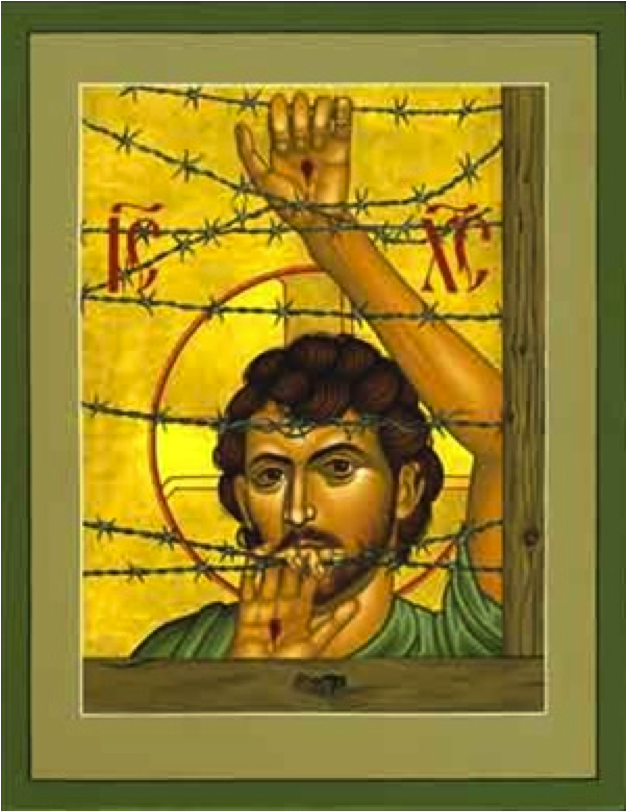
       Icon of Christ on the margins, Br Robert Lentz OFM

Christ for othersMatthew 25 in its entirety presents Jesus teaching on the importance of taking personal responsibility not only for myself, i.e. the individualized society of the mythic autonomous individual, but the importance of taking responsibility for myself as a means, simultaneously, of looking out for my neighbor.

The need to take responsibility for my neighbor affirms the truth that my self-interest is always best served when I contribute to my neighbor’s flourishing. Neighbor is a relational term, and our capacity for relationship rests on the dynamic tension within ourselves between fear, which makes us self-protective, and generosity, which opens us to joy. In a further interesting aside, neuroscanning technology reveals to us that it is the same region of the brain that lights up, whether the subject is experiencing the joy of giving or the pleasure of receiving. Both giving and receiving use the same neurocircuitry.

The parable of the sheep and the goats reveals interdependency as a core value of the Kingdom of God. Neither independence nor dependence, interdependency offers a middle way between the extremes of individualization, everyone out for themselves, and collectivization, everyone subject to the depersonalization of the bureaucratic state.

I am grateful to Carl Gregg http://www.patheos.com/blogs/carlgregg/2011/11/four-spiritual-practices-for-preaching-on-matthew-25-a-progressive-christian-lectionary-commentary-on-mt-25-for-nov-20-2011/  for reminding me of the story in the Prologue of M. Scott Peck’s, The Different Drum; Community Making and Peace. Scott Peck relays the story of the abbot of a dying monastery who seeks the counsel of a hermit in an attempt to find a solution to the monastery’s decline. They talk and pray together but no solution presents. As the abbot takes his leave the hermit casually invites the abbot to consider that maybe the Messiah is already here among his remaining, now aged monks.

The abbot upon his return shares with his brothers the hermit’s invitation. Each monk now begins to contemplate the unlikely prospect that one of his brothers, whom he finds so tiresome, might be the messiah. He even has to consider that he himself might be the messiah and the combination of these two possibilities brings about a dramatic change in the interpersonal chemistry of the monastery.

Families began using the monastery grounds for picnics. Over time, through repeated conversation with the aging, but now newly inspired, monks some of the young men of the vicinity become drawn in the vocation to religious life. Soon new life begins to flow into the old monastery as new young aspirants join.

Christ the King is not a celebration of the kingly power of the Church. It is a recognition of the need to work tirelessly for the realization of kingdom ways.

Kingdom ways, as articulated in the parable of the sheep and goats is more than a simple injunction to feed the hungry, cloth the naked, visit the sick and the imprisoned, as a kind of modern religious social work. It invites us to embrace the image of society as a rich tapestry woven from the exercise of responsibility. This is not a responsibility to maintain our own self-sufficiency. Taking responsibility for ourselves requires of necessity, that we look out for one another.

Jesus invites his hearers to see God in themselves. Usually, we are invited to see God in others, but how can we recognize God in others unless we already experience the presence of God in our own lives?

Gregg also mentions an anonymous Franciscan blessing:

God bless us with discomfort at easy answers, half truths, and superficial relationships, so that we may live deep within our heart. May God bless us with anger at injustice, oppression, and exploitation of people, so that we may work for justice, freedom and peace.  May God bless us with tears to shed for those who suffer from pain, rejection, starvation and war, so that we may reach out our hand to comfort them and to turn their pain into joy. May God bless us with enough foolishness to believe that we can make a difference in this world, so that we can do what others claim cannot be done. Amen

[1] ‘I think we have gone through a period when too many children and people have been given to understand “I have a problem, it is the Government’s job to cope with it!” or “I have a problem, I will go and get a grant to cope with it!” “I am homeless, the Government must house me!” and so they are casting their problems on society and who is society? There is no such thing! There are individual men and women and there are families and no government can do anything except through people and people look to themselves first… There is no such thing as society. There is living tapestry of men and women and people and the beauty of that tapestry and the quality of our lives will depend upon how much each of us is prepared to take responsibility for ourselves and each of us prepared to turn round and help by our own efforts those who are unfortunate.’ Margaret Thatcher 1987

An Adequate Return?

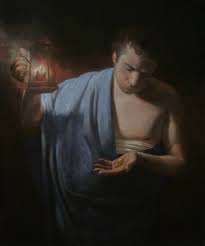
Historical anthropologists tell us that the parable of the talents had a very different set of nuances at the time of Jesus than it has for us today. In the Mediterranean world of antiquity the economic pie was pretty much fixed in size. Consequently, the behavior of the rich in becoming richer was viewed pejoratively, because the enlargement of one person’s slice of the economic pie was predicated on someone else’s slice shrinking. It’s a story as old as time. The rich enrich themselves at the expense of the poor. As Jesus sums it up at the end of the parable:

to those who have, even more will be given, but to those who have not, even what they have will be taken away. 

The rich person, as the man in this story entrusts the management ofimages-1 his wealth to his slaves, some of whom occupied a privileged place as stewards. The parable of the talents as seen within its antiquarian context, is a tale of the complex relationship between the owning class and the stewards they entrusted with the dirty business of growing their wealth. Given Jesus’s strong message on justice, heralding the Kingdom of God, it seems unlikely that he would have approved of wealth creation at the expense of the poor.

From our perspective in the culture of the 1st world of the 21st Century, we hear this parable as a tale of prudent wealth management. We identify with the master’s praise of his stewards who are able, through a combination of calculated risk and skill in the money market, to bring him a handsome return on his original investment. We frown on the steward who buried the talent in the ground because we think this is not a skilful way to manage money. It’s akin to putting it in the bank at 0.1% and leaving it there.

In our world the economic pie expands and shrinks according to the patterns of investment. Consequently, our view of investment in bonds and stocks is a morally acceptable activity. In fact, within the economic values system of Venture Capitalism, it is a praise-worthy activity.

Cultural bias

Culturally, I speak as a New Zealander who between the ages of 22 and 53, spent the whole of his formative years as an adult, in the UK. In both Britain and New Zealand there has been a long held belief in the role of government as an agent for economic redistribution, in the pursuit of social equity. I have been conditioned to value this as an important role for government. Yet, my first-hand experience is of the limited success, indeed of the positive drawbacks of this political approach to economics. It’s a great ideal, but experience shows that perhaps government is not the best agent for ensuring broad economic equity in society. By economic equity, I mean the recognition that no-one makes money on their own. I believe the challenge of our age is to find more effective mechanisms for ensuring a balance in economic interests across the whole of society. I refer to this because, for me, this is as much a spiritual challenge as it is an economic or political one.

Christian attitudes to wealth creation

Christian teaching on the ethics of economic production is most clearly articulated in the social teaching of the Roman Catholic Church. It’s a pity that most of this sound teaching goes unheeded because the noise of the Church’s lamentable preoccupation on sexual matters grabs all the limelight.

Christian social teaching understands that wealth generation has two parts to it. It needs entrepreneurs and risk takers, supported by investors on the one hand. It also needs workers on the other. Workers and entrepreneurial inspired investment are both the necessary participants in wealth generation. A Christian vision is of a society where the contribution of workers as part of the generation of profit is fairly rewarded in terms of respect for the dignity of work, and a fair economic return on labor.  A fair reward should not be limited to the minimum wage. I note that from the workers side, this might not be such a universally popular idea. It’s great to share in the profit, but not so good when you have to share in the risk. In the pursuit of wealth generation profits can go down as well as up. Yet, it is only when profit as well as risk is shared that everyone has an investment in ensuring that economic endeavors are profitable and for the benefit of the whole of society.

Historical context

I find Jesus’ parable of the talents challenging, provocative, comforting, and disturbing, all in equal measure. From my 21st Century perspective it appears to validate the emphasis of our prevailing economic culture. Yet, Jesus didn’t live in our world. He shows little regard for material success. He stands in the Hebrew prophetic tradition of decrying the exploitation of the powerless by the powerful. Following this tradition, until the Renaissance it was forbidden by the Church for a Christian to charge interest on a loan; hence the important role that Jews, who could charge interest, played in medieval banking. So given all of this, what might Jesus’ intended meaning for this tale be?

Matthew locates the parable after the parable of the wise and foolish virgins. So he seems to be extolling in both parables the virtues of responsible and prudent behavior; of the need to be prepared for all future possibilities. Yet, Matthew follows with parable of the sheep and the goats, which seems to be turning the tables on what appears to common sense as wise and prudent behavior in favor of compassionate behavior. The message here seems to be that compassionate behavior conflicts with what seems prudent common sense.

Bringing the parable home

Sunday November 16th is a big day in the life of St Martin’s community. At 4pm we will celebrate my installation as the 12th Rector and at the same time rededicate ourselves to the memory of our patron saint, Martin, Bishop of Tours, and Patron of France. November 16th is also Ingathering Sunday, marking the end point of our month-long Annual Renewal Campaign (ARC).

Despite the ambivalence and enigmatic meaning of the parable of the talents, this tale fits well with our theme of month-long celebration, a celebration of gratitude and a strengthening of our commitment to live more generous lives.

imagesIn my commentary on October 15 lunching our ARC I said:

While there is a practical connection between our annual renewal and next year’s budget, there is no spiritual connection between the two.

The annual renewal process is not about how much money we need for the budget. If needed, that’s a conversation for 2015, but not now. Annual renewal invites us to conduct a spiritual inventory on our attitudes to giving. Our pledge is an expression of gratitude to God, not an offering towards keeping the lights on.

The extent of our gratitude, expressed monetarily, is an important element in our celebration of a feeling of gratitude that brings us to our knees in thankfulness for our experience of God’s generosity.

When viewed from this deeper and richer perspective, the parable of the talents is not about wise financial investment. It’s about the investment of ourselves in the greater life of the community, as the most fruitful expression of thankfulness to God.

It is only when our giving flows generously from our encounter with the sources of our gratitude to God, that it is capable of being for us, an experience of fruitfulness .

We are the talents

I believe the experience of being fruitful is something we are all so longing for. This quality of fruitfulness has nothing to do with how much or how little we have.  Through energy and a willingness to risk, we invest ourselves so that we bear fruit? Through our collective energy we forge a community that makes a difference in the world. Or are we like the talent buried in the ground, keeping ourselves safe and secure, keeping the risks low, and consequently, limiting our ability to bear fruit?

At the end of the parable Jesus says something that seems so out of character:

For to all those who have, more will be given, and they will have an abundance, but from those who have nothing, even what they have will be taken away. 

What if this is a comment, not about material possessions, which would seem to be of little importance to Jesus? What if we read these words as a comment about gratitude? What if it’s a reference to the importance in life of taking risks in pursuit of our passions? We can live safely buried in our own concerns and insulated within our own self-protections. Or we can unearth, as in dig-up our talents, our gifts, our energies, and let our passion motivate us to invest ourselves.

Investment is always about risk. Risk, in spiritual terms is courage. We need courage to trust enough to move beyond the safe and sure, so to embrace generosity as the adequate return on our life’s investment.

The Plight of Virgins

Be prepared!

I remember from my days as a Queen’s Scout that our primary motto was: be prepared! A preoccupation with being prepared, being ready for whatever life might throw is a necessary prerequisite for the autonomous, self-sufficient person in our highly individualized society. I recognise the importance of anticipation in my own life experience.

Of course, no one knows what to expect of the future. We develop a tendency to anticipate events based on what we already know about life. Sometimes experience is an accurate guide, yet, often it is misleading. Facing the uncertainties of the future armed only with the incomplete recollection of past experience, feeds the wellsprings of anxiety in most of us. This is where the scouting motto: be prepared,  is a comfort. It’s a comfort because it insulates us within the illusion that we can be ready for what-ever lies around the corner.

The illusion of being prepared is to some extent a comfort. Being prepared is an important element in my own life narrative, i.e. the story I tell myself about who I am and why I am the way I am. The problem with anticipation as an expression of needing to be prepared is that it encourages risk adversion in life. Life lived too safely, is a very unsatisfying experience!

Our preoccupation with being prepared makes us vulnerable to judgment. Here I am referring to our need to judge others as a way of putting clear blue water between us and them. In our society we reserve our harshest judgments for those who fail the be prepared  test. How easily the phrases: well it’s his own fault,  or  she has no one to blame but herself, or its time they really took responsibility for themselves, trip lightly off my tongue. In fact, one of my favourite comments to friends of either gender is: oh, what a foolish virgin you’ve been!

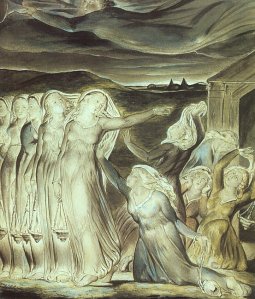
Referring to the parable of the wise and foolish virgins is my tongue-in-cheek, way of being ironic. Irony is one of the higher achievements of British culture. Irony doWilliam_blake_ten_virginses not always translate well in the American ear.  I am attempting through reference to the parable of the wise and foolish virgins, to attribute another’s misfortune to their own fecklessness, or carelessness, or maybe even their negligence. This safely distances me from my own anxiety that: there but for my vigilant preparation, go I.

The parable of the wise and foolish virgins so easily lends itself in support of a very unattractive quality of smugness or complacency. I remember a popular aphorism growing up: I’m alright Jack! This expresses a complacency in thinking that because I am in a good place, that’s all that matters.

Historical distance 

Matthew’s parables of the Kingdom are a reworking within the priorities of his own context the powerful and often disturbing images that Jesus employed to communicate the radical nature of God and the expectation of the Kingdom. Matthew’s context is one of bitter controversy. Acrimony between Jew and Jewish followers of Jesus, and between the gentile authority of Rome and the growing number of gentile followers of Jesus. These external tensions are played-out between the various elements that are coming together to form the fledgling Christian community. The tensions in the Matthean community around inclusion and exclusion were very real. Communal survival is all. Individual survival is linked to communal survival. Matthew emphasizes the consequences of failure as in being unprepared. The denouement with which he brings each of his parables of the Kingdom to a close offers a threat of terrible exclusion as the punishment for being unprepared.

Moral failure

The early Church was gripped by the expectation of the imminent return of the Lord. Yet, as they waited day-by-day, month-by-month, year-by-year, they experienced the inexplicable fact of the Lord’s delay. The picture of the virgins, waiting for the return of the bridegroom is a powerful metaphor for the experience of the early Christians. They found themselves waiting. Waiting is difficult because it involves being caught between the expectation and its delayed fulfillment. Waiting is the most difficult of all the experiences that we face as human beings.

Be prepared!, is a warning from Matthew to his readers lest they succumb to the anxieties of waiting and fall away. Afterall, how were the early Christians to endure their suffering without the expectation that the coming of their reward was immanent? A reward they would enjoy only if they remained prepared. Being prepared is nothing short of the discipline that ensures survival.

A deep uncertainty plagued Matthew and his community. This same uncertainty dogged the lives of all the early Christain communities. A deep uncertainty plagues our own communities today, but the nature of the uncertainty calls for quite a different response.

For us the sources of anxiety in waiting are different from those of the early Christians. Episcopalians, at least, do not seriously anticipate the imminent return of the Lord. For us, the need to be prepared is the way we defend against the vagaries of everyday experience. A different kind of judgement is reserved for the unprepared in our own day. Being cast into outer darkness where there is much gnashing of teeth has been replaced with a need to attribute moral failure to those who are less prepared than we might be. Through this attribution we distinguish ourselves from others less fortunate than us. We comfort ourselves with the belief that their experience is different from ours. The unprepared are not those who will fail to get into the Kingdom. For us, those who seem to be unprepared for life’s vicissitudes are the spectre of what we most fear in modern life, i.e. loss of control.

The troubling question

I know how Matthew uses this parable but I still wonder how Jesus might have used this parable? My guess is that it formed part of a more extensive teaching about the need to make a choice. Will you choose to be aligned with the coming of God’s Kingdom, or not.

We have something in common with the early Christians. We too struggle to survive the experience of waiting. In a time of waiting, the delay in the fulfillment of our expectation plays havoc with our sense of certainty. We crave the certainty of being able to predict what to expect and when to expect it. Otherwise, we ask, how else can we safely know what is reliable and what it not?

Bringing the parable home

The context in which I reflect on this parable is one in which my community, St Martin’s on Providence’s East Side, is engaged  in its Annual Renewal Campaign. The parable of the wise and foolish virgins is timely, as well as troubling. This is a parable that reinforces notions that we live in a world of scarcity. In a culture of scarcity, you keep what you have by not sharing it with others. Within a worldview that sees resources as limited, the pie is only so big. People of necessity are divided into the haves and the have-nots. At St Martin’s there is no mistaking that we are among the haves when the world is viewed from the perspective of scarcity.

I am finding that my invitation for us to come together and share stories of gratitude to God, as a way of encouraging one another in generosity of spirit, is receiving a mixed reception.  Some people get the message about gratitude and generosity immediately and respond with enthusiasm. Others, are clearly bamboozled by the message and respond with caution or resistance. Others still, see the message as a cleaver and devious ploy to get them to open their pocketbooks. The question in these people’s minds might be: if he’s really talking about money then why not come straight-out with it?

Buried within the invitation to celebrate gratitude and generosity lies a different question. This is: what is our attitude towards money and our practice of using our money? Do we hoard it in fear of not having enough, or do we share it, letting it flow from our experience of abundance as a force for the greater good?

Celebrating gratitude and generosity is celebrating our actual experience rather than focusing on our fears. Our actual experience is one of abundance through which we expose as a lie, our fearful assumptions of scarcity!

What I invite the members of my community to consider is simple. How can we reconnect our giving with our experience of gratitude and generosity – our experience of God’s gifts of abundance to us? It is only when our giving flows generously from our encounter with the sources of our gratitude to God, that it is capable of being an experience of fruitfulness for us. I believe the experience of being fruitful is something we are all so longing for. This quality of fruitfulness has nothing to do with how much or now little we have.

Foolishness?

Back to the parable of the virgins. One question keeps nagging at me. Why didn’t all the virgins just go into the wedding breakfast upon the bridegroom’s arrival? They all went to sleep while waiting. So, unlike in other parables falling asleep is not the offence. During the time they were asleep 1024px-Schadow,FW-Die_klugen_und_törichten_Jungfrauen-1they continued to burn oil and so why didn’t the virgins who were running short simply exclaim their delight at the bridegroom’s arrival and dance into the wedding breakfast behind him? Afterall it’s not their fault the bridegroom is delayed. Instead, they panicked and went rushing off to buy oil from shops already long closed for the night.

Why did they panic? The bridegroom is clearly a metaphor for Christ, who is more likely to have rejoiced in their having waited for his arrival.  The reaction of these women to the bridegroom’s arrival has the whiff of shame about it. What is their shame? It smells to me to be their failure to be self-sufficient. We all know that failure to be self-sufficient leaves us feeling foolish. They feel foolish and even in olden times, feeling foolish seems as frightening a prospect as it remains today. Their foolishness lies in their lack of self-sufficiency, they are the losers in the: I’ve got enough, I’m alright Jack, game

Isn’t self-sufficiency the enemy of gratitude?

So Great a Cloud of Witnesses

Prelude

In the Piers Paul Read’s novel The Death of a Pope a conversation is taking place over dinner in Kampala, Uganda between a young English reporter named Kate and a Catholic aid worker named Uriarte. Uriarte in explaining to Kate Uganda’s tribal and political complexity mentions the forty-five Bagandan Christian martyrs slain by the 19th century King of Baganda, now modern-day Uganda. Of the forty-five martyrs twenty-two were Roman Catholics, and the rest Anglicans. Uriarte says: the Church flourished on the blood of the martyrs …. it was like the early days of the Church. The Twenty-two Catholics were canonized by Pope Paul VI. Kate asks: Aren’t the Anglican martyrs in Heaven? Uriarte smiles: I dare say, but the Church of England doesn’t make saints. They don’t have a pope.

Of Saints and saints

On the pecking order of sainthood the martyrs are the crowning glory. However, as Uriarte hints at, it remains a thorny question as to what we mean when we talk about the saints? Because the word saint has two distinct meanings depending on whether you are using a capital or a lowercase s. Uriarte is correct, Saints can only be made by the Pope, which after the Reformation severely limits Sainthood to members of the Roman Catholic Church. It’s a nice question: what is the post-death status of the Anglican martyrs, are they non-official Saints or merely saints?

There are three qualifications for becoming a Saint. The first is quite simple, he or she must be dead! The second qualification is she or he needs to have been an elite Christian, having at least one attested miracle to their name. The third qualification is having the good fortune of being in communion with the Bishop of Rome.

Episcopalians, being Anglicans can’t make Saints anymore.  The feast of All Saints is nevertheless so important a celebration that it is only one of four feasts that the Prayer Book allows to take precedence over the propers for the Sunday nearest November 1st.

Yet, what about the saints, the ordinary Christians who have died without any record of having lived lives of extraordinary holiness, or died the death of a martyr? Traditionally, these we commemorate in more mournful tones on November 2nd with the feast of All Souls.

The Three-Tiered Universemichelangelo-buonarroti-the-last-judgement-1534-41_i-G-66-6636-GRUE100Z

The division between All Saints and All Souls represents the Medieval conception of the three-tiered universe. This vision drew extensively from the Apocalyptic literature of Old Testament in writings like the book of Daniel, Enoch, 1st and 2nd Maccabees. This tradition is carried over in full voice into the New Testament in the book of Revelation.

An apocalyptic theme concerns the fate of the souls of the righteous. These were they who had suffered gruesome martyrdom for the sake of the Nation of Israel. By the time of Jesus, the souls of the righteous were understood to rest in the hand of God where they awaited a full bodily resurrection at the time of the coming of the Messiah.

Drawing upon this apocalyptic theme, Medieval Christianity pictured the Saints occupying the top-tier of the three-tiered universe. They were called the Church Triumphant and it is they that the writer of  1 John pictures in the year A epistle for All Saints. The souls of the ordinary dead, those non-elite Christians in life, occupied the second tier, called the Church Expectant. Their souls did not dwell with God but following death waited in either in a state of suspended rest or writhing in pains of Purgatory, depending on your theology. Here, like the righteous heroes of Israel awaiting the coming of the Messiah, expectant souls must await the Parousia, i.e. the Second Coming of Christ.

At the Second Coming of Christ all the dead, both the souls of the Saints in triumph and the souls of the saints in expectation were to be raised to bodily form again. Resurrection, the return to embodied life, as demonstrated by Jesus was not merely a spiritual life after death, which state the Saints in triumph already enjoyed. Resurrection both in Second Temple Judaism and early Christianity meant embodied life . As N.T. Wright calls it: not life after death, but life, after life, after death.

Which brings me to the third or bottom tier of the three-tiered universe. Here the still living remained in the Church Militant, here in earth. The living, those who in the words of the great hymn For all the saints, still vainly struggle in the hope that maybe at the end of time, they too, will in glory shine.

The Communion of Saints

Today, the echo of the three-tiered universe still permeates our imaginations. Yet, it no longer dominates our rational minds. Consequently, the division between All Saints and All Souls is falling away. Today, we tend to run the two together in one great celebration of All Saints, replacing the Medieval tiered universe with the image of the more egalitarian Communion of the Saints. This is an image of that great cloud of witnesses, envisioned by the writer to the Letter to the Hebrews, surrounding us with perpetual prayer and love.

We experience the presence of the saints both with an S and s in our lives through the concept of being in relationship. Relationship ties people together in this life. Relationship continues to unite us with our dead loved ones and all those whose witness in life provides us with hope and courage for our living. This is why in our Anglican Tradition, though we can’t make new Saints we continue to remember exemplary Christians in our calendar of Lesser Feats and Fasts, now rechristened Holy Men and Women in its latest edition. The Saints, those canonized by a pope, and the saints, those we continue to remember are now seen as one, united together with the living within the one Communion of Saints.

For me, the division between All Saints and All Souls, no longer resting on a hierarchical distinction between Saints and saints continues to have some meaning, but only in a psychological and not an eschatological sense. Psychologically, the experience of death carries both the hope life with God and the sadness occasioned by the loss of loved ones. Human Beings need both to celebrate and mourn in the face of death. The different notes struck by All Saints and All Souls do at least honor this dichotomy of need.

Going Back to the New Testament

The writer of I John, states: Beloved, we are God’s children now; what we will be has not yet been revealed. What we do know is this: when he is revealed, we will be like him, for we will see him as he is. It’s easy to picture being like God as an image of perfection. Yet, in the Beatitudes, Jesus paints a different picture of what it might be to be like God. In the New Testament saint does not refer to the elite Christians whose souls now enjoy immortal life with God. It refers to ordinary Christians engaged in the daily tasks of discipleship on this side of the grave. The hymn I Sing a Song of the Saints of God picks up this idea. Allowing for its rather quaint English schoolboy/girl imagery it hits the nail on the head:

SAM_0018

 …the world is bright with the joyous saints who love to do Jesus’ will. You can meet them in school, or in lanes, or at sea, in church, or on trains, or in shops, or at tea. 

In the New Testament to be a saint you don’t have to be dead. Matthew tells us that Jesus turning to his disciples began to speak:

Blessed are the poor in spirit, for theirs is the kingdom of heaven. Blessed are those who mourn, for they will be comforted. Blessed are the meek, for they will inherit the earth. Blessed are those who hunger and thirst for righteousness, for they will be filled. Blessed are the merciful, for they will receive mercy. Blessed are the pure in heart, for they will see God. Blessed are the peacemakers, for they will be called children of God. Blessed are those who are persecuted for righteousness’ sake, for theirs is the kingdom of heaven. Blessed are you when people revile you and persecute you and utter all kinds of evil against you falsely on my account. Rejoice and be glad, for your reward is great in heaven, for in the same way they persecuted the prophets who were before you.  (Matthew 5:1-12 NEB) 

Baptism not death

In the New Testament it is through baptism not death that we become saints. Through our baptism we come into relationship together within the community of Christ’s Church. Here we participate in the miraculous at the level of everyday living. On this All Saints Sunday despite not having a pope, we at St Martin’s are making a saint. His name is Benjamin Liam McCloskey. Benjamin, through baptism joins the company of saints, which is the way the New Testament talks about communities of Christians like the one at St Martin’s.

Miracles

You could see miracles as expressions of the extra-ordinary. However, I find this completly unhelpful, because I do not have any experience of the extra-ordinary. I live amidst the ordinary experiences of everyday life. Therefore, for me this is what the miraculous of the everyday looks like:

  • It is the act of listening bringing the miracle of healing to a brother or sister in pain.
  • It is standing in the place of fear with another, sharing our common humanity with one another, standing together and surviving being afraid.
  • Sharing our joys and being open to the infection of another’s joy and delight.

Through the miracles of everyday life we advance the Kingdom Of God in the here and now with:

  • The smile of acceptance of another’s difference
  • The pledge of solidarity with another’s struggle
  • The generosity and grace in providing material support of money or food to another in need

I call these miracles because through them we participate in God’s regeneration of the world through acts of grateful love and generous service.

Postlude

I continue to remind all of us at St Martin’s concerning this month of our annual renewal program. Our focus is a challenging one for many of us conditioned by the idea of giving to the budget. The focus I want us to have is on gratitude to God; an experience from which the exercise of tender competence for one another and our world flows.

At the heart of this process is an invitation. God is inviting each one of us to connect with the sources of gratitude in our lives and to become accountable to our calling as God’s saints.  God invites you and me to live up to the nobility of our saintly calling by never missing an opportunity to embrace a generous action. Gratitude, generosity, and service, these are the building blocks in the Kingdom of God. The Kingdom of God, like being a saint, is not something for the life hereafter. It is living and active, cutting like a two-edged sword in the here-and-now of our lives together. We have a role to play: be it high and lofty, or down and dirty, for the saints of God are folk like me, and as the hymn quoted above end: and I mean to be one too! 

Matthew 22:15-22

There is a change in tone and feel as Jesus arrives in Jerusalem fresh from the hopes and excitement of his teaching ministry in Galilee. The mood becomes increasingly confrontational. Jesus’ focus becomes one of avoiding the traps that are being set for him.

images-1In the atmosphere of religious and political extremes that characterized Jerusalem under the yoke of Roman occupation, there is small wiggle room between blasphemy on the one side, and treason on the other. It’s into this double-bind space that a particularly, unholy alliance of Herodian (the royal party of collaboration) and Pharisee (the religious part of religious reform) factions seek to lure Jesus. The question is: is it lawful to pay the poll tax (a flat-rate personal tax) to Rome? If Jesus answers yes, he commits blasphemy – admitting that Caesar is a rival authority to God. If his answer is no, he commits treason – denying the authority and what’s more the divinity of the Emporer.

How will Jesus answer them? To answer yes, or no are both dangerous options. Yet, so too is any attempt to offer a middle way answer.  As we know only too well from contemporary American political debate, when an atmosphere of fear and mutual contempt characterizes a separation of competing political and religious world views, a moderate view pleases no-one.

One can only admire Jesus’ dexterity. With one question: whose, head is on the coin?  he draws both interlocutors into the trap they think they are setting for him. I imagine it’s one of the Herodians who produces the coin. To possess such a coin within the Temple precincts is in itself an act of blasphemy. Caesar’s head, a forbidden graven image, appears on the coin. However, it’s the inscription that encircles the head of Caesar that proclaims him as divine that goes to the heart of the matter. Jesus’ next move is to state that some things are owed to civil authority and some things are owed to God. It appears simple, honor your obligation to each and don’t get them mixed up!

Jesus answers by not really answering. His answer silences his opponents, but we are still left with the unanswered question: what does he really mean?

Separation of Church and State

The health of the American body politic rests upon several nice and images-1neat separations connected with today’s Gospel reading. The most obvious is the separation of Church and State enshrined in the Constitution.  We are mostly, in agreement that: render unto Caesar  means an obligation to submit to the lawful exercise of civil authority. Therefore, although some of us question the right of the government to levy taxes, few of us refuse to pay them. We are less clear as to what: render unto God the things of God, means.  Why might that be?

Jesus, the Pharisees, and the Great Seal of the United States are all in agreement. Each affirms the truth of the motto on the Great Seal: In God We Trust. It’s an interesting aside to note that from 1782 until 1956 the motto on the Great Seal was : E Pluaribus Unam -out of many, one. In 1957 it was changed to: In God We Trust. Interesting to speculate on the reason for the change. But best not go there at the moment.

In other words, there is a legitimate distinction to be made between Church and State, but not between God and State. Yet here, as in most areas of our lives we play a subtle game of selective cognizance.

Ownership, allegiance, and accountability

There’s a nice story told about the Christian conversion of the Gauls.images-1 When the Christian missionaries led these Celtic warriors into the water for baptism, as the man was submerged under the water he raised his right arm up so that his arm and hand remained above the water.  The intent here is clear. The warrior was saying: my sword arm and hand do not belong to God and with these I reserve the right to kill and maim. 

Whatever the historical veracity of this story it reflects a common view today. While we may be made in the image of God and therefore everything about us belongs to God, our money at best – belongs to us, and at worst – to the Government. As I like to put it, we live as if our hearts belong to God, but not our wallets.

The heart of this Gospel encounter is not concerned with creating a clean separation between God and Mammon, or between civil and religious authority. The central issue concerns allegiance and ownership. To whom, or to what do we owe allegiance? Over which aspects of our life do we have a right to exercise ownership?

The way we choose to answer these questions reveals the kind of persons we long to be, as well as the kind of community we envision ourselves becoming?

Getting to the point

At St Martin’s, Sunday October 19th is when we launch our Annual Renewal Campaign (ARC).  The Church tells us that stewardship is more than what we do with our money. But we all have a sneaking suspicion that this is mere window dressing when the only time of the year we really address issues of stewardship is in preparation for setting the next year’s budget.

You don’t need me to tell you that money matters. It matters because like every other aspect of our lives money goes to the heart of our spiritual values. Episcopalians often have an impoverished thinking about our financial pledge. We see it as giving to the parish budget. How unsexy is that? Neither is it very spiritually fulfilling! We have a need to expect that our financial generosity will bear richer fruit. Through our giving we long for fruit that leaves us with a sense of having made a difference, and not simply kept the lights on.

So, let me reframe. Let me state that while stewardship is a year-long program of nurturing the life of our community, it commences with the conversation about our accountability before God in the area of financial responsibility. The Gospel we hear today invites us to see stewardship hinging upon the core issues of allegiance and ownership. While there is a practical connection between our ARC and next year’s budget, there is no spiritual connection between the two. This bears endlessly repeating!

There is a real synchronicity between our ARC and the Gospel of the day. Several questions occur at this point:

  1. The main question is not how much do we need to give to meet next year’s budget? The question before us is to whom do we owe allegiance for everything that is good in our lives?
  2. Do we view the use of money in relation to our primary allegiance to God, or is money, in effect our Celtic warrior’s sword arm?
  3. Do we think our financial health and security are the fruit of our own achievement, or the grace-filled gift from God?

Jesus’ confrontation with the Herodians and Pharisees challenges our comfortable assumption that our money is the product of our own skillfulness, our own good luck, or our privileged ability to command a nice financial reward? Jesus challenges us to think about our primary allegiances. He also invites us to an encounter with gratitude as our response to God for the good things we have been given to enjoy.

The process

On November 16th, our ARC concludes with Ingathering Sunday. This is also the date the Bishop comes to install me as St Martin’s 12th rector.  Our theme between now and then is not how much do we need to give to next year budget. Our theme is celebrating our community’s rich human potential. We begin with an acknowledgement of gratitude to God for the many gifts, imagesstrengths, and qualities that already characterise our individual lives, and life together in our St Martin’s community.

As we celebrate these things, I invite us to enter into an intentional conversation together about gratitude and generosity. In the coming week you will all receive a communication from me in the mail. In it I explain in more detail how we might go about structuring our conversation about gratitude and generosity.

These conversations begin from an encounter with our a debt of gratitude to God. Drilling down to the next layer, I invite us to specifically reflect on three further questions:

  1. Who are the persons who fill our lives with a joy and quality of life that brings us to our knees, overwhelmed by a deep thankfulness to God? A variation on this question might be for some of us, who have the persons been that have filled our life with a quality that continues to overwhelm us with a deep thankfulness to God?
  2. What are the experiences, the events that have deeply shaped our lives, experience of grace and love given to us against all the odds of probability, that on contemplation bring us to our knees in thankfulness for the reckless generosity of God?
  3. Reconnecting with these places of personal encounter with the generosity towards God, can we risk to share our experience of gratitude, inviting others to open to a similar experience in their own lives?

In conclusion

Jesus answers his opponents by implicating them in the tensions they seek to entrap him within. His answer silences them, but we are still left with the unanswered question: what does he really mean?

It is never an easy task to negotiate our way in today’s world amidst the many siren calls that offer attractive, yet fruitless allegiances. Today’s Gospel challenges us to consider how we displace God from the center of our sense of allegiance. Thinking of ourselves as the source of the good we enjoy, seeing ourselves as the ultimate authority is the best definition I know of blasphemy.

In my own life I note how an allegiance to fear, to power, or the complacency of success, continually tempt me. Jesus does not say that it is easy living in the tension between the things of Caesar, and the things of God. He simply warns us about the competing powers and influences vying to sway us, to capture our hearts, and ultimately to own us?  When we displace God as the focus of our allegiance we render ourselves vulnerable. Under the illusion of owning ourselves, we become vulnerable to being owned by competing worldly allegiances.

Jesus’ interlocutors in today’s Gospel go away amazed. I invite us to deepen our community’s financial stewardship conversation over the next weeks through a personal encounter with our experience of gratitude for God’s generosity. Who knows, maybe we too can become amazed by what we begin to glimpse ourselves being capable of.

Dressing for the Kingdom

I don’t know when bifocal spectacles were invented? I do remember when I was young seeing people with two pairs of spectacles – one for short and one for long sighted purposes. You sometimes still see the older style of bifocals -you know, the ones with the clear line across the middle, separating short and long sighted lenses. Most of us who are able to tolerate the initial disorienting effect until our vision adjusts are thankful for the invention of varifocal lenses. Varifocals enable the wearer to move seamlessly from short to long sighted zones in what otherwise appears to the naked eye to be one undivided lens.

I offer this as an analogy for reading scripture. This analogy is particularly useful in learning how to read the Gospels. The Gospels are the foundational narratives of the Christian Faith, in that they weave accounts of the earthly life and ministry of Jesus. From Gospel to Gospel, these accounts are similar, and yet quite different in emphasis. They spin the story of Jesus.

I feel we need to rehabilitate the word spin. We tend to use it pejoratively today because we live in a world where mass means of communication bombard us with catch phrases and sound bites, which it seems are often designed to obscure rather than clarify truth. Yet, when it comes to story, there is no objective independent story telling. There is only the story as a construction of experience. Stories make sense of the complexity of our experience of the world. It is this process of constructing meaning, rather than obfuscation that I mean when I use the word spin

All stories contain spin, even our own life stories, as I explored in my entry – If to err is human- so too is to forgive[1]. This is also true of all Scripture. We need a good pair of varifocal lenses, firmly planted across the bridge of our noses when we come to read the Gospel texts.

Through the close-up lens

Matthew 22:1-14 through the short-sight zone of our varifocals appears as a quite extraordinary tale. It assaults our sense of credulity at more than one point. In last week’s reflection- Might Jesus have been a Pharisee, I described the parable medium that Jesus used as his primary teaching tool as a story of the everyday life that suddenly whacks you in the side of the head. Today’s parable of the royal wedding feast not only whacks us in the side of the head, it delivers a punch or two to the gut.

The parable

It’s a story about a King who invites people to the wedding of his son. When he finds out that his selected guests have not only declined his invitation but they have killed the servants bearing the invitation. He retaliates by sending out the militia and not only killing them all, but devastating their city, as well. Now it’s not lost on us that the king is clearly a representation for God. So it’s particularly difficult for us when we read that God behaves vindictively to such devastating effect – whack!

The King then sends his servants out to invite anyyone they encounter in the streets, regardless of their station in life or the morality of their lives. Aahh, we sign in relief, as God seems to have recovered and is acting back in character. For over the last few weeks in the parables of the vineyard we have been presented with images of God as a reckless practitioner of generosity.

All seems well. The wedding hall is full to over flowing and a beaming King makes his entry only to discover that one of the guests has gained entry without the seemingly required wedding garment – where did that requirement suddenly spring from? The King a.k.a, God seems to lose it again and has the man cast out of the feast and condemned to outer darkness – i.e. damnation – whack, whack, punch! 

In short sight this is not a story that inspires in us much confidence in being able to safely predict God’s behavior. After all, our feeling safe as a condition for being able to trust one another rests firmly on our being able to reasonably predict one another’s behavior. We get really nervous when someone starts acting unpredictably, God included.

This leads me to the question: so is this parable helpful in any way? What on earth is Jesus’ point here? The moral of the story seems to be: be careful when refusing invitations, and if you do accept, make sure you have the right clothes for the party.

Through the long distance lens

As we lift our eyes towards the long-sight zone of our varifocals we begin to discern the outlines of a different story. To put it boldly, this original Jesus parable is being spun by Matthew for his own purposes.

Matthew is telling a related, but quite different story from the one Jesus tells in the context of his confrontation with the Temple authorities. It’s related in that we can still discern Jesus’ teaching, but this core teaching of Jesus is overlaid with the events and concerns that are dominating the lives of Matthew and his community.

Matthew’s story is that God invited his beloved Israel to his royal banquet, but Israel declined to come. Not only did Israel decline, but it acted violently towards God’s servants, a.k.a, the Hebrew Prophets, and ultimately towards the fulfillment of the prophets, Jesus himself. God punished Israel by sending the Roman Legions against Jersualem, killing and scattering its populace and laying waste to the great Temple. The Roman destruction of the Temple in 70 AD takes place a good 40 years after Jesus death. With hind-sight Matthew, writing around 90AD inserts this event into the original parable of Jesus with the line about the King’s retribution. This becomes clearer to us as we look at the text through our long-sight lens.

In Matthew’s story the guests at the banquet are now the rag-tag collection of odds and sods, forced into a new community as a result of being outcast from their community of origin, i.e. the fledgling Jewish Christians who are now outcast from their synagogues. This new community needs to construct its own story to help it make sense of the new situation it finds itself in. Matthew, in continuity with Jewish tradition is their scribe. Like all scribes throughout Israel’s history, his job is to reinterpret the faith story in the light of current events.

Matthew tacks onto the end of the parable about the royal wedding a quite separate story about the wedding garment. If this is original to Jesus, it must come from a completely different context and so its original meaning seems unclear. What Matthew intends it to mean however, is clear. Within this rag tag band of odds and sods, that is the emerging Church, while many differences must be tolerated, there are some fundamental standards that are to be enforced to ensue good order. The wedding garment is a metaphor for correct behavior.

What might correct behavior mean in Matthew’s community? Correct behavior in any community is more than obeying the by-laws and reflecting the socially accepted norms. Correct behavior is behavior that strengthens the bonds of affection, friendship, relationship, and commonality. Maverick and unpredictable behavior that sows seeds of discord and corrodes trust in the members of a community’s ability to communicate effectively with one another is the equivalent of being found at the banquet without the right clothes. Matthew is saying, in his new and vulnerable community this kind of behavior cannot be tolerated. I might add that no community, fledgling or otherwise, is able to tolerate for too long the behavior of individual members when it corrodes the bonds of relationship and trust.

Taking our varifocals off

Taking our varifocals off for a moment we now begin to reflect on the parable of the wedding feast and its appendix, the story of the wedding garment, from our own contemporary perspective.

When we interpret this parable within the wider message that Jesus teaches concerning the expectations of the kingdoms, what kind of story do we receive? This is a story about invitation and response to invitation. Like the Hebrew Prophets who precede him, Jesus issues God’s invitation for us to return to the covenant, which God established with Abraham and has renewed again and again throughout history. So when the king a.k.a, God, finds that those he longs to invite to his banquet decline, he reissues the invitation again and again. Maybe the original invitees do or don’t accept, but over time many who initially were regarded, or may have regarded themselves as not among the invited, with joy receive and accept the invitation.

The theological nature of acceptance

You and I are the recipients of an invitation to come into covenant with God, made new through the death and resurrection of Jesus Christ. Like Matthew, we too are scribes of the Kingdom and in our interpretation of God’s invitation, the covenant with Israel has not been superseded. It has simply been extended so that it now include us. Perhaps we have not seen it that way?

The personal nature of acceptance

Perhaps we have assumed that we are not included in the invitation. Or perhaps we have taken our invitation so much for granted that we have neglected to actually accept. As we come into covenant with God, there is a clear sense that each party to the covenant bears an appropriate responsibility. When one party fails to discharge their responsibility then the covenant is rendered inoperable.

Jesus is saying to us that the primary expectation for the coming of the kingdom is that we will respond to God’s invitation and take up our responsibility to collaborate with God in the Kingdom’s coming. A fruit of that acceptance is the fostering of deep and meaningful bonds between us within the context of our community (ies). It is to us as a community that God speaks, and it is from and through us working together as a community that the expectations of the Kingdom will be advanced. Perhaps we have not understood it this way?

The banquet as a metaphor for the Kingdom

Having accepted God’s invitation to become co-creators of the Kingdom, it is important that our clothing reflects the gravity of our having been invited into covenant by God. At St Martin’s our response to God’s invitation means putting on our most festive clothes and throwing ourselves extravagantly into a celebration of our diversity, and the rich human potential of our members. We celebrate our enormous potential as a community to make a difference in one another’s lives. We celebrate with gratitude and thanksgiving the abundance of God’s generosity towards us. Through our celebration of our common life we work tirelessly to make a difference in the world around us, a world in desperate need of the celebration of the love of God.

Over the coming month, the month of our Annual Renewal Campaign, how might we as a community join together in affirming our acceptance of the invitation to come in covenant relationship with God? Might we not put on our wedding garments and celebrate with true joy our God’s generous invitation to make the Kingdom real in our own time? An invitation requires an acceptance to become effective. Let’s not overlook our responsibility to respond.

[1] https://relationalrealities.com/2014/09/13/if-to-err-is-human-so-too-is-to-forgive/

Might Jesus have been a Pharisee? A commentary on the Parable of the Wicked Tenants.

Jesus offers three parables concerning vineyards. Two weeks ago we explored in the sermon entitled Lord, do not give us our just deserts, the parable about the hiring and payment of workers in the vineyard. The storyline of this parable presents us with an interesting twist on generosity. We are shown that the generosity of God is somewhat reckless and makes no sense to us. It is in fact, an affront to our normal expectations of fairness. It turns our sense of justice upside-down.

Last week in the parable of the two sons concerning their father’s request to work in the family vineyard we explored our need to experience ourselves making a difference in the wider world. By accepting God’s call for us to enter into a collaborate participation within a parish community, we can make a difference in the world. You can read more at Making a difference.

wicked tenantsToday we receive a further parable concerning the action of wicked tenants who through murder attempt to dispossess a vineyard’s rightful owner. Of the three vineyard parables this is the most challenging and difficult for us to interpret.

The parable as a story rooted in a social and economic context

Jesus has just arrived in Jerusalem having journeyed from Galilee. As it remains today, Galilee was the northern most province of Jewish territory. In the 1st Century however, the population of Galilee was mixed. A largely, Jewish rural peasantry lived alongside a Greek and Roman urban commercial class. Together with the local Jewish aristocracy, the gentile commercial class owned large tracts of land, which they leased to be farmed by the Jewish tenant farmers. This constituted a traditional feudal economy.

An escalation in rural unrest swept the Galilean countryside as the feudal balance of privileges and obligations between landowner and tenant farmer came under threat from the increasing commercialization of farming, necessary to meet the growing food security needs of the Roman Empire. This situation, not unknown in our own day resulted in severe exploitation of the tenant farmers, who in many cases were being reduced to landless peasant laborers. The plight of the itinerant peasant laborers is clearly at the heart of Jesus’ parable of the workers in the vineyard.

The parable of the wicked tenants is a tale of the violent resistance of tenant leaseholders to a shifting economy, a shift that results in growing general unrest throughout the Galilean countryside. 

The parable as a story rooted in a conflict between power and authority

Having arrived in the Jerusalem Temple, Matthew shows Jesus embroiled in an escalating argument with the Temple authorities. The Jerusalem Temple was not only the center of Jewish religion, it was also an oppressive socio-economic institution that taxed and controlled the populace as a proxy of the Roman occupation. Jesus is directly challenging the corruption of religious authority through the influences of economic and social power.

In the vineyard parables, and especially in the parable of the wicked tenants, Jesus is asserting his claim to represent the Kingdom authority of God. The Kingdom of God is a concept at the heart of the Oral Tradition of the Jewish prophets. This tradition rails continually against the political corruption of the Law of Moses and the exploitation of power under the guise of religious authority.

Listen to another parable, Jesus says to the priests and scribes. By telling the story  as a story echoing the socio-economic tensions of the time, Jesus plays on their aristocratic outrage in the face of the affront to their rightful privileges posed by resistance of the populace. In this reading the Temple Authorities see themselves as the legal landowner. Yet, Jesus’ story also contextualizes a much older story that would be known to his hearers. Jesus echoes Isaiah’s vineyard parable set as the first reading of 17th Sunday after Pentecost.

Parable genre

The parable is a form of story telling that lures hearers into a false sense of security. It invites them to identify with the familiar elements in the storyline so as to paint themselves in the best light. Just when they are comfortable it whacks them in the side of the head with a conclusion that is so counter intuitive as to seem outrageous.

Now when the owner of the vineyard comes, what will he do to those tenants? They said to him, ‘He will put those wretches to a miserable death and lease the vineyard to other tenants who will give him the produce at harvest time’. Now Jesus whacks them. Have you never read the scriptures: … when the chief priest and the Pharisees hear this … they realized that he was speaking about them.

Matthew’s use of Jesus’ parable of the wicked tenants

Matthew adapts the parable to speak to his own context. For Jesus, this parable, along with all the parables he tells, but especially the vineyard parables, proclaims the expectation of the Kingdom of God. The expectation of the Kingdom reveals how God sees things within the context of the in-breaking of a new divine order. For Matthew the parable becomes a story about the Christian Church. Matthew and all the Evangelists conflate the Kingdom and the Church. To this day we inherit a long tradition of seeing the Kingdom and the Church as if they are coterminous. Jesus speaks only about the Kingdom.

Following Matthew’s lead, the Christian Church, conflating Kingdom and Church, has interpreted this parable as a parable of how God as the landowner has expelled the wicked Jewish tenants and given the vineyard to the new Christian tenants. God sends the prophets of Israel again and again to call the Jewish tenants to pay what they owe. Each time they kill the prophet. Finally, they kill the heir, i.e. Jesus. God punishes Israel by removing it from the tenancy.

This reflects the struggle of Matthew’s small and fragile Christian community against the powerful synagogues with their Pharisee rabbis. Matthew’s treatment is understandable within his context. Yet, from the end of chapter 21 and throughout 22, Matthew ratchets up an astonishing invective against the Pharisees. 2000 years of anti-Semitism flow from Matthew’s and the other Evangelists adaptations of the teaching of Jesus to their contexts.

This last week, our Jewish neighbors have been celebrating their High Holy Days, from Rosh Hashanah and Yom Kippur, the New Year. For Christians to receive this gospel with its overt anti-Semitism needs some further comment.

An astonishing assertion

Jesus’ argument is with the Temple Authorities, the priests and scribes of the aristocratic Sadducee party. By contrast the Pharisees represented a great religious reform movement that vehemently opposed the Jerusalem-based, Sadducee priesthood with its strangle-hold on power. 

There is considerable evidence to suppose that Jesus was himself, a Pharisee. Jesus sees the teaching of the Prophets, the Oral Tradition, as a complementary authority to the Law of Moses. This is also the Pharisee position. His teaching on the resurrection of the dead is a Pharisee teaching. His emphasis on the coming of the Kingdom of God is a Pharisee expectation. Even if Jesus was not actually a card carrying Pharisee, his view of the world was clearly aligned with theirs. Jesus clearly preaches and teaches within the great awakening that gives rise to the Pharisaic reform movement taking place in 1st Century Judaism.

The 1st century socio-economic tensions that Jesus echos in his teachings on the Kingdom of God finally boil over into series of Jewish rebellions against the Romans in the 60’s AD. The Jewish wars culminate in the Roman destruction of Jerusalem and the Temple in 70AD. With the end of the Temple there is an end of the priesthood. With the loss of the Temple and its power structure in Jewish society the Sadducee’s fade from history. The Pharisees become the movement that reconstitutes Judaism, a new Judaism that blossoms into the rabbinic movement that gives Judaism its shape today. This process is going on along side a similar process that is leading to the emergence of the Christian Church. Each movement reflects many common elements.

Within the time frame in which Matthew is writing the rabbis, who are codifying a reformed Judaism finally decide that it’s no longer judicious to tolerate the Jewish Christians within the broad tent of the synagogue. They expel the Christian Jews. Pharisaic Judaism and the young Christian Church, despite their clear similarities, now become bitter rivals. The animosity between Jew and Christian begins here in the final decade of the 1st century. This is why Matthew slips the Pharisees in as allies of the priests and the scribes in their confrontation with Jesus. Matthew does so not because they were actually Jesus’ rivals, but because they are really his rivals, with whom he and his community are in tension. 

Our use of the parable of the wicked tenants

This is a parable that has been traditionally interpreted as pointing to God’s repudiation of his covenant with Israel. Yet, for me it is the parable that calls us as Christians to take a long hard at our complacency.

The ancient prejudice

Anti-Semitism is once again on the rise. We must not blindly accept the Gospel writers contextualization of 1st and 2nd Century Jewish-Christian conflict as the justification for the perpetuation of anti-Semitism. It is currently very difficult, especially for American Jewry to distinguish between the State of Israel and the religion of Judaism. Rabbi’s tread carefully along a tightrope they are bound to fall off at some point. They will either offend conservative members who conflate Israel and Judaism, or they will offend liberal members who feel strongly that a Jewish voice must be heard in critique of Israeli treatment of the Palestinians. Christians must not participate in a rise of anti-Semitism under the guise of a critique of Israel’s treatment of the Palestinians. If it’s not possible at the moment for Jews to always keep the two separate, there is no excuse for us failing to do so.

A selective deafness

We can be surprising deaf at those times when we separate Jesus’ clear teaching on the expectations of the Kingdom of God from the mission of the Church. The Church is not the Kingdom, though its charge is to be an agent of the Kingdom. As the Church we are called to work tirelessly in the vineyard of God’s Kingdom to advance the cause of justice in this world.

The Church frustrates the expectations of Kingdom when Christians fain hard of hearing, refusing to hear the radical message on social and economic justice that lies at the heart of Jesus’ teaching on the Kingdom of God.

Self-satisfaction

Our third sin is that of self-satisfaction and self-assertion. As Episcopalians we need to repent of our uncritical acceptance of certain social values as Christian values. The social values of the autonomous individual, strong and independent, tempt us into the sin of believing that we are the authors of our own salvation. The benefits of a secure and successful life are not the fruits of our own cleverness. They are the gifts from God for which the correct response is gratitude. Knowing our dependence on God’s reckless generosity, we take the gifts given us to enjoy, so that through self-giving and generous lives, we express our gratitude by working together to build the Kingdom God in our several generations.

Blog at WordPress.com.

Up ↑