A World not for the Faint-hearted

In the Church’s calendar today it’s the 6th Sunday in Ordinary time- the 3rd after Pentecost. In the secular calendar it’s Father’s Day, and in our local calendar the Sunday of the PVD Pride Weekend.

Over the decades Pride month with its customary Pride marches has morphed with changes in cultural attitudes towards homosexuality. I refer you to this week’s E-News Epistle in which I wrote a more detailed overview of the derivation and contested meanings of the term homosexual, along with an overview of the constituent communities that nestle under the umbrella of the LGBTQ+ Rainbow Alliance.

For me the significance of the acronym LGBTQ+ lies in its modeling not of a single community but of an alliance of different communities coexisting under a collective umbrella. The Rainbow Alliance is an alliance of differences in a celebration of diversity. Given the increasing forces polarizing our society, the toleration of contested differences within alliances of diversity is an important model for a possible way forward.

The adoption of the colors of the rainbow as the emblem of the LGBTQ+ Rainbow Alliance reminds us that in the Bible, the rainbow is the divine commitment to a regeneration of the creation after the total devastation of the Flood. The rainbow is a sign of God’s new covenant with humanity and the creation – a reminder of the divine faithfulness and mercy – a symbol of hope, beauty, and of the divine presence guiding us into a new future.

Someone recently sent me a cartoon which said God- the original they/them. Pride Festival has over the years become a wider cultural celebration – no longer just an LGBTQ+ event – but a true community-wide carnival.

Providence Pride comes at the end of a week in which the Southern Baptist Convention (SBC) reaffirmed its prohibition on women exercising authority in the church – unless that authority is vicariously derived from the overall authority of a male leader. To emphasize their point, they expelled from the SBC all the churches with a woman in overall pastoral leadership.

Religious organizations are prone to delusion. SB thinking is that this move will stem the hemorrhage of members leaving the SBC. Currently at around 13 million members – its estimated that the Convention has lost 1.1 million members just in the past three years with half a million in the last year alone. From the outside looking in – it’s been a bad week for the SBC. Clearly their loss must surely become the American Baptists USA’s gain. Listen- you can hear the clapping in Providence’s First Baptist Church in America from here!

Conservative Christian traditions – evangelical, catholic, or orthodox, are at odds with the social and cultural evolution that has redefined relations between men and women. They cling onto a 1st-century social structuring of gender relations rooted in the theological notion of a Bible-based Fatherhood of God that is immutable to change.

God is male and sits at the apex of the authority pyramid. Therefore, men are the human beings most like a male God. According to Genesis it was Adam whom the divine community created first from the dust of the earth. As the male God reigns from heaven, so the men exercise the male God’s vicarious authority as the heads of family units within which women and children nestle in protective custody.

This argument is on shaky ground when we remember that in Genesis God gave all authority over creation not to Adam alone, but to Adam and Eve as a couple. But hey, who cares about this small discrepancy, because as the argument goes we know Jesus only called men as disciples and Paul said women must not be allowed to speak in church.

Abstracting sideways from the family we arrive at the church – which for the SBC at least seems nothing more than a collection of male headed families grouped under male religious leadership – an extension from the family of the same pyramid structure of authority and culture of protective custody for women and children. Like all forms of custody – protective or otherwise – attempts to challenge it -or to step outside its control – are met with punishment – the usual one of being cast out of family and church. Social death and still in some places, physical death is the ultimate punishment for challenging the hierarchy of male authority.

We should not miss two essential points in this debate around male authority. Gender rooted authority -resting on the privilege of maleness – is the root of all cycles of abuse in church life regardless of denomination. Gender rooted male privilege is conceived of as a zero-sum game. Like all authoritarian regimes no change is possible for fear that any change – no matter how seemingly inconsequential – will result in the whole edifice being swept away.

Last week SBC leadership signaled that they understand the core issue only too well. For if the wall of strict male dominated gender based authority is breached, where will things end?

Well, we all know the answer to that question. It means that any change in the status quo will result in so much more than allowing women a voice. One change opens the door to questions that go to the very heart of the construction of gender identity itself. Women in religious authority today – what’s to stop trans women exercising religious authority tomorrow?

The actions of the SBC this past week allow me to segue nicely into the celebration of Father’s Day. The notion of fatherhood along with just about every other traditional institution in our society is a hotly contested one. All roads lead to Rome – as the saying goes. If human fatherhood is in contention, then the fatherhood of God as identified with the exclusively male gender also comes into contention.

Underpinning shifting understandings around how gender identity is constructed lie the complexities of nature v nurture, biology v social conditioning, somatic bodies v psychological minds. All I have space to say here is that for many motherhood and fatherhood can no longer be perfectly aligned with traditional notions of gender identity-based roles. Because ultimately, both motherhood and fatherhood are essential qualities of the divine – and are thus reflected in our human nature without discrimination – taking us on a journey beyond all cultural gendered distinctions.

We can trace three great cultural emancipation movements that have changed the modern world during the last 250 years. The first emancipation movement took the 19th century by storm with the ending of commercial slavery. The emancipation of women followed close on the heels of slavery’s abolition. In our own living memory homosexuality has been freed from the shackles of legal persecution and punishment – paving the way towards a growing social acceptance of lesbian and gay sexual identities. A fourth cultural upheaval is upon us with the questioning of premodern constructions of gender identity.

Each shift in culture has been accompanied by an interrogation of the Biblical voice – freeing it to speak its truth into new contexts. Episcopalians together with mainline Protestants have been in the vanguard of this evolution – an evolution fiercely resisted by Evangelicals and the official voice of the Catholic Church at every step of the way. The struggle continues.

The confluence of Pride and Father’s Day this year focuses attention on the questioning of traditional constructions of gender. Questioning leads to reaction and the tactics of traditional gender conformity reaction are taking an increasingly fascist turn.

No longer content to arrange matters within their own institutions and communities, white Christian nationalist traditions such as the SBC see no downside to supping with the devil in their pursuit of political power – such is their fear of any change leading to a loss of historic privilege. Through the courting of power, they seek to enforce their religious worldview on the rest of society through a very unconservative legislative intrusion into the arenas of freedom of religious conscience and individual choice.

When the historic champions of freedom of religion, freedom of choice, freedom of speech, and little or no government regulation become the party of religious infringement of women’s rights, don’t say gay, public library book bans, and an Orwellian intrusion into the arena of parental choice – we need to wake to the fact that we have entered a world no longer for the faint-hearted.

Epistles

Who do you think is has had the more lasting influence on the shape and development of Christian faith and practice – Jesus or Paul? It’s kind of an interesting question. Of course, I would want to put Luke up there as well – as it’s his historical structuring of the story of the transmission from Jesus to the Church that gives us the shape of the liturgical year from Christmas through Easter.

Who you think has had the more lasting influence on the content and shape of Christian faith also depends on whether you are a member of an apostolic or evangelical Christian tradition. For instance, you hear very little reading of, and preaching on, the gospels in evangelical churches compared with a heavy preponderance of long expositions on brief and selective soundbites from the epistles.

Conservative, white Evangelical thinking prefers rules-based black and whites – do this but don’t do that – this is good, that is bad kind of thing. While Jesus’ name is loudly and ritualistically proclaimed in evangelical communities there is little teaching on his kingdom message because his teaching does not easily lend itself to a follow-the-rules approach to Christian living . Whereas the epistles of Paul and even more so, the pastoral epistles – those which are clearly dated later than Paul’s own lifetime although often claiming his or one of the other the Apostles authorship – are crammed full of dos and don’ts. They lend themselves to attempts to apply 1st and 2nd century cultural norms concerning the patriarchy’s hot button issues – slavery, women, and sexuality to 21st century life – while ignoring the clear challenges that early Christian communities posed to the existing imperial orders of the time. If you ignore the early Christian challenge to 1st century imperial world order, then you can go on excusing modern-day authoritarianism.

The nub of the matter is that Jesus’ teaching is too counterculture for conservative leaning white evangelicals. Jesus confronted the conventional practice of Jewish religion of his time with a provocative radical religious challenge. He challenged the way religious practice inevitably submits to the pressures of culture. The hallmarks of religious submission to cultural norms can be seen in a reducing of the Christian message to one of individual sexual morality – ignoring Jesus social teaching – and conveniently exonerating the political, economic, and cultural norms of the status quo – the business as usual society.

When Christian faith is reduced to a message about cultural conformity, being different makes you vulnerable. If your view of salvation depends on following a culturally submissive, rules-based approach to faith – then you’ll harden your heart towards those whose vulnerability threatens that order.

The Swiss psychoanalyst Carl Jung once remarked that he was glad to be Jung and not a Jungian – referring to the tensions that had already emerged in his lifetime between his visionary yet idiosyncratic thinking and his followers need for systematic consistency. This struggle to preserve the teaching of the founding visionary by restricting its application in the interests of consistency and cultural conformity is particularly prevalent in the history of religious movements. To ensure survival – the movement restricts the vision of the founder sacrificing the flexibility and creativity of the leader’s vision to preserve and protect for posterity, the leaders teaching.

And so, it was for the writers of the NT epistles. Their job was to preserve and transmit the memory of Jesus into a system that served living communities faced with the challenges of a continually changing and challenging world. If you embrace an early Christian patriarchal worldview but ignore their challenge of these communities to the violence of power, then contemporary, white American evangelicalism is what you end up with.

Given my earlier comments about the epistles being the go-to texts for conservative evangelicals, it’s important that we in the apostolic Christian tradition reclaim them.

With the Easter season now behind us we enter into the period of the calendar known as Ordinary Time which opens with several weeks of readings from Paul’s letter to the Romans. Here, Paul lays out the contours of what it means to live the new life of the resurrection. In Romans, Paul is at pains to distinguish between obedience to the Law of Moses and the life of faith in Jesus Christ.

From our vantage point, Paul is often difficult to read because he loves to get down in the weeds of the meaty issues of the time.  He’s at pains to contrast faith with works, with baptism not circumcision as the mark of belonging. Paul’s letters are written in a cultural and religious context different from ours. I find the trick with Paul is not to be distracted by his words so as to miss the radical quality of his vision for the Christian life –  a vision in which it is baptism not circumcision that matters.

On the 5th Sunday in Ordinary Time we read Romans 4 in the light of Genesis 12 which details the call of Abraham. In Romans 4, Paul is reminding his fellow Jews that it is Abraham not Moses who is the father of the nation. That the first covenant with Israel is the one God makes with Abraham – a covenant not of circumcision or at least not at first, but a covenant of faith. Paul’s direct argument in Romans 4 is that Abraham was reckoned righteousness through his faith in God – and not simply for his own sake but for ours because like Abraham, our relationship to God is a matter of faith i.e., baptism and not circumcision.

In the readings for Pentecost 2 or the 5th Sunday in Ordinary Time we see a continuous connecting thread. We have examples of the way both Paul and Jesus approach the Law of Moses. The difference is telling and demonstrates my earlier comments about why the epistles are the go-to texts for evangelical Christians.

Whereas Paul is the lawyerly lawyer – Jesus is the social renegade. Jesus challenges the aridity of a legalistic following of the Law not with complex legal argument like Paul does but by confronting the way the Law has submitted to cultural and social norms. He breaks these norms. He risks ritual impurity by eating with the unacceptable people. In response to Pharisee criticism, he notes God’s concern is with the sick not with those who define themselves as the healthy. God comes not to call the righteous but those who acknowledge their sinfulness. Jesus does not resort to complex invective but simply reminds the followers of the Law to soften their hearts – reminding them that God requires mercy not sacrifice.

We are living through a time in which the authoritarian politics of hate and exclusion are drawing energy from the submission of evangelical religion to the norms of white patriarchal culture with its values of racial superiority, hatred of women, and persecution of lesbian, gay and transgendered persons.

When religion submits to the values of a political culture of tribal exclusion – the result is the Reich Church of Nazi Germany with its wholehearted endorsement of the anti-Jewish laws, the Russkiy-mir of Putin’s tamed Russian Orthodox worldview promoting the virtues of a medieval conquest mindset, the Southern Baptist bully pulpit culture now feeding into a cycle of Republican sponsored discriminatory legislation amounting to a very unconservative governmental intrusion into the personal lives of Americans.  The result is always the same. When religion submits to the values of tribal political culture – sacrifice replaces mercy and hearts are hardened against those who pose a challenge simply by virtue of becoming vulnerable.

Imagine!

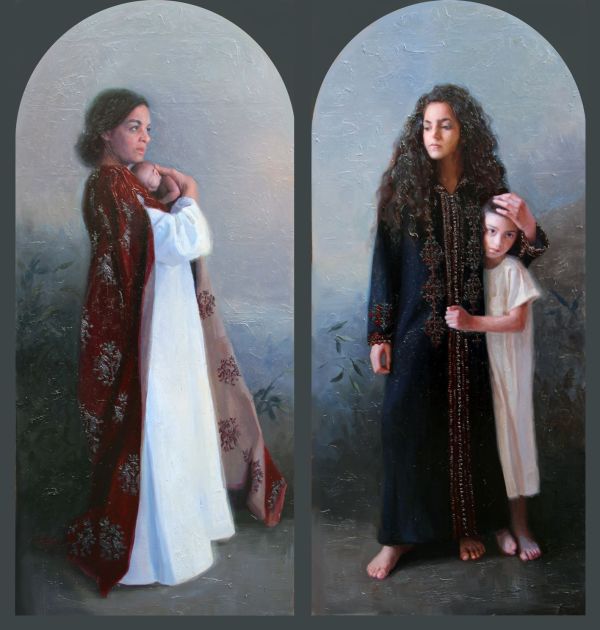
Image by Jennifer Allison – fineartamerica.com

In a piece titled Science fiction writers imagine the way out – in the May edition of The Christian Century, Melissa Florer-Bixler writes Jesus’ parables give us space to see that something else is possible. In her article she explores how sci-fi writers are putting flesh on the bones of Jesus teaching.

Florer-Bixler is clearly a devotee of science fiction writing. She cites one story in which a city is planted from seeds – buildings, people, and animals sprout like daffodils. In another – people bound together by their common fate, create a new life in a decimated land.

I have often referenced science fiction speaking more directly to our 21st century imagination – reimagining new approaches to faith – enriching our inherited biblical images.

Images from Biblical imagination were fashioned within a pre-modern worldview with quite a different sense of the relationship between cause and effect. The biblical and medieval pictures of a three-tiered universe still hold poetic charm. But in most cases they no longer inform our 21st-century worldview. The Biblical pre-modern imagination may continue to charm us – yet it’s now relegated to the category of ancient tales of implausibility if not downright impossibility; imaginative attempts to explain the workings of the universe before humanity learned better – or so we think.

Sci-fi imagination is a key that unlocks biblical imagination – opening it up for us as a space to imagine something else – the possibility of new worlds.

Florer-Bixler cites the renowned sci-fi writer, Walidah Imarisha, All organizing is science fiction. Florer-Bixler comments that the inverse is also true – our disorganizing, our entrenchment, and the intractability of our brokenness are a failure of imagination, a failure to believe in the possibility of new worlds.

Imarisha writes that whenever we try to envision a world without war, without violence, without prisons, without capitalism, we are engaging in speculative fiction. Florer-Bixler describes this as an invitation into an experience of dislocation and disruption – a process of transporting us into worlds that are strange – with their own distinctive language, unknown place names, and intricate histories patterning themselves in our brains. The sci-fi imagination invites us to move beyond the impoverished architecture of our modern materialist mindset – shaking loose expectations and assumptions that from a spiritual perspective – no longer serve us, or serve us poorly.

About this process of shaking loose, Florer-Bixler writes I’m familiar with this loosing as invitation, how it curves within me toward curiosity. In the New Testament Jesus turns my attention from endless cycles of harm toward seeds, pearls, and returning children. Jesus stretches me past the scraps of good life I’ve come to believe we can scratch out from the ruins. The reign of God is like yeast and weeds. It is fisherfolk with nets in flight.

Luke, having given us an account of Jesus Ascension in the first chapter of his Acts of the Apostles – the sequel to his story of the life and times of Jesus of Nazareth – Son of God – his second chapter opens with the following description

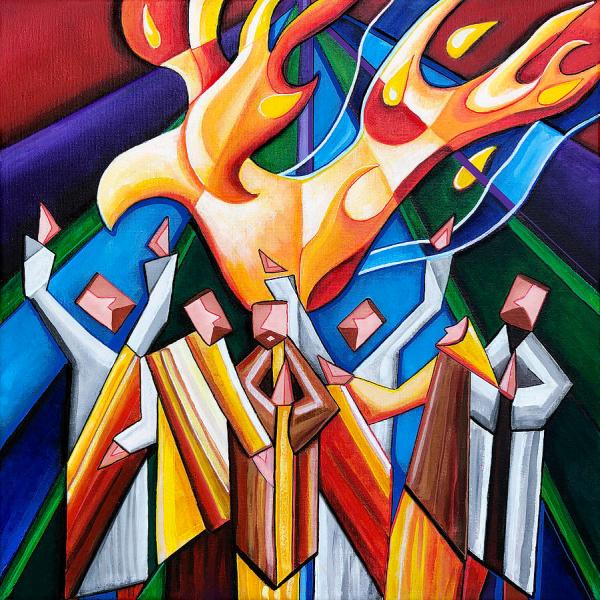
When the time for Pentecost was fulfilled, they were all in one place together. And suddenly there came from the sky a noise like a strong driving wind, and it filled the entire house in which they were. Then there appeared to them tongues as of fire, which parted and came to rest on each one of them. And they were all filled with the Holy Spirit and began to speak in different tongues, as the Spirit enabled them to proclaim.

Our modern scientific imagination poorly equips us for taking this account seriously as an actual eyewitness account of events on the Day of Pentecost. Of course, we are charmed by its details. Luke’s account works for us as a series of narrative props. We are invited to wear red. Flame motifs abound in banner, balloons, and streamers. We love to mimic the polyglot experience as members of the congregation for whom English is a second language are invited to speak in their native tongue. But beyond enacting aspects of Luke’s story, what sense are we to make of it all?

We embrace the idea of receiving a double portion of the spirit of the risen Christ – the reciprocal movement to his Ascension. But as to the how and even the why of it all beyond the colorful details in Luke’s story – we adopt an attitude of indulgent agnosticism or even down right disbelief. Nice story we say – wish it were true.

Luke’s description of the event – wind and flame and an early form of instantaneous translation for the benefit of the international audience present – is followed by Peter’s long address in which he sets this pyrotechnic-poliglot event within the context of the unfolding of Israel’s longer story of relationship with God. Today’s portion ends with Peter citing the prophet Joel: In the last days it will be, God declares, that I will pour out my Spirit upon all flesh, and your sons and your daughters shall prophesy, and your young men shall see visions, and your old men shall dream dreams.

But remembering Joel’s prophecy of a people empowered to imagine new worlds is not where Luke ends chapter 2. Our current reading ends at verse 21 and if we had been able to jump from 21 to 43, we would see that Luke’s purpose is not to end with Joel’s poetic vision but to go on to describe what it looks like when – to paraphrase Florer-Bixler – a community moves beyond the impoverished architecture of conditioned imagination – to shake loose expectations and assumptions and believe in the possibility of new worlds.

From verse 42-47, Luke paints a compelling picture of what a community empowered by the Holy Spirit looks like. He writes:

They devoted themselves to the apostles’ teaching and to fellowship, to the breaking of bread and to prayer. … All the believers were together and had everything in common. They sold property and possessions to give to anyone who had need. Every day they continued to meet together in the temple courts. They broke bread in their homes and ate together with glad and sincere hearts, praising God and enjoying the favor of all the people. And the Lord added to their number daily those who were being saved.

Luke’s task in constructing his Day of Pentecost narrative is not to tell us about the amazing pyrotechnic-polyglot experience accompanying the outpouring of the Holy Spirit upon the witnesses – but to show the effects of the Spirit’s birthing of a new community capable of believing in the possibility of a different world.

Luke describes a community of folk transformed through the indwelling of the Holy Spirit where from all according to ability -to all according to need –became the central organizing principle. Talk about the courage to imagine new worlds. The pooling of resources is the foundation for the early Christian community’s experience of an empowered transformation into a truly magnetic community configuring itself for those who had yet to show up.

I’m not proposing a return to the early Christian model of resource sharing. It’s both attractive and also unappealing – conjuring for us unfortunate resonances to failed Communist experiments. What it highlights for us however, is the requirement for us to imagine new ways of sharing resources more equitably.

In terms of the use of resources the world today is facing a resources crisis – of which water is the number one resource in increasingly short supply. In a world of finite resource supply, Luke’s portrayal of the effects of the Spirit’s outpouring upon the first Christians points us to the question of equity – that is – how resources are to be shared. The many do not have enough for life – because the few have way more than we need.

Florer-Bixler writes: In the real world, the tethers of oppression are wrapped so tight. Corporate interests and monied developers curl their tentacles around hope. There isn’t enough air. Jesus loosens the grip as we are given space to see that something else is possible here. He refuses reforms that polish up our entrenched systems or policies that quibble over the structure of power. The reign of God sprouts and grows, wild and unruly.

The reign of God sprouts and grows, wild and unruly! Few of us are happy with the ways of our world today. But how might we imagine things to be better. Of course, imagining is the first step. But two additional steps are necessary – the will and the courage to believe in the urgency of our dreams becoming reality.

Pentecost is when we celebrate our receiving of a double share of Christ’s Spirit – the Holy Spirit who proceeds from the Father through the Son as we say in the Nicene Creed. Following the first day of Pentecost what exactly was the nature of the transformation of Christ’s followers? It seems that it was the transformation of imagination – the power to imagine living life differently empowered by Christ’s Spirit to continue the work he began.

At Pentecost the baton passes to us!

This is my prayer for us this Pentecost – to imagine the life we long to live; to postpone our dream no longer – and waste our hearts on fear no more (O’Donohue, Morning Offering).

Don’t look up!

Don’t look up – words of warning for us as we, like the disciples let our eyes be distracted with gazing upwards after Jesus majestically ascending into a swirl of cumulus clouds – illuminated against a backdrop of suffused sunlight. 

Oh, how different is Jesus’ departure from his arrival into this world!

Because Ascension always occurs on a Thursday – the 40th day after the resurrection, the normal custom is to celebrate Ascension on the Sunday after – and even then – we are likely to miss the significance of this event because the Ascension of Jesus presents its own set of challenges to belief.

In Matthew and Mark, it appears as a kind of concluding event to tie up some loose ends. Jesus had died and then unexpectedly returned in a post resurrection body – that while defying some fundamental laws of Newtonian physics is still a recognizable human body – even to the extent of still displaying the wounds of his passion. They’d seen him die and then they ‘d witnessed his return! He remained living and breathing among them and then – poof – he was gone!  But gone where? Well, as every child in Sunday School knows, he’d gone up to heaven – dummy.

In Luke, the Ascension not only comes at the end of the story of the life and times of Jesus of Nazareth, son  of God – tying up any loose ends – but more importantly it becomes the preamble for the opening chapter in Luke’s sequel to his life and times of Jesus of Nazareth, Son of God – the Acts of the Apostles – or  the life and times of the Church.

Writing after Luke, John understands this point clearly but has his own inimitable way of writing about it as we find in today’s Gospel. John’s Jesus in unpacking the significance of his resurrection over a series of Sunday evenings in the upper room carefully explains to his disciples that he must leave them so that God can glorify him with the glory that he had before the world existed. But he is at pains to reassure them that they will not be left comfortless like abandoned orphans.

When it comes to the Ascension, it’s not the when, or where, or how, or even whether it took place – but that with the Ascension a pivotal transition point is reached in the longer story of creation, incarnation, and resurrection. In Jesus’ birth God entered human experience through a human life. In other words the Creator came to dwell within the tent of the creation. At his Ascension, it’s not the restoration of Jesus’ pre-existent divinity that is the main point but God’s reception of his full humanity – perfected through suffering – into the divine nature.

The function of imagination is to construct meaning out of events that are not directly observable to the human eye – and yet – events that nonetheless shape our experience. Religious imagination builds pictures that distill into sharp focus choices to be made, actions to be taken, and directions to be followed – or avoided – as the case may be.

Luke’s graphic account of the event is powerfully influenced by Elijah’s ascension recorded in the 2nd book of Kings. In like manner – as the mantle of Elijah fell upon the shoulders of his disciple Elisha – giving him a double portion of his master’s spirit, God having received the fullness of Jesus’ humanity – perfected through suffering – into the divine nature – a double portion of Jesus’ Spirit now descends upon the disciples at Pentecost. Ascension and Pentecost – humanity ascending and divinity descending, are the contraflow events connecting the dimension of time and space with the spiritual ground – joining heaven to earth and earth to heaven.

For the modern imagination, the medieval picture of a three-tiered universe – with the spatial references of heaven above and earth beneath – of up and down – becomes the image of a contraflow between time and space and the spiritual ground. The Ascension is a contraflow between parallel dimensions.

If we can stop looking up long enough we can ask the real question – so what next?

Traditional religious imagination pictures two possibilities in answer to the question: what next? Both are imagined in the dualling collects for the Ascension.

Listen:

Grant, we pray, Almighty God, that as we believe your only begotten Son our Lord Jesus Christ to have ascended into heaven, so we may also in heart and mind there ascend, and with him continually dwell.

Compare and contrast with:

Almighty God, whose blessed Son our Savior Jesus Christ ascended far above all heavens that he might fill all things: Mercifully give us faith to perceive that, according to his promise, he abides with his Church on earth, even to the end of the ages.

We see how religious imagination struggles with the question: so, what next? We long to throw up our hands – giving up on the evils of the world – to ascend with the Lord and there with him to dwell. We long for God to rescue us from ourselves and the mess we continue to make of the world.

We stand amidst an imperfect recovery from global pandemic while staring into the abyss of the ecological collapse. We are struggling to avert the prospect of multiple global flashpoints – Ukraine- Russia-Nato, Israel-Palestine, Israel-Iran, a collapsing nuclear armed Pakistan, China-Taiwan-US – any one of which could spell global catastrophe.  For us things seem to be going from bad to worse according to every measure of progress. So, it’s a natural response to pray for God to – beam us up, Scotty.

Yet, in the Ascension of Jesus God promises to fill all things and to abide here with us – amidst all the pain, disappointment, and sheer messiness of this world. We must not fall into the temptation of wishing to be rescued out of this world. Instead, we must stand firm – empowered by a double measure of the Spirit of Jesus to face up to the challenges ahead in the knowledge that a God acquainted with suffering stands with us. Because Jesus is acquainted with our suffering – God through the divine spirit empowers us in our age-long struggle to realize coming of the kingdom in a new heaven – on earth.

The Ascension of Our Lord is a central insight of our Christian faith. The nature of this insight does not lie in the when, where, how, or whether the event as Luke pictures it took place. As a central insight the Ascension punctuates the continuum that runs on one side from Jesus’s birth, through his death and resurrection to the other side of the Ascension where the instruction don’t look up becomes the question what’s next?

What’s next? Let the words of the late Irish poet, John O’Donohue speak here:

May [we] have the courage today,

To live the life that [we] would love,

To postpone [our] dream no longer

But do at last what [we] came here for

And waste [our] heart[s] on fear no more. (Morning Offering)

Good-Enoughness

If you love me? This is the direct as well as the implied question that Jesus asks his followers all the way through John’s gospel. The thing not to miss here is that Jesus asks if you love me? But what we often hear is – if you loved me?

From love to loved – there’s a world of difference. A difference we hear and feel implicitly. If you love me is a question that implies promise. Whereas if you loved me implies a regret – even a threat. Love me as I demand, or I won’t love you back.

If you loved me, is the battle cry for conditional love. Conditional love is love with strings. And conditional love is the most common form of love we experience. If you loved me, you would show you loved me by meeting my needs.

Sometimes the needs to be met are material, but most often, they are psychological and emotional. The threat implied in if you loved me is the threat of abandonment, rejection, and the fear of being alone.

Jesus said, if you love meI will not leave you orphaned – that is – I will never abandon you. But Jesus also said, if you love me, you will keep my commandments. So, is Jesus’ love conditional after all? Perhaps? But the condition here is not a commandment to – love me back – but the greatest commandment of all – love one another. The string attached to Jesus’ love is not – meet my needs – but meet one another’s needs. Through loving us, Jesus models how we should love one another. He is – in short- the archetype – the universal pattern for the good mother.

Ideally, we learn to love because we were first, loved. In the process of learning to love through first being loved – we encounter many vicissitudes along the way. Many of us enjoy the gift of love and loving because of the indelible memory of first having been loved at our mother’s breast. Others of us were not so fortunate. There are many reasons why the mother-infant exclusive bonding fails leaving many of us afraid of surrendering to loving and being loved.

In a period when as a culture we are struggling to delineate the biological hardwiring of gender from the softwiring of gender identity – confusions also proliferate around the differences between birthing and mothering.

In the most usual course of events, being pregnant triggers the hormonal instincts for mothering. Giving birth ushers a woman and infant into the complex and sacred relationship of mothering – a state of mutual enthrallment. We are fortunate if we experienced the nurturance of being loved because the woman who birthed us was also the one who mothered us. Yet, this is a complex process. Good mothers can never be perfect mothers. Fortunately, all that is required is that they be good-enough.

The concept of the good-enough mother originated with one of the most influential figures of the Object Relations School of British Psychoanalysis – Donald Winnicott – a man who combined the rare skills of both pediatrician and psychoanalyst. Take a look at this short 6 minute video on the essential elements of Winnicott’s approach here.

By good-enough, Winnicott meant that mothers did not need to be perfect. The mother-infant relationship, though vulnerable to mishap is also robust and able to withstand a variety of imperfect conditions. That mothers needed to be good-enough but not perfect is a reminder for us all that in the arena of love, the quest for the perfect is certainly the enemy of the good.

Winnicott’s focus was on the good-enough experience within the early mother-infant relationship. Good-enough mothering is love that is consistent and unconditional. In the usual course of events, while good-enough mothering is found in our early experience with our birthing mothers – this cannot always be so. For many of us the experience of good-enough mothering came through non biological relationships with both men as well as women for the concept of good-enough mothering is not gender exclusive. Good enough mothering is not only an inherent human quality, but most importantly, a characteristic of God as mother.

Human beings are resilient and highly adaptive. Where mother-infant bonding fails – love ultimately trumps biology.

Human beings are highly resilient and the capacity to love and be loved is highly adaptive to circumstances. An interruption in the early experience of being loved can be later compensated for in the love of father, grandparent, or close relative – stepping into the role of primary carer. Early difficulties can be repaired through the love of a teacher, a mentor, or dare I say even a therapist. The redeeming unconditional love of a spouse, or significant other – offers reparation for earlier losses. A friend of mine refers to his husband as the one who has loved me into being. I know this is not an isolated experience.

As a society, we fail the women and men who are responsible for good-enough mothering through our political failure to promote social and economic policies supportive of maternal health, child development, and family life. In a country that eulogizes mother and apple pie, the US ranks low on the scale of nations where public policy concretely supports healthy maternal care, child development, and the structures of family life. We stand alone among developed nations in the stridency of our defense of the rights of the unborn and our social and economic neglect of the born.

This Mother’s Day is the first following the overturning of 50 years of a woman’s Constitutional right to abortion. The 33rd edition of the Annie E. Casey Foundation’s KIDS COUNT® Data Book describes how children in America are in the midst of a mental health crisis, struggling with unprecedented levels of anxiety and depression. This year’s publication continues to present national and state data across four domains — economic well-being, education, health and family, and community. A tragic paradox is revealed in the ranking of states according to measures in overall child well-being. Florida, at no. 32 out of 50, is the highest-ranked southern state in the family and community domain. Utah, New Hampshire, and Vermont topped this same list while New Mexico, Arkansas, Louisiana, and Mississippi feature among the bottom rankings. Again there seems to be a correlation between state preoccupied with a fanatical defense of the rights of the unborn and the chronic political neglect of the born.

When Jesus said, if you love me he made it clear that loving him meant following his commandment that we love one another. Being able to love one another is dependent on having an experience of being loved. Jesus also said, if you love me, I will give you eternal life. The rub is however that whatever the supposed joys in heaven – eternal life begins in the here and now! It’s ensuring the quality of life in the here and now that should matter most to us – and by which, Jesus makes clear, we shall be judged.

The Gateway

On the fourth Sunday after Easter – traditionally referred to as Good Shepherd Sunday – it is customary for the preacher to explore the protective and nurturing metaphor of shepherding.  As many of you know I’ve explored in previous years how the metaphor of the shepherd and the dynamics of shepherding offer a sharp contrast between modern and 1st-century methods of sheep farming. Good Shepherd Sunday also has a habit of falling on Mother’s Day and I’m somewhat relieved that this year we’re still two weeks ahead of that sermon challenge.

Coming from a country such as New Zealand – a nation of five million humans and over 40 million sheep – the life of sheep and that of the shepherds who manage them is somewhat familiar. In previous sermons on Good Shepherd Sunday, I’ve spoken of my nephew Hamish, who farms a hill country station – sheep farms are known as stations in the rugged hill country of NZ’s South Island – a topography familiar to many of us as the mountainous and foreboding terrain that formed the scenic backdrop for the Lord of the Rings Trilogy.

In the 19th-century, Scottish farmers – familiar with the harsh topography of the Scottish Highlands – settled easily in the rugged high-altitude foothills of the imposing mountain range of the Southern Alps – running like a great spinal column down the center of the South Island (S I). For them this was as close to the homeland they had left as anywhere on the globe. Their sheep farming heritage easily transplanted into this new setting.

Like the Scottish Highlands, the S I’s high-country land is poor – expansive high-altitude grassland. With the granite bedrock only a couple of inches below the surface the land is completely unsuitable for arable farming. This landscape is only suitable to the particular Marino breed of sheep – a scrawny bread – bred not for the succulence of its meat but for the fineness of its wool – wool today much coveted by the Italian textile and designer fashion houses. The Italian fashion industry is the end destination for my nephew’s wool.

Easter IV draws its Good Shepherd theme from John’s presentation of Jesus as the good shepherd in chapter 10 of his gospel. Here we are given two contrasting images of Jesus. One is as the personification of the good shepherd- I am the good shepherd – hearing my voice my sheep know me and follow me. This image resonates with intimations of intimacy and loving care. The other image – which is the one presented to us on Easter IV in year 1 of the Common Lectionary – is the more striking image of Jesus as the gateway to the sheepfold.

Facing the blank looks of incomprehension on the faces of his disciples as he speaks about himself as the gatekeeper who guards against the illicit entry of thieves and rustlers seeking to mislead and steal the sheep, Jesus offers what I would have thought was an even less comprehensible metaphor – of him as the literal gate to the fold –I am the gate for the sheep.

On a baptism Sunday, the shepherd and sheepfold metaphors present us with fundamental questions about the nature of the church and the dynamics of belonging.  What is the Church; how do we get into the Church, and what are the hallmarks of belonging???

The Episcopal Church has this quaint phrase to identify one of its three main membership criteria. Following John 10 you might think the Episcopal Church would say that one of the core attributes of membership is to know and be known by Jesus. It is very telling that the Episcopal Church prefers to define membership as those who know and are known to the treasurer.  Easter IV being a baptism Sunday here at St Martin’s – lends an added poignancy to questions of belonging.

The Church is the Christian community – which may seem an obvious statement. But we have a very impoverished understanding of Christian community because we imagine that we are the Christian community – that without us there is no Church. IN this sense we think of the Christian community as a voluntary association much like being members of the tennis club. Accordingly the answer to the question what is the Church – is – we are the Church – the fruit of our organization.

However, the Christian community is God’s creation not ours. The Christian community is not a manifestation of our social organizing. It is the creation of God-in-Christ active within the dimension of time and space. Following this view, we don’t create Christian community – we simply participate in it. As the sheep entering the sheepfold – so we come into a divine community that is already awaiting our arrival and in which we are invited to participate.

That the Christian community emerges from our self-organization is only the first of two major mistaken ideas. The other widespread mistaken view is that being Christian is an individual thing – as in – you don’t need to go to church to be a Christian – or I’m spiritual but not religious. We each can be as autonomously spiritual as we like, but being spiritual does not make us Christian. The Early Church father, Tertullian summed it up when he said one Christian is no Christian. The only way to be a Christian is to participate in the life of the Christian community – which is the divine community of God-in-Christ or the Body of Christ – made visible in the dimension of time and space.

John 10 speaks of both sheep and sheepfold. The sheep don’t form the sheepfold – they enter the sheepfold when they pass through the gate. Likewise, we don’t form the Christian community, we enter the Christian community – the Body of Christ in the world – through the gate of baptism. If baptism is the gate, the rich pasture is the Eucharist. Through baptism we come to belong to a community that nurtures us with the rich pasture of the Eucharist – Christ’s mystical body – upon which we feed.

If John 10 is the metaphor for our entry and belonging within the Christian community then the first reading from Luke-Acts chapter 2 clarifies the nature of belonging. We don’t simply belong by virtue of becoming members – the hallmark of belonging is participation – active engagement in the covenanted relationship with God – and – more challengingly, a covenanted relationship with one another.

By covenanted relationship I mean a relationship in which we become responsible for one another. We read in Acts 2:42 that the first Christians devoted themselves to the apostles teaching and when they gathered to worship God, they broke bread with one another – praying unceasingly for one another, and for the world around them that often viewed them with considerable hostility. In addition, they practiced common fellowship which meant they shared their material resources – holding all things in common for the benefit of all. It’s this characteristic of early Christianity that not only facilitated the Church’s astonishing growth in a short span of time – and day by day the Lord added to their number – but has continued to inspire a vision of a society where each gives according to their ability, and each receives according to their need.

Through baptism we enter into belonging. By participation our belonging fosters believing – both signs of our taking responsibility for one another.

That we seem even further away from being able to embody this ideal as the hallmark of our participation together within the Christian community – is a continued matter for our profound repentance.

Re-Membering

Image: Road to Emmaus by Ivanka Demchuck

Following the Great Three Days of Easter, we find ourselves among the various accounts of Jesus’ post-resurrection appearances. These come mostly from John but also include today’s gospel portion which is Luke’s account of the experience of two of Jesus’ disciples on the road to Emmaus – a village not far from Jerusalem.

Luke 24:13-35 is one of the iconic gospel passages – shaping Christian spiritual imagination down the ages. Emmaus is a name deeply associated with places of spiritual seeking and retreat – a name that Christians automatically associate with spiritual journeying.

The post-resurrection accounts from John that pose a direct challenge to our received Newtonian understanding of the laws of the physical universe – accounts where Jesus walks through locked doors and solid walls, one moment appearing, the next disappearing – and all that. Luke’s account relates an experience that offers no such challenge to our Newtonian rationality. Luke’s post resurrection appearance is immediately relatable because at its center is the all too familiar experience of minds clouded and hearts set on fire.

Jenna Smith in her article A Blaze of Glory published in The Christian Century, alerts us to the Ukrainian artist Ivanka Demchuk’s painting Road to Emmaus. Demchuk’s work is influenced by the techniques and aesthetics of iconography and in the painting, we see Christ, in white, facing the two disciples on the road. She layers gold filament in a way that draws the eye immediately to the disciples’ torso region – portraying that most significant phrase in the passage: Were our hearts not burning in us as he spoke to us? Smith comments that Demchuk’s use of gold, against the back layers of white, effectively lights up the scene, as if there is a ball of embers in the disciples’ chests. I love the image, both in the text and in this artwork, of hearts burning within us. It is, in this story, so good, such an indicator of trueness and of life. I’ve posted the painting to accompany this sermon online at relationalralties.com and stmartinprov.org.

We relate to Luke’s story on the road to Emmaus because, whether we know it or not – we are all on the road to Emmaus – journeying with minds clouded by grief and hearts enkindled by the fires of our yearning.

For the two disciples traveling to Emmaus, it had been a long and bewildering day. The Lord’s death – yes – can it only have been on Friday? – somehow time for them has stood still – the Lord’s death and now first thing today some of the women reported the disappearance of Jesus’ body from the now mysteriously empty tomb. The succession of these events is too great for them to bear. Faced with experience too huge and overwhelming to process – their minds shut down like a computer hard drive crashing. Numbed into mindlessness by grief – all they can think of to do is to physically react and get as far away from Jerusalem as a day’s travel can take them.

Viewing this story from the sidelines of history – from our 21st-century psychologically informed perspective– we’re curious about the dynamics of the experience these two disciples are having as they walk away from the city as fast as their legs can carry them. Along the road they encounter a mysterious stranger who asks to walk with them. He’s been following, perhaps, at a distance and having caught up with them he asks: What are you discussing while you walk along?

Oh, it’s bad enough this stranger intrudes on their grief, but he further burdens them with his dumb-assed question as well. Cleopas, one of the two, turns on the stranger and in a voice dripping with incredulity demands: Are you the only one in Jerusalem who doesn’t know what been going on there these past days?

As if to rub salt into their wounds the stranger simply asks: what things? The disciples commence to pour out their hearts – the first stage of articulating their grief by talking it out to someone else. They relate their grief and bewilderment, the devastation of their lost expectation: we had hoped that he was the one to redeem Israel. And now the worrying disappearance of Jesus body – with only the witness of the women – unreliable in itself – as you know what women are like imagining all sorts of fancies. I mean women – being addressed by angles – really?

We can picture them standing dumbfounded when the stranger rebukes them: what fools you are – not only fools but faithless fools! He then begins a process of reconstructing the broken chains of memory – relinking associations which like broken links on a website no longer connect to the source of meaning. Today, we would recognize that the disciples were suffering from post-traumatic depression – a state of mental shutdown resulting from an overwhelming experience of trauma, grief, and loss.

Luke relates that Jesus beginning with Moses interpreted the things about himself in all the scriptures. In the guise of the stranger, he helps the disciples to begin to process their grief through a process of re-membering. When hyphenated the word remember takes on its original meaning. To Re-member is to put back together – to reconnect broken memory fragments weaving them once again, into a meaningful picture of the world.

There is a fundamental law of psychological life – that the mind only recognizes what it already knows. They could not see what their minds had no stored memory template for – offering a clue into the mindset afflicting the disciples’ on the road to Emmaus.

All forms of trauma – of which acute grief is but one form – interfere with the pattern mapping of memories onto real time experience that enables recognition – that is – the act of re-membering. We know how depression – depresses certain chains of memory capable of restructuring pain and loss – preferring instead memory chains associated with hopelessness and helplessness that simply confirm our current experience of suffering.

The disciples had seen Jesus’ death and burial. With his death all their hope died. They could no longer access the stored memories of him to map onto their real time experience. Cut off by grief from their memories of his teaching, they couldn’t see Jesus because their minds had no way of recognizing him.

As the three men journey on the road to Emmaus something deeply therapeutic is taking place. Grief has traumatized them – preventing remembering. They don’t recognize Jesus because they’ve lost access to the memories of him that could reconnect them to his resurrected body. Gradually with each step along the road – as the stranger beginning with Moses, interprets the things about Jesus in all the scriptures – they begin to re-member – a process beginning in their bodies ennkindling their hearts. By the time the stranger leaves them they can turn to one another exclaiming: Were our hearts not burning in us while he was talking to us on the road, while he was opening the scriptures to us?

There’s one more thing to notice in this story. When the disciples reach Emmaus and invite the stranger to stay and eat with them: Stay with us for it’s almost evening and the day is now nearly over. – it’s not only the day that is nearly over but the therapeutic process of reconnecting the broken links – allowing them to map memory onto real time experience is also complete. In response to their invitation – the stranger takes bread, blesses, and breaks it before sharing it with them. Luke tells us that then were their eyes opened and they now correctly recognized the stranger as Jesus. Process complete –memory pattern mapping onto real time experience has been rebooted – and Jesus vanishes from them.

Every therapist working with serious trauma knows that it’s action –as in controlled reenactment rather than words that matter. Over the sharing of the bread Jesus reenacts – reconnecting the last broken link in the disciples’ fuller recovery of memory in real time.

The road to Emmaus is the symbol for our spiritual journey. Like the disciples’ – we make this journey travelling in one another’s company. Like the disciples’, we walk the road to Emmaus with minds clouded by distraction and forgetfulness. Memory templates of doubt and fear rather than hope and courage map onto real time experience. Consequently, like the disciples’ on the road to Emmaus we fail to notice the ball of embers – our hearts burning with yearning for something more.

If we don’t see Jesus – maybe it’s because he’s not who we are looking for – until like the disciples’ we recognize him as he blesses, brakes, and shares with us his bread of life. Only then are our eyes opened in recognition of his abiding presence with us.

Living in the Time In-Between

Ayana Mathis, in her New York Times first installment in a series on American literature and faith titled The Prophetic, is recalling her childhood memories of growing up in a Black revivalist Christian tradition. She writes that:

the God of her revival childhood was all-powerful and relatively benevolent, but had a great many rules about what we should do  (go to church 3x a week, live by the Word of God, literally interpreted) and what we shouldn’t do (listen to secular music, play cards, watch movies, drink). These commitments and privations would be rewarded with God’s love, palpable, like a bird alighting on a shoulder.

She describes leaving this world behind with the memorable image of plunging into the world on the other side of the stained-glass window. Mathis views the beginnings of her adult journey as one of growing beyond her conservative Christian origins to become an artist. Her’s was a journey of learning how to disbelieve but be imprinted by belief.

How to disbelieve while remaining imprinted by belief struck a deep chord in me. Mathis asserts that American literature –and by extension mainstream American culture – remains imprinted by belief, freighted by ideas about morality, justice, and standards for living. Her assertion is that whatever the condition of our belief at the personal level – as in do we, or don’t we? – the cultural impact of belief remains imprinted on us. That despite many manifold wrongs and derelictions, the literary and cultural landscape of America remains deeply imprinted by the nation’s historically Christian heritage.     

She notes that this Christian imprint has both good and not so beneficial consequences –in her phrase it trucks in paradox. The Christian imprint on American society has often been used to justify great evil and at best inspire decency and generosity, acting as a hedge against oversimplistic notions of society and the individual. Her assertion is that our Christian legacy asks us to tolerate a degree of paradox – requiring us to wrangle with contradictory realities in mind and heart with sustenance and insight to be gained in that wrangling.

Omitting her more personal references to a fundamentalist upbringing, Mathis is speaking to many of us – I suspect- here in this church on this Easter morning. Few of us good middle-class, over-educated, professionally-successful, and predominantly White worshippers remain Christian if measured by orthodox belief and devotional piety and practice. Yet here we are on Easter Day. Some among us may be a little surprised to find ourselves sitting in these pews. Yet nevertheless we’re here – despite being unable to give a full account for why we have been drawn here.

Perhaps we’re being drawn by memories of an earlier phase of family life as children or as parents of young children? Perhaps it’s the influence of friends drawing us here? Perhaps – and this is the best reason of all – we’re drawn here by cultural tradition – tradition as the imprint of belief upon our personal struggle with disbelief? Deep-down being here reflects a questioning of certainties -once – easily taken at face value but alas no longer so. Many of us have lost confidence in a belief that Jesus was raised from the dead, and all is right in our lives and our world.

We are they who are seeking to find a fingerhold – to say a foothold here would be to overstate our confidence – to find a fingerhold on what it means to live well with a hope which at times aspires to the level of real courage – and love demonstrated through generous concern for everyone affected by our action or non-action – in short – a generous concern for our neighbor. We are they who are seeking a fingerhold on something ineffable. We wrangle with disbelief while remaining mysteriously imprinted by belief.

Many today think Christian belief is too hard. Belief has been reduced to yes or no answers. Such belief seems to us irrational – an artifact of a former time long passed. We think in terms of making the leap of faith – wondering can we leap that far or not. Edward Weber in a recent edition of the Anglican Digest recalls an Associated Press interview with John Updike not long before his death in 2009 in which he said that he was aware of the explanations for the creation of the universe, which did not require God, but that personally he just could not quite make the leap of unbelief.

So perhaps the leap of unbelief is as hard and irrational as any leap in the other direction? It’s not so hard to believe in a higher power. It’s not even so hard to believe in resurrection as an internal spiritual experience in the minds of the disciples. It’s quite another level of difficulty to actually believe in resurrection as a bodily experience for Jesus.

In his poem, Seven Stanzas at Easter, Updike unashamedly speaks of his belief in the literal, corporeal resurrection of Jesus. Despite his controversial lifestyle, and regardless of whether he practiced a conventional piety or not – John Updike remained firmly imprinted by Christian belief.

Make no mistake: if He rose at all It was as His body; If the cell’s dissolution did not reverse, The molecules reknit, The amino acids rekindle, The Church will fall.

It was not as flowers, Each soft Spring recurrent; It was not as His Spirit in the mouths and fuddled eyes of the Eleven apostles; It was as His flesh; ours.

I’m convinced – whatever the condition of our personal Christian belief – we remain imprinted by the Christian social and cultural legacy. For me, belief is no longer an either or proposition. Belief is neither something I can possess, nor is it something I can lose. Belief is like the tide – it ebbs only to return in the flow. For me, as I am today, belief is the expression not so much of objective faith in a collection of doctrinal propositions but a heartfelt experience of being deeply imprinted by belief as a narrative – a narrative of belief that creates meaning and purpose in my life – continually correcting my orientation to the world around me in all its evil as well as its glory. Mathis echoes Updyke – faith as the practice of wrangling contradictory realities in mind and on heart and finding sustenance and insight in the wrangling.

I agree with Updike that if Jesus was not bodily raised to a new and transformed life – yet a life so continuous with his pre-death human life that he remained recognizable to the disciples – – the Church will fall.

By the church’s fall I’m not imagining the church as the respectable middle-class institution – of which St. Martin’s is one of the finer examples. I’m thinking the Christian legacy which remains imprinted on our culture. Despite the process of relentless secularization – Christianity’s cultural imprint is of a generous orthodoxy which gives our culture its distinctive shape.

There is at the heart of Christianity a curious paradox – Jesus died on the cross – but Christ was born in an empty grave. Wrangling with this paradox is worth it- for it leads us to the realization that resurrection is both a present time experience as well as a future hope.

For me this is the paradox of living in the season of the resurrection – a period of time I think of as the-time-in-between – that is – the time between the resurrection of Jesus and the divine restoration of the whole of the creation at a point we can only poetically refer to as at the end of time. To live in the-time-in-between is to live bookended between the resurrection of Jesus and the eventual restoration of all of creation. If we can forget our narcissistic worries about belief – what is it and do we possess it or have we lost it?, – we become free to embrace living in the time-in-between as a narrative opening us to an immense enrichment of meaning and purpose that continually refocuses our attention on the day and its task of building a future better than our past.

The onetime legendary 19th-century bishop of Massachusetts, Phillips Brooks, wrote: The great Easter truth is not that we are to live newly after death, but that we are to be new here and now by the power of the resurrection.

Living in the-time-in-between means the promise of being reunited in the Resurrection with all who we have loved and yet see no longer. It also means new beginnings after a failed relationship, healing after a messy divorce or a parent-child estrangement; it means new life on the other side of addiction recovery and the healing of old hurt; it means new life for a nation like Ukraine rebirthing in the fire of war.

The new life of resurrection in the-time-in-between can be found in the struggle for peace – not peace at any price but peace with justice; in the making real our hopes and dreams for a future better than our past – a future arriving step by step through our commitment to put right that which currently, is so very wrong in our world. In the-time-in-between we are called to strive for and to witness and to collaborate in the divine plan for restoration and renewal – challenging the world to see and know that things which were cast down are being raised up, and things which had grown old are being made new!

For us living in-the-time in-between the resurrection of Jesus and the resurrection of the whole of creation – poetically referred to as at the end of time – means to wrangle with paradox – holding contradictory realities in mind and heart, and thereby drawing sustenance and insight in that wrangling (Mathis). To disbelieve while being imprinted by belief is the best description I can find for living in the-time-in-between. All well and good you might say but what of the bodily resurrection of Jesus? All I can say is that living in the-time-in-between – we should rule nothing out.

Fickleness of Crowds

Featured Image: Entry to Jerusalem, Sadao Watanabe

There is something mysterious about crowds. Being part of a crowd can be an exhilarating escape from our individual sense of isolation and helplessness. In crowds we find an experience of shared solidarity. An experience of mass protest builds networks to support ongoing action when we return to the sphere individual life. Crowd experiences can become an in-the-moment expression of the more expansive currents of aspiration and longing for change.

But there is also something menacing about crowds. Being caught up in a mass mind-meld can be frightening. Crowds morph in the blink of an eye from peaceful protest to violent action. The journey from exuberant celebration to mass hysteria can be a very short one. We are right to fear being caught up in the experience of mass manipulation when an unscrupulous and skillful orator stokes our fears. Fear-stoked messages become conduits for the surfacing of repressed collective memories and imagined grievances – an experience that we in America are all too familiar with.  

Crowds become the conduits for the resurfacing of shared cultural and historical storylines. It matters greatly which storylines echo through a particular crowd’s collective awareness.  In short crowds can be fickle.

He had come to celebrate the Passover. Having traveled from Bethany, Jesus entered Jerusalem through the East Gate to the wild acclaim from the crowds that greeted him. They stripped the fronds from the palm trees to lay them as a carpet before him as he entered the city gates.

The surfacing of collective memory – acted out in real time – is often the best interpreter of a crowd’s mind-meld . The waving of palms was a gesture that tells us everything about the mind of the crowd welcoming Jesus.

Jerusalem with its estimated population of 40,000 had swelled to well over 250,000 for the Passover festival. Accommodation in the city was at a premium, hence Jesus, during the two weeks prior to the festival had been commuting the two miles from the Bethany home of his friends Lazarus, Martha, and Mary to the city. During this time his reputation had gone viral. Jesus was the name whispered on every breath. Who is he? they whispered to one another. A question couched within the question – the only question that really mattered to the crowds – is he the one?

It’s the palm branches that tell us everything we need to know about the crowd’s expectations. Like the MAGA – Make America Great Again – slogan – the waving of palm branches was a political gesture echoing and earlier storyline. Some 160 years before, the triumphant Judas Maccabeus, the last leader of a successful Jewish rebellion against foreign domination, had led his victorious partisans into the Temple. One of their first acts of victory was to cleanse and rededicate the Temple – the memory of which is celebrated by the Jewish community in the festival of Hanukkah. For us, the important point is that the partisans used palm branches to cleanse and prepare the sanctuary for rededication after its defilement by the Syrian tyrant, Antiochus Epiphanes, whose erection of a larger-than-life sized statue of himself placed in the Holy of Holies was the initial trigger for the rebellion.

The waving of palm branches speaks of the crowd’s expectations for Jesus as a new national liberator in the mold of Judas Maccabeus – come to free them – this time – from the hated Roman occupation.

Of interest here is to what extent was Jesus the hapless victim of a mistaken historical identity – and to what extent was he deliberately playing into the MIGA Make Israel Great Again storyline – colluding with the crowd’s frenzy of jubilation? Again we don’t need to search far for the answer. Riding into the city on the back of an ass proclaimed another historical storyline – that of the prophet Zechariah:  

Rejoice greatly, O daughter of Zion!
    Shout aloud, O daughter of Jerusalem!
Lo, your king comes to you;
    triumphant and victorious is he,
humble and riding on an ass,
    on a colt the foal of an ass.
Zechariah 9:9

Of course, as events played out, we know that Jesus had a very different interpretation of what kingship in this context meant. However, we should not miss the implication here that he seems not to be averse to playing on popular messianic expectation of an earthly liberator king.

At the same time as Jesus entered through the East Gate, another triumphal entry procession wound its way into the city through the West Gate. The Roman Procurator, Pontius Pilate at the head of his Roman Legion had also come up to Jerusalem for the Passover.

Pilate did not live in Jerusalem. He chose to avoid the city’s ancient warrens seething with civil and religious discontent. Pilate and his Roman administration preferred the sea breezes and mod-cons of Herod the Great’s former capital at Caesarea Maritima – 60 miles to the west on the coast and now the administrative center of the Roman occupation of Judea.

Pilate hated and feared the crowds of Jerusalem. He feared them most during the Passover which required him to come up to the city with a show of preemptive force to forestall the potential for insurrection. For Passover celebrated Jewish collective memory of liberation from an earlier period of slavery. Pilate’s arrival was indeed a wise move, for the crowds that hailed Jesus, were in insurrection mood.

Holy Week commemorates the events beginning on Palm Sunday of Jesus’ last week in Jerusalem before the Passover. The echoes of three historical storylines merge from Jewish collective memory to intersect and clash with an alarming result as Pilate, the crowds, and Jesus all become caught up in an escalation of events – which in the end – none could control.

The storyline of worldly oppression and political violence intersects with a storyline of populist resistance and nationalist longing for liberation at whatever cost. Both confront the third storyline which concerns the next installment in the epic narrative of God’s love and vision for the world.

I have spoken over recent weeks and days concerning Holy Week and the Triduum – the Great Three Days of Easter – as our liturgical enactment of a drama in three acts. Palm Sunday is the overture – setting up the major themes that will play out from Act I on Maundy Thursday through to Act III on Easter Day.

Of course, we know how the drama ends. But like a Shakespeare play – our knowing the ending does not deprive us of experiencing its spiritual impact in new and unexpected ways. Remember, it’s one thing to read the play in the comfort of an armchair, but it’s always a more meaningful experience to attend its enactment.

Crowds can communicate the exhilarating experience and act as conduits for a people’s collective memory. In American collective memory we find both a storyline of revolution and liberation alongside a darker storyline of civil war. Both storylines vie and clash in our collective memory – and in the present time we remain uncertain which storyline will find a conduit in the action of crowds.

Crowds are fickle because they evoke competing storylines.

Richard Lischer in his 2014 article in Christian Century notes his South African friend Peter Storey who once remarked that “America is the only country where more Christians go to church on Mother’s Day than Good Friday.” It is a sobering thought. Those who skip Maundy Thursday and Good Friday only to show up on Easter Sunday are missing the essential truth of Easter – which is that the Messiah was born in a grave (Paul Tillich).

We too are the victims of competing storylines. For like the crowds praising Jesus as he entered the Holy City, we enthusiastically hail our next political savior until that is, he or she no longer is. We long to do the brave thing, until that is, the moment when we don’t.

Lazarus Unbound

Featured image: Jacob Epstein’s Lazarus Unbound, New College, Oxford

On Passion Sunday – Lent V – we hear the story of the Raising of Lazarus as the seventh in the series of John’s Seven Signs of the Kingdom. John has an overarching-transpersonal message he wants us to hear. This overarching message is that Jesus is the Son of God, the Light that has come into the world as the Word of God – who was with God before the beginning of creation; that we come into relationship with God through hearing and accepting this message. John weaves his overarching-transpersonal message into a rich fabric of arresting personal human-interest stories.

John places his seventh sign story at the Bethany home of his friend Lazarus and his sisters Martha and Mary. Bethany is two miles from Jerusalem, conveniently placing Jesus within commuting distance for the start of his final week in Jerusalem.

We’re attracted to the narrative richness of John’s storytelling. But we’re also put off by their complexity for John is always weaving two parallel storylines at the same time. We’re jolted as the narrative wanders back and forth between his overarching-transpersonal and personal human-interest storylines – between the storyline about Jesus’ relationship to the glory of God and the intimate personal storyline of love, loss, and friendship.

In the personal human-interest storyline, the disciples and Jesus are just across the Jordan in the region of Perea having fled Judea after the Judean officials threatened Jesus’ life. Bethany is also in Perea, so they are not too far away when they receive news that Jesus’ friend Lazarus – has fallen gravely ill. His sisters’ request Jesus to come immediately. The disciples are puzzled by Jesus’ response to this urgent request for help. Instead of rushing off to Bethany Jesus simply says that Lazarus’ plight is not one that will lead to his death but is an opportunity for the glory of God.

So here is an example of the John moving rapidly between storylines. In response to the disciples’ human question Jesus gives a transpersonal answer – which at the level of the personal human-interest storyline must have struck them as a callous response. John then moves equally abruptly back to the personal storyline – showing Jesus responding to the disciples’ anxiety by explaining that Lazarus merely sleeps, so no need to be alarmed.

There are other examples of abrupt transitions between storylines as when he answers the disciples’ anxiety about his going back to Judea having only just escaped being stoned there with a transpersonal explanation about walking in the light and stumbling in the dark. I imagine the disciples exchange of puzzled looks – thinking to themselves – now what’s he on about?

We see the interesting contrast between transpersonal and personal storylines in Jesus’ encounters first with Martha, and then her sister, Mary. Incidentally, we know both these women independently of John’s account here. Both Martha and Mary appear in Luke 10:38-42, from which we learn that Martha is the hyperactive one, while Mary is the contemplative. It’s no surprise that while Mary is being comforted indoors, Martha is out pacing the road on the lookout for Jesus’ approach.

Both sisters greet Jesus with identical words: Lord, if you had been here my brother Lazarus would not have died. Martha encounters Jesus within the personal human-interest storyline of friendship and loss but in his response to her, we are jolted back into the overarching-transpersonal storyline. In response to what is in effect Martha’s rebuke – really Jesus, how could you not have come immediately for now Lazarus is dead! – he subjects her to an examination of her belief in the resurrection – hardly evidence of a skilled pastoral manner here. He then identifies the resurrection with himself leading Martha to proclaim: Yes Lord, I believe that you are the Messiah, the Son of God, the one who is coming into the world. 

Jesus’ response to Martha focuses on the transpersonal -theological significance of Lazarus’ death as an opportunity, not for sorrow, but so that God might be glorified in the presence of the bystanders who will come to believe in him. In the overarching-transpersonal storyline the outcome is already preordained, so there’s no need for Martha to worry.

In contrast, his response to Mary who greets him with the same words as her sister has used, reveals Jesus now responding to Mary from within the personal-human interest story. John describes Jesus being greatly disturbed in spirit and deeply moved. The result is that Jesus too begins to weep with Mary as John presents Lazarus’ death within the parallel storyline of human love and loss. Nowhere else, does Jesus appear more vulnerable – more human – than in his response to Mary. Together, both now weeping, they go to the tomb of friend and brother.

It is at the tomb we see how the overarching-transpersonal and personal human-interest storylines merge. Both storylines are about relationship. In the transpersonal storyline its Jesus awareness of his relationship with God. In the personal storyline it’s his experience of friendship with Martha, Mary, and Lazarus. Trust the lofty and theological John to offer us the most moving vignette of the importance of human friendship for Jesus. While unashamedly weeping over the death of his friend we see a moving picture of his compassion for this family of friends. In his command Lazarus come forth, Jesus articulates his human sorrow within the narrative of his transpersonal relationship with God.

Despite continued widespread views to the contrary, the raising of Lazarus is not a premonition of the resurrection, a kind of trial demonstration. Lazarus’ emergence from his tomb is simply resuscitation. Lazarus is returned to life for the somewhat specific purpose of glorifying God in the presence of some -note only some of the bystanders. It is not to set up a happily ever after ending. For in the act of glorifying God, Jesus drives others of those who witness his action into the arms of the Judean religious authorities – setting in motion the very resolve that will end in his arrest and death.

Lazarus’ restoration to life is a limited one-time offer only. Nothing is surer that at some future date he will die again. The theological point for John is that what begins in resuscitation will end in resurrection. If you want to know more about the difference between the two – you will need to tune in on Easter Day.

On Passion Sunday we are 14 days from the Great Three Days of Easter and I want to now to make some general comments about the significance of worship – particularly liturgical worship – that is – worship shaped by the traditions of ancient, catholic, and apostolic Christianity – which the Anglican Tradition of the Episcopal Church preserves.

We can commemorate the events of Jesus’ passion, death, and resurrection at a personal level – attaching importance to them to the degree to which they break through the cacophony of noise and distraction at the level of our every-day preoccupations. At the level of personal association, we will treat the events of Jesus passion, death, and resurrection – as either spiritually meaningful to us in the here and now or as merely of historical significance.

In contrast, Liturgical Christianity commemorates these events not so much as a sequence of personal associations, but as collective memory reenacted in present time through participation in a great drama in distinct acts. Act 1 concerns Jesus preparation for his death – on the night before he died Jesus took bread. Act 2 is his death. Act 3 concerns God doing a new thing by raising Jesus to a new and transformed life.

In liturgy we are not commemorating historical events – that is looking back in time. We are bringing history to life in present-time – as if these events are happening for the first time.

Of course, we know how the drama ends. But like a Shakespeare play – our knowing how the play ends does not deprive us of experiencing the impact of the drama in new and unexpected ways. After all it’s one thing to read the play in the comfort of an armchair, but it’s always a more meaningful experience to attend its performance.

A few of us will he here on Maundy Thursday evening, though not enough of us. Many more of us may be here on Good Friday evening, though again never enough of us. A few of us will be here on Easter Eve for the retelling of our faith family story around the new fire of Easter concluding with the renewal of our baptismal covenant. Nearly all of us able to be here will no doubt be here on Easter Day. So let me leave you with this thought. None of us would be seriously content to arrive for the final act of a play having missed the preceding acts. It makes little sense to us to attend the conclusion of the play without having been present at its beginning – hint, hint!!

Blog at WordPress.com.

Up ↑