A King, But What Kind of King?

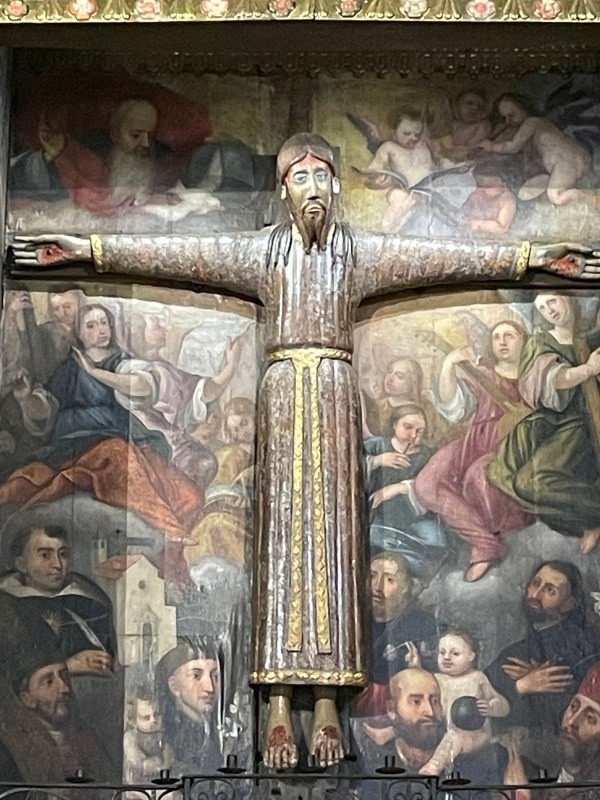
Image: 9th-century Christ figure, Esglesia de Sant Cristofol de Beget, Catalonia.

Note the sermon recording is a version of the text below streamlined for oral delivery.

This Sunday, the last in the season after Pentecost, brings us again to the Feast of Christ the King. It’s worth remembering that this is a relative newcomer to our Anglican–Episcopal calendar. Traditionally, the Sunday before Advent was known as Stir-Up Sunday—from that marvelous opening of the old Collect for Advent Sunday. We now find his Collect moved to Advent II.

“Stir up, we beseech thee, O Lord, the wills of thy faithful people…”

In England, of course, this also served as the annual cue for the vigorous stirring of the Christmas pudding. A lighthearted association, yes—but there is a deeper, more unsettling story beneath the surface of this day.

100 years ago in 1925, Pope Pius XI instituted the Feast of Christ the King as an explicit protest against the rise of fascism and the growing threat of communism. His instinct was to reassert the old Constantinian notion of the Church as the supreme earthly authority—the singular center of allegiance for Roman Catholics. At tremendous cost to freedom of thought and conscience within the Church, he marshaled his legions against those he perceived as rival authoritarian powers.

It is, as you’ve heard me say before, an old and familiar story: one form of authoritarian power confronting another. And for us, for our Anglican sensibilities and ecclesiology, this is problematic. We do not imagine ourselves as an authoritarian church, nor do we look to the state to wield sacred authority on our behalf. And so we are forced to ask:

What kind of king, and what kind of kingship, are we actually celebrating today?

The first chapter of Genesis tells us that humanity—male and female—is made in the image and likeness of God. But if God is unseen, then the only way we can learn anything about God is by taking a long, honest look at ourselves.

And this is where things immediately become complicated.

For which image of humanity is God reflected in?
The compassionate one?
The jealous one?
The collaborative one?
The violent one?
Perhaps, in some mysterious sense, all of them?

This double-edged mirroring cuts both ways. We deduce that God is loving, relational, and faithful because we find traces of these aspects within ourselves. But we also project onto God our fear, our rage, our desire for power and control—because these too are embedded so deeply within us.

This is why the Bible’s shifting, sometimes contradictory portraits of God may have more to do with the conflicting, constantly changing images of ourselves than with any actual change in God. And so today’s great question arises again:

Which of our many competing self-images do we want Christ the King to reflect?

The Church has never lacked for imagery.

Pantocrator—the omnipotent ruler of the universe—gazes down from Orthodox domes and even from our own great West Window at St. Martin’s, itself a war memorial. In this rendering, Christ is robed with imperial grandeur, presiding over the world with absolute command.

Christus Rex, the risen high priest, appears in the reredos of the St. Martin Chapel—Christ triumphant, the cross firmly behind him now, is decked in priestly attire; new life springing forth from resurrection’s victory.

But then there is that other image—stubborn, uncomfortable, and impossible to romanticize:
the one who reigns not from a throne but from a cross.
Not robed in splendor but stripped of all earthly power.
Not lifted above humanity but nailed into its deepest suffering.

This third image refuses the familiar pairing of strength over against vulnerability. It insists instead on a revolutionary pairing:

strength through vulnerability,
continuity reshaped by disruption,
life emerging from death.

This is the image Luke gives us today in Jesus’ Passion. Here, Christ’s kingship shines through the very moment when Rome, the Temple, and a frightened populace converge to crush him. He refuses to play the power game. He refuses to mount a defense that mirrors their tactics. His vulnerability becomes the very thing that reveals divine strength.

We are living, once again, in an interesting moment—interesting in that biblical sense where the tectonic plates shift beneath our feet. Authoritarian voices rise across the world; fear becomes a political currency; purity narratives—racial, religious, cultural—gain traction among anxious populations. Meanwhile, many feel that continuity is slipping away, that the old certainties no longer hold.

Newton’s Third Law quietly reminds us: for every action there is an equal and opposite reaction. And so the pendulum of history swings between order and chaos, continuity and disruption, stability and fracture.

Like Pope Pius XI a century ago, we, too, are tempted to imagine that the only adequate response to coercive power is counter-coercive power. Strength for strength. Force for force. A sort of theological arms race.

The danger here is subtle but real:
when God is remade in our image, it is only a matter of time before violence, domination, and exclusion become divinely sanctioned.

And so Christ the King asks us to choose carefully which image of ourselves we are willing to project onto God.

Left to our own devices, our imaginations merely recycle the familiar. We recognize only what we have already trained ourselves to see.

But the Gospel calls us into a more permeable imagination—one in which the rigid boundaries of our conventional selves give way, and something new breaks through. Jesus’ parables work in this way – as disruptive stories—stories that jump the track like a needle skipping on a vinyl record, suddenly placing us in an unanticipated part of the song.

Christ the King, as Luke gives him, is such a disruption.

Not Pantocrator high above us.
Not Christus Rex safely beyond us.
But Christ who stoops, who descends, who reigns from the cross itself.

This is not the familiar polarity of strength or vulnerability.
It is the holy paradox of strength through vulnerability.

Not disruption as the enemy of continuity,
but disruption as a necessity in the long-term reshaping and renewal of continuity.

Beneath the cross—Luke implies it, and the tradition expands it—are three great stones wedged into the earth:

divine love,
divine mercy,
divine justice.

From this place of what looks like utter defeat, Jesus exercises a kingship the world is not conditioned to recognize. A kingship that unsettles our desire for easy answers, half-truths, and superficial allegiances. A kingship that pushes us to live from hearts less governed by fear.

Christ’s kingship blesses us with righteous anger at injustice, oppression, and exploitation of the helpless. It calls us not to passive acceptance but to active labor for freedom, peace, and justice.

And Christ’s kingship blesses us with just enough holy foolishness to believe that we truly can make a difference—that the world’s wounds are not beyond healing, and that we are called to participate in that healing.

As Dietrich Bonhoeffer wrote in another moment of deep historical crisis:

“We have been silent witnesses of evil deeds; we have been drenched by many storms; we have learnt the arts of equivocation and pretence; experience has made us suspicious of others and kept us from being truthful and open; intolerable conflicts have worn us down and even made us cynical. Are we still of any use?

He continues:

What we shall need is not geniuses, or cynics, or misanthropes, or clever tacticians, but plain, honest, and straightforward men. Will our inward power of resistance be strong enough, and our honesty with ourselves remorseless enough, for us to find our way back to simplicity and straightforwardness?” we shall need is not geniuses, or cynics, or misanthropes, or clever tacticians, but plain, honest, straightforward men and women … with enough inward strength to find our way back to simplicity and straightforwardness.”

So today—this last Sunday of the Christian year—we stand again before the three competing images of Christ the King:

Pantocrator, the omnipotent ruler;
Christus Rex, the triumphant high priest;
and Jesus of Nazareth, reigning from the cross.

The first two are familiar.
The third is revolutionary.

For in that crucified face, we find not a projection of our own lust for control, but a revelation of God’s true nature:

a kingship that reconciles by resisting,
that resists by refusing to imitate violence,
that transforms by entering the world’s suffering rather than escaping it.

Perhaps this is the image of Christ the King we need now:
the one who reigns by setting aside every pretense of worldly strength,
and who invites us to do the same—so that God may enter our picture
and remake us in the divine image of love, justice, and mercy.

Amen.

Confrontation

Sermon on Luke 20:27–38 — “The God of the Living”

This story from Luke’s Gospel gives us one of Jesus’ clearest windows into what resurrection really means.

He isn’t just talking about life after death.
He’s talking about a whole new kind of life.

Resurrection doesn’t just keep the story going —
it transforms existence.
It isn’t the old life resumed,
it’s a new creation breaking in.

The Setting

To feel the power of what Jesus says, we have to picture the scene.

He’s standing in the Temple courtyard —
surrounded by religious authorities,
priests in their robes,
men who run the system.

The Sadducees.

They were the religious aristocrats —
a small priestly class who controlled the Temple in Jerusalem.
Wealthy, well-connected, aligned with Rome.
Religion and politics —
for them, it was all one system.
And it worked pretty well for them.

They only accepted the written Torah —
the first five books of Moses —
and since those books don’t mention resurrection or angels,
they didn’t believe in either.

For them, what you see is what you get.
God’s justice is whatever happens — if it happens — in this life.
So when Jesus preaches resurrection,
they hear danger.


Political danger.
Theological danger.
Because resurrection means
God still has surprises they can’t control.

So they come with their clever little riddle —
about a woman who marries seven brothers.
“In the resurrection,” they ask,
“whose wife will she be?”

It’s meant to make hope sound ridiculous.

But Jesus doesn’t take the bait.
He says, “as usual you’re asking the wrong kind of question.”

The resurrection, he says,
isn’t about rearranging the old furniture.
It’s not a continuation of this world’s arrangements —
it’s a transformation of life itself.

And then he quotes their own Torah —
the story of Moses at the burning bush.
God says, ‘I am the God of Abraham’ — not ‘I was.’

If God is their God,
then they are alive to God.
Because to belong to God
is to share God’s life.
And God’s life never ends.

A Theological Debate with Real Consequences

Jesus isn’t just winning an argument here.
He’s taking a stand in one of the great theological battles of his time.

The Pharisees — unlike the Sadducees —
believed that God’s justice must extend beyond the grave, – that wrongs in this life will be eventually put to rights –
that God’s faithfulness doesn’t stop at the cemetery gate.

And here, for once, there is no daylight between Jesus and the Pharisees.
He shares their conviction
that the covenant promise of God cannot be broken by death.

As Bishop Tom Wright says,
resurrection is not simply “life after death,”
but life after life after death
the full flowering of creation made new.

So this moment in the Temple
is not just a debate about heaven.
It’s a declaration that God’s future is already reaching into the present.
Resurrection is not something we wait for —
it’s something we can live into right now.

Then and Now

It’s easy to leave the Sadducees in the first century,
but their voice still echoes.

You can hear it today whenever people say:

  • “Be realistic — nothing ever really changes.”
  • “Power is power — take what you can.”
  • “Hope is naïve — better to be transactional.”

That voice fills our politics.
It shapes our economy.
It even creeps into our churches.

It whispers:
“The only world that matters is the one you can control.”
“The future belongs to the powerful.”
“Resurrection is just wishful thinking.”

But the God Jesus reveals
won’t fit inside that logic.
The God of Jesus
is the living God —
the One who keeps breaking in,
bringing life where death thought it had the last word.

The God of the Living

When Jesus calls God
“the God of Abraham, Isaac, and Jacob,”
he’s saying something profound about who God is.

If God is their God,
then they are alive to God.
Because God’s faithfulness can’t be interrupted by death.

Resurrection isn’t just about what happens after we die.
It’s what happens whenever God’s life breaks into our dead places:

— when forgiveness replaces bitterness,
— when courage rises to face down fear,
— when love crosses a boundary we thought was final.

That’s resurrection.
That’s the God of the living at work.

Resurrection as Resistance

To believe in resurrection
is to resist despair.
It’s to say that cruelty, injustice, and death
do not get the last word.

It’s to live as if God’s future
is already pressing in on this moment.

And yes —
it’s a dangerous belief.
Because resurrection threatens every order built on fear and violence used as a means of control.
That’s why the Sadducees — then and now —
want to silence it.

Fast Forward to 2025

You don’t have to look far to hear the same old logic being used today:

“People are bad and must be controlled.”
“The poor have only themselves to blame.”
“Immigrants are a threat and so must be expelled.”
“We’re not responsible for climate change, so drill, baby drill.”
“The Church is dying — why bother trying, it’s yesterday’s news?”

And into that weary chorus of constant outrage as distraction, Jesus still speaks:

“God is not God of the dead, but of the living.”

He calls us to live as citizens of that kingdom —
not someday, but today.

To practice resurrection
by daring to hope,
by forgiving, by standing with those the world forgets.

Conclusion — The God of the Living

So what does it mean to say
that God is not the God of the dead, but of the living?

It means that every time we meet despair with courage,
every time bitterness gives way to forgiveness,
every time indifference is replaced with compassion —
resurrection is already happening.

It means faith is not about survival.
Church is not about maintenance.
Resurrection is not escape — resurrection is transformation.
And that transformation begins with us.

That old Sadducean spirit still lingers —
in every system that defends the status quo,
in every voice that says nothing really changes,
in every theology that locks God in the past.

But the living God —
the God of Abraham, Isaac, and Jacob —
the God who raised Jesus from the dead —
will not be managed by fear or cynicism.

To proclaim resurrection
is not to deny death —
it’s to deny its finality.

It’s to trust that love is stronger.
That mercy endures.
That creation still pulses with divine possibility.

It’s to stand in the middle of an anxious, fractured world
and say with quiet defiance:

“The future belongs not to those who manipulate our fear of death,
but to the God who brings life out of death.”

So when you look around at our world —
its exhaustion, its cruelty, its despair —
do not lose heart.

Live as witnesses to the living God.
Practice resurrection
in the small, stubborn acts of love
that make God’s future visible in the present.

For the God of Abraham, Isaac, and Jacob,
the God and Father of our Lord Jesus Christ,
is still the God of the living.

And my friends —this means that however we may be feeling,
God is not done with us yet.

The Scarcity-Abundance Paradox

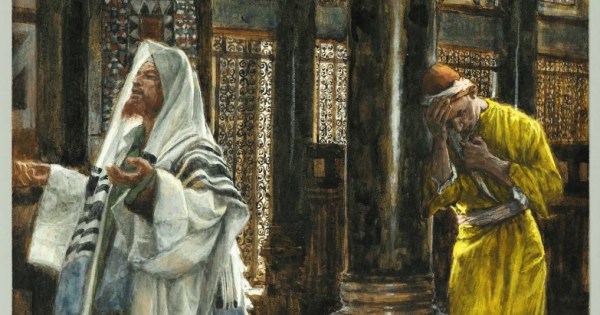
Image: The Pharisee and the Tax Collector, James Tissot, 1886-1894

Any attempt to speak about money in the church runs the risk of provoking a cynical or defensive response. We’ve all heard it before — “the church just wants my money.” But this reaction misses the point.

Money, in the life of faith, is only ever a metaphor for values. When we commit to financially supporting an organization — especially the Church — our hope is not only to contribute value but also to derive a sense of value. Both are essential to living meaningfully with purpose.

One of the great paradoxes at the heart of Christian life is that spiritual renewal is so much more than money, and yet financial generosity is a key expression of our deepening awareness of our need for God. But money and religion often make for a volatile mix.

Putting religion aside for a moment, our attitudes and feelings about money evoke in many of us a deep-seated anxiety — the scarcity–abundance paradox.

I can trace my own anxiety about money back to my parents arguing about it. As the eldest child, I witnessed the early days of their marriage when money was the powerful metaphor for their fears of scarcity as they struggled to build a stable life.

What about you? What are your earliest memories of family conversations around money? Was money, in your home, a metaphor for enoughness or for scarcity?

We internalize — without being conscious of doing so — the anxieties transmitted to us during infancy and childhood. In my case, an expectation of scarcity was implanted in me, even though enoughness — even abundance — has been a much stronger feature of my adult life.

This tension between expectation and experience is exactly where God begins to work.

The Old Testament reading from Joel speaks into this space. After years of drought, famine, and devastation, Joel delivers a word of hope:

The threshing floors shall be full of grain,
the vats shall overflow with wine and oil.

That would have been miracle enough — but Joel goes further:

Then afterward, I will pour out my spirit on all flesh;
your sons and your daughters shall prophesy,
your old men shall dream dreams,
and your young men shall see visions.

God’s promise is not only enough to survive, but enough to dream again.

We often associate “abundance” with endless surplus. That’s why I prefer the word enoughness. Abundance means sustained enoughness — a way of living rooted in trust rather than fear.

Trusting this promise is risky. It requires relinquishing the illusion of being in control — the illusion that we are the authors of our own security. For those of us shaped by scarcity fears, God’s promise of abundance is not easily believed.

So we must ask: Which is more real — our fear of scarcity, or the evidence of our own experience?

Scarcity says: there won’t be enough.
Enoughness says: there is always enough.

Fear blocks generosity. Trust makes generosity possible. When we look honestly at our lives, we discover how often fear has misled us. Most of us live every day with enough — and more than enough. The critical question becomes: Which story do we choose to inhabit?

America may well be the most prosperous society in human history — and yet, paradoxically, we experience the highest levels of scarcity anxiety fueled by the myth of self-sufficiency. In the land of plenty, we too easily condone poverty and inequality, justifying these conditions as the consequences of personal and moral inadequacy.

To abundance understood as enoughness, God calls us to add the practice of justice. Generosity is not just an act of kindness — it is a protest against the myth of scarcity and the injustice that flows from it.

In today’s Gospel, Jesus tells of two men who go up to the Temple to pray: a Pharisee and a tax collector.

The Pharisee believes himself the author of his own salvation. He stands tall, proud of his accomplishments, loudly proclaiming them before God.

We know we are supposed to side with the tax collector, and yet — if we are honest — many of us live more like the Pharisee, designing our lives so we will never need anything from anyone.

But the tax collector — standing apart, unable even to lift his eyes — knows his need of God. In that posture of honest dependence, he discovers a truth the Pharisee cannot: everything — even the good we do — flows from God’s grace, not our control.

The source of all our loves in life flows from God’s love for us. Only when we acknowledge this can we begin to understand our need for God.

Generosity is not a financial transaction — it is a spiritual practice, a way of saying:
I trust in God’s unstinting generosity.

This stewardship season invites us to remember that none of us is an island — our lives are bound together in God’s shared abundance. Through mutual generosity we accomplish far more than any one of us can do alone. Through giving, time, participation, and compassion, we remind each other that abundance is not personal achievement but the fruit of life in community.

Between now and November 24th, I invite each of us to cultivate practices of generosity — for our spiritual, emotional, and societal flourishing. Generosity is not simply about sustaining a budget — it is about extending ourselves to realize God’s promise of enoughness.

Every act of generosity participates in God’s dream for justice.

And so we return to Joel’s vision:

I will pour out my Spirit upon all flesh;
our sons and our daughters shall prophesy;
our old men shall dream dreams;
our young men shall see visions.

So this Stewardship season, let’s dream of unleashing our generosity to achieve yet-to-be-imagined possibilities.

And Then There Were Nine

Image courtesy of Redeeminggod.com

Today is the launch of our public stewardship renewal campaign for 2026. It will run until November 9th. Letters with educative documentation, along with an estimate of giving card, allowing for the vagaries of the US postal service, should land in your mailboxes by the end of this coming week or hopefully sooner. Now, no one wants to hear – even on the Stewardship launch Sunday, a sermon distorted into a harangue for more money. So you can rest easy, I’m not interested in doing that either.

I want you to picture the scene Luke depicts in today’s gospel.

Ten men stand at a distance. Ten voices cry out—not for justice, not even for understanding, but simply: Jesus, Master, have mercy on us. And Jesus—without touch, without spectacle—says, Go, show yourselves to the priests. They go. Ten are cleansed. But only one turns back.

And Luke pauses here to let us feel the implication of the story – one not lost on Jesus’ immediate 1st-century audience. Because the one who returns is a hated foreigner, a Samaritan who falls at Jesus’ feet, giving thanks. His gratitude becomes an act of recognition, an awakening of something within him, as he becomes overwhelmed by hope. For gratitude is never just backward-looking; it is the soil in which the future grows.

Five centuries before this moment, the prophet Jeremiah wrote to another group of people living outside the fold of inclusion—a people rendered strangers in a foreign land -Israel’s exiles in Babylon. They were displaced, disheartened, and desperate to go home to rebuild what had been lost. So Jeremiah’s letter would have shocked them. He didn’t say, Hold on, you’ll be back next year.  He said: Build houses and live in them. Plant gardens and eat their produce. Seek the welfare of the city where I have sent you. (Jer. 29:5–7)

In other words: Hope is not waiting for escape—it is beginning again where you are. Jeremiah’s hope was not naïve optimism. It was a fierce, grounded trust that God is still at work, even in exile. Like gratitude, hope starts by paying attention to what is already possible. For gratitude is never just backward-looking; it is the soil in which the future grows.

The healed Samaritan and Jeremiah’s exiles are kin in spirit. Both live outside the center of inclusion. Both find hope in despair. Both embody what we might call resilient gratitude—the capacity to thank God even before everything is fixed.

The Samaritan’s turning back is his equivalent to planting a garden in exile. He does not rush back into a normal life, the life he must have longed to return to during his years of being shunned. He turns toward the source of his gratitude. And in that turning, he is not only cured but discovers a new kind of wholeness.

Jesus’ final words to him—Your faith has made you well—echo Jeremiah’s promise: For surely I know the plans I have for you, says the Lord, plans for your welfare and not for harm, to give you a future with hope.

Stewardship is about the fostering of our sense of gratitude for what God has already given. From gratitude, hope emerges, trusting that the same God will bring future abundance to life.

Stewardship, then, is nothing less than the practice of hope in action. It requires attentive care. St Benedict loved to tell his monks that stewardship is the exercise of tender competence in ordinary things. Jeremiah said, Build houses… plant gardens… seek the welfare of the city. Stewardship does precisely that—it tends, builds, and plants for the future even when the present feels uncertain.

Every pledge of financial generosity, every act of service, every hour given in ministry is an act of trust that God’s future – already coming to fruition through us is worth investing in. It says, With our time and our treasure, we believe our story isn’t over.

In the Samaritan’s turning back, we glimpse the same truth: gratitude is never passive. It propels us forward into participation—into giving, healing, reconciling, and most importantly investing in the future in a community where our commitment to one another becomes more important than our prized self-sufficient individuality. The key to recognizing gratitude is to never resist for too long, an opportunity to express generosity towards another.

To give thanks in the midst of uncertainty is to refuse to be ruled by fear. To give generously, even when anxious about the future, is to declare that God’s promise of abundance is greater than our fear of scarcity.

When we live this way, we become what Jeremiah envisioned—a community that plants gardens in exile, a people who embody hope through gratitude expressed in generous living. People who make possible a future we cannot yet see.

As I often remind us, it’s only together that we can achieve so much more than any one of us alone. As we enter our own season of stewardship, the fostering in us of our tender competence and love for one another in community, we need to remind ourselves that it is to God we must continually give thanks for the enjoyment of our abundance amidst the experience of change, challenge, and uncertainty.

Like Jeremiah’s exiles, we are called not to wait for the perfect moment— but to build now, plant now, give now, hope now. You and I may not be here tomorrow, yet through what we tend today, the community we build will remain.

Every pledge, every gift, every offering of time and skill says that we believe that God still has plans for us. We believe that love will have the last word. That is when we turn back, as the healed Samaritan did—when we give thanks and offer ourselves anew—we open the way for God to create a new future together. Gratitude is not the end of faith. It is the beginning of renewal. Jeremiah calls us to build despite our present experience of alienation and exile from an America we still cherish in our hearts.

Gratitude is the seed of hope, and hope is the architecture of the future God is already building through us.

Ten men stand at a distance. Ten voices cry out—not for justice, not even for understanding, but simply: Jesus, Master, have mercy on us. And Jesus—without touch, without spectacle—says, Go, show yourselves to the priests. Ten go but only one turns back in gratitude. Nine are cleansed, but only one is made whole. And just to rub it in for his xenophobic Jewish audience harboring an aversion and hostility towards Samaritans, Jesus asks: Were not ten made clean? Was none of them found to return and give thanks to God except this foreigner?

For gratitude is never just backward-looking; it is the soil in which the future grows.

Lest We Forget

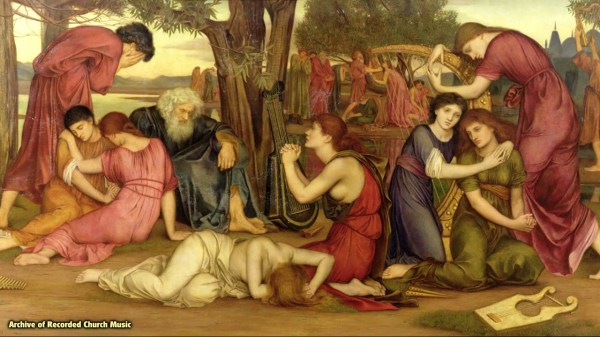
Image: By the Waters of Babylon, by Herbert Sumsion in Ripon Cathedral

In our increasingly visual age, thoughts translate through images. For example, Lamentations 1:1-6 and Psalm 137 offer a remarkably powerful textual pairing. Most of us will choose to read them as text using the  Lectionary page insert, yet, for those of us brave enough to put down the insert and allow ourselves to simply listen, the words strike a different kind of effect on us. You may think I’m splitting hairs, but think about the experience of attending a performance of a play.  I suppose you might follow along with a copy of the script in your lap. But most of us prefer to raise our heads so we can watch and listen.

There’s reading and then there’s watching and listening; they are not the same kind of experience. In a highly visual age, the evocative power of words heard fills our imagination with visual images. As visual images, Lamentations 1:1-6 and Psalm 137 can be viewed on a split screen as disturbingly complementary images.

Textually, they take the literary form of lament. Although scholars debate the authorship of Lamentations, the weight of consensus in both Jewish and later Christian traditions ascribes or at least associates the authorship with the prophet Jeremiah, also known as the “weeping prophet,” the voice of divine heartbreak. Psalm 137 is also a lament, but one of the human heartbreak experienced by those in exile from all they love.  

Developing the idea of words translating into images, when we view Lamentations and Psalm 137 on a split screen, what do we see?

On the left split screen we see the immediate aftermath of Jerusalem’s destruction by Babylon (586 BCE). Lamentations depicts life among those who were too lowly, too poor to be worthy of transportation to Babylon. The tone is one of profound grief and lament over the city’s devastation, depopulation, and humiliation – How lonely sits the city that once was full of people! How like a widow she has become, she that was great among the nations! The poet personifies Jerusalem as a bereaved widow, stripped of her children and her dignity.

On the right side of the split screen, Psalm 137 offers a view set among the exiles now in Babylon. By the waters of Babylon we sat and wept when we remember Zion. The tone is equally anguished – the voice of a deported community remembering Zion from afar, weeping, and vowing never to forget Jerusalem.

Both insist that Jerusalem is not just a place, but the very heart of God’s people. In Lamentations, we see loss and trauma reverberating inwardly as grief and shame. In Psalm 137, we hear loss and trauma reverberating outwardly as longing and rage.

Side by side, these two readings give us a portrait of trauma:

  • In Jerusalem: emptiness, silence, the unbearable loss of God’s dwelling place.
  • In Babylon: memory, resistance, a fierce clinging to identity in a hostile land.

Both cry out to God. Both ask: how long can a people endure when the center of their life has collapsed?

But let’s now divide the two-fold split screen into a four-fold split screen. In the upper two quadrants, viewed from left to right, we still see the images depicted in Lamentation and Psalm 137. But now in the lower two quadrants, we add the image of a devastated Gaza beneath that of the ruins of Jerusalem. Alongside and beneath the images of Psalm 137, we place an image of American exile among those mourning the loss of the nation they continue to cherish in their hearts.

On the left of the screen, moving not from left to right but now from top to bottom, we see images of entire neighborhoods reduced to rubble, defenseless people slain in the street, families torn apart, thousands driven from their homes seeking shelter among biblical images of broken wood and stone and more contemporary ones of twisted rebar and shattered concrete.

Our hearts break along with the breaking of God’s heart at Gaza images of grief and death, of three premature newborns forced to share one ventilator because the incubators have been destroyed; of widows and orphans, of families displaced again and again and forced to inhabit the hell envisaged in Lamentations now recreated before our eyes. – How lonely sits the city that once was full of people – words of grief in the city laid waste, echoes of ancient Jerusalem in present-day Gaza.

On the right side of the screen, from top to bottom, our eyes move between images of displacement. From the rivers of Babylon and the refugee camps of Gaza and the West Bank to America’s political disintegration – we hear the exiles cry of anguish: How can we sing the Lord’s song in a foreign land? When will we be able to once more open the doors to the houses we were driven from 75 years before with the keys we’ve passed from generation to generation throughout our long exile? How long, O Lord, can we endure in a nation where the public square, once at least aspiring toward justice, feels captured by cruelty and resentment, and where our institutions fold and our democracy fractures?  

We may not have walls of stone toppled like Jerusalem’s, or like Gaza’s shattered rebar and concrete, but we do know what it feels like when moral foundations crumble. When truth is mocked. When compassion is despised and mercy rejected. When neighbors are targeted—immigrants, transgender people, the poor—while the powerful and the corrupt continue in plain sight to enrich themselves. We cry aloud: What has happened to us? Who have we become?

Like the survivors in a ruined Jerusalem, we grieve for what has been lost. Like the exiles by Babylon’s rivers, we pivot between despair and rage. The horrors we see on the four-quadrant split-screen confront us with humankind’s inhumanity. When weeping is over and tears are wiped away, what do these texts—transformed into searing images — ask of us?

What are we to do with our grief and rage as we struggle in the tension between mercy and revenge?

The danger in Psalm 137 is clear: grief can also harden into vengeance. Its final verses cry for revenge of the most brutal kind. In our reading of this psalm, we must resist the strong desire to sanitize it by omitting its final three verses with a false justification that this is not who we are anymore. But do we not know this temptation only too well today, when grievances, real or imagined, find their expression through violent words designed to inflame violent action; when political opponents become enemies to be crushed, not neighbors to be persuaded?

We are Christ’s own. And in Christ, we are called to stop the spiral of vengeance—not by denying grief, but by the transformation of sorrow when we weep honestly with those who weep; when we remember fiercely the values of compassion and justice, even when our rulers mock them; when we witness faithfully that exile is not the end. Ruins are not the last word. For as both Lamentations and Psalm 137 ultimately attest, our God remains faithful to those who refuse to forget Jerusalem.

For our story is resurrection. From rubble, God builds anew. From exile, God leads home as we stand between Lamentations and Psalm 137—between grief for what is lost and hope that refuses to die. In the temptation of despair, we nurture the courage to remain true and to hold fast.

The anguished cry If I forget you, O Jerusalem, becomes our metaphor as we refuse to forget who we are as Christ’s own. We do not have the luxury of surrendering to rage and despair. Let future generations look back at us and say, They remembered. They resisted. And by God’s grace, they rebuilt.

Amen.

Lectionary Threads

Setting the Scene
I was surprised but also heartened by the feedback I received about my weekly E-Epistle on Paul’s letter to Philemon, which appeared two weeks ago in the E-Newsletter. It reminded me how deeply we hunger for the bold wisdom hiding in Scripture, and how the appointed readings can open up unexpected conversations.

Each Sunday, we are given four scriptural readings, traditionally referred to as lessons because of their instructive potential. Often—at least on the surface—it’s hard to comprehend why the compilers of the lectionary place particular texts side by side. Yet, as a general rule, we can find thematic threads between the Old Testament lesson and the Gospel. The psalm may or may not extend that theme—it often stands in its own right as a hymn of praise or lament. But the New Testament epistle is the outlier. Rather than tying directly into the other lessons, its themes usually unfold sequentially over several weeks, offering us a parallel commentary on what it means to live as Christians in the world.

I know many preachers will default to the gospel lesson, and rightly so. But I find myself often drawn to the Old Testament—because the backstories are so rich, the narratives so captivating. Yet I do not turn to them for history alone. As the writer of Ecclesiastes reminds us, “there is nothing new under the sun.” Human society repeats its patterns. Shakespeare was keenly aware of this. In order to keep his head on his shoulders, his history plays project Elizabethan social and political tensions back into historical settings. This is a tried and true device allowing any writer to speak about contemporary issues through the lens of history.

What goes around then comes around again. Jeremiah holds up ancient politics and divine lament as a mirror for our times when once again we find ourselves struggling to respond to the chilling effects of an unholy alliance between corporate greed and the political suppression of First Amendment freedom of expression.

Jeremiah’s Lament
The passage from Jeremiah, chapter 8, into chapter 9, is one of the most anguished laments in Scripture. Sometimes called the weeping prophet, Jeremiah gives voice to both his own grief and God’s grief as the armies of Babylon camp at Jerusalem’s gates. The line between prophet and God blurs: is this Jeremiah speaking, or is it God? Either way, his poetry is saturated with pain. My joy is gone, grief is upon me, my heart is sick. The harvest is past, the summer is ended, and we are not saved.

These are words of missed opportunity, of doors closing, of a people who refused to turn back to God until it was too late. Jeremiah then utters the piercing question: Is there no balm in Gilead? Is there no physician there?

Everyone in his audience knew what he meant. Gilead, in what is today northwest Jordan, was famous for its resin used in medicine. Healing was available. The balm existed. But the people would not take the cure.

This is the paradox of prophetic ministry: to speak God’s truth is also to carry God’s heartbreak. Jeremiah embodies both divine compassion and human solidarity. God’s anger is real, but underneath it lies a brokenhearted love for a wayward people.

Little wonder then that the image of a balm in Gilead became a lasting metaphor for Christ’s power to heal and restore. And little wonder, too, that this image found its way into the heart-rending songs of the enslaved African communities in America who sang out amidst back-breaking toil and unimaginable cruelty: There is a balm in Gilead to make the wounded whole; there is a balm in Gilead to heal the sin-sick soul. When every other cure had failed, when every earthly power failed them, the enslaved sang of Gilead’s balm, and in so doing, their song became the balm that could not be taken away from them.

Jeremiah is not only the prophet of tears. He is also a prophet of hope. Even after Jerusalem fell, even in exile, he urged the people to build houses, marry, raise families, and seek the peace of the city where they found themselves. Life must go on. Even in Babylon, there was still a future in the unfolding of God’s dream for them.

Jesus’ Parable
In Luke’s gospel we hear Jesus’ perplexing parable of the dishonest manager, who is suspected of fraud, and now fears dismissal. Too weak to dig, too proud to beg, he concocts a plan. He calls in his master’s debtors and reduces their bills. He knows that when he is out of work, they will not forget his generosity towards them when it mattered most.

We recognize this as not only a morally dubious move, but a fraud of mega proportions. We are astonished when the master, aka Jesus, commends him for his shrewdness and holds him up as an example to emulate. Can we be clear here about what Jesus is commending? It’s not the steward’s fraud, but his shrewd sense of urgency. The man knew his time was short. He acted decisively, creatively—even boldly.

The children of this age, Jesus says, are more shrewd in dealing with their own generation than are the children of light. If the crooked can act so cleverly to avert disaster, why do the faithful so often drift through life oblivious to the eternal implications of their complacency?

And then comes the sting in the tail, for Jesus boldly states that you cannot serve God and Mammon. Note, not should not, but cannot! Only one master can win our allegiance.

Drawing the Threads Together
So what happens when we place Jeremiah’s lament and Jesus’ parable side by side?

  • Both press us to live with urgency. Jeremiah shows us the grief of a people’s missed opportunity. Jesus alerts us to the necessity of seizing the moment.
  • Both warn us against misplaced trust. Jeremiah laments a people who refused the available cure. Jesus unmasks the rival god: Mammon – power, wealth, possessions – offering the illusion of security.
  • Both reveal God’s brokenhearted love. Jeremiah weeps God’s tears. Jesus names God’s rival and calls us back to the path of discipleship.

Together, they ask us the question: Where do you place your trust? Which master’s tune do we dance to? As we approach this year’s stewardship renewal season, a variation of the question arises: Do we celebrate our wealth and security because they are ours to possess alone, or are they the means for living a generous life in the service of the common good? The key to Christian living is to not resist for too long an invitation to be generous!

Application
We live in a world where false balms abound. Healing is sought in consumption, political power, financial security, and through transactional relationships of transient self-interest. We convince ourselves: if only I had a little more, then I would feel safe, my cup would be filled, and my life would be complete. But the harvest passes, the summer ends, and the wound of insatiable longing remains unhealed.

As God’s people, we live in a world where Mammon whispers constantly in our ear. It tells us: money and possessions are the only true masters, power the only true balm. And so, Jesus’ words strike hard: You cannot serve God and Mammon.

But as Jeremiah would eventually counsel the Babylonian exiles, here’s the good news: we are not abandoned or left without hope. The balm is real. The healer is present. The master who loves us is faithful. The question is: will we miss our moment, like Jeremiah’s people? Or like the steward will we act with urgency, with a shrewd sense of timeliness – no longer in the interests of selfish gain, but with a desire to invest in the values and expectations of God’s kingdom; to pour ourselves into generous living that fosters our work for peace with justice tinged with mercy to come to our world?

The Call
Jeremiah wept for the wounds of his people. Jesus called his followers to choose their master. And here we are, standing between lament and parable, asking the same question:

Will we trust false cures or the true balm? Will we serve Mammon, or the living God? The harvest is still here. The balm is still offered. The choice of masters is still before us. Let us act with urgency.

There is a balm in Gilead to make the wounded whole; there is a balm in Gilead, to heal the sin-sick soul.

Unfortunately, we must choose.

Parable of the Diligent Woman Luke 15:1-10

I want to begin with a historical footnote that you will recognize is not without contemporary significance. We note that the parables of Jesus recorded by Luke in chapters 13 -15 are all set in the context of disputes between Jesus and the Pharisees. Christians have always read too much into this. Argument has always been a characteristic of Jewish biblical interpretation. As the Talmud’s tells us – two Jews, three opinions – at least.

That Jesus and the Pharisees argued over Torah interpretation was normal. But by the time the Evangelists were constructing their gospel narratives from the oral traditions that had grown up around Jesus and his stories of the Kingdom, the memory of his intra-communal (within the same community) disputes with the Pharisees had become highly colored by the growth of a bitter animosity between emergent Rabbinic Judaism and early Christianity – both competing for the upper hand amidst the ruins of the Second Temple.

Thus, in the highly intercommunal (between communities) tensions between the developing Rabbinic and Christian traditions of the mid- to late 1st century, Pharisees became easy scapegoats for the other– convenient historical reference points for one another in a hyperpolarized Jewish world.

Jesus, himself, may well have been a product of the Pharisee movement, which in the context of Second Temple Jewish religion was a progressive movement that brought a deeper spirituality to Torah interpretation. The Pharisee movement placed a greater emphasis on the teaching of the prophets than the rigidly conservative Temple-based Sadducees. A progressive movement, whose power base lay in the countryside, not the Jerusalem temple.  Through the system of synagogues, the Pharisees ran a network of local schools, and it’s probably in one such that Jesus received his education. We should view Jesus, if not as a Pharisee himself, but as someone who was certainly part of the progressive movement. Yet, within the progressive movement, there were tensions. And to use a contemporary lens, we might see the Pharisees as the establishment Democratic-Liberal establishment with Jesus as the more politically radical Democratic-Socialist fringe. I know this comparison is somewhat controversial – but I use it to highlight the nature of the tensions between Jesus and his Pharisee interlocutors. For Jesus, the issue is always political – esp. in Luke, who presents Jesus continuing in the highly political tradition of the Hebrew prophets.

Between Luke’s time and ours, has anything really changed much? The names change, but the dynamic of polarized worldviews stays the same. That Luke depicts Pharisee criticism of Jesus with such intensity is really code for the ongoing conflict between those who have and those who have not; those who are in and those who are excluded. Jesus is invariably presented as being an advocate for the have-nots, the excluded, the overlooked. If we look at the situations in which Jesus and the Pharisees get into it, they all concern the refusal of a male-dominated religion to recognize the needs of the weak, the sick, and the vulnerable.

Whereas Matthew views Jesus as the embodiment of the Torah’s fulfilment, the new and improved Moses, Mark views Jesus from the perspective of God’s identification with those at the rough end of empire power – Isaiah’s  Suffering Servant. Luke adds a new socio-political dimension by presenting Jesus’ concern for the outcast and the discriminated against – women and children, widows and orphans, and the sick, in particular. Which is why Luke’s presentation of Jesus has a very contemporary feel. It’s within this larger political context that Luke presents Jesus’ championing of women as social inferiors. This is the background against which the parable of the lost coin needs to be read.

In chapter 15, Luke offers a wealth of images in three parables original to him. We might best think of Jesus’ parables as stories of the kingdom. In these three parables – the lost sheep, the lost coin, and the prodigal son- Luke presents Jesus’ concern with the theme of lost and found.

Today’s gospel stops short, giving us, mercifully, only the parables of the lost sheep and the lost coin. As we have other opportunities in the liturgical year to explore the parable of the lost sheep and that of the prodigal son, it’s the story of the lost coin that piques our uncontested curiosity today.

Set between the two male-dominated kingdom stories exploring the theme of lost and found, the parable of the lost coin has a woman as the central protagonist. Because of this, it can often be overlooked. Although generally referred to as the parable of the lost coin, it might better be referred to as the parable of the diligent woman. For it’s not the coin or its value but the woman’s concern and diligence in searching that lies at the heart of this story of the kingdom.

The diligence of the woman who turns her house upside down in what amounts to the spring-clean of spring-cleans in search of her lost coin speaks to us of dedication or diligence. To be diligent means to exert constant and earnest effort to accomplish what is undertaken. Diligence requires a persistent exertion of body or mind. In my experience, diligence is a key quality displayed by women and particularly suited to the arena of everyday life.

Diligence is not heroic, nor particularly dramatic. Because diligence is an unobtrusive quality, it’s often overlooked or taken for granted. Diligence involves an attention to the details, taking care in ordinary everyday circumstances. It’s a woman who is this parable’s protagonist because diligence is a characteristic of the feminine principle in the spiritual life. It’s a gentle competence in ordinary things. Being a feminine spiritual principle, it’s an unsung characteristic of discipleship.

In my experience of the politics of gender, diligence is a quality more often displayed by women than by men. Even in the modern world, where the gender divides of traditional societies have been greatly eroded, the parable of the diligent woman symbolizes women’s care for the details in lives of service, nurture, and relationship building. Whether this is in the traditional areas of service to others in the family or today by extension in caring professions that serve us in communities, women blaze the way and are largely unsung in doing so.

Gentle, yet determined competence strongly shapes women’s experience in ways that are less evident than the lives of men. Men are less focused on nurturing relationships beyond those of mutual advantage. Competitiveness, drive, and ambition are more culturally acceptable in men, and it comes as little surprise that in contemporary America, where diligence is undervalued, it’s men who are increasingly lonely and isolated, deprived of the intimacy of peer relationships to support their well-being.

The average attention span in today’s media-driven age is approximately 8.25 seconds, which is shorter than that of a goldfish. This decline is largely attributed to the rapid consumption of content on social media and digital platforms. None of us needs reminding that diligence is less than sexy in the clashing and discordant cacophony of multiple distractions. As a society, we’ve lost our appreciation for diligence in public service as well as private life, preferring instead the peacock display of self-serving egotism.

I have already noted that diligence is a quality of the spiritual life, and my specific observation from this parable can be applied to the challenges facing us as a spiritual community. As we once more embark on a new program year, we acknowledge Ministry Sunday today.

I believe the quality exemplified in the parable of the diligent woman expresses the persistent exertion of body and mind to recover what’s been lost. Diligence, the perseverance to do what needs to be done with the resolution of heart, mind, and body, is the quality we most need to mirror for one another.

In the politics of Jesus, as Luke presents him, God does not welcome us into the kingdom; God invites us into the kingdom. We are not to wait within our walls and smile sweetly to those who venture through the doors, although in many parish communities, to do this is to take a much-needed step in the right direction. God sends us out into our lives to display the quality of diligence in our lives among friends, neighbors, and colleagues; to become living signs that things which were cast down can be raised up, things which had grown old can be renewed, and most of all, in the diligent search that what has been lost and might once again be found.

Ordinary people who faithfully, diligently, and consistently do simple things that are right before God will bring forth extraordinary results. Elder David A. Bednar . Happy Ministry Sunday!

Table Talk

Image: Table Talk – Arrington & Associates arringtonassoc.com

We’ve been listening to the voice of the prophet Jeremiah for the last three weeks in our OT readings. So who was he?

Jeremiah was born in the Levite village of Anathoth, located just outside Jerusalem, in the territory of the tribe of Benjamin. Being from a priestly family not connected to the Temple worship in Jerusalem, he was close enough to know the ways of the Temple, but far enough from its center to see its faults. As a young man, God called him. Jeremiah resisted—“I am only a boy, a dresser of sycamores,” he said—but God put words in his mouth and sent him out to speak hard truths: not only to uproot and tear down, but also to build and to plant.

Not unlike our own day, Jeremiah lived in a time of deep turmoil. Leaders were corrupt, religion was shallow, and the nation was on the brink of collapse. He warned: Babylon was coming, and Jerusalem would fall. No one listened. He was mocked and imprisoned for treason. As the city was about to fall, he was thrown into a dry cistern and left to die.

For the first Christians, Jeremiah evoked their memory of Jesus. Remembered as the weeping prophet, his tears flowing from a deep love, he wept because his people would not listen. And yet he never gave up hope. He even bought a plot of land as a sign that God’s people would one day return and rebuild. He embodied hope. He looked ahead to a new covenant, not written on stone tablets but written upon the human heart.

It is no wonder the early Christians saw Jeremiah as a prototype of Jesus—one who suffered for speaking God’s truth, whose heart broke for his people, and who pointed beyond judgment to God’s steadfast promise of new life.

Jeremiah’s vision still speaks to us today. Faithfulness is not always easy, but it is always rooted in love. Jeremiah shows us that even when old ways collapse, God is planting something new. The question is: will we make that essential leap from the external observance of religion as a series of rules and rituals to the power of internal tranformation. Or as Jeremiah phrases it: will we allow God’s covenant to be written upon our hearts?

In “The Cost of Resistance” and “Religion, Conduit or Smokescreen? – my last two sermons, I addressed the importance of resistance, either as non-violence, which allows for confrontation or non-resistance, which rejects confrontation in favor of identification with the oppressed. Both were crucial elements in Jesus’ challenge to religious and political authority. Jesus echoed Jeremiah’s call for a new covenant, not of empty ritual, but of inner transformation  – a covenant no longer written in stone and enforced by law, but one written upon the human heart and empowered by love – not sentimental love, but love as the robust expression of mercy at the heart of God’s justice.


In chapter 14, Luke relates a story about Jesus attending a dinner. For Jesus, a dinner is never just a dinner. It’s a metaphor for the world.

In Luke 14, Jesus is at a Pharisee’s house on the Sabbath. He watches people scramble for the best seats, angling for honor. He sees the host inviting all the right people—friends, relatives, wealthy neighbors—the kind of guests who can return the favor.

And Jesus says: Not so in God’s kingdom.

First, he speaks to the guests: Don’t grab the best seat. Take the lowest place. Because in God’s world, all who exalt themselves will be humbled, and those who humble themselves will be exalted.

This isn’t just table manners. This is a whole new way of thinking about status. Honor is not seized. It’s given. It’s gift.

Then he turns to the host: When you give a banquet, don’t invite the people who can pay you back. Invite the poor, the crippled, the lame, and the blind. Invite the ones who cannot repay.

That’s radical. Not only in the ancient world, but throughout human history, meals have been about reciprocity—keeping the social wheel spinning.

Jesus says: Stop calculating. Stop expecting a return. Throw open the doors.

As a young man, I remember one evening at a soup kitchen. I expected to serve from behind the counter. But the priest said, “Sit down and eat with our guests.” I did—and found myself laughing and sharing stories with people who had nothing to give back but themselves. One man even offered me the last piece of bread. That night, I realized the kingdom isn’t charity. It’s communion.

A few months ago, I read about a small church on the southern border. They opened their parish hall to migrant families who had nowhere to sleep. No repayment possible, no guarantee of safety or security. Just beds on the floor, warm food, and open doors. The world might see it as impractical, even dangerous. But I think Jesus would see it as a rehearsal dinner for the kingdom banquet.

And I think too of the early church, where at Christian gatherings, slaves and masters, men and women, rich and poor, Jews and Gentiles sat at the same table. In the empire of Caesar, that was unthinkable. But in the kingdom of God, it was the most natural thing in the world. The table re-ordered society.

The table is just the beginning. Jesus is describing a whole new way of life, and the implications for us can be rather disturbing. In a world obsessed with status, Jesus points us toward humility. In a world built on transactions, he points us toward generosity. In a world that excludes, he points us toward radical welcome.

Our economy thrives on profit and return. But Jesus says: invite those who cannot repay.

Our politics builds walls and charts borders. But Jesus says: the kingdom is not complete until the stranger is welcomed.

Our relationship with creation is marked by exploitation. But Jesus says: take the lower seat, live humbly as a guest at creation’s table. Reduce your carbon footprint by curbing your discretionary spending on things that are not necessary but only desirable. Maybe some of these decisions are now going to be forced on us, if not by virtue then of necessity, as our minds begin to boggle at increased prices, and our fingers are slower to click the Amazon complete purchase button.

Our nations compete for dominance, our corporations scramble for power. But Jesus says: true greatness is found in service, not control.

And here, at this table—the Lord’s table—we taste that world. No reserved seats. No VIP section. All come empty-handed. All are fed by grace.

Luke 14 is not about table etiquette; it’s about God’s dream for the world:

  • A world where generosity replaces calculation.
  • Where strangers and migrants are honored guests.
  • Where creation is cherished.
  • Where humility dethrones pride.
  • And where grace, not power, is the currency of life.

This is the banquet of God. This is the feast of the kingdom.

Jeremiah’s words ring out across the centuries. Even in times of turmoil, God is still at work—tearing down what cannot last, and planting seeds of hope for what will endure. May we have the courage and the love to live as people of this promise – a covenant written upon our hearts.

I know most of us will be thinking, though few I imagine will say it out loud, that this is all very well and good – a wonderful utopian picture impossible to achieve. How often are we told that the dream of God is not reality. But before we rush with something of a secret sigh of relief to dismiss utopian dreams, let me leave us with this thought. Coming down to the intimacies of our everyday lives, if we share this bread and drink from this cup, might it be possible for this table to begin to reshape all our other tables—our homes, our neighborhoods, even our politics. Is this such an impossible dream?

Amen.

Religion, Conduit or Smokescreen

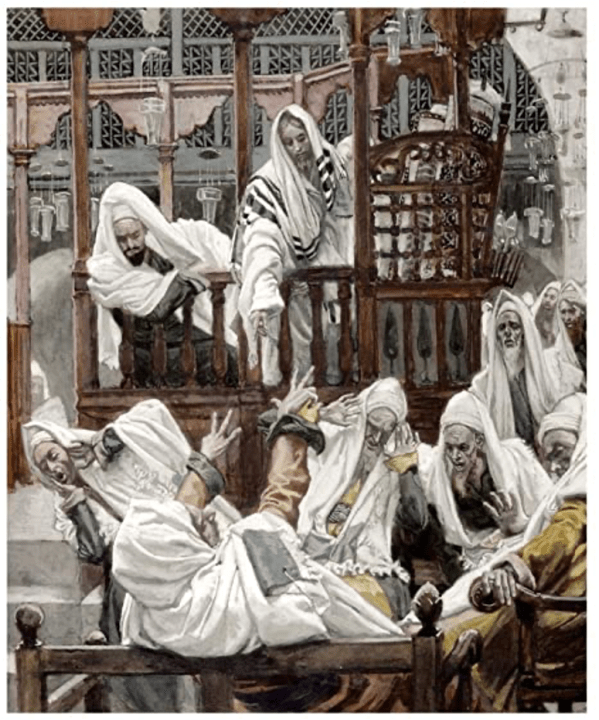
Image: Tissot- The woman with an infirmity of 18 years

Asked in an interview on the podcast Unholy Things on August 5, 2025, the Israeli historian Yuval Noah Harari was asked:  October the 7th, 2023, till now, where does that fit – is it a footnote or a chapter in the sweep of Jewish history?

Listen here

Harari responded: I think it’s one of the – could be one of the biggest turning points in Jewish history-  maybe the biggest since the fall of the temple in 70 CE  – since the Roman conquest. Because Judaism has survived it became the world champion in surviving catastrophes, but it never faced a catastrophe like we are dealing with right now which is a spiritual catastrophe for Judaism itself because what is happening right now in Israel could basically – I think destroy, void, 2000 years of Jewish thinking and culture and existence. That the worst case scenario that we are facing right now – what we are facing is the potential of an ethnic cleansing campaign in Gaza and the West Bank resulting in the expulsion of 2 million maybe more Palestinians; the establishment of greater Israel and the disintegration of Israeli democracy; the creation of a new Israel which is based on an ideology of Jewish supremacy and on the worship of what were completely anti-Jewish values for more than last two millennia; a country based on the worship of power and violence and which is militarily strong – it will survive – it will be militarily strong  – it will have alliances with various bullies around the world. It will also be economically viable, and this will be the spiritual disaster because this will be the new Judaism that all Jews in the world will have to deal with. It will not disappear again. Jews are very good dealing with catastrophes from the Roman conquest to the Holocaust but this will not be a military catastrophe. The state will actually be successful in military and economic terms and it will make the challenge much, much bigger. No Jew, say, in London or New York or anywhere else, we’ll be able to say this is not the real Judaism.

There is one episode in the iconic TV drama, The West Wing, that is forever etched in my memory. The background to this particular episode concerns the President being asked to pardon a man awaiting execution on death row. Attending Shabbat Service, Toby Ziegler, the White House Chief of Communications, is puzzled by the rabbi’s sermon, in which he states that vengeance is un-Jewish. Puzzled, Toby questions the rabbi about the Torah teaching – an eye for an eye. He reminds the rabbi that throughout Exodus, Leviticus, and Deuteronomy, the Torah prescribes the death penalty for a large number of offences, mostly religious in nature. The rabbi replies that maybe the Torah sanctioned death penalty represented the best teaching at that time, but that the later rabbis in the Talmud went to great lengths to confine the meaning of the Torah texts to forms of reparation that did not require death. Jewish thought moved on as it deepened, over time, the human understanding of God’s justice and mercy.

Jewish thought moved on as it deepened, over time, the human understanding of God’s justice and mercy.

In Luke 13, we eavesdrop on an encounter between Jesus and religious authority over the case of a woman Luke describes as seriously crippled. Actually, crippled is a rather smooth English rendering that does not do justice to the specificity of Luke’s use of the Greek synkypto, which means bent together– as in doubled over. The woman is more than crippled – she appears to be suffering from a form of spondylo-arthritis known as Marie-Strümpell Disease.

Imagine for a moment the experience of being doubled over. Imagine what happens to your breath as the doubling over of your spine constricts the movement of your lungs. Imagine having this condition for 18 years.

Noticing the woman, Jesus stops proceedings by placing his hand on her and saying, “You are released from your weakness.” She immediately straightens and gives glory to God. Cause for rejoicing all around, you may think? Not a bit of it. Jesus’s action has provoked fierce indignation as the leader of the synagogue accuses him of breaking the Sabbath.

Last week, I spoke about the role of non-violent resistance in Jesus’ ministry, and here Luke presents an instructive example of this in action. The encounter with the woman bent over is not a story of miraculous healing from infirmity – an action the synagogue leader suggests would be more appropriate for the other days of the week. However, Jesus does not say, “Woman, be healed from your infirmity“; he says, “Woman, you are set free from your ailment.” The question here is, what ails her? Or, more accurately, what is the source of her ailment? In other words, this is not a story of healing at all. Its a story about exorcism.

In the spirit of non-violent resistance, Jesus confronts the religious leadership with the central question: ought not this woman, a daughter of Abraham who Satan bound for 18 years, be set free from this bondage on the Sabbath Day?  Notice how Jesus reframes the context – reminding the synagogue leader of this woman’s status in the community as a daughter of Abraham. He also throws in the reference to satanic binding – implying a connection to the Sabbath Day. In other words, Jesus is signalling that his diagnosis of her condition is spiritual and not physiological.

This is a story of two encounters – with the woman and the religious authorities. In his reference to satanic binding, Jesus is exposing what’s really going on behind the smokescreen of religion. The symbolism here is of a woman doubled over under the weight of the religious-inspired collective moral judgment upon her.

The authority exercised by religion, in this story, has become a smokescreen to obscure the fear-driven hardening of the human heart?  For the ancients, and even for us today, fear of illness motivates moral judgment as an attempt to explain away our fear of what we either do not understand or are unable to control.

Why has Jesus identified the woman’s condition as satanic binding? The French philosopher, René Girard, states it neatly -Satan exists, [only] because we exist. By this, he means that evil is an anthropological – a human, cultural construction, not a cosmic rival to the victory of God.

In religious tradition and its institutions, evil is to be found in the hardening of the human heart, which privileges the protection of human power – a universal tendency to resist the continual reshaping by the demands of divine justice and mercy. If there is a judgment to be borne, then it’s that we are all found wanting when faced with the judgment of God’s justice and mercy.

Here, we come back to heart of the matter in Luke 13: 10-17 where we find in Jesus’ confrontation with the synagogue leadership a foretaste of both later New Testament and rabbinic traditions that came to understand that it is compassion and mercy not vengeance that lies at the heart of divine justice.

By his reference to Satan’s binding, Jesus is drawing attention to the spiritual effects of the weight imposed upon an individual when religion as the defense of human hard heartedness. In other words, he’s saying to the religious authorities, what can be more appropriate than on the Sabbath Day – to liberate this woman from the satanic bondage you’ve imposed upon her by your perversion of religion as a smokescreen for the hardness of your hearts?

Toby Zeigler’s rabbi reminded him that Jewish thought is continually evolving, deepening over time, the human understanding of God’s justice and mercy. Harari’s words are a fearful warning about the spiritual and moral consequences for Israel in departing from this 2000-year line of development- and by extension – his words are a warning to us of the immanent spiritual and moral dangers in this current American political landscape as religion becomes contaminated by political ambition and the perversion of nationalist aspiration.

The question we always need to ask is: how is religious tradition being used? Is it being used to imprison or to liberate? Is our Christianity a conduit for a deepening of our understanding of mercy at the heart of God’s justice, or is it a smokescreen obscuring the hardening of the human heart? When hearts harden, all kinds of violence and cruelty become justifiable.

The Cost of Resistance

You hypocrites! You know how to interpret the appearance of earth and sky, but why do you not know how to interpret the present time?

Thursday of this past week, August 14th, was the commemoration of Jonathan Myrick Daniels, an Episcopal seminarian at Harvard’s Episcopal Theological School who in 1965 became the Episcopal Church’s most prominent civil rights martyr.

Robert Tobin (son of parishioners Bob and Maureen Tobin) in Privilege and Prophecy provides a narrative of the Episcopal Church’s evolving identity and social activism during the period 1945-1979. Drawing extensively on archival materials and periodicals from multiple sources, he provides an intimate picture of how Episcopal leaders understood their role and responsibilities during a time of upheaval in American religious and social life.

Tobin places Jonathan Daniels, a New Englander born in Keene, New Hampshire, against a background of Northern white Christian hypocrisy in the civil rights era. He calls out the white liberal romantic identification with Southern black suffering as an avoidance of the violence of racial discrimination on their own doorsteps.

So much Northern white Christian advocacy for racial equality was conducted from the safety and protection of positions of white privilege. John Butler, a prominent Episcopal churchman of the time, noted that demonstrating publicly in the South had required less personal courage than confronting the genteel racism of his Princeton parishioners.

Tobin comments on the iconic Rhode Island theologian, William Stringfellow, who perceptively noted that while Northern white liberals didn’t despise or hate Negroes, they also didn’t know that paternalism and condescension were forms of alienation as much as enmity.

Jonathan Daniels – struggling with the paradoxes and ironies of his horror of racial oppression from his position of white privilege, like many other idealists of his ilk, joined the Selma Freedom Riders. But unlike many, he took to heart Stringfellow’s rebuke.  He not only marched but also felt compelled to remain afterward to register black voters, tutor children, and help integrate the local Episcopal church.

Driven by a powerful spiritual awakening experienced during the reading of the Magnificat at Evensong , he explained:

I could not stand by in benevolent dispassion any longer without compromising everything I know and love and value …. as the price that a Yankee Christian had better be prepared to pay if he goes to Alabama.

In mid-August 1965, Daniels was shot dead as he shielded a young black activist, Ruby Sales, from the deadly aim of Tom Coleman, an unpaid special deputy, subsequently acquitted on the grounds of self-defense by an all-white jury.

John Coburn then Dean of ETS later confessed:

It took a long time to realize that Jon was a martyr. He was just a typical, questioning, struggling student, trying to make sense out of the issues, conflicts, and injustices of our society.

Yet with time, Daniels has come to be revered as a martyr in the Episcopal Church. As a man who embraced nonviolent protest in the face of the evil of racism – and who accepted the ultimacy of nonresistance because he had come to the realization that his possible death was the price that a Yankee Christian had better be prepared to pay if he goes to Alabama.

Jesus’ powerful accusation

You hypocrites! You know how to interpret the appearance of earth and sky, but why do you not know how to interpret the present time?

comes at the end of a difficult passage – seemingly flying in the face of our preferred image of Jesus as the peacemaker.

Although within the overall context of his ministry, Jesus preaches a message of peace, he recognizes that peace never comes without cost. Peace is never peace at any price – it must always be peace as the harbinger of justice. It’s not peace but justice that lies at the heart of Jesus’ concern. Luke 12 dispels any doubt we might still harbor concerning the real impact of Jesus’ recognition that conflict, which may even spur some to violence, is an unavoidable birth pang of the kingdom’s coming.

Jesus lived in a context riven by political and religious-sectarian violence. The question he addresses is whether violence can achieve justice.

We, too, live in a world increasingly riven by politicized violence. Domestically, what is the appropriate Christian response when incendiary rhetoric incites politicized violence among those who wish to wave a Bible in one hand and a gun in the other?  Internationally, what is our humanitarian response in defense of nations and peoples subjected to colonialist violence – esp. when the disregard of a peoples’ right to exist trips over into genocide? While different options for action are open to us, all must proceed from an unwavering commitment to remaining clear-sighted in the face of the temptation to look away.

Whatever Jesus thought about violence, he was never one to look away. In his life and teaching, we detect a complex interleaving of two related strands of clear-sighted resistance – nonresistance and nonviolence as related and yet different forms of protest in response to systemic evil.

Nonresistance not only rejects acts of violence but also rejects confrontation when it has the potential to lead to violence. It’s essential that we grasp the point that nonresistance does not equate to nonaction. Nonresistance is the action of seeking solidarity with the victims by joining with them, even and especially when we ourselves become subjected to violence at the hands of the powerful. Practitioners on the path of nonresistance seek to change the world around them through sacrificial example.

By contrast, nonviolence seeks change through direct confrontation with the systems that maintain injustice and oppression through violence. The confrontation can be fierce, yet it stops short of resorting to violence to win the argument. When faced with the inevitability of violence, the path of nonviolence merges into the path of nonresistance.

In the larger frame, nonresistance and nonviolence are the two essential elements in Christian resistance. Jesus’ journey from life through death to new life is a demonstration of God taking the ultimate path of nonresistance. In his ministry, Jesus more often follows the path of nonviolence – calling out the systemic evils of injustice and oppression. But the new thing God does through Jesus is to bring about profound change through self-sacrifice on the path of nonresistance.

Returning to John Butler’s comment that confronting segregation in the deep South required less courage than confronting the smugly hidden racism of his Princeton parishioners alerts us to the dangers of hypocrisy when our Christian pretense to peace and love is but a fig leaf excusing us from facing up to the hidden and subtle forms of the violence that we claim to reject.

Do you think that I have come to bring peace to the earth? No, I tell you, but rather division!

We are living through another period when the level of division and conflict Jesus speaks about in Luke 12 permeates every level of our society. Although many of us are uncertain of how to respond to attacks upon the ethical values and principles that lie at the heart of our conception of democratic social and political order, the most important thing is to resist the temptation to look away – to avert our gaze from the appearances of the present time.

I could not stand by in benevolent dispassion any longer without compromising everything I know and love and value …. as the price that a Yankee Christian had better be prepared to pay if he goes to Alabama.

You hypocrites! You know how to interpret the appearance of earth and sky, but why do you not know how to interpret the present time?

Maybe it’s less costly to gaze upwards to interpret the patterns in the heavens than to look around and, with clear sight, confront the patterns of the present time?

Blog at WordPress.com.

Up ↑