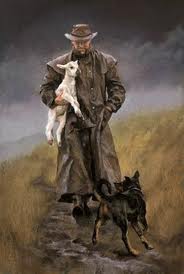
In but not of: that’s the question.


So it truly is a miracle to experience the sudden bursting into new life that occurs as the weeks of May give way to the sudden warmth of a New England spring – so long delayed that it seems no sooner here than it’s gone and suddenly, summer is upon us.

My thoughts of awaiting the miracle of spring coming to my garden provide a suitable analogy to where we are at present in the yearly cycle of the Church’s calendar. As in the days of late April and early May transitioning between the seasons of winter to spring to summer, we now wait in the time-in-between, between Ascension and Whitsun, expectant of a new cycle of fruitfulness in the spiritual life of the community we know as the Church.

***

Concepts of ascending and descending provide powerful metaphors for the movement of spiritual time from one cycle to the next. The Evangelist Luke used them to particular effect. Ascending and descending as metaphors already existed in the Jewish spiritual imaginary for Luke to draw upon. As the prophet Elijah had ascended into heaven, born in a chariot of fire, as he rose, his mantle fell to rest upon the shoulders of his servant Elisha; anointing him to continue the vital work of prophecy in Israel. In Luke’s theological schema, Jesus bodily ascends in order that his Spirit can descend upon his followers; anointing them to continue the vital working for the kingdom’s in-breaking- your kingdom come; your will be done on earth as it is in heaven.

With the appointment of Matthias to replace Judas Iscariot, who having betrayed Jesus, now lay dead, his entrails polluting the field he had purchased with the ill-gotten gains of his treachery, we see a picture of getting on with the work during a period of waiting in an in-between time – waiting for further instructions, as it were.

The Evangelist John gives us a more nuanced picture of the tensions involved in the work ahead. Being a disciple of Jesus will require living in the world but not being of the world. This is a place of necessary tension. In the First Letter of John, written by someone we know as John the Elder who was a disciple of John the Evangelist, the author makes explicit the tensions involved in living in the world, while not being of the world.

John the Elder addresses the tensions leading to the breakup of the Beloved Community formed around the teachings of John the Evangelist. Some in the community had come to believe that they could be in relationship with God without believing in Jesus as Son of God. Freed from believing in Jesus as the way to the Father, having confined the concept of neighbor to those like themselves, they no longer felt bound by Jesus’ commandment to live with love as the mark of their discipleship.

John the Elder protests that belief in Jesus as the Son of God and obedience to his commandment to love everyone is what marks-out those who continue to live in the world but are not of the world.

Those who believe in the Son of God have the testimony in their hearts. Those who do not believe in God have made him a liar by not believing in the testimony that God has given concerning his Son.

If he were to put it in more contemporary language John the Elder might have said that it’s all a matter of values; the values of the kingdom or the values of the world.

***

Contexts change, but the tension between being in the world but not of the world remains the same. For the community of John the Evangelist, the theology of living in the world but not being of the world was born out of an experience of dispossession and exclusion. Johannine Christians were Jews no longer welcome in the synagogues. They were excluded from the cultural settings in which late 1st and early 2nd-century Jewish life reconstructed itself after the fall of the Temple. In the time of John the Elder, the Johannine community was fractured by the actions of those who had come to understand the intimacy with God promised by Jesus in his farewell instructions to the disciples as a matter of their entitlement to claim equality with God.

It’s a short journey from claiming equality with God to no longer needing God.

***

As 21st-century Christians, we remain in the tension between living in the world but not being of the world. Like the members of the Beloved Community, we also hold conflicting understandings of what being in the world but not of the world looks like. We are struggling to navigate our way through a period when the perennial tension of living in the world but not being of the world is a focus of particular conflict. Contexts change but the tension between being in but not of the world remains the same.

***

Being in but not of the world is the central theological tension running through the entire history of the Judeo-Christian epic. On the one hand, there is a theology of the chosen people in possession of the promised land by virtue of their being the chosen. On the other, there is the theology of liberation from bondage, a different kind of experience of chosen-ness in which the promised land is not a possession but exactly what its name describes – a promise – still in the process of being fulfilled. Both are theologies rooted in the Exodus experience of our Hebrew ancestors in faith. They conflict with each other, mightly.

In the particular American context, this ancient theological tension manifests in our conflicting vision of ourselves as a nation. One vision is that we are the chosen people inhabiting a shining city set on a hill, looking out over the promised land, ripe for our taking. The other is of a people chosen by virtue of being freed from the bondage of multiple oppressions. Set in the context of our New England history, is the tension between the Massachusetts Bay and the Rhode Island experiments.

Today, it’s the tension between those who define their chosen-ness through assumptions of white-male privilege and those whose sense of being chosen is the direct result of their experience of oppression at the hands of white-male privilege.

Judeo-Christian history is the story of a people chosen through being liberated into the hope of the promised land. But it’s also a story of a people who kept forgetting that their chosen status was not based on their power and privilege, but on their having once been slaves before their liberation. Whenever the people forgot this and claimed the promised land on the basis of assumptions of entitlement, they lost it. They kept forgetting that being chosen carries responsibilities, and the promised land is only ever a gift, not a birthright.

***

For me, it’s mostly my vulnerability, not my sense of entitlement that defines me as one who is living in the world but not of the world. Being connected to my vulnerability connects me to the vulnerability in others. Here are some simple ways to work out whether you are living in the world but not being of the world.

  • How do you feel when judges interpret the law and politicians pass legislation that favors corporate interests over those of communities?
  • Do you notice when the operation of the law and the criminal justice system oppresses the poor and denies them justice?
  • Are you turning a blind eye so that you fail to recognize let alone challenge the entrenched institutions and attitudes of racism in America?
  • How do you feel when your elected officials are in the pockets of those who would continue to exploit and pollute our air, land, and water in the interests of private profit?
  • Do you believe that the concern for the threat to women from the male use of power to sexually and professionally exploit them is overblown?
  • Do you agree that whiteness and white maleness, in particular, deserve special minority protections; that when a black woman is given a job over the choice of a white man that she’s been given his job?
  • Do you think the freedom of religious conscience should be able to deny LGBT people equal rights before the law?
  • Do you believe that universal access to affordable public education and healthcare – esp. for women is not a civil right?
  • Do you believe that Second Amendment rights should be protected from any regulation in the interests of public safety?

imagesIn seven days, we will commemorate the birth of the community we know as the Church. In seven days we will receive the empowerment of the Holy Spirit so that we might continue the work of agitation for the inbreaking of the kingdom. Are we living inspired by the expectations of the kingdom; expectations of justice for all; as those who depend on God to liberate us from our bondage, not once but over and again? Or are we those whose lives are guided by a complicity with the values of the world; values shaped by the exercise of the powerful over the powerless; the values and politics of entitlement? The answer will tell us whether we are in or of the world.

“Never forget that justice is what love looks like in public.”
― Cornel West

I’ve Been Thinking About Friendship

images-2I’ve been thinking about friendship. One of my weaknesses has always been an ability to move-through.

I‘m struck by a paradox of moving-through. Emotional attachment to places and people is a necessary skill for a priest to have, yet so is the ability to detach and move on. As a priest, one enters a community ready-made to receive you. New faces, new relationship possibilities, new situations and contexts rapidly fill the void left by previous leavings. Parishioners often like to remind me when I do something they don’t agree with that I am only passing through and they were here before me and will be here after I have gone.

I have to confess that being a priest enables me to connect more deeply with others, but at the same time, it has encouraged in me a kind of laziness when it has come to the maintenance of previous friendships, left behind after moving-through. I am increasing saddened by this awareness.

I’ve been thinking about friendship. Perhaps it’s a wisdom that comes with aging – the realization dawning more clearly that when it comes to friendship, there is little time for squandering and taking love for granted.

***

I’ve been thinking about friendship. Men and women seem to have different approaches to friendship. Friendships, their making and sustaining seem to have now become the social responsibility of women, who maintain friendships not only with one another, but facilitate the social worlds of their families, and especially their husbands and partners. While this is a situation that is particular to heterosexual marriage, the dynamic of one partner taking social responsibility for making and sustaining friendships is also something that characterizes relationships between gay men. In my long 40-year relationship, it’s largely been Al’s responsibility to nurture our mutual relationships with others.

I was born in 1955. In the world of my childhood and adolescence in the late 1960’s & early 70’s I remember my mother and father existing in separate social worlds. As the social world of women has greatly expanded beyond the traditional areas of home and children, changing expectations of marriage have also resulted in a shrinking of traditional spheres of male camaraderie leaving men more and more the passive participants in the social worlds their wives now create, organize, and sustain. In the NPR March 19th podcast Hidden Brain episode titled The Lonely American Man, a number of men reflect on the slow deterioration of their capacity for friendship. One man reports that when his wife is home, there are never enough hours in the day for all their social activities, but when she is away for more than three days, he rapidly becomes a hermit.

A new sense of the deficit of moving-through, and a growing concern about wider societal trends leaving many men emotionally isolated from one another gives impetus to my desire to revive some kind of men’s community at St Martin’s. It comes as little surprise that the Women’s Spirituality Group (WSG) flourishes while attempts to bring men into community together, continue to flounder. I am reassured to discover that this is not only the rector’s concern but is a concern more widely shared among the men of the parish.

On April 7th, 30 men came together to talk about hopes and expectations for a revival of a men’s community. On April 24th a similar number attended the first beer and pizza evening. On May 8th we plan a second of these dinners. At these events, men are recognizing and articulating their need to enjoy the company of other men; to eat together, to share experience, to grow together, and eventually, together to forge a vision of being of greater service in the wider community. To this end, St Martin’s Men’s Community (SMMC) is establishing itself as an umbrella under which men can self-organize according to different needs and interests.

Within the SMMC we have the level of the large group community. Here the process of being in a large group (30) encourages individual encounters.  The SMMC also fosters an energy for more intimate encounters in smaller groups. One example is the revival of something remembered with affection – the priest facilitated small lunch discussion group. Alongside this, flowing from the traditional concept of a book group, new possibilities for multiple reading (smaller than a book like an Op-Ed article) discussion groups are emerging. A third level of activity is service. This will take longer to emerge but will be the direct fruit of both the large social and small group learning encounters. As the community solidifies there is the future hope of SMMC sponsored service projects in the wider community.

As is the case with the WSG, the SMMC is one of our portals or gateway ministries because it is open to all men from far and wide, Episcopalian or not, who wish to participate in building Christian men’s community together.

***

I slipped in that qualifier Christian before the word community above. It feels controversial to have done so, for in the St Martin’s Community the use of Christian as a qualifier is often heard as an expression of an unwanted and undesirable exclusivity associated with Evangelical groups. Yet, what we are about is building Christian community among men. The thorny question is what is it that makes a community Christian amidst a raft of other social and service group possibilities?

In John 15, Jesus, building on his commandment that his disciples love one another continues to explain to them that there is no greater love than to lay down one’s life for one’s friends. For Jesus, this is not a generalized statement that in principle there’s no greater love than to lay down one’s life in the cause of friendship. Jesus is being very personal. He is teaching his disciples about his own willingness to give his life for them, as it turns out on the cross. He contemplates his own self-sacrificial death not simply as an expression of some lofty and high principle known only between the heavenly Father and his earthly Son, but as an intimate relational commitment to his friends. He startles them when he tells them:

You are my friends, he tells them. I do not call you servants any longer, because a servant does not know what the master is doing; but I have called you friends because I have shared with you everything I have learned from God. 

This kind of friendship is a revolutionary political action in a world of strict hierarchies of master and servant relations characterized by the use and misuse of differentials of power that characterize the normal tendencies or status quo in human societies. 

***

The life of faith is lived at the intersection of two axis lines – one horizontal and the other vertical. At the human level, we easily recognize that friends are accountable to, and for one another. On the horizontal axis, there’s mutuality in the responsibilities for one another shared among friends. Is this also true along the vertical axis?

Jesus teaches that the world will recognize us as his friends by the manner of our love for one another. He also teaches, that his friendship with his disciples flows directly from his friendship with God. This is how love flows up and down along a vertical axis revealing friendship-love as a core quality of the divine nature. In a few weeks, we will celebrate the deeper implications of this mystery on Holy Trinity Sunday.

It’s easy to get the relationship between the two axes back-to-front in the sense that many have and still believe that you must love God first then others second. After all, this is how the ancient Jewish commandment – love God as the first commandment and then love neighbor. Even Jesus restates this in the summary of the Law. But from a human perspective living into the reflection of divine friendship first requires viable blueprints and templates for friendship with one another. Developmentally, do we not learn to love God through the love of self and then love of neighbor?

Human beings, left to their own impulses tend towards developing friendships that usually bear the marks of self-interest. It’s easy to be friends with those we are attracted to. It’s easy to be friends with the like-minded, those who are like us. Human friendship tends to degenerate into exclusionary practices.

The connection between human friendship and Christian friendship lies in adding the dimension of the vertical axis an allowing it to inform and shape our expression of friendship with one another. Our belief that friendship is an essential quality of God reflected back to us confronts our tendencies towards the exclusivities that preserve so many evils in human society.

***

I’ve been thinking about friendship informed by the vertical axis which further transforms us into resurrection-story-shaped communities – where friendship empowers us to be no less than God’s future-arrived-in-the- present.

May [we] have the courage to listen to the voice of desire that disturbs [us] when [we] have settled for something safe and may the forms of [our] belonging – in love, creativity, and friendship be equal to the grandeur and the call of [our] soul[s].

My paraphrasing of lines from: For Longing [1]– a poem by John O’ Donohue

[1]

blessed be the longing that brought you here
and quickens your soul with wonder.

may you have the courage to listen to the voice of desire
that disturbs you when you have settled for something safe.

may you have the wisdom to enter generously into your own unease
to discover the new direction your longing wants you to take.

may the forms of your belonging – in love, creativity, and friendship –
be equal to the grandeur and the call of your soul.

may the one you long for long for you.
may your dreams gradually reveal the destination of your desire.

may a secret providence guide your thought and nurture your feeling.

may your mind inhabit your life with the sureness
with which your body inhabits the world.

may your heart never be haunted by ghost-structures of old damage.

may you come to accept your longing as divine urgency.
may you know the urgency with which God longs for you.


Bearing Resurrection Fruit

A sermon from Linda Mackie Griggs for Easter 5The Vine


Abide in me as I abide in you. Just as the branch cannot bear fruit by itself unless it abides in the vine, neither can you unless you abide in me.

Every year during this liturgical season I go on a mission to remind people that they can say “Happy Easter!” for fifty days, not just for one. For those of you counting along, today is Day 29, so that makes 21 “Happy Easter” days to go.

This isn’t just a liturgy-geeky fun fact. Easter as a season, not just a day, is important to the Christian life, if only because at seven weeks—that’s longer than Advent, longer than Lent—its length reinforces the impact of what has happened in the Resurrection. Easter isn’t just a holiday on our calendar—there and then gone—any more than the Big Bang was just a random cosmic pop in space. Like the Big Bang, Easter has transformational consequences. It transforms how we see the world, our neighbors and ourselves. The impact of Easter on our lives is a challenge and an invitation—asking a recurring question: What does it really mean to be People of Resurrection?

Today’s Gospel passage is from Jesus’ Farewell Discourse, which he shared with his disciples in the hours following the Last Supper and before his arrest. These are Jesus’ final words of peace, challenge, and reassurance to his friends. Reading the discourse you get the palpable feeling of urgency—like a parent’s final instructions to a child heading out the door, or a teacher trying to cram vital information into the last lecture. Even before the Discourse, at the Last Supper, Jesus urgently needed to communicate his love and legacy in a way that the disciples would never forget; taking bread and wine, blessing them and offering them as himself with words that resound through the ages, This is my Body…This is my Blood.

And the Discourse is similarly vivid as Jesus tries in his last few hours to impress his wisdom on the hearts of his friends.

Today we hear him speak of abiding, of vines, and of fruit. What does it mean to abide in Jesus? In the Gospel and the three Letters of John, all of which were written by the same late first-century community, the word abide appears nearly 70 times. Seventy. Somebody is trying to tell us something.

“To abide” in the Johannine context is distinctive from other references in the New Testament—here it means to stay, remain, dwell, endure, await. It connotes the Benedictine idea of stability—sticking it out no matter what. To abide in Jesus and in God is to be in a consistent, steady, solid, but not always easy relationship. Abiding is both comforting and challenging at the same time.

Seventy times. Obviously, this is a core concept for John. But I don’t think it is necessarily a new idea that randomly popped up in his head. As I was reading this passage and seeing this word repeated…abide…abide…abide…it started reminding me of another phrase that I see over and over when reading the Psalms: Steadfast love. “Help me O Lord! Save me according to your steadfast love….His steadfast love endures forever…Let your steadfast love come to me…” The list of references in the Bible Gateway website goes on for pages.

There is a foundational Jewish ethical/theological concept called chesed. It is articulated in the Hebrew Scriptures as, yes, ‘steadfast love’, mercy or loving-kindness. It refers to the special relationship between God and God’s people, and it informs the relationship of God’s people to one another. Fundamental to chesed is what are called acts of mercy and compassion. In other words, God’s compassionate care for us is reflected in and expressed by our commitment and compassionate behavior toward others.

God’s compassionate care and steadfast love. Abiding love.

Related to chesed is the broader concept of tikkun olam, or ‘repairing the world’; a phrase that dates back to the first century, or about the time of Jesus and John. It encompasses those actions that serve to establish God’s Kingdom by bringing healing and wholeness to the world.

Bearing Fruit

Jesus and John the Evangelist were rooted in the Jewish faith. They were plenty knowledgeable of the Scriptures and of the fundamental tenets of Judaism, including the concept of chesed. So it isn’t too much of a stretch to see how it might influence Jesus’ teachings.

The steadfast love of God invites and challenges us to reflect that love to the world in concrete ways; to contribute actively and intentionally to the healing and reconciliation of God’s people with God, Creation and each other.

To live in the steadfast love of God is to abide in the Vine. A thriving, glorious and prodigiously fruitful vine.

John uses the metaphor of being cut off for the isolation, alienation and emptiness that result from seeking to fill the God-shaped hole within us in exclusively self-gratifying and fruitless ways. We’re called to resist that. We’re called to be woven, entwined, even entangled sometimes, in relationship with God.

To be People of Resurrection is to understand in our minds and hearts that Jesus, the embodied Word of God, is the root and vine of all we do for the healing of the world. We are called to fruitfulness through acts of mercy and steadfast love; acts that are not just good because good people should do good things, but as part of a larger dream—God’s Dream– of a just and peaceful world. A Dream that exploded into Creation in the Risen Christ, and that still ripples through our lives if we have eyes to see it and ears to hear it.

The beauty of the image of the Vine is that the branches share the nourishment together—no one branch must bear the burden of producing all the fruit. The Dream of God is a big picture and we each choose how to respond to God’s call to fruitful living. The key is to begin somewhere and trust in the dream.

There’s a meme that I saw a few months ago that illustrates it: One character says to another: “Why so optimistic about 2018? What do you think it will bring?” Response: “I think it will bring flowers.” “Yeah? How come?” “Because I’m planting flowers.”

To be People of Resurrection is to plant flowers–to live a life of discipleship, connection and community, seeking to thrive and to help others thrive and live abundantly. It is to abide in the Risen Christ—to stay, remain, dwell, endure, await–plant—nourished with faith and hope through the Vine that empowers us to bear fruit that carries the DNA of the Kingdom of God.

Happy Easter!


Of Lambs and Elephants


In the 12th-century, St Bernard of Clairvaux, founder of the great Cistercian reform of Benedictine life described Holy Scripture as: 

a vast sea in which a lamb can paddle and an elephant can swim.

When it comes to our encounter with the Bible through a regular practice of reading Holy Scripture, most of us will be lambs paddling. Yet maybe some of us if not already elephants swimming the depths will be encouraged to grow in that direction.

In a few weeks, we will finish our reading of the Bible Challenge, a programmatic reading of the Bible begun after Easter last year. We began the year-long reading of the Bible as a way of dispelling the fruits of 150 years of  Biblical Criticism that has left us feeling that the Bible is for experts, scholars, and clergy trained to be able to unpack the sitz im leben, the historical, cultural, and theological settings in which a text was originally written. This has led to a propensity among Episcopalians to encounter the Bible through the lens of commentary. Thus learning about rather than engaging with the text keeps us in our detached comfort zone.

Yet our Anglican Tradition speaks in the imagery of the three-legged stool in which Scripture, Tradition, and Reason are held in a mutual tension of equal relationship. We still honor Scripture, but we now only hear it within the context of worship. Outside of the formality of liturgy, we attempt to sit on a two-legged stool of Tradition and Reason. Straddling a two-legged stool requires considerable acrobatic dexterity.

St Martin’s is a community where few of us find it possible to accept faith as a matter of unquestioning obedience to the literal interpretation of words on a page. We are a community where faith is increasingly seen as a major life-shaping story. Many of us enjoy the way meaning is conveyed through language that is complex, and nuanced. We are beginning to understand the way story shapes us individually and communally. We believe that metaphor more effectively conveys truth-plus, and that truth is poorly conveyed when limited to the face value of the words on the page.

****

The language of the Bible is such that meaning is conveyed imaginatively. Meaning is fluid and open-ended able to speak to the challenges encountered in our lived experience. Stimulated by the power of curiosity we are encouraged to explore beyond the simple meaning of words on the page. A rich appreciation of metaphor allows us to echo the words of the prophet Jeremiah[1]:

When your words came, I ate them; they were my joy and my heart’s delight, for I bear your name, Lord God Almighty.

Approaching the text for Easter 4 can we discover our experience revealed as truth-plus through the way text uses of metaphor and poetic figures of speech?

****

The Fourth Sunday after Easter conveys the arresting metaphor of The Good Shepherd conveyed through the powerful imagery of the 23rd Psalm and John 10. In 2015 I preached on the Good Shepherd text, drawing upon what for preachers can become a clichéd contrast between biblical and contemporary images of shepherding. However, coming from a country where sheep outnumber people by 40-1, I am very familiar with the contemporary experience of shepherding sheep.

imgresYou may recall that I have spoken about my nephew Hamish who on his sheep station in The Lord of the Rings high country of N.Z’s. South Island, shepherds his Marino sheep either from the seat of an ATV or the saddle of a horse, depending on the terrain. In response to a complex set of whistles and verbal commands from Hamish, he drives his sheep before him in the direction he wants them to go.

Sheep have been gifted by the Creator with a double dose of stupidity. Nevertheless, the image for our relationship with God is often depicted as a version of modern New Zealand sheep herding; God in the rear driving us on with his dogs of guilt barking in our ears and fear nipping at our heals. Yet, contrast the words of Psalm 23 in which God is the shepherd and we the sheep. God as the Good Shepherd does not drive us before him, setting his dogs upon us, whose bark frightens us, and whose teeth nip us into line. Instead, he leads us beside still waters so that we may lie down in green pastures. Even through the valley of death, he accompanies us so that we need not fear any harm befalling us. His rod and staff are not symbols of discipline and control, but of protection and comfort. The Biblical image of sheep is one of cherished objects with which the shepherd feels an intimacy of love and concern.

Again, a contrast between sheep and people reveals that it is not only sheep who are created with a double dose of stupidity. Jesus, teaching in poetic metaphors discovers again and again that it’s the human beings that fail to hear his voice. The biblical image draws a distinction between the sheep who hear his voice and the people who are deaf to his voice. Hearing in this sense is a metaphor for knowing and being known by.

In John 10 Jesus speaks about the unreliability of the hired hand who at the first sign of the wolf runs away. He speaks of robbers, identified as those who do not enter the sheepfold by the gate. His metaphor for the entrance shimmers between images of gate and gatekeeper before finally identifying himself as the gate. Jesus is not some arbitrary gatekeeper but with his body becomes the gate across the entrance of the sheepfold, so that those who seek to enter to do us harm must first encounter him.

In response to hearing his voice, the sheep come and go, responsive to the shepherd’s voice, in pursuit of the green pasture. The mention of green pasture is a metaphor for life lived to the full takes us full circle back to the imagery of Psalm 23.

****


Despite the great distances of time, place, and mindset separating us from Bernard of Clairvaux, John the Evangelist, and the psalmist of the 23 Psalm, we share the experience of being shaped by the power of a poetic imagination whose rich language of allegory and metaphor opening our ears to recognize the distinctiveness of God’s voice among the cacophony of competing, false voices in the world. Whether as lambs paddling on the edge of a vast scriptural sea, or as elephants venturing beyond the safety of the shore, we face the prospect of no longer living in a place of security, but still hearing God’s voice echoing through the creative imagination –we swim with increasing confidence and trust. Hearing the Good Shepherd’s voice we navigate through a difficult and at times dangerous world.


Collaboration


Does the first story of Jesus’ resurrection still have any power to change the way we live in the present time? The fact that each of the Gospel writers and St Paul describe the events surrounding Jesus’ resurrection differently, is according to N. T. Wright, the best evidence that they were describing real memories of something that actually happened. After all, if you wanted to make up a story in which Jesus dies on a cross and is then miraculously alive again three days later, you would make a much better argued and convincing case than the one made by the gospel writers.

First-century Jews expected the coming of the Messiah. What they didn’t expect was that the Messiah would be someone like Jesus, who instead of leading a great national revolt to throw off the yoke of foreign domination, was put to death in the most ignominious way imaginable. Messiahs didn’t die on crosses, and if they did, then, it just stood to reason that they were not who they claimed to be.

First-century Jews, unlike Jews today, believed in the resurrection of the dead. They believed that the dead went to heaven, where in a state of bliss they awaited the final day of resurrection when they would be raised to a new physical-bodily life, in a new world physically restored by God. Resurrection was not life after death. Life after death was the souls of the righteous resting in the hand of God, as the Book of Wisdom tells us. Resurrection was a stage beyond going to heaven to be with God. It was a return to new physical-bodily life, in a newly restored world. In other words, life, after life after death.

It’s remarkable to see how within a very short space of time, the first-century Jewish followers of Jesus had quite a different story to tell. They not only believed that Jesus’ death didn’t disqualify him as the Messiah but proved the case. They also believed that Jesus did not die and go to heaven but that by raising him to new physical-bodily life God had demonstrated the resurrection ahead of the time of the final fulfillment in which the whole world would be raised to life, after life after death.

Hence the variations in the post-resurrection narratives found in Luke and John, nevertheless stress the detail that Jesus was bodily present to the disciples, not in a spiritual body better suited to the environs of celestial bliss, but in a real-life human body that still bore the marks and signs of the earthly body that had died on the cross. So Luke and John both stress the reality of the wounds to be touched. In the same vein, Luke adds the nice detail about Jesus asking if there was anything to eat and being given a piece of fish.

But the real evidence for the veracity of the gospel narratives about the resurrection of Jesus lies in the power of transformation that came about in the first communities  Christians, who lived according to a different story from everyone else. How can we account for this transformation and the rapid growth in the appeal of the Christian way of life?

***

The resurrection of Jesus made a difference in the first and following centuries of the common era, but does the story of Jesus’ resurrection still have any power to change us and the way we live in the present time? For me, the answer lies in the power of narrative- or story, to not simply describe but to actually construct-create reality.

On Easter Day my theme concerned the stories we choose to live by. Of course, the real problem lies in the fact that very often the stories we live by choose us, rather than we choose them. This can be a problem and the solution is to become more aware of which stories lay claim to us; shaping our worldviews in ways that with more awareness, we might not be so comfortable with.

Anyone of us has simply to look around at our civic and political culture at the moment to see how some very primitive and pernicious stories are laying claim to sections of popular imagination. We are witnessing a remaking of our society in ways that we as Christians should all find highly disturbing. Primitive and pernicious stories create a reality that hides the truth that we are all in this society together whether we like it or not.

The solutions to many of the issues confronting us in our society will only be found by working together. In order to do this, we need stories that bring us together.

As Christians, we must become more aware of the other stories that are choosing us and preventing us from living according to the resurrection story.When we live the resurrection story our Christian communities become agents of transformation in a world grown old. Materialism is a story of creation without a creator, according to which the material universe seems to run well enough without a need for a creator to guide it along its path.  Instead of the creation reflecting the glory of God, it becomes something to be worshiped in itself. Another overarching story that lays claim to us is the myth of progress.

***

This last week we commemorated the deaths of both Dietrich Bonhoeffer and Pierre Teilhard de Chardin. Most of you know of Bonhoeffer, but you may not be so familiar with de Chardin, a French Jesuit paleontologist who brought a mystical understanding to the natural process of the evolution of the planet. His thinking and writing gave voice to the 20th-century desire for a theology fit for the scientific age. Both priest and paleontologist, Teilhard de Chardin believed that all history is evolving towards the Omega-point – the point at which humanity will have evolved enabling the emergence of the Cosmic Christ. It’s a mystical vision that develops a theological version of the myth of progress. The kingdom of God evolves akin to the laying down of evolutionary layers, layer upon layer. The question though is how is God involved in this process? Does God have to wait upon human spiritual-evolution before the emergence of the Cosmic-Christ can occur – a theological version of the Enlightenment theme? It’s natural for the modern mind to read into de Chardin in this way.

Reading de Chardin’s seminal work Phenomenon of Man in my early 20’s his thought influenced me in the direction of embracing a progressive theological worldview. Progressive theology sees the arc of the moral universe bending towards justice through a process in which humanity, despite temporary setbacks and missteps along the way, continues under its own steam to move along the path of improvement. But where does God figure in this human-focused momentum for progress? How can we account for the fact that with each misstep evil and suffering seem to abound? The problem remains of how to account for the flourishing of evil in this process? The best answer, but an unsatisfactory one is that we simply ignore it, seeing evil as a temporary phenomenon that will be corrected in the overall march of progress.

It’s salutary to remember Teilhard de Chardin and Dietrich Bonhoeffer in the same week because each of these great Christians presents us with a very different version of the resurrection story.

Bonhoeffer’s theology points us away from an evolutionary model of the kingdom to one of present-time in-breaking of the kingdom. Through the commitment of Christians to live lives of holiness in the here and now the kingdom intrudes, interrupting the world of the status quo. This version of the kingdom requires something from us. Bonhoeffer asks with a poignant timeliness:

having learned the arts of equivocation, pretense, and cynicism are we still of any use? Will our inward power of resistance be strong enough, and our honesty with ourselves remorseless enough, for us to find our way back to simplicity and straightforwardness? 

***

The First Christian communities emerged out of a world not dissimilar to our own. It was a world in which enormous suffering was simply accepted as the way things were. It was a world in which cruelty was the normative quality of human behavior. Local communal identities and economic well-being were suffocated under a blanket of globalist exploitation that served the interests of an imperial trans-Hellenic elite.


These first Christian communities transmuted their Jewish belief in resurrection from a future far-off expectation into something realized in the here and now. Dominic Crossan terms this transmutation – collaborative eschatology.[1] The first Christians were transformed by a hope that flowed from a belief in the resurrection as something that had begun with Jesus in the empty tomb, but more importantly,  was lived-out in lives shaped by the resurrection story in the present. The first Christians saw in Jesus’ resurrection the next chapter in the long Exodus story of liberation.  God was inviting them through the empowered of the Spirit to collaborate with the divine project of liberation and restoration.

The important thing was not that God had inaugurated the end time through raising Jesus from the dead, but that as the Messiah Jesus was in his person God’s-future-arrived-in-the-present.

The first Christians show us what can be done to transform a society in which the evils of a world grown old abound. We are those who belong to Jesus and are called to be the continued embodiment of God’s-future-arrived-in-the-present. Being empowered by the Spirit we have the responsibility to transform our present time to seek justice, love mercy, and walk humbly with our God.


[1] Cited by N.T. Wright pg 46 Surprised By Hope

Persistence: John 20:19-31

doubting-thomas

A sermon for Easter 2 from the Rev. Linda Mackie Griggs

“Jesus came and stood among them and said, ‘Peace be with you.’ After he said this, he showed them his hands and his side.” 

It was a common practice of the Gospel writers to, as they say in theater circles, pierce “the fourth wall”; that is, to speak directly to the audience as an aside to the action on the stage. John’s Gospel is a good example of piercing the fourth wall, only it doesn’t so much pierce it as take a sledgehammer to it. John’s narrative frequently airs the feelings of rejection of the community for having been expelled from the synagogue late in the first century by projecting it back to the events of Jesus’ life and ministry. This is something we’ve been discussing throughout Lent, so it should be no surprise that in today’s story we find another pejorative reference to “the Jews.” We have learned that we need to read John’s Gospel with special care in order to keep from falling into the trap of unintended interpretive consequences, like anti-Semitism. But here today we have another unintended consequence, of a different kind.

“Have you believed because you have seen me? Blessed are those who have not seen and yet have come to believe.”

You know how, when you’re talking with someone, it is the one critical thing that focuses your attention, no matter how many nice things they say? This is one of those cases. A lot of energy has been spent on parsing these parting words of Jesus to Thomas. The word, ‘chastise’ comes up in a number of the commentaries I’ve read this week. We are drawn to wonder: What is Jesus telling Thomas about his faith? Is Thomas now eternally in the doghouse because he was skeptical about the Resurrection? And then by extension, what can I extrapolate about MY faith? What does this say about my winding and bumpy spiritual journey– my questions and doubts? Am I not a good enough Christian because of them? Who IS a good enough Christian if an unquestioning belief is a criterion for being one?

So many questions about doubts. So this statement has been a stumbling block for a lot of people; no surprise then that this is known as the story of Doubting Thomas. We have come to think it’s a story exclusively about him and his supposed lack of faith, and by extension, we tend to think it is a commentary on how we should believe, and what should be the nature of ‘good faith’ and sufficient belief.

But actually, the whole thing is a red herring. We have become completely distracted from the main point.

Rather than being a commentary on faith vs. doubt, this is actually another example of John’s breaking of the fourth wall. But this time he isn’t lamenting the expulsion from the synagogue. This statement has to do with time. John’s Gospel was written almost a generation after the Resurrection, therefore there was no one around who had had direct contact with Jesus or his ministry. So John poked his head through the fourth wall in order to reassure those who had not personally experienced Jesus that their faith in him was not in vain.

So this exchange about doubt and belief has had an unintended consequence of focusing us ultimately on ourselves and what or how WE believe. It doesn’t just miss the point; it turns it totally inside out. We’ve been thinking about what WE do rather than what GOD is doing.

So let’s ask a different question. Were you ready for Easter this year?

Not everyone is. It is such a wondrous time of hope, joy and promise—a celebration of Jesus’ triumph over death, showing us that nothing, no nothing can come between us and the love of God. It’s a powerful message. So powerful, sometimes, that it is difficult to take it in. Our fragile humanity just doesn’t feel up to the task of comprehending something that momentous.

I know someone whose mother died on Easter Sunday a few years ago. That particular day was pretty much a fog for her, but a year later, after a months’-long grief journey, when Easter came around again, it was a very difficult time. She looked at me sadly and said, “Easter just came too early. I’m not ready for it.”

This was a rawly honest statement—arguably theologically questionable for a seminary student, but that was her truth in that moment.

So what was Thomas’s truth on that first Easter? We can only speculate as to why Thomas was not in the house with his friends on that day. We do know that he greeted the disciples’ news with skepticism—a skepticism likely born of the trauma and grief of the preceding days. The news of resurrection was too much. He wasn’t ready for Easter. Perhaps he didn’t want to be disappointed yet again. And so his absence is a stand-in for anyone who carries a wound or burden that distances them from Easter joy: health issues, grief at the loss of a loved one, disillusionment with the church, alienation from a community, fear for the future. Sometimes we can’t see Easter right in front of us. Sometimes we don’t dare look. It is possible to be locked-out in more ways than one.

But here’s the point: Whether locked out like Thomas or locked in like the disciples, Jesus came anyway. Right through the door. Twice. Historically we have focused on Thomas’ refusal to believe unless he touched Jesus’ wounds, but note that he wasn’t the only Doubting Thomas of the group. Even the rest of the disciples in the house hadn’t believed the reports of the women disciples. Instead,   they had gone into hiding, and when Jesus came through the door—literally through the door–they didn’t recognize him until they had seen the marks in his hands and side. (“THEN the disciples rejoiced…”)

Did he chastise them for locking the door? No.Did he chastise them for their fear? No.

He just said, “Peace be with you,” and in a Pentecost, moment breathed the Holy Spirit upon them. And then sent them out– made them Apostles.

That’s the point.  This is about what Jesus did, not about what fear, denial, depression, or doubt did. Here he came. Ready or not. And he did it twice.

And yet, having seen and rejoiced at seeing Jesus the first time—what did they do? These newly-inspirited Apostles shut the door again. And again it didn’t matter. Jesus came bringing words of peace. No chastisement. Just grace. It’s not about what they did (or didn’t do.) It was about what Jesus did. He persisted. He persisted through betrayal, death and the tomb. He persisted through the locked doors and locked hearts of his fearful friends. He never gave up on them.

And so he offered his wounds to Thomas. Here, he says, touch. I am really here. And I’m not going anywhere.

Thomas’s declaration of faith was instantaneous. He had said that he would not believe unless he put his hand in Jesus’ side and touched his hands and feet, but as it turns out Jesus’ presence was all that he needed.

“My Lord and my God.”

Thomas saw Jesus’ wounds. The disciples recognized Jesus when they recognized his wounds.

Wait a minute.

Jesus was resurrected with his wounds. The risen Lord is not complete without them. He is not complete without brokenness, because brokenness is part of this world—a world Jesus loved to the end and loves still. He loves it—and us– completely and persistently. All of us. All of us who at some time or another are locked out or locked in. Ready or not, God’s love is always ready to be present for us. Ready to help us bear our own wounds, and to help us bear the wounds of others.

My friend who struggled that Easter a few years ago found comfort in her community. Jesus showed up in the friends who offered their listening and prayerful presence. For those friends, her questions and doubts were secondary to the grief that had her locked in. And Jesus showed up.

Jesus’ persistence challenges us to see and seek him in places we don’t expect, in people we might not recognize at first, and even at times when we think we least desire it.

We are people of the Resurrection. Jesus calls us to be apostles—sends us out to proclaim the Good News, using words if necessary.

And he’s ready when we are.

Stories To Live By


Science may be described as the art of systematic oversimplification – the art of discerning what we may with advantage omit. Karl Popper

Blinded by the language of scientific oversimplification with its emphasis on proceeding by falsification our culture no longer understands the nuanced power of story.  Stories are things we tell our children as a substitute before they absorb a scientific simplified picture of the universe. Thus, we fail to see just how much our experience of reality is still story shaped because we are storied beings. So the important question concerns which stories are shaping our worldview. Stories can be dangerous.

Being unconscious of the multiplicity of stories shaping the way we see the world, we easily become vulnerable to the pernicious cultural-collective stories that claim us in ways we may not always be comfortable with.

*

school-bus-linus-and-lucy-peanuts-6273388-1280-960In the Peanuts cartoon, the following conversation takes place between Lucy and Linus.

Lucy: I have a lot of questions about life, and I’m not getting any answers!

Linus: Looks at her blankly

Lucy: I want some real honest to goodness answers….

Linus and Lucy now gaze into the near distance

Lucy: I don’t want a lot of opinions … I want answers!

Linus: Would true or false be all right?

Story and culture

Like Lucy, do we not also insist on reducing life to a series of true or false answers? The problem is that stories that shape our awareness are never simply true or false. Instead, we might better ask – is this story effective or not – how complete or incomplete a description of experience is it – is it expansive or restrictive – inclusive or exclusionary? Stories that are more complete, more expansive, more inclusionary are more effective than stories that restrict human experience, imprisoning us in definitions of identity and worldview that are too small and cramped to allow us to flourish.

Materialism is the pervasive cultural story of our time. It’s a story that promises a good deal more than it delivers. We live out personal and communal stories that promote an illusion; that our pursuit of more and more things or a better, glossier experience will plug the emptiness inside us. Our drive for more and more success, more and more power, and more and more attractiveness delivers less and less of that for which our hearts yearn.

Satiation is often the illusion we mistake for satisfaction, an overarching story that ruthlessly claims our allegiance.

*

What happens when the materialist story, a principal narrative through which we explain ourselves to ourselves, comes under threat? In 2018, much of the fear and uncertainty we are living through is the result of our materialist narrative now coming under threat from changes in the world we can no longer control.

Healthy stories do not necessarily replace unhealthy ones. Under threat, our materialist story is giving way to more primitive stories, stories of nationalist, xenophobic, and tribal identity that once again seek to claim us. The materialist narrative gives way before older, primitive stories that define our identity through suspicion and fear of the other.

For instance, we mourn the loss of an effective political direction for our society, because our current political narratives imprison us in identity spaces that are actually highly toxic to human flourishing. Current political narratives are too tight and rigid. They fail to provide us with enough wriggle room, something essential for growth.

In unstable times we become vulnerable to pernicious cultural-collective stories that claim us in ways we may not always be comfortable with.

*

As storied beings, we humans shape our future through the stories we choose or reject.  We can fill the uncertainty of the future with stories of fear and foreboding. Or, we can see the open-ended-ness beyond the shaken-up turmoil of the present, as a space to fill with the epic themes of courage, faith, hope, solidarity, and love.

As the old certainties of a social consensus collapse before our very eyes, we mourn the loss of shared civic values like honesty, truth, decency, and the cherishing of the common good. The vital question for today, Easter Day in 2018, surely, is this:

what stories will we choose to actively shape a future different from the present we are living through?

In 2018, we receive the story of Jesus’ death and resurrection as the next chapter in the longer Exodus epic story of liberation.

The Exodus-Resurrection epic story has indelibly and distinctively shaped American expectations. We hear its theme of expectation in the Founders Enlightenment language of liberty, fraternity, and the pursuit of happiness. We also hear it in the words of African Spirituals; slave songs of yearning-steeped-in hope, hope for liberation into the promise of new life. The expectation of inalienable – God-given liberation, is the shape of American cultural progress.

In a world desperate for the good news of God’s promise of new life, how might this story once again become the guiding story that shapes the choices to take us into an uncertain future?

I offer some brief observations on this question.

Responding to an invitation to collaborate with God in the restoration and healing of the creation, the first Christians became transformed, not as individuals by themselves, but as communities no longer afraid, no longer looking for places to hide from fear, no longer looking for scapegoats onto which to project their fear.

They became God’s instruments in a redemption from cruelty in a world long grown old. They discovered liberation from the cruelty of empire, i.e. harsh systems that worship power in a zero-sum game of winner takes all. Their liberation came through a story about love.

Learning from those who have traveled this road before us, we rediscover God’s promise of new life articulated in the resurrection of Jesus Christ is not a magic wand, reducing the complexity of the world to a series of simplistic true or false answers. It’s an invitation.

God invites our collaboration in the ongoing work of restoring the creation. Such collaboration requires we live resurrection-story shaped lives.

New life is not an individual gift, but one to be participated in through our membership of faithful, and loving communities. The Early Church Father, Tertullian noted one Christian is no Christian. What this means is together we participate in God’s invitation to be part of the solution of the transformation we long for.

Living resurrection-story shaped lives we discover first-hand that faith-inspired-love is stronger than violence; more effective and expansive a story to live by than stories that feed our fear and hatred.


*

What Lucy can’t quite grasp is that truth and the courage to believe come not through the certainty of a series of true or false answers. Truth and the courage to believe come instead through story shaped living.

We are the stories we tell ourselves about ourselves and to one another about how we see the world. Our future will be influenced by the stories we choose today to be shaped by.

Resurrection is our Christian story about God’s doing with Jesus on the third day. But Jesus is simply the first fruits of God’s promise to heal and to restore the creation; a promise that continues to unfold through us in our own day.

The old, hard stories of fear play themselves out, and history shows repeatedly the ends to which they lead. This means that on Easter Day, 2018, our focus is not on Jesus’ resurrection – true or false, but toward what God might be doing in our resurrection-shaped lives. We stare in the headlights of the resurrection story of new life .

Can our future be different from our past? The answer will depend on which stories we – and here I mean we as a people, choose to live by.

May the stories we choose, awaken us to the invisible geography that invites us to explore new frontiers,

as we break the dead shell of yesterdays we risk being disturbed and changed,

to live the lives we long to love.

Living our resurrection shaped story we postpone no longer the life we came here to live and waste our hearts on fear no more.

Paraphrasing of John O’Donohue’s Morning Offering.

Nails

Good Friday Reflection 2018 from the Rev. Linda Mackie Griggs

There is a church near New York City where, at the beginning of Holy Week, the Celebrant at the Eucharist places a small nail in communicants’ hands with the host.

She kind of sneaks it in—you don’t see it coming; you just notice something metallic and sharp beneath the little wafer. You pause in a bit of confusion, registering after a second, that with Jesus comes a nail.

It’s an unexpected invitation to ponder.

You’re holding a nail.

Nails are normally used to connect; to construct. Yet today we are confronted with Nails that connect in order to destroy. They are joined with the Cross, as instruments of torture and death.And in that church in New York, each person has a nail.

What if everybody attending Holy Week services had a nail?

That’s a lot of nails.

The nails in the Cross on Golgotha weren’t just functional nails to effect a single crucifixion. These were nails of Empire.

Nails of oppression.

Nails of injustice.

Nails of indifference.

Nails of complicity.

The wounds from these nails weren’t just wounds in a single body. They were wounds of all the crucified.

The ignored.

The marginalized.

The enslaved.

The abused.

These are the wounds of all the broken.

When we gaze upon the cross, we are challenged to regard the nails; not just three of them, all of them. To gaze on the wounds; not just five of them, all of them.

We are here tonight to witness to the fact that each of us is holding a nail.

But that’s not the whole story.

The body that bore those wounds carried that cross and was nailed to it because of his passion for the dream of God—a dream of justice, compassion and nonviolence.

A dream that ran completely counter to the Empire and authorities that saw him as a threat and a disruption.

Jesus, the embodied Christ, carried that cross and hung upon it, and in doing so transformed it.

He transformed the cross.

He transformed the wounds.

He transformed the nails.


On November 14, 1940, German planes firebombed the city of Coventry England.

Hundreds died, thousands of homes were destroyed, and the medieval cathedral of St. Michael was left a smoldering shell. The following morning – Not a year later,

or after an endless series of committee meetings and feasibility studies,

but the next morning, the decision was made was to rebuild as a sign of faith, trust and hope for the future of the world.

No hesitation.

In November of 1940, in the middle of the Blitz, surely by the grace of God,

grief and revenge were transformed into faith, hope and trust.Since then the rebuilt Cathedral has become a center for the Ministry of Peace and Reconciliation,

supporting efforts to ease conflict throughout the world.

And the symbol?

cross of nailsNails.

A local priest found three medieval roofing nails in the rubble of the Cathedral and formed them into a Cross. It has become an iconic symbol of hope, and healing for the broken—nails as they should be: connectors and builders.

It was a spirit of faith and hope that transformed the grief of Coventry into a tangible gift of reconciliation. It was that same forgiving love that Jesus embodied, offering himself as a free and costly gift for the healing of the world.

He forgave the cross, the wounds, the nails.

All of them.

Tonight Jesus invites us to the Cross. To regard and to feel his pain and the pain of all the forgotten, the marginalized and the victimized that he loves even now

and to the end.

Tonight let his love transform us, and the nails we carry.


Journeying With

imagesHe had come to celebrate the Passover. Having traveled from Bethany, Jesus entered Jerusalem through one of its eastern gates to wild acclaim from the crowds that greeted him by stripping the fronds from the palm trees lining the road.

The waving of palms was a gesture that tells us something of popular expectations for Jesus. Some 160 years before the triumphant Judas Maccabeus led his victorious partisans into the Temple, bearing palm branches with which they cleansed and rededicated it after the defilement by the Syrian tyrant, Antiochus Epiphanies. The waving of palm branches reveals something of the expectations of Jesus as another liberator, who in the mold of Judas Maccabeus had come to free them from the hated Roman occupation.

At the same time as Jesus was entering from the East, another triumphal entry procession wound its way into the city from the West. The Roman Procurator, Pontius Pilate, at the head of his Roman Legion had also come up to Jerusalem for the Passover.

Pilate did not live in Jerusalem. He chose to avoid the city’s ancient warrens seething with civil and religious discontent. Pilate and his Roman administration preferred the sea breezes and Mar A Largo conveniences of Herod the Great’s former capital at Caesarea Maritima, now the administrative center of the Roman occupation of Judea.

Pilate hated and feared the crowds of Jerusalem most especially during the Passover celebrations. But he had to come up to the city on his once a year visit with a show of preemptive force in order to forestall the potential for insurrection during the flashpoint of the Passover. A wise move, for the crowds that hailed Jesus, were in insurrection mood.

Holy Week commemorates the events beginning on Palm Sunday of Jesus’ last week in Jerusalem before the Passover. Three narratives or storylines intersect and clash with an alarming result as Pilate, the crowds, and Jesus all become caught up in an escalation of events none could control. The storyline of worldly oppression and political violence intersects with a storyline of populist resistance and nationalist longing for liberation at whatever cost. Both confront the third storyline which concerns the next installment in the epic narrative of God’s love and vision for the world.

Events take an unexpected turn and rapidly spiral seemingly out of control, culminating on the eve of the Passover with Jesus celebrating the Last Supper with his disciples, followed by arrest, mock trial, and crucifixion the following day.

On Maundy Thursday we will gather to celebrate Jesus’ Last Supper during which he washed his disciple’s feet, mandated (maundy) them to love one another, before instituting the Eucharist by establishing a lasting association between the Passover bread and wine and his body and blood soon to be broken and shed on the cross.

Holy Week is the week during which we accompany Jesus on the way of his passion. For some of us, this can be an intensely personal experience as our own experiences of loss and suffering – our passion surfaces in identification with that of Jesus. For most of us, however, the nature of our Holy Week experience is less personal and more communal. We journey with Jesus as part of a community that journeys to the cross bearing within us not only our individual maladies and sufferings but the maladies and sufferings of the world around us.

Liturgy is a form of dramatic reenactment through which as a community, we are transported into sacred time. In ordinary time and space, we remember. In sacred time we become participants in the timeless events that engulf Jesus.

By timeless, I mean that liturgy is more than ordinary remembering, it is remaking again the past in the present. Liturgy ushers us into a dimension called sacred time where the temporal divisions of past, present, and future blend together in the eternal now. In sacred time we become participants with Jesus – as if we too are part of his band of disciples during that eventful last week:

  • Like them at his Last Supper, we experience the uncomfortable intimacy symbolized in his washing our feet.
  • With them, we share in the breaking and sharing of Jesus’ Passover bread and drink from his Passover cup.
  • With the disciples, we accompany Jesus to the Garden of Gethsemane where we keep watch with him until Midnight.
  • Over the following 15 hours of Thursday evening and into the Friday we call Good, we follow as part of the band of his disciples viewing with dismay and from a safe distance, the unfolding of frightening events of Jesus’ arrest, trial, and crucifixion.

On Good Friday, the Gethsemane Watch begins again at 5:30am.  Departing at 8:30am, , members from St. Martin’s join other Christians’ en-route to the State House for a public marking of this day. The Good Friday Walk is not an action taking place in sacred time but in the here and now. It is an act of solidarity that looks in two directions; towards solidarity with Jesus, and at the same time solidarity for the alleviation of hunger among God’s sons and daughters, our sisters and brothers. I hope that many of you will find time for both forms of participation on the Friday we call Good.

Stations of the Cross will take place at noon and the Solemn Liturgy of Good Friday at 7 pm.At the end of the Good Friday, we sing a hymn based on Jesus final words from the cross – it is finished. With the death of Jesus on the cross, the old order dies as Jesus begins his journey into hell where he vanquishes the ancient hold of evil over the world. We mark Jesus’ descent into the realm of the dead on Saturday.

On Saturday evening we gather in the waning twilight to celebrate the ancient liturgy of the Easter Vigil. Here in dramatic and timeless actions:

  • we kindle the new fire and welcome the new Light of Christ into the world.
  • we listen to highlights from the long epic story of our communal relationship with God
  • we renew our baptismal covenant and welcome the newly baptized into the Church
  • we celebrate with joyful noise the resurrection followed by an Easter party with champagne and chocolate.

On Easter Day we continue, joined by many from our wider community and beyond who are drawn to celebrate with us the resurrection – the new chapter in the epic narrative of God’s promise of new life.

Our memory fails us if we think of Jesus’ resurrection only in terms of “then” and not also in terms of “now.” We are not re-enacting Jesus’ resurrection; we are reappropriating Jesus’ resurrection power.-Br. Curtis Almquist SSJE

Visit our full Holy Week and Easter schedule here.

Blog at WordPress.com.

Up ↑