Gratitude on the Borderland

A little recap

Last week we launched our two-month annual renewal program, the theme of which I characterized as the stewardship of tender competence.  Stewardship is a year-long process, however, it gets an injection of energy during  the Fall of each year with an annual renewal phase. In the annual renewal phase we are asked to enter into an intentional reflection within ourselves and within our community. The focus of this reflection is on our relationship with God, lived and expressed through our relationship with one another as members of the Body of Christ at Trinity Cathedral. For me, there is a metaphor for the process of reflection borrowed from London Underground’s slogan: mind the gap.

As we begin the process of spiritual reflection on the way we are living, where do we notice the gap in our awareness lying?  I am keenly aware of a gap between what feels safe and manageable and what feels more than I am able to share from my gifts of time, talent, and treasure. It is when we mind the gap, that we notice the emotional- psychological chasm in our awareness between what we feel is reasonable and what is asked of us.

As Christians, and as a Christian Community, we long to contribute to the increase of well-being in the world around us. Becoming aware of the link between our desire to make a difference and our own spiritual growth and health is crucial. For instance, there is a strong spiritual health connection between the extent to which we long to open our hearts and the comparatively closed nature of our checkbooks. I am afraid that spiritual health requires us to open our checkbooks as widely as we long to open our hearts.  

The links: faith, courage and gratitude

In the passage from Luke’s Gospel that we heard proclaimed last week, Jesus drew our attention to the nature of faith. The problem of faith is not that we don’t have enough faith, but that we are not living courageously enough to believe that the mustard seed amount of faith we do have is able to achieve more than we can either imagine or expect.  Where are we to find the source for courage?

We live lives of gentle courage when noticing that at the heart of the mustard seed amount of faith there lies the core experience of gratitude. Gratitude is the first fruit of the spiritual life of discipleship. No circumstance is able to knock us off course for long when on a day by day basis we give grateful thanks for the freely given benefits we enjoy in our lives. In my experience only gratitude supplies enough of the energy needed for courageous, faithful, living.

The Gospel readings that will take us through this season of stewardship renewal focus on Jesus’ journey from Galilee to Jerusalem. This journey is an image for the path of discipleship. We are the disciples who accompany Jesus on the way to Jerusalem. Along the way we are learning what God needs from us as accountable and tenderly competent stewards. Mark, Matthew, and Luke each offer their own interpretation of Jesus’ journey to Jerusalem. Each, creates a particular feel for this journey through their selection of events encountered along the way. This year we journey with Jesus as seen through Luke’s eyes.

One of the key characteristics of the journey as perceived by Luke is the way Jesus goes out of his way to welcome those who were on the outside of society. Luke’s Jesus is particularly attentive to the plight of women and children in a brutally, male dominated society. He attends not only to the physical plight of the sick. He pays particular attention to the way illness socially relocates individuals to the outer edges of their social and religious systems. In doing this we are asked to reflect on the way social and religious systems continue today to relocate the sick and vulnerable to the margins. Luke’s Jesus is particularly concerned with the issues of inclusion and exclusion, who is in and who is out.

Gospel context

Today’s Gospel centers on a typical Lucan event, that of a request for healing. As Jesus moves through the contested borderlands between Jewish Galilee and the hostile region of Samaria, ten lepers encounter him along the road. They respectfully keep their distance while calling out for Jesus to have mercy on them.  Jesus turns his attention towards them and seeing them simply says: go show yourselves to the priests. As they set off to do so they are healed.

Miraculously finding themselves healed, nine continue on their way. Only one turn’s back to thank God, falling at Jesus’ feet, overwhelmed with gratitude. Jesus then asks the onlookers as well as his disciples, were not ten made clean?  Jesus’ point is that it is only the foreigner, the spurned other, who returns to give thanks?

This short story is crammed to overflowing with significance. Luke intends for us to read between the lines in order to grasp the significance for our own journey of discipleship.

  1. The first thing to notice is the location. Jesus is in the contested border region between two mutually hostile populations, Jews and Samaritans. It is significant that Luke does not place this event among the rolling hills of Jewish Galilee. Neither does he wait until Jesus has safely crossed into the Jewish heartland of Judea. Because it is in the borderland, the places in our lives in-between those comfortable zones of certainty and secure identity. It is in the in-between spaces that we find God is most active.
  2. The region between Samaria and Galilee is a metaphor for the in-between places where we experience risk and uncertainty, maybe even danger. It is in those uncomfortable experiences of taking a risk that we are more likely to be open to the power of God in our lives. The reason for this is simple. God is always closer to us in our vulnerability than in our security.
  3. The phrase Luke uses for the healing of the lepers is made clean. Jesus sends them to the priests so that they can be certified to be ritually clean again. We miss the point if we see their physical disease as the core problem for the lepers. It’s their ritual contamination, a source of their exclusion from society and religion that is the core problem for them. In my experience it’s often the so-called religious worldview of good Church–going Christians that presents the strongest resistance to the inclusive expectations of the Kingdom of God.
  4. In reflecting on tender competence in our relationships with others, does our religion protect us from those we shun? Does our faith challenge our need to protect our own sense of security by scape-goating and shunning those we fear as other?
  5. A related point follows. Presumably nine of the lepers were Jews. Luke wants us to see that only the Samaritan, the feared other, the foreigner, allows himself to be spiritually and not merely physically healed. The fruit of his spiritually healing shows in his becoming overwhelmed with gratitude.

Some concluding remarks

Why does God desire our expression of gratitude? The latin word gratis means freely given, not earned, not paid for, but gift. Gratitude is our human response for what is freely given to us by God. Gratitude is not a matter of groveling before an irate, finger wagging God, who in a booming voice demands: you should be be grateful!  By closing the gap in our awareness, gratitude functions as a spiritual and emotional realignment towards God that issues forth in generous love and service. Gratitude opens us to God like flowers before the warmth of the Sun. Gratitude calls us to more deeply appreciate the link between the gifts God has given us to enjoy and our responsibility towards the health and welfare of the common good.

God invites our collaboration. We have the free will to either accept or decline the invitation. Most of us don’t really decline God’s invitation, we simply postpone acceptance until what we imagine will be a more propitious time in the future when we will be better situated to accept. In this way we perpetuate the gap between what feels safe and what is required of us. In this gap our courage fails. We feel unable to make an impact upon the world around us. We are filled with a sense of futility that encourages us to close-in, living increasingly in the interests of our own safety and security.

As we proceed with our intentional reflection on the art of tender competence, my hope for us all is that we become more mindful of the gifts of health, wealth, time and talent, which are ours not only to enjoy, but to share through lives of courageous faith and generous service.

The Exercise of Tender Competence

First part of a message for the opening Sunday of stewardship renewal 

October 6th is the Sunday designated for the launch of our Annual Renewal Program. The first question to address is what is annual renewal? The short answer is, it’s the start of our annual renewal of stewardship awareness. Stewardship is a yearlong process, which focuses our attention, as individuals, on our relationship with God as our creator and our commitment to the creation, which is the world around us.

At the heart of being Christian lies the key realization that God is not solitary but relational and communal. In Genesis: 1, God converses with God-self saying: Let us make humanity in our own image, in the likeness of ourselves and let them be masters all that lives upon the earth. The essence of what it means to be human flows from being formed in the essential image of God. Consequently, we are relational beings made to seek our fulfillment through relationships with one another.  In other words, like God, our identity and fulfillment is to be found in community. Tertullian, the Early Church Father, is reputed to have said: one Christian is no Christian. To be Christian is to be a member of the people of God. We are the Body of Christ because we are all baptized into one body. 

Somewhere in his description of the responsibilities of the cellarer, the person in the monastery entrusted with the management of resources and care of fabric, St Benedict uses the phrase tender competence. Norvene West, a prominent writer on Benedict writes: Stewardship means working with God to tend and care for the world, including tending and caring for our own vocation. 1997 p59 

In creation God has appointed us to be trustees. The job of the trustee is to look after things that don’t strictly belong to us. It is to look out for the interests of others. It involves giving account for actions taken. To be a good steward involves learning, day by day, how to be watchful, and mindfully aware of the responsibility to practice a tender competence in the care for the material world and human relationships. Through tender competence we give thankful account to God for all we have been given in trust to enjoy.

Tender competence is the action of discipleship, an action flowing from the experience of gratitude. Gratitude is the first fruit of spiritual living. To live the spiritual life of discipleship is to live from the experience of gratitude. Disciples never resist, for too long at least, a generous impulse.

Second Part

I begin this cycle of annual renewal by sharing with you my enormous gratitude to this community for the honor and love you extend to me as your priest and pastor. My gratitude to God for leading me to this phase of my life connects me with my desire for all of you to live joyful lives, lives lived outside the box rather than lives created by the limitation of imagination and failure of courage.

The first element of our annual renewal process is to address the thorny issue of money. As we look to 2014, we need to assess our financial strengths and weaknesses in order to be able to plan how we are going to exercise tender competence in the coming year. Gratitude, expressing itself in a generosity made real through tender competence for the world, is God’s call to us.

Since 2009 we have been running a deficit budget. The reason for this lies in the fact that it was only in 2009 that Trinity Cathedral took full responsibility for paying our own clergy. We think of Trinity as an old and well-established community. Yet, financially speaking we are only really four years old. We survived the collapse of the Downtown and the white-flight to the suburbs in the 1970’s and 80’s because the Diocese took financial responsibility for keeping a cathedral presence in the heart of the City. That act of faith bore rich fruit and all of us here this morning are evidence to that.

Once again we are growing year on year. I believe that growth is the strongest evidence that we are meeting needs. Each one of us has a need for a place to journey in the company of others similarly searching. Here, together, we stand in the tension between our received Tradition and the expectations of the Kingdom.

Today, I invite us to renew our intentional conversation around a metaphor of the gap. Anyone who has been to London will have heard the voice-over telling travelers to mind the gap as they move from platform to train and vice versa on the Underground. I invite us to mind the gap in our expectations between what feels safe, and what feels generous.  Let’s mind the gap between what we think we can provide, and what we really can provide. The difference between the two is simply the limitation of expectation and imagination, and the failure of courage. loves live from a notion of scarcity rather than abundance.

We limit our expectations to what most of us can easily afford, which in most cases amounts to an incredibly low percentage of our surpluses of money, time, and skills. Yet, what is needed is a prayerful and courageous generosity of money, time, and talent. Part of the malaise of modern life lies in our experience of futility and helplessness. We accept that we are unable to effect any real change in the world.  At the heart of all our longing is our human need to experience making an impact for good. Through our shared journey of discipleship as a community, Trinity has the power to make animpact in the world and through this we come to experience making a difference in the world.

Last year was the first year that we addressed our annual renewal program in an intentional and planned fashion. I would like to share with you the three most important fruits of that during this past year.

  • Firstly, we increased the number of pledging households by 30%.
  • Secondly, we have faithfully served one another and the world around us through our vibrant ministry programs.
  • Thirdly, we have grown in talent so that this year, as Interim Dean, I do not have to lead our annual renewal. We have in place a highly skilled annual renewal ministry team that represents both established and new elements of our membership. The extent of their commitment to this ministry lies in their willingness to sign-on for three years so that continuity and incremental vision become the bedrock of the way we will address the demands upon us to become more empowered stewards.  

From today until Christ the King Sunday, which is the last Sunday before Advent, or the Sunday before Thanksgiving, selected speakers from the congregation will share with us the importance for them of being part of Trinity’s community. Members of the stewardship ministry team will explain the stages of our renewal process.

It is my life experience that God does not encroach into that part of life which is ours to be accountable for. One of the reasons we so often feel that our prayers go unanswered is because we want God to take all the responsibility for changing our lives and making a better world. God does God’s part, but God is also reliant on us doing ours!

Third Part

Today’s Gospel reading starkly sets the theme for our annual renewal phase of Stewardship. Jesus is saying two things to us:

  • We need only to have an amount of faith the size of a mustard seed for there to be no limit to what we can achieve.  Often our courage and vision fail because we think we need more faith than we have. What we have is enough!
  • As stewards and disciples, there is nothing out of the ordinary in doing only what is our duty and responsibility to do.   

We are God’s stewards. As Christ’s disciples we are called to be accountable for the good use of the resources of money, time and talent entrusted to us.  One result of this accountability is that we give generously from the benefits we enjoy so that this Christian Community can make an impact in the world for good. Another is that we encounter that longed-for deepening sense of purpose, which is the spiritual fruit of an expanding sense of gratitude.

The Evolving Face of God

Part I

Spiritual understanding emerges over time from humanity’s long march of  relationship with God.  Christianity and Islam both inherit from Judaism a very historically rooted understanding of the evolution of God’s relationship with humanity. This historical understanding of God can be contrasted with the understanding of the great Eastern religions which hold a view of God as cosmic, outside historical time and place. In this view God is universal and unchanging.

In the Judaic historical view of God, God appears to be continually changing – evolving into human consciousness through events in time and place. The Scriptural record is the unfolding account that witnesses to this process of evolution. If we compare the images of God in Exodus:32 and Luke:15, God appears to grow and change over time. The point here is not the complex theological question of whether God changes or is unchanging. God appears to grow within an evolving relationship with humanity. With the evolution of culture our image of God, hopefully, deepens.

In Exodus 32 we see God entering into history very clearly through the long forty day conversation with Moses on Mount Sinai. Forty days is a long time, and in conversation with Moses, a clear picture emerges of a God  possessing strong feelings. The God of the Torah feels and reacts when things don’t go according to plan. Exodus:32 reveals a God who, when crossed can rise to heights of rage that threaten to obliterate Israel. God rages against Israel because God passionately loves Israel. The passionate God is revealed here to have anger management issues. God appears to have a poor tolerance for being disappointed and displays an alarming tendency for poor impulse control.

Part II

The people have become frightened by Moses’ long stay on the mountain. They feel lost and bewildered without Moses and the God who accompanies him. Lost and afraid, deprived of Moses they turn to Aaron, Moses’ brother for comfort and leadership. They ask him to restore their lost sense of God’s presence.

Aaron is priest and priests are usually more down-to-earth than prophets. So Aaron and the people construct a God who is more immediately available to them. It’s not so much that they confuse the Golden Calf for the unseen God of Moses. Through the Golden Calf they simply long to experience a God who is accessible and available.  In the Golden Calf, they can see God, and they can touch God. This image is an image of God with them, a God to whom they are able to pour out their concerns, to whom they can express their fears, a God before whom they can dance and celebrate with ecstatic joy. Feeling lost and abandoned, through the Golden Calf the Israelites have a God they cannot lose.

Exodus:32 seems to be one of those powerful cathartic moments in the history of the relationship between God and this small section of humanity, namely the Israelites. In the face of God’s rage and the threat of poor impulse control Moses discovers it’s possible to stand his ground and force God to calm down. Moses discovers that God can be reasoned with. If this is a first for Moses it is not for God, who earlier in time seems to have had a similar encounter with Abraham who convinced God to save the cities of the plain – Sodom and Gomorrah. In both instances a human being needs to remind God of God’s desire to remain faithful to his promises despite a sudden rush of blood to the head. There is a deep insight into the psychology of relationship here. No real relationship can exist where either party to the relationship lacks the power to make an impact upon the other!

God also seems to learn something from this encounter. God’s mood is changed by being reminded of the bigger picture of the covenant with Abraham, now being renewed with Moses. Despite his rage, God also seems to realize that human beings need a level of physical intimacy of encounter with Godself.  Rabbi Arthur Waskow commenting on this aspect of the encounter on Mount Sinai says:

The ancient rabbios thought there was a relationship between the Golden Mishkan (the portable Shrine known to us as the Tent of Meeting) and the Golden Calf. The way they understand the relationship was that from watching how the people dance for the calf, God ruefully accepts that the people need a physical focus for their experience of God. So God gives them the Mishkan in place of a calf. In this approach, the story as we have it in the Torah is “out of order” — chronologically reversed. For it is the experience of the calf that convinces God to design a Mishkan.

Rabbi Waskow ruefully notes the similarity between the golden calf and the golden altar to be placed at the center of the Tent of Meeting; both made of gold, both with horns. He says:

And the people? Dimly from the foot of the mountain, they hear the overtones, a blur: “Plenty of gold? Uh-huh. And — something about horns? — Un-huh. Must be a golden bull-calf!!” So they build it. For God as well as us, the truth is firm: What you sow, that you shall reap. Or to put it in another way: certainly earth is spirit, there needs to be a physical context for the spiritual path. (A “path” is very earthy.) https://theshalomcenter.org/content/golden-calf-golden-mishka

Part III

We also live in a time when idols abound. Since the Enlightenment, God has been in retreat from the stage of the universe, finally ending up well off stage, leaving us to strut with increasing self-importance center stage. Christianity takes a detour into Deism where the image of God is that of the prime mover who subsequently leaves the universe to run itself. God absents Godself, leaving us feeling alone because we are now like the Israelites at the foot of Mt Sinai, bereft of a lively sense of being in relationship with God and trying to get on with things the best way they can. Finding substitutes to fill the chasm of our loss we construct and worship our own golden calves. Amidst the many idols of Western Society the idols of science and morality particularly stand-out.

Like the Golden Calf our idols of science and morality comfort us with something more immediate and tangible in the face of an experience of existential loneliness. I am not suggesting that scientific progress is not a benefit to society but as an idol it comforts us with the illusion that through increasing control over the material universe we don’t need God because we can become the authors of our own salvation. Similarly, civilization needs a moral compass.  Yet, the idol of morality comforts us in the belief that if we just follow the rules we will be saved by being a good person.

Idols function well, up to a point. It’s lonely center stage with only the faintest intimation of God whispering from the stage wings. In our loneliness we question whether we really do have a relationship with God that is accessible to us in the here-and-now of our lives. In our need to assuage our existential loneliness the idols of science and morality promise more than they can deliver. The 21st century is a time when these idols increasingly fail to fill the gap created by our loss of tangible relationship with God. This causes us to plunge into even deeper despair!

Part IV

Many Christians might accuse me of heresy in suggesting that God is anything but unchangeable. Yet, my point is because we have a God made known to us through the particularity of human history and culture, as we evolve our experience of God and our images of God, evolve with us. In Luke:15 Jesus offers us profound images that reveal the evolution of God over the long march from Exodus to the Incarnation. Where the God of Moses is passionate and jealous, the God of Jesus is compassionate and extravagant.

The parables of Jesus are not morality stories. They are exhortations to discipleship. Through the juxtaposing of images that are at once familiar and at the same time absurd, Jesus challenges us to move beyond the limits of our idols, which limited by what we are able to imagine for ourselves. The expectations of the Kingdom of God (thy will be done on earth as it is in heaven) break into our safe but lonely experience, forcing us to draw uncomfortable comparisons between what we are prepared to settle for, and what God desires for us.

The God of Moses demanded obedience. The God of Jesus call us into a relationship of discipleship in which we find the courage to live and work for more than we imagine being possible. Only discipleship leads us to the discovery that in the midst of feeling alone and lost, we are already found. As David Ewart in his weekly sermon blog Holy Textures puts it:

There may indeed be joy in heaven over one sinner who repents, but the parables are more about the joy to be had on earth from hearing the good news of the extravagant God who risks all to search for each one of us personally, individually – joyfully. Our God isn’t sitting passively off somewhere in heaven waiting for someone to bring news that a sinner has repented today. Our God is actively searching for us.

My question is will we allow ourselves to be found?

Kingdom Priorities and Family Values

Our lives are live-out within a place of tension between the Tradition we receive and the demands of the times in which we live. As human beings we like to divide reality into past, present, and future. For us these divisions carry real meaning. The past is gone, the future has yet to arrive. So we are invited to pay attention to living in the present.

This neat division of past, present, and future breaks down when we consider the tradition is the presence of the living past in the midst of our present experience. At the same time the future is always breaking into the present through what we Christians recognize as the expectations of the Kingdom. Daily we pray the words: Thy Kingdom come, thy will be done, on earth as it is in heaven. In God’s sense of time Tradition as the living past, and Kingdom expectations as the direction of that which is not yet, flow in and out of our experience of present reality.

Two weeks ago I preached on the passage from Luke’s Gospel where Jesus heals the woman with curvature of the spine on the Sabbath Day. https://relationalrealities.com/2013/08/24/the-humanizing-of-tradition/

I explored the importance of this healing lying not as an expression of physical cure but as the healing through which Jesus lifted from the woman the moral burden of sin, which popular Jewish belief of the time maintained was the cause of her deformity.

At issue between Jesus and the leader of the synagogue was not the fact of the woman’s deliverance, but that Jesus had infringed and interpretation of God’s command in Genesis to keep the Sabbath day holy through abstaining from all work. Jesus understood his action as releasing the woman from the bondage of Satan, an fitting action for the Sabbath Day.

I went on to explore Jesus’ reference to the bondage of Satan as an expression of the way the interpretation of Tradition becomes subject over time to the hardness of the human heart. For Jesus indicates that Satan is to be found in way the hardness of the human heart turns Tradition into an agent for human oppression rather than an instrument of our liberation.

My title for this sermon of two weeks ago was the Humanizing of Tradition. Luke shows us how Jesus’ uses the circumstances of the here and now to humanize the application of the Tradition of Moses by interpreting-out of the living tradition the distorting effects of human society’s need to find scapegoats to sacrifice.

Some have commented how helpful they found my sermon from two weeks ago. Episcopalians are very comfortable when we read how Jesus again and again seeks to humanize religious tradition. We particularly like the way Luke attends to the human realities encountered in this place of tension in the present time. As Episcopalians, we warm to this Jesus. Ours is a very human interpretation of Christianity. We are at home with there not being easy answers. In fact we are hugely relieved that life requires skillful negotiation of a world of grey rather than feeling locked into the certainties of a world of black and white. We embrace culture and are passionate advocates for the interpreting-out of the hardness of heart from the Christian Tradition. 

Yet our mood changes to unease when we encounter Jesus proclaiming the expectations of the Kingdom. We puzzle at his call for us to take up our cross and follow him on the road of discipleship. We don’t usually think of ourselves as disciples. That’s a little too intense for us. Passages such as Luke 14: 25-33 really disturb us if we allow ourselves to pay attention to them. Our response is to take comfort in Jesus’ use of hyperbole as a teaching tool, whispering reassuringly to one another that when Jesus says: Whoever comes to me and does not hate father or mother, wife and children, brothers and sisters, yes, and even life itself, cannot be my disciple – he doesn’t really mean it, he is just exaggerating for effect!

Yet, Jesus does mean what he says. If he teaches and demonstrates the humanizing of tradition, he also calls for the radicalizing of culture through the expectation of the coming of God’s Kingdom. We welcome the expectations of the kingdom through embarking on the path of discipleship. This is a path that requires us to place relationship with Christ as our first and highest priority. Only if we do this can we become agents of the Kingdom.

Episcopalians may not have much enthusiasm for the notion of discipleship, especially because those Christian’s who do, give it such a bad name! Yet, we really do care about the coming of the Kingdom. We are a Christian tradition that is passionate about social justice and the eradication of discrimination that results in the evils of racism, sexism, homophobia, and poverty.

It’s not possible to ignore Jesus’ proclamation of the Kingdom and the radical implications of the coming of the Kingdom for our culture. Neither is it enough to explain away his words as simply the use of hyperbole, although this is also true. So what is the way forward for us in relation to this text and other texts in which Jesus proclaims Kingdom expectations?

At Trinity Cathedral summer is passing. Two things for me mark the passing of summer: the Choir returns after its summer recess and we move into the period of the annual renewal program. Financial stewardship is a significant element of our annual renewal. Following the custom developed last year we will commence the annual renewal program on the 6th of October and run through to the Sunday before Thanksgiving. A departure from previous years means that we will have a pretty clear draft budget for 2014 in advance of the renewal campaign so no-one can remain unaware concerning the urgent financial priorities facing us in 2014.

It is urgent that we meet the financial challenges presented by the 2014 budget. Yet, we will not do so if we only rely on those who can afford to be more generous. The only way we will grow into the challenges in 2014 is through taking seriously Christ’s call to discipleship. Generosity without gratitude is not sufficient. Members can be generous. Only disciples experience and are able to express gratitude.

For me the pivotal section in Luke 14:25-33, God’s invitation to conversation with us as a community, comes at the very end when Jesus says: So therefore, none of you can become my disciple if you do not give up all your possessions.  

Unfortunately, the English translation uses the word possessions, which implies things to be given up. However, the Greek can also be translated as possessing. Possessing implies that what is to given up is not a thing – a possession, but an attitude to possessing. Our relation to possessions lies not in having them but in the meaning and importance we give them, i.e. our attitude towards them.

The same is true with relationships. Our relationship with the people we call husbands, wives, sons, daughters, brothers or sisters becomes a spiritual problem when we seek to possess them. What offends many of us when we hear the phrase family values is the way this phrase operates as short hand for relationships of control and possession. We possess others when we see them as objects to satisfy our own need for security. We glory in them as extensions of our own needs, thus bringing us social approval and acceptance. However, relationships are gifts to be enjoyed. Even our own life is a gift which is given back to us again and again. The danger here is of clinging to a view of our life as the result of our own self-assertion, of something we earn, the success of which we is in our control.

It’s not a matter of hating family members and our own lives in the literal sense. Jesus is inviting us to see our relationships, our possessions, and our own life as flowing from the priority we give to our longing to love God.  As Augustine put it: our hearts are restless Lord, until they find their rest in thee.  

The message of this Gospel passage is this:

  • Success does not lie in the numbers of followers, in fact numbers alone pose a danger, because nothing attracts like success and success alone will not provide the staying power and stamina needed to bring about the expectations of the Kingdom.
  • The problem lies not in family relationships, but in the attitude we harbor towards others as objects to possess, with the power of possessing being the source for our own sense of security.
  • If we cling to our relationships and even our own life as something to congratulate ourselves on having earned through the hard work of self-improvement, we will lose the only thing that is certain, the enjoyment of life as gift and the fruitfulness of life that flows from this.
  • As a community of Christians we will not be able to fulfill our passion for the coming of the Kingdom unless we first accept the call to discipleship. The Kingdom is not furthered simply by our being good people doing what good people like to do.
  • We become disciples through our membership of the self-denying, cross- bearing community of the Body of Christ at the intersection of Central and Roosevelt. This alone defines us as a community of disciples. Discipleship alone has the power to provide us with the resources to complete the task God calls us to.

Discipleship is an expectation of the Kingdom of God. Through responding to the call to follow Christ, the expectations of the coming of the Kingdom break into the present through us as daily we pray: Thy Kingdom come, thy will be done, on earth as it is in heaven.

The Humanizing of Tradition

Part I  

I am again watching the TV series The West Wing. The action is set in the first term of a fictitious Democratic presidential administration and this multi-season series aired between 1999 and 2006. I am still watching the episodes in the first series and what is so interesting is that it is possible to trace back the evolution of current political trends to a time when their outline is clear yet, their future trajectory has yet to set in stone. Despite the programs clear liberal-Democrat bias, The West Wing portrays a time when politicians still believed in the importance of political consensus in the service of the best interests of the nation. Thirteen years later, the loss of belief in, the need for, consensus on issues of vital importance to the nation has come to completely characterize a current political scene of governmental gridlock. While this is interestingly instructional, this is not the point to which I want to draw your attention.

In one particular episode concerning a request for the President to pardon a man awaiting execution on death row there is a particularly moving seen between Toby Ziegler, the White House Chief of Communications, and his Rabbi concerning the right and wrong of the death penalty. In his Sabbath sermon, the Rabbi had stated that vengeance is not Jewish. Toby points out to the Rabbi that it is written in the Torah an eye for and eye. Throughout Exodus, Leviticus and Deuteronomy the Torah prescribes the death penalty for a large number of offences mostly, religious in nature. The Rabbi’s reply is powerful. He says that maybe the Torah sanctioned death penalty represented the best teaching at that time. He then tells Toby that the later Rabbi’s who compiled the Talmud, which is the collation of later rabbinic interpretation of the Torah, went to great lengths to confine the meaning of the Torah texts to forms of reparation that did not require death. Jewish thought moved-on as a result of a deepening, over time, of the human understanding of God’s justice.

Witnessing this exchange between Toby and the Rabbi offers a reminder that in Judaism, unlike some branches of Christianity, the literal ferocity and violence present in many Old Testament texts cannot be applied in a timeless manner. Later Jewish thought moderates the violence and ferocity implicit in many passages of the Torah. In our relationship to the Holy Scriptures I am pleased to say that our own Anglican tradition of Biblical interpretation follows in this rabbinical tradition of evolving interpretation in response to social and cultural development. Social and cultural development is very often the indicator of our growing into an ever- deepening sense of God’s truth, which Spiral Dynamics understands as a product of cultural evolutionary development http://spiraldynamics.org/  

Part II

The argument we see in Luke 13:10-17 turns on whether or not it is lawful for Jesus to heal the woman on the Sabbath? If this is a story about physical healing, then, as the leader of the synagogue says, why not wait and perform it on a regular day? However, this is a story where the alleviation of physical suffering is a by-product of a moral action. Jesus performs a moral work of God, which he sees as a fitting action for the Sabbath. Citing the exception that allows for animal welfare on the Sabbath, Jesus asks the synagogue leader:

ought not this woman, a daughter of Abraham whom Satan bound for eighteen long years, be set free from this bondage on the Sabbath day?

The weightier part of this woman’s burden is not her physical deformity, but the burden of being morally and ritually unclean. The patriarchal interpretation of the Law places upon her and anyone else who suffers from disease or deformity a burden of moral impurity. Such an interpretation attributes disease and deformity to individual or familial sinfulness. It is from this moral burden that Jesus releases her and claims in doing so he is fulfilling God’s Sabbath command to keep this day holy. In his question Jesus couches the woman’s condition in terms of satanic binding. How do we attribute Jesus’ reference to the binding of Satan?

Unfortunately, dualism still characterizes much popular Christian thought. Dualism posits the notion that Satan is a celestial figure in opposition to God; that the world is the battleground for the war between the forces of Satan and the army of God, a battle between evil and good. This is, and has always been declared throughout Christian history to be a serious misunderstanding that flies in the face of the meaning of the Cross and Resurrection of Christ. There is no celestial battle, for God is triumphant and supreme. However, in the old myth about the heavenly war between the archangel Lucifer and God, Lucifer- Satan is defeated and we are told his body falls to earth.

We can interpret the fall to earth of Lucifer- Satan to mean that Satan is to be found not as a celestial rival roaming the universe in opposition to God, but as the symbol for the presence of evil rooted in the human heart. As one commentator puts it, Satan exists, because we exist!

The foremost exponent of this view is Rene Girard, a philosopher, we at Trinity Cathedral remember as much loved by Bishop Nicholas Knisely. A Girardian perspective holds that Satan is an anthropological not a metaphysical presence in the world. In other words, Satan is a projection of the hardness and evil that lurks in the human heart in opposition to God. Time and again in the Gospels Jesus stands in powerful opposition to the way the Tradition of Moses falls captive to the hardness of the human heart. History shows that if unchecked even the best traditions and social systems inevitably degrade into instruments of oppression and discrimination.

The example from Luke 13 reveals Jesus in a Giradian light. As a foretaste of the later rabbinic tradition that was to come to flower in the Talmud, Jesus confronts the use of tradition as an instrument for satanic oppression. Satanic oppression is code for the processes by which traditions look for a scapegoat for the collective inability to process projected guilt and fear.

Part III

I was recently asked to articulate in a sentence the essence of my understanding of my priestly ministry.  I believe my ministry is to witness to a personal relationship with God that is lived-out in community where it is forged from within the tensions between the Tradition we receive and the challenges of the lives we live. I trust that for many of you this statement will be confirmed in your experience of me.

We use the word tradition with a small t and Tradition with a capital T interchangeably. The difference between in usage between the two is that small t traditions are non-binding and subject to change all the time.  As Anglican Christians, Episcopalians understand Tradition with a capital T as referring specifically to the Church’s interpretation of the Scriptures and historic creeds. This Tradition is handed-on from one generation to another. So how are we to relate to Tradition with a capital T?

One of the chief characteristics of being Episcopalian comes from our Anglican  understanding that God speaks to us from within that place of tension between the Tradition handed-on to us and the culture in which we live. We understand Scripture to be subject to the interpretation of Tradition, i.e. its meaning is what the consensus or mind of the Church comes to understand it to mean. This interpretation evolves over time. We also understand that both Scripture and Tradition are subject to the scrutiny of Reason. Like Tradition, Reason with a capital R is not just any rational thinking. It is confined to the expression of the higher universal values of love as justice, liberty as freedom from systems of oppression, equality as in non-discrimination.

This place of tension is not an easy place to stay. Our Christian journey forces us to find ways of living lives that are both faithful to Tradition and authentic for the needs of our time. Yet, sitting in this place of tension is what makes Episcopalians stand out in a religious terrain where Tradition is seen by some Churches as a timeless expression of God’s law to be imposed upon culture, and by other Churches as something to be overturned and discarded as a relic of a former age.

As Episcopalians we believe that God communicates through the process of our dynamic interaction with the Tradition. This approach to interpretation is guided by attending to the signs of the times. In last weeks Gospel from Luke 12:49-56 Jesus rebukes his hearers for failing to do just this. He says: you know how to interpret the appearance of the earth and sky, but why do you not know how to interpret the present time? 

In Conclusion  

In Luke 13:10-17 we discover something of an historical paradox. Jesus confronts the leader of the synagogue, whom we can assume to be of the Pharisee party with an interpretation of the Sabbath Tradition that not only humanizes its application, but proclaims God’s desire that this Tradition be honored in a way that unbinds human beings from the satanic, as in heart-hearted, and scape-goating application of Tradition.

The paradox here lies in the fact that it was the Pharisee party that went on following the destruction of the Temple in 70AD to give birth to Rabbinic Judaism. As witnessed by the West Wing encounter between Toby and his Rabbi, the Rabbis began to restrict the unmediated application of the Torah through increasingly,  humanizing interpretation, interpretations later compiled into the Talmud.

Jesus engages the leader of the synagogue who accuses him of violating the Sabbath by curing the woman suffering from curvature of spine. What we can easily misinterpret as Jesus’ opposition to the Law is really Jesus, as Rabbi, interpreting-out the violence of the human heart from within the Tradition with a capital T.

We can do no better than to follow the example Jesus gives us. To do so is to live our encounter with Tradition in such a way that it becomes an instrument for God’s continual desire for the re-forming of human society. In our hands, the Tradition we receive becomes an instrument for liberation from hardness of heart on the long march of the Children of God.


Measuring-up to Luke 11:32-40

Last Sunday, I got to use the new TED-style microphone headset, a result of a generous donation from one of our members – a practice I am keen to encourage through the formation of a Friends of Trinity Cathedral ministry. I first noticed this headset while watching the TED Talks. For those who are not familiar with these, go to Netflix on your TV, or to Ted Talks on your computer. Here are three links to talks I recently posted on Trinity’s FaceBook site.

http://www.ted.com/talks/sasha_dichter.html?source=facebook#.UeH3q0SIFHx.    http://www.ted.com/talks/lawrence_lessig_we_the_people_and_the_republic_we_must_reclaim.html?utm_source=facebook&source=facebook&utm_medium=social&utm_campaign=ios-share http://www.ted.com/talks/dan_pallotta_the_way_we_think_about_charity_is_dead_wrong.html?source=facebook – .UeH2hA7PUFw.facebook

What fascinates me about the TED Talks is not only the content of the presentations, but the style of presentation. Presenters do vary in their presentation styles, yet the TED style is a masterful use of the immediacy of conversation, made possible by the combination of verbal and visual stimuli. This is achieved by the engagement of both our eyes and our ears as pictures, key words, and short phrases flash on the big screen behind the speaker’s head, pithily capturing the meaning of the words we are hearing. So when I said last week: now I have the headset, next comes the big screen above the pulpit, many anxiously snickered, hoping that I was making a joke, but sensing I was not!

The Episcopalian Brand features a strong emphasis on traditional worship. Yet, even Episcopalians are increasingly conditioned by the communications revolution, taking place all around us. As the world shifts from the communication style established by the invention of the printing press, we become less oriented to complex verbally based expression of ideas and argument, and more oriented towards a communication style that skillfully mixes the visual with verbal into the message. One picture speaks a thousand words as the old adage goes, captures the increasing return to the use of visual elements in mass communication, which in the digital age works on our minds and stimulates our imaginations through the skillful mixing of sight and sound. Through our ancient liturgy, a medium of sight, sound, and action, the Episcopal Church is already ahead in the game, so why not take further advantage of modern electronic media to further enhance our core communication modality.

One stumbling block to this is that those of us 40 and over have been shaped by a communication style that uses words to stimulate thoughts and ideas. What you said really made me think is a comment I often receive from parishioners following one of my sermons. Well, I am glad to know that, particularly as I am one who loves the interplay between words, thoughts and reflections. Yet, Jesus has a teaching style that does not aim to stimulate thoughtful reflective connections between words and ideas. Jesus teaching style is closer to that of the TED Talks, in that words are used conversationally to evoke powerful, usually contradictory images rather than thoughtful reflections. It is through his confrontative image based message that Jesus, who is not interested in sparking reflective debate, seeks to change lives. These images don’t flash on a big electronic screen behind Jesus, but on the internal screens of his listener’s individual minds. Jesus communication style uses words to evoke images that challenge us directly in ways that expository teaching and preaching cannot!

Unlike the Buddha, Jesus teaches very little about the internal spiritual life. As I said two weeks ago, even when he refers directly to prayer, he does so by provoking uncomfortable images that direct our attention to the quality of our engagement with the world of relationships around us. Recently in his teaching on prayer, known to us as the Lord’s Prayer, Jesus presents an image of shamelessness driving our longing for God.

https://relationalrealities.com/2013/07/27/when-you-pray-say-abba/   He provokes the image of the small child whispering daddy or mummy as the way we are to approach God. Note these are direct and controversial images, not complex metaphysical instructions.

Last week, Canon Rhodes shared his sense of relief that it was I, and not him, who had to deal with the Gospel for today. I have spent a week wrestling with this text from Luke. Like the Ted-Talks, Jesus uses words to provoke images that flash across our internal screens. If taken seriously, these images disturb me deeply because when I measure myself, my attitudes, and my actions against these images, I am uncomfortably aware of how far in my discipleship, I fall short.

In what ways do I fall short of being able to live the fullness of the life of a disciple?  To begin with, my alms are given from my surplus and not by selling my possessions. If my surplus decreases, it would seem eminently reasonable to me that the level of my giving should likewise follow.  Is my treasure where my heart can be found?  This is not a comforting image for me because it requires me to examine the question: what is it I treasure? My treasure is not monetary. Yet, it is personal to me. My heart is devoted to the pursuit of my own competence and self-sufficiency.

I have such a vivid picture of a purse that does not wear out and will contain the wherewithal necessary for life in heaven. If I had a big TED screen behind me now would be the time to flash pictures of moth eaten purses and rust corroded strongboxes, contrasted to a scene of living the good life floating about on clouds in heaven. Pictures of heavenly purses which I have been prudent enough to prepare for in advance remind me that this last week GEICO encouraged me to take advantage of my eligibility for an Umbrella Policy, which for a small increase in my premium will give me a million dollars coverage against evil third parties intent on suing me. Yet, what if heaven is not a future event to be prepared for? Jesus is more likely to be suggesting that heaven is here and now and the heavenly purse is one that is unfailingly useful in bringing about good in this world. Resources that are put to use now are less subject to the decay of moth and rust than if they are amassed and horded, left unused in preparation for some future, and largely imaginary state.

Am I dressed for action? Oh most certainly I am. Yet, a more pertinent question is: how am I dressed for action? My early life experience has given me a prodigious skill to anticipate and be ready for whatever trouble might lurk around the corner. Dressed in armor, I am ready for action. Yet, the action Jesus has us picture here is not that of battle, but of expectation and readiness to welcome with joy and celebration being in loving and trusting relationship. The servants are overjoyed at the return of their master. This is an image that looses its power for us until we remember that in Jesus’ world the relationship between master and servant was one of mutual dependency, trust, and protection.

Am I dressed for expectation? This does not mean being ready for the future before it happens. Jesus means that I should be ready in the present moment and in each successive present moment to celebrate because I trust God and am trusted by God. All that energy expended on anticipating the future is futile for none of us knows at what hour the imaginary threat we anticipate will present itself. Anxious anticipation results in our not being ready for what happens to us in the present. If I am ready now, I am always ready and I have no need to scare myself into a state of anxious anticipation of disaster, which never really arrives anyway. Jesus asks us to focus our attention on the only moment in which we are actually living – the present moment is the only moment in which we are actually alive.

How would my life change if I knew that I was going to die next Sunday. I suspect that the next week would be the most life filled experience of my life. Under the impetus of no time to lose I would turn my attention to what really matters for me. This would be the present celebration of love and friendship.

In the Letter to the Hebrews, the reading, which precedes the Lucan passage with which I am inviting us all to struggle, we hear the greatest definition of the character of faith ever recorded. This anonymous writer tells us that: Faith is the assurance of things hoped for, the conviction of things not seen. The great American novelist Mark Twain puts a more idiomatic spin on the character of faith when he has Huck Finn proclaim: Faith is believin what you know ain’t so. 

I have a version of Huck’s comment which I tell people when they ask: how can I risk taking the leap of faith when I don’t know what I feel about God or even if there is a God?  I tell them to fake it till you make it. What I mean by this is that in longing for a trusting and loving relationship with God it’s important to live as if what you most long for is – already true!

So, what is it that we must live-out everyday as if it is true? Jesus begins this particular conversation with us with these words: Do not be afraid, little flock, for it is your Father’s good pleasure to give you the Kingdom. Note that God addresses us as a little flock, i.e. as a community, not as individuals here. God is inviting us to trust and to relax, to be less preoccupied with getting so that we can respond to God’s giving and emulate God’s generosity in our giving. Jesus tells us it is only through being open to God’s initiative, God’s provision, in sum God’s reality that our deepest needs come to be met.

Is not our deepest need to make a difference through living life as an expression of gratitude and generosity? What we most long for is not only that our need is met, but that we live beyond the confines of our self-centeredness so that our life becomes a source of what makes a difference for good in the lives of others who share the world with us! Let this be our prayer today and everyday.


When you pray say Abba

Our granddaughter Claire will be eight on the 15th August. Although we live next door to each other, we went to Italy this last June as a family. I had a special opportunity to observe her enjoying her relationship with her father. Unfortunately, for her mother, Claire is at that terrible age when daughters like to pit their wills against their mothers. This internecine struggle between mother and daughter only intensifies Claire’s adoration of her father. Maybe his turn will come as Claire negotiates the complex process of relational development, but for the time being there is a quality of love, admiration, adoration, and intimacy communicated every time Claire utters the word Daddy.

In speaking of him to me she will often say, my Daddy –this, or my Daddy -that. When I hear Claire utter the word Daddy, I have an internal experience that is akin to a melting sensation. It is a beautiful experience that carries the strongest intimations of warmth, and the intimacy of unquestioned safety. However, as I reflect upon the experience in the light of Luke 11:1-13, I have two questions that arise. Firstly, when Jesus told the disciples: when you pray, say Abba; is my melting experience what Jesus had in mind? Abba most directly translates into English not as Our Father, but as Daddy? If so then my second question is: when I address God as Daddy, why is it so hard for me to capture the experience I glimpse that Claire has in relation to her Daddy?

This intimation of warmth, and the intimacy that can only arise from a sense of unquestioned trust and safety is the experience Jesus clearly had in mind when he told his disciples: when you pray, say Abba hallowed be your name.  Like nearly everything Jesus said to his disciples, this would have provoked in them the error message –this does not compute.  Intimacy, affection, and unquestioning trust were not expectations they had when addressing God. For them, God was the God-of-our Fathers, the creator of the universe. 2,000 years separate us, and yet we are not so different from them in our expectations when addressing God in prayer.

Sadly, and paradoxically, I feel more comfortable with a little distance between me and God. Temperamentally, I am more comfortable addressing God as Our Father, rather than as Daddy – which if truth be told leaves me feeling a little silly. Maybe that’s because I am an Episcopalian? Yet, it seems that it took the early Jewish Christians around 100 years before they could reclaim addressing God as Abba instead of God of our Fathers. There is something in the religious DNA the balks at too much intimacy. How can you hallow, which means to honor and respect the name of God, if you call God Daddy? Yet, this is what my parched soul cries out for.

I am not alone in wanting more in my relationship with God. However, I am mostly aware of fearing to risk wanting more. Comfortable though we may be with a little formal distance, do not our hearts ache with a deep longing for more? Fearing we cannot find the-more-we-long-for in our relationship with God, we seek it in less appropriate places, through less satisfying experiences. The result is we ache with feelings of alienation and loneliness. Do we not all long for that depth of relationship observable in Claire’s feelings towards her Daddy. Here is the quality of love, which alone, is able to satisfy our soul hunger. It is this quality of love and trust that Jesus shockingly holds out to us as the fruit of prayer that always begins with, Daddy, holy is your name.

Jesus’ teaching on prayer is short and simple. He shares his own experience of prayer as the speaking-out of relationship. Relationship characterized by the intimacy expressed through addressing the creator of the universe as Daddy with all the attendant consequences of relationship that I observe my granddaughter enjoying with her Daddy. This realization is so challenging for many of us that we never penetrate beneath the relational filter afforded by the more distancing term, Father. Why is this?

In our human relationships we learn the importance of the right amount of distance. As a generalization, the function of distance in relationship is to protect us from rejection on the one hand, and on the other, the experience of feeling engulfed. We learn these patterns through our early experience of our parents. It’s not just fathers, it’s also mothers that figure significantly in the way we learn to manage distance – by which I mean the achievement of the right amount of distance in our relational lives. We never really get this calibration right. We tend to find a hovering place somewhere on a continuum between merger and separation, that is always unsatisfacory.

Some of us impulsively gravitate towards the merger end with the result that we experience rejection when others are driven by us to push us away. Some of us experience feeling marooned towards the separation end with the result that we experience disconnection no matter how socially skilled we become at masking this. For some of us, we move back and forth in a volatile way, one moment experiencing too much closeness, the next too much separation. This experience, unfortunately more and more common in society. It was aptly caught by the title of Jerold Kereisman and Hal Straus’ little psychological self-help book: I Hate You –Don’t Leave Me http://www.amazon.com/Hate-You-Dont-Leave-Understanding/dp/0380713055

Jesus does not simply hand his disciples a form of words. He demonstrates what the praying of the words involves in the three stories that follow. In the story of the man waking his neighbor at midnight for three loaves of bread we can note two startling characteristics of Jesus’ attitude to prayer.

1. The request for three loaves is an excessive request given that bread was baked fresh each morning and not kept longer than the day of baking. No one would have at midnight that much bread left over from the day. So prayer involves the audacity of asking for a lot rather than a little.

2.  We are told that the neighbor gives-in, not because he pities the man  or feels generous, but because of the man’s perseverance. Perseverance is not the meaning of the Greek word Luke uses. Anaideia does not translate as perseverance but as shamelessness, as in not to feel shame. Prayer involves abandoning our cherished self-respect and exposing ourselves to the shame of wanting and longing. For us, it’s a shameful thing to be dependent upon our longings. For us, it’s also a fearful thing to risk the humiliation of exposing our own need. In our prayer with God we must be audacious, impudent, beyond shame in our expression of our need of God. 

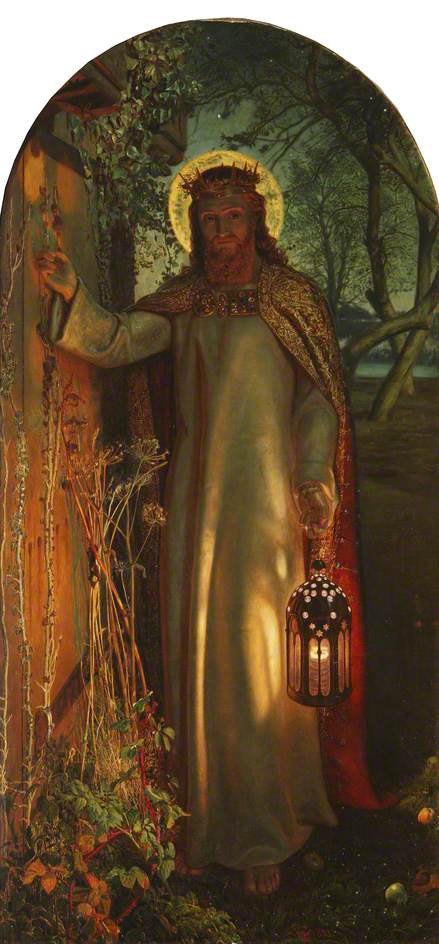
Prayer involves the courage to ask in order to receive, to seek in order to find, to knock so that opportunities will open to us. We often hear this text with the emphasis on the receiving, finding, and opening as if God is some kind of request vending machine. For me, this text is put into perspective in the famous Holman Hunt painting The Light of the World,  now hanging in St Paul’s Cathedral, London. Jesus is pictured standing with ou_kbc_pcf24_largea lamp, knocking at a door overgrown with ivy and brambles. He clearly seeks entry, yet on closer inspection the door has no handle. The implication is that it can only be opened from the inside. What is depicted here is the door of the heart. Hunt captures what it means to knock and the door will be opened. Paradoxically, it is Jesus who is doing the knocking, and it is we who have the power to open or not.

In Jesus’ teaching and personal example on prayer we are given a new revelation of God as Abba or Daddy. Depending on our association to the gendered experience of father, we might need to translate this into God as Amma or Mummy. The meaning is the same either way, for while God is not gendered, our human experience is.

This is really good news! Because it means in that prayer is the articulation of our relationship with God, and it doesn’t matter where we find ourselves on the emotional-relationship continuum between merger and separation. In our relationship with God it is audacious expectation, and shameless vulnerability, which open us to the love of God. In our relationship with God there is no right distance to find.

Can we find buried in our own experience that quality of unquestioning trust and expectation of immediacy and love which Claire currently takes for granted in her relationship with her Daddy? As someone who struggles more with the experience of distance, that is feeling too much distance in my relationships, observing Claire relating to her Daddy evokes feelings of sadness and joy. Sadness in the face of my own thwarted longings. Joy in the prospect that in my relationship with God I too can be more like Claire. She is for me a role model of hopeful joy. The same quality of experience is present also in Claire’s relationship with her Mummy. For despite the relational vicissitudes resulting from the current phase of her developmental and relational chemistry, Claire brings the same unquestioning trust and love to her relationship with both her parents. It’s Mummy’s turn to bear the brunt of Claire’s explorations in relating and relationship. There is nothing surer that at some future point it will be Daddy’s turn to be the one against which she is compelled to test her will.

Let’s embark on an experiment. For the next month, whenever you pray begin your prayer with the relational daddy or mummy, and at the end of the month note the change.

Where Prayer Has Been Valid: a cathedral reaching-out


For many of us in the Episcopal Church we feel somewhat surprised by so many spiritual seekers coming through our doors and finding enough of something, often very indefinable, that makes them want to come back. Yet, on deeper reflection, our initial feeling of surprise fades, for was this not also our initial experience on finding our way into relationship with the Episcopal Church?

The Cathedral and the Life of Prayer

In August of 2006, I found myself sitting in Trinity Cathedral for the first time. My partner Al and I, at that time still living in London, were on one of our visits to Phoenix to spend time with our young family who had recently moved here from Washington D.C. My first impression was how different Trinity was from my more familiar experience of an English Cathedral. Yet, as I sat with the light streaming through the stained glass windows the words from T.S. Elliot’s poem Little Gidding drifted into my mind:

You are not here to verify,
Instruct yourself, or inform curiosity

Or carry report. You are here to kneel

Where prayer has been valid. And prayer is more

Than an order of words, the conscious occupation

Of the praying mind, or the sound of the voice praying.

I knew without doubt that I was kneeling in a place where prayer has been valid. The walls of Trinity Cathedral are saturated with the prayers of generations of Arizonan Episcopalians. From here all Episcopal life in the city of Phoenix traces its origins. Even in this new world, the cathedrals of the Episcopal Church are places that collect the intensity of generations of hearts laid bare in prayer.

What is a Cathedral?

The easy answer is that a cathedral is the church housing the cathedra, or bishop’s chair. Yet, as I remind the members of our diocese on those great family gatherings around diocesan confirmations, and ordinations, the cathedral is also our collective spiritual home. On such occasions I rather enjoy the surprise on many faces as I say, ‘welcome home!’

Unlike a parish church, the cathedral exists as a benefit for the life of the whole diocese. The peculiarity of its clergy being known as canons further drives home the point. For the title of canon simply means appointed for the benefit of the whole Church. Although at Trinity, we have a life that is not unlike that of any parish, it is in our identification with the wider church that we feel most particularly fulfilled. 

Trinity and the Diocese

In the Diocese of Arizona, Trinity Cathedral is the church that everyone has a right to look to for an example of excellence in liturgy, music, and as a source for spiritual guidance. Our sense of service is most potently experienced when the members of the diocese gather together in the presence of our bishop. Bishop Kirk is not only our shepherd; through being in communion with him we are connected to the network of relationships we call the Wider Church.

Although an attitude of elitism is a temptation cathedrals are often vulnerable to, Trinity is a source for excellence and tradition in a world where the value for such is easily lost. Trinity is the place where tradition in worship encounters contemporary ideas as we seek to live out the tensions between the traditions we receive and lives we are actually living in the 21st century. For us this tension is the very essence of being Episcopalian.

Trinity and the City of Phoenix

In the City of Phoenix, Trinity Cathedral is the church for the city. We embrace the city through our ministries of music, the arts and social outreach. Ministry to the arts is an important service to civic life that cathedrals in particular, are able to offer. At Trinity we welcome all who seek a sacred space for those important life occasions such as weddings and funerals. We are a place where the civic life of the city has an opportunity to connect with the dimension of the Divine.

Being placed in Phoenix’s urban heart our embrace of diversity enables us to be a place of refuge and hospitality for those who have found it difficult to find a spiritual home elsewhere. For any person an essential ingredient in finding a spiritual home lies in being able to look around and experience themselves reflected in the faces of others. In this sense, diversity is not simply a quality Trinity aspires to. It is the core quality defining our particular identity. Diversity is what makes us different from many parish churches, which rightly tend to reflect the profiles of their particular neighborhoods.

As the cathedral, Trinity does not exist only for its own members. Neither does it exist only for the diocesan family. It exists for everyone, whether they are Episcopalians or not, our kind of believers, or not.

The Anglican Tradition has been molded within more than a thousand years of interaction between Catholic Christianity and the cultural life of the English Nation. This interaction between Christian Tradition and culture has shaped an attitude of openness to the world. For over 300 years the Episcopal Church has continued that interaction between Church and World within the distinct experience of American culture.

Trinity Cathedral’s particular vocation is to embody in its life the heart of our Anglican Tradition of Benedict and the Benedictine Spirit. Historically, our cathedrals continue the spirit of the Benedictine monastic institutions and traditions they came to replace at the time of the English Reformation. As this spirit comes to be re-embodied afresh in each new generation, not only in our cathedrals but in all our parish churches, at Trinity we understand this to be in particular, our vocation and mission.

Of Neighbors and Eternal Life

Sadao_Watanabe_The_Good_Samaritan_smWith the Zimmerman trial being reported in the news this last week the Good Samaritan parable strikes me as a timely commentary on the question of who is my neighbor? Of course this was at the heart of the lawyer’s questioning of Jesus. Jesus, side steps the question and elicits an answer from the lawyer to a slightly different question: which of the three, the Priest, Scribe and Samaritan acted as a neighbor? The lawyer now does some side stepping of his own and simply replies: the one who showed mercy. In telling the lawyer to go and do likewise, Jesus is answering the lawyer’s original question: what must I do to inherit eternal life?

So there are two questions here. The first is who is my neighbor? The second is what is what is my responsibility to my neighbor? The simple answer to the first question is everyone is my neighbor. You may question this as an impossibility? A simple definition of the word neighbor is the one who comes near. Therefore, for me it’s the second question that is the more significant. If everyone is my neighbor, the real rub is, so what do I owe them; what do they owe to me?

Understanding neighbor in this way, George Zimmerman became Trayvon Martin’s neighbor the moment he came near to him. Such a reading is dramatically at odds with the assumptions that underpin social relations in contemporary America. In our society, a working definition of neighbor might be, not the one who comes near to me, but the one who fears me or of whom I am afraid.

Why is this so? Do we really pose such a threat to one another? Is this a hangover from frontier culture in which the stranger was automatically experienced as a threat until discovered to be otherwise? Perhaps. Having lived in the UK for 30 years and now in the US, I notice how quick Americans are to enthusiastically shake hands with broad smiles. In England such behavior might imply particular interest being shown between people, otherwise the English tend to ignore one another. I have learned not to assume this in the American context. The person vigorously shaking my hand and broadly smiling at me with perfect teeth is not expressing any particular interest in me. He, for usually it’s men who behave like this is simply signaling to me that he poses no threat to me and is hoping I am likewise, nonthreatening.

Yet, the pioneer roots of American culture can’t explain the degree to which we now fear one another in modern America. Listening to the Gospel reading of The Good Samaritan, one sympathizes with Jesus as the lawyer attempts to cross-examine him. The overly litigious nature of American society both reflects and stimulates an environment of mutual fear and suspicion between us.

It seems to me that a better explanation of the situation we find ourselves in as neighbors to one another lies in the nature of modern society viewed from the helpful perspective of a theory called Spiral Dynamics http://spiraldynamics.org/ . Spiral Dynamics is a tool that I found very useful in my former life as a priest within a large secular organizational setting. Here, my task was to be the pastor to organizational structures and relationships.

Spiral Dynamics helps to analyze organizations, and by extension social structures in terms of types of cultural development it calls Memes. A meme is a particular location on an evolutionary continuum that helps to explain the dynamics of social relations and worldview. Spiral Dynamics assigns a color to each meme, which greatly aids comprehension. Each meme represents an organized shared system of values around which a culture structures itself. For instance, purple, tribal cultures based on blood or extended kinship ties, blue, hierarchical-authoritarian cultures, relying on complex stratified bureaucracies, where knowing one’s place in the order is a primary concern.  Orange, scientific- entrepreneurial cultures structure social relations around an ethos of progress, and wealth-creation. Whereas, green, communitarian- egalitarian culture bases its value system on shared notions of equality, consensus, and the common good. There are two rather interesting evolutionary stages identified as the yellow, systemic-integrative, and turquoise, holistic-interdependent memes.

Historically, it has been possible to identify a culture by reference to its monochrome memetic identity: purple, red, or blue, green, etc. It’s also possible to show how a society evolves through the hierarchy of memes; from purple or red to blue, from blue to orange, or from blue to orange to green.

In each memetic location, the concept of neighbor is given a dominant meaning. In a purple, tribal culture my neighbor is my kin or others similarly connected by virtue of belonging within the tribe. Those outside the tribe are not my neighbors, and in fact they are usually seen as my enemies. In blue, authoritarian- hierarchical culture my neighbor is someone of the same class, group, or occupational identity as me. In orange, scientific-entrepreneurial culture there exists a shared yet, individualistic concept of neighbor. Anyone who is not able to embody a strongly individualistic, progress or wealth-driven self-sufficiency is not my neighbor. In green, communitarian culture my neighbor is an extensive concept that includes everyone who agrees to be governed by a shared construction of the common good. Anyone who does not agree to this construction of the common good is not a neighbor, as those who resist the contemporary liberal social agenda, usually blue or orange meme individuals, come to quickly find out. No modern society has yet to achieve a secure hold on yellow or torquoise memes, although small groups among the elites do reflect these memetic locations.

Spiral Dynamics tells us a lot about our competing political and religious cultures. The Army and the Church are classic blue cultures. Republicans tend towards being blue- orange in culture. Democrats are heavily green with sometimes an orange, and sometimes a yellow tinge. Evangelical Christians sometimes are purple, sometimes blue. Roman Catholics tend toward the blue, with purple enclaves and with green on the liberal fringes. Episcopalians are almost uniformly green.

When a society displays a primary memetic location, there exists a consensus within that society concerning both the identity of, and obligations owed, between neighbors. In contemporary American culture there no longer is any consensus on neighborliness. Fear is generated between us as we struggle with competing purple, blue, orange and green notions of who is my neighbor. I suspect competing concepts of neighbor lie at the heart of the violent altercation between George Zimmerman and Trayvon Martin leading to the tragic death of young Martin. Amidst the overwhelming confusions between who is neighbor and who is foe in our global, pluralistic society, Zimmerman seems to have relied upon a more primitive, purple, tribal classification. Zimmerman decided that Martin was not his neighbor, but his enemy; a conclusion reached through a complex process of classifying the identifiers (age, race, on foot rather than in a car, etc) of like and non-like.

Jesus lived in a society structured around two memetic locations. The dominant location was the blue culture of the Roman Empire, which imposed an authoritarian, bureaucratic enforcement of hierarchy and stratification. Along side this, and in reaction against it, there co-exited the earlier purple culture centered on tribal loyalties. Jesus exploits his listener’s purple, tribal construction of neighbor through his parable of the Good Samaritan. For them good and Samaritan couldn’t share the same mental space. In connecting good and Samaritan, Jesus was creating an identity conflict that threatened to burst open his hearers tribal construction of neighbor, or push them into cognitive shut-down.

Jesus conversation with the lawyer had a larger group of people eavesdropping-in on their conversation in a manner similar to our eavesdropping-in on the Zimmerman trial. Jesus invites the lawyer and the eavsdroppers into the turquoise, meme of the Kingdom of God. Here, there are no tribes, nations, or empires, only neighbors. In the Kingdom of God we are not concerned to discriminate between neighbor and non-neighbor on the basis of the costs to us of neighborliness. In the Kingdom of God we are invited to consider as our neighbors all who come near. Our only consideration should be the cost to them if we refuse to be a neighbor to them.

Jesus asked the lawyer: which of the three do you think was a neighbor to the injured man lying in the ditch? The lawyer replied, the one who showed mercy. Jesus said to him- go and do likewise!

The print appearing above is Sado Watanabe’s: The Good Samaritan

For Episcopalian Eyes Only!

The Church of England is a complex animal because it does not share the possibility for consensus more easily arrived at in the Episcopal Church(TEC). TEC has its voices of minority, yet it draws from a narrower and more homogenous range within the wider social spectrum than does the Church of England, which often strikes us from this side of the pond to be bedeviled by the breadth of its constituency and therefore, the strength of different voices competing with that of the predominant voice of progressive liberalism. Here you can see in the Archbishop’s opening address to the General Synod his attempt to address the complexities of difference within his audience while at the same time sounding an unequivocal call to move beyond the confines of our limited imaginings to embrace the winds of change the Spirit is breathing into and through the Church.

Mark+

Pressmail from St Matthew’s Westminster
View this email in your browser

Archbishop’s call for church revolution
Justin Welby, addressing General Synod in York, 5th July 2013

The Archbishop of Canterbury, Justin Welby

Before I begin I would like to thank all the staff at Lambeth and around the NCIs, and at Bishopthorpe and the Anglican Communion Office, who have been so effective and kind in dealing with the frightening and unsettling impact of a new Archbishop. Transitions are always very complex, and taking on a new Archbishop is as demanding as it gets. But there’s invariably been a warm welcome and extremely hard work, for which I am extremely grateful. Chief amongst those who have led the way through the process is Chris Smith, the Chief of Staff at Lambeth. After more than ten years of faithful service, working night and day and every weekend – he’s the biggest menace to my capacity to have a quiet evening in on a Saturday night because I get an email from him – after more than ten years of never stopping he is moving on to other things later this year. His contribution has been largely behind the scenes, but he has served the Church of England and the Anglican Communion – not only for a long time but with huge effect – and our debt to him is more than we can imagine. So on your behalf I would like to thank him.

As you know too from public announcements, Bishop Nigel Stock, Bishop of St Edmundsbury and Ipswich, has with great generosity and considerable sacrifice, I’d imagine, agreed to become the Bishop at Lambeth, in a new configuration for the role, working alongside the new Chief of Staff. I could not be more grateful to have such a wise and experienced person, who will enable my many weaknesses to be compensated for more than adequately.

One of the things about this job is you tend to carry a lot of baggage – physical, metaphorical; probably more than I know. We arrived yesterday, the car having broken down en route – there’s a nasty metaphor there. But we did arrive – and we found ourselves with a ton of baggage to carry from one end of what seemed to be a much bigger campus than last year, to the other. And it reminded me – as I was staggering along with what seemed to be enough robes to rival Wippell’s – that we come to this session of Synod with a certain amount of baggage; and it’s good to find ways of getting rid of it. A friend of ours – of my wife and mine, from our days when we lived in Paris – worked for many years for an American company but living in Paris. We went to stay with them about six of seven years ago – he’s now ordained; there’s no connection – and he was still laughing about an experience at Kennedy airport the day before. It was a February and the weather in New York had been very bad, and he’d arrived and everyone was in a grump and the flights were late. And when he got one from the front of the check-in, the person in front of him was incredibly rude to the poor check-in operator. And John, our friend, is always gracious and polite, and when he got to the front he said, ‘I’m embarrassed to be a passenger when people treat you like that. I don’t know how you were so patient.’ And she said, ‘Well, sir. I shouldn’t really tell you this. There’s sort of bad news and good news. The bad news is he’s sitting next to you on the flight to New York. But the good news is I’ve sent his luggage to Tokyo.’

There are a number of obvious applications to that, one of which is we could do with some people like that at the beginning of a Synod session – for the baggage to go somewhere else.

You don’t want a lot of baggage in a revolution. And we live in a time of revolutions. And the trouble with revolutions is once they start no-one knows where they will go. Of the most serious type, the physical type, the practical type… Bishop Angaelos, Head of the Coptic Church in the UK, whom I met in Egypt last week, and who is sitting with us today, knows exactly about revolutions. While we were in Egypt, we heard much talk of what would happen this week – and we’ve seen. And the grace and leadership of Christians in that country is something to behold.

But we live also in a time of many revolutions in this country. And as the Synod meets today, we are custodians of the gospel that transforms individuals, nations and societies. We are called by God to respond radically and imaginatively to new contexts – contexts that are set up by revolutions. I want to thank you, and to say what a privilege it is to share with you, in the ministry of shouldering the heavy burden of facing these changing contexts, and grappling with them in this Synod, now and over the years to come, and to thank you for your commitment in your work here you show to Jesus Christ and to His church. It is genuinely a privilege to be among you.

The revolutions are huge. The economic context and position of our country has changed, dramatically. With all parties committed to austerity for the foreseeable future, we have to recognise that the profound challenges of social need, food banks, credit injustice, gross differentiation of income – even in many areas of opportunity – pressure on all forms of state provision and spending: all these are here to stay. In and through the church we have the call and potentially the means to be the answer that God provides. As Pope Francis recalled so memorably, we are to be a poor church for the poor, however and wherever poverty is seen, materially or spiritually. That is a revolution. Being a poor church for the poor means both provision and also prophetic challenge in a country that is still able and has the resources to reduce inequality – especially inequality of opportunity and life expectancy. If you travel north from parts of Liverpool to Southport, you gain almost a year in life expectancy for every mile you travel. We are debating these questions in this Synod. But prophetic challenge needs reality as its foundation, or it is mere wishful thinking; and it needs provision as its companion, or it is merely shifting responsibility.

The social context is changing radically. There is a revolution. It may be, it was, that 59% of the population called themselves Christian at the last census, with 25% saying they had no faith. But the YouGov poll a couple of weeks back was the reverse, almost exactly, for those under 25. If we are not shaken by that, we are not listening.

The cultural and political ground is changing. There is a revolution. Anyone who listened, as I did, to much of the Same Sex Marriage Bill Second Reading Debate in the House of Lords could not fail to be struck by the overwhelming change of cultural hinterland. Predictable attitudes were no longer there. The opposition to the Bill, which included me and many other bishops, was utterly overwhelmed, with amongst the largest attendance in the House and participation in the debate, and majority, since 1945. There was noticeable hostility to the view of the churches. I am not proposing new policy, but what I felt then and feel now is that some of what was said by those supporting the bill was uncomfortably close to the bone. Lord Alli said that 97% of gay teenagers in this country report homophobic bullying. In the USA suicide as a result of such bullying is the principle cause of death of gay adolescents. One cannot sit and listen to that sort of reality without being appalled. We may or may not like it, but we must accept that there is a revolution in the area of sexuality, and we have not fully heard it.

The majority of the population rightly detests homophobic behaviour or anything that looks like it. And sometimes they look at us and see what they don’t like. I don’t like saying that. I’ve resisted that thought. But in that debate I heard it, and I could not walk away from it. We all know that it is utterly horrifying. to hear, as we did this week, of gay people executed in Iran for being gay, or equivalents elsewhere. With nearly a million children educated in our schools we not only must demonstrate a profound commitment to stamp out such stereotyping and bullying; but we must also take action. We are therefore developing a programme for use in our schools, taking the best advice we can find anywhere, that specifically targets such bullying. More than that, we need also to ensure that what we do and say in this Synod, as we debate these issues, demonstrates above all the lavish love of God to all of us, who are all without exception sinners. Again this requires radical and prophetic words which lavish gracious truth.

The three Quinquennial Goals of growing the church, contributing to the common good and reimagining ministry, are utterly suited to a time of revolution. They express confidence in the gospel. They force us to look afresh at all our structures, to reimagine ministry, whether it be the ministry of General Synod, or the parish church, or a great cathedral, or anything between all of those three. For that reimagination to be more than surface deep, we need a renewal of prayer and the Religious Life. That is the most essential emphasis in what I am hoping to do in my time in this role. And if you forget everything else I say, which you may well do – probably will do – please remember that. There has never been a renewal of church life in western Christianity without a renewal of prayer and Religious Communities, in some form or another, often different. It has been said that we can only imagine what is already in our minds as a possibility; and it is in prayer, individually and
together, that God puts into our minds new possibilities of what the Church can be.

The Quinquennial Goals challenge our natural tendency to be inward looking, calling on us to serve the common good. That covers many areas, and between us all, not singly, we are able to face the challenge. May Synod rise to that. But the second of my personal emphases, within that goal, is reconciliation, within the church but most of all fulfilling our particular Anglican charism to be reconcilers in the world, in our communities, in families, even, dare I say it, amongst ourselves. Even if we do sometimes conduct our arguments at high volume and in public, to be reconcilers means enabling diversity to be lived out in love, resisting hatred of the other, demonisation of our opponents.

The common good goes much further than that. Our unique presence across the country enables us to speak with authority both in parliament and here, and in every church and cathedral and synod and gathering place across the country. Our extraordinary presence across the world as Anglicans enables us to speak with intelligence from around the world. As Anglicans we are called to reconcile incredible differences of culture in over 150 countries. What an extraordinary heritage we have under God. So we seek to be renewed here and across the Communion, and to find the reconciling presence of God. This Synod meets in an era of revolution, but we have together the means and the courage to seize the opportunities that revolution brings.

The Quinquennial goals aim at spiritual and numerical growth in the church. That includes evangelism, the third of my emphases. The lead has been set by the Archbishop of York. Here again we need new imagination in evangelism through prayer, and a fierce determination not to let evangelism be squeezed off our agendas. At times I feel it’s rather like me when I have to write a difficult letter, or make an awkward phone call: even things like ironing my socks become more attractive. We treat evangelism too often in the same way. We will talk about anything, especially miscellaneous provisions measures after lunch on Sunday; and we struggle to fit in the call to be the good news in our times through Jesus Christ. The gospel of Jesus Christ is indeed THE good news for our times. God is always good news; we are the ones who make ourselves irrelevant when we are not good news. And when we are good news, God’s people see growing churches.

Attitudes to hierarchy and authority have changed, and continue to change; there’s nothing new in that. And the more they do, the more we are perceived, often wrongly – but genuinely – to say one thing, about grace, community and inclusion, and do another.

And yet with all these revolutions, which raise such huge challenges to us in our lives as the Church, we see clearly that God is working a wonderful and marvelous revolution through the Church in the wind of the Spirit, blowing through our structures and ideas and imagination.There is a new energy in ecumenism, not least shown by Pope Francis. There is a hunger for visible unity. Many churches across England are growing in depth and numbers. People are looking for answers in a time of hardship and when we show holy hospitality and the outflow of grace, we are full of people seeking us. There is every cause for hope. This Synod had a shock, depending on your view, good or bad, last November; but there is here assembled, in weakness or confidence, in all sorts of fear and lack of trust, people with the faith and wisdom who in grace will seek the way to the greater glory of God.

In some things we change course and recognise the new context. Revolutions change culture. In others we stand firm because truth is not set by culture, nor morals by fashion. But let us be clear, pretending that nothing has changed is absurd and impossible. In times of revolution we too in the church, in the Church of England, must have a revolution which enables us to live for the greater glory of God in the freedom which is the gift of Christ. We need not fear. The eternal God is our refuge and underneath are the everlasting arms.

There have been many times where the Church of England felt that change was in the air or this was a moment of crisis. Because we are not an organisation, let alone a business, or even an institution, but in reality the people of God gathered by the Holy Spirit to walk together in a way that leads to the greater glory of God, there are bound to be many crises and turning points.

So let us not imagine for one moment that because we are in revolutionary times what we are going through currently is either more dangerous, more difficult or more complicated than anything faced by the generations before us. We are in the hands of God; the eternal God is our refuge and underneath are the everlasting arms. We need not worry, but we must give all that we have and we are, for the uniquely great cause of the service of Jesus Christ.

So how we journey here is essential, and that is why during these next few days, certain things are being reimagined: not least what we do tomorrow. What is clear to all of us is that there exists, as we gather – and let’s be honest about it – a very significant absence of trust between different groups; and, it must be said – and the evidence of this is clear, though sad – an absence of trust towards the Bishops collectively.

One thing I am sure of is that trust is rebuilt and reconciliation happens when whatever we say, we do. For example, if, while doing what we believe is right for the full inclusion of women in the life of the church, we say that all are welcome whatever their views on that, all must be welcome in deed as well as in word. If we don’t mean it, please let us not say it. On the one hand there are horrendous accounts from women priests whose very humanity has sometimes seemed to be challenged. On the other side I recently heard a well-attested account of a meeting between a Diocesan Director of Ordinands and a candidate, who was told that if the DDO had known of the candidate’s views against the ordination of women earlier in the process he would never have been allowed to get as far as he did.

Both attitudes contradict the stated policy of the Church of England, of what we say, and are completely unacceptable. If the General Synod, if we decide, that we are not to be hospitable to some diversity of views, we need to say so bluntly and not mislead. If we say we will ordain women as priests and Bishops we must do so in exactly the same way as we ordain men. If we say that all are welcome even when they disagree, they must be welcome in spirit, in deed, as well as in word.

Lack of integrity and transparency poisons any hope of rebuilding trust, and rebuilding trust in the best of circumstances is going to be the work of years and even decades. There are no magic bullets.

So how we travel, and our capacity to differ without hating each other and to debate without dividing from each other, is crucial to the progress we make.

Integrity and transparency depend utterly on a corporate integrity and transparency before God, above all in our prayer and liturgy. I sometimes wonder if one of the drivers of our lack of trust is that we have lost from our experience and our expectation two of the great moods of liturgy: of lament and of celebration. The ability truly to lament, to rage at circumstances, at loss, at decline, at injustice, at our own sin or the problems we face, is one that enables us to find afresh the mercy and grace of God. Lament is a liturgical mood that builds our capacity to trust God in the face of change, and then we trust each other. Encountering the face of Jesus Christ in pain, grief or anger transforms us.

Equally the capacity to celebrate, to lift our hearts and voices in true and passionate praise and thanksgiving because the presence of God is known among, restores our perspective. Not only does it renew our faith and strengthen weary limbs in the long journey we are undertaking, but also the act of celebrating that which we share together cuts across our great barriers and difficulties. We celebrate because who can not be overwhelmed by the love of God?

Take for example the two Anglican Dioceses I saw a week ago in the Middle East, in Jerusalem and in Egypt. In the midst of terrible and confused situations, with unspeakable human suffering, tension and fear, they shine with brilliant light. And they are part of us. In each of them there is a profound commitment to the common good of the populations in which they live as a minority – populations of whatever faith and ethnicity. In each of them there are more schools, hospitals and clinics than there are churches. In each of them the Bishops have established confident and effective relationships with other churches, with Muslim leaders and with governments that enable them to speak frankly and truly and with great courage. And we need to remember that as what they do there affects us, lifts our hearts, shows us the grace and glory and power of God, even more so what we do here affects them and every other church in the Anglican Communion. We have great responsibilities.

We should do no less, be no less effective, no less bold than our brothers and sisters in Christ in those Dioceses; in Nigeria, in Pakistan, in places of persecution and suffering, of revolution, change and disruption. The eternal God is our refuge, and underneath are the everlasting arms.

Come Holy Spirit, fill the hearts of your people and kindle in them the fire of your love. AMEN.

© Justin Welby 2013

Blog at WordPress.com.

Up ↑