Who’s talking Fairness?

The Thomas Avenue Home Depot car park in Phoenix AZ around 5am. Men squat in ones or twos or small groups seeking whatever shade the sparse Acacia trees of Phoenix’s ubiquitous car park desert plantings can provide against the merciless sun – which even at this hour of the day grows hot. A pickup truck drives slowly by – stopping at a group of men. After a brief exchange of words – the men climb onto the back and the pickup drives off. Maybe the driver of the pickup is in construction. Maybe he’s a farm foreman. Either way – he’s on the lookout for day laborers who abound at any number of pickup points in the carparks that dot not only the Phoenix landscape but towns and cities across the Southwest.

At whatever time of day, you can find scatterings of such men –seeking the only work easily available to them as below minimum wage undocumented day laborers. Numbers throughout the day fluctuate, yet, even towards the end of the working day some still patiently wait for the ever-decreasing possibility of finding a day’s hire. What of those who are not hired as the sun sets?

Manual work – now there’s an expression! It means to work with one’s hands. Unskilled day laborers who have nothing but their labor to trade have always been and remain vulnerable to the dehumanizing conditions we impose on those who have no power, no voice, no country, no other marketable skills.

Even skilled workers who like the members of the United Autoworkers Union – or the Writers Guild of America – workers whose manual labor takes the form of an application of necessary knowledge and skill are forced to strike for an equitable share of the huge profits generated from their labor. It’s odd how even today capital refuses to recognize that the most valuable commodity in the creation of profit are the workers whose labor produces it.

And so it was ever thus as we plainly see from Jesus’ parable in Matthew 20 – in which he addresses the economic plight for a class of Jewish tenant farmers and small landowners who had become the losers in the 1st-century global economy. In the 1st-century – Galilee was a cosmopolitan mishmash where Syro-Phoenicians, Greeks, Roman incomers, and Jews mixed freely. It was the most fertile and productive agricultural region in the Middle East. Therefore, Galilee was also at the heart of the socio-economic upheavals that accompanied an agrarian revolution in which Jewish tenant farmers and small landowners were being displaced by the influx of Roman new money.

The Roman new money wanted to amalgamate land holdings to create larger farms to form more economic units to maximize profit for the landowners through scaling-up agricultural production to feed the Empire’s rapidly increasing population. As a story this one is not an unfamiliar one from the pages of history – where page after page evidences the eviction of tenant farmers and small landholders reducing them to the status of day laborers. Jesus would have encountered men standing idle in the marketplace – an ancient Home Depot carpark – awaiting hire to work the land they had once farmed.

This story opens with Jesus describing it to his listeners as a parable of the kingdom of heaven. In other words, he’s telling them that this is a story about God. Jesus’ stories about God take the form of parables – that is- stories that draw on the familiarity of the hearers’ everyday experience to expose them to an unexpected and somewhat disturbing conclusion – a kind of sting in the tail ending.

Read from our 21st-century perspective this parable about a landowner presents him as a man with a strong social conscience. He acts to do what he can to stem the tsunami of injustice afflicting his society. He not only pays his laborers above the daily minimum wage but is concerned for the plight of those who as the day progresses have still not been hired. He goes out at intervals through the day and hires them in batches – promising them the same daily rate as those he had engaged in the early morning. So far, so good.

But the surprise comes when at the end of the day, he pays everyone the same amount regardless of the hours worked. I mean, who does that? How can this be fair – we cry?

Both Jesus’ 1st and 21st-century hearers are confronted – if not affronted by this man’s behavior. How can it be fair to pay those taken on late in the day – working only and hour or so – the same amount as those who have been toiling since 7am? But remember, this is a story about God. The employer – standing in for God counters – why accuse me of being unfair when I am actually being generous. Those who have worked since sunrise receive exactly the wage I’d promised. In effect, my generosity is my own business and not your concern.

Wow, can God really be like this? Where’s then – the incentive to work hard and do the right thing if God is so indiscriminate in the distribution of their generosity? This story assails our cherished distinctions between the deserving and undeserving – those entitled and those with no claim whatsoever.

Jesus’ parables – his stories about God – are at their heart stories about justice. If aliens from outer space were to observe how we Christians talk about God, they might conclude that the thrust of God’s concern as evidenced in Jesus’ teaching is about personal sexual morality. They would be correct because that’s what most Christians and non-Christians believe.

Closer reading of the gospels reveals that Jesus never speaks about personal sexual morality in social life. The closest he comes is in his parable about the woman taken in adultery and we know upon whose heads his judgment is heaped here. The other example is his teaching on the indissolubility of marriage – but this is a teaching honored mostly in the breach. 99.8% of Jesus teaching directly addresses the societal and religious issues of his day reframed through the lens the kingdom’s justice revolution.

What is justice? Jesus shows us that justice is love in action. Justice has little to do with fairness and everything to do with generosity. Thus the right to earn our daily bread through the dignity of human labor is an aspect of justice viewed through the lens of the kingdom revolution – where Justice requires the dignity of human labor honored by the equitable distribution of both risk and profit.

On a baptism Sunday, we hear Jesus opening words The kingdom of God is like. He sets the expectations of the kingdom within this parable about an employer’s seemingly – to us – unfair remuneration of his laborers. Through it we learn that God is not interested in fairness at all. God is only interested in generosity. Like all stories of the kingdom revolution our conventional expectations of the way things should work – are upended.

We live in a world in which so much is governed by the principle – first come first served. In the workplace it’s enshrined in notions of reward for seniority – protections for length of service– and corresponding vulnerability of the last in to being the first out the door when downturn strikes.

The task of the Christian community is to reflect less the values and arrangements of the world and more the expectations of the kingdom’s justice revolution. In the kingdom there is no such thing as seniority nor greater reward based on length of service. In the Christian community there should be no discrimination according to status. Among us, there is only the status of the baptized. Baptism is the common denominator that elevates us all to the same level of significance in God’s eyes. Whatever distinctions we enjoy in the world – whatever lack of privilege and disrespect we suffer in the world – all inequality is leveled through baptism.

When Lucca is baptized in a moment – he will be admitted to a community of equals – taking his place with the rest of us who sit in the front row in the House of God. For my generosity is my own business and not your concern – says the Lord.

Sealed in Blood

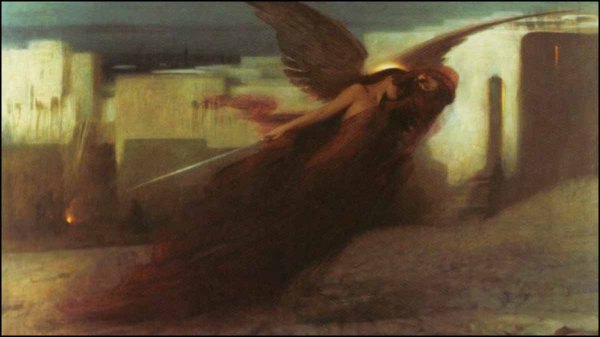
Image: Arthur Hacker (English Pre-Raphaelite painter, 1858-1919), “And There Was a Great Cry in Egypt” (1897)

With the story of the Passover in Exodus 12 we leapfrog forwards from the lifechanging encounter between Moses and Yahweh in Exodus 3 which takes place beyond the wilderness. Last week I explored the dynamic of finding our way beyond the wilderness – wilderness being a metaphor for life’s status quo. To reach beyond the wilderness is to risk following our curiosity – curiosity that is triggered by the glimpse of something  in peripheral vision – out of the corner of our eye. The encounter between God and Moses beyond the wilderness was life changing both for Moses -obviously – but also for God. Life changing, how exactly?

For Moses it was an experience of being called; of finding his identity radically reshaped. But called from what and called to what?

The place beyond the wilderness is a metaphor for an experience bereft of the signposts that keep us corralled within the familiar. It is a place empty of the signs and markers that normally keep the unfamiliar at bay – for in the unfamiliar thar be dragons. Beyond the wilderness Moses is called from his uncalled life – his life amidst the familiar routines and expectations shaped by life as business-as-usual. By turns – Moses is terrified and yet curious, he’s stripped and exposed and yet empowered – he’s shaken not stirred into a new identity – an emerging new sense of self and purpose.

But the encounter with Moses is also life changing for God. Moses is not the only one whose identity is shaken not stirred. God – I AM WHO I AM – a God of memory of the past becomes God -I WILL BE WHO I WILL BE – God now defined by future actions that refashion God’s identity to become the God of liberation, the warrior God, who gets their[1] hands bloody in the messy affairs of human history.

In today’s reading from Exodus 12 we catch a glimpse of just how messy things had become.

Between Chapter 3 and 12, Exodus chronicles a series of skirmishes in the war Yahweh – to use God’s Hebrew name – has provoked with the Pharoah over his refusal to let the Hebrews go. In pursuit of his new role as liberator – God has donned the identity of the warrior. One interpretation characterizes this conflict as a trial of strength between Yahweh and the Gods of Egypt. Whether this is a cosmic struggle or simply a struggle between the divine will and recalcitrant human resistance, need not overly concern us, here. Save to remind ourselves that the Pharaoh’s opening salvo – his command that all Hebrew male infants be killed at birth has now found its echo in Yahweh’s ultimate response – that is to strike all firstborn – human and animal – in the land of Egypt as a judgement not only against the Pharaoh but upon all the gods of Egypt. Yahweh asserts his right to do this terrible thing – for he proclaims I am the Lord – that is -I AM WHO I WILL BE.

Yahweh instructs Moses on how the Hebrews are to prepare for and commemorate the angel of death’s passing over the land shrouded in the darkness of night. This is to be a unique event- an event like none other – therefore it is to be remembered as a perpetual anniversary – a commemoration of Yahweh’s involvement in the liberation of his people from bondage.

On the night of the angel’s passing over the land – the Hebrews encounter their God in a lifechanging event that will henceforth forge them into a people. On this night the Hebrews will be changed from a community of slaves into an Israelite nation – identified and protected by the blood of the sacrificial lamb smeared on the doorposts and lintels of their houses..

Down the centuries the Jewish people have continued to commemorate the night of the angel’s passing over. Passover or Pesach is not only a yearly commemoration but also a weekly family meal of remembrance on the eve of Shabbat – the Sabbath day. At the Shabbat meal a question is posed by the eldest to the youngest person present: why is this night different from all other nights? This question triggers collective memory enshrined in the unique customs of this commemoration where food is the focus. A meal of unleavened bread – for there was no time for the dough to rise. A meal seasoned with the bitter herbs of adversity, eaten in haste – eaten in a state of readiness for flight.

The Passover and flight from Egypt mark a reset in the measurement of chronological time – it becomes the beginning of months. It’s on the 10th day of the first month that the festival of Passover is to be commemorated.

How we measure the passing of time is interesting. As a Church community, we measure our year according to three different cycles. Some aspects of Church life follow the dictates of the chronological calendar year – January to December. The Lectionary and calendar of greater and lesser festivals of the Christian year run from December to November – beginning with Advent Sunday and concluding with the celebration of the kingship of Christ. Yet we have a third way of measuring the passing of months in the Program year from September to July. The Program year is a particular – and in my experience – a unique feature of American Church life.

The first covenant between Yahweh and Israel was inaugurated on the night of the Passover and sealed in the sign of sacrificial blood. The second covenant between God and the second Israel – that is – an Israel now extending beyond the blood boundaries of the Israelite nation – has also been sealed in sacrificial blood – this time not the blood of a sacrificial lamb but the blood of Jesus the Christ – the Lamb of God.

I need to say here that in using the language of first and second covenants and racial and extended Israel – I am not in any way suggesting that the second covenant has replaced the first. God does not abrogate their promises – nor abandon their faithfulness. Therefore, both covenants remain in force and are conduits for God’s continued presence with God’s people -Jew and Gentile. Neither am I suggesting that the extended Israel – the nonracial Israel – has supplanted the Israel of blood and circumcision. Extended Israel – usually referred to as the New Israel is an extension of God’s promises to Abraham – which through Christ – now encompass – potentially – the entire human race.

The parallel continues. As with the yearly commemoration of Passover and its weekly echoes on the eve of Shabbat, the New Israel of the second covenant – the Christian people of God – likewise commemorate Jesus’ with the symbolism of the Passover meal. We read On the eve of Passover Jesus took bread and gave thanks; he took the cup  giving thanks and saying …..

The yearly celebration of Easter therefore coincides in the same Luna calendar cycle as the Exodus Passover. So as with the weekly celebration of Pesach on the Shabbat eve – Christ’s Passover – the passage from life to death to new life – is celebrated by Christians on the first day of the week.

On that fearful night when Yahweh’s angel of death passed over the land of Egypt – the identity of a new people was forged through the experience of deliverance at the hand of Yahweh now the warrior God – sallying forth in defense of a chosen people. The promise made to Abraham becomes renewed as God cherishes once again an exclusive human relationship with Moses. The Jews rightly remember this night as the lynchpin of their identity as a community liberated to become instrumental in God’s plan for the liberation of a world – a world still ensnared in Egypt’s bondage.

Egypt represents in any age our entrapment in the uncalled life in which we continue to connive with the forces of oppression – be they political, social, or environmental. The promise made to Abraham became renewed in the sacrifice of Christ as Passover lamb. The blood of Christ – no longer a sign smeared upon our door posts, is now seared into our hearts.

On the night before he died, Jesus celebrated the Passover with his disciples. Over the following three days the angel of death passed over him. In his passage from life to death to new life – those who follow in his name were forged into a new community liberated to become instruments in God’s plan for the liberation of a world still ensnared in Egypt’s bondage.

On the 10th day of the first month of the Program year – Homecoming Sunday we celebrate Christ our Passover as the lynchpin of our identity as a community liberated to become the willing instrument in God’s plan for the liberation of a world still ensnared in Egypt’s bondage.

Deliverance is the lynchpin in identity. We can only pray that as Episcopalians – we might take our identity as seriously as our Jewish friends and neighbors across the street from us on the corner of Orchard place and Orchard Avenue – do. That together as Jew and Gentile we might work tirelessly in the divine dream for the healing of the world. Amen!


[1] My use of the collective pronoun for what the Tradition often views as a singular God reflects an affirmation that God’s nature  is communal not singular, and also beyond the immediate associations with human gender.

Encounter

Robert J Warren, the Vicar of All Saints, the Anglican Church in Rome, has a witty turn of phrase. He writes:

Moses was doing his best to lose the Egyptian accent that people had remarked on when he first landed in Midian (Exodus 2:18-19). It was an accent worth losing.  First, it was a lie: he wasn’t Egyptian.  He’d been a Hebrew child raised like a dirty secret in the heart of the Egyptian court.  Second, it provided a clue to his past misdeeds.  The child became a man back in Egypt.  His identity crisis sharpened and caused him to snap.  He’d killed an Egyptian overseer who was beating a Hebrew slave and thus became a fugitive from Egyptian justice.

Warren somewhat amusingly, yet concisely, summaries Moses’ story so far.  Exodus chapter 3 opens on Moses’ day-to-day life after having fled across the Gulf of Aqaba to Midian – an area that took its name from Midian who had been one of Abraham’s many illegitimate sons. Time has elapsed since his flight – time enough for the ever-resourceful Moses to have not simply found sanctuary but to have married the daughter of Jethro, the priest of Midian.

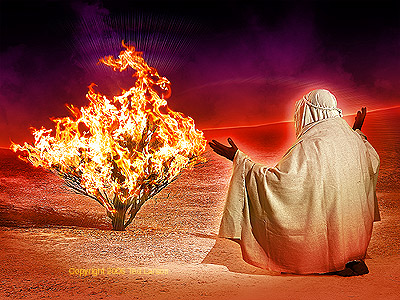
One day while absent-mindedly leading Jethro’s flocks Moses wanders into a region described as beyond the wilderness. It’s not an incidental detail that beyond the wilderness lies at the foot of Mt. Horeb – sometimes referred to as Mt. Sinai – or the holy mountain of God. It seems that the later Deuteronomist scribes who compiled Exodus sometime in the 6th-century BCE seem to have had a hazy grasp of geography. Midian is situated on the eastern shores of the Gulf of Aqaba – modern Saudi Arabia – yet Mt. Horeb sits at the southern tip of the Sinai Peninsula – so Moses has indeed been wandering far from home.

It’s helpful to picture Moses as daydreaming as he walks along – because his attention is alerted by a mysterious phenomenon which he spies in his peripheral vision – out of the corner of his eye so-to-speak. Focused concentration narrows the range of our peripheral vision. It’s only when we are not concentrating on anything closer to hand that our peripheral vision expands to take in a wider panorama. Out of the corner of his eye Moses spies something that arouses his intense curiosity. Driven by curiosity Moses leaves the beaten track and sets off across country.

In his peripheral vision Moses had caught sight of a mysterious phenomenon. Driven by curiosity – Moses arrives at his first encounter with the living God – a momentous encounter that will upend his life as he knows it.  

This encounter is not only life changing for Moses but from the perspective of God’s biography it’s also direction changing for God as well. In this encounter with Moses – we hear God speaking again for the first time since his relationship with Abraham.

Throughout Genesis’ long epics of the Patriarchs after Abraham, God has remained silent. The Patriarchal cycles are stories that focus on human action in which God is assumed as background but plays no direct role. In warning Moses to take off his sandals for he is about to tread on holy ground – we hear God speaking directly to a human being again. God speaking – is the prelude to a personal relationship with Moses who for God becomes a new Abraham – that is- a human being with whom God can form and intense and personal relationship. Through his relationship with Moses –as in the days of Abraham – God once again emerges as the primary actor in the unfolding story.

Moses’ encounter with God before the burning bush is an extended metaphor which illuminates the nature of own spiritual journey. Hidden within the rich theological-biographical detail – is a story of rediscovery, of remembering, and of reset.                                                                                                             

As Exodus chapter 2 winds to a close we witness a startling recovery of memory for God. We read:

After a long time, God heard the Israelites groaning and remembered his covenant with Abraham. God looked upon them and God took notice of them. 

We might ask why has God taken so long to act? Is there a suggestion here that the enslavement is the result of God having forgotten his people? Their servitude comes to and end only when God notices their plight as he recovers his memory of Abraham. We shall never know but it is interesting to speculate.

In remembering Abraham God seems to become aware again of a need for relationship – something he last enjoyed with Abraham.  This is also a story of rediscovery, remembering, leading to a reset now with Moses as God’s chosen partner.

At the heart of this story is the surprising revelation of God’s name. God has until this point been the God of ancestors – for the Israelites a God of distant memory. In response to God’s request – Moses pressures God for something more personal in the form of a name rather than a description.  God replies: tell them I AM WHO I AM has sent you.

The English is incapable of conveying the pulsating quality of the Hebrew letters YHWH -which shimmer with ambiguity of meaning. I AM WHO I AM – can be read as a statement about who God is and has always been – a God associated with the past. But it also can be read as a statement about who God will now become – I WILL BE WHO I WILL BE. The nature of who God will be – becomes revealed in future action where God is to become known as Liberator.  This is material enough for a whole sermon series yet to come.

However, today I want to focus on the element of the story captured in the phrase beyond the wilderness. I interpret this to mean – a place beyond conscious recognition – outside of the boundaries of familiar imagination.

The process of noticing what’s hidden in our peripheral vision is often best demonstrated in crime fiction where the chief witness is subjected to some kind of hypnotic process taking them back to the scene of the crime – during which they recover details of the crime lodged in peripheral vision – details that had remained hidden – inaccessible to their conscious memory.

Through the cultivation of curiosity, we begin to consciously register elements otherwise unrecognized in the peripheral vision of our daydreaming.

To venture beyond the wilderness is to leave the beaten path – the constrictions of the familiar. Matthew Syrdal – is the pastor of The Church of Lost Walls – a wild theology church in Denver, synthesizing theology and ecology. He has referred to the beaten path as the uncalled life. He bemoans that as pastors and spiritual leaders we spend too much time tending the uncalled life of the flock – by which he means:

The business-as-usual, relatively autonomous existence we often lead. In the uncalled life, Syrdal notes that: Most of us typically experience no major intrusion to speak of, nothing disrupting or redefining our identity and role in our communities, yet also no appearance or message — no larger conversation with the Holy.

He likens our uncalled life to the Israelites slavery in Egypt. In the uncalled life we are silently crying out – unknown and uncalled. In other words – being unable to notice the call of the Holy within us and around us – we remain unconsciously encapsulated in our distress – a distress emanating from the fixed and closed pattern of our lives.

Syrdal further suggests that our unconscious distress finds collective expression of the storm surges of racism, fear, and terror – forces currently in play – powerfully disrupting our civic life todayHe writes:

At times, it might seem as if the whole of western culture is enslaved in a cultural pathology — the City that Egypt represents in the Exodus narrative. The City, egocentric civilization, is almost by definition structured as a defense mechanism against the natural world and the threat it represents. In our times, Egypt is that which slashes and burns the old growth of a forgotten World, that which consumes the Earth’s resources with an insatiable appetite. We are largely, and mostly unconsciously, enculturated from early childhood with the incipient imperialism of Egypt. Moses, as a type, represents for us an awakening from the imperial dream to something like the dreaming of the Deep World.

The story of Moses and the burning bush is a story of theophany – to use the technical term. Theophany is a story or experience of divine revelation – and from the perspective of God’s biography – that is – God’s personal story -a self-revelation – a new learning for God about being God.

Theophany occurs – never in plain sight, nor along the familiar path – but always beyond the wilderness – meaning – off the beaten track hidden in peripheral vision. The trick for us is to catch its glimpse out of the corner of our eye.

Like Moses, we become changed by an encounter with the Holy – only when our lives become decentered enough – disturbed enough – to reshape our expectations, stimulate our curiosity, and pay attention to what’s happening out of the corner of our eye.

Exodus

As Genesis ends, Joseph remained in Egypt, he and his father’s household, seeing his descendants to the third generation. As he lay dying he requested the return of his bones to the land of Abraham. Then he died at 110 years. Joseph had come a long way from the provocative brat prancing around in his technicolor dreamcoat. Genesis concludes by telling us that Joseph was embalmed and placed in a coffin in Egypt.

With Joseph’s death the stage is now set for the next installment in Israelite history as recorded in the book of Exodus. Exodus 1:1-7 records the 12 sons of Jacob who came down to Egypt, the death of Joseph and that whole generation, and that the Israelites continued to be fruitful and prolific: they multiplied and grew exceedingly strong that the land was filled with them.

Exodus 1:1-7 is the explanatory preamble to what we are now told in verse 8, which begins with the ominous words: Now a new king arose over Egypt who did not know Joseph. Twelve momentous words that introduce us to the story of the enslavement of the Hebrews in Egypt.

The new Pharaoh has come to fear and envy the presence of a people living separately within his nation.  We might read this as the first historical instance of antisemitism proper – a hatred of Jews born of the mix of fear and envy – exacerbated by a refusal to abandon their separate identity. The Pharaoh who had forgotten who and what Joseph had done had come to fear the separate identity of the Hebrews – a nation within a nation separated by customs and religion – a dynamic to be repeated again and again throughout the history of the Jewish people.

Pharaoh indulges in hyperbole when he says the Hebrew people are more numerous and powerful than we are – so come let us deal shrewdly with them. His pretext casts them as a fifth column who, in the event of war would join the enemy. I say hyperbole, because were it true that the Hebrews were more numerous and powerful than the Egyptians, why didn’t they resist enslavement?  

We are not privy to Pharaoh’s mindset. We only know what the Deuteronomist compilers of the history say – their aim being to give the pretext to explain Hebrew enslavement.

As we read or listen to the Exodus narrative, we hear the historical echoes in the Nazi use of a similar hyperbole as justification for the extermination of European Jewry.  We hear the echoes in this ancient story as the pretext for the internment of the Pacific Coast Japanese communities in 1941 – let us deal shrewdly with them for fear they will give aid to our enemy. We witness it in the CCP’s Uighur interment in vast forced labor camps. We note it in Russia’s forced transportation of Ukrainians and Crimean Tatars; in all the attempts to destroy the future through the theft of the children.

The early phase of forced labor seems not to have dented the prolific growth in Hebrew numbers. Growing more desperate, Egyptian policy becomes more ruthless culminating in a policy of infanticide. The Hebrew midwives are instructed to kill the male babies at birth. However, we are told that the midwives feared God and refused to do so. When interrogated, they tell Pharaoh that the Hebrew women are not like the Egyptian women because they are more vigorous- giving birth before they can arrive. The midwives use the word khayot – meaning brutish- animal like. The midwives complain to Pharaoh – what can we do- these Hebrew women breed like rabbits – thus turning Pharaoh’s dehumanizing trope against him.

The narrative now switches to the birth of a Hebrew male infant whose mother placed him in a waterproofed basket and concealed him among the bulrushes at the river’s edge charging her daughter to watch from a distance to see what would happen.

Pharaoh’s daughter came down to the river to bathe when she and her maids heard the infant’s cry. Of course, she recognizes the infant as a Hebrew. The infant’s older sister offers to find a Hebrew nurse to care for the child and the Princess agrees. Thus, the infant is restored to his mother, who raises him until the time when he is adopted by the Princess as her own son. The Princess names him Moses because I drew him out of the water.

Words matter and it should not be lost on us to learn that the word used to describe Moses’ basket is the same word used for Noah’s ark. We also note that the Deuteronomists are at pains to identify Moses is in some sense like Noah and belonging to the line of Levi – Moses is a member of the tribe which after the Exodus become the Levitical priesthood.

A key detail in the Exodus story concerns the role of women. The actions of the midwives, Moses’ mother, and sister; of Pharaoh’s daughter and her maidservants, express the resistance of women against patriarchal violence. The birth of Moses is a story about female fidelity to God, maternal and sisterly love, and women’s instinctual compassion for the vulnerable.

The initiatives sponsored and led by women among the migrants on the Mexico-US border continue this long tradition of resistance to patriarchal violence because of a concern for the vulnerable. Women are often more likely to be motivated by an appreciation of human needs – seeing in the easily dehumanized migrant faces the plight of women, children, and families – restoring migrants to the fullness of their human dignity.  

I only have space and time to note here a link identifying the role of women in six care agencies working with migrants along the Southern Border. Like the women in the first two chapters of Exodus, today women are at the forefront of resisting the dehumanizing processes of the immigrant experience – which opens us to a wider observation.

Today the myth that promotes a fear of immigrants as having some secret power or potential to steal our jobs –jobs we no longer deign to perform; who and pose a dangerous threat to law and order and national stability. This would be ironic if it was not also a tragedy. In a nation chronically short of unskilled labor to fill the jobs vacancies we rely on an yet reject as somehow beneath us – it’s ironic and tragic that in a nation of immigrants – where a sizable portion of the population is separated from the immigrant experience only by one, two or three generations at most – should now so vehemently advocate pulling up the migration ladder behind them.

The economic health of the US now depends on immigration. Like the ancient Hebrews, migrant communities have higher birth rates and instead of seeing this as some kind of race replacement conspiracy we need to remember that like our parents and grandparents’ today’s migrants long to become American and to imbibe American values as they integrate. Yet cultural interaction and integration is a two-way street and immigrants bring elements that are currently revitalizing the host culture from the arts we celebrate to the food we eat.

If concern for the plight and suffering of fellow human beings is not enough to move our hearts – and clearly it’s not -let’s not forget that necessary immigration will ensure a healthy labor and tax pool large enough to sustain the Social Security and Medicare systems that an aging boomer population is increasingly reliant upon.

I want to highlight two further elements in the Exodus narrative. FIrstly, the experience of enslavement and liberation from slavery – fundamentally shaped the development of the post-Exodus Israelite community. In remembering their own captivity and liberation, Israelite law enshrined a sacred duty to welcome and respect the stranger in their midst. This sacred duty – like many sacred duties – more often observed in the breach yet, nevertheless, became a central moral principle for the post-Exodus Israelite society.

Secondly, the Exodus as recorded in the book of the same name marks a crucial transition in the evolution of God’s identity. The Creator now becomes the Liberator. The Exodus event becomes for all enslaved people a sign of the promise that God not only hears their cries and notes their suffering but works for their freedom.  

This weekend as we celebrate the memory of the historic 1963 March for Freedom, we remember the Exodus experience graphically demonstrated in our own national history as the spiritual and social catalyst in the African American journey from the days of enslavement into the continued Civil Rights struggles of our own time.

The Liberator God is also a personal god. A god who requires human collaborative agency – be they midwives, mothers, sisters, or princesses. In the birth and life of Moses, God now find a principal collaborator.

Not since the days of Abraham has God encountered a human being in the intimacy of a personal relationship. The promise to Abraham is now renewed in a promise to Moses. The God of Abraham now becomes for all intents and purposes the God of Moses. More about Moses next week.

What’s the Hardest thing of All?

Image Jaymi Hensley in Joseph and his Amazing Technicolor Dreamcoat

The OT readings from both last week and today focus on Genesis’ story of Joseph.

Last week I offered a 30,000 ft overview of the book of Genesis – the first book of the both the Torah, and Christian Old Testaments. It’s part of what is known as the Deuteronomic corpus composed sometime between the 7th and 6th Centuries BCE. In a way we might think of the Deuteronomists as the equivalent of our Founding Fathers, whose writings laid out the constitutional framework for the new nation emerging after victory in the Revolutionary War. Similarly, Deuteronomists wrote a history of Israel to cement the transition from a loose tribal confederation into a centralized monarchy through the central theological filter of Israel’s covenant with God.

The Deuteronomic history follows a pattern with Genesis accounting the stories of origins. The book of Deuteronomy retells the Exodus experience with the books of Joshua, Judges, focusing on the period after Israel’s conquest of the land. Samuel 1 and 2 and Kings 1 and 2 cover the period of political transition from tribal confederation to monarchy – and the period of the Monarchy under David and its eventual fragmentation after the death of Solomon. A major theme in the Deuteronomic history is the explanation of God’s punishment of Israel when it ignored God and the covenant. Thus it was later re edited into its final form by the priestly scribes seeking to explain the reasons for the Babylonian Exile.

As the the written synthesis of older oral stories predating by centuries the written text – Genesis comprises two great narrative sweeps. The first begins with the creation stories, detailing the fall, the flood, and other myths – stories from before the beginning of recorded history. The second narrative sweep in Genesis brings us into human history with the personal stories of Abraham, Isaac, Jacob, and Joseph. These story cycles are the result of a weaving of originally unrelated oral traditions into a family story of father, son, grandson, and great grandson. The Joseph story epic is truly a family saga in the vein of the recent HBO drama – Succession.

Who is Joseph? The short answer is he is Jacob’s next to youngest son – born to him in his old age by Rachel his first and most beloved of his four wives. Put politely, Joseph is something of a teenage brat, who plays on his father’s favoritism to really piss his older brothers off. To add insult to injury, as a sign of his favoritism Jacob weaves Joseph a coat of many colors – the inspiration for Tim Rice & Andrew Lloyd-Webber’s musical Joseph and His Amazing Technicolor Dreamcoat. The sight of Joseph preening and prancing around in his coat – the reminder of Jacob’s favoritism – must have been a daily provocation to his brothers. As Rice & Lloyd-Webber’s title hints at Joseph was not only a prancer, but he was also a dreamer – more precisely the receiver and interpreter of what Carl Jung called big dreams.

To cut a long story short, consumed with jealousy, his brothers intending to murder him threw Joseph into a dry well. But after second thoughts they pulled him up to sell him to Midianite traders who in turn, sold him on into slavery in Egypt. Through a series of events Joseph’s gift for dream interpretation enables him to climb out of slavery and up Egypt’s political ladder. He eventually comes to the notice of the Pharaoh himself – as the one to interpret a very troubling dream Pharaoh had about seven fat cows who devour seven skinny ones. Joseph interpreted the cows as seven years of good harvest followed by seven years of famine. He so impressed Pharaoh that he made Joseph prime minister with responsibility for putting the dream’s interpretation into practice. Joseph confiscated seven years of good harvest and stored the grain away in barns to ensure survival during the seven years of famine. Egypt’s continued abundance of grain during the famine years compelled Jacob to send a delegation of his sons – all except the youngest Benjamin – down to Egypt to buy grain.

The brothers come before the Prime Minister as bedraggled supplicants. Of course, Joseph recognizes them, even though they have no idea he is their long lost brother. Joseph, the inveterate joker, plays on their ignorance – manipulating them into returning home with gifts for their father and a request to return with the youngest brother, Benjamin.

On their return, Joseph can’t keep the charade up any longer. He breaks down in front of them. Today’s reading opens on this scene when Joseph reveals himself to the extreme consternation of his brothers. He cries:

I am Joseph, is my father still alive? But his brothers could not answer him, so dismayed were they at his presence. And they came closer, and he said, I am Joseph, whom you sold into Egypt.

But instead of savoring the moment revenge being a dish best served cold – seeing their distress Joseph allays their fears of retribution. He explains to them that God planned all this – sending him ahead so that he might be in position to save them from dying of famine. There is much weeping, kissing, and hugging – to the puzzlement of all in Pharaoh’s household.

With the Patriarch epics and esp. the Joseph story cycle – the Deuteronomic compilers objective was to construct an account of origins. With the Joseph saga the stage is set for the next installment in Israel’s history with Moses and the Exodus.

We have the advantage of psychological curiosity. For us the patriarchs are stories speaking to the enduring human nature of personal and family tensions.  Looked at from this angle, the spiritual value of the Joseph story lies in its study of conflicting human emotions – favoritism, jealousy, rivalry and hatred, betrayal, revenge and the complexities of forgiveness.

Joseph – the visionary trickster – is not above playing with his brothers and making them squirm. But this is the extent of his desire for revenge. As a dreamer and interpreter of dreams, Joseph has always been able to penetrate the thin space between human perception and divine intimation. He’s had time to meditate with gratitude on God’s larger purpose for him – with the arrival of his brothers, this purpose is given ultimate meaning .

In today’s portion we see him abandoning his game-playing to reveal himself as someone who responds to memories of betrayal. He meets the impulse for revenge with forgiveness. The brothers are relieved and yet continue nevertheless to feel disquieted because they remain stuck in a more primal stage of emotional development in which one bad turn always deserves another. In Joseph’s self-revelation, they are confronted with having to process the hitherto unprocessed unconscious legacy of their jealousy and murderous intent toward their younger brother.

Today’s portion ends with a scene of tearful reconciliation. The youngest brother, Benjamin, has joined them in Egypt and their ancient father Jacob will soon do so. It seems all’s well that ends well. But emotions are never so simple.

With Jacob’s death in the final chapter of Genesis, at chapter 50:15 we read:

Realizing that their father was dead, Joseph’s brothers said, “What if Joseph still bears a grudge against us, and pays us back in full for the wrong that we did to him?” 

Learning from experience seems not to have been a skill Joseph’s brothers had acquired. They once more concoct a lie to ward off what they imagine is Joseph’s desire for revenge – in reality their own projections of unresolved guilt. They tell Joseph that Jacob’s dying intention was to beg him to forgive his brothers.

Without the benefit of a modern psychological analysis, the 6th-century  BCE Deuteronomists knew that it’s easier to forgive than to be forgiven – or more specifically, to forgive ourselves through the transformation of being forgiven.

Post Vacation Reflections

I returned last week from my annual July vacation break. As some of you know, Al and I have been vacationing in the Lot Et Garonne – Dordogne Departments of SW France for many years. It’s a region of Bastides – fortified villages and small towns whose fortifications date back to the 100-years war between England and France that raged approximately between 1337 and 1453. This is region of rolling vineyards producing the classic Bordeaux wines, although more locally, Duras and Bergerac have their own wine appellations. The wines of the SouthWest became the staple wine for the English to which they gave the generic name of Claret. The region is also the heartland of French Rugby. To gain a flavor of this region I recommend Martin Walker’s novels featuring Bruno Chef de Police. Although Southern Europe experienced an unprecedented heatwave this July, the misdirected flow of the Gulf Stream resulted in this region experiencing the coolest July we can remember.

During my month away each year I try to read something substantial and was pleased to be able to complete Tuck Shattuck’s Christian Homeland, his recently published history of Episcopal-Anglican missionary activity in Palestine between 1850 and 1950. I also had time to delve into numerous Tom Holland podcasts and online lectures.

Tom Holland is a renowned historian of the Classical period. A much-published writer and speaker and host of his own podcast The Rest is History. His book Dominion: The Making of the Western Mind is of particular interest. In it he explores how the revolutionary impact of Christianity completely remade the ancient world with profound reverberations that have continued into our own age.

Holland has some interesting thoughts on Western Secularism which he sees as the child of the Christian revolution. He notes that pews may be emptying and the institution of the Church fading, yet Western Secularism continues to preserve the Christian revolution despite most secularists’ overt hostility towards conventional theistic Christianity.

Love, equity, justice, the protection of the rights of the individual, freedom of expression, the championing of justice for the oppressed – are among the principles Western Secularism claims – as the US Constitution states – to be truths that are simply self-evident. Secularists seem to assume these self evident truths float in a rational vacuum awaiting discovery in the Enlightenment. Yet, as Holland points out these values are nowhere to be found in historical societies not shaped by the Christian revolution. What secularists discern as self-evident truths- those for instance enshrined in the UN Declaration of Human Rights – are the legacy of the fact that like fish in water we are all, people of faith as well as secularists, swimming in the same Christian sea.

What distinguishes Christians from Western Secularists is not values or principles but simply that for Christians the active presence of the mind and hand of God remains discernable to us in the flow of events in the world around us.

Yet, the immediate difficulty for people with a Christian faith story is how do we arcuately discern the presence of the mind and hand of God in the flow of daily events. The simple yet problematic answer is we look to the Bible.

However, the problem is how do we distinguish between the mind and hand of God and the influences of our minds and hands. Can the Bible be a conduit for discerning the mind and hand of God’s activity unsullied by our own projections? The power of text lies not in what the text says – that is – the plain meaning of the words on the page – but in what can be read into it. The temptation for both conservative and progressive Christians alike is to project into the biblical texts a reflection of each’s culturally conditioned priorities, hopes, and fears and assume they are evidence for the mind and hand of God.

In the contested heat of biblical interpretation is that the biblical witness still matters for progressives as much as conservatives. What is often missed however, is that at the heart of contested interpretation lies an area of commonality – a mutual recognition that the function of the biblical witness is not to confirm but to disturb. The Bible functions not so much to affirm or align with our projections but to confront us with what we refuse to see. The mind and hand of God’s activity in the world is one of judgement – calling us to repentance for the willful conflation of our priorities and self-interests as if they are the same as those of the mind and hand of God.

Since Pentecost we’ve been journeying through the significant story lines in the Book of Genesis. On the 14th Sunday in Ordinary Time, we arrive at the story of Joseph – the final epic story cycle in Genesis.

The date of Genesis’ compilation as a written text is still debated, but consensus favors sometime between the 7th– 6th centuries BCE by a group of scribes known as the Deuteronomists. 200 hundred years later, the Deuteronomic corpus received a complete editorial makeover during the Exile between 585 and 457 BCE – leaving us with the Torah pretty much in its present form.

Genesis contains two grand narrative sweeps. It begins with a sweep from creation through the fall, the flood, and assorted events leading up to the arrival on the scene of a man called Abraham. The second great sweep chronicles events in the lives of Abraham, Isaac, Jacob and finally Joseph – men collectively known as the Patriarchs. Whereas Abraham, Jacob, and Joseph have their own extensive narrative cycles, Isaac gets short shrift – appearing only through his relationships and never in his own right. He is Abraham’s son, Rebekah’s husband, Jacob and Esau’s father. Isaac’s main function for the Deuteronomic compilers of Genesis is that he is the procreative link allowing them to conflate independent patriarch traditions into a contiguous narrative through the fiction of kinship – father, son, grandson, and great-grandson -connecting Abraham to Jacob and beyond to Joseph.

The Joseph cycle brings Genesis’ grand story of origins to a close. The book of Exodus opens with the list of Jacob’s eleven sons before reporting the death of the 12th son, Joseph. After the deaths of all the patriarchs, the Hebrews continue to flourish and multiply in the land of Goshen. However, a significant shift in tone occurs at verse 8 which simply begins with the ominous words: Now a new king arose in Egypt who did not know Joseph. These words – so full of import become the preamble to the enslavement of the Hebrews – setting the stage for the next act in the Israel’s epic story – Moses and the Exodus.

The OT reading for next Sunday continues Joseph’s remarkable story – details which we will pick up then. So, stay tuned.

Tradition & Change

Feature picture: Peter and Paul, El Greco

The collect for today begins: Almighty God, you have built your Church upon the foundation of the apostles and prophets, Jesus Christ as the chief cornerstone: Grant us so to be joined together in unity of spirit by their teaching that we may be made a holy temple acceptable to you….

This collect comes on the Sunday closest to the joint commemoration of Peter and Paul on June 29th. While each have their own individual commemorations, it has always struck me as an important statement by the Church that they are additionally commemorated together on June 29th.

Peter, entrusted by Jesus as the leader among the apostles – whose symbol is the crossed keys of the kingdom – ended his days in Rome, where he became its first bishop. Paul, the dramatic covert, whose encounter with the Spirit of Jesus on the road to Damascus transformed him from persecutor to apostle, also ended his days in Rome. It was in Rome that both Peter and Paul were martyred during the persecution of Nero between 64-67 AD. Peter was crucified upside down – feeling unworthy to die in the same way as his Lord. As a Roman citizen Paul had the privileged of beheading by sword. Thus, Peter is depicted by the crossed keys, while Paul is depicted with crossed swords.

In the English Church, the commemoration of Peter and Paul on June 29th is known as Petertide. The Saturday closest to June 29th is the customary date for ordinations to the diaconate and presbyterate. In cathedrals up and down the land, as many as between 900 to a 1000 women and men in any given year are ordained. It’s a massively festive time in the Church.

Petertide is a very personal commemoration for me. This Petertide marks my 38th anniversary as a Clerk in Holy Orders – as the clergy of the Church of England are officially known. My ministry has been characterized by remarkable twists and turns – each completely unanticipated by me. One of the things I have learned is that the door that opens is never the door we’ve had our sights on.  The trick is to notice and have the courage to walk through the door -that though unlooked for – is actually the one opening. This has guided me well navigating the twist and turns of my ministerial path and of my life more generally.

Two different men one could not imagine. Could the church in Rome have been big enough for both at the same time? I suspect the answer was yes and no. Yes, because each understood the charism with which he had been entrusted by the Lord. Peter’s mission was to the circumcised and Paul’s to the uncircumcised. But nothing could have disguised the personal friction between them – largely based on temperaments as different as chalk from cheese.

Paul records an interesting incident in Galatians 2 where he tells us of the difficulties encountered among the Gentiles because of the interference from the circumcised (Jewish) followers of the way. This continued to be a serious issue and helps account for Paul’s preoccupation with the relationship between Gentile and Jewish converts – a major theme in his Letter to the Romans which we’ve been hearing about in the epistle readings over several Sundays.

Paul writes in Galatians 2:11 about Peter’s visit to Antioch where he says:  I opposed him to his face – for he stood self-condemned.  On arrival Peter seems to have been living it up – enjoying the dispensations from the restrictions of the law accorded to the Gentile converts. Paul writes:

for until certain people came from James, Peter used to eat with the Gentiles. But after they came, he drew back and kept himself separate for fear of the circumcision faction. Other Jews joined him in this hypocrisy. But when I saw that they were not acting consistently with the truth of the gospel, I said to Cephas (Peter) before them all, “If you, though a Jew, live like a Gentile and not a Jew, how can you compel the Gentiles to live like Jews?”

Oh, to have been a fly on the wall at that encounter!

Yet, in commemorating Peter & Paul together, the Church is making a statement not only about the acceptance of difference but the need for diversity in how we approach and understand the Tradition. The Church is making a clear statement in bringing Peter and Paul together that one approach does not meet the needs of every situation.

Let’s consider the following questions:

  • Are you a rule keeper or a rule breaker?
  • Do you value time honored traditions and rely on them as a guide in new situations, or do you recognize that new situations might need completely novel responses?

Taking the last point first. Peter – hot headed and quick on the draw. Exuberant and fun-loving.  Always speaking before thinking – but undoubtedly possessing a gravitas that others recognize in his leadership. While Paul is the one who burns at a low simmer – the one you might worry about – fearing the possibility of going from slow burn to combustion in a matter of nano seconds. Paul the introverted scholar – given to building his case through long winded legalistic argument before suddenly – his hidden passion – his love for Christ sears everyone to the quick. With Paul you could be in little doubt whether he thought you were for or against him.

But temperament is not the main issue here but simply a recognition that temperament equips each for the nature of the work Christ calls us to. Peter was essentially a rule follower, a trusty pair of hands to whom the future of the Church had been entrusted. Peter’s approach was to rely on the time-tested tradition to respond to the challenge of new situations. 

Paul, had been a disciple of the great Pharisee teacher Gamaliel, and so we might expect him to be a pillar of orthodoxy. At first, he was – as Saul he was the chief prosecutor of the followers of the way. But his life had been dramatically changed when its course took a hard left. All his certainties were challenged and collapsed in a searing encounter with the Spirit of the risen Christ on the Damascus Road. Once an advocate of implacable tradition, Paul became the one to think outside the box – reinterpreting and reshaping tradition to meet the challenges of situations requiring completely new responses. Peter stays home and solidifies the base while Paul is the bold adventurer – striking out into uncharted waters.

Like Peter, Episcopalians greatly value the Tradition – the teaching and practice inherited from former generations of Christians. Like Paul we also believe that applying former interpretation to new situations is doomed to failure. We accept that each new generation must find itself in the inevitable place of tension between what has been handed on to us and the challenges we face in the lives we are actually living.

We live in an age in which change moves at unprecedented speed. Our civic as well as religious institutions are facing challenges to their fitness for purpose in a rapidly changing world. Jesus teaching about new wine needing new wineskins is the point.

We face the challenge to regulate AI armed with 19th-century legal principles and 20th-century legislative tools no-longer fit for purpose. The tech companies motivated by good old capitalist greed are poorly equipped to build AI programs other than in their own self-image. Hence, we will have AI programs -devoid of the moral and spiritual frameworks that will enable them to truly serve humanity. We will need AI that is not just cleaver but also possessing the essential spiritual qualities of humanity. AI must be better than many of its creators.

A conservative Supreme Court majority seeks to apply a fundamentalist doctrine that imprisons the Constitution – confining its inherent wisdom to guide instead of thwart change in American life. The conservative Justices claim to infallibly intuit the Founder’s intentions- while ignoring the Founder’s overriding intention – which was to create a document sufficiently clear and yet more importantly, sufficiently vague enough to allow for evolving interpretation in response to the issues of the time. Their espousal of a fundamentalist doctrine of originalism would be the stuff of standup comedy – if that is -the consequences affecting the lives of women, LGBTQ+ persons, the young and educationally indebted, and now people of color were not so serious.

The Church faces a demographic and cultural shift of enormous significance for the survival of the tradition’s embodiment of centuries of human wisdom honed from the human-divine journey together. We see all around us frantic attempts to plug the cracks appearing in the vessel of Tradition with 19th-century mortar – sealed over with 1st and 2nd -century veneer – the most recent example being the decision of the Southern Baptists to inhibit women from positions of authority.

What is our response to be as the cracks in the vessel of tradition multiply and expand? Is our response to be one of patching and filling – or can we come to see in the cracks the light of new solutions shining through?

Perhaps Peter and Paul despite their difference or even because of it might agree that tradition is a poor cudgel but a brilliant searchlight. A searchlight illumining new pathways into the future – a future glimpsed through the cracks – because without the cracks how else will the light get in?

Family Trouble

Image Sarah and Hagar by Svetlana Tartakovska

There is always a temptation as preacher to steer clear of difficult passages. But maybe I’m a glutton for punishment as they say – because the 4th Sunday after Pentecost presents us with challenging OT and Gospel readings.

In Matthew 10:24-39 Jesus seems to be suggesting that conflict between family members and by extension, conflict in wider society is to be expected. The passage concludes with this dire warning – I’ve not come to bring peace but a sword – for I’ve come to pit family members against one another and one’s foes will be one’s kith and kin.

Once over our shock at his words, we might begin to notice that the picture of familial and societal conflict Jesus presents is actually the one we are most familiar with. What’s shocking about it is for some reason we don’t expect Jesus to talk this way. After all –isn’t Jesus the prophet of turn the other cheek not the prophet of strike back? Isn’t Jesus’ message all about love and acceptance?

The reality is that we live in a conflict riven society set in an increasingly conflict riven world. Riffing a little on my own responses to this passage – it’s as if we cry out for peace and yet Jesus rebuffs us with don’t cry to me for peace, when you have no real appetite for what it takes to establish it.

The reign of God’s Kingdom ushers the promise of peace. But it’s not any kind of peace. It’s not peace without cost. It’s peace predicated upon the establishment of justice. To the extent to which there is no justice in the world then there will be no peace. For the reign of God’s Kingdom is at odds with the ways of the world. Jesus does not so much bring the sword as many of his more crusader minded followers believe. The sword of violence is already in play when God’s reign breaks into a world not yet committed to peace with justice.

Love is the abiding principle by which we as Christians should live. We prattle on about what a complex word love is and how can we even begin to know what it should look like. But it’s actually very simple. Justice is what Christian love looks like in action. Justice is Christian love’s expression of solidarity with the stranger, the vulnerable, and the outcast. It’s one thing to acknowledge we may not be up love’s demands, but it’s quite another to say we don’t know what love is.

This gospel from Matthew 10:24-39 is preceded by the reading from Genesis 21:8-21 which relates a curious incident of conflict in Abraham’s family life. It’s a story about a wife and a concubine. It’s a story about the heir and his bastard brother. It’s a story about power and the victims of power – about the jealousy of a wife for vengeance on the one who threatens her son and his future – and the failure of a husband to intervene in order to protect both his sons – bastard son as well as heir. Talk about family drama!

The shock value in this story is a reminder to us that we cannot impose a 21st Western veneer of monogamous family life upon Abrahams domestic arrangements. This is a warning to popular American religion that likes to take early Biblical figures and modern role models. It requires a lot of airbrushing out to maintain this fiction.

In 2017 Linda+ preached on this text in a sermon titled Families are Complicated. In it she drew the following conclusion from the story about Abraham’s domestic arrangements:

God continues to work within the framework of the gift of free will and the resulting complications and chaos that accompany it. …. In doing that, we gain a window on our own lives and the lives of our neighbors. Hagar’s suffering is redeemed through us; it calls us to see and hear her lament in the abused, rejected and marginalized of our own time, and it further calls us to offer them God’s healing wherever we can, like a well of cool water in the harsh wilderness. By God’s grace and with God’s help, that’s not really complicated at all.

Linda’s+ final sentence expresses her desire for a hopeful conclusion to the otherwise disturbing story. Yet, I also hear a note of irony in her final sentence. The irony of not really complicated at all is the hint that it’s very, very complicated indeed! Well, without God’s grace, that is. But often we human beings are not much interested in God’s grace when it comes to sorting out interpersonal and wider societal conflicts. A note of irony lies in our continued deafness to the point of this ancient story – because it endlessly complicates our lives if we see and hear God’s lament in the abused, rejected and marginalized of in our own time.

Although the actors in this Genesis story are far from modern persons with modern sensibilities – and again, I warn against viewing them through our 21st-century Western cultural lens – they nevertheless represent archetypal human choices. We see in Sarah our human desire to protect what is ours both now and in the future by sacrificing others whose existence threatens our control. In Abraham, we see despite the helpless hand wringing and genuine heartache – a response of I can’t get involved – a nothing to do with me response. In Hagar and Ishmael, we see the responses of the powerless who have no protection but that afforded by the love of God. It seems it’s only God who is listening and loving.

Kathryn M. Schifferdecker, Professor of Old Testament at Luther Seminary in St Paul, MIN, in her 2014 commentary on this text in Working Preacher notes:

God opens Hagar’s eyes to see a well of water nearby, just as Abraham in the next chapter will see the ram caught in the thicket. And in both cases the seeing leads to new life for [both] Abraham’s sons. …It is easy to overlook this story of Ishmael, set as it is between the story of Isaac’s miraculous birth and the story of his (near) sacrifice. Yet, it is worth pausing and considering what Ishmael’s story tells us about God’s care and providence. As the old hymn reminds us, “There’s a wideness in God’s mercy like the wideness of the sea.” We cannot limit God’s mercy. God hears the cry of the abandoned. God hears the cry of the outcast, and God saves.

We cry peace, peace, but there can be no peace until there is justice. The sons of Abraham are still at each other throats in multiple permutations of this family conflict that echoes still in our own time. Whether it’s Jew and Arab; Israeli and Palestinian; Christian and Jew; Christian, Jew and Muslim – however you define it -this is the timeless family struggle between the Sarahs and Hagars, between the Isaacs, and Ishmaels, and between the Jacobs, and Esaus. On and on – round and round it goes – to our undying shame.

Cleophus J LaRue, Princeton Seminary Professor of Homiletics sums it up thus:

Some think the divisions are little more than a family squabble, while others see in them a struggle against the cosmic powers of this present darkness (Ephesians 6:12).  …. The Christ whom God has sent among us does not come to usher in an era of peace but rather an era of engagement and challenge where convictions will be tested and decisions made about the things that matter in this life even as creation, along with humanity, groans for redemption. The struggle is not an easy burden to bear. 

Jesus’ sword means that simply following Jesus will bring its own rejections and conflicts as we work to right wrongs, fight complacency – ours as well as others, speak truth to power, turn away from judgement and embrace service, and be genuinely open to a transformative encounter with Christ in our worship and work. All these are possible with God’s grace. Note, not a hint of irony in this last sentence.

A World not for the Faint-hearted

In the Church’s calendar today it’s the 6th Sunday in Ordinary time- the 3rd after Pentecost. In the secular calendar it’s Father’s Day, and in our local calendar the Sunday of the PVD Pride Weekend.

Over the decades Pride month with its customary Pride marches has morphed with changes in cultural attitudes towards homosexuality. I refer you to this week’s E-News Epistle in which I wrote a more detailed overview of the derivation and contested meanings of the term homosexual, along with an overview of the constituent communities that nestle under the umbrella of the LGBTQ+ Rainbow Alliance.

For me the significance of the acronym LGBTQ+ lies in its modeling not of a single community but of an alliance of different communities coexisting under a collective umbrella. The Rainbow Alliance is an alliance of differences in a celebration of diversity. Given the increasing forces polarizing our society, the toleration of contested differences within alliances of diversity is an important model for a possible way forward.

The adoption of the colors of the rainbow as the emblem of the LGBTQ+ Rainbow Alliance reminds us that in the Bible, the rainbow is the divine commitment to a regeneration of the creation after the total devastation of the Flood. The rainbow is a sign of God’s new covenant with humanity and the creation – a reminder of the divine faithfulness and mercy – a symbol of hope, beauty, and of the divine presence guiding us into a new future.

Someone recently sent me a cartoon which said God- the original they/them. Pride Festival has over the years become a wider cultural celebration – no longer just an LGBTQ+ event – but a true community-wide carnival.

Providence Pride comes at the end of a week in which the Southern Baptist Convention (SBC) reaffirmed its prohibition on women exercising authority in the church – unless that authority is vicariously derived from the overall authority of a male leader. To emphasize their point, they expelled from the SBC all the churches with a woman in overall pastoral leadership.

Religious organizations are prone to delusion. SB thinking is that this move will stem the hemorrhage of members leaving the SBC. Currently at around 13 million members – its estimated that the Convention has lost 1.1 million members just in the past three years with half a million in the last year alone. From the outside looking in – it’s been a bad week for the SBC. Clearly their loss must surely become the American Baptists USA’s gain. Listen- you can hear the clapping in Providence’s First Baptist Church in America from here!

Conservative Christian traditions – evangelical, catholic, or orthodox, are at odds with the social and cultural evolution that has redefined relations between men and women. They cling onto a 1st-century social structuring of gender relations rooted in the theological notion of a Bible-based Fatherhood of God that is immutable to change.

God is male and sits at the apex of the authority pyramid. Therefore, men are the human beings most like a male God. According to Genesis it was Adam whom the divine community created first from the dust of the earth. As the male God reigns from heaven, so the men exercise the male God’s vicarious authority as the heads of family units within which women and children nestle in protective custody.

This argument is on shaky ground when we remember that in Genesis God gave all authority over creation not to Adam alone, but to Adam and Eve as a couple. But hey, who cares about this small discrepancy, because as the argument goes we know Jesus only called men as disciples and Paul said women must not be allowed to speak in church.

Abstracting sideways from the family we arrive at the church – which for the SBC at least seems nothing more than a collection of male headed families grouped under male religious leadership – an extension from the family of the same pyramid structure of authority and culture of protective custody for women and children. Like all forms of custody – protective or otherwise – attempts to challenge it -or to step outside its control – are met with punishment – the usual one of being cast out of family and church. Social death and still in some places, physical death is the ultimate punishment for challenging the hierarchy of male authority.

We should not miss two essential points in this debate around male authority. Gender rooted authority -resting on the privilege of maleness – is the root of all cycles of abuse in church life regardless of denomination. Gender rooted male privilege is conceived of as a zero-sum game. Like all authoritarian regimes no change is possible for fear that any change – no matter how seemingly inconsequential – will result in the whole edifice being swept away.

Last week SBC leadership signaled that they understand the core issue only too well. For if the wall of strict male dominated gender based authority is breached, where will things end?

Well, we all know the answer to that question. It means that any change in the status quo will result in so much more than allowing women a voice. One change opens the door to questions that go to the very heart of the construction of gender identity itself. Women in religious authority today – what’s to stop trans women exercising religious authority tomorrow?

The actions of the SBC this past week allow me to segue nicely into the celebration of Father’s Day. The notion of fatherhood along with just about every other traditional institution in our society is a hotly contested one. All roads lead to Rome – as the saying goes. If human fatherhood is in contention, then the fatherhood of God as identified with the exclusively male gender also comes into contention.

Underpinning shifting understandings around how gender identity is constructed lie the complexities of nature v nurture, biology v social conditioning, somatic bodies v psychological minds. All I have space to say here is that for many motherhood and fatherhood can no longer be perfectly aligned with traditional notions of gender identity-based roles. Because ultimately, both motherhood and fatherhood are essential qualities of the divine – and are thus reflected in our human nature without discrimination – taking us on a journey beyond all cultural gendered distinctions.

We can trace three great cultural emancipation movements that have changed the modern world during the last 250 years. The first emancipation movement took the 19th century by storm with the ending of commercial slavery. The emancipation of women followed close on the heels of slavery’s abolition. In our own living memory homosexuality has been freed from the shackles of legal persecution and punishment – paving the way towards a growing social acceptance of lesbian and gay sexual identities. A fourth cultural upheaval is upon us with the questioning of premodern constructions of gender identity.

Each shift in culture has been accompanied by an interrogation of the Biblical voice – freeing it to speak its truth into new contexts. Episcopalians together with mainline Protestants have been in the vanguard of this evolution – an evolution fiercely resisted by Evangelicals and the official voice of the Catholic Church at every step of the way. The struggle continues.

The confluence of Pride and Father’s Day this year focuses attention on the questioning of traditional constructions of gender. Questioning leads to reaction and the tactics of traditional gender conformity reaction are taking an increasingly fascist turn.

No longer content to arrange matters within their own institutions and communities, white Christian nationalist traditions such as the SBC see no downside to supping with the devil in their pursuit of political power – such is their fear of any change leading to a loss of historic privilege. Through the courting of power, they seek to enforce their religious worldview on the rest of society through a very unconservative legislative intrusion into the arenas of freedom of religious conscience and individual choice.

When the historic champions of freedom of religion, freedom of choice, freedom of speech, and little or no government regulation become the party of religious infringement of women’s rights, don’t say gay, public library book bans, and an Orwellian intrusion into the arena of parental choice – we need to wake to the fact that we have entered a world no longer for the faint-hearted.

Epistles

Who do you think is has had the more lasting influence on the shape and development of Christian faith and practice – Jesus or Paul? It’s kind of an interesting question. Of course, I would want to put Luke up there as well – as it’s his historical structuring of the story of the transmission from Jesus to the Church that gives us the shape of the liturgical year from Christmas through Easter.

Who you think has had the more lasting influence on the content and shape of Christian faith also depends on whether you are a member of an apostolic or evangelical Christian tradition. For instance, you hear very little reading of, and preaching on, the gospels in evangelical churches compared with a heavy preponderance of long expositions on brief and selective soundbites from the epistles.

Conservative, white Evangelical thinking prefers rules-based black and whites – do this but don’t do that – this is good, that is bad kind of thing. While Jesus’ name is loudly and ritualistically proclaimed in evangelical communities there is little teaching on his kingdom message because his teaching does not easily lend itself to a follow-the-rules approach to Christian living . Whereas the epistles of Paul and even more so, the pastoral epistles – those which are clearly dated later than Paul’s own lifetime although often claiming his or one of the other the Apostles authorship – are crammed full of dos and don’ts. They lend themselves to attempts to apply 1st and 2nd century cultural norms concerning the patriarchy’s hot button issues – slavery, women, and sexuality to 21st century life – while ignoring the clear challenges that early Christian communities posed to the existing imperial orders of the time. If you ignore the early Christian challenge to 1st century imperial world order, then you can go on excusing modern-day authoritarianism.

The nub of the matter is that Jesus’ teaching is too counterculture for conservative leaning white evangelicals. Jesus confronted the conventional practice of Jewish religion of his time with a provocative radical religious challenge. He challenged the way religious practice inevitably submits to the pressures of culture. The hallmarks of religious submission to cultural norms can be seen in a reducing of the Christian message to one of individual sexual morality – ignoring Jesus social teaching – and conveniently exonerating the political, economic, and cultural norms of the status quo – the business as usual society.

When Christian faith is reduced to a message about cultural conformity, being different makes you vulnerable. If your view of salvation depends on following a culturally submissive, rules-based approach to faith – then you’ll harden your heart towards those whose vulnerability threatens that order.

The Swiss psychoanalyst Carl Jung once remarked that he was glad to be Jung and not a Jungian – referring to the tensions that had already emerged in his lifetime between his visionary yet idiosyncratic thinking and his followers need for systematic consistency. This struggle to preserve the teaching of the founding visionary by restricting its application in the interests of consistency and cultural conformity is particularly prevalent in the history of religious movements. To ensure survival – the movement restricts the vision of the founder sacrificing the flexibility and creativity of the leader’s vision to preserve and protect for posterity, the leaders teaching.

And so, it was for the writers of the NT epistles. Their job was to preserve and transmit the memory of Jesus into a system that served living communities faced with the challenges of a continually changing and challenging world. If you embrace an early Christian patriarchal worldview but ignore their challenge of these communities to the violence of power, then contemporary, white American evangelicalism is what you end up with.

Given my earlier comments about the epistles being the go-to texts for conservative evangelicals, it’s important that we in the apostolic Christian tradition reclaim them.

With the Easter season now behind us we enter into the period of the calendar known as Ordinary Time which opens with several weeks of readings from Paul’s letter to the Romans. Here, Paul lays out the contours of what it means to live the new life of the resurrection. In Romans, Paul is at pains to distinguish between obedience to the Law of Moses and the life of faith in Jesus Christ.

From our vantage point, Paul is often difficult to read because he loves to get down in the weeds of the meaty issues of the time.  He’s at pains to contrast faith with works, with baptism not circumcision as the mark of belonging. Paul’s letters are written in a cultural and religious context different from ours. I find the trick with Paul is not to be distracted by his words so as to miss the radical quality of his vision for the Christian life –  a vision in which it is baptism not circumcision that matters.

On the 5th Sunday in Ordinary Time we read Romans 4 in the light of Genesis 12 which details the call of Abraham. In Romans 4, Paul is reminding his fellow Jews that it is Abraham not Moses who is the father of the nation. That the first covenant with Israel is the one God makes with Abraham – a covenant not of circumcision or at least not at first, but a covenant of faith. Paul’s direct argument in Romans 4 is that Abraham was reckoned righteousness through his faith in God – and not simply for his own sake but for ours because like Abraham, our relationship to God is a matter of faith i.e., baptism and not circumcision.

In the readings for Pentecost 2 or the 5th Sunday in Ordinary Time we see a continuous connecting thread. We have examples of the way both Paul and Jesus approach the Law of Moses. The difference is telling and demonstrates my earlier comments about why the epistles are the go-to texts for evangelical Christians.

Whereas Paul is the lawyerly lawyer – Jesus is the social renegade. Jesus challenges the aridity of a legalistic following of the Law not with complex legal argument like Paul does but by confronting the way the Law has submitted to cultural and social norms. He breaks these norms. He risks ritual impurity by eating with the unacceptable people. In response to Pharisee criticism, he notes God’s concern is with the sick not with those who define themselves as the healthy. God comes not to call the righteous but those who acknowledge their sinfulness. Jesus does not resort to complex invective but simply reminds the followers of the Law to soften their hearts – reminding them that God requires mercy not sacrifice.

We are living through a time in which the authoritarian politics of hate and exclusion are drawing energy from the submission of evangelical religion to the norms of white patriarchal culture with its values of racial superiority, hatred of women, and persecution of lesbian, gay and transgendered persons.

When religion submits to the values of a political culture of tribal exclusion – the result is the Reich Church of Nazi Germany with its wholehearted endorsement of the anti-Jewish laws, the Russkiy-mir of Putin’s tamed Russian Orthodox worldview promoting the virtues of a medieval conquest mindset, the Southern Baptist bully pulpit culture now feeding into a cycle of Republican sponsored discriminatory legislation amounting to a very unconservative governmental intrusion into the personal lives of Americans.  The result is always the same. When religion submits to the values of tribal political culture – sacrifice replaces mercy and hearts are hardened against those who pose a challenge simply by virtue of becoming vulnerable.

Blog at WordPress.com.

Up ↑