What Next?

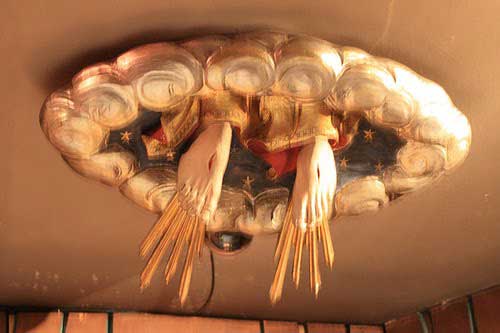
Image from the Chapel of the Ascension at Walsingham, England.

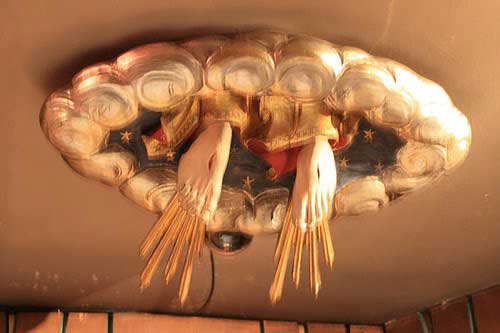
Next door to the Shrine Church the Chapel of the Ascension, built in the dispiriting modern style of the 1960’s, the style that festooned the US with hideous A-Frame churches, nevertheless has one most astonishing feature. On entering the chapel one’s attention is immediately drawn to the ceiling where two feet dangle at the center of a rosette of gilded clouds punctuated by lightening forks representing the only remaining part of Jesus’ body still visible after one imagines him squeezing through the gilded rosette into heaven on the other side of the ceiling. Those of you participating via the livestream will be privileged to this truly baroque sight – all the more astonishing because of the chapel’s otherwise plain sheetrock walls and ceiling.

The Ascension, which today is treated as a rather non-event. Always occurring on the 40th Thursday after the Resurrection – to accommodate the reality that most Episcopalians rarely venture to church except on Sundays – the current custom is to celebrate the Ascension of the Lord on the Sunday following. It’s Luke who gives us the most vivid narration of the Ascension scene.

If constructing stories and weaving narratives are the ways we make sense of our experiences in the world, what is the nature of the relationship between story and material experience? In other words, do narratives – our human need for stories simply interpret and explain our material experience, or do narratives construct our material experience through the power of language to bring to awareness the objects and meanings of which it speaks.

This tension surrounding the function and power of language is especially pertinent when it comes to religious-spiritual stories. Narrative Theology asserts that spiritual meaning lies not in the literal veracity of the events depicted – did they happen or not – but in the function of story to construct and convey purposeful meaning and truth- and here it’s helpful to paraphrase the late biblical scholar, Marcus Borg who used to say that the Bible contained many true stories – and some of them actually, happened.

Does a story construct meaning and purpose that we can trust as a source of understanding of the divine which enriches and empowers us to live our best lives?

Spiritual stories recycle elements from human imaginative memory. Clearly, Luke’s graphic account of Jesus’ ascension borrows extensively from Elijah’s ascension in a chariot of fire buoyed upwards by heavenly steeds amidst billowing clouds that obscure heaven from earthly sight. In like manner – as the mantle of Elijah fell upon the shoulders of Elisha – giving him a double portion of his master’s spirit, the double portion of Jesus’ spirit falls upon his disciples -clothing them in preparation to take up the work Jesus had begun.

The resonance between the two ascension stories is unmistakable.  Now skeptics will say – ah-hah, so you admit that Luke copied an earlier story that is a feat of imagination to start with. Well yes, I’m happy to admit this, because both stories function not as eyewitness accounts of actual events but as ways of making sense of a meaning and truth capable of changing lives and altering the trajectory of history. By the way – even eyewitness accounts of actual events are never photographic but interpretations – colored by the contents of individual memory. The problem in crime solving is that no two people will recall the same event in the same way.

In Luke’s chronology of events from Calvary to Pentecost, his story of the Ascension of Jesus forms a transition point bringing the earthly ministry of Jesus to a close to prepare his followers for what was to come next. The question underlying the Ascension event is not how, when, or if it happened, but what light does it shed on the question of what next?

Can we trust the meaning inherent in the story of the Ascension of Jesus, even though most of us accept it to be, as all stories are, a construction of imagination? By focusing the stories meaning on the question what next – this becomes a story sharply focusing the choices to be made, the actions to be taken, and the directions to be followed that transform our perceptions of the world and our role in living our best lives by furthering the work Jesus began.

By substituting the traditional heaven and earth spatial metaphor of up and down for one more suited to contemporary imagination – that of heaven and earth as side by side – the Ascension becomes a story of a conduit event linking our space and divine space.

The two essential points in the Ascension story now come into focus.

In his return to the divine space, Jesus does not jettison his humanity like a suit of worn-out clothes – but carries the fullness of his humanity – perfected through suffering, death, and resurrection – to be received by God – incorporating the essence of humanity into the divine nature. The first collect for the Ascension captures this: that as we believe your only begotten Son our Lord Jesus Christ to have ascended into heaven, so we may also in heart and mind there ascend, and with him continually dwell. The we here is not us individually, but the essence of our humanity which now constitutes an element within the divine nature.

In receiving the gift of Jesus humanity perfected through suffering, death, and resurrection the gift of the divine spirit of Jesus is released to make the return journey back into our space – or as the second collect for the Ascension captures it:  our Savior Jesus Christ ascended far above all heavens that he might fill all things and to abide in his church until the end of time.

As Jesus ascends, we become  Christ’s mystical body on earth  – now prepared and empowered as the Church for the continuance of the work Jesus began.

The Ascended Christ bearing our perfected humanity is received into the heart of God so that henceforth, in the imagery of the book of Revelation, the home of God is to be found not above in the clouds but here on the earth among mortals. Now we come to the most extraordinary assertion of Christian faith – that from henceforth to be most fully human is to be most like God.

As the disciples gawk stupefied after the Lord’s disappearing feet, they are told to stop looking upwards. In other words, there is nothing to be found up there. Instead, we need to look around us for signs of God’s continued presence in our world through the power of the Holy Spirit.

So What’s Next?

Picture: Chapel of the Ascension, Shrine of Our Lady of Walsingham, Norfolk, England

There is a rather ugly 1960s chapel at the Shrine of Our Lady of Walsingham – deep in the rural countryside of the county of Norfolk dedicated to the Ascension of our Lord. On entering the Chapel of the Ascension, one is greeted with a surreal experience. For in the center of the low ceiling is a gilded cloud ring plaster rosette from the center of which hang two bare feet – suspended in the air. Ostensibly belonging to Jesus with the rest of his body having already burst through the ceiling.

The celebration of the Ascension always occurs on a Thursday – the 40th day after the resurrection. Because Episcopalians rarely venture to church except on Sundays – the current custom is to celebrate the Ascension of the Lord on the Sunday following – which in 2024 also incongruously happens to be Mother’s Day.

Incidentally, I heard a funny quip recently referring to the Southern Baptist church calendar which comprises only four commemorations: Christmas, Easter, the 4th of July, and Mother’s Day. It goes without saying that while we shouldn’t pass up any opportunity to celebrate the importance of mothers and mothering in our lives, in the Episcopal Church, Mother’s Day is not part of the liturgical calendar.

Constructing stories and weaving narratives are the way we make sense of our experience of the world. The perennial question concerns the relationship between story and material experience – in other words, does weaving narratives – telling stories interpret and explain our material experience, or does the power of narrative –  in the words of the French deconstructionist philosopher Michel Foucault – construct our experience – as in language creating the objects and meaning of which it speaks.

This tension surrounding the function and power of language is especially pertinent when it comes to religious-spiritual stories. Narrative Theology asserts that spiritual meaning lies not in the literal veracity of the events depicted – did they happen or not – but in the function of story by itself to construct and convey purposeful meaning across time. The question is not whether or not Bible stories depict actual happenings – but how they construct meaning and purpose that can be trusted to shape our living?

Spiritual stories recycle human imaginative memory. Clearly, Luke’s graphic account of Jesus’ Ascension borrows extensively from Elijah’s ascension recorded in the 2nd book of Kings. In like manner – as the mantle of Elijah fell upon the shoulders of Elisha – giving him a double portion of his master’s spirit, the double portion of Jesus’ Spirit clothes the disciples. The resonance is unmistakable.  

In Luke’s chronology of events from Calvary to Pentecost, his story of the Ascension of Jesus forms a transition point bringing the earthly ministry of Jesus to a close to empower his followers with his spirit to become a community equipped to continue his work. The question underlying the Ascension event is not how, when, or if it happened, but what light does it shed on the question of what’s next?

The question of what’s next throws into sharp focus the choices to be made, the actions to be taken, and the directions to be followed.

In her sermon last week, Linda+ noted that love is not just about how we are to feel. It is about who we are called to be. Rather than asking: What does it mean to believe in God’s love – she posed the more significant question do we trust God’s love, do we surrender to it, will we let love transform us? 

So here’s a question. How can we trust the meaning inherent in the story of the Ascension of Jesus even though most of us believe it as an event to be simply a construction of imagination?

One response is to substitute the traditional spatial metaphor of up and down for heaven and earth with a metaphor more suited to contemporary imagination – that of heaven and earth as side by side. The Ascension becomes the conduit connecting parallel dimensions. Through this conduit a two-way traffic flows between what we might call our space and God space.

The image of the Ascension of Jesus as a conduit for two-way traffic communicates two important insights. In his return to the God space, Jesus does not jettison his humanity like a suit of worn-out clothes – but carries the fullness of his humanity – perfected through suffering -to be received by God into the divine community. The words of the first collect for the Ascension capture this: that as we believe your only begotten Son our Lord Jesus Christ to have ascended into heaven, so we may also in heart and mind there ascend, and with him continually dwell. The we here is not us individually, but the entirety of our humanity which now constitutes an element within the divine nature.  

In receiving the fullness of Jesus humanity into the divine nature, God releases the divine spirit of Jesus to make the return journey back into our space. This image is captured in the words of the second collect for the Ascension:  our Savior Jesus Christ ascended far above all heavens that he might fill all things and to abide in his church until the end of time. The Ascension is the point where we, Christ’s mystical body on earth are prepared to become empowered to continue the work Jesus began.

The Ascended Christ bearing our perfected humanity is received into the heart of God – so that – as the book of Revelation poetically phrases it – the home of God now dwells among mortals. Now we come to the most extraordinary assertion of Christian faith – that from henceforth to be most fully human is to be most like God.

The Ascension of Jesus opens us to contemplate our participation in the what’s next in God’s work of renewing the creation -throwing into sharp focus the choices to be made, the actions to be taken, and the directions to be followed – when we tire of gazing heavenwards – that is.

Don’t Look Up!

Image is of the ceiling of the Chapel or the Ascension at the Shrine of Our Lady of Walsingham

Don’t be troubled, and do not be afraid. I’m going away and I’m telling you this before it happens, so that when it does, you will be prepared.

Words of advance warning from Jesus to his disciples fit well with the Ascension of Our Lord coming up on Thursday this week. Because Ascension always occurs on a Thursday – the 40th day after the resurrection, the normal custom is to celebrate Ascension on the Sunday after. This year to preserve the Memorial Day weekend commemoration we are anticipating the Ascension on the Sunday before – today -Easter 6.

The Ascension of Jesus presents its own set of challenges to belief. It’s only in Luke, that the Ascension appears as a discrete event. Otherwise, it’s somewhat fuzzy. For instance it’s only hinted at in John’s gospel:

Don’t be troubled, and do not be afraid. I’m going away and I’m telling you this before it happens, so that when it does, you will be prepared.

In John, Jesus alludes to his imminent departure, but beyond offering reassurance of even better things to come – gives no further details.

I think the important point to hold onto here is not when, where, or how the ascension of Jesus took place – but that with the Ascension the pivotal transition point is reached – when the ministry of Jesus morphs into the ministry of the Christian community. Clearly Luke’s graphic account of the event is powerfully influenced by Elijah’s ascension recorded in the 2nd book of Kings. In like manner – as the mantle of Elijah fell upon the shoulders of Elisha – giving him a double portion of his master’s spirit, the double portion of Jesus Spirit descends upon the church at Pentecost – but first like Elijah, the master must ascend.

Last week I emphasized that God’s promise of a new heaven and a new earth is a vision primarily not for a future in heaven but a call to action in this life. The Revelation to John is explicit on this point:

I saw the new Jerusalem descending to earth so that from henceforth the life of God is to be found among mortals.

The function of imagination is to construct meaning out of events that are not directly observable to the human eye – and yet – events that nonetheless shape our experience. Religious imagination builds pictures that highlight into sharp focus choices to be made, actions to be taken, and directions to be followed – or avoided – as the case may be.

If the function of religious imagination is capable of multiple meanings that shape inferences of things unseen then the nature of the image matters.

Biblical imagination pictures a metaphorical ladder rising from earth to heaven – with Jesus ascending upwards before disappearing in the clouds. This is not an image that works well for the modern religious imagination. Instead of a ladder disappearing into the clouds – might we better picture heaven and earth no longer up and down but as parallel dimensions with a conduit opening in the membrane separating them. Along this conduit there is a two-way flow between the divine and temporal dimensions or between what we might call Our Space and the God Space.

The Ascension is the first stage of the pivotal transition point – when the ministry of Jesus becomes the work of the Christian community to carry forward. The image of a conduit opening between dimensions allowing a two-way flow between them better speaks to our modern sci-fi influenced imagination. Through the conduit opening between dimensions Jesus returns to the God Space – releasing his all-empowering Spirit to flow in the opposite direction – from the God Space back into the church – the divine energy of the God Space permeating Our Space.

The real question to ask about the Ascension of our Lord is – so what next?

Traditional religious imagination pictures two possibilities in answer to the question: what next? So for instance it’s interesting that Ascension Day provides two collects.

Listen:

Almighty God, whose blessed Son our Savior Jesus Christ ascended far above all heavens that he might fill all things: Mercifully give us faith to perceive that, according to his promise, he abides with his Church on earth, even to the end of the ages.

Compare:

Grant, we pray, Almighty God, that as we believe your only begotten Son our Lord Jesus Christ to have ascended into heaven, so we may also in heart and mind there ascend, and with him continually dwell.

We see how religious imagination struggles with the question: so, what next? We long to throw up our hands – giving up on the evils of the world – to ascend with the Lord and there with him to dwell. In response to experience there is something in us that longs for God to rescue us from ourselves and the mess we continue to make of the world.

This is an image that attracts us in the present time as we stare into the abyss of the pandemic, ecological collapse, and the resurgence of holy war – or sacred violence as I’ve been naming it. Things seem to be going from bad to worse according to every measure of progress. So, it’s a natural response to pray for God to – beam us up, Scotty.

Yet, in the Ascension of Jesus God promises to fill all things and to abide here with us – amidst all the pain, disappointment, and sheer messiness of this world. We must not fall into the temptation of wishing to be rescued out of this world. Instead, we must stand firm – empowered by a double measure (a reference to Elisha’s request of the ascending Elijah) of the Spirit of Jesus to face up to the challenges ahead in the knowledge that God is here  -empowering us in the age-long struggle to realize the kingdom of God – the new heaven on earth.

The Ascension of Our Lord is a central truth of our Christian faith. The nature of this truth does not lie in the when, where, how mechanics of the event as Luke pictures it. The truth of the Ascension lies in its place along the continuum of birth, death, and resurrection of Jesus.

Let me demonstrate by tabulating the following points:

  • In the birth of Jesus, God the Creator came to dwell within the tent of creation.
  • In the death and resurrection of Jesus, God the Redeemer broke the grip of sacred violence upon the human heart. I’ve spoken of sacred violence within the context of Russia’s holy war against Ukraine. But sacred violence is all around us. It is currently fuelling the denial of a women’s access to safe reproductive health, the sacpegoating LGBTQ persons, the embrace of white supremacy, and the connivance with domestic terrorism.
  • In the Ascension of Jesus is now pictured as an interdimensional movement – the Spirit in Jesus returns to the unity of the divine community.
  • But in so doing Jesus does not discard his humanity like a suit of worn-out clothes. In the Ascension, Jesus returns to the God Space clothed in the fullness of his humanity.
  • The Ascension, allows a double portion of his Spirit to flow back through the interdimensional conduit into Our Space – where we, his body on earth become empowered to continue the work he began.
  • The Ascension is a prerequisite if Pentecost is to follow. This two way traffic through the conduit between Our Space and the God Space results in Jesus bearing humanity into the heart of the divine community, so that – as Revelation poetically phrases it – the home of God now comes to dwell among mortals. From henceforth to be human is to be most like God.

These now are the profound implications for our role in the what’s next in God’s work of renewing the creation – when we tire of gazing heavenwards – that is.

Blog at WordPress.com.

Up ↑