From Final Chapter to Epilogue

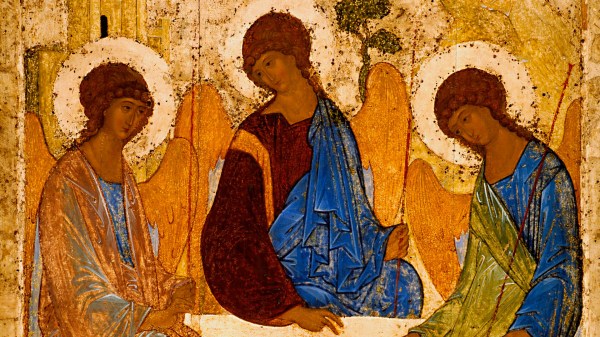
Image: Andrei Rublev’s 15th-century icon of the Holy Trinity

Last week on Pentecost Sunday, I likened the Bible to what my granddaughter Claire, at an important stage in her learning to read, used to refer to as her chapter books. When children are learning to read, a critical stage is reached when they graduate from simple, single-storyline books to complex stories that unfold in stages, or chapters.  In the last two weeks, we have celebrated two significant chapters in the Christian biblical chapter book- namely the Ascension of Jesus and the descent of his Spirit – a two-way process which Tom Wright describes as the moment when the personal presence of Jesus with his disciples is translated into the personal power of Jesus in his disciples.

Pentecost is the final chapter in the Christian chapter book. But in all good chapter books, the final chapter is often capped off with an epilogue – a short addition or concluding section at the end of a literary work, usually dealing with the future of its characters.  Trinity Sunday is the Christian chapter book’s epilogue, hinting at a foretaste in volume two, so to speak, of the continuing Christian storyline with the action now centering on the life of the Church.

How do you recognize an Episcopal Church at first sight? Well, the red doors are usually a giveaway. But when you see Holy Trinity as the dedication of the church, you know this is an Episcopal Church. The Trinity is deeply revered in the Anglican tradition with by far, a greater number of Episcopal churches dedicated to the Holy Trinity than to any other single dedication. Why is this so? I think it must have something to do with the naturally speculative cast of the Anglican mind. Unlike more literalist traditions, we appreciate mysteries to puzzle over. We’re not interested in simple answers to complex questions. We appreciate mystery as something that hints at but never fully explains truth.

There is a spoof report of a supposed conversation between Jesus and his disciples. In answer to Jesus’ question Who am I? Peter, – yes, it’s always Peter who pipes up first – launches into: “Thou art the Logos, existing in the Father as His rationality and then, by an act of His will, being generated, in consideration of the various functions by which God is related to his creation, but only on the fact that Scripture speaks of a Father, and a Son, and a Holy Spirit, each member of the Trinity being coequal with every other member, and each acting inseparably with and interpenetrating every other member, with only an economic subordination within God, but causing no division which would make the substance no longer simple”. And Jesus answering, said, “What?”

Some people are, by temperament, Jesus-people. Others by temperament are God-people, while others, often many others, are Holy Spirit-people – no, I’m not looking at Linda+ when I say this. I have to say I appreciate the role both Jesus and God play in my spiritual imagination. I’m also good on the Holy Spirit as long as we don’t get too enthusiastic about her. But my temperament really hums in the contemplation of the Trinity. Why is this? Part of my answer would be to affirm the elegant simplicity of the Trinity as the fullest expression of God. And I want you all to know how simple and enticing the Trinity really is.

The distinctively Christian understanding of God, as Trinity, emerges from the Pentecost event, as an everyday experience long before it became a doctrine. This unthought experience of God as Trinity is captured in a venerable Celtic prayer:

Three folds of the cloth, yet only one napkin is there,                                                                                           Three joints in the finger, but still only one finger fair,                                                                                               Three leaves of the shamrock, yet no more than one shamrock to wear,
Frost, snowflakes and ice, all in water their origin share,
Three Persons in God: to one God alone we make our prayer.      

Like most experiences, it’s only when we turn our backs on the poetic and try to rationally capture the intuitive that things get complicated.

God as Trinity – that is, as divine community – arose out of the everyday experience of the first Christians. They knew of God, the creator, from their Jewish inheritance. Yet, this inheritance of faith had been augmented through a collective memory of Jesus as a human personification of God. Following the Ascension event, when they had so keenly felt the loss of a personal connection with Jesus, at Pentecost they became overpowered by– literally inflated with his Spirit as the personal presence of Jesus with them was translated into the personal power of Jesus in them. It’s only later, when Christianity takes root among the Greeks – ah those Greeks being of a more philosophical frame of mind, loved codified statements – like the one we repeat every Sunday in the Nicene Creed. It’s here that the Trinity begins to get complicated.   

While human beings have always cherished relationships, it’s only with the advent of a psychosocial understanding of relationship that we have grasped the importance of relationality as the engine of emotional development. Following on from our being created in the image of an unseen God, we can deduce that the dynamics at play in human relationships reflect something essential about God. If we are made for relationships in community then might this be true of God as well. The image of God as a solitary being falls away before the image of God as divine community.

I’m now coming closer to answering the earlier question of why I am at heart a Trinity-person.  In 2025, the celebration of the Holy Trinity coincides with both Father’s Day and the baptism of a child in the fourth generation of one of our church families. Both Father’s Day and baptism provide rich material for reflecting on the relational nature of God as divine community.

Fatherhood, often thought of as a male characteristic – the possession of individual men, is really a concept dependent on and expressive of relationship. All fathers are men, but not all men are fathers. Men become fathers only through the procreation or adoption of children. Relationally speaking, you cannot be a father without a child.

Traditionally, despite acknowledging that God is genderless, God the creator nevertheless has been referred to as Father, rendering Jesus his Son. Yes, these are now unfashionably gendered nouns. But its not the gendering, but the relationality of these nouns that captures the essence of the divine nature. Other nouns for God can be used so long as they speak of relationship – as in Lover, Beloved, and Love-sharerer. As with us, so it seems with God. Fatherhood is an identity created through a relationship. Likewise, baptism speaks the language of relationship.

Here, a contemporary psychological understanding of relationality is pertinent. Human beings come into existence through relationships. I’m not referring here to biology but to the development of self-consciousness as the core foundation for identity.

The psychology of Object Relation Theory, the psychoanalytic school in which I was trained as a therapist after my ordination to the priesthood, perceives the infant as object-seeking from birth. This means the infant is instinctively drawn to the mother, initially to her breast, but soon her face as well. Every mother of a newborn knows this unfolding experience. The infant and mother are held in the embrace of a mutual gaze. It’s the experience of coming to self-consciousness through the gaze of the mother that is as vital to infant flourishing as the physical sustenance the mother provides.

My point in all of this is to say that our sense of self is caught – a process of self-discovery through catching a glimpse of ourselves in the gaze of another. Self-consciousness and identity are the fruit of being in relationship. While the initial mutual gaze is between mother and infant, it eventually broadens to include the gaze between mother, father, and infant as the child develops a consciousness of the father’s presence.

I want to make a necessary disclaimer here. Although I’ve been speaking of the more usual context of female mother, with male father, I want to stress that mothering or motherhood, fathering or fatherhood are potentially gender fluid roles. However, this takes us into a more contested area and should be the subject of a separate sermon.

I’ve been suggesting that the Trinity is first an experience and only thereafter a concept of God as relational within divine community. This seems a somewhat modern development in reinterpreting traditional metaphors for God, yet, the early 15th-century Russian iconographer Andrei Rublev seems to have had a premonition of God as a divine community that uncannily echoes a contemporary, psychologically informed image of God.

His icon of the Holy Trinity depicts three angel-like figures seated around a table – an allegory of the visitation of the three angels to Abraham at the oaks of Mamre as recorded in Genesis 13. But it’s the facial expressions I want to draw your attention to. Although dressed differently, and presented essentially as men – although angels are actually genderless, they share the same face and gaze through the same eyes. Their mutual gaze of love is evocative of the gaze shared between mother and infant. It’s as if each is held in being through the exchange of mutual gaze with the other. The optical illusion is created so that while the members of the divine community sustain each other through a shared loving gaze, we are also drawn into the experience of that gaze. Before Rublev’s icon of the Holy Trinity – we experience something so familiar to us – an echo from our earliest unthought memory.

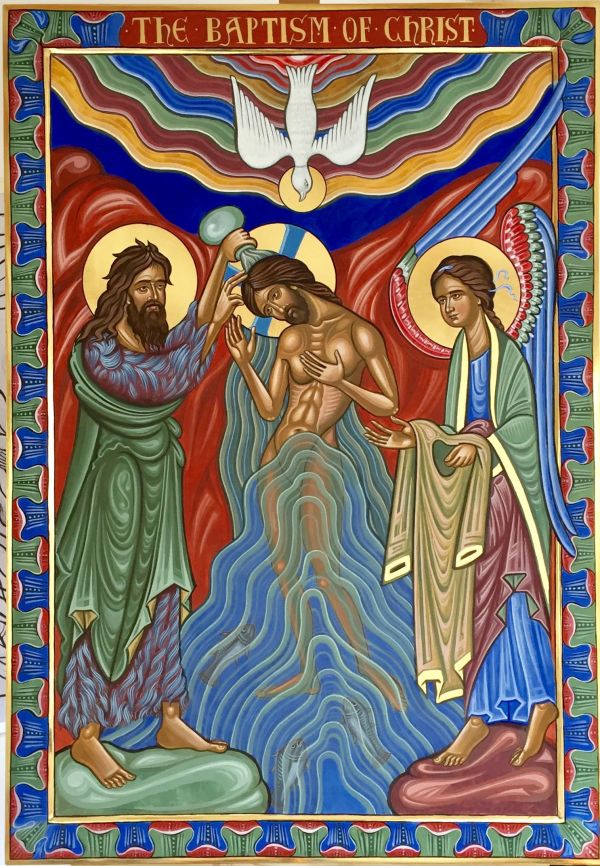
Today, on Trinity Sunday, little Evie Tulungen will become a Christian. This is a shorthand way of speaking. But exactly in what sense will Evie become a Christian? Most of us will imagine that Evie becomes a Christian through the flowing of water and the anointing of the Holy Spirit. Both are true. But what we may miss is an equally important point. It will be through her baptism that Evie becomes a part of the mutual gaze shared between participants in the Christian community. The Early Church Father, Tertullian is reputed to have said that one Christian is no Christian. What he meant was that being Christian, like fatherhood and motherhood, like sonship and daughterhood, is a relational experience. There are no individual Christians, only persons who through baptism are born into a shared life of relationship within a community called Christian. Though an imperfect reflection it may be, the community of the Church is none other than the reservoir for a love no longer exclusive to the Divine Community but now shared through the overflowing of the Spirit into the life of the world.
Baptism?

A contributor to Sermons.com shares a humorous story about three pastors lamenting their shared problem: bats in the belfry. The first pastor tried scaring them away by shooting at them, but all he succeeded in doing was making holes in the roof. The second pastor captured the bats, transported them 50 miles away, and released them, only to find they returned to the church before he did. The third pastor stunned his colleagues by announcing he no longer had a bat problem. When asked how he achieved this, he replied, “I baptized them—and I’ve never seen them again.”

This amusing anecdote illustrates the saying, “Many a true word is spoken in jest.” It raises a serious question: What is the meaning and purpose of baptism?

William Temple, a revered Archbishop of Canterbury in the mid-20th century, once observed, “The Church is the only society that exists for those who are not its members.” This sentiment sheds light on the Anglican tradition’s unconventional view of boundaries. Becoming a member of the Episcopal Church often feels effortless—attending regularly can subtly integrate you into the community before you even notice.

This approach is unusual among contemporary American churches. The Episcopal Church’s open boundaries express Temple’s assertion. However, this openness creates challenges in distinguishing the Church from the world. Worship is open to all, but only the baptized are invited to communion—though no one is turned away.

To Christians from other traditions, this may seem inconsistent. Yet, it reflects a theology that regards baptism as entry into a saving community, nourished by Holy Communion. It also acknowledges that the altar rail is not the place to turn away those who approach with faith and good conscience.

In Mark’s Gospel, Jesus’ baptism is profoundly personal—his adoption as God’s Son is a secret known only to him and John the Baptist. By contrast, Luke’s account portrays Jesus’ baptism as a communal event:

“Now when all the people were baptized, and when Jesus also had been baptized and was praying…”

Mark presents Jesus stepping onto the world stage, becoming the Son of God through adoption at baptism. Luke, however, emphasizes that Jesus has always been the Son of God, with his baptism confirming this preexisting truth.

These differences reflect an ongoing theological debate: Are we saved through baptism, or is baptism a recognition of salvation already granted?

Evangelicals often view baptism as a personal act of faith—a believer’s conscious decision and a ticket to heaven. Anglicans, however, generally see baptism as a celebration of God’s grace, marking entry into a community where salvation is encountered and witnessed.

Returning to Temple’s statement, “The Church is the only society that exists for those who are not its members,” we recognize the Church often falls short, behaving as though it exists solely for its own benefit.

Protestants view the Church as a temporary gathering, existing only when believers come together. In contrast, Anglicans and Catholics see the Church as the mystical body of Christ, existing beyond any specific gathering. Accordingly, Protestants see baptism as entry into an individual relationship with Christ, while Anglicans and Catholics view it as entry into the communal life of the Church—a saving experience.

For Roman Catholics, salvation is bound within the Church, necessitating rigorous boundaries. Anglicans, however, see the Church as leaven in the loaf of the world. The Episcopal Church exists not to confine God’s salvation but to witness to its presence already at work.

Why does this matter? For me, it challenges the Calvinist preoccupation with personal salvation. I reject the idea that my salvation depends on choosing Jesus while my neighbor faces damnation. God loves us both without distinction. The real question is: How do we live out this truth?

Baptism is not a one-time event but a daily commitment to live out God’s purpose in the world. In the Episcopal Church, this commitment is articulated in the Baptismal Covenant, which includes five promises:

    1.   Faithfulness in community: Participate in the life of the Church, practicing faith daily.

    2.   Resistance to evil: Fight evil and return to the path of repentance when you fall short.

    3.   Proclamation of the Gospel: Share the good news that God has already saved the world in Christ.

    4.   Service to others: Love and serve your neighbor as yourself.

    5.   Justice and dignity: Strive for justice, peace, and the dignity of every human being.

As Episcopalians, we embrace fuzzy boundaries intentionally. Guided by Temple’s vision, we affirm that belonging precedes believing.

Through baptism, we join a community that witnesses to God’s salvation as a gift for all. Christians live in tension—balancing engagement with the world’s values and dedication to a life of service and witness shaped by the Baptismal Covenant.

Everyone had had such high hopes. Ten years ago Cyrus, the King of Persia had set them free to return to their beloved Jerusalem. Jerusalem, that treasured memory, embellished in their hearts during the long 50 years of captivity in Babylon. 50 years of mourning and repentance pouring out in the voice of psalm 137:

By the rivers of Babylon we sat and wept
when we remembered Zion.
There on the poplars
we hung our harps,
for there our captors asked us for songs,
our tormentors demanded songs of joy;
they said, “Sing us one of the songs of Zion!”
How can we sing the songs of the LORD
while in a foreign land?
If I forget you, O Jerusalem,
may my right hand forget its skill .
May my tongue cling to the roof of my mouth
if I do not remember you,
if I do not consider Jerusalem
my highest joy.

50 years of waiting during which the Levites, the priestly scholars of the Law, turned their undivided attention to the scrolls of the Torah, which had been carried into exile. The Torah comprised the history of Israel’s relationship with Yahweh-God. With the passion of repentant zeal the Levites  edited the record of the nation’s history, a history that had recorded the ups and downs between Yahweh- God and a stiff-necked people – struggling to remain in relationship together. 50 years, during which the great task of editing the sacred texts was an attempt to find meaning in the face of the disaster of defeat and exile. This process initiated religious reforms as a sign of repentance. Once again the Children of Israel were called to return to the covenant with Yahweh-God. After 50 years, God finally answered them. Cyrus, his instrument – set them free to return to Jerusalem, city of cherished memory.

The returnees had had such high hopes. Yet within a space of years we hear God’s complaint renewed against them in the words of Isaiah, the third of that name. The third Isaiah raises his voice in protest:

Shout out, do not hold back! Lift your voice like a trumpet and announce to my people their rebellion, to the house of Jacob their sins.

The old dynamic had reasserted itself. The people complain against God :

Look we fast and you do not see, we follow the rules, humble ourselves, and you do not notice.

They are attention-seeking, self-preoccupied , their humility a mask for their arrogant complacency.Through the voice of the prophet God blasts them for their complicity in the structural sins of injustice and oppression, which had so quickly corrupted the society of the restored Jerusalem community. Look, Yahweh cries:

you serve your own interests on your fast day, and oppress all your workers …. Such fasting as you do today will not make your voice heard on high. … Is this not the fast I choose: to loose the bonds of injustice, to undo the thongs of the yoke, to let the oppressed go free, and to break every yoke? Is it not to share your bread with the hungry, and bring the homeless poor into your house; when you see the naked, to cover them, and not hide yourself from your own kin.

The hopes of the returnees, the 50-year task of reform and repentance had given way to the human propensity to retreat from a dream of something new, back into business-as-usual. Human-centered ways of seeing obscure the clarity of a new God-inspired perspective. A perspective grasped only in moments of crisis when the edifice of human self-interest cracks and the resulting fear makes them receptive once more to God’s words. Like Isaiah and the Hebrew prophets before him, Jesus sounded the same call to repentance and change. Christians have come to recognize the echo of Isaiah’s words in Jesus’ proclamation of the in-breaking of the Kingdom of God.

The Apostle Paul reminds the Christians at Corinth that:

When I came to you, brothers and sisters, I did not come proclaiming the mystery of God to you in lofty words or wisdom. For I decided to know nothing among you except Jesus Christ, and him crucified.  

In such tones Paul confronts the Corinthians with the error of their ways.

As it was with the Jews in 583BC, so with the Corinthians in around 60AD. The French have an expression: plus ca change, plus c’est la meme chose- the more things change the more they stay the same. The Corinthians rested their new-found faith upon the foundations of human wisdom, rather than on the power of God. The problem with human wisdom is that it degrades into business-as-usual. By this I mean that human behaviour both individual, and societal inevitably gravitates to what is known, to what is familiar. What we know is the need to scramble for the exercise of power. Power is necessary to protect self-interest. Self-interest always results in a severing of the connections between people and groups in society. Paul tells the Corinthians:

What no eye has seen, nor ear heard, nor human heart conceived, what God has prepared for those who trust in him. 

The problem, Paul explains is that if human society is driven only by what we already know how to do, the familiar ways and means, business-as-usual – he refers to this as knowing only what the human spirit within tells us – we close-off to the promptings of the Holy Spirit. So then, how are the promptings of the Holy Spirit to be discerned?

Transpersonal psychology, is the psychology that understands that the ordering of the emotions, i.e. the personal life, is only the first phase of psychological work. The ordering of our relationship to the spiritual, i.e.the transpersonal life, remains the second phase of work. Transpersonal psychology makes a distinction between the lesser and greater self. The lesser self is shaped by the experiences of our personal autobiography, i.e. the events and experiences of our individual lives. Our experience of life is given particular meaning through the way we remember our personal history. Memory is a region of smoke and mirrors, which conditions our perception of experience. The memory of the lesser self is only ever partial. Its conclusions drawn for living life are consequently distorted by the emotion of fear.

The greater self is the lesser self, placed within a larger frame of collective and spiritual reference. This larger frame of reference connects us to our collective memories. Connected to collective consciousness society remembers how in the past our tendency towards business-as-usual has always produced unfortunate results. How quickly the exiles returning to Jerusalem forgot the lessons of their collective past. How short the collective memory span of the American public is. Disconnected from our collective consciousness, we remain destined to endlessly repeat the mistakes of the past.

The greater self opens us also to the promptings of the Spirit. Here we are continually refashioned by an encounter with life that reveals to us how interdependent we are upon one another and how dependant we are upon God. Living from the greater self reveals to us that individual prospering is intertwined with the individual wellbeing of others. My prosperity is dependant because it is interconnected with your wellbeing.

The voice of the Prophet Isaiah sounds to us across 2500 years of life lost in the living. Similarly, the words of the Apostle Paul confront us across 1900 years of wisdom lost in knowledge. T.S.Eliot concludes:

The cycles of Heaven in twenty centuries
Brings us farther from God and nearer to the Dust[1].

Jesus had a pithy and somewhat enigmatic way of talking at times. He says: You are the salt of the earth, you are the light of the world. Note, he does not say you are to be the salt of the earth nor does he say you are to become the light of the world. He says, you are! We are the salt of the earth and the light of the world when we live lives of love that unite us within a connection to both our collective memory and the prompting of the Spirit.

Love is expressed interpersonally through compassion and collectively through justice. At the personal level love includes self-acceptance, mutual-acceptance, toleration, forgiveness, self-giving service, humility. Collectively, the expression of love means agitating for justice, fighting inequity, embracing inclusion, practicing tolerance and extending mercy. Living lives of love is no sentimental project.

God called the Jewish exiles to return to the covenant he made with them as a people.  God continues to call us to also live in a covenant. Ours is not the covenant God made with Moses, but the New Covenant initiated by Jesus on the cross, and confirmed by God in the resurrection. It is a New Covenant in my blood reaffirmed each time we celebrate Eucharist together. This is a covenant into which we have all been baptized. Being salty and illuminated, we continue to be those who live the promises of our baptismal covenant.[2]


[1] Choruses from the Rock T.S Eliot.
The endless cycle of idea and action,
Endless invention, endless experiment,
Brings knowledge of motion, but not of stillness;
Knowledge of speech, but not of silence;
Knowledge of words, and ignorance of the Word.
All our knowledge brings us nearer to death,
But nearness to death no nearer to God.
Where is the Life we have lost in living?
Where is the wisdom we have lost in knowledge?
Where is the knowledge we have lost in information?
The cycles of Heaven in twenty centuries
Brings us farther from God and nearer to the Dust.

[2]  Celebrant    Will you continue in the apostles’ teaching and fellowship, in the breaking of bread, and in the prayers?
People         I will, with God’s help.
Celebrant    Will you persevere in resisting evil, and, whenever you fall into sin, repent and return to the Lord?
People         I will, with God’s help.
Celebrant   Will you proclaim by word and example the Good News of God in Christ?
People         I will, with God’s help.
Celebrant   Will you seek and serve Christ in all persons, loving your neighbor as yourself?
People        I will, with God’s help.
Celebrant   Will you strive for justice and peace among all people, and respect the dignity of every human being?
People        I will, with God’s help.
(Book of Common Prayer, pp. 304-305)

Blog at WordPress.com.

Up ↑