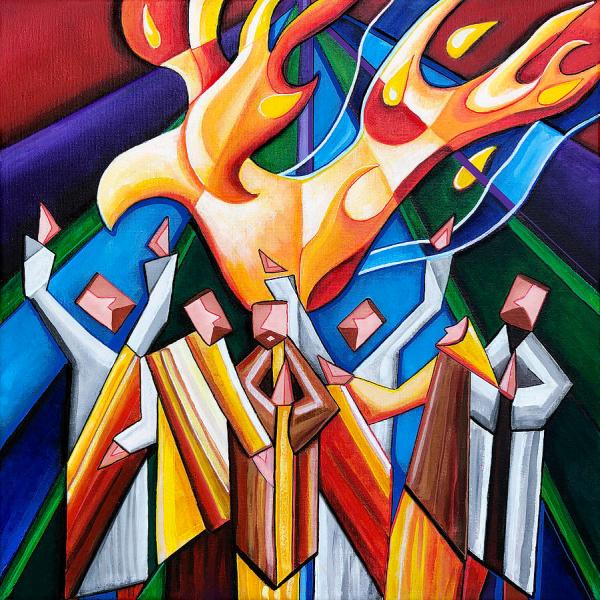
Image by Jennifer Allison
Everything is connected to everything else. The butterfly beats its wings in the New England woods provoking an invisible chain reaction resulting in a typhoon battering the Japanese coast. The magnitude of interconnection is truly mind-blowing. How so?
All that is ever seen is what Spirit causes, motivates, inspires, encourages, impels, triggers, stirs, provokes, stimulates, influences, or activates.
In his song Blowin’ in the Wind, the great Bob Dylan once more with a direct simplicity comes closest to articulating the mystery of Spirit: (https://www.youtube.com/watch?v=KpD26IoRLvA 1:27 -end)
Dylan asks
Yes, and how many years must a mountain exist
Before it is washed to the sea?
And how many years can some people exist
Before they're allowed to be free?
Yes, and how many times can a man turn his head
And pretend that he just doesn't see?

The answer, my friend, is blowin' in the wind
The answer is blowin' in the wind.
In this vein, let me try to give some descriptive theological shape to the Day of Pentecost – the arrival of which brings to a close the long biblical narrative that has been unfolding since Christmas, through Easter, ending here at Pentecost.
Pentecost – is Greek for the 50th day after Easter. On the Day of Pentecost the Spirit of the risen and ascended Christ – the Holy Spirit entered material time and space as a crucial participant in the on-going life of the creation.
John hints at Jesus’ gift of his spirit to his disciples in his farewell discourses – where in today’s gospel he tells them – If I do not go away, the Advocate will not come to you; but if I go, I will send it to you …. for when the Spirit of Truth comes, it will guide you into all truth.
It’s Luke, of course, who offers the graphic description of the event that overwhelmed Jesus’ followers on the Day of Pentecost. Luke’s chronological arrangement of the life and times of Jesus from birth to resurrection ends with his Ascension. In the sequel to his gospel, the Acts of the Apostles, Luke chronicles the life and times of the first followers of Jesus of Nazareth. Beginning with the event that transformed them from a dispirited rag-tag band of the dejected and the lost into an empowered, pneumatic community inflated by the power of the Spirit. Luke goes on to record in Acts how empowered by the Holy Spirit this pneumatic community begins to forge a distinctively revolutionary way of living. Pentecost marks the transfer of power from what had been the ministry of Jesus to the ministry of those who became initially known as the followers of The Way.
Being faithful Jews, these first followers of Jesus had gathered in Jerusalem for Shavuot – the other great pilgrim festival at which every Jew – especially those of the male variety was encouraged to come up to Jerusalem on the 50th day following Passover to commemorate the giving of the Torah by God to Moses. Luke paints a vivid technicolor picture of the events that overtook Jesus’ followers who were visited by a pyrotechnic eruption of wind, fire, and ecstatic utterance marking their pneumatic inflation with the Holy Spirit.
Among the multitude of pilgrims gathered for Shavuot from across the Jewish diaspora were Jews from Media, Elam, and as far away as Mesopotamia – from Cappadocia and a host of other cities in Asia Minor together with Egyptian, Libyan, and Arabian Jews, alongside local Judeans. All witnessed the clamor among a band of unruly Galilean peasants – hearing them shouting out in their own tongues while others of a more cynical mindset dismissed the rabble-rousers as drunk – not simply drunk, but drunk at nine o’clock in the morning. After all, what could you expect from a bunch of Galileans?
Last week I drew the metaphor of a conduit – a two-way traffic highway connecting the dimension of time and space with the spiritual dimension – each a dimension arranged in parallel. With the Ascension of Jesus, the direction of traffic moves from time and space to spiritual space as Jesus is received by God and reunited within the divine nature – not simply as a divine being but now clothed in the fulness of his humanity.
Following the reception of the humanity of Jesus- now perfected through suffering – into the divine nature, the traffic flow reverses as the divine spirit of Jesus is released to reenter time and space – becoming known as the Holy Spirit – who in the words of the Nicene Creed proceeds from the Father through the Son.
All that is ever seen is what Spirit causes, motivates, inspires, encourages, impels, triggers, stirs, provokes, stimulates, influences, or activates.
On the Day of Pentecost, the disciples of Jesus were set blaze – enraptured –hearts and minds ignited with passion. Drawing a more contemporary analogy, in his song, I’m on Fire Bruce Springsteen captures such a moment when he sings: (https://www.youtube.com/watch?v=1VxFS5-klfk 1.24 -end)
At night, I wake up with the sheets soakin’ wet and a freight train runnin’ through the middle of my head, only you - can cool my desire, oh,oh,oh, I’m on fire!
The Holy Spirit is the manifestation of God as the primal force animating from within and spanning between everything – an echo of the Genesis vision of the divine wind moving across the face of the void – calling structure and order out of chaos.
The Apostle Paul in chapter 8 of his letter to the Romans recaptures the grandeur of the Genesis vision – leading him to his arresting association of the Holy Spirit as the midwife of the Creation. He writes:
Know this, that the whole creation has been groaning in labor pains until now; and not only the creation, but we ourselves, who have the first fruits of the Spirit, groan inwardly while we wait for adoption, as part of the redemption of Creation.
Paul offers this extraordinary image of the Spirit birthing us in our weakness; like pre-linguistic newborns, the Spirit speaks for us in sighs too deep for words.
St Martin’s is a Spirit-filled community. This is not the way we normally think of ourselves for we are shaped by a cooler Anglican ethos that has traditionally been highly suspicious of too much enthusiasm. Our Spirit-fullness is revealed through our synergy of traditional Anglican worship with radical theological and social messaging – allowing us to explore, fashion, and present fresh perspectives on traditional articulations of theology and faith practice. In this we capture the revolutionary effect of the Spirit – directly addressing head-on, the challenges faced by us in the lives we are actually living. This can be a testing experience and gives the lie to the accusation that our Anglican way is an easy religion.
Following this liturgy – we will celebrate our Spirit-filled, magnetic community – a community drawing others to us. We are an attractive, warm, and welcoming community. We express a quiet spiritual empowerment. We exhibit revolutionary courage – confronting challenges to faith in a modern context while also risking new opportunities – as together we reach out for God’s invitation to work tirelessly for the healing of the world.
All that is ever seen is what Spirit causes, motivates, inspires, encourages, impels, triggers, stirs, provokes, stimulates, influences, or activates.
Or as Bob Dylan tells it –The answer my friends – is blowing in the wind – the answer is blowing in the wind. The life of Spirit is not subject to our manipulation or control – it’s not comprehensible to our grasping minds. The Spirit makes itself known through us when we allow ourselves to become available to its prompting to act under the furtherance of the divine plan for creation which always begins with a revolutionary refusal to accept that the way things are in the world is the way things have to be.
 Relationalrealities