A King, But What Kind of King?

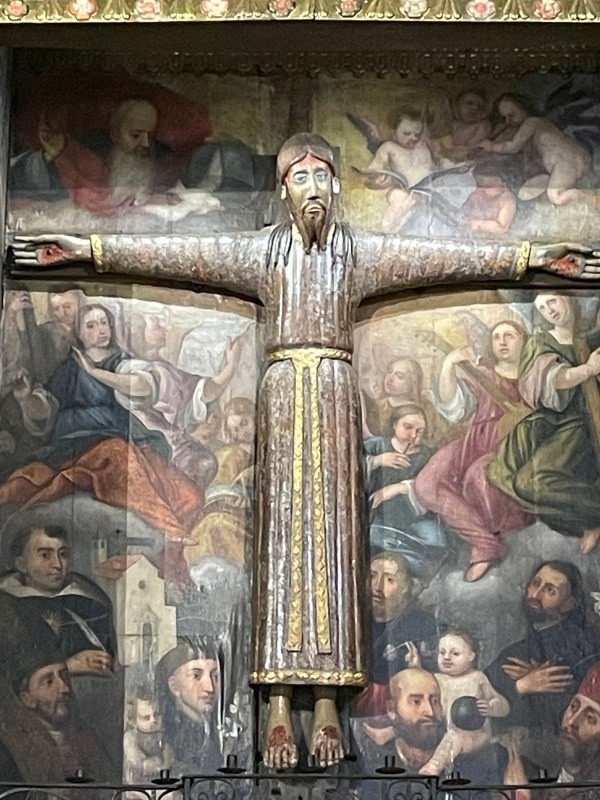
Image: 9th-century Christ figure, Esglesia de Sant Cristofol de Beget, Catalonia.

Note the sermon recording is a version of the text below streamlined for oral delivery.

This Sunday, the last in the season after Pentecost, brings us again to the Feast of Christ the King. It’s worth remembering that this is a relative newcomer to our Anglican–Episcopal calendar. Traditionally, the Sunday before Advent was known as Stir-Up Sunday—from that marvelous opening of the old Collect for Advent Sunday. We now find his Collect moved to Advent II.

“Stir up, we beseech thee, O Lord, the wills of thy faithful people…”

In England, of course, this also served as the annual cue for the vigorous stirring of the Christmas pudding. A lighthearted association, yes—but there is a deeper, more unsettling story beneath the surface of this day.

100 years ago in 1925, Pope Pius XI instituted the Feast of Christ the King as an explicit protest against the rise of fascism and the growing threat of communism. His instinct was to reassert the old Constantinian notion of the Church as the supreme earthly authority—the singular center of allegiance for Roman Catholics. At tremendous cost to freedom of thought and conscience within the Church, he marshaled his legions against those he perceived as rival authoritarian powers.

It is, as you’ve heard me say before, an old and familiar story: one form of authoritarian power confronting another. And for us, for our Anglican sensibilities and ecclesiology, this is problematic. We do not imagine ourselves as an authoritarian church, nor do we look to the state to wield sacred authority on our behalf. And so we are forced to ask:

What kind of king, and what kind of kingship, are we actually celebrating today?

The first chapter of Genesis tells us that humanity—male and female—is made in the image and likeness of God. But if God is unseen, then the only way we can learn anything about God is by taking a long, honest look at ourselves.

And this is where things immediately become complicated.

For which image of humanity is God reflected in?
The compassionate one?
The jealous one?
The collaborative one?
The violent one?
Perhaps, in some mysterious sense, all of them?

This double-edged mirroring cuts both ways. We deduce that God is loving, relational, and faithful because we find traces of these aspects within ourselves. But we also project onto God our fear, our rage, our desire for power and control—because these too are embedded so deeply within us.

This is why the Bible’s shifting, sometimes contradictory portraits of God may have more to do with the conflicting, constantly changing images of ourselves than with any actual change in God. And so today’s great question arises again:

Which of our many competing self-images do we want Christ the King to reflect?

The Church has never lacked for imagery.

Pantocrator—the omnipotent ruler of the universe—gazes down from Orthodox domes and even from our own great West Window at St. Martin’s, itself a war memorial. In this rendering, Christ is robed with imperial grandeur, presiding over the world with absolute command.

Christus Rex, the risen high priest, appears in the reredos of the St. Martin Chapel—Christ triumphant, the cross firmly behind him now, is decked in priestly attire; new life springing forth from resurrection’s victory.

But then there is that other image—stubborn, uncomfortable, and impossible to romanticize:
the one who reigns not from a throne but from a cross.
Not robed in splendor but stripped of all earthly power.
Not lifted above humanity but nailed into its deepest suffering.

This third image refuses the familiar pairing of strength over against vulnerability. It insists instead on a revolutionary pairing:

strength through vulnerability,
continuity reshaped by disruption,
life emerging from death.

This is the image Luke gives us today in Jesus’ Passion. Here, Christ’s kingship shines through the very moment when Rome, the Temple, and a frightened populace converge to crush him. He refuses to play the power game. He refuses to mount a defense that mirrors their tactics. His vulnerability becomes the very thing that reveals divine strength.

We are living, once again, in an interesting moment—interesting in that biblical sense where the tectonic plates shift beneath our feet. Authoritarian voices rise across the world; fear becomes a political currency; purity narratives—racial, religious, cultural—gain traction among anxious populations. Meanwhile, many feel that continuity is slipping away, that the old certainties no longer hold.

Newton’s Third Law quietly reminds us: for every action there is an equal and opposite reaction. And so the pendulum of history swings between order and chaos, continuity and disruption, stability and fracture.

Like Pope Pius XI a century ago, we, too, are tempted to imagine that the only adequate response to coercive power is counter-coercive power. Strength for strength. Force for force. A sort of theological arms race.

The danger here is subtle but real:
when God is remade in our image, it is only a matter of time before violence, domination, and exclusion become divinely sanctioned.

And so Christ the King asks us to choose carefully which image of ourselves we are willing to project onto God.

Left to our own devices, our imaginations merely recycle the familiar. We recognize only what we have already trained ourselves to see.

But the Gospel calls us into a more permeable imagination—one in which the rigid boundaries of our conventional selves give way, and something new breaks through. Jesus’ parables work in this way – as disruptive stories—stories that jump the track like a needle skipping on a vinyl record, suddenly placing us in an unanticipated part of the song.

Christ the King, as Luke gives him, is such a disruption.

Not Pantocrator high above us.
Not Christus Rex safely beyond us.
But Christ who stoops, who descends, who reigns from the cross itself.

This is not the familiar polarity of strength or vulnerability.
It is the holy paradox of strength through vulnerability.

Not disruption as the enemy of continuity,
but disruption as a necessity in the long-term reshaping and renewal of continuity.

Beneath the cross—Luke implies it, and the tradition expands it—are three great stones wedged into the earth:

divine love,
divine mercy,
divine justice.

From this place of what looks like utter defeat, Jesus exercises a kingship the world is not conditioned to recognize. A kingship that unsettles our desire for easy answers, half-truths, and superficial allegiances. A kingship that pushes us to live from hearts less governed by fear.

Christ’s kingship blesses us with righteous anger at injustice, oppression, and exploitation of the helpless. It calls us not to passive acceptance but to active labor for freedom, peace, and justice.

And Christ’s kingship blesses us with just enough holy foolishness to believe that we truly can make a difference—that the world’s wounds are not beyond healing, and that we are called to participate in that healing.

As Dietrich Bonhoeffer wrote in another moment of deep historical crisis:

“We have been silent witnesses of evil deeds; we have been drenched by many storms; we have learnt the arts of equivocation and pretence; experience has made us suspicious of others and kept us from being truthful and open; intolerable conflicts have worn us down and even made us cynical. Are we still of any use?

He continues:

What we shall need is not geniuses, or cynics, or misanthropes, or clever tacticians, but plain, honest, and straightforward men. Will our inward power of resistance be strong enough, and our honesty with ourselves remorseless enough, for us to find our way back to simplicity and straightforwardness?” we shall need is not geniuses, or cynics, or misanthropes, or clever tacticians, but plain, honest, straightforward men and women … with enough inward strength to find our way back to simplicity and straightforwardness.”

So today—this last Sunday of the Christian year—we stand again before the three competing images of Christ the King:

Pantocrator, the omnipotent ruler;
Christus Rex, the triumphant high priest;
and Jesus of Nazareth, reigning from the cross.

The first two are familiar.
The third is revolutionary.

For in that crucified face, we find not a projection of our own lust for control, but a revelation of God’s true nature:

a kingship that reconciles by resisting,
that resists by refusing to imitate violence,
that transforms by entering the world’s suffering rather than escaping it.

Perhaps this is the image of Christ the King we need now:
the one who reigns by setting aside every pretense of worldly strength,
and who invites us to do the same—so that God may enter our picture
and remake us in the divine image of love, justice, and mercy.

Amen.

Contending Images of Kingship

The first chapter of Genesis God states – Let us make humanity, male and female in our own image.  All well and good. But if we are made in the image of an unseen God, then we can only come to learn something about God through taking a good hard look at ourselves. The tricky question then is, which image of humanity is God reflected in? Maybe all of them?

Like a double-edged sword, the mirroring of divine and human images cuts both ways. We can deduce that God is loving, relational, and collaborative because we also possess these qualities. Yet, we can equally imagine God as jealous, angry with a propensity for violence in pursuit of the ends of power and control because these are also very typical human characteristics. The Bible’s presentation of shifting and changing images of God -may in the end simply be the projections of our own conflicting images of ourselves.

The final Sunday before the start of a liturgical year on Advent Sunday is dedicated to Christ as King – begging the question – what kind of king, what kind of kingship is being imaged here?

Pantocrator is one popular image of Christ as King – omnipotent ruler of all of creation – often pictured on the concave half dome typical of many Orthodox churches. We see Christ as Pantocrator in St Martin’s great West window which is by no mistake a war memorial window. As Pantocrator, Christ is robed in the trappings of political power, the paramount operative in the zero-sum-equation of dominion through domination.

Christus Rex is another traditional image of Christ – an image depicted in the St Martin Chapel reredos. Here Christ is robed not as king but as high priest whose resurrection life springs forward from the cross – which is now firmly behind him in the background.  Both Pantocrator and Christus Rex images sit in uneasy tension with the other enduring image of Christ reigning not from a throne or a gilded cross but dying, nailed to a tree.

The final Sunday of the year is a celebration of the end time as depicted in 1 Corinthians 15 – when the Father will place all things in subjection under his Son who as dutiful Son will complete the Father’s restoration of the divine dream for all of creation.

Our images of power vie with the our images of vulnerability. We project humanity’s competing characteristics into the blank space that is the unseen God. If we are fashioned in the image of an unseen creator, then we can only come to learn something about God through taking a good hard look at ourselves. Thus the tricky question remains, which of our many conflicting self-images do we want Christ as king to reflect?

Interesting is an interesting word! What an interesting historical moment we are living through. Our culture rocks and reels as the tectonic plates shift unpredictably. Newton’s Third Law of Motion states that counteracting forces always come in pairs – as the pendulum of history swings between the order and chaos – between continuity and disruption – each vying for dominance. The theological thrust for designating the final Sunday in the liturgical year to the kingship of Christ crystalizes the waring tensions within us – counteracting forces finding expression in competing images of God.

In 1925 Pope Pius XI proclaimed the feast of Christ the King as an assertion of the Catholic Church’s protest to the rise of fascist and communist authoritarianism. He chose the images of strength in asserting the equally authoritarian power of the Church as the only center of allegiance for Roman Catholics. At a considerable cost to liberty and freedom of thought within the Church, he marshaled the Catholic legions for battle against forces in direct competition with the power of the Church.

The historical context for the origins of the commemoration of Christ the King today sounds a tone that is both timely yet also problematic as once again we are being called to face down a new resurgence of authoritarian forces. Pius XI drew on an old story of one authoritarian system asserting itself against competing, equally authoritarian rivals – strength against strength. For those of us who do not subscribe to the notion of an authoritarian church or even an authoritarian state, Christ the King is a very necessary reminder of the dangers in mistaking power for strength and vulnerability for weakness.

Human beings have rich imaginations – but left to our own devices – as it were- our imaginations tend to recycle familiar image patterns. Consequently, we only tend to recognise what we are already preconditioned to look for.  In the pursuit of the deeper search for the spiritual or soul-filled connection we so long for – the challenge is to allow the boundaries of our imaginations to become more permeable – less strictly policed by our conventional selves – allowing something new to break-in.

An example of the in-breaking of new insight might be that instead of the all too familiar counteracting pairing of strength with vulnerability, continuity with disruption as polar alternatives- we imagine new possibilities in a collaborative pairing of strength through vulnerability – with the forces of disruption seen not as destructive of continuity but as the timely reshaping and revitalizing of continuity over the long term.

We are storied beings – meaning we are only ever the stories we tell about ourselves. Stories are one of the most effective ways through which the unfamiliar breaks-in to disrupt the familiar patterns of recycled imagination. New spiritual insight breaks-in through the medium of stories that change through shock or surprise. Parables are disruptive stories – which like the needle on an old vinyl record jumps tracks as it hits a scratch in the record’s surface – disrupting the familiar melody and jolting us suddenly into a new one.

Matthew’s Jesus parable of the Sheep and the Goats allows new spiritual insight to break-in – disrupting our usual imaginings of Jesus’ kingship. In this parable Jesus presents kingship as service, strength through the embrace of vulnerability – the in-breaking of compassion disrupting the more familiar continuity of hardness of heart.

Matthew presents a picture of the end time when the Son of Man will come in his glory to sit upon his throne. But this is not Jesus clothed in worldly power. What breaks-into our imaginations through this story are the responsibilities of kingship being those of service, empathy, and a concern for the least important, the least powerful, the least able among us. Justice is the hallmark of this image of kingship in which Jesus echoes the prophet Ezekiel in our first lesson who speaks of God as shepherd of the flock seeking out the lost, bringing back the strayed, binding up the injured, strengthening the weak, and feeding them with justice.

We embrace the image of Christ the King because at the heart of the gospels stands the iconic image of Jesus’ royalty, not as one lifted high above us decked in robes of kingly power, but as one who stoops to reach down to join us in the one nailed to a tree. Christ’s kingship – breaks open the strength, or vulnerability, continuity, or disruption polarities with a new and revolutionary image of strength displayed in vulnerability, of disruption as necessary for long term continuity.

At its base the cross was wedged into place by three huge stones hammered into the ground. These are the stones of strength through service, strength in vulnerability, and strength as the fruit of justice. 

Christ’s kingship extends over us to discomfort our search for easy answers, half-truths, and superficial relationships – so that we may live more deeply from less fearful hearts. Christ’s kingship extends over us to bless us with anger at injustice, oppression, and exploitation of the helpless – so that we may work tirelessly in the cause for freedom and peace with justice. Christ’s kingship extends over us to bless us with tears shed for those who suffer from pain, rejection, starvation, and war – so that we may reach out our hand to comfort them by standing together in their pain. Christ’s kingship extends over us to bless us with enough foolishness to believe that we can make a difference in this world – so that we can do what others claim cannot be done. Amen (My paraphrasing of an anonymous Franciscan blessing)

Service, Reconciliation, and Resistance

Christ the King, the last Sunday of the liturgical year presents us with two images of Christ as leader. Christ the King robed in the trappings of political culture. The paramount operative in the zero-sum-game of dominion as domination sits in an uneasy tension with Christ reigning not from a throne but nailed to a tree.

One is an image of power, the other an image of vulnerability. We are more comfortable with displays of power, with images of strength, while we easily mistake displays of vulnerability with helplessness and weakness.

The age-old Jewish expectation of the messiah as the one who would come with power – God’s super shepherd – to set the world right-side up took a sharp left turn in the imaginations of the followers of Jesus. By bringing two familiar O.T. images together they forged a new vision for messianic leadership. The messiah was not only to be the great shepherd about whom Jeremiah speaks in the O.T. lesson for Christ the King. For his first followers Jesus was the one who will gather a scattered people and put the world to rights through following the path of suffering about which the prophet Isaiah had much to say.

Drawing on images of both shepherd and suffering servant the first Christians forged a revolutionary understanding of the messiah’s role inspiring in them a new vision that changed the world.

The crucifixion of Jesus is an example of leadership in right action. But is it a story of failure or success?

Throughout the centuries the Christian Church has worked hard to portray the crucifixion of Jesus as the ultimate exercise of kingly power.  But in order to flesh out such a vision, the Church borrowed the paraphernalia of earthly trappings of power. The dying man becomes the triumphant hero vanquishing the anti-God forces through the in-breaking of God’s reign of justice. Christ Pantocrator, sitting atop the world with scepter and orb in hand and crown on head – the superhero of the Byzantine age emerges in the middle of the 20th Century as the triumphal Christ the King, leading the Christian legions against the evils of Communism.

Luke is an amazing storyteller. Mark’s storytelling is spare and sparse – communicating an urgency of living in the moment in which there is no time to lose. Matthews storytelling elevates Jesus above the hubbub as he recasts the story of Jesus in the light of the age-old Jewish hope for a new Moses. But it’s Luke who offers us a Jesus storyline that connects with our intimate experience of the world as it is.

When they came; the they being the political and religious movers and shakers. When they came to a place whose name was synonymous with violence – the place of the skull – otherwise known as cranium hill – they scrabbled about like vultures for the poor man’s clothing, eventually casting lots among them. They mocked him, twisting his words and throwing them back at him – huh, he saved others why can’t he save himself if he is who he says he is?

The political and religious operatives unleashed their foot soldiers of political street violence – to further the false narrative of mockery – accusing him of pretensions of kingship by emphasizing the absurdity of such a claim. False and misleading stereotypes are always easy to demolish. And they place the man Jesus between two common criminals as if to drive home the inference of guilt by association.

And Luke tells us that all this time, in the background, the people stand by, watching while their leaders scoff. And Luke gives no indication that the people share their leaders’ attitudes.

Luke conveys a wealth of inference in a few words: and the people stood by.

Luke refers to the people as the laos; a term that refers specifically to the community of the faithful, the holy assembly – the laos -from which we derive the term- the laity. We can’t miss Luke’s inference here – these are not some rabble crowd of prurient onlookers but God’s people, standing-by to silently bear witness to the event unfolding before their very eyes that signals the crash and burn of their dream of a great shepherd who would free them and put the world to rights.

The powers of this world will have their way. Luke’s laos – the people of God -witness the destruction of their expectations of Jesus as the great shepherd – the messiah of Jeremiah’s prophecy. It will take time for them to discover Jesus as God’s suffering servant. And only some of them will do so.

At the heart of this scene Luke portrays the most important conversation taking place between the three figures standing at the center of this drama; Jesus and his criminal companions. Here we find the tussle between refusal and acceptance of responsibility for deeds done. One thief blames Jesus for his inability to miraculously rescue him. While his companion accepts his responsibility –for we indeed have been condemned justly. This admission of guilt is a first statement of repentance. The second thief is an archetype of the believer, he alone truly recognises who Jesus really is, and it draws from Jesus the promise of saving inclusion.

At the heart of the drama of the cross we find not the image of the great shepherd as triumphal worldly messiah. Instead we find the portrayal of love in action. Love demonstrated not from a position of power, but through the acceptance of suffering.

It’s no longer 1925 – the year when Pius XI proclaimed the feast of Christ the King as the final Sunday of the Christian year. I have traced this history in a previous post and you can find this here. We now live in an age when the Church has lost its capacity to compete with rivaling political systems in the contest for authoritarian power. Consequently, two great temptations befall us.

The first is the temptation to hitch our wagon to the secular political train. We witness sections of the Evangelical world falling prey to the temptation to Christianize the politics of the right for self-serving advantage. The second temptation is to withdraw into silence, accepting the thesis of the secular left -that there is no place in the civic marketplace for a Christian voice.

When viewed in conventional terms is the cross a failure or success? It’s hard to see death on a cross as successful leadership. But what if it’s through apparent failure that the way to success opens up?  Confronted by the failure of Jeremiah’s vision of the messiah as king and super shepherd, the first followers of Jesus encountered the victory of the cross in the unexpected image of Isaiah’s suffering servant.

Viewed in purely worldly terms, the Jesus project ended in the failure. However, we must not be misled as to the nature of the real failure here. The cross is not a failure of Jesus or of God’s to deliver of the divine plan. What fails here is the death on the cross of our own earthly ambition – ambition projected onto God’s purposes.

The cross stood tall because it was wedged into the ground and held in place by three great stones bearing the inscriptions: service, reconciliation, and resistance. 

For the first followers of Jesus the vision that emerged from their initial experience of their failure of expectations at the cross – achieved more than any successful earthly demonstration of power could ever do. The vision that emerged was a vision that changed the world. 

An anonymous Franciscan blessing goes:

God bless us with discomfort at easy answers, half-truths, and superficial relationships so that we may live deep within our hearts …. May God bless us with enough foolishness to believe that we can make a difference in this world so that we can do what others claim cannot be done. Amen

Blog at WordPress.com.

Up ↑