'relationalrealities' is the recognition human beings are designed to be in relationships. Relationality is the meaning of being made in the image of God who is by divine nature, relational – Lover, Beloved, and Love-sharer..
Love hurts, and our hearts have an all too familiar affinity with suffering. Yet, if we dwell on our suffering, we are in danger of being little more than mere spectators of Jesus’ suffering on his way to the Cross.
It’s so easy to stand and watch from a safe distance, comforted by an image of Jesus as the noble hero valiantly traveling the route God has set for him, seemingly heedless of the costs because, after all, he knows ahead of time how things will end.
But we must go deeper than this if we are to move from spectators to participants in Jesus’ Passion. You see, if we are to be participants, then Jesus must be more like us than not. We are not noble heroes passing through the drama of our lives unscathed with complete foreknowledge. And so, if he is to be more like us, then neither is Jesus.
He treads his path, a path he chooses to accept – and like us, he knows little more than what is revealed as he takes each step, putting one foot in front of the other, one breath at a time. Jesus is no noble victim sacrificing his life for the sins of the world. If we just stop there, no matter how thankful we might feel, we fail to see that the way of the Cross is God’s invitation to become transformed not by suffering, but by the power of love. For Jesus’ chooses the way of love.
Some say love it is a river that drowns the tender reed, some say love it is a razor that leaves your soul to bleed, some say love it is a hunger an endless aching need. I say love, it is a flower, and you its only seed. ….
The Rose Verse 2
The Way of the Cross requires us nothing short of a transformation in our whole (moral, emotional, and spiritual) way of being. In Jesus, God’s hands get dirty as Jesus takes the initiative and leads us through example. Our acceptance, our entry into the way of love, involves risking as Jesus risked. Risk is the raw material for transformation for
It’s the heart afraid of breaking, that never learns to dance It’s the dream afraid of waking, that never takes the chance It’s the one who won’t be taking, who cannot seem to give And the soul afraid of dying, that never learns to live …
Entering into the way of love leads us to challenge the status quo – taking risks and stepping out in faith rather than holding back in fear. As a community, it means uncovering and challenging the cosmic forces of dehumanization woven into the very DNA of our culture and its collective memory. In our confrontation with the forces of power and privilege that stand in opposition to the expectations of the Kingdom of God, we may often fail, but we cannot be defeated. Failure is a temporary setback, not an ultimate defeat of God’s purposes for us in the unfolding repair of the world.
Entering upon the way of love – above all else means accepting an invitation to become transformed into a new way of being, one step at a time – a transformation from timid and grateful children into collaborators with God in the vision of putting the world to rights.
From mere spectators to active participants with Jesus on the way to the cross is a movement through belonging into believing, a risking that moves us from fear into loving and trusting being loved.
This is not a hero’s path. Jesus shows us that it is a very human path. On Good Friday, God shows us the way of love, motivated not by an abhorrence of sin but by what is for God—the impossibility for God of not loving enough.
When the night has been too lonely and the road has been too long And you think that love is only for the lucky and the strong Just remember in the winter, far beneath the bitter snows Lies the seed, that with the sun’s love in the spring becomes the rose.
A contributor to Sermons.com shares a humorous story about three pastors lamenting their shared problem: bats in the belfry. The first pastor tried scaring them away by shooting at them, but all he succeeded in doing was making holes in the roof. The second pastor captured the bats, transported them 50 miles away, and released them, only to find they returned to the church before he did. The third pastor stunned his colleagues by announcing he no longer had a bat problem. When asked how he achieved this, he replied, “I baptized them—and I’ve never seen them again.”
This amusing anecdote illustrates the saying, “Many a true word is spoken in jest.” It raises a serious question: What is the meaning and purpose of baptism?
William Temple, a revered Archbishop of Canterbury in the mid-20th century, once observed, “The Church is the only society that exists for those who are not its members.” This sentiment sheds light on the Anglican tradition’s unconventional view of boundaries. Becoming a member of the Episcopal Church often feels effortless—attending regularly can subtly integrate you into the community before you even notice.
This approach is unusual among contemporary American churches. The Episcopal Church’s open boundaries express Temple’s assertion. However, this openness creates challenges in distinguishing the Church from the world. Worship is open to all, but only the baptized are invited to communion—though no one is turned away.
To Christians from other traditions, this may seem inconsistent. Yet, it reflects a theology that regards baptism as entry into a saving community, nourished by Holy Communion. It also acknowledges that the altar rail is not the place to turn away those who approach with faith and good conscience.
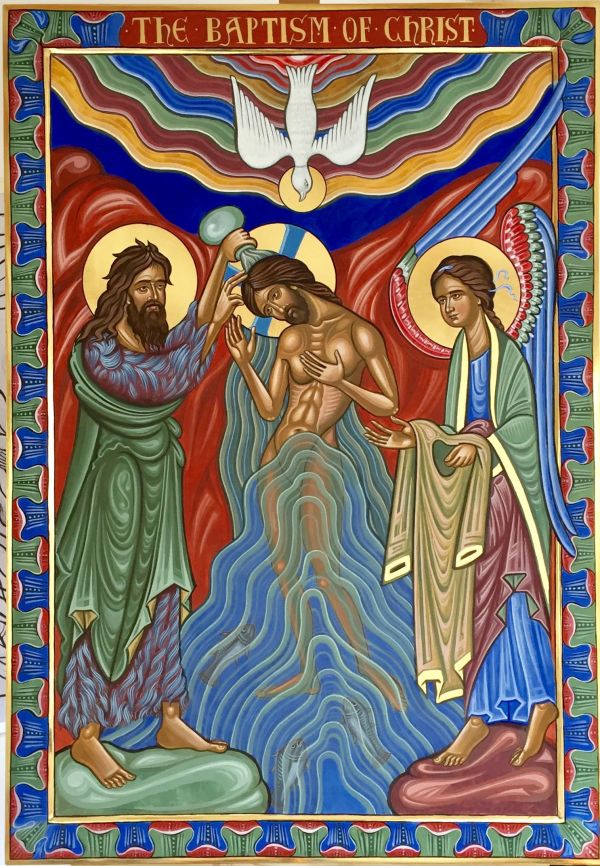
In Mark’s Gospel, Jesus’ baptism is profoundly personal—his adoption as God’s Son is a secret known only to him and John the Baptist. By contrast, Luke’s account portrays Jesus’ baptism as a communal event:
“Now when all the people were baptized, and when Jesus also had been baptized and was praying…”
Mark presents Jesus stepping onto the world stage, becoming the Son of God through adoption at baptism. Luke, however, emphasizes that Jesus has always been the Son of God, with his baptism confirming this preexisting truth.
These differences reflect an ongoing theological debate: Are we saved through baptism, or is baptism a recognition of salvation already granted?
Evangelicals often view baptism as a personal act of faith—a believer’s conscious decision and a ticket to heaven. Anglicans, however, generally see baptism as a celebration of God’s grace, marking entry into a community where salvation is encountered and witnessed.
Returning to Temple’s statement, “The Church is the only society that exists for those who are not its members,” we recognize the Church often falls short, behaving as though it exists solely for its own benefit.
Protestants view the Church as a temporary gathering, existing only when believers come together. In contrast, Anglicans and Catholics see the Church as the mystical body of Christ, existing beyond any specific gathering. Accordingly, Protestants see baptism as entry into an individual relationship with Christ, while Anglicans and Catholics view it as entry into the communal life of the Church—a saving experience.
For Roman Catholics, salvation is bound within the Church, necessitating rigorous boundaries. Anglicans, however, see the Church as leaven in the loaf of the world. The Episcopal Church exists not to confine God’s salvation but to witness to its presence already at work.
Why does this matter? For me, it challenges the Calvinist preoccupation with personal salvation. I reject the idea that my salvation depends on choosing Jesus while my neighbor faces damnation. God loves us both without distinction. The real question is: How do we live out this truth?
Baptism is not a one-time event but a daily commitment to live out God’s purpose in the world. In the Episcopal Church, this commitment is articulated in the Baptismal Covenant, which includes five promises:
1. Faithfulness in community: Participate in the life of the Church, practicing faith daily.
2. Resistance to evil: Fight evil and return to the path of repentance when you fall short.
3. Proclamation of the Gospel: Share the good news that God has already saved the world in Christ.
4. Service to others: Love and serve your neighbor as yourself.
5. Justice and dignity: Strive for justice, peace, and the dignity of every human being.
As Episcopalians, we embrace fuzzy boundaries intentionally. Guided by Temple’s vision, we affirm that belonging precedes believing.
Through baptism, we join a community that witnesses to God’s salvation as a gift for all. Christians live in tension—balancing engagement with the world’s values and dedication to a life of service and witness shaped by the Baptismal Covenant.
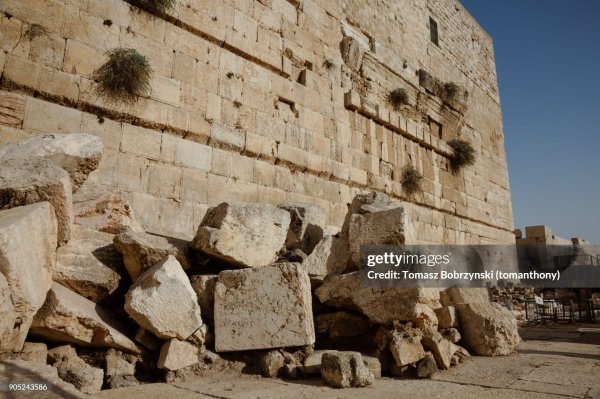
The Photo shows stones from the Second Temple in Jerusalem thrown by the Romans who destroyed the city in the 1st century AD. Robinson’s Arch is visible above the Herodian street in the southwestern corner of the Temple Mount. It was named after scholar Edward Robinson who discovered it. The arch supported a large staircase which was buit by Herod the Great as part of the expansion of the Temple Mount. Ophel Archaeological Park. GPS: N31.77580°, E35.23594°.
Note on the recording: the recording from No one wants this that comes towards the end of this recording is garbled but you can hear the clear version below in the text.
It is not an exaggeration- though it may come as a surprise to some when I say that the Roman destruction of the Second Temple in 70AD was a seismic event – the shock waves from which continue to ricochet down the historical timeline. In the Jewish Revolt from 68-70AD, the Romans laid waste across the Jewish homeland in town and countryside – culminating in the catastrophe of the Temple’s destruction along with much of Jerusalem around it.
It’s interesting to speculate had the Temple continued as the national and religious center of Jewish life might the subsequent course of Jewish-Christian relations have followed a different trajectory? If the Jews had not been forced into diaspora by Roman devastation of town and countryside – becoming the perpetually resented other at the heart of Christian Europe – might the long and sorrowful history of antisemitism have been avoided?
Imagine, no antisemitism, no Holocaust, no need for the Zionist project and the creation of a Jewish state – no Nakba expulsion of Palestinians from their historic lands -no Jewish-Israeli Arab conflict – no Intifada – no Gaza or West Bank – no denial of Palestinian statehood through military occupation and illegal settlements. What if there had continued an evolution of Jewish life in the biblical homeland whatever the wider imperial superstructure of the region. What if no post-1914 British and French power grab – drawing impossible nation-state borderlines in the sand. Instead, imagine a collage of Jewish and Arab communities living side by side – enjoying the same rights and freedoms of religious and community expression in contrast with the drawing of sharp ethnic divisions between Jewish and Arab identities. As with all alternative visions of history, we can only dream.
For fledgling Christianity, the destruction of the Temple was also a seminal event reshaping early Christian memories of Jesus and redefining the subsequent development of post-Temple Jewish-Christian rivalries as the early Church and Rabbinic movements vied for supremacy in an increasingly hostile race for the heart and soul of post-Temple religious reconstruction.
For Mark, writing around 70AD, the destruction of the Temple is a contemporaneous event of such significance that surely Jesus must have prophetically predicted it 40 years before it came to pass. In service of the theological purpose of his narrative – Mark, therefore, puts words into Jesus’ mouth – establishing a long gospel tradition of projecting late 1st and 2nd-century Christian-Jewish tensions into Jesus’ relations with the Pharisees and other Jewish sects in the early 1st-century Jewish homeland.
In chapter 13, Mark presents Jesus after several days teaching his disciples in the Temple precincts. Mark records him leaving the Temple with his disciples – one of whom remarks on the massive stones in the Temple’s construction. Even with our contemporary engineering capabilities the construction of Herod’s great Second Temple is still awe-inspiring. Standing before the Wailing Wall we can still imagine the size of the original Temple Mount platform upon which the Muslim Dome of the Rock now stands. Jesus responds with a prophecy that not one stone shall remain upon another – for all will be thrown down. Mark makes no mention here of Jesus’ claim to rebuild the ruined Temple in three days. We need to wait for John to embellish his version of Mark’s story in 2:19 with this detail.
On the Mount of Olives facing the Temple Mount across the Kidron Valley, his disciples ask for clarification on when his prophecy of the Temple’s destruction will happen. Jesus avoids the direct question and begins to warn them about the dangers of mis and disinformation campaigns that will sow the seeds of confusion – seducing many and leading them astray by false claims of leadership in his name. He warns them not to be alarmed by news of conflict and rumors of wars – such will be necessary to herald a true vision capable of taking them into the future. But for the future to arrive it must begin in the painful stage of birthing that must first destroy the familiar patterns of life as they knew it.
Jesus in Mark 13 is presented as laying out his eschatological vision. Eschatology is theology of expectation that constructs a sweeping view of events that will mark the end of the present age in preparation for an end time. In chapter 13 Mark reminds the first Christians that Jesus’ conception of Messiahship begins not in a triumph in the present age but in a series of events of impending disaster culminating in his eventual triumphal coming again at the end of time as judge and savior of the whole world. But first, the kingdom of God must be born through a process marked by great convulsions and upheavals heralding the arrival of the end time.
When you hear of wars and rumors of wars, do not be alarmed; This must take place, but the end is still to come. For nation will rise against nation, and Kingdom against Kingdom; there will be earthquakes in various places; there will be famines. This is but the beginning of the birth pangs.
Christians throughout history have associated major convulsion and upheaval in the socio-political and economic fabric as heralding the imminence of the end time. Yet for most of us whose lives have been lived in the peace and predictability of the post-1945 Pax Americana – an expectation of the end time has been confined to millenarian sects while the rest of us accepted that the world – as we experienced it – had now come of age – marked by a time of social and scientific progress accompanied by the steady growth of economic prosperity.
Yet, we now awake to find ourselves in a world where war and rumor of wars disrupt our sleep. A world in which many are being led astray by the dark arts of dis and misinformation – perpetrated by foreign actors and aided and abetted by the charlatans of the political class who have no interest other than the accumulation of power beyond limit.
The last four years of the Biden Administration may well be seen in the rearview mirror of history as that last gasp of a world we grew up to expect. From now on things are going to be markedly different.
Last week Bishop Nicholas commented on the recent election results suggesting we don’t yet know what any of this means. Well, maybe? What is clear is that a majority of voters voted for change. Motives for doing so seem mixed with no clear vision for what change will look like. It’s the time and tested response – of repeating failed choices in the hope of a different result.
As a scientist, Bishop Nicholas in essence reframed the gist of Jesus’ words in Mark 13 with the scientific observation of large systems transitioning from one stable phase to another. He commented that as it nears that point of change, fluctuations in a system become larger and more frequent. This is why water gets cloudy before it freezes or boils—the fluctuations signal that a significant change is coming. In our current political system, the jury’s still out on whether the direction of change is towards freezing or boiling.
Beyond endless analysis of what has now happened the more pressing question is – so how will we weather the convulsions and upheavals of the large socio-political paradigm change that is upon us?
Reading Mark 13 our attention is captured by the dire nature of Jesus predictions – because they mirror the instabilities we are now experiencing. Adding to the socio-political instabilities we should not fail to note instability in the largest system of all – the environment of the planet. Thus we are likely to miss the line where Jesus tells us not to be alarmed by the process that must take place – a process he identified as the beginning of the birth pangs. What are birth pangs other than the signal that new life is on the way?
In the Netflix romcom, Nobody Wants This – a sexy, youngish rabbi and his remarkably godless gentile girlfriend find themselves in a restaurant talking about the meaning of Shabbat. Listen
Buildings – and the systems they represent – may crumble – but that doesn’t matter – what matters is gathering with people we care about and who care for us. In the time that is upon us – solidarity, caring for one another in communities of solidarity and support – together sheltering within the protection of belonging – this has always been for Christians – and is now for us – the best survival strategy for enduring the birth pangs that will in the end result in the arrival of new birth. This is Jesus’ message to us about the promises of God – and God is always faithful.
Everything is connected to everything else. The butterfly beats its wings in the New England woods provoking an invisible chain reaction resulting in a typhoon battering the Japanese coast. The magnitude of interconnection is truly mind-blowing. How so?
All that is ever seen is what Spirit causes, motivates, inspires, encourages, impels, triggers, stirs, provokes, stimulates, influences, or activates.
In his song Blowin’ in the Wind, the great Bob Dylan once more with a direct simplicity comes closest to articulating the mystery of Spirit: (https://www.youtube.com/watch?v=KpD26IoRLvA 1:27 -end)
Dylan asks
Yes, and how many years must a mountain exist
Before it is washed to the sea?
And how many years can some people exist
Before they're allowed to be free?
Yes, and how many times can a man turn his head
And pretend that he just doesn't see?

The answer, my friend, is blowin' in the wind
The answer is blowin' in the wind.
In this vein, let me try to give some descriptive theological shape to the Day of Pentecost – the arrival of which brings to a close the long biblical narrative that has been unfolding since Christmas, through Easter, ending here at Pentecost.
Pentecost – is Greek for the 50th day after Easter. On the Day of Pentecost the Spirit of the risen and ascended Christ – the Holy Spirit entered material time and space as a crucial participant in the on-going life of the creation.
John hints at Jesus’ gift of his spirit to his disciples in his farewell discourses – where in today’s gospel he tells them – If I do not go away, the Advocate will not come to you; but if I go, I will send it to you …. for when the Spirit of Truth comes, it will guide you into all truth.
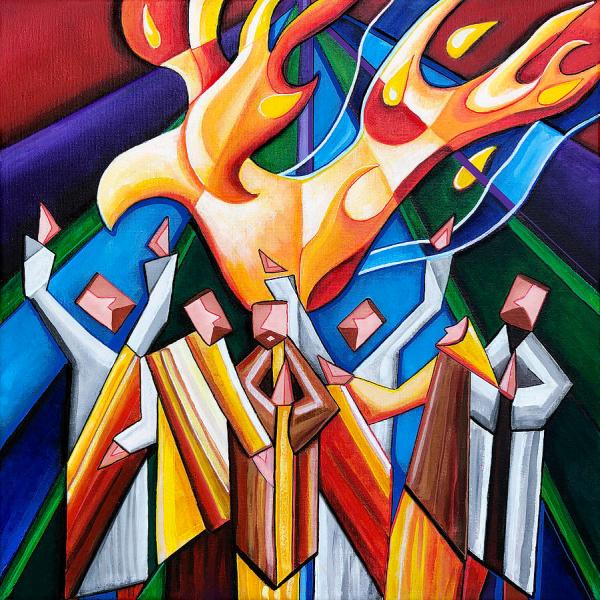
It’s Luke, of course, who offers the graphic description of the event that overwhelmed Jesus’ followers on the Day of Pentecost. Luke’s chronological arrangement of the life and times of Jesus from birth to resurrection ends with his Ascension. In the sequel to his gospel, the Acts of the Apostles, Luke chronicles the life and times of the first followers of Jesus of Nazareth. Beginning with the event that transformed them from a dispirited rag-tag band of the dejected and the lost into an empowered, pneumatic community inflated by the power of the Spirit. Luke goes on to record in Acts how empowered by the Holy Spirit this pneumatic community begins to forge a distinctively revolutionary way of living. Pentecost marks the transfer of power from what had been the ministry of Jesus to the ministry of those who became initially known as the followers of The Way.
Being faithful Jews, these first followers of Jesus had gathered in Jerusalem for Shavuot – the other great pilgrim festival at which every Jew – especially those of the male variety was encouraged to come up to Jerusalem on the 50th day following Passover to commemorate the giving of the Torah by God to Moses. Luke paints a vivid technicolor picture of the events that overtook Jesus’ followers who were visited by a pyrotechnic eruption of wind, fire, and ecstatic utterance marking their pneumatic inflation with the Holy Spirit.
Among the multitude of pilgrims gathered for Shavuot from across the Jewish diaspora were Jews from Media, Elam, and as far away as Mesopotamia – from Cappadocia and a host of other cities in Asia Minor together with Egyptian, Libyan, and Arabian Jews, alongside local Judeans. All witnessed the clamor among a band of unruly Galilean peasants – hearing them shouting out in their own tongues while others of a more cynical mindset dismissed the rabble-rousers as drunk – not simply drunk, but drunk at nine o’clock in the morning. After all, what could you expect from a bunch of Galileans?
Last week I drew the metaphor of a conduit – a two-way traffic highway connecting the dimension of time and space with the spiritual dimension – each a dimension arranged in parallel. With the Ascension of Jesus, the direction of traffic moves from time and space to spiritual space as Jesus is received by God and reunited within the divine nature – not simply as a divine being but now clothed in the fulness of his humanity.
Following the reception of the humanity of Jesus- now perfected through suffering – into the divine nature, the traffic flow reverses as the divine spirit of Jesus is released to reenter time and space – becoming known as the Holy Spirit – who in the words of the Nicene Creed proceeds from the Father through the Son.
All that is ever seen is what Spirit causes, motivates, inspires, encourages, impels, triggers, stirs, provokes, stimulates, influences, or activates.
On the Day of Pentecost, the disciples of Jesus were set blaze – enraptured –hearts and minds ignited with passion. Drawing a more contemporary analogy, in his song, I’m on Fire Bruce Springsteen captures such a moment when he sings: (https://www.youtube.com/watch?v=1VxFS5-klfk 1.24 -end)
At night, I wake up with the sheets soakin’ wet and a freight train runnin’ through the middle of my head, only you - can cool my desire, oh,oh,oh, I’m on fire!
The Holy Spirit is the manifestation of God as the primal force animating from within and spanning between everything – an echo of the Genesis vision of the divine wind moving across the face of the void – calling structure and order out of chaos.
The Apostle Paul in chapter 8 of his letter to the Romans recaptures the grandeur of the Genesis vision – leading him to his arresting association of the Holy Spirit as the midwife of the Creation. He writes:
Know this, that the whole creation has been groaning in labor pains until now; and not only the creation, but we ourselves, who have the first fruits of the Spirit, groan inwardly while we wait for adoption, as part of the redemption of Creation.
Paul offers this extraordinary image of the Spiritbirthing us in our weakness; like pre-linguistic newborns, the Spirit speaks for us in sighs too deep for words.
St Martin’s is a Spirit-filled community. This is not the way we normally think of ourselves for we are shaped by a cooler Anglican ethos that has traditionally been highly suspicious of too much enthusiasm. Our Spirit-fullness is revealed through our synergy of traditional Anglican worship with radical theological and social messaging – allowing us to explore, fashion, and present fresh perspectives on traditional articulations of theology and faith practice. In this we capture the revolutionary effect of the Spirit – directly addressing head-on, the challenges faced by us in the lives we are actually living. This can be a testing experience and gives the lie to the accusation that our Anglican way is an easy religion.
Following this liturgy – we will celebrate our Spirit-filled, magnetic community – a community drawing others to us. We are an attractive, warm, and welcoming community. We express a quiet spiritual empowerment. We exhibit revolutionary courage – confronting challenges to faith in a modern context while also risking new opportunities – as together we reach out for God’s invitation to work tirelessly for the healing of the world.
All that is ever seen is what Spirit causes, motivates, inspires, encourages, impels, triggers, stirs, provokes, stimulates, influences, or activates.
Or as Bob Dylan tells it –The answer my friends – is blowing in the wind – the answer is blowing in the wind. The life of Spirit is not subject to our manipulation or control – it’s not comprehensible to our grasping minds. The Spirit makes itself known through us when we allow ourselves to become available to its prompting to act under the furtherance of the divine plan for creation which always begins with a revolutionary refusal to accept that the way things are in the world is the way things have to be.
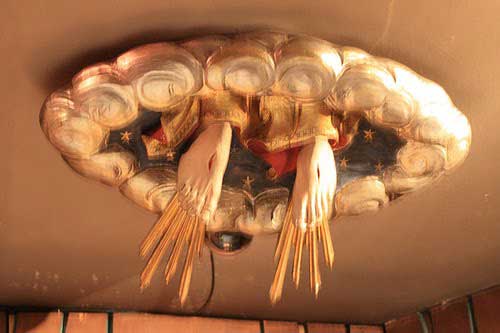
Picture: Chapel of the Ascension, Shrine of Our Lady of Walsingham, Norfolk, England
There is a rather ugly 1960s chapel at the Shrine of Our Lady of Walsingham – deep in the rural countryside of the county of Norfolk dedicated to the Ascension of our Lord. On entering the Chapel of the Ascension, one is greeted with a surreal experience. For in the center of the low ceiling is a gilded cloud ring plaster rosette from the center of which hang two bare feet – suspended in the air. Ostensibly belonging to Jesus with the rest of his body having already burst through the ceiling.
The celebration of the Ascension always occurs on a Thursday – the 40th day after the resurrection. Because Episcopalians rarely venture to church except on Sundays – the current custom is to celebrate the Ascension of the Lord on the Sunday following – which in 2024 also incongruously happens to be Mother’s Day.
Incidentally, I heard a funny quip recently referring to the Southern Baptist church calendar which comprises only four commemorations: Christmas, Easter, the 4th of July, and Mother’s Day. It goes without saying that while we shouldn’t pass up any opportunity to celebrate the importance of mothers and mothering in our lives, in the Episcopal Church, Mother’s Day is not part of the liturgical calendar.
Constructing stories and weaving narratives are the way we make sense of our experience of the world. The perennial question concerns the relationship between story and material experience – in other words, does weaving narratives – telling stories interpret and explain our material experience, or does the power of narrative – in the words of the French deconstructionist philosopher Michel Foucault – construct our experience – as in language creating the objects and meaning of which it speaks.
This tension surrounding the function and power of language is especially pertinent when it comes to religious-spiritual stories. Narrative Theology asserts that spiritual meaning lies not in the literal veracity of the events depicted – did they happen or not – but in the function of story by itself to construct and convey purposeful meaning across time. The question is not whether or not Bible stories depict actual happenings – but how they construct meaning and purpose that can be trusted to shape our living?
Spiritual stories recycle human imaginative memory. Clearly, Luke’s graphic account of Jesus’ Ascension borrows extensively from Elijah’s ascension recorded in the 2nd book of Kings. In like manner – as the mantle of Elijah fell upon the shoulders of Elisha – giving him a double portion of his master’s spirit, the double portion of Jesus’ Spirit clothes the disciples. The resonance is unmistakable.
In Luke’s chronology of events from Calvary to Pentecost, his story of the Ascension of Jesus forms a transition point bringing the earthly ministry of Jesus to a close to empower his followers with his spirit to become a community equipped to continue his work. The question underlying the Ascension event is not how, when, or if it happened, but what light does it shed on the question of what’s next?
The question of what’s next throws into sharp focus the choices to be made, the actions to be taken, and the directions to be followed.
In her sermon last week, Linda+ noted that love is not just about how we are to feel. It is about who we are called to be. Rather than asking: What does it mean to believe in God’s love – she posed the more significant question do we trust God’s love, do we surrender to it, will we let love transform us?
So here’s a question. How can we trust the meaning inherent in the story of the Ascension of Jesus even though most of us believe it as an event to be simply a construction of imagination?
One response is to substitute the traditional spatial metaphor of up and down for heaven and earth with a metaphor more suited to contemporary imagination – that of heaven and earth as side by side. The Ascension becomes the conduit connecting parallel dimensions. Through this conduit a two-way traffic flows between what we might call our space and God space.
The image of the Ascension of Jesus as a conduit for two-way traffic communicates two important insights. In his return to the God space, Jesus does not jettison his humanity like a suit of worn-out clothes – but carries the fullness of his humanity – perfected through suffering -to be received by God into the divine community. The words of the first collect for the Ascension capture this: that as we believe your only begotten Son our Lord Jesus Christ to have ascended into heaven, so we may also in heart and mind there ascend, and with him continually dwell. The we here is not us individually, but the entirety of our humanity which now constitutes an element within the divine nature.
In receiving the fullness of Jesus humanity into the divine nature, God releases the divine spirit of Jesus to make the return journey back into our space. This image is captured in the words of the second collect for the Ascension: our Savior Jesus Christ ascended far above all heavens that he might fill all things and to abide in his church until the end of time. The Ascension is the point where we, Christ’s mystical body on earth are prepared to become empowered to continue the work Jesus began.
The Ascended Christ bearing our perfected humanity is received into the heart of God – so that – as the book of Revelation poetically phrases it – the home of God now dwells among mortals. Now we come to the most extraordinary assertion of Christian faith – that from henceforth to be most fully human is to be most like God.
The Ascension of Jesus opens us to contemplate our participation in the what’s next in God’s work of renewing the creation -throwing into sharp focus the choices to be made, the actions to be taken, and the directions to be followed – when we tire of gazing heavenwards – that is.
 Relationalrealities