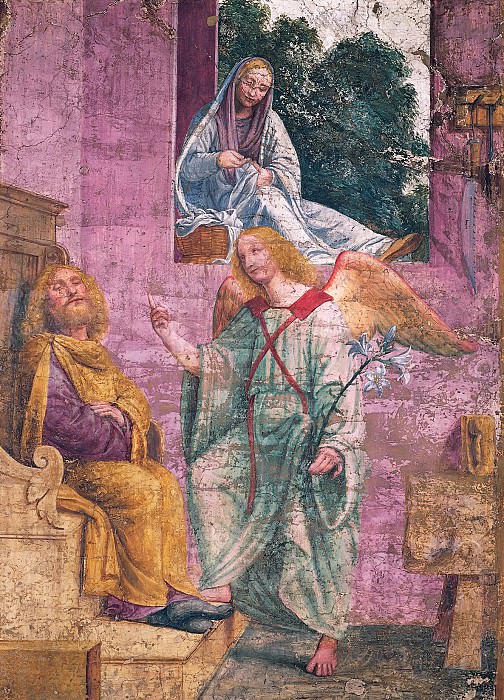
Dreaming Joseph

Image: The dream of St Joseph. Bernardino (Bernardino de Scapis) Luini (c.1480-1532)

This year, we return to Matthew as the gospel of choice in the three-year Lectionary cycle. Thus, Advent IV’s gospel opens with Matthew’s account of the events leading to the birth of Jesus. Matthew structures his birth narrative around themes specific to him. I want to offer a very personal take on Matthew’s understanding of the significance of Jesus’ birth.

For most of us, our sense of the nativity narrative emerges from an often unconscious compilation of Luke and Matthew, giving us the typical manger scene depicted in countless churches and nativity plays. In doing so, we miss the significance of each Evangelist’s distinctive portrayal of the events surrounding Jesus’ birth.

Luke’s focus is on Mary. His birth narrative is Mary’s story, depicting a birth in farmyard conditions surrounded by sheep and cattle and witnessed by ordinary shepherds – representative of those on the margins of society – and of course, let’s not forget the angels.

Matthew’s version of events gives us Joseph’s story – the story of Jesus’ birth told from Joseph’s perspective. Matthew does not mention the setting. Here, there are no shepherds, no cattle or sheep. This is a birth witnessed not by ordinary people but by foreign emissaries – the Magi – representatives of the wider world’s homage to the infant king of the Jews. Matthew also has an angel, but Matthew’s angel appears not to Mary, as in Luke’s account, but to a dreaming Joseph.

The first point to notice in the Matthew chronicle is the importance of establishing Jesus’ identity within the long genealogy that extends back through Jewish mythological time to Abraham. Matthew spends 17 verses of his 25-verse first chapter to do this. So we notice from the outset how intensely a Jewish story this is.

The second point to note is that Matthew’s story is highly political, situating the birth of Jesus within the turbulent political context of 1st-century Palestine. Here we have all the ingredients for a tense political drama – a brutal ruler in Herod the Great, the puppet of Roman occupation, whose murderous intent drives the Holy Family into exile as political asylum seekers. The Holy Family escapes, but every other-year-old male child born in the region of Bethlehem is slaughtered as Herod, alerted by the indiscretion of the Magi, endeavors to neutralize Isaiah’s prophecy of the birth of a rival king.

Matthew’s is a rich narrative, one that sets the birth of Jesus within a political context entirely familiar to us today in a world where literally millions of fathers and mothers with young children are daily forced to undertake the perils and dangers as refugees escaping in fear for their lives. And, Matthew’s birth narrative provides a contemporary flavor of the political and humanitarian themes embedded in his account. Matthew sets Jesus’ birth within the context of political oppression and of a ruler’s desire to seek out and punish anyone who poses a threat.

Matthew’s birth narrative also hints at the societal complexities of Joseph and Mary’s predicament. Matthew will go on to describe the holy family’s displacement and flight from political violence, but he must first skillfully navigate 1st-century Jewish societal reactions to surprise pregnancies out of wedlock.

Matthew’s approach to the Jesus story is told from within the Jewish patriarchal worldview of the men in charge. I have an intense personal unease with this feature of his approach. As a gay man, I learned early to fear the power of the patriarchy and to be deeply suspicious of the presentation of scripture through the exclusive lens of the men-in-change, in whose worldview there was no place for someone like me.

Richard Swanson is – at least to my way of thinking – a delightfully provocative biblical commentator who never misses an opportunity to take the patriarchal voice – that is, the traditional interpretation of scripture from the restrictive perspective of the men-in-charge – down a peg or two. Swanson coined the delicious phrase Holy Baritones to describe scripture’s patriarchal voice. My not infrequent uneasiness with Matthew’s voice is that, at times, he seems to me to epitomize the role of section leader in the Holy Baritone chorus.

It’s only in verse 18 that Matthew turns to the birth of Jesus. Having, as I’ve already noted, spent the first 17 verses of his 25-verse first chapter establishing Jesus’ identity at the heart of Jewish patriarchal transmission. Matthew writes:

When his mother Mary had been engaged to Joseph, but before they lived together, she was found to be with child.

In a society with a strict prohibition against sex before marriage, which by the way is a central convention in all patriarchal societies, including our own until relatively recently, Matthew chooses to introduce the birth of Jesus by telling us that Mary was found to be with child.

Was found to be is a grammatical structure known as the divine passive. It’s a way of telling us that so and so happened while obscuring causality. For the Hebrew writers, it was a way of indicating that something had occurred by the hand of God without invoking the name that could not be spoken. Matthew makes clear that Mary’s pregnancy is the result of God’s hidden hand. Still, unlike Luke’s portrayal of a direct encounter between Mary and the Archangel Gabriel, in which God addresses Mary directly and respects her primary decision-making agency, the thrust of Matthew’s narrative suggests that, once Mary’s pregnancy is discovered, she no longer has any agency, with all decision-making reserved to Joseph.

Matthew presents Joseph in a predicament. His reputation, through no fault of his own, is endangered by this turn of events. A kindly middle-aged widower with a teenage betrothed, he is resolved to end the engagement quietly. What a mensch! But here’s my problem with Matthew’s Joseph-focused version of events. In a religious society with draconian laws against sex before marriage, Joseph’s risk is one of public disgrace. Still, Mary risks honor killing by being stoned to death – in the first instance by her father – and if he could not bring himself to do the deed, then by another male relative – an uncle, or brother, or male cousin conveniently waiting in the wings. The reality of honor killing is a nasty detail that the Holy Baritone voice skips over in silence.

So how is Joseph to be extricated from his predicament of being betrothed to a girl who has now been found with child. Matthew rescues Joseph through the tried and trusted literary device of an angel appearing to him in a dream, telling him not to be afraid. Afraid of what we might ask? – if not a reputational disgrace. The angel instructs Joseph to proceed with the marriage because it is God who has caused Mary’s pregnancy. On waking, Joseph dares to do as the angel had commanded him. After all, what’s social opprobrium when compared with divine displeasure?

We might expect Matthew to end his chapter here. Joseph the mensch rescues his betrothed by marrying her. But as a cheerleader for the Holy Baritone voice, Matthew is not done yet. He rather tellingly – to my mind at least – mentions that while Joseph married Mary, he declined to consummate the marriage until after the child was born.

Why does Matthew feel the need to tell us this? Well, one of the pervading themes of the Holy Baritone voice is a preoccupation with genital penetration and sexual purity. As today’s conservative obsession with the restriction of women’s reproductive, queer, and transgender rights continues to demonstrate, this preoccupation continues a story older than time.

Let’s listen again to Matthew’s voice:

When Joseph awoke from sleep, he did as the angel of the Lord commanded him; he took her as his wife but had no marital relations with her until she had borne a son, and named him Jesus.

Although Joseph did as he was commanded, we will never know how he actually felt; however, we have a hint of how Matthew thought he might.

Finding Enchantment In A Disenchanted Age

Reredos Center Panel Cropped color corrected 064I

I want to say to you all, visitors, annually returning old friends, spiritual seekers, and regular members the Episcopal Church welcomes you! Whoever you are, what- ever you think you believe or don’t believe, know that you are in good company here. So I say, welcome all to Downton Abbey, a world of bewildering, yet magnetic rituals and tradition.

In my mind, there is a strong link between the Episcopal Church and Downton Abbey, beyond our mere sharing of things English. Like Downton Abbey, Episcopalians sit in the tension between the rituals of a Tradition that often appears to have been crafted for another age, and the demands of life as we try to live it, in 21st century America. We are not alone in this, but we are unusual in our failure to resolve this tension by either saying:

tradition trumps modern life – as appears in current expressions of conservative Christianity whether Catholic and Evangelical, or modern life trumps tradition – as appears in much of the response from Liberal Protestantism. 

Like the inhabitants of Downton Abbey, in the Episcopal Church we struggle to inhabit our rituals and interpret the Christian Tradition passed to us so that it might speak anew its wisdom in a world where the rapidity of change is truly unprecedented in history.

America as a nation itself sits in this tension between the tradition known as the American Dream and the challenges of a rapidly changing world. The Episcopal Church, America’s best kept secret, welcomes you to life in the tension or the fast lane. Here the gritty struggle between faith and doubt, hope and fear, nostalgia for the past and terror of the future, is continually shaping us in our calling to be living channels for the pouring of God’s love into the world.

II

Luke is the great historian of the New Testament. His Gospel places the birth of Jesus in historical time and place that comes to us across 2000 years of transmission and interpretation. Luke’s narrative of the birth of Jesus depicts an enchanted world where God communicates through angels to shepherds to those who are on the margins of social acceptability. This is an enchanted world where the Creator of the Universe is born as the most fragile of life forms, the human infant; in a stable, in the most marginal of circumstances; and not only survives, but gives rise to a birthing of the Kingdom of God that changes simply everything.

Luke doesn’t invent his narrative from pure imagination. Like all good storytellers he welds together the experience of his readers, who need to make sense of challenges of life in the 1st Century, with elements in a trans-generational vision that offers him the central image of a birth of a child that ushers in a new order in the cycle of creation.

To us, Luke’s story of the birth of Jesus contains fairy-tale aspects from a time of enchantment. Yet, what seem to us a mere fairy-tale elements, have for much of Christian history so closely resonated with the precarious vulnerability of the lives people actually lived. Like the actors in Luke’s drama of the birth of Jesus most of our ancestors lived in similar rural poverty, where life was precarious and often hard. It also resonated with the enchanted mindset [1] in which God was experienced to be magically and mysteriously present in every aspect of the material world that surrounded human life. In this world of enchantment, God was never absent, and people never felt alone.

So how does this story resonate with us whose lives are lived amidst the urban and technological complexities of 21st century America? How does this story communicate to a people whose disenchanted mindset[2] no longer has room for the magical and mysterious presence of God at the level of material reality? In our disenchanted world, God seems largely absent. 300 years of scientific progress has left us feeling alone, center stage in a lonely and potentially hostile universe.

It’s impossible for us to return to that enchanted mindset, no matter how much we might wish to do so. Ours is not a world filled with the magical presence of God – 300 years of scientific rationalism has unalterably changed the way we think. Yet, human beings are still capable of imagination, we still dream.

III

The birth of Jesus is significant, not in the seeming fairy-tale details of Luke’s narrative, but because it still resonates with the deeper, imaginative dreaming parts of our lives.  In his op-ed The Subtle Sensations of Faith, this past week the New York Times columnist David Brooks quotes one of the great religious mystics in contemporary America, Christian Wiman who in his spiritual autobiography My Bright Abyss asks:

When I hear people say they have no religious impulse whatsoever ... I always want to respond: Really? You have never felt overwhelmed by, and in some way inadequate to, an experience in your life, have never felt something in yourself staking a claim beyond yourself, some wordless mystery straining through word to reach you? Never? 

For many of us the intimations of a spiritual dimension to life, somehow lying alongside the flat reductive rationality of our day to day existence, are so fragmented that we have no way of joining them up into a sense-making experience. Like the half-remembered fragments of our nightly dreams and visions, they remain half intuited and consigned to a shadow-land, which we no longer recognize as real in any meaningful way.

Brooks noting this quotes his friend Wiman again:

Religion is not made of these moments; religion is the means of making these moments part of your life rather than merely radical intrusions so foreign and perhaps even fearsome that you can’t even acknowledge their existence afterward. Religion is what you do with these moments of over-mastery in your life.

Religion offers us a mechanism to organize and make sensible our intuitions of radical intrusion from the spiritual dimension. The difference between Luke’s enchanted mindset – a mindset that permeates the whole of our Scriptural Tradition and our disenchanted post scientific rationalism lies in the different perception with regard to the location of spiritual experience. For Luke and the enchanted mindset, spiritual experience is essentially external, permeating and communicating through the very structures – the objects, contexts, and relationships of the material world. For us, spiritual experience is now essentially internal, permeating and communicating not through the material world of objects and contexts around us, but through the psychospiritual worlds within us.

As 21st century people we have no less of a need for religion’s rituals and Tradition than our Christian forebears had. It’s that we have a need for a renewed religious experience that breaks free of a need to push God and our spiritual experience back into the enchanted mindset. For most of us who cannot inhabit this mindset anymore the result is the atomization or fragmentation of our spiritual experience under the relentless alienation of disenchanted reductionism.

What we require is a renewed imaginative religious mindset capable of integrating the alienated aspects of our dreaming and longing selves. We need a religion that does not take us back to enchantment, but one that can carry us forward beyond our current addiction to disenchantment, an addiction to only what can be seen, measured, and scientifically verified.

The event we know of as the Incarnation – literally God, the Creator becoming one with the Creation is a uniquely Christian perspective that we are in dire need of renewing for our 21st century lives. As I noted earlier we find ourselves sandwiched between the echoes of certainties we no longer feel we can trust and the experience of ourselves catapulting at an alarming speed into an uncertain future. Yet, the message of the Incarnation is that Dreams are nevertheless made real within the context of limitation and uncertainty.

God calls us to incarnate our dreams. Like God’s dream incarnated in the birth of Jesus, incarnating our dreams happens within the limitations of our imperfect human lives. Propitious circumstances are not required for the incarnation of dreams.

David Brooks puts it this way:

Insecure believers sometimes cling to a rigid and simplistic faith. But confident believers are willing to face their dry spells, doubts, and evolution. Faith as practiced by such people is change. It is restless, growing. It’s not right and wrong that changes, but their spiritual state and their daily practice. As the longings grow richer, life does, too

Dreams are incarnated in us when we connect with our passions and dedicate ourselves to living passionately, with a compassion born from the realization that we are interconnected and interdependent, together within the ebb and flow of a universe that is responsive to our dreams.

Our dreams are the most accurate reflection of the way the divine universe really functions. Life is not a plan – conceived, implemented with certainty of direction and prediction of outcome. Life is more like a dream, always evolving and in the process of becoming. Life, like our dreaming is fluid, ebbing and flowing and responsive to events and experience.

This is how I imagine it works. When we incorporate our dreaming into everyday life we become, individually and communally, more magnetic. By becoming more and more magnetic, we draw the energies of life into us. We incorporate our dreaming into everyday life when we make dreaming our core resource. That when our dreaming, hoping and loving; together with the eschewed resources of our suffering, and fearfulness, become available for living, the resources of life flow to meet us. At points of suffering and disillusionment the tide ebbs only to gather and return with a flowing fullness towards us. David Books again: to be truly alive is to feel one’s ultimate existence within one’s daily existence.

The message of the Incarnation is that God operates within the limitations of human nature and human society. The message of the Incarnation is a simple one that fulfills the cycle of creation  initiated in the stories of the creation in Genesis. It is this: that to be human is to be most like God. To be Christian is simply: to know that to be human is to be most like God.

[1] Charles Taylor in his tome A Secular Age poses the concepts of enchantment and disenchantment to distinguish between the contrasting mindsets before and after the social evolution he calls the development of the secular age.

[2] Taylor describes the experience for Western Society during and following the Enlightenment Rational and Scientific Revolutions as a growing experience of disenchantment.

Blog at WordPress.com.

Up ↑