Becoming open to the new – now there’s a counter-cultural proposition if ever there was one. Landscapes change, challenging us to take our values, principles, and beliefs with us as we find our bearings in a new and unfamiliar landscape.
The story of the call of Moses, as we receive it in Exodus 3, is the work of the Deuteronomist scribes of the Babylonian captivity following Jerusalem’s fall and the Temple’s sacking in 586 BC. The seven decades of the Babylonian captivity confronted the Jewish exiles with the challenge of rebuilding a sense of national and religious identity in a dramatically changed landscape. Soul searching for the meaning of events that had befallen them required them to confront the painful question- had God abandoned them in their captivity? In search of an answer, the scribes returned to their stories of national and religious origin. The fruit of this exploration emerged as the book of Exodus. Returning to the stories of national origin, the Jews of the captivity found meaning in present-time events and imagined a new future in restoring national identity.
As we find in Exodus 3, the story of the call of Moses is a reassembling from the fragments of oral folk memory. Many Bible stories – particularly origin stories follow this method. Remembering has less to do with reviving an old tale than with forging a new one.
As we receive the story of the call of Moses, we note the relationship between the time in which the story is set, around 1500 BC, and the circumstances at the later period of composition between 586 and 539 BC. As I’ve just noted, projecting present-time themes back into the past is a tried-and-true method biblical writers used when it was not always safe to be transparent. It’s not only biblical writers who employ this method. Shakespeare’s history plays covering the period from 1399 – 1485 purport to chronicle the rulers and events between these years. Yet, what we see portrayed in his history plays is a picture of Elizabethan and Jacobean society’s politics, entertainment, and social situations, safely projected into the medieval period. In this way, Shakespeare commented on current events without risking losing his head – literally. The purpose of remembering has less to do with reviving an old story than with forging a new one.
The call of Moses is a multilayered story about the struggle to hold onto cultural identity during a period of national catastrophe. There is an overarching narrative linking later issues of exile with an earlier period of captivity. However, within the narrative, events become powerfully instructional. Within the story, we discover the importance of curiosity, the importance of paying attention to peripheral vision, the oscillation between forgetting and remembering, the location of divine encounter as in the place where God meets us, and the struggle to find the courage to respond to God’s call.
Curiosity and the importance of peripheral vision. The story opens with Moses shepherding his father-in-law’s sheep for fresh pasture. Walking along a familiar track, he should have focused on what lay directly ahead of him. However, he becomes distracted when his curiosity is aroused by something he sees flickering in his peripheral vision – glimpsed, as we might say, out of the corner of his eye.
Isn’t this often the way of things. It’s not what appears to be most evident that we need to pay attention to but what we glimpse – caught out of the corner of our eye. Don’t we love those detective stories in which a witness being questioned about the details of the crime remembers something crucial in solving the case? At first, they claim not to have seen anything important. Yet, through painstaking detective prompting – bit by bit, their memory is unlocked, revealing something recorded by their peripheral vision.
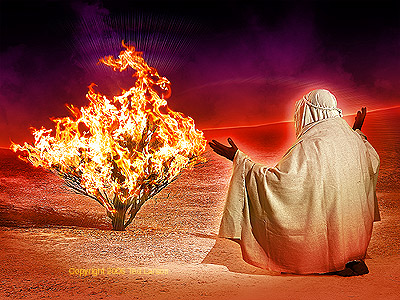
Moses detours from his beaten path to better view this fantastic sight of a bush burning without being consumed. As he approaches the burning bush, he hears a voice calling from the heart of the flames: Moses, remove your shoes, for you are about to enter holy ground. He does so and encounters that which will change the trajectory of his life – propelling him onto a new path toward his still-to-emerge life’s purpose.
Forgetting and remembering. Reading between the lines, we are surprised that Moses does not know the god who addressed him. In declaring that he is the God of his fathers, God jogs the collective memory fragments of Moses’ Hebrew identity. Remember, Moses was raised as an Egyptian. The reason he wanders around leading someone else’s sheep is because of the conflict between his Egyptian and Hebrew identities that eventually forces him into exile. Forgetting and remembering – the relationship of the past to the future – become the pivotal themes in the conversation between Moses and God.
God does not waste time after the introductions are over in declaring the purpose he has in mind for Moses. God is asking Moses to return to Egypt to remind the people that the god whom they have forgotten – has not forgotten them. For the hearers of the story in Babylon, this was a reminder that even as they were in danger of forgetting God, God would not forget them.
The place of encounter. Moses is leading his father-in-law’s flock through a landscape described as a place beyond the wilderness. The incurious among us might miss the significance of this description by simply picturing Moses walking through an arid desert landscape – in other words, a wilderness. But he’s not walking through a wilderness- he’s walking into a landscape beyond the wilderness – a description that implies entering a changed landscape – one beyond previous experience – devoid of recognizable signposts.
Moses is tasked with reintroducing God to the Hebrews and, in so doing, conveying a message of hope to them. As with all significant life-changing challenges – Moses is frightened and seeks to avoid the responsibility by playing down his fitness for the task. Even if I take your message to them, why should they believe me? I imagine many of us are similarly daunted by the task of reintroducing the God of the biblical record, the God revealed in the life, death, and resurrection of Jesus, to a culture held firmly in the grasp of a modern-day Pharaoh.
God’s new name. Up to this point in the story, God has identified as the God of memory – the God of your fathers. In answer to Moses’ understandable hesitancy, God instructs him to give the Hebrews his new name, symbolized by the Hebrew acronym YHWH – translated as I am who I am. God instructs Moses to tell the Hebrews that I am has sent me to you.
The Hebrew letters YHWH shimmer with ambiguity. The ambiguity of meaning is an outstanding characteristic of Hebrew, wholly lost in English translation. The Hebrew I am who I am, suggests a shimmering oscillation between I am who I have been, and I am who I will be. A God identified with memory becomes a God of future possibility.
The God of their fathers resurfaces into Hebrew consciousness – not as a God of distant memory but henceforth as Yahweh, a God of future hope and promise – a God whom they may have forgotten -but who has not forgotten them and who is inviting them into a changed landscape – into a place beyond the wilderness – a place of new beginning replacing the mourning for the past.
Today, rather like the Hebrews in Egypt and the Jews in Babylon, we find ourselves in a culture in which God, as revealed in the biblical record, has likewise become forgotten. Most Americans no longer share a common religious knowledge, allowing us to access a shared memory of God. The younger the generation, the worse it becomes. Outright rejection accompanies a general ignorance regarding the biblical stories through which God introduced God-self to former generations.
You might object that there is a vocal minority that loudly proclaims divinely mediated knowledge of God. However, this god is not recognizable as the God of Moses. The god of popular American Christian Nationalism is a god who no longer hears the cries of the poor and the oppressed, the voice of the stranger and the dispossessed, the plight of the victims of a cruel hatred for the LGBTQ+ community. This god is vociferously celebrated for his deafness, along with his whiteness and his maleness.
Today, we painfully awaken to the experience of finding ourselves in a changed landscape. Will we reach a place beyond the wilderness where new connections forge new possibilities to be grasped?
Receiving this story in 2025, we can’t avoid the question: are we willing to take our values, principles, and beliefs into a changed landscape – into an encounter with a God of future possibility? Or will we continue to mourn the loss of previous certainties – pretending that we don’t notice things have changed? In a changed landscape – a place beyond the wilderness God reintroduces God-self to us. No longer a God of fading or even of forgotten memory – but a God of vibrant present-time hope and future possibility – calling us to slough off the dead shell of yesterday and begin to live the life to which we are called. But this requires fortitude to resist being coopted into pharaoh’s camp. It will require finding the courage to confront a culture that seeks to make one man God so that all men become slaves. My goodness, if we do, then who might we become?
 Relationalrealities