Choosing the Right Storyline

All we have are the stories we construct to explain the world both to ourselves and to one another. The creation of narrative is the essential building block for discovering meaning and developing purpose. Any cursory Google or web search will reveal the considerable neuroscientific evidence in support of this assertion. For example – neuroscience researchers have repeatedly found that reader attitudes shift to become more congruent with the ideas expressed in a narrative after exposure to fiction (Green & Brock, 2000; Prentice, Gerrig, & Bailis, 1997; Strange & Leung, 1999; Wheeler, Green, & Brock, 1999).

The current profusion of online disinformation and conspiracy theories proves that there is always more than one way to tell a story, and the way you tell it influences beliefs and behaviors. Our awareness of competing stories increases the accuracy of our experience—to use a current slogan—there are facts, and then there are alternative facts. It’s vital to be able to distinguish between restrictive and toxic stories that restrict our capacity for creative responses and expansive stories that encourage creativity in our encounters with the world around us. We develop accuracy of perception, clarity of meaning, and purpose as we select between competing narrative storylines because it’s vital to know which storyline we are participating in.

The power of a storyline rests on its capacity to attract our attention and command our allegiance. We may construct a storyline to make sense of the world as we experience it, but once we do so, that storyline has the power to own us. The question of the current moment is, among competing storylines available to us, which storyline will we choose to believe? From among a bewildering choice of possibilities, which stories will command our allegiance?

With the spread of online information, the question of which stories we allow to shape our perceptions of reality is the question of the moment. We might be surprised to learn that this is not only a modern problem.

Palm Sunday offers a snapshot of competing storylines from Jesus’ last week in Jerusalem before the Passover and his crucifixion. On Palm Sunday, we witness a clash of competing storylines that are particular to Jesus’ 1st-century setting yet are also universal – timeless.

There is the storyline of sacred violence as the storyline of empire – that is – the unrestrained exercise of power to dominate and subjugate. From Rome to Rule Britannia, from the European legacy of colonial violence to the revival of Putin’s dream of the Russian imperium – not to forget to mention here the legacy and current ugly resurgence of American manifest destiny – the storyline of empire repeats endlessly across time.

Then there is the storyline of populist nationalism with its blood-socked dreams of liberation. On Palm Sunday the waving of palms was a significant echo from Jewish-nationalist collective memory. For some 160 years before, the triumphant Judas Maccabeus, the last leader of a successful Jewish revolt against foreign domination, led his victorious partisans into the Temple – which the Hellenist tyrant Antiochus Epiphanes had defiled by placing his statue in the Holy of Holies. Using palm branches, the Maccabean partisans cleansed and rededicated the sanctuary after its defilement. On entering the sanctuary, they discovered miraculously the last light of the Menorah still burning – an event Jews, today, celebrate in the festival of Hanukkah.

On Palm Sunday, this more recent Jewish storyline of national liberation found a powerful amplification in Israel’s more ancient founding story of liberation—commemorated in the festival of the Passover.

Inhabiting the amplified storyline of national liberation, the crowds ecstatically welcome Jesus into the city. They have yet to discover that they have chosen the wrong storyline. But they will do so – and rather quickly, with the result that they will pivot from exuberance to disillusionment and anger over the course of days. Jesus may be the Messiah, but his messiahship is part of a third storyline—that of the dream of God’s salvation, not of Jewish national liberation.

Casting our mind’s eye over the competing storylines converging on Palm Sunday, we observe that at the same time as Jesus was entering the city from the east, a second triumphal entry procession wound its way into the city from the west. The Roman Prefect, Pontius Pilate, at the head of a militia made up mostly of Samaritan mercenaries, had also come up to Jerusalem for the Passover.

As Prefect, Pilate was a vicious yet relatively low-level regional administrator who reported directly to Vitellius, governor of the Province of Syria. Each year at the Passover, Pilate came up to Jerusalem – forsaking the sea breezes of Caesarea Maritima— Herod the Great’s former capital and now the administrative center of the Roman occupation of Judea.

Pilate loathed and feared Jerusalem’s ancient rabbit warrens seething with civil and religious discontent. He most feared the pilgrim throngs crowding into the city for the Passover, swelling the city’s normal population of between 20-30,000 to over 150,000. The stability of Roman imperial rule required Pilate to come up to the city with a show of preemptive force to forestall any potential for insurrection.

Passover was Israel’s founding story of liberation from slavery. Pilate’s arrival was indeed a wise move, for the crowds hailing Jesus’ arrival were in insurrection mood. Being caught, as they would soon discover, in the wrong Messiah storyline—would have dire consequences for Jesus.

In the week leading to the celebration of Passover, we see with hindsight the lethal intersection of these three competing storylines – of imperial domination and political violence intersecting with populist resistance and longing for national liberation – both confronted by the next installment in the epic storyline of God’s love and vision for the world-through-Israel. This clash of storylines results in a chain of events that takes an unexpected turn – rapidly spiraling out of everyone’s control.

Emotionally and spiritually bloodied by our passage through the snapshots of Holy Week violence, we will eventually arrive at a different story – a new story – a bigger and better story – the unlikely story of Easter. Yet, on Palm Sunday, we’ve some way to travel before arriving there.

Holy Week is when we accompany Jesus on his journey to the cross. For some of us, this can be an intensely personal experience as our own experiences of loss and suffering – our passion – surface in identification with Jesus. For most of us, however, the nature of our Holy Week experience is less personal and more communal.

As liturgical Christians, we journey with Jesus as a community – each liturgical step along the way. Each snapshot is a prism refracting our own individual suffering and our identification with the overwhelming suffering of the wider world – an experience amplified by events in 2025.

Liturgy transports us together through sacred time. In sacred time, there is no past and no future, only the eternal now. Here, our individuality dissolves as we become participants in the events that engulf Jesus, erasing separation across time and then becoming now. As I’ve mentioned, we are no strangers to the storylines of sacred violence and national populist yearning for a messiah.

Choosing the right story to explain the world to ourselves is crucial. Choosing the wrong story leads only to disillusionment and rage.

Like the crowds praising Jesus as he entered the Holy City, we enthusiastically hail our next political savior until that is, – he or she no longer is.

We long to do the courageous thing – until that is, the moment when we don’t.

In sacred time, we become participants with Jesus—as if we were part of his band of disciples during this eventful last week. With them, we will share in the breaking of Jesus’ Passover bread and drink from his Passover cup. With them, we will accompany Jesus to the Garden of Gethsemane, where we, too, will fight sleep to keep watch with him through the night and early hours of Friday morning. With them, we will follow Jesus on the way of his suffering to the cross. For like them – we will long do the courageous thing – until the moment when we we won’t.

History does not exactly repeat itself, but it certainly rhymes.

2025

Becoming open to the new – now there’s a counter-cultural proposition if ever there was one. Landscapes change, challenging us to take our values, principles, and beliefs with us as we find our bearings in a new and unfamiliar landscape.

The story of the call of Moses, as we receive it in Exodus 3, is the work of the Deuteronomist scribes of the Babylonian captivity following Jerusalem’s fall and the Temple’s sacking in 586 BC. The seven decades of the Babylonian captivity confronted the Jewish exiles with the challenge of rebuilding a sense of national and religious identity in a dramatically changed landscape. Soul searching for the meaning of events that had befallen them required them to confront the painful question- had God abandoned them in their captivity? In search of an answer, the scribes returned to their stories of national and religious origin. The fruit of this exploration emerged as the book of Exodus. Returning to the stories of national origin, the Jews of the captivity found meaning in present-time events and imagined a new future in restoring national identity.

As we find in Exodus 3, the story of the call of Moses is a reassembling from the fragments of oral folk memory. Many Bible stories – particularly origin stories follow this method. Remembering has less to do with reviving an old tale than with forging a new one.

As we receive the story of the call of Moses, we note the relationship between the time in which the story is set, around 1500 BC, and the circumstances at the later period of composition between 586 and 539 BC. As I’ve just noted, projecting present-time themes back into the past is a tried-and-true method biblical writers used when it was not always safe to be transparent. It’s not only biblical writers who employ this method. Shakespeare’s history plays covering the period from 1399 – 1485 purport to chronicle the rulers and events between these years. Yet, what we see portrayed in his history plays is a picture of Elizabethan and Jacobean society’s politics, entertainment, and social situations, safely projected into the medieval period. In this way, Shakespeare commented on current events without risking losing his head – literally. The purpose of remembering has less to do with reviving an old story than with forging a new one.

The call of Moses is a multilayered story about the struggle to hold onto cultural identity during a period of national catastrophe. There is an overarching narrative linking later issues of exile with an earlier period of captivity. However, within the narrative, events become powerfully instructional. Within the story, we discover the importance of curiosity, the importance of paying attention to peripheral vision, the oscillation between forgetting and remembering, the location of divine encounter as in the place where God meets us, and the struggle to find the courage to respond to God’s call.

Curiosity and the importance of peripheral vision. The story opens with Moses shepherding his father-in-law’s sheep for fresh pasture. Walking along a familiar track, he should have focused on what lay directly ahead of him. However, he becomes distracted when his curiosity is aroused by something he sees flickering in his peripheral vision – glimpsed, as we might say, out of the corner of his eye.

Isn’t this often the way of things. It’s not what appears to be most evident that we need to pay attention to but what we glimpse – caught out of the corner of our eye. Don’t we love those detective stories in which a witness being questioned about the details of the crime remembers something crucial in solving the case? At first, they claim not to have seen anything important. Yet, through painstaking detective prompting – bit by bit, their memory is unlocked, revealing something recorded by their peripheral vision.

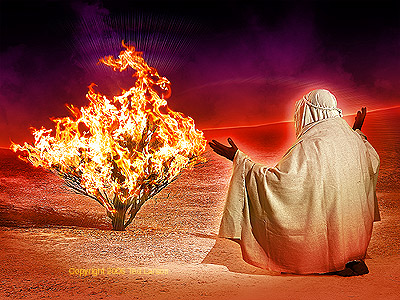
Moses detours from his beaten path to better view this fantastic sight of a bush burning without being consumed. As he approaches the burning bush, he hears a voice calling from the heart of the flames: Moses, remove your shoes, for you are about to enter holy ground. He does so and encounters that which will change the trajectory of his life – propelling him onto a new path toward his still-to-emerge life’s purpose.

Forgetting and remembering. Reading between the lines, we are surprised that Moses does not know the god who addressed him. In declaring that he is the God of his fathers, God jogs the collective memory fragments of Moses’ Hebrew identity. Remember, Moses was raised as an Egyptian. The reason he wanders around leading someone else’s sheep is because of the conflict between his Egyptian and Hebrew identities that eventually forces him into exile. Forgetting and remembering – the relationship of the past to the future – become the pivotal themes in the conversation between Moses and God.

God does not waste time after the introductions are over in declaring the purpose he has in mind for Moses. God is asking Moses to return to Egypt to remind the people that the god whom they have forgotten – has not forgotten them. For the hearers of the story in Babylon, this was a reminder that even as they were in danger of forgetting God, God would not forget them.

The place of encounter. Moses is leading his father-in-law’s flock through a landscape described as a place beyond the wilderness. The incurious among us might miss the significance of this description by simply picturing Moses walking through an arid desert landscape – in other words, a wilderness. But he’s not walking through a wilderness- he’s walking into a landscape beyond the wilderness – a description that implies entering a changed landscape – one beyond previous experience – devoid of recognizable signposts.

Moses is tasked with reintroducing God to the Hebrews and, in so doing, conveying a message of hope to them. As with all significant life-changing challenges – Moses is frightened and seeks to avoid the responsibility by playing down his fitness for the task. Even if I take your message to them, why should they believe me? I imagine many of us are similarly daunted by the task of reintroducing the God of the biblical record, the God revealed in the life, death, and resurrection of Jesus, to a culture held firmly in the grasp of a modern-day Pharaoh.

God’s new name. Up to this point in the story, God has identified as the God of memory – the God of your fathers. In answer to Moses’ understandable hesitancy, God instructs him to give the Hebrews his new name, symbolized by the Hebrew acronym YHWH – translated as I am who I am. God instructs Moses to tell the Hebrews that I am has sent me to you.

The Hebrew letters YHWH shimmer with ambiguity. The ambiguity of meaning is an outstanding characteristic of Hebrew, wholly lost in English translation. The Hebrew I am who I am, suggests a shimmering oscillation between I am who I have been, and I am who I will be.  A God identified with memory becomes a God of future possibility.  

The God of their fathers resurfaces into Hebrew consciousness – not as a God of distant memory but henceforth as Yahweh, a God of future hope and promise – a God whom they may have forgotten -but who has not forgotten them and who is inviting them into a changed landscape – into a place beyond the wilderness – a place of new beginning replacing the mourning for the past.

Today, rather like the Hebrews in Egypt and the Jews in Babylon, we find ourselves in a culture in which God, as revealed in the biblical record, has likewise become forgotten. Most Americans no longer share a common religious knowledge, allowing us to access a shared memory of God. The younger the generation, the worse it becomes. Outright rejection accompanies a general ignorance regarding the biblical stories through which God introduced God-self to former generations.

You might object that there is a vocal minority that loudly proclaims divinely mediated knowledge of God. However, this god is not recognizable as the God of Moses. The god of popular American Christian Nationalism is a god who no longer hears the cries of the poor and the oppressed, the voice of the stranger and the dispossessed, the plight of the victims of a cruel hatred for the LGBTQ+ community. This god is vociferously celebrated for his deafness, along with his whiteness and his maleness.

Today, we painfully awaken to the experience of finding ourselves in a changed landscape. Will we reach a place beyond the wilderness where new connections forge new possibilities to be grasped?

Receiving this story in 2025, we can’t avoid the question: are we willing to take our values, principles, and beliefs into a changed landscape – into an encounter with a God of future possibility? Or will we continue to mourn the loss of previous certainties – pretending that we don’t notice things have changed? In a changed landscape – a place beyond the wilderness God reintroduces God-self to us. No longer a God of fading or even of forgotten memory – but a God of vibrant present-time hope and future possibility – calling us to slough off the dead shell of yesterday and begin to live the life to which we are called. But this requires fortitude to resist being coopted into pharaoh’s camp. It will require finding the courage to confront a culture that seeks to make one man God so that all men become slaves. My goodness, if we do, then who might we become?

Baptism?

A contributor to Sermons.com shares a humorous story about three pastors lamenting their shared problem: bats in the belfry. The first pastor tried scaring them away by shooting at them, but all he succeeded in doing was making holes in the roof. The second pastor captured the bats, transported them 50 miles away, and released them, only to find they returned to the church before he did. The third pastor stunned his colleagues by announcing he no longer had a bat problem. When asked how he achieved this, he replied, “I baptized them—and I’ve never seen them again.”

This amusing anecdote illustrates the saying, “Many a true word is spoken in jest.” It raises a serious question: What is the meaning and purpose of baptism?

William Temple, a revered Archbishop of Canterbury in the mid-20th century, once observed, “The Church is the only society that exists for those who are not its members.” This sentiment sheds light on the Anglican tradition’s unconventional view of boundaries. Becoming a member of the Episcopal Church often feels effortless—attending regularly can subtly integrate you into the community before you even notice.

This approach is unusual among contemporary American churches. The Episcopal Church’s open boundaries express Temple’s assertion. However, this openness creates challenges in distinguishing the Church from the world. Worship is open to all, but only the baptized are invited to communion—though no one is turned away.

To Christians from other traditions, this may seem inconsistent. Yet, it reflects a theology that regards baptism as entry into a saving community, nourished by Holy Communion. It also acknowledges that the altar rail is not the place to turn away those who approach with faith and good conscience.

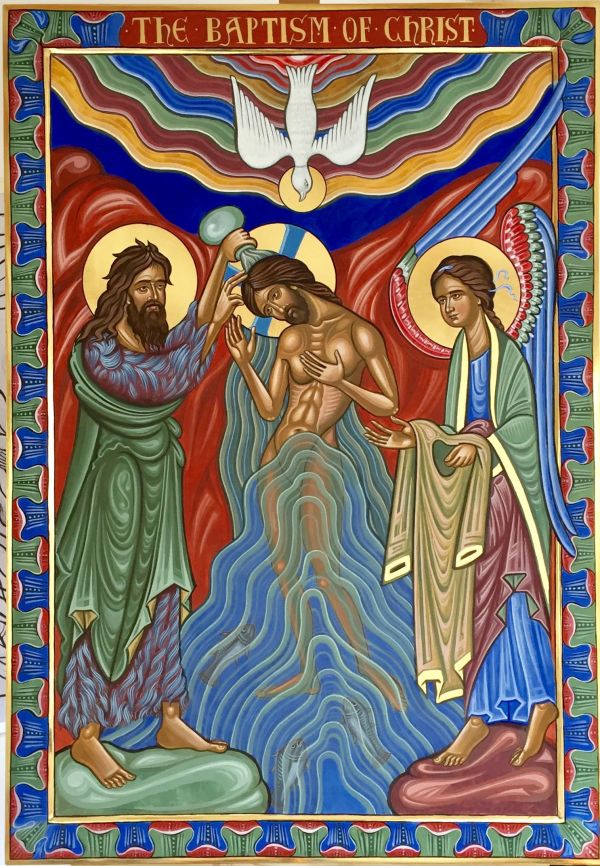
In Mark’s Gospel, Jesus’ baptism is profoundly personal—his adoption as God’s Son is a secret known only to him and John the Baptist. By contrast, Luke’s account portrays Jesus’ baptism as a communal event:

“Now when all the people were baptized, and when Jesus also had been baptized and was praying…”

Mark presents Jesus stepping onto the world stage, becoming the Son of God through adoption at baptism. Luke, however, emphasizes that Jesus has always been the Son of God, with his baptism confirming this preexisting truth.

These differences reflect an ongoing theological debate: Are we saved through baptism, or is baptism a recognition of salvation already granted?

Evangelicals often view baptism as a personal act of faith—a believer’s conscious decision and a ticket to heaven. Anglicans, however, generally see baptism as a celebration of God’s grace, marking entry into a community where salvation is encountered and witnessed.

Returning to Temple’s statement, “The Church is the only society that exists for those who are not its members,” we recognize the Church often falls short, behaving as though it exists solely for its own benefit.

Protestants view the Church as a temporary gathering, existing only when believers come together. In contrast, Anglicans and Catholics see the Church as the mystical body of Christ, existing beyond any specific gathering. Accordingly, Protestants see baptism as entry into an individual relationship with Christ, while Anglicans and Catholics view it as entry into the communal life of the Church—a saving experience.

For Roman Catholics, salvation is bound within the Church, necessitating rigorous boundaries. Anglicans, however, see the Church as leaven in the loaf of the world. The Episcopal Church exists not to confine God’s salvation but to witness to its presence already at work.

Why does this matter? For me, it challenges the Calvinist preoccupation with personal salvation. I reject the idea that my salvation depends on choosing Jesus while my neighbor faces damnation. God loves us both without distinction. The real question is: How do we live out this truth?

Baptism is not a one-time event but a daily commitment to live out God’s purpose in the world. In the Episcopal Church, this commitment is articulated in the Baptismal Covenant, which includes five promises:

    1.   Faithfulness in community: Participate in the life of the Church, practicing faith daily.

    2.   Resistance to evil: Fight evil and return to the path of repentance when you fall short.

    3.   Proclamation of the Gospel: Share the good news that God has already saved the world in Christ.

    4.   Service to others: Love and serve your neighbor as yourself.

    5.   Justice and dignity: Strive for justice, peace, and the dignity of every human being.

As Episcopalians, we embrace fuzzy boundaries intentionally. Guided by Temple’s vision, we affirm that belonging precedes believing.

Through baptism, we join a community that witnesses to God’s salvation as a gift for all. Christians live in tension—balancing engagement with the world’s values and dedication to a life of service and witness shaped by the Baptismal Covenant.

Temple Stones

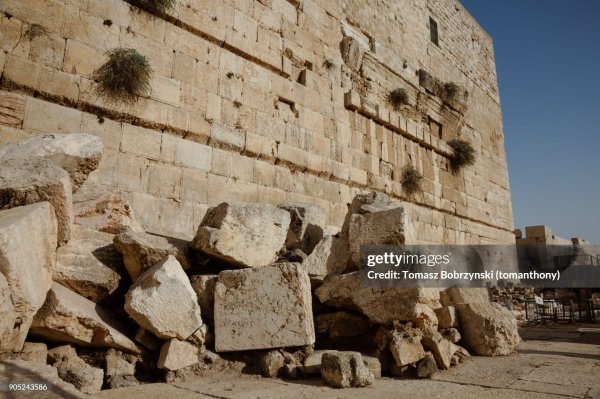
The Photo shows stones from the Second Temple in Jerusalem thrown by the Romans who destroyed the city in the 1st century AD. Robinson’s Arch is visible above the Herodian street in the southwestern corner of the Temple Mount. It was named after scholar Edward Robinson who discovered it. The arch supported a large staircase which was buit by Herod the Great as part of the expansion of the Temple Mount. Ophel Archaeological Park. GPS: N31.77580°, E35.23594°.

Note on the recording: the recording from No one wants this that comes towards the end of this recording is garbled but you can hear the clear version below in the text.

It is not an exaggeration- though it may come as a surprise to some when I say that the Roman destruction of the Second Temple in 70AD was a seismic event – the shock waves from which continue to ricochet down the historical timeline. In the Jewish Revolt from 68-70AD, the Romans laid waste across the Jewish homeland in town and countryside – culminating in the catastrophe of the Temple’s destruction along with much of Jerusalem around it.

It’s interesting to speculate had the Temple continued as the national and religious center of Jewish life might the subsequent course of Jewish-Christian relations have followed a different trajectory? If the Jews had not been forced into diaspora by Roman devastation of town and countryside – becoming the perpetually resented other at the heart of Christian Europe – might the long and sorrowful history of antisemitism have been avoided?

Imagine, no antisemitism, no Holocaust, no need for the Zionist project and the creation of a Jewish state – no Nakba expulsion of Palestinians from their historic lands -no Jewish-Israeli Arab conflict – no Intifada – no Gaza or West Bank – no denial of Palestinian statehood through military occupation and illegal settlements. What if there had continued an evolution of Jewish life in the biblical homeland whatever the wider imperial superstructure of the region. What if no post-1914 British and French power grab – drawing impossible nation-state borderlines in the sand. Instead, imagine a collage of Jewish and Arab communities living side by side – enjoying the same rights and freedoms of religious and community expression in contrast with the drawing of sharp ethnic divisions between Jewish and Arab identities. As with all alternative visions of history, we can only dream.

For fledgling Christianity, the destruction of the Temple was also a seminal event reshaping early Christian memories of Jesus and redefining the subsequent development of post-Temple Jewish-Christian rivalries as the early Church and Rabbinic movements vied for supremacy in an increasingly hostile race for the heart and soul of post-Temple religious reconstruction.

For Mark, writing around 70AD, the destruction of the Temple is a contemporaneous event of such significance that surely Jesus must have prophetically predicted it 40 years before it came to pass. In service of the theological purpose of his narrative – Mark, therefore, puts words into Jesus’ mouth – establishing a long gospel tradition of projecting late 1st and 2nd-century Christian-Jewish tensions into Jesus’ relations with the Pharisees and other Jewish sects in the early 1st-century Jewish homeland.

In chapter 13, Mark presents Jesus after several days teaching his disciples in the Temple precincts. Mark records him leaving the Temple with his disciples – one of whom remarks on the massive stones in the Temple’s construction. Even with our contemporary engineering capabilities the construction of Herod’s great Second Temple is still awe-inspiring. Standing before the Wailing Wall we can still imagine the size of the original Temple Mount platform upon which the Muslim Dome of the Rock now stands. Jesus responds with a prophecy that not one stone shall remain upon another – for all will be thrown down. Mark makes no mention here of Jesus’ claim to rebuild the ruined Temple in three days. We need to wait for John to embellish his version of Mark’s story in 2:19 with this detail.

On the Mount of Olives facing the Temple Mount across the Kidron Valley, his disciples ask for clarification on when his prophecy of the Temple’s destruction will happen. Jesus avoids the direct question and begins to warn them about the dangers of mis and disinformation campaigns that will sow the seeds of confusion – seducing many and leading them astray by false claims of leadership in his name. He warns them not to be alarmed by news of conflict and rumors of wars – such will be necessary to herald a true vision capable of taking them into the future. But for the future to arrive it must begin in the painful stage of birthing that must first destroy the familiar patterns of life as they knew it.

Jesus in Mark 13 is presented as laying out his eschatological vision. Eschatology is theology of expectation that constructs a sweeping view of events that will mark the end of the present age in preparation for an end time. In chapter 13 Mark reminds the first Christians that Jesus’ conception of Messiahship begins not in a triumph in the present age but in a series of events of impending disaster culminating in his eventual triumphal coming again at the end of time as judge and savior of the whole world. But first, the kingdom of God must be born through a process marked by great convulsions and upheavals heralding the arrival of the end time.

When you hear of wars and rumors of wars, do not be alarmed; This must take place, but the end is still to come. For nation will rise against nation, and Kingdom against Kingdom; there will be earthquakes in various places; there will be famines. This is but the beginning of the birth pangs.

Christians throughout history have associated major convulsion and upheaval in the socio-political and economic fabric as heralding the imminence of the end time.  Yet for most of us whose lives have been lived in the peace and predictability of the post-1945 Pax Americana – an expectation of the end time has been confined to millenarian sects while the rest of us accepted that the world – as we experienced it – had now come of age  – marked by a time of social and scientific progress accompanied by the steady growth of economic prosperity.

Yet, we now awake to find ourselves in a world where war and rumor of wars disrupt our sleep. A world in which many are being led astray by the dark arts of dis and misinformation – perpetrated by foreign actors and aided and abetted by the charlatans of the political class who have no interest other than the accumulation of power beyond limit.

The last four years of the Biden Administration may well be seen in the rearview mirror of history as that last gasp of a world we grew up to expect. From now on things are going to be markedly different.

Last week Bishop Nicholas commented on the recent election results suggesting we don’t yet know what any of this means. Well, maybe?  What is clear is that a majority of voters voted for change. Motives for doing so seem mixed with no clear vision for what change will look like. It’s the time and tested response – of repeating failed choices in the hope of a different result.

As a scientist, Bishop Nicholas in essence reframed the gist of Jesus’ words in Mark 13 with the scientific observation of large systems transitioning from one stable phase to another. He commented that as it nears that point of change, fluctuations in a system become larger and more frequent. This is why water gets cloudy before it freezes or boils—the fluctuations signal that a significant change is coming. In our current political system, the jury’s still out on whether the direction of change is towards freezing or boiling.

Beyond endless analysis of what has now happened the more pressing question is – so how will we weather the convulsions and upheavals of the large socio-political paradigm change that is upon us?

Reading Mark 13 our attention is captured by the dire nature of Jesus predictions – because they mirror the instabilities we are now experiencing. Adding to the socio-political instabilities we should not fail to note instability in the largest system of all – the environment of the planet. Thus we are likely to miss the line where Jesus tells us not to be alarmed by the process that must take place – a process he identified as the beginning of the birth pangs. What are birth pangs other than the signal that new life is on the way?

In the Netflix romcom, Nobody Wants This – a sexy, youngish rabbi and his remarkably godless gentile girlfriend find themselves in a restaurant talking about the meaning of Shabbat. Listen

Buildings – and the systems they represent – may crumble – but that doesn’t matter – what matters is gathering with people we care about and who care for us. In the time that is upon us – solidarity, caring for one another in communities of solidarity and support – together sheltering within the protection of belonging – this has always been for Christians – and is now for us – the best survival strategy for enduring the birth pangs that will in the end result in the arrival of new birth.  This is Jesus’ message to us about the promises of God – and God is always faithful.

Blog at WordPress.com.

Up ↑