Justice Deferred

Image: The Book of Job, William Blake

In her sermon two weeks ago, Linda+ introduced us to the recent series of OT lessons from the Book of Job, saying that the much-used statement “Everything happens for a reason” is one of the five cruelest words in the English language to someone who is suffering—right up there with “It’s all in God’s plan.

I’ve coined the term fable morality for the popular attitude that luck – the avoidance of tragedy in our lives is a sign of God’s grace. Linda+ asked: where are the blessings and the grace of God for your neighbor who has lost everything? You get grace and blessings, and they don’t? What kind of God allows that? What kind of God would do that? She concluded her introduction with Welcome to the Book of Job.

Welcome indeed!

We are mostly familiar with the story of Job – a non-Israelite yet righteous man – whose faith in God is tested in severe adversity. Job is so righteous that God boasts about him in the heavenly council – holding him up as an example of human faithfulness arousing the angelic adversary – the satan’s invitation to enter into a small wager. Here we make a curious discovery – that the Lord God is a bit of a gambler who likes nothing better than a flutter on the forces of fate.

God seems to have allowed himself to be manipulated by the satan with the expectation of a safe bet. Expecting a quick an easy win – the Lord is utterly unprepared for what happens next. At first Job responds as God expects. Twice he refuses to curse the Lord. But then Job does something God didn’t expect – he seeks an explanation as to why his life has taken this calamitous turn. In doing so he appeals to the Lord’s justice as the better side of the divine nature.

Here lies the central theme in the story: Job continues to insist on his righteousness while refusing to acknowledge that the sorry turn of events in his life is the result of sin. Job demands an explanation from God on the basis that the Lord is a just god. In insisting on justice as an essential attribute of the Lord God’s identity, Job exposes God’s betrayal of God’s own better nature.

There’s an old joke among preachers concerning a marginal note in the sermon text that reads – argument weak here so shout and pound the pulpit. From the voice within the whirlwind, God now tries to deflect Job’s questions with a display of pulpit thumping designed to intimidate and silence Job. Pounding the divine pulpit, the Lord roars -who are you to question me? Can you do what I’ve done? Were you there to see my power at creation? Do you know more than I know?

But Job is not questioning God’s power. For Job, God is God not simply because God is all-powerful. God is God because justice is an essential and integral aspect of the divine nature without which God cannot be God.

God begins to realize the bind he finds himself in. He cannot respond to Job in terms of justice because confident of quick victory in his wager with the satan – he has allowed a manifest and brutal injustice to be perpetrated on Job. Thus, God draws the robe of the power around himself – blustering and stomping about in the hope that Job won’t notice that God is changing the subject. Job lies in abject suffering while God waxes lyrical about creating crocodiles and whales.

In Chapter 42:1-6 we have Job’s response. Unlike his earlier speeches in self-defense – Job’s final response is brief and concise. Most English language Bibles use the following translation.

I know that you can do all things and that no purpose of yours can be thwarted. I uttered what I did not understand, things too wonderful for me, which I did not know. I had heard of you by hearing of the ear, but now my eye sees you; therefore, I despise myself and repent in dust and ashes.

All’s well that ends well – in other words with the explicit warning – who are we – mere mortal beings – to question the Almighty? Repentance before the Lord even in the face of what seems inexplicable injustice is the only acceptable response.

However, this traditional interpretation makes no sense and does serious violence to the integrity of Job’s complaint. Jack Miles in his revolutionary book God: A Biography offers a very different approach to interpretation. Miles justifies this by demonstrating how the traditional interpretation relies on a repentance gloss on the original Hebrew introduced in the 2nd-century Greek translation in the Septuagint. After his long and passionate presentation of his case before the Lord – Miles questions why Job would suddenly abandon his cause at the very end.

Miles contends that when freed from the presumption of the later Greek repentance gloss – the inherent ambiguity of the Hebrew suggests a very different translation of 42:1-6.

[You] know that you can do all things and that no purpose of yours can be thwarted. [You say] who is this that hides counsel without knowledge? Therefore, I spoke more than I realized. [You say] Hear and I will speak, I will question you, and you declare to me. [Ahh], I had heard of you by hearsay (the words of my comforters) but now that my eyes have seen you I shudder with sorrow for mortal clay.

Miles suggests that this translation fits within the larger context of Job’s consistent refusal to back down in the face of God’s attempt to intimidate him. What seems to upset Job at this point is the realization that if God insists on deflecting questions of justice with displays of power– then all humanity is done for.

Job may have been reduced to silence but so has God been silenced by being brought face to face with the internal tension between his better and darker selves. The Lord now seeks to avoid facing his inner conflict by restoring Job’s fortunes. In the Lord’s time-honored behavior when he realizes he has gone too far – he makes double restitution without admitting culpability. Might we see in this a hidden expression of divine remorse?

Throughout the historical development of the Tanakh the Jewish scriptures struggle to reconcile the unfettered exercise of divine power with the constraint of divine justice. In other words, how can the split nature of the divine be understood – for the Lord God seems to have a dark as well as a light side to his identity, or in Job’s words the Lord gives, and the Lord takes away; yet blessed be the name of the Lord.  

In the Psalms, we find the main divine assertion – I am the Lord whose power is made manifest through justice. Earlier in the Torah, we find Abraham repeatedly appealing to God’s better nature – invoking the attribute of justice as a necessary curb on God’s darker power-driven impulses. In effect, this is the argument Job now uses with God. Like Abraham, Job reminds God of the human expectations for God to live up to his assertion that divine power is made manifest through justice.

Accordingly, Jewish tradition understands that justice is imperfect – guaranteed by God but also at the mercy of his darker impulses. Time and again the Tanakh witnesses God’s justice winning over his power impulses. But as Job reveals this struggle is sometimes touch and go.

The encounter between God and Job has reduced both to silence. After the book of Job, the Lord God never speaks again in the Tanakh. In all the books that follow – God is either absent with the focus being on human interaction or heard through human repetition of God’s historical statements quoted from earlier passages in the Torah or the prophets. God makes a fleeting appearance in the book of Daniel but as the very remote and silent Ancient of Days.

The book of Job leaves a somewhat bitter aftertaste in the mouth.  Yes, God restores Job’s fortunes and doubles his prosperity, and his better self eventually wins out over his darker impulses. But as Jack Miles notes – no amount of compensation can make up for Job’s loss of his previous family and servants – all merely the collateral damage flowing from the misjudged wager with the devil.

As for the Tanakh’s image of divine justice – well it’s mixed. In the books that follow Job, the simplistic fable morality – God rewards the good and punishes the bad – reasserts itself. We do find attempts to deal with unpredictability with the assertion that God will do neither good nor bad – somehow remaining detached and impartial. Only in the book of Job do we encounter a groping after a deeper and more paradoxical wisdom– that the lord will often do good but sometimes do bad. Justice is imperfect. From now on Job not only knows this about the Lord, but the Lord cannot escape knowing this about himself.

Fathers, Prophets, & Kings

Two weeks ago, Linda+ preached on the call of Samuel in which a key line reads – in those days the voice of the Lord was not often heard. This is a recognition by the Deuteronomist scribes – the collators and editors of the Samuel story – that in hearing God’s call Samuel becomes the first person since Moses to whom the Lord speaks directly. Samuel is a crucial transitional figure – presiding over an age of national transition in the Israelite evolution from a loose tribal confederation – where political power is highly devolved -towards a centralization of political power in a monarchical system.

Samuel is a figure linking the past but also prefiguring the future. He’s the priestly successor to Eli – custodian of the shrine at Shiloh. He is the last of the great Judges who since the days of Joshua had guided the Israelites in times of crisis. He is also the first of a new breed of prophets. After Samuel the office of prophet will become the significant counter – the Lord’s loyal opposition to the centralization of political power under the monarchy.

The story so far is -responding to the people’s clamor for a king, and with the Lord seemingly giving the green light to their request, Samuel has anointed Saul as the first king in Israel. But Saul is arrogant and easily gets above himself in the Lord’s eyes. On the pretext that Samuel had not arrived within the appointed time to perform an important sacrifice after a battle with the Philistines – Saul usurps the priestly role and offers the sacrifice himself. This is a serious trespass. Samuel arrives and in shock cries out to Saul – what have you done? The Lord is also not pleased and in rejecting Saul as unfit to continue to rule sends Samuel in search of a man after the Lord’s own heart to be king in Saul’s place.

Poor Samuel. Although originally opposed to the consecration of a king, he seems to have grown both fond of Saul and at the same time fearful of him. The OT reading for today finds Samuel moping. The Lord tells him to snap out of it and get on with the job.

Understandably, Samuel had been swayed in his original selection of Saul by Saul’s impressive warrior-like appearance – tall, handsome, dark-haired, and bearded, with shoulders and thighs of death. But Saul has a fragile ego. He’s a classic narcissist. Easily threatend and vindictive in response. Standing before the parade of Jesse’s sons – Samuel’s tastes in men have not changed as he ponders an acceptable Saul lookalike to replace him.

As Jesse’s sons’ parade before him – Samuel is constantly distracted by the Lord whispering in his ear – no, not this one, no not that one. After the seventh in the lineup had passed by and been rejected by the Lord, Samuel – somewhat at a loss turns to Jesse and asks if there is another son somewhere? Jesse says he has another son, but he is just a boy – out minding the sheep. David is brought before Samuel who finds the boy rather effeminate in appearance with a fresh, hairless, ruddy complexion, androgynously handsome with beautiful eyes – hardly king material in Samuel’s eyes.

But to Samuel’s astonishment, the Lord confirms this is the one. When Samuel takes a moment to make sure he has not misheard – the Lord becomes impatient. He commands Samuel to – rise and anoint him; for this is the one! Samuel takes the horn of oil and anoints David as king in the presence of his brothers. We are told the spirit of the Lord came mightily upon David from that day forward – which is propaganda code for the Deuteronomists’ approval of David – who in their eyes becomes the template for the good king -a man after the Lord’s own heart -. a template of kingship against which all subsequent kings will find approval but mostly be found wanting.

It’s a tricky situation that Samuel now finds himself in. No one outside David’s family knows that David has replaced Saul – certainly, Saul has no inkling and will not have for some time to come. Worried about blowback -Samuel thinks it wise to step out of the limelight for a while and retreats to his home at Ramah where he has founded a school for budding prophets.

There’s a deep irony running through Samuel’s story. He succeeds Eli as the priest at Shiloh because Eli‘s dynastic ambition has corrupted him to appoint his sons Hophni and Phineas – spoiled bad boys if ever there were. Here lies the tragic irony. Like Eli before him – Samuel – distracted by his own dynastic ambitions loses his moral compass in naming his own bad boy sons to succeed him. It’s important to note this in the mix of Samuel’s emotions when confronted with the people’s demand to sideline his sons and anoint a king instead to rule in their place.

Samuel is a good leader until he isn’t, which is how Nanette Sawyer puts it in writing in the recent edition of The Christian Century. She writes:

Samuel’s decision to appoint his sons as leaders and judges shines a light on his human fallibility. The people see it too, and they want out of this system of leadership based on judges who appoint their own greedy children to take over. When they got Samuel instead of Hophni and Phineas, maybe they thought they were done with that problem. But here it is, happening again.

Fatherhood is often a painful experience. For Samuel, his biological sons are not his only disappointment. As father to the nation, the people likewise disappoint him in wanting to replace the system he embodies with a king.

Oh, what a curse it is to be the son of a great father.  The saga of the great man and his disappointing sons still has the power to grip our contemporary attention – as attested to by the Hunter Biden tragedy.  As the sons of both the presidential contenders for 2024 demonstrate – though in very different ways – it’s a short trip from privilege to corruption for the children growing up in the shadow of the larger-than-life father.

Let we who have ears to hear listen closely! As in our own time, in the time of Samuel, the Israelites feel locked into a political system designed to resist change. Like us, they express a growing concern about the capacity of a devolved system of authority held together by a common rule of law to safeguard their future. Like us, in the face of multiple challenges to national life, they paradoxically demand to have a king who they fantasize will solve all their problems. The Israelites offer us a salutary warning against trading one set of problems for another – out of the frying pan into the fire as the old saying goes.

Samuel warns them of the cost of kingship to be paid in the indentured service of their sons and daughters; through the taxation of land and first fruits; in the arbitrary confiscation of land and the levying of a military draft. But the greatest cost will be paid in elevating a leader who like a contemporary Supreme Court Justice will enjoy complete unaccountability.

My throwaway comment about Supreme Court Justices’ unaccountability reminds us that the echoes of Samuel’s story and its political context reverberate through our own constitutional halls. And like the ancient Israelites, facing the challenges of uncertainty and change – we too seem to hanker for a strong charismatic leader – harboring the mistaken expectation that such a leader will care about us.  The Israelites cry give us a king to make us great again. But the story of kings is that they make only themselves and their sycophants great at the expense of those they are raised over to serve. The historian Timothy Snyder with a reference to Putin’s Russia notes that the people do not flourish under a king. Only the king and the king’s loyalists flourish, and then only as long as they also benefit the king and the king’s power. Let we who have ears to hear listen closely!

Samuel at first bitterly opposes the request and complains to the Lord about how the people disrespect the Lord in even wanting a king to rule over them. Perhaps realizing that Samuel is more anxious for his own authority than the Lord’s – the Lord simply tells Samuel to do as the people ask. It seems even the Lord is not always right.

At the end of her article, Sawyer wryly comments: God’s story, our story, is a long one, and we are only in the middle of it. Now is a time to heed Samuel’s warnings. Now is a time to utilize all of our resources—our energy, intelligence, imagination, and love—to work toward God’s dreams for our world. That will be a world in which wealth is shared, justice is done, accountability is maintained, and the abundance and beauty of God’s creation are honored. 

Seeing and Being Seen!

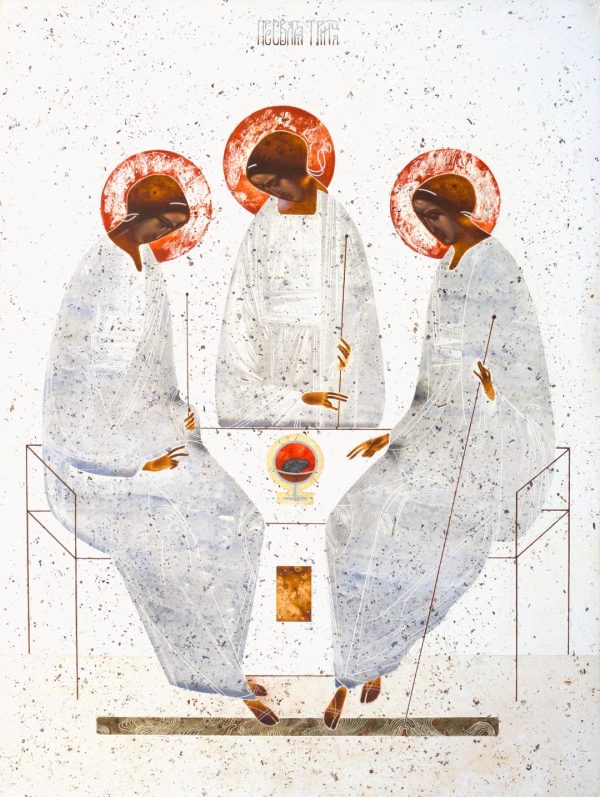
Image: Ivanka Demchuk Trinity in the style of Andrei Rublev

Our unique personhood sits within a much larger set of characteristics that we share with every other human being. Yet there is a kernel at the heart of these shared characteristics that marks us out as uniquely ourselves – as in – like no one else. How is individuality discovered?

There’s a commonly held view that individuality is innate. We come to discover who we are through an internal process of growing self-awareness. In other words, the unique sense of self is something we are born with and develops in step with the process of cognitive maturation.

In contrast, a psychologically informed view holds that personal identity is not innate but interactional. Personal identity develops through our interactions with others – interactions shaped by social and physical environmental factors.

So, bear with me for a moment as I develop a couple of seemingly unrelated strands, I assure you they will come together in a moment.

There is that old chestnut question: does a tree falling in the forest make a sound if there is no one to hear it fall? The short answer is no – its fall makes no sound. The complex answer is the tree’s fall causes pressure waves in the air around it. But these are not sounds until picked up by and transformed into sounds by the human ear.

As many of you know I have a background in Object Relations psychology which is a particular British offshoot of classical Psychoanalysis. Object Relations theory views human beings as primarily object or relationship-seeking. The infant instinctively seeks connection with its mother who represents a reliable and constant object. The infant suckling at the breast or the bottle comes to its first awareness of self through being reflected in the mother’s loving gaze.

The human equivalent of the tree falling with no one to hear its fall is the infant deprived over time of the experience of being seen – that is -reflected in the gaze of the mother. Such an infant will eventually die and we have a name for this – it’s called failure to thrive.

My psychology-psychotherapy formation led me – as a childless man – to the realization of what every mother experientially knows – that the infant catches the first intimations of selfhood in the interactional field of the mother’s loving gaze. The mother gazes at the infant. The infant gazes back- catching the first hints of its separateness – individuality – reflected in the mother’s face. I know of a young mother who as her child awakes from sleep whispers – Hello little one, I’m glad you’re back. I’ve missed you.

On Trinity Sunday what happens when we take my initial reflections on human identity development and view them through a trinitarian lens?

When it comes to the Trinity – the doctrine of three persons in one God – there is only one thing we need to remember. The Trinity was an experience of God long before it became a doctrine about God. In fact, the doctrine emerged only as a protection for the unique Christian experience of God.

For the early Christians, the Trinity as an everyday experience of God emerges in this way. As Jews, they believed in God the Creator, the God of their ancestors, the God of Abraham, and Moses. As followers of Jesus, they experienced a life-changing encounter with God through his ministry, death, and resurrection. After his departure following his resurrection, they were inflated in present-time with an experience of transformation from a dejected and lost band of leaderless followers into a community empowered with a revolutionary purpose. Under the guidance of the Spirit – which they associated with the Spirit of Jesus – they took up the work Jesus had begun. In these three distinct ways, they experienced the presence and power of God in their lives.

In the spiritual life of faith and practice, we are caught between two opposing pressures. On the one hand, we are compelled to try to rationalize our faith experience – capturing the invisible and intangible nature of spiritual experience in stories and formulae we can easily understand and repeat. Yet, on the other hand, we have a strong motivation to protect the mystery at the heart of religious experience from being reduced to the limits of our impoverished human imagination.

This tension between these motivations came to a head in 325 CE when the bishops – as the successors to the Apostles met together in council at a place called Nicaea – now the modern-day Turkish city of Iznik situated 139 KM southeast of Istanbul – then Constantinople. The council was torn by opposing factions. There were those who wanted to rationalize the mystery of the threefold Christian experience of God – to make it sensible to ordinary human comprehension within the laws of the physical universe. There were others who defended the essential mystery at the heart of Christian experience. Using the philosophy of the day -they put in place a protection for the mystery of God lying at the heart of Christian experience. This protection has come down to us in the Nicene Creed which we proclaim as the historic faith of the Church believed in all places and at all times.

Thus the Nicene Creed speaks of Jesus being of one substance with the Father, and of the Holy Spirit as proceeding from the Father through the Son. Confounding our expectations – nothing is explained and the meaning of the essential mystery is left open-ended. Although the Trinity expressed an experience of God long before it became a doctrine about God – at Nicaea – experience came under the protection of a doctrine that proclaimed God as a relational community of Father, Son, and Holy Spirit.

Today we hear these terms not as an attempt to gender the divine, but as an articulation of relationality at the heart of the divine nature. Following current sensitivities around gendered language some substitute Creator, Redeemer, and Sustainer for the traditional gendered terms. While theologically correct nevertheless these are terms denoting function, not relationship. Lover, Beloved, and Love-sharer is a better solution – making the point that it is relationship not gender that lies at the heart of the divine nature.

In 1410, an obscure Russian monk named Andrei Rublev depicted an icon of the Holy Trinity drawn from the Genesis story recording the visit to Abraham at the Oaks of Mamre by two angels. Rublev’s icon of the Trinity articulates a step change – a massive leap forward in the human capacity to imagine God – presenting the three distinct Christian experiences of God as a relational community of three persons – distinctively clothed – yet in every other way identical – sharing the same face – the same gaze. Each member beholds the other two simultaneously in a mutually loving gaze.  

Rublev’s Trinity is more than a representation of the theology of God’s nature. It’s an expression of the Orthodox devotional tradition in which the Trinity lies at the heart of Christian devotion. Inspired and informed by this devotional tradition, Rublev presents God not as a solitary figure but God as a relational community.

We only come to truly see ourselves when we are caught in the experience of being seen. Coming to see through the experience of being seen is an essential characteristic of the infant-mother bond. Thus it should come as no surprise that seeing through the experience of being seen is an essential quality of the divine community. When we sit before the icon of the Trinity we are drawn into the mutuality of the divine gaze. It’s as if God seeing us says hello – welcome back, we’ve missed you.

Three folds of the cloth yet only one napkin is there,
Three joints in the finger, but still only one finger fair,
Three leaves of the shamrock, yet no more than one shamrock to wear,
Frost, snowflakes, and ice, all in water their origin share,
Three Persons in God: to one God alone we make our prayer.                                                                       An Irish Celtic prayer to the Trinity.

So What’s Next?

Picture: Chapel of the Ascension, Shrine of Our Lady of Walsingham, Norfolk, England

There is a rather ugly 1960s chapel at the Shrine of Our Lady of Walsingham – deep in the rural countryside of the county of Norfolk dedicated to the Ascension of our Lord. On entering the Chapel of the Ascension, one is greeted with a surreal experience. For in the center of the low ceiling is a gilded cloud ring plaster rosette from the center of which hang two bare feet – suspended in the air. Ostensibly belonging to Jesus with the rest of his body having already burst through the ceiling.

The celebration of the Ascension always occurs on a Thursday – the 40th day after the resurrection. Because Episcopalians rarely venture to church except on Sundays – the current custom is to celebrate the Ascension of the Lord on the Sunday following – which in 2024 also incongruously happens to be Mother’s Day.

Incidentally, I heard a funny quip recently referring to the Southern Baptist church calendar which comprises only four commemorations: Christmas, Easter, the 4th of July, and Mother’s Day. It goes without saying that while we shouldn’t pass up any opportunity to celebrate the importance of mothers and mothering in our lives, in the Episcopal Church, Mother’s Day is not part of the liturgical calendar.

Constructing stories and weaving narratives are the way we make sense of our experience of the world. The perennial question concerns the relationship between story and material experience – in other words, does weaving narratives – telling stories interpret and explain our material experience, or does the power of narrative –  in the words of the French deconstructionist philosopher Michel Foucault – construct our experience – as in language creating the objects and meaning of which it speaks.

This tension surrounding the function and power of language is especially pertinent when it comes to religious-spiritual stories. Narrative Theology asserts that spiritual meaning lies not in the literal veracity of the events depicted – did they happen or not – but in the function of story by itself to construct and convey purposeful meaning across time. The question is not whether or not Bible stories depict actual happenings – but how they construct meaning and purpose that can be trusted to shape our living?

Spiritual stories recycle human imaginative memory. Clearly, Luke’s graphic account of Jesus’ Ascension borrows extensively from Elijah’s ascension recorded in the 2nd book of Kings. In like manner – as the mantle of Elijah fell upon the shoulders of Elisha – giving him a double portion of his master’s spirit, the double portion of Jesus’ Spirit clothes the disciples. The resonance is unmistakable.  

In Luke’s chronology of events from Calvary to Pentecost, his story of the Ascension of Jesus forms a transition point bringing the earthly ministry of Jesus to a close to empower his followers with his spirit to become a community equipped to continue his work. The question underlying the Ascension event is not how, when, or if it happened, but what light does it shed on the question of what’s next?

The question of what’s next throws into sharp focus the choices to be made, the actions to be taken, and the directions to be followed.

In her sermon last week, Linda+ noted that love is not just about how we are to feel. It is about who we are called to be. Rather than asking: What does it mean to believe in God’s love – she posed the more significant question do we trust God’s love, do we surrender to it, will we let love transform us? 

So here’s a question. How can we trust the meaning inherent in the story of the Ascension of Jesus even though most of us believe it as an event to be simply a construction of imagination?

One response is to substitute the traditional spatial metaphor of up and down for heaven and earth with a metaphor more suited to contemporary imagination – that of heaven and earth as side by side. The Ascension becomes the conduit connecting parallel dimensions. Through this conduit a two-way traffic flows between what we might call our space and God space.

The image of the Ascension of Jesus as a conduit for two-way traffic communicates two important insights. In his return to the God space, Jesus does not jettison his humanity like a suit of worn-out clothes – but carries the fullness of his humanity – perfected through suffering -to be received by God into the divine community. The words of the first collect for the Ascension capture this: that as we believe your only begotten Son our Lord Jesus Christ to have ascended into heaven, so we may also in heart and mind there ascend, and with him continually dwell. The we here is not us individually, but the entirety of our humanity which now constitutes an element within the divine nature.  

In receiving the fullness of Jesus humanity into the divine nature, God releases the divine spirit of Jesus to make the return journey back into our space. This image is captured in the words of the second collect for the Ascension:  our Savior Jesus Christ ascended far above all heavens that he might fill all things and to abide in his church until the end of time. The Ascension is the point where we, Christ’s mystical body on earth are prepared to become empowered to continue the work Jesus began.

The Ascended Christ bearing our perfected humanity is received into the heart of God – so that – as the book of Revelation poetically phrases it – the home of God now dwells among mortals. Now we come to the most extraordinary assertion of Christian faith – that from henceforth to be most fully human is to be most like God.

The Ascension of Jesus opens us to contemplate our participation in the what’s next in God’s work of renewing the creation -throwing into sharp focus the choices to be made, the actions to be taken, and the directions to be followed – when we tire of gazing heavenwards – that is.

Blog at WordPress.com.

Up ↑