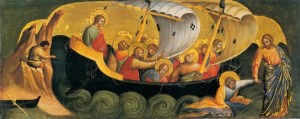
And Then There Were Nine

Image courtesy of Redeeminggod.com

Today is the launch of our public stewardship renewal campaign for 2026. It will run until November 9th. Letters with educative documentation, along with an estimate of giving card, allowing for the vagaries of the US postal service, should land in your mailboxes by the end of this coming week or hopefully sooner. Now, no one wants to hear – even on the Stewardship launch Sunday, a sermon distorted into a harangue for more money. So you can rest easy, I’m not interested in doing that either.

I want you to picture the scene Luke depicts in today’s gospel.

Ten men stand at a distance. Ten voices cry out—not for justice, not even for understanding, but simply: Jesus, Master, have mercy on us. And Jesus—without touch, without spectacle—says, Go, show yourselves to the priests. They go. Ten are cleansed. But only one turns back.

And Luke pauses here to let us feel the implication of the story – one not lost on Jesus’ immediate 1st-century audience. Because the one who returns is a hated foreigner, a Samaritan who falls at Jesus’ feet, giving thanks. His gratitude becomes an act of recognition, an awakening of something within him, as he becomes overwhelmed by hope. For gratitude is never just backward-looking; it is the soil in which the future grows.

Five centuries before this moment, the prophet Jeremiah wrote to another group of people living outside the fold of inclusion—a people rendered strangers in a foreign land -Israel’s exiles in Babylon. They were displaced, disheartened, and desperate to go home to rebuild what had been lost. So Jeremiah’s letter would have shocked them. He didn’t say, Hold on, you’ll be back next year.  He said: Build houses and live in them. Plant gardens and eat their produce. Seek the welfare of the city where I have sent you. (Jer. 29:5–7)

In other words: Hope is not waiting for escape—it is beginning again where you are. Jeremiah’s hope was not naïve optimism. It was a fierce, grounded trust that God is still at work, even in exile. Like gratitude, hope starts by paying attention to what is already possible. For gratitude is never just backward-looking; it is the soil in which the future grows.

The healed Samaritan and Jeremiah’s exiles are kin in spirit. Both live outside the center of inclusion. Both find hope in despair. Both embody what we might call resilient gratitude—the capacity to thank God even before everything is fixed.

The Samaritan’s turning back is his equivalent to planting a garden in exile. He does not rush back into a normal life, the life he must have longed to return to during his years of being shunned. He turns toward the source of his gratitude. And in that turning, he is not only cured but discovers a new kind of wholeness.

Jesus’ final words to him—Your faith has made you well—echo Jeremiah’s promise: For surely I know the plans I have for you, says the Lord, plans for your welfare and not for harm, to give you a future with hope.

Stewardship is about the fostering of our sense of gratitude for what God has already given. From gratitude, hope emerges, trusting that the same God will bring future abundance to life.

Stewardship, then, is nothing less than the practice of hope in action. It requires attentive care. St Benedict loved to tell his monks that stewardship is the exercise of tender competence in ordinary things. Jeremiah said, Build houses… plant gardens… seek the welfare of the city. Stewardship does precisely that—it tends, builds, and plants for the future even when the present feels uncertain.

Every pledge of financial generosity, every act of service, every hour given in ministry is an act of trust that God’s future – already coming to fruition through us is worth investing in. It says, With our time and our treasure, we believe our story isn’t over.

In the Samaritan’s turning back, we glimpse the same truth: gratitude is never passive. It propels us forward into participation—into giving, healing, reconciling, and most importantly investing in the future in a community where our commitment to one another becomes more important than our prized self-sufficient individuality. The key to recognizing gratitude is to never resist for too long, an opportunity to express generosity towards another.

To give thanks in the midst of uncertainty is to refuse to be ruled by fear. To give generously, even when anxious about the future, is to declare that God’s promise of abundance is greater than our fear of scarcity.

When we live this way, we become what Jeremiah envisioned—a community that plants gardens in exile, a people who embody hope through gratitude expressed in generous living. People who make possible a future we cannot yet see.

As I often remind us, it’s only together that we can achieve so much more than any one of us alone. As we enter our own season of stewardship, the fostering in us of our tender competence and love for one another in community, we need to remind ourselves that it is to God we must continually give thanks for the enjoyment of our abundance amidst the experience of change, challenge, and uncertainty.

Like Jeremiah’s exiles, we are called not to wait for the perfect moment— but to build now, plant now, give now, hope now. You and I may not be here tomorrow, yet through what we tend today, the community we build will remain.

Every pledge, every gift, every offering of time and skill says that we believe that God still has plans for us. We believe that love will have the last word. That is when we turn back, as the healed Samaritan did—when we give thanks and offer ourselves anew—we open the way for God to create a new future together. Gratitude is not the end of faith. It is the beginning of renewal. Jeremiah calls us to build despite our present experience of alienation and exile from an America we still cherish in our hearts.

Gratitude is the seed of hope, and hope is the architecture of the future God is already building through us.

Ten men stand at a distance. Ten voices cry out—not for justice, not even for understanding, but simply: Jesus, Master, have mercy on us. And Jesus—without touch, without spectacle—says, Go, show yourselves to the priests. Ten go but only one turns back in gratitude. Nine are cleansed, but only one is made whole. And just to rub it in for his xenophobic Jewish audience harboring an aversion and hostility towards Samaritans, Jesus asks: Were not ten made clean? Was none of them found to return and give thanks to God except this foreigner?

For gratitude is never just backward-looking; it is the soil in which the future grows.

Exploring  the Biblical context

The Gospel reading for Pentecost 9 is the last section of Matthew 14. Last week in Another Spin on the Feeding of the Five Thousand, I presented this chapter as three story lines (Herod’s banquet, God’s banquet or the feeding of the five thousand, and Jesus walking on the water) juxtaposed by Matthew for maximum effect. This led me to an uncomfortable exploration of the themes of national abundance, scarcity, and failure of courage set within the current US immigration dilemma.

16_Lorenzo_Veneziano,_Christ_Rescuing_Peter_from_Drowning._1370_Staatliche_Museen,_Berlin.The final story line in Matthew 14 concerns the episode of Jesus coming to the disciples who are imperiled in a boat in the midst of a fierce storm. Jesus comes to them across the mountainous waves, walking upon the water. As he does so, he calls to them: do not be afraid. Immediately encouraged by Jesus’ call Peter gets out of the boat and attempts to walk on the water to meet Jesus. At first all goes well as Peter follows his spontaneous impulse, a characteristic that normally gets him into trouble. Then I imagine Peter begins to become self-conscious. As he begins to watch himself doing something his mind tells him he can’t do, he begins to sink. Increasingly aware of the sound of the wind and the height of the waves, he becomes distracted by a sense of his own fragility and vulnerability. As he begins to sink Jesus reaches out and catches him. Imagine Peter’s relief, his utter joy!

Exploring the current context

Following a link from David Lose http://www.davidlose.net/ I came across Brené Brown, who is a vulnerability researcher. She proposes that as a society, we have lost our tolerance for vulnerability. She identifies a number of ways this happens. https://www.youtube.com/watch?v=_UoMXF73j0c&list=PLF1DBBEBE74831153&index=1

The first factor she identifies is the way joy becomes foreboding. Let me give you a personal example of this. In order to spend a few days away we have arranged for a dog sitter to collect Charlie Girl and take her to an organic farm run by the sitter. The sitter has been recommended to me and it is a huge relief to find a good recommendation. As the time for Charlie’s collection comes closer, I awake today with the thought, but what if the dog sitter kidnaps Charlie, after all I don’t know this person?

Brown talks about disappointment becoming a lifestyle attitude. This equates to the old adage, “if you don’t expect then you can never be disappointed”. Yet, this illusion of self-protection relegates us to a perpetual attitude of disappointment. We experience low-grade disconnection, going through the motions of life without vital connection. We are driven by the need to pursue perfection mistakenly thinking this is the pursuit of excellence. Do we not all experience the feeling of never being quite good enough, of things never meeting-up to expectations? Psychologically this is a tool of self-protection from the dangerous feelings of being content or happy. Strange as it may seem, despite consciously telling ourselves how much we yearn to be happy, our fear of joy and of losing our perpetual attitude of disappointment ensures that joy and contentment continue to elude us.

Brown names the rise of religious extremism as a symptom of an equation – faith minus vulnerability = extremism. She comments on the prevalence of our addictions to drugs, food, our indebtedness as symptoms of the denial of vulnerability. Her most telling point, however, is that we cannot numb our fear of vulnerability without also numbing our capacity for joy.

Interpreting between contexts 

This last week I recall a couple of experiences when I had to confront my own ambivalent experience of vulnerability. The first involved a visit to an elderly parishioner in assisted living. This woman has a disease process that involves an increasing paralysis of her body, which has now robbed her of speech. Seeing her made me fearful of being in such a state of utter vulnerability. In the course of administering Holy Communion to her, I offered some reflections on living within the experience of limitation. At the conclusion, with some difficulty she indicated towards the back of her 1928 Book of Common Prayer. As she spelled out some letters on her alphabet card, I realized she was asking me to read something she had written on the blank inner side of the back cover. As I read, I began to realize that she was not asking me to read this to comfort her, but to comfort me. Somehow she had intuited my discomfort with her level of vulnerability and wanted me to read her own reflection on her situation.

The focus of my reflection was upon the frustrations of living within the severe limitations she appeared, to me, to experience. By contrast her reflections, noted in her prayer book, were full of the joyful trust and a sense of being utterly sustained by God. I had offered her an image that was like the disciples who remaining in the sinking boat, valiantly continue bailing-out the waters crashing over the sides. Whereas, for her, her vulnerability had become a way for her to walk on the waters and to reach out and be met by the loving Christ saying to her: do not fear. My companion in this encounter did not share my fears of falling out of a capacity for an active engagement with life. She felt Christ’s embrace catching her and bearing her up in an attitude of joyful gratitude.

My second experience concerns my responsibility to administer the generous discretionary funds that are available for the crisis support of members of the congregation. The problem is that I don’t get to administer the funds for the benefit of parishioners. In an upper middle class parish made up of predominantly professional or entrepreneurial members, schooled in the American creeds of autonomous individuality and the virtue of financial independence, to admit to a need for financial help to meet and unforeseen crisis involves a painful admission of vulnerability. As Brené Brown notes, for many of us vulnerability equates with weakness.

Instead of the discretionary funds being administered for the benefit of the members of the congregation, they are more often distributed to strangers who wander into the Church office. Usually, these are people who have developed a capacity for skillful and manipulative exploitation of their vulnerability. Much of my ministry has been at the sharp end of dealing with people with what psychiatry calls personality disorders. A personality disordered person fills the interpersonal space with a level of chaos and disturbance that makes it hard for them to live constructively or enjoy stable relationships with others. I am, therefore, far from a fresh-faced pastoral rookie, not easily persuaded by hard luck stories.

My general assumption is that these supplicants are scamming me. They are persons who have honed manipulation and the parading of their vulnerability into a survival life-skill. Yet, the gratuitous generosity of God requires me in good conscience to give people the benefit of the doubt until proven wrong. This last Friday afternoon, I was able to confirm my suspicion that I was being scammed.

The long and short of this experience was through skillful sleuthing around I managed to find proof the person in question was scamming me. You might expect my exposé to have produced a sense of satisfaction. On the contrary, the discovery exposed me to feelings of having been foolish and stupid. I felt incompetent in the exercise of my pastoral duty. A voice inside my head remonstrated with me for having been such a gullible pushover.

Yet, the truth of the matter was that faced with simply not knowing whether what I was being told was true or not, I had actually primed the pump in such a manner as to be able to follow how the person claiming assistance to buy medication actually spent the money. The actual circumstances of how I did this are a little too demeaning for the ego of a Cardinal Rector to admit to. Yet, I am left with the question, why was I left feeling so stupid?

Revisiting connections

In the parables of Jesus, we find a picture of God as gratuitously, and to our mind recklessly generous. The challenge for me in pastoral ministry is to take risks and to become vulnerable. This means at times becoming vulnerable to the possibility of being duped. My belief and experience of God as gratuitously, and recklessly, generous requires this of me. Yet, my ego as the consummate pastoral and psychospiritual professional hates becoming vulnerable. Because although I know better, and my spiritual experience confirms the truth of what I know, it’s hard to shake the habit of equating the experience of vulnerability with being weak, foolish, and ultimately, incompetent. For won’t every marginal person in Providence now hear that the Rector of St Martin’s is a pushover?

Most of us live in fear of becoming vulnerable because we equate being vulnerable with being dependent as in my first pastoral vignette, and, or feeling weak as in the second – fearing that our vulnerability as a weakness will open us up to exploitation.

Could our experience of life be enhanced by breaking the mental link between weakness and vulnerability? The disciples being tossed about in the boat is an image for me of negotiating the winds and heavy seas that come upon us in life from time-to-time. There can be little doubt that the world can be a rough place. We have only to look to events unfolding in many places in our world to see this to be self-evident. In our attempt to deny our vulnerability we become the victims to the illusion that we are actually in control of our lives. That if we only do the right thing, not rock the boat, and not take risks, we can avoid the storms of life. The corollary of this is that if we find ourselves being tossed in some rough weather then it’s because of our own fault, our own foolishness.

Life is not an exercise of painting by numbers, where by following the instructions we always use the right color and never paint over the lines. It’s not like a game of hopscotch – successfully jumping from square to square avoiding treading on the lines. The price we pay for numbing our vulnerability is to become alienated from, and fearful of feelings of contentment and joy. We find we are only comfortable when we are able to turn every situation into a problem.

Peter’s impulse on seeing the Lord coming toward them through the storm is to get out of the boat and take a risk. It’s only when he becomes aware of doing something that his mind tells him he can’t do, that he begins to sink. As he does the Lord catches him. So too, will Christ catch us and bear us up, if we let him.

Brené Brown’s solution to our personal and societal denial of vulnerability is echoed by the Christian Faith. It is to live lives of contentment through practicing over and over again the spiritual discipline of gratitude. My prayer is that within the community of St Martin’s we may deepen our practice of becoming vulnerable, one to another. To this end I commend to you a spiritual practice.

Recommendations for practice

End each day with an examination of the events of the day in a spirit of non- recrimination, non-judgment, watching for signs of rumination, i.e. rehearsing what we should have done, should have said, but didn’t. Then awaken to each new day reciting our chorus of thanksgivings, or at the very least noting how long it takes for us to do so.

Blog at WordPress.com.

Up ↑