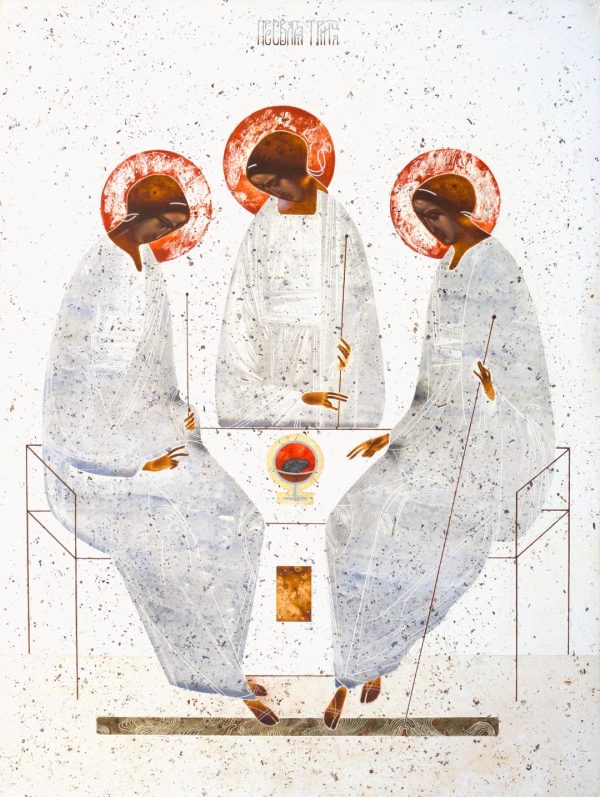
Image: Ivanka Demchuk Trinity in the style of Andrei Rublev
Our unique personhood sits within a much larger set of characteristics that we share with every other human being. Yet there is a kernel at the heart of these shared characteristics that marks us out as uniquely ourselves – as in – like no one else. How is individuality discovered?
There’s a commonly held view that individuality is innate. We come to discover who we are through an internal process of growing self-awareness. In other words, the unique sense of self is something we are born with and develops in step with the process of cognitive maturation.
In contrast, a psychologically informed view holds that personal identity is not innate but interactional. Personal identity develops through our interactions with others – interactions shaped by social and physical environmental factors.
So, bear with me for a moment as I develop a couple of seemingly unrelated strands, I assure you they will come together in a moment.
There is that old chestnut question: does a tree falling in the forest make a sound if there is no one to hear it fall? The short answer is no – its fall makes no sound. The complex answer is the tree’s fall causes pressure waves in the air around it. But these are not sounds until picked up by and transformed into sounds by the human ear.
As many of you know I have a background in Object Relations psychology which is a particular British offshoot of classical Psychoanalysis. Object Relations theory views human beings as primarily object or relationship-seeking. The infant instinctively seeks connection with its mother who represents a reliable and constant object. The infant suckling at the breast or the bottle comes to its first awareness of self through being reflected in the mother’s loving gaze.
The human equivalent of the tree falling with no one to hear its fall is the infant deprived over time of the experience of being seen – that is -reflected in the gaze of the mother. Such an infant will eventually die and we have a name for this – it’s called failure to thrive.
My psychology-psychotherapy formation led me – as a childless man – to the realization of what every mother experientially knows – that the infant catches the first intimations of selfhood in the interactional field of the mother’s loving gaze. The mother gazes at the infant. The infant gazes back- catching the first hints of its separateness – individuality – reflected in the mother’s face. I know of a young mother who as her child awakes from sleep whispers – Hello little one, I’m glad you’re back. I’ve missed you.
On Trinity Sunday what happens when we take my initial reflections on human identity development and view them through a trinitarian lens?
When it comes to the Trinity – the doctrine of three persons in one God – there is only one thing we need to remember. The Trinity was an experience of God long before it became a doctrine about God. In fact, the doctrine emerged only as a protection for the unique Christian experience of God.
For the early Christians, the Trinity as an everyday experience of God emerges in this way. As Jews, they believed in God the Creator, the God of their ancestors, the God of Abraham, and Moses. As followers of Jesus, they experienced a life-changing encounter with God through his ministry, death, and resurrection. After his departure following his resurrection, they were inflated in present-time with an experience of transformation from a dejected and lost band of leaderless followers into a community empowered with a revolutionary purpose. Under the guidance of the Spirit – which they associated with the Spirit of Jesus – they took up the work Jesus had begun. In these three distinct ways, they experienced the presence and power of God in their lives.
In the spiritual life of faith and practice, we are caught between two opposing pressures. On the one hand, we are compelled to try to rationalize our faith experience – capturing the invisible and intangible nature of spiritual experience in stories and formulae we can easily understand and repeat. Yet, on the other hand, we have a strong motivation to protect the mystery at the heart of religious experience from being reduced to the limits of our impoverished human imagination.
This tension between these motivations came to a head in 325 CE when the bishops – as the successors to the Apostles met together in council at a place called Nicaea – now the modern-day Turkish city of Iznik situated 139 KM southeast of Istanbul – then Constantinople. The council was torn by opposing factions. There were those who wanted to rationalize the mystery of the threefold Christian experience of God – to make it sensible to ordinary human comprehension within the laws of the physical universe. There were others who defended the essential mystery at the heart of Christian experience. Using the philosophy of the day -they put in place a protection for the mystery of God lying at the heart of Christian experience. This protection has come down to us in the Nicene Creed which we proclaim as the historic faith of the Church believed in all places and at all times.
Thus the Nicene Creed speaks of Jesus being of one substance with the Father, and of the Holy Spirit as proceeding from the Father through the Son. Confounding our expectations – nothing is explained and the meaning of the essential mystery is left open-ended. Although the Trinity expressed an experience of God long before it became a doctrine about God – at Nicaea – experience came under the protection of a doctrine that proclaimed God as a relational community of Father, Son, and Holy Spirit.
Today we hear these terms not as an attempt to gender the divine, but as an articulation of relationality at the heart of the divine nature. Following current sensitivities around gendered language some substitute Creator, Redeemer, and Sustainer for the traditional gendered terms. While theologically correct nevertheless these are terms denoting function, not relationship. Lover, Beloved, and Love-sharer is a better solution – making the point that it is relationship not gender that lies at the heart of the divine nature.
In 1410, an obscure Russian monk named Andrei Rublev depicted an icon of the Holy Trinity drawn from the Genesis story recording the visit to Abraham at the Oaks of Mamre by two angels. Rublev’s icon of the Trinity articulates a step change – a massive leap forward in the human capacity to imagine God – presenting the three distinct Christian experiences of God as a relational community of three persons – distinctively clothed – yet in every other way identical – sharing the same face – the same gaze. Each member beholds the other two simultaneously in a mutually loving gaze.
Rublev’s Trinity is more than a representation of the theology of God’s nature. It’s an expression of the Orthodox devotional tradition in which the Trinity lies at the heart of Christian devotion. Inspired and informed by this devotional tradition, Rublev presents God not as a solitary figure but God as a relational community.
We only come to truly see ourselves when we are caught in the experience of being seen. Coming to see through the experience of being seen is an essential characteristic of the infant-mother bond. Thus it should come as no surprise that seeing through the experience of being seen is an essential quality of the divine community. When we sit before the icon of the Trinity we are drawn into the mutuality of the divine gaze. It’s as if God seeing us says hello – welcome back, we’ve missed you.
Three folds of the cloth yet only one napkin is there,
Three joints in the finger, but still only one finger fair,
Three leaves of the shamrock, yet no more than one shamrock to wear,
Frost, snowflakes, and ice, all in water their origin share,
Three Persons in God: to one God alone we make our prayer. An Irish Celtic prayer to the Trinity.
 Relationalrealities