Lectionary Threads

Setting the Scene
I was surprised but also heartened by the feedback I received about my weekly E-Epistle on Paul’s letter to Philemon, which appeared two weeks ago in the E-Newsletter. It reminded me how deeply we hunger for the bold wisdom hiding in Scripture, and how the appointed readings can open up unexpected conversations.

Each Sunday, we are given four scriptural readings, traditionally referred to as lessons because of their instructive potential. Often—at least on the surface—it’s hard to comprehend why the compilers of the lectionary place particular texts side by side. Yet, as a general rule, we can find thematic threads between the Old Testament lesson and the Gospel. The psalm may or may not extend that theme—it often stands in its own right as a hymn of praise or lament. But the New Testament epistle is the outlier. Rather than tying directly into the other lessons, its themes usually unfold sequentially over several weeks, offering us a parallel commentary on what it means to live as Christians in the world.

I know many preachers will default to the gospel lesson, and rightly so. But I find myself often drawn to the Old Testament—because the backstories are so rich, the narratives so captivating. Yet I do not turn to them for history alone. As the writer of Ecclesiastes reminds us, “there is nothing new under the sun.” Human society repeats its patterns. Shakespeare was keenly aware of this. In order to keep his head on his shoulders, his history plays project Elizabethan social and political tensions back into historical settings. This is a tried and true device allowing any writer to speak about contemporary issues through the lens of history.

What goes around then comes around again. Jeremiah holds up ancient politics and divine lament as a mirror for our times when once again we find ourselves struggling to respond to the chilling effects of an unholy alliance between corporate greed and the political suppression of First Amendment freedom of expression.

Jeremiah’s Lament
The passage from Jeremiah, chapter 8, into chapter 9, is one of the most anguished laments in Scripture. Sometimes called the weeping prophet, Jeremiah gives voice to both his own grief and God’s grief as the armies of Babylon camp at Jerusalem’s gates. The line between prophet and God blurs: is this Jeremiah speaking, or is it God? Either way, his poetry is saturated with pain. My joy is gone, grief is upon me, my heart is sick. The harvest is past, the summer is ended, and we are not saved.

These are words of missed opportunity, of doors closing, of a people who refused to turn back to God until it was too late. Jeremiah then utters the piercing question: Is there no balm in Gilead? Is there no physician there?

Everyone in his audience knew what he meant. Gilead, in what is today northwest Jordan, was famous for its resin used in medicine. Healing was available. The balm existed. But the people would not take the cure.

This is the paradox of prophetic ministry: to speak God’s truth is also to carry God’s heartbreak. Jeremiah embodies both divine compassion and human solidarity. God’s anger is real, but underneath it lies a brokenhearted love for a wayward people.

Little wonder then that the image of a balm in Gilead became a lasting metaphor for Christ’s power to heal and restore. And little wonder, too, that this image found its way into the heart-rending songs of the enslaved African communities in America who sang out amidst back-breaking toil and unimaginable cruelty: There is a balm in Gilead to make the wounded whole; there is a balm in Gilead to heal the sin-sick soul. When every other cure had failed, when every earthly power failed them, the enslaved sang of Gilead’s balm, and in so doing, their song became the balm that could not be taken away from them.

Jeremiah is not only the prophet of tears. He is also a prophet of hope. Even after Jerusalem fell, even in exile, he urged the people to build houses, marry, raise families, and seek the peace of the city where they found themselves. Life must go on. Even in Babylon, there was still a future in the unfolding of God’s dream for them.

Jesus’ Parable
In Luke’s gospel we hear Jesus’ perplexing parable of the dishonest manager, who is suspected of fraud, and now fears dismissal. Too weak to dig, too proud to beg, he concocts a plan. He calls in his master’s debtors and reduces their bills. He knows that when he is out of work, they will not forget his generosity towards them when it mattered most.

We recognize this as not only a morally dubious move, but a fraud of mega proportions. We are astonished when the master, aka Jesus, commends him for his shrewdness and holds him up as an example to emulate. Can we be clear here about what Jesus is commending? It’s not the steward’s fraud, but his shrewd sense of urgency. The man knew his time was short. He acted decisively, creatively—even boldly.

The children of this age, Jesus says, are more shrewd in dealing with their own generation than are the children of light. If the crooked can act so cleverly to avert disaster, why do the faithful so often drift through life oblivious to the eternal implications of their complacency?

And then comes the sting in the tail, for Jesus boldly states that you cannot serve God and Mammon. Note, not should not, but cannot! Only one master can win our allegiance.

Drawing the Threads Together
So what happens when we place Jeremiah’s lament and Jesus’ parable side by side?

  • Both press us to live with urgency. Jeremiah shows us the grief of a people’s missed opportunity. Jesus alerts us to the necessity of seizing the moment.
  • Both warn us against misplaced trust. Jeremiah laments a people who refused the available cure. Jesus unmasks the rival god: Mammon – power, wealth, possessions – offering the illusion of security.
  • Both reveal God’s brokenhearted love. Jeremiah weeps God’s tears. Jesus names God’s rival and calls us back to the path of discipleship.

Together, they ask us the question: Where do you place your trust? Which master’s tune do we dance to? As we approach this year’s stewardship renewal season, a variation of the question arises: Do we celebrate our wealth and security because they are ours to possess alone, or are they the means for living a generous life in the service of the common good? The key to Christian living is to not resist for too long an invitation to be generous!

Application
We live in a world where false balms abound. Healing is sought in consumption, political power, financial security, and through transactional relationships of transient self-interest. We convince ourselves: if only I had a little more, then I would feel safe, my cup would be filled, and my life would be complete. But the harvest passes, the summer ends, and the wound of insatiable longing remains unhealed.

As God’s people, we live in a world where Mammon whispers constantly in our ear. It tells us: money and possessions are the only true masters, power the only true balm. And so, Jesus’ words strike hard: You cannot serve God and Mammon.

But as Jeremiah would eventually counsel the Babylonian exiles, here’s the good news: we are not abandoned or left without hope. The balm is real. The healer is present. The master who loves us is faithful. The question is: will we miss our moment, like Jeremiah’s people? Or like the steward will we act with urgency, with a shrewd sense of timeliness – no longer in the interests of selfish gain, but with a desire to invest in the values and expectations of God’s kingdom; to pour ourselves into generous living that fosters our work for peace with justice tinged with mercy to come to our world?

The Call
Jeremiah wept for the wounds of his people. Jesus called his followers to choose their master. And here we are, standing between lament and parable, asking the same question:

Will we trust false cures or the true balm? Will we serve Mammon, or the living God? The harvest is still here. The balm is still offered. The choice of masters is still before us. Let us act with urgency.

There is a balm in Gilead to make the wounded whole; there is a balm in Gilead, to heal the sin-sick soul.

Unfortunately, we must choose.
Buying a Field

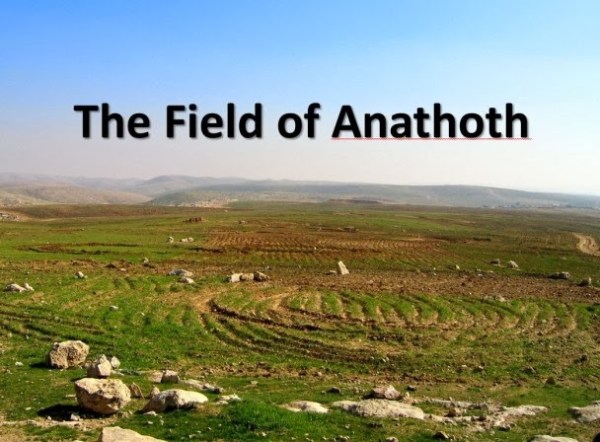
On the eve of catastrophe what farsighted actions will we take – in the spirit of Jeremiah’s purchase of the field in Anathoth?

For several Sunday’s we’ve been listening to the prophet Jeremiah in our O.T. readings. He was born into a priestly family in Anathoth – a village in the territory of Benjamin around 650 BC. He’s believed to have died in Egypt probably around 570 BC. He’s the major prophet active during the particularly turbulent decades preceding and following the fall of Jerusalem in 587 BC.

In today’s passage Jeremiah is imprisoned on king Zedekiah’s orders in the court of the palace guard as the Babylonian forces besiege Jerusalem. Silencing a prophet is always a fruitless task. Deprived of his personal liberty and access to the king Jeremiah dictates to his scribe Baruch – who then publicly proclaimed his master’s words of warning to the Temple congregations.

While locked up in the guardhouse, the word of the Lord came to him saying that his cousin Hanamel will offer him the right of redemption on a field in his home village of Anathoth. One might speculate that Hanamel, surveying the dire situation clearly wants to liquidate his assets in preparation for possible hasty flight. His luck’s in. On the eve of destruction, one might think Jeremiah would have more pressing things on his mind than to buy a piece of land that to all intents and purposes will be of no use to him.

The similarities between 6th-century Judah and 21st-century America may at first sight not seem obvious to the historically untutored eye. Yet, his was, like ours is, a world on the precipice of unprecedented upheaval and crisis. As a consequence of Zedekiah’s foolish foreign adventurism, the armies of Nebuchadnezzar – for the second time in 10 years -had arrived at the gates of Jerusalem- this time to end, once and for all, the Judahite problem.

After the fall of the Northern Kingdom of Israel 721, Judah had benefited from a refugee influx of Israel’s elite. They brought with them cultural and economic expertise that transformed Judah from an underpopulated backwater into a successful and economically prosperous trading nation – an ancient Singapore on the Jordan.

The parallels with today’s America are uncanny. In the years preceding 587 trade was strong, the equivalent of the stock market was buoyant, Judah’s GDP was growing.  But economic prosperity fostered in Zedekiah dangerous foreign policy ambitions – ambitions that led directly to the destruction of the city and state in 587.

As in contemporary America 6th-century Judah’s prosperity was very unequally distributed with all the predictable societal consequences of inequality of wealth. Money corrupted politics hastened the decline in moral and ethical standards in public life because as Carlos Lozada in the New York Times on September 22nd writes the big lie is predicated on the big joke. The big joke is that if everyone is lying and everyone knows that everyone is lying – so no harm done.

Jeremiah warns against external threats brought about by the kings ill-judged foreign policy adventures, while at the same time he decries the greed and abuse of power that was leading directly to a collapse in moral and ethical standards in public life. When the wellspring of prosperity is poisoned – as we well know – such prosperity paradoxically exacerbates institutional and moral decline.  Jeremiah’s message is a call for repentance among the haves for their corruption and exploitation, and among the have-nots for their willingness to be conned and bought off with lies.

Like the 8th-century prophet Hosea, Jeremiah is a prophet of lamentation known some quarters as the weeping prophet. A major theme of Hosea’s is the land’s lament. Hosea is writing some 200 years before Jeremiah – during the social and political instability prior to the Assyrian destruction of the Northern Kingdom in 721 BC stress the land’s lament. Interestingly, archeological evidence points to serious changes in climate patterns during this period may well have impacted international relations and been a factor in Israel’s decline.  

Andi Lloyd writing in The Land Mourns  in the latest edition of Christian Century Magazine notes that for Hosea the land’s lament is not the equivalent of our modern environmental grieving over:

…. pollution or strip-mining or any material injury to itself. The land’s lament, to which Hosea gives voice, is wider than that. The land’s lament speaks a foundational ecological truth: when one part of creation goes awry, the whole suffers. The land’s grief at what the people have done points to the fundamental reality of our interconnection. …. Therefore the land mourns …. because the people have gone astray, in all the familiar ways: There is no faithfulness or loyalty, and no knowledge of God in the land. Swearing, lying, and murder, and stealing and adultery break out; bloodshed follows bloodshed. (Hosea 4:1–2)

The land mourns is a metaphor for a fundamental imbalance between the interconnected elements in the creation. The prophetic vision was a correction to this imbalance – restoring a vision of a world as it ought to be. However, the prophets lived as we do, in a world of too much injustice and too little love fraying the threads that bind the creation together. Andi Lloyd writes:

Now, as then, the fabric that connects all of creation is badly torn: torn by manifold injustices wrought and perpetu­ated by the exploitative systems in which we live, torn by ideologies of scarcity that teach us to love too narrowly and too little. To mourn is to speak that truth to the lies that prop up the denial on which the status quo depends.

One of the major consequences of a world out of balance is the loss hope. We become despondent. Our confidence in progress and belief in a future better than the past is undermined – and despair distorts our vision.

Through repentance Jeremiah preaches the restoration of lost hope. Before the fall of Jerusalem, he sounds the voice of warning. But after the fall of the city rather than a voice of I told you so – amid the destruction of the nation he proclaims a message of present time faith in future hope.

In contrast to Psalm 137’s voice of lament: 

How can we sing a song of the LORD in a foreign land?  If I forget you, O Jerusalem, may my right hand wither. May my tongue cling to the roof of my mouth if I do not remember you, if I do not exalt Jerusalem as my greatest joy!…

Jeremiah counsels the Exiles to:

Build houses and settle down; plant gardens and eat what they produce. Marry and have sons and daughters; find wives for your sons and give your daughters in marriage, so that they too may have sons and daughters. Increase in number there; do not decrease.  Also, seek the peace and prosperity of the city to which I have carried you into exile. 

The realization of future hope begins now through faith as present time action. On the eve of destruction, one might think Jeremiah would have more pressing things on his mind than to buy a piece of land that to all intents and purposes will be of no use to him – which at first sight seems a futile thing to do. He pays the price, signs the deed, instructing Baruch to place it into an earthenware vessel:

in order that they may last for a long time.  For thus says the Lord of hosts, houses, and fields and vineyards shall again be bought in this land.

Today, we are living in the face of multiple crises; national, international, and environmental. We struggle against despair and despair’s bitter fruit – helplessness. In our disempowerment we fail to see the interconnections that link all our current crises together so that to take steps to address one is to impact the larger whole. For instance, to tackle the corruption fueled by dirty money and special interests in political life is also to increase transparency and reduce the temptation for dishonesty in public life.  In raising the moral and ethical standards of politicians by no longer voting for politicians who habitually lie about climate change we will make progress in addressing the environmental crisis. In standing up to regimes who exploit their carbon extraction wealth to threaten and wage war on their neighbors, we have a strong incentive to wean ourselves off carbon dependance thus lessening the inevitability of environmental catastrophe.

So you see we are far from helpless!

On the eve of catastrophe what farsighted actions will we take – in the spirit of Jeremiah’s purchase of the field in Anathoth?

Blog at WordPress.com.

Up ↑