Remedy Against the Hardness of the Human Heart

In the current political climate women’s and children’s issues are spotlighted by an age-old paradox. On the one hand, the anti-choice political-religious agenda – with renewed energy seeks to impose a Kafkaesque level of government overreach into women’s reproductive lives threatening disastrous consequences for the integrity of medical professionals dedicated to women’s health. It’s ironic that this movement is championed by that part of our political and religious culture that has traditionally coined the slogan – keep the government out of our lives.

Yet, the paradox becomes more glaring when we note that the political and religious championing of the rights of the unborn is matched by a reluctance to legislate for the welfare and protection of the already born. Recent Republican refusal in the US Senate to extend the child credit is a sorry truth that for an electorate that practices a high degree of selective cognizance cannot be highlighted enough. Child-family credit is the single most effective instrument in dramatically reducing child poverty.

The political terrain of women’s and children’s welfare remains an area of fraught intersectionality. Anxieties about women’s reproductive rights meet head-on with accompanying white anxieties about race and class. The origin of American abortion prohibition has its roots in the murky history of white protestant racial anxieties in the face of late 19th-century immigration from southern and eastern Europe – anxieties that today find a voice in conspiracies of racial replacement.

It’s ironic that the strident claims of the religious right’s assertion that God and the Christian tradition abhors abortion find no support or evidence in the Judeo-Christian Scriptures which remain completely silent on the issue of abortion. In contrast, the diverse voices heard in the Scriptures are resoundingly loud and clear on issues of women’s and children’s welfare. They are similarly loud and clear about the obligation to welcome and protect the stranger. But the latter point is worthy of its own sermon.

As a case on point – Jesus’ teaching in Mark 10 should make us all wriggle with discomfort. How can we continue to claim to know the mind of God on contemporary reproductive issues about which Scripture remains consistently silent while ignoring the clearly articulated mind of God on the nature of the human relationship within marriage?

If Scripture is silent on contemporary issues of reproductive rights – justifying male control of female bodies – a general attitude nevertheless can be discerned hidden within Jesus’ debate with the Pharisees and his teaching to his disciples on divorce in Mark 10.

It’s not surprising that the debate about divorce centers on female adultery. Female adultery represents an attack on male control over female reproduction – because a wife’s adultery muddies the waters of legitimacy. A man needs to know that the children his wife bears are his and not someone else’s. Anxiety about legitimacy is code for the legal protection of intergenerational transmission of property rights – a cornerstone of patriarchal order.

Confronting this very male anxiety, Jesus messages in Mark 10 that adultery cuts both ways. It’s not just the wife’s adultery that counts for divorce, but the husband’s does as well. This is shocking news for both his Pharisee interlocutors and his faithful disciples. This is not what they want to hear.

Of interest to us is Jesus’ thoughts on the Mosaic writ of divorce as an accommodation for the hardness of the human heart. What does he mean by this? One reading of the writ is to see it as a recognition that men have a right to do what men want to do concerning their wives and children. But I think a better reading of what Jesus is getting at here is to recognize the Mosaic writ less as a permission for male bad behavior but as a protection for a woman by requiring her husband to publicly demonstrate the grounds for divorcing her. The writ protects what little rights a Hebrew wife might claim in the face of an unscrupulous husband’s attempt to cast her aside.

Mark is always in a hurry – he thinks nothing of abrupt and unexpected jumps in the narrative. One moment Jesus is addressing the question of divorce and then suddenly he’s talking about the welcome and protection of children. Although we note a rather abrupt and unskillful transition – Mark is showing his readers that the point to which Jesus is driving his argument firstly with the Pharisees and then with his disciples – is towards the recognition in a society where women and children had few rights and were easily the subjects of male abuse – that the protection and care for women and children is one of God’s primary concerns.

In his teaching on divorce, Jesus asserts the relationship between husband and wife is one of equals. Reflecting God’s covenant with humanity, Jesus asserts that marriage as a relationship of equals was God’s original intention for men and women in creation. When Jesus says: what God has joined together let no one separate, he is saying that God’s intention and the practice of divorce conflict. The Pharisees go away muttering to themselves, the disciples are rendered speechless, and Christians have squirmed on the hook of this teaching for nearly 2000 years.

Jesus understands the difference between divine intention and human experience. He is fully aware that God’s original intention for creation is continually frustrated by human failure. In this light, he sees the Mosaic writ of divorce as a pastoral and compassionate response to the reality of human failure. What he is not prepared to accept is the ossification of the Mosaic writ into a cruel legalism that favored husbands over wives – and was indeed an expression of hardness of heart. Jesus moves the conversation away from the legalistic debate among men concerning the justifiable grounds for divorcing their wives, into a different conversation – one that recognizes the tension between human fallibility and God’s intention for marriage as a partnership of equals – a reflection of God’s love for us in creation which as in all other areas of human response is found wanting.

So today, in the Episcopal Church, where do we find our theology of marriage and divorce? After a long debate in the 20th century, Anglican theology groped towards a position that seeks to hold in tension the original divine intention for marriage and the reality of human failure. In our tradition, the solution we arrived at after much soul searching is to reserve a right to remarriage in church after civil divorce to the bishop’s prerogative. In nearly all cases the decision of the bishop depends on the advice of the priest preparing the couple for remarriage.

In marriage preparation, Linda+ and I invite the divorced person (s) seeking remarriage to share their perception of the failure of a previous marriage. In their story, we listen for the echoes of sorrow. We hope to hear in their story a sense of loss – a loss of innocence – to hear the echo of the pain and disillusionment at finding failure where they had hoped for fulfillment and joy. It seems to me that no one who has been through a divorce emerges unscathed by the loss of their once innocent belief that when you make sacred promises everything should work out, and people should live happily thereafter.

Our question to the divorced person or persons is – in this process how has this experience of loss of innocence deepened your self-awareness to better equip you to have a more mature expectation of yourself to sustain your hopes for this new marriage relationship? This is a pastoral inquiry and on the strength of the response we request episcopal permission to remarry the couple into a new beginning. When the religious tradition prohibits divorce denying it as a potentially life-giving opportunity for new beginnings -the Church continues a legalistic-pharisaic hardness of heart that perpetuates trauma in family life – with historically speaking, women and children – the primary causalities.

As Anglican Christians in the Episcopal Church, we live in the tension where a fixed interpretation of Scripture and Tradition meets the changing reality of the lives we are actually living. This place of tension is where we expect to encounter God, meeting us not only in our successes but particularly in our failures. Into this tension – God comes looking for us.

Seeing and Being Seen!

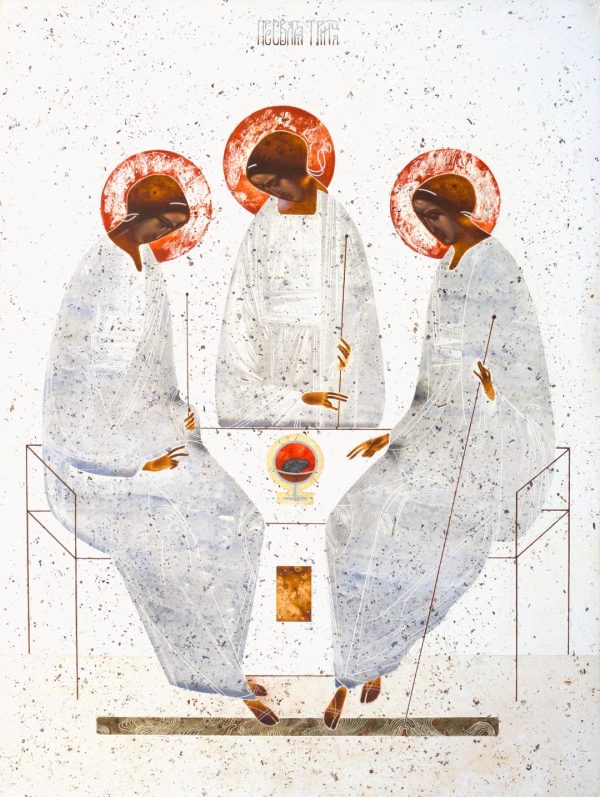
Image: Ivanka Demchuk Trinity in the style of Andrei Rublev

Our unique personhood sits within a much larger set of characteristics that we share with every other human being. Yet there is a kernel at the heart of these shared characteristics that marks us out as uniquely ourselves – as in – like no one else. How is individuality discovered?

There’s a commonly held view that individuality is innate. We come to discover who we are through an internal process of growing self-awareness. In other words, the unique sense of self is something we are born with and develops in step with the process of cognitive maturation.

In contrast, a psychologically informed view holds that personal identity is not innate but interactional. Personal identity develops through our interactions with others – interactions shaped by social and physical environmental factors.

So, bear with me for a moment as I develop a couple of seemingly unrelated strands, I assure you they will come together in a moment.

There is that old chestnut question: does a tree falling in the forest make a sound if there is no one to hear it fall? The short answer is no – its fall makes no sound. The complex answer is the tree’s fall causes pressure waves in the air around it. But these are not sounds until picked up by and transformed into sounds by the human ear.

As many of you know I have a background in Object Relations psychology which is a particular British offshoot of classical Psychoanalysis. Object Relations theory views human beings as primarily object or relationship-seeking. The infant instinctively seeks connection with its mother who represents a reliable and constant object. The infant suckling at the breast or the bottle comes to its first awareness of self through being reflected in the mother’s loving gaze.

The human equivalent of the tree falling with no one to hear its fall is the infant deprived over time of the experience of being seen – that is -reflected in the gaze of the mother. Such an infant will eventually die and we have a name for this – it’s called failure to thrive.

My psychology-psychotherapy formation led me – as a childless man – to the realization of what every mother experientially knows – that the infant catches the first intimations of selfhood in the interactional field of the mother’s loving gaze. The mother gazes at the infant. The infant gazes back- catching the first hints of its separateness – individuality – reflected in the mother’s face. I know of a young mother who as her child awakes from sleep whispers – Hello little one, I’m glad you’re back. I’ve missed you.

On Trinity Sunday what happens when we take my initial reflections on human identity development and view them through a trinitarian lens?

When it comes to the Trinity – the doctrine of three persons in one God – there is only one thing we need to remember. The Trinity was an experience of God long before it became a doctrine about God. In fact, the doctrine emerged only as a protection for the unique Christian experience of God.

For the early Christians, the Trinity as an everyday experience of God emerges in this way. As Jews, they believed in God the Creator, the God of their ancestors, the God of Abraham, and Moses. As followers of Jesus, they experienced a life-changing encounter with God through his ministry, death, and resurrection. After his departure following his resurrection, they were inflated in present-time with an experience of transformation from a dejected and lost band of leaderless followers into a community empowered with a revolutionary purpose. Under the guidance of the Spirit – which they associated with the Spirit of Jesus – they took up the work Jesus had begun. In these three distinct ways, they experienced the presence and power of God in their lives.

In the spiritual life of faith and practice, we are caught between two opposing pressures. On the one hand, we are compelled to try to rationalize our faith experience – capturing the invisible and intangible nature of spiritual experience in stories and formulae we can easily understand and repeat. Yet, on the other hand, we have a strong motivation to protect the mystery at the heart of religious experience from being reduced to the limits of our impoverished human imagination.

This tension between these motivations came to a head in 325 CE when the bishops – as the successors to the Apostles met together in council at a place called Nicaea – now the modern-day Turkish city of Iznik situated 139 KM southeast of Istanbul – then Constantinople. The council was torn by opposing factions. There were those who wanted to rationalize the mystery of the threefold Christian experience of God – to make it sensible to ordinary human comprehension within the laws of the physical universe. There were others who defended the essential mystery at the heart of Christian experience. Using the philosophy of the day -they put in place a protection for the mystery of God lying at the heart of Christian experience. This protection has come down to us in the Nicene Creed which we proclaim as the historic faith of the Church believed in all places and at all times.

Thus the Nicene Creed speaks of Jesus being of one substance with the Father, and of the Holy Spirit as proceeding from the Father through the Son. Confounding our expectations – nothing is explained and the meaning of the essential mystery is left open-ended. Although the Trinity expressed an experience of God long before it became a doctrine about God – at Nicaea – experience came under the protection of a doctrine that proclaimed God as a relational community of Father, Son, and Holy Spirit.

Today we hear these terms not as an attempt to gender the divine, but as an articulation of relationality at the heart of the divine nature. Following current sensitivities around gendered language some substitute Creator, Redeemer, and Sustainer for the traditional gendered terms. While theologically correct nevertheless these are terms denoting function, not relationship. Lover, Beloved, and Love-sharer is a better solution – making the point that it is relationship not gender that lies at the heart of the divine nature.

In 1410, an obscure Russian monk named Andrei Rublev depicted an icon of the Holy Trinity drawn from the Genesis story recording the visit to Abraham at the Oaks of Mamre by two angels. Rublev’s icon of the Trinity articulates a step change – a massive leap forward in the human capacity to imagine God – presenting the three distinct Christian experiences of God as a relational community of three persons – distinctively clothed – yet in every other way identical – sharing the same face – the same gaze. Each member beholds the other two simultaneously in a mutually loving gaze.  

Rublev’s Trinity is more than a representation of the theology of God’s nature. It’s an expression of the Orthodox devotional tradition in which the Trinity lies at the heart of Christian devotion. Inspired and informed by this devotional tradition, Rublev presents God not as a solitary figure but God as a relational community.

We only come to truly see ourselves when we are caught in the experience of being seen. Coming to see through the experience of being seen is an essential characteristic of the infant-mother bond. Thus it should come as no surprise that seeing through the experience of being seen is an essential quality of the divine community. When we sit before the icon of the Trinity we are drawn into the mutuality of the divine gaze. It’s as if God seeing us says hello – welcome back, we’ve missed you.

Three folds of the cloth yet only one napkin is there,
Three joints in the finger, but still only one finger fair,
Three leaves of the shamrock, yet no more than one shamrock to wear,
Frost, snowflakes, and ice, all in water their origin share,
Three Persons in God: to one God alone we make our prayer.                                                                       An Irish Celtic prayer to the Trinity.

It’s Blowin’ in the Wind

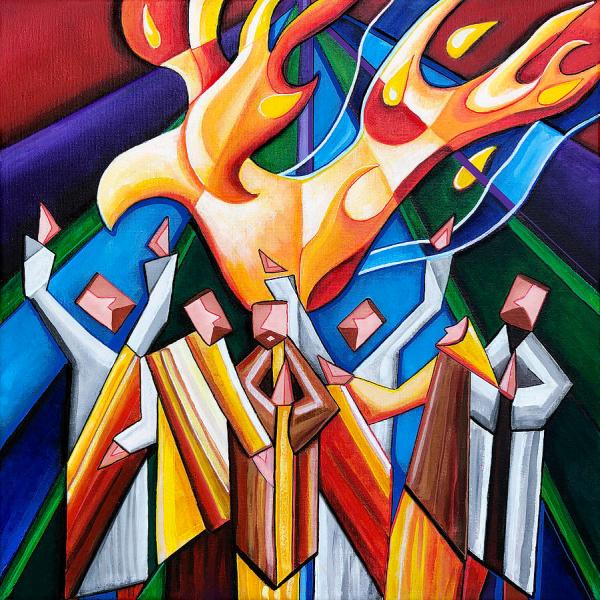
Image by Jennifer Allison

Everything is connected to everything else. The butterfly beats its wings in the New England woods provoking an invisible chain reaction resulting in a typhoon battering the Japanese coast. The magnitude of interconnection is truly mind-blowing. How so?

All that is ever seen is what Spirit causes, motivates, inspires, encourages, impels, triggers, stirs, provokes, stimulates, influences, or activates.

In his song Blowin’ in the Wind, the great Bob Dylan once more with a direct simplicity comes closest to articulating the mystery of Spirit: (https://www.youtube.com/watch?v=KpD26IoRLvA 1:27 -end)

Dylan asks

Yes, and how many years must a mountain exist
Before it is washed to the sea?
And how many years can some people exist
Before they're allowed to be free?
Yes, and how many times can a man turn his head
And pretend that he just doesn't see?

The answer, my friend, is blowin' in the wind
The answer is blowin' in the wind.

In this vein, let me try to give some descriptive theological shape to the Day of Pentecost – the arrival of which brings to a close the long biblical narrative that has been unfolding since Christmas, through Easter, ending here at Pentecost.

Pentecost – is Greek for the 50th day after Easter. On the Day of Pentecost the Spirit of the risen and ascended Christ – the Holy Spirit entered material time and space as a crucial participant in the on-going life of the creation.

John hints at Jesus’ gift of his spirit to his disciples in his farewell discourses – where in today’s gospel he tells them – If I do not go away, the Advocate will not come to you; but if I go, I will send it to you …. for when the Spirit of Truth comes, it will guide you into all truth.

It’s Luke, of course, who offers the graphic description of the event that overwhelmed Jesus’ followers on the Day of Pentecost. Luke’s chronological arrangement of the life and times of Jesus from birth to resurrection ends with his Ascension. In the sequel to his gospel, the Acts of the Apostles, Luke chronicles the life and times of the first followers of Jesus of Nazareth. Beginning with the event that transformed them from a dispirited rag-tag band of the dejected and the lost into an empowered, pneumatic community inflated by the power of the Spirit. Luke goes on to record in Acts how empowered by the Holy Spirit this pneumatic community begins to forge a distinctively revolutionary way of living. Pentecost marks the transfer of power from what had been the ministry of Jesus to the ministry of those who became initially known as the followers of The Way.

Being faithful Jews, these first followers of Jesus had gathered in Jerusalem for Shavuot – the other great pilgrim festival at which every Jew – especially those of the male variety was encouraged to come up to Jerusalem on the 50th day following Passover to commemorate the giving of the Torah by God to Moses. Luke paints a vivid technicolor picture of the events that overtook Jesus’ followers who were visited by a pyrotechnic eruption of wind, fire, and ecstatic utterance marking their pneumatic inflation with the Holy Spirit.

Among the multitude of pilgrims gathered for Shavuot from across the Jewish diaspora were Jews from Media, Elam, and as far away as Mesopotamia – from Cappadocia and a host of other cities in Asia Minor together with Egyptian, Libyan, and Arabian Jews, alongside local Judeans. All witnessed the clamor among a band of unruly Galilean peasants – hearing them shouting out in their own tongues while others of a more cynical mindset dismissed the rabble-rousers as drunk – not simply drunk, but drunk at nine o’clock in the morning. After all, what could you expect from a bunch of Galileans?

Last week I drew the metaphor of a conduit – a two-way traffic highway connecting the dimension of time and space with the spiritual dimension – each a dimension arranged in parallel. With the Ascension of Jesus, the direction of traffic moves from time and space to spiritual space as Jesus is received by God and reunited within the divine nature – not simply as a divine being but now clothed in the fulness of his humanity.

Following the reception of the humanity of Jesus- now perfected through suffering – into the divine nature, the traffic flow reverses as the divine spirit of Jesus is released to reenter time and space – becoming known as the Holy Spirit – who in the words of the Nicene Creed proceeds from the Father through the Son.

All that is ever seen is what Spirit causes, motivates, inspires, encourages, impels, triggers, stirs, provokes, stimulates, influences, or activates.

On the Day of Pentecost, the disciples of Jesus were set blaze – enraptured –hearts and minds ignited with passion. Drawing a more contemporary analogy, in his song, I’m on Fire Bruce Springsteen captures such a moment when he sings:  (https://www.youtube.com/watch?v=1VxFS5-klfk 1.24 -end)

At night, I wake up with the sheets soakin’ wet and a freight train runnin’ through the middle of my head, only you - can cool my desire, oh,oh,oh, I’m on fire!

The Holy Spirit is the manifestation of God as the primal force animating from within and spanning between everything – an echo of the Genesis vision of the divine wind moving across the face of the void – calling structure and order out of chaos.

The Apostle Paul in chapter 8 of his letter to the Romans recaptures the grandeur of the Genesis vision – leading him to his arresting association of the Holy Spirit as the midwife of the Creation. He writes:

Know this, that the whole creation has been groaning in labor pains until now; and not only the creation, but we ourselves, who have the first fruits of the Spirit, groan inwardly while we wait for adoption, as part of the redemption of Creation.

Paul offers this extraordinary image of the Spirit birthing us in our weakness; like pre-linguistic newborns, the Spirit speaks for us in sighs too deep for words.

St Martin’s is a Spirit-filled community. This is not the way we normally think of ourselves for we are shaped by a cooler Anglican ethos that has traditionally been highly suspicious of too much enthusiasm. Our Spirit-fullness is revealed through our synergy of traditional Anglican worship with radical theological and social messaging – allowing us to explore, fashion, and present fresh perspectives on traditional articulations of theology and faith practice. In this we capture the revolutionary effect of the Spirit – directly addressing head-on, the challenges faced by us in the lives we are actually living. This can be a testing experience and gives the lie to the accusation that our Anglican way is an easy religion.

Following this liturgy – we will celebrate our Spirit-filled, magnetic community – a community drawing others to us. We are an attractive, warm, and welcoming community. We express a quiet spiritual empowerment. We exhibit revolutionary courage – confronting challenges to faith in a modern context while also risking new opportunities – as together we reach out for God’s invitation to work tirelessly for the healing of the world.

All that is ever seen is what Spirit causes, motivates, inspires, encourages, impels, triggers, stirs, provokes, stimulates, influences, or activates.

Or as Bob Dylan tells it –The answer my friends – is blowing in the wind – the answer is blowing in the wind. The life of Spirit is not subject to our manipulation or control – it’s not comprehensible to our grasping minds. The Spirit makes itself known through us when we allow ourselves to become available to its prompting to act under the furtherance of the divine plan for creation which always begins with a revolutionary refusal to accept that the way things are in the world is the way things have to be.

So What’s Next?

Picture: Chapel of the Ascension, Shrine of Our Lady of Walsingham, Norfolk, England

There is a rather ugly 1960s chapel at the Shrine of Our Lady of Walsingham – deep in the rural countryside of the county of Norfolk dedicated to the Ascension of our Lord. On entering the Chapel of the Ascension, one is greeted with a surreal experience. For in the center of the low ceiling is a gilded cloud ring plaster rosette from the center of which hang two bare feet – suspended in the air. Ostensibly belonging to Jesus with the rest of his body having already burst through the ceiling.

The celebration of the Ascension always occurs on a Thursday – the 40th day after the resurrection. Because Episcopalians rarely venture to church except on Sundays – the current custom is to celebrate the Ascension of the Lord on the Sunday following – which in 2024 also incongruously happens to be Mother’s Day.

Incidentally, I heard a funny quip recently referring to the Southern Baptist church calendar which comprises only four commemorations: Christmas, Easter, the 4th of July, and Mother’s Day. It goes without saying that while we shouldn’t pass up any opportunity to celebrate the importance of mothers and mothering in our lives, in the Episcopal Church, Mother’s Day is not part of the liturgical calendar.

Constructing stories and weaving narratives are the way we make sense of our experience of the world. The perennial question concerns the relationship between story and material experience – in other words, does weaving narratives – telling stories interpret and explain our material experience, or does the power of narrative –  in the words of the French deconstructionist philosopher Michel Foucault – construct our experience – as in language creating the objects and meaning of which it speaks.

This tension surrounding the function and power of language is especially pertinent when it comes to religious-spiritual stories. Narrative Theology asserts that spiritual meaning lies not in the literal veracity of the events depicted – did they happen or not – but in the function of story by itself to construct and convey purposeful meaning across time. The question is not whether or not Bible stories depict actual happenings – but how they construct meaning and purpose that can be trusted to shape our living?

Spiritual stories recycle human imaginative memory. Clearly, Luke’s graphic account of Jesus’ Ascension borrows extensively from Elijah’s ascension recorded in the 2nd book of Kings. In like manner – as the mantle of Elijah fell upon the shoulders of Elisha – giving him a double portion of his master’s spirit, the double portion of Jesus’ Spirit clothes the disciples. The resonance is unmistakable.  

In Luke’s chronology of events from Calvary to Pentecost, his story of the Ascension of Jesus forms a transition point bringing the earthly ministry of Jesus to a close to empower his followers with his spirit to become a community equipped to continue his work. The question underlying the Ascension event is not how, when, or if it happened, but what light does it shed on the question of what’s next?

The question of what’s next throws into sharp focus the choices to be made, the actions to be taken, and the directions to be followed.

In her sermon last week, Linda+ noted that love is not just about how we are to feel. It is about who we are called to be. Rather than asking: What does it mean to believe in God’s love – she posed the more significant question do we trust God’s love, do we surrender to it, will we let love transform us? 

So here’s a question. How can we trust the meaning inherent in the story of the Ascension of Jesus even though most of us believe it as an event to be simply a construction of imagination?

One response is to substitute the traditional spatial metaphor of up and down for heaven and earth with a metaphor more suited to contemporary imagination – that of heaven and earth as side by side. The Ascension becomes the conduit connecting parallel dimensions. Through this conduit a two-way traffic flows between what we might call our space and God space.

The image of the Ascension of Jesus as a conduit for two-way traffic communicates two important insights. In his return to the God space, Jesus does not jettison his humanity like a suit of worn-out clothes – but carries the fullness of his humanity – perfected through suffering -to be received by God into the divine community. The words of the first collect for the Ascension capture this: that as we believe your only begotten Son our Lord Jesus Christ to have ascended into heaven, so we may also in heart and mind there ascend, and with him continually dwell. The we here is not us individually, but the entirety of our humanity which now constitutes an element within the divine nature.  

In receiving the fullness of Jesus humanity into the divine nature, God releases the divine spirit of Jesus to make the return journey back into our space. This image is captured in the words of the second collect for the Ascension:  our Savior Jesus Christ ascended far above all heavens that he might fill all things and to abide in his church until the end of time. The Ascension is the point where we, Christ’s mystical body on earth are prepared to become empowered to continue the work Jesus began.

The Ascended Christ bearing our perfected humanity is received into the heart of God – so that – as the book of Revelation poetically phrases it – the home of God now dwells among mortals. Now we come to the most extraordinary assertion of Christian faith – that from henceforth to be most fully human is to be most like God.

The Ascension of Jesus opens us to contemplate our participation in the what’s next in God’s work of renewing the creation -throwing into sharp focus the choices to be made, the actions to be taken, and the directions to be followed – when we tire of gazing heavenwards – that is.

The ‘Tao’ of Mutual Accountability

Previously in Matthew

Jesus has been exploring his ministry in the context of traveling about the Galilean countryside. He has been preaching, teaching, healing, miracle-working, and getting into hot, debate. He has experienced grief at the death of John the Baptist, rejection by his family, neighbors, and the religious authorities. He seems to have had an ah-ha moment on a journey into the neighboring territory of the Phoenicians, where confronted by the demand for healing from a woman of all people, a woman who would not take no for an answer, he grows into an expanded understanding of his ministry. From this point on Jesus’ ministry is no longer only to the lost sheep of the House of Israel, but to everyone, regardless of race, and we might add gender, class and sexual orientation.

We get a real sense of how Matthew is constructing his Jesus-storyline through this particular sequencing events:

  • Jesus’ ministry in Galilee culminates with the feeding of the 5000. 5000 along with the number 12 have particularly Jewish significance. Matthew is telling us that the miracle of the feeding of the 5000 is a Jewish meal.
  • Jesus then journeys into the borderland, by way of walking across the Sea of Galilee in the midst of a storm. On arrival in the region of Tyre and Sidon he is confronted by a foreigner, not just a foreigner but a woman to boot. From this encounter he seems to grow in his self-understanding of God’s purpose for him.
  • Upon his return to Jewish territory Jesus performs a second feeding miracle, the feeding of the 4000. For Matthew this is not a repeat of the earlier story. This is Matthew constructing a new event where the numerical signifiers 4, and 7 indicate that the feeding of the 400o is a Gentile meal.

It’s in the borderland that Jesus discovers the missing piece to his identity. The borderland is a place that is beyond his familiar, Jewish environment. There seems to be a message here for us!

We are at the mid point in Matthew’s narration of Jesus’ ministry. From now-on Jesus’ attention is directed towards Jerusalem. The road to Jerusalem is the road that he now takes and it’s the road to Jerusalem that we are to accompany him on, as we journey from summer to autumn. Accompanying Jesus on the road to Jerusalem is a journey of discovery. Along this road we will discover what it means for us to be his disciples.

Last week I noted Matthew Skinner’s comment, and it bears repeating that:

As we journey soon into the new beginnings of post-Labor Day autumn, what will it mean to deny ourselves, take up our crosses, and follow Jesus? More, certainly, than giving up a few things; more than suffering as part of the human condition; more than moving forward on new paths—peering into autumn’s transitions, we belong to one another.  

Today’s episode in Matthew

In Matthew chapter 18, Jesus addresses how his disciples are to behave towards one another as they begin to travel with him on the road to Jerusalem. One might imagine that his comments are particularly addressed to the process by which the disciples will negotiate differences and conflict between them.

If Skinner’s assertion that we belong to one another is to have any meaning then we have to understand Jesus’ teaching on our responsibility for one another, and our individual accountability for one another, especially around issues of difference and potential conflict.

In a culture where Episcopalians have come to treat membership of the Church as another version of our membership of any number of voluntary and nonprofit organizations, the idea that we are responsible for, and accountable to, one another rings alarm bells. No one is going to tell me what to do, we mutter to ourselves and, if I find I don’t like it, then I will just leave, has become our solution of choice when faced with the inevitability of conflict in our social worlds.

I love Rick Morley’s tongue in cheek characterization of so much of our behavior in Christian community in a blog entitled, Before you un-friend [1]:

If another member of the church sins against you…just talk about them behind their back. If another member of the church sins against you…just call a bunch of people in the church to complain about them. You may even want to start a letter-writing campaign against them. If another member of the church sins against you…just send them a nasty email. Copy the clergy. And, while you’re at it, CC the bishop. If another member of the church sins against you…don’t say anything. Just avoid them. Un-friend them on Facebook. And, if you can’t avoid them on Sundays, then just leave the church

Matthew 18: 15-20 has become engrained in our collective unconscious as the epitome of the abusive and oppressive way religious communities treat people. These verses have been used to justify the abuse in religious communities of shunning, which is invariably a form of officially sanctioned scapegoating.

We need have no fear of this happening to us within the Episcopal Church, because most of us don’t give that level of priority to our Church membership. That we might be accountable to one another makes us shudder. This is our collective unconscious fear coming out, a fear from a time when inclusion and exclusion from community carried implications of life or death. Our collective dread is further compounded in our individual experience because ostracism is one of the most painfully reoccurring personal experiences of growing up.

For not to

We don’t particularly care for the experience of being accountable to another person, or group of persons, especially if they seem to be just like us, with no more nor less claim to authority than we possess. We read Matthew within a frame colored by our experience of school days. For most of us being accountable to another leads to a step-by-step process of ratcheting up the pressure that groups use to ensure conformity. Firstly one person confronts you. Then if that does not go so well, and it invariably doesn’t, they come back with an ally. When that doesn’t achieve the desired result a gang of persons, and eventually the whole group or community then ostracizes or expels you, that is, if you haven’t jumped ship, first.

Yet, what happens if we read Matthew within a new frame created by substituting the word to with the word for? In this frame we are no longer accountable to, but become accountable for one another. The image of Jesus communicated to us through the Gospels is never one of him resorting to hierarchical authority. Even in Matthew, who presents us with the most Moses-like image of Jesus, Jesus is presented as having authority, not as being authoritarian. Reading these verses against this larger experience of Jesus leads me to suggest that Jesus is asking his disciples to be responsible for  one another and not to one another. Matthew opens chapter 18 with Jesus talking about the adult abuse of children. The implication follows that if we are not to abuse children then it makes no sense for us to use power as the instrument for abuse of one another.

I take Jesus to mean that within our community life we are to be accountable for one another. This means looking out for one another. Sometimes, looking out for one another involves addressing behaviors that are harmful to relationships between individuals. Sometimes, looking out for one another makes it necessary to challenge one another when if left unchallenged, our behavior endangers the stability of the whole community.

Journeying togetherimages-2

In The Essential Ingredient, David Lose commenting on Matthew 18:15-20 asks:[2]

So what kind of community do we want from our congregation — largely social, somewhat superficial (which is, of course, safe)? Do we want something more meaningful or intimate (which is riskier and harder)? Do we want a place that can both encourage us and hold us accountable? Are we looking for a place we can be honest about our hopes and fears, dreams and anxieties? Do we want somewhere we can just blend in or are we looking for a place we can really make a difference? 

Sunday September 7th is Homecoming Sunday at St Martin’s in Providence. Unlike anywhere else I’ve been, there is a sheer literality to Homecoming Sunday in the life of Rhode Island Churches, where the custom for many is to make good use of summer weekends for trips to the sea and elsewhere because as all Yankees know- winter is coming! So this is an appropriate time to pose the questions Lose frames above. As we journey together into the mists and mellow fruitfulness of the Fall, what kind of community are we on the way to becoming?

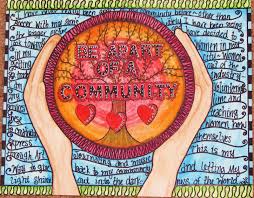
I would like us to be always in the process of becoming a community where relationship rests on a mature capacity to negotiate our differences face-to-face. For me conflict is inevitable in any healthy Christian community. By healthy, I mean a community where people engage with their passion in the task of worshiping together, loving each other and serving the world. Where passions are engaged strong feeling is always in play. I don’t fear strong feeling. My fear is to be part of a community of lukewarm feeling, where difference can be avoided because ultimately, nothing is important enough to fall-out over. Where the personal cost of leaving the community is so inconsequential because if we don’t like St Martin’s there’s always somewhere else to go; though evidence shows that when Episcopalians stop going to one church, we stop going to any church. 

Where two or three agree to gather

Our Gospel pericope (section of verses) ends with Jesus’ enigmatically speaking about agreement and gathering together in his name. Given that this comes at the end of a teaching on mutual accountability, agreement must refer to some form of common accord.

Does this mean that we have to agree with one another before we can gather in his name? Does agreement envision eradication of difference?  Because most Christian traditions stress theological agreement does gather together mean the fruit of theological agreement about what’s true and what is false? My answer to each of these questions is a resounding no!

Shared agreement is not available to Episcopalians. We can be likened to the Jews of the Christian world because the only thing we can agree on is that we don’t agree about much. What this actually means is not that anything goes, but that we are a communion, which is a word that signifies relationship rather than structure. We recognize that the world can be viewed through several difference lenses. We acknowledge that there are broadly speaking, several worldviews possible. We see no reason to pretend that these differences of worldview will not be reflected in our communities. It’s not shared truth, but common worship that holds us together. It’s within a communion of relationships we become accountable, i.e. lookout for one another.

Because of this, and in this way I believe we are able echo Matthew Skinner’s words:images-1

peering into autumn’s transitions, we [find that we] belong to one another

[1] http://www.rickmorley.com/

[2] http://www.davidlose.net/

Blog at WordPress.com.

Up ↑