Justice Deferred

Image: The Book of Job, William Blake

In her sermon two weeks ago, Linda+ introduced us to the recent series of OT lessons from the Book of Job, saying that the much-used statement “Everything happens for a reason” is one of the five cruelest words in the English language to someone who is suffering—right up there with “It’s all in God’s plan.

I’ve coined the term fable morality for the popular attitude that luck – the avoidance of tragedy in our lives is a sign of God’s grace. Linda+ asked: where are the blessings and the grace of God for your neighbor who has lost everything? You get grace and blessings, and they don’t? What kind of God allows that? What kind of God would do that? She concluded her introduction with Welcome to the Book of Job.

Welcome indeed!

We are mostly familiar with the story of Job – a non-Israelite yet righteous man – whose faith in God is tested in severe adversity. Job is so righteous that God boasts about him in the heavenly council – holding him up as an example of human faithfulness arousing the angelic adversary – the satan’s invitation to enter into a small wager. Here we make a curious discovery – that the Lord God is a bit of a gambler who likes nothing better than a flutter on the forces of fate.

God seems to have allowed himself to be manipulated by the satan with the expectation of a safe bet. Expecting a quick an easy win – the Lord is utterly unprepared for what happens next. At first Job responds as God expects. Twice he refuses to curse the Lord. But then Job does something God didn’t expect – he seeks an explanation as to why his life has taken this calamitous turn. In doing so he appeals to the Lord’s justice as the better side of the divine nature.

Here lies the central theme in the story: Job continues to insist on his righteousness while refusing to acknowledge that the sorry turn of events in his life is the result of sin. Job demands an explanation from God on the basis that the Lord is a just god. In insisting on justice as an essential attribute of the Lord God’s identity, Job exposes God’s betrayal of God’s own better nature.

There’s an old joke among preachers concerning a marginal note in the sermon text that reads – argument weak here so shout and pound the pulpit. From the voice within the whirlwind, God now tries to deflect Job’s questions with a display of pulpit thumping designed to intimidate and silence Job. Pounding the divine pulpit, the Lord roars -who are you to question me? Can you do what I’ve done? Were you there to see my power at creation? Do you know more than I know?

But Job is not questioning God’s power. For Job, God is God not simply because God is all-powerful. God is God because justice is an essential and integral aspect of the divine nature without which God cannot be God.

God begins to realize the bind he finds himself in. He cannot respond to Job in terms of justice because confident of quick victory in his wager with the satan – he has allowed a manifest and brutal injustice to be perpetrated on Job. Thus, God draws the robe of the power around himself – blustering and stomping about in the hope that Job won’t notice that God is changing the subject. Job lies in abject suffering while God waxes lyrical about creating crocodiles and whales.

In Chapter 42:1-6 we have Job’s response. Unlike his earlier speeches in self-defense – Job’s final response is brief and concise. Most English language Bibles use the following translation.

I know that you can do all things and that no purpose of yours can be thwarted. I uttered what I did not understand, things too wonderful for me, which I did not know. I had heard of you by hearing of the ear, but now my eye sees you; therefore, I despise myself and repent in dust and ashes.

All’s well that ends well – in other words with the explicit warning – who are we – mere mortal beings – to question the Almighty? Repentance before the Lord even in the face of what seems inexplicable injustice is the only acceptable response.

However, this traditional interpretation makes no sense and does serious violence to the integrity of Job’s complaint. Jack Miles in his revolutionary book God: A Biography offers a very different approach to interpretation. Miles justifies this by demonstrating how the traditional interpretation relies on a repentance gloss on the original Hebrew introduced in the 2nd-century Greek translation in the Septuagint. After his long and passionate presentation of his case before the Lord – Miles questions why Job would suddenly abandon his cause at the very end.

Miles contends that when freed from the presumption of the later Greek repentance gloss – the inherent ambiguity of the Hebrew suggests a very different translation of 42:1-6.

[You] know that you can do all things and that no purpose of yours can be thwarted. [You say] who is this that hides counsel without knowledge? Therefore, I spoke more than I realized. [You say] Hear and I will speak, I will question you, and you declare to me. [Ahh], I had heard of you by hearsay (the words of my comforters) but now that my eyes have seen you I shudder with sorrow for mortal clay.

Miles suggests that this translation fits within the larger context of Job’s consistent refusal to back down in the face of God’s attempt to intimidate him. What seems to upset Job at this point is the realization that if God insists on deflecting questions of justice with displays of power– then all humanity is done for.

Job may have been reduced to silence but so has God been silenced by being brought face to face with the internal tension between his better and darker selves. The Lord now seeks to avoid facing his inner conflict by restoring Job’s fortunes. In the Lord’s time-honored behavior when he realizes he has gone too far – he makes double restitution without admitting culpability. Might we see in this a hidden expression of divine remorse?

Throughout the historical development of the Tanakh the Jewish scriptures struggle to reconcile the unfettered exercise of divine power with the constraint of divine justice. In other words, how can the split nature of the divine be understood – for the Lord God seems to have a dark as well as a light side to his identity, or in Job’s words the Lord gives, and the Lord takes away; yet blessed be the name of the Lord.  

In the Psalms, we find the main divine assertion – I am the Lord whose power is made manifest through justice. Earlier in the Torah, we find Abraham repeatedly appealing to God’s better nature – invoking the attribute of justice as a necessary curb on God’s darker power-driven impulses. In effect, this is the argument Job now uses with God. Like Abraham, Job reminds God of the human expectations for God to live up to his assertion that divine power is made manifest through justice.

Accordingly, Jewish tradition understands that justice is imperfect – guaranteed by God but also at the mercy of his darker impulses. Time and again the Tanakh witnesses God’s justice winning over his power impulses. But as Job reveals this struggle is sometimes touch and go.

The encounter between God and Job has reduced both to silence. After the book of Job, the Lord God never speaks again in the Tanakh. In all the books that follow – God is either absent with the focus being on human interaction or heard through human repetition of God’s historical statements quoted from earlier passages in the Torah or the prophets. God makes a fleeting appearance in the book of Daniel but as the very remote and silent Ancient of Days.

The book of Job leaves a somewhat bitter aftertaste in the mouth.  Yes, God restores Job’s fortunes and doubles his prosperity, and his better self eventually wins out over his darker impulses. But as Jack Miles notes – no amount of compensation can make up for Job’s loss of his previous family and servants – all merely the collateral damage flowing from the misjudged wager with the devil.

As for the Tanakh’s image of divine justice – well it’s mixed. In the books that follow Job, the simplistic fable morality – God rewards the good and punishes the bad – reasserts itself. We do find attempts to deal with unpredictability with the assertion that God will do neither good nor bad – somehow remaining detached and impartial. Only in the book of Job do we encounter a groping after a deeper and more paradoxical wisdom– that the lord will often do good but sometimes do bad. Justice is imperfect. From now on Job not only knows this about the Lord, but the Lord cannot escape knowing this about himself.
Liminal Times: Job a meditation

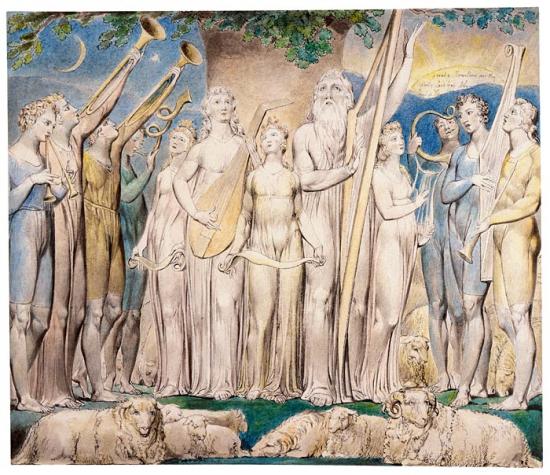
Image: Job and his family restored, William Blake. The Morgan Library & Museum

At St Martin’s, we find ourselves between the joyful celebration of the success of Opening Our Doors to the Future – the capital campaign and the launch of our Annual Stewardship Drive for 2022. The capital campaign – beyond dollar amounts raised – is an expression of confidence from our current members in the future of St Martin’s. Next week, we will officially launch the stewardship drive for 2022. Over the course of its five-week duration, we will be asking our membership to review and renew their estimate of giving so that we can effectively plan for 2022, our 125th year.

However, this review and renewal process asks us to reflect on the question: can we let our imaginations become tools through which God’s dreaming for the world can flow more freely into our world?

We find ourselves in what Susan Beaumont in her insightful book How to lead when you don’t know where you are going –described as a liminal season. A liminal season is a shoulder season – a time in-between. How do we proceed when between an ending and a new beginning—when the old way of doing things no longer works but a way forward is not yet clear?  It’s not only in the church but as a wider society we find ourselves in a liminal time when the continuity of tradition disintegrates and uncertainty about the future fuels doubt and chaos. In a liminal season it simply is not helpful to pretend we understand what needs to happen next. Prophetic words for us in this moment of history.

St Martin’s endeavors to occupy a place of tension weathering the uncertainty of the times through a commitment to traditional worship combined with a radical theological messaging that recognizes and attempts to speak into the uncertainty of the times. We are all watching the stalwart generation of faithful members pass on to the next great adventure and wonder who is coming up behind them to take their place? Our fear that we are on a trajectory of decline fills some of us with despair while provoking in others a manic attempt to delay what we all fear is inevitable.

In last week’s sermon I offered a sweeping overview of the essential themes found in the book of Job – a book that offers one of the most profound explorations of the nature of human suffering in the face of a God who often seems to us uninterested in our plight – a God who from our experience remains silent in the face of humanity’s age-old question concerning suffering – why?

In today’s Job portion we hear him exclaiming:  Oh that I knew where I might find him, that I might come to his dwelling. We might read this sentence as Oh what I wouldn’t give to know that God is really there. Words that remind us of the partial nature of our knowledge and the narrowness of our vision.

Our vision is clouded with self-preoccupation and protests of self-importance – cutting us off from the divine energy for renewal. So much of our vision – both individually and in community is hedged-in by our need for reassurance. We strain to hear a false note of security – a grasping for knowledge as a defense against the uncertainties of the future.

Job continues:

I would lay my case before him, and fill my mouth with arguments, I would learn what he would answer me, and understand what he would say to me. Would he contend with me in the greatness of his power? No; but he would give heed to me. There an upright person could reason with him, and I should be acquitted forever by my judge.

Eventually, God will respond to Job in rhetorical metaphors that expose the human dilemma; we cannot know what we feel we need to know. We fill the vacuum in our knowledge with simplistic answers such as leading a charmed life is a sign of God’s favor and suffering means God’s punishment or abandonment. Feeling alone and abandoned in an indifferent universe – we cast ourselves even further adrift when concluding that because our suffering is not instantly alleviated – we are not given the miracle we demand, we cease to matter to God.

In the end, God responds to Job by effectively sidestepping his complaint. God will not meet Job’s complaint by justifying divine action or inaction. Instead, we will hear God reminding Job of the paradox of his quest for omniscience -to know the entirety of things:

Where were you when I laid the foundations of the world? Tell me if you have understanding who determined its measurements – surely you know! Who laid the cornerstone when the morning stars sang together, and all the heavenly beings shouted for joy?

We cannot know the entirety of things. We cannot know the future except in outline – glimpsed through a glass darkly. Yet, journeying into the future has never required us to know where we’re going. Oh, I know we like to pretend that we often do, but, we have never known the future before it arrives. In this lies grounds for hope. Instead of being preoccupied with our own construction of a future of either doom and gloom or of false and brittle certainties – can we let our imaginations become tools through which God’s dreaming for the world can flow  with greater freedom?  Our future lies in the mind of God and always has done!

If we learn anything from the serious practice of a spiritual life, God’s surprises are so much more exciting and fulfilling than anything – when left to the impoverishment of our own imaginations -we could predict or plan for ourselves.

Between the Job of the prologue and the Job of the epilogue lies the experience of his suffering. Job’s is not an experience of senseless suffering although through protest he demands for God to show him its meaning.

God never gives Job an answer to his insistent question why. Many see in this refusal to satisfy Job’s demand a suspicion that maybe God can’t give Job a satisfactory answer. Nevertheless, between beginning and ending lies the experience of change and being changed – albeit by something pretty awful. Maybe this is the purpose of Job’s suffering – a catalyst for change.

In the beginning, before Job has everything he cherishes taken from him, he believes that his prosperity reflects his own greatness. In this he is a great icon for many of today’s obscenely wealthy 1%-ters. The book ends with God’s restitution to Job not simply of the original wealth taken from him but of a magnification of that wealth tenfold. But Job is not the same man he was before. Suffering has changed him, and he now understands his wealth as a sign not of his greatness, but of God’s. His wealth is no longer his, but a sign of God’s generosity.

Job’s response to God’s generosity is gratitude. How might any of us express our gratitude? By a dedication and commitment to live in turn, with greater generosity.

Job now does something unheard of – as a sign of his gratitude for all he has he rewrites his will – settling portions of his estate on his three daughters as well as his male heirs. In the time in which this story is set, this action would have been unthinkable -beyond the capacity of the ancient imagination.

Can anything be a clearer demonstration of job as a changed man?

Living amidst the uncertainties, the fear, doubts, and violence of a liminal time, we might pay greater attention to our part in the unfolding of God’s dream for the world. The flow of God’s dreaming for the world requires only two things from us. The first is a capacity to be endlessly curious in the face of doubt and fear. And the second is a willingness to be changed in the direction of becoming more fit for God’s purpose!

Can you love what you cannot control?

The Wisdom genre of writing in the O.T comprises the book of Wisdom, Ecclesiastes, and the book of Job. On the whole, the book of Wisdom presents a conventional view of: do good and you will be rewarded, do bad and you will be punished. Ecclesiastes has a more complex and nuanced view which challenges the book of Wisdom’s more simplistic conclusions. Ecclesiastes views the universe as unpredictable. Bad things happen to good people just as good things happen to bad people, and there is no clear explanation for why this is so. This more nuanced perspective raises a core conundrum: can we rely on God to be both wise, and just? It’s this conundrum that the book of Job addresses.

The author of Job is an Israelite writing at a date that is difficult to determine. However, the point here is that he is drawing on a much older non-Israelite story about a man called Job who lived in Ur –  city of the Chaldeans, which in today’s topography is located somewhere between Damascus and the Euphrates. The book’s prologue and epilogue seem to hang together, both written in Hebrew prose and at first sight offer a simplistic morality more in keeping with the Book of Wisdom. The core of the book between prologue and epilogue is written in the most exquisite Hebrew poetry; the complexity and obscurity of which has posed a serious challenge for any translator.

Job’s story begins in mythical time in the realms of the heavenly conference involving God and the more important angels. In this conference, God boasts about his servant Job, praising him for his faithfulness. The angel known as the Satan which means  accuser, questions God’s assessment of Job.  Satan basically says let me test Job and you will find out that he’s not as faithful as he pretends because once his prosperity is challenged he will curse God. God gives the Satan his wish. He can visit any disaster upon Job so long as he stops short of taking his life.

The prologue presents Job as an ancient embodiment of today’s 1%. He is rich beyond imagining.  He’s a successful market trader – having made prudent investments including making regular propitious sacrifices to God. Suddenly, his whole livelihood is devastated by a huge earthquake which not only destroys all his property but kills livestock, servants and his children. Only Job and his wife are spared. This calamity is followed by a series of physical afflictions, reducing Job to a whimpering heap of festering sores.

At first, Job continues to praise God, and even though eventually he laments the day of his birth, he refuses to believe that God has abandoned him.

From left stage there now enter a couple of Job’s good friends. They tell Job that God is just, and the world is ordered by divine justice, ergo Job must have done something wrong to be so punished by God. His friends faithfully visit Job and try to comfort him in his afflictions.

We can get a sense of how Job’s friends felt when we consider our own experience of supporting a close friend through a period of suffering. After a while, the burden of witnessing pain we are powerless to alleviate plays on our own fears. We find ourselves subtly distancing ourselves from our friend’s suffering by finding an causal explanation for their suffering. This way we can  convince ourselves that because our situation is different then their plight won’t befall us. We may even resort to: after all so-and-so has only themselves to blame, they should have exercised more, drank less and eaten more healthily.

Despite continuing to feel sympathy, it’s comforting if we can assign agency for suffering to something our friend may or may not have done. We might also need to distance ourselves from their experience for the opposite reason – that we fear that this is indeed something that could easily befall us. The reminder of this can be so frightening that we may sever all contact with a once dear friend.

Job’s friends need to find an explanation for Job’s life falling apart. The most obvious one for them is provided by their conventional morality of divine justice – God does not punish the innocent, only the guilty They work hard to get Job to admit his sin. Job vehemently protests his innocence, not only to his friends but also to the Almighty.

As the first two friends are about to give up on Job as a lost cause a new friend arrives. He’s a younger man, full of the untested confidence of youth. He advances a new and novel idea. God is not punishing Job for sin but testing his faithfulness by purging him of ego – God does not regard any who are wise in their own conceit[1].

He continues to persuade Job for the next several chapters and finally, not only has Job had enough, but it seems, God has as well. Dismissing the arguments of the young friend God demands: Who is this who darkens counsel without words of knowledge?[2]

Now, God finally addresses Job directly. Job’s complaint all along has been -how can a just God act so unjustly towards him? God counters with shall a faultfinder contend with the Almighty[3], pushing Job back on the defensive.

God now addresses Job from within a whirlwind saying: gird up your loins like a man for I now wish to question you[4].

God takes Job on a virtual tour of the universe asking him: were you present at the birth of creation? Did you bring order to the universe, have you seen this, been there, done that, and do you know how it all works? Do you claim to understand the complexity of the universe as if you are able to keep it all in good working order?

It’s curious that God does not defend the idea of divine justice but asserts divine sovereignty in the face of Job’s accusations.

The upshot of God’s response to Job is that Job cannot claim to understand anything God does, including the inexplicability of suffering. What may look like an injustice to Job, is from God’s wider perspective simply part of a larger and richer whole encompassed within divine wisdom, something beyond Job’s capacity to understand. And thus, we arrive at the final chapter of the book with Job acknowledging the foolishness of his demands to know all that God knows.

When we are faced with something beyond our understanding, we have alternative choices to make. we can pull back, stay safe, and simply resign ourselves to the inexplicability of God’s will. Or we can reject such a God who would do this thing abandoning ourselves to the meaninglessness of the universe. Or we can treat that which is presently beyond our understanding as an invitation to arouse our curiosity and allow ourselves to be subtly changed not by the answers we receive but by the questions we ask.

Something has shifted for Job and he now embraces that which seems beyond his understanding with curiosity. A new perspective opens for Job from which to view his experience of suffering. Throughout this whole terrible experience, Job has been so fixated on protesting his innocence and calling God to account, he has failed to notice that the experience of suffering has been slowly changing him. Having his whole world blown to smithereens transforms Job so that faced with God’s sovereignty he is able to now confess:

I had heard of you by hearing of the ear, but now my eye sees you: therefore, I recant – give up my demand – for I am only a creature that lives among dust and ashes.

Job’s experience is now reframed by his knowing that he is both at the center of God’s concern, yet, at the same time, only one speck of dust within the enormous complexity of God’s perspective. He may be no wiser as to why he has had to suffer but he knows that God has never abandoned him.

The lethal development for any of us is to conclude that because we don’t get an instant alleviation of our suffering – we are not given the miracle we demand, we cease to matter to God.

For Job, and for us also, this is both a thrilling and terrifying discovery. Like Job, it’s hard for us to sit in the tension between knowing that God loves us, utterly, and the recognition that we are powerless to control so much that happens in our lives and our world. The book of Job raises many theological and existential questions to which God in the end gives no where near an adequate account. In the Tanakh – the Jewish canon of scripture equivalent to the Christian Old Testament, God’s address to Job is the last time God speaks. In the books that follow Job, God is forever silent. The rabbis conclude that it is not God who has silenced Job, but after eliciting God’s blazing self-defense it is Job who has finally silenced God.

We now come to what appears to be a happy-ever-after ending as God restores all Job’s losses tenfold. This is a jarring conclusion to what otherwise is the most profound exploration of the relationship between human suffering and God’s justice. It’s seeming simplistic message and the return to the prose style of the prologue has led commentators to see this as an ending tacked on to the original story because, after all, don’t we all like happy endings?

Literary analysis shows that the prose style of the opening and closing scenes in the book of Job belong to a separate more simplistic story. The core of the book – written not in prose style but complex Hebrew poetry is a later insertion – an attempt to deal in a more complex way with the meaning of suffering.

That being so, what appears to be a happy ending gloss-over nevertheless raises some profound questions. It strikes me rather like a reboot of the story. Using the analogy of downloads on our computers, the more significant downloads, the ones that reconfigure aspects of the operating system require a complete machine reboot to take effect.

This traumatic destruction of Job’s whole life and all he thought he could take for granted has changed him and now requires a reboot to take effect. Job is newly restored to even more good fortune. But Job in the epilogue is not the same as Job in the prologue. He is a man who now understands the nature of abundance as a the generosity of God and not simply his reward for good behavior and the offering of propitious sacrifices.

It’s a common human experience that only after we lose something do we come to understand its true value. In short, for the first time Job now understands that God’s generosity is given not earned. If we apply this insight to our own lives we can appreciate the significant shift in self-understanding involved.

This takeaway has a particular meaning for us on the day we are also gathering to give thanks for the success of our recent capital campaign. It’s also a reminder as we look ahead to the launch of our annual stewardship drive in two week’s time. God’s renewal of Job’s prosperity is an unearned gift, for which Job feels a new intensity of gratitude towards God. In response, Job commits to live with greater generosity in the way he uses his wealth. So also must we.

In his reboot, Job now comes to mirror God’s expression of generosity.  He gives his three new daughters evocative names which translate roughly as Dove, Cinnamon, and Rouge-Pot. He settles on them the same inheritance as he settles on his sons; something completely unheard of in ancient Israel.

The central question that arises for us today from the book of Job is this: Can you love what you do not control and still risk living with a spirit of generosity? It is a question worth pondering. Perhaps you have only to think about your children to know what your answer is.

[1] V37:24

[2] V38:2

[3] V40:1-2

[4] V40:6

Blog at WordPress.com.

Up ↑