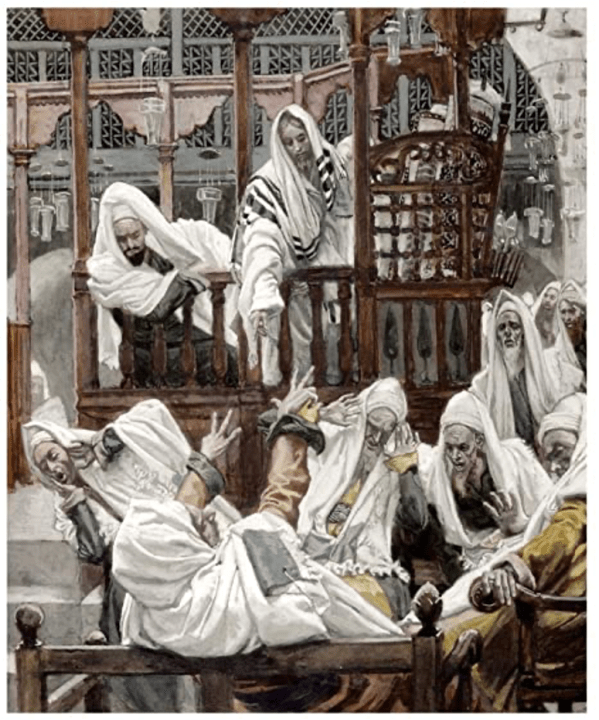
Image: Tissot- The woman with an infirmity of 18 years
Asked in an interview on the podcast Unholy Things on August 5, 2025, the Israeli historian Yuval Noah Harari was asked: October the 7th, 2023, till now, where does that fit – is it a footnote or a chapter in the sweep of Jewish history?
Listen here
Harari responded: I think it’s one of the – could be one of the biggest turning points in Jewish history- maybe the biggest since the fall of the temple in 70 CE – since the Roman conquest. Because Judaism has survived it became the world champion in surviving catastrophes, but it never faced a catastrophe like we are dealing with right now which is a spiritual catastrophe for Judaism itself because what is happening right now in Israel could basically – I think destroy, void, 2000 years of Jewish thinking and culture and existence. That the worst case scenario that we are facing right now – what we are facing is the potential of an ethnic cleansing campaign in Gaza and the West Bank resulting in the expulsion of 2 million maybe more Palestinians; the establishment of greater Israel and the disintegration of Israeli democracy; the creation of a new Israel which is based on an ideology of Jewish supremacy and on the worship of what were completely anti-Jewish values for more than last two millennia; a country based on the worship of power and violence and which is militarily strong – it will survive – it will be militarily strong – it will have alliances with various bullies around the world. It will also be economically viable, and this will be the spiritual disaster because this will be the new Judaism that all Jews in the world will have to deal with. It will not disappear again. Jews are very good dealing with catastrophes from the Roman conquest to the Holocaust but this will not be a military catastrophe. The state will actually be successful in military and economic terms and it will make the challenge much, much bigger. No Jew, say, in London or New York or anywhere else, we’ll be able to say this is not the real Judaism.
There is one episode in the iconic TV drama, The West Wing, that is forever etched in my memory. The background to this particular episode concerns the President being asked to pardon a man awaiting execution on death row. Attending Shabbat Service, Toby Ziegler, the White House Chief of Communications, is puzzled by the rabbi’s sermon, in which he states that vengeance is un-Jewish. Puzzled, Toby questions the rabbi about the Torah teaching – an eye for an eye. He reminds the rabbi that throughout Exodus, Leviticus, and Deuteronomy, the Torah prescribes the death penalty for a large number of offences, mostly religious in nature. The rabbi replies that maybe the Torah sanctioned death penalty represented the best teaching at that time, but that the later rabbis in the Talmud went to great lengths to confine the meaning of the Torah texts to forms of reparation that did not require death. Jewish thought moved on as it deepened, over time, the human understanding of God’s justice and mercy.
Jewish thought moved on as it deepened, over time, the human understanding of God’s justice and mercy.
In Luke 13, we eavesdrop on an encounter between Jesus and religious authority over the case of a woman Luke describes as seriously crippled. Actually, crippled is a rather smooth English rendering that does not do justice to the specificity of Luke’s use of the Greek synkypto, which means bent together– as in doubled over. The woman is more than crippled – she appears to be suffering from a form of spondylo-arthritis known as Marie-Strümpell Disease.
Imagine for a moment the experience of being doubled over. Imagine what happens to your breath as the doubling over of your spine constricts the movement of your lungs. Imagine having this condition for 18 years.
Noticing the woman, Jesus stops proceedings by placing his hand on her and saying, “You are released from your weakness.” She immediately straightens and gives glory to God. Cause for rejoicing all around, you may think? Not a bit of it. Jesus’s action has provoked fierce indignation as the leader of the synagogue accuses him of breaking the Sabbath.
Last week, I spoke about the role of non-violent resistance in Jesus’ ministry, and here Luke presents an instructive example of this in action. The encounter with the woman bent over is not a story of miraculous healing from infirmity – an action the synagogue leader suggests would be more appropriate for the other days of the week. However, Jesus does not say, “Woman, be healed from your infirmity“; he says, “Woman, you are set free from your ailment.” The question here is, what ails her? Or, more accurately, what is the source of her ailment? In other words, this is not a story of healing at all. Its a story about exorcism.
In the spirit of non-violent resistance, Jesus confronts the religious leadership with the central question: ought not this woman, a daughter of Abraham who Satan bound for 18 years, be set free from this bondage on the Sabbath Day? Notice how Jesus reframes the context – reminding the synagogue leader of this woman’s status in the community as a daughter of Abraham. He also throws in the reference to satanic binding – implying a connection to the Sabbath Day. In other words, Jesus is signalling that his diagnosis of her condition is spiritual and not physiological.
This is a story of two encounters – with the woman and the religious authorities. In his reference to satanic binding, Jesus is exposing what’s really going on behind the smokescreen of religion. The symbolism here is of a woman doubled over under the weight of the religious-inspired collective moral judgment upon her.
The authority exercised by religion, in this story, has become a smokescreen to obscure the fear-driven hardening of the human heart? For the ancients, and even for us today, fear of illness motivates moral judgment as an attempt to explain away our fear of what we either do not understand or are unable to control.
Why has Jesus identified the woman’s condition as satanic binding? The French philosopher, René Girard, states it neatly -Satan exists, [only] because we exist. By this, he means that evil is an anthropological – a human, cultural construction, not a cosmic rival to the victory of God.
In religious tradition and its institutions, evil is to be found in the hardening of the human heart, which privileges the protection of human power – a universal tendency to resist the continual reshaping by the demands of divine justice and mercy. If there is a judgment to be borne, then it’s that we are all found wanting when faced with the judgment of God’s justice and mercy.
Here, we come back to heart of the matter in Luke 13: 10-17 where we find in Jesus’ confrontation with the synagogue leadership a foretaste of both later New Testament and rabbinic traditions that came to understand that it is compassion and mercy not vengeance that lies at the heart of divine justice.
By his reference to Satan’s binding, Jesus is drawing attention to the spiritual effects of the weight imposed upon an individual when religion as the defense of human hard heartedness. In other words, he’s saying to the religious authorities, what can be more appropriate than on the Sabbath Day – to liberate this woman from the satanic bondage you’ve imposed upon her by your perversion of religion as a smokescreen for the hardness of your hearts?
Toby Zeigler’s rabbi reminded him that Jewish thought is continually evolving, deepening over time, the human understanding of God’s justice and mercy. Harari’s words are a fearful warning about the spiritual and moral consequences for Israel in departing from this 2000-year line of development- and by extension – his words are a warning to us of the immanent spiritual and moral dangers in this current American political landscape as religion becomes contaminated by political ambition and the perversion of nationalist aspiration.
The question we always need to ask is: how is religious tradition being used? Is it being used to imprison or to liberate? Is our Christianity a conduit for a deepening of our understanding of mercy at the heart of God’s justice, or is it a smokescreen obscuring the hardening of the human heart? When hearts harden, all kinds of violence and cruelty become justifiable.

 Relationalrealities