Choosing the Right Storyline

All we have are the stories we construct to explain the world both to ourselves and to one another. The creation of narrative is the essential building block for discovering meaning and developing purpose. Any cursory Google or web search will reveal the considerable neuroscientific evidence in support of this assertion. For example – neuroscience researchers have repeatedly found that reader attitudes shift to become more congruent with the ideas expressed in a narrative after exposure to fiction (Green & Brock, 2000; Prentice, Gerrig, & Bailis, 1997; Strange & Leung, 1999; Wheeler, Green, & Brock, 1999).

The current profusion of online disinformation and conspiracy theories proves that there is always more than one way to tell a story, and the way you tell it influences beliefs and behaviors. Our awareness of competing stories increases the accuracy of our experience—to use a current slogan—there are facts, and then there are alternative facts. It’s vital to be able to distinguish between restrictive and toxic stories that restrict our capacity for creative responses and expansive stories that encourage creativity in our encounters with the world around us. We develop accuracy of perception, clarity of meaning, and purpose as we select between competing narrative storylines because it’s vital to know which storyline we are participating in.

The power of a storyline rests on its capacity to attract our attention and command our allegiance. We may construct a storyline to make sense of the world as we experience it, but once we do so, that storyline has the power to own us. The question of the current moment is, among competing storylines available to us, which storyline will we choose to believe? From among a bewildering choice of possibilities, which stories will command our allegiance?

With the spread of online information, the question of which stories we allow to shape our perceptions of reality is the question of the moment. We might be surprised to learn that this is not only a modern problem.

Palm Sunday offers a snapshot of competing storylines from Jesus’ last week in Jerusalem before the Passover and his crucifixion. On Palm Sunday, we witness a clash of competing storylines that are particular to Jesus’ 1st-century setting yet are also universal – timeless.

There is the storyline of sacred violence as the storyline of empire – that is – the unrestrained exercise of power to dominate and subjugate. From Rome to Rule Britannia, from the European legacy of colonial violence to the revival of Putin’s dream of the Russian imperium – not to forget to mention here the legacy and current ugly resurgence of American manifest destiny – the storyline of empire repeats endlessly across time.

Then there is the storyline of populist nationalism with its blood-socked dreams of liberation. On Palm Sunday the waving of palms was a significant echo from Jewish-nationalist collective memory. For some 160 years before, the triumphant Judas Maccabeus, the last leader of a successful Jewish revolt against foreign domination, led his victorious partisans into the Temple – which the Hellenist tyrant Antiochus Epiphanes had defiled by placing his statue in the Holy of Holies. Using palm branches, the Maccabean partisans cleansed and rededicated the sanctuary after its defilement. On entering the sanctuary, they discovered miraculously the last light of the Menorah still burning – an event Jews, today, celebrate in the festival of Hanukkah.

On Palm Sunday, this more recent Jewish storyline of national liberation found a powerful amplification in Israel’s more ancient founding story of liberation—commemorated in the festival of the Passover.

Inhabiting the amplified storyline of national liberation, the crowds ecstatically welcome Jesus into the city. They have yet to discover that they have chosen the wrong storyline. But they will do so – and rather quickly, with the result that they will pivot from exuberance to disillusionment and anger over the course of days. Jesus may be the Messiah, but his messiahship is part of a third storyline—that of the dream of God’s salvation, not of Jewish national liberation.

Casting our mind’s eye over the competing storylines converging on Palm Sunday, we observe that at the same time as Jesus was entering the city from the east, a second triumphal entry procession wound its way into the city from the west. The Roman Prefect, Pontius Pilate, at the head of a militia made up mostly of Samaritan mercenaries, had also come up to Jerusalem for the Passover.

As Prefect, Pilate was a vicious yet relatively low-level regional administrator who reported directly to Vitellius, governor of the Province of Syria. Each year at the Passover, Pilate came up to Jerusalem – forsaking the sea breezes of Caesarea Maritima— Herod the Great’s former capital and now the administrative center of the Roman occupation of Judea.

Pilate loathed and feared Jerusalem’s ancient rabbit warrens seething with civil and religious discontent. He most feared the pilgrim throngs crowding into the city for the Passover, swelling the city’s normal population of between 20-30,000 to over 150,000. The stability of Roman imperial rule required Pilate to come up to the city with a show of preemptive force to forestall any potential for insurrection.

Passover was Israel’s founding story of liberation from slavery. Pilate’s arrival was indeed a wise move, for the crowds hailing Jesus’ arrival were in insurrection mood. Being caught, as they would soon discover, in the wrong Messiah storyline—would have dire consequences for Jesus.

In the week leading to the celebration of Passover, we see with hindsight the lethal intersection of these three competing storylines – of imperial domination and political violence intersecting with populist resistance and longing for national liberation – both confronted by the next installment in the epic storyline of God’s love and vision for the world-through-Israel. This clash of storylines results in a chain of events that takes an unexpected turn – rapidly spiraling out of everyone’s control.

Emotionally and spiritually bloodied by our passage through the snapshots of Holy Week violence, we will eventually arrive at a different story – a new story – a bigger and better story – the unlikely story of Easter. Yet, on Palm Sunday, we’ve some way to travel before arriving there.

Holy Week is when we accompany Jesus on his journey to the cross. For some of us, this can be an intensely personal experience as our own experiences of loss and suffering – our passion – surface in identification with Jesus. For most of us, however, the nature of our Holy Week experience is less personal and more communal.

As liturgical Christians, we journey with Jesus as a community – each liturgical step along the way. Each snapshot is a prism refracting our own individual suffering and our identification with the overwhelming suffering of the wider world – an experience amplified by events in 2025.

Liturgy transports us together through sacred time. In sacred time, there is no past and no future, only the eternal now. Here, our individuality dissolves as we become participants in the events that engulf Jesus, erasing separation across time and then becoming now. As I’ve mentioned, we are no strangers to the storylines of sacred violence and national populist yearning for a messiah.

Choosing the right story to explain the world to ourselves is crucial. Choosing the wrong story leads only to disillusionment and rage.

Like the crowds praising Jesus as he entered the Holy City, we enthusiastically hail our next political savior until that is, – he or she no longer is.

We long to do the courageous thing – until that is, the moment when we don’t.

In sacred time, we become participants with Jesus—as if we were part of his band of disciples during this eventful last week. With them, we will share in the breaking of Jesus’ Passover bread and drink from his Passover cup. With them, we will accompany Jesus to the Garden of Gethsemane, where we, too, will fight sleep to keep watch with him through the night and early hours of Friday morning. With them, we will follow Jesus on the way of his suffering to the cross. For like them – we will long do the courageous thing – until the moment when we we won’t.

History does not exactly repeat itself, but it certainly rhymes.

An Ending or a Beginning?

Palm Sunday commemorates Jesus’ triumphal entry into the Holy City of Jerusalem. I’ve italicized triumphal because it’s all a matter of perspective. Is it a triumph or the prelude to disaster? If it’s a triumph, then a triumph for whom – Jesus or the crowds?

At a luncheon given by the Lord Mayor of London in November 1942 in celebration of Field Marshall Montgomery’s victory at El Alamein, Prime Minister Winston Churchill was the star guest. For those of you who are not World War 2 history buffs, El Alamein is the small oasis town on the Egyptian-Libyan border where after a series of defeats and retreats British and Empire troops dealt the decisive blow in the North Africa Campaign – paving the way for an eventual Allied invasion of Italy.

Churchill – the consummate wordsmith captured the mood and significance of the moment when he told the assembled guests in the Mansion House:   This is not the end. It is not even the beginning of the end. But it is, perhaps, the end of the beginning.

It’s interesting to hear in the archival recording of his speech the ripple of nervous laughter among those present. With hindsight, we hear Churchill’s words as prophetic. But to those present on this occasion they must have seemed tantalizingly enigmatic – hence the ripple of nervous laughter. For at the time – who could have with any certainty predicted the outcome of the war?

So, here’s another question. Is Palm Sunday the beginning of the end or the end of the beginning in Jesus’ campaign of non-violent resistance?

It’s important to explain the application of the term non-violent resistance to the Jesus movement – after all, it seems such a modern concept more associated for many of us with Gandhi and MLK Jn.

Some of us will be familiar with the book The Last Week by John Dominic Crossan and the late Marcus Borg – in which they chronicle events as recorded in Mark’s gospel of Jesus’ last week before the crucifixion. In God & Empire: Jesus against Rome, Then and Now, Dom Crossan explores the development of the Jesus movement as a movement of non-violent resistance.  In contrast to John the Baptist’s movement of expectation – of the inbreaking of God’s kingdom, Jesus’ is a movement of action in recognition that the kingdom is already here.

Crossan hypothesizes that with the Baptist’s execution at the hands of Herod Antipas, nothing changed – the kingdom did not come sweeping in – leading Jesus to conclude that God’s kingdom was already here and what was required was not humanity waiting for God to act but collaboration between God and human agency giving shape to the kingdom within human history. This collaborative kingdom unfolding in real time was a movement of non-violent resistance to the forces of empire – an expression of God’s opposition to the forces that impose and maintain peace through violence.

Jesus was led to the realization that the nature of the kingdom must be different from the one John expected and that non-violent resistance was its hallmark.

Jesus grew up in a world of unspeakable violence. His was a world in which the cycle of violent resistance to occupation provoked an even more devastating response from the forces of empire – a cycle all too reminiscent of the situation in present-day Gaza and the West Bank. Growing up in Nazareth, Jesus would have learned the painful lesson of the ultimate futility of violent resistance. His childhood would have been shaped by hearing the stories of the calamity of 4BC when after the death of Herod the Great the Jews’ fear of a full Roman annexation sparked a series of violent revolts across the Jewish homeland.

In response, Varus, the Roman governor in Syria, led the Roman Legions south. Sweeping through Galilee they burned towns and villages and slaughtered men of fighting age along with the elderly while enslaving women and children. Galilee’s capital Sephhoris was pillaged and burned. Sephhoris was only an hour’s walk away – just over the ridge from Nazareth.

Jesus did not experience the calamity of 4BC as it was only after Herod’s death that the Holy Family returned from exile in Egypt. But he would have grown up in a community that had. For the people of Nazareth 4BC was not a distant memory but a painfully visceral recent experience.

Passover seems to have been the catalyst for Jesus taking his movement of non-violent resistance to Jerusalem – moving to the heart of where the action was happening. Now non-violent resistance does not – it seems for Jesus to have meant non-provocative resistance. Quite what Jesus expected to happen, he nevertheless chose to enter Jerusalem in the most provocative of ways – that is – by acting out the prophet Zechariah’s messianic prophecy: Shout aloud, O Daughter of Jerusalem! Behold your king is coming to you ….. riding on a donkey, the colt of a foal.

We can’t know with any certainty what was in his mind. Certainly, we know the mind of the crowds who greeted him. Remember, Jesus had been several days in Bethany – a stone’s throw from Jerusalem – and news of him must have spread like wildfire among the pilgrims pushing the city’s population to three times its normal size. Overcrowding and a growing frenzy of rumor and expectation raised the mood in the city to a fever pitch.

The echo of collective memory gives color and meaning to actions in the present. The waving of palms was a gesture from Jewish collective memory and tells us something about the popular expectations for Jesus. Some 160 years before, the triumphant Judas Maccabeus, the last leader of a successful Jewish rebellion against foreign occupation, led his victorious partisans into a defiled Temple. Bearing palm branches they cleansed and rededicated the sanctuary after its defilement by the Syrian tyrant, Antiochus Epiphanies – an event commemorated today by Jews in the festival of Hannukah.

The waving of palm branches tells us something of the crowd’s expectations of Jesus as another national liberator, who in the mold of Judas Maccabeus had come to free them from the hated Roman occupation. What seems perplexing is how Jesus seems to play into this expectation only to turn jubilation into raging disappointment days later.

At the same time as Jesus was entering from the East, a real triumphal entry procession wound its way into the city from the West. At the head of his Roman Legion, the Roman Procurator, Pontius Pilate had also come up to Jerusalem for the Passover.

Pilate feared Jerusalem’s ancient warrens seething with civil and religious discontent with some justification. His Administration preferred the sea breezes and modern conveniences of Herod the Great’s former capital at Caesarea Maritima just south of modern-day Haifa. Pilate feared the crowds most during the Passover which required him to come up to the city with a show of preemptive force to forestall the ever-present potential for insurrection. Passover was an extremely dangerous time. It commemorated the Jewish collective memory of liberation from an earlier period of slavery. Pilate’s arrival was indeed a wise move, for the crowds that hailed Jesus, were in insurrection mood.

Returning to the earlier question – is Palm Sunday the beginning of the end or the end of the beginning in Jesus’ campaign of non-violent resistance?

What we do know is that in Holy Week the storyline of worldly oppression and political violence intersects with a storyline of populist resistance – of nationalist longing for liberation no matter the cost. Both are storylines of violence being confronted by a third storyline – that of non-violent resistance -the recognition that God’s kingdom has already arrived and is unfolding through the collaboration between human agency and the divine purpose. The collaboration between human agency and divine purpose is the theme we will return to on Easter Day.

We already know that Holy Week is not the beginning of the end but the end of the beginning for Jesus. Nevertheless, we journey with Jesus transported by the liturgies of Holy Week. For some of us, this will be an intensely personal experience as our own experiences of loss and suffering – our passion surfaces in identification with Jesus. For others, the nature of our Holy Week experience is less personal and more communal. We journey with Jesus as part of a community that journeys to the cross carrying and bearing witness to the violence, pain, and sufferings of the world of the 21st century.

Liturgy is a form of dramatic reenactment that transports a community through sacred time – a dimension of experience beyond chronological time. In sacred time the past and future conflate into the present, where through liturgical action we become more than passive bystanders. We become participants in the timeless events that shaped Jesus’ last days.

Historical associations in sacred time trigger memory in real-time giving voice and expression to our contemporary experiences. You see, human beings don’t change much over time. The tensions we see acted out in the events of Holy Week are the very tensions we continue to struggle with today.

And so, like the crowds praising Jesus as he entered the Holy City, we enthusiastically hail our next political savior -until that is – he or she no longer is. Like those accompanying Jesus in his last week, we long to do the brave thing – until that is, – the moment when we don’t.

Fickleness of Crowds

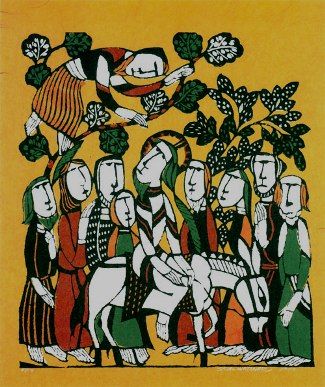
Featured Image: Entry to Jerusalem, Sadao Watanabe

There is something mysterious about crowds. Being part of a crowd can be an exhilarating escape from our individual sense of isolation and helplessness. In crowds we find an experience of shared solidarity. An experience of mass protest builds networks to support ongoing action when we return to the sphere individual life. Crowd experiences can become an in-the-moment expression of the more expansive currents of aspiration and longing for change.

But there is also something menacing about crowds. Being caught up in a mass mind-meld can be frightening. Crowds morph in the blink of an eye from peaceful protest to violent action. The journey from exuberant celebration to mass hysteria can be a very short one. We are right to fear being caught up in the experience of mass manipulation when an unscrupulous and skillful orator stokes our fears. Fear-stoked messages become conduits for the surfacing of repressed collective memories and imagined grievances – an experience that we in America are all too familiar with.  

Crowds become the conduits for the resurfacing of shared cultural and historical storylines. It matters greatly which storylines echo through a particular crowd’s collective awareness.  In short crowds can be fickle.

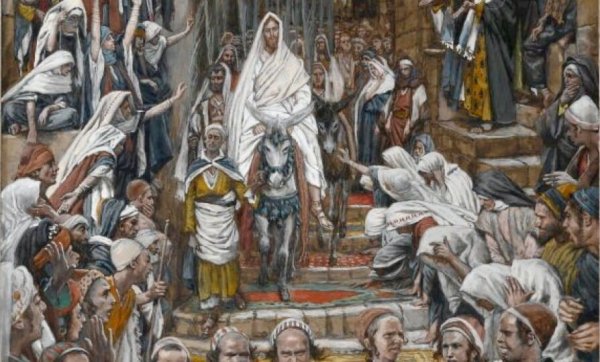
He had come to celebrate the Passover. Having traveled from Bethany, Jesus entered Jerusalem through the East Gate to the wild acclaim from the crowds that greeted him. They stripped the fronds from the palm trees to lay them as a carpet before him as he entered the city gates.

The surfacing of collective memory – acted out in real time – is often the best interpreter of a crowd’s mind-meld . The waving of palms was a gesture that tells us everything about the mind of the crowd welcoming Jesus.

Jerusalem with its estimated population of 40,000 had swelled to well over 250,000 for the Passover festival. Accommodation in the city was at a premium, hence Jesus, during the two weeks prior to the festival had been commuting the two miles from the Bethany home of his friends Lazarus, Martha, and Mary to the city. During this time his reputation had gone viral. Jesus was the name whispered on every breath. Who is he? they whispered to one another. A question couched within the question – the only question that really mattered to the crowds – is he the one?

It’s the palm branches that tell us everything we need to know about the crowd’s expectations. Like the MAGA – Make America Great Again – slogan – the waving of palm branches was a political gesture echoing and earlier storyline. Some 160 years before, the triumphant Judas Maccabeus, the last leader of a successful Jewish rebellion against foreign domination, had led his victorious partisans into the Temple. One of their first acts of victory was to cleanse and rededicate the Temple – the memory of which is celebrated by the Jewish community in the festival of Hanukkah. For us, the important point is that the partisans used palm branches to cleanse and prepare the sanctuary for rededication after its defilement by the Syrian tyrant, Antiochus Epiphanes, whose erection of a larger-than-life sized statue of himself placed in the Holy of Holies was the initial trigger for the rebellion.

The waving of palm branches speaks of the crowd’s expectations for Jesus as a new national liberator in the mold of Judas Maccabeus – come to free them – this time – from the hated Roman occupation.

Of interest here is to what extent was Jesus the hapless victim of a mistaken historical identity – and to what extent was he deliberately playing into the MIGA Make Israel Great Again storyline – colluding with the crowd’s frenzy of jubilation? Again we don’t need to search far for the answer. Riding into the city on the back of an ass proclaimed another historical storyline – that of the prophet Zechariah:  

Rejoice greatly, O daughter of Zion!
    Shout aloud, O daughter of Jerusalem!
Lo, your king comes to you;
    triumphant and victorious is he,
humble and riding on an ass,
    on a colt the foal of an ass.
Zechariah 9:9

Of course, as events played out, we know that Jesus had a very different interpretation of what kingship in this context meant. However, we should not miss the implication here that he seems not to be averse to playing on popular messianic expectation of an earthly liberator king.

At the same time as Jesus entered through the East Gate, another triumphal entry procession wound its way into the city through the West Gate. The Roman Procurator, Pontius Pilate at the head of his Roman Legion had also come up to Jerusalem for the Passover.

Pilate did not live in Jerusalem. He chose to avoid the city’s ancient warrens seething with civil and religious discontent. Pilate and his Roman administration preferred the sea breezes and mod-cons of Herod the Great’s former capital at Caesarea Maritima – 60 miles to the west on the coast and now the administrative center of the Roman occupation of Judea.

Pilate hated and feared the crowds of Jerusalem. He feared them most during the Passover which required him to come up to the city with a show of preemptive force to forestall the potential for insurrection. For Passover celebrated Jewish collective memory of liberation from an earlier period of slavery. Pilate’s arrival was indeed a wise move, for the crowds that hailed Jesus, were in insurrection mood.

Holy Week commemorates the events beginning on Palm Sunday of Jesus’ last week in Jerusalem before the Passover. The echoes of three historical storylines merge from Jewish collective memory to intersect and clash with an alarming result as Pilate, the crowds, and Jesus all become caught up in an escalation of events – which in the end – none could control.

The storyline of worldly oppression and political violence intersects with a storyline of populist resistance and nationalist longing for liberation at whatever cost. Both confront the third storyline which concerns the next installment in the epic narrative of God’s love and vision for the world.

I have spoken over recent weeks and days concerning Holy Week and the Triduum – the Great Three Days of Easter – as our liturgical enactment of a drama in three acts. Palm Sunday is the overture – setting up the major themes that will play out from Act I on Maundy Thursday through to Act III on Easter Day.

Of course, we know how the drama ends. But like a Shakespeare play – our knowing the ending does not deprive us of experiencing its spiritual impact in new and unexpected ways. Remember, it’s one thing to read the play in the comfort of an armchair, but it’s always a more meaningful experience to attend its enactment.

Crowds can communicate the exhilarating experience and act as conduits for a people’s collective memory. In American collective memory we find both a storyline of revolution and liberation alongside a darker storyline of civil war. Both storylines vie and clash in our collective memory – and in the present time we remain uncertain which storyline will find a conduit in the action of crowds.

Crowds are fickle because they evoke competing storylines.

Richard Lischer in his 2014 article in Christian Century notes his South African friend Peter Storey who once remarked that “America is the only country where more Christians go to church on Mother’s Day than Good Friday.” It is a sobering thought. Those who skip Maundy Thursday and Good Friday only to show up on Easter Sunday are missing the essential truth of Easter – which is that the Messiah was born in a grave (Paul Tillich).

We too are the victims of competing storylines. For like the crowds praising Jesus as he entered the Holy City, we enthusiastically hail our next political savior until that is, he or she no longer is. We long to do the brave thing, until that is, the moment when we don’t.

Blog at WordPress.com.

Up ↑