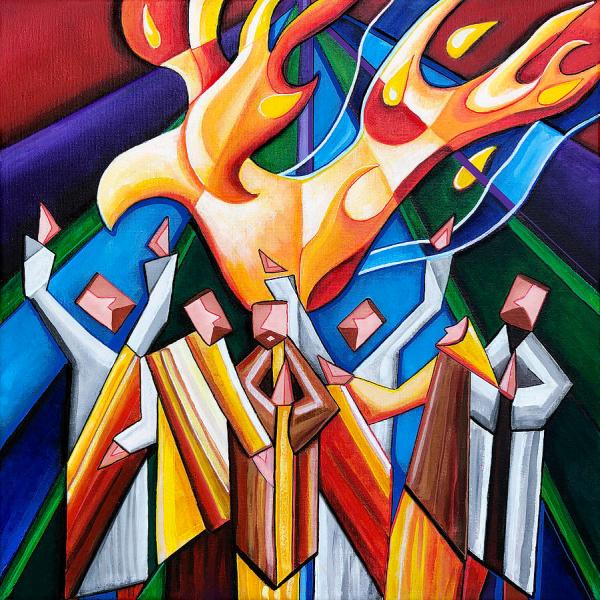
It’s Blowin’ in the Wind

Image by Jennifer Allison

Everything is connected to everything else. The butterfly beats its wings in the New England woods provoking an invisible chain reaction resulting in a typhoon battering the Japanese coast. The magnitude of interconnection is truly mind-blowing. How so?

All that is ever seen is what Spirit causes, motivates, inspires, encourages, impels, triggers, stirs, provokes, stimulates, influences, or activates.

In his song Blowin’ in the Wind, the great Bob Dylan once more with a direct simplicity comes closest to articulating the mystery of Spirit: (https://www.youtube.com/watch?v=KpD26IoRLvA 1:27 -end)

Dylan asks

Yes, and how many years must a mountain exist
Before it is washed to the sea?
And how many years can some people exist
Before they're allowed to be free?
Yes, and how many times can a man turn his head
And pretend that he just doesn't see?

The answer, my friend, is blowin' in the wind
The answer is blowin' in the wind.

In this vein, let me try to give some descriptive theological shape to the Day of Pentecost – the arrival of which brings to a close the long biblical narrative that has been unfolding since Christmas, through Easter, ending here at Pentecost.

Pentecost – is Greek for the 50th day after Easter. On the Day of Pentecost the Spirit of the risen and ascended Christ – the Holy Spirit entered material time and space as a crucial participant in the on-going life of the creation.

John hints at Jesus’ gift of his spirit to his disciples in his farewell discourses – where in today’s gospel he tells them – If I do not go away, the Advocate will not come to you; but if I go, I will send it to you …. for when the Spirit of Truth comes, it will guide you into all truth.

It’s Luke, of course, who offers the graphic description of the event that overwhelmed Jesus’ followers on the Day of Pentecost. Luke’s chronological arrangement of the life and times of Jesus from birth to resurrection ends with his Ascension. In the sequel to his gospel, the Acts of the Apostles, Luke chronicles the life and times of the first followers of Jesus of Nazareth. Beginning with the event that transformed them from a dispirited rag-tag band of the dejected and the lost into an empowered, pneumatic community inflated by the power of the Spirit. Luke goes on to record in Acts how empowered by the Holy Spirit this pneumatic community begins to forge a distinctively revolutionary way of living. Pentecost marks the transfer of power from what had been the ministry of Jesus to the ministry of those who became initially known as the followers of The Way.

Being faithful Jews, these first followers of Jesus had gathered in Jerusalem for Shavuot – the other great pilgrim festival at which every Jew – especially those of the male variety was encouraged to come up to Jerusalem on the 50th day following Passover to commemorate the giving of the Torah by God to Moses. Luke paints a vivid technicolor picture of the events that overtook Jesus’ followers who were visited by a pyrotechnic eruption of wind, fire, and ecstatic utterance marking their pneumatic inflation with the Holy Spirit.

Among the multitude of pilgrims gathered for Shavuot from across the Jewish diaspora were Jews from Media, Elam, and as far away as Mesopotamia – from Cappadocia and a host of other cities in Asia Minor together with Egyptian, Libyan, and Arabian Jews, alongside local Judeans. All witnessed the clamor among a band of unruly Galilean peasants – hearing them shouting out in their own tongues while others of a more cynical mindset dismissed the rabble-rousers as drunk – not simply drunk, but drunk at nine o’clock in the morning. After all, what could you expect from a bunch of Galileans?

Last week I drew the metaphor of a conduit – a two-way traffic highway connecting the dimension of time and space with the spiritual dimension – each a dimension arranged in parallel. With the Ascension of Jesus, the direction of traffic moves from time and space to spiritual space as Jesus is received by God and reunited within the divine nature – not simply as a divine being but now clothed in the fulness of his humanity.

Following the reception of the humanity of Jesus- now perfected through suffering – into the divine nature, the traffic flow reverses as the divine spirit of Jesus is released to reenter time and space – becoming known as the Holy Spirit – who in the words of the Nicene Creed proceeds from the Father through the Son.

All that is ever seen is what Spirit causes, motivates, inspires, encourages, impels, triggers, stirs, provokes, stimulates, influences, or activates.

On the Day of Pentecost, the disciples of Jesus were set blaze – enraptured –hearts and minds ignited with passion. Drawing a more contemporary analogy, in his song, I’m on Fire Bruce Springsteen captures such a moment when he sings:  (https://www.youtube.com/watch?v=1VxFS5-klfk 1.24 -end)

At night, I wake up with the sheets soakin’ wet and a freight train runnin’ through the middle of my head, only you - can cool my desire, oh,oh,oh, I’m on fire!

The Holy Spirit is the manifestation of God as the primal force animating from within and spanning between everything – an echo of the Genesis vision of the divine wind moving across the face of the void – calling structure and order out of chaos.

The Apostle Paul in chapter 8 of his letter to the Romans recaptures the grandeur of the Genesis vision – leading him to his arresting association of the Holy Spirit as the midwife of the Creation. He writes:

Know this, that the whole creation has been groaning in labor pains until now; and not only the creation, but we ourselves, who have the first fruits of the Spirit, groan inwardly while we wait for adoption, as part of the redemption of Creation.

Paul offers this extraordinary image of the Spirit birthing us in our weakness; like pre-linguistic newborns, the Spirit speaks for us in sighs too deep for words.

St Martin’s is a Spirit-filled community. This is not the way we normally think of ourselves for we are shaped by a cooler Anglican ethos that has traditionally been highly suspicious of too much enthusiasm. Our Spirit-fullness is revealed through our synergy of traditional Anglican worship with radical theological and social messaging – allowing us to explore, fashion, and present fresh perspectives on traditional articulations of theology and faith practice. In this we capture the revolutionary effect of the Spirit – directly addressing head-on, the challenges faced by us in the lives we are actually living. This can be a testing experience and gives the lie to the accusation that our Anglican way is an easy religion.

Following this liturgy – we will celebrate our Spirit-filled, magnetic community – a community drawing others to us. We are an attractive, warm, and welcoming community. We express a quiet spiritual empowerment. We exhibit revolutionary courage – confronting challenges to faith in a modern context while also risking new opportunities – as together we reach out for God’s invitation to work tirelessly for the healing of the world.

All that is ever seen is what Spirit causes, motivates, inspires, encourages, impels, triggers, stirs, provokes, stimulates, influences, or activates.

Or as Bob Dylan tells it –The answer my friends – is blowing in the wind – the answer is blowing in the wind. The life of Spirit is not subject to our manipulation or control – it’s not comprehensible to our grasping minds. The Spirit makes itself known through us when we allow ourselves to become available to its prompting to act under the furtherance of the divine plan for creation which always begins with a revolutionary refusal to accept that the way things are in the world is the way things have to be.

Imagine!

Image by Jennifer Allison – fineartamerica.com

In a piece titled Science fiction writers imagine the way out – in the May edition of The Christian Century, Melissa Florer-Bixler writes Jesus’ parables give us space to see that something else is possible. In her article she explores how sci-fi writers are putting flesh on the bones of Jesus teaching.

Florer-Bixler is clearly a devotee of science fiction writing. She cites one story in which a city is planted from seeds – buildings, people, and animals sprout like daffodils. In another – people bound together by their common fate, create a new life in a decimated land.

I have often referenced science fiction speaking more directly to our 21st century imagination – reimagining new approaches to faith – enriching our inherited biblical images.

Images from Biblical imagination were fashioned within a pre-modern worldview with quite a different sense of the relationship between cause and effect. The biblical and medieval pictures of a three-tiered universe still hold poetic charm. But in most cases they no longer inform our 21st-century worldview. The Biblical pre-modern imagination may continue to charm us – yet it’s now relegated to the category of ancient tales of implausibility if not downright impossibility; imaginative attempts to explain the workings of the universe before humanity learned better – or so we think.

Sci-fi imagination is a key that unlocks biblical imagination – opening it up for us as a space to imagine something else – the possibility of new worlds.

Florer-Bixler cites the renowned sci-fi writer, Walidah Imarisha, All organizing is science fiction. Florer-Bixler comments that the inverse is also true – our disorganizing, our entrenchment, and the intractability of our brokenness are a failure of imagination, a failure to believe in the possibility of new worlds.

Imarisha writes that whenever we try to envision a world without war, without violence, without prisons, without capitalism, we are engaging in speculative fiction. Florer-Bixler describes this as an invitation into an experience of dislocation and disruption – a process of transporting us into worlds that are strange – with their own distinctive language, unknown place names, and intricate histories patterning themselves in our brains. The sci-fi imagination invites us to move beyond the impoverished architecture of our modern materialist mindset – shaking loose expectations and assumptions that from a spiritual perspective – no longer serve us, or serve us poorly.

About this process of shaking loose, Florer-Bixler writes I’m familiar with this loosing as invitation, how it curves within me toward curiosity. In the New Testament Jesus turns my attention from endless cycles of harm toward seeds, pearls, and returning children. Jesus stretches me past the scraps of good life I’ve come to believe we can scratch out from the ruins. The reign of God is like yeast and weeds. It is fisherfolk with nets in flight.

Luke, having given us an account of Jesus Ascension in the first chapter of his Acts of the Apostles – the sequel to his story of the life and times of Jesus of Nazareth – Son of God – his second chapter opens with the following description

When the time for Pentecost was fulfilled, they were all in one place together. And suddenly there came from the sky a noise like a strong driving wind, and it filled the entire house in which they were. Then there appeared to them tongues as of fire, which parted and came to rest on each one of them. And they were all filled with the Holy Spirit and began to speak in different tongues, as the Spirit enabled them to proclaim.

Our modern scientific imagination poorly equips us for taking this account seriously as an actual eyewitness account of events on the Day of Pentecost. Of course, we are charmed by its details. Luke’s account works for us as a series of narrative props. We are invited to wear red. Flame motifs abound in banner, balloons, and streamers. We love to mimic the polyglot experience as members of the congregation for whom English is a second language are invited to speak in their native tongue. But beyond enacting aspects of Luke’s story, what sense are we to make of it all?

We embrace the idea of receiving a double portion of the spirit of the risen Christ – the reciprocal movement to his Ascension. But as to the how and even the why of it all beyond the colorful details in Luke’s story – we adopt an attitude of indulgent agnosticism or even down right disbelief. Nice story we say – wish it were true.

Luke’s description of the event – wind and flame and an early form of instantaneous translation for the benefit of the international audience present – is followed by Peter’s long address in which he sets this pyrotechnic-poliglot event within the context of the unfolding of Israel’s longer story of relationship with God. Today’s portion ends with Peter citing the prophet Joel: In the last days it will be, God declares, that I will pour out my Spirit upon all flesh, and your sons and your daughters shall prophesy, and your young men shall see visions, and your old men shall dream dreams.

But remembering Joel’s prophecy of a people empowered to imagine new worlds is not where Luke ends chapter 2. Our current reading ends at verse 21 and if we had been able to jump from 21 to 43, we would see that Luke’s purpose is not to end with Joel’s poetic vision but to go on to describe what it looks like when – to paraphrase Florer-Bixler – a community moves beyond the impoverished architecture of conditioned imagination – to shake loose expectations and assumptions and believe in the possibility of new worlds.

From verse 42-47, Luke paints a compelling picture of what a community empowered by the Holy Spirit looks like. He writes:

They devoted themselves to the apostles’ teaching and to fellowship, to the breaking of bread and to prayer. … All the believers were together and had everything in common. They sold property and possessions to give to anyone who had need. Every day they continued to meet together in the temple courts. They broke bread in their homes and ate together with glad and sincere hearts, praising God and enjoying the favor of all the people. And the Lord added to their number daily those who were being saved.

Luke’s task in constructing his Day of Pentecost narrative is not to tell us about the amazing pyrotechnic-polyglot experience accompanying the outpouring of the Holy Spirit upon the witnesses – but to show the effects of the Spirit’s birthing of a new community capable of believing in the possibility of a different world.

Luke describes a community of folk transformed through the indwelling of the Holy Spirit where from all according to ability -to all according to need –became the central organizing principle. Talk about the courage to imagine new worlds. The pooling of resources is the foundation for the early Christian community’s experience of an empowered transformation into a truly magnetic community configuring itself for those who had yet to show up.

I’m not proposing a return to the early Christian model of resource sharing. It’s both attractive and also unappealing – conjuring for us unfortunate resonances to failed Communist experiments. What it highlights for us however, is the requirement for us to imagine new ways of sharing resources more equitably.

In terms of the use of resources the world today is facing a resources crisis – of which water is the number one resource in increasingly short supply. In a world of finite resource supply, Luke’s portrayal of the effects of the Spirit’s outpouring upon the first Christians points us to the question of equity – that is – how resources are to be shared. The many do not have enough for life – because the few have way more than we need.

Florer-Bixler writes: In the real world, the tethers of oppression are wrapped so tight. Corporate interests and monied developers curl their tentacles around hope. There isn’t enough air. Jesus loosens the grip as we are given space to see that something else is possible here. He refuses reforms that polish up our entrenched systems or policies that quibble over the structure of power. The reign of God sprouts and grows, wild and unruly.

The reign of God sprouts and grows, wild and unruly! Few of us are happy with the ways of our world today. But how might we imagine things to be better. Of course, imagining is the first step. But two additional steps are necessary – the will and the courage to believe in the urgency of our dreams becoming reality.

Pentecost is when we celebrate our receiving of a double share of Christ’s Spirit – the Holy Spirit who proceeds from the Father through the Son as we say in the Nicene Creed. Following the first day of Pentecost what exactly was the nature of the transformation of Christ’s followers? It seems that it was the transformation of imagination – the power to imagine living life differently empowered by Christ’s Spirit to continue the work he began.

At Pentecost the baton passes to us!

This is my prayer for us this Pentecost – to imagine the life we long to live; to postpone our dream no longer – and waste our hearts on fear no more (O’Donohue, Morning Offering).

Blog at WordPress.com.

Up ↑