
Transfiguration in a Disenchanted Age

Last Sunday after the Epiphany – 2026

We stand at a hinge in the liturgical year. Behind us lies the season of Epiphany with its moments of illumination. Ahead of us stretches the long road to Jerusalem and the austerity of Lent. At this pivotal point in the Jesus narrative, we are given two mountain stories: Moses on Sinai and Jesus on the Mount of Transfiguration. Two peaks. Two luminous encounters. Two moments when heaven and earth appear to overlap.

Across the wide sweep of Scripture—from Moses to Jesus—we can trace not a change in God, but a deepening in human awareness of God. For Moses, God is encountered “up there” and “out there”—in thunder and cloud, in fire and trembling mountain. God commands wind and sea. The divine presence is external, overwhelming, transcendent.

By the first century, something has shifted. The prophets speak of a law written on the heart. The psalmists cry from the depths of inward experience. By the time Jesus appears, God is no longer encountered only on mountains but within conscience, compassion, and community.

The movement is from “up there,”
to “in here,”
to “between us.”

This is not a movement from transcendence to its absence, but from transcendence as distance to transcendence as depth.

Charles Taylor describes a similar shift in Western consciousness. In A Secular Age, he speaks of the transition from an enchanted world to a disenchanted one. In 1500, belief in God in the West was nearly unavoidable. The world felt charged with spiritual presence. Today, belief can feel implausible. Reality appears calculable, controllable, confined.

In an enchanted age, transcendence saturates reality. In a disenchanted age, reality is saturated with immanence. We have descended from expansive connectivity into increasing isolation.

And yet the hunger for transcendence persists. We binge stories of magical realism. We attend concerts like revivals.
We chase peak experiences. We curate spiritual moments. The longing has not disappeared. The human spirit still yearns for more than what can be measured.

On the mountain of Transfiguration, Peter sees Jesus radiant, his face shining, his clothes dazzling. Moses and Elijah appear. The veil between material and spiritual reality thins. Time itself seems to bend. In response, Peter cries out:

“Lord, it is good for us to be here. Let us build three dwellings.”

He wants to contain the moment, to hold it in place, to domesticate transcendence within the structures of control.

But the cloud descends. The voice speaks. And just as suddenly, it is over.

As they descend, Jesus orders silence: “Tell no one about the vision until the Son of Man has been raised.”

Illumination and secrecy. Now—and not yet.

But why secrecy?

Because revelation without readiness can distort.
Because glory without the cross becomes fantasy.
Because peak experience is never the destination—it is only ever a preparation.

The mountain is not a residence. It is a revelation.

The Transfiguration is a moment when the spiritual penetrates the material, allowing Jesus and his disciples to see more clearly the path downward and onward.

We often imagine transcendence as altitude. But altitude is a primitive religious metaphor.

When Dr. Martin Luther King Jr. declared, “I’ve been to the mountaintop,” no one assumed he had taken a hike. The mountain had become a metaphor for moral clarity, prophetic vision, the ability to see beyond present injustice toward promised possibility.

Transcendence is not about geography. It is about perception. And here lies the paradox for us in 2026: in a disenchanted age, transcendence is not found by escaping immanence. It is discovered within it. Not somewhere else. Right here.

The distinction between joy and happiness helps illuminate this.

Happiness is self-focused.
Joy is self-transcending.

Happiness asks, “How do I feel?”
Joy asks, “Who can I share this with?”

Joy and grief are closer than we imagine. At births and weddings, at funerals and memorials, we are carried beyond ourselves. In deep grief, we transcend the self just as surely as in deep joy. We are bound to others in shared vulnerability. Both joy and grief rupture the illusion that we are alone on center stage. Both are moments of transcendence that reconfigure our experience at the very heart of immanence.

In recent days, the people of Minneapolis have experienced something that, in its own way, bears the shape of transfiguration. Moments of crisis have catalyzed protest. Protest has coalesced into collective resistance to power. In those moments, something happens “between us.”

Strangers stand together.
Voices rise in chorus.
Fear and courage intertwine.
Grief and determination occupy the same streets.

No one would call such days “happy.” Yet they are transcendent. In the face of injustice, people move beyond private preoccupation. They step off the lonely center stage of individualism and into a web of shared vulnerability and resolve. Community, no longer theoretical, becomes embodied.

Ordinary streets become sites of moral clarity. Immanence becomes the arena of transcendence.

Not dazzling light on a mountaintop,
but illumination in the midst of pain.
Not escape from history,
but deeper engagement within it.

This, too, is transfiguration!

The disciples glimpse glory. But they must descend the mountain back into ordinary existence. They have glimpsed who Jesus is. But they must walk with him toward who he must become.

The Transfiguration is a hinge moment. Behind it lie teaching and healing in Galilee. Ahead lies the costly solidarity of Jerusalem.

Behind us is the light of Epiphany. Ahead lies the demanding honesty of Lent that will strip away illusion, confront us with suffering, and challenge our need for distraction.

But today we are given a glimpse—so that when darkness comes, we remember that Transcendence is real, not as escape, but as empowerment to live in the present moment – to face its challenges and to embrace its opportunities.

The thread that binds Moses, Jesus, Charles Taylor, Martin Luther King Jr., Minneapolis, joy and grief together is this:

Transcendence is not about leaving the world.
It is about seeing the world differently.

It is not about climbing higher.
It is about loving deeper.

It is not found in isolated bliss.
It is found in relational courage.

God is not only “up there.”
Not only “in here.”
But “between us.”

In the space where we risk connection. Where grief becomes solidarity. Where solidarity transforms hope, Jesus does not remain on the mountain. He touches the frightened disciples and says, “Get up. Do not be afraid.” Then he sets his face toward Jerusalem—toward suffering, service, and a love that does not retreat.

“Listen to him,” the voice from the cloud commands.

And what does he teach?

Blessed are the poor.
Blessed are the peacemakers.
Love your enemies.
Lose your life to find it.

This is transcendence within immanence. Glory revealed in vulnerability.

In a disenchanted age, we are tempted either to chase spectacle or to surrender to cynicism. The gospel offers a third way.

Attend to the relational space.
Stand together in grief.
Serve in love.
Resist injustice.
Practice courage.

Transcendence has not vanished. It has simply moved.

Not up there.
Not someday.
But here.
Now.
Between us.

The mountain shows what is possible.
The descent shows who we are becoming.

As we enter Lent in 2026—with political fractures, digital distraction, ecological anxiety, and spiritual weariness—the invitation is not to escape upward. It is to descend with purpose to discover that even in a disenchanted age, the world still burns with unconsumed fire—if we have eyes to see and ears to listen.

And so we listen.
We rise.
We walk down the mountain—together!
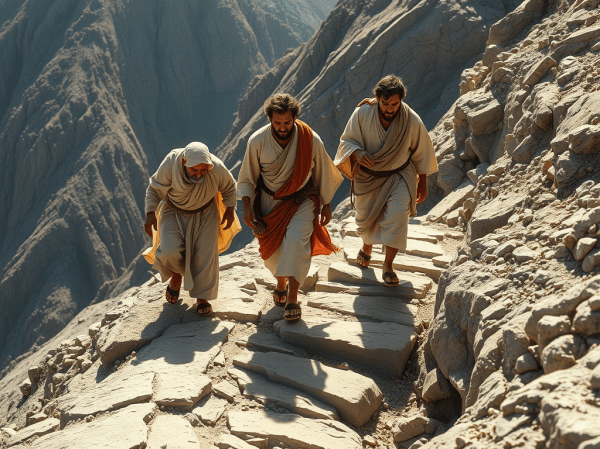
It’s the Coming Down that Matters

Looking at the gospel reading from Luke chapter 9, you will see that we are given two options. The first is to read only verses 28-36. Here, we hear the story of Jesus taking Peter and John on a mountain climb. On reaching the summit, Jesus becomes transfigured – his face shining with intense illumination and his clothes glowing with a dazzling whiteness. We note the echo of Moses’ experience on the mountaintop of Sinai reported in the OT lesson from Exodus 34.

Between verses 28- 36, we learn that the disciples gaze amazed yet fearfully at Jesus, speaking with Moses and Elijah – discussing Jesus’ journey to his death in Jerusalem.

The last Sunday after Epiphany is not the celebration of the feast of the Transfiguration – which takes place on August 6th. Today, we simply hear the story of Jesus and the disciples’ transfiguration experience as the transition story that marks the movement from Epiphany into Lent.

Epiphany means showing – a peeling away the layers of appearance to reveal the underlying true nature of things. Epiphany season begins on January 6th with the event known as The Epiphany – recalling the visit of the Magi to the infant Christ Child – signaling the non-Jewish world’s recognition of Jesus as the promised one foretold by Israel’s prophets. A second epiphany with a small e occurs a week later when we celebrate the Baptism of Jesus – during which the voice from heaven reveals Jesus as God’s openly acknowledged son. After his baptism, the clouds part as the heavens open to herald God’s proclamation of Jesus’ divine sonship. During Jesus’ transfiguration experience, once again, we hear the voice of God repeating the earlier proclamation of Jesus’ sonship – but in contrast to the clouds parting and the heavens opening, this time the voice sounds from within the density of a dark cloud descending to envelop the mountain summit.

The story of the Transfiguration functions as a final epiphany with a small e – in this case, a piercing of the layers of appearance exposing the underlying hidden truth of Jesus’ identity as a preparation for his fateful journey to Jerusalem. The story also functions as a literary device, marking the halfway point in the gospel narratives between Jesus’ ministry in Galilee and his journey to Jerusalem – his death and resurrection. We can picture the Galilee ministry progressing towards an epiphany on the mountaintop. Likewise, we can picture the trip to Jerusalem beginning with the descent from the mountain – setting out on the hard road through Lent to the destination of the cross before the final epiphany of his resurrection.

The story of the Transfiguration operates symbolically similarly to when Dr Martin Luther King Jr. proclaimed I have been to the mountain top, and I’ve seen the Promised Land. No one ever thought he was claiming to have climbed a mountain to describe the view on the other side. They understood his use of the mountaintop as a symbol with deep theological and biblical resonance. Likewise, for the synoptic gospel writers – Mark, Matthew, and Luke – the story of the Transfiguration is loaded with theological and biblical resonance, linking the beginning of the Jesus story with its ultimate ending – from birth through death to resurrection.  

So far, so good. But suppose we continue to read beyond verses 36 to 43. In that case, we enter into a bracketed section of text – bracketed to indicate that in the mind of the Lectionary compilers, these verses are optional. The bracketing might suggest a desire to keep the gospel reading short. But it also strikes me that the bracketing of verses 37-43 not only leaves the story incomplete but also might indicate how much more comfortable we are with experiences of transcendence than those of immanence.

Mountaintop experience symbolizes much hankered after peak experience – the spiritual high – the blissful experience. In contrast, the journey down shows Jesus reentering the noise and chaos – the tension, the messiness of the world. The arguing and recrimination in the scene that greets him at the bottom of the mountain is emblematic of our life experience when we come down from the highs of peak experience. Transitory bliss is soon dissipated amidst the more familiar feelings of anger, frustration, exasperation, and disappointment. Jesus does not hold back in expressing all these feelings in the face of human propensities and pretensions as he cries You faithless and perverse generation, how much longer must I be with you and bear with you?

Today’s gospel marks our transition from Epiphany to Lent. Figuratively, we descend from Epiphany’s heights to accompany Jesus on the rugged and stony road through Lent that will lead us to Jerusalem and beyond. This year, we hear the readings for the last Sunday before Lent sounding within the unique context of the present time in which we can’t ignore the fact that today, we revisit the story of the Transfiguration of Jesus on the mountain in the context of profound shock at the speed with which the world as we have come to know it seems to be coming apart at the seams.

We are sick at heart –aching with concern for the thousands of legal refugees now stranded across the globe at ports of debarkation for the US –  clutching their State Department permissions to enter the US now seemingly not worth the paper they were written on. Our concern encompasses the legal refugees newly arrived in the US whose resettlement programs have now been defunded. Our hearts are full of fear for the families of undocumented immigrants – families where parents and children at the beginning of each day wonder if they will still be together at day’s end. 

We seethe with rage at the callous indifference shown to thousands of faithful civil servants whose employment has been summarily terminated by the click of the send button.

We blanch with shame as America insidiously affirms Russian aggression before the General Assembly of the United Nations. We watch in fascinated horror as foreign leaders are welcomed, unaware that the Oval Office has now been transformed into the set of The Apprentice. Bravo to President Zelensky, who, unlike the ritual humiliation of Jordan’s King Abdullah two weeks ago, refused to play the game and pretend he didn’t recognize that the subtle art of diplomacy is now replaced by the crude art of the deal. 

Our faith in sound government is further corroded by a deepening cynicism as we witness once more a cowered Congress embarking on swinging budget cuts – not to put a dent in the national debt but to give wiggle room for a trillion dollars in tax giveaways to the 1%.

But lest I be accused of laying blame at others’ doors, as the blame game goes around and around, there is enough blame to crown all our heads with shame. Dietrich Bonhoeffer –our go-to prophet for our age – speaking to his fellow pastor-resisters during Christmas 1942 pulls us up short, reminding us of our failings. To paraphrase him:  we stand in grave danger lest we become even more the silent witnesses of evil deeds. We stand in peril of further perfecting our defense skills, relying on our learning in the arts of obfuscation and equivocal speech. If we fail to protest in the face of a deluge of unbearable events, we will become more worn down – become – as if it were possible – even more cynical – so that Bonhoeffer’s question – Are we still of any use, becomes the question for our age.

Kristopher Norris, Pastor of Calvary Baptist Church in Washington DC, in the Baptist Global News wrote: With family separations at the border, automatic detentions, dangerous dehumanizing rhetoric from our highest office and authoritarian misappropriations of scripture from our highest attorney, many churches and Christian leaders have remained silent witnesses. Three-fourths of white evangelicals continue to support these policies. Other churches and Christian leaders have responded with appropriate outrage. We’ve said this is not who we are — as Americans or as Christians. But Bonhoeffer’s words should compel us to take a deeper look at ourselves, at our history, and acknowledge that this is not true…. this is who we are as Americans ….. this is who we are as Christians ….. for this – citing the legacy of white Christian Nationalism is our collective history.

On Ash Wednesday, we will hear the Church’s invitation to the observance of a holy Lent. Among the traditional disciplines – the practices of discipleship – repentance is named as the chief way to make a right beginning. It is not only the best way to make a proper beginning, but it will remain the only way we will stay self-reflective and course for Jerusalem.

Repentance is the mark of our mortal nature, and repentance must become our byword as we accompany Jesus through the arid landscape of Lent, navigating the stony path to Jerusalem. In this life, it’s not what happens on the mountaintop that shapes us but how we conduct ourselves on the downward journey into the inevitable confrontation with the challenges of life in the world ruled by the demons of our age.

Self-Transcendence

At the heart of the transfiguration of Jesus on the mountaintop lies an experience of a transcendent reality normally hidden from ordinary perception. The disciples are shown Jesus irradiated with the glory of the divine nature flowing through him.

I want us to focus less on the nature of Jesus’ experience of transcendence – after all we get the message it’s meant to convey. The event of the transfiguration of Jesus is also a profound experience for the disciples. We see them struggling with an experience of self-transcendence. One moment they are infused with a glimpse of something that literally blows their minds. For a moment they are transported beyond the boundaries of normal imagination before falling back again into their self-preoccupation – expressed in their desire to capture and hold onto the experience.

Transcendence – a reality beyond rational perception – now here’s a tricky subject for the post-modern-21st-century imagination. We are prisoners of rationality that rejects the possibilities of transcendence. We have become mired in immanence -a state of ordinary perception limited to sensory experience. We find ourselves struggling with the cognitive dissonance of no longer believing in a transcendent reality beyond ordinary perception while desperately, hungering for it. We search frantically believing mistakenly, that we will find it through our pursuit of an ever-elusive state of happiness.

Margaret Wheatley highlights our predicament in contrasting the emotional experiences of happiness with those of joy and sorrow. In writing of joy as an experience of connection, communion, presence, and grace within the immanence – the ordinariness of our daily experience – she offers what I think is the clearest contemporary definition of self-transcendent experience.

In contrasting joy and sorrow with happiness – she notes how in both moments of joy and sorrow we find the qualities of self-transcendence – an encounter with a deeper and more expansive connection, communion, presence, and grace within the immanence of the boundaries of our daily lives.

She notes that joy and sadness are both states that embrace us with an energy that take us beyond a sense of our solitary selves. Whether laughing or crying – it doesn’t matter. Faced with a birth, a wedding, an anniversary – we are captivated by joy. In the face of a death, a disaster, a tragedy of personal or epic proportions, sorrow and sadness capture us as we suffer with, console, and love one another. Joy and sorrow are both experiences of self-transcendence –experiences not to be found in our pursuit of happiness.

It’s one of life’s great paradoxes that we crave self-transcendence through our pursuit of happiness which only further estranges us from the very transcendent experiences we crave. The pursuit of happiness rather than leading us to self-transcendence entraps us in an all-consuming preoccupation with ourselves.

The Canadian philosopher Charles Taylor – to my mind one of the towering figures in contemporary philosophy – contrasts the year 1500 when it was impossible not to believe in God with the impossibility of such belief for many today. He charts the route of travel as the culture of the West moved from the impossibility of unbelief to the impossibility of belief.

In the long 400-year emergence of the secular Western mindset, Taylor notes the gradual transition from the age of enchantment to the age of disenchantment. By disenchantment he has in mind a state in which we experience our loss of connection to transcendent experience – that which Wheatley defines for the modern imagination as connection, communion, presence, and grace within the ordinariness of our daily lives.

When our connection to the transcendent is lost, all we are left with is our solitary selves – isolated beings center stage – as it were – a place of great loneliness and disenchantment.

Drawing on Taylor’s distinction between enchantment and disenchantment helps us to view the Biblical narratives as the product of an enchantment mindset. To the enchantment imagination, God is often frighteningly present in the physical structures of the material world. Divine power not only inhabits objects and places, but infiltrates and disturbs the relational spaces between us. The enchantment mindset understands God’s presence in spatial terms of up and down, in and out. Thus, God inhabits sacred mountaintops, fills sacred spaces.

On the mountaintop Peter, James, and John experience an epiphany of Jesus clothed in his divinity as the Christ. This is a fleeting experience, no sooner glimpsed than it is gone – forever eluding their desire to capture and contain it. Then the disciples must negotiate the even more perilous path down the mountain carrying an experience about which they cannot speak. They must carry the remembrance of what they have seen and yet, at the same time, practice a kind of forgetting.

As they were coming down the mountain Jesus ordered them, “tell no one about the vision until after the Son of Man has been raised from the dead”.

It seems that spiritual peak experience is only a means to, and not an end in itself. Events on the Mount of the Transfiguration are the midpoint – a final epiphany or revealing before taking the long journey towards the culmination of Jesus’ ministry.

Unlike our ancestors we no longer look for God – or the presence of the divine – in material space-time. The acceptance by past generations, whose enchanted expectations of encountering God in material objects and places is now firmly rejected by most of us as supernaturalism. Nevertheless, we remain unsettled. The question for us today is not does a separate spiritual dimension still exist – but where and how is it accessible to our modern disenchantment minds?

Spatial references to up and down don’t any longer work in the same way for us. For us, God no longer inhabits the mountaintop. Heaven is no longer imagined as up there, or hell being down there. When Martin Luther King Jr. said he’d been to the mountaintop, no one assumed he had physically climbed a mountain. The mountaintop now becomes the metaphor for the possibility of a different order of experience, one that challenges our resignation to the absence of the spiritual in lives dominated by preoccupation with the self. We may no longer find God in and through the material world in quite the same way as our Biblical and generational ancestors did, yet, despite this – our desire for God remains.

The paradox is that while we reject enchantment as superstition and supernaturalism, no generation craves with a greater intensity a desire for self-transcendence than we do. Magical realism abounds in popular literature. Heroic superhero sagas dominate Hollywood’s works. Opioids, marketed as a solution for physical pain promise a solution to the increasing levels of spiritual pain left by the loss of transcendent experience.

In writing of joy and sorrow as experiences of connection, communion, presence, and grace within the ordinariness of our daily life – Wheatley offers what I think is the clearest contemporary definition of transcendent experience -self-transcendence that takes us beyond the limitations of our preoccupation with self and our pursuit of promised fulfilment in the achievement of personal success and happiness.

As 21st century people trapped in immanence in a world that denies transcendent reality we especially need a sense of purpose to take us beyond ourselves. Wheatley turns to the great 19th-century Bengali poet and spiritual teacher, Rabindranath Tagore who movingly wrote:

I slept and dreamt that life was joy. I awoke and saw that life was service. I acted – and behold, service was joy.

Life dreamed as joy becomes real through service and it is in service that we are surprised by joy.

The Transfiguration story is a halfway point in Mark’s account of the life and times of Jesus of Nazareth. It marks the transition point from his preaching and teaching in the Galilean countryside to his arrival on the wider stage as he begins his eventful journey to Jerusalem.

The Visit of the Magi and the Transfiguration bookend the Christmas-Epiphany season. From here on, we move into a different phase of the spiritual journey. The landscape becomes rocky and desert-like as we journey down the mountain into the season of Lent.

Lent is the season in which we revisit and take up again the disciplines that will open us beyond mere self-preoccupation – infusing our experience of immanence – the ordinary everydayness of our lives with intimations of self-transcendence in the rediscovery of experiences of connection, communion, presence, and grace – of joy through worship, prayer, and  service.

Blog at WordPress.com.

Up ↑