From Final Chapter to Epilogue

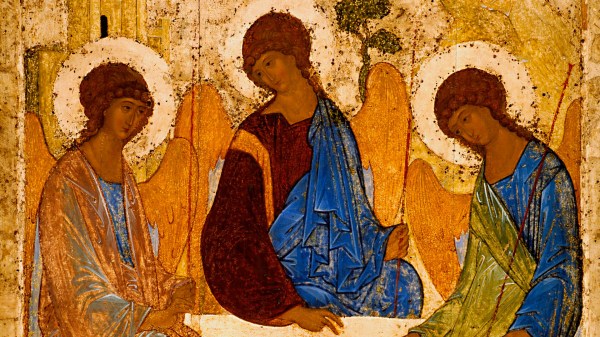
Image: Andrei Rublev’s 15th-century icon of the Holy Trinity

Last week on Pentecost Sunday, I likened the Bible to what my granddaughter Claire, at an important stage in her learning to read, used to refer to as her chapter books. When children are learning to read, a critical stage is reached when they graduate from simple, single-storyline books to complex stories that unfold in stages, or chapters.  In the last two weeks, we have celebrated two significant chapters in the Christian biblical chapter book- namely the Ascension of Jesus and the descent of his Spirit – a two-way process which Tom Wright describes as the moment when the personal presence of Jesus with his disciples is translated into the personal power of Jesus in his disciples.

Pentecost is the final chapter in the Christian chapter book. But in all good chapter books, the final chapter is often capped off with an epilogue – a short addition or concluding section at the end of a literary work, usually dealing with the future of its characters.  Trinity Sunday is the Christian chapter book’s epilogue, hinting at a foretaste in volume two, so to speak, of the continuing Christian storyline with the action now centering on the life of the Church.

How do you recognize an Episcopal Church at first sight? Well, the red doors are usually a giveaway. But when you see Holy Trinity as the dedication of the church, you know this is an Episcopal Church. The Trinity is deeply revered in the Anglican tradition with by far, a greater number of Episcopal churches dedicated to the Holy Trinity than to any other single dedication. Why is this so? I think it must have something to do with the naturally speculative cast of the Anglican mind. Unlike more literalist traditions, we appreciate mysteries to puzzle over. We’re not interested in simple answers to complex questions. We appreciate mystery as something that hints at but never fully explains truth.

There is a spoof report of a supposed conversation between Jesus and his disciples. In answer to Jesus’ question Who am I? Peter, – yes, it’s always Peter who pipes up first – launches into: “Thou art the Logos, existing in the Father as His rationality and then, by an act of His will, being generated, in consideration of the various functions by which God is related to his creation, but only on the fact that Scripture speaks of a Father, and a Son, and a Holy Spirit, each member of the Trinity being coequal with every other member, and each acting inseparably with and interpenetrating every other member, with only an economic subordination within God, but causing no division which would make the substance no longer simple”. And Jesus answering, said, “What?”

Some people are, by temperament, Jesus-people. Others by temperament are God-people, while others, often many others, are Holy Spirit-people – no, I’m not looking at Linda+ when I say this. I have to say I appreciate the role both Jesus and God play in my spiritual imagination. I’m also good on the Holy Spirit as long as we don’t get too enthusiastic about her. But my temperament really hums in the contemplation of the Trinity. Why is this? Part of my answer would be to affirm the elegant simplicity of the Trinity as the fullest expression of God. And I want you all to know how simple and enticing the Trinity really is.

The distinctively Christian understanding of God, as Trinity, emerges from the Pentecost event, as an everyday experience long before it became a doctrine. This unthought experience of God as Trinity is captured in a venerable Celtic prayer:

Three folds of the cloth, yet only one napkin is there,                                                                                           Three joints in the finger, but still only one finger fair,                                                                                               Three leaves of the shamrock, yet no more than one shamrock to wear,
Frost, snowflakes and ice, all in water their origin share,
Three Persons in God: to one God alone we make our prayer.      

Like most experiences, it’s only when we turn our backs on the poetic and try to rationally capture the intuitive that things get complicated.

God as Trinity – that is, as divine community – arose out of the everyday experience of the first Christians. They knew of God, the creator, from their Jewish inheritance. Yet, this inheritance of faith had been augmented through a collective memory of Jesus as a human personification of God. Following the Ascension event, when they had so keenly felt the loss of a personal connection with Jesus, at Pentecost they became overpowered by– literally inflated with his Spirit as the personal presence of Jesus with them was translated into the personal power of Jesus in them. It’s only later, when Christianity takes root among the Greeks – ah those Greeks being of a more philosophical frame of mind, loved codified statements – like the one we repeat every Sunday in the Nicene Creed. It’s here that the Trinity begins to get complicated.   

While human beings have always cherished relationships, it’s only with the advent of a psychosocial understanding of relationship that we have grasped the importance of relationality as the engine of emotional development. Following on from our being created in the image of an unseen God, we can deduce that the dynamics at play in human relationships reflect something essential about God. If we are made for relationships in community then might this be true of God as well. The image of God as a solitary being falls away before the image of God as divine community.

I’m now coming closer to answering the earlier question of why I am at heart a Trinity-person.  In 2025, the celebration of the Holy Trinity coincides with both Father’s Day and the baptism of a child in the fourth generation of one of our church families. Both Father’s Day and baptism provide rich material for reflecting on the relational nature of God as divine community.

Fatherhood, often thought of as a male characteristic – the possession of individual men, is really a concept dependent on and expressive of relationship. All fathers are men, but not all men are fathers. Men become fathers only through the procreation or adoption of children. Relationally speaking, you cannot be a father without a child.

Traditionally, despite acknowledging that God is genderless, God the creator nevertheless has been referred to as Father, rendering Jesus his Son. Yes, these are now unfashionably gendered nouns. But its not the gendering, but the relationality of these nouns that captures the essence of the divine nature. Other nouns for God can be used so long as they speak of relationship – as in Lover, Beloved, and Love-sharerer. As with us, so it seems with God. Fatherhood is an identity created through a relationship. Likewise, baptism speaks the language of relationship.

Here, a contemporary psychological understanding of relationality is pertinent. Human beings come into existence through relationships. I’m not referring here to biology but to the development of self-consciousness as the core foundation for identity.

The psychology of Object Relation Theory, the psychoanalytic school in which I was trained as a therapist after my ordination to the priesthood, perceives the infant as object-seeking from birth. This means the infant is instinctively drawn to the mother, initially to her breast, but soon her face as well. Every mother of a newborn knows this unfolding experience. The infant and mother are held in the embrace of a mutual gaze. It’s the experience of coming to self-consciousness through the gaze of the mother that is as vital to infant flourishing as the physical sustenance the mother provides.

My point in all of this is to say that our sense of self is caught – a process of self-discovery through catching a glimpse of ourselves in the gaze of another. Self-consciousness and identity are the fruit of being in relationship. While the initial mutual gaze is between mother and infant, it eventually broadens to include the gaze between mother, father, and infant as the child develops a consciousness of the father’s presence.

I want to make a necessary disclaimer here. Although I’ve been speaking of the more usual context of female mother, with male father, I want to stress that mothering or motherhood, fathering or fatherhood are potentially gender fluid roles. However, this takes us into a more contested area and should be the subject of a separate sermon.

I’ve been suggesting that the Trinity is first an experience and only thereafter a concept of God as relational within divine community. This seems a somewhat modern development in reinterpreting traditional metaphors for God, yet, the early 15th-century Russian iconographer Andrei Rublev seems to have had a premonition of God as a divine community that uncannily echoes a contemporary, psychologically informed image of God.

His icon of the Holy Trinity depicts three angel-like figures seated around a table – an allegory of the visitation of the three angels to Abraham at the oaks of Mamre as recorded in Genesis 13. But it’s the facial expressions I want to draw your attention to. Although dressed differently, and presented essentially as men – although angels are actually genderless, they share the same face and gaze through the same eyes. Their mutual gaze of love is evocative of the gaze shared between mother and infant. It’s as if each is held in being through the exchange of mutual gaze with the other. The optical illusion is created so that while the members of the divine community sustain each other through a shared loving gaze, we are also drawn into the experience of that gaze. Before Rublev’s icon of the Holy Trinity – we experience something so familiar to us – an echo from our earliest unthought memory.

Today, on Trinity Sunday, little Evie Tulungen will become a Christian. This is a shorthand way of speaking. But exactly in what sense will Evie become a Christian? Most of us will imagine that Evie becomes a Christian through the flowing of water and the anointing of the Holy Spirit. Both are true. But what we may miss is an equally important point. It will be through her baptism that Evie becomes a part of the mutual gaze shared between participants in the Christian community. The Early Church Father, Tertullian is reputed to have said that one Christian is no Christian. What he meant was that being Christian, like fatherhood and motherhood, like sonship and daughterhood, is a relational experience. There are no individual Christians, only persons who through baptism are born into a shared life of relationship within a community called Christian. Though an imperfect reflection it may be, the community of the Church is none other than the reservoir for a love no longer exclusive to the Divine Community but now shared through the overflowing of the Spirit into the life of the world.
Seeing and Being Seen!

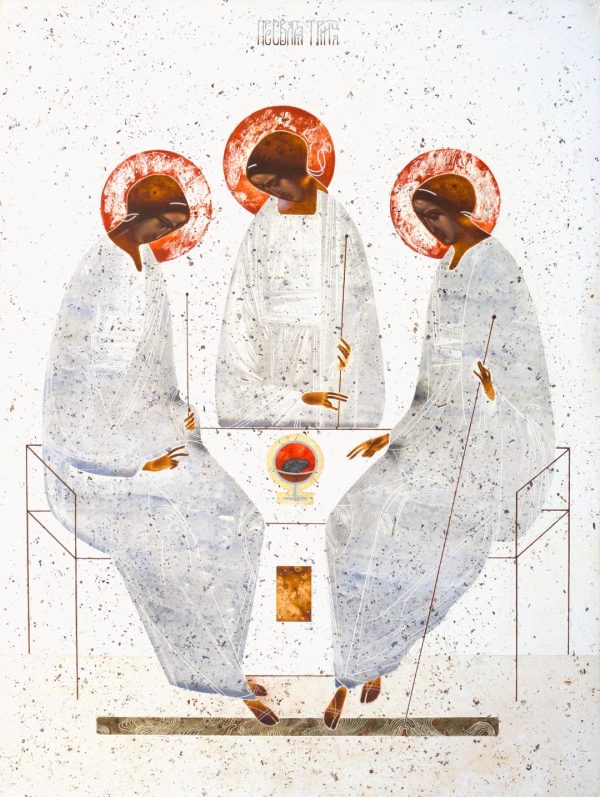
Image: Ivanka Demchuk Trinity in the style of Andrei Rublev

Our unique personhood sits within a much larger set of characteristics that we share with every other human being. Yet there is a kernel at the heart of these shared characteristics that marks us out as uniquely ourselves – as in – like no one else. How is individuality discovered?

There’s a commonly held view that individuality is innate. We come to discover who we are through an internal process of growing self-awareness. In other words, the unique sense of self is something we are born with and develops in step with the process of cognitive maturation.

In contrast, a psychologically informed view holds that personal identity is not innate but interactional. Personal identity develops through our interactions with others – interactions shaped by social and physical environmental factors.

So, bear with me for a moment as I develop a couple of seemingly unrelated strands, I assure you they will come together in a moment.

There is that old chestnut question: does a tree falling in the forest make a sound if there is no one to hear it fall? The short answer is no – its fall makes no sound. The complex answer is the tree’s fall causes pressure waves in the air around it. But these are not sounds until picked up by and transformed into sounds by the human ear.

As many of you know I have a background in Object Relations psychology which is a particular British offshoot of classical Psychoanalysis. Object Relations theory views human beings as primarily object or relationship-seeking. The infant instinctively seeks connection with its mother who represents a reliable and constant object. The infant suckling at the breast or the bottle comes to its first awareness of self through being reflected in the mother’s loving gaze.

The human equivalent of the tree falling with no one to hear its fall is the infant deprived over time of the experience of being seen – that is -reflected in the gaze of the mother. Such an infant will eventually die and we have a name for this – it’s called failure to thrive.

My psychology-psychotherapy formation led me – as a childless man – to the realization of what every mother experientially knows – that the infant catches the first intimations of selfhood in the interactional field of the mother’s loving gaze. The mother gazes at the infant. The infant gazes back- catching the first hints of its separateness – individuality – reflected in the mother’s face. I know of a young mother who as her child awakes from sleep whispers – Hello little one, I’m glad you’re back. I’ve missed you.

On Trinity Sunday what happens when we take my initial reflections on human identity development and view them through a trinitarian lens?

When it comes to the Trinity – the doctrine of three persons in one God – there is only one thing we need to remember. The Trinity was an experience of God long before it became a doctrine about God. In fact, the doctrine emerged only as a protection for the unique Christian experience of God.

For the early Christians, the Trinity as an everyday experience of God emerges in this way. As Jews, they believed in God the Creator, the God of their ancestors, the God of Abraham, and Moses. As followers of Jesus, they experienced a life-changing encounter with God through his ministry, death, and resurrection. After his departure following his resurrection, they were inflated in present-time with an experience of transformation from a dejected and lost band of leaderless followers into a community empowered with a revolutionary purpose. Under the guidance of the Spirit – which they associated with the Spirit of Jesus – they took up the work Jesus had begun. In these three distinct ways, they experienced the presence and power of God in their lives.

In the spiritual life of faith and practice, we are caught between two opposing pressures. On the one hand, we are compelled to try to rationalize our faith experience – capturing the invisible and intangible nature of spiritual experience in stories and formulae we can easily understand and repeat. Yet, on the other hand, we have a strong motivation to protect the mystery at the heart of religious experience from being reduced to the limits of our impoverished human imagination.

This tension between these motivations came to a head in 325 CE when the bishops – as the successors to the Apostles met together in council at a place called Nicaea – now the modern-day Turkish city of Iznik situated 139 KM southeast of Istanbul – then Constantinople. The council was torn by opposing factions. There were those who wanted to rationalize the mystery of the threefold Christian experience of God – to make it sensible to ordinary human comprehension within the laws of the physical universe. There were others who defended the essential mystery at the heart of Christian experience. Using the philosophy of the day -they put in place a protection for the mystery of God lying at the heart of Christian experience. This protection has come down to us in the Nicene Creed which we proclaim as the historic faith of the Church believed in all places and at all times.

Thus the Nicene Creed speaks of Jesus being of one substance with the Father, and of the Holy Spirit as proceeding from the Father through the Son. Confounding our expectations – nothing is explained and the meaning of the essential mystery is left open-ended. Although the Trinity expressed an experience of God long before it became a doctrine about God – at Nicaea – experience came under the protection of a doctrine that proclaimed God as a relational community of Father, Son, and Holy Spirit.

Today we hear these terms not as an attempt to gender the divine, but as an articulation of relationality at the heart of the divine nature. Following current sensitivities around gendered language some substitute Creator, Redeemer, and Sustainer for the traditional gendered terms. While theologically correct nevertheless these are terms denoting function, not relationship. Lover, Beloved, and Love-sharer is a better solution – making the point that it is relationship not gender that lies at the heart of the divine nature.

In 1410, an obscure Russian monk named Andrei Rublev depicted an icon of the Holy Trinity drawn from the Genesis story recording the visit to Abraham at the Oaks of Mamre by two angels. Rublev’s icon of the Trinity articulates a step change – a massive leap forward in the human capacity to imagine God – presenting the three distinct Christian experiences of God as a relational community of three persons – distinctively clothed – yet in every other way identical – sharing the same face – the same gaze. Each member beholds the other two simultaneously in a mutually loving gaze.  

Rublev’s Trinity is more than a representation of the theology of God’s nature. It’s an expression of the Orthodox devotional tradition in which the Trinity lies at the heart of Christian devotion. Inspired and informed by this devotional tradition, Rublev presents God not as a solitary figure but God as a relational community.

We only come to truly see ourselves when we are caught in the experience of being seen. Coming to see through the experience of being seen is an essential characteristic of the infant-mother bond. Thus it should come as no surprise that seeing through the experience of being seen is an essential quality of the divine community. When we sit before the icon of the Trinity we are drawn into the mutuality of the divine gaze. It’s as if God seeing us says hello – welcome back, we’ve missed you.

Three folds of the cloth yet only one napkin is there,
Three joints in the finger, but still only one finger fair,
Three leaves of the shamrock, yet no more than one shamrock to wear,
Frost, snowflakes, and ice, all in water their origin share,
Three Persons in God: to one God alone we make our prayer.                                                                       An Irish Celtic prayer to the Trinity.

What’s in a Name?

Jesus asked his disciples: Whom do people say that I am?

His disciples answered Some say you are John the Baptist returned from the dead; others say Elijah, or another of the old prophets.

And Jesus asked again: But whom do you say that I am?

Peter answered: Thou art the Logos, existing in the Father as His rationality and then, by an act of His will, being generated, in consideration of the various functions by which God is related to his creation, but only on the fact that Scripture speaks of a Father, and a Son, and a Holy Spirit, each member of the Trinity being coequal with every other member, and each acting inseparably, each interpenetrating every other member, with only an economic subordination within God, but causing no division which would make the substance no longer simple.

And Jesus answering, said: Excuse me?

There’s an old term for God which we don’t refer to much these days. It’s the Godhead. Godhead is so much more than a name. It’s a description which hints at the essential nature of the deity. That essential nature hints at the communal rather than the solitary. God is a nickname by which we refer to the Godhead. We have every right to think the Trinity is confusing. But it’s actually very simple.

First a little history. The most expansive articulation of the doctrine of the Trinity was officially accepted at the Council of Nicaea in 325. The doctrine of the Trinity was and remains protective rather than explanatory in nature. The doctrine of the Trinity requires us to tolerate mystery -as in- knowing – but not knowing how we know.

The 4th-century Nicene doctrine of the Trinity is the culmination of three centuries of theological speculation on what begins for the first Christians as a lived everyday experience.

As Jews the first Christians experienced the historical God of their ancestors who brought them up out of the land of Egyptian slavery; who gave them the Torah through Moses; the God with whom they had lived – falling in and out of relationship over centuries of ups and downs.

Yet, as the followers of Jesus, they also had a new experience of God – God with a human face. While living among them, Jesus had taught them a new way of seeing God – God revealed through the intimacy of human relationship – God revealed in a loving look, a casual smile, a kind or not so kind word of instruction from a human voice, a physical touch of a healing God.

After Jesus left them –-they were surprised by a completely unexpected experience of God as indwelling spirit –the Spirit of the risen Christ – now inhabiting deep within them, filling the spaces between them, and enveloping the whole world around them.

By the 4th-century, Christianity had developed from an obscure Jewish sect to become the official religion of the Roman Empire. Religious zeal and political lobbying now ran in the same channel – a phenomenon we today are not unacquainted with. Factional partisanship fanned intense theological disagreements between competing episcopal camps – inevitably spilling out into running street battles between the unruly mobs of their supporters. For a chilling perspective on the death and violence that accompanied the conciliar debates, John Philip Jenkins’ Jesus Wars is a must read.

At issue were attempts to define the nature of the internal relationships within the Godhead. The Emperor Constantine the Great, fearing civil war called the bishops to convene in Ecumenical Council at Nicaea in 325 where he forced them to codify something that earlier generations of Christians had simply lived as an everyday awareness.

At Nicaea, using Aristotelian philosophical concepts of persons and con-substance it was decided once and for all – at least at the official level – that the essence of the Godhead comprised three persons all sharing the one substance. One God in three persons, three persons but only one God who is Father, Son, and Holy Spirit. To put it in today’s language – three discernable identities emanating from and united within a single relationship. If you think relationship the wrong term here let me go on.

Tradition is a slippery thing. It passes from one generation to another, each subsequent generation receiving the legacy of its forebears. Yet, if tradition is received unchanged – it dies. For Tradition to remain a living force – each generation must reinterpret what is received – so that it speaks to the lives actually lived by Christians facing new challenges and seeking to apply timeless truths in new contexts.  

As I wrote in E-News this past week, you can’t be in a relationship by yourself. There is no such thing as a community of one.  We identify ourselves in reference to others with whom we live in relationship. Today we recognize that individual identity filters through our perception of the way others see us. We catch a glimpse of ourselves in the face of the other – looking back at us.

Andrei Rublev’s famous 14th-century depiction of the Trinity offers a pictorial metaphor of three identical persons – each lovingly gazing upon one another. We see here three identical figures gazing upon each other with a strong mutual love. That there are three attests to the communal nature of relationship within the Godhead. That they are identical attests to their single shared nature. But it’s their mutual gaze that strikes us. It’s as if each figure catches a glimpse of themselves in the reflected gaze of the other two.

We not only see the figures gazing at each other, but we also catch a glimpse of ourselves in the relationship to them for as we gaze at them they are also gazing back at us. We are communal and relational, because God is communal and relational – after all in whose image we were created.

All well and good you might say but can we really continue to talk about God in the gendered terms of Father and Son, with the Holy Spirit not obviously gendered until referred to as he, which is odd because in the Hebrew ruach is feminine and carries the pronoun she.

Patriarchal Tradition – linguistically ascribed masculine identities to the relational elements within the Godhead. Whereas in our own time the drive for linguistic inclusivity is a response to evolving conceptions of gender relations exposing the Tradition’s male gender bias. Not throwing the baby out with the bathwater is a warning we should hear, however.

We hear the gender bias issue being resolved by referring to Father, Son, and Holy Spirit simply as creator, redeemer, and sanctifier. This may overcome the gendered issue but the problem here is that these terms refer to functions within the Godhead not to relationships. It’s important to remember that the point of Father, Son, and Holy Spirit is not gender but relationship.

A better solution is to refer to the members of the Trinity – as I do frequently -Lover, Beloved, and Love-Sharer. These terms preserve the essential relational – can’t have one without the other- nature within the Godhead.  

It is the relational quality within the community of God that commends itself so powerfully to us – living increasingly in a world where relationality, its presence or absence, is the measure of meaning and an indicator of quality of life.

If only the Nicene Fathers had had the benefit of an Irish poetic sensitivity:

Three folds of the cloth, yet only one napkin is there,
Three joints in the finger, but still only one finger fair,
Three leaves of the shamrock, yet no more than one shamrock to wear,
Frost, snowflakes, and ice, all in water their origin share,
Three Persons in God: to one God alone we make our prayer.                                
Celtic Prayer to the Trinity.

Blog at WordPress.com.

Up ↑