Table Talk

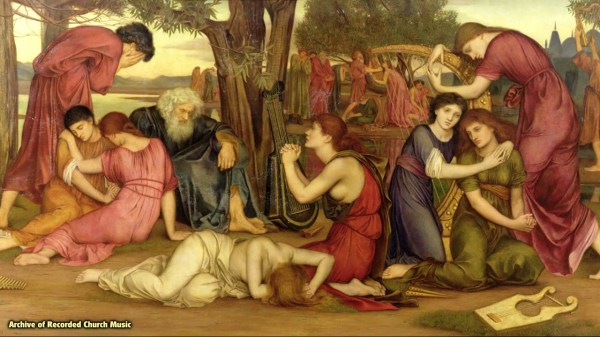
Image: Table Talk – Arrington & Associates arringtonassoc.com

We’ve been listening to the voice of the prophet Jeremiah for the last three weeks in our OT readings. So who was he?

Jeremiah was born in the Levite village of Anathoth, located just outside Jerusalem, in the territory of the tribe of Benjamin. Being from a priestly family not connected to the Temple worship in Jerusalem, he was close enough to know the ways of the Temple, but far enough from its center to see its faults. As a young man, God called him. Jeremiah resisted—“I am only a boy, a dresser of sycamores,” he said—but God put words in his mouth and sent him out to speak hard truths: not only to uproot and tear down, but also to build and to plant.

Not unlike our own day, Jeremiah lived in a time of deep turmoil. Leaders were corrupt, religion was shallow, and the nation was on the brink of collapse. He warned: Babylon was coming, and Jerusalem would fall. No one listened. He was mocked and imprisoned for treason. As the city was about to fall, he was thrown into a dry cistern and left to die.

For the first Christians, Jeremiah evoked their memory of Jesus. Remembered as the weeping prophet, his tears flowing from a deep love, he wept because his people would not listen. And yet he never gave up hope. He even bought a plot of land as a sign that God’s people would one day return and rebuild. He embodied hope. He looked ahead to a new covenant, not written on stone tablets but written upon the human heart.

It is no wonder the early Christians saw Jeremiah as a prototype of Jesus—one who suffered for speaking God’s truth, whose heart broke for his people, and who pointed beyond judgment to God’s steadfast promise of new life.

Jeremiah’s vision still speaks to us today. Faithfulness is not always easy, but it is always rooted in love. Jeremiah shows us that even when old ways collapse, God is planting something new. The question is: will we make that essential leap from the external observance of religion as a series of rules and rituals to the power of internal tranformation. Or as Jeremiah phrases it: will we allow God’s covenant to be written upon our hearts?

In “The Cost of Resistance” and “Religion, Conduit or Smokescreen? – my last two sermons, I addressed the importance of resistance, either as non-violence, which allows for confrontation or non-resistance, which rejects confrontation in favor of identification with the oppressed. Both were crucial elements in Jesus’ challenge to religious and political authority. Jesus echoed Jeremiah’s call for a new covenant, not of empty ritual, but of inner transformation  – a covenant no longer written in stone and enforced by law, but one written upon the human heart and empowered by love – not sentimental love, but love as the robust expression of mercy at the heart of God’s justice.


In chapter 14, Luke relates a story about Jesus attending a dinner. For Jesus, a dinner is never just a dinner. It’s a metaphor for the world.

In Luke 14, Jesus is at a Pharisee’s house on the Sabbath. He watches people scramble for the best seats, angling for honor. He sees the host inviting all the right people—friends, relatives, wealthy neighbors—the kind of guests who can return the favor.

And Jesus says: Not so in God’s kingdom.

First, he speaks to the guests: Don’t grab the best seat. Take the lowest place. Because in God’s world, all who exalt themselves will be humbled, and those who humble themselves will be exalted.

This isn’t just table manners. This is a whole new way of thinking about status. Honor is not seized. It’s given. It’s gift.

Then he turns to the host: When you give a banquet, don’t invite the people who can pay you back. Invite the poor, the crippled, the lame, and the blind. Invite the ones who cannot repay.

That’s radical. Not only in the ancient world, but throughout human history, meals have been about reciprocity—keeping the social wheel spinning.

Jesus says: Stop calculating. Stop expecting a return. Throw open the doors.

As a young man, I remember one evening at a soup kitchen. I expected to serve from behind the counter. But the priest said, “Sit down and eat with our guests.” I did—and found myself laughing and sharing stories with people who had nothing to give back but themselves. One man even offered me the last piece of bread. That night, I realized the kingdom isn’t charity. It’s communion.

A few months ago, I read about a small church on the southern border. They opened their parish hall to migrant families who had nowhere to sleep. No repayment possible, no guarantee of safety or security. Just beds on the floor, warm food, and open doors. The world might see it as impractical, even dangerous. But I think Jesus would see it as a rehearsal dinner for the kingdom banquet.

And I think too of the early church, where at Christian gatherings, slaves and masters, men and women, rich and poor, Jews and Gentiles sat at the same table. In the empire of Caesar, that was unthinkable. But in the kingdom of God, it was the most natural thing in the world. The table re-ordered society.

The table is just the beginning. Jesus is describing a whole new way of life, and the implications for us can be rather disturbing. In a world obsessed with status, Jesus points us toward humility. In a world built on transactions, he points us toward generosity. In a world that excludes, he points us toward radical welcome.

Our economy thrives on profit and return. But Jesus says: invite those who cannot repay.

Our politics builds walls and charts borders. But Jesus says: the kingdom is not complete until the stranger is welcomed.

Our relationship with creation is marked by exploitation. But Jesus says: take the lower seat, live humbly as a guest at creation’s table. Reduce your carbon footprint by curbing your discretionary spending on things that are not necessary but only desirable. Maybe some of these decisions are now going to be forced on us, if not by virtue then of necessity, as our minds begin to boggle at increased prices, and our fingers are slower to click the Amazon complete purchase button.

Our nations compete for dominance, our corporations scramble for power. But Jesus says: true greatness is found in service, not control.

And here, at this table—the Lord’s table—we taste that world. No reserved seats. No VIP section. All come empty-handed. All are fed by grace.

Luke 14 is not about table etiquette; it’s about God’s dream for the world:

  • A world where generosity replaces calculation.
  • Where strangers and migrants are honored guests.
  • Where creation is cherished.
  • Where humility dethrones pride.
  • And where grace, not power, is the currency of life.

This is the banquet of God. This is the feast of the kingdom.

Jeremiah’s words ring out across the centuries. Even in times of turmoil, God is still at work—tearing down what cannot last, and planting seeds of hope for what will endure. May we have the courage and the love to live as people of this promise – a covenant written upon our hearts.

I know most of us will be thinking, though few I imagine will say it out loud, that this is all very well and good – a wonderful utopian picture impossible to achieve. How often are we told that the dream of God is not reality. But before we rush with something of a secret sigh of relief to dismiss utopian dreams, let me leave us with this thought. Coming down to the intimacies of our everyday lives, if we share this bread and drink from this cup, might it be possible for this table to begin to reshape all our other tables—our homes, our neighborhoods, even our politics. Is this such an impossible dream?

Amen.

Religion, Conduit or Smokescreen

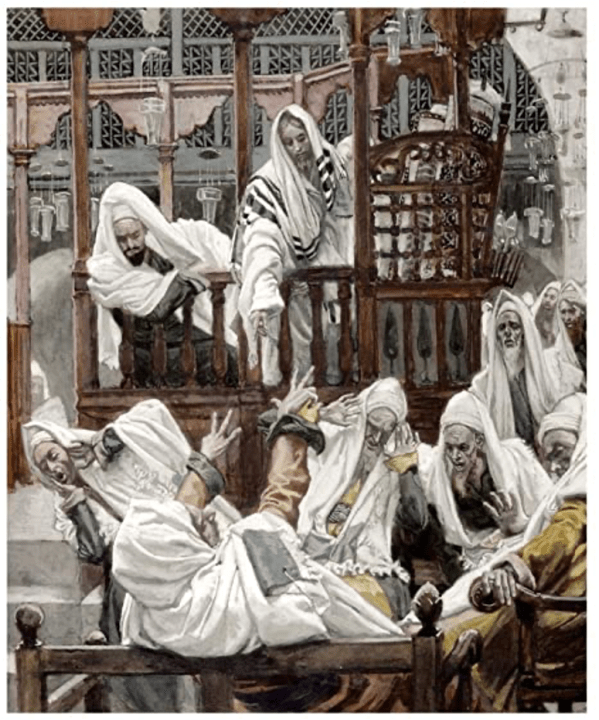
Image: Tissot- The woman with an infirmity of 18 years

Asked in an interview on the podcast Unholy Things on August 5, 2025, the Israeli historian Yuval Noah Harari was asked:  October the 7th, 2023, till now, where does that fit – is it a footnote or a chapter in the sweep of Jewish history?

Listen here

Harari responded: I think it’s one of the – could be one of the biggest turning points in Jewish history-  maybe the biggest since the fall of the temple in 70 CE  – since the Roman conquest. Because Judaism has survived it became the world champion in surviving catastrophes, but it never faced a catastrophe like we are dealing with right now which is a spiritual catastrophe for Judaism itself because what is happening right now in Israel could basically – I think destroy, void, 2000 years of Jewish thinking and culture and existence. That the worst case scenario that we are facing right now – what we are facing is the potential of an ethnic cleansing campaign in Gaza and the West Bank resulting in the expulsion of 2 million maybe more Palestinians; the establishment of greater Israel and the disintegration of Israeli democracy; the creation of a new Israel which is based on an ideology of Jewish supremacy and on the worship of what were completely anti-Jewish values for more than last two millennia; a country based on the worship of power and violence and which is militarily strong – it will survive – it will be militarily strong  – it will have alliances with various bullies around the world. It will also be economically viable, and this will be the spiritual disaster because this will be the new Judaism that all Jews in the world will have to deal with. It will not disappear again. Jews are very good dealing with catastrophes from the Roman conquest to the Holocaust but this will not be a military catastrophe. The state will actually be successful in military and economic terms and it will make the challenge much, much bigger. No Jew, say, in London or New York or anywhere else, we’ll be able to say this is not the real Judaism.

There is one episode in the iconic TV drama, The West Wing, that is forever etched in my memory. The background to this particular episode concerns the President being asked to pardon a man awaiting execution on death row. Attending Shabbat Service, Toby Ziegler, the White House Chief of Communications, is puzzled by the rabbi’s sermon, in which he states that vengeance is un-Jewish. Puzzled, Toby questions the rabbi about the Torah teaching – an eye for an eye. He reminds the rabbi that throughout Exodus, Leviticus, and Deuteronomy, the Torah prescribes the death penalty for a large number of offences, mostly religious in nature. The rabbi replies that maybe the Torah sanctioned death penalty represented the best teaching at that time, but that the later rabbis in the Talmud went to great lengths to confine the meaning of the Torah texts to forms of reparation that did not require death. Jewish thought moved on as it deepened, over time, the human understanding of God’s justice and mercy.

Jewish thought moved on as it deepened, over time, the human understanding of God’s justice and mercy.

In Luke 13, we eavesdrop on an encounter between Jesus and religious authority over the case of a woman Luke describes as seriously crippled. Actually, crippled is a rather smooth English rendering that does not do justice to the specificity of Luke’s use of the Greek synkypto, which means bent together– as in doubled over. The woman is more than crippled – she appears to be suffering from a form of spondylo-arthritis known as Marie-Strümpell Disease.

Imagine for a moment the experience of being doubled over. Imagine what happens to your breath as the doubling over of your spine constricts the movement of your lungs. Imagine having this condition for 18 years.

Noticing the woman, Jesus stops proceedings by placing his hand on her and saying, “You are released from your weakness.” She immediately straightens and gives glory to God. Cause for rejoicing all around, you may think? Not a bit of it. Jesus’s action has provoked fierce indignation as the leader of the synagogue accuses him of breaking the Sabbath.

Last week, I spoke about the role of non-violent resistance in Jesus’ ministry, and here Luke presents an instructive example of this in action. The encounter with the woman bent over is not a story of miraculous healing from infirmity – an action the synagogue leader suggests would be more appropriate for the other days of the week. However, Jesus does not say, “Woman, be healed from your infirmity“; he says, “Woman, you are set free from your ailment.” The question here is, what ails her? Or, more accurately, what is the source of her ailment? In other words, this is not a story of healing at all. Its a story about exorcism.

In the spirit of non-violent resistance, Jesus confronts the religious leadership with the central question: ought not this woman, a daughter of Abraham who Satan bound for 18 years, be set free from this bondage on the Sabbath Day?  Notice how Jesus reframes the context – reminding the synagogue leader of this woman’s status in the community as a daughter of Abraham. He also throws in the reference to satanic binding – implying a connection to the Sabbath Day. In other words, Jesus is signalling that his diagnosis of her condition is spiritual and not physiological.

This is a story of two encounters – with the woman and the religious authorities. In his reference to satanic binding, Jesus is exposing what’s really going on behind the smokescreen of religion. The symbolism here is of a woman doubled over under the weight of the religious-inspired collective moral judgment upon her.

The authority exercised by religion, in this story, has become a smokescreen to obscure the fear-driven hardening of the human heart?  For the ancients, and even for us today, fear of illness motivates moral judgment as an attempt to explain away our fear of what we either do not understand or are unable to control.

Why has Jesus identified the woman’s condition as satanic binding? The French philosopher, René Girard, states it neatly -Satan exists, [only] because we exist. By this, he means that evil is an anthropological – a human, cultural construction, not a cosmic rival to the victory of God.

In religious tradition and its institutions, evil is to be found in the hardening of the human heart, which privileges the protection of human power – a universal tendency to resist the continual reshaping by the demands of divine justice and mercy. If there is a judgment to be borne, then it’s that we are all found wanting when faced with the judgment of God’s justice and mercy.

Here, we come back to heart of the matter in Luke 13: 10-17 where we find in Jesus’ confrontation with the synagogue leadership a foretaste of both later New Testament and rabbinic traditions that came to understand that it is compassion and mercy not vengeance that lies at the heart of divine justice.

By his reference to Satan’s binding, Jesus is drawing attention to the spiritual effects of the weight imposed upon an individual when religion as the defense of human hard heartedness. In other words, he’s saying to the religious authorities, what can be more appropriate than on the Sabbath Day – to liberate this woman from the satanic bondage you’ve imposed upon her by your perversion of religion as a smokescreen for the hardness of your hearts?

Toby Zeigler’s rabbi reminded him that Jewish thought is continually evolving, deepening over time, the human understanding of God’s justice and mercy. Harari’s words are a fearful warning about the spiritual and moral consequences for Israel in departing from this 2000-year line of development- and by extension – his words are a warning to us of the immanent spiritual and moral dangers in this current American political landscape as religion becomes contaminated by political ambition and the perversion of nationalist aspiration.

The question we always need to ask is: how is religious tradition being used? Is it being used to imprison or to liberate? Is our Christianity a conduit for a deepening of our understanding of mercy at the heart of God’s justice, or is it a smokescreen obscuring the hardening of the human heart? When hearts harden, all kinds of violence and cruelty become justifiable.

The Cost of Resistance

You hypocrites! You know how to interpret the appearance of earth and sky, but why do you not know how to interpret the present time?

Thursday of this past week, August 14th, was the commemoration of Jonathan Myrick Daniels, an Episcopal seminarian at Harvard’s Episcopal Theological School who in 1965 became the Episcopal Church’s most prominent civil rights martyr.

Robert Tobin (son of parishioners Bob and Maureen Tobin) in Privilege and Prophecy provides a narrative of the Episcopal Church’s evolving identity and social activism during the period 1945-1979. Drawing extensively on archival materials and periodicals from multiple sources, he provides an intimate picture of how Episcopal leaders understood their role and responsibilities during a time of upheaval in American religious and social life.

Tobin places Jonathan Daniels, a New Englander born in Keene, New Hampshire, against a background of Northern white Christian hypocrisy in the civil rights era. He calls out the white liberal romantic identification with Southern black suffering as an avoidance of the violence of racial discrimination on their own doorsteps.

So much Northern white Christian advocacy for racial equality was conducted from the safety and protection of positions of white privilege. John Butler, a prominent Episcopal churchman of the time, noted that demonstrating publicly in the South had required less personal courage than confronting the genteel racism of his Princeton parishioners.

Tobin comments on the iconic Rhode Island theologian, William Stringfellow, who perceptively noted that while Northern white liberals didn’t despise or hate Negroes, they also didn’t know that paternalism and condescension were forms of alienation as much as enmity.

Jonathan Daniels – struggling with the paradoxes and ironies of his horror of racial oppression from his position of white privilege, like many other idealists of his ilk, joined the Selma Freedom Riders. But unlike many, he took to heart Stringfellow’s rebuke.  He not only marched but also felt compelled to remain afterward to register black voters, tutor children, and help integrate the local Episcopal church.

Driven by a powerful spiritual awakening experienced during the reading of the Magnificat at Evensong , he explained:

I could not stand by in benevolent dispassion any longer without compromising everything I know and love and value …. as the price that a Yankee Christian had better be prepared to pay if he goes to Alabama.

In mid-August 1965, Daniels was shot dead as he shielded a young black activist, Ruby Sales, from the deadly aim of Tom Coleman, an unpaid special deputy, subsequently acquitted on the grounds of self-defense by an all-white jury.

John Coburn then Dean of ETS later confessed:

It took a long time to realize that Jon was a martyr. He was just a typical, questioning, struggling student, trying to make sense out of the issues, conflicts, and injustices of our society.

Yet with time, Daniels has come to be revered as a martyr in the Episcopal Church. As a man who embraced nonviolent protest in the face of the evil of racism – and who accepted the ultimacy of nonresistance because he had come to the realization that his possible death was the price that a Yankee Christian had better be prepared to pay if he goes to Alabama.

Jesus’ powerful accusation

You hypocrites! You know how to interpret the appearance of earth and sky, but why do you not know how to interpret the present time?

comes at the end of a difficult passage – seemingly flying in the face of our preferred image of Jesus as the peacemaker.

Although within the overall context of his ministry, Jesus preaches a message of peace, he recognizes that peace never comes without cost. Peace is never peace at any price – it must always be peace as the harbinger of justice. It’s not peace but justice that lies at the heart of Jesus’ concern. Luke 12 dispels any doubt we might still harbor concerning the real impact of Jesus’ recognition that conflict, which may even spur some to violence, is an unavoidable birth pang of the kingdom’s coming.

Jesus lived in a context riven by political and religious-sectarian violence. The question he addresses is whether violence can achieve justice.

We, too, live in a world increasingly riven by politicized violence. Domestically, what is the appropriate Christian response when incendiary rhetoric incites politicized violence among those who wish to wave a Bible in one hand and a gun in the other?  Internationally, what is our humanitarian response in defense of nations and peoples subjected to colonialist violence – esp. when the disregard of a peoples’ right to exist trips over into genocide? While different options for action are open to us, all must proceed from an unwavering commitment to remaining clear-sighted in the face of the temptation to look away.

Whatever Jesus thought about violence, he was never one to look away. In his life and teaching, we detect a complex interleaving of two related strands of clear-sighted resistance – nonresistance and nonviolence as related and yet different forms of protest in response to systemic evil.

Nonresistance not only rejects acts of violence but also rejects confrontation when it has the potential to lead to violence. It’s essential that we grasp the point that nonresistance does not equate to nonaction. Nonresistance is the action of seeking solidarity with the victims by joining with them, even and especially when we ourselves become subjected to violence at the hands of the powerful. Practitioners on the path of nonresistance seek to change the world around them through sacrificial example.

By contrast, nonviolence seeks change through direct confrontation with the systems that maintain injustice and oppression through violence. The confrontation can be fierce, yet it stops short of resorting to violence to win the argument. When faced with the inevitability of violence, the path of nonviolence merges into the path of nonresistance.

In the larger frame, nonresistance and nonviolence are the two essential elements in Christian resistance. Jesus’ journey from life through death to new life is a demonstration of God taking the ultimate path of nonresistance. In his ministry, Jesus more often follows the path of nonviolence – calling out the systemic evils of injustice and oppression. But the new thing God does through Jesus is to bring about profound change through self-sacrifice on the path of nonresistance.

Returning to John Butler’s comment that confronting segregation in the deep South required less courage than confronting the smugly hidden racism of his Princeton parishioners alerts us to the dangers of hypocrisy when our Christian pretense to peace and love is but a fig leaf excusing us from facing up to the hidden and subtle forms of the violence that we claim to reject.

Do you think that I have come to bring peace to the earth? No, I tell you, but rather division!

We are living through another period when the level of division and conflict Jesus speaks about in Luke 12 permeates every level of our society. Although many of us are uncertain of how to respond to attacks upon the ethical values and principles that lie at the heart of our conception of democratic social and political order, the most important thing is to resist the temptation to look away – to avert our gaze from the appearances of the present time.

I could not stand by in benevolent dispassion any longer without compromising everything I know and love and value …. as the price that a Yankee Christian had better be prepared to pay if he goes to Alabama.

You hypocrites! You know how to interpret the appearance of earth and sky, but why do you not know how to interpret the present time?

Maybe it’s less costly to gaze upwards to interpret the patterns in the heavens than to look around and, with clear sight, confront the patterns of the present time?

“Money can’t buy me love”

On Thursday, The Public’s Radio – our local NPR station announced a one-day emergency pledge drive to make up for its loss of $1 million in funding because of President Trump’s actions to stifle public service journalism. This one-day appeal led me to double my monthly contribution, an instance of sheer defiance and an act of resistance against yet another act of petty tyranny.

Increasing my support for NPR is an acceptance of my responsibility to be a good steward of my resources in support of the common good. Today’s gospel alerts us to the centrality of good stewardship in the life of Christian discipleship! In our parish’s yearly cycle, it’s not quite time to talk about making an NPR-style pledge drive commitment– after all it’s only August and the dreaded month of the October stewardship campaign may seem some time away. But in my defense I quote one of Susan Allen’s oft-repeated phrases when she feels the compulsion to tell me something I don’t want to hear – I’m just saying.

The story of the wealthy farmer in Luke 12 is not a condemnation of wealth or those who possess it, although, like many of us feel today, Jesus keenly felt the injustice of the vast wealth disparities of his day.   More than almost any other topic, Jesus speaks about the relationship of wealth and money to the priorities of the human heart.

While there’s no precise number that everyone agrees on, biblical scholars generally estimate that Jesus talks about money in approximately 11 of his 39 parables (some say up to 16 depending on interpretation). About one in every seven verses in the Gospel of Luke references money or possessions. Overall, Jesus makes over 25 direct statements regarding wealth, money, material possessions, or roughly 20% of all his recorded teachings.

Jesus’ teaching on wealth and excess abundance was not a targeted criticism of the wealthy as such, but a critique of the corruption of values that often goes hand in hand with the possession of excess wealth and power. In Luke 18, just a few chapters on from the story we hear today, Jesus says that it’s easier for a camel to pass through the eye of a needle than for a rich man to enter the kingdom of heaven. Again, we shouldn’t misread his critique – aimed not at those wealthy but at the corruption of values and the hardening of the heart that distort the connections between wealth and responsibility.

Likewise, Luke 12 is a snapshot of Jesus’ teaching on the core responsibility of Christian discipleship. The subtext of the story of the wealthy farmer is a warning to be on guard against attitudes that lead us to view our abundance as ours alone and not as a resource to be shared in the strengthening and advancement of the common good. 

A now regrettably dwindling few Episcopalians may still remember one of the most evocative offertory sentences in the 1928 Book of Common Prayer, which quotes from Matthew 6:19-20.

Lay not up for yourselves treasure upon earth, where moth and rust doth corrupt, and where thieves break in and steal: but lay up for yourselves treasure in heaven, where neither moth nor rust doth corrupt, and where thieves do not break in and steal.

The sentence concludes with a direction to look at the things you treasure as the best guide to discovering the state of your heart. For where your treasure is there your heart will be also.

In contemporary America, our addiction to the accumulation of material possessions is a good indication of where to find our hearts. Our national addiction to excess abundance offers some staggering stats. SpareFoot’s 2024 industry almanac reports approximately 2.1 billion sq ft – equivalent to 75.3 sq miles of commercial self-storage facilities in operation nationwide. It’s expected that a further 56 million sq ft will be added in this year alone. One in three Americans use commercial self-storage at an average cost of $128 per 10×10 sq foot of space.  RI has 3.38 million sq ft of commercial self-storage space, which is equivalent to 3.2 sq ft per person. This falls far beneath the US average of 5.4 sq ft of commercial storage space per person.

Why is this the case? A simple answer lies in the corruption of the human heart, whereby we have come to identify ourselves with what we own. There’s also the reasoning that goes, well, I don’t have an immediate use for all of this stuff, but you never know what the future holds. Possessions easily become symbols of security, providing an illusion of protection against adversity.

The farmer comforts himself with the prospect of building even bigger barns in which to store even greater wealth, further consoling himself with the prospect of even more ample abundance to last many years. He tells himself he can afford to kick off his sandals, put his feet up, eat, drink, and be merry. The farmer is presented as a fool, not because he’s rich and getting richer. His foolishness lies in his assigning finite things infinite value. He believes that his prosperity will insulate him from fate and fortune, and thus, his need to increase the volume of his possessions. The farmer represents a common human dilemma in the face of the answer to the question, when is enough, enough – is – just a little bit more.

The literary form of the parable is characterized by being a story drawn from everyday experience with an unexpected sting in its conclusion. If Jesus were to reconstruct this parable for today’s context, who do you imagine he would cast as the principal protagonist – the main character in the story? I’ll leave you to fill in the blank.

The parable of the wealthy farmer plays on the paradox between earthly wealth and spiritual bankruptcy.  Despite this man’s confidence that he will be protected by his wealth, in the end, which, like all endings, will come suddenly and unexpectedly, his attitude exposes his spiritual bankruptcy. To paraphrase Jesus, the coinage for life in the kingdom of God cannot be paid for in cash, stocks, or property. Only the coinage of gratitude and generosity of heart, measured by the good we have done and the love we have shown is accepted here.

As his disciples, we are called to continue the prophetic work bequeathed to us by Jesus. We struggle to overcome the seduction of possessions, our addiction to accumulating stuff in the interest of amassing personal power and prestige, or to ward off our existential insecurity. We are easily tricked by the illusion that we become what we own.

In the face of corrupting messages of autonomous individuality, as Christians, we assert the solidarity of community and our responsibility to contribute to the strengthening of our everyday life – lived together.  

This takes us to the central conundrum posed by Jesus in this parable – the sting in the story’s tail, so to speak. Is our trust in material abundance sufficient to carry the weight of our longing for meaning and joy in life?

Lay not up for yourselves treasure on earth —- I think you know the rest of the line. Or in the words of Lennon and McCartney money can’t buy me love.

Conflictual Motivations

Today’s Gospel reading tells the story of Jesus’ visit to the house of Martha and Mary, as recounted by Luke. I have to say my first reaction to seeing this as the gospel for the day drew a weary yawn from me – oh no, not this old chestnut again. For me, the old chestnut is the well-worn trope -better to be a passive hearer of the word than an active doer. I didn’t have to dig too deeply to realize that my response was a self-justification. When I go a little deeper, I experience this story of Luke’s as a judgment of one of my prominent personality characteristics.

I’m a potterer. My new best friend, Chat GPT, defines potterer as: a person who occupies themselves by doing small tasks in a leisurely, casual, or aimless manner. They spend their time doing small activities around the home or garden without any urgency or particular purpose. Ouch!

When Al and I came to Providence, we bought a 200-year-old colonial house with many small rooms. Having spent the greater part of our lives together in flats or condos designed around integrated kitchen-living-dining spaces, living in a house with many small rooms did not really suit us. But the one gift of such a house for me was that there was always something that needed doing, fixing, changing. As many of you may know, 200-year-old houses provide a marvelous excuse to potter.

We’ve since returned to condo living. However, one drawback to the integrated kitchen-living-dining space is that my need to potter around becomes a major source of irritation to my spouse.

At 6 pm most evenings, Al and I stop and sit down together to watch the PBS NewsHour. 6 pm coincides with cocktail hour, which for me at the moment means a refreshing glass of chilled Fino Sherry. As I approach my advancing years, I find myself returning to the satisfaction of this most quintessentially English aperitif.

But if you think I’m painting a picture of two aging clerics quietly sitting down to watch the evening news, you would be wrong. I start out sitting, but because the TV is always visible in our integrated space, I soon start wandering back and forth between pottering in the kitchen and sitting still, driving Al to eventually say – For heaven’s sake, sit down – before in exasperation, asking – Is there any need for you to be in the kitchen? No need, I reply, just trying to be helpful.

The major problem with pottering is captured in T.S. Eliot’s words from the first part of his Choruses from the Rock

The endless cycle of idea and action, endless invention, endless experiment, brings knowledge of motion, but not of stillness; knowledge of speech, but not of silence; …Where is the Life we have lost in living?

I enjoy being busy with small activities that lack urgency and a particular purpose. In other words, I am continually in a state of distraction. Distraction from free-floating existential anxieties causes me to miss so much of what life has to offer – life lost in the living.

In the story of Jesus’ visit to the home of his friends Martha and Mary, we are being offered three key insights. Firstly, the story offers us a glimpse of the importance to Jesus of friendship. He was more than an itinerant holy man wandering to and fro, accompanied only by a band of followers obsessed by a mission. Jesus seems to have had room in his life for familial friendships. We can imagine that he returned to Martha and Mary’s home in Bethany whenever he was passing through the area, as further evidenced by John’s story of another visit made to Martha, Mary, and their brother Lazarus, in the tumultuous days before his final week in Jerusalem. How many times do we miss the moment offered to us in friendships because we are too distracted, preoccupied with other things?

Secondly, Luke introduces us to the difference between Martha and Mary’s welcome. While Martha is preoccupied with the duties of playing the host, Mary sits quietly at Jesus’ feet, receptive to his words.

Luke describes Martha as a woman distracted by many things. He very deliberately uses the word perispaō which carries a rich meaning of being pulled away, to be dragged around, to be overburdened or drawn in different directions. Martha is overburdened by her distraction, which diverts her attention away from what really matters in this moment. The issue isn’t Martha’s host responsibilities—it’s her attitude of busyness. Martha wants Jesus to feel welcomed as the family’s honored guest and longtime friend. But pay attention to what her approach to this is doing to her. Her joy at Jesus’s arrival is tainted with resentment about all she has to do – Lord do you not care that my sister has left me to do all the work?

The third insight in this story lies in remembering that Luke is the most woman-friendly of the New Testament writers. He uses his story of Jesus’ visit to Martha and Mary to make a countercultural point. In taking on the role of a disciple and sitting at the Lord’s feet, attentive to his words, Mary’s action would have shocked a first-century Jewish audience, where such a privilege was reserved only for men. By contrast, Martha seems resentfully resigned to fulfill the more conventional expectations of a good 1st-century Jewish hostess.

Luke’s story of Jesus’ visit to old friends is a theological story about the nature of discipleship. All disciples are good people, but not all good people are disciples is the theological message Luke wants to get across. He contrasts Christian discipleship with what I would call being a good person, doing what a good person does. Now we all agree that doing good is preferable to doing harm, but where does the source of our motivation to make a difference in the world come from? In other words, are we motivated by our need to project self-image? I’m kind, I’m generous, I’m concerned about others because this is who I am. Or are we motivated to do good because we are motivated by a sense of being part of something so much greater than ourselves –namely a participant in the mission Jesus began but now entrusts us to continue.

You may ask – am I not just splitting hairs? Why does the source of our motivation to do good matter, so long as our actions achieve a good result? Luke would answer, simply pay attention to the personal effect of the difference in Martha’s and Mary’s responses to Jesus. Discipleship begins not with doing for, but with attending to, Jesus. Jesus doesn’t say Martha’s work is wrong. He says she’s missing the one thing necessary.

Are we not all Martha? Distracted. Pressured. Measuring our value by what we can accomplish—even in ministry. But Jesus invites us to slow down and metaphorically sit at his feet. We are a community where the primary impulse is often to serve as a projection of our need to be effective. How quickly this compulsion can turn to, if not resentment, then to burnout when things don’t go the way we expect.

When the source of motivation is a desire for a successful outcome, the danger of disappointment lurks in the shadows. However, when the actions we take flow from a faith-filled vision of discipleship, we cannot feel daunted because we understand ourselves to be conduits through which the greater expectations of the kingdom are being realized, regardless of how things may appear to us. Not my will but thine, O Lord.

We must guard against our need to be do-gooders – if being of use, making a difference, is to be a fruit of discipleship and not just a projection of our own sense of self as a good person. Christian-inspired action flows out of our desire not to act but to listen and receive Jesus through stillness. Anglican Tradition – with its emphasis on the centrality of common worship offers frequent opportunities to encounter Jesus in the collective stillness of hearing his Word and being fed by his body and blood. This is the essential prerequisite, only after which can we go out with confidence to love and serve the Lord.

Luke uses this brief narrative to emphasize that listening to Jesus—receiving his teaching—is the heart of true discipleship. This story is less about contrasting personalities (active vs. contemplative) and more about what matters most in the life of a follower of Christ.

Questions to ask ourselves:

  • Do I value Jesus’ voice above my own productivity?
  • Have I confused good works with spiritual depth?
  • When was the last time I sat still and really listened?

Martha’s service isn’t wrong, but in that moment, it’s conflictual. She is trying to serve Jesus without first receiving from him. Her motivation is shaped by her conventional understanding of what’s required of her. Her impulse comes from both self and societal expectations, rather than from faith. Consequently, her good intentions leave her feeling burdened and resentful.

Mary wasn’t lazy—she was focused. She wasn’t passive—she was present, allowing herself to be shaped by her encounter with Jesus’ Word before embarking on the life of faith in action. How very countercultural.

Neighbor Problems

Image: Jorge Cocco

In his recent WAVES Festival address in San Diego – WAVES being an acronym for Well-being, Art, Vision, Entrepreneurship, and Science- David Brooks offered a commentary on current America, referring to the country having taken two recent hits. He described the Zelensky meeting in the Oval Office as a searing memory. What I saw that day was a group of people who occupied the Oval Office seeking power – just pure power – the power to bully. The Oval Office event reminded Brooks of George Orwell’s 1984, in which one of Orwell’s characters describes his lust for power being fulfilled not as a demand for obedience, but in the capacity to make other people suffer. It seems clear that Brooks’ number one hit on the nation concerns the Administration’s driving impulse – to achieve absolute power confirmed by its capacity to inflict suffering and embrace cruelty as a primary instrument of routine government.

In his address, Brooks suggests that American society moves through repetitive historical cycles – his point being that no matter how bad things currently seem, we’ve been here at least once before in the amazingly short 250-year history of the American experience. While identifying several socio-political elements in the repeating historical cycle, as his second hit on the nation he identifies the dramatic shift in the politics of immigration.

He notes that the idea of America is that we welcome all sorts of people here, and we celebrate diversity and pluralism. America is a crossroads nation where people come and bring their talents, and they have the opportunity to grow and contribute to the creation of a national sense of confidence. He noted that the current political climate is the result of a cataclysmic loss of [national] confidence and some sort of spiritual assault.

In Luke 10, the lawyer initiates a conversation with Jesus about the inheritance of eternal life. We detect a quality of self-serving in his approach. Fixing him with a shrewd and assessing gaze, Jesus flushes out the man’s real concerns. It’s not his capacity to love God that’s on the lawyer’s mind, but the thorny requirement to love his neighbor as himself. He blurts out – Who is my neighbor? As is his custom, Jesus does not try to explain. Instead, he tells him a story.

As I often remind us, the construction and telling of stories provides the only lens through which we can view and make some sense of our experience and place in the world. In his address to the WAVE Festival, Brooks is reminding us that we have always had competing stories through which to discover and articulate our experience as a nation. In any period, the rise and fall of particular stories color our view of ourselves as a nation. This is so clearly demonstrated in the cyclic pattern of our attitudes to the concept of neighbor. Is a neighbor someone like us or not like us, someone to be welcomed, if only out of a sense of self-interest, or feared? Each answer will determine national immigration policy.

Brooks identifies national confidence as a key ingredient of whether we embrace an inclusive or exclusive story of neighbor. He quotes John Bowlby the great British psychoanalyst and originator of attachment theory who wrote that all of life is a series of daring explorations from a secure base – all of life is a series of daring explorations from a secure base. Brooks argues that recent history has robbed Americans individually and collectively of a sense of living life from a secure base. Fear and insecurity have come to characterize the current state of national confidence. Since the financial collapse in 2008, ordinary Americans have experienced one blow after another to our confidence. Our insecurity, now both everyday as well as existential feeds a pathological suspicion of our neighbor. Like the lawyer confronting Jesus, we are currently experiencing a deep anxiety concerning personal and collective obligations towards our neighbor, the biblical stranger in our midst.

We find ourselves in periods when our national confidence allows us to welcome immigrants as an untapped resource contributing to our shared prosperity through high-value knowledge and skills or filling the multitude of jobs we no longer wish to or lack sufficient people to perform. There are other periods, such as the one we are currently slogging our weary way through, when, sapped by loss of personal and national confidence, we fall prey to the story casting immigrants as threats to our very way of life. From history, even our short 250-year national history, we can chart which of those competing stories has the power to liberate and which to imprison – to take us forward or cast us back. I suppose the light at the end of the tunnel is the knowledge that we have been here before, and we eventually come through periods of fear and insecurity to embrace a brighter story of ourselves.

Because we are somewhat biblically educated Episcopalians, we are aware of some of the historical cultural tensions and clashes of identity in Jesus’ parable of the Good Samaritan. For a start, we remember that Jews and Samaritans hated each other – a hatred rooted in the tragedy and pain of a shared history. Between Jew and Samaritan existed a hatred and fear of a ferocity equaled by the current Israeli Palestinian mutual fear and loathing.  Good Samaritan for Jesus’ hearers was a shocking and provocative oxymoron – a rhetorical figure of speech in which deeply incongruous and contradictory terms are combined. Such is Jesus’ way. 

At the heart of the lawyer’s conversation with Jesus lies his need to have Jesus limit his obligation to love his neighbor as himself. His need was rooted in his fear of too much being asked of him – in other words, he lacked the self-confidence to receive the commandment. Jesus recognizes this, and so at the end of his provocative story, he asks who in the story was the neighbor to the robbed and beaten man? Without thinking, the lawyer blurts out, the one who showed him mercy.

The obligation to show mercy suddenly jumps out of the parable and hits the lawyer fair and square in the face. Mercy emerges as the heart of what it means to love our neighbor as ourselves.

The concept of love is always ambiguous. We can quibble over the extent or limit of what it means to show love for our neighbor. But the command to show mercy allows for no such ambiguity. Perhaps this is why, in the current political climate, mercy has become the most provocative and incendiary of all the expectations of the kingdom.

From Final Chapter to Epilogue

Image: Andrei Rublev’s 15th-century icon of the Holy Trinity

Last week on Pentecost Sunday, I likened the Bible to what my granddaughter Claire, at an important stage in her learning to read, used to refer to as her chapter books. When children are learning to read, a critical stage is reached when they graduate from simple, single-storyline books to complex stories that unfold in stages, or chapters.  In the last two weeks, we have celebrated two significant chapters in the Christian biblical chapter book- namely the Ascension of Jesus and the descent of his Spirit – a two-way process which Tom Wright describes as the moment when the personal presence of Jesus with his disciples is translated into the personal power of Jesus in his disciples.

Pentecost is the final chapter in the Christian chapter book. But in all good chapter books, the final chapter is often capped off with an epilogue – a short addition or concluding section at the end of a literary work, usually dealing with the future of its characters.  Trinity Sunday is the Christian chapter book’s epilogue, hinting at a foretaste in volume two, so to speak, of the continuing Christian storyline with the action now centering on the life of the Church.

How do you recognize an Episcopal Church at first sight? Well, the red doors are usually a giveaway. But when you see Holy Trinity as the dedication of the church, you know this is an Episcopal Church. The Trinity is deeply revered in the Anglican tradition with by far, a greater number of Episcopal churches dedicated to the Holy Trinity than to any other single dedication. Why is this so? I think it must have something to do with the naturally speculative cast of the Anglican mind. Unlike more literalist traditions, we appreciate mysteries to puzzle over. We’re not interested in simple answers to complex questions. We appreciate mystery as something that hints at but never fully explains truth.

There is a spoof report of a supposed conversation between Jesus and his disciples. In answer to Jesus’ question Who am I? Peter, – yes, it’s always Peter who pipes up first – launches into: “Thou art the Logos, existing in the Father as His rationality and then, by an act of His will, being generated, in consideration of the various functions by which God is related to his creation, but only on the fact that Scripture speaks of a Father, and a Son, and a Holy Spirit, each member of the Trinity being coequal with every other member, and each acting inseparably with and interpenetrating every other member, with only an economic subordination within God, but causing no division which would make the substance no longer simple”. And Jesus answering, said, “What?”

Some people are, by temperament, Jesus-people. Others by temperament are God-people, while others, often many others, are Holy Spirit-people – no, I’m not looking at Linda+ when I say this. I have to say I appreciate the role both Jesus and God play in my spiritual imagination. I’m also good on the Holy Spirit as long as we don’t get too enthusiastic about her. But my temperament really hums in the contemplation of the Trinity. Why is this? Part of my answer would be to affirm the elegant simplicity of the Trinity as the fullest expression of God. And I want you all to know how simple and enticing the Trinity really is.

The distinctively Christian understanding of God, as Trinity, emerges from the Pentecost event, as an everyday experience long before it became a doctrine. This unthought experience of God as Trinity is captured in a venerable Celtic prayer:

Three folds of the cloth, yet only one napkin is there,                                                                                           Three joints in the finger, but still only one finger fair,                                                                                               Three leaves of the shamrock, yet no more than one shamrock to wear,
Frost, snowflakes and ice, all in water their origin share,
Three Persons in God: to one God alone we make our prayer.      

Like most experiences, it’s only when we turn our backs on the poetic and try to rationally capture the intuitive that things get complicated.

God as Trinity – that is, as divine community – arose out of the everyday experience of the first Christians. They knew of God, the creator, from their Jewish inheritance. Yet, this inheritance of faith had been augmented through a collective memory of Jesus as a human personification of God. Following the Ascension event, when they had so keenly felt the loss of a personal connection with Jesus, at Pentecost they became overpowered by– literally inflated with his Spirit as the personal presence of Jesus with them was translated into the personal power of Jesus in them. It’s only later, when Christianity takes root among the Greeks – ah those Greeks being of a more philosophical frame of mind, loved codified statements – like the one we repeat every Sunday in the Nicene Creed. It’s here that the Trinity begins to get complicated.   

While human beings have always cherished relationships, it’s only with the advent of a psychosocial understanding of relationship that we have grasped the importance of relationality as the engine of emotional development. Following on from our being created in the image of an unseen God, we can deduce that the dynamics at play in human relationships reflect something essential about God. If we are made for relationships in community then might this be true of God as well. The image of God as a solitary being falls away before the image of God as divine community.

I’m now coming closer to answering the earlier question of why I am at heart a Trinity-person.  In 2025, the celebration of the Holy Trinity coincides with both Father’s Day and the baptism of a child in the fourth generation of one of our church families. Both Father’s Day and baptism provide rich material for reflecting on the relational nature of God as divine community.

Fatherhood, often thought of as a male characteristic – the possession of individual men, is really a concept dependent on and expressive of relationship. All fathers are men, but not all men are fathers. Men become fathers only through the procreation or adoption of children. Relationally speaking, you cannot be a father without a child.

Traditionally, despite acknowledging that God is genderless, God the creator nevertheless has been referred to as Father, rendering Jesus his Son. Yes, these are now unfashionably gendered nouns. But its not the gendering, but the relationality of these nouns that captures the essence of the divine nature. Other nouns for God can be used so long as they speak of relationship – as in Lover, Beloved, and Love-sharerer. As with us, so it seems with God. Fatherhood is an identity created through a relationship. Likewise, baptism speaks the language of relationship.

Here, a contemporary psychological understanding of relationality is pertinent. Human beings come into existence through relationships. I’m not referring here to biology but to the development of self-consciousness as the core foundation for identity.

The psychology of Object Relation Theory, the psychoanalytic school in which I was trained as a therapist after my ordination to the priesthood, perceives the infant as object-seeking from birth. This means the infant is instinctively drawn to the mother, initially to her breast, but soon her face as well. Every mother of a newborn knows this unfolding experience. The infant and mother are held in the embrace of a mutual gaze. It’s the experience of coming to self-consciousness through the gaze of the mother that is as vital to infant flourishing as the physical sustenance the mother provides.

My point in all of this is to say that our sense of self is caught – a process of self-discovery through catching a glimpse of ourselves in the gaze of another. Self-consciousness and identity are the fruit of being in relationship. While the initial mutual gaze is between mother and infant, it eventually broadens to include the gaze between mother, father, and infant as the child develops a consciousness of the father’s presence.

I want to make a necessary disclaimer here. Although I’ve been speaking of the more usual context of female mother, with male father, I want to stress that mothering or motherhood, fathering or fatherhood are potentially gender fluid roles. However, this takes us into a more contested area and should be the subject of a separate sermon.

I’ve been suggesting that the Trinity is first an experience and only thereafter a concept of God as relational within divine community. This seems a somewhat modern development in reinterpreting traditional metaphors for God, yet, the early 15th-century Russian iconographer Andrei Rublev seems to have had a premonition of God as a divine community that uncannily echoes a contemporary, psychologically informed image of God.

His icon of the Holy Trinity depicts three angel-like figures seated around a table – an allegory of the visitation of the three angels to Abraham at the oaks of Mamre as recorded in Genesis 13. But it’s the facial expressions I want to draw your attention to. Although dressed differently, and presented essentially as men – although angels are actually genderless, they share the same face and gaze through the same eyes. Their mutual gaze of love is evocative of the gaze shared between mother and infant. It’s as if each is held in being through the exchange of mutual gaze with the other. The optical illusion is created so that while the members of the divine community sustain each other through a shared loving gaze, we are also drawn into the experience of that gaze. Before Rublev’s icon of the Holy Trinity – we experience something so familiar to us – an echo from our earliest unthought memory.

Today, on Trinity Sunday, little Evie Tulungen will become a Christian. This is a shorthand way of speaking. But exactly in what sense will Evie become a Christian? Most of us will imagine that Evie becomes a Christian through the flowing of water and the anointing of the Holy Spirit. Both are true. But what we may miss is an equally important point. It will be through her baptism that Evie becomes a part of the mutual gaze shared between participants in the Christian community. The Early Church Father, Tertullian is reputed to have said that one Christian is no Christian. What he meant was that being Christian, like fatherhood and motherhood, like sonship and daughterhood, is a relational experience. There are no individual Christians, only persons who through baptism are born into a shared life of relationship within a community called Christian. Though an imperfect reflection it may be, the community of the Church is none other than the reservoir for a love no longer exclusive to the Divine Community but now shared through the overflowing of the Spirit into the life of the world.

Pentecostal Reflections

Image, Veda Rosenbury’s Great East Window at Trinity Cathedral, Phoenix

I remember the amused joy of watching our granddaughter Claire learn to read. As a 3-year-old, she would mimic her parents reading in bed. Lying on their bed, she wanted to show us that she, too, could read a book. She would gabble away to herself in her 3-year-old language, clearly delighting in some gripping yarn, all the while completely oblivious to the fact that she was reading the book upside-down.

When Claire first started reading whole books, I would ask her what she was reading. I’m reading a chapter book, she would reply. I was struck by her response, which described the type of book she was reading rather than its content. By referring to her book as a chapter book, she got me thinking about the nature of a story. Chapters organize the development and progression of more complex stories. That was the point she had grasped; she was no longer reading books with a single, simple story but was now reading books where the story progressed in stages or chapters.

As I continually assert, narratives are the building blocks of meaning. We make sense of the world around us, including making sense of ourselves to ourselves as well as to others through the construction and endless telling of stories.

Constructing a story to make sense of her 3-year-old world was what Claire was doing when she lay on her parents’ bed mimicking their reading. It was irrelevant to her construction of a story that she was holding her book upside down. At 3-years of age, the problem for the rest of us was that only she could understand the story she was making.

The Bible is, in a sense, like one of Claire’s chapter books. It builds the story of God chapter by chapter. Many authors writing from different historical and cultural contexts over an extended timeline make the Bible a rich, complex, and often confusing read. Yet the overarching narrative it tells is the story of our experience of God’s presence within the flow of history.

For Christians, the story of Jesus forms the penultimate section of this long biblical story. The story of Jesus unfolds through the chapters chronicling his birth, life, and ministry, his death and resurrection, culminating in his ascension and the descent of the Holy Spirit, and the birth of the Church as the continuation of Jesus’ ministry in the world.

Continuing with my analogy of the Bible as a chapter book, Pentecost is the final chapter in the Jesus story. In the previous chapter of the story called the Ascension, Jesus, in the fullness of his humanity now perfected through suffering, death, and resurrection, passes through the membrane separating the parallel worlds of Our-Space and God-Space. As parallel dimensions, Our-Space and God-Space occupy the same location in time, although separated by a permeable membrane that allows energy to flow from one to the other. Last week, I used a different analogy: an interdimensional two-way conduit or superhighway to express the same idea of movement between dimensions.

At the Ascension, Jesus passes through the membrane from the dimension of Our-Space to that of God-Space. In doing so, he does not jettison his humanity like a worn-out suit of clothes to don a new divine suit on the other side. In the Ascension, it’s his very humanity now perfected through suffering, death, and resurrection that is embraced and incorporated into the nature of the divine self.

In the present chapter, called Pentecost, energy passes in the opposite direction, i.e., from God-Space to Our-Space. Having received Jesus’ full humanity into the divine nature, the divine spirit is now released back through the membrane, where in Our-Space it empowers us to continue the work begun by Jesus.

There are at least three different ways to talk about the Pentecost event. The first is Pentecost as a highly mystical pyrotechnic event – the 50th day after Easter -focusing on the pyrotechnics of the day: wind, fire, and an experience of instantaneous translation between the speakers of myriad languages as a proclamation of God’s vision of inclusion. The second is as I’ve been doing in this sermon up to now – a story of energy flows between related dimensions, both occupying the exact location in timespace –  a Sci-Fi influenced use of imagination alongside the medieval images of the triple-decker universe. The third is a focus on the human fruits of the day itself.

Tom Wright describes Pentecost as:

The moment when the personal presence of Jesus with the disciples is translated into the personal power of Jesus in the disciples.

In Acts, chapter 2, Luke tells the story of the fruits of Pentecost.

Awe came upon everyone, ….All who belonged were together and had all things in common; they would sell their possessions and goods and distribute the proceeds to all, as any had need. Day by day, as they spent much time together in the temple, they broke bread at home and ate their food with glad and generous hearts praising God and having the goodwill of all the people.

His description of the early Christian community is a description of what Our-Space infused with the energies of God-Space might look like – if we allowed it to. Equality and magnetic inclusion become the hallmarks of such a community where the phrase: from all according to ability -to all according to need – is lived out in real time. This produced among the first Christians the most magnetic community, which drew increasing numbers of people into a new way of being human within a new kind of community: one that invested itself in those who had yet to become members.

This image of Christian community frightens us – and so it should! For it stands as a perpetual indictment upon the values and practices that we live by in our own society and which in our present moment are being frighteningly exposed in the corruption of money, privilege, and power now openly celebrated in plain sight.

Luke’s story in Acts 2 raises a serious question for us. Could this vision of transformation and risky living, shaping the first Christian communities, ever become a story we can tell ourselves about our society?

As Episcopalians, we pride ourselves on espousing a tolerant, inclusive Christian vision for a society with greater inclusion and distribution of wealth, but not enough to truly disrupt our societal expectations. While heavy on tolerance and inclusion, we run light on accountability. We like faith as a comfort as long as we can remain undisturbed by its imperatives.

Some of us understand faith as personally life-changing. Some, though perhaps fewer in number, understand that there is a connection between personal transformation and the process of societal change. Nevertheless, most of us expect our faith to let us off lightly by making few demands on us. We do not wish to be made accountable to the imperatives of our faith.

The presence of God’s Spirit in the world of Our-Space demands of us transformation along the lines experienced by the first Christians. They experienced personal change as the catalyst for societal change. To reference Tom Wright again: Pentecost was the moment when the personal presence of Jesus with the disciples is translated into the personal power of Jesus in the disciples.

This Pentecost, the presence in us of the power of the Spirit of Jesus – AKA Holy Spirit – defines our mission. Should we choose to accept it:

  • We cannot engage in acts of charity towards the less fortunate individuals while failing to confront the systems that deprive them and whole communities of access to the fruits we expect as of right to enjoy.
  • We cannot reject calls for personal accountability in our communities. Leaving when we feel challenged or uncomfortable might be an option for members of a non-profit, but not for disciples of Christ.
  • The story we live by tells us we need to feel troubled if the fruits of our own material success blind us to the inequalities in wider society.
  • We need to stop expecting our faith to insulate us and allow it, instead, to disturb us.

Conclusion

In his poem God’s Grandeur, Gerard Manley Hopkins captures the message of Pentecost – a timeless message which is for us, oh so very timely.

The World is charged with the grandeur of God. 

It will flame out, like shining from shook foil; 

It gathers to a greatness, like the ooze of oil – crushed.

Why do men then now not reck his rod? 

Generations have trod, have trod, have trod; 

And all is seared with trade; bleared, smeared with toil and wears man’s smudge and shares man’s smell:

The soil is bare now, nor can foot feel, being shod.

And for all this, nature is never spent;

There lives the dearest freshness deep down things;

And though the last lights off the black West went -

Oh, morning, at the brown brink eastward, springs –

Because the Holy Ghost over the bent

World broods with warm breast and with ah! bright wings.

What Next?

Image from the Chapel of the Ascension at Walsingham, England.

Next door to the Shrine Church the Chapel of the Ascension, built in the dispiriting modern style of the 1960’s, the style that festooned the US with hideous A-Frame churches, nevertheless has one most astonishing feature. On entering the chapel one’s attention is immediately drawn to the ceiling where two feet dangle at the center of a rosette of gilded clouds punctuated by lightening forks representing the only remaining part of Jesus’ body still visible after one imagines him squeezing through the gilded rosette into heaven on the other side of the ceiling. Those of you participating via the livestream will be privileged to this truly baroque sight – all the more astonishing because of the chapel’s otherwise plain sheetrock walls and ceiling.

The Ascension, which today is treated as a rather non-event. Always occurring on the 40th Thursday after the Resurrection – to accommodate the reality that most Episcopalians rarely venture to church except on Sundays – the current custom is to celebrate the Ascension of the Lord on the Sunday following. It’s Luke who gives us the most vivid narration of the Ascension scene.

If constructing stories and weaving narratives are the ways we make sense of our experiences in the world, what is the nature of the relationship between story and material experience? In other words, do narratives – our human need for stories simply interpret and explain our material experience, or do narratives construct our material experience through the power of language to bring to awareness the objects and meanings of which it speaks.

This tension surrounding the function and power of language is especially pertinent when it comes to religious-spiritual stories. Narrative Theology asserts that spiritual meaning lies not in the literal veracity of the events depicted – did they happen or not – but in the function of story to construct and convey purposeful meaning and truth- and here it’s helpful to paraphrase the late biblical scholar, Marcus Borg who used to say that the Bible contained many true stories – and some of them actually, happened.

Does a story construct meaning and purpose that we can trust as a source of understanding of the divine which enriches and empowers us to live our best lives?

Spiritual stories recycle elements from human imaginative memory. Clearly, Luke’s graphic account of Jesus’ ascension borrows extensively from Elijah’s ascension in a chariot of fire buoyed upwards by heavenly steeds amidst billowing clouds that obscure heaven from earthly sight. In like manner – as the mantle of Elijah fell upon the shoulders of Elisha – giving him a double portion of his master’s spirit, the double portion of Jesus’ spirit falls upon his disciples -clothing them in preparation to take up the work Jesus had begun.

The resonance between the two ascension stories is unmistakable.  Now skeptics will say – ah-hah, so you admit that Luke copied an earlier story that is a feat of imagination to start with. Well yes, I’m happy to admit this, because both stories function not as eyewitness accounts of actual events but as ways of making sense of a meaning and truth capable of changing lives and altering the trajectory of history. By the way – even eyewitness accounts of actual events are never photographic but interpretations – colored by the contents of individual memory. The problem in crime solving is that no two people will recall the same event in the same way.

In Luke’s chronology of events from Calvary to Pentecost, his story of the Ascension of Jesus forms a transition point bringing the earthly ministry of Jesus to a close to prepare his followers for what was to come next. The question underlying the Ascension event is not how, when, or if it happened, but what light does it shed on the question of what next?

Can we trust the meaning inherent in the story of the Ascension of Jesus, even though most of us accept it to be, as all stories are, a construction of imagination? By focusing the stories meaning on the question what next – this becomes a story sharply focusing the choices to be made, the actions to be taken, and the directions to be followed that transform our perceptions of the world and our role in living our best lives by furthering the work Jesus began.

By substituting the traditional heaven and earth spatial metaphor of up and down for one more suited to contemporary imagination – that of heaven and earth as side by side – the Ascension becomes a story of a conduit event linking our space and divine space.

The two essential points in the Ascension story now come into focus.

In his return to the divine space, Jesus does not jettison his humanity like a suit of worn-out clothes – but carries the fullness of his humanity – perfected through suffering, death, and resurrection – to be received by God – incorporating the essence of humanity into the divine nature. The first collect for the Ascension captures this: that as we believe your only begotten Son our Lord Jesus Christ to have ascended into heaven, so we may also in heart and mind there ascend, and with him continually dwell. The we here is not us individually, but the essence of our humanity which now constitutes an element within the divine nature.

In receiving the gift of Jesus humanity perfected through suffering, death, and resurrection the gift of the divine spirit of Jesus is released to make the return journey back into our space – or as the second collect for the Ascension captures it:  our Savior Jesus Christ ascended far above all heavens that he might fill all things and to abide in his church until the end of time.

As Jesus ascends, we become  Christ’s mystical body on earth  – now prepared and empowered as the Church for the continuance of the work Jesus began.

The Ascended Christ bearing our perfected humanity is received into the heart of God so that henceforth, in the imagery of the book of Revelation, the home of God is to be found not above in the clouds but here on the earth among mortals. Now we come to the most extraordinary assertion of Christian faith – that from henceforth to be most fully human is to be most like God.

As the disciples gawk stupefied after the Lord’s disappearing feet, they are told to stop looking upwards. In other words, there is nothing to be found up there. Instead, we need to look around us for signs of God’s continued presence in our world through the power of the Holy Spirit.

Building Heaven on Earth

I am struck by the fugue-like nature of the themes in the readings for the fifth Sunday after Easter. The Encyclopedia Britannica defines a fugue as a musical composition characterized by systematically imitating a main theme, called the subject, across multiple voices or parts. It typically includes an exposition where the subject is introduced, followed by development sections that explore variations and interactions of the theme.

Working with the fugue metaphor, we hear the central melody in Luke’s account of Peter’s dream—a rich melody introducing a new vision for human community based on radical inclusion. The central theme is further developed in the second reading from the book of Revelation, where it is expanded into the cosmic key of God’s announcement that heaven is to be found on earth. The gospel reading then restates the central melody in the tone of Jesus’ teaching on love as action.

Staying with the musical metaphor, there is a brilliant summation of the melodic interplay I’ve just described in Belinda Carlisle’s legendary 1987 hit single Heaven on Earth:

Ooo, baby, do you know what that’s worth? Heaven is a place on Earth.
They say in heaven, love comes first. We’ll make heaven a place on earth. Ooo, heaven is a place on earth. 
Lyrics by Rick Nowells and Ellen Shipley

In Surprised by Hope, N.T. (Tom) Wright describes Jesus’ resurrection as the beginning of God’s new project—not to snatch people away from earth into heaven but to colonize earth with the life of heaven. It’s somewhat amusing to find the great Tom Wright channeling Belinda Carlisle.

Christians today, in the main, think that resurrection means spiritual life after death, as in we all will go to heaven to live with God when we die. While liberal Christians have a straightforward inclusive notion of who gets into heaven, basically everyone, conservative Christians still cling to the idea that entry to heaven is conditional on right believing and ritual formulas such as Jesus died for my sins – Jesus as my savior, etc. But both agree on the point of Jesus’ resurrection as a promise of life after death – an announcement of future life with God somewhere else after biological death.

The notion that we leave our bodies behind to ascend as souls to some other place is a deeply anti-Christian idea firmly rooted in Classical Greek thought. The NT does not talk of the separation of body and soul; it speaks of the integration of body and spirit as dual aspects of human experience in the material dimension of time, space, and matter. Belinda croons, “Ooo, baby, do you know what that’s worth?” Heaven is a place on Earth. They say in heaven love comes first. We’ll make heaven a place on earth. Ooo, heaven is a place on earth.

Christians need to understand Jesus’ resurrection, not as an individual event, something that happened only to him, but as the first fruits, the inauguration of a project of changing the world, redirecting our attention away from pie in the sky when we die back to the current state of life on earth.

The concept of our souls’ future fulfilment requiring the jettisoning of our bodies invites us to care more about the life to come than the life to be lived now. Christians who are most focused on their destination in heaven are likely to neglect the duty to leave the world in a better state than the one they came into.

Resurrection as an internal, individualized, spiritual experience of future fulfilment breaks the continuity linking the resurrection of Jesus to the ultimate resurrection of the whole of creation.

Through the Hebrew prophets, God continually affirmed the goal of the resurrection project, as nothing short of the remaking of heaven on earth. It’s only within the continuity of this promise for the whole creation that the resurrection of Jesus on Easter Day makes any sense.

Revelation’s melodic expansion – See! the home of God is among mortals … see I am making all things new – is a further development of Luke’s central theme of radical inclusion before the gospel’s final restatement in Jesus’ teaching on love as the engine for transformation.

Tom Wright speaks of Jesus’ resurrection as a foretaste of the future brought into real time, God’s promise of the kind of future we should anticipate in the present. Anticipating the future—now, there’s a challenge. Because the shape of the future does not arrive preformed of its own accord. Our anticipation today shapes the kind of future that will arrive through the actions we take or fail to take now.

The radical vision of an inclusive community is where the home of God is to be found. The struggle within human communities to translate love into justice is where the power of remaking a new heaven on earth can be seen. As Christians, we do not look forward to a future heaven for the righting of all wrongs and the wiping away of every tear. We grasp the challenges of working towards these goals today by

  • loving as we are loved
  • behaving towards others as we expect to be treated
  • agitating for human dignity as a foundational right for everyone, and not something to be dictated or denied by the exercise of power.

The radical vision of the home of God at the heart of the human community is centered on the cherishing and protection of human dignity. In Dignitas Infinita, the late Pope Francis laid out the four aspects of human dignity.

  1. Ontological dignity – the dignity of being made in the image of God, loved and cherished by God as a reflection of the divine nature.
  2. Moral dignity – the exercise of freedom and fidelity to the dictate of conscience – not only a requirement for right action but also for right motivation and intention
  3. Social dignity—the means to prosper in a society that affords the social, economic, and environmental protections necessary for sustainable living with dignity.
  4. Existential dignity involves combating serious illnesses, domestic violence, gender and racial scapegoating, pathological addictions and their social causes, and other hardships that debase a person’s ontological dignity. Existential dignity also affects those who may enjoy the material prosperity considered essential for a dignified life, yet struggle to live with hope and the experience of joy in their hearts.

What God has made clean, who are we to call profane? Who are we to reject and exclude those whom God has included through the Holy Spirit’s outpouring? For see the home of God is to be found not in heaven but here among us, where through loving action we support God’s reign of justice. When love is realized through action, justice becomes its name.

Or as Belinda Carlisle croons: Ooo, baby, do you know what that’s worth? Ooo, heaven is a place on earth. They say in heaven, love comes first. We’ll make heaven a place on earth, Ooo, heaven is a place on earth..

Blog at WordPress.com.

Up ↑